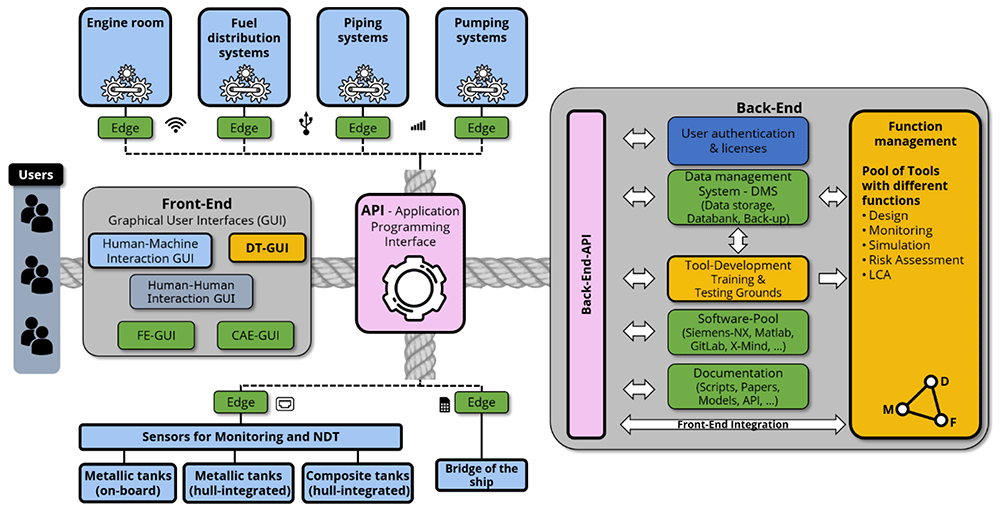
The hard system for DT of NH3 fuelling system
Overview
Based on the DNV standard13, a hard system schematic for DT is shown in Figure 2. A detailed discussion of each item is presented in the following sections.
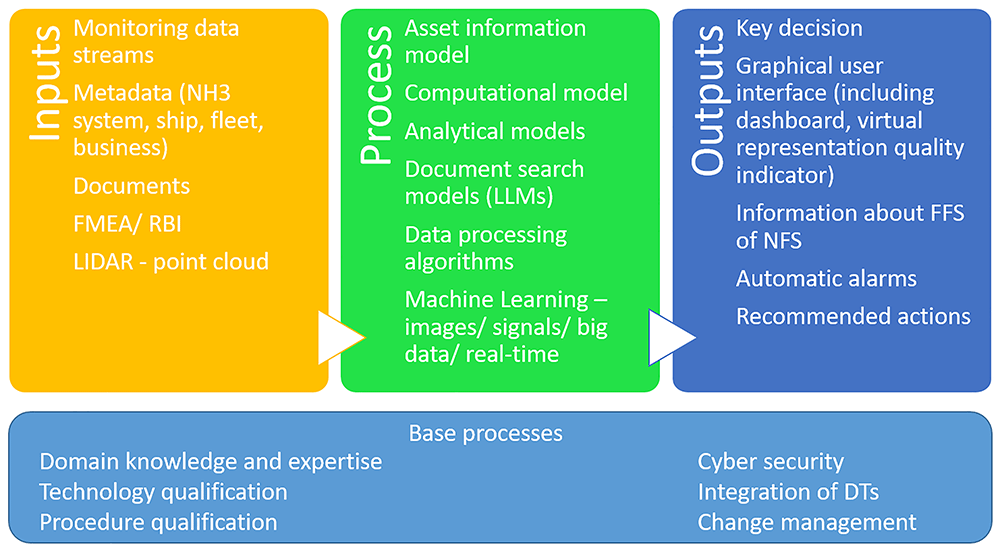
Figure 2. Hard systems model of the digital twin13.
Inputs
Monitoring data streams
The key to the function of the DT in terms of monitoring data streams is the selection of SHM sensors.
As previously mentioned, sensors that measure strain and vibration are commonly used to monitor ship structures globally. Locally, the NH3 fuelling system, which is more susceptible to corrosion damage and is subjected to internal pressure, can use permanently fixed ultrasonic sensors to measure wall loss and acoustic emission sensors to detect crack initiation or growth.
In addition, process monitoring sensors are required for the fuelling system’s Supervisory Control and Data Acquisition (SCADA) to transmit data regarding the temperature, pressure, and flow rate in piping and tanks. There are pumps in the NH3 fuelling system that can be monitored using vibration sensors to detect misalignments or imbalances that might result in leaks or mechanical failures. Similarly, vibration sensors can track piping vibrations caused by turbulence, blockages, or weak joints as well as monitor valve vibrations to ensure smooth opening and closing. Finally, to consider the influence of the external environment, sensors that can measure ambient temperature, wind speed, wave height, etc. should be included.
By analyzing these data from the sensors, the system's fuel delivery can be optimized, potential disruptions to ammonia flow can be prevented, and the risk of ammonia leakage can be minimized.
Metadata
Metadata provide a crucial context to the monitoring data, without which results from the analysis of sensor data may not have any meaning. The Metadata describe the characteristics, settings, and conditions under which the sensors operate and enable better integration within the DT systems. Some key information should be sensor identification (ID/Name, type, manufacture, model number, etc.), functionality (measured parameter, unit, accuracy, and resolution), location, calibration (calibration standard, last calibration date, next calibration due, etc.), and operational context (operational environment, ship speed and direction, loading intervals, communication protocol, etc.).
Documentation
Documentation plays a critical role as an input for the effective implementation of DT in an NH3 fuelling system. These include system design specifications that provide a detailed architecture of the fuelling system, including pump layouts, pipeline diagrams, and control systems. Technical datasheets are essential, as they offer information on the capacities, operational ranges, and materials of critical components (pumps, valves, sensors, and storage tanks). Safety and compliance documents, such as risk assessments, can provide an in-depth analysis of potential hazards within the NH3 fuelling system and highlight the role of DT in risk mitigation and ensuring regulatory compliance. Operations and maintenance documents are equally important, encompassing step-by-step operating procedures for the safe and efficient functioning of the system along with maintenance manuals that outline both routine and corrective maintenance practices for various components. Additionally, these documents include inspection reports, maintenance logs, and event histories such as accidents or repairs. Together, these documents form the foundation for ensuring the proper design, operation, safety, and maintenance of the NH3 fuelling system while supporting the functionality and accuracy of the DT.
Failure mode and effect analysis
A Failure Mode and Effects Analysis (FMEA) identified wall thinning, embrittlement, and cracks as potential failure modes in the NH3 fuelling system, specifically in storage tanks, straight piping sections, and connections.
Wall thinning, caused by material degradation or erosion from high-velocity ammonia flow, can weaken structural integrity, leading to leaks or failure. Another failure mode is embrittlement, which is triggered by exposure to low temperatures, chemical interactions, or stress, and can reduce material ductility, making metallic components prone to sudden fractures. In terms of cracks, whether initiated by manufacturing defects, fatigue, thermal cycling, or mechanical stress is also a critical failure mode. Cracks in storage tanks as well as in straight piping sections and connections can propagate over time, leading to leaks, loss of containment, or even ruptures.
A risk-based inspection (RBI) assessment was performed for metallic storage tanks following API RP 58014. This identified external corrosion under insulation, coating breakdown, and NH3 embrittlement as the primary damage mechanisms.
Point cloud models of the structure
3D maps of a structure created using Light Detection and Ranging (LIDAR) are now being used to create a virtual copy15. Virtual reality images can be tagged with information, such as inspection reports and photographic images, thus providing a direct context for inspections. An inspector can stand in front of the structure and visually compare it with how it appears in a photograph viewed on a tablet computer linked to the virtual copy. On large structures, such as bridges, inspections are performed with drones, which use ML to detect anomalies caused by corrosion and fatigue. For pipework, LIDAR-created 3D images also help overcome the frequent problem of pipework CAD drawings (or PIDs) not matching, because of modifications during fabrication.
Process
Asset information model
The Asset Information Model (AIM) is a critical component in the creation and operation of a DT for an NH3 fuelling system. It serves as a centralized repository that compiles all data and information necessary to support asset management and optimize the performance of the fuelling system. AIM can provide both graphical and non-graphical data as well as essential documentation and metadata, ensuring a holistic digital representation of the physical system. For an NH3 fuelling system, AIM can feature detailed point-cloud models that visually map components such as piping, pumps, valves, and storage tanks. It should also incorporate the original design specifications that outline the system architecture and operational parameters. Beyond the design data, AIM integrates records of repair work, such as valve replacements or pipe repairs, as well as historical operational performance data captured from SCADA systems.
Computational model
A computational model is a mathematical framework used to simulate and analyze the behavior of complex systems. By leveraging extensive computational resources, these models solve intricate equations that provide a deeper understanding of the system dynamics, interactions, and potential failure modes through computer simulations. For an NH3 fuelling DT system, the Finite Element Analysis (FEA) models will be used as the computational model to simulate the structural integrity and performance of critical components, such as piping, storage tanks, pumps, and valves. Incorporating FEA results with real-time data from SCADA systems and other sensors can offer valuable insights into how these critical components behave under various conditions. These insights will provide a dynamic representation of the health of the system, enabling engineers to predict potential issues and proactively address them.
Analytical models
Analytical models rely on mathematical calculations to evaluate the behavior and performance of systems and determine whether a system is fit for service. In an NH3 fuelling system, Engineering Critical Assessment (ECA) is an essential analytical method to ensure the integrity of the NH3 piping system. The ECA process includes identifying and assessing potential flaws, such as cracks, corrosion, or material defects, that could compromise the integrity of the system. By applying the principles of fracture mechanics, ECA calculates whether such defects are acceptable within the context of the material properties of the system (e.g., fracture toughness and tensile strength), operational pressure, temperature variations, and the expected lifecycle of the system.
Document search models
Large-language models (LLMs) are gaining significant attention because of their transformative capabilities in generative AI, enabling tasks such as text generation, summarization, translation, and answering complex questions. LLMs can be leveraged to interrogate library documents within the DT framework, thereby providing efficient access to critical information. This means that, instead of manually searching through extensive documentation or datasets, users can query the LLM in natural language to extract relevant insights, such as operational procedures, maintenance schedules, or technical specifications.
Data processing algorithms
These could be subsystems of the DT, incorporated with ‘Edge computers’ for specific ‘smart sensors. ’ Examples include:
Vibration analysis algorithms investigate the patterns in vibration signals to detect modal changes that are indicative of failures in machinery and structures.
Image analysis algorithms that extract meaningful information from images, for example the presence of surface corrosion.
Machine learning – images/signals/big data, real-time
The sensors in the NH3 fuelling system produce extensive data over prolonged periods. To derive valuable insights from these data for computational and analytical models, the application of ML is critical. ML employs advanced statistical algorithms to detect trends, patterns, and correlations within the data, helping identify damage mechanisms in the NH3 system. Integrating ML into DT requires a robust and well-planned work program, encompassing data pre-processing, model training, and validation. Specialized expertise in computational science and data analytics is necessary to effectively implement and optimize these algorithms.
Technology gap analysis
Based on the above information, from an SHM point of view, efforts have been made to identify possible technology gaps that can be foreseen in developing a DT for the fuelling system and corresponding actions. The outcomes are summarized in Table 1. Note the importance of finding commercially available off-the-shelf (COTS) solutions.
Table 1. Possible technology gaps analysis in developing a DT for the NH3 fuelling system and the corresponding actions.
| Technology | Description | Current function | Required function | Action |
|---|
Smart SHM
sensors | Sensor systems with
software included within
local ‘Edge computers’ | Sensor data processed
separately, then analyzed
and interpreted manually | Sensor data processed
analyzed and interpreted locally
on edge computers | Feasibility study,
including search for
COTS components,
technology qualification |
| Data fusion | Combining data from
different sources, for
example AE sensor data
with load sensor data | Data analyzed separately | combined | Selection of data to
combine. Feasibility
study |
Embedded
SHM sensors | Fiber optic sensor
embedded in composite
storage tanks | Optical Bragg gratings
used to measure strain,
temperature, pressure and
detect transients such as
acoustic emissions | Optic fibers | Feasibility study,
including search for
COTS components,
technology qualification |
Machine
Learning | Learn from SHM sensor
data, including past data
to identify patterns and
make predictions. | Use of LLMs to interrogate
databases of documents
in DT | Automatic interpretation of
sensor data to give information
about structural integrity of
NH3 fuelling system | Feasibility study,
selection of data,
big data analytics,
statistical analysis. |
Outputs
Key decisions
Each DT should be linked directly to a key decision-making process to ensure its effectiveness and relevance. The recommended practice for qualifying DTs outlined in DNVGL-RP-A2013 suggests that key decisions, referred to as Functional Elements (FEs), should be organized into a hierarchical structure. In this hierarchy, lower-level FEs contribute to and support the achievement of broader, higher-level FEs. This structure enables a clear and logical flow of information, ensuring that the outputs of a DT directly influence the critical decision-making processes. For an NH3 fuelling system, the FEs addressed by the DT can include various critical tasks, such as the identification, location, and sizing of damage in components such as piping, valves, and storage tanks. These elements can be fed into higher-level decisions, such as predicting system failures, determining life extension strategies, assessing fitness-for-service, and planning maintenance or repair schedules.
Graphical user interface, automatic alarm and recommended actions
A Graphical User Interface (GUI) serves as the point of interaction between humans and computers. This interface can be accessed via desktop computers and tablets depending on the user's preferences and needs. The dashboard in the GUI presents various types of visual data in a simplified, easy-to-understand format. To ensure the quality of the data, the dashboard should include a quality indicator that assesses the reliability of the displayed information. A common approach is a 'traffic light' system, where:
Green indicates that the information is of sufficient quality for key decision-making.
Yellow warns that the data may be of insufficient quality and requires caution when used for decisions.
Red indicates that the information is of poor quality and should not be used for critical decisions.
In addition, the system should be designed to prioritize automatic alarms that promptly notify users of critical issues, enabling swift responses to potential risks. Furthermore, the system should highlight recommended actions to address these issues based on the output of key decision-making processes, ensuring that the most effective solutions are clearly communicated and can be swiftly implemented.
Base processes
Domain knowledge and expertise
Building an effective DT for an NH3 system requires expertise spanning multiple areas, including, but not limited to, chemical engineering, structural design, mechanical engineering, structural integrity management, control systems, data science, safety and risk management, ML, Non-Destructive Testing (NDT), simulation, and modelling. Collaboration across these domains is essential to ensure that DT accurately represents the system’s physical and operational characteristics and provides reliable data for decision-making. It should be noted that the wide range of relevant knowledge mentioned can be covered by project partners, but there is a lack of expertise in the operation of the NH3 system.
Technology qualification
To gain trustworthiness, all technologies used by DT must be qualified. This process provides evidence that a technology will function within specified operational limits with an acceptable level of confidence. The methodologies that can be used are outlined in DNV A20316. This uses an iterative approach, as shown in Figure 3, where the technology is broken down into components that can be categorized on a scale ranging from COTS to novel, and the level of qualification set accordingly. Technology Reference Levels (TRLs) are useful marker17. The risk of each component not performing as required was assessed, and a work plan was developed to provide evidence that mitigates this risk. The qualification process can be staged using an iterative approach, with each cycle concluded at a different milestone. This milestone could be based on the Technology Reference Level (TRL).
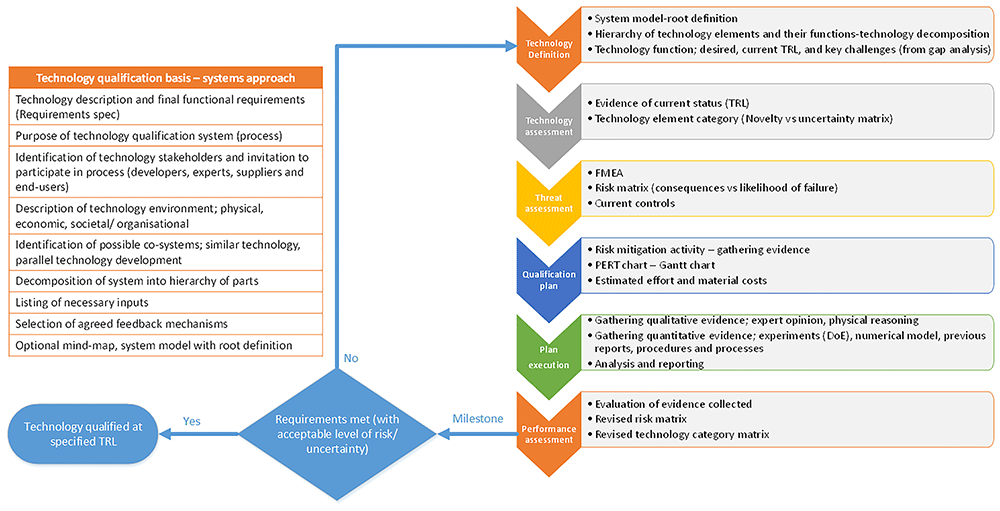
Figure 3. Systems approach to Technology Qualification.
Procedure qualification
Procedure qualification is the process of providing evidence of the SHM and NDT capabilities. It can include the results of capability evaluation exercises, feedback from site experiences, applicable and validated theoretical models, and physical reasoning. It should include trials on deliberately defective test pieces and mockups. A suitable methodology is provided by European Network for Inspection and Qualification (ENIQ)18. The methodology identifies the essential influencing parameters. An example of the influencing parameters in an Acoustic Emission (AE) monitoring system is shown in Figure 4.
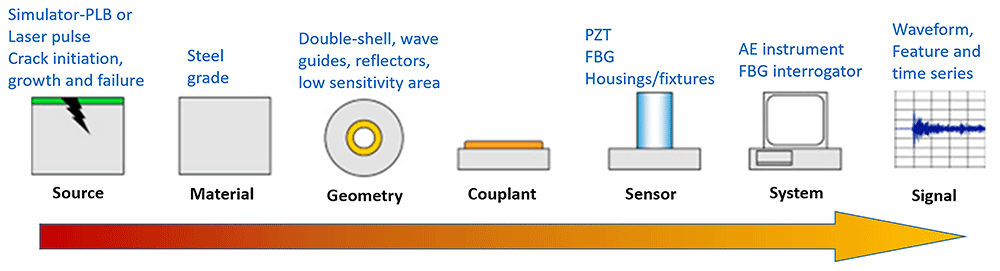
Figure 4. Essential influencing parameters in Acoustic Emission monitoring.
Cyber security
Cyber security and protection of DT from malicious attacks is essential. Cloud-based systems are especially vulnerable and may rule out their use entirely. Therefore, significant human factors must be addressed.
Interfaces
Interfaces between different elements of the DT and co-systems are key issues that need to be addressed. For example, data from different sensor systems and their associated metadata (sensor location, characteristics, etc.) are normally processed, interpreted, and stored using proprietary software. Sharing data from different systems is difficult, which is an issue that requires further research.
Open-source file formats, such as Hierarchical Data Format version 5 (HDF5), have been developed to support large, complex, and heterogeneous data. HDF5 uses a "file directory-like structure that allows data to be organized within the file in many different ways, as you might do with files on your computer. The HDF5 format also allows for the embedding of metadata, making it self-describing.
Change management
The introduction of DTs can cause major changes in an organization's goals, processes, and technologies. The purpose of change management is to implement strategies for effecting and controlling change and helping people adapt to it.