Introduction

Non communicable diseases (NCDs) were responsible for more than half of all premature deaths worldwide in 20161. Most NCDs share predisposing risk factors (e.g. unhealthy diet and insufficient physical activity) which can cluster and interact exponentially2. Recent research has demonstrated that 44% of children and adolescents (aged 11–17) have at least four lifestyle risk factors2 and 81% of 11–17 year olds do not meet the recommendation of 60 minutes of moderate-to-vigorous physical activity per day3. Some researchers link this development to the ‘displacement hypothesis’, which holds that increasing screen time (in particular smartphone use) is occupying time-slots previously used for physical activity (i.e. play or sports) among adolescents4. This is concerning given that insufficient physical activity alone is responsible for a significant percentage of the burden of disease of NCDs such as coronary heart disease (6%) and type 2 diabetes (10%)5. Furthermore, physical activity can have benefits for mental health, quality of life and wellbeing4.

In their umbrella review, van Sluijs et al highlighted the limitations of existing interventions to improve adolescent health, where interventions in school settings have been mostly unsuccessful in promoting physical activity, with minimal significant effects5. E- and mHealth interventions (i.e. health apps) present an interesting possibility for improvement in health promotion both because of their extensive reach and their potential to promote physical activity, as shown in preliminary studies6,7. Qualitative studies have shown that both children and adolescents have positive attitudes towards e-and-mHealth interventions as a result of the familiarity of app structures (i.e. navigating the functions of an app) and the convenience of accessing the intervention in their own time7–9. Primary advantages identified by researchers include a greater accessibility and reach, and the possibility of gamification and personalization of interventions7,9. Nonetheless, only one third of adolescents have ever used a health app, because of (by their own estimation) unfamiliarity with existing apps and the feeling that these apps have been designed for adults and are therefore less relevant for them9. Participatory design approaches provide a promising solution in this area, as they have been shown to develop solutions that better align with user needs and interests10. The increasing popularity of participatory approaches as well as participatory research (including co-design, co-creation, co-production, participatory action research (PAR)) to address global health challenges is the result of a combination of rights-based rationales (i.e. children’s right to have a say in policies and interventions that affect them) and the demonstrated benefits of these methods for intervention uptake11. Funders increasingly require participatory approaches contributing to their application in large multi-country consortia, which lack guidance on how to structure and support these challenging methodologies at such a large scale12. Additional complexity is introduced by the task of applying approaches tailored to specific groups of participants such as children and adolescents, which can be challenging at the best of times13.

This study aims to detail the steps involved in the development of a flexible co-design protocol for the SmartCHANGE project - a multi-country consortium working to develop e-health applications to promote healthy lifestyle behaviors among children and adolescents. Within the SmartCHANGE project, three applications will be developed: one for parents and children (aged 6–10), one for adolescents (aged 11–14) and one for healthcare practitioners (HCPs), backed by a trustworthy AI-driven decision-support tool. This will be done through engagement of HCPs, families with younger children and adolescents in four different EU countries: Portugal, The Netherlands, Finland and Slovenia. Below, we explain our approach to develop a flexible co-design protocol that addresses the following three challenges:

CHALLENGE 1: Co-design across disciplines

Given the need in the design of e-Health lifestyle applications to work with experts in an array of disciplines (e.g. human movement sciences, behavioral psychology, design, ethics, law etc.), being explicit and detailed in the research approach and its underlying theoretical and methodological assumptions is essential. Across various disciplines, different research methods exist for engaging stakeholders/end-users/citizens in research resulting in significant debate on the definitions of key-concepts as well as their underlying theoretical and ethical foundations11,14,15. The integration of knowledge in inter- and transdisciplinary research has been the subject of numerous studies, where differences in underlying epistemologies and ontologies, as well as terminology and common practices, present a significant barrier to collaboration12,16. For instance in an interdisciplinary consortium research project in the Amazon, researchers from different disciplines had to overcome deeply ingrained biases with regards to each other’s research and the validity thereof, as well as the resulting fragmentation in the overall project16. Furthermore, differences in underlying ontologies and epistemologies can create challenges with regards to differing views on how phenomena can be studied (i.e. is reality an observable fact or socially constructed?) and the value placed on experiential knowledge (a equal source of knowledge or primarily a source of feedback?) have significant implications for the basic questions of who is listened to and in what way11,14.

CHALLENGE 2: Co-design across many types of users

Research has demonstrated that the needs of children and adolescents are distinct, and that the perspectives of parents, while essential, are not a viable proxy for the needs of children and adolescents11. As such, design of a sustained e-health application by definition involves co-design with children, adolescents, parents and healthcare practitioners. This presents a key challenge in that the distinct needs of each group necessitate the development of four unique trajectories, where co-design with a single stakeholder group is already considered a time-intensive and complex process13. Co-design with various groups therefore also requires input on the distinct needs of each group as well as of the ability to adjust participatory research methodologies to particular groups11,17.

CHALLENGE 3: Co-design across countries

The final challenge relates to the trend towards large-scale multi-country research consortia in research targeting societal challenges12. Cross-cultural collaboration is challenging at the best of times, where research collaboration can be hampered not only by varying institutional contexts (e.g., guidelines, standards, expectations and obligations) but also varying sociological features (i.e. hierarchical structure) and approaches to research (i.e. norms, values and approaches)18. In the current study, the challenge is further intensified by the fact that co-design is a locally situated process, grounded in the daily life and work of a specific place and time11,17,19. Therefore, co-design should be flexible and context responsive in a way that presents challenges for the collection of sufficiently comparable data to inform the design of a single e-health application per stakeholder group.
Methods

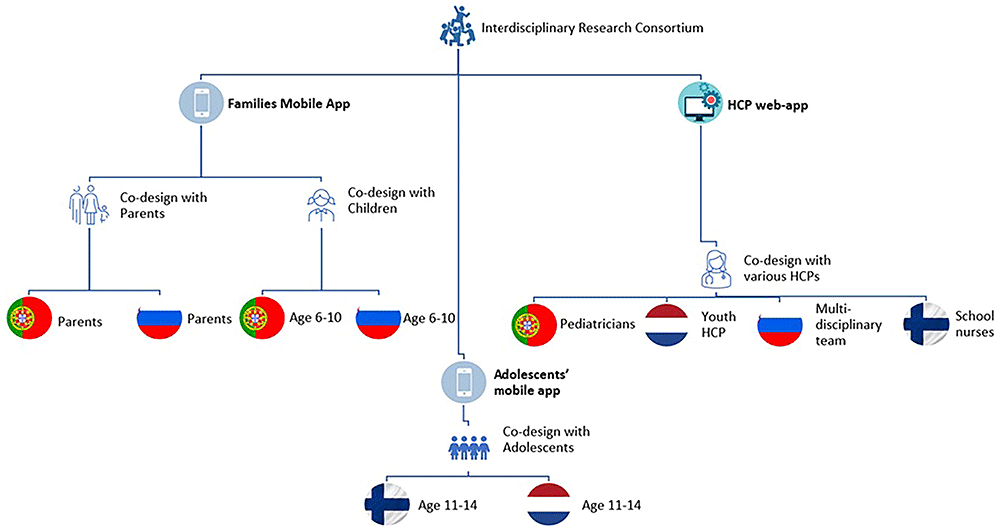
SmartCHANGE is a Horizon-Europe Research and Innovation project, which involves the development of three applications that make use of trustworthy AI, for four pilot sites on the basis of co-design with four different stakeholder groups (see Figure 1). A mobile app targeting families will be developed through co-design with children aged 6–10 yrs and their parents in Slovenia and Portugal, while a mobile app for adolescents is co-designed with ages 11–14 yrs in Finland and the Netherlands. Additionally, a web-app for healthcare practitioners will be co-designed together with representatives from all four sites, tailored to different healthcare practitioners (e.g. pediatricians in Portugal and school nurses in Finland). The development of the protocol for this co-design involved three steps: (1) assessing needs and expectations of researchers and designers; (2) determining the co-design approach; and (3) developing the practical protocol for co-design sessions. see Figure 1). For the development of the protocol, researchers the University of Ljubljana, University of Porto, JAMK university of applied sciences and Amsterdam University Medical Centers, as well as designers from Engineering and ConnectedCare were involved.

03ee6ba9-4aa2-47ec-bb0a-53326893f1d7_figure1.gif

Figure 1. Overview of participants in the process of co-designing thee SmartCHANGE solutions in four European countries (Abbreviations: App, application; HCP, health care practitioners)

Step 1: Needs and expectations of researchers and designers

Through informal interviews and a short questionnaire among primary researchers involved in the co-design at each study site, we aimed to 1) get a better understanding of the local health and school systems; 2) explore expectations of the co-design process; and 3) identify individual research goals and needs. The interview questions focused on partner’s expectations of the co-design process, what they wanted to learn through the co-design and what contextual factors on site might influence the process. The short questionnaire focused on mapping the school and health systems as well as exploring any relevant policies, and understanding the lives of children and adolescents (e.g. degree of autonomy, important actors in their lives). Findings from both methods were grouped into four themes (expectations, research aims, co-design context and facilitation needs) and summarized to inform the protocol creation. The interview guide and questions can be found in Appendix A of the Extended Data20.

Step 2: Determining the co-design approach

To define and structure our approach, we conducted an informal review to identify practical frameworks for participatory research used in design and public-health research. We searched for relevant publications in PubMed through combinations of terms related to participatory method (participatory research, co-design, co-creation, PAR), stakeholder group (children, adolescents, families) and framework (model, protocol). The leading researcher (CD) conducted the search and identified commonly used frameworks in co-design with children and adolescents. Based on the research aims identified in step 1, CD opted to expand the search to co-design with communities and searched on google scholar as well as in grey literature (such as reports and articles by designers applying co-design in a non-research context). The identified frameworks were discussed within the research team (CD, TA and MC) to make a final selection.

Step 3: Developing the practical protocol for implementing co-design

Based on the results of the interviews and questionnaires in step 1 and the framework developed in step 2 we developed a practical protocol for applying co-design with adolescents, families or HCPs in four countries. Initial feedback was provided by the Amsterdam research team (MC, TA), after which the second draft was sent to all participating primary researchers and designers. Based on their feedback, the final version of the practical protocol was accomplished.

Results

Needs and expectations

Involved researchers mentioned differing expectations with regards to co-design (i.e. the amount of time that would be invested, the degree of integration between groups) as well as their aims or desired outcomes (i.e., exploration of needs and context vs. consultation on form and appearance). Differences also emerged with regards to the contexts with, for example, different timing of school holidays and different relevant HCPs to be recruited. Furthermore, researchers expressed a desire for support and clarity with regards to the activities planned for co-design given a lack of experience with such methods. This led to the conclusion that the final protocol would need to be detailed enough to provide support while also being sufficiently flexible to be adapted to the different contexts.

Co-design approach

Through the informal literature search, a total of 7 frameworks for structuring participatory research were identified within design and public health research fields (See Appendix B in the Extended Data), with frameworks from design research having a more practical focus and those from public health a more theoretical focus. The conclusion was reached within the Amsterdam research team that no existing framework fitted the needs of the study. As such, a framework was developed by combining relevant elements of frameworks in the literature. Initial versions were discussed within the team and refined into a final product.

Three existing frameworks were considered relevant for informing the SmartCHANGE co-design framework: Sanders’ and Stappers’ co-design framework21, the double-diamond framework of design22, and the Kaupapa Maori co-design framework23. Sanders’ and Stappers’ co-design emerges from design scholarship and divides the process in three phases: pre and post design, generative and evaluative21. This framework focuses on providing structure for moments of engagement with end-users, where the actual design of the product takes place behind the scenes; the pre-and-post design phase focuses on understanding the context and preparing participating end-users for co-design; the generative phase involves brainstorming ideas; and the evaluative phase focuses on the effect and effectiveness of the final product21. The double-diamond framework provides deeper insights into the design process itself, with regards to the way in which design moves through phases of diverging and converging of scope22. The first diamond is ’discover and define‘: beginning with an intended research question, the research then expands to consider the whole context of end-users, including factors that might otherwise be judged irrelevant; the research then converges towards the identification of a problem statement which cancan be addressed in the ‘develop and deliver’ diamond, which entails a similar process of diverging to consider new ideas and converging towards a final solution22. The Kaupapa Maori co-design framework visualizes the more relational aspects of co-design that emerges in the field of participatory research within public health23. It takes an iterative approach to relationship building throughout the process and visualizes various steps and phases as gears, suggesting that they all continue to move together rather than in a linear flow from one step to the next. See Appendix B of the extended data for further information about these frameworks.

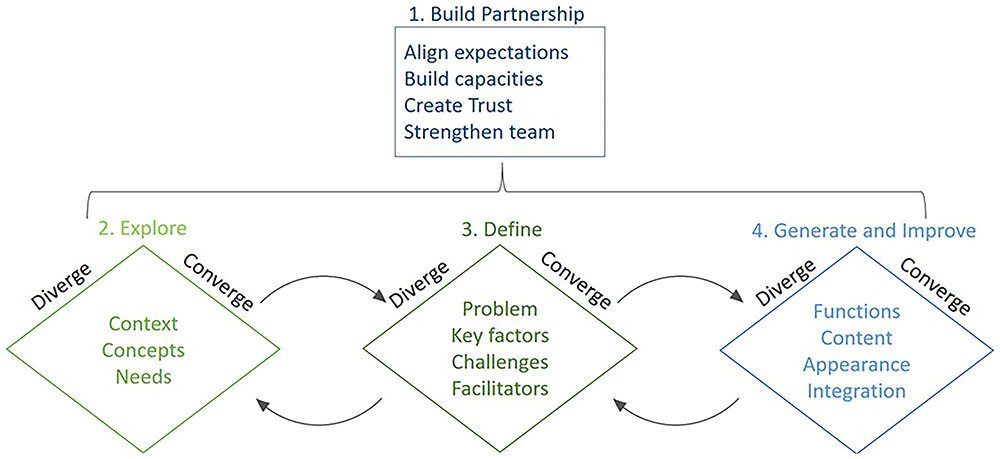
Figure 2 presents the SmartCHANGE co-design framework which includes an overarching phase of partnership building, an ‘explore’ phase, a ‘define’ phase and a ‘generate and improve’ phase. It attempts to incorporate each of the strengths outlined above by treating co-design as a non-linear process that nonetheless has distinct steps, within which the scope shifts continually to accommodate the need to bring in the full picture as well as the ultimate target of developing a limited set of solutions. Building partnerships (phase 1) is an overarching phase focused on the ongoing process of building research partnerships with stakeholders (adolescents, families and HCPs) by setting mutual expectations for the process, building the necessary capacities to enable co-design, building trust and strengthening the team. The explore phase (phase 2), focuses on understanding the context and needs of stakeholders, as well as their understanding of relevant concepts. The define phase (phase 3) focusses on creating a shared understanding of the underlying problem, including key factors contributing to the problem and challenges and facilitators in addressing the problem. The generate and improve phase (phase 4) focusses on co-designing a solution for the problem identified in phase 3, by collectively shaping the functions, content and appearance of the application (and refining each of these) as well as the pathway through which it is intended to be integrated within participants’ communities. More details on the specific aims of each phase can be found in Appendix B of the extended data.

03ee6ba9-4aa2-47ec-bb0a-53326893f1d7_figure2.gif

Figure 2. The SmartCHANGE Co-design Framework.

Practical protocol

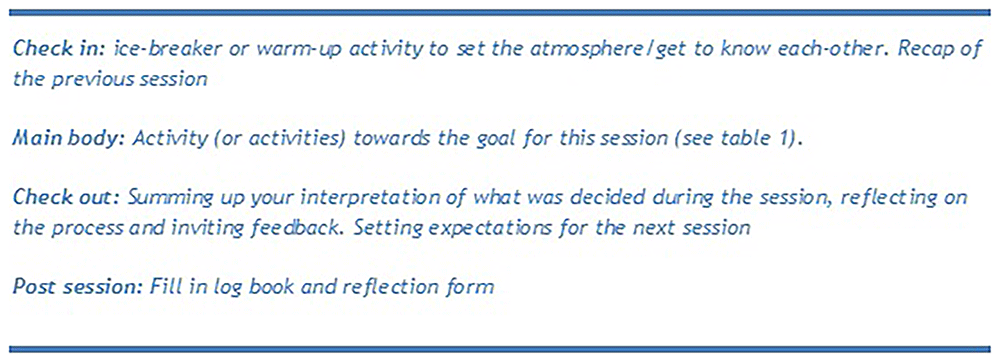
In response to involved researchers’ desire for clarity and the need for flexibility to enable context responsiveness, the practical protocol involves the breaking down of the phases of the framework into smaller, actionable goals informed by the needs of designers (see Table 1). Each of the resulting goals is then linked to a set of suggested activities for each stakeholder group, where it was decided to work with each group separately based on assumptions of the primary researchers regarding availability and needs. We further specify the overarching structure for the co-design sessions (see Figure 3), and provide detailed descriptions of potential approaches to sessions with each of the stakeholder groups (see examples in Appendix D)20. These descriptions are intentionally open-ended rather than going into detail, to avoid becoming overly prescriptive and therewith restricting flexibility. Each session description also includes information regarding the expected outputs for designers in relation to deadlines for deliverables; these are also summarized in a specific timeline that links suggested session numbers for each group to these deadlines (see Table 2) Furthermore, the specific session descriptions are prefaced with a description on how to use the protocol, which highlights that they should be treated as inspirational rather than prescriptive. In addition to the protocol itself, we developed a training program, logbook forms and reflection forms to support researchers at each study site in carrying out participatory research and logging their findings (see Appendix C)20.

Table 1. Goals and stakeholder-specific suggested activities across the four co-design phases, separate for HCPs, families and adolescents.

HCPFamiliesAdolescents
PhaseGoal No.Goal descriptionSession no.Suggested ActivitySession no.Suggested Activity (children activity)Session no.Suggested Activity
Partnership1Build a mutual learning environment (trust and empowerment)1Set team agreements1Set team agreements, Health Brainstorm (create a personal container)1Set team agreements (and ongoing)
Partnership2Explore and align expectations regarding the research process1Presentation and discussion of SmartCHANGE project1Presentation and discussion of SmartCHANGE project1Presentation and discussion of SmartCCHANGE project
Partnership3Identify ways of motivating ongoing participation1Discussion after project presentation1Discussion after project presentation1Discussion after project presentation
Partnership4Identify existing skills/knowledge levels relating to key concepts (i.e., research/AI/risk prediction 'sensitive data'' )3, 5Presentation and discussion of SmartCHANGE project, Presentation and discussion on AI3,7Presentation and discussion of SmartCHANGE project2, 3, 4, 5Collage exercise, various workshops
Partnership5Build capacity to enable stakeholder participation5Presentation and discussion on AI7Presentation and discussion on AIvariousVarious workshops
Explore6Understand the current actions, routines and daily context around the health behavior of families and adolescents. Note- focused on actions rather than intentions1Reflection on consultations exercise1, 2Health brainstorm exercise (Collage exercise), Timeline exercise (interview with an alien)2, 3, 4, 5Timeline exercise, conducting peer-research
Explore7Understand how participants themselves interpret key terms such as 'health', 'risk' etc.1Brainstorm exercise (at-risk-child), Picture association exercise1, 3Health brainstorm exercise (Collage exercise)1,2 ,3 ,4, 5Graffiti wall activity
Explore8Explore how health-related decisions regarding children and adolescents are currently made and who has a say (+ to what extent) Note: focused on intentions rather than actions2, 3Reflection on consultations exercise, Brainstorm pain-points, Hypothetical case vignettes exercise, Factor diagram exercise2Circles of influence exercise (co-create cartoon)2 ,3, 4, 5Timeline exercise, neighborhood mapping exercise, conduct peer-research
Explore9Identify support needs and what ideal circumstances to enable healthy behavior would look like according to participants2Brainstorm pain-points, Hypothetical case vignettes4Ideal Neighborhood activity6, 7, 8Ideal world exercise, conduct peer-research
Explore10Identify the underlying determinants that influence health decision making and health behavior2Brainstorm pain-points, Hypothetical case vignettes exercise, Jam Board exercise4Mind map activity (photovoice activity)6, 7, 8Ideal world exercise, conduct peer-research
Explore11Explore what motivates families and adolescents to change their behavior (and the specific role of future health risk as a motivator)2Reflection on consultations exercise, Jam board activity3Jam-board activity about previous support and brainstorm on digital sources (Brainstorm and sorting activity)6, 7, 8Motivation mind-mapping activity, conduct peer research
Explore12Identify perceptions of existing applications and tools to understand preferences (explanations, app interfaces, place in routine)3Gaps in support exercise3Jam-board activity about previous support and brainstorm on digital sources (Brainstorm and sorting activity)2, 3, 4, 5Workshops, Health App Research project
Explore13Explore stakeholder perceptions of risk prediction models and AI to establish a baseline for building trust and co-creating Explainable AI3,5Gaps in support exercise , presentation and discussion on AI3,7Jam-board activity about previous support and brainstorm on digital sources and presentation and discussion on AI6, 7, 8Presentation and discussion about AI and Health App research project
Define14Build a working definition of 'the problem' regarding health behavior among families and adolescents4Problem definition exercise5Creative problem framing exercise (Draw and write activity)9, 10, 11, 12, 13Analyze peer research, visualize data, create presentations and activity about problems statements.
Define15Understand which determinants of health behavior (both actionable and structural) are seen as significant by stakeholders (and which are most important)4Create simplified problem tree6Create simplified problem tree9, 10, 11, 12, 13Analyze peer research, visualize data, create presentations and activity about problems statements.
Define16Consolidate key gaps and challenges for which support is desired that fall within the scope of the app.6Bus-stop brainstorm activity, Serious Lego exercise6,8Bus-stop brainstorm activity, Serious Lego exercise (Cartoon together)14, 15, 16, 17, 18, 19, 21Various design-jam activities, workshops, design cycle project
Generate/Improve17Generating ideas for specific functions that address the gaps and needs generated previously6Serious Lego exercise, Thumbnail prototyping8Serious Lego Exercise, thumbnail prototyping (Crazy eights activity)14, 15, 16, 17, 18, 19, 21Various design-jam activities, workshops, design cycle project
Generate/Improve18Determine the type of explanations and visualizations desired by stakeholders5, 7, 8Presentation and discussion on AI, Feedback dicsussion7,8,10,11Deconstructing an app activity, Presentation and discussion on AI14, 15, 16 ,17, 18, 19, 21Various design-jam activities, workshops, design cycle project
Generate/Improve19Prioritizing what ideas/aspects of ideas are the most important to stakeholders7Buy a Feature activity, Concept Poster creation9,10Buy a feature activity , concept poster creation (health invention activity)14, 15, 16, 17, 18, 19, 21Various design-jam activities, workshops, design cycle project
Generate/Improve20Determine which visual elements/stylistic choices matter to stakeholders and what sorts of preferences they have regarding these7,8Buy a Feature activity , Concept Poster creation9,10Concept poster creation (health invention activity)14, 15, 16, 17, 18, 19, 21Various design-jam activities, workshops, design cycle project
Generate/Improve21Establish how an app could be integrated into existing routines and what would be needed for it to be implemented smoothly8Brainstorm activity11Implementation brainstorm activity14, 15, 16, 17, 18, 19, 21Various design-jam activities, workshops, design cycle project
Generate/Improve22Generate feedback on the initial designs in order to identify the priorities and preferences of stakeholders (functions, visuals, explanations)8, 9Feedback discussion, Think-aloud activity, Rose thorn bud activity11, 12Feedback discussion, Think-aloud activity, Rose thorn bud activity14, 15, 16, 17, 18, 19, 21Various design-jam activities, workshops, design cycle project
Generate/Improve23Spot gaps/issues or areas for potential improvement within full designs.9Think-aloud activity, rose thorn bud activity12Think-aloud activity, rose thorn bud activity22, 23, 24Think-aloud activity, rose thorn bud activity

Abbreviations: HCP (healthcare practitioners) AI (artificial intelligence)

03ee6ba9-4aa2-47ec-bb0a-53326893f1d7_figure3.gif

Figure 3. Structure for SmartCHANGE co-design sessions.

Table 2. Timeline of co-design sessions across the four co-design phases, separate for HCPs, families and adolescents.

20242025
JanuaryFebruaryMarchAprilMayJuneJulyAugustSeptemberOctoberNovemberDecemberJanuary
HCPsPartnership buildingSession 1Session 5
ExploreSession 2Session 3
DefineSession 4
Generate/ImproveSession 6Session 7Session 8Session 9
FamiliesPartnership buildingSession 1Session 7
ExploreSessions 2–4
DefineSessions 5–6
Generate/ImproveSessions 8–10Session 11Session 12
AdolescentsPartnership buildingSession 1
ExploreSessions 2–8
DefineSessions 9–13
Generate/mproveSessions 14–21Session 22Session 23
DesignCreating personas or Mapping pain pointsDefining gap & first brainstormSecond brainstormFirst iteration clickable prototypeRevision clickable prototypeSubmit Prototype for DeliverableFormal feedback prototypeTesting full prototype

Abbreviations: HCP (healthcare practitioners)

Discussion

This co-design protocol specifically aims to address the challenges in interdisciplinary, multi-country multi-stakeholder participatory research. To enable meaningful co-design across various disciplines, with multiple end-user groups in multiple countries, we engaged with researchers at all study sites to develop a practical protocol that is both structured enough to meet their needs and flexible enough to address the diverse contexts. The creation of this practical protocol helped us to align expectations within the interdisciplinary, multi-country consortium with regards to co-design both as a process (i.e. through agreeing on actionable goals based on both research aims and design outputs) and as a concept (i.e. hybrid definition as embodied by the framework).

Though this protocol was created for the SmartCHANGE project in particular, it may provide relevant insights for other projects aiming to co-design solutions for multiple end-users in multiple countries. With funders increasingly requiring participatory components, participatory research in large multi-country consortia is on the rise12,24. This raises the risk of participation being implemented ‘quick and dirty’ and becoming tokenistic in order to check the box and meet the requirement with consequences for the research participants, the quality of the research and the perception of participatory methods within research communities. Furthermore, the push to justify public spending on science has altered the research landscape, where the shift to problem-oriented research and measuring success by societal impact has led to proposal and reporting practices that put researchers in the difficult position of balancing very specific outputs with the flexibility required to apply participatory methods12,24,25. This may also exacerbate existing challenges in multi-country consortium research, where different working cultures, resources, infrastructures and local (health/school) systems affect both researchers and research participants’ ability to meet the demands of participatory projects24,25. For example, deadlines determined by actors in one setting based on the working hours and norms of that country may prove a source of friction both within the research team (i.e. being expected to work later than is conventional), and with regards to expectations on participants (i.e. hours or duration of participatory sessions).

Other researchers have shared approaches to tackle the challenge of multi-country participatory research26 including research with multiple stakeholders27. For instance the YoPA project outlines an overarching research approach to engage adolescents and other key stakeholders (e.g. policymakers) in teen-centred co-creation in multiple countries in Europe and Africa27. It addresses similar challenges regarding flexibility, multiple local contexts and unified research aims by combining a flexible and adaptive participatory action research approach with a rigorous practical protocol and evaluation framework27. Similar to our project, it sets out the goal of developing a practical protocol together with facilitators from all four study sites to guide the process of participatory action research with mixed-methods and comparative approaches27. Another protocol that addresses these challenges is that of Okop et al.26 which outlines the co-design of a cardiovascular disease prevention intervention in four countries in Africa. Rather than working independently at each study site using one overarching protocol as presented in this paper Okop et al. take the approach of training adult citizen-scientists from local communities who engage in peer research, and analyzing the findings collectively at one study site26.

The strengths of this study center on the combination of existing frameworks with context specific input, where researchers and designers from multiple countries gave input for the formulation of research aims, outputs and timelines representing their needs and expectations. Additionally, the discussing of definitions, approaches to data collection and the development of the training program create a solid basis for the collaboration between different researchers. Potential limitations may arise with regards to the flexibility of the protocol leading to significant differences in outcomes such as the generated app ideas which affect the aim of designing one app per stakeholder group to be applied in all countries. We hope to address this limitation through continued monitoring and reflection with researchers from all study sites using the prepared logbooks and reflection forms, as well as feedback on the collected findings throughout the process. Furthermore, the strict deadlines for design deliverables make for a short timeline for the co-design which may affect the quality of the process and responsiveness of researchers to their participants. We intend to address this through weekly intervision meetings with all researchers and designers where we can collectively reflect and decide on the direction our research is going. Finally, the decision to design an AI-supported risk-prediction app prior to engaging with the end-users is a limitation because this means the final solution may not align with their needs and preferences entirely. We hope to address this through transparency and clear expectation management during the co-design.

This protocol presents an approach to the practical planning of an interdisciplinary, cross-country, multi-stakeholder co-design project. By sharing our challenges and mitigation approaches we hope to support future research applying participatory methods or participatory research with multiple populations in multiple countries.

Ethics statements

Ethical approval for the SmartCHANGE co-design was obtained by researchers in each country. In the Netherlands approval was obtained from the non-WMO Committee of the Medical Ethics Review Committee of Amsterdam University Medical Centers (20230852).

Extended data

Extended data can be found in Zenodo: https://doi.org/10.5281/zenodo.15877719

Appendix A: Interview and questionnaire questions

Appendix B: Frameworks

Appendix C: Logbooks and reflection forms

Appendix D: Practical protocol

Acknowledgements

The authors would like to thank Gregor Jurak, Maroje Soric Jose Ribiero, Maria Paula Santos, Anu Kangasniemi, Tuija Tammelin, Piritta Asunta, Lotte van der Jagt, Elena Mancuso, Valentina di Giacomo for their direct contributions with regards to the research aims, the context and needs at each study site and the practical concerns with respect to design.

References

  • 1.  NCD Countdown 2030 collaborators: NCD countdown 2030: worldwide trends in non-communicable disease mortality and progress towards Sustainable Development Goal target 3.4. Lancet. 2018; 392(10152): 1072–88. PubMed Abstract | Publisher Full Text
  • 2.  Biswas T, Townsend N, Huda MM, et al.: Prevalence of multiple non-communicable diseases risk factors among adolescents in 140 countries: a population-based study. EClinicalMedicine. 2022; 52: 101591. PubMed Abstract | Publisher Full Text | Free Full Text
  • 3.  Guthold R, Stevens GA, Riley LM, et al.: Global trends in insufficient physical activity among adolescents: a pooled analysis of 298 population-based surveys with 1·6 million participants. Lancet Child Adolesc Health. 2020; 4(1): 23–35. PubMed Abstract | Publisher Full Text | Free Full Text
  • 4.  Lambert EV, Kolbe-Alexander T, Adlakha D, et al.: Making the case for 'physical activity security': the 2020 WHO guidelines on physical activity and sedentary behaviour from a Global South perspective. Br J Sports Med. 2020; 54(24): 1447–8. PubMed Abstract | Publisher Full Text
  • 5.  van Sluijs EMF, Ekelund U, Crochemore-Silva I, et al.: Physical activity behaviours in adolescence: current evidence and opportunities for intervention. Lancet. 2021; 398(10298): 429–42. PubMed Abstract | Publisher Full Text | Free Full Text
  • 6.  Baumann H, Fiedler J, Wunsch K, et al.: mHealth interventions to reduce physical inactivity and sedentary behavior in children and adolescents: systematic review and meta-analysis of Randomized Controlled Trials. JMIR Mhealth Uhealth. 2022; 10(5): e35920. PubMed Abstract | Publisher Full Text | Free Full Text
  • 7.  Radovic A, McCarty CA, Katzman K, et al.: Adolescents' perspectives on using technology for health: qualitative study. JMIR Pediatr Parent. 2018; 1(1): e2. PubMed Abstract | Publisher Full Text | Free Full Text
  • 8.  Visier-Alfonso ME, Sánchez-López M, Rodríguez-Martín B, et al.: Parents' perceptions of children's and adolescents' use of electronic devices to promote physical activity: systematic review of qualitative evidence. JMIR Mhealth Uhealth. 2023; 11: e44753. PubMed Abstract | Publisher Full Text | Free Full Text
  • 9.  Goodyear VA, Armour KM, Wood H: Young people learning about health: the role of apps and wearable devices. Learning, Media and Technology. 2019; 44(2): 193–210. Publisher Full Text
  • 10.  van Gemert-Pijnen JEWC, Nijland N, van Limburg M, et al.: A holistic framework to improve the uptake and impact of eHealth technologies. J Med Internet Res. 2011; 13(4): e111. PubMed Abstract | Publisher Full Text | Free Full Text
  • 11.  Montreuil M, Bogossian A, Laberge-Perrault E, et al.: A review of approaches, strategies and ethical considerations in participatory research with children. Int J Qual Methods. 2021; 20: 160940692098796. Publisher Full Text
  • 12.  Cundill G, Harvey B, Tebboth M, et al.: Large-Scale transdisciplinary collaboration for adaptation research: challenges and insights. Glob Chall. 2018; 3(4): 1700132. PubMed Abstract | Publisher Full Text | Free Full Text
  • 13.  Coyne I, Carter B: Participatory research in the past, present and future. Being Participatory: Researching with Children and Young People. 2018; 1–13. Publisher Full Text
  • 14.  Vargas C, Whelan J, Brimblecombe J, et al.: Co-creation, co-design, co-production for public health – a perspective on definitions and distinctions. Public Health Res Pract. 2022; 32(2): 3222211. PubMed Abstract | Publisher Full Text
  • 15.  Masterson D, Areskoug Josefsson K, Robert G, et al.: Mapping definitions of co-production and co-design in health and social care: a systematic scoping review providing lessons for the future. Health Expect. 2022; 25(3): 902–13. PubMed Abstract | Publisher Full Text | Free Full Text
  • 16.  Schonenberg R, Boy J, Hartberger K, et al.: Experiences of inter-and transdisciplinary research- a trajectory of knowledge integration within a large research consortium. Erdkunde. 2017; 71(3): 177–193. Publisher Full Text
  • 17.  McCaffrey L, McCann B, Giné-Garriga M, et al.: Co-creation experiences among adults in diverse contexts: a health CASCADE scoping review. Public Health. 2025; 238: 29–36. PubMed Abstract | Publisher Full Text
  • 18.  Wöhlert R: Communication in international collaborative research teams. A review of the state of the art and open research questions. SCM Studies in Communication and Media. 2020; 9(2): 151–217. Publisher Full Text
  • 19.  Wright M, Brito I, Cook T, et al.: International Collaboration for Participatory Health Research (ICPHR) (2013) position paper 1: what is participatory health research? Version: Mai 2013. Berlin, 2013. Reference Source
  • 20.  Dictus CT: Navigating multi-country, multi-disciplinary co-design with families, adolescents and healthcare practitioners Appenix. Zenodo. 2025.
  • 21.  Sanders EBN, Stappers PJ: Probes, toolkits and prototypes: three approaches to making in codesigning. CoDesign. 2014; 10(1): 5–14. Publisher Full Text
  • 22.  British Design Council: Double diamond framework for innovation design council. British Design Council, [updated 2023]. Reference Source
  • 23.  Te Morenga L, Pekepo C, Corrigan C, et al.: Co-designing an mHealth tool in the New Zealand Māori community with a “Kaupapa Māori” approach. AlterNative: An International Journal of Indigenous Peoples. 2018; 14(1): 90–9. Publisher Full Text
  • 24.  Klerkx L, Seuneke P, de Wolf P, et al.: Replication and translation of co-innovation: the influence of institutional context in large international participatory research projects. Land Use Policy. 2017; 61: 276–92. Publisher Full Text
  • 25.  Wright MT, Hartung S, Bach M, et al.: Impact and lessons learned from a national consortium for participatory health research: PartKommPlus-German research consortium for healthy communities (2015–2018). Biomed Res Int. 2018; 2018: 5184316. PubMed Abstract | Publisher Full Text | Free Full Text
  • 26.  Okop KJ, Kedir K, Kasenda S, et al.: Multi-country collaborative citizen science projects to co-design cardiovascular disease prevention strategies and advocacy: findings from Ethiopia, Malawi, Rwanda, and South Africa. BMC Public Health. 2023; 23(1): 2484. PubMed Abstract | Publisher Full Text | Free Full Text
  • 27.  Chinapaw MJM, Klaufus LH, Oyeyemi AL, et al.: Youth-centred participatory action approach towards co-created implementation of socially and physically activating environmental interventions in Africa and Europe: the YoPA project study protocol. BMJ Open. 2024; 14(2): e084657. PubMed Abstract | Publisher Full Text | Free Full Text