Introduction
Rationale
Experiences mediated by technology (e.g. printed books, screens, and virtual reality) are studied across a variety of disciplines, often with little cooperation. Different theorizations, models, and empirical tools have been developed, resulting in a fuzzy agglomerate of related and overlapping concepts, like presence (Lombard et al., 2015), flow (Csikszentmihalyi, 1990; Harmat et al., 2016), and narrative absorption (Hakemulder et al., 2017). A scoping review is a suitable method to identify and summarize the core aspects of these various concepts, since they are currently obscured by the heterogeneity of disciplines investigating them. I surveyed the questionnaires most used in empirical research regarding this kind of psychological phenomena and I categorized the items in each questionnaire based on their wordings, thus independently from the conceptual models within which they have been developed. Overlapping concepts have been formulated in different fields according to specific disciplinary interests and based on knowledge within each field, this review focuses on how language is actually used in questionnaire items, rather than on how concepts are formulated top-down and associated with corresponding linguistic expressions that become items of a questionnaire.
Objectives
The goal is to highlight similarities and overlaps between questionnaires’ items in order to identify which are the most relevant aspects of the psychological phenomena labelled as “presence,” “flow,” and “narrative absorption.” Based on this categorization, I suggested the domains to which each group of items can be ascribed (e.g. space, realism, agency, etc.) and I associated them to the respective psychological phenomena for which they are more frequently used (e.g. presence, social presence, narrative absorption, etc.).
Methods
Eligibility criteria
The sources considered are questionnaires available in English, no year limit has been used. To be included in the review, questionnaires need to have been developed or used for research about one of the following media: VR, video game, film, book. I only included questionnaires measuring psychological states, not those measuring personality traits or broader psychological concepts (e.g. state empathy has been included, but not trait empathy). Validation and statistical reliability were not necessary criteria.
Search
The queries used in Google Scholar are: “presence questionnaire,” “immersion questionnaire,” “flow questionnaire,” “narrative questionnaire,” “narrative engagement,” “narrative absorption,” “narrative transportation.”
Selection of sources of evidence
I obtained information about questionnaires directly from published articles and also from reviews included in Master theses or PhD dissertations. The criterion used to consider a questionnaire eligible as a source of evidence is its application in recent years: once I identified a questionnaire, I checked its use in research starting from the year 2000. I made this selection also with the help of a review of the questionnaires most used in VR research in the years 2016–17 (Hein et al., 2018).
Data charting process
When multiple versions of a questionnaire were available, I considered only the most recent or shortest version, since this is likely to be an improvement over previous or longer versions, with respect to the goal of this scoping review. I then recorded each item of the data in a spreadsheet and manually annotated them.
Data items
Being a data-driven bottom-up review, I did not define any specific variables a priori. Rather, I analyzed all questionnaires’ items. Among the total items in all the questionnaires studied, I only grouped and categorized the items for which I found close similarities and overlap of wordings.
Critical appraisal of individual sources of evidence
From a preliminary screening, I found that some items inquire about more than one aspect of the target experience. During the analysis, I identified all such items and excluded them from the synthesis of results, in order to avoid confusion with respect to the aspect covered by each type of item.
Synthesis of results
I compared the items of the selected questionnaires and grouped them according to similarities in the wordings used. For instance, the narrative absorption item “When I was finished with reading the story it felt like I had taken a trip to the world of the story” (Kuijpers et al., 2014) strongly resembles the spatial presence item “After my experience of the displayed environment, I had a sense that I had returned from a journey” (Lessiter et al., 2001). Once I have identified various clusters of items, I labelled each group and linked it to the most relevant psychological phenomenon. When items were already originally grouped in subdimension of the broader psychological construct, I used the subdimensions as guidance for the classification.
Results
Selection of sources of evidence
The process of selection is outlined in Figure 1.
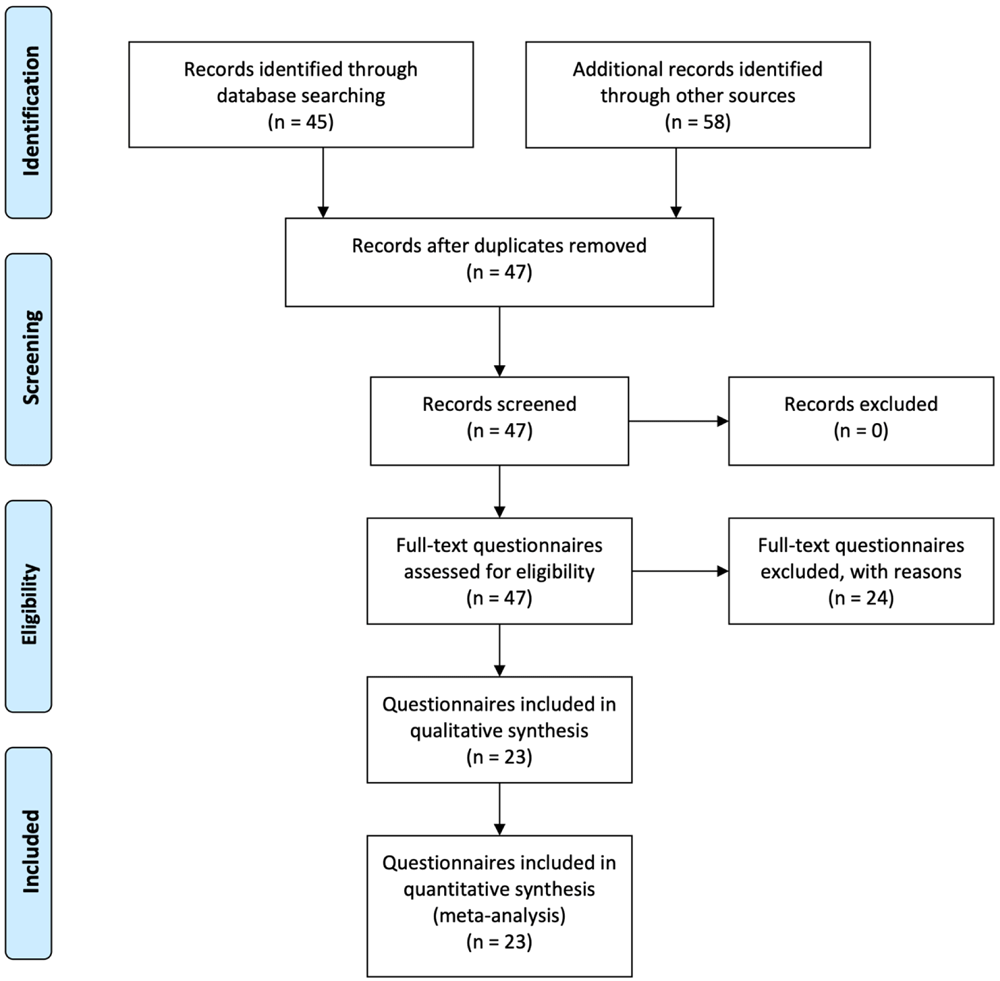
Figure 1. Flow diagram of the selection of sources process (adapted from Moher et al., 2009).
Characteristics of sources of evidence
The questionnaires analyzed are listed in Table 1. Out of the 23 questionnaires included in the analysis, 8 have been developed to measure presence, 3 for flow, 6 for game immersion/engagement, and 6 for narrative phenomena (absorption, engagement, transportation, immersion, identification with characters, and empathy with characters).
Table 1. Questionnaires analyzed and categorized.
Total number of items, n= 484.
| Questionnaire | Type | Total number of
items | Number of selected
items |
|---|
| 1 | Temple Presence Inventory (TPI) (Lombard et al., 2000) | Presence | 42 | 18 |
| 2 | Slater, Usoh and Steed (SUS) (Usoh et al., 2000) | Presence | 6 | 3 |
| 3 | Sense of Presence Inventory (ITC-SOPI) (Lessiter et al., 2001) | Presence | 44 | 23 |
| 4 | Igroup Presence Questionnaire (IPQ) (Schubert, 2003) | Presence | 14 | 10 |
| 5 | Networked Minds Social Presence Inventory (NMSPI) (Harms & Biocca, 2004) | Presence | 36 | 33 |
| 6 | Presence Questionnaire, version 3 (PQ) (Witmer et al., 2005) | Presence | 29 | 10 |
| 7 | Spatial Presence Experience Scale (SPES) (Hartmann et al., 2016) | Presence | 8 | 8 |
| 8 | Multimodal Presence Scale (MPS) (Makransky et al., 2017) | Presence | 15 | 12 |
| 9 | Flow Short Scale (FSS) (Rheinberg, 2008) | Flow | 13 | 8 |
| 10 | EduFlow Scale (EFS) (Heutte et al., 2014) | Flow | 12 | 8 |
| 11 | Reading Flow Short Scale (RFSS) (Thissen et al., 2018) | Flow | 8 | 6 |
| 12 | EGameFlow (EGF) (Fu et al., 2009) | Game/Flow | 42 | 16 |
| 13 | Immersion in the Narrative Game Questionnaire (INGQ) (Qin et al., 2009) | Game | 27 | 18 |
| 14 | Game Engagement Questionnaire (GEQ) (Brockmyer et al., 2009) | Game | 19 | 12 |
| 15 | User Engagement Scale (UES) (O’Brien & Toms, 2013; Wiebe et al., 2014) | Game | 28 | 15 |
| 16 | Game Experience Questionnaire (GExQ) (IJsselsteijn et al., 2013) | Game | 40 | 26 |
| 17 | Game Immersion Questionnaire (GIQ) (Cheng et al., 2015) | Game | 14 | 7 |
| 18 | Transportation Scale (Green & Brock, 2000) | Narrative | 11 | 10 |
| 19 | Identification Scale (Cohen, 2001) | Narrative | 10 | 9 |
| 20 | Narrative Engagement Scale (NES) (Busselle & Bilandzic, 2009) | Narrative | 12 | 12 |
| 21 | State Empathy Scale (SES) (Shen, 2010) | Narrative | 12 | 9 |
| 22 | Story World Absorption Scale (SWAS) (Kuijpers et al., 2014) | Narrative | 18 | 17 |
| 23 | Film Immersion Questionnaire (FIQ) (Jennett et al., 2008; Rigby et al., 2019) | Narrative | 24 | 18 |
Critical appraisal within sources of evidence
Some items present a combination of more than one aspect, so I excluded them from the synthesis of the results in order to avoid confusion within each group of items. For instance, the item “I lose perceptions of time and the real world surrounding me, as if everything just stops” (Game Immersion Questionnaire, Cheng et al., 2015) asks about the perception of both time and space. I also excluded items inquiring about some of the aspects identified when they have peculiar wordings that do not overlap with other items. Out of the total 484 items, 308 (64%) have close similarities and overlapping of wordings.
Results of individual sources of evidence
Table 1 reports the number of items selected in each questionnaire.
Synthesis of the results
The complete categorization of the questionnaire items can be found in the underlying data. A summary of the most frequent categories is reported in Table 2. Attention is undoubtedly the most relevant term for all the constructs considered, conceived as disregard for both thoughts and perceptions that are not part of the activity eliciting presence, flow, or absorption. Similarly, a distorted perception of time is in many cases considered to be a sign of the occurrence of all the considered phenomena. With respect to categories specific to each concept, spatial presence is characterized by items related to space, agency, and a comparison with reality not mediated by technology. Social presence is characterized by the same categories that are relevant for spatial presence (space and agency) but in relation to the existence of other agents; additionally, some kind of cognitive attention to the other and emotional arousal elicited by them are also frequent. Flow is specifically characterized by the perception of a sense of challenge. Narrative absorption is characterized by a comparison with non-mediated reality (in terms of vividness of imagery), by an easy comprehension of content, and by emotions and thoughts anticipating possible outcomes (suspense). Lastly, there are two groups of items explicitly asking about the user’s perception of involvement/engagement or absorption/immersion.
Table 2. Categorization of items (n = 308) from presence, flow, game, and narrative questionnaires.
Total
items | Scales
with item | Item type | Category | Main psychological
phenomenon |
|---|
| 23 | 11 | Attention (no external thoughts) | Attention | Attention |
| 17 | 9 | Attention (no external perceptions) |
| 18 | 11 | Time distortion | Time | – |
| 17 | 9 | “Being there” (feelings and perceptions, not
thoughts) | Space | Spatial presence |
| 8 | 5 | Realities overlapping |
| 6 | 3 | Closeness of story world |
| 7 | 6 | Return to reality |
| 5 | 5 | Being part of the action (also partly overlaps with
"being there") |
| 10 | 5 | Possibility of action in space | Agency |
| 6 | 4 | Control of content |
| 5 | 3 | Control of medium |
| 9 | 6 | Naturalness/fluency of medium use |
| 14 | 6 | Perceived realism | Comparison |
| 5 | 2 | Attention to another agent | Attention | Social presence |
| 5 | 4 | Co-location with another agent | Space |
| 24 | 4 | Mind reading | Cognition |
| 5 | 2 | Behavioural response to another agent | Agency |
| 13 | 7 | Matching of another agent 's emotions | Emotion |
| 4 | 3 | Feelings for another agent |
| 6 | 5 | Connection with another agent | Emotion/
Cognition |
| 16 | 6 | Understanding of another agent (perspective
taking, cognitive empathy) | Cognition |
| 12 | 7 | Challenge | Cognition | Flow |
| 8 | 4 | Vividness of imagery | Comparison | Narrative absorption |
| 14 | 7 | Comprehension of content | Comprehension |
| 9 | 6 | Suspense/anticipation | Emotion/
Cognition |
| 18 | 10 | Emotional response to medium/content | Emotion | Emotional impact |
| 14 | 7 | Explicit use of involvement/engagement terms | Metaphor | – |
| 10 | 9 | Explicit use of absorption/immersion terms |
Discussion
Summary of evidence
In all questionnaires, the most frequently recurring items concern attention and the sense of time. The isolation from external thoughts and perceptions is the main characteristic of presence-related phenomena, and such disconnection from stimuli unrelated to the undergoing experience probably leads to an alteration of the sense of time. Despite the evolution towards broad psychological conceptions of presence (Baños et al., 2000; Lee, 2004; Riva et al., 2015), a review (Hein et al., 2018) of the psychometric questionnaires used in VR research in the years 2016–17 found that the most used one is the Presence Questionnaire (Witmer & Singer, 1998), which heavily focuses on visual realism and naturalness of interaction. However, the broadest and most protracted collective effort aimed at clarifying how to measure presence (Hartmann et al., 2016; Vorderer et al., 2004) has excluded realism from the subdimensions of presence, keeping only “self-location” and “possible action” as core dimensions. Indeed, these two categories seem to be the two really specific to presence, since a comparison with non-mediated reality is also relevant for the “imagery” category, which concerns items related to narrative absorption. Inquiring about the vividness of imagery or about the realism of a VR scene is a way to check how similar the imagined/mediated experience is to a non-mediated one. Both realism and vivid imagery are outcomes that can be associated with presence, but they are not particularly helpful to explain the underlying psychological processes that bring to the emergence of a sense of presence.
Many questionnaires also take into account the possibility that perceiving the existence of other agents can affect our sense of presence or, more broadly, that we can have intense experiences when interacting with others or following their actions. With a growing degree of complexity, such perception goes from merely noticing the existence of others, to interacting with them, to emotional and cognitive ways of responding to and understanding others’ mental states. These groups of items, which I have associated with the concept of social presence, occur often together with spatial presence items and seem to entail it as the basis on top of which they can emerge. Indeed, they are all different expressions of a self-other relationship and can be conceptualized as forms of presence in co-participation. Analogously, questionnaires about flow experiences include items that I have here associated with spatial presence – and in some cases also items related to social presence – plus a specific group of questions regarding the perception of an experience as challenging. Similar wordings can be also found in items of narrative and game questionnaires.
Items that I specifically associated with the concept of narrative absorption regard imagery, the feeling of suspense triggered by the narrated events, and the comprehension of the content of the story, an aspect which can be connected to the sense of challenge of flow experiences, since the right match between the complexity of a story and the cognitive skills of the audience is relevant for narrative absorption. It is worth noting that questionnaires investigating narrative absorption include these three groups of items but also items related to spatial presence and social presence (with characters of a story), which can be considered subdimensions of narrative absorption. Given their metaphorical nature, items explicitly asking whether an experience elicited involvement, engagement, immersion, or absorption are not particularly useful for describing the psychological processes activated during the experiences they aim at qualifying. Moreover, the adjective “immersive” is used in VR research as a technical attribute of the medium – consistently with Sheridan seminal definition (Sheridan, 1992) – whereas in game and narrative studies it is a quality of the player or reader’s experience (Jennett et al., 2008; Ryan, 2015; Stockwell, 2019).
Another popular but quite heterogeneous group of questions concerns the emotional impact of mediated experiences. Ten questionnaires investigate this aspect in slightly different ways, so it is hard to say whether emotional impact is a component of any of the presence-related phenomena or a secondary effect elicited by them.
The recognition presented can be used to reflect on the extent to which wording similarities among items from different questionnaires actually result from similarities between the underlying conceptualizations. One possible outcome is a cross-disciplinary systematization of concepts, suggesting viable options for an interdisciplinary agreement about the core aspects of the psychological states elicited by mediated experiences. To sum up, attention and time distortion are common to all the considered phenomena, and spatial presence (space and agency) is the phenomenon with the narrowest scope, the core. Social presence and narrative absorption are phenomena of increasingly broader scope, each of them including the listed phenomena of narrower scope. Flow is a concept transversal to the other three, being more related to the balance between a person’s skills and the complexity of the stimulus, rather than to a specific psychological dimension.
Following the above-mentioned strategy, in Table 3 I summarized the conceptual overlaps that can be inferred from the similarities between items, and I recommend the subdimension that best correspond to the various groups of items. Additionally, in Table 4, I present a selection of items that best correspond to the categories identified by my inductive process. The use of such items to measure presence, social presence, and narrative absorption can help to achieve a more solid epistemic comparability among research on these phenomena. In order to benefit from previous statistical validations, in case of similarities, I gave preference to items coming from the same questionnaire. Depending on the task/content with which the participants are engaging, only a part of these items may be relevant.
Table 3. Selection of questionnaire subdimensions recommended to achieve a more solid epistemic comparability among research on presence, social presence, and narrative absorption.
| Item type | Category | Recommended questionnaire
subdimension | Main
psychological
phenomenon |
|---|
| Attention (no external thoughts) | Attention | NES by Busselle & Bilandzic (2009)
– “Attentional focus” | Attention |
Attention (no external
perceptions) | PQ v.3 by Witmer et al. (2005)
– “Adaptation/Immersion” /
FIQ by Rigby et al. (2019) –
“
Real-world Dissociation” |
| Time distortion | Time | Various | – |
“Being there” (feelings and
perceptions, not thoughts) | Space | SPES by Hartmann et al. (2016) – “Self-
location” | Spatial presence |
| Realities overlapping |
| Closeness of story world |
| Return to reality |
Being part of the action (also
partly overlaps with "being there") |
| Possibility of action in space | Agency | SPES by Hartmann et al. (2016) – “Possible
action” |
| Control of content |
| Control of medium |
Naturalness/fluency of medium
use |
| Attention to another agent | Attention | NMSPI by Harms & Biocca (2004) –
“Perceived Attentional Engagement” | Social presence |
| Co-location with another agent | Space | MPS by Makransky et al. (2017) – “Social
presence” |
| Mind reading | Cognition |
Behavioural response to another
agent | Agency | NMSPI by Harms & Biocca (2004) –
“Perceived Behavioural Interdependence” |
Matching of another agent 's
emotions | Emotion | NMSPI by Harms & Biocca (2004)
– “Perceived Emotional Contagion” / SES by
Shen (2010) – “Affective empathy” |
| Feelings for another agent |
| Connection with another agent | Emotion/Cognition |
Understanding of another agent
(perspective taking, cognitive
empathy) | Cognition | NMSPI by Harms & Biocca (2004) –
“Perceived Comprehension” / SES by Shen (2010) – “Cognitive empathy” |
| Challenge | Cognition | RFSS by Thissen et al. (2018) – “Absorption” | Flow |
| Vividness of imagery | Comparison | SWAS by Kuijpers et al. (2014) – “Mental
imagery” | Narrative
absorption |
| Comprehension of content | Comprehension | NES by Busselle & Bilandzic (2009)
– “Narrative understanding” |
| Suspense/anticipation | Emotion/Cognition | Transportation Scale by Green & Brock (2000) – “Transportation” |
Table 4. Selection of questionnaire items (with minimal adaptation) recommended to achieve a more solid epistemic comparability among research on presence, social presence, and narrative absorption.
(R = reverse scored).
| Item | Item type | Recommended questionnaire
subdimension | Main
psychological
phenomenon |
|---|
| 1 | While [task/content] I found
myself thinking about other
things. [R] | Attention (no external
thoughts) | NES by Busselle & Bilandzic (2009)
– “Attentional focus” | Attention |
| 2 | I had a hard time keeping my
mind on the [task/content]. [R] |
| 3 | I was able to concentrate very
well on [task/content] rather
than on the mechanisms used
to [perform/represent] that
[task/content]. | Attention (no external
perceptions) | PQ v.3 by Witmer et al. (2005)
– “Adaptation/Immersion” |
| 4 | I didn’t notice events taking
place around me. | FIQ by Rigby et al. (2019) – “Real-
world Dissociation” |
| 5 | I lost track of time. | Time distortion | Various | – |
| 6 | I felt like I was actually there
in the environment of the
presentation. | Self-location | SPES by Hartmann et al. (2016)
– “Self-location” | Spatial presence |
| 7 | It seemed as though I actually
took part in the action of the
presentation. |
| 8 | It was as though my true
location had shifted into
the environment in the
presentation. |
| 9 | I felt as though I was physically
present in the environment of
the presentation. |
| 10 | The objects in the presentation
gave me the feeling that I could
do things with them. | Possible action | SPES by Hartmann et al. (2016)
– “Possible action” |
| 11 | I had the impression
that I could be active in
the environment of the
presentation. |
| 12 | I felt like I could move around
among the objects in the
presentation. |
| 13 | It seemed to me that I
could do whatever I wanted
in the environment of the
presentation. |
| 14 | I paid close attention to [other
agent/s]. | Attention to another agent | NMSPI by Harms & Biocca (2004) – “Perceived Attentional
Engagement” | Social presence |
| 15 | I was easily distracted from
[other agent/s] when other
things were going on. [R] |
| 16 | I felt like I was in the presence
of someone else while [task/
content]. | Co-location with another
agent | MPS by Makransky et al. (2017)
– “Social presence” |
| 17 | I felt that the [other agent/s]
in [place] were aware of my
presence. | Mind reading |
| 18 | The [other agent/s] in [place]
appeared to be sentient
(conscious and alive) to me. |
| 19 | My actions were often
dependent on [other agent/s’] actions. | Perceived Behavioural
Interdependence | NMSPI by Harms & Biocca (2004) – “Perceived Behavioural
Interdependence” |
| 20 | My behavior was often in direct
response to [other agent/s’] behavior. |
| 21 | What [other agent/s] did often
affected what I did. |
| 22 | I was sometimes influenced by
[other agent/s’] moods. | Affective empathy | NMSPI by Harms & Biocca (2004)
– “Perceived Emotional Contagion” |
| 23 | I experienced the same
emotions as the [other agent/s]
while [task/content]. | SES by Shen (2010) – “Affective
empathy” |
| 24 | I could feel the [other agent/s’]
emotions. |
| 25 | I was able to understand what
[other agent/s’] meant. | Understanding of another
agent (perspective taking,
cognitive empathy) | NMSPI by Harms & Biocca (2004)
– “Perceived Comprehension” |
| 26 | I can see the [other agent/s’]
point of view. | SES by Shen (2010) – “Cognitive
empathy” |
| 27 | I can understand what the
[other agent/s’] was going
through. |
| 28 | I felt optimally challenged while
[task/content]. | Challenge | RFSS by Thissen et al. (2018)
– “Absorption” | Flow |
| 29 | When I was reading the story,
I had an image of the main
character in mind. | Vividness of imagery | SWAS by Kuijpers et al. (2014)
– “Mental imagery” | Narrative
absorption |
| 30 | When I was reading the story,
I could see the situations
happening in the story being
played out before my eyes. |
| 31 | I could imagine what the world
in which the story took place
looked like. |
| 32 | At points, I had a hard time
making sense of what was
going on in the story. [R] | Comprehension of content | NES by Busselle & Bilandzic (2009)
– “Narrative understanding” |
| 33 | I wanted to learn how the story
ended. | Suspense/anticipation | Transportation Scale by Green & Brock (2000) – “Transportation” |
Limitations
Categorizing only 308 items, out of the total 484 found in the sampled questionnaires, this scoping review may have missed some aspects of presence and related concepts that are important to grasp the nuances of the phenomenal experience that may be specific to certain media. However, by focusing on items showing a recurring intersubjective agreement between researchers and disciplines, I think I have successfully identified and summarized the core aspects of the surveyed phenomena. However, it is worth remembering that the employment of measurement tools should always be justified by theoretical reflection and empirical validation. A scoping review is an aid for the systematization of knowledge, but it also produces new knowledge that requires further scrutiny and methodological testing before it can be deployed into experimental settings.
Conclusions
The categorization proposed here can be used to further refine existing questionnaires and possibly encourage a convergence of different disciplines towards a use of the same items, so that insight coming from different fields could be used for the advancement of knowledge in specific areas. For instance, empirical research on narrative could benefit from using existing items for presence and social presence, without “reinventing the wheel” and focusing rather on refining how to measure dimensions like suspense and imagery. Moreover, a shared agreement on basic items will enable better and more informative meta-analyses, as well as comparative media studies, a kind of research that is strongly relevant for all the disciplines that I mentioned here, since only a comparison between experiences with different media can help to account for the specificity of presence and related phenomena.
Data availability
Underlying data
OSF: Presence, flow, and narrative absorption questionnaires: a scoping review
https://doi.org/10.17605/OSF.IO/RBZ8G (Pianzola, 2021)
This project contains the following underlying data:
scoping_review_data_2021-02-26.xlsx (Human-readable version containing the 23 selected questionnaires with color coding of the items and summary model)
scoping_review_data_2021-02-26.csv (Machine-readable version containing the 23 selected questionnaires with the respective annotations for each item)
Data are available under the terms of the Creative Commons Zero "No rights reserved" data waiver (CC0 1.0 Public domain dedication).
Acknowledgments
I am grateful to Christoph Klimmt for his commentary on the first version of this article, his feedback helped me rethink the limitations of this work and led me to reframe it in a slightly different way.
Faculty Opinions recommendedReferences
- Arksey H, O’Malley L:
Scoping studies: Towards a methodological framework.
Int J Soc Res Methodol.
2005; 8(1): 19–32. Publisher Full Text
- Baños RM, Botella C, Garcia-Palacios A, et al.:
Presence and Reality Judgment in Virtual Environments: A Unitary Construct?
Cyberpsychol Behav.
2000; 3(3): 327–335. Publisher Full Text
- Brockmyer JH, Fox CM, Curtiss KA, et al.:
The development of the Game Engagement Questionnaire: A measure of engagement in video game-playing.
J Exp Soc Psychol.
2009; 45(4): 624–634. Publisher Full Text
- Busselle R, Bilandzic H:
Measuring narrative engagement.
Media Psychology.
2009; 12(4): 321–347. Publisher Full Text
- Busselle R, Bilandzic H:
Beyond metaphors and traditions. Exploring the conceptual boundaries of narrative engagement. In F. Hakemulder, M. M. Kuijpers, E. S. Tan, K. Bálint, & M. M. Doicaru (Eds.): Narrative Absorption. John Benjamins, 2017; 11–27. Publisher Full Text
- Cheng MT, She HC, Annetta LA:
Game immersion experience: Its hierarchical structure and impact on game-based science learning. Impact of immersion on learning.
J Comput Assist Learn.
2015; 31(3): 232–253. Publisher Full Text
- Cohen J:
Defining Identification: A Theoretical Look at the Identification of Audiences with Media Characters.
Mass Commun Soc.
2001; 4(3): 245–264. Publisher Full Text
- Csikszentmihalyi M:
Flow: The psychology of optimal experience. Harper Collins, 1990. Reference Source
- Fu FL, Su RC, Yu SC:
EGameFlow: A scale to measure learners’ enjoyment of e-learning games.
Comput Educ.
2009; 52(1): 101–112. Publisher Full Text
- Green MC, Brock TC:
The role of transportation in the persuasiveness of public narratives.
J Pers Soc Psychol.
2000; 79(5): 701–721. PubMed Abstract
| Publisher Full Text
- Hakemulder F, Kuijpers MM, Tan ES, et al.:
Narrative Absorption. John Benjamins, 2017. Publisher Full Text
- Harmat L, Andersen FØ, Ullén FØ, et al.:
Flow Experience: Empirical Research and Applications. Springer International Publishing, 2016. Publisher Full Text
- Harms C, Biocca F:
Internal Consistency and Reliability of the Networked Minds Measure of Social Presence. In M. Alcañiz & B. Rey (Eds.): Seventh Annual International Workshop: Presence 2004.
2004. Reference Source
- Hartmann T, Wirth W, Schramm H, et al.:
The Spatial Presence Experience Scale (SPES): A Short Self-Report Measure for Diverse Media Settings.
J Media Psychol.
2016; 28(1): 1–15. Publisher Full Text
- Hein D, Mai C, Hußmann H:
The usage of presence measurements in research: A review.
Proceedings of the 17th Conference of the International Society for Presence Research (ISPR).
2018. Reference Source
- Heutte J, Fenouillet F, Boniwell I, et al.:
Optimal learning experience in digital environments: Theoretical concepts, measure and modelisation. Digital Learning in 21st Century Universities. Georgia Institute of Technology, Atlanta, 2014. Reference Source
- IJsselsteijn W, de Kort YAW, Poels K:
The Game Experience Questionnaire. Technische Universiteit Eindhoven. 2013. Reference Source
- Jennett C, Cox AL, Cairns P, et al.:
Measuring and defining the experience of immersion in games.
Int J Hum Comput Stud.
2008; 66(9): 641–661. Publisher Full Text
- Kuijpers MM, Hakemulder F, Tan ES, et al.:
Exploring absorbing reading experiences: Developing and validating a self-report scale to measure story world absorption.
Scientific Study of Literature.
2014; 4(1): 89–122. Publisher Full Text
- Lee KM:
Presence, Explicated.
Commun Theory.
2004; 14(1): 27–50. Publisher Full Text
- Lessiter J, Freeman J, Keogh E, et al.:
A Cross-Media Presence Questionnaire: The ITC-Sense of Presence Inventory.
Presence (Camb).
2001; 10(3): 282–297. Publisher Full Text
- Levac D, Colquhoun H, O’Brien KK:
Scoping studies: Advancing the methodology.
Implement Sci.
2010; 5(1): 69. PubMed Abstract
| Publisher Full Text
| Free Full Text
- Lombard M, Biocca F, Freeman J, et al.:
Immersed in Media: Telepresence Theory, Measurement & Technology. Springer, 2015. Publisher Full Text
- Lombard M, Ditton TB, Crane D, et al.:
Measuring Presence: A Literature-Based Approach to the Development of a Standardized Paper-and-Pencil Instrument.
Presence 2000: The Third International Workshop on Presence.
2000. Reference Source
- Makransky G, Lilleholt L, Aaby A:
Development and validation of the Multimodal Presence Scale for virtual reality environments: A confirmatory factor analysis and item response theory approach.
Comput Human Behav.
2017; 72: 276–285. Publisher Full Text
- Moher D, Liberati A, Tetzlaff J, et al.:
Preferred Reporting Items for Systematic Reviews and Meta-Analyses: The PRISMA Statement.
PLoS Med.
2009; 6(7): e1000097. PubMed Abstract
| Publisher Full Text
| Free Full Text
- O’Brien HL, Toms EG:
Examining the generalizability of the User Engagement Scale (UES) in exploratory search.
Inf Process Manag.
2013; 49(5): 1092–1107. Publisher Full Text
- Paiva de Oliveira R, Calsavara Paiva de Oliveira D, Fernandes Tavares T:
Measurement Methods for Phenomena Associated with Immersion, Engagement, Flow, and Presence in Digital Games.
SBC - Proceedings of SBGames 2016.
2016; 127–135. Reference Source
- Peters MDJ, Godfrey CM, Khalil H, et al.:
Guidance for conducting systematic scoping reviews.
Int J Evid Based Healthc.
2015; 13(3): 141–146. PubMed Abstract
| Publisher Full Text
- Pianzola F:
Presence, flow, and narrative absorption questionnaires: a scoping review (supplementary material). 2021. http://www.doi.org/10.17605/OSF.IO/RBZ8G
- Qin H, Patrick Rau PL, Salvendy G:
Measuring Player Immersion in the Computer Game Narrative.
Int J Hum-Comput Int.
2009; 25(2): 107–133. Publisher Full Text
- Reddy GSH:
Empirical Investigation on Measurement of Game Immersion using Real World Dissociation Factor. Blekinge Institute of Technology, 2016. Reference Source
- Rheinberg F:
Intrinsic motivation and flow-experience. In H. Heckhausen & J. Heckhausen (Eds.), Motivation and Action. Cambridge University Press, 2008; 323–348. Publisher Full Text
- Rigby JM, Brumby DP, Gould SJJ, et al.:
Development of a Questionnaire to Measure Immersion in Video Media: The Film IEQ.
Proceedings of the 2019 ACM International Conference on Interactive Experiences for TV and Online Video - TVX ’ 19.
2019; 35–46. Publisher Full Text
- Riva G, Mantovani F, Waterworth EL, et al.:
Intention, Action, Self and Other: An Evolutionary Model of Presence. In M. Lombard, F. Biocca, J. Freeman, W. IJsselsteijn, & R. J. Schaevitz (Eds.).
Immersed in Media.
2015; 73–99. Publisher Full Text
- Ryan ML:
Narrative as virtual reality 2: Revisiting immersion and interactivity in literature and electronic media. (Second edition). Johns Hopkins University Press, 2015. Reference Source
- Schubert TW:
The sense of presence in virtual environments: A three-component scale measuring spatial presence, involvement, and realness.
Zeitschrift Für Medienpsychologie.
2003; 15(2): 69–71. Publisher Full Text
- Shen L:
On a scale of state empathy during message processing.
West J Commun.
2010; 74(5): 504–524. Publisher Full Text
- Sheridan TB:
Musings on Telepresence and Virtual Presence.
Presence (Camb).
1992; 1(1): 120–126. Publisher Full Text
- Skarbez R, Brooks FP Jr, Whitton MC:
A Survey of Presence and Related Concepts.
ACM Comput Surv.
2017; 50(6): 1–39. Publisher Full Text
- Stockwell P:
Immersion and Emergence in Children’s Literature. In Neurohr, B. and Stewart-Shaw, L. (Eds.).
Experiencing Fictional Worlds.
John Benjamins, 2019; 15–32. Publisher Full Text
- Thissen BAK, Menninghaus W, Schlotz W:
Measuring Optimal Reading Experiences: The Reading Flow Short Scale.
Front Psychol.
2018; 9: 2542. PubMed Abstract
| Publisher Full Text
| Free Full Text
- Tricco AC, Lillie E, Zarin W, et al.:
PRISMA Extension for Scoping Reviews (PRISMA-ScR): Checklist and Explanation.
Ann Intern Med.
2018; 169(7): 467–473. PubMed Abstract
| Publisher Full Text
- Usoh M, Catena E, Arman S, et al.:
Using Presence Questionnaires in Reality.
Presence (Camb).
2000; 9(5): 497–503. Publisher Full Text
- van Baren J, IJsselsteijn W:
Measuring Presence: A Guide to Current Measurement Approaches [OmniPres project IST-2001-39237]. 2004. Reference Source
- Vorderer P, Wirth W, Gouveia FR, et al.:
MEC Spatial Presence Questionnaire (MEC- SPQ): Short Documentation and Instructions for Application. Project Presence: MEC (IST-2001-37661). 2004.
- Wiebe EN, Lamb A, Hardy M, et al.:
Measuring engagement in video game-based environments: Investigation of the User Engagement Scale.
Comput Human Behav.
2014; 32: 123–132. Publisher Full Text
- Witmer BG, Jerome CJ, Singer MJ:
The Factor Structure of the Presence Questionnaire.
Presence (Camb).
2005; 14(3): 298–312. Publisher Full Text
- Witmer BG, Singer MJ:
Measuring Presence in Virtual Environments: A Presence Questionnaire.
Presence (Camb).
1998; 7(3): 225–240. Publisher Full Text