Introduction

Poly(p-phenylene vinylene)s (PPVs) are among the best investigated π-conjugated polymers1,2. They are composed of alternating para-phenylene and vinylene units and usually feature substituents attached to the π-conjugated backbone to modify their optoelectronic and dissolution properties. Most frequently, alkoxy substituents are attached to the phenylene units, but the corresponding alkylthio-substituted PPVs have also been reported3. The alkyl part of the substituents (often a linear or branched alkyl chain) is intended to improve the solubility, while the purpose of the oxygen or sulfur atom linking the alkyl part to the backbone is to modify the optoelectronic properties, mainly through their positive mesomeric effect.

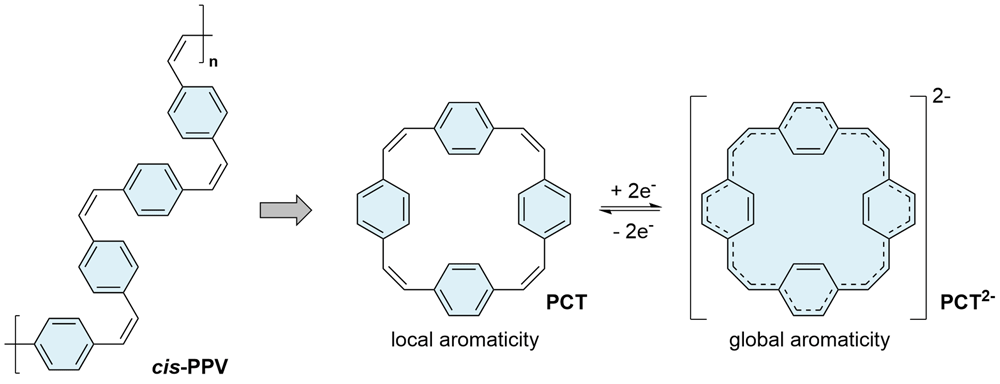
[2.2.2.2]Paracyclophanetetraene (PCT) can be seen as a cyclic structural analogue of unsubstituted PPV (Figure 1). This π-conjugated macrocycle, first synthesized in the 1970s4, was recently rediscovered by us and has proven to be a capable battery electrode material5. The excellent redox and charge storage properties of PCT have been attributed to ring currents and voids enabled by the cyclic structure of the molecule, suggesting that the optoelectronic properties of PCT and PPV differ significantly, despite their structural similarity. In contrast to the polymers, the vinylene units in PCT must adopt a cis-configuration; no end groups are present that may affect the properties.

fb9bede9-b71b-4655-b55e-c9d919c30e9d_figure1.gif

Figure 1. [2.2.2.2]Paracyclophanetetraene (PCT) as a cyclic structural analogue of cis-poly(p-phenylene vinylene) (cis-PPV) (left); reversible two-electron reduction and aromaticity switching of PCT (right).

The aim of the work presented here was to synthesize and study PCT derivatives with alkoxy and alkylthio substituents at the phenylene units, in analogy to the well-investigated substituted PPVs. In contrast to PPV, PCT dissolves well in organic solvents also without substituents with linear or branched alkyl chains. Thus, simple methyl groups were selected as the alkyl part of the substituents. When studying the properties of the resulting methoxy- and methylthio-substituted PCT derivatives, we were particularly interested in the effect of the substituents on the ring currents, having recently reported the drastic effects of the introduction of ester groups (at the vinylene units) on these currents6.

Results and discussion

Synthesis

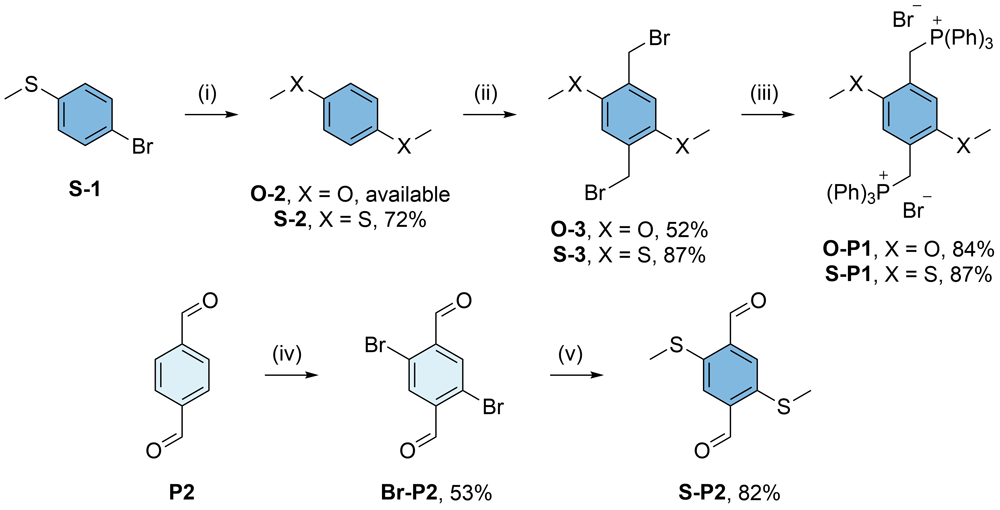
Unsubstituted PCT can be synthesized by a Wittig cyclisation reaction in yields of 10% to 15% using [1,4-phenylenebis(methylene)]bis(triphenylphosphonium) dibromide (P1) and terephthalaldehyde (P2) as the cyclisation precursors4,5. Aiming for an analogous synthesis of methoxy- and methylthio-substituted PCT derivatives, we first synthesized the substituted Wittig cyclisation precursors O-P1, S-P1, and S-P2 (Figure 2): The phosphonium salts O-P1 and S-P1 were synthesized via the same route, but while 1,4-dimethoxybenzene (O-2) for the synthesis of O-P1 is readily available from commercial suppliers, the corresponding methylthio-substituted compound 1,4-bis(methylthio)benzene (S-2) for the synthesis of S-P1 was obtained by a copper-catalysed conversion of 4-bromothioanisole (S-1) in dimethyl sulfoxide (DMSO)7. Compounds O-2 and S-2 were then bromomethylated by adapting our previously reported procedures to these substrates3. The reactions yielded compounds O-3 and S-3 in yields of 52% and 87%, respectively. In the final step, O-3 and S-3 were reacted with triphenylphosphine (PPh3) in boiling toluene, affording O-P1 and S-P1 as white solids in good yields. In contrast, the dialdehyde S-P2 was synthesized by slightly adapting published procedures for the bromination of P2 in the first step and nucleophilic aromatic substitution with sodium methanethiolate (NaSCH3) in the second step8,9.

fb9bede9-b71b-4655-b55e-c9d919c30e9d_figure2.gif

Figure 2. Synthesis of methoxy- and methylthio-substituted Wittig cyclisation precursors O-P1, S-P1, and S-P2.

Reaction conditions: (i) CuI, Cu(OAc)2, dimethyl sulfoxide (DMSO), 135 °C; (ii) paraformaldehyde, HBr in acetic acid, 1,4-dioxane (X = O) / formic acid (X = S), 80 °C; (iii) PPh3, toluene, 120 °C; (iv) N-bromosuccinimide (NBS), conc. H2SO4, 60 °C; (v) NaSCH3, dimethylformamide (DMF), r.t..

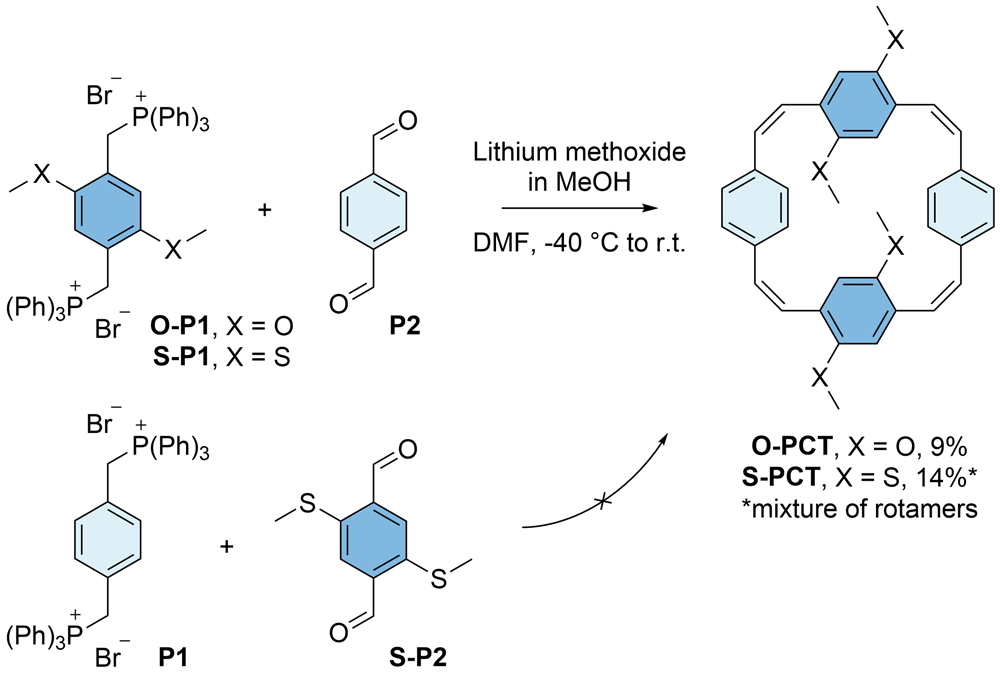
The phosphonium salts O-P1 and S-P1 were then reacted with terephthalaldehyde (P2) in dimethylformamide (DMF) at a low temperature of -40 °C (Figure 3). As for the synthesis of PCT5, lithium methoxide dissolved in anhydrous methanol (MeOH) was used as the base for these Wittig cyclisation reactions. The base was added slowly using a syringe pump, affording the macrocycles O-PCT and S-PCT in yields of 9% and 14%, respectively, after work-up and purification by gel permeation chromatography (GPC). In contrast, placing the methylthio substituents on the aldehyde precursor instead of the phosphonium salt, reacting p-xylylenebis(triphenylphosphonium bromide) (P1) with precursor S-P2 under the same reaction conditions, did not afford any S-PCT, presumably due to a less favourable cis/trans ratio of the vinylene units formed in this Wittig reaction (the electronic character of the precursors can influence the ratio). The reaction of S-P1 and S-P2 to obtain the macrocycle with substituents on all four phenylene units has also been attempted but did not give the desired product.

fb9bede9-b71b-4655-b55e-c9d919c30e9d_figure3.gif

Figure 3. Synthesis of methoxy- and methylthio-substituted [2.2.2.2]paracyclophanetetraenes O-PCT and S-PCT by Wittig cyclisation reactions of precursors O-P1/S-P1 and P2 (top).

The analogous reaction of precursors P1 and S-P2 did not yield the product (bottom).

Conformation

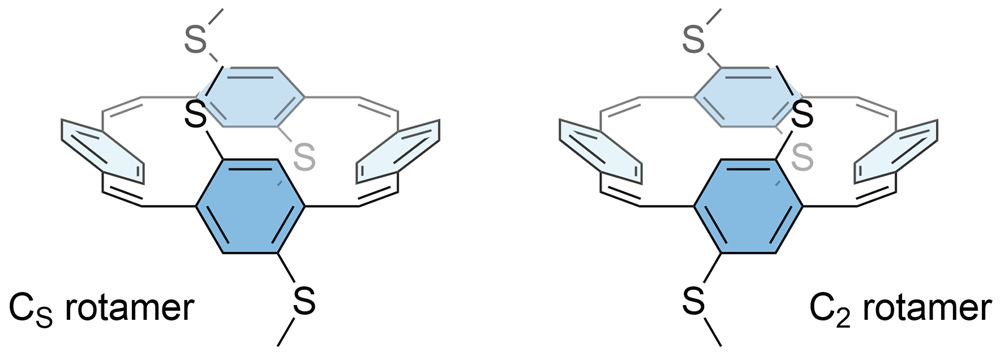
1H NMR spectra of S-PCT recorded at room temperature and 50 °C indicated the presence of two rotamers that could not be separated (see Figure 4 for an illustration of the two rotamers). A rotamer ratio of approximately 10:1, which corresponds to a free energy difference of about 6 kJ/mol, was determined from the integrals. In contrast, the 1H NMR spectrum of O-PCT did not show the presence of rotamers, indicating a lower energy barrier for the rotation of the phenylene units with methoxy substituents than with methylthio substituents.

fb9bede9-b71b-4655-b55e-c9d919c30e9d_figure4.gif

Figure 4. Illustration of the two rotamers of S-PCT, classified according to their idealised symmetry properties.

The computed energy barrier for interconversion is 94 kJ/mol.

To test these assumptions, computations were carried out to estimate the energy barrier for the interconversion of the two rotamers. Indeed, a barrier of only 45 kJ/mol was found for O-PCT. According to the Eyring equation, this corresponds to an interconversion time of about 10 µs, which is well below the time scale relevant to NMR. Both rotamers are very similar in energy, with the Cs rotamer 3.2 kJ/mol below the C2 rotamer, suggesting that both are present at room temperature. S-PCT, on the other hand, showed a significantly enhanced barrier of 94 kJ/mol with an associated interconversion time well above one hour. The C2 rotamer was found to be more stable by 16.6 kJ/mol, which is similar but somewhat larger than the free energy difference deduced from experiment (see above). The difference in behaviour between the two molecules can be understood by the fact that the methylthio groups are bulkier, causing steric strain for the transition state and the Cs rotamer. Taking the neutral C2 rotamer as an example, we find that the two C-O bonds in O-PCT are 1.35 and 1.39 Å in length whereas the C-S bonds in S-PCT measure 1.77 and 1.81 Å.

UV-vis absorption and photoluminescence

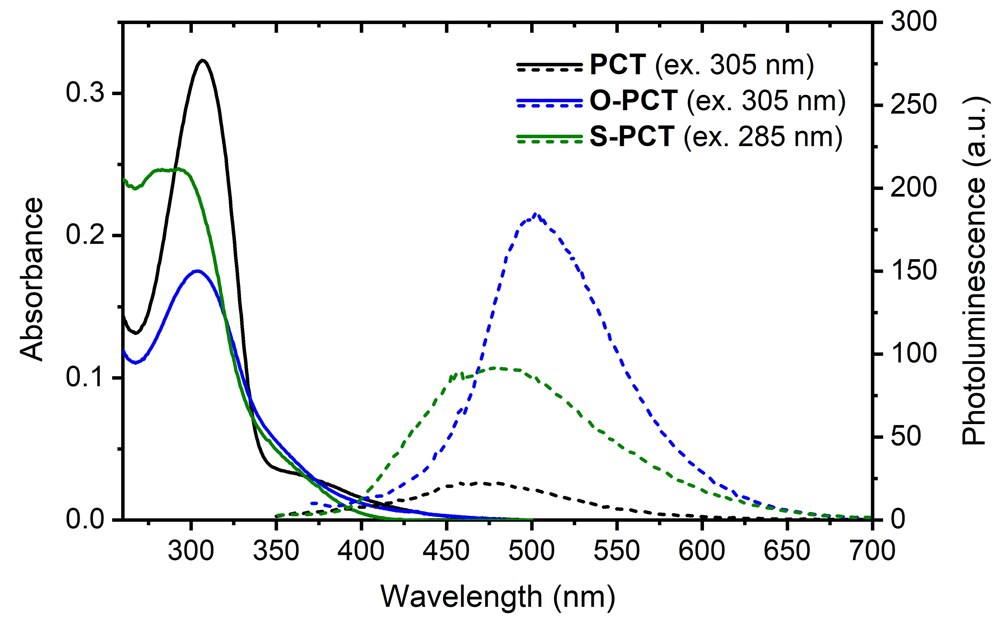
UV-vis absorption measurements in CHCl3 solution (Figure 5, solid lines) showed slightly blueshifted absorption maxima for O-PCT (λabs,max = 304 nm) and S-PCT (λabs,max = 293 nm) compared to PCT (λabs,max = 306 nm). The second absorption peak in the spectrum of S-PCT (λabs = 283 nm) may be attributed to the presence of two rotamers. Photoluminescence (PL) measurements of the solutions (Figure 5, dashed lines) showed a significant increase in PL intensity upon introduction of the substituents, particularly upon introduction of the methoxy substituents. Similar sensitivity to the substitution pattern for the PL intensity were also found for the related ester-substituted molecules and can be tentatively assigned to symmetry breaking in the excited state, lifting the selection rules for the formally symmetry-forbidden S1 state6, see, e.g., reference 10 for a discussion of the underlying physics. Despite the increase in PL intensity upon introduction of the substituents, all three macrocycles are still weak emitters, with a relative determination of the photoluminescence quantum yield (PLQY) indicating values of <1% for O-PCT and S-PCT and <0.1% for PCT. In contrast to the absorption maxima, the PL maxima of O-PCT (λPL,max = 502 nm) and S-PCT (λPL,max = 481 nm) were found to be redshifted compared to PCT (λPL,max = 468 nm), thus increasing their Stokes shifts from 1.40 eV for PCT to 1.61/1.65 eV for O-PCT/S-PCT. It is worth noting that the Stokes shifts of the linear PCT analogue containing 4 phenylene-vinylene units (λabs,max = 396 nm; λPL,max = 463 nm)11, of alkoxy-substituted PPV (λabs,max = 502 nm; λPL,max = 558 nm)12, and alkylthio-substituted PPV (λabs,max = 453 nm; λPL,max = 527 nm)3 are all well below 0.5 eV, highlighting the dramatic effect of the cyclic conjugation. Indeed, the large Stokes shifts of the substituted and unsubstituted PCTs, resulting in almost no spectral overlap between absorption and emission, can be seen as a signature of excited-state aromaticity, cf. references 6 and 13. Thus, the spectra suggest that symmetry breaking is only a dynamic effect accounting for a minor perturbation of excited-state aromaticity (see below for a further discussion).

fb9bede9-b71b-4655-b55e-c9d919c30e9d_figure5.gif

Figure 5. UV-vis absorption (solid lines) and photoluminescence spectra (dashed lines) of the macrocycles in CHCl3 solution (5 μM).

The excitation wavelengths for recording the photoluminescence (PL) spectra are shown in brackets.

Redox potentials

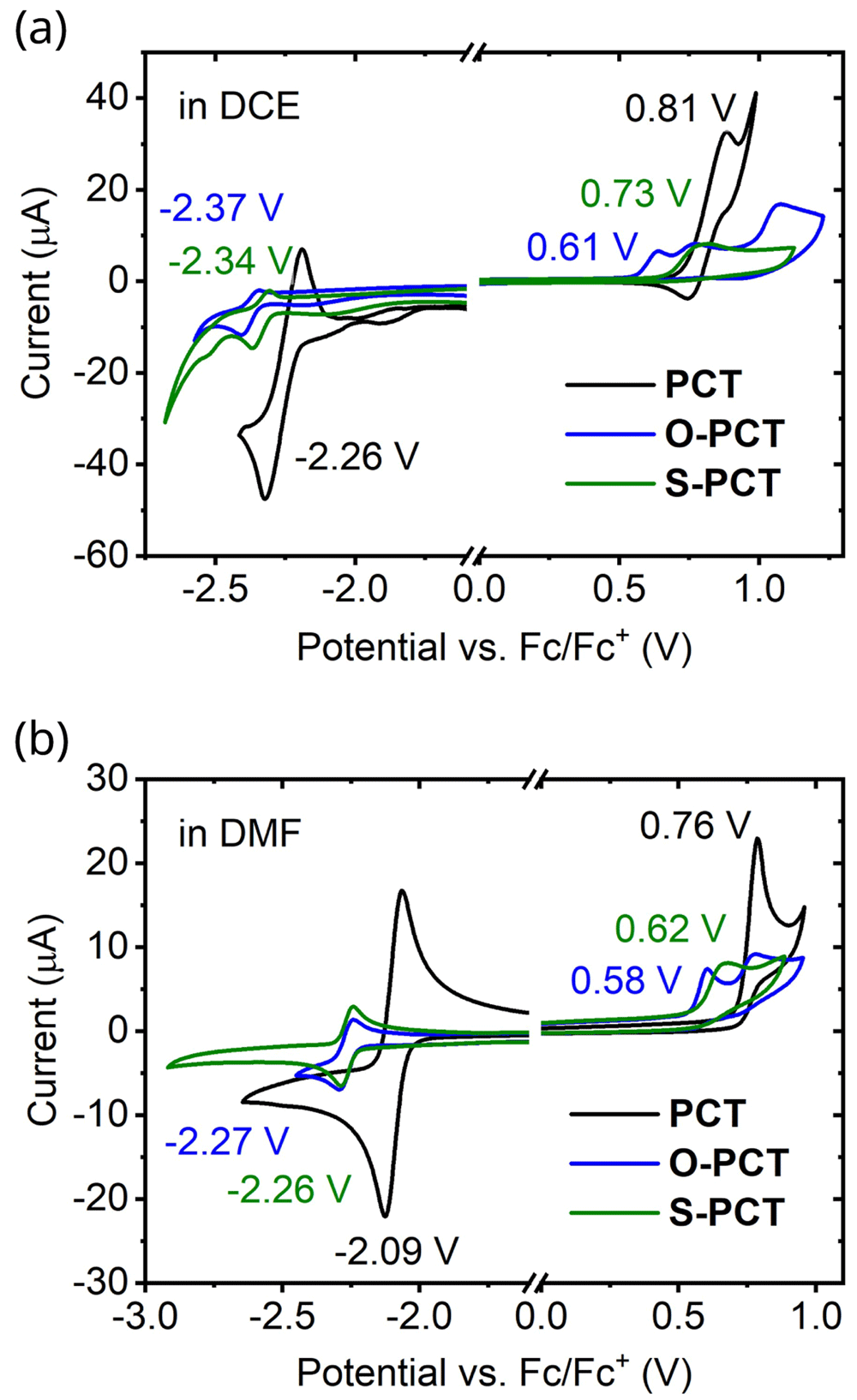
Cyclic voltammetry measurements of the macrocycles in 1,2-dichloroethane (DCE) and dimethylformamide (DMF) (Figure 6) were carried out to determine the redox potentials vs. ferrocene/ferrocene+ (Fc/Fc+) in two different solvents. As a general trend, the redox potentials for both the reductions and oxidations shifted to lower values upon introduction of the substituents, with a slightly larger shift observed for the introduction of the methoxy substituents. This can be explained by the electron-donating character of the substituents.

fb9bede9-b71b-4655-b55e-c9d919c30e9d_figure6.gif

Figure 6. Cyclic voltammograms of the macrocycles in 1,2-dichloroethane (DCE) and dimethylformamide (DMF) recorded using a glassy carbon working electrode, a platinum mesh auxiliary electrode, and a silver wire quasi-reference electrode (QRE) at a scan rate of 0.1 V s-1.

0.1 M tetrabutylammonium hexafluorophosphate (NBu4PF6) was used as the supporting electrolyte.

In DCE, the redox potential for the first reduction wave shifted from -2.26 V for PCT to -2.34 V for S-PCT and -2.37 V for O-PCT. For S-PCT, a second reduction wave was observed at -2.50 V. The redox potential for the first oxidation wave shifted from 0.81 V for PCT to 0.73 V for S-PCT and 0.61 V for O-PCT. For S-PCT, the first derivative of the measurement indicated further oxidations at 0.79 V and 1.08 V. For O-PCT, a second and third oxidation wave were observed at 0.73 V and 1.03 V, respectively.

In DMF, the redox potential for the first reduction wave showed a shift from -2.09 V for PCT to -2.26 V for S-PCT and -2.27 V for O-PCT. No further reduction waves were observed in this solvent. The redox potential for the first oxidation wave shifted from 0.76 V for PCT to 0.62 V for S-PCT and 0.58 V for O-PCT. A second oxidation wave was observed at 0.83 V for S-PCT and 0.74 V for O-PCT.

Computations place the potentials for concerted two-electron reduction in DCE at -2.28, -2.40, and -2.35 V for PCT, O-PCT, and S-PCT, respectively, suggesting that the experimental reduction potentials refer to two-electron processes. Potentials for two-electron oxidation are placed at 0.89, 0.75, and 0.98 V for the three molecules. Considering that the values for O-PCT and S-PCT are considerably higher than the measured first oxidation potentials, this suggests that oxidation proceeds via one-electron processes.

Ring currents and chemical shielding

To study the effect of the methoxy and methylthio substituents on the magnetic properties (ring currents and chemical shielding) and on the associated local and global (anti)aromaticity of the macrocycles, the visualisation of chemical shielding tensors (VIST) method14, which is based on the nucleus independent chemical shift15, was used. As explained previously6,14, VIST allows the visualisation of local variations in aromaticity and antiaromaticity in the context of the molecular structure by showing the chemical shielding tensor components using a representation of blue (shielded, aromatic) or red (deshielded, antiaromatic) dumbbells. Each tensor component relates to ring currents in a plane perpendicular to it.

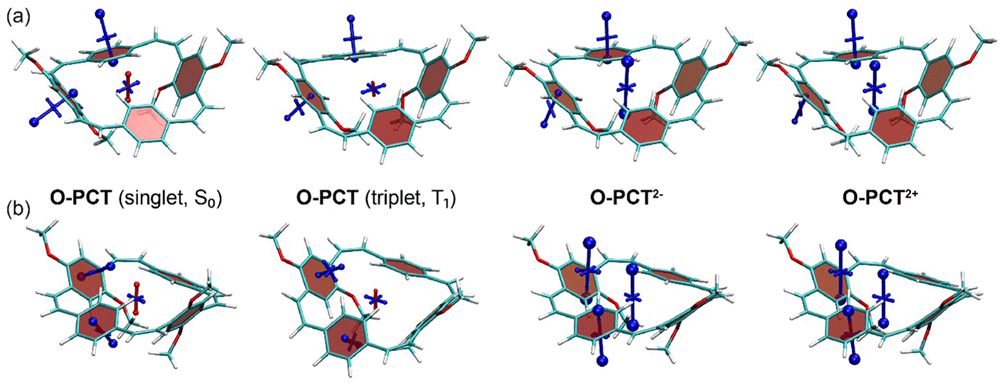
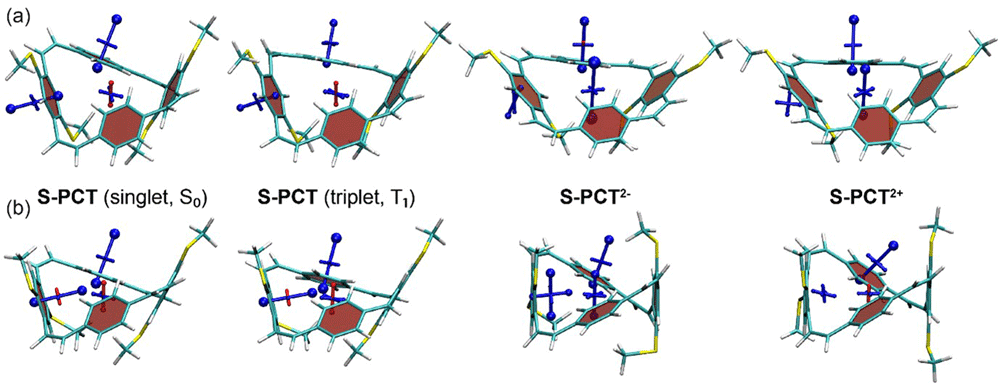
The VIST plots of O-PCT and S-PCT in the neutral S0 and T1 states as well as in the doubly charged S0 states are provided in Figure 7 and Figure 8, respectively. Shielding tensors were computed at the centre of the ring to probe global ring currents as well as 1 Å off the centre of the phenylene units to probe their local aromaticity. Both rotamers of the macrocycles were analysed. The corresponding VIST plots of PCT are provided in our previous work6. The substituents are seen to have little effect on the magnetic properties of the neutral S0 state. As in our previous analysis of PCT, the main component of the chemical shielding tensors located 1 Å off the planes of the phenylene units is shielded and almost perpendicular to the planes, indicating their local aromaticity. At the centre of the macrocycle, the tensor component perpendicular to the plane of the macrocycle is slightly deshielded, possibly indicating weak global antiaromaticity of the macrocyclic [4n] π-electron system.

fb9bede9-b71b-4655-b55e-c9d919c30e9d_figure7.gif

Figure 7.

VIST plots for the rotamers (a) C2 and (b) Cs of O-PCT (classified according to their idealised symmetry properties) in different charge and spin states. Shielded (aromatic) tensor components are shown in blue, deshielded (antiaromatic) tensor components in red. Each tensor component relates to ring currents in a plane perpendicular to it.

fb9bede9-b71b-4655-b55e-c9d919c30e9d_figure8.gif

Figure 8.

VIST plots for the rotamers (a) C2 and (b) Cs of S-PCT (classified according to their idealised symmetry properties) in different charge and spin states. Shielded (aromatic) tensor components are shown in blue, deshielded (antiaromatic) tensor components in red. Each tensor component relates to ring currents in a plane perpendicular to it.

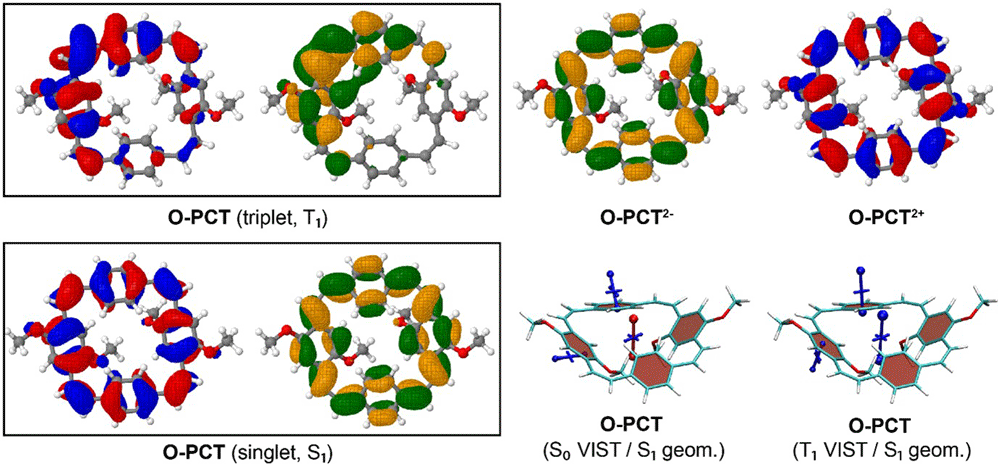
In contrast to the S0 state, the magnetic properties of the neutral T1 state of O-PCT and S-PCT differ significantly from those of PCT. The VIST plots of PCT in the T1 state indicate strong aromatic macrocyclic currents (and perturbed local aromaticity). This macrocyclic Baird aromaticity is obliterated by the introduction of the substituents; as the S0 states, the neutral T1 states of O-PCT and S-PCT are dominated by the local aromaticity of the phenylene units. To explain this phenomenon, we analysed the electronic structure in more detail by computing the natural difference orbitals (NDOs)16 between the S0 and T1 states of the C2 rotamer of O-PCT as an example. The NDOs, shown on the upper left in Figure 9, reveal that in the T1 state the symmetry is broken, and the excitation is localised on one side of the molecule. More specifically, the excitation is centred around one of the vinyl groups, which is strongly twisted out of plane. Following the arguments in Ref. 17, it can be understood that Baird aromaticity would only be achieved if the transition occurred between delocalised orbitals in a cyclically conjugated structure. Next, we were interested whether similar symmetry breaking occurs for the S1 state. Therefore, the S1 state was optimised, and the NDOs obtained are shown on the lower left in Figure 9. In contrast to the T1 state, the excitation in the S1 state is evenly delocalised over the whole macrocycle. Closer inspection shows that both NDOs possess 12 nodal planes, corresponding to the quasidegenerate HOMO and LUMO of the parent [24]annulene structure. The excitation occurs between these quasidegenerate orbitals, which is the signature of excited-state aromaticity within the MO picture17 and is, thus, consistent with the large Stokes shift observed in the measurements. The computation of shielding tensors in the S1 state is not routinely possible. Therefore, we have computed VIST plots of the S0 and T1 states at the S1 geometry instead (Figure 9, bottom right). These show enhanced antiaromaticity and aromaticity compared to the VIST plots at the geometries optimized for the respective states, further confirming that the S1 geometry facilitates delocalisation.

fb9bede9-b71b-4655-b55e-c9d919c30e9d_figure9.gif

Figure 9. Dominant natural difference orbitals (NDOs) (blue/red for electron detachment; green/orange for attachment) for different electronic states of O-PCT (C2 rotamer) and VIST plots for the S0 and T1 states at the S1 geometry.

Differently to the T1 state, the VIST plots of the doubly charged states of O-PCT and S-PCT (Figure 7 and Figure 8) indicate similarly strong macrocyclic aromaticity as observed for PCT2- and PCT2+ with the exception of the Cs rotamer of S-PCT2+ for which the VIST plot does not indicate any macrocyclic currents. In all other cases, the main component of the chemical shielding tensors at the phenylene units are tilted and almost perpendicular to the plane of the macrocycle, indicating strong perturbation of the local aromaticity by macrocyclic currents. The central shielding tensors also indicate the strong macrocyclic currents. To exemplify the change in electronic structure, we present the NDOs of the C2 rotamer of O-PCT (Figure 9, upper right). The relevant attachment NDO for the dianion as well as the detachment NDO for the dication are both evenly delocalised over the entire macrocycle. More specifically, they are of similar shape as the S1 NDOs, possessing the 12 nodal planes corresponding to the quasidegenerate [24]annulene frontier orbitals. Revisiting the Cs rotamer of S-PCT2+, we find that its relevant orbitals do not possess the required cyclically delocalised structure, thus explaining the lack of aromaticity.

A more quantitative picture is provided in Table 1 considering the shielding tensor at the centre of the ring. Specifically, we present the negative of the eigenvalue of the shielding tensor that corresponds to the dumbbell pointing out of plane in the VIST plots shown above, denoted NICSev. For systems of higher symmetry, NICSev is equivalent to the commonly used NICSzz values. However, the definition used here is also applicable for the presented molecules of lower symmetry where there is no well-defined “z-axis”. We present values for the original PCT structure, taken from Ref. 6, along with values for O-PCT and S-PCT as shown in Figure 7 and Figure 8. In addition, we present data considering the frozen structure of PCT optimised in the respective electronic state with added methoxy or methylthio substituents, denoted O-PCT@PCT and S-PCT@PCT. The NICS values for S0 are all positive (between 6 and 11 ppm), indicating slight antiaromaticity along with the discussion above. Striking differences are observed for the T1 values. These are positive and close to zero for the fully optimised structures of O-PCT and S-PCT whereas the O-PCT@PCT and S-PCT@PCT models show strong global aromaticity (-37.7 and -35.8 ppm). This highlights that Baird aromaticity is not hindered by the substituents as such but that aromaticity is lowered only when the geometry relaxes. The doubly charged states exhibit strongly negative NICS values throughout, indicating aromaticity. Finally, it is worth pointing out that the O-PCT@PCT shielding values for T1, 2-, and 2+ are consistently higher than the corresponding values for PCT. This suggests that the effect of the “pure” substitution is even an enhancement in aromatic ring currents.

Table 1. NICSev values determined at the centre of the macrocycle for the different molecules, considering always the C2 rotamer, and electronic states.

S0T12-2+
PCTa11.0-35.8-38.7-33.5
O-PCTa9.62.8-38.5-29.8
S-PCTa6.65.9-37.2-25.1
O-PCT@PCTb7.8-37.7-42.5-33.6
S-PCT@PCTb8.1-35.8-43.0-31.0

a Structure fully optimised for the respective state.

b Based on a frozen structure of PCT optimised for the respective state with added methoxy or methylthio substituents.

In summary, we find that O-PCT and S-PCT possess similar electronic structure as the parent PCT molecule. But similarly to our previously discussed ester-substituted molecules6, we find that due to their lower symmetry they are further removed from the underlying idealised antiaromatic [24]annulene structure. The large Stokes shifts seen in the UV/vis absorption and PL spectra (Figure 5) are consistent with excited-state aromaticity, as seen for the optimised S1 state of O-PCT in Figure 9. On the other hand, we tentatively assign the enhanced photoluminescence activity of the substituted molecules to an increased propensity for symmetry breaking, which is seen explicitly in the T1 optimised structure and probably also plays a role for the S1 state in terms of structural fluctuations. However, a full ab initio simulation of the resulting spectra is out of the scope of this work.

Conclusions

Our study shows that methoxy- and methylthio-substituted PCT derivatives can be obtained by Wittig cyclisation reactions of substituted [1,4-phenylenebis(methylene)]bis(triphenylphosphonium) dibromides and terephthalaldehyde, in similar yields as reported for the synthesis of unsubstituted PCT. The required substituted Wittig cyclisation precursors can be obtained in good yields via a two/three-step procedure. Placing substituents on the terephthalaldehyde precursor did not yield the macrocycles in our attempts.

While the energy barrier for the rotation of the methoxy-substituted phenylene units in O-PCT was found to allow a rapid interconversion of the two rotamers, the significantly higher energy barrier for the rotation of the methylthio-substituted phenylene units in S-PCT resulted in distinct 1H NMR signals that can be assigned to the two rotamers. Computations supported this finding, highlighting that the interconversion barrier in S-PCT is more than twice the barrier in O-PCT, increasing the expected interconversion time from 10 µs to well over one hour. The larger barrier was related to the bulkier nature of the methylthio substituents when compared to the methoxy substituents.

The introduction of the substituents was also found to alter the optoelectronic properties of PCT. In particular, the maximum photoluminescence (PL) intensity of O-PCT was found to be approximately eight times higher than for PCT, a feature that we tentatively assign to dynamic excited-state symmetry breaking and the associated lifting of selection rules. However, despite the increase in PL intensity, the photoluminescence quantum yield (PLQY) of the substituted macrocycles was still low. While the PL maxima were found to be redshifted, the UV-vis absorption maxima of O-PCT and S-PCT were slightly blueshifted compared to PCT, thus increasing the overall Stokes shifts to above 1.5 eV, which is more than three times the value of the linear PPV analogues. Furthermore, the electron-donating character of the substituents leads to a shift of the redox potentials to lower values, as confirmed by cyclic voltammetry measurements in two different solvents along with computations. This can be an interesting feature for tuning the properties for applications such as organic battery electrodes and further confirms the high tuneability of the properties of this compound class.

In the neutral and most of the doubly charged singlet states of O-PCT and S-PCT, the ring currents and chemical shielding do not differ significantly from those of PCT in the same states, according to our computational investigation using the visualisation of chemical shielding tensors (VIST) method. However, in the neutral T1 state, the macrocyclic Baird aromaticity observed in the VIST plots of PCT is obliterated by the introduction of the substituents and the associated breaking of the symmetry; the molecules are dominated by the local aromaticity of the phenylene units.

In summary, the study expands the set of available [2.2.2.2]cyclophanetetraenes and offers further insights into the tuneability of the properties of this versatile compound class.

Methods

Synthetic methods

Reagents and solvents for the synthesis were purchased from commercial suppliers and used without further purification, including compounds S-1 (Sigma-Aldrich, product number 196525), O-2 (Sigma-Aldrilch, product number D131350), P1 (Alfa Aesar, product number A18241.14), and P2 (Sigma-Aldrich, product number 808617). Purification by recycling preparative GPC was carried out on a LaboACE LC-5060 (Japan Analytical Industry Co., Tokyo, JAPAN) system equipped with a JAIGEL-2HR column and a TOYDAD800-S detector.

1,4-Bis(methylthio)benzene (S-2): Synthesis adapting a published procedure7. 4-Bromothioanisole (S 1) (508 mg, 2.5 mmol, 1.0 equiv.), CuI (119 mg, 0.63 mmol, 0.25 equiv.) and Cu(OAc)2 (908 mg, 5.0 mmol, 2.0 equiv.) were added to an oven-dried vial, purged with nitrogen and sealed before adding 8 mL DMSO. The suspension was heated to 135 °C for 36 hours before cooling to room temperature (r.t.) and adding 40 mL Et2O. The orange suspension was filtered off and washed with cold H2O before extracting the filtrate with Et2O (3x), drying the organic phase with Na2SO4 and removing the solvent under reduced pressure. Product S-2 was purified by column chromatography using hexane/Et2O (10:1), yielding an off-white, wax-like solid (305 mg, 1.8 mmol, 72%). 1H NMR (400 MHz, CDCl3): δ 7.20 (s, 4H), 2.47 (s, 6H) ppm; in accordance with the literature7.

2,5-Bis(bromomethyl)-1,4-dimethoxybenzene (O-3): Synthesis adapting a procedure used for the bromomethylation of 1,4-dihexyloxybenzene3. 1,4-Dimethoxybenzene (O-2) (691 mg, 5.0 mmol, 1.0 equiv.) and paraformaldehyde (901 mg, 30 mmol, 6.0 equiv.) were suspended in 20 mL 1,4-dioxane. 8.0 mL HBr (30% in acetic acid) was added dropwise and the reaction was heated to 80 °C for 24 hours. The white suspension was slowly cooled to r.t., allowing the product to crystallise as a white solid. The solid was filtered off, washed twice with H2O and recrystallised from acetonitrile (MeCN), yielding product O-3 as white needles (837 mg, 2.6 mmol, 52%). 1H NMR (400 MHz, CDCl3): δ 6.87 (s, 2H), 4.54 (s, 4H), 3.87 (s, 6H) ppm; in accordance with the literature18.

2,5-Bis(bromomethyl)-1,4-bis(methylthio)benzene (S-3): Synthesis adapting a procedure used for the bromomethylation of related substrates3. 1,4-Bis(methylthio)benzene (S-2) (375 mg, 2.2 mmol, 1.0 equiv.) and paraformaldehyde (264 mg, 8.8 mmol, 4.0 equiv.) were dissolved in 20 mL formic acid while heating to 80 °C. 3.1 mL HBr (30% in acetic acid) were added and the reaction was stirred at 80 °C for 1 hour. Paraformaldehyde (264 mg, 8.8 mmol, 4.0 equiv.) and 3.1 mL HBr (30% in acetic acid) were added three more times in intervals of 1 hour; the reaction was then stirred at 80 °C overnight using a magnetic stirrer. The white suspension was slowly cooled to r.t., allowing the product to crystallise as an off-white solid. Product S-3 was isolated by filtering and washing with MeOH (685 mg, 1.9 mmol, 87%). 1H NMR (400 MHz, CD2Cl2): δ 7.28 (s, 2H), 4.63 (s, 4H), 2.52 (s, 6H) ppm. 1H NMR (400 MHz, CDCl3): δ 7.26 (s, 2H, overlaps with solvent peak), 4.61 (s, 4H), 2.52 (s, 6H) ppm; 13C{1H} NMR (101 MHz, CDCl3): δ 137.2, 136.0, 129.5, 31.1, 16.7 ppm. HRMS (m/z): [M]+ calcd for C10H12S2Br2: 353.8742, found: 353.8733 (APCI).

[(2,5-dimethoxy-1,4-phenylene)bis(methylene)]bis(triphenylphosphonium) dibromide (O-P1): Substrate O-3 (713 mg, 2.2 mmol, 1.0 equiv.) and PPh3 (2.02 g, 7.7 mmol, 3.5 equiv.) were suspended in 7.5 mL anhydrous toluene in a sealed vial under nitrogen and heated to 120 °C overnight. The white precipitate was filtered and washed with toluene and Et2O. Product O-P1 was isolated as a white solid (1.56 g, 1.8 mmol, 84%). 1H NMR (400 MHz, CDCl3): δ 7.79 – 7.73 (m, 6H), 7.73 – 7.61 (m, 24H), 6.96 (d, J = 1.9 Hz, 2H), 5.23 (d, J = 12.8 Hz, 4H), 2.97 (s, 6H) ppm. 31P{1H} NMR (162 MHz, CDCl3): δ 21.82 ppm. HRMS (m/z): [M–2Br]2+ calcd for C46H42Br2O2P2: 344.1330, found: 344.1325 (ESI).

[(2,5-bis(methylthio)-1,4-phenylene)bis(methylene)]bis(triphenylphosphonium) dibromide (S-P1): Substrate S-3 (605 mg, 1.7 mmol, 1.0 equiv.) and PPh3 (1.34 g, 5.1 mmol, 3.0 equiv.) were suspended in 25 mL anhydrous toluene in a sealed vial under nitrogen and heated to 120 °C overnight. The white precipitate was filtered and washed with toluene and Et2O. Product S-P1 was isolated as a white solid (1.30 g, 1.5 mmol, 87%) after triturating in boiling n-butanol for 1.5 h for further purification. 1H NMR (400 MHz, CDCl3): δ 7.82 – 7.74 (m, 6H), 7.73 – 7.59 (m, 24H), 7.13 (d, J = 2.1 Hz, 2H), 5.52 (d, J = 12.5 Hz, 4H), 1.71 (s, 6H) ppm. 31P{1H} NMR (162 MHz, CDCl3): δ 22.00 ppm. HRMS (m/z): [M–2Br]2+ calcd for C46H42Br2P2S2: 360.1101, found: 360.1111 (ESI).

2,5-Dibromoterephthalaldehyde (Br-P2): Synthesis adapting a published procedure8. Terephthalaldehyde (P2) (8.05 g, 60 mmol, 1.0 equiv.) was dissolved in 80 mL conc. H2SO4 at 60 °C. N-Bromosuccinimide (NBS) (23.5 g, 132 mmol, 2.2 equiv.) was added in small portions over 30 min. The reaction was then stirred for 3 hours at 60 °C before cooling to r.t. and pouring onto ice. The white precipitate was washed with aq. NaHCO3 and brine before being recrystallised from CHCl3. Br-P2 was isolated as off-white crystals (9.30 g, 31.9 mmol, 53%). 1H NMR (400 MHz, CDCl3): δ 10.35 (s, 2H), 8.16 (s, 2H) ppm; in accordance with the literature19.

2,5-Bis(methylthio)terephthalaldehyde (S-P2): Synthesis adapting a published procedure9. Br-P2 (992 mg, 3.4 mmol, 1.0 equiv.) was dissolved in 70 mL DMF before adding NaSCH3 (498 mg, 7.1 mmol, 2.1 equiv.) at r.t. The dark red solution was stirred for 10 minutes and then poured into 250 mL 1M HCl, forming an orange precipitate. The mixture was extracted with CHCl3 (3x), the organic phase dried with Na2SO4 and the solvent removed under reduced pressure. The crude product was recrystallised from MeCN, yielding S-P2 as an orange solid (630 mg, 2.8 mmol, 82%). 1H NMR (400 MHz, CDCl3): δ 10.41 (s, 2H), 7.80 (s, 2H), 2.57 (s, 6H) ppm; in accordance with the literature9.

Methoxy-substituted [2.2.2.2]paracyclophanetetraene O-PCT: Wittig cyclisation precursor O-P1 (1.19 g, 1.4 mmol, 1.0 equiv.) and terephthalaldehyde (P2) (188 mg, 1.4 mmol, 1.0 equiv.) were dissolved in 70 mL anhydrous DMF under nitrogen, purged with nitrogen for 5 min and cooled to -40 °C using an MeCN/dry ice bath. Lithium methoxide (159 mg, 4.2 mmol, 3.0 equiv.) was dissolved in 18 mL anhydrous MeOH by sonication, purged with nitrogen for 2 minutes (purge carefully to avoid precipitation) and added to the reaction over 9 hours using a syringe pump. The rate of addition was adjusted to maintain a faint red colour of the solution. After complete addition of the base, the reaction was stirred overnight, using a magnetic stirrer, while warming to r.t. The resulting suspension was poured into H2O and extracted with Et2O (3x), the organic phase dried with Na2SO4 and the solvent removed in vacuo. The obtained solid was dissolved CH2Cl2 and flashed over silica using CH2Cl2 as the eluent until the solvent ran clear (to remove the Wittig reaction side product triphenylphosphine oxide (TPPO)). The crude product was purified by recycling preparative GPC using CHCl3 as the eluent, yielding O-PCT as a yellow oil that crystallised slowly over time (32 mg, 0.06 mmol, 9%). 1H NMR (400 MHz, CDCl3): δ 7.08 (s, 8H), 6.72 (s, 4H), 6.58 (d, J = 12.2 Hz, 4H), 6.52 (d, J = 12.1 Hz, 4H), 3.55 (s, 12H) ppm. 13C{1H} NMR (101 MHz, CDCl3): δ 151.1, 136.0, 130.8, 128.8, 127.0, 126.2, 113.4, 56.3 ppm. HRMS (m/z): [M]+ calcd for C36H32O4: 528.2301, found: 528.2301 (ESI).

Methylthio-substituted [2.2.2.2]paracyclophanetetraene S-PCT: Wittig cyclisation precursor S-P1 (1.00 g, 1.14 mmol, 1.0 equiv.) and terephthalaldehyde (P2) (153 mg, 1.14 mmol, 1.0 equiv.) were dissolved in 35 mL anhydrous DMF under nitrogen, purged with nitrogen for 5 min and cooled to -40 °C using an MeCN/dry ice bath. Lithium methoxide (130 mg, 3.4 mmol, 3.0 equiv.) was dissolved in 9 mL anhydrous MeOH by sonication, purged with nitrogen for 2 minutes (purge carefully to avoid precipitation) and added to the reaction over 9 hours using a syringe pump. The rate of addition was adjusted to maintain a faint red colour of the solution. After complete addition of the base, the reaction was stirred overnight while warming to r.t. The resulting suspension was poured into H2O and extracted with Et2O (3x), the organic phase dried with Na2SO4 and the solvent removed in vacuo. The obtained solid was dissolved CH2Cl2 and flashed over silica using CH2Cl2 as the eluent until the solvent ran clear (to remove the Wittig reaction side product triphenylphosphine oxide (TPPO)). The crude product was purified by recycling preparative GPC using CHCl3 as the eluent, yielding S-PCT as an orange solid (48 mg, 0.08 mmol, 14%). 1H NMR measurements (including measurements at elevated temperature) suggest that the product is a mixture of two rotamers (ratio approx. 10:1, determined from 1H NMR integrals). Main rotamer: 1H NMR (400 MHz, CDCl3): δ 6.97 (s, 4H), 6.95 (s, 8H), 6.63 (d, J = 12.0 Hz, 4H), 6.57 (d, J = 12.0 Hz, 4H), 2.14 (s, 12H) ppm. 13C{1H} NMR (101 MHz, CDCl3): δ 137.0, 135.6, 134.2, 131.5, 129.0, 128.2, 127.0, 16.0 ppm. 1H NMR (400 MHz, CDCl3, 50 °C): δ 7.00 (s, 4H), 6.95 (s, 8H), 6.65 (d, J = 11.9 Hz, 4H), 6.58 (d, J = 11.9 Hz, 4H), 2.14 (s, 12H) ppm. Minor rotamer: 1H NMR (400 MHz, CDCl3): 7.00 (s, 4H), 6.98 (s, 8H), 6.58 (s, 8H), 2.22 (s, 12H) ppm. 1H NMR (400 MHz, CDCl3, 50 °C): δ 7.03 (s, 4H), 6.99 (s, 8H), 6.58 (s, 8H), 2.21 (s, 12H) ppm. HRMS (m/z): [M+H]+ calcd for C36H32S4: 593.1460, found: 593.1444 (APCI).
Measurement methods and instrumentation

NMR spectra were recorded in CDCl3 solution at 400 MHz for 1H, 101 MHz for 13C, and 162 MHz for 31P on a Bruker AV-400 spectrometer. High-resolution mass spectrometry (HRMS) was carried out on systems from Thermo Scientific (Thermo Scientific Q-Exactive/Dionex Ultimate 3000) for atmospheric pressure chemical ionization (APCI) and Waters (Waters LCT Premier (ES-ToF)/Acquity i-Class) for electrospray ionization (ESI). While the Thermo Scientific system gives the actual mass of the ionized compounds, the Waters system is calibrated to give the mass of the neutral compounds. This was considered when calculating the m/z values for comparison with the measurements.

UV-vis absorption spectra were recorded on an Agilent Cary 60 UV-vis spectrophotometer at room temperature. The measurements of the macrocycles were carried out with 5 μM solutions in CHCl3 at a scan rate of 300 nm min-1 and a data interval of 0.5 nm. The baseline was corrected for plotting the data in Figure 5. Photoluminescence (PL) spectra of the macrocycles were acquired on an Agilent Cary Eclipse fluorescence spectrophotometer with 5 μM solutions in CHCl3 at a scan rate of 120 nm min-1 and a data interval of 1 nm. The excitation and emission slits were set to 5 nm, the emission and excitation filters were set to ‘auto’ setting, and the detector voltage was set to ‘high’ (800 V). To facilitate a comparison, these are the same settings as used in our previous work on a set of ester-substituted macrocycles6. For the relative determination of the photoluminescence quantum yield (PLQY) of the macrocycles, UV-vis absorption and PL spectra of a 50 μM solution of quinine in 0.05 M H2SO4 were recorded as a reference. For the PL measurements of this reference, a neutral density filter (ND 1.5) was used in the emission pathway to enable measurements under the same instrument settings as used for the macrocycles. The use of neutral density filters is recommended to enable the determination of very small quantum yields (<1%) relative to a moderately to highly emissive reference20. For the calculation of the PLQYs of the macrocycles according Ref. 20, a PLQY of 60% was assumed for the reference21.

Cyclic voltammetry (CV) measurements were carried out at arbitrary concentration using a glassy carbon working electrode, a platinum mesh auxiliary electrode, and a silver wire quasi-reference electrode (QRE) at a scan rate of 0.1 V s-1. 0.1 M Tetrabutylammonium hexafluorophosphate (NBu4PF6) in dichloroethane (DCE) or dimethylformamide (DMF) were used as the supporting electrolyte solution. Ferrocene (Fc) was measured as reference. The solutions were purged with nitrogen for 5 min prior to the measurements. However, the presences of a reduction process at around -1.4 V vs. Fc/Fc+ in the measurements suggests that some residual oxygen was not efficiently removed by the purging process22. This reduction process was also present when measuring the supporting electrolyte solutions only (without a sample), corroborating that the process does not involve the macrocycles. In line with best practice, the redox potentials were estimated from the half-wave potential (E1/2) when reversibility was observed and from the inflection-point potential (Ei) when no reversibility was observed23.

Computational methods

Geometries for the neutral S0 and T1 states as well as the dianion and dication were optimized in vacuum using density functional theory (DFT) with the PBE0 functional24,25 along with the def2-SV(P) basis set26 and the D3 dispersion correction27 in its optimised power version28. Transition state (TS) energies were optimized via a constrained optimization, fixing two of the phenylene-vinylene torsion angles, considering that a full TS optimization did not converge for S-PCT and verifying that the energies between this method and the full optimization were consistent for O-PCT. Interconversion times (t) between rotamers were estimated via the Eyring equation

1t=kThexp⁡(−ΔaEkT)

where k and h are the Boltzmann and Planck constants, T = 298 K is the temperature and ΔaE is the computed activation barrier. Redox potentials were computed using the PBE0 functional along with the def2-SVPD basis set using a conductor-like polarizable continuum model29 considering a dielectric constant of 10.125 to represent 1,2-dichloroethane (DCE) and following the procedure described in detail in Ref. 6. All these computations were carried out in Q-Chem 5.330,31. S1 states were optimised using time-dependent (TD) DFT with the ωPBEh functional32 (using ω=0.1 a.u. and 20% global Hartree-Fock exchange) along with the def2-SV(P) basis set and the D3 dispersion correction using the same D3-parameters as for PBE0.

Chemical shielding tensors were computed at the PBE0/def2-SVP level using gauge including atomic orbitals33 as implemented in Gaussian 0934. Shielding tensors were represented graphically using the VIST (visualisation of chemical shielding tensors) method14 as implemented in TheoDORE 2.435 using cclib36 for some of the file parsing work and VMD37 for the final graphical representation. Shielding tensors for the O/S-PCT@PCT structures were computed using the optimised structure of PCT for the respective state, freezing this structure, adding methoxy/methylthio substituents, and optimising only the geometry of those groups.

NDOs16 for the T1 and charged states were computed using TheoDORE following two independent DFT calculations. NDOs for the S1 state were computed directly within Q-Chem after the TDDFT computation.

Data availability

Underlying data

Zenodo: Research data for "[2.2.2.2]Paracyclophanetetraenes (PCTs): cyclic structural analogues of poly(p-phenylene vinylene)s (PPVs)". https://doi.org/10.5281/zenodo.632347538

This project contains the following data:

  • - The underlying experimental research data (1H NMR, 13C NMR, 31P NMR, high-resolution mass spectrometry (HRMS), UV-vis absorption, photoluminescence (PL), cyclic voltammetry)

  • - The underlying computational research data (molecular geometries, input/output files for Q-Chem, Gaussian, and TheoDORE)

Data are available under the terms of the Creative Commons Attribution 4.0 International license (CC-BY 4.0).

The 1H NMR, 13C NMR, and 31P NMR spectra are also available via ChemSpider. See CSIDs: 120300 (S-2), 3332510 (O-3), 110417237 (S-3), 110417244 (O-P1), 110417245 (S-P1), 14757439 (Br-P2), 110417240 (S-P2), 110417241 (O-PCT), and 110417242 (S-PCT).

Acknowledgements

We thank Ugurcan Sal for contributing to synthetic experiments, Lisa Haigh for HRMS measurements, and Peter Haycock for NMR measurements at elevated temperature (all Imperial College London).

References

  • 1.  Blayney AJ, Perepichka IF, Wudl F, et al.: Advances and Challenges in the Synthesis of Poly(p-phenylene vinylene)-Based Polymers. Isr J Chem. 2014; 54(5–6): 674–688. Publisher Full Text
  • 2.  Schönbein AK, Wagner M, Blom PWM, et al.: Quantifying the Kinetics of the Gilch Polymerization toward Alkoxy-Substituted Poly(p-phenylene vinylene). Macromolecules. 2017; 50(13): 4952–4961. Publisher Full Text
  • 3.  Rimmele M, Ableidinger K, Marsh AV, et al.: Thioalkyl- and sulfone-substituted poly(p-phenylene vinylene)s. Polym Chem. 2019; 10(6): 738–750. Publisher Full Text
  • 4.  Thulin B, Wennerström O, Högberg HE: Simple Synthesis of [2.2.2.2]-Paracyclophane-1,9,17,25-Tetraene by a Wittig Reaction. Acta Chem Scand Ser B. 1975; 29(1): 138–139. Publisher Full Text
  • 5.  Eder S, Yoo DJ, Nogala W, et al.: Switching between Local and Global Aromaticity in a Conjugated Macrocycle for High-Performance Organic Sodium-Ion Battery Anodes. Angew Chem Int Ed. 2020; 59(31): 12958–12964. PubMed Abstract | Publisher Full Text | Free Full Text
  • 6.  Rimmele M, Nogala W, Seif-Eddine M, et al.: Functional group introduction and aromatic unit variation in a set of π-conjugated macrocycles: revealing the central role of local and global aromaticity. Org Chem Front. 2021; 8(17): 4730–4745. PubMed Abstract | Publisher Full Text | Free Full Text
  • 7.  Amal Joseph PJ, Priyadarshini S, Kantam ML, et al.: Investigation of the scope and mechanism of copper catalyzed regioselective methylthiolation of aryl halides. Tetrahedron. 2013; 69(38): 8276–8283. Publisher Full Text
  • 8.  Prusinowska N, Bardziński M, Janiak A, et al.: Sterically Crowded Trianglimines-Synthesis, Structure, Solid-State Self-Assembly, and Unexpected Chiroptical Properties. Chem Asian J. 2018; 13(18): 2691–2699. PubMed Abstract | Publisher Full Text
  • 9.  Yamamoto T, Nishimura T, Mori T, et al.: Largely π-Extended Thienoacenes with Internal Thieno[3,2-b]thiophene Substructures: Synthesis, Characterization, and Organic Field-Effect Transistor Applications. Org Lett. 2012; 14(18): 4914–4917. PubMed Abstract | Publisher Full Text
  • 10.  Szakács Z, Glöcklhofer F, Plasser F, et al.: Excited-state symmetry breaking in 9,10-dicyanoanthracene-based quadrupolar molecules: the effect of donor-acceptor branch length. Phys Chem Chem Phys. 2021; 23(28): 15150–15158. PubMed Abstract | Publisher Full Text | Free Full Text
  • 11.  Gierschner J, Mack HG, Lüer L, et al.: Fluorescence and absorption spectra of oligophenylenevinylenes: Vibronic coupling, band shapes, and solvatochromism. J Chem Phys. 2002; 116(19): 8596–8609. Publisher Full Text
  • 12.  Su WF, Yeh KM, Chen Y: Synthesis and optoelectronic properties of luminescent poly(p-phenylenevinylene) derivatives containing electron-transporting 1,3,4-oxadiazole groups. J Polym Sci Part A Polym Chem. 2007; 45(18): 4377–4388. Publisher Full Text
  • 13.  Kotani R, Liu L, Kumar P, et al.: Controlling the S1 Energy Profile by Tuning Excited-State Aromaticity. J Am Chem Soc. 2020; 142(35): 14985–14992. PubMed Abstract | Publisher Full Text
  • 14.  Plasser F, Glöcklhofer F: Visualisation of Chemical Shielding Tensors (VIST) to Elucidate Aromaticity and Antiaromaticity. Eur J Org Chem. 2021; 2021(17): 2529–2539. PubMed Abstract | Publisher Full Text | Free Full Text
  • 15.  Chen Z, Wannere CS, Corminboeuf C, et al.: Nucleus-Independent Chemical Shifts (NICS) as an Aromaticity Criterion. Chem Rev. 2005; 105(10): 3842–3888. PubMed Abstract | Publisher Full Text
  • 16.  Plasser F, Wormit M, Dreuw A: New tools for the systematic analysis and visualization of electronic excitations. I. Formalism. J Chem Phys. 2014; 141(2): 024106. PubMed Abstract | Publisher Full Text
  • 17.  Plasser F: Exploitation of Baird Aromaticity and Clar’s Rule for Tuning the Triplet Energies of Polycyclic Aromatic Hydrocarbons. Chemistry. 2021; 3(2): 532–549. Publisher Full Text
  • 18.  Kotha S, Cheekatla SR, Lal S, et al.: Pentacycloundecane (PCUD)-Based Cage Frameworks as Potential Energetic Materials: Syntheses and Characterization. Asian J Org Chem. 2020; 9(12): 2116–2126. Publisher Full Text
  • 19.  Meindl B, Pfennigbauer K, Stöger B, et al.: Double Ring-Closing Approach for the Synthesis of 2,3,6,7-Substituted Anthracene Derivatives. J Org Chem. 2020; 85(12): 8240–8244. PubMed Abstract | Publisher Full Text
  • 20.  Würth C, Grabolle M, Pauli J: Relative and absolute determination of fluorescence quantum yields of transparent samples. Nat Protoc. 2013; 8(8): 1535–1550. PubMed Abstract | Publisher Full Text
  • 21.  Brouwer AM: Standards for photoluminescence quantum yield measurements in solution (IUPAC Technical Report). Pure Appl Chem. 2011; 83(12): 2213–2228. Publisher Full Text
  • 22.  Elgrishi N, Rountree KJ, McCarthy BD, et al.: A Practical Beginner’s Guide to Cyclic Voltammetry. J Chem Educ. 2018; 95(2): 197–206. Publisher Full Text
  • 23.  Espinoza EM, Clark JA, Soliman J, et al.: Practical Aspects of Cyclic Voltammetry: How to Estimate Reduction Potentials When Irreversibility Prevails. J Electrochem Soc. 2019; 166(5): H3175–H3187. Publisher Full Text
  • 24.  Perdew JP, Burke K, Ernzerhof M: Generalized Gradient Approximation Made Simple. Phys Rev Lett. 1996; 77(18): 3865–3868. PubMed Abstract | Publisher Full Text
  • 25.  Adamo C, Barone V: Toward reliable density functional methods without adjustable parameters: The PBE0 model. J Chem Phys. 1999; 110(13): 6158–6170. Publisher Full Text
  • 26.  Weigend F, Ahlrichs R: Balanced basis sets of split valence, triple zeta valence and quadruple zeta valence quality for H to Rn: Design and assessment of accuracy. Phys Chem Chem Phys. 2005; 7(18): 3297–3305. PubMed Abstract | Publisher Full Text
  • 27.  Grimme S, Antony J, Ehrlich S, et al.: A consistent and accurate ab initio parametrization of density functional dispersion correction (DFT-D) for the 94 elements H-Pu. J Chem Phys. 2010; 132(15): 154104. PubMed Abstract | Publisher Full Text
  • 28.  Witte J, Mardirossian N, Neaton JB, et al.: Assessing DFT-D3 Damping Functions Across Widely Used Density Functionals: Can We Do Better? J Chem Theory Comput. 2017; 13(5): 2043–2052. PubMed Abstract | Publisher Full Text
  • 29.  Barone V, Cossi M: Quantum Calculation of Molecular Energies and Energy Gradients in Solution by a Conductor Solvent Model. J Phys Chem A. 1998; 102(11): 1995–2001. Publisher Full Text
  • 30.  Shao Y, Gan Z, Epifanovsky E, et al.: Advances in molecular quantum chemistry contained in the Q-Chem 4 program package. Mol Phys. 2015; 113(2): 184–215. Publisher Full Text
  • 31.  Krylov AI, Gill PMW: Q-Chem: an engine for innovation. Wiley Interdiscip Rev Comput Mol Sci. 2013; 3(3): 317–326. Publisher Full Text
  • 32.  Rohrdanz MA, Martins KM, Herbert JM: A long-range-corrected density functional that performs well for both ground-state properties and time-dependent density functional theory excitation energies, including charge-transfer excited states. J Chem Phys. 2009; 130(5): 054112. PubMed Abstract | Publisher Full Text
  • 33.  Cheeseman JR, Trucks GW, Keith TA, et al.: A comparison of models for calculating nuclear magnetic resonance shielding tensors. J Chem Phys. 1996; 104(14): 5497–5509. Publisher Full Text
  • 34.  Frisch MJ, Trucks GW, Schlegel HB, et al.: Gaussian 09, Revision E.01. Wallingford, CT, 2013.
  • 35.  Plasser F: TheoDORE: A toolbox for a detailed and automated analysis of electronic excited state computations. J Chem Phys. 2020; 152(8): 084108. PubMed Abstract | Publisher Full Text
  • 36.  O'boyle NM, Tenderholt AL, Langner KM: cclib: A library for package-independent computational chemistry algorithms. J Comput Chem. 2008; 29(5): 839–845. PubMed Abstract | Publisher Full Text
  • 37.  Humphrey W, Dalke A, Schulten K: VMD: visual molecular dynamics. J Mol Graph. 1996; 14(1): 33–38, 27–8. PubMed Abstract | Publisher Full Text
  • 38.  Pletzer M, Plasser F, Rimmele M, et al.: Research data for "[2.2.2.2]Paracyclophanetetraenes (PCTs): cyclic structural analogues of poly(p-phenylene vinylene)s (PPVs)". [Data set]. Zenodo. 2021. http://www.doi.org/10.5281/zenodo.6323475