Introduction
Fear of Falling (FoF) is a prevalent concern among older populations, often associated with significant morbidity, reduced mobility, and a decrease in overall quality of life1–5, especially among those with a history of falls6,7. Previous research, however, has overwhelmingly focused on trait FoF, or an ongoing, self-reported condition, while largely neglecting acute FoF, or sudden spikes in fear. This gap in research presents a critical opportunity to prevent falls right at the moment when they become most likely to occur.
Despite extensive previous research on trait FoF and its concurrent conditions, particularly gait and balance disorders8–11, as well as behavioral interventions in mitigating trait FoF12–16, considerably less is known about potential ways to measure acute FoF. Our argument is that, unlike trait FoF (the chronic manifestation of FoF) measured by survey instruments like the Falls Efficacy Scale International (FES-I), acute FoF could be traced instead by analyzing physiological biomarkers and gaze patterns of older adults through concurrent streams.
Although there have been very limited explorations of acute FoF per se, there is literature on its close relatives, acute stress and state anxiety17,18. Previous studies of acute stress identified several biomarkers, such as cortisol secretion after stress and increased heart rate (HR) and systolic blood pressure during stress19–22. Unlike the peak in cortisol secretion that occurs after the event of acute stress, HR increases throughout stress exposure, with peaks observed both at the beginning of stressor exposure and throughout its duration. This dynamic response makes HR a particularly useful temporal marker for acute stress and, by extension, for acute FoF.
In addition, previous research also recognizes HR and HR variability (HRV) as direct reliable physiological biomarkers to assess fall risk23,24. In another study, using HRV data among people with and without hypertension, Nugrahingsih et al. found that those with hypertension had a higher risk of falls25. HRV was also found to predict the risk of falling in first-time falls26. However, none of these studies connected HR or HRV to falls or acute FoF in real time.
Research has been considerably scarcer on the differences in oculomotor patterns of people experiencing FoF, even though most of them agree that gaze is important for studying falls. For example, previous studies have shown that individuals with a history of falling and those without tended to have different gaze behaviors27. Compared to fallers, non-fallers are more likely to have longer average fixation durations on far-located people while walking and, in general, avert their gaze to less relevant stimuli in the environment. Moreover, studies of state anxiety have shown that experiencing anxiety is related to increased attention (focus)28. Additionally, previous research has established that, compared to younger individuals, older adults have a reduced capacity to scan the environment in detail29. All these studies together indicate that gaze patterns might be related to falls and FoF, albeit have not explicitly analyzed their association with the latter.
A study that could be relevant in this regard showed that high-risk chronic FoF individuals were more likely to focus on looking at the immediate walkway areas only 1-2 steps ahead, indicating a lower elevation of their gaze30,31. There were also more numerous studies conducted on state anxiety and acute stress with oculomotor patterns, which are similarly useful in the study of acute FoF. These studies have shown that people experiencing state anxiety and acute stress exhibited longer fixation durations in their eye movements, indicating attention bias for threats32–36.
However, unlike lab-induced acute stress (which is usually based on stationary visual task experiments), acute FoF arises during dynamic tasks (e.g., walking or transitioning from sitting to standing). Thus, it is gaze elevation, particularly downward head pitches, that could be a more sensitive indicator of acute FoF than gaze fixation duration, as also shown based on measures of trait FoF30,31. When individuals feel heightened FoF, they direct their gaze toward the ground or near-field obstacles, reducing the time spent scanning the broader environment and, at times, ignoring other threats like moving cars and other environmental obstacles.
To address these gaps in the study of acute FoF, this paper presents a new multi-modal methodology for detecting "potential FoF" instances by combining oculomotor (gaze elevation) and physiological (HR) indicators. By focusing on both gaze elevation and HR, this work provides and tests a novel framework for studying acute FoF. This is the first study to test the feasibility of identifying windows of elevated physiological arousal in conjunction with downward-directed gaze as potential acute FoF events through multi-modal sensor data. Such "potential FoF" events are then used to train and evaluate machine learning and deep learning models.
In our study, raw sensor signals were cleaned, aligned, and low-pass filtered before being input into multiple classification models, including traditional machine learning algorithms, ensemble methods, and deep learning architectures. We evaluated logistic regression, k-nearest neighbors (KNN), random forest, XGBoost, and CatBoost, and ensemble models. For deep learning, we applied transfer learning by transforming accelerometer signals into spectrograms and fine-tuning pre-trained convolutional networks (VGG16, ResNet50). To assess modality-specific performance, we also tested all models on accelerometer signals alone.
Methods
The proposed model is designed to predict theoretically defined acute FoF instances in gaze elevation and HR signals from multi-modal sensor data. The overview of the methodology is shown in Figure 1 with three stages: 1) data pre-processing, 2) model training, and 3) model testing and prediction.
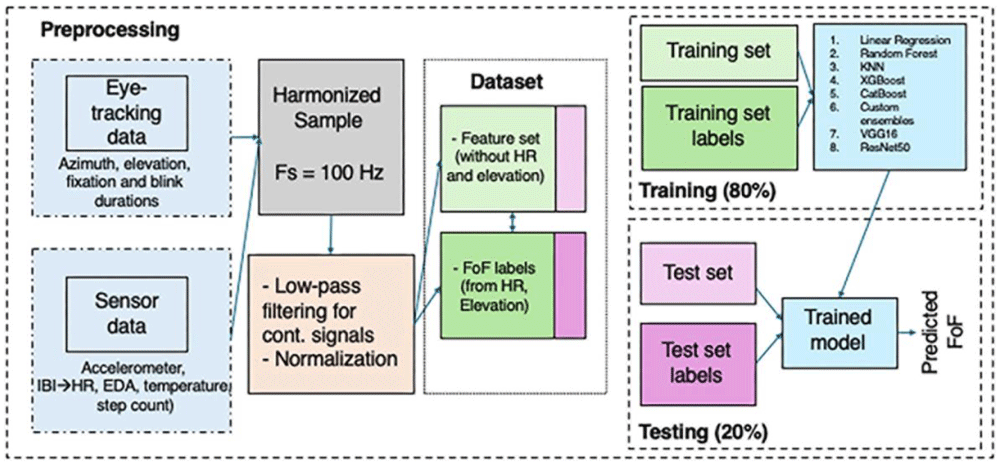
Figure 1. Overview of the methodology.
Observation setup and data collection
Fifteen community-dwelling older adults were initially enrolled in the study. However, only six (age: 55–64 years (n=4) and age 70–79 years (n=2)) were included into this study due to human error in saving raw Empatica data on an AWS server and data quality issues. Sensor time-series signals frequently contained missing values and high-frequency noise. Thus, we dropped observations where either biometric or gaze data did not record properly or was faulty or of poor quality. All participants included in the analytical sample reported moderate-to-high concern about falling (FES-I ≥ 27). The sample leans toward participants with higher state FoF because our recruitment specifically targeted individuals exhibiting elevated state FoF to maximize the likelihood of capturing FoF-related signatures in oculomotor and physiological signals. Oculomotor data came from mobile eye-tracking glasses (Pupil Labs Neon). Simultaneously, a suite of physiological and movement-related signals were captured with Empatica EmbracePlus wearable watches37. The ethics approval was obtained from the Research Ethics Board of York University (e2022–204).
Raw data extraction, HR calculation, and harmonization
Raw sensor data were acquired from wearable and eye-tracking devices. Note that blood volume pulse and gyroscope signals from Empatica EmbracePlus devices were excluded from subsequent analyses due to data quality problems and the high volume of missing records.
HR was derived from provided systolic peak timestamps. Each systolic peak corresponds to a single heartbeat event, and by computing the time differences between consecutive peaks, Inter-Beat Intervals (IBIs) were obtained. The IBI, measured in seconds, represents the duration between successive heartbeats. Prior to any interpolation or noise reduction, HR was calculated from these IBIs to ensure that the intrinsic beat-to-beat timing remained intact:
All data streams were aligned to a common temporal reference frame (100Hz) to facilitate subsequent multi-modal analyses. The observation sequences were constrained to synchronized time periods.
Signal pre-processing, low-pass filtering, and normalization
A low-pass filter was applied to key signals, excluding temperature, step counts, fixation, and blink durations (see Figure 2). This filtering step attenuated high-frequency noise components, yielding cleaner signals for downstream analyses. The low-pass filter was implemented using a 7th-order Butterworth Infinite Impulse Response (IIR) filter, previously validated for both gaze and biometric sensor data34. Each time-series signal x(t), sampled at fs = 100 Hz, was filtered to retain frequencies below the cutoff of fc = 5 Hz. The filter is defined as:
where N is the filter order and
ωc represents the cut-off frequency. The normalized cutoff was defined as
. Zero-phase distortion was ensured via bidirectional filtering, maintaining the temporal fidelity crucial for time-series analysis of gaze and biometric data
34.
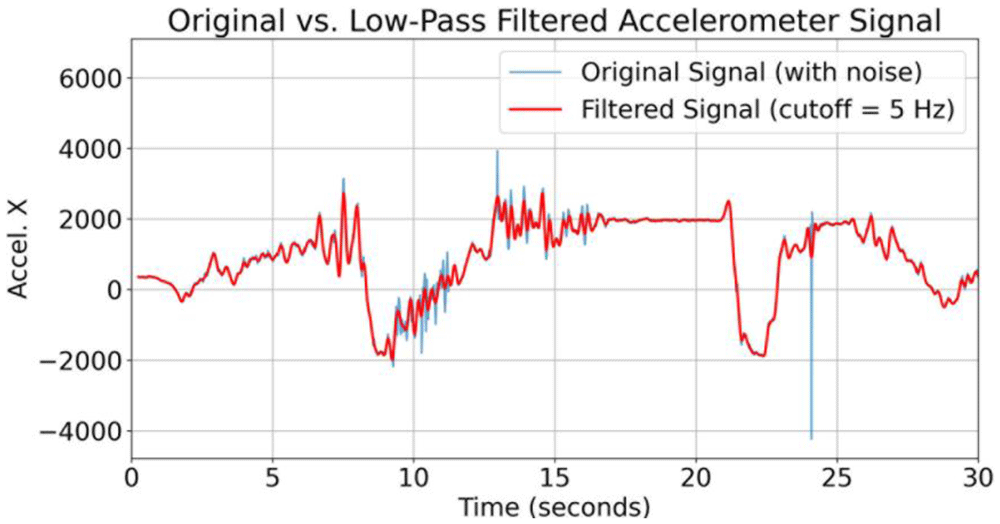
Figure 2. Raw and filtered signal for accelerometer (x).
Identification of potential FoF
Being a proof-of-concept study, our pilot relied on theoretical knowledge on HR and gaze patterns to identify potential acute FoF, as discussed above. Specifically, we examined participant-specific distributions of HR and gaze elevation data to define a binary metric of Potential FoF.
After data preprocessing, the continuous HR and gaze elevation signals were categorized into terciles for each participant. The highest HR tercile represented moments of relatively elevated physiological arousal, while the lowest gaze elevation tercile indicated downward-looking behavior patterns. A data segment was labeled as Potential FoF if it concurrently met both criteria: HR in the top tercile and gaze elevation in the bottom tercile. While these heuristic thresholds do not establish true FoF events, we adopt the term "Potential FoF" to reflect the exploratory scope of this study. Our objective is to test whether such periods can be reliably distinguished within the dataset. In Figure 3, potential FoF events are highlighted in light blue, identified based on concurrent HR (green) and gaze elevation (red) signals, with thresholds defined using participant-specific terciles across all observations.
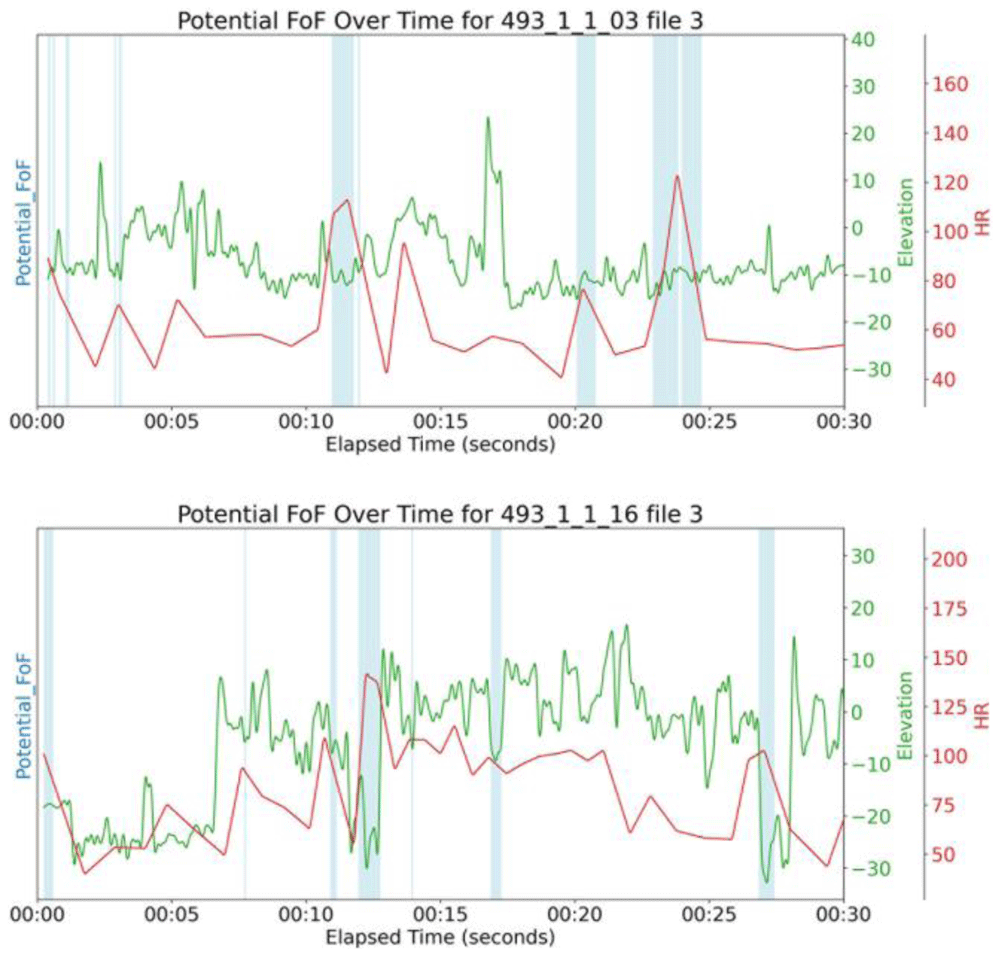
Figure 3. Potential FoF in Sensor Data.
Classification and transfer learning
Our experimental framework employed a two-stage evaluation. Hyperparameters were optimized by maximizing ROC AUC through stratified cross-validation on the training data. For evaluation, we report ROC AUC, and we additionally explored different decision thresholds on the test set to illustrate the maximum achievable F1-score for the minority class (Potential FoF cases). Then, two ensemble classification models were tested. The first ensemble combined Random Forest, CatBoost, and K-Nearest Neighbors, while the second ensemble replaced CatBoost with Logistic Regression.
Additionally, we implemented transfer learning with pre-trained VGG16 and ResNet50 architectures, restricted to accelerometer data (x, y, z axes). Continuous signals were segmented into fixed-length windows of 300 samples (3 s at 100 Hz), with trailing segments zero-padded to maintain consistent input size. Windows were labeled Potential FoF if more than 30% of samples within the segment carried the minority label. Then, each window is converted into log-scaled spectrograms. We only used accelerometer signals for these models to test whether a smaller subset of signals could be used to identify the potential FoF instances as a proof of concept for a more parsimonious approach.
Results
As shown in Table 1, the best-performing individual classifiers on the multi-modal dataset were XGBoost, Random Forest, and KNN, each achieving ROC AUC values of 0.99 and minority-class F1-scores of 0.85-0.93. In contrast, Logistic Regression performed poorly (AUC = 0.56, F1 = 0.21), while CatBoost produced slightly lower results than the top-performing models (AUC = 0.98, F1 = 0.81). These findings suggest that tree-based and distance-based approaches are well suited for capturing the nonlinear relationships in the potential acute FoF signals.
Table 1. Individual-Model Classifier Performance (ROC AUC and Minority-class F1).
| Classifier | ROC AUC | Minority F1 |
|---|
| Logistic Regression | 0.56 | 0.21 |
| KNN | 0.99 | 0.90 |
| Random Forest | 0.99 | 0.85 |
| XGBoost | 0.99 | 0.93 |
| CatBoost | 0.98 | 0.81 |
| Ensemble Models | | |
| Ensemble 1 (RF+CatBoost+KNN) | 0.99 | 0.95 |
| Ensemble 2 (RF+LR+KNN) | 0.99 | 0.94 |
| Transfer Learning Models | | |
| VGG16 (fine-tuned) | 0.90 | 0.83 |
| ResNet50 (fine-tuned) | 0.90 | 0.82 |
Ensemble strategies provided further gains in minority-class sensitivity and stability. Ensemble 1, combining Random Forest, CatBoost, and KNN, achieved an F1 of 0.95 and ROC AUC of 0.99, while Ensemble 2, substituting Logistic Regression for CatBoost, produced nearly identical results (Minority F1 = 0.94, ROC AUC = 0.99). We also evaluated all classifiers using accelerometer data alone in order to benchmark their performance against the transfer-learning models. The best results were achieved by Ensemble 1 (ROC AUC = 0.79, minority-class F1 = 0.39), followed closely by Ensemble 2 and KNN.
Transfer learning on spectrogram representations of accelerometer signals substantially improved upon these baselines. Fine-tuned VGG16 and ResNet50 both reached ROC AUC values of 0.90 and F1-scores of 0.82–0.83, demonstrating that pre-trained CNN models can extract patterns better from raw movement data. Importantly, these results were obtained using only accelerometer inputs, underscoring the potential of parsimonious sensor configurations for studying FoF. This aligns with previous research linking gait and balance dynamics to FoF8–11, and points to transfer learning as a promising approach for extracting clinically relevant information from wearable sensors.
Conclusions
In this work, we demonstrated a proof-of-concept multi-modal framework for detecting acute FoF events in older adults by combining oculomotor (gaze elevation) and physiological (HR) signals. Our experiments show that optimized ensemble methods achieved ROC AUC = 0.99 and minority-class F1 = 0.94–0.95, while spectrogram-based transfer learning with fine-tuned CNNs reached ROC AUC = 0.90 and minority-class F1 = 0.82-0.83 using accelerometer-only inputs. Together, these findings highlight two promising strategies for FoF detection: multi-modal ensembles and parsimonious accelerometer-based transfer learning, both showing great performance on highly imbalanced FoF data.
These results extend existing sensor-based fall-risk assessment by (1) introducing "potential FoF" as a multi-modal construct grounded in concurrent physiological arousal and downward gaze, and (2) validating both ensemble learning and cross-domain transfer learning on wearable data. Future work will expand ground-truth data collection, integrate additional biomarkers (e.g., pupil dilation), and scale to larger and more diverse cohorts. The ultimate goal is to enable timely, personalized interventions to prevent falls in everyday settings.
This study has several limitations. First, as a proof-of-concept, only six participants were included due to human error and data-quality exclusions, leaving the sample underpowered for population-level inference. Second, ground-truth FoF data were not available; a follow-up project will address this using micro-phenomenological debriefing interviews after one- and dual-task experiments with and without obstacles.
Together, our results highlight the feasibility of detecting potential acute FoF using multi-modal wearable-based approaches, opening avenues for scalable fall-prevention strategies.
Ethics and consent
The ethics approval was issued by the Research Ethics Board of York University (e2022-204). A written informed consent was obtained from all participants.