Introduction

The notion that art impacts society beyond its aesthetic value has a long history, dating back to the concept of catharsis proposed by Aristotle (Belfiore & Bennett, 2007). Since the 1990s, the social effects of the arts in a European context have been increasingly explored by researchers, policymakers, and other stakeholders (Belfiore, 2002; Belfiore & Bennett, 2010; Gray, 2007), and ‘social impact’ often forms a justification for public funding of the arts (Belfiore, 2002; Gray, 2007). For example, from 2016 to 2018, the Swedish government funded arts projects in socio-economically marginalised areas to advance democratic ideals and cultural participation, inspired by the Art Council England’s ‘Creative Spaces and People’.

This study is written in the context of the Horizon 2020 EU-funded AMASS Project (Acting on the Margins: Arts as Social Sculpture), which aims to address specific aspects of marginalisation in Europe through arts and creative activities (AMASS, 2019). The testbeds, comprising various art projects, are situated in the Czech Republic, Finland, Hungary, Italy, Malta, and Portugal, countries with a marginal position, geographically, socially and/or culturally, in the European Union. As an overarching project, AMASS is part of a policy trend to explore the potential of the arts to address social marginalisation in a changing Europe. Within the project, ‘the arts’ primarily refers to the performing and visual arts, and ‘social marginalisation’ primarily refers to individuals, populations, and communities that have not been able to fully exercise their social rights, in terms of, for example, access to educational systems and the labour market.

Thus, from a policy and practitioners’ perspective, the arts are often laden with a positive value, although some research argues that the arts exist only for those who can decipher them: a real impact of the arts can exist only for a small elite of educated people (Bourdieu, 1984). The mechanisms of impact – either in the form of consumption or production of the arts – on individuals and societies are still unclear (Belfiore, 2002; Gilmore, 2014), and the research field of “the social impact of the arts” is vaguely defined and therefore difficult to assess.

In this article, we aim to characterise the field through an overview of trends in studies on the social impact of the arts as a broadly defined research area. What, when delineated and defined according to the criteria set within the AMASS project, are the major themes found in this research field? What are the characteristics of the ‘research front’ in the social impact of the arts? With this study, we wish to inform debates on the social effects of the arts and provide cultural policy scholars and artist-researchers with insights into categories, patterns, and trends in the research field of the social impact of the arts. In a previous study (Gustrén et al., 2021), we analysed ‘grey literature’ on the social impact of the arts. This study focuses on peer-reviewed research in English, a selection that is discussed in detail below.

Surveying a field: a literature review

When surveying a clearly defined field of research, scholars often use a systematic literature review (SLR) to map and assess current knowledge (Kitchenham, 2004; O’Brien & McGuckin, 2019). In the field of the social impact of the arts, studies such as Daykin et al. (2008), Jindal-Snape et al. (2018), and Young, Camic & Tishler (2016) provide valuable insight into topics such as the effects of the arts on adolescent health and behaviour, the general academic performance of children, and on cognitive functioning in elderly people with dementia. This study takes a broader look at an unclearly defined field. In this article, we do not perform a strict SLR, rather we employ a more open approach where a vital objective is to illustrate the potential variety in the totality of different understandings of the social impact of the arts present in the research literature. The method is inductive, and thus we do not start with preformed hypotheses guided by an established theoretical approach. Our ambition is for our results to serve as a first step in theorising the question of the impact of art on marginalised groups. However, in line with the SLR method, we attempt to analyse available research as thoroughly, fairly, and with as little bias as possible (Kitchenham, 2004; O’Brien & McGuckin, 2019).

In the following sections, we outline the two-step analysis that we performed. The first step delineated the field. We formulated a review protocol to collect data, which we thematised and visualised using a co-word analysis. To identify the characteristics of the emerging themes, we performed a qualitative analysis by reading selected articles from the corpus. In the second step of the analysis, we performed a bibliographic coupling on the reference lists of the articles in the set to identify the research front. These consisted of works with similar thematic content, defined as the most cited articles in the corpus. This generated a new set of themes which were also qualitatively assessed through a close reading of selected, highly cited articles within the set. We conclude our study by discussing the implications and limitations of our findings and making suggestions for further research.

Methods

Delineating the field

We began by conducting a pilot study to identify relevant databases and search strings. The research team performing the pilot study included two university librarians who conducted literature searches in Web of Science, SCOPUS, Art & Architecture Source (EBSCO), and general search engines, by applying a broad set of keywords.

Based on the pilot study results, we concluded that the review should include additional databases covering scholarly publications and should exclude general search engines because they provided irrelevant hits. The keywords were then limited to generate more relevant hits in databases. For the study, the delimitation of the search terms was motivated by themes present in the AMASS project, by defining arts as mainly relating to performing and visual arts. Secondly, we define “social impact” as relating to issues of marginalisation explored in the project, such as poverty, minority issues, and forced migration, i.e., in terms of underserved or marginalised communities, populations, or individuals. In relation to these issues of marginalisation, we primarily searched for the effects of interventions aimed at addressing them in some way.

To generate more relevant hits in databases, we limited the keywords within the PIO framework (population-intervention-outcome), inspired by a model used in pilot studies for evidence-based research in nursing (Arguelles, 2011)1. Based on the results of the pilot study, we developed the following review protocol:

Time frame: 1990 – 2019. The time frame was set to make an analysis of development over time possible while allowing only for literature available in the digital format.

Literature included: Peer-reviewed articles in English, available in the digital format.

Databases: Searches were conducted in two general databases, SCOPUS and Web of Science (Arts and Humanities Citation Index), and eight more specialised databases: Art & Architecture Source (accessed from EBSCO); Art Bibliographies Modern (ABM); Arts and Humanities Database; Design and Applied Arts (DAAI); ERIC; International Bibliography of Art (IBA); PsycINFO; and Sociological Abstracts (all accessed from ProQuest).

Keywords and search strings: Within the framework of PIO (population-intervention-outcome), “social exclusion” OR “minorities” OR “marginalised” were set as the main keywords for population (with 12 keywords as subordinated variants), “performing arts” OR “visual arts” were set as main keywords for intervention (with 21 additional keywords as subordinated variants), and “social impact” OR “empowerment” OR “policymaking” OR “evaluation” were set as main keywords for outcome (with 25 keywords as subordinated variants, see Appendix 1 for a complete list of keywords). When conducting the searches in each database, the three sets of keywords were combined by using AND (Table 1).

Table 1. Search terms according to the PIO model.

PopulationInterventionOutcome
Main search terms: social
exclusion, marginalisation,
minorities
Main search terms:
performing arts,
visual arts
Main search terms: social
impact, empowerment,
policy making, evaluation
Indigenous
Native
Immigrant
Migrant
Refugee
Intercultural*
Diversity
Underserved
Underprivileged
Poverty
Gender
Children
Young people
Drama
Theatre
Theater
Museum
Performing art
Contemporary art
Arts education
Art intervention
Artistic project
Community art
Socially engaged art
Participatory art
Arts activism
Public art
Civic art
Social effects
Social change
Social outcomes
Wellbeing
Well being
Health
Mental health
Quality of life
Inclusion
Citizenship
Civic engagement
Civic participation
Equity
Social equality
Values
Attitudes
Tolerance
Resilience
Empowerment
Skill enhancement
Evidence
Measurement
Analysis
Assessment
Democratic development

The search resulted in 11,764 hits in 10 databases, chosen for their appropriateness for the subject (Table 2).

Table 2. Distribution of identified documents from each source.

Database(s)N
Arts and architecture Source (EBSCO) 2,374
Arts and Humanities Citation Index (Web of Science) 974
SCOPUS 2,850
Various Proquest databases5,566
Total11,764

The removal of duplicates stemming from the combination of databases using DOI (1404 duplicates) and title (133 additional duplicates) resulted in a total amount of 10,227 unique documents.

Although care was taken in retrieving documents, we identified some quirks in the respective databases during the process. Firstly, although the time frame for the retrieval was bound from 1990 to 2019, some articles published outside these limits were found. Ten articles had no registered year. Sixty documents were published in 2020, and five had a publication year between 1978 and 1988. We did not investigate the reason for this further but surmised that different databases use different ways of identifying the year in the search (i.e., publication year versus submission year, the existence of preprints, and the possibility of metadata errors in the included databases). Because we deemed that the bias introduced by their inclusion would be negligible for the final analysis, these papers were included in our corpus.

Outlining the field: descriptive analysis

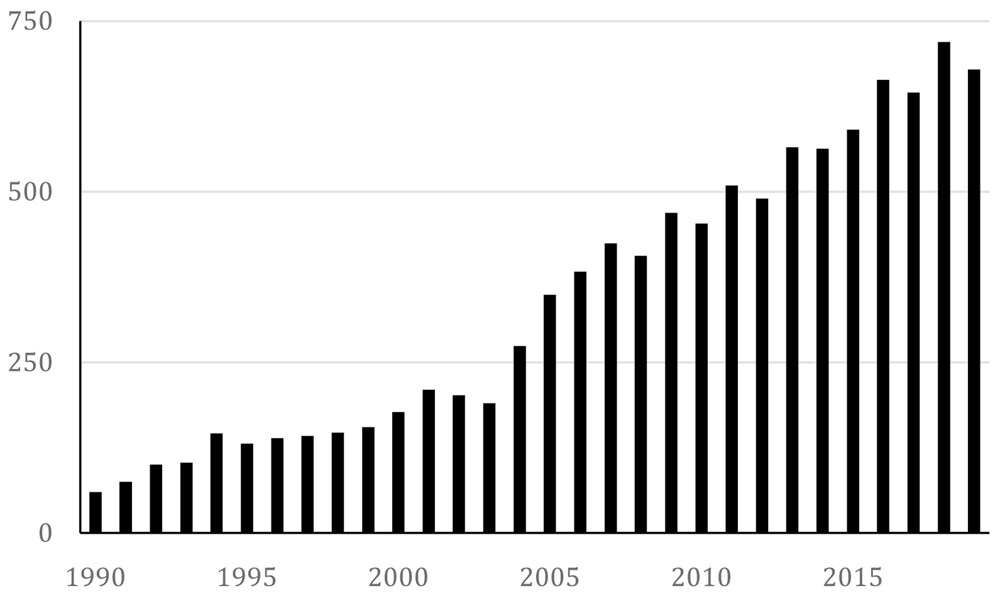
The bibliographic approach amounted to a description of the top 20 journals where the articles were published and a count of the number of articles published each year, summarised in Table 3 and Figure 1.

Table 3. Top 20 journals in the set.

Publication titleCount of
final order
Arts Education Policy Review210
Art Education120
Research in Drama Education119
Visual Arts Research114
Studies in Art Education98
Journal of Aesthetic Education94
Curator 92
Museum International89
New Theatre Quarterly87
Youth Theatre Journal82
International Journal of Art & Design Education62
Journal of Museum Education55
Journal of Archaeological Science54
Theatre Topics52
Theatre Survey51
International Journal of Education & the Arts51
Antiquity50
Third Text46
Museum Management & Curatorship43
International Journal of Education through Art41
add59740-4ef3-400d-bea1-6f52432be780_figure1.gif

Figure 1. Number of retrieved documents yearly.

This list illustrates that the discipline of arts education is dominant in the field and that journals dedicated to research on theatre and museums are at the forefront. Among the top ten journals, five are indexed in Web of Science. The other journals are indexed in SCOPUS, except for Visual Arts Research, which is not represented in Journal Citation Reports or SCOPUS.

From this figure, we can derive that research interest in the social impact of the arts, interpreted as the number of articles published per year and operationalised through our search strings, have increased since 2005 and tripled in amount to around 600 in 2015. Thus, it is an expanding field, which further motivates the need for mapping trends in the data.

Analysing emerging themes in the data

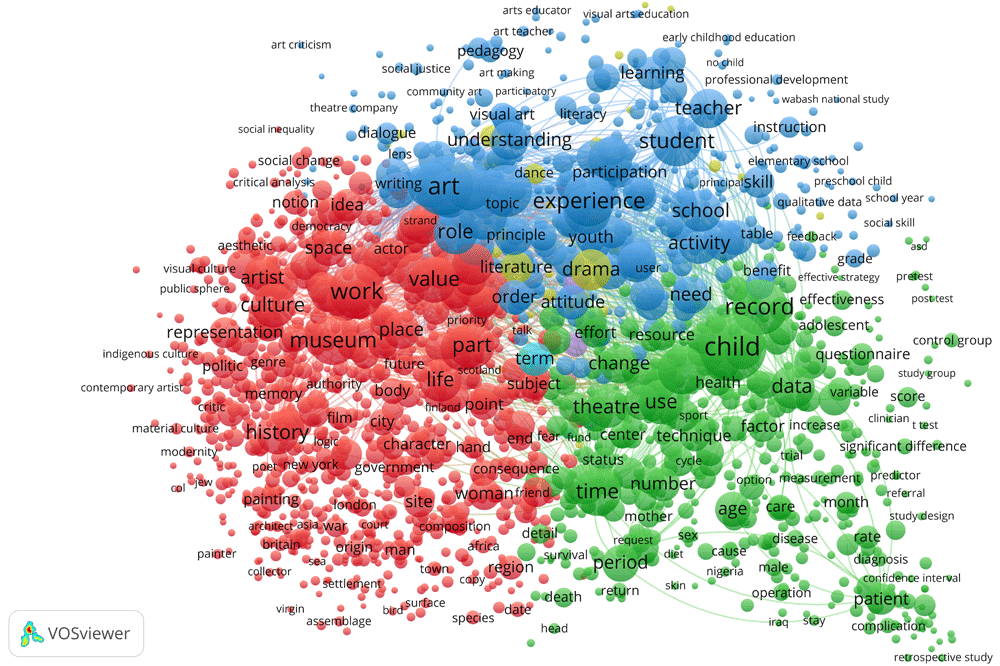
We performed a text-based content analysis to understand emerging themes in the data, which used the terms found in the titles and abstracts of the collected publications to identify the topical structure of the data. Co-word analysis was used to identify topical clusters within the collected texts, consisting of terms often found co-located in the texts. Using the software package VOSviewer, an analysis of the contents of the titles and abstracts of the articles was performed and visualised as a co-word map. VOSviewer employs a method for “linguistic” parsing (the Apache OpenNLP programming library, Van Eck & Waltman, 2010) that identifies noun phrases, meaning words, or combined terms including nouns or adjectives in front of nouns in a data set. We identified that the co-occurrence of these noun phrases calculated a distance measure based on the co-occurrence of each pair of noun phrases. Lastly, a threshold for inclusion in visualisation was applied, limited to noun phrases occurring at least 20 times in the text (n=1966). In our treatment of the data, we found that generic terms, such as ‘article’, ‘author’, and ‘paper’, obfuscated the results in the visualisation. We therefore performed a manual inspection of the noun phrases and removed these generic terms. The resulting data set used in the analysis consisted of 1,827 terms. The visualisation of the terms used in the articles presented us with three overarching themes, demonstrated in three clusters (Figure 2).

add59740-4ef3-400d-bea1-6f52432be780_figure2.gif

Figure 2. Co-word analysis of terms found in titles and abstracts in the data set.

The co-occurrence of 1827 noun phrases found at least 20 times in the data set was used to construct the visualisation. Three main clusters were identified based on the thematic closeness of the terms in the texts.

We named each cluster based on the topic areas related to artistic impact in the graph. Since the co-word analysis is calculated as the statistical relationship between all terms, there is an overlap between the categories. The boundaries between categories are more blurred than the colours indicate. This does not mean that the clusters cannot be distinguished from each other, rather that the terms are gradually more related to each other as they get closer to the boundary. The red and the green clusters are abutting the blue cluster to suggest a correspondence between terms used in articles from all three clusters. For instance, terms like ‘attitude’, ‘order’, ‘change’, ‘effort’, ‘part’, and ‘subject’ link these three clusters together in the overarching themes of culture, learning, and health. An analysis of word occurrences in the cluster resulted in the thematic identification described below.

The red cluster is mainly concerned with issues of culture and society, such as the value of culture within the geographical context of cities, municipalities, countries, or regions. The terms within the red cluster consider aesthetic culture, i.e., primarily the fine arts, as well as anthropological culture, i.e., a whole way of life (Williams, 1985). In this context, culture also includes the museum as an institutional space as well as the artwork and artefacts housed in cultural heritage institutions. Although ‘women’ is a term in this cluster, it typically lacks a specified analytical subject.

The blue cluster thematises issues of art and education. It typically deals with the experience of learning in an institutionalised and formal setting or a more informal community setting. The typical research subject in this cluster is the pupil or, more broadly, the child.

Lastly, the green cluster connects issues of art and wellbeing. It is primarily focused on health issues in context, with methodologies and techniques for measuring the use of art to improve health and well-being among the subjects of intervention.

The visualisation helped us to analyse how these clusters represent various epistemological and theoretical traditions that overlap but are still disparate enough to be categorised as subfields. Similarly, the bibliographic method allowed us to cast a wide net and work inductively to survey the field. However, it does have certain limitations. Fields with a high number of publications, and that more readily align themselves with the PIO framework, emerged to a higher degree than other fields in our searches.

Selecting articles for a qualitative analysis of the themes. To validate the thematic structure of the field, we performed a close reading of articles representative of each cluster based on the co-occurrence of terms in the visualisation. We used an approach based on the term weighting of the titles and abstracts to identify relevant articles to read. We wrote a script that determined the number of times a specific term was found in each text and a relevance measure that determined how distinctive the specific term is in the corpus. Using the visualisation, we identified specific terms used for selecting relevant articles to read in the qualitative part of the study. Initially, we focused on the ten most common terms per cluster, five relating to the other clusters and five isolated terms in each cluster. The isolated terms were interpreted as those that set the theme apart, while the related themes provided articles that can be argued to belong to overlapping themes. This work resulted in twenty distinctive terms for each of the identified thematic clusters found in the visualisation. We identified fifty articles for each term and used the metadata consisting of title, journal information, and DOI to determine the actual articles for close reading. All in all, one hundred articles were read for the analysis.

Based on the three identifiable clusters generated by co-word analysis, the specific terms we used to identify documents were:

Culture and society cluster

Terms related to the other clusters: “ value,” “part,” “idea,” “subject,” “country.”

Terms isolated from the other clusters: “ work,” “culture,” “museum,” “place,” “history.”

Art and education cluster

Terms related to the other clusters: “ experience,” “concept,” “community,” “activity,” “need.”

Terms isolated from the other clusters: “ pedagogy,” “understanding,'' ''student,” “teacher,” “learning.”

Art and well-being cluster

Terms related to the other clusters: “ record,” “child,” “change,” “theatre,” “time.”

Terms isolated from the other clusters: “ patient,” “treatment,” “age,” “data,” “use.”

Given that the research articles thematised art and culture, we performed a close reading of the articles in dialogue with one another by using three guiding questions in the analysis: How do the articles conceive of the role or effect of the arts? How is this role or effect realised/explored in research? What conclusions do the articles wish to disseminate to the research community? These questions directed our analysis of this material to the overall research questions and aim of the study.

Results: the arts and society, education, and well-being

Our thematic analysis confirmed that the clusters overlap in themes but are epistemologically distinct. They also vary in terms of methodologies. The culture and society cluster represents research that takes a more general outlook on the role of arts and culture in society, in contrast to research with a greater focus on certain populations of interest (such as children and young people and their developmental abilities, behaviours, or attitudes). Typical research themes are related to debating the (changing) role of the arts (e.g., Delacruz [2011]; from the isolated term ‘work’). Within the same theme is an exploration of the changing role of cultural institutions, such as museums and libraries (e.g., Burgess [2009], within the isolated term ‘history’; Martens [2015], related to the isolated term ‘culture’). Drawing on the concept of ‘site’ as a meaningful place or location, Morris & Cant ([2006]; within ‘place’ as an isolated term) critically examine the relation between art and places through observation of artistic practices. Thus, the isolated terms are found in studies that debate the role of arts and culture in a community context by critically approaching the significance of artistic practices for society rather than focusing on methodology. Articles within the terms ‘culture’, ‘history’, ‘work’, and ‘place’ are also rather broad in scope, indicating less group-oriented or targeted interventions and more interventions directed towards the general public.

Articles with terms that are isolated from the other clusters conceptualise the role of culture and the arts to reflect developments in society and foster shared values for social welfare, often through cultural institutions. These articles tend to offer reflective narratives, as opposed to more traditional scholarly texts in the social sciences where specific theoretical assumptions are set against empirical material and conclusions are drawn (although such research exists). Methodologies are not fitted into the PIO model of experimental research but were philosophically/theoretically oriented, sometimes lacking empirical material. The tendency to include more general social developments as a theme reflects a more humanistic rather than social science or natural science approach. In the art and well-being cluster, the term ‘subject’ primarily refers to children and their development, whereas ‘value’ relates to the isolated term ‘museum’ in the art and society cluster. The term ‘part’ may also relate to the lifecycle (birth, death, etc..) of the art and well-being cluster, in that the health conditions of older people are discussed in relation to their engagement with the arts. Finally, the articles associated with the term ‘country’ link together the clusters in the sense that they are about community art and learning, and a connection to the lifecycle of people in specific geographical places. For example, exploring mural paintings and developing “methods which had the capacity to tell stories of coexistence on the country, in a place where Aboriginal and non-Aboriginal people have been immersed in a cycle of relations for over 230 years” (Harrison et al., 2016, p. 1330; within the related term ‘country’).

Research in the art and education cluster is characterised by a strong belief in the significance of the arts and their impact, mostly as a learning tool, and often details results of this approach in different contexts. For example, how theatre pedagogy can be used in intercultural education research ([Frimberger, 2016]; ‘pedagogy’ as an isolated term), how young people are trained to theatrically explore their identities and the identities of others (Reisberg et al., 2006; Tuisku, 2015), or how art education can help students acquire knowledge and apply concepts at different levels of cognitive development ([Ho & Lin, 2015; Lekue, 2015]; ‘understanding’ as an isolated term). The articles we studied indicated that the relationship between teacher and student is more of an agreement than one characterised by a power imbalance. The teacher is not so much in focus as the student-actor or spectator ([Stillman & Beltramo, 2019]; ‘teacher’ as an isolated term). Hence, pedagogy has more in common with the practice of creating artwork, although studied from the perspective of art educators and the de-centring of art education. The term ‘activity’ thus relates to the art and well-being cluster of the development and health of children. Knowledge development through art is conceived of the visual component of learning and has connections to self-expression. Understanding, literacy, and psychology are about the psychological and sociocultural development of children regarding their aesthetic and conceptual abilities to articulate or represent knowledge. The related terms, such as ‘activity’, are close to the art and well-being cluster and take an art-therapeutic approach. One important conclusion is that the concept of ‘community’ in this cluster is participation oriented. Research associated with this term aims to show the value of art education for individual community members and communities at large. Articles within the arts and education cluster do not always explore formal learning institutions or situations. Bailey et al. ([2019]; within ‘need’ as a related term) addresses the future needs for qualitative, accessible, and appropriate housing for the elderly, where the role of art, in this case serves to open channels of communication. Furneaux-Blick ([2019]; ‘activity’ as a related term) conceptualises art therapy as meeting clients on their terms and addressing the power imbalance inherent in working with children with (in)visible disabilities. Articles in this cluster can thus promote the significance of art education by bringing it out of the classroom and offering it openly to benefit the community at large ([Ortiz & Chung, 2011]; ‘community’ as a related term). The related terms of the art and education cluster are thus clearly related to the art and well-being cluster and their subject matter specifically explores issues related to the elderly and students with (in)visible disabilities. The isolated terms are more student-oriented and situated in a formal learning context, in contrast to related terms that form a bridge back to the art and society cluster and its focus on community welfare.

Research typical for the art and well-being cluster both in terms of belonging to terms isolated from and related to the other clusters, encompasses topics related to the understanding of how various aspects of art in various settings and contexts can impact a set of specific populations. These include nurses, children in paediatric care, women from a specific community, or school children. Research in this cluster is exemplified by the need to articulate the aims and objectives of cultural provision and generate ‘evidence’, such as the impact of youth theatre on non-arts audiences ([Hughes & Wilson, 2004]; within ‘theatre’ as a related term). Findings in this cluster were discussed in tandem with theory, especially in research belonging to the isolated terms (for example, understandings of youth transitions theory and Piaget’s (1997[1929]) developmental stages of the child). Research belonging to the isolated terms was found to be oriented towards educational professionals, such as insights into developing art therapy methods for autistic children ([Cao et al., 2013]; within the isolated term ‘treatment’). Thus, this cluster represents an experimental theme focused on methodologies to capture the effects of arts interventions. The more isolated the term, the more this focus on methods related to a specific medical field, but the cluster is not restricted to studies of the impact of the arts in medical research. As studies involving children are common in this cluster, ethical issues regarding interventions for children demand rigorous methodologies for conducting and capturing the effects of the arts and culture.

There is a typical research design in this cluster of combining a quantitative and qualitative approach with participatory involvement of the population being investigated (conceived of as “peer researchers”), such as questionnaires, qualitative interviews, and participatory creative research workshops. Impact is thus an essential concept for research representing this cluster, for example, the impact of art on improved health and satisfaction outcomes in paediatric patients ([Nanda et al., 2009]; ‘age’ as an isolated term). Research in this cluster report on mixed methods, such as surveys and recorded qualitative comments for finding significant differences in art preferences across the different age groups, (Nanda et al., 2009) or using both questionnaires and focus group studies to approach film as a platform to engage, evoke, and develop understanding of the patient experience among student nurses ([Ogston-Tuck et al., 2016]; ‘patient’ as an isolated term).

Typically, the articles in the related terms of the art and well-being cluster showed a topical diversity, compared to the isolated terms related to a medical research tradition. For example, research in this cluster within the related term ‘change’ involved developing tools for understanding how the short-term effect of visiting a science centre exhibition in Finland influenced the knowledge and attitude of young people toward climate change ([Gorr, 2014]; with the results of the study indicating that the exhibition experience did not support comprehensive attitude change). There were also studies aimed at providing researchers and practitioners who work with children with a model for creating guided-play activities in which children experience a range of emotions. Thus, according to the researchers, they develop social and emotional skills ([Goldstein, 2018]; ‘time’ as a related term). Other research was more user-oriented, focusing on the participatory element, such as Brahma, Pavarala, & Belavadi, ([2019]; within the related term ‘record’) who studied the use of theatre targeting regressive social norms relating to gender inequality, such as domestic violence, child marriage, women’s and children's health issues.

In summation, these themes present the social impact of the arts as it relates to health and wellbeing, education, and knowledge (or cognitive learning skills), and – somewhat less identifiable – community and identity. Where the PIO categories are distinguishable, children were identified as the primary population under study, and often in formal learning contexts. Theatre and drama are the most common interventions, and knowledge/skills enhancement is the most common outcome. These clusters overlapped where articles included a methodological exploration in understanding how the arts impact either individuals, groups, or more generalised populations. For example, SmithBattle ([2012]; ‘student’ as an isolated term) studies the pedagogy of student-created dramatic performances to promote reflection on sexuality and health care experiences. The role of theatre is understood to “foster empathy and convey the complexity of clinical situations from the vantage point of patients and clinicians” (SmithBattle, 2012, p. 591; c.f. Feagan & Rossiter, 2011). Articles within the related terms in the arts and society cluster contrast with the isolated terms through a more apparent presence of methodological interest or exploration. For instance, they are concerned with patterns of and reasons for engaging in the arts among older people (55+) and barriers to such engagement ([Keaney & Oskala, 2007]; within the related term ‘part’). In contrast, related terms found in the arts and society cluster have an educational focus, such that there is a connection to the art and education cluster and its concern with the relation between art and learning. Likewise, Chung & Ro ([2004]; within the related term ‘subject’) studied the effects of problem-solving instruction in practical arts education on the creativity and self-efficacy of children.

Articles within the related terms are not always easily identified to explore the impact of the arts on more generalised populations. For example, Woodward & Ellison ([2010]; ‘experience’ as a related term in the arts and education cluster) examines the transformative potential of subject-object relationships in the context of art. DeBettignies & Goldstein (2020) investigate the role or of improvised drama in improving the self-concept of children as a means of improving their chances to succeed in school (‘concept’ as a related term; and here it specifically refers to self-concept, a multifaceted construct of cognitive and physical abilities and social functioning, status, and recognition).

As our next focus of analysis will show, in our corpus there is also an interest in how societal changes impact culture and the arts. For example, Earle ([2013]; within ‘value’ as a related term in the culture and society cluster) investigates how the legitimacy crisis western museums have faced since the end of the 20th century has affected their standing as purveyors of cultural education.

Mapping the research front

In the study of bibliometrics, a research front (Persson, 1994) is developed by exploring the content among articles with similar references. This builds on the idea that articles that cite similar references carry the “symbolic content” (Small, 1978) of the cited works. Understanding the research front is sometimes used to determine the ‘best’ research. However, we were interested in understanding emerging themes in such a set of articles to map how a field is formed through related content.

We employed a bibliometric method based on the bibliographic coupling of articles, as quantified by their shared references, to generate a relevant set for our close reading. We therefore reduced the heterogeneous set of articles to thematic groups based on their similarity in content. Using the VOSviewer software, (see van Eck & Waltman, 2010) we analysed a subset of 974 articles (W). We used part of the set of initially identified articles (A), obtained from Web of Science, to produce another cluster analysis of the documents to categorise them into thematic parts. In this instance, the relation among individual articles (identified as ‘author’, ‘year’ in the graph) was based on shared citations in their respective reference lists.

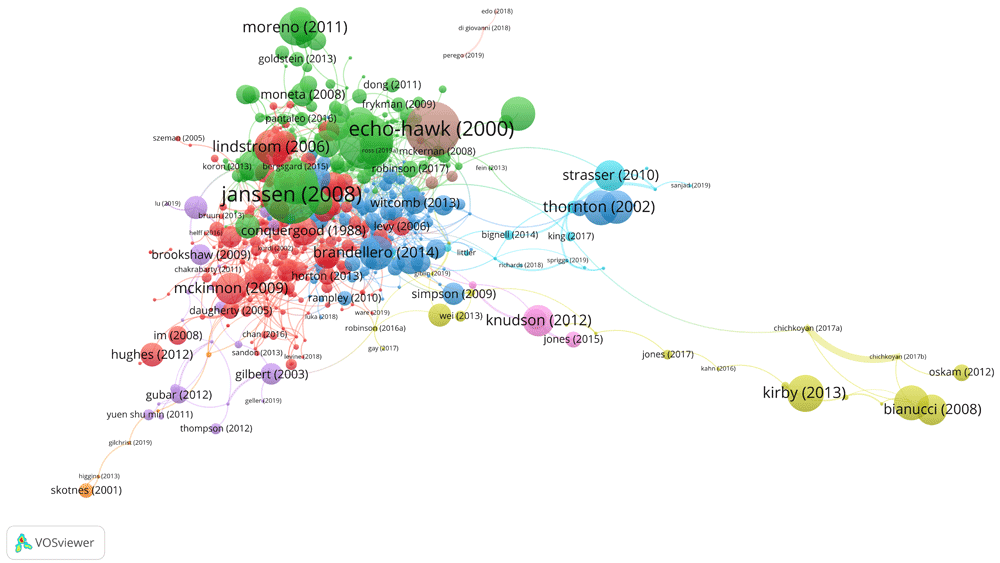
The following figure (Figure 3) visualises the mapping of the most cited articles of nine clusters. This overview illustrates how themes of research can develop as authors connect their work to that of other researchers. In the following paragraphs, we will discuss these themes and their relevance for the analysis of the research front.

add59740-4ef3-400d-bea1-6f52432be780_figure3.gif

Figure 3. Bibliographic coupling of articles as quantified by their shared references.

About the clusters

After forming an overview of the nine different clusters of the bibliographic coupling visualisation above, we considered the titles of articles and their thematic content. In doing so, we found that the red and green clusters were most relevant for a qualitative analysis of the research front regarding the art’s social impact. Based on the criteria explained below, we did not examine all the clusters in this dataset, partly to help us define a set of articles for analysis that was manageable within the set time frame of writing (two researchers, Lindström Sol and Gustrén, were responsible for the close reading of the articles).

For example, although the blue cluster (n=99) contained a few interesting contributions regarding the work of cultural institutions, we found several instances in this cluster thematising analysis of objects (e.g., metallurgy, jewellery). Since this was not within our chosen scope, we excluded this cluster from further analysis.

Moreover, the yellow (n=23), orange (n=6), and brown (n=4) clusters mainly contained works on topics like archaeology, biology, palaeontology, and other domains within the natural sciences. They also included humanistic works covering topics in history, prehistory, and antiquity. Ethnographic approaches to the ancient world and its oral traditions were a recurrent feature in these clusters. For instance, Echo-Hawke (2000) was a highly cited article in the orange cluster, whose title and abstract indicate that the article is tracing oral traditions dating back to ancient history. Although interesting, we did not deem it relevant enough for a study on the social impact of the arts from a contemporary perspective.

We made the same determination for the purple cluster (n=16), mainly investigating topics in childhood, nursery, play, and similar features. The turquoise cluster (n=6) explored Elizabethan theatre, and Shakespeare in particular and we could identify no explicit indications of any social effects. Finally, the pink cluster (n=3) covered various forms of audio description or studies of sound in the context of theatre and museum exhibits. These articles were too few and lacked citations, which made it difficult to identify a potential research front.

Initially when developing our corpus, we cast a wide net and sifted for relevant content rather than starting by choosing relevant articles and scrutinising their reference lists individually. This resulted in the development of clusters that we deemed were not relevant to our specific focus of marginalisation. Our method requires manual filtrations, but also has the advantage of excluding reader bias from the selection. Instead, articles with similar reference lists, thus sharing a topical focus, were found close to each other during our analysis. In conclusion, to analyse and define the research front of the social impact of the arts, we performed a close reading of the top-cited articles (determined as those with ten or more citations) in the remaining clusters. We wish to emphasize that literature that was excluded from the corpus based on our selection criteria could still have relevance to the topic area (Table 4).

Analysing the research front: topical themes

Since abstracts and articles in the two remaining clusters did not provide sufficient information about population, intervention, outcome, we did not deem them disparate enough for a meaningful separation of topical analysis, with one exception. Although largely overlapping, the red cluster tends to thematise informal learning settings such as theatre/drama as an intervention. In contrast, the green cluster tends to thematise formal educational settings such as schools and museums.

In our reading, we used the PIO model, i.e., defining population, intervention, and outcomes in the articles, to form a basis on which we can discuss the understanding of the social impact of the arts. By reading the titles and abstracts of the most cited articles in the chosen clusters (n=44), we excluded two articles on the following grounds: the article was not written in English (Octobre, 1999), and the article did not consider culture and the arts as a theme (McKinnon, 2009), instead of considering performing vulnerability in the courtroom. This demonstrates that our method requires further refinement to differentiate between figurative uses of ‘performance’. Overall, we analysed 42 articles to understand the scope of the research front of the social impact of the arts.

Results: an overview of most common populations, interventions, and outcomes in the research front

The included articles were analysed through a close reading to outline the population, intervention, and outcomes, both intended and observed. This presented us with a few interpretational difficulties since most articles were not written within the PIO framework. To identify population, we set out to understand the effects of arts and culture on something or someone, and this something or someone was interpreted as the population. Instead of a defined group of people as the population, it could be more abstract concepts such as arts journalism, political developments and/or the perception of a country or region through art. Similarly, as we will discuss in more depth below, this could include the effects of political and geographical developments on art.

When identifying interventions, we struggled, for example, with the question of what is to be understood as an intervention in studies of theatre plays - the analysis of the play or the actual play? In some of the articles, authors were not part of an investigation of an artistic intervention, rather they engaged in an analysis of cultural products intended to theorise about their significance in various ways. Based on AMASS’ focus on artistic and cultural interventions, we chose to define intervention as the observed artistic/cultural product/process. The emphasis of our analysis was on the observed rather than intended outcomes of these processes.

Interventions provided more straightforward points of analysis. Below we discuss the several categories of observed outcomes we developed to make up the research front of the social impact of the arts.

Populations

The results of our analysis illustrate that the most common population is children and young people in formal learning settings, and theatre/drama is one of the most common interventions. This confirms that the research front follows the theme of the co-word analysis, where these categories were also common in the overall data. The second category, unspecific or broadly defined populations, related largely to the potential of cultural institutions, such as museums, to act as educational settings. Thus, we conclude that parts of the research front on the social impact of the arts (as defined by our search methods) connect the importance of social impact to the relevance of cultural institutions. Groups experiencing marginalisation, such as minorities and refugees, are not the most prominent populations investigated in our corpus (Table 5).

Table 5. Themes belonging to population in the data analysed.

PopulationsEmpirical instances
Children and young people in formal and
informal learning settings
(15 articles)
Children without earlier music training (Moreno et al., 2011)
Primary school child, musical learner? (Lum & Dairianathan, 2014)
Young people/underprivileged youth (Lindström, 2006; Neelands, 2009;
Peppler, 2010)
Pupils, children 3, 6, and 12 years old (Eerola & Eerola, 2014)
English learners in the primary grades (Greenfader et al., 2015)
Teacher students (Page et al., 2006; Gibson, 2003)
Art naïve uni students (Lauring et al., 2016)
Primary and secondary school students (Rickard et al., 2012; Day, 2002)
20 children aged 4–5 (Hsiao, 2010)
Former child soldiers of post-war Northern Uganda (Edmondson, 2005)
Young audiences (Balloffet et al., 2014)
Unspecific/broadly defined populations
(10 articles)
Individuals (Vannini & Waskul, 2006)
Diverse communities (Campbell, 2008)
The audience participant (Gregory, 2003; Heddon et al., 2012; Henriksen &
Frøyland, 2000)
Interpretative communities (Miller, 2008)
Arts journalism (Janssen et al., 2008)
Families (Ash, 2003)
Visitors (Leonard, 2010)
Adults (Göncü & Perone, 2005)
Professionals within the culture sector
(5 articles)
Regional heritage institutions (José del barrio et al., 2009)
Performers and directors (Taylor, 2013)
Publishers and translators (Sapiro, 2015)
Musicians (Schuele & Lederman, 2004)
Artists and venue providers (Wheeler, 2003)
Political geographies
(4 articles)
The Israel-Palestine conflict (Bernard, 2014)
Post-colonial Korean society (Im, 2008)
The nuclear in post-war Britain (Hughes, 2012)
Post-colonial Uzbekistan (Adams, 2017)
Indigenous, minority people
(4 articles)
Indigenous artists, Native North American (Horton & Berlo, 2013)
Sami people (Levy, 2006)
Aboriginal and non-indigenous children, young people, adults in four rural
towns (Sonn et al., 2015)
Participants from low-income, minority ethnic backgrounds (Dawson, 2018)
Immigrants and refugees
(3 articles)
Hmong refugees (Conquergood, 1988)
Asylum seekers (Wake, 2013)
Immigrant adolescents with behavioral difficulties (Moneta & Rousseau, 2008)
Disadvantaged (1 article)Unemployed people (Tofteng & Husted, 2011)

Interventions

The most common interventions confirm the co-word analysis where theatre and drama, in formal and informal educational settings, dominate the research front. Music and visual arts are also common, along with discussions of museum activities. The category ‘media and popular culture’ relates to the outcome category ‘theory/method development’, which will be elaborated on below (Table 6).

Table 6. Themes belonging to intervention in the data analysed.

InterventionsEmpirical instances
Art education/formal learning settings
(12 articles)
Student portfolios (Lindström, 2006)
Music/visual arts education (Lum & Dairianathan, 2014)
Drama in schools (Neelands, 2009)
Effect of music training (Moreno et al., 2011)
Use of new technologies for communication as part of arts curriculum (Peppler, 2010)
Forum theatre workshop in school (Day, 2002)
School-based music and visual arts instruction (Rickard et al., 2012)
School based drama intervention (Moneta & Rousseau, 2008)
Extended music curricular class (Eerola & Eerola, 2014)
Attitudes to art and art education (Gibson, 2003)
Drama and creative movement intervention among students (Greenfader et al., 2015)
Art-making activities among kindergarten children (Hsiao, 2010)
Theatre
(11 articles)
Health theatre (Conquergood, 1988)
Shared memories through drama (Campbell, 2008)
Drama as arts therapy (Edmondson, 2005)
One-to-one theatre performance dialogue and collaboration (Heddon et al., 2012)
Theatre-based action research (Tofteng & Husted, 2011)
Verbatim or testimonial theatre (Wake, 2013)
Political theatre (Bernard, 2014) Intercultural theatre in Hamlet (Im, 2008)
Verbatim theatre (Taylor, 2013)
Adult improvisation based on child play (Göncü & Perone, 2005)
European style theatre (Adams, 2017)
Media and popular culture
(7 articles)
Life-from-space theory in popular culture (Gregory, 2003)
Science communication (Dawson, 2018)
Popular imagery and culture of the nuclear (Hughes, 2012)
Digital gameplay (Miller, 2008)
Analysis of international arts and culture coverage (Janssen et al., 2008)
Dissemination of French literature (Sapiro, 2015)
Institutionalization of performance art (Wheeler, 2003)
Museum activities
(6 articles)
Museums for scientific literacy (Henriksen & Frøyland, 2000)
Exhibition analysis of the representation of Sami identity (Levy, 2006)
Families making sense of science content in museums (Ash, 2003)
Techniques for efficiency evaluation in museum management (José del Barrio et al., 2009)
Exhibitions on popular music (Leonard, 2010)
Edutainment within the museum sector (Balloffet et al., 2014)
Visual arts
(4 articles)
Attitudes to contemporary, socially orientated art (Page et al., 2006)
Contemporary arts discourse on indigenous understandings (Horton & Berlo, 2013)
Art appreciation (Lauring et al., 2016)
Photography and photo elicitation (Sonn et al., 2015)
Music
(2 articles)
Aesthetic experience of life through music (Vannini & Waskul, 2006),
Review on occupational disorders of instrumental musicians (Schuele & Lederman, 2004)

Outcomes

The most common theme regarding outcomes can be argued to belong to an internal, academic debate, furthering conceptual and theoretical knowledge on the social impact of the arts. The prominent themes of skills enhancement and knowledge dissemination/learning mirror the co-word analysis result, where the social impact of the arts is conceptually related to learning outcomes (Table 7).

Table 7. Themes belonging to outcomes in the data analysed.

CategoryAuthor/year of
publication
Intended outcome/aimObserved outcome(s)
Theory/method
development
(8 articles)
Gregory, 2003Assessing a scientific theory’s popularisation via
popular press, museums, etc.
The paper argues for science communication studies to look
beyond traditional categories to embrace the wide variety of media
and genres that contribute to the construction of science in the
public.
Vannini & Waskul, 2006In this article, the authors explore music as a metaphor
for life.
From within the metaphor of life as music, the authors
conceptualize beauty as the diverse rhythms, melodies, and
harmonies contributing to the constitution of both subjectivity and
intersubjectivity.
Miller, 2008This article investigates the Grand Theft Auto video
game series to demonstrate the potential of a
folkloristic, ethnographic approach for the analysis of
digital games.
This case study suggests that digital gameplay should be regarded
as a form of performance practice with the capacity to invoke
traditional folkloric genres and engender new traditions.
Campbell, 2008This article discusses artistic projects concerning a
sharing of the past. It includes theories of memory
work, memory sharing as a cultural practise.
The authors states that “diverse audience engagement with political
and artistic projects of sharing the past might help fortify the
symbolic resources that those who are politically marginalized need
to shape or maintain memory” (p. 41).
Neelands, 2009This article discusses the ensemble-based approach of
drama in schools. It contrasts the pro-social emphasis
in the ensemble model with a pro-technical emphasis.
Using ideas drawn from McGrath and Castoriadis, the author claim
that the ensemble approach provides young people with a model of
democratic living.
Hughes, 2012This article studies the effects of cultural interpretations
of a phenomenon (nuclear culture) on popular imagery.
The author warns of risk of homogeneous storytelling, and a
reduction of pluralistic histories.
Horton & Berlo, 2013This study is an analysis of why it has been difficult
for the ‘new materialisms’ to incorporate indigenous
intellectual traditions into discussions of non-human
agency, focusing on contemporary arts discourse.
The authors states that indigenous artists’ understandings of
material have an acute awareness of the contemporary, global
challenges of cohabitation.
Taylor, 2013This article analyses how affective listening is used
to develop performances in Alecky Blythe's verbatim
theatre.
The article argues that voice in London Road both claims and
defers authenticity and authority, since voice signifies presence and
embodied identity but the reworking of speech into song signals
the absence of the real.
Skills enhancement
(7 articles)
Lindstrom, 2006Can the arts be assessed and taught? This article
uses a study of portfolios as methods for art skills
enhancement among young people.
The author concludes that the notion that assessments of learning
outcomes must be either limited to superficial knowledge or
completely arbitrary is a misconception. Improved visual design and
artistic skills can be accomplished in certain circumstances.
Moreno et al., 2011The article studies the effect of 20 days of music or
visual arts training on children’s pre-literacy skills.
The authors found that the children’s “ability to map unfamiliar
symbols to known words improved significantly from pretest to
posttest” (p. 170). The effects on the music group were stronger.
Greenfader et al., 2015The article studies the effect of a performing arts
program on the oral language skills of young English
learners.
The authors found that the treatment group (N = 902)
outperformed controls (N = 4,338) on speaking assessments. Effects
were strongest on English learners with the most limited
English-speaking abilities.
Hsiao, 2010The article investigates methods of enhancing
kindergarteners' artistic creative thinking and
expressive drawing through appreciation of picture
books.
The authors found significant and positive change in reading and
drawing behaviours of children when at home. “The results also
showed that the collage series of picture books had more impact on
children than did other picture books in terms of teaching efficacy
by picture book appreciation” (p.143).
Eerola & Eerola, 2014The article explores if music education can create social
benefits in the school environment (general satisfaction
about the school and a sense of achievement and
opportunity for students).
The authors found that extended music education enhanced the
quality of school life and had a positive effect on the social aspects
of schooling.
Rickard et al., 2012The article studies the impact of an increase in school-
based music training on a range of cognitive and
psychosocial measures for 10 to 13-year-olds in two
independent studies.
No convincing benefits of school music classes were apparent in
the studies. The authors emphasise the intrinsic value of music
education for enjoyment and learning.
Moneta & Rousseau, 2008The article explores the emotional regulation (ER)
capabilities through drama intervention in immigrant
adolescents with behavioural difficulties.
Some impairment in emotional expression and emotional
regulation in this study sample. “In general, the drama process
seemed to help emotional expression and awareness and to foster
a transformation of emotive processes in the sense of a ‘collective
ER’” (p.329).
Knowledge
dissemination/learning
(7 articles)
Henriksen & Frøyland, 2000The article explores “museums’ potential to contribute
relevant and usable information in a practical, science-
related matter to a local community” (p. 395).
The authors found sceptical attitudes among families and museum
professionals towards the role of museums for scientific literacy.
This does not threaten the relevance of museums.
Ash, 2003The article studies the effects of museums and
museum pedagogy on families' scientific sense-making
and learning.
The authors argues that themes in knowledge arise from both the
family members and the museum exhibit.
Peppler, 2010The article studies the effects of the contribution of
media arts education in informal settings in learning
outcomes among underprivileged youth.
The author argues that through using new types of software, young
people can engage with technology in ways that encourages active
learning.
Tofteng & Husted, 2011The articles studies how drama can empower action
research processes in the field of unemployment.
The article also discusses the reactions of the audience,
“to use the plays to show others how life is outside the
labour market.” (p. 37).
The authors argue that theatre-based action research opens a new
way to communicate and make visible knowledge and experiences
from below that have difficulties reaching the public agenda or
influencing structures of power.
Levy, 2006The article examines the variable representation of the
prehistory of the indigenous Saami peoples in several
Nordic museums.
The author found that the presentation of the prehistory of
indigenous Saami peoples differs significantly between majority
community museums and those run by Saami communities. “The
national and regional museums diminish or even deny a Saami role
in the antiquity of the nation. In contrast, the Saami institutions
grant the Saami the same ancientness as the other Nordic
populations.” (p 143).
Dawson, 2018The article explores science communication (through
popular media and cultural institutions) from the
perspective of participants from low-income, minority
ethnic backgrounds.
The author is critical towards the status quo of science
communication and claims that “Social reproduction in science
communication constructs a narrow public that reflects the shape,
values and practices of dominant groups, at the expense of the
marginalised” (p.772).
Leonard, 2010This article studies the effect of museum and museum
pedagogy on audiences' sense-making and learning
around popular music.
The authors argue that the exhibition “moved beyond the
expected to represent a greater diversity of music genres, sounds,
performers and dimensions. Value judgements always inform which
exhibition ideas are given the green light and shape the way stories
are told within displays” (p. 180).
The impacts of the
social on art/culture
(7 articles)
Lauring et al., 2016This article studies the impact of social and monetary
contextual information on liking ratings of art.
The authors found that paintings with high monetary primes or
with high ratings by peers and art experts led to higher participant
liking ratings. In contrast, paintings with a low rating by the low-
education/income social group led to higher liking ratings by
participants. These results provide empirical support for the social
distinction behaviour theory.
Im, 2008This essay examines the implication of interculturalism
in New Asia and ultimately the relationship between
West and East, focusing on Lee Yountaek's production
of Hamlet that premiered in Seoul in 1996.
The author argues that Lee Yountaek's adaptation of Hamlet reflects
the impasse of contemporary Korean society, whose postcolonial
reality is obscured by an optimistic idea of interculturalism.
Balloffet et al., 2014This article examines the concept of "edutainment"
within the museum sector.
The authors conclude that edutainment presents both
opportunities and risks: attracting new audiences, particularly
young people, but also the “Disneyfication” of cultural institutions.
Janssen et al., 2008The article studies the importance of national context
and global hierarchies for arts journalism and the
coverage of non-western culture/arts.
The authors found that international coverage remains
concentrated on a few countries, of which the United States
has become the most prominent. Although the global diversity
of coverage has increased, non-Western countries are still
underrepresented.
Adams, 2017The article examines the cultural change in Uzbekistan
through the evolution of European-style theatre during
the twentieth century.
The author argues that “the dominance of the European-style
theatre means that other ways of being, thinking, and experiencing
are marginalized” (p. 354).
Sapiro, 2015This article is an empirical study of the circulation of
French literature in the United States in the era of
globalization.
The author concludes that French literature has “lost its visibility on
the American book market” due to the globalization of publishing
houses and the transnational literary field (s. 341), and that small
publishers have taken over the role of producing symbolic capital.
Wheeler, 2003“This article discusses the role of meaning in the
institutionalization of performance art between 1970
and 2000” (p. 491).
The author argues that the field has progressed, contradictorily,
towards both popular entertainment and avant-garde art, and that
artists were committed to “the integration of art with society and
the subsequent interest in exposing inequitable social structures”
(p. 507).
Fostering ethical
and moral behaviour
in audiences and
participants
(5 articles)
Bernard, 2014This article discusses plays thematizing the Israel/
Palestine conflict, examining controversies these plays
engendered, and “the effort to generate empathy and
humanitarian feeling” (…) “and persuade a viewer to
affiliate with a particular struggle or set of beliefs (p.
163).
The author claims that these plays “suggest a new receptiveness to
Palestinian points of view” (p. 172) but the discussion on emotional
effects of audiences is speculative.
Day, 2002This study investigates the experiences of, and
interactions between, participants of a Forum theatre
workshop, which addressed the issue of the refugee
child at school.
Findings revealed that the workshop was highly relevant to the
students, reflecting moral dilemmas which they faced in their
everyday lives, as they encountered refugee students at school. This
interactive workshop gave them the opportunity to try out moral
behaviour, which could potentially be applied to real-life situations.
Wake, 2013This is a study of audience and media reception and
the political effects of an Australian play about asylum
seekers.
The author hold a discussion on the potential for pain and
exploitation in testimonial theatre. “(...) [W]hile Through the Wire was
ethically problematic, it was also politically efficacious” (p. 117), as
“The play was highly visible in the mainstream media. The realist
aesthetic facilitated identification with asylum seekers.” (ibid.)
Heddon et al., 2012This is a study of effects of one-on-one theatre
performance, dialogue, and collaboration on those
participating.
The authors discuss a risk of the intervention: the experiential
performance proffers hierarchies of experience, invoking the notion
of an ideal audience-participant. However, there is also a potential
to produce more intimate connections in shared experiences.
Assessment/
evaluation
(5 articles)
Page et al., 2006The article studies how socially orientated
contemporary art is making a success in the wider
global context, but is omitted as practice in many
schools, although the UK government recommends art
as part of curriculum. How can this be rectified?
“Conclusions have been tentatively drawn about how the curriculum
may be better served by the use of contemporary art, as well as the
means by which new learning methods may be facilitated” (p. 146).
Lum & Dairianathan, 2014This article seeks to assess and evaluate the matching
of policy and practice, ambition to include arts
education, primarily music and visual art, as one of
the key areas of focus in pursuing the goal of holistic
education of a primary school child in the Singapore
school system.
The survey research was carried out in music education involving
musical learnings from early childhood through tertiary education
with a view to identify key areas of research interests and gaps.
del Barrio et al. (2009)The authors use a multivariate statistical technique to
synthesise the initial information and data envelopment
analysis (DEA) for efficiency evaluation in regional
heritage institutions in Spain.
The results point to the promotion of evaluation tools and methods
for management of heritage institutions and public resource
allocation.
Schuele & Lederman, 2004This study aims to explore common work-related
injuries among instrumental musicians, assessing the
risk for long-term disability.
The authors found that many of the medical problems encountered
in instrumental musicians seem to have a good outcome and rarely
lead to long-term disability except for focal dystonia. Work-related
disorders might be eligible for health and wage-loss benefits
through workers’ compensation and private and state-funded
disability insurance.
Gibson, 2003This article explores students’ and teachers’ attitudes
towards art and arts education.
The author found that the prior experiences, existing knowledge,
beliefs, attitudes, perceptions, and interest in the visual arts of
student teachers impacts the likelihood of their adding visual arts
education to teaching curricula in a primary school context.
Health/
well-being
(2 articles)
Conquergood, 1988This article studies the effects of an environmental
health education program, which employed
performances and popular theatre, on critical
awareness about the health problems: 1) among
refugees in Ban Vinai, dealing with trauma and crisis;
and 2) implications for medical health officials.
The author argues that for health care programs to be delivered
successfully, agency workers depend on the acceptance and
cooperation of the recipients. A result of the study pointed to
the need for more consciousness-raising activities for health
professionals themselves.
“For popular theatre to work effectively as a tool of critical
awareness and empowerment for oppressed peoples it must be
rooted in and begin with their cultural strengths” (p. 181).
Edmondson, 2005The study explores hoe theatre and performance can
be used to market trauma and humanitarianism with
the case of refugees in northern Uganda.
The author is critical to how arts therapy in northern Uganda was
valued primarily to market trauma.
“These works did not function as personal expressions of trauma
and healing; instead, they were assimilated into the master
narrative of war.” (p. 457).
“In the creation of the World Vision plays, the staging methods
worked to silence the children's voices, as their own ideas about
children's rights or peacemaking were never solicited” (p. 461).
Community
empowerment/identity
(1 article)
Sonn et al., 2015This article explores the potential in photography
and photo elicitation as a medium for self-expression
and place “among aboriginal and non-indigenous
children, young people, and adults in four rural towns
in Australia” (p. 89).
(The method) “reflected individual and collective constructions
of place, based on positive experiences and emotions tied to the
natural environment and features of the built environment (...) “it
is an approach that can contribute to community psychology’s
empowerment agenda” (ibid).
Theory/method
development
(8 articles)
Gregory, 2003Study of assessment tool’s ability to capture a scientific
theory’s popularisation via popular press, museums,
etc.
The paper argues for science communication studies to look
beyond traditional categories to embrace the wide variety of media
and genres that contribute to the construction of science in the
public.
Vannini & Waskul, 2006In this article, the authors argue for the creation of the
metaphor life as music.
From within the metaphor of life as music, the authors
conceptualize beauty as the diverse rhythms, melodies, and
harmonies contributing to the constitution of both subjectivity and
intersubjectivity.
Miller, 2008This article investigates the Grand Theft Auto video
game series in order to demonstrate the potential of a
folkloristic, ethnographic approach for the analysis of
digital games.
This case study suggests that digital gameplay should be regarded
as a form of performance practice with the capacity to invoke
traditional folkloric genres and engender new traditions.
Campbell, 2008A discussion of artistic projects concerning sharing the
past. Theories of memory work, memory sharing as a
cultural practise.
Shared experiences “allows us to forge a usable past together.”
Neelands, 2009Discussing the ensemble-based approach of drama
in schools. Contrasts the pro-social emphasis in the
ensemble model with a pro-technical emphasis.
Using ideas drawn from McGrath and Castoriadis, the paper claims
that the ensemble approach provides young people with a model
of democratic living.
Hughes, 2012Effects of cultural interpretations of a phenomenon
(nuclear culture) on popular imagery.
Risk of homogeneous storytelling, reduction of pluralistic histories.
Horton & Berlo, 2013An analysis of why it has been difficult for the ‘new
materialisms’ to incorporate indigenous intellectual
traditions into discussions of non-human agency,
focusing on contemporary arts discourse.
Indigenous artists’ understandings of material have an acute
awareness of the contemporary, global challenges of cohabitation.
Taylor, 2013This article analyses how affective listening is used
to develop performances in Alecky Blythe's verbatim
theatre.
The article argues that voice in London Road both claims and
defers authenticity and authority, since voice signifies presence
and embodied identity but the reworking of speech into song
signals the absence of the real.
Skills enhancement
(7 articles)
Lindstrom, 2006Can the arts be assessed and taught? A study of
portfolios as methods for art skills enhancement
among young people.
The notion that assessments of learning outcomes must be either
limited to superficial knowledge or completely arbitrary is shown to
be a misconception. Improved visual design and artistic skills can
be done in certain circumstances.
Moreno et al., 2011The effect of 20 days of music or visual arts training on
children’s pre-literacy skills.
(The children’s) “ability to map unfamiliar symbols to known words
improved significantly from pretest to posttest” (p. 170). The effects
on the music group were stronger.
Greenfader et al., 2015.Effect of a Performing Arts program on the oral
language Skills of young English learners
The treatment group (N = 902) outperformed controls (N = 4,338)
on speaking assessments. Effects strongest on English learners
with the most limited English-speaking abilities.
Hsiao, 2010Investigate methods of enhancing kindergarteners'
artistic creative thinking and expressive drawing
through appreciation of picture books.
Significant and positive change in children's reading and drawing
behaviors at home. “The results also showed that the collage
series of picture books had more impact on children than did
other picture books in terms of teaching efficacy by picture book
appreciation.”
Eerola & Eerola, 2014Can music education create social benefits in the
school environment (general satisfaction about the
school and a sense of achievement and opportunity for
students)?
Extended music education enhanced the quality of school life and
had a positive effect on the social aspects of schooling.
Rickard et al., 2012.The impact of an increase in school-based music
training on a range of cognitive and psychosocial
measures for 10–13-year-olds in two independent
studies.
No convincing benefits of school music classes were apparent.
“The intrinsic value of music education for enjoyment and learning
should therefore remain central to the justification of music
education in the national school curriculum” (abstract).
Moneta & Rousseau, 2008Emotional regulation (ER) capabilities through drama
intervention, immigrant adolescents with behavioral
difficulties.
Some impairment in emotional expression and emotional
regulation in this study sample. “In general, the drama process
seemed to help emotional expression and awareness and to foster
a transformation of emotive processes in the sense of a
‘collective ER.’”
Knowledge
dissemination/
learning
(7 articles)
Henriksen & Frøyland, 2000Explore “the potential of museums to provide
information and experiences that the audience finds
relevant in the context of science-related issues they
encounter in their private or civic lives.”
Skeptical attitudes among families and museum professionals
towards the role of museums for scientific literacy. No found
effects threaten the relevance of museums.
Ash, 2003The article studies the effects of museums and
museum pedagogy on families' scientific sense-making
and learning.
Themes in knowledge arise from both the family members and the
museum exhibit.
Peppler, 2010Understanding contribution of media arts education
in informal settings to learning outcomes among
underprivileged youth.
Using new types of software, young people can engage with
technology that encourages active learning.
Tofteng & Husted, 2011How drama can empower action research processes in
the field of unemployment.
The article also discusses the reactions of the
audience, “to use the plays to show others how life is
outside the labor market.” (p. 37).
Theatre-based action research opens a new way to communicate
and make visible knowledge and experiences from below that have
difficulties reaching the public agenda or influencing structures of
power.
Levy, 2006Examines the variable representation of Saami
prehistory in several Nordic museums.
The presentation of Saami prehistory differs significantly
between majority community museums and those run by Saami
communities. ”The national and regional museums diminish or
even deny a Saami role in the antiquity of the nation. In contrast,
the Saami institutions grant the Saami the same ancientness as
the other Nordic populations” (p 143).
Dawson, 2018Explore science communication (through popular
media and cultural institutions) from the perspective
of participants from low-income, minority ethnic
backgrounds.
“Social reproduction in science communication constructs a
narrow public that reflects the shape, values and practices of
dominant groups, at the expense of the marginalised.”
Leonard, 2010Studies the effect of museum and museum pedagogy
on audiences' sense-making and learning around
popular music.
The exhibition “moved beyond the expected to represent a greater
diversity of music genres, sounds, performers and dimensions.
Value judgements always inform which exhibition ideas are given
the green light and shape the way stories are told within displays”
(p. 180).
The impacts of the
social on art/
culture
(7 articles)
Lauring et al., 2016Impact of social and monetary contextual information
on liking ratings of art.
Paintings with high monetary primes or with high ratings by peers
and art experts led to higher participant liking ratings. In contrast,
paintings with a low rating by the low-education/income social
group led to higher liking ratings by participants. These results
provide empirical support for the social “distinction” behavior
theory.
Im, 2008This essay examines the implication of interculturalism
in New Asia and ultimately the relationship between
West and East, focusing on Lee Yountaek's production
of Hamlet that premiered in Seoul in 1996.
Lee Yountaek's Shakespeare reflects the impasse of contemporary
Korean society, whose postcolonial reality is obscured by an
optimistic idea of interculturalism.
Balloffet et al., 2014This article examines the concept of "edutainment"
within the museum sector.
Edutainment presents both opportunities and risks: attracting new
audiences, particularly young people, but also “Disneyfication” of
cultural institutions.
Janssen et al., 2008Studies the importance of national context and global
hierarchies for arts journalism and the coverage of
non-western culture/arts.
International coverage remains concentrated on a few countries,
of which the United States has become the most prominent.
Although the global diversity of coverage has increased, non-
Western countries are still underrepresented.
Adams, 2017Examines the cultural change in Uzbekistan through
the evolution of European-style theater during the
twentieth century.
The article argues that the adoption of this theatrical form was
part of a broader project of cultural modernization (...) “an example
of a colonial hierarchy of cultures, which deemed European forms
to be more advanced than indigenous ones. This orientation
makes an investment in indigenous cultural forms less desirable
since they are only intelligible on a local level.” (abstract)
Sapiro, 2015An empirical study of the circulation of French literature
in the United States in the era of globalization.
Upmarket genres like poetry and theatre are better represented
than commercial genres. The high centralization of the publishing
field in the Francophone area impacts the circulation pattern.
A by-product of the stiffening of commercial constraints on
the publishing industry, the discourse on the ‘death of French
literature’ paradoxically contributes to nourishing the well-founded
fiction of national literatures.
Wheeler, 2003This article discusses the role of meaning in the
institutionalization of performance art between 1970
and 2000.
“The process of institutionalization is shown as a paradox for
American avant-garde art” (...) “Thus institutionalization is a process
of negotiation shaped by meaning as well as social structure.”
(abstract)
Fostering ethicality
and moral behavior,
audiences and
participants
(5 articles)
Bernard, 2014Discussion of plays thematizing the Israel/Palestine
conflict, examining controversies these plays
engendered, and the effort to generate empathy and
humanitarian feelings, to persuade a viewer to affiliate
with a particular struggle or set of beliefs, and to
commit herself or himself to action.
(These plays) “remind us that there is no specific politics associated
with an empathetic response (...)”
Perhaps these plays will persuade new audiences to ask
themselves, with Hare, “Are we where we
live? Or are we what we think?” (1998, 43, in Bernard, p. 172).
Negative media reception.
Day, 2002This study investigates the experiences of, and
interactions between, participants of a Forum theatre
workshop, which addressed the issue of the refugee
child at school.
Findings revealed that the workshop was highly relevant to the
students, reflecting moral dilemmas which they faced in their
everyday lives, as they encountered refugee students at school.
This interactive workshop gave them the opportunity to try out
moral behaviour, which could potentially be applied to real-life
situations.
Wake, 2013A study of audience and media reception, and political
effects of Australian play about asylum seekers.
Discussion on potential for pain and exploitation. testimonial
theatre. “(...) while Through the Wire was ethically problematic, it
was also politically efficacious” (p. 117).
“The play was highly visible in the mainstream media. The realist
aesthetic facilitated identification with asylum seekers (ibid.)
Heddon et al., 2012A study of effects of one-on-one theatre performance,
dialogue and collaboration.
Risk of intervention: the experiential performance proffers
hierarchies of experience; invoking the notion of an ‘ideal
audience-participant.’ However, also potential to produce more
intimate connections, create togetherness in shared experiences.
Assessment/
evaluation
(5 articles)
Page et al., 2006Socially orientated contemporary art is making a
success in the wider global context, but is omitted as
practice in many schools, although the UK government
recommends art as part of curriculum.
“Conclusions have been tentatively drawn about how the
curriculum may be better served by the use of contemporary
art, as well as the means by which new learning methods may be
facilitated” (abstract).
Lum & Dairianathan, 2014Assess and evaluate the matching of policy and
practice, ambition to include arts education, primarily
music and visual art, as one of the key areas of focus
in pursuing the goal of holistic education of a primary
school child in the Singapore school system.
Survey research carried out in music education involving musical
learnings from early childhood through tertiary education with a
view to identify key areas of research interests and gaps.
José del barrio et al. (2009)Using a multivariate statistical technique to synthesise
the initial information and data envelopment analysis
(DEA) for efficiency evaluation in regional heritage
institutions in Spain.
Promoting evaluation tools and methods for management of
heritage institutions and public resource allocation.
Schuele & Lederman, 2004A study of common work-related injuries among
instrumental musicians, assessing the risk for long-
term disability.
Many of the medical problems encountered in instrumental
musicians seem to have a good outcome and rarely lead to long-
term disability except for focal dystonia. Work-related disorders
might be eligible for health and wage-loss benefits through
workers' compensation and private and state-funded disability
insurance.
Gibson, 2003What do student teachers really think about art and art
education?
Student teachers' prior experiences, existing knowledge, beliefs,
attitudes, perceptions, and interest in the visual arts impacts the
prospects of them adding visual arts education to their teaching in
a primary school context.
Health/
well-being
(2 articles)
Conquergood, 1988The effects of an environmental health education
program, which employed performances and popular
theatre, on critical awareness about the health
problems: 1. among refugees in Ban Vinai, dealing
with trauma and crisis, and 2. implications for medical
health officials.
For health care programs to be delivered successfully, agency
workers depend on the acceptance and cooperation of the
recipients. A result of the study pointed to the need for more
consciousness-raising activities for health professionals
themselves.
“For popular theatre to work effectively as a tool of critical
awareness and empowerment for oppressed peoples it must be
rooted in and begin with their cultural strengths” (p. 181).
Edmondson, 2005The study “explores the ways in which theatre
and performance are used to market trauma and
humanitarianism in northern Uganda.”
Arts therapy in northern Uganda was valued primarily to market
trauma.
“These works did not function as personal expressions of trauma
and healing; instead, they were assimilated into the master
narrative of war.” (p. 457).
“In the creation of the World Vision plays, the staging methods
worked to silence the children's voices, as their own ideas
about children's rights or peacemaking were never solicited.
Instead of speaking as commentators on war, they served as the
mouthpieces for predetermined messages (p. 461).
Community
empowerment/
identity
(1 article)
Sonn et al., 2015‘Voices’ used photography and photo elicitation as the
medium for exploring and expressing a sense of place
among aboriginal and non-indigenous children, young
people and adults in four rural towns.
(The method) “reflected individual and collective constructions
of place, based on positive experiences and emotions tied to the
natural environment and features of the built environment” (...)
“it is an approach that can contribute to community psychology’s
empowerment agenda.” (abstract)

Mapping the research front: discussion

The results reveal various interpretations of the social impact of the arts that can inform researchers in this field. As we previously demonstrated, the categories overlap. The analysis also found ambiguous, negative, or null results (Henriksen & Frøyland, 2000; Rickard et al., 2012), which are useful to understand diverse and sometimes ineffective methods for engaging populations with and through the arts.

Arguably, the results demonstrate that the field thematises and investigates a broader topic area than traditional understandings of art. Rather, our corpus includes studies on cultural institutions, education, and popular culture. Also, they seem to reflect individual or group effects rather than effects on a societal level. Few articles in the data discuss an understanding of “the social” in social impact. For example, Henriksen & Frøyland’s (2000) study on the importance of museums for science-related issues for the public is examined through a group of parents who, they argue, represent the wider public. This is not a critique of that conception, but a wish for a deeper understanding of the link between impacts on individuals, groups, and societies.

When authors of articles in our corpus argue that effects are present in their research, and when they claim to have witnessed empathic responses from the audiences of theatre plays, these populations are not surveyed, nor are these effects tested (c.f. Bernard, 2014; Wake, 2013). Rather, these effects are situated as natural outcomes of the structure of the performance itself: “When audiences think about where Rachel stood, until the moment that she stood in front of a bulldozer, they must also think about where they stand themselves” (Bernard, 2014, p. 170). Our study was not intended to be evaluative, but we sometimes struggled to find evidence for the arguments for these effects (c.f. Daykin et al., 2008). Studies on the effects of theatre participants (Day, 2002; Heddon et al., 2012) differ from studies of effects on audiences, with a methodology that allows for a discussion of tested results. Daykin et al. (2008, p. 261) conclude that it is unlikely that a single method can be found that will serve as a “gold standard” (ibid) in research on the impact of the arts.

The articles aiming towards the theory or method development of their academic field are not obviously relevant to a discussion on the social impact of the arts. Articles analysed as assessments and evaluations of policy geared toward culture and the arts or institutional and educational strategies do not provide much information about the social impact of the arts either, as they take the meaning of art, often as a positive force, as a given. When effects are accounted for, such as in providing young people with a model for a democratic living (Neelands, 2009) or creating awareness of global challenges (Horton & Berlo, 2013), these are not claimed but discussed as possible outcomes. For example, Schuele & Lederman’s (2004) study of common work-related injuries among instrumental musicians leads to an interesting discussion on the eligibility of musicians to receive wage-loss benefits and state-funded disability insurance, which arguably would (if they were enforced) be a form of social effect. The articles in the categories ‘theory/method development’ and ‘assessment/evaluation’ make up one-third of the total articles, which demonstrates that a large share (two-thirds) of our corpus does not provide any explicit answers to the question of how to identify the social impact of the arts.

The results pointing to a prevalence of research studying the pedagogical effects of various art forms on children in school settings, regarding their academic performance or skills/knowledge gain, allowed us two reflect on two things: first, the limited role of marginalisation issues in research on the social effect of the arts. This leads to our second concern: the appropriateness of including ‘children’ in a definition of marginalised groups. Arguably, children are a relatively powerless group in society, however, far from all children are experiencing marginalisation. In future similar studies, we recommend researchers studying the social impact of the arts to further problematise ‘children’ as a population.

When articles in the research field thematise identifiable social effects as something more comprehensive than the immediate effect of an observed and limited population (children in a school setting), they can be perceived as:

There are many points to be made from these results. For example, although Conquergood (1988) conceives of performance art as a tool to create awareness of health issues, the article argues above all for the dependency of interventions on the participant population, and to consider the culturally appropriate means of reaching out to the population on their terms, i.e., the social prerequisites for working with and changing conditions for a group of people through art interventions. Thus, it is reasonable to claim that the article discusses the social effects on art rather than the social effects of art.

Several other articles reverse the discussion and ask questions: How do new trends in knowledge dissemination affect museums? (Balloffet et al., 2014) What is the importance of national context and global hierarchies for arts journalism covering non-western culture/arts? (Janssen et al., 2008) How are globalising trends towards interculturalism and modernisation mirrored in national/local theatre developments, and with what effects? (Adams, 2017; Im, 2008) These are a few examples that made us aware that our method requires further refinement to separate studies of the social effects of art from studies on the social effects on art.

This brings us to the results of the analysis which point to the articles thematising the negative social effects of the arts. These include marginalising voices and experiences (Dawson, 2018; Edmondson, 2005; Levy, 2006), evoking negative emotions or ethically problematic assumptions in production and dissemination (Heddon et al., 2012; Moneta & Rousseau, 2008; Wake, 2013), or purposefully obscuring or trivialising colonialism and its atrocities (Adams, 2017; Im, 2008). These results both confirm and point to a different kind of negative effect than the theories of Bourdieu (1984) and answer the tentative question of Belfiore and Bennett (2007) as regards unquestioned assumptions about art in cultural policy discourse: can the arts be negative? The analysis of our corpus revealed that the arts can indeed have negative effects, depending on how they are used. For example, Tofteng & Husted (2011) claim that “theatre-based action research opens up a new way to communicate and make visible knowledge and experiences from below that have difficulties reaching the public agenda or influencing structures of power” (p. 27). However, when the analysed play reached the audience, “[o]ne of the scenes was met with massive scepticism” and ended in “heated debate” (p. 37). The audience expressed disbelief in the story of the participant about being refused income support. They dismissed the experience as “fantasy or pure fiction” (ibid). The play was subsequently changed to relate a story that the participant never experienced, which undoubtedly must have been a harrowing ordeal for the participant. However, the author does not account for this episode as part of the social effects of art or artistic choices.

In our analysis of the research front, we found no studies that conceptualise the entertainment or enjoyment aspect of arts and culture as a potential effect apart from Rickard, Bambrick & Gill (2012) who emphasise “the intrinsic value of music education for enjoyment and learning” (p.57).

This analysis of the research front adds perspectives but also confirms that the outcome to develop skills or gaining knowledge is the most researched, and validated, type of effect found in the data. In what ways this effect can be claimed to be social requires a theoretical discussion on the links between the individual and societal impact of education.

Conclusion: understanding the social impact of the arts through mapping the research field

Using bibliographic methods, we aimed to define and survey the research area we call the social impact of the arts. We performed this analysis to understand the major themes and characteristics of the field, including what we operationalise as the ‘research front’. As such, we sought to provide insights into categories, patterns, and trends in the field.

Firstly, through identifying relevant databases and search strings, along with using the PIO model for identifying population, intervention, and outcome in the data to retrieve more relevant hits, we created a data set of over 10,000 articles that constituted the research field. Arts and drama education journals were found to be the most related to the field, along with a few journals on practices and theories in museum studies. The number of publications has risen steadily from 2015 onwards, indicating a growing research interest in the social impact of the arts.

Through a co-word analysis, we identified topic clusters within the corpus, consisting of terms often found co-located with each other in the texts. These were categorised as three overlapping but identifiable themes that, through a close reading of the top-cited articles in each theme, were found to constitute distinctive epistemological and methodological subfields. These were categorised as:

Through the analysis of these themes, we can understand the social impact of the arts as relating to health and well-being, education, knowledge (or cognitive learning skills), community, and identity. Where the PIO categories are distinguishable, the most studied population was children in a formal learning context. Theatre and drama are the most common interventions, and knowledge/skills enhancement is the most common outcome. This reflects the dominance of arts education journal articles in the corpus.

We conceptualised the research front as a collection of the most cited articles in our corpus. Analysing these articles involved using the PIO model to distinguish research categories and discuss the meaning of the social impact of the arts as described in the data. We concluded that the concept of ‘art’, defined as aesthetical activities, is too narrow to understand the kinds of cultural and artistic interventions and themes explored in the data and needs to be reframed to include a more general ‘culture’ category that can encompass the actions of institutions. The research front of the social impact of the arts investigates populations experiencing marginalisation, such as minorities, refugees, and other disadvantaged groups. However, we also encountered articles relating to a more general media/popular culture theme, which illustrated a desire present in many of the articles to develop theoretical and methodological frameworks. This theme, along with articles aiming to evaluate/assess cultural policy or cultural management tools, added little to the definition of the social impact of the arts, as they either take the social good of the arts for granted, or aim to add to their research field without theorising the significance of their results beyond discipline-specific theoretical and methodologic development. More close reading of the articles – with clearly defined exclusion criteria – is needed to further investigate the meaning of the social impact of the arts in research.

Our analysis also revealed a strong theme in the corpus of fostering ethical and moral behaviour in audiences and participants, health/wellbeing, community empowerment/identity, and most commonly, skills enhancement and knowledge dissemination/learning. Although this study did not have an evaluative aim, it was sometimes difficult to understand if and how the impact has occurred, especially regarding fostering ethical and moral behaviour among audiences. Another theme we discussed was the investigation of how various social issues impact art and artistic practices, which gives an indication that impact is not one-sided. Above we outlined the negative impacts of the arts that we found in our corpus, with examples such as using the arts to silence marginalised voices, to evoke negative emotions or ethically problematic assumptions in production and dissemination, and to obscure or make light of colonial pasts in artistic production.

In the article, we have discussed the meaning of the social effects of the arts. Previous research on the topic often details the impact of the arts on groups or individuals, but seldom theorises links between individual, group, and societal impact. Beyond the enhancement of knowledge and skills as a result of various art interventions, the effects outlined in the research that can be claimed to be social and ‘positive’ are: reaching the public policy agenda; eliciting media response (which can be negative); influencing structures of power; building or shoring up indigenous or community identities as a way of resisting majority cultures; and achieving critical awareness and changed behaviour concerning health problems (in specific circumstances). Few articles in our corpus explored the enjoyment or entertainment aspect of arts and culture. Through the methodology we employed to construct the research front, we developed categories to better understand how the social impact of the arts is studied in research. Future studies could dive deeper into understanding and elaborating on our categories. It would also be useful to perform an expanded close reading from our corpus to either challenge, provide nuance for, or confirm our results.

Data availability

All data underlying the results are available as part of the article and no additional source data are required.

Footnotes

1The model in nursing research is called PICO (population-intervention-comparison-outcome). As the research on the impact of the arts is more likely to be performed in the social sciences and humanities rather than the natural sciences and medicine with their different epistemological foundations, the category “comparison” was deemed to have lesser importance in our study.

References

  •  Adams LL: Modernity, Postcolonialism, and Theatrical Form in Uzbekistan. Slavic Rev. 2017; 64(2): 333–354. Publisher Full Text
  •  AMASS Consortium: Proposal for European Commission Research Executive Agency Inclusive, Innovative and Reflective Societies, Research and Innovation action Number 870621 AMASS, Annex 1 (A, B). 2019; unpublished.
  •  Ash D: Dialogic inquiry in life science conversations of family groups in a museum. J Res Sci Teach. 2003; 40(2): 138–162. Publisher Full Text
  •  Arguelles C: Evidence-Based Practice Mentors: Taking Information Literacy to the Units in a Teaching Hospital. J Hosp Librariansh. 2011; 11(1): 8–22. Publisher Full Text
  •  Bailey C, Forster N, Douglas B, et al.: Housing voices: using theatre and film to engage people in later life housing and health conversations. Housing, Care and Support. 2019; 22(4): 181–192. Publisher Full Text
  •  Balloffet P, Courvoisier FH, Lagier J: From museum to amusement park: The opportunities and risks of edutainment. International Journal of Arts Management. 2014; 16(2): 4–18, 66–67. Reference Source
  •  Belfiore E: Art as a means of alleviating social exclusion: Does it really work? A critique of instrumental cultural policies and social impact studies in the UK. International Journal of Cultural Policy. 2002; 8(1): 91–106. Publisher Full Text
  •  Belfiore E, Bennett O: Rethinking the Social Impacts of the Arts. International Journal of Cultural Policy. 2007; 13(2): 135–151. Publisher Full Text
  •  Belfiore E, Bennett O: Beyond the “Toolkit Approach”: Arts Impact Evaluation Research and the Realities of Cultural Policy‐Making. Journal for Cultural Research. 2010; 14(2): 121–142. Publisher Full Text
  •  Bernard A: Taking sides: Palestinian advocacy and metropolitan theatre. J Postcolon Writ. 2014; 50(2): 163–175. Publisher Full Text
  •  Brahma J, Pavarala V, Belavadi V: Driving Social Change Through Forum Theatre: A Study of Jana Sanskriti in West Bengal, India. Asia Pacific Media Educator. 2019; 29(2): 164–177. Publisher Full Text
  •  Bourdieu P: Distinction: a social critique of the judgement of taste. Cambridge, Harvard University Press, 1984. Reference Source
  •  Burgess C: The development of labor history in UK museums and the people's history museum. Int Labor Work Class Hist. 2009; 76(1): 26–35. Publisher Full Text
  •  Campbell S: The second voice. Memory Studies. 2008; 1(1): 41–48. Publisher Full Text
  •  Cao H, Shan W, Xu Y, et al.: Eastern sandplay as a safe container for a combined intervention for a child with Asperger syndrome: A case study. Arts Psychother. 2013; 40(1): 134–142. Publisher Full Text
  •  Chung N, Ro GS: The Effect of Problem-Solving Instruction on Children’s Creativity and Self-Efficacy in the Teaching of the Practical Arts Subject. Journal of Technology Studies. 2004; 30(2): 116–122. Publisher Full Text
  •  Conquergood D: Health Theatre in a Hmong Refugee Camp: Performance, Communication, and Culture. TDR. 1988; 32(3): 174–208. Publisher Full Text
  •  Dawson E: Reimagining publics and (non) participation: Exploring exclusion from science communication through the experiences of low-income, minority ethnic groups. Public Underst Sci. 2018; 27(7): 772–786. PubMed Abstract | Publisher Full Text | Free Full Text
  •  Day L: 'Putting Yourself in Other People's Shoes': The use of Forum theatre to explore refugee and homeless issues in schools. J Moral Educ. 2002; 31(1): 21–34. Publisher Full Text
  •  Daykin N, Orme J, Evans D, et al.: The Impact of Participation in Performing Arts on Adolescent Health and Behaviour: A Systematic Review of the Literature. J Health Psychol. 2008; 13(2): 251–264. PubMed Abstract | Publisher Full Text
  •  DeBettignies BH, Goldstein TR: Improvisational Theater Classes Improve Self-Concept. Psychol Aesthet Creat Arts. 2020; 14(4): 451–461. Publisher Full Text
  •  del Barrio MJ, Herrero LC, Sanz JÁ: Measuring the efficiency of heritage institutions: A case study of a regional system of museums in Spain. J Cult Herit. 2009; 10(2): 258–268. Publisher Full Text
  •  Delacruz EM: Entrepreneurial strategies for advancing arts-based public engagement as a form of university-sanctioned professional activity in the new creative economy. International Journal of Education & the Arts. 2011; 12(1): 1–25. Reference Source
  •  Earle W: Cultural Education: Redefining the Role of Museums in the 21st Century. Sociol Compass. 2013; 7(7): 533–546. Publisher Full Text
  •  Echo-Hawk RC: Ancient History in the New World: Integrating Oral Traditions and the Archaeological Record in Deep Time. Am Antiq. 2000; 65(2): 267–290. Publisher Full Text
  •  Edmondson L: Marketing Trauma and the Theatre of War in Northern Uganda. Theatre Journal. 2005; 57(3): 451–474. Publisher Full Text
  •  Eerola PS, Eerola T: Extended music education enhances the quality of school life. Music Education Research. 2014; 16(1): 88–104. Publisher Full Text
  •  Feagan R, Rossiter K: University-community engagement: A case study using popular theatre. Education + Training. 2011; 53(2/3): 140–154. Publisher Full Text
  •  Frimberger K: A Brechtian theatre pedagogy for intercultural education research. Language and Intercultural Communication. 2016; 16(2): 130–147. Publisher Full Text
  •  Furneaux-Blick S: Painting together: how joint activity reinforces the therapeutic relationship with a young person with learning disabilities. International Journal of Art Therapy. 2019; 24(4): 169–180. Publisher Full Text
  •  Gibson R: Learning to be an Art Educator: Student Teachers’ Attitudes to Art and Art Education. International Journal of Art & Design Education. 2003; 22(1): 111–120. Publisher Full Text
  •  Gilmore A: Understanding of the value and impacts of cultural experience - a literature review. Cultural Trends. 2014; 23(4): 312–316. Publisher Full Text
  •  Goldstein TR: Developing a dramatic pretend play game intervention. Am J Play. 2018; 10(3): 290–308. Reference Source
  •  Gorr C: Changing Climate, Changing Attitude? Mus Soc Issues. 2014; 9(2): 94–108. Publisher Full Text
  •  Gray C: Commodification and instrumentality in cultural policy. International Journal of Cultural Policy. 2007; 13(2): 203–215. Publisher Full Text
  •  Greenfader CM, Brouillette L, Farkas G: Effect of a Performing Arts Program on the Oral Language Skills of Young English Learners. Read Res Q. 2015; 50(2): 185–203. Publisher Full Text
  •  Gregory J: The popularization and excommunication of Fred Hoyle’s “life-from-space” theory. Public Understanding of Science. 2003; 12(1): 25–46. Publisher Full Text
  •  Gustrén C, Lindström Sol S, Johannisson J, et al.: Artistic Means of Social Change: Arts-Based Interventions for Addressing Marginalisation in a European Context. Invisibilidades. Revista Ibero-Americana De Pesquisa Em Educação, Cultura E Artes. 2021; 15: 12–21.
  •  Göncü A, Perone A: Pretend Play as a Life-span Activity. Topoi. 2005; 24: 137–147. Publisher Full Text
  •  Harrison N, Page S, Tobin L: Art has a Place: Country as a teacher in the city. Educational Philosophy and Theory. 2016; 48(13): 1321–1335. Publisher Full Text
  •  Heddon D, Iball H, Zerihan R: Come Closer: Confessions of Intimate Spectators in One to One Performance. Contemporary Theatre Review. 2012; 22(1): 120–133. Publisher Full Text
  •  Henriksen EK, Frøyland M: The contribution of museums to scientific literacy: views from audience and museum professionals. Public Understanding of Science. 2000; 9(4): 393–415. Publisher Full Text
  •  Ho TKL, Lin HS: A web-based painting tool for enhancing student attitudes toward learning art creation. Computers & Education. 2015; 89: 32–41. Publisher Full Text
  •  Horton JL, Catherine Berlo C: Beyond the Mirror. Third Text. 2013; 27(1): 17–28. Publisher Full Text
  •  Hsiao CY: Enhancing Children's Artistic and Creative Thinking and Drawing Performance through Appreciating Picture Books. International Journal of Art & Design Education. 2010; 29(2): 143–152. Publisher Full Text
  •  Hughes J: What is British nuclear culture? Understanding Uranium 235. Br J Hist Sci. 2012; 45(4): 495–518. Publisher Full Text
  •  Hughes J, Wilson K: Playing a part: the impact of youth theatre on young people's personal and social development. Res Drama Educ. 2004; 9(1): 57–72. Publisher Full Text
  •  Im Y: The Location of Shakespeare in Korea: Lee Yountaek's Hamlet and the Mirage of Interculturality. Theatre Journal. 2008; 60(2): 257–276. Publisher Full Text
  •  Janssen S, Kuipers G, Verboord M: Cultural Globalization and Arts Journalism: The International Orientation of Arts and Culture Coverage in Dutch, French, German, and U.S. Newspapers, 1955 to 2005. Am Sociol Rev. 2008; 73(5): 719–740. Publisher Full Text
  •  Jindal-Snape D, Davies D, Scott R, et al.: Impact of arts participation on children’s achievement: A systematic literature review. Thinking Skills and Creativity. 2018; 29: 59–70. Publisher Full Text
  •  Keaney E, Oskala A: The Golden Age of the Arts? Taking Part Survey Findings on Older People and the Arts. Cultural Trends. 2007; 16(4): 323–355. Publisher Full Text
  •  Kitchenham B: Procedures for Performing Systematic Reviews. Keele University Techincal Report TR/SE-040/ NICTA Technical Report 040001TT.1. Keele University & National ICT Australia, LTD. 2004. Reference Source
  •  Lauring JO, Pelowski M, Forster M, et al.: Well, if they like it... Effects of social groups' ratings and price information on the appreciation of art. Psychol Aesthet Creat Arts. 2016; 10(3): 344359. Publisher Full Text
  •  Lekue P: Artistic Understanding and Motivational Characteristics. iJADE. 2015; 34(1): 44–59. Publisher Full Text
  •  Leonard M: Exhibiting Popular Music: Museum Audiences, Inclusion and Social History. J New Music Res. 2010; 39(2): 171–181. Publisher Full Text
  •  Levy JE: Prehistory, Identity, and Archaeological Representation in Nordic Museums. Am Anthropol. 2006; 108(1): 135–147. Publisher Full Text
  •  Lindström L: Creativity: What Is It? Can You Assess It? Can It Be Taught? International Journal of Art & Design Education. 2006; 25: 53–66. Publisher Full Text
  •  Lum CH, Dairianathan E: Mapping musical learning: An evaluation of research in music education in Singapore. Int J Music Educ. 2014; 32(3): 278–295. Publisher Full Text
  •  Martens M: Childhood and Culture Reflected Through the Lens of LIS Education: Embedded Practice in Danish Library and Information Science Education. J Educ Libr Inf Sci. 2015; 56(1): 69–79. Publisher Full Text
  •  McKinnon SL: Citizenship and the Performance of Credibility: Audiencing Gender-based Asylum Seekers in U.S. Immigration Courts. Text and Performance Quarterly. 2009; 29(3): 205–221. Publisher Full Text
  •  Miller K: Grove Street Grimm: Grand Theft Auto and Digital Folklore. J Am Folk. 2008; 121(481): 255–285. Publisher Full Text
  •  Moneta I, Rousseau C: Emotional expression and regulation in a school-based drama workshop for immigrant adolescents with behavioral and learning difficulties. Arts Psychother. 2008; 35(5): 329–340. Publisher Full Text
  •  Moreno S, Friesen D, Bialystok E: Effect of music training on promoting preliteracy skills: preliminary causal evidence. Music Perception. 2011; 29(2): 165–172. Publisher Full Text
  •  Morris NJ, Cant SG: Engaging with place: artists, site-specificity and the Hebden Bridge Sculpture Trail. Social & Cultural Geography. 2006; 7(6): 863–888. Publisher Full Text
  •  Nanda U, Chanaud CM, Brawn L, et al.: Pediatric art preferences: countering the "one-size-fits-all" approach. HERD. 2009; 2(4): 46–61. PubMed Abstract | Publisher Full Text
  •  Neelands J: Acting together: ensemble as a democratic process in art and life. Res Drama Educ: The Journal of Applied Theatre and Performance. 2009; 14(2): 173–189. Publisher Full Text
  •  O'Brien AM, McGuckin C: The Systematic Literature Review Method: Trials and Tribulations of Electronic Database Searching at Doctoral Level. SAGE Publications Ltd: SAGE Research Methods Cases. 2019. Publisher Full Text
  •  Octobre S: Profession, segments professionnels et identité: L'évolution des conservateurs de musées. Revue Française De Sociologie. 1999; 40(2): 357–383. Publisher Full Text
  •  Ogston-Tuck S, Baume K, Clarke C, et al.: Understanding the patient experience through the power of film: A mixed method qualitative research study. Nurse Educ Today. 2016; 46: 69–74. PubMed Abstract | Publisher Full Text
  •  Ortiz C, Chung SK: Art Education in Action on the Street. Art Education. 2011; 64(3): 46–52. Publisher Full Text
  •  Page T, Herne S, Dash P, et al.: Teaching Now with the Living: A Dialogue with Teachers Investigating Contemporary Art Practices. Int J Art & Design Education. 2006; 25: 146–155. Publisher Full Text
  •  Peppler K: Media Arts: Arts Education for a Digital Age. Teach Coll Rec. 2010; 112(8): 2118–2153. Publisher Full Text
  •  Persson O: The intellectual base and research fronts of JASIS 1986-1990. J Am Soc Inf Sci. 1994; 45(1): 31–38. Publisher Full Text
  •  Piaget J: Selected works Vol. 1 The child's conception of the world. London: Routledge, (1997[1929]). Reference Source
  •  Reisberg M, Brander B, Gruenewald DA: Your Place or Mine? Reading Art, Place, and Culture in Multicultural Picture Books. Teacher Education Quarterly. 2006; 33(1): 117–133. Reference Source
  •  Rickard NS, Bambrick CJ, Gill A: Absence of widespread psychosocial and cognitive effects of school-based music instruction in 10-13-year-old students. Int J Music Educ. 2012; 30(1): 57–78. Publisher Full Text
  •  Sapiro G: Translation and Symbolic Capital in the Era of Globalization: French Literature in the United States. Cultural Sociology. 2015; 9(3): 320–346. Publisher Full Text
  •  Schuele SU, Lederman RJ: Occupational disorders in instrumental musicians. Med Probl Perform Art. 2004; 19(3): 123–128. Publisher Full Text
  •  Small HG: Cited Documents as Concept Symbols. Social Studies of Science. 1978; 8(3): 327–340. Publisher Full Text
  •  SmithBattle L: Learning to see the other through student-created dramas. J Nurs Educ. 2012; 51(10): 591–594. PubMed Abstract | Publisher Full Text
  •  Sonn CC, Quayle AF, Kasat P: Picturing the Wheatbelt: Exploring and Expressing Place Identity Through Photography. Am J Community Psychol. 2015; 55(1–2): 89–101. PubMed Abstract | Publisher Full Text
  •  Stillman J, Beltramo JL: Exploring Freirean Culture Circles and Boalian Theatre as Pedagogies for Preparing Asset-Oriented Teacher Educators. Teach Coll Rec. 2019; 121(6): 1–38. Publisher Full Text
  •  Taylor L: Voice, Body and the Transmission of the Real in Documentary Theatre. Contemporary Theatre Review. 2013; 23(3): 368–379. Publisher Full Text
  •  Tofteng D, Husted M: Theatre and action research: How drama can empower action research processes in the field of unemployment. Action Research. 2011; 9(1): 27–41. Publisher Full Text
  •  Tuisku HV: Exploring Bodily Reactions: Embodied Pedagogy as an Alternative for Conventional Paradigms of Acting in Youth Theatre Education. Youth Theatre Journal. 2015; 29(1): 15–30. Publisher Full Text
  •  van Eck NJ, Waltman L: Software survey: VOSviewer, a computer program for bibliometric mapping. Scientometrics. 2010; 84(2): 523–538. PubMed Abstract | Publisher Full Text | Free Full Text
  •  Vannini P, Waskul D: Symbolic Interaction as Music: The Esthetic Constitution of Meaning, Self, and Society. Symb Interact. 2006; 29(1): 5–18. Publisher Full Text
  •  Wake C: To Witness Mimesis: The Politics, Ethics, and Aesthetics of Testimonial Theatre in Through the Wire. Modern Drama. 2013; 56(1): 102–125. Publisher Full Text
  •  Wheeler BB: The Institutionalization of an American Avant-Garde: Performance Art as Democratic Culture, 1970-2000. Sociol Perspect. 2003; 46(4): 491–512. Publisher Full Text
  •  Williams R: Keywords: A Vocabulary of Culture and Society. New York: Oxford University Press, 1985.
  •  Woodward I, Ellison D: Aesthetic Experience, Transitional Objects and the Third Space: The Fusion of Audience and Aesthetic Objects in the Performing Arts. Thesis Eleven. 2010; 103(1): 45–53. Publisher Full Text
  •  Young R, Camic PM, Tischler V: The impact of community-based arts and health interventions on cognition in people with dementia: a systematic literature review. Aging Ment Health. 2016; 20(4): 337–351. PubMed Abstract | Publisher Full Text