Simultaneously, the wind power industry must address the increasing stream of end-of-life (EoL) wind turbine blades, whose primary materials are fiber-reinforced plastics (FRP). Europe’s wind energy generation is expected to expand from 200 GW to 2,300 GW in the coming 30 years4 by using larger and more resistant blade structures (the capacity of wind turbines will increase from 5–10 MW to over 25 MW). With repowering, there are a considerable number of EoL wind turbine blades. Despite various existing technologies for recycling composites, these solutions are not available at an industrial scale or economically competitive, with cement co-processing and landfills being the most widely used methods today. An estimated total–40-60,000 tons of wind turbines are likely to be decommissioned in Europe by the end of 2023, with an expected increase to 325,000 tons by 2050.5 Waste management has become a key priority in the wind industry with the increasing number of wind turbines that come to the end of their operating lifetime.6
Circular economy across 2 value chains
Circular Economy (CE) has been proposed as a material and energy-efficient solution for product value chains (e.g., the Ellen MacArthur Foundation). The concept has gained considerable momentum in recent decades and has been adopted across sectors and disciplines. The current accepted framework establishes (from high to low circularity) Refuse, Rethink, Reduce, Reuse, Repair, Refurbish, Remanufacture, Repurpose, Recycle, and Recover. We reduce and optimize resource and material use as we increase the circularity ladder. In summary, reuse is more energy-, material-, and resource-efficient than recycling. The success of the R framework resides in its versatility in cross-sectoral applications, with numerous products and applications fitting the CE concept.
Composite recycling is a cross-sector challenge, and cross-value chain cooperation is imperative for closing the loop of EoL wind turbine blades. By bringing the wind energy and construction value chains together, we aim to create a symbiotic relationship that avoids sending EoL wind turbine blades to landfills by using them as a secondary resource in the construction industry, thereby reducing its dependency on raw virgin resource materials such as reactive binders and fine aggregates, such as siliceous sand or fillers.7 This is precisely what the project Blades2Build aims to support in achieving the EU’s 2050 Environmental Goals and Sustainable Development Goals (SDGs). Blades2Build is a new Horizon Europe Innovation project that demonstrates at an industrial scale the ambitious goal of improving and supporting circularity solutions for EoL wind blades by exploring three different circular stages ( Figure 1):
• Direct reuse of EoL wind turbine blades with minimal refurbishment or processing.
• Individual material constituents of the blades (and wind turbine blade manufacturing waste) are repurposed for other uses/products, specifically in construction materials, with the use of concrete and asphalt mixtures as the first option, creating circular products.
• Recycling the blade and manufacturing waste containing resin in cement/clinker co-processing as alternative raw materials and fuel (the resin provides heat, while the fibers left after combustion can be used as raw materials).
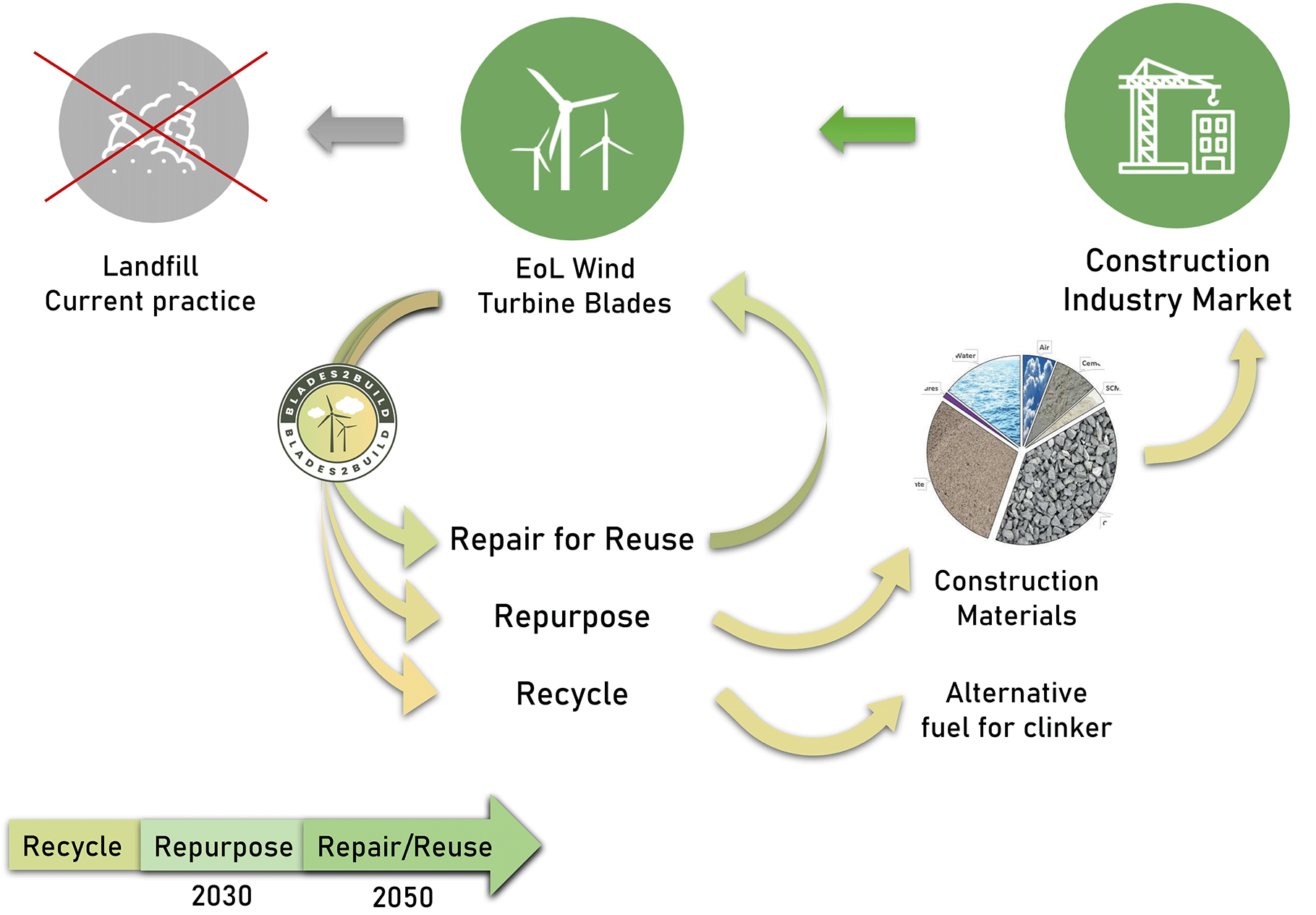
Figure 1. The circular options put forward by Blades2Build to simultaneously reduce waste from wind power generation and pressure on raw materials by the construction industry.
From the repurposing and recycling routes, we will create new construction materials with FRP material waste from wind turbine blade structures.
Synergistic and multidisciplinary approaches are required to achieve a truly circular future. We cannot neglect that our society stands on “raw” materials exploitation and manufacturing, and that many products and services need these materials’ conditions to function. As we strive for higher levels of circularity (reuse, reduce), we should cooperate with cross-value chains – in an open-loop supply chain fashion – to use waste materials from one value chain and relieve the pressure on raw materials of the other in an economical process. In this way, we guarantee that the future renewable energy supply and construction materials respond to policies that are responsible for zero waste and resource efficiency.