Introduction
The EU-funded project WATERFRONT examines how artist-led participatory practices can support citizen engagement with climate change challenges in waterfront contexts (Waterfront 2023). This is to raise awareness of climate change, encouraging them to take initiatives individually and/or collectively under the motto that many small contributions add up to a large one. To explore how artists can stimulate this connection between artists and citizens, co-design sessions were held in three participating countries at their specific locations: Gothenburg/Sweden, Zadar/Croatia, and Lesbos/Greece. At the request of these three countries and their initiators, the Dutch team, which participated in a previous EU-funded project, the "SOS Climate Waterfront," also participated in the online session of Sweden to start bringing in their former lessons learned and to participate in the project further.
The project focuses specifically on the preparatory phase of the WATERFRONTS project, in which focus groups are used to explore local climate issues, artistic approaches, and conditions for meaningful public involvement. The purpose is not to evaluate artistic outcomes or community impacts but to analyse process-related insights emerging from these focus groups and from a subsequent reflective workshop. By examining these moments, the aim is to clarify how artists can be supported in leading participatory work with communities, and which process conditions may help translate concerns about climate change into collective action.
In short, the outcome of these co-design sessions was that the urgency of citizen involvement in climate measures, with all related issues, was discussed, as well as the inventiveness of involving artists in raising awareness, but how this could be achieved was left very open. Therefore, on this topic of how artists can get started, the smallest contributions of these co-design sessions have been analysed in conjunction with each other, in combination with the literature, to provide an initial working model.
This, with the goal of supporting artists in the four countries in their work, and, after observing and comparing them with actual processes, to develop action perspectives for new projects in other countries as well. This resulted in a strategic working model and tools to obtain such an approach. What is written in successive chapters: 1. Introduction to the WATERFRONT initiative; 2. Research conceptual model, 3. The’ Artivism approach, 4. The Artivism conceptual framework, 5: The research questions, 6. The co-design sessions resulted in 7. The artivism process was modelled, and 8. Conclusions and remarks with references and an attachment.
The WATERFRONT EU-initiative, its targets and context,
The EU-funded WATERFRONT project aims to support communities in engaging with climate change challenges in waterfront contexts through artist-led participatory practices. The project is based on the understanding that climate change is experienced locally and unevenly and that effective responses require citizens to be actively involved in shaping how challenges are understood and addressed (Waterfront 2023).
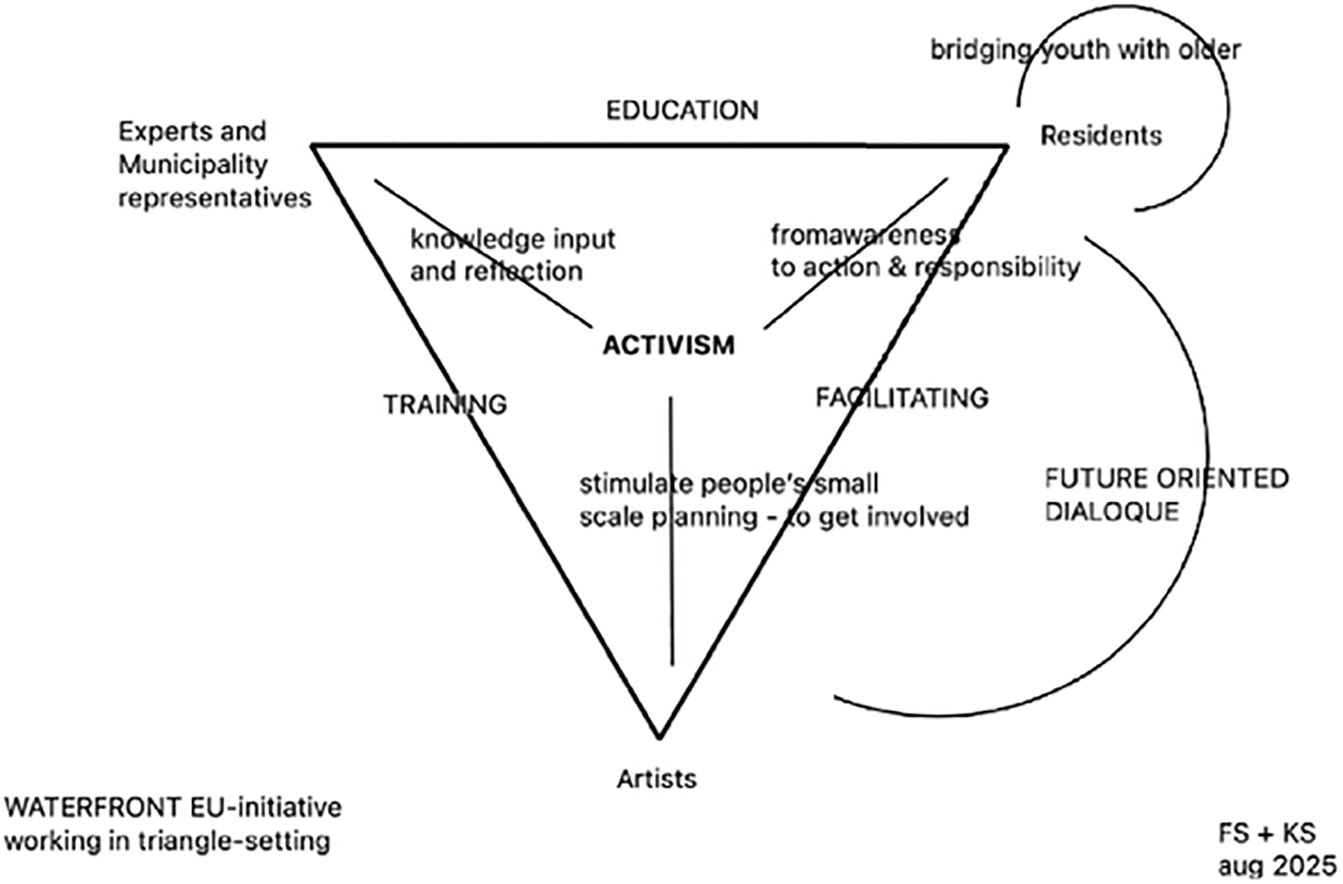
Within WATERFRONTS, artists play a central role by leading participatory activities that enable dialogue, reflection, and co-design with local communities organized in the tradition of Artivism. Expert knowledge contributes to contextual insight, but solutions are not predefined. Instead, they emerge through collective exploration, guided by artistic practices.
The project is coordinated in Sweden, with partner organizations in Greece and Croatia, and an associated partner from the Netherlands. Activities take place in Gothenburg, Sweden; Lesbos, Greece; and Zadar, Croatia. Dutch participants contributed through focus groups organized in Sweden and through participation in the Gothenburg workshop and are exploring funding opportunities for a spin-off project in the Rotterdam area.
The initiative builds on insights from earlier European projects addressing climate change in coastal regions, including the SOS Climate Waterfront Project (Sanders and Jonkers 2024) (Sanders and Oliveira 2024). WATERFRONTS extends this work by emphasizing artist-led participation, process design, and the role of creative practices in enabling citizen involvement and shared responsibility.
As a preparatory step, WATERFRONTS includes a series of focus groups organized in the participating countries. These focus groups brought together artists, climate experts, and practitioners with experience of community engagement. Although formally structured as focus groups, the sessions facilitated co-design by encouraging participants to jointly explore local climate challenges, discuss possible approaches, and reflect on how artists might engage citizens in later phases of the project. The insights generated through these sessions inform the WATERFRONTS methodology and support artist capacity building by generating action perspectives, a framework for effective process management, so that local governments in other cities or other locations can adopt this approach, adapting it as much as possible to their own local circumstances.
Following this preparatory phase, artists engage in Artivism activities in their communities. These activities were subsequently deepened through residencies at the respective waterfront locations. Peer learning between artists takes place after residencies, allowing for reflection, exchange of experiences, and consolidation of insights.
The project's goal regarding these action perspectives is partly open-ended; it remains to be seen what kind of initiatives citizens will take (Waterfront 2023). Will they be practical initiatives in the public spaces surrounding their homes, or will they help each other make their homes more energy efficient? Alternatively, will they involve entirely different initiatives, such as liveability, health, inclusivity, and shared mobility? Therefore, the question remains whether these initiatives will be taken solely among citizens or also in collaboration with other organizations, businesses, or the municipality as a local government.
WATERFRONTS focuses on coastal and waterfront locations because such areas are particularly exposed to climate change. These locations often experience multiple and interconnected challenges, including sea-level rise, flooding, water scarcity, heat stress, and pressure on public spaces. By working in this context, the project seeks to better understand how artist-led participatory practices can support communities in responding to complex and overlapping climate risks.
The research conceptual model and its highlights
The conceptual research model applied in this study is structured around five interconnected research steps that support an action-oriented and learning-based approach:
a. The first step consists of ex ante research conducted on location. This step focuses on identifying relevant issues, assumptions, and sensitivities at an early stage, before the outcomes are known. Focus group co-design sessions with experts on climate change and artists are used as a key method in this phase to explore local climate challenges, expectations, and possible approaches, and to provide them with the tools they need to engage productively with citizens.
b. The second step involves process learning through immediate analysis. Insights emerging from ex-ante research are analysed as the process unfolds, allowing early patterns and tensions to be identified and informing the development of the methodological framework.
c. The third step concerns the translation of these insights into methodological orientation, during a conference with experts with practical experience with similar processes to explore action perspectives for the work artists have undertaken for their natural environment locations. At this stage, emerging knowledge is used to clarify the directions, roles, and points of attention that guide subsequent phases of the project, including artist capacity building.
d. The fourth step focuses on the observation and analysis of practice. As artist-led activities are implemented, attention is paid to how participatory processes develop in real-world contexts and how earlier assumptions hold up in practice.
e. The fifth step consists of the consolidation of learning. Insights from the different research steps are brought together to support methodological understanding and future application to continue similar processes at other locations by other citizens or local organizations, without aiming to produce fixed or universal solutions.
The research approach underpinning these steps follows action research logic. Research is not positioned as a retrospective evaluation but as an integral part of the process as it unfolds. Learning takes place ex ante, in the sense that it occurs before outcomes are fixed and is carried out on location. Therefore, the analysis is closely connected to ongoing processes rather than being postponed to a later evaluation phase.
In addition, the model draws on principles associated with living lab approaches, because the research is studied ex-ante on location during implementation and is also immediately analysed using suitable reflection methods, in particular by holding focus group sessions. Knowledge is generated in real-life contexts through interactions between different actors and through continuous feedback between exploration, analysis, and adjustment (Sanders and Overtoom 2022) as shown in Figure 1. This allows research to remain responsive to local conditions and evolving perspectives. Within this framework, focus group sessions function as an ex-ante, on-location research method that supports early process learning and sense-making. They do not serve as reflective evaluations of completed actions, but as an exploratory input that informs the methodological framework.
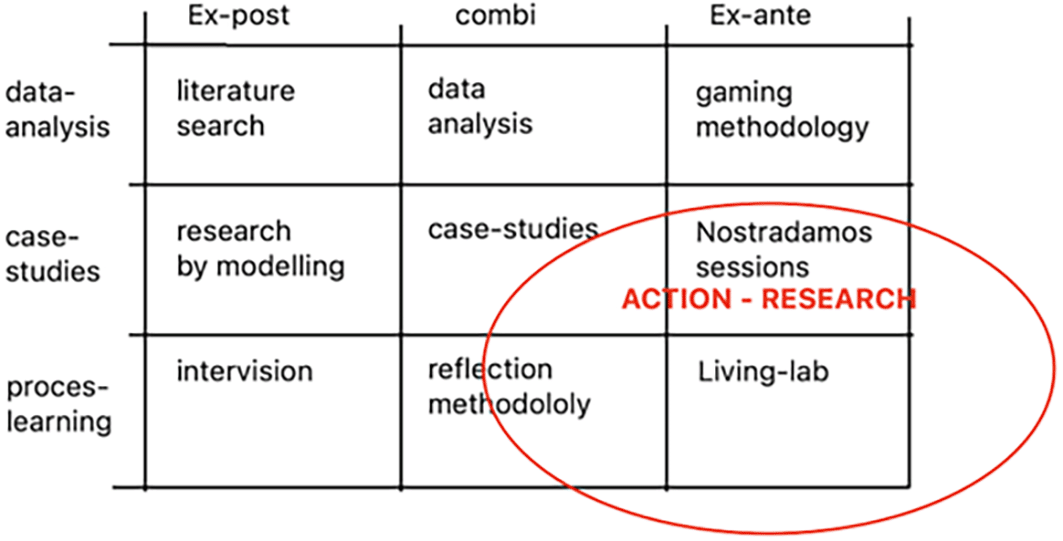
Figure 1. The Living-lab research methodology in context (Sanders and Overtoom 2022).
Artivism, the thesis and historical existence
The term ‘artivism’ is defined as the practice that emerges from the overflow of academic and museum artistic creation into social spaces and places (Aladro-Vico et al., 2018). Art practice moves from creation towards an instrument for social action. Artivism has a long history based on the sixtieth century, from the desire to connect to reality, to becoming part of societal movements.
The London Artist Placement Group established in the 1960s the following parameters to define artivism: 1. The context is half of the work; 2. The function of art as a medium focuses on processes and objectives; and 3. The contribution of art to society is art; 4. The status of the artist must be on par with the rest of the professionals with whom they collaborate; 5. The artist must be independent and the 6. To achieve an optimal result, the artist must establish how to coordinate with various people or departments.
Only in that time the artivism became merely used to break down the established order, it became a rebellious movement ad this continued during the centuries, as shown by recent examples in Europe like the ‘Ende Gelände’ movement against carbon-energy use (since 2015), Extinction Rebellion on climate issues, and the French ‘Yellow Vests protests’ movement on social issues (both since 2018), movements that are still rebellious although their goals are wider oriented including tacking climate-change and social justice.
Less noticeable, during the same period, smaller movements have been active, with initiatives not rebellious and also focusing on societal issues such as climate change, social equality, and more local issues. Practical examples are: the resident-built capsule with memories for the new development of the ‘Vissershop’ neighbourhood in Zaandam city in the Netherlands, the re-visibility of the tsunami line in Lisbon city to make residents aware of how far the ocean can reach under climate change, and the street art in Gothenburg city addressing a diversity of social issues among the residents.
In this way, the WATERFRONT research aligns well with a tradition of artivism initiatives, with the difference that the instrument is deployed in a living lab setting to study not only the practical, direct results but also the process the artists experience with local residents, including the stimulating and counteracting forces. This is to determine how residents can be encouraged, individually or in groups, to take responsibility for climate change.
Artivism, and its conceptual framework explored
Art can influence humans in their behaviour by influencing personal preferences by encouraging people to explore and make new unknown choices by teaching us to overcome the fear of the unknown and take that step in a positive and negative sense (Aumann 2022). Artivism, as a hybrid form of Art and Activism, originates from an educational movement in the world of museums to encourage people by artistic initiatives into social spaces and places the adoption of more positive behaviour towards change and social transformation through the work of artists (Aladro-Vico et al., 2018). Synonymous words of Artivism are ‘creative activism, “artistic activism, “political art’ and ‘activist art’ (Stephen and Silas 2022). Artivism thereby assumes equality between artistic creation and socio-political action, highlighting an organic relationship between art and activism (Sandoval & Latorre 2008) to explore pathways for transformation (Jordan 2020).
The first signs of Artivism should be placed in the 1960s when the London Artist Placement Group (APG) and Situationists International (SI) manifested themselves in seeking to challenge traditional art practices and engage with social issues, but they did so with differing approaches and philosophies. The APG, emerging from a more pragmatic British context, focused on integrating artists into industrial and organizational settings to foster social and technological change, while the SI, originating in Europe, aimed for a radical societal transformation through the creation of “situations” and the subversion of everyday life (Debord 1956). Although other terms such as ‘context art’ and ‘community art’ are also included under the umbrella of artivism as they seek to move ‘from direct political action to social intervention, from the artist to the catalyst, to the agent and the turn of collaboration, micro-politics and social creativity’ (García Cano & Vérez 2025).
Turning societal situations or changing these towards situations in which citizens take over the role of professionals through societal engagements has become an important aspect of Artivism (Stojanović, 2017) which is strongly related to the field of role-change: important drivers for role-change are the following societal leadership of leaders among the people, bridging with government as a condition and a sense of urgency (Sanders 2009). What all places artivism in the action role stimulates change among citizens towards taking responsibility for societal challenges of importance, safety in neighbourhoods, social equity, and climate-change measures. Related to climate change challenges, artivism is used as an instrument for three fields of interpretation: 1. Focusing on educating audiences as citizen groups, 2. Ecocritical movements to highlight policy controversies, and 3. Improving citizen involvement (Rodríguez-Labajos 2022) of which are the most recent.
WATERFRONT, the research questions
The way artists will interact with the citizens involved during the WATERFRONT project to raise citizens’ awareness of climate change and willingness to participate in climate measures is not pre-framed in advance. In that respect, the WATERFRONT project is an open exercise where artists’ work is not constrained. They are free to determine how they approach citizens with their art and what kind of interactions they engage in. The only constraint was that the themes were climate change, awareness, and participation of citizens in climate measures. This means that the project is well suited to a full-fledged living-lab setting.
The co-design sessions between the artists involved and climate and communication experts took place before the artists began work, although they were pre-selected primarily based on their availability and involvement in their community. This turned the sessions into an exploration of the work the artists would be doing as well as an exchange of ideas and strategies to help each other. The strategies explored should be valuable for comparing later observations of the process followed in order to maintain even better perspectives for action for all artists doing comparable work.
The research conducted within the WATERFRONTS is guided by a central question that addresses the role of artist-led practices in supporting citizen engagement with climate change in waterfront contexts.
This main research question is:
How can artist-led practices support citizen engagement with climate change challenges in waterfront contexts, and what conditions enable such engagement to develop into collective action?
To explore this question in a focused and practical way, the research is further guided by the following sub-questions, which were used to structure the exploratory focus group discussions:
1. Which climate measures are citizens expected to be willing to participate in, according to the perspectives shared during the research process?
2. How do artists plan to shape and implement their climate artivism activities in ways that actively involve citizens?
3. How are citizens expected to respond to artist-led climate artivism initiatives?
Together, these research questions provide a framework for analysing expectations, assumptions, and anticipated dynamics at an early stage of the project. They focus on understanding the potential forms of participation and engagement rather than evaluating outcomes or impacts.
The co-design sessions and results
Seven co-design sessions took place: three online for invited guests from Gothenburg/Sweden, Denmark, and the Netherlands; three online for participants from Zadar/Croatia; and one physical meeting held on the island of Lesbos/Greece. The sessions were primarily attended by experts along with a limited number of artists. Only the session held in Lesbos, Greece, featured only experts. These experts included experts on climate change, community development, and social behaviour. Equal numbers of women and men participated in the sessions. All these sessions were moderated by external professional moderators to ensure that the conversations were as open as possible, allowing everything to be said and discussed interactively so that the process the artists would engage in with citizens would also be discussed during the conversation.
Three questions were posed to attendees during each of these sessions: What climate issues are expected for the area, what kind of art exhibition will stimulate residents to become involved in these issues, and how will residents become involved? Finalized with the possibility of adding forgotten thought or simply adding it.
Please note: For the underlying data and the translation of the co-design sessions into the highlights, see the attached table, Table 5, as used in the following analyses.