Introduction
The world progresses, but its principal problems of poverty and inequality remain. Much of globalized society is engrossed in what they see as the pressing reality of climate change, derived from the exhaustion and mistreatment of the earth, and exacerbated by the unprecedented consumption of goods and services. Meanwhile, another part lives in an abyss of labor exploitation that is either overt and unabashed, or disguised through the legal processes of outsourcing, relocation, and international fragmentation of the value chain. Corruption and economic domination have produced a new de facto social class in developed countries: the precariat (Guamán & Luque, 2019; Luque et al., 2016; Standing, 2013). A great part of the world’s citizens finds themselves in this chasm, having been forced out of their natural ecosystem (Sassen, 2015); in this abyss, any means of survival is valid including the processes of the informal economy. These comprise more than 90% of micro and small enterprises (MYPE) globally (International Labour Organization [ILO], 2019) as well as a significant part of the rural economy in developing countries (ILO, 2020b). In fact, the informal economy accounts for 10–20% of GDP in well-established economies and up to 60% in emerging economies (Schneider & Enste, 2002), and two billion people worldwide are employed informally, which represents more than 60% of the global workforce. 93% of all informal employment is in emerging and developing countries: in Africa, 85.8% of jobs are informal; the proportion is 68.2% in Asia and the Pacific, 68.6% in the Arab States, 40.0% in the Americas, and 25.1% in Europe and Central Asia (ILO, 2018). In Latin America and the Caribbean, about 140 million workers are in a situation of informality; according to Salazar-Xirinachs and Chacaltana (2018, p.15):
“These are workers who are not covered by labor law and are not, therefore, subject to the relevant formal regulations of the world of work or employment justice; they make no social security contributions and, consequently, do not participate in the welfare state or the social contract that characterizes modern societies; they mostly have low-productivity jobs and, as a result, their incomes are low. At worst, many of them live in poverty or extreme poverty; and at best, they comprise what analysts call "vulnerable groups”.
In response to this panorama, the member states of the United Nations agreed on the creation of the 2030 Agenda (https://sdgs.un.org/2030agenda), which covers the three dimensions of sustainability (the economic, the social, and the environmental), and includes 17 Sustainable Development Goals (SDGs) (https://sdgs.un.org/goals) The eighth of these SDGs has the aim of promoting sustained, inclusive, and sustainable economic growth, full and productive employment and decent work for all. It is estimated that more than 600 million new jobs will have to be created by 2030 bearing in mind that 780 million people do not currently earn enough to keep them above the poverty line of $2 per day (ILO, 2020a). Consequently, the International Labour Organization (ILO) recommendation No. 204 on the transition from the informal to the formal economy (ILO, 2015) mandates that the creation and sustainability of enterprises and decent jobs be facilitated and promoted, and steps be taken to prevent the informalization of employment.
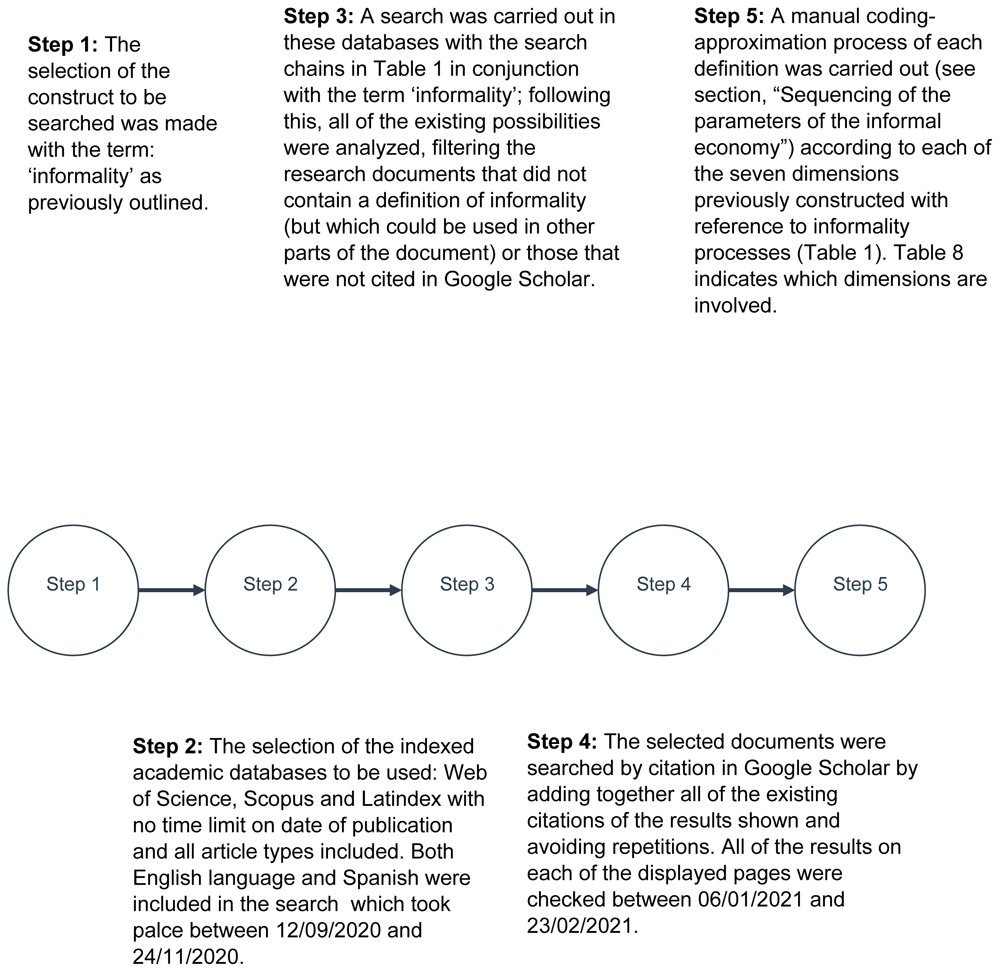
Given the scale of the issue and the potential remedies being sought by international bodies, it is necessary to analyze the factors that contribute to the development of processes of informality in order to better define the dimensions involved. This study is based on a conceptual analysis with the specific aim of clarifying whether informality is concerned only with economic aspects or whether conditions of greater depth or interconnectedness are involved (see Table 1; Luque, 2021). These conditions are often overlooked in definitions of informality but can have an important role to play.
Table 1. Definition coding for each dimension with full search chain.
| Dimensions, coding and related search of informality processes | ||
|---|---|---|
| Dimension | Definition coding | Search chain |
| Economic | Economic or financial aspects that affect and promote informality processes | ‘economic inclusion’ |
| ‘protection of economic rights over human rights’ | ||
| ‘equity of tax payments for big business’ | ||
| Legal | Established relationships of regulatory nature that cause asymmetries | ‘globalization processes’ |
| ‘weakening of control of regulatory bodies’ | ||
| ‘trade union freedom’ | ||
| ‘regulatory and monitoring bodies for global action’ | ||
| ‘new forms of partnership and association' | ||
| Social | Relationships and impact of the development of informal activity on society | ‘formal recognition of social economy processes' |
| ‘quality of life’ | ||
| ‘welfare state’ | ||
| ‘processes of fair treatment’’ | ||
| ‘alternative modes of life' | ||
| Political | Legal regulation and the absence of it based on political ideals/ programs | ‘free trade and investment agreements with instruments for the resolution of private conflicts' |
| ‘lack of rights and employment deregulation' | ||
| ‘precariousness of employment’ | ||
| Cultural | Ensemble of material and spiritual assets such as language, lifestyles, customs, traditions, habits, values, patterns, tools and knowledge | ‘collective identity’ |
| ‘undefined aspects that constitute society’ | ||
| ‘worldview’ | ||
| ‘cooperativism’ | ||
| ‘solidarity’ | ||
| ‘value of heritage’ | ||
| ‘promotion and conservation of ancestral traditions’ | ||
| Ethical | Principles based on ethics, customs, and morals1 | ‘continual cost reduction’ |
| ‘investments in countries in a state of conflict' | ||
| ‘corporate corruption’ | ||
| Labor | De-structured view of the development process | ‘fairer, more ethical and inclusive growth' |
| ‘fair trade’ | ||
| ‘precariousness of employment’ | ||
The processes of informality and the development of its terminology
The term ‘informal sector’ was initially coined in 1972 in an ILO employment advisory mission to Kenya; from there it developed to ‘informal economy’, making it clear that informality is not limited to a ‘sector’, but is an alternative way of conducting almost all economic activity (ILO, 2020c). The basic definition of informality includes elements of conflict and cooperation (Thompson & Smith, 2009) as well as compatibility with the processes of marginality and economic domination (Castells & Portes, 1989a; Harvey, 2007). Informality is measurable (ILO, 2013), but it involves multiple heterogeneous causes, situations, and phenomena of great magnitude and depth, extending to aspects of self-employment (Slavnic, 2010). However, it is possible to distinguish between the origin and the nature of informality: Mars (1982) approached the subject extensively from the point of view of why workers seek illicit remuneration for carrying out their activities. The processes of informality are imbued with strong cultural components characterized in turn by common denominators such as the lack of decent employment or the conditions that provide it (although, in certain cases, informal workers receive better wages than permanent, formal workers (Chen et al., 2005).
According to de soto (1989, p.11), informality is technically an illegal activity, albeit one that lacks "antisocial intent". From a business perspective, the impact of this is limited (Khavul et al., 2009; Siqueira & Bruton, 2010) notwithstanding the doubts expressed by many academics and experts in management and entrepreneurship (Ram et al., 2017). In fact, there may be informal, unregistered enterprises that, through their activity, receive revenue from the legal production of goods and services (Bruton et al., 2012, p 1). In the view of the Inter-American Centre for Knowledge Development in Vocational Training (ILO/CINTERFOR), informal work includes:
“All paid work (e.g., both self-employment and wage labor) that is not registered, regulated or protected by legal or regulatory frameworks, as well as unpaid work undertaken in a for-profit business. Informal workers do not have stable contracts of employment, employee benefits, social protection or worker representation.” (ILO/CINTERFOR, 2020b)
Among the characteristics of informal work is a lack of definition of the place in which the activity takes place, a lack of schedules and working hours, deficient means and resources, and irregularity of income; additionally, it is often carried out in an insecure and unhealthy environment without any kind of employment or social protection. Payment for the production of goods and services is typically unregistered in order to evade taxation, social security payments, and to avoid legal requirements (Williams & Windebank, 1998, p. 4).
The causes of informality are many, but the economic context in a country is the decisive factor, followed by the legal situation, political stability, and certain microeconomic circumstances such as poor education, discrimination of all kinds (including that which is legally sanctioned), and various aspects of deprivation that lead to limited access to decent housing (both for rent and property). This is compounded by lack of access to financial services and, in turn, to markets (despite the constant rise of the cooperative sector, which offers savings and credit). Many studies show that the burdens associated with tax and social welfare systems are the key drivers of the growth of the informal economy (Alm et al., 2006; Dell'Anno, 2003; Tanzi, 1980). Indeed, widespread and inflexible regulations also push an increasing number of workers and companies to join the informal sector (Hoa, 2019). This over-zealous regulation combines with the processes of economic recession to favor models of disruptive economy. Companies such as Uber (https://www.uber.com), Glovo (https://glovoapp.com/), Cabify (https://cabify.com), Airbnb (https://www.airbnb.co.uk/), OpenTable (https://www.opentable.co.uk/), Yelp (https://www.yelp.com), Deliveroo (https://deliveroo.com), and the giants, Amazon (https://www.amazon.com) or AliExpress (https://www.aliexpress.com), inherently offer little social coverage, taking advantage of the cracks in labor law deregulation to empower themselves and overrun the economic system, having forced out the traditional companies in their sector.
Poverty as an element of disruption and domination
Poverty is not incompatible with richness of spirit. Nonetheless, economic deprivation conditions much of human existence, above all, quality of life and the prospects of the next generation. Poverty has detrimental consequences even for the lives of the rich: a society in which greater equality is achieved on the basis of the processes of true equity and a state that implements strong social policies will tend to be more peaceful and settled and obtain greater cost savings (Wilkinson & Pickett, 2011). However, certain companies exploit the model of necessity, which consists in eroding any type of social assistance (the welfare state) and using the processes of corporate social responsibility to disguise the deficiencies of the care system. Such models rely entirely on goodwill but lack any enforceability (Ruggie, 2001). The situation is aggravated by the ability of states to displace their policy commitments and social responsibility obligations with the blessing of supranational organizations (Luque & Álvarez, 2021; Mason, 2016; Passet, 2013). At the same time, processes of corruption are occasionally sponsored by (usually transnational) companies in order to undermine the labor market, while monopsony stretches the very fabric of small and medium-sized enterprises (Luque, 2018). It should be noted that many developing economies and models in transition demonstrate that informal economies of considerable size can coexist with the expansion of the formal economy and achieve good growth results (ILO, 2014, p. 9).
“Many factories repeatedly issued unlawful short-term contracts to avoid paying workers maternity and other benefits, and to intimidate and control them. Small factories that subcontract to larger export-oriented factories are more likely to hire workers on a casual basis, making it harder for workers to assert their rights because they risk being easily fired. Apparel brands have not taken adequate steps to end the illegal short-term contracts in their supplier factories–even where their supplier codes of conduct have clauses limiting their use.” (Human Rights Watch, 2015)
Faced with this situation, much of the public, committed to preserving their quality of life, look for easy credit (often accepting usurious interests) to the extent that uncontrolled debt becomes a social leitmotif. Many governments mirror this credit debt on a global scale (World Bank, 2020). In developed countries, gambling has become widespread, and bookmakers have multiplied, encouraged by the state, whether as a kind of social anesthesia or as a squalid source of tax revenue (Humphreys et al., 2020; Lopez-Gonzalez et al., 2019). According to Francisco and Bergoglio "The culture of relativism is the same pathology that makes one person take advantage of another and treat them as a mere object, pushing them into forced labor, or making them a slave to debt" (2015, p. 95). From new forms of poverty emerge new classes of the poor: the victims of climate, politics, economics and hunger, they range from refugees to academics (Oliván & Luque, 2019). According to Beck:
“The rich, who coincidentally are the most resourceful and powerful actors on the political scene, do not need the poor even for the salvation of their souls (which, in any case, they do not believe they have and whose care they would not consider worthy of their interest), nor even to continue being rich, nor yet to grow even richer (which they believe would be easier if there were no need to share a portion of their wealth among the poor).” (Beck, 1998, p.90).