1. Introduction

Water and soil play a central role in environmental health and human well-being across Europe. However, protecting them and keeping agriculture productive remains a challenging balancing act. European policy has been evolving for decades in response to growing concerns (public health, climate change, and biodiversity loss), but translating high-level goals into everyday farm practice is not straightforward.

In recent years, governments have pushed policies that try to pair productivity with sustainability. The idea is sensible, but it often runs into trade-offs in practice: measures that protect ecosystems can slow short-term yields or raise costs for farmers. In this article we review how 14 European countries (including Albania, Cyprus, Czech Republic, Denmark, France, Greece, Italy, Netherlands, Norway, Poland, Portugal, Spain, Turkey, and Ukraine), have developed and implemented water and soil management policies, and we look at the institutional and market arrangements that shape real-world outcomes. For clarity, we use “PIM” to mean policy, institutional, and market conditions.

The assessment of the strengths and constraints related to policy, institutional capacity, and market conditions is critical for understanding the feasibility of adopting sustainable agricultural technologies and practices. Analyzing these factors helps assess whether farmers have the necessary access to prerequisites required for the successful adoption of technologies. This assessment is further necessary because investigating these builds the infrastructure for the European countries to adopt technologies within the frameworks of the Common Agricultural Policy and National Strategic Plans, thereby advancing a more sustainable and competitive agricultural sector.

The threats are well known and persistent. Intensive agriculture often plays a major role: overapplication of nitrogen fertilizers and extensive pesticide use, for example, contribute to soil degradation and to the contamination of surface water and groundwater with nitrates, phosphorus, and pesticide residues. Across parts of northern and Central Europe, nitrogen surpluses remain a concern, and groundwater nitrate concentrations have shown little improvement over decades.1 Soil quality is also being eroded through loss of organic matter, compaction, contamination, and sealing, while water scarcity and more frequent droughts, worsened by climate change, add a worrying new stress. The EU estimates that 60–70% of European soil is unhealthy due to human activities.2

To make sense of how policy translates (or fails to translate) into practice, we carried out a comparative assessment of PIM conditions across 14 selected countries. Our analysis draws on EU and national policy documents, structured questionnaire responses from stakeholders, and Excel-based national policy summaries. This approach lets us compare readiness for sustainable practices and technology adoption across various European countries. This comparative assessment will highlight systemic barriers and also identify existing opportunities that can inform future policy design and technology deployment plans to reach long-term environmental and economic sustainability.

2. Literature review

The European Union (EU) has acknowledged the critical role of water and soil in environmental sustainability and human well-being for years. Over recent decades, policy has gradually evolved to confront the progressive degradation of these resources, motivated by concerns that range from public health to climate change and biodiversity loss. More recently, EU policy has emphasized two objectives in responding to global pressures such as resource scarcity and climate risks: maintaining agricultural productivity and enhancing sustainability.3 This study examines how 14 selected European countries have articulated water and soil management in policy and practice, and it highlights prevailing scientific insights and applied measures intended to foster sustainability.

2.1. Water and soil assessment

Water and soil are fundamental natural resources that are deeply interconnected and essential for human well-being and economic activity. Agricultural ecosystems, for instance, rely on several soil functions, including the production of food, fiber, and fuel, water purification and regulation, carbon sequestration and climate regulation, habitat for biodiversity, and the recycling of nutrients and agro-chemicals.4 The physical, chemical, and biological characteristics of soil, along with natural and human influences like land use, collectively shape these vital soil functions.

However, human activities have a significant impact on these resources, often leading to degradation. Intensive agricultural practices contribute to environmental problems such as soil erosion and water eutrophication, which leads to threatening both agricultural production and soil functions.5 Specifically, the excessive use of fertilizers or herbicides can pollute water bodies.6 Agricultural practices throughout the EU contribute significantly to the pollution of water resources by nitrates, phosphorus, and pesticides.1 This pollution creates a major risk to water bodies across the EU, with nitrogen surpluses remaining very high in northern and Central Europe and nitrate concentrations in groundwater showing no improvement for 30 years.1 Similarly, pesticide use has not decreased since 2011, affecting water quality, quantity, ecology, and biodiversity.1

In response, the European Commission’s Farm to Fork Strategy, a key part of the 2020 European Green Deal, has set ambitious targets to reduce the use and risk of chemical and more hazardous pesticides by 50%, the use of fertilizers by at least 20%, and nutrient losses by at least 50% by 2030.1 Soil degradation manifests in various forms, including erosion, a decline in organic matter, contamination, sealing, compaction, and a reduction in biodiversity, all of which affect soil quality and its capacity to provide ecosystem services. Additionally, Europe faces increasing challenges from water scarcity and droughts, necessitating effective risk management strategies.

EU policy instruments address many of these concerns. The Water Framework Directive (WFD), together with the Nitrates Directive and the Groundwater Directive, aims to improve water quality and reduce nutrient and pesticide losses to the environment. The WFD promoted Integrated River Basin Management (IRBM) as a holistic planning approach that treats land and water as parts of the same system. Implementing IRBM requires cross-disciplinary understanding and benefits from tools that can quantify variable source pollution and erosion. Agro-hydrological models, for instance the Soil and Water Assessment Tool (SWAT+), are commonly used to estimate sediment and nutrient reductions and to inform targeted mitigation measures.

Despite increased awareness, soil is often not explicitly included in environmental policies, and a comprehensive EU-level soil protection directive is currently lacking. Although the European Commission proposed a Soil Framework Directive, it was ultimately withdrawn due to disagreements among Member States. This absence has led to varied approaches to soil protection across Member States. Ronchi et al.’s study indicates a persistent gap between the scientific understanding of soil degradation and the policy attention it receives.7 While monitoring tools like CORINE Land Cover and LUCAS Soil provide extensive data on land use and soil properties, policies often remain disconnected from this evidence.7 For effective soil management, there is a clear need for harmonized targets, monitoring, and evaluation methods across the EU. Enhanced coordination of data and knowledge is crucial for strengthening policy coherence and effective implementation.

2.2. The policy background

The history of European water and soil management policy reflects a long process of adaptation, shaped by shifting priorities from productivity to sustainability. Early agricultural revolutions in the 18th and 19th centuries focused on increasing yields through intensive methods, which, however, led to issues like soil erosion, biodiversity loss, and water contamination.3 European water and soil management policies have undergone significant evolution. Early EU water policies, initiated in the mid-1970s, focused on setting standards for water uses, such as drinking and bathing, and controlling the discharge of harmful substances.8,9

However, these early policies were often criticized for being isolated and fragmented, leading to a recognized need for a more holistic approach.8 These directives, while sometimes challenged, often led to broader reforms and research, effectively shaping national environmental policies. By the early 1990s, the focus expanded to include controlling diffuse pollution, particularly from urban wastewater and agricultural nitrates. The Nitrates Directive and the Water Framework Directive (WFD) are considered highly relevant for water and also soil quality due to their indirect impacts.

The Common Agricultural Policy (CAP) has undergone a parallel evolution. Once focused primarily on increasing food production, the CAP has integrated environmental dimensions. This evolution recognizing agriculture’s dual role as both a source of environmental pressure and a potential contributor to ecosystem services. Reforms have introduced key mechanisms such as cross-compliance, that links funds to farmers to follow environmental standards, and rural development measures, which reward sustainable practices that go beyond legal baselines. Recent initiatives have further strengthened the link between CAP payments and sustainability objectives through “greening” requirements. Empirical work by Pulighe et al. (2025) shows that practices such as no-till farming, filter strips, crop rotation, and grassed waterways can meaningfully reduce soil erosion and improve water conservation which is aligning well with CAP’s broader environmental purposes.5

The adoption of the Water Framework Directive (WFD) in 2000 represented a strategic revision, promoting integrated management of freshwaters by establishing the river basin as the core management unit. While this directive sets broad objectives for water quality, it also allows Member States flexibility in defining specific standards and measures, embodying the principle of subsidiarity.8

Turpin et al. indicate that the “embeddedness” of soil concerns within policy frameworks varies significantly across Member States. Studies show a positive correlation between higher embeddedness levels and national efforts in environmental innovation and increased farmer land ownership.6 Countries that exhibit higher levels of embeddedness, alongside strong trust in EU institutions and a commitment to renewable energy, tend to propose a greater number of management practices to address soil-related challenges. Conversely, a higher farm income can sometimes correlate negatively with the number of implemented practices, suggesting complex trade-offs. Overall, Ronchi et al. found that national soil protection laws often lack coordination, with each country defining its specific threats independently, and contamination thresholds vary widely across Member States, impacting human health and investment decisions. The absence of a unified EU framework for soil protection has resulted in a fragmented and inconsistent legislative landscape among Member States.7

Despite its progressive framework, the implementation of the WFD continues to face challenges. Variations in interpretation, ambiguity in the Common Implementation Strategy, and insufficient institutional support have hindered the consistent application of IRBM principles across Member States.8 To advance sustainable soil and water management, there is a clear need for a coherent European framework that integrates these objectives, supported by transparent reporting and monitoring mechanisms. Establishing a comprehensive EU soil conservation policy would represent an important step toward addressing systemic gaps and reinforcing the EU’s environmental commitments.

3. Methodology

This study employed a comprehensive approach to evaluate the hypothesis. The methodology was based on three types of data sources (see Table 1):

Table 1. Methodology approach.

Data sourceFocusUse in research
Literature Review EU/national frameworksLegal/policy alignment, gaps
Questionnaire Stakeholder perceptionsImplementation experience, barriers
Excel Policy Data Specific laws/policies per countryVerification and comparison across sites

The study included a comparative analysis assessment across 14 European countries: Albania, Cyprus, Czech Republic, Denmark, France, Greece, Italy, Netherlands, Norway, Poland, Portugal, Spain, Turkey, and Ukraine. These countries were selected to represent diverse agricultural and socioeconomic conditions and also as strategic locations for implementing different policies and integrated environmental solutions.

4. The pathway for sustainability results

European countries are actively advancing their sustainability in water and soil management, displaying diverse levels of readiness, institutional capacity, and implementation approaches. Much of this effort is included in National Strategic Plans (NSPs) that align with broader European frameworks such as the Common Agricultural Policy (CAP), the Water Framework Directive (WFD), and the European Green Deal.

In general, these frameworks aim to promote a resilient and environmentally sustainable agricultural sector, while ensuring the long-term health of Europe’s natural resources. The analysis demonstrates that most European countries exhibit a high degree of policy alignment with EU sustainability objectives. In this sense, this point reflects the most difficult challenge for the policy, but also the capacity of stakeholders to adopt the financial and regulatory national or European framework.

Questionnaire results showed overall excellent national alignment with EU policy such as the CAP and WFD and directives, clear focus on various sustainability goals, and underscored the continuing need to a technology forward approach to agricultural practices regarding efficient water use, and water and soil pollution. Areas of opportunity include addressing the lack of knowledge within the farming sector and poor message clarity within and between policies.

4.1. Results analysis

Almost all participants were able to identify their NSPs and expressed alignment with several EU policies, with the highest alignments to the CAP, WFD and Green New Deal and Farm to Fork. These were followed by seventy percent alignment with Natura 2000. Though not provided as a response, several respondents wrote in 2030 SDGs as being aligned. As respondents were not given this as an option, this suggests that perceived alignment would have been higher among respondents had this been included in the list and also indicates a relevance and awareness of SDGs within the agricultural sector. Most participants agreed that their NSPs enhance climate resilience and deliver co-benefits for sustainable water management, reduced pesticide and fertilizer use, rural development, and farmer support. Biodiversity conservation (82.4%) and organic farming (70.6%) emerged as particularly prominent objectives, while about one-third of respondents identified carbon sequestration as a key sustainability priority.

When asked to list three specific policies, their compliance requirements, monetary support and scale of vision, there were several interesting similarities and differences among participants. Most responses included a mix of voluntary and mandatory policies, all of which included significant funding through national subsidies, EU programs, and rural development funds. Often participation in voluntary programs was encouraged through access to these funds and focused on encouraging sustainable best practices.

Mandatory policies were more aimed at environmental protection, such as nitrate use and pollution. In general, policies focusing on water management, organic farming, and climate adaptation were most common. Regarding enforcement, less than 10% of policies across all participants’ responses were judged to be weak with little to no enforcement. For the large part of the policies, about two thirds of respondents considered them to be moderately enforced, though some gaps may exist within these. This is in line with the fact that many policies were described as voluntary, with distribution of funds being the main driver for participation. Most policies covered long-term goals aligning with 2030 or 2050 timelines and included structural changes, like modernization of irrigation, as well as behavioral changes, like crop diversification.

Regarding sustainability and specific SDGs, only one respondent said that one of their national policies was ineffective at promoting sustainability, while over three quarters of the other policies were either considered very effective or effective. Participants were asked to list the main sustainability goals related to their national policies, and the area with the most room for improvement was the adoption of technology, followed by soil health and promotion of biodiversity. Only one policy from one respondent considered to be very effective at the promotion of technology, while the large majority of others marked that technology promotion was only moderately effective or neutral. Further details are presented in Table 2.

Table 2. Effectiveness of governance policies in promoting sustainability and technology adoption.

Effectiveness of governance policiesVery effectiveEffectiveNeutralIneffectiveDo not know
Sustainability10.4%68.8%10.4%2.1%8.3%
Technology adoption4.2%58.3%22.9%2.1%12.5%

As shown in Table 3, these results suggest the policy has a strong environmental foundation. They are most strongly associated with climate mitigation and water use efficiency, reflecting its focus on preventing climate change and encouraging sustainable agricultural practices. Clean Water and Sanitation was selected by the majority of respondents, indicating that these policies are (Table 3).

Table 3. The main sustainability goals targeted.

Climate mitigationWater use efficiencySoil healthBiodiversityTechnology adoption
Total Average 72.9%70.8%68.8%64.6%52.1%

The suggestion from some participants that decent work and economic growth (SDG8) and industry innovation and infrastructure (SDG9) should have been included in sustainable goal alignment highlights areas where more emphasis could be put on stakeholder interests. Likewise, zero hunger (SDG2) was perceived as more poorly aligned to national policy as compared to life on land, clean water and sanitation (SDG6), climate action (SDG 13) and responsible consumption and production (SDG12). An overview of these SDG contributions is presented in Table 4 based on the questionnaire results.

Table 4. Contribution of SDGs.

SDG2- zero hungerSDG6- clean water and sanitationSDG12- responsible consumption and productionSDG13- climate actionSDG15- life on LandSDG14- life below water
Total Average 54.2%83.3%64.6%79.2%62.5%6.3%

However, the practical application often faces significant challenges, such as high initial costs for new technologies, a lack of immediate profitability for farmers, and insufficient awareness among the agricultural community. This suggests that while the vision and policy frameworks for readiness are positive, the actual applicability still requires support and adaptation to local economic realities and farmer engagement. Policies often require structural changes in land use practices, which involve initial investments, legal adjustments, and additional labor or knowledge. Farmers will face challenges without adequate financial incentives or technical support. Table 5 summarizes the challenges in the implementation of policies.

Table 5. The challenges in enforcement of policies.

Lack of government fundingWeak institutional coordination Low awareness among farmers Conflicting policy objectives Not profitable for farmers Farmers can invest High bureaucracy No market for products
Total Average 58.3%41.7%64.6%35.4%47.9%52.1%56.3%8.3%

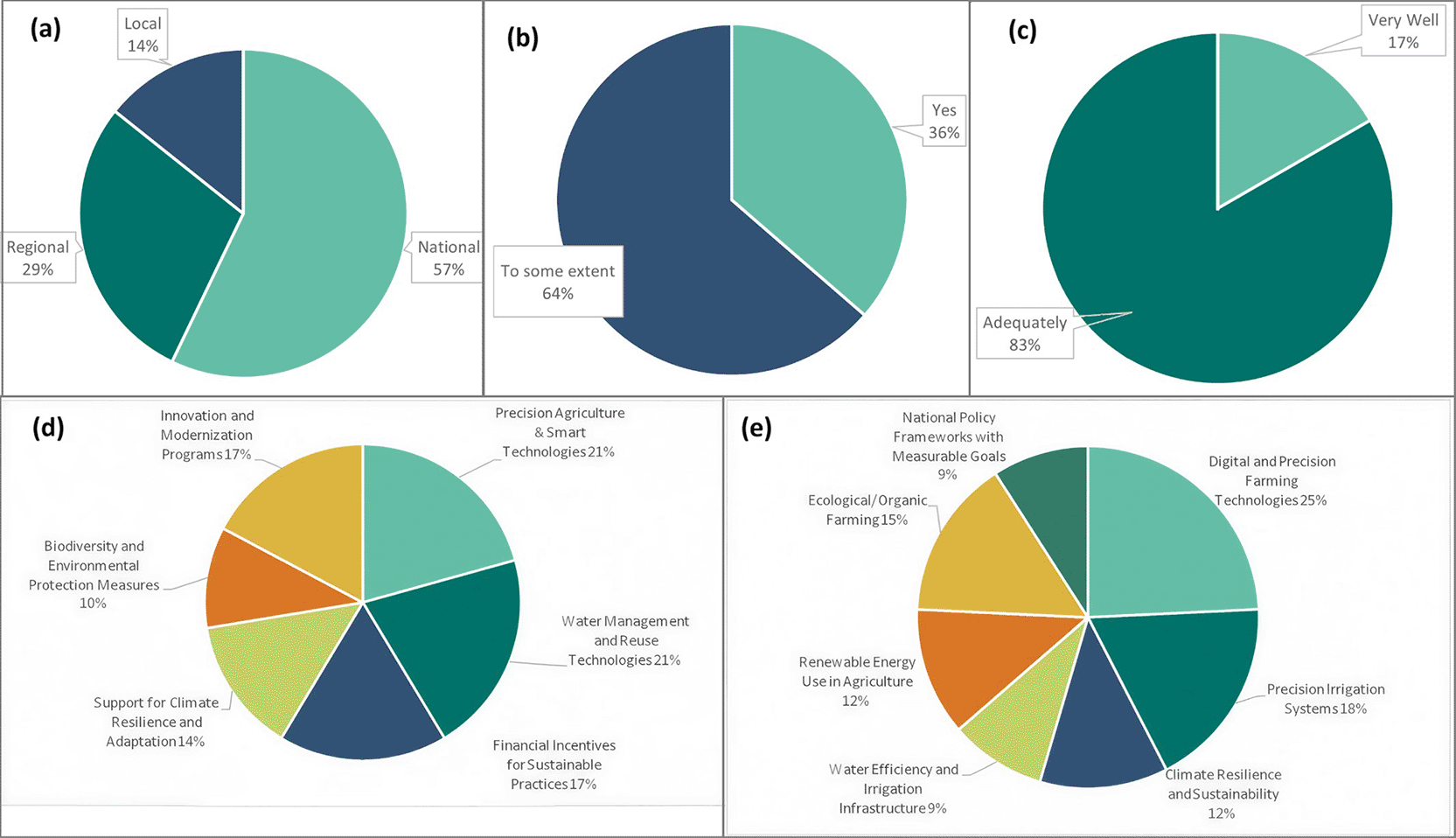
The questionnaire responses indicate that most policy implementation efforts are executed by public entities, most often at the national level (see Figure 1). While information about policies adequately reaches farmers and other users, engagement from involved stakeholders in shaping new policies is often occasional rather than consistently collaborative. This suggests a need for stronger partnerships. Furthermore, only approximately half of farmers receive necessary advisory support or training from public institutions, which highlights an opportunity to expand these services (including practical training and on-site advice) to significantly boost the adoption of sustainable practices. Reflecting a strong push for innovation, national strategies prioritize technologies that improve water efficiency and soil health, frequently mentioning advanced tools like precision irrigation systems, digital monitoring, and smart farming practices. This technological advancement is a core pathway toward a resilient agricultural sector, with targeting for digital transformation and efficient water use, and seeking to use cutting-edge solutions to optimize resource management.
54a742a2-9442-4745-92c2-49e2f2986971_figure1.gif

Figure 1. Overview of implementation, stakeholder involvement, communication, and top policy/technology targets.

(a) Level of policy implementation, (b) Stakeholder Engagement, (c) Policy Communication, (d) Most frequently mentioned policies and technologies, (e) Most frequently mentioned targets and themes

As shown in Table 6, key primary actors are often government ministries, especially those focused on agriculture, as well as farmer cooperatives. These actors guide the implementation of policies and facilitate the shift towards sustainable methods. The collective effort of diverse stakeholders, from policymakers to private companies and local communities, is essential for building together an effective and long term framework for sustainability.

Table 6. Stakeholders and actors overall influence average rating.

Stakeholder/actorOverall influence rating (1 = very low, 5 = very high)
Ministry of Agriculture4.56
Farmer Organizations4.12
Ministry of Environment3.86
Water Agency/Regulator3.73
Private Sector3.62
Research Institutions3.50

This assessment of policy fit, institutional capacity, and market potential across selected European countries indicates varying levels of readiness for water sustainability and soil health, as well as varied support requirements.

A distinct group of countries, including the Czech Republic, Greece, and the Netherlands, generally exhibit high overall readiness to implement sustainable practices and technologies. These nations are typically highlighted by strong alignment with European frameworks, well-funded incentives, and robust institutional and engagement capacities. For these countries, suggested support often focuses on advanced solutions, such as integrated innovation for pollution reduction, location-based information platforms, and interdisciplinary and inter-agency approaches. For instance, countries demonstrating strong policy fit are suited for advanced monitoring and precision irrigation technologies.

The majority of surveyed countries, including Albania, Cyprus, Denmark, France, Italy, Poland, Portugal, Spain, Turkey, and Ukraine, are categorized by moderate readiness. These nations generally show partial alignment with European frameworks, moderate financial incentives, or some institutional and engagement capacity. The suggested support for this diverse group frequently emphasizes a combination of approaches:

  • • Integrated Monitoring & Modeling Platforms and Tailor-made Tools: This includes the development of platforms, farmer tools, and co-developing recommendations to enhance understanding and application.

  • • Financial & Technical Farmer Support: There is a significant need for financial and technical assistance, alongside the promotion of profitable and accessible solutions and effective economic models to incentivize adoption.

  • • Participatory Approaches and Living Labs: Many countries benefit from encouraging multi-actor engagement, establishing living labs, and creating demonstration sites to drive innovation and practical implementation.

  • • Capacity Building & Knowledge Sharing: Initiatives focus on training, knowledge transfer, and raising awareness among farmers to bridge existing gaps.

  • • Evidence-based Policy Recommendations: A clear focus is placed on strengthening governance through evidence-based monitoring tools and reliable policy recommendations.

  • • Targeted Interventions: Some regions require support related to specific challenges, such as addressing water quality and climate change or focusing on post-war recovery and cost-benefit solutions in particular river basins.

Ultimately, the pathway for sustainability in European agriculture depends on continuous learning, stronger collaboration, and a willingness to integrate new technologies. By addressing the current gaps in funding, coordination, and awareness, and by encouraging technology-driven approaches, European countries can ensure that their water and soil resources are protected for future generations, leading to a more competitive and cooperative agricultural landscape.

However, systemic challenges remain widespread:

  • • Policy and Governance Barriers: Many Member States face issues such as inadequate public funding, institutional fragmentation, weak coordination mechanisms, and overlapping or conflicting policy objectives. Countries like Albania, Turkey, Greece, and Italy report difficulties balancing economic growth with environmental objectives, while Spain and Ukraine highlight inconsistencies between national and regional governance frameworks.

  • • Economic and Financial Constraints: High upfront costs, limited access to credit, and low profitability of sustainable technologies continue to discourage farmer adoption. This is particularly evident in Portugal, Spain, and Turkey, where financial support mechanisms are insufficient or poorly targeted.

  • • Knowledge and Capacity Gaps: Despite policy alignment, many farmers remain unaware of available programs or lack the technical expertise to implement advanced technologies. The absence of advisory networks and extension services further limits technology diffusion and reduces the practical effectiveness of policy measures.

The impact of European water and soil policies on promoting best practices is multidimensional. While policies provide a solid framework, their effectiveness is heavily influenced by national-level implementation, institutional capacity, and market dynamics. The integration of advanced digital tools and real-time monitoring platforms is seen as a promising pathway to narrow the gap between policy design and practical implementation. Establishing ongoing feedback mechanisms and linking financial incentives to targeted capacity-building initiatives are crucial for strengthening institutional effectiveness and promoting adaptability.

5. The European political analysis

The research explores two main hypotheses:

H1:

Readiness for the application of soil improvement and water use practices in the selected European countries is positive.

H2:

European water and soil policies create a positive impact in promoting best practices.

Our research indicates that the readiness for implementing soil improvement and water use practices in European countries is generally positive from a policy and framework perspective, yet it faces notable challenges in practical application. The study found that European countries are actively developing plans for sustainability in water and soil management, often rooted in their National Strategic Plans (NSPs), which show strong alignment with broader European frameworks (like CAP, WFD, and the European Green Deal). Stakeholders usually perceive these NSPs as beneficial for enhancing climate resilience in agriculture, improving water management, and reducing the use of pesticides and fertilizers. This strong alignment and clear focus on sustainability goals suggest a positive intent and foundational readiness within the policy landscape.

However, the practical applicability of these plans is complex and varies significantly across different countries. While some nations demonstrate high overall readiness, many others indicate only moderate readiness. Significant issues remain, including the high initial costs associated with new technologies, a lack of immediate profitability for farmers, and insufficient awareness within the agricultural community. Policies often demand structural changes and investments that can burden farmers without adequate financial or technical support. Furthermore, challenges in policy enforcement, such as limited government funding, weak institutional coordination, and conflicting policy objectives, also hinder practical applicability. Therefore, while the policy intent for readiness is positive, the full applicability of soil improvement and water use practices is not uniformly positive and requires substantial support and adaptation. This research confirms that while the frameworks are in place, the path from policy to practical application still faces considerable challenges.

The results significantly confirm that European water and soil policies create a positive impact in promoting best practices, but with important exceptions. European Union policies have always attempted to address the degradation of water and soil resources, with directives like the Water Framework Directive (WFD) and the Nitrates Directive playing a critical role in improving water quality and promoting integrated management. The Common Agricultural Policy (CAP) has also evolved to encourage sustainable practices through measures like “cross-compliance” and rural development incentives.

Our findings show that stakeholders generally consider governance policies to be effective in promoting sustainability, with over three-quarters of policies rated as either very effective or effective. These policies show strong alignment with key Sustainable Development Goals (SDGs), particularly those related to Clean Water and Sanitation, Climate Action, and Responsible Consumption and Production. Many countries prioritize advanced practices such as precision irrigation, organic soil management, and water recycling. This demonstrates that the European policy framework provides a robust foundation and guidance for encouraging positive environmental actions.

Nevertheless, the pathway from policy to practice is not straightforward. While policies provide incentives and frameworks, their ability to stimulate rapid uptake of new technologies is limited by economic, institutional, and social frictions. In particular, uneven implementation, lack of coherent soil protection at the EU level, insufficient advisory services, and modest stakeholder engagement reduce the efficiency of policy instruments. Thus, H2 is broadly supported, but the support is qualified: policies create enabling conditions, yet their effectiveness in producing consistent, on-the-ground adoption of best practices is constrained by implementation barriers.

This comparative analysis could be useful because of how it highlights the uneven relationship between Policies, Institutions, and Markets (PIM) across European contexts. Pulling these strands together, it offers a baseline that future work can build on, though it would be misleading to treat it as the final word.

The key contribution appears to be the identification of a persistent gap: apparently, policy frameworks look highly coordinated. National Strategic Plans (NSPs) show strong alignment with EU priorities such as the Common Agricultural Policy (CAP) and the Water Framework Directive (WFD). Yet this apparent readiness does not consistently translate into effective adoption of technologies on the ground. Farmers and local institutions often encounter barriers that restrict the impact of well-designed strategies.

What follows, then, is less a call for more comprehensive policy design and more a reminder that research should take implementation seriously. The real question is not whether the frameworks are well-designed, but why they fail when tested in practice. Early signs suggest that digital tools and real-time monitoring platforms could help narrow this gap by making progress easier to track and policies more adaptable. But whether these tools will be widely embraced remains uncertain, particularly if institutions lack the capacity or trust to integrate them effectively. Looking ahead, the research challenge is likely to expand. Only by making sustainable practices both viable and rewarding for farmers can long-term resilience be achieved. Otherwise, the most ambitious strategies may risk remaining limited to policy documents rather than shaping daily agricultural realities.

6. Conclusion and further development

This study examined how European countries address the critical challenge of managing water and soil resources to advance sustainability. It explored the evolution of European policy frameworks, the scientific principles supporting them, and the practical mechanisms used to encourage sustainable practices across the continent. The analysis focused on how these policies influence readiness for sustainable technologies and practices, highlighting both the opportunities that drive progress and the challenges that constrain implementation.

The findings confirm two central points regarding water and soil management in Europe. First, the readiness for applying soil improvement and water use practices is generally strong at the policy and framework level but faces significant barriers in practical implementation. European countries have developed National Strategic Plans (NSPs) that align closely with overarching frameworks such as the Common Agricultural Policy (CAP), the Water Framework Directive (WFD), and the European Green Deal. Stakeholders widely recognize these NSPs as valuable tools for enhancing agricultural resilience to climate change, improving water management, and reducing reliance on pesticides and fertilizers. However, the transition from policy to practice remains uneven across countries. High initial investment costs, limited short-term profitability for farmers, and low awareness within the agricultural sector continue to hinder adoption. Furthermore, weak coordination, insufficient funding, and administrative complexity exacerbate these challenges. Thus, while the strategic intent and institutional frameworks are in place, the widespread adoption of sustainable soil and water management practices still faces notable practical obstacles.

Second, European water and soil policies generally create a positive impact in promoting best practices, but their effectiveness is influenced by how they are implemented. EU instruments such as the WFD and the Nitrates Directive have been critical in improving water quality and encouraging integrated management, while the CAP has evolved to link agricultural support more closely to environmental performance. Most stakeholders perceive these governance policies as effective in advancing sustainability, with strong alignment to key Sustainable Development Goals (SDGs) (notably Clean Water and Sanitation (SDG 6), Climate Action (SDG 13), and Responsible Consumption and Production (SDG 12)). Many countries have also embraced practices such as precision irrigation, organic soil management, and efficient resource water systems. Nevertheless, the consistency of these outcomes varies. Soil protection remains insufficiently embedded within EU-level legislation, resulting in fragmented national approaches. Moreover, while policies successfully promote broad sustainability objectives, they are less effective at accelerating technology adoption. Persistent gaps in awareness, advisory services, and stakeholder engagement limit the full realization of policy goals.

Ultimately, creating a sustainable pathway for European agriculture requires continuous learning, stronger collaboration, and a willingness to integrate new technologies. Addressing existing gaps in funding, coordination, and awareness is essential. By developing technology-driven approaches, European countries can ensure that their vital resources are protected for future generations. This includes the integration of advanced digital tools and linking financial incentives to targeted capacity-building efforts to bridge the gap between policy design and practical implementation. Expanding advisory support and promoting consistent stakeholder engagement are also key steps in this ongoing journey towards a truly sustainable future.

Ethics and consent

Ethical approval and consent were not required.

Underlying data

Repository name: Figshare. https://doi.org/10.6084/m9.figshare.30932498.10

The project contains the following underlying data:

Data are available under the terms of the CC BY 4.0 licence.

References

  • 1.  Platjouw FM, Nesheim I, Enge C: Policy coherence for the protection of water resources against agricultural pollution in the EU and Norway. Rev. Eur. Comp. Int. Environ. Law. 2023; 32(3): 485–500. Publisher Full Text
  • 2.  Panagos P, Montanarella L, Barbero M, et al.: Soil priorities in the European Union. Geoderma Reg. 2022; 29: e00510. Publisher Full Text
  • 3.  Chatzitheodoridis F, Spinthiropoulos K, Loizou E, et al.: Rationale of government policies on agricultural productivity and sustainability. A European perspective. 2025; 6(2): 605–628. Publisher Full Text
  • 4.  Vrebos D, Bampa F, Creamer R, et al.: The impact of policy instruments on soil multifunctionality in the European Union. Sustainability. 2017; 9(3): 407. Publisher Full Text
  • 5.  Pulighe G, Belocchi A, Tani AC, et al.: Impacts of agricultural management practices on water cycle, soil erosion and crop yields in a Mediterranean agroecosystem. Sci. Total Environ. 2025; 995: 180111. PubMed Abstract | Publisher Full Text
  • 6.  Turpin N, Ten Berge H, Grignani C, et al.: An assessment of policies affecting sustainable soil management in Europe and selected member states. Land Use Policy. 2017; 66: 241–249. Publisher Full Text
  • 7.  Ronchi S, Salata S, Arcidiacono A, et al.: Policy instruments for soil protection among the EU member states: A comparative analysis. Land Use Policy. 2019; 82: 763–780. Publisher Full Text
  • 8.  Giakoumis DC, Voulvoulis N: The transition of EU water policy towards the Water Framework Directive’s integrated river basin management paradigm. Environ. Manag. 2018; 62: 819–831. PubMed Abstract | Publisher Full Text | Free Full Text
  • 9.  Kallis G, Nijkamp P: Evolution of EU water policy: A critical assessment and a hopeful perspective (Research Memorandum No. 1999-27). FEWEB; 1999.
  • 10.  Hadad M, Pego A: Underlying Data for: A Comparative Analysis Assessment on Policy, Soils, and Water in European Countries: A Pathway for Sustainability. figshare. 2025. Publisher Full Text