1. Introduction

1.1 Background and rationale

This article’s primary motivation is to provide a comprehensive mapping and examination of potential risks and harms relevant to the creation, development and use of eXtended reality technologies (XRTs), also called immersive technologies. XRTs are growing increasingly ubiquitous across sectors, and there have been several calls for close examination of these technologies.1–3 This work not only contributes to illuminating potential risks, but allows for an informed building of normative frameworks, approaches, or tools which may adequately address or mitigate these issues. A robust examination of risks also allows for researchers and policy makers to make informed decisions not only about design but also about the safe and ethical dissemination of XRTs to the wider public.

This article is a key research output of the Horizon Europe project, XR4Human,4 which will develop ethics and interoperability guidance documents for developers and users of XRTs in Europe. Specifically, the article supports the work of Work Package 2, which is tasked to map, examine, and evaluate the ethical, philosophical and risk-related issues of XRTs. Through this scoping review and the subsequent typologies developed, the article contributes to the WPs task of developing a normative framework which forms as the foundation for the Code of Conduct for the Human-Centered and Ethical Development of Immersive Technologies. While the project focuses primarily on European contexts, the findings presented here also have global relevance.

1.1.1 eXtended reality (XR)

XR is an all-encompassing term commonly used to represent:

technology-mediated experiences enabled via a wide spectrum of hardware and software, including sensory interfaces, applications, and infrastructures. XR is often referred to as immersive video content, enhanced media experiences, as well as interactive and multi-dimensional human experiences.5

In essence, XR is a fusion concept capturing “all the realities”: augmented reality (AR), virtual reality (VR) and mixed reality (MR).5 The meaning and usage of XR and its modes/forms have evolved over time (see6–8). These terms remain in flux, expanding as new infrastructures, affordances and trends emerge. AR places digital information on top of a user’s physical environment; MR is an active blending of digital and physical, wherein changes to, or interactions with, the digital object would occur as if it existed in physical space; VR is a completely digitized interactive environment which can give the user the experience of complete immersion.5 Immersion is a complex concept which may refer to the physics or technical abilities offered by a device (measured quantitatively), but may also refer to a user’s subjective experience of feeling “present” in a virtual environment (qualitative).4 These environments, commonly characterized in literature as virtual environments (VEs) (sometimes “virtual worlds”), are a primary affordance of XR. These can be understood as a network of persons represented as avatars, interacting in synchronicity.9,p.2 Often considered as the apex or ultimate goal of XR, the interconnection and expansion of virtual environments would culminate in a Metaverse, a digitized parallel of reality itself which persists over time, is interoperable, and is immersive.a.10

1.1.2 Risk and harm

As XRTs become more widely adopted across various disciplines and applications, more attention has been placed on the associated risks and harms. There have been a number of governmental, non-governmental agencies and individual interest in examining what constitutes a risk or harm in various technologies. The Institute of Electrical and Electronics Engineers (IEEE) has been one of the key standards agencies to play a significant role in examining risks of technologies, as evidenced by the series of white papers they published on the ethics of XRTs.11

According to the IEEE, a “risk” is “an unwanted event that may or may not occur”.12 The International Organisation for Standardization (ISO), another key agency, notes that a risk is a “combination of the probability of occurrence of harm and the severity of that harm”.13 Given that risks are directly connected to an unwanted event or probability of harm, it would be prudent to examine what constitutes harm.

IEEE defined harm as “any unwanted occurrence which ends in some sort of “value damage or loss” to a person.14 This very broad interpretation presents the opportunity to capture a wide range of unwanted events in the XR literature. However, it may also present a significant challenge in contextualising what harms ought to be considered by developers. Harm has been a concept that has been debated extensively in philosophical, sociological, and jurisprudential academic literature.b15–17 Acknowledging the nuanced understanding of harm and how the probability of harm (i.e., risks) may be represented in literature, it was important to examine what may already be broadly categorised as risks and harms of XR to facilitate a foundational awareness of various risk/harm descriptors and how they are used in relation to XR.

In 2020, the Cyber XR Coalition published what is described as a framework for XR risk assessment.18 It was emphasised that the risk categories in the report were a “work in progress”, which could be interpreted as an acknowledgment of the challenge of attempting to map risks and harms. The reported risk categories in this framework were human, financial, legal, information, and societal.18 They note harms such as physical, psychological, misuse of data, privacy violations, manipulated social discourse etc. societal.18

Others have similarly sought to identify risks associated with XR, often focusing on a specific type of XR, application, or user. For example, XRSI released a publication focused on the privacy risks of XR and proposed mitigation measures.19 The Rathenau Institute publication, Responsible VR: Protect consumers in virtual reality, is another example, identifying risk clusters that are relevant to consumers: physical and mental risks; social risks; abuse of power; and legal risks.20 Likewise, the IEEE embarked on what they described as the “Global Initiative on Ethics of Extended Reality” which yielded several publications on challenges with various applications (use cases) of XR.21 The European Union, as part of its Web 4.0 and virtual worlds strategy, has also begun to reflect on “opportunities, pitfalls and potential solutions” of XR technologies, with a focus on virtual worlds/metaverses.22 Noting that the global market for XR, particularly, virtual worlds should reach over 800 billion by 2030, it is imperative that developers are not only aware of the risks and harms but to ensure that the development of the technology is co-creative, human-centric, inclusive, considers and is respectful of fundamental rights, and avoids risk of harm to users.4,16,22

1.1.3 Aim and objectives

This article aims to contribute to any knowledge gaps in the existing literature by applying the scoping review method for obtaining a comprehensive mapping of XR risks and harms related to design, development and use. A scoping review is a type of systematic knowledge mapping in which findings are to be summarised and presented as described in the literature.2,3 This mapping spans across disciplines and methodologies.

The specific objectives are:

  • 1. To identify and describe the various forms of risks and harms associated with the design, development and use of XR technologies.

  • 2. To identify and describe the mitigation strategies/redress proposed in literature for identified risks and harms.

1.1.4 Previous systematic reviews and research gap(s)

A preliminary search in January 2023 identified only a few systematic/scoping reviews reporting harms and risks related to the use of XR technologies.23–26 These, however, were narrow in disciplinary scope i.e., mainly relating to a specific domain or specific scenarios (health or construction), or one type of XR technology or experience (ex: VR only).23–26 A gap, therefore, exists in the XR literature for reviews that comprehensively map risks and harms related to XR technologies and experiences. This expanded mapping of risks and harms is building on the findings of an initial mapping of ethics guidelines for XR technologies conducted early 2023, where various ethical issues with the use of the technology were identified.27

2 Method

Considering the broad nature of the research questions, a scoping review, following the seminal review framework of Arksey and O’Malley28 and the Johanna Briggs Institute (JBI) Manual for Evidence Synthesis29 was selected as the methodological approach. This article’s method, additionally, adheres to the reporting standard, the Preferred Reporting Items for Systematic Reviews and Meta-Analysis extension for scoping review (PRISMA-ScR).30

Sources covering risks and harms of XR are not homogenous, thus a scoping approach allows for the inclusion of literature from various domains, traditions, study designs and methodological approaches.28,31 The method is also appropriate to finding potential knowledge gaps.28,31 Scoping reviews are primarily descriptive endeavours, meaning that “findings” (i.e., risks and harms themselves) are reported as written within the included sources.29 Although the PRISMA-ScR review guidelines note a critical appraisal of literature as an optional part of the scoping process.,30 this review did not include a critical appraisal of source quality, specifically regarding empirical rigor or methodological validity. Given the diversity and technical complexity of the included literature, and in keeping with the descriptive aim of scoping reviews, the reviewers considered that critical appraisal would not have been appropriate and could introduce bias. A straightforward presentation of findings was therefore judged the most practical and methodologically sound choice.29

The following sections will provide an overview of the review protocol, search strategy, source inclusion/exclusion criteria, the process of selecting sources of evidence, as well as data mapping and reporting.31

2.1 Team and expertise

The review team comprises of CD (ethicist/methodologist), LC (vision scientist), SO (ethicist/pharmacist), and RK (research ethicist).c Additionally, members of WP2 acted as experts providing guidance throughout the research. These members include philosophers, technology experts and practitioners, vision scientists, psychologists, and other social and natural scientists.

2.2 Review protocol

Reviewers CD, LC, SO prepared a protocol based on JBI standards for scoping review protocols.32 This protocol served as the roadmap for how to approach this review. However, while the protocol itself was not registered, the data charts which present extracted findings will be uploaded to the XR4Human Community in Zenodo.org.33

2.3 Information sources and search strategy

The search strategy comprised of an inductive search using databases followed by citation chaining and manually inputted sources. This design allows for an iterative process that brings in more sources as reviewers become familiar with appropriate literature, widening the breadth of the mapping.31

In January 2023, the search string was constructed after several meetings. The final search string ( Table 1) was submitted to a University of Oslo librarian who executed a search in the databases, IEEE Xplore and Scopus. These databases provide a wide range of technical literature from multidisciplinary sources. The search yielded 2281 records, which were then uploaded to the management software Rayyan.34 After deduplication, 1939 sources remained and were considered for eligibility. See Table 2. for details.

Table 1. Search string.

Search string used for search in the databases Scopus and IEEE Xplore, with number of retrieved documents for each database.

DatabasesSearch stringNumber of retrieved documents
Scopus(TITLE-ABS-KEY ((safe* OR harm* OR danger* OR abus* OR hazard* OR secur* OR “adverse effect” OR “adverse vents” OR risk OR risking OR risks OR benefit* OR privacy OR wellbeing OR “well-being”)) AND TITLE-ABS-KEY (ethic* OR bioethic* OR philosoph* OR integrit* OR moral* OR “human centred” OR “human centered”) AND TITLE-ABS-KEY ((interactive W/2 (media* OR experience*)) OR metaverse OR xr OR xr4* OR (immersive W/2 (technolog* OR environment*)) OR (virtual W/2 (realit* OR environment*)) OR ((virtualis* OR virtualiz*) W/2 (technolog* OR network*)) OR (augmented W/2 realit*) OR (mixed W/2 realit*) OR (extended W/2 realit*)))1768
IEEE Xplore((((interactive NEAR/2 (media OR experience OR experiences)) OR metaverse OR xr OR xr4* OR (immersive NEAR/2 (technology OR technologies)) OR (immersive NEAR/2 (environment OR environments)) OR (virtual NEAR/2 (reality OR realities OR environment*)) OR (virtuali* NEAR/2 (technology OR technologies OR network*)) OR (augmented NEAR/2 (reality OR realities)) OR (mixed NEAR/2 (reality OR realities)) OR (extended NEAR/2 (reality OR realities))) AND (safe OR safety OR harm OR harming OR harms OR danger* OR abuse OR hazard* OR security OR secure OR “adverse effect” OR “adverse events” OR risk OR risking OR risks OR benefit OR benefits OR privacy OR wellbeing OR “well-being”) AND (ethic OR ethical OR ethics OR ethically OR bioethic OR bioethical OR philosophi* OR integrity OR integrities OR moral OR morals OR morality OR moralities OR “human centred” OR “human centered”)))513

Table 2. Overview of number of retrieved records from database search and after deduplication.

Database Number of retrieved records
Scopus1768
IEEE Xplore513
Number of records before deduplication:2281
Number of records after deduplication:1939

Citation chaining of the included database sources was also performed. Reviewers CD, SO and LC systematically searched the reference lists of the full-text database articles deemed appropriate for data extraction. This process yielded 111 additional sources, which were then screened for eligibility using Rayyan. In addition to citation chaining, further publications were identified for screening through manual input from the XR4Human consortium members.

2.4 Inclusion and exclusion criteria

All included sources referred either in the title or abstract to XRTs, including virtual reality (VR), augmented reality (AR), mixed reality (MR), the Metaverse, virtual worlds, or virtual environment, or to recognized synonyms such as “immersive technologies” (see Table 3 for an overview of the type of sources considered and the eligibility criteria used). The approach was to specify which terminology (e.g., AR, MR, VR) was used in each source, along with the applications of the technology (use cases) and the accompanying output devices or platforms (see Table 4: Data charting categories).

Table 3. Overview of the type of sources considered, and the eligibility criteria used.

Screening
Sources considered Types: Academic/scientific literature, book chapter, guidelines, recommendations, policy documents, regulations, framework, official standards, can be either journal articles or grey literature (report, working paper, policy paper, etc.) from government, non-governmental organisations, or industry.
Authors: Academic researchers, institutions, government and affiliated agencies, non-governmental organisations, professional societies, non-profit organisations.
Must be full text.
Language: English only.
Sources excluded Conference summaries, videos, images, podcasts, blog articles, news articles, syllabi, books.
Eligibility
Sources included Explicitly referred in title and/or abstract to “immersive technologies” or extended reality (XR) or virtual reality (VR) or mixed reality (MR) or augmented reality (AR) or virtual environments (VEs) or virtual worlds or Metaverse. Publications that mentioned specific XR-related artifacts/devices/platforms were also included.
Referred in title and/or abstract to harm or risk. “Risk” and “harm” encompasses a wide umbrella of meaning, including synonyms (i.e. danger, abuse, etc.), hence words highly associated with risk and harm such as “well-being” or “safety”, etc were considered.
Date range: 2000–2023 (database literature, citation chaining), 2000–2024 (manual input)
Sources excluded Did not mention immersive technologies, XR or its constituents (VR, AR, MR), virtual environments or virtual worlds, or the Metaverse.
Did not identify any form of risk or harm or synonym arising from the design/use/implementation of XR in the title or abstract.
Mentioned XR very generally or broadly but did not engage with the technology specifically (for example, as part of “digital technologies”).
Languages outside of English.

Table 4. Data charting categories as presented in section 2.5.1.

CategoryDescription
Title of publicationExtracted as written in the publication
AuthorThe names of the authors in the order as written in publications
Year of publicationAs reported
Type of publicationJournal article, book chapter, conference paper, report, pre-print
CountryThe country or countries where the authors’ research institution or organization is/are located, as given in the publication
MethodsEmpiricalExperimental, quasi experimental, survey, observational, case study, mixed method
Non-empirical Reviews, theoretical, philosophical, commentaries/opinion pieces, book reviews, conceptual, policy, historical
Unit of analysis (Type of XR experience mentioned)XR, AR, MR, VR, virtual worlds, virtual environments (VEs), Metaverse(s)
Output device or platform mentioned“Wearables” such as head-mounted displays (HMD), glasses or goggles, haptic gloves, vests and suits.
Virtual environment platforms (VEs; can be desktop), mobile devices and platforms, desktop, 360 video, CAVE. If the source is about a particular VE platform or device, this will be specified (ex: sources analysing VE platform, Pokemon GO, etc.).
Use casesGeneral application, industry/manufacturing, commerce, healthcare, education/training, entertainment, journalism, governance/law, urban planning, socializing, research
Meets inclusion criteria (Include)Yes
Reasons
Risks notedRisk is to be coded only when there is mention of the likelihood of harm to individual or society
Harms notedHarm is to be coded if there are explicit examples of harm that occurred during exposure to/with use of XR, and if there was an explicitly stated harm
Mitigations measures/recommendationsMeasures proposed by authors on how to address various risks or harms noted in the publications

Having established earlier that sources use multiple and sometimes divergent understandings of what constitutes a risk and harm, or sometimes use synonymous terms, a broad inclusion strategy for terms was employed. Selected publications were required to refer to harm, risk, or their synonyms, or to related terms (e.g., well-being, security, etc.) in the title or abstract.

Sources that did not identify any risk/harm arising from the use and/or application of XR were excluded. Additionally, sources that only mentioned XR very generally (as part of “digital technologies”, for example) but did not engage more specifically with XR-related risks/harms were excluded. Further inclusion criteria required full texts to be available in English. The database search covered publications from 2000 to January 2023, although some 2023 and 2024 publications were manually added. Practical reasons motivated these language and timeframe preferences: English was the common language among the reviewers, and while discussions of XR risks and harms predate 2000, earlier publications were considered likely to be outdated.d Due to project timelines, reviewers were unable to conduct a database search inclusive of 2024.

Strictly peer reviewed publications were not required, as doing so would have limited the range of sources. However, due to time constraints, sources such as blogs, vlogs, conference summaries and podcasts were excluded. There were no restrictions regarding context, population, research methodology, or disciplinary background in keeping with the goal of identifying a broad range of XR-related risks and harms. The final inclusion/exclusion criteria were developed iteratively, with significant refinements made following the pilot phase.

2.4 Source selection process

Reviewers (SO, CD, LC) conducted an initial screening of each database source according to the aforementioned inclusion criteria using the software Rayyan.34 This review was a “first pass”, focusing on title and abstract. Disagreements were discussed and settled during our weekly meetings. Reviewer RK independently reviewed any conflicts. After this process, 145 database sources remained and were uploaded to NVivo 1435 for data extraction.

To ensure that sources aligned with the research question, and to further refine both inclusion criteria and the draft charting table (section 2.5), twenty-five pilot articles were selected for full-text reading by reviewers CD, SO, and LC.30 This led to clarifications of eligibility criteria, refinement of the categorization process, and the addition of new categories to the data chart. After the pilot stage, it was agreed that each source would be reviewed by one reviewer, instead of the recommended two, complemented by weekly discussions to address any uncertainty/ambiguity.29 This was a practical decision, as the expected number of included sources after citation chaining and manual input would be high. This approach both reinforced the appropriateness of included sources and facilitated continued refinement of the data items and charting process. Of the 145 database publications read in full, 100 were assessed as suitable for final inclusion.

Citation chaining commenced on these included articles mid-2024, while manual input was ongoing. The same inclusion and exclusion criteria applied to citation-chained sources. This process yielded 111 eligible texts. Combined with manual input of 12 publications, a total of 125 non-database sources were screened, of which 30 were excluded for not meeting eligibility criteria. The final number of publications included across database search, citation chaining, and manual input was 195 (see Figure 1 Prisma flow chart).

1cd22c00-5a0a-4877-8eb3-5aad82bcfc12_figure1.gif

Figure 1. The PRISMA flow diagram.

The PRISMA flow diagram36 illustrating the selection process of publications, with the number of publications identified, screened, assessed for eligibility and included in the review. The search process comprised of database search, citation searching, and manual input. The final number of publications included in the scoping review was 195.

2.5 Data charting, coding and theme identification

2.5.1 Data charting

Following Aromataris et al.,29 the approach to data charting was primarily descriptive. Source data were classified into several categories and presented in a table or chart format (the “charting” method). The purpose of data charting is to organise information systematically, which aids in the synthesis of findings and the identification of commonalities and differences across sources. Charts were discussed between reviewers at weekly meetings, and individual charts were also accessible to each team member. These meetings facilitated a deeper understanding of how categories were defined and enabled the identification of additional items to be charted.

The categories included title, author, year published, type of publication, country, method (s) used, units of analysis, output device or platform mentioned, use cases, risks or harms discussed, and recommended strategies for risk mitigation or redress for harms. “Unit of analysis” refers to the specific experience described by the authors; “use case” refers to the specific areas of application; and “device” refers to the hardware components or systems enabling the experience being analysed, as described by the source. This categorization helps to narrow down the type of experience to which the identified risks and harms were connected. (See Table 4).

2.5.2 Coding, analysis, and theme identification

In addition to data extraction and presentation through the charting method, qualitative descriptive content analysis was used as an analytic tool to synthesize findings.37 Due to the large volume and wide range of risks and harms mapped, it was critical to present the data in a way that was understandable to the reader. Descriptive content analysis is a method that uses codes to group and classify text, allowing themes to emerge inductively.28

Reviewers CD, SO and LC used NVivo 14 to assign codes to the risks and harms identified within their respective sources.31,32 Codes with conceptual or practical similarities were placed together. During pilot testing it was recognized that the way “risks” and “harms” were framed—whether from a quantitative, qualitative, or philosophical point of view—varied widely between sources. Furthermore, many sources used synonyms or related concepts instead of the explicit terms “risks” and “harms”. As a result, some interpretation was necessary.31 For conceptual clarity, expansive definitions for risks and harm were established a priori (as described in Section 1.3). If sources indicated that an unwanted event may occur, the described event was classified as a risk. If sources indicated an actual event had taken place, it was classified as a harm. In other words, harms were coded as events that have taken place, while probable, implied, or speculative occurrences were coded as a risk. Although the reviewers acknowledged conceptual slippage between risks and harms (i.e., sources might refer to a “risk of harm”), a deliberate distinction was maintained between events that had occurred and those that might occur, to support future analyses of XR vulnerabilities.

Notably, the codes were kept as close in meaning to the source as possible (31, Ch.11.2.8) For example, sources describing risk of “cybersickness” were assigned the code “cybersickness” and grouped accordingly. This process led to the emergence of several broad themes (e.g., “physical risks”, under which cybersickness and other risks pertaining to physical well-being were classified). The reviewers then compared the emerging themes, reflected on the appropriateness of each code within its assigned theme, and discussed the potential establishment of new themes. Eventually, this iterative process led to the collective development of a novel typology of risks comprising six main risk themes (i.e., health and wellbeing; autonomy; epistemic and scientific; normative; structural; technical safety and security) and 19 sub-themes (described further in Section 3).

3. Findings

The following sections present the mapped data, which will form the basis for the subsequent discussion. This includes an overview of the characteristics of the source material (as charted), as well as a report addressing the primary research question: “what are the risks and harms of XR technologies?”

3.1 Source characteristics

3.1.1 Characteristics of publications

The findings of this review were extracted from the 195 included publications, with date range from 2000–2024. Most sources were published between 2016 and 2022. Since the database search covered publications from 2000 through January 2023, and only manually selected publications were added for 2023 and 2024, Figure 2 reflects only the period from 2000 to 2022. The manually inputted sources for 2023 and 2024 are excluded from the figure, as they do not represent a comprehensive output for those years. The types of sources included were journal articles, book chapters, conference papers, pre-prints, and reports.

1cd22c00-5a0a-4877-8eb3-5aad82bcfc12_figure2.gif

Figure 2. Number of publications from year 2000 to 2022 included in the review.

Since database search was performed in January 2023, the number of publications from year 2023 (n = 12) and 2024 (n = 5) were not included in the bar chart.

3.1.2 Geographic distribution of authors

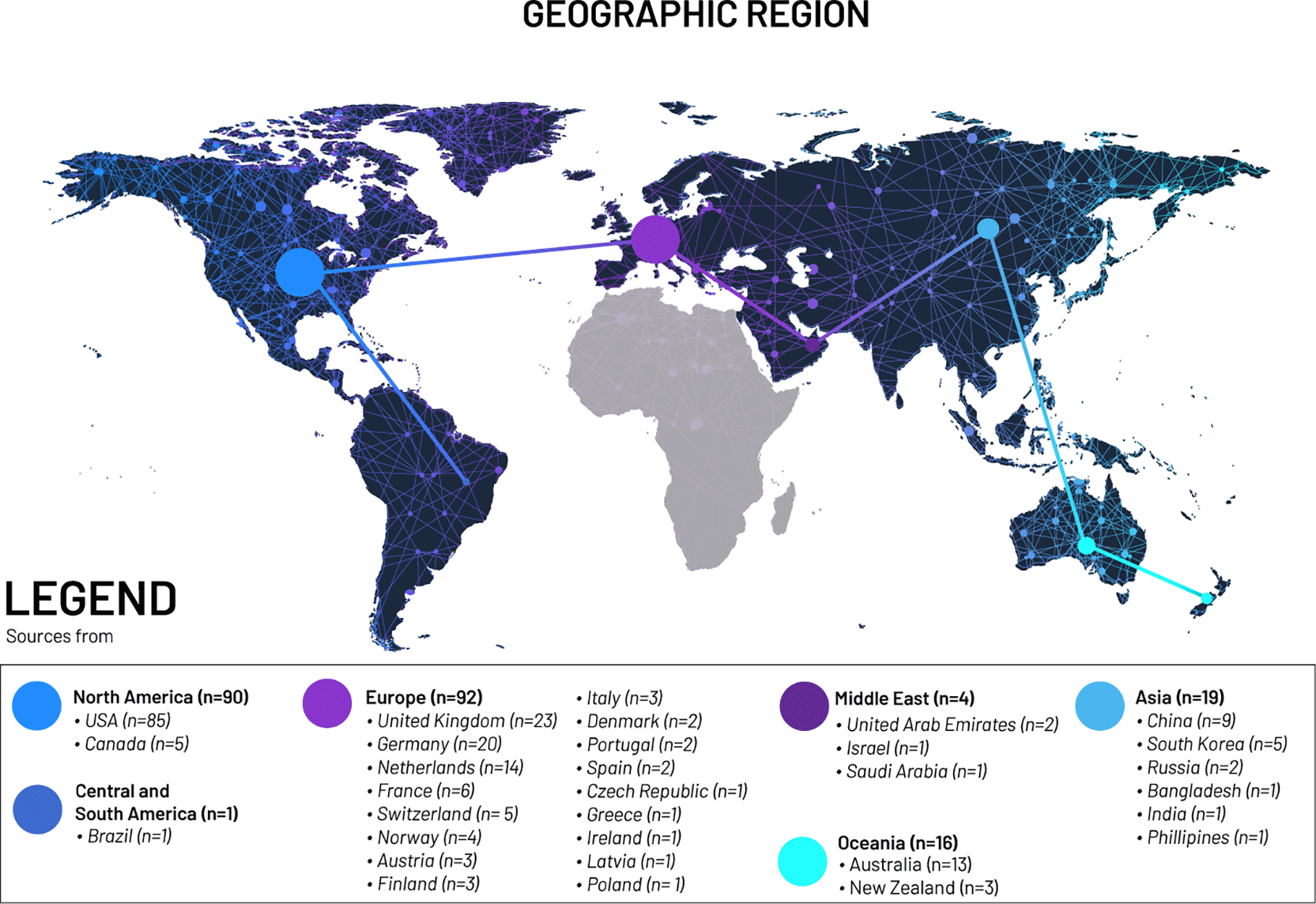
The included sources represented a broad geographic range of authors (see Figure 3). Note that the number of countries listed surpass the number of sources due to multi-authored publications with affiliations across multiple countries. Most authors originated from North America, largely the United States (n = 90). European contributions comprised 92 publications, with the majority from UK (n = 24) and Germany (n = 20). Nineteen sources were from Asia and 16 from Oceania (Australia and New Zealand). A smaller number of sources originated from the Middle East (n = 4) and South and Central America (n = 1). No sources were identified from African or Caribbean countries, although it is possible that some were filtered out due to English-language restrictions or excluded source types.

1cd22c00-5a0a-4877-8eb3-5aad82bcfc12_figure3.gif

Figure 3. Geographic distribution of source authors.

Note that the number of countries listed (n = 222) exceeds the number of publications reviewed (n = 195) due to multi-authored publications with affiliations from multiple countries.

3.1.3 Distribution of use cases

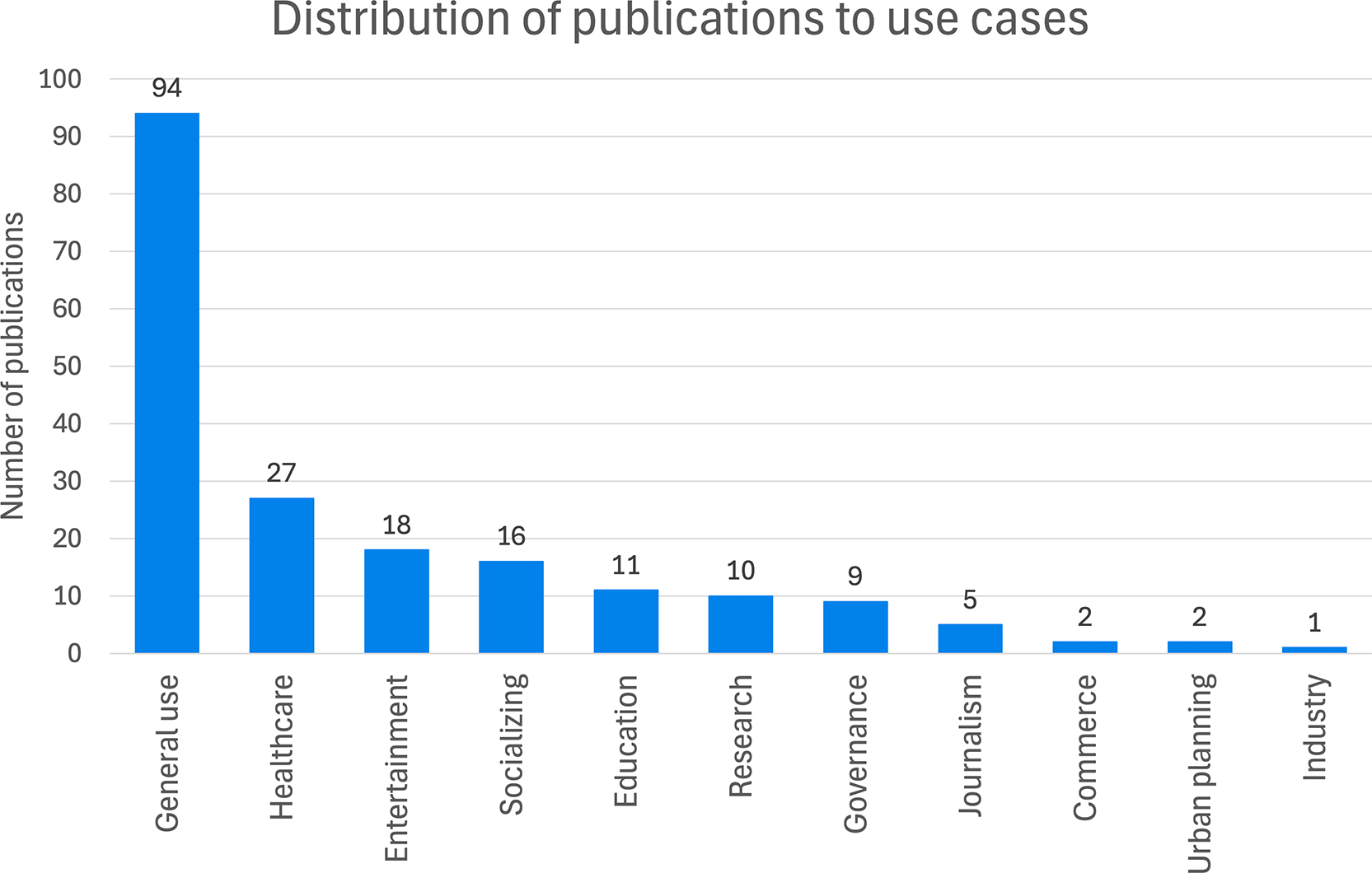
The included sources reflected a variety of use cases, i.e., the domain to which the XRTs were applied ( Figure 4 and Table 5, the latter specifying references). The majority of sources focused on general use or application (n = 94). Other publications focused on healthcare (n = 27), entertainment (n = 18), socializing (n = 16), education (n = 11), research (n = 10), governance (n = 9), and journalism (n = 5). The use cases least represented were industry, commerce, and urban planning.

1cd22c00-5a0a-4877-8eb3-5aad82bcfc12_figure4.gif

Figure 4. Distribution of all included publications (n = 195) to use cases; the specific areas of application as presented in the literature.

Table 5. Use cases, number of publications, and corresponding references.

Use casesNumber of publications References
General use941–3,23,24,38–126
Healthcare27127–153
Entertainment (gaming)18154–171
Socializing16172–187
Education/training11188–198
Research10199–208
Governance, law/legal9209–217
Journalism5218–222
Commerce220,223
Urban planning2224,225
Industry e.g., manufacturing, logistics1226

3.1.4 Distribution of units of analysis

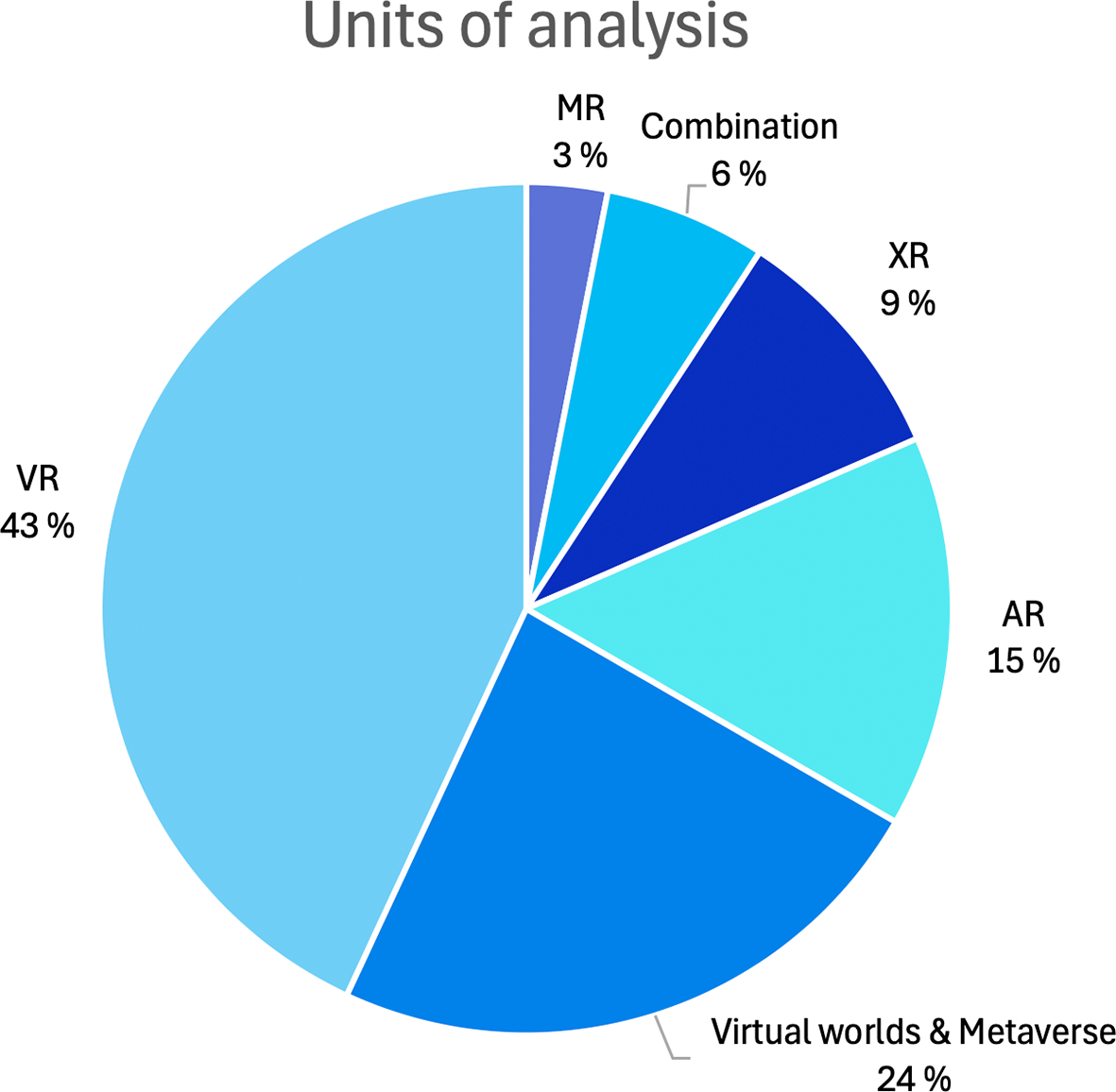
In terms of charted unit of analyses ( Figure 5), 84 publications pertained to VR only, 46 to virtual worlds, metaverses or virtual environments, and 29 to AR. An additional 18 publications focused on XR or immersive technologies more generally. MR was relatively underrepresented, with only 6 publications identified.

1cd22c00-5a0a-4877-8eb3-5aad82bcfc12_figure5.gif

Figure 5. Distribution of units of analysis with number of publications in parentheses.

Publications with more than one unit of analysis (e.g., AR and MR) are categorized as “Combination”.

We observed conceptual differences in how terms such as VR, “virtual environments”, “virtual worlds” and the “Metaverse” were utilized between 2000–2024. Changes were also noted in the types of output devices and platforms discussed over time. Publications from earlier years (2000–2012) discussed virtual environments or virtual worlds, with particular attention to desktop platforms such as Second Life, Habbo, LambdaMOO, among others, as well as to avatars.104,114,117,170,175,176,209,215,217 These platforms were variably described as virtual environments, virtual worlds, or “metaverses,” and in some cases, also classified as VR technologies.23,104,117,132,170,208 More recently, there has been an uptick in references to virtual environments under the terminology of the Metaverse (see discussion section for more).60,102,107,128,194,211,212 After 2012, the focus shifted towards various output devices, particularly wearables such as head mounted displays (HMDs).101,181,182

There were inconsistencies regarding the meaning of or how VR was understood over time. We note a shift where the authors start to consider “immersion” (quantitatively understood) as a critical component of VR. Therefore, while many sources identified HMDs as primary facilitators of VR and bracketed desktop platforms as non-VR. However, some recent sources still referenced desktop platforms as examples of VR.111,148,184 These sources use rather broad definitions, such as describing VR as a “close to perfect simulation of the real-world including representations of oneself and other persons,” where the most convincing simulations are “fully immersive”.148,p.574 In this interpretation, desktop simulations would be a less convincing type of virtual reality, but nevertheless VR. Notably, many publications did not define their unit of analysis.101,152,183,195,207

Additionally, there were inconsistencies in how the terms Metaverse, virtual worlds, and virtual environments were used, with some sources referring to them interchangeably.153 “Virtual environments” were often defined through their immersive aspects, e.g., a virtual environment is an “immersive, interactive, multi-sensory, viewer-centered, three-dimensional computer-generated environment” (Cruz-Neira in1,p.9). How “immersive” was interpreted, and whether this definition would limit virtual environments to devices offering quantitatively immersive experiences (like HMDs), remained unclear. Another definition framed virtual environments more broadly describing them as attempts “to create a replica of an object of experience in a way for a human to understand”.126,p.550

AR applications in the form of wearables (e.g., glasses or goggles), as well as mobile devices and their associated platforms, were the third most discussed unit of analysis. Of note, the mobile platform Pokemon GO was the AR application with the highest number of mentions in the literature.2,108,154,158,160,164,171 While HMDs are frequently associated with VR, recent discussions increasingly address AR and MR applications that utilize passthrough technology.53,78,89,98

Finally, disciplinary scope and aims should be mentioned. The sources come from a wide range of disciplines, and similarly purport a variety of aims. These sources went about achieving their aims through various methods, from offering a critical discussion, to philosophical argumentation, to mixed methods and proof of concepts/experimental work. Discussions and evidence of risks and harms are not siloed to a narrow disciplinary or methodological tradition. Though these findings are not summarized in an accompanying table, they are available in the reviewers’ data charts.

3.2 Typology of risks and corresponding harms

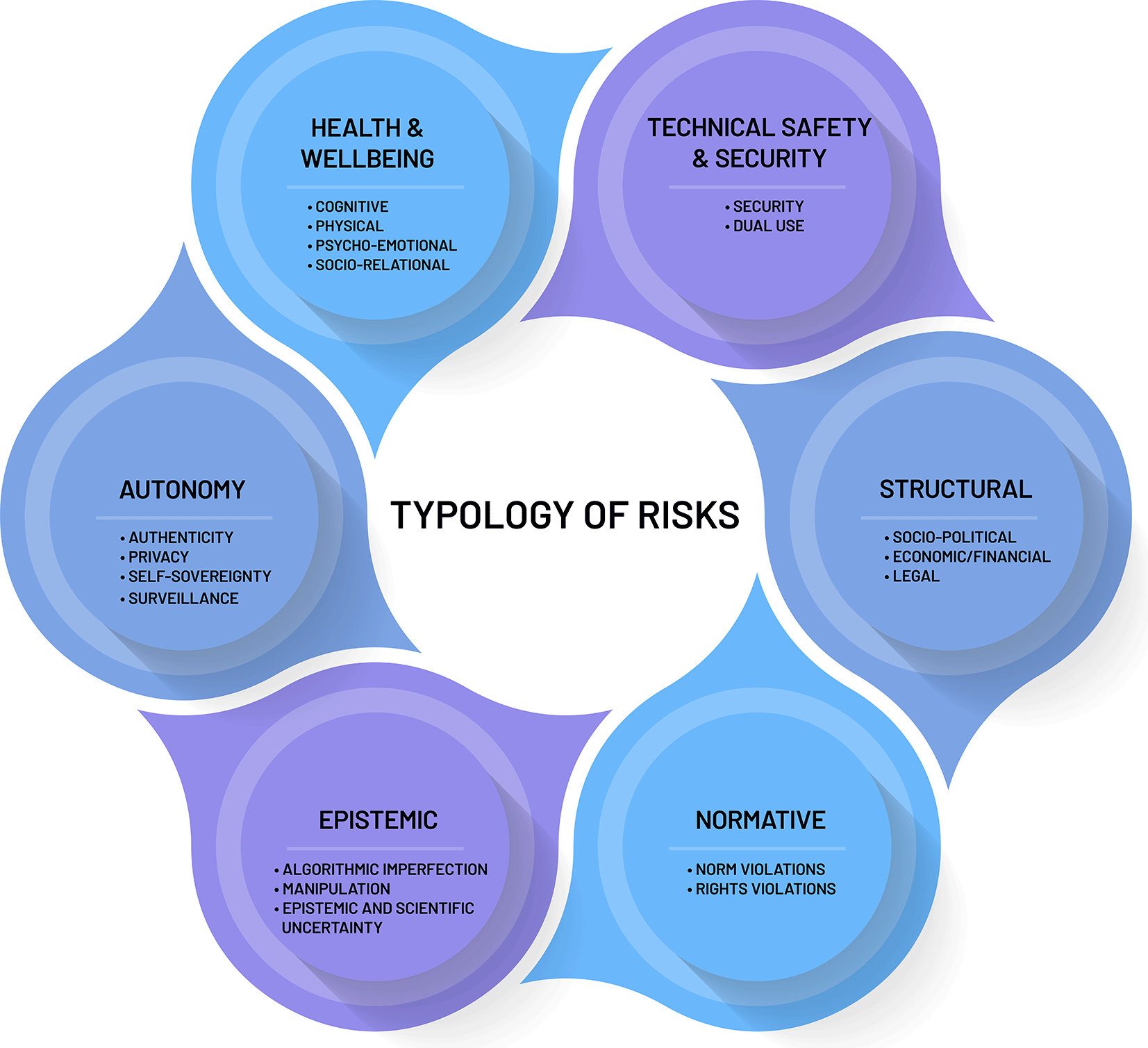
The main purpose of this review was to map risks and harms of XR. The process of coding and subsequent iterative classification of codes allowed for reviewers CD, SO, and LC to develop a typology of risks. What emerged after this process included six major themes and 19 sub-themes: 1) health and wellbeing (cognitive, psycho-emotional, socio-relational and physical), 2) autonomy (privacy, self-sovereignty, surveillance, authenticity), 3) epistemic and scientific (epistemic uncertainty, scientific uncertainty, algorithmic imperfection, manipulation), 4) normative (norm violations, rights violations), 5) structural (socio-political, economic/financial, legal), and 6) technical safety and security (security, dual use).

Developing a typology was a practical approach for presenting a large dataset with large variation in types of risks and harms.227 Some themes were inherently more concrete (like health & well-being risks), while others more abstract (autonomy risks, normative risks, epistemic risks). (See Figure 6) Additionally, the codes are not mutually exclusive and may overlap between thematic categories. The typology should therefore operate mainly as a revisable, heuristic mapping for risks. A substantial number of codes were associated with each risk and harm category and are listed in tables 6–11 alongside the thematic elaborations.
1cd22c00-5a0a-4877-8eb3-5aad82bcfc12_figure6.gif

Figure 6. Risk typology.

Risk typology developed by the reviewers from the iterative classification of codes for risk and harm. The typology includes six major themes and 19 sub-themes. See further details in Section 3.2.

Table 6. Health and well-being risks.

HEALTH & WELLBEING RISKS
COGNITIVEPSYCHO-EMOTIONAL SOCIO-RELATIONAL PHYSICAL
Addiction
Anthropomorphizing virtual objects
Avatar proteus effect
Creation of false memories
Difficulty concentrating
Difficulty distinguishing real and virtual realities
Embodiment illusion and body memory
Incongruent perception/understanding of self to 3D space and physical surroundings
Information overload
Manipulation
Negative effect on child cognitive development
Negative effects on users with pre-existing cognitive conditions
Perceptual changes and unconscious influence on cognition leading to:

  • • real life immoral actions

  • • real world behaviour transfer from virtual

  • • dangerous behaviour

Poor decision making from visual fatigue
Problems with attention
Lack of awareness over surroundings
Reduced cognitive performance
Unknown cognitive effects from general or long-term use to wider population and vulnerable groups
Agential uncertainty
Aggression
Anxiety
Attachment to avatar/virtual beings
Body dysmorphia
Brainwashing
Deception
Depersonalisation and derealisation
Desensitization & decreased empathy
Exacerbation of pre-existing conditions
Detachment and Escapism
Exposure trauma
Intensification of experience
Nudging
Violent propensity
Reduced inhibitions
Re-traumatisation
Self-consciousness
Self-objectification
Technostress
Withdrawal symptoms
Unknown psycho-emotional effects from general or long-term use to wider population and vulnerable groups
Abuse of power
Assault
Bystander haptic proxy
Controlling vulnerable persons
Defamation
Harassment
False attribution towards specific groups based on XR experience
Impersonation of others
Impoverished inter-personal relationships
Griefing
Groping
Manipulative advertising
Radicalization and extremist recruitment
Remote work gender disparities
Reputational damage
Self-censorship
Social engineering
Social isolation or asocial
Social exclusion
Socially unacceptable use of device
Stalking
Surveillance & Sousveillance
Threat misidentification
Third party avatar modification
Trolling
Virtual graffiti
Work-life imbalance
Unknown socio-relational effects to wider population and vulnerable groups from general or long-term use
Auditory occlusion
Cybersickness and discomfort
Dizziness and postural instability
Ergonomic issues
Fatigue
Strain
Headache
Infections - (microorganisms)
Increased reaction time
Falls, injuries, life threatening situations & death for user and bystander.
Manipulated and limitations of movements
Nausea
Neglect of well being
Obesity
Seizures
Sensorimotor after-effects
Unspecified adverse effects on minority users
Sweating
Visual disturbances and asthenopia
Unknown physical effects from general or long-term use to wider population and vulnerable groups

Table 7. Autonomy risks.

AUTONOMY RISKS
PRIVACYSELF-SOVEREIGNTY SURVEILLANCEAUTHENTICITY
Biometric psychography
Breach of privacy

  • • Associational

  • • Informational

  • • Physical

De-anonymising data of user/bystander
Location registration
Lack of or limited awareness of privacy risks
Third party identification of user/bystander
Traceability of avatars
Tracking of user/bystander
Unintentional sharing of sensitive (intimate) data
Violation of the principle of purpose limitation
Unspecified AI influenced novel privacy threats
Unknown privacy threats
Confusing choice architecture
Compromised consent
Inability to opt-out
Lack of or limited control of virtual environment
Lack of transparency
Manipulation of persons to act as robots
Misuse of data
Problems with data control
Poor comprehension of terms of use and privacy agreements
Over-trust
Enhanced data capture
Sousveillance (Inter-Citizen)
Surveillance (Government/Workplace)
Live mapping
World scraping
Conformism and homogeneity
Instrumentalization of user and bystander for data
Inauthenticity of avatar or user
Reduced authenticity

Table 8. Epistemic risks.

EPISTEMIC RISKS
EPISTEMIC UNCERTAINTYSCIENTIFIC UNCERTAINTYALGORITHMIC IMPERFECTIONMANIPULATION
Avatar Identity
Biased immersive Journalism
Difficulty distinguishing between real and simulation
Superrealism
Inherent uncertainty
Immersive experiences become beliefs
Diminished objectivity
Difficulty to test all aspects of technology
Questionable ecological validity
Questionable empirical evidence
Lack of or limited assessment tools for usability of device
Lack of or limited research on long-term cognitive and psychological impact
Overstating benefits
Clinical and research issues:

  • • Contraindication to participate in XR

  • • Consent issues

  • • Hasty use

  • • Paternalism

  • • Therapeutic misconception

  • • Unsafe application of XR in treatment

  • • Lack of training

  • • Lack of established standards for medical or research

Algorithmic bias
Algorithmic miscategorization
Facial recognition incongruency
Misuse of augmented intelligence
Cyberbalkanization
Dark patterns
Deepfakes
Digital deception
Fake news
Filter bubbles
Gatekeeping
Fabricated visual or auditory information
Malevolent creativity
Misinformation and disinformation
Misleading or manipulative design
Paranoviruses

Table 9. Normative risks.

NORMATIVE RISKS
NORM VIOLATIONS (Moral & Conventional)RIGHTS VIOLATIONS
Crossing respected legal, social, cultural and ethical boundaries
Changing beauty norms to align with avatars
Dignity violations
Deepfakes of the dead
Exposure to immoral or offensive content
Encouraging immorality and unethical behaviour
Legitimation of immersive technology as weapon of war
Loss of cultural diversity
Moral damage
Private spaces become non-existent
Reversal of the relationship between man and technology
Shift in values
Surveillance as new normal
Inappropriate behaviour due to unclear norms in virtual environment
Unknown norm violations from general or long-term use to wider population and vulnerable groups
Accessibility issues
Discriminatory or un-inclusive design
Expansion of digital divide
Gatekeeping
Stigmatisation
Marginalisation
Replication of real-world inequities in virtual environments
Exposing people to simulated acts without their consent

Table 10. Structural risks.

STRUCTURAL
SOCIO-POLITICAL ECONOMIC/FINANCIALLEGAL
Algorithmisation
Authoritarianism
Creation of panopticon
“Data violence”
Datafication
Democratic decay
Limited potential for socio-political solutions to risks
Perpetuation of biases or power-structures
Perpetuation of colonising ideals
Privatization of social and political thought
Social control
Surveillance capitalism
Attention economy
Creation of market monopoly
Difficulty managing virtual assets
Gambling
Gentrification
Higher cost of living
Increased cost of healthcare
Unemployment
Harvesting in game currency eg gold farming
Replacement costs for personal glasses
Copyright violations
Defamation of character
Exploitation of legal rights
Fraud and scams
Geolocating user to target for crime
Identity theft
Intellectual property theft
Lack of governance/regulations
Potential violations of data protection law
Pyramid and ponzi schemes
Taking advantage of lawless VR
Trespassing in real life for game purposes
Unclear legal responsibility
Unconventional uses of VR as evidence in court
Unregulated banking and gambling
Unspecified breaking of law

Table 11. Technical safety and security risks.

TECHNICAL SAFETY AND SECURITY
SECURITYDUAL USE
Attacks
- Chaperone attack
- Data scraping bot
- Disorientation attack
- Hack controls app in real time
- Hacking
- Human joystick attack
- Implanting virtual eavesdropping
- Keystroke inference attack
- Overlay attack
- Shoulder surfing
- System becomes owned by attacker
- Using sensors to extract information from user
Exploits
- Malicious apps altering digital object
- Malware
Negligence
- Breaches via 3rd party apps
- Data leaks
- Difficulty authenticating information
- Shared security problems between software or hardware
Unspecified security threats
Unknown security vulnerabilities
Empathy increaser to empathy decreaser
Illicit applications
Unspecified harms due to dual use

The following section is a reporting of the risks and harms based on the typology. Note that written sections will not present all the codes, but rather the codes that the reviewers had in common or were frequently discussed. Later discussion will then reflect upon and use evidence to contextualize both the charted findings as well as the findings classified within the typology.

3.2.1 Health and well-being risks

Risks to health and well-being encompass “a state of complete physical, mental and social well-being and not merely the absence of disease or infirmity”.228

3.2.1.1 Cognitive

Cognitive impacts are those to the brain’s conscious activity: to think, understand, learn, remember, and make decisions about, among other things. Here, the affordances of XR – particularly immersive VR – offered several unique risks. Immersive VR can convincingly simulate new environments, leading users to experience sensations similar to those outside VR and may potentially even influence their behaviour.126 These behavioural changes can be limited to the virtual environment itself, where the participant takes on associated behavioural traits of their avatar representation (“proteus effect”), or may extend virtual activities into extra-virtual spaces.1,109,123,148

The combination of immersion and presence (a user feeling like they are in a virtual environment) can contribute to the unique difficulty of separating virtual and physical “realities”.73,78,126,132,194,210 This is not only a problem for immersive XR; AR may also cause confusion, as digitally over-laid information could be mistaken for real-world/physical information.122 This may mean that some persons may confuse the two realities (virtual and non-digital realities), or even obtain false memories from a VR experience, a problem especially for children who are not as capable as adults in distinguishing between imaginary and real.3,24,144,207

In addition to its immersive and presence-inducing properties, XR offers a sense of embodiment, where the user perceives their virtual body as their own.146 This phenomenon can affect/distort users’ perception of 3D space (impeding or inhibiting spatial understandings), and their physical bodies.116 Reported effects include changes in body image, self-objectification, issues in how persons remember their body, as well as perception that the virtual body is “more real” than the biological body, potentially contributing to various disordered behaviours and emotional difficulties.98,116,145

Related to how persons may understand virtual environments is how they interpret virtual entities, avatars, or objects. Users may anthropomorphize, or add human characteristics, to virtual entities, which can lead to interacting with an avatar as if it were “capable of empathy, individual perspective, and rationality. As a result, they may place undue confidence, trust or expectations in these agents”.1,p.37

Several authors noted the addictive potential of XR: the more immersive the artifact, the more potentially addictive.1,107,144,145,186,208,221 Although the exact mechanisms are debated, many posit that a strong sense of presence, coupled with compelling virtual experiences, contributes to addictive behaviors.1,181,196 The virtual environments themselves can be voluminous and complex to the point of overwhelming users’ ability to process, resulting in information overload.116,207 Sources also describe XR as capable of reducing cognitive performance, including poor decision making within intra-virtual task assignments, reduced concentration, and difficulties with attention.107,116,122,146,168,197

3.2.1.2 Psycho-emotional

Psycho-emotional risks pertain to psychological and/or emotional states. XR’s capacity to construct immersive environments raises concerns about triggering or intensifying emotional states such as anger (aggression) and anxiety, as well as dissociative conditions like depersonalization and derealization.1,3,144,223 Related to this is a feeling of agential uncertainty, i.e., “the risks of no longer perceiving oneself as the author of one’s own action”.148,p.579

XR use may also contribute to desensitization, reduced empathy,24,112 and trauma-like responses to offensive, immoral or violent virtual experiences.100,107,140,148,151,196,206,219 XR’s highly realistic graphic and haptic capabilities may make violations of personal space feel more distressing.196 Some authors argue that this heightened realism could facilitate aggression in real life or serve as a space for radicalisation and violence.102,181 This realism may also facilitate a preference for virtual experiences over extra-virtual ones, which may lead to escapism.107,116,208

3.2.1.3 Socio-relational

Socio-relational risks affect interpersonal relationships, group dynamics, and/or family bonds. Following psycho-emotional impacts, escapism may also negatively affect real-world relationships.116 Time spent with the technology may serve to isolate and disconnect users from families and friends, a reduction in physical or social contact, and difficulty forming relationships.113,115 Further, social interactions within XR can be fraught with harmful behaviours, including harassment and assault in the form of defamation, griefing, groping, modifying user avatars, stalking, trolling, and virtual graffiti.78,178,183,185,196,214,216,221 These environments may also serve as conduits for control or exclusion, where users feel the need to conform or self-sensor in order to fit in.115 In addition to personal relationships, professional relationships may also be impacted. XR has the potential to increase remote work, which may lead to heightened workplace surveillance, as well as difficulties balancing between work and life.1

3.2.1.4 Physical

Physical risks associated with XR design or use have been noted by several sources. A primary risk is that of cybersickness, sometimes called simulation sickness, characterized by negative symptomatology including, but not limited to: “nausea, vomiting, eyestrain, disorientation, ataxia, and vertigo”.208,p.1044–46,50,52,54,55,59,127,129,130,169,200; HMD users face additional issues with reduced user stability, where balance and orientation may be affected.54,197

Use of these devices also have impacts on the visual system, from discomfort, blurred vision, and eye strain (asthenopia), to worsening of stereoacuity and other oculomotor effects.52,59,191 Some of the adverse effects may be a consequence of the vergence-accommodation conflict, an unnatural disruption between vergence and accommodation that occur in a typical stereoscopic HMD.52,54,124 HMDs that are not properly aligned in front of the eyes may also lead to perceptual distortions and worsening of the discomfort.59 Uncomfortable and poor fit of the headset is more common in those with smaller head size and shorter interpupillary distances, such as in females and children (see section 3.3. for more on this).59,191 Correct vision prescription is important for comfortable use,124,198 although not all headsets allow users to wear glasses underneath.43,124 Moreover, individuals lacking stereovision (~30% of the population) may have significantly diminished VR experience.124,150

Ergonomic issues associated with XR use include fatigue due to hardware weight, strain from requiring more head movement, and movement limitations.122,197 The possibility of injury is frequently mentioned across units of analysis and output devices. These injuries may be minor but at times be life-threatening or even result in death.166 Injuries may arise due to several issues: from hardware or game design to malfunction and manipulation.53,171 When it comes to HMDs, visual and auditory occlusion may lead to self-injury or collisions with bystanders or objects.219 HMDs also have a small field of view that contributes to inhibited spatial understanding, compromising a user’s ability to navigate spaces safely.98

Game design in AR, particularly with mobile AR games like Pokémon GO, are frequently cited as facilitators of “distraction”-related injuries, including accidental death when a user pays closer attention to the AR display than their physical environment.142,158,159,167,171,196 It has also been reported that AR-playing individuals have been killed for trespassing.196 Some other effects include headache, auditory occlusion, seizures and infections secondary to sharing devices.73,136,208,226 Finally, authors write about how the cognitive, psycho and socio-appeal of virtual environments may lead some individuals to neglect their real-world needs, preferring virtual engagement over bodily self-care.116

3.2.2 Autonomy Risks

This category addresses risks related to the ability to “govern oneself, to be directed by considerations, desires, conditions, and characteristics that are not simply imposed externally… but are part of what can somehow be considered one’s authentic self”.229,p.1 This definition was selected for its broad scope and is reflective of issues identified by authors, which have been grouped into the following sub-themes: risks to privacy, to self-sovereignty, risk of surveillance, and risks to authenticity.

3.2.2.1 Privacy

Privacy is both a state and a protective mechanism, creating a space in which people may “direct their lives as they see fit irrespective of social and political pressures”.230,p.118 Privacy was one of the most frequently cited concerns, across all units of analysis, devices and platforms.39,53,62,68,72,73,76–78,80,84,86,88,91,194,211,212,218 Privacy discussions centre around data – how it is ascertained, aggregated, analysed, shared, controlled, and what that means for the average user. XR is changing and expanding in terms of data collection possibilities, alongside acquiring “greater contextual awareness” through the analysis of bystander and environmental data.193,p.4 This means that XR is growing better equipped to make predictions about personal location habits (where a user goes, when, and how often).193

Mobile AR platforms and devices, despite not collecting unconscious biometric data like gait or eye tracking, nevertheless pose significant issues when it comes to environmental or spatial data and are prevalent as geolocating and potential recording devices. Privacy, therefore, is a significant problem for AR, where Global Positioning systems are heavily relied upon, as well as user information.167

Moreover, the discussions point to a uniqueness of XR technologies, particularly immersive XR, in exacerbating the privacy issues already present with other forms of technology. Some consider digital technologies to be inherently privacy-reducing, especially in the linking of social networks and VR where data capture and interpretation will take on novel dimensions.181,p.6 Indeed, enhanced data capture is a notable feature of XR technologies.1,2,62,108,111,115,181

XR makes it easier to classify and track both users and bystanders, whereby bystanders cannot necessarily consent or opt out.108,109,111 The ease with which users and bystanders can be de-anonymized due to highly capable environmental sensors and efficient machine learning is also a concern.100,111,142 Additionally, some authors discuss how users may lack an understanding of these risks, not fully comprehending the privacy and terms of use agreements offered by companies.2,62 These threats are further complicated by the increasing incorporation of artificial intelligence (AI), which, combined with sensor data, may lead to hitherto unknown privacy threats.61,96 Authors describe violations of informational, associational, emotional, and physical privacy.108,215 XR can more easily reveal who one associates with, user’s emotional or affectional states, as well as where they are.58,181 It may do this through unexpected or novel means such as through reflections on a user’s pupil which indicate their location.121

3.2.2.2 Self-Sovereignty

Self-sovereignty can be understood as the ability to govern oneself, and one’s information, deciding upon and pursuing a self-selected course of action without interference. XR has unique implications on user’s ability to self-govern. Data, again, is a critically discussed issue.100,111,170,223 Not only does XR have access to intimate data; it can also share that data with third parties.186 This results in increased vulnerability of data: greater quantities of it are collected, it can be easily de-anonymized, and it can then be shared and analyzed.122,181 Importantly, many users are unaware of what has been shared, have little control over what is shared, and have no way to retrieve or change this data.1,109,195 This data may be available for others for the entirety of one’s lifetime.94

Then, there is the risk of data inaccuracies and misuse.62,100 XR, supported by AI, can infer personal and intimate user characteristics and protected traits (e.g., sexual preference, gender identity, religion or belief, national origin, etc.) based on information extracted without the user’s knowledge or consent.111 This type of data analysis is referred to as “biometric psychography”, wherein XR is able to gain a “sophisticated, longitudinal understanding” of a person by tracking not only their behaviour but also their mental and affective states (e.g., happiness, sadness, anger, fear, arousal, frustration, etc.) and cognitive processes (e.g., attention, memory encoding and retrieval, decision-making, problem-solving, perception, reasoning).111,p.11 Authors note that this inference-making capability is not always accurate, but can nevertheless be used to potentially discriminate against the user, or for targeted marketing efforts.109,115 It can also be used to alter behaviour in a way that benefits a company or brand.2,p.289

Self-sovereignty, as discussed by authors, is related to control. “VR,” writes Marloth et al.148 is “understood as artificially created and completely controllable”. It is difficult to determine who, exactly, is in control within a virtual environment setting – the user, the developer/designer, or the technology itself. Some authors, like Marloth et al., imply that there is an inherent lack of control in artificially created spaces where the user has fundamental design input.145 The Metaverse is also discussed in terms of control, where it is pointed out that though users have an expectation of being exposed to other actors (i.e., lack total control), there are nevertheless social and interpersonal expectations within worlds about issues like anonymity, personal reputation, and who can watch and when.215,p.96

3.2.2.3 Surveillance

To be surveilled is to be monitored or observed.231 While some forms of surveillance enhance (e.g., public health surveillance), sometimes to be surveilled serves to reduce autonomy (and other rights).231 Surveillance is closely related to the topics discussed above – privacy and self-sovereignty. Multiple sources refer to XR as a vehicle for surveillance, across units of analyses, devices, and platforms.62,66,67,71,108,218 Surveillance is discussed as an inherent aspect/feature of virtual environments/Metaverse.224,p.5

AR-related literature discusses issues concerning persistent and pervasive devices and platforms.122 Pervasive AR is described as “always on” and a “disappearing interface,” which makes issues of private use but also workplace use problematic.122,p.87 Increased workplace surveillance is cited as a risk of XR technology in general, made possible by the unique affordances of immersive wearables such as HMDs. Employers can potentially monitor employees through biometric sensors, and make potentially unsound conclusions about focus and procrastination.1,p.41 It is not only the workplace that is monitored. Some authors proffered XR as instrumental in enabling government surveillance, often referred to as “Big Brother.” They suggest that criminal investigators may use XR to identify individuals at a protest, or may obtain a journalist’s 360 video.221,p.340 In addition to government surveillance, the risk of citizen-driven surveillance—referred to as “Little Brother” or “sousveillance”—is also discussed, both in the real world and in virtual environments or the Metaverse.103,115,215,221 Wearables, especially AR smart glasses, are considered efficient tools for tracking and spying on persons without their knowledge.115,p.130

3.2.2.4 Authenticity

Authenticity concerns what it means to be oneself, to act oneself, or to be “expressive of one’s own self-identity”.232,p.1 Authors raise the question of whether an avatar is, in fact, an autonomous agent acting of their own authentic desires, or whether the controlled and constructed nature of virtual environments prevent authenticity.115,187 Maslen and Salvulescu note:

immersive technology might render the actions of the virtual agent inauthentic or, at least, not continuous with those of the ‘real life’ agent. The concern is not that the agent herself becomes inauthentic, but rather that her activities in the virtual environment are not her own thus, the question is not so much whether the use of immersive technologies renders the self inauthentic but, rather, whether one can be authentically oneself in virtual environments. If I visit you as my robot avatar, have you really met me, and are the actions I take mine? (,187 p.4).

Other sources discuss a reduction in authenticity in terms of a pressure to conform under constant monitorization (authenticity as relational to issues of surveillance and self-sovereignty).144,181 Conformism in the Metaverse is talked about as a flattening of the individual in favour of a collective or group identity.224,p.4 Other analyses posit that VR can reinforce certain social interactions in a way that may lead to homogenisation.1

3.2.3 Epistemic Risks

Epistemic risks concern how knowledge or beliefs are formed,233 and in this case, how XR informs the actions, choices and judgements of users, as well as how these choices affect scientific or research practices This theme is divided into: epistemic and scientific uncertainty, algorithmic imperfection, and manipulation.

3.2.3.1 Epistemic uncertainty

Some authors claim that immersive XR is inherently epistemically uncertain.116 This is because virtual environments are generated, and these generated environments then interact with a user’s senses in various ways. Inhabiting a virtual environment, therefore, is inherently risky when it comes to knowing what is real/true. One author notes that the visual experience of a person is generally assumed to correspond with “ground truth” or an objective physical reality. However, XR is inherently unstable, where generated data can be controlled, rearranged and manipulated such that the sensory experiences of users are altered.116,145,148

Within XR, the issue of what is true and how it may be known is also one that relates to distinguishing between real and simulation – a problem first discussed under Health and Wellbeing risks. Authors not only consider this as a cognitive and psychological problem, but also a risk relevant to knowledge acquisition, belief, and truth. This is not only an issue for VR, but AR and MR, where illusions generated by a computer may transform into a belief.122,p.88 Pervasive AR, further, aims to further blur the boundary between the “real” from the “virtual.” Authors warn that, as a result, “perceptual artifacts” may become increasingly capable of shaping individuals’ attitudes, beliefs and knowledge.1,122

There are also risks related to avatar identity and potential user harms. It can be difficult to determine whether a user’s virtual identity coheres with their real-world identity. There is no guarantee that someone online is who they claim to be,102–104,216 nor can it be guaranteed that a user is interacting with a real individual or a bot.102,103 This may have several consequences in terms of eroding trust.102

3.2.3.2 Scientific Uncertainty

Several authors discuss the relationship between XR and science. These discussions revolve around two main points: authors who question the evidence supporting XR as a therapeutic, educational, or training tool, and authors questioning the epistemic validity of experiments using XR, i.e., that an experiment is actually measuring what it claims to measure.197,204,205 First, while there is much research taking place on the effects of XR, there is still a lack of knowledge within certain domains and subject areas, particularly regarding the physiological, ethical and social dimensions, as well as the psychological impacts on special populations or vulnerable groups.24,41,142,201 As such, there is a risk of overstating the possibilities and benefits of XR technologies.24,188 Regarding scientific validity – specifically how generalisable experimental findings can be – studies may not be adequately accounting for gender differences.204 Additionally, some authors question how field of view impacts results197 and whether “virtual” experiences can adequately inform us about “material” (i.e., non-virtual) experiences at all.1,p.35 Authors also caution that XR could be used with clinical populations without sufficient training or might be applied without the participant fully understanding associated risks.152 Finally, there is a risk of engendering the participant or patient with a sense of false hope at the possibilities afforded by XR.142,143,148

3.2.3.3 Algorithmic Imperfection

XR technologies are reliant on data to function. Collecting, processing, and transmitting this data is, in turn, dependent on algorithms and other automated systems (e.g., machine learning).234 Algorithms, however, can be “black boxes” whose inner processes can be unknown even to those developing them, and whose results may be flawed.111 In XR, where user data may include environmental or biometric information, algorithmic errors can have serious implications: an incorrect inference — for example, falsely identifying a user as having a mental illness — can affect how users are represented, treated, and even how they perceive themselves, thereby impacting personal identity.111,195

Authors further question the training datasets for XR technologies and XR learning analytics, as well as the predictive power of such analytics, often trained on male, white, neurotypical and able-bodied engineers.195 In other words, these algorithms are subject to bias.111,195

3.2.3.4 Manipulation

Knowledge manipulation or the manipulation of virtual environments includes the “usual suspects” of internet manipulation: misinformation and disinformation, fake news, deepfakes, filter bubbles, gatekeeping, cyberbalkanization, among others.92,96,97,181,221,222 What further complicates these manipulatory practices common to all digital platforms, authors claim, is that the immersive XR experiences facilitate these practices more easily and convincingly.53,96,97,222 Consider a VR deepfake, where persons may “be portrayed as carrying out actions and saying things they did not do. This is already powerful enough in photos and videos, but in XR could be even more dangerous because plausibility includes the automatic attribution of realness to virtual humans”.116,p.7 AI, with its enormous generative potential, when combined with VR and other immersive technologies, significantly increases the risk of malicious content creation and the spread of disinformation.222

Immersive virtual environments may use cognitive or psychological manipulation to achieve various objectives.99,221 Marketing agencies may take advantage of persons by designing virtual environments towards the goal of furthering sales.122,223 An HMD user can be physically steered into various directions through subtle, imperceptible changes in spatial cues—a technique known as the “human joystick attack”—potentially causing dizziness or confusion.119,222 The wealth of knowledge available about a user may fuel a nefarious actor’s ability to exploit the user, potentially for financial or social gain.222 Users may be scammed, experience extortion or “sextortion”.92

Manipulative potential may be scaled up such that there is “risk of harm to our own processes of knowledge creation and reasoning”.97,p.93 For example, pervasive AR, where digital objects become indistinguishable from “real” objects, may be used to facilitate a false reality. This effect on “objectivity” includes fabricating journalistic or social events. Scaled up, malicious actors may introduce “paranoviruses” as a mode of social control, were networked devices are used to provoke group panic, paranoia, or to facilitate propaganda.101,p.736

3.2.4 Normative Risks

To make a “normative” decision is to determine which actions or outcomes are good or permissible and which are bad, or impermissible.235 In this way, constructing a “norm” means determining rules for behaviour, sometimes based out of convention or etiquette, other times rooting in moral or ethical reasoning. Human rights may be considered a type of explicitly recognized (legally, socially) moral norm.

3.2.4.1 Norm Violations (Moral and Conventional)

Authors generally refer to potential norm violations as arising from or being influenced by virtual environments. Some argue that the immersive and highly realistic experiences of some virtual spaces/worlds may encourage immorality in general, or unethical behaviours, as these environments expose people to what may be considered immoral content. This is, of course, subjective, as perceptions of what is moral vary widely from society to society and even within societies. However, there are some things that may be deemed morally objectionable by a broad segment of society. An example is the simulation of underage sex.166,196,223 There is also some speculation that certain exposures, for example, violent content, might alter normativity.114,206

Further, the felt “realness” of XR experiences may serve to motivate what some call “empathy content”:

VR as an ‘empathy machine’ puts the device to work as an effective curative to circumvent cruel or indifferent thoughts about already immiserated people and replace them with intense sensory experiences that invoke feelings of presence… ‘Seeing as’ a refugee… making racial empathy pleasurable puts the under commons to work providing empathy content.112,p.53

Nash discusses empathy-oriented content as carrying the risk of “improper distance”, where immersive virtual environments or virtual videos facilitate “forms of self-focus and self-projection rather than a more distance position that allows for recognition of distance between self and other…. it presents distant spaces and others in an aesthetic mode, inviting a contemplation of the scene as a tableau vivant or spectacle rather than a painful reality”.220,p.125 In other words, moral engagement with another person becomes centered on how the user feels or experiences the feelings of others—prioritizing the user’s emotional response over the reality of the person whose “painful reality” is being portrayed. There is moral power, Nash argues, in VR’s ability to simulate experience as opposed to merely showcasing events (like traditional television). This runs the risk of no longer recognising the other as other, but rather foregrounds the emotional experience of users themselves.

Avatar representations within virtual environments and AR filters may also have an impact on norms. The homogenization of society intra-virtually may influence a loss of diverse, culturally specific norms,132 as well as may alter norms of beauty.116 When analysing normativity within virtual environments, Deng and Ruan argue that an avatar is a symbolic representation of a person’s past and present selves, in addition to being an “extension” of a user’s personal identity—highlighting that personal dignity in virtual environments can indeed be violated.170,p.338 The avatar, considered by some to be an extension of a person is also referred to as having a prominent “moral” effects on users represented by their avatars.1,p.49 Other examples of dignity violations, authors argue, are the presence of deepfakes of the dead in virtual environments.1,104

Some authors discuss the “moral danger” of XR, suggesting that normative accountability in XR becomes challenging in a virtual environment where consequences for actions may be absent: “if I feel I have nothing to lose, why treat other people with dignity and sensitivity?”3,p.1542 Virtual Reality Social Networks may facilitate a societal and personal shallowness, wherein information is presented instantly, which according to some, means little time is spent contemplating and “digesting” the presented information.181,p.19

Other potential violations occur when inappropriately using devices. Playing AR mobile games like Pokémon GO can risk crossing cultural or ethical boundaries. The game, for example, has been played in churches or at the Holocaust Museum.166,171

3.2.4.2 Rights violations

Rights violations, potential and actual, are reported across units of analyses, platforms, and virtual environments. Of note are discriminatory practices in the design or deployment of XR, un-inclusive design and accessibility issues, and the possibility of XR deepening existing societal inequalities.142,198,204 Some authors suggest that XR devices are often modelled on the physical attributes of white, able-bodied young men, using them as standards for device design.195 In addition to the devices themselves, XR platforms and virtual environments are said to be built to reflect the needs, desires, and implicit biases of the same demographic group, thereby negatively impacting the XR experience of other races or genders despite their initial interest in the device and/or platform.105,118,196

Persons living with disabilities or cognitive impairments may also encounter use limitations, such as some HMDs requiring a non-sitting position, or an overt focus on visual or auditory cues to navigate platforms.142 Cisgendered women or those with a smaller head size are not accommodated in HMD hardware design, increasing the likelihood of experiencing simulation sickness.118,204

Hosfelt et al.109 and Lee & Hu-An196 argue that player characters/representations and roles are not adequately represented in XR. Further, avatar representations themselves may be built around gendered or racialised stereotypes and often assume the player or user is a heterosexual male, thus catering to their perceived preferences (e.g., females portrayed as damsels in distress or objectified sexually).1,196 Thus, there are concerns that platforms and virtual environments, programmed with biased data, will serve to perpetuate real-world inequalities and the marginalisation of certain groups.105,109 Pokémon GO, for example, appears to be systemically biased toward urban places with few minorities as its geographic mapping of in-game points of interest is predominantly concentrated in these communities.164

A final consideration is that not all people can afford XR or have access to it.114,225 The increasing use of XR in school or work contexts may potentially engender inequalities, where those with digital literacy or economic potential face a competitive advantage, turning XR into a gatekeeping technology, i.e., access to educational or career opportunities may become implicitly or explicitly contingent on XR familiarity or ownership. Gatekeepers — such as employers, educational institutions, or credentialing bodies — may hinder career progress by making XR experience or access a precondition for participation or advancement.1,p.52

3.2.5 Structural Risks

This category describes risks to high-level structures: socio-politics, law, and economics/finance. It looks at large-scale arrangements of people, entities or systems, and how they may be affected by XR technologies.

3.2.5.1 Socio-political Risks

This is a combination category addressing risks to political and social systems. One large-scale social harm is the datafication of society, closely related to the algorithmisation of persons.185,225 To “datafy” is to transform life into digitally analysable units.195 These phenomena are further facilitated by the large-scale data acquisition capacities of XR, and the nature of virtual environments as surveillable, analysable, and controllable.195,225

Critics argue that datafication is inherently limiting, bracketing or setting boundaries on knowledge in a way which affects social relations on both personal level and within large scale systems.181,194,195 Algorithmisation is, similarly, described as the reductionist application of algorithms to analysing life.225 Datafication and algorithmisation are considered by some as a form of “data violence” which may harm persons in unintended or unforeseen ways, predicated on implicitly (and sometimes explicitly) flawed data systems and engineering.195,p.4 These processes, authors claim, are highly beneficial to big tech companies, reinforcing power and influence and producing new forms of surveillance capitalism i.e., a form of capitalism which relies on personal information as value.196,225 The concentrated power of technology companies may contribute to democratic decay, and also facilitate governance via technocracy.109,224 It is argued that these technologies are increasingly privatizing social interactions, shifting them to virtual environments and platforms – spaces where “inherently biased viewpoints and ideological framing” are present.196,p.8

3.2.5.2 Economic/Financial Risks

This category describes risks which apply to how resources are produced, used and managed. Several authors discuss the potential for XR technologies to increase the cost of living, as well as contribute to processes of gentrification. This is due to XR aiding in the shift of work to digital spaces, which may mean local workforces are no longer relied upon.1 Additionally, certain XR affordances such as augmented sensing in combination with artificial intelligence have been shown to diminish the need for human labour, which can further limit opportunities for work.94 Healthcare, too, may face increasing costs due to the implementation of XR systems in clinical settings.161,175,192

Another risk is that the XR market may become monopolized, which not only contributes to consolidating power and political impact, but also limits competition in an open market.1,p.52 The monopolisation of platforms has effects on competition, and serves to facilitate the “interests of the few”.109,p.1 Virtual environments also present a range of resource management difficulties, particularly concerning virtual assets.102

3.2.5.3 Legal Risks

A legal risk is any risk that pertains to the lack of or breaking of existing laws. There are several identified by authors, stemming from actions taking place within virtual environments themselves, but also from using the technology in unlawful ways such as using geolocational data to target someone for a crime, or trespassing for game purposes.20,166,167,212 Virtual environments are described as “lawless”, underscoring that governance (legal but also social) is at its infancy.217,p.3 Thus, legal responsibility – whether of the developer, designer, or user – for unethical or illegal actions is unclear, and regulation is in its infancy.1,167 This lawlessness may facilitate fraud and scams, identity theft, pyramid and Ponzi schemes, copyright violations, intellectual property theft, and unregulated banking and gambling.1,102,217 XR users can potentially experience violations of already existing data protection rules such as the General Data Protection Regulations (GDPR). However, the application of these regulations to XR is not well understood.116

3.2.6 Technical safety and security

This category pertains to risks stemming from the technical or digital limits and vulnerabilities of XR. These can be understood as risks inherent to XR’s hardware or software – technical systems which can be disrupted or exploited.

3.2.6.1 Security risks

This subcategory identifies issues related to the design, maintenance and management of hardware, software, data, and services provided through XR technologies. These can be targeted attacks upon the system or user, exploits such as malware, as well as issues with negligent or unsatisfactory design.115,225 These targeted attacks may take on various methods; some may attack infrastructure directly by way of controlling the application or system (sometimes without user knowledge).49,222 Other attacks may occur by observing user interactions with devices, such as by way of shoulder surfing, or using sensors to deduce password inputs.109,111 Perhaps most worrisome, some authors purport, is the ease with which wearables such as HMDs can be overtaken and manipulated such that the user is physically manipulated (more below). The human joystick attack has been shown to unwittingly and unknowingly move HMD users from one physical location to another location selected by the manipulator.126,p.550

Other technical security risks may be brought about as a function of poor code or design. These can lead to various breaches, data leaks, and difficulty authenticating information.102,110,122 The complex relationship between intra-devices also means that systems may share security problems between them.126

3.2.6.2 Dual Use Risks

According to EU Regulation 2021/821, “dual use” refers to technologies that “meet many civilian needs, but … can also be used for defense, intelligence and law enforcement”.236 However, this review treats dual use more expansively, as authors describe dual use scenarios as any application of XR that, although designed nominally for a person’s benefit, may be used to “threaten or harm people, animals or the environment”.237

Immersive VR, accessible via wearables like HMDs, was often the focus of analysis. Authors describe the potential “double-edged sword” nature of XR technologies, which offer great societal promise by way of their unique immersive capabilities (among other potentialities), yet can simultaneously be used for nefarious purposes.208,p.21

Attributes of VR include its purported ability to increase empathy, which authors warn could, instead, decrease empathy,219,p.6 or facilitate other behavioural or emotional changes.143 These impacts on empathy may be applied to not only the general population but could be applied to military contexts, which may desensitize actors in delicate combat situations to further a nation-state’s goals.1,125,219
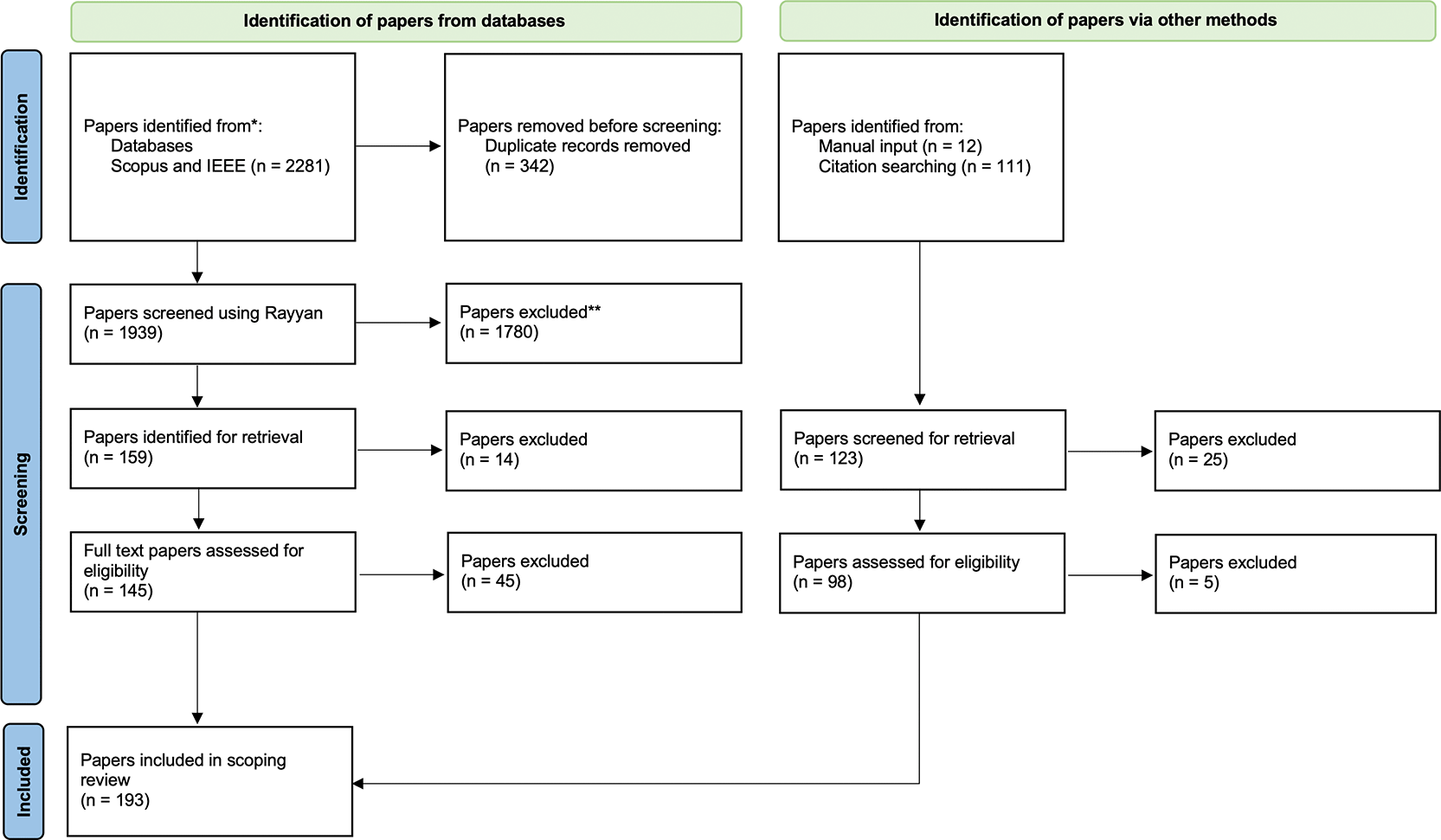
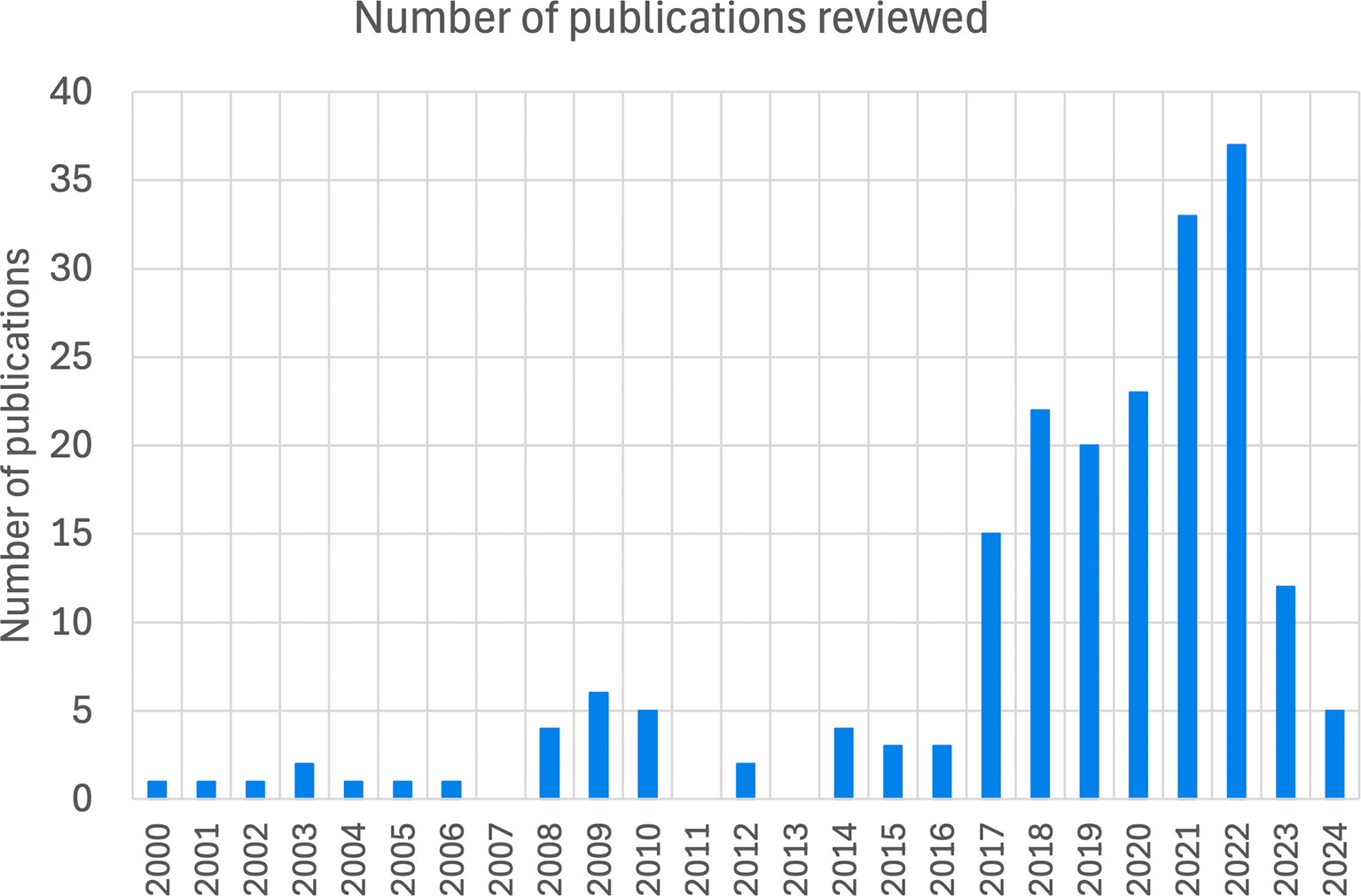
3.3 Further considerations

3.3.1 Special Populations (Vulnerable Groups)

There are some consistencies across categories which should be noted. First, that risks to certain populations or groups are made worse/heightened in some way.98,99 These populations were generally referred to as having a heightened susceptibility to experiencing harm, the causes of which were multi-factorial (physical, cognitive, social, etc.). In the category of health and well-being, these were often children, the elderly, disabled persons, as well as people with pre-existing conditions.99,143 Notable risks for children and young people pertain to how reality is experienced and understood, particularly when using HMDs.99,143 Here, a heightened risk of false memory adoption is noted, concern over whether children can discern properly between physical and digital realities after being immersed, as well as overall impact on cognitive development.99,143 Further, those with pre-existing cognitive or psychiatric conditions also experience heightened use-risks, such as those with reality-perception disorders or dissociative disorders becoming further destabilised.150 Autistic users may experience specific psychological and physiological effects.149 Those with vestibular or oculomotor conditions, or damage to the central nervous system, face a higher risk of cybersickness.145,146 Older users, too, face injury and usability limitations from deteriorated vision and hearing, as well as unstable gait.150,151

3.3.2 Unknowns and long term uses

Common to all categories and across units of devices, platforms and virtual environments were discussions pertaining to what is simply unknown about these technologies. For health and wellbeing, a combination of lacking and potentially problematic research means cognitive, psycho-emotional, socio-relational and physical risks of XR on persons is unknown (with special populations like children also being mentioned).24,143,144,148,183,221 The infancy of the tech produces unknowns at the level of governance and responsibility, as well as security vulnerabilities which may yet to be discovered (novel ways of attacking XR devices).110,224 It is also unclear what XR can do to the normative sphere, how it will change moral and social conventions, or to socio-political structures.122 These unknowns deepen temporally – it is unclear how long-term use will further deepen these risks.98

3.4 Mitigation measures

A subsidiary objective of this review was to identify corresponding harm-reducing or risk mitigation strategies proposed in the literature. The coded measures are reported based on our interpretation of the literature and, as much as possible, reported in a general (non-specific) format to facilitate ease of comprehension. The main themes are organised into four domains, namely: society (government and non-governmental), industry (design, development and deployment), research (with XR technologies), and individuals (users and bystanders) (see Table 12).

Table 12. Mitigation measures.

DomainsProposed Mitigation measures
Society
Government & non-governmental organisations
Governance Laws, standards, and policies Data protection

  • • implement existing data standards (user and sharing)

  • • clear and comprehensible privacy agreements

  • • use of explicit consent forms

Modernize laws for virtual environments

  • • property rights

  • • trespass

Corporate restrictions/limitations

  • • data monopoly

  • • emotional analysis

  • • type of content & games

  • • tracking and sharing of sensitive data

  • • virtual product placements

Crime management Digital (NFT) forensics, cross border information sharing
Rules and guidelines

  • • address bias and discrimination

  • • respect for cultural norms and inclusivity

  • • Codes of conduct and etiquette

Equitable and safe XR Ensure ethical and human centered XR technology
Use design fiction to speculate on future
Digital equity and connectivity
Industry
Design, Development & Deployment
Software Structural Privacy & wellbeing Technical security
Ethics by design
Empower users to define own virtual representation
Interoperability
Mechanisms for mitigating harassment
Valuing and enhancing transparency and accountability
Access restriction
Augmented consent protocols
Limit audio inputs
Minimizing tracking and biometrics
Motion cues
Protocols for identity protection
Permission requests
Spatial awareness sensors in headset to prevent collision
User controlled profiles
Warnings/notification of notification of danger/tracking
Warning lights to signal use of facial recognition to bystander
AI-based security protocol
Block chain technology
Dynamic security control
Encryption
Intelligent system design
Preventive game design
Privacy bubbles
Shadow avatars
Trustworthy XR architecture
Hardware Design lightweight and ergonomic devices for comfortable use with prescription glasses
Design adjustable headsets for different head size and inter-pupillary distance
Research
with XR Technologies
Review system Apply the equivalence principle (TEP)
Dual use awareness
Institutional Review Board model in organization
Informed consent
XR-specific code of ethics
Experimental design Control of simulation environment
Inclusion/exclusion criteria

  • • Screening for person with cybersickness,

  • • Contraindications

  • • Vulnerabilities/vulnerable groups

Transparency
Safety Gradual acclimation
Minimizing tracking and biometric extraction
Offline use of technology during experiments
Post experience well-being
Use of grab bars
Training researchers
Individual
Bystander, User
Responsible use of technology Balance time virtual with real life
Breaks in play
User awareness of bystander
Risk awareness
Ensure that correctable eye and vision problems are corrected

3.4.1 Society (Government and non-governmental organisations)

At the societal level, several authors emphasised the need for interrogating existing laws to identify how and when these may be applicable to current identifiable legal issues arising with the use of XR technologies.69,102,139 The recommendations at the societal level include governance measures and a call for more research-knowledge building in relation to implementation and impact of XR technologies. Governance considerations include the examination of existing laws and development of policies to address known crimes related to breach of privacy, property and ownership, and trespassing.175,176,195,213 There is a general appeal across the literature for the creation of or modernizing of laws and policies to address new and emerging legal challenges such as those that arise with property and commercial transactions in virtual environments.72,176 Corporate restrictions or limitations are also proposed to prevent data monopoly, emotional analysis, managing virtual content and types of games that may be considered dangerous and inappropriate.225 Crime management measures include incorporation of digital forensics and cross border information sharing.213 Rules and guidelines were recommended to address norm (moral and conventional) violations with regards to bias and discrimination as well as respect for cultural diversity, thereby ensuring inclusivity.86 Codes of conduct and etiquette would be essential for social interactions when using the technology.69

Governance measures are particularly emphasized in relation to the Metaverse as it becomes more expansive in various activities including the purchase of property, commercial and other social activities. The risk of new types of crime in the Metaverse beyond the scope of current legislative measures are significant considerations in a comprehensive report issued by the Interpol and the World Economic Forum.180,213 Finally, building and/or facilitating equitable and safe XR should be prioritised, thereby ensuring ethical and human centered XR technologies.124 There is an appeal for further longitudinal studies (knowledge building) on the technologies to understand the long-term impact and unknowns.41 Some authors also propose the use of design fiction— “the creation of tangible representations of imagined technologies to provoke discussion about possible futures”238 --to speculate on possible future consequences and to encourage investment in digital equity and connectivity.86,222

3.4.2 Industry

The industry mitigation measures were focused on improvements with software and hardware. Software recommendations were extensive and highly technical. To simplify the reporting, measures were organised as structural, privacy and well-being, and technical security. Structural software considerations include intelligent systems designs as well as ethics by design, including users in the design process, empowering users to define their virtual representations.24,43,75,197 There is a need for implementing mechanisms in virtual environments for mitigating harassment and promoting a culture that values transparency and accountability.173,211,213 Interoperability is an important and necessary structural measure.102 Measures to protect privacy and well-being include minimizing tracking and collection of biometric information, enabling protocols for identity protection, permission requests, and augmented security protocols.102,109,170 To minimize or mitigate against collisions and dangerous situations, some authors recommended spatial awareness sensors and warning message.161,211 Warning lights may also be placed on output devices, such as AR glasses for example, to signal use of facial recognition to bystanders.69 Hardware design was also highlighted as a key consideration for industry. The authors asserted that developers should also consider designing lightweight and ergonomic headsets that are adjustable to facilitate different head size and inter-pupillary distance as well as ensure comfortable use with prescription glasses.43,124 Technical security measures include the use of AI-based or dynamic security control.173 Some authors emphasised encryption and preventive game design. Within the virtual environments such as the Metaverse, privacy enhancing technologies, block chain technology, shadow avatars and privacy bubbles were presented as plausible measures of protection.211,213

3.4.3 Research with XR technologies

Proposed measures within the research domain include (a) adopting a review system tailored to the unique challenges of conducting research with XR technologies, (b) designing experiments with inclusion/exclusion screening for persons likely to experience cybersickness or may have contraindications or vulnerabilities, and finally (c) safety measures to facilitate gradual acclimation to the technology, ensuring researchers are adequately trained on how to use the technology, assessment of post-experience well-being for research participants.149,203 Privacy measures include use of the technology offline during experiments and minimising tracking or data and biometric extraction.109,139,170 Safe physical environments to prevent both foreseeable and unintended harm to the participants could include a practical measure such as grab bars that would prevent users (especially the elderly) from falling when feeling disoriented.203 The adoption of an Institutional Review Board (IRB) model within organisations where there is awareness of the possibility of dual use of XR for unintended purposes, ensuring informed consent by users, and development of XR specific code of ethics.125,211 Some authors argued for the application of the equivalence principle when assessing the ethics of a virtual experience when conducting research. They posit that “if it would be wrong to subject a person to an experience then it would wrong to a virtually real analogue of that experience”.206,p.260

3.4.4 Individuals

Individual mitigation measures aim to empower and protect users and bystanders. The main recommendations centred on the responsible use of XR technology. Maslen and Savulescu contend:

…moral responsibility is a function of the intentions and foresight the agent had with respect to the harm risked or caused, and the avoidability of that harm, together with whatever duties of care exist… Such principles would extend to telepresence. Whether a manufacturer is liable for some portion of the harm, or whether responsibility attaches fully to the agent who assumed the risks associated with using the technology, will in large part depend on the respective duties of care in the situation, the user’s expectations relating to the functioning of the technology, any abnormal use of the technology, and the degree of foreseeability of the harm.187

Users are encouraged to balance virtual time with real life and take breaks in play and going into nature.161 Risks awareness is important for both users and bystanders.72,86,113

4. Discussion

The review gives a mapping of risks and harms of XR technologies across various use cases. Following a scoping method in conjunction with a qualitative descriptive content analysis, we identified risks and harms spanning across six major categories of risk: health and well-being, autonomy, epistemic and scientific, normative, structural, and technical safety and security. The following discussion will contextualise some of the charted items and findings (including the risk typology), point to potential knowledge gaps, and offer some reflections on the scoping review process.

4.1 Summary of results

First, the increase in XR publications over the last few years, the geographical distributions of said publications and how the distribution relates to knowledge-building and mitigation strategy are discussed. Then, the significance of the emergent risk typology will be addressed alongside a comparison of similar typologies.

The increasing number of publications on XR risks and harms over the last decade reflects the change in academic and societal interest in these issues. This might feed strategic efforts towards redress, and hopefully, more knowledge will bring about change. It is uncertain, however, what that change will look like or whose voices will be heard in this changemaking. The review’s majority of sources originate from economically advantaged countries, and therefore contains an underrepresentation of views from regions/countries that are economically disadvantaged (e.g., countries categorized as low- and middle-income from Africa, Asia, Latin America, and the Caribbean). How this underrepresentation may affect or steer the global discussions on how risks and harms are to be considered and mitigated is unclear.

Most of the sources were from the USA (46%), a country with advanced XR infrastructure accompanied by a robust startup ecosystem, accounting for 37% of global XR revenue share.239 China and Japan are also projected to be key builders and investors in XR,235 but only 6% of the sources were from China. There were no sources form Japan. Having no contributed works, however, does not mean that scholarship and knowledge building on XR risk is not available. Sources may have been published in non-English languages. Thus, there may be discussions taking place that account for risks and harms to which non-native speakers are not privy.

This review includes a comprehensive mapping of risks and harms related to XR technologies, with over 200 codes mapped. The listing of this large number of actual/potential harms in a reportable format may be overwhelming for the reader, but it is also a starting point for further research on risks and harms. The listed risks/harms are not connected to particular use cases, output devices or platforms. Connection can be made, however, through cautious inference, as 70% of the use cases were for general application, healthcare, and entertainment (gaming) as well as the main types of output devices being VR and AR.

Although use cases such as education, research, governance, commerce, and industry were not significant in number of publications reviewed, the relevance of risks within these areas of application is of importance as these areas are projected to grow, especially for industry training.240 Social and entertainment applications of XR were amongst the most frequent use cases reviewed. With the increasing convergence of social networks and XR – Meta’s Horizon, for example – it is expected that novel risks and harms will emerge.241 Military applications were notably absent from our findings. Given the sensitive and security risks associated with use of XR in military settings, this absence is explainable.

The mapping is not only comprehensive in terms of breadth of risks/harms, but also covers risks/harms across domains and units of analyses (explicitly including virtual environments and the Metaverse). As far as can be found, only Cyber-XR offers a risk typology which includes all units of analysis (VR, MR, AR, but not virtual environments) and covers all domains (i.e., for general use).18 There are several areas of alignment between their typology and this one. This alignment is encouraging, as it reinforces our findings and subsequent categorisation of risk themes. For example: Cyber-XR has five risk categories: human, financial, legal, information, and societal.18,p.56–57 They do not, however, explicitly identify epistemic risks as a major concern. Instead, they grouped what herein is outlined as structural, normative, and epistemic under societal and legal risks, identifying issues such as disinformation, deep fakes and other epistemic risks as “manipulated social discourse”.18,p.56 Notably, Cyber-XR classify “lack of ground truth” and “inability to establish truth” under societal and legal risks, respectively.18,p.57

While these things may indeed produce legal and social problems, they point to an inherent issue with XR: XR makes it more difficult to distinguish between digital information and non-digital information. Thus, the epistemic risk category is important to bring forward as an independent/unique conceptual category. It is critical that the knowledge ascertained and interpreted from XR technologies are assessed in their own right – especially given the nature of immersive virtual environments as changeable and experientially convincing, and the increasing integration of AI. Further, epistemic and scientific uncertainty is highly relevant to those conducting research with or on XR technologies.

The risk typology also distinguishes social risks from socio-political risks, signifying a separation of scale – social risks operating on a micro, inter-personal level whilst socio-political risks operate at a macro level. This separation is important to future scholarship which take on micro, meso, and macro-level analyses. Finally, normative risks were separated from risks to autonomy, while acknowledging the overlap between the two as fundamentally rights-based issues. The reason being that the abundance of literature pertaining to issues of self-sovereignty, surveillance, and privacy, especially, and as such these risks could be considered within a self-contained theme: autonomy.

4.1.1 The development of XR risk-strategies: potential motivators

The uptick in discussions and subsequent publications on XR technologies and its risks may be a function of the relatively increasing affordability and public visibility due to expanding range of applications. The early 2010s saw computer storage advancements, faster processing, powerful graphics chips, improved form factor and the release of the Oculus Rift in 2012.242,243 Oculus was soon acquired by Meta (then Facebook), “leading to a significant increase in the popularity of VR devices for home use”.242,p.2 Facebook’s 2021 rebrand into Meta Platforms also signifies that large technology companies are serious about XR – Meta’s own branding echoing the “metaverse”. As of 2024, Meta owns nearly three quarters (74%) of the global XR market share.244

Technology companies’ efforts towards designing and developing XR devices and platforms can have significant effects and influence on research and public discourse. This is especially salient given the relatively “high degree” of independence under which the XR industry operates.245 For example, there was an increase in AR-related literature, which coincided with the release of Pokémon GO in 2016; with usership at the time in the tens of millions.246 Thus, the role of technology companies in mitigating risks should not be underestimated. Whether the motivation to make critical design and governance changes comes from within company bounds, or whether it requires extra-regulatory power remains to be seen.

It is important to consider that regulatory bodies and civil society groups (NGOs or advocacy groups) are critical to the governance of XR risks as they, too, alongside industry, are stakeholders – and that strategic efforts are indeed being made. Several included publications within this review propose regulatory strategies: The World Economic Forum, Interpol, and IEEE, for example.102,105,111,142,180,184,213 Co-governance practices, where strategies for redress are collectively established between industry, civil society and governments, are growing increasingly popular.245 The XRSI (Extended Reality Safety Initiative), an organisation which provides research and standards have advised both industry and governments, for example.247

The way technology changes over time also affects how conceptualisation of XR is popularized and communicated, which, in part, may explain the shift in meaning from “virtual reality” as desktop experiences to wearable displays with immersive affordances. “The immersive experience is what most people think of when it comes to VR and is one of the most marketable aspects of VR technology”.242,p.19 It would seem VR’s affordances as a technology which can convincingly transport a person into a new space and have them feel as if they were there, embodied and present, is of interest to scholars and others in various domains. Indeed, VR comprised 43% whereas AR comprised 15% of sources within this review.

AR, whose goal is not to completely immerse but rather to augment or overlay digital information, may seem like less of a risk. However, the potential for AR as a “pervasive” technology, facilitated through the ubiquity of cellphones and mobile platforms, should not be underestimated.122,248 As Girginova et al point out: “Globally, many more people in 2022 experienced AR technologies on a daily basis than VR technologies. Yet, VR research dominates academic literature”.249 Additionally, scholars predict an uptake of wearable AR which allows for an integration of everyday activity with digital information through optical displays; this “always-on” state means that the volume of user data tracked, stored, and interpreted will increase.122,p.85 The network sharing capacities of these platforms makes it easier to create large scale 3D spatial maps – potentially against people’s knowledge or will.122,p.85 The wearability of XR and its ability to be integrated more seamlessly into everyday life – the latter being something immersive VR, by nature, cannot do – may bring about epistemic, structural, autonomy-related risks yet to be identified (among others). Therefore, more research within this AR-specific domain is required.

Wearability and everyday integration are important to consider in relation to MR as well, which was the least discussed unit of analysis, comprising 3% of sources. It may be that the relative newness of MR, or its conceptual ambiguity and practical similarities to AR which subsumes discussions about MR under AR.250 With the 2024 introduction of HMD products like the Apple Vision Pro – marketed as a “spatial computing device” that “just about everyone calls” a mixed reality headset – an increase in company interest in MR/AR technologies is likely, as well as more public consumption.251,252

A final thing to consider is that though units of analysis have changed in meaning and expanded over the years in terms of capabilities or affordances, risks identified in earlier sources are still reflected in recent literature.104,105 At least two decades have passed and problems persist, and become amplified, in immersive XR: harassment (notably of women and minorities), privacy violations, for example, among others. Is this a function of lack of effort, inadequate or insufficient mitigation techniques, or is it simply ‘the nature of the beast’, an inherent feature of a technology which is controlled by someone else.

4.1.2 Identified areas for further exploration

4.1.2.1 The need for more varied and interdisciplinary research

There are several research opportunities to consider which have already been mentioned including: 1) more attention to “pervasive” AR/MR technologies and 2) the relative similarities and continuation of risks identified more than twenty years ago into present day. In addition to these, more research into the mental, social and physical well-being of persons using these technologies needs to be conducted related to special populations and long term-use effects. Whilst this review has an extensive overview of potential effects on well-being, multiple sources identified a lack of understanding how XR effects well-being over long periods of time, as well as how it effects minority or vulnerable groups such as those with autism or mental health conditions.134,149

Finally, while this review showcases a range of risks – from “concrete” risks to more “abstract” such as normative risks – the majority of literature pertained to more concrete risks. This observation is reflected in the extensive review by Girginova et al.249, which reveals the underrepresentation of non-STEM research within the XR space. Thus, the humanistic or non-STEM dimensions of XR, they argue, are important to understand if an ethical product is to be made.249

4.1.2.2 Ramifications of AI/XR intersection

Attention should be paid to risks related to AI/XR. Though we did not explicitly code AI-related risks, anticipating that XR will increasingly rely on AI, some authors highlighted risks related to generating virtual worlds and the analysis and interpretation of large swaths of extracted information. Hirzle et al.,253 reports in their scoping review of XR and AI literature that AI can create XR worlds by “creating a realistic replication of the real world, modifying the real world, or generating a synthetic world”.253 They also note that AI may be used to understand and support interactions with users, facilitate interactions with intelligent virtual agents, and enable user authentication and identification.253 Noting that the AI/XR intersection comes with not only the usual AI-related issues (bias, transparency, etc.) but unique challenges, reviewers posit that AI/XR combinations being used in simulations will augment many of the potential harms discussed earlier. AI/XR may contribute not only to epistemic and scientific uncertainty risks, but could be used to manipulate behaviour, cognition, emotions, etc. Computer vision and generative AI can facilitate real time surveillance and interactions that are tailored to specific users/bystanders. Reviewers therefore posit that all risk categories are of relevance for deeper reflection in relation to AI/XR intersecting and call for more discussion and research on the ethical and societal impacts of AI/XR combinations.

4.1.2.3 Environmental risks, impact and opportunities

In addition to sources detailing AI/XR, attention should be paid to the unique environmental risks associated with XR. Some purport that XR reduces the need to travel for work or leisure, in addition to minimising office-space use which lowers an individual’s carbon footprint.254 XR may also promote immersive strategies for building relationships with nature through storytelling, thereby communicating environmental issues in potentially novel ways.255 However, only one source within this review identified XR’s potential negative effects on the environment. Adomaitis et al.90 point out that the production and maintenance of XR infrastructure necessitates large amounts of material resources and energy. Additionally, they note, “information is physical”.90,p.50 Thus, it is not only the production of hardware as such, but the large energy-consumptive data stores and cloud services required by XR which have environmental costs - this includes the data stores necessary to maintaining Metaverse infrastructure. Considering these things, it is surprising that such a low number of references to environmental risks are reported.

It can be assumed that XR’s likely integration of AI will serve to further problematize its impacts on the environment by creating additional energy needs. Nascent environmental impacts of generative AI include “expanding demand for computing power, larger carbon footprints, shifts in patterns of electricity demand, and an accelerated depletion of natural resources”.256,p.1; see also257 Additionally, energy intensive practices are expected to increase with demand for high resolution images and video.258 It is also unclear how increasing consumption will further drive electronic waste.258

4.2 Limitations and challenges with scoping review process

There are several potential limitations. Indeed, undertaking a review of 195 sources from a range of disciplinary domains and methodologies did not come without challenges. First, registering a scoping review protocol would have been preferred, as it reinforces the values of open science and transparency, as well as potentially yielding valuable community inputs. Though a protocol was made, time constraints directed team efforts towards proceeding with the review.

Secondly, though reviewers believe to have a robust selection of sources, and an effective search strategy, valuable inputs may have been missed by constraining grey literature sources. The popularity of immersive technologies as a topic of speculation assumes a vast number of newspaper articles or popular magazine references – untenable to include for a small research team. The database search ending in January 2023 also may mean the most recent discussions on risks and harms were not included. A preliminary database search using the same search strategy was re-conducted February 2025 yielding 1666 records after de-duplication. This shows a significant growth in potentially relevant articles after the original search period ending in 2023. Though, the addition of resources from citation chaining as well as manually inputted articles between 2023–2024 have indeed brought in relevant and timely literature.

An additional limitation stems from having one reviewer reading texts in-full instead of the recommended two.24 However, pilot articles were read together, and from there clear criteria was established by consensus. Reviewers additionally met regularly to discuss discrepancies, uncertainties, and when data items were unclear.

Finally, there may be some limitations to the typology itself. Coding was indeed a challenge, both from the perspective of interpreting what sources considered a “risk” or “harm”, but also what type of XR or experience they applied to. This means the risks and harms which apply to, for example, a VR desktop platform might not apply to immersive devices or vice versa. It would benefit scholarship to map risks and harms according to conceptual specificity.

Additionally, multiple risks/harms cut across several thematic categories, even if they might not be categorised as such. There are also sub-categories within our typology with great conceptual overlap, such as cognitive risks and psycho-emotional risks. There are some practical reasons for this separation, as combining sub-categories would have made for a lengthy category. Further (non-descriptive) critical analysis should be done on the inter-sections of risks and harm.

5. Conclusion

EXtended Reality technologies are no stranger to evolution, from early panoramic paintings aiming to “immerse” viewers into a scene, to science fiction conceptualisations of the “ultimate display”, to modern day headsets rendering believable sensations of joy and awe.259 It is clear that the landscape of technological possibilities is burgeoning – and with all these opportunities come many unknowns, including risks and harms. The typology offered by this article renders these risks more clearly, giving scholars, policy-makers, designers and developers a starting point for approaching mitigative strategies from multiple levels: individual, industrial and societal. The article does this across the full spectrum of XRTs devices, as well as domains (i.e. entertainment, etc.). There are several research communities and governance initiatives which will benefit from this work. One such is the Horizon Europe project, XR4Human, whose future ethics and interoperability guidance documents – including a Code of Conduct for the Human-Centered and Ethical Development of Immersive Technologies – are reliant on a complete understanding of risks and harms.

The number of publications on the ethical issues of eXtended reality technologies are rapidly increasing and evolving in number, scope, and context. The focus on VR technologies within identified scholarship, while important, reveals potential gaps addressing the issues posed by AR (and MR), especially as these latter technologies are more ubiquitous and wearable. The review also found that some risks identified decades prior have persisted into present day, indicating a need to better understand why these risks have not been adequately addressed. Additional research opportunities highlighted include the environmental impacts of XRTs, and the changing nature of XR as it increasingly intersects with artificial intelligence.

To reiterate, this typology consists of risks to health and wellbeing (cognitive, psycho-emotional, socio-relational, physical), to autonomy (privacy, self-sovereignty, surveillance, authenticity), epistemic and scientific risks (epistemic uncertainty, scientific uncertainty, algorithmic imperfection, manipulation), normative risks (norm and rights violations), structural (socio-political, economic/financial, legal), and technical safety and security risks (security, dual use). The novelty of this typology is not only its expansive coverage, but its explicit detailing of more abstract risks as warranting independent categorisation, such as epistemic risks. Given the changeable and convincing nature of virtual environments, knowledge formation and the assessment of XR impacts on it are all the more critical.

Ethics and consent

Ethical approval and consent were not required.

Declaration of AI usage

Microsoft Copilot was employed strictly as a grammar tool.

Data availability

Data related to this project is available following an Open Data policy, under CC-BY 4.0 licensures. Scoping Review PRIMSA Checklist for Mapping Risks and Harms of eXtended Reality (XR) technologies” available via ZENODO. https://doi.org/10.5281/zenodo.19663830, license CC-4.0 International.261 Data charts as defined in section 2.5.1 “Data Charting” are additionally available via ZENODO, https://doi.org/10.5281/zenodo.19663743, license CC-4.0 International.262

Submission Declaration: This work was published as a report to ZENODO. https://doi.org/10.5281/zenodo.14044988.260

Acknowledgements

Thank you to Alina Kadlubsky for the creation of Figure 3.

References

  • 1.  Adomaitis L, Grinbaum A, Lenzi D: TechEthos D2.2: Identification and specification of potential ethical issues and impacts and analysis of ethical issues of digital extended reality,neurotechnologies, and climate engineering. CEA Paris Saclay; 2022.
  • 2.  Harborth D: Human Autonomy in the Era of Augmented Reality—A Roadmap for Future Work. Inform. 2022; 13(6): 289. Publisher Full Text
  • 3.  Spiegel JS: The Ethics of Virtual Reality Technology: Social Hazards and Public Policy Recommendations. Sci. Eng. Ethics. 2018; 24(5): 1537–1550. Publisher Full Text
  • 4.  XR4Human: The Equitable, Inclusive, and Human-Centered XR Project. Responsible development and uptake of XR technologies.n.d. [cited 2024 October]. Reference Source
  • 5.  XR Safety Initiative (XRSI): The XRSI Definitions of Extended Reality (XR); XR Safety Initiative Standard Publication XR-001 2024.[cited 2024 October]. Reference Source
  • 6.  Carroll J, Hopper L, Farrelly AM, et al.: A Scoping Review of Augmented/Virtual Reality Health and Wellbeing Interventions for Older Adults: Redefining Immersive Virtual Reality. Front Virtual Real. 2021; 2. Publisher Full Text
  • 7.  Mann S, Havens JC, Iorio J, et al.: All Reality: Values, taxonomy, and continuum, for Virtual, Augmented, eXtended/MiXed (X), Mediated (X,Y), and Multimediated Reality/Intelligence.2018.
  • 8.  Rauschnabel PA, Felix R, Hinsch C, et al.: What is XR? Towards a Framework for Augmented and Virtual Reality. Comput. Hum. Behav. 2022; 133: 107289. Publisher Full Text
  • 9.  Bell M: Toward a Definition of “Virtual Worlds”. J. Virtual Worlds Res. 2008; 1(1).
  • 10.  X Reality Safety Initiative (XRSI): The Metaverse: XRSI.2024 [cited 2024 October]. Reference Source
  • 11.  IEEE Standards Association: Ethical Considerations of Extended Reality (XR).2022 [cited 2025 April]. Reference Source
  • 12.  Hansson SO: Risk. The Stanford Encyclopedia of Philosophy. Stanford University: Metaphysics Research Lab; 2023. Summer 2023. Reference Source
  • 13.  International Organization for Standardization (ISO): Medical devices — Application of risk management to medical devices (ISO14971:2019).2019.
  • 14.  IEEE: IEEE Standard Model Process for Addressing Ethical Concerns during System Design. IEEE Std 7000–2021.2021; 1–82.
  • 15.  Canning V, Tombs S: From Social Harm to Zemiology: A Critical Introduction. London: Routledge; 1st ed2021.
  • 16.  Zhou YK: What it means to suffer harm. Jurisprudence. 2022; 13(1): 26–51. Publisher Full Text
  • 17.  Unruh CF: A Hybrid Account of Harm. Australas. J. Philos. 2023; 101(4): 890–903. Publisher Full Text
  • 18.  The CyberXR Coalition: Immersive Technology Standards for accessibility, inclusion, ethics, and safety. Special Edition Cyber XR-2020-1.0.2020.
  • 19.  Initiative XS: The XRSI Privacy Framework, version 1.0.2020.
  • 20.  Snijders D, Horsman S, Kool L, et al.: Responsible VR. Protect consumers in virtual reality. Den Haag; 2020.
  • 21.  IEEE Standards Association: The IEEE Global Initiative on Ethics of Extended Reality.n.d. [cited 2024 October]. Reference Source
  • 22.  European Commision: Towards the next technological transition: Commission presents EU strategy to lead on Web 4.0 and virtual worlds.2023 [cited 2024 October]. Reference Source
  • 23.  Nichols S, Patel H: Health and safety implications of virtual reality: a review of empirical evidence. Appl. Ergon. 2002; 33(3): 251–271. PubMed Abstract | Publisher Full Text
  • 24.  Kenwright B: Virtual Reality: Ethical Challenges and Dangers [Opinion]. IEEE Technol. Soc. Mag. 2018; 37(4): 20–25. Publisher Full Text
  • 25.  Prabhakaran A, Mahamadu A-M, Mahdjoubi L: Understanding the challenges of immersive technology use in the architecture and construction industry: A systematic review. Autom. Constr. 2022; 137: 104228. Publisher Full Text
  • 26.  Costello PJ: Health and Safety Issues associated with Virtual Reality-A Review of Current Literature.1997.
  • 27.  Cox S, Kadlubsky A, Svarverud E, et al.: A scoping review of the ethics frameworks describing issues related to the use of extended reality [version 1; peer review: 3 approved with reservations]. Open Res Eur. 2024; 4(74).
  • 28.  Arksey H, O'Malley L: Scoping studies: towards a methodological framework. Int. J. Soc. Res. Methodol. 2005; 8(1): 19–32. Publisher Full Text
  • 29.  Aromataris E, Lockwood C, Porritt K, et al.: JBI Manual for Evidence Synthesis.2024 [cited 2024 October]. Reference Source
  • 30.  Tricco AC, Lillie E, Zarin W, et al.: PRISMA Extension for Scoping Reviews (PRISMA-ScR): Checklist and Explanation. Ann. Intern. Med. 2018; 169(7): 467–473. Publisher Full Text
  • 31.  Peters M, Godfrey C, McInerney P, et al.: Scoping Reviews 2020. JBI Manual for Evidence Synthesis. JBI; Reference Source
  • 32.  Peters MDJ, Godfrey C, McInerney P, et al.: Best practice guidance and reporting items for the development of scoping review protocols. JBI Evid Synth. 2022; 20(4): 953–968. Publisher Full Text
  • 33.  XR4Human Project: XR4Human—The Equitable, Inclusive, and Human-Centered XR Project: Zenodo.Reference Source
  • 34.  Ouzzani M, Hammady H, Fedorowicz Z, et al.: Rayyan—a web and mobile app for systematic reviews. Syst. Rev. 2016; 5(1): 210. PubMed Abstract | Publisher Full Text | Free Full Text
  • 35.  Lumivero: NVivo 14.2024.
  • 36.  Page MJ, McKenzie JE, Bossuyt PM, et al.: The PRISMA 2020 statement: an updated guideline for reporting systematic reviews. BMJ. 2021; 372: n71. Publisher Full Text
  • 37.  Pollock D, Peters MDJ, Khalil H, et al.: Recommendations for the extraction, analysis, and presentation of results in scoping reviews. JBI Evid Synth. 2023; 21(3): 520–532. Publisher Full Text
  • 38.  Wierzbowski M, Pochwatko G, Borkiewicz P, et al.: Behavioural Biometrics in Virtual Reality: To What Extent Can We Identify a Person Based Solely on How They Watch 360-Degree Videos? 2022 IEEE International Symposium on Mixed and Augmented Reality Adjunct (ISMAR-Adjunct). 2022; p. 417–22.
  • 39.  Bye K, Hosfelt D, Chase S, et al.: The ethical and privacy implications of mixed reality. ACM SIGGRAPH 2019 Panels. Los Angeles, California: Association for Computing Machinery; 2019; p. Article 4.
  • 40.  Haas EHA, Lee L-H: Deceiving Audio Design in Augmented Environments: A Systematic Review of Audio Effects in Augmented Reality. 2022 IEEE International Symposium on Mixed and Augmented Reality Adjunct (ISMAR-Adjunct). 2022; 36–43.
  • 41.  Madary M, Metzinger TK: Real Virtuality: A Code of Ethical Conduct. Recommendations for Good Scientific Practice and the Consumers of VR-Technology. Front Robot AI. 2016; 3.
  • 42.  Jung J, Lee H, Choi J, et al.: Ensuring Safety in Augmented Reality from Trade-off Between Immersion and Situation Awareness. 2018 IEEE International Symposium on Mixed and Augmented Reality (ISMAR). 16–20 Oct. 2018; p. 70–9.
  • 43.  Thomas D, Holmquist LE: Is Functionality All That Matters? Examining Everyday User Opinions of Augmented Reality Devices. 2021 IEEE Conference on Virtual Reality and 3D User Interfaces Abstracts and Workshops (VRW); 27 March −1 April 2021. p. 232–7.
  • 44.  Lopes P, Tian N, Boulic R: Exploring Blink-Rate Behaviors for Cybersickness Detection in VR. 2020 IEEE Conference on Virtual Reality and 3D User Interfaces Abstracts and Workshops (VRW); 22–26 March 2020. p. 794–5.
  • 45.  Vinson NG, Lapointe J-F, Parush A, et al.: Cybersickness induced by desktop virtual reality. Proceedings of Graphics Interface 2012. Toronto, Ontario, Canada: Canadian Information Processing Society; 2012; p. 69–75.
  • 46.  Souchet AD, Xie W, Lourdeaux D: Distinguishing Visual Fatigue, Mental Workload and Acute Stress in Immersive Virtual Reality with Physiological Data: pre-test results. 2022 IEEE Conference on Virtual Reality and 3D User Interfaces Abstracts and Workshops (VRW); 12–16 March 2022. p. 720–1.
  • 47.  Zielasko D: Subject 001 - A Detailed Self-Report of Virtual Reality Induced Sickness. 2021 IEEE Conference on Virtual Reality and 3D User Interfaces Abstracts and Workshops (VRW). 2021; 165–8.
  • 48.  O'Hagan J, Gugenheimer J, Bonner J, et al.: Augmenting People, Places & Media: The Societal Harms Posed by Everyday Augmented Reality, and the Case for Perceptual Human Rights. Proceedings of the 22nd International Conference on Mobile and Ubiquitous Multimedia. Vienna, Austria: Association for Computing Machinery; 2023; p. 225–35.
  • 49.  Yang Z, Li CY, Bhalla A, et al.: Inception Attacks: Immersive Hijacking in Virtual Reality Systems. arXiv. 2024.
  • 50.  LaViola JJ: A discussion of cybersickness in virtual environments. SIGCHI Bull. 2000; 32(1): 47–56.
  • 51.  Pase S: Ethical considerations in augmented reality applications. Proceedings of the International Conference on e-learning, e-Business, Enterprise Information Systems, and e-Government.2012.
  • 52.  Saredakis D, Szpak A, Birckhead B, et al.: Factors Associated With Virtual Reality Sickness in Head-Mounted Displays: A Systematic Review and Meta-Analysis. Front. Hum. Neurosci. 2020; 14: 14. Publisher Full Text
  • 53.  Wang X, Lee L-H, Bermejo Fernandez C, et al.: The Dark Side of Augmented Reality: Exploring Manipulative Designs in AR. Int. J. Hum. Comput. Interact. 2023; 40(13): 3449–3464. Publisher Full Text
  • 54.  Park S, Lee G: Full-immersion virtual reality: Adverse effects related to static balance. Neurosci. Lett. 2020; 733: 134974. PubMed Abstract | Publisher Full Text
  • 55.  Mittelstädt JM, Wacker J, Stelling D: VR aftereffect and the relation of cybersickness and cognitive performance. Virtual Reality. 2018; 23: 143–154. Publisher Full Text
  • 56.  Miller MR, Herrera F, Jun H, et al.: Personal identifiability of user tracking data during observation of 360-degree VR video. Sci. Rep. 2020; 10(1): 17404. PubMed Abstract | Publisher Full Text | Free Full Text
  • 57.  Adams H, Narasimham G, Rieser J, et al.: Locomotive Recalibration and Prism Adaptation of Children and Teens in Immersive Virtual Environments. IEEE Trans. Vis. Comput. Graph. 2018; 24(4): 1408–1417. Publisher Full Text
  • 58.  Abraham M, Saeghe P, Mcgill M, et al.: Implications of XR on Privacy, Security and Behaviour: Insights from Experts. Nordic Human-Computer Interaction Conference. Aarhus, Denmark: Association for Computing Machinery2022; p. Article 30.
  • 59.  Stanney K, Lawson BD, Rokers B, et al.: Identifying Causes of and Solutions for Cybersickness in Immersive Technology: Reformulation of a Research and Development Agenda. Int J Hum-Comput Interact. 2020; 36(19): 1783–1803. Publisher Full Text
  • 60.  Nair V, Garrido GM, Song DX, et al.: Exploring the Privacy Risks of Adversarial VR Game Design. Proc Privacy Enhancing Technol. 2023; 4: 238–256. Publisher Full Text
  • 61.  Bozkir E, Özdel S, Lau KHC, et al.: Embedding large language models into extended reality: Opportunities and challenges for inclusion, engagement, and privacy. Proceedings of the 6th ACM Conference on Conversational User Interfaces. 2024; 1–7.
  • 62.  Selinger E, Altman E, Foster S: Eye-Tracking in Virtual Reality: A Visceral Notice Approach for Protecting Privacy. Privacy Stud J. 2023; 2: 1–34.
  • 63.  Sharples S, Cobb S, Moody A, et al.: Virtual reality induced symptoms and effects (VRISE): Comparison of head mounted display (HMD), desktop and projection display systems. Displays. 2008; 29(2): 58–69. Publisher Full Text
  • 64.  Wen J, Ming K, Wang F, et al.: Cyber-I: Vision of the Individual's Counterpart on Cyberspace. 2009 Eighth IEEE International Conference on Dependable, Autonomic and Secure Computing; 12–14 Dec. 2009. p. 295–302.
  • 65.  Kruijff E, Swan JE, Feiner SK: Perceptual issues in augmented reality revisited. 2010 IEEE International Symposium on Mixed and Augmented Reality. 2010; 3–12.
  • 66.  Heimo OI, Kimppa KK, Helle S, et al.: Augmented reality - Towards an ethical fantasy? 2014 IEEE International Symposium on Ethics in Science, Technology and Engineering; 23-24 May 2014. p. 1–7.
  • 67.  Denning T, Dehlawi Z, Kohno T: In situ with bystanders of augmented reality glasses: perspectives on recording and privacy-mediating technologies. Proceedings of the SIGCHI Conference on Human Factors in Computing Systems. Toronto, Ontario, Canada: Association for Computing Machinery; 2014; p. 2377–86.
  • 68.  Roesner F, Kohno T, Molnar D: Security and privacy for augmented reality systems. Commun. ACM. 2014; 57(4): 88–96. Publisher Full Text
  • 69.  Verbeek P-P: Designing the Public Sphere: Information Technologies and the Politics of Mediation.Floridi L, editor. The Onlife Manifesto: Being Human in a Hyperconnected Era. Cham: Springer International Publishing; 2015; p. 217–27.
  • 70.  Motti VG, Caine K: Users’ Privacy Concerns About Wearables.Brenner M, Christin N, Johnson B, et al., editors. Financial Cryptography and Data Security. Berlin, Heidelberg: Springer Berlin Heidelberg; 2015; p. 231–44.
  • 71.  Franks MA: The Desert of the Unreal: Inequality in Virtual and Augmented Reality. UC Davis Law Rev. 2017; 51.
  • 72.  Adams D, Bah A, Barwulor C, et al.: Ethics emerging: the story of privacy and security perceptions in virtual reality. Proceedings of the Fourteenth USENIX Conference on Usable Privacy and Security. Baltimore, MD, USA: USENIX Association; 2018; p. 443–58.
  • 73.  Lebeck K, Ruth K, Kohno T, et al.: Towards Security and Privacy for Multi-user Augmented Reality: Foundations with End Users. 2018 IEEE Symposium on Security and Privacy (SP). 2018; 392–408.
  • 74.  Hill RW: Ethics of Immersive Technologies.Abbas AE, editor. Next-Generation Ethics: Engineering a Better Society. Cambridge: Cambridge University Press; 2019; p. 39–53. Publisher Full Text
  • 75.  Valluripally S, Gulhane A, Mitra R, et al.: Attack Trees for Security and Privacy in Social Virtual Reality Learning Environments. 2020 IEEE 17th Annual Consumer Communications & Networking Conference (CCNC). Las Vegas, NV, USA: IEEE Press; 2020; p. 1–9.
  • 76.  Happa J, Glencross M, Steed A: Cyber Security Threats and Challenges in Collaborative Mixed-Reality. Frontiers in ICT. 2019; 6: 6. Publisher Full Text
  • 77.  Kudina O, Verbeek P-P: Ethics from Within: Google Glass, the Collingridge Dilemma, and the Mediated Value of Privacy. Sci. Technol. Hum. Values. 2019; 44(2): 291–314. Publisher Full Text
  • 78.  Gugenheimer J, McGill M, Huron S, et al.: Exploring Potentially Abusive Ethical, Social and Political Implications of Mixed Reality Research in HCI. Extended Abstracts of the 2020 CHI Conference on Human Factors in Computing Systems. Honolulu, HI, USA: Association for Computing Machinery; 2020; p. 1–8.
  • 79.  Maloney D, Zamanifard S, Freeman G: Anonymity vs. Familiarity: Self-Disclosure and Privacy in Social Virtual Reality. Proceedings of the 26th ACM Symposium on Virtual Reality Software and Technology. Virtual Event, Canada: Association for Computing Machinery; 2020; p. Article 25.
  • 80.  Kumarapeli D: [DC] Privacy in VR: Empowering Users with Emotional Privacy from Verbal and Non-verbal Behavior of Their Avatars. 2021 IEEE Conference on Virtual Reality and 3D User Interfaces Abstracts and Workshops (VRW); 27 March-1 April 2021. p. 715–6.
  • 81.  Lu F.[DC] Glanceable AR: Towards an Always-on Augmented Reality Future. 2021 IEEE Conference on Virtual Reality and 3D User Interfaces Abstracts and Workshops (VRW); 27 March −1 April 2021. p. 717–8.
  • 82.  Nakul E, Jeannin R, Lopez C: A new device to restore sensory congruency in virtual reality and to prevent cybersickness. 2021 IEEE Conference on Virtual Reality and 3D User Interfaces Abstracts and Workshops (VRW); 27 March −1 April 2021. p. 156–60.
  • 83.  Dao E, Muresan A, Hornbæk K, et al.: Bad Breakdowns, Useful Seams, and Face Slapping: Analysis of VR Fails on YouTube. Proceedings of the 2021 CHI Conference on Human Factors in Computing Systems. Yokohama, Japan: Association for Computing Machinery; 2021; p. Article 526.
  • 84.  Guzman JA, Seneviratne A, Thilakarathna K: Unravelling Spatial Privacy Risks of Mobile Mixed Reality Data. Proceedings of the ACM on Interactive, Mobile, Wearable and Ubiquitous Technologies. 2021; 5(1): 1–26. Publisher Full Text
  • 85.  Bajorunaite L, Brewster S, Williamson JR: Virtual Reality in transit: how acceptable is VR use on public transport? 2021 IEEE Conference on Virtual Reality and 3D User Interfaces Abstracts and Workshops (VRW). 2021; p. 432–3.
  • 86.  Dick E: Risks and Challenges for Inclusive and Equitable Immersive Experiences. Information Technology & Innovation Foundation.; 2021. Reference Source
  • 87.  Jung S, Li C, McKee R, et al.: Floor-vibration VR: Mitigating Cybersickness Using Whole-body Tactile Stimuli in Highly Realistic Vehicle Driving Experiences. IEEE Trans. Vis. Comput. Graph. 2021; 27(5): 2669–2680. PubMed Abstract | Publisher Full Text
  • 88.  Giaretta A: Security and Privacy in Virtual Reality - A Literature Survey. ArXiv. 2022;abs/2205.00208.
  • 89.  Cheng K, Tian JF, Kohno T, et al.: Exploring user reactions and mental models towards perceptual manipulation attacks in mixed reality. Proceedings of the 32nd USENIX Conference on Security Symposium. Anaheim, CA, USA: USENIX Association; 2023; p. Article 52.
  • 90.  O'Hagan J, Saeghe P, Gugenheimer J, et al.: Privacy-Enhancing Technology and Everyday Augmented Reality: Understanding Bystanders' Varying Needs for Awareness and Consent. Proc ACM Interact Mob Wearable Ubiquitous Technol. 2023; 6(4): Article 177.
  • 91.  Gopal SRK, Shukla D, Wheelock JD, et al.: Hidden reality: caution, your hand gesture inputs in the immersive virtual world are visible to all! Proceedings of the 32nd USENIX Conference on Security Symposium. Anaheim, CA, USA: USENIX Association; 2023; p. Article 49.
  • 92.  Turner C: Augmented Reality, Augmented Epistemology, and the Real-World Web. Philosophy & Technology. 2022; 35(1): 19. Publisher Full Text
  • 93.  Gao B, Mai Z, Tu H, et al.: Effects of Transfer Functions and Body Parts on Body-Centric Locomotion in Virtual Reality. IEEE Trans. Vis. Comput. Graph. 2023; 29(8): 3670–3684. PubMed Abstract | Publisher Full Text
  • 94.  Raisamo R, Rakkolainen I, Majaranta P, et al.: Human augmentation: Past, present and future. International Journal of Human-Computer Studies. 2019; 131: 131–143. Publisher Full Text
  • 95.  Rudenko A: Analysis of virtual communities in the context of human security. Man India. 2017; 97(23): 73–83.
  • 96.  Aliman N-M, Kester L: Facing Immersive “Post-Truth” in AIVR?. Philosophies. 2020; 5(4): 45. Publisher Full Text
  • 97.  Aliman NM, Kester L: VR, Deepfakes and Epistemic Security. 2022 IEEE International Conference on Artificial Intelligence and Virtual Reality (AIVR). 2022; p. 93–8.
  • 98.  Bailenson JN, Beams B, Brown J, et al.: Seeing the World Through Digital Prisms: Psychological Implications of Passthrough Video Usage in Mixed Reality. Technol Mind Behav. 2024; 2(2: Summer 2024): 43–58. Publisher Full Text
  • 99.  Bonnail E, Tseng W-J, Mcgill M, et al.: Memory Manipulations in Extended Reality. Proceedings of the 2023 CHI Conference on Human Factors in Computing Systems. Hamburg, Germany: Association for Computing Machinery; 2023; p. Article 875.
  • 100.  Buck LE, Bodenheimer B: Privacy and Personal Space: Addressing Interactions and Interaction Data as a Privacy Concern. 2021 IEEE Conference on Virtual Reality and 3D User Interfaces Abstracts and Workshops (VRW). 2021; 399–400.
  • 101.  Cook A: Paranovirus: Bridging Realities Using Digital Media Simulations. Proceedings of the Eleventh International Conference on Tangible, Embedded, and Embodied Interaction. Yokohama, Japan: Association for Computing Machinery; 2017; p. 733–8.
  • 102.  World Economic Forum: Metaverse Cybersecurity: Building Resilience in the Future Internet.2024.
  • 103.  Falchuk B, Loeb S, Neff R: The Social Metaverse: Battle for Privacy. IEEE Technol. Soc. Mag. 2018; 37(2): 52–61. Publisher Full Text
  • 104.  Ford PJ: A further analysis of the ethics of representation in virtual reality: Multi-user environments. Ethics Inf. Technol. 2001; 3(2): 113–121. Publisher Full Text
  • 105.  Fox D, Thornton IG: The IEEE Global Initiative on Ethics of Extended Reality (XR) Report - Extended Reality (XR) Ethics and Diversity, Inclusion, and Accessibility.2022; 1–25.
  • 106.  Gruenefeld U, Stratmann TC, Jung J, et al.: Guiding Smombies: Augmenting Peripheral Vision with Low-Cost Glasses to Shift the Attention of Smartphone Users. 2018 IEEE International Symposium on Mixed and Augmented Reality Adjunct (ISMAR-Adjunct); 16–20 Oct. 2018; p. 127–31.
  • 107.  Han D-ID, Bergs Y, Moorhouse N: Virtual reality consumer experience escapes: preparing for the metaverse. Virtual Reality. 2022; 26(4): 1443–1458. Publisher Full Text
  • 108.  Harborth D, Pape S: Investigating privacy concerns related to mobile augmented reality Apps – A vignette based online experiment. Comput. Hum. Behav. 2021; 122: 106833. Publisher Full Text
  • 109.  Hosfelt DD: Making ethical decisions for the immersive web. arXiv. 2019. abs/1905.06995.
  • 110.  Luo S, Hu X, Yan Z: HoloLogger: Keystroke Inference on Mixed Reality Head Mounted Displays. 2022 IEEE Conference on Virtual Reality and 3D User Interfaces (VR); 12–16 March 2022. p. 445–54.
  • 111.  McGill M: The IEEE Global Initiative on Ethics of Extended Reality (XR) Report. Extended Reality (XR) and the Erosion of Anonymity and Privacy - White Paper.2021; 1–24.
  • 112.  Nakamura L: Feeling good about feeling bad: virtuous virtual reality and the automation of racial empathy. J. Vis. Cult. 2020; 19(1): 47–64. Publisher Full Text
  • 113.  O’Hagan J, Williamson JR, McGill M, et al.: Safety, Power Imbalances, Ethics and Proxy Sex: Surveying In-The-Wild Interactions Between VR Users and Bystanders. 2021 IEEE International Symposium on Mixed and Augmented Reality (ISMAR); 4–8 Oct. 2021. p. 211–20.
  • 114.  Papagiannidis S, Bourlakis M, Li F: Making real money in virtual worlds: MMORPGs and emerging business opportunities, challenges and ethical implications in metaverses. Technol. Forecast. Soc. Chang. 2008; 75(5): 610–622. Publisher Full Text
  • 115.  Royakkers L, Timmer J, Kool L, et al.: Societal and ethical issues of digitization. Ethics Inf. Technol. 2018; 20(2): 127–142. Publisher Full Text
  • 116.  Slater M, Gonzalez-Liencres C, Haggard P, et al.: The Ethics of Realism in Virtual and Augmented Reality. Front Virtual Real. 2020; 1.
  • 117.  Spence EH: Meta Ethics for the Metaverse: The Ethics of Virtual Worlds. Proceedings of the 2008 conference on Current Issues in Computing and Philosophy. IOS Press; 2008; p. 3–12.
  • 118.  Stanney K, Fidopiastis C, Foster L: Virtual Reality Is Sexist: But It Does Not Have to Be. Front Robot AI. 2020; 7: 4. PubMed Abstract | Publisher Full Text | Free Full Text
  • 119.  Tseng W-J, Bonnail E, Mcgill M, et al.: The Dark Side of Perceptual Manipulations in Virtual Reality. Proceedings of the 2022 CHI Conference on Human Factors in Computing Systems. 2022.
  • 120.  Wolfendale J: My avatar, my self: Virtual harm and attachment. Ethics Inf. Technol. 2007; 9(2): 111–119. Publisher Full Text
  • 121.  Yao P, Lympouridis V, Zyda M: Virtual Equipment System: Face Mask and Voodoo Doll for User Privacy and Self-Expression Options in Virtual Reality. 2021 IEEE Conference on Virtual Reality and 3D User Interfaces Abstracts and Workshops (VRW). 2021; p. 747–8.
  • 122.  Regenbrecht H, Zwanenburg S, Langlotz T: Pervasive Augmented Reality—Technology and Ethics. IEEE Pervasive Comput. 2022; 21(3): 84–91. Publisher Full Text
  • 123.  Jia J, Chen W: The Ethical Dilemmas of Virtual Reality Application in Entertainment. 2017 IEEE International Conference on Computational Science and Engineering (CSE) and IEEE International Conference on Embedded and Ubiquitous Computing (EUC). 2017; p. 696–9.
  • 124.  Pladere T, Svarverud E, Krumina G, et al.: Inclusivity in stereoscopic XR: Human vision first. Front Virtual Real. 2022; 3.
  • 125.  Khlif M: Virtual Reality consistency with Common Concerns of Humanity: an overview. 2020 Seventh International Conference on Information Technology Trends (ITT); 25–26 Nov. 2020. p. 218–23.
  • 126.  Casey P, Baggili I, Yarramreddy A: Immersive Virtual Reality Attacks and the Human Joystick. IEEE Trans Depend Secure Comput. 2021; 18(02): 550–562. Publisher Full Text
  • 127.  Reger GM, Smolenski D, Edwards-Stewart A, et al.: Does Virtual Reality Increase Simulator Sickness During Exposure Therapy for Post-Traumatic Stress Disorder?. Telemed J E-Health. 2019; 25(9): 859–861. Publisher Full Text
  • 128.  Wiederhold BK, Riva G: Metaverse Creates New Opportunities in Healthcare. Annu. Rev. Cyberther. Telemed. 2022.
  • 129.  Bouchard S, St-Jacques J, Renaud P, et al.: Side effects of immersions in virtual reality for people suffering from anxiety disorders. JCR. 2009; 2(2): 127.
  • 130.  Tyrrell R, Sarig-Bahat H, Williams K, et al.: Simulator sickness in patients with neck pain and vestibular pathology during virtual reality tasks. Virtual Reality. 2018; 22(3): 211–219. Publisher Full Text
  • 131.  Sarkar U, Lee JE, Nguyen KH, et al.: Barriers and Facilitators to the Implementation of Virtual Reality as a Pain Management Modality in Academic, Community, and Safety-Net Settings: Qualitative Analysis. J. Med. Internet Res. 2021; 23(9): e26623. Publisher Full Text
  • 132.  Botella C, Garcia-Palacios A, Baños RM, et al.: Cybertherapy: Advantages, limitations, and ethical issues. PsychNology J. 2009; 7(1): 77–100.
  • 133.  Rose V, Stewart I, Jenkins K, et al.: A scoping review exploring the feasibility of virtual reality technology use with individuals living with dementia. International Conference on Artificial Reality and Telexistence Eurographics Symposium on Virtual Environments. 2018.
  • 134.  Kellmeyer P, Biller-Andorno N, Meynen G: Ethical tensions of virtual reality treatment in vulnerable patients. Nat. Med. 2019; 25(8): 1185–1188. PubMed Abstract | Publisher Full Text
  • 135.  Szpak A, Michalski SC, Saredakis D, et al.: Beyond Feeling Sick: The Visual and Cognitive Aftereffects of Virtual Reality. IEEE Access. 2019; 7: 130883–130892. Publisher Full Text
  • 136.  Felix RB, Rao A, Khalid M, et al.: Adjunctive virtual reality pain relief following traumatic injury: protocol for a randomised within-subjects clinical trial. BMJ Open. 2021; 11(11): e056030. PubMed Abstract | Publisher Full Text | Free Full Text
  • 137.  Ara J, Karim FB, Alsubaie MSA, et al.: Comprehensive Analysis of Augmented Reality Technology in Modern Healthcare System. Int. J. Adv. Comput. Sci. Appl. 2021; 12(6): 840–849. Publisher Full Text
  • 138.  Schmidt M, Newbutt N, Schmidt C, et al.: A Process-Model for Minimizing Adverse Effects when Using Head Mounted Display-Based Virtual Reality for Individuals with Autism. Front Virtual Real. 2021; 2.
  • 139.  Nason EE, Trahan M, Cash D: Evaluation of a Mobile Virtual Reality Intervention for Social Anxiety Disorder: Ethical and Methodological Lessons Learned. Journal of Technology in Behavioral Science. 2023; 8(1): 79–86. Publisher Full Text
  • 140.  Jicol C, Feltham J, Yoon J, et al.: Designing and Assessing a Virtual Reality Simulation to Build Resilience to Street Harassment. Proceedings of the 2022 CHI Conference on Human Factors in Computing Systems. New Orleans, LA, USA: Association for Computing Machinery; 2022; p. Article 117.
  • 141.  Lewis-Evans B: A short guide to user testing for simulation sickness in Virtual Reality.Drachen A, Mirza-Babaei P, Nacke L, editors. Games User Research. Oxford University Press; 2018.
  • 142.  Evans J: The IEEE Global Initiative on Ethics of Extended Reality (XR) Report - Extended Reality (XR) Ethics in Medicine.2022; 1–31.
  • 143.  Fromberger P, Jordan K, Müller JL: Virtual reality applications for diagnosis, risk assessment and therapy of child abusers. Behav. Sci. Law. 2018; 36(2): 235–244. PubMed Abstract | Publisher Full Text
  • 144.  Kaimara P, Oikonomou A, Deliyannis I: Could virtual reality applications pose real risks to children and adolescents? A systematic review of ethical issues and concerns. Virtual Reality. 2022; 26(2): 697–735. PubMed Abstract | Publisher Full Text | Free Full Text
  • 145.  Kellmeyer P: Neurophilosophical and Ethical Aspects of Virtual Reality Therapy in Neurology and Psychiatry. Camb. Q. Healthc. Ethics. 2018; 27(4): 610–627. PubMed Abstract | Publisher Full Text
  • 146.  Kourtesis P, MacPherson SE: How immersive virtual reality methods may meet the criteria of the National Academy of Neuropsychology and American Academy of Clinical Neuropsychology: A software review of the Virtual Reality Everyday Assessment Lab (VR-EAL). Comput. Hum. Behav. Rep. 2021; 4: 100151. Publisher Full Text
  • 147.  Ligthart S, Meynen G, Biller-Andorno N, et al.: Is Virtually Everything Possible? The Relevance of Ethics and Human Rights for Introducing Extended Reality in Forensic Psychiatry. AJOB Neurosci. 2022; 13(3): 144–157. PubMed Abstract | Publisher Full Text
  • 148.  Marloth M, Chandler J, Vogeley K: Psychiatric Interventions in Virtual Reality: Why We Need an Ethical Framework. Camb. Q. Healthc. Ethics. 2020; 29(4): 574–584. Publisher Full Text
  • 149.  Schmidt M, Newbutt N: Towards a Conceptual Model for Consideration of Adverse Effects of Immersive Virtual Reality for Individuals with Autism.Soares MM, Rosenzweig E, Marcus A, editors. Design, User Experience, and Usability: Design for Diversity, Well-being, and Social Development. Cham: Springer International Publishing; 2021; p. 333–42.
  • 150.  Washburn M, Hagedorn A, Moore S: Creating Virtual Reality Based Interventions for Older Adults Impacted by Substance Misuse: Safety and Design Considerations. J. Technol. Hum. Serv. 2021; 39(3): 275–294. Publisher Full Text
  • 151.  Waycott J, Kelly RM, Baker S, et al.: The Role of Staff in Facilitating Immersive Virtual Reality for Enrichment in Aged Care: An Ethic of Care Perspective. Proceedings of the 2022 CHI Conference on Human Factors in Computing Systems. New Orleans, LA, USA: Association for Computing Machinery; 2022; p. Article 414.
  • 152.  Botero M, Whatley E: Harm, Consent, and Virtual Selves in Full-Body Ownership Illusions: Real Concerns for Immersive Virtual Reality Therapies. Camb. Q. Healthc. Ethics. 2020; 29(4): 585–591. PubMed Abstract | Publisher Full Text
  • 153.  Gorrindo T, Groves JE: Crime and hate in virtual worlds: a new playground for the id?. Harv. Rev. Psychiatry. 2010; 18(2): 113–118. Publisher Full Text
  • 154.  Alomar N, Alsaleh M, Alarifi A: Behavioral consequences of Pokémon GO: The exaggerated picture. Comput. Hum. Behav. 2019; 90: 223–245. Publisher Full Text
  • 155.  Joseph B, Armstrong DG: Potential perils of peri-Pokémon perambulation: the dark reality of augmented reality?. Oxf. Med. Case Rep. 2016; 2016. Publisher Full Text
  • 156.  Pourchon R, Léger P-M, Labonté-LeMoyne É, et al.: Is Augmented Reality Leading to More Risky Behaviors? An Experiment with Pokémon Go.Nah FF-H, Tan C-H, editors. HCI in Business, Government and Organizations Interacting with Information Systems. Cham: Springer International Publishing; 2017; p. 354–61.
  • 157.  Kade D: Ethics of Virtual Reality Applications in Computer Game Production. Philosophies. 2016; 1(1): 73–86. Publisher Full Text
  • 158.  Ayers JW, Leas EC, Dredze M, et al.: Pokémon GO-A New Distraction for Drivers and Pedestrians. JAMA Intern. Med. 2016; 176(12): 1865–1866. Publisher Full Text
  • 159.  Barbieri S, Vettore G, Pietrantonio V, et al.: Pedestrian Inattention Blindness While Playing Pokémon Go as an Emerging Health-Risk Behavior: A Case Report. J. Med. Internet Res. 2017; 19(4): e86. PubMed Abstract | Publisher Full Text | Free Full Text
  • 160.  Judge EF, Brown TE: Pokémorials: Placing Norms in Augmented Reality. Univ Brit Columbia Law Rev. 2017; 50: 46.
  • 161.  Heidrich D, Oberdörfer S, Latoschik ME: The Effects of Immersion on Harm-inducing Factors in Virtual Slot Machines. 2019 IEEE Conference on Virtual Reality and 3D User Interfaces (VR); 23–27 March 2019. 2019; p. 793–801.
  • 162.  Yildirim C: Cybersickness during VR gaming undermines game enjoyment: A mediation model. Displays. 2019; 59: 35–43. Publisher Full Text
  • 163.  Lavoie R, Main K, King C, et al.: Virtual experience, real consequences: the potential negative emotional consequences of virtual reality gameplay. Virtual Reality. 2020; 25: 69–81.
  • 164.  Colley A, Thebault-Spieker J, Lin AY, et al.: The Geography of Pokémon GO: Beneficial and Problematic Effects on Places and Movement. Proceedings of the 2017 CHI Conference on Human Factors in Computing Systems. 2017.
  • 165.  Huff C, Johnson DG, Miller K: Virtual harms and real responsibility. IEEE Technol. Soc. Mag. 2003; 22(2): 12–19. Publisher Full Text
  • 166.  Millard DE, Hewitt S, O'Hara K, et al.: The Unethical Future of Mixed Reality Storytelling. Proceedings of the 8th International Workshop on Narrative and Hypertext. Hof, Germany: Association for Computing Machinery; 2019; p. 5–8.
  • 167.  Mukhra R, Baryah N, Krishan K, et al.: "Pokémon Go" and Ethical Considerations-Are Pokémons Poking Us Enough?. J Inf Ethics. 2019; 28(2): 117–124.
  • 168.  Oberdörfer S, Heidrich D, Latoschik ME: Think Twice: The Influence of Immersion on Decision Making during Gambling in Virtual Reality. 2020 IEEE Conference on Virtual Reality and 3D User Interfaces (VR). 2020; p. 483–92.
  • 169.  Wang J, Shi R, Xiao Z, et al.: Resolution Tradeoff in Gameplay Experience, Performance, and Simulator Sickness in Virtual Reality Games. 2022 IEEE Conference on Virtual Reality and 3D User Interfaces Abstracts and Workshops (VRW); 12–16 March 2022. p. 542–3.
  • 170.  Deng X, Ruan J: Users' privacy in the Second Life Library. 2009 IEEE International Symposium on IT in Medicine & Education. 2009; 1: 337–40.
  • 171.  Makhmutov M, Asapov T, Brown J, Alexander: Safety Risks in Location-Based Augmented Reality Games. 20th International Conference on Entertainment Computing (ICEC). Coimbra, Portugal: Springer International Publishing; 2021; p. 457–64.
  • 172.  Blackwell L, Ellison N, Elliott-Deflo N, et al.: Harassment in Social VR: Implications for Design. 2019 IEEE Conference on Virtual Reality and 3D User Interfaces (VR). 2019; 854–5.
  • 173.  Fiani C, Bretin R, Mcgill M, et al.: Big Buddy: Exploring Child Reactions and Parental Perceptions towards a Simulated Embodied Moderating System for Social Virtual Reality. Proceedings of the 22nd Annual ACM Interaction Design and Children Conference. Chicago, IL, USA: Association for Computing Machinery; 2023; p. 1–13.
  • 174.  Maloney D, Freeman G, Robb A: It Is Complicated: Interacting with Children in Social Virtual Reality. 2020 IEEE Conference on Virtual Reality and 3D User Interfaces Abstracts and Workshops (VRW); 22–26 March 2020. p. 343–7.
  • 175.  Dudley A, Braman J, Wang Y, et al.: Security, Legal, and Ethical Implications of Using Virtual Worlds.2010. Reference Source
  • 176.  Warren I, Palmer D: Crime risks of three-dimensional virtual environments. Trends Issues Crime Crim. Justice. 2010; 388: 1–6.
  • 177.  Blackwell L, Ellison N, Elliott-Deflo N, et al.: Harassment in Social Virtual Reality: Challenges for Platform Governance. Proc ACM Hum-Comput Interact. 2019; 3(CSCW): 1–25. Publisher Full Text
  • 178.  Freeman G, Zamanifard S, Maloney D, et al.: Disturbing the Peace: Experiencing and Mitigating Emerging Harassment in Social Virtual Reality. Proc ACM Hum-Comput Interact. 2022; 6(CSCW1): 1–30. Publisher Full Text
  • 179.  Vondráček M, Baggili I, Casey P, et al.: Rise of the Metaverse’s Immersive Virtual Reality Malware and the Man-in-the-Room Attack & Defenses. Comput. Secur. 2023; 127: 102923. Publisher Full Text
  • 180.  World Economic Forum: Metaverse Identity: Defining the Self in a Blended Reality. Switzerland: 2024.
  • 181.  O’Brolcháin F, Jacquemard T, Monaghan D, et al.: The Convergence of Virtual Reality and Social Networks: Threats to Privacy and Autonomy. Sci. Eng. Ethics. 2016; 22(1): 1–29. PubMed Abstract | Publisher Full Text
  • 182.  Outlaw J, Duckles B: Why women don’t like social virtual reality: A study of safety, usability, and self-expression in social VR.2017 [cited 2024 October]. Reference Source
  • 183.  Shriram K, Schwartz R: All are welcome: Using VR ethnography to explore harassment behavior in immersive social virtual reality. 2017 IEEE Virtual Reality (VR). 2017; 225–6.
  • 184.  Cortese M, Outlaw J: The IEEE Global Initiative on Ethics of Extended Reality (XR) Report--Social and Multi-User Spaces in VR: Trolling, Harassment, and Online Safety. The IEEE Global Initiative on Ethics of Extended Reality (XR) Report--Social and Multi-User Spaces in VR: Trolling, Harassment, and Online Safety.2021; 1–17.
  • 185.  Hirskyj-Douglas I, Kantosalo A, Monroy-Hernández A, et al.: Social AR: Reimagining and Interrogating the Role of Augmented Reality in Face to Face Social Interactions. Companion Publication of the 2020 Conference on Computer Supported Cooperative Work and Social Computing; Virtual Event, USA. Association for Computing Machinery; 2020; p. 457–65.
  • 186.  Maloney D, Freeman G, Robb AC: Social Virtual Reality: Ethical Considerations and Future Directions for An Emerging Research Space. 2021 IEEE Conference on Virtual Reality and 3D User Interfaces Abstracts and Workshops (VRW). 2021; 271–7.
  • 187.  Maslen H, Savulescu J: The ethics of virtual reality and telepresence.Prescott TJ, Lepora N, Verschure PFMJ, editors. Living machines: A handbook of research in biomimetics and biohybrid systems. Oxford University Press; 2018; p. 587–95.
  • 188.  Zhong J, Zheng Y: Empowering Future Education: Learning in the Edu-Metaverse. 2022 International Symposium on Educational Technology (ISET). 2022; p. 292–5.
  • 189.  Rauschenberger R, Barakat B: Health and Safety of VR Use by Children in an Educational Use Case. 2020 IEEE Conference on Virtual Reality and 3D User Interfaces (VR); 22–26 March 2020. p. 878–84.
  • 190.  Kye B, Han N, Kim E, et al.: Educational applications of metaverse: possibilities and limitations. J Educ Eval Health Prof. 2021; 18: 32. PubMed Abstract | Publisher Full Text | Free Full Text
  • 191.  Yamada-Rice D, Mushtaq F, Woodgate A, et al.: Children and Virtual Reality: Emerging Possibilities and Challenges.2017.
  • 192.  Iserson KV: Ethics of Virtual Reality in Medical Education and Licensure. Camb. Q. Healthc. Ethics. 2018; 27(2): 326–332. PubMed Abstract | Publisher Full Text
  • 193.  Gulhane A, Vyas A, Mitra R, et al.: Security, Privacy and Safety Risk Assessment for Virtual Reality Learning Environment Applications. 2019 16th IEEE Annual Consumer Communications & Networking Conference (CCNC). 2019; 1–9.
  • 194.  Li Y, Wei W, Xu J: The Exploration on Ethical Problems of Educational Metaverse.Zhang L-J, editor. Metaverse – METAVERSE 2022. Cham: Springer Nature Switzerland; 2022; p. 29–38.
  • 195.  Carter M, Egliston B: What are the risks of Virtual Reality data? Learning Analytics, Algorithmic Bias and a Fantasy of Perfect Data. New Media Soc. 2023; 25(3): 485–504. Publisher Full Text
  • 196.  Lee JJ, Hu-Au E: E3XR: An Analytical Framework for Ethical, Educational and Eudaimonic XR Design. Front Virtual Reality. 2021; 2.
  • 197.  Flowers BA, Rebensky S: Are you Seeing what I'm Seeing?: Perceptual Issues with Digital Twins in Virtual Reality. 2022 IEEE Conference on Virtual Reality and 3D User Interfaces Abstracts and Workshops (VRW). 2022; 126–30.
  • 198.  Simon-Liedtke JT, Baraas R: Towards eXtended Universal Design. Stud. Health Technol. Inform. 2022; 297: 391–399. PubMed Abstract | Publisher Full Text
  • 199.  Southgate E, Smith SP: Designing and conducting research using immersive technologies in schools: Seven observations. 2017 IEEE Virtual Reality Workshop on K-12 Embodied Learning through Virtual & Augmented Reality (KELVAR). 2017; p. 1–3.
  • 200.  Almeida A, Rebelo F, Noriega P, et al.: Virtual Reality Self Induced Cybersickness: An Exploratory Study.Rebelo F, Soares M, editors. Advances in Ergonomics in Design. Cham: Springer International Publishing; 2018; p. 26–33. Publisher Full Text
  • 201.  Southgate E, Smith SP, Scevak J: Asking ethical questions in research using immersive virtual and augmented reality technologies with children and youth. 2017 IEEE Virtual Reality (VR); 18–22 March 2017. p. 12–8.
  • 202.  Kim A, Darakjian N, Finley JM: Walking in fully immersive virtual environments: an evaluation of potential adverse effects in older adults and individuals with Parkinson's disease. J. Neuroeng. Rehabil. 2017; 14(1): 16. PubMed Abstract | Publisher Full Text | Free Full Text
  • 203.  Brown JA, Dinh AT, Oh C: Safety and Ethical Considerations When Designing a Virtual Reality Study with Older Adult Participants.Gao Q, Zhou J, editors. Human Aspects of IT for the Aged Population Design, Interaction and Technology Acceptance. Cham: Springer International Publishing; 2022; p. 12–26.
  • 204.  Peck TC, Sockol LE, Hancock SM: Mind the Gap: The Underrepresentation of Female Participants and Authors in Virtual Reality Research. IEEE Trans. Vis. Comput. Graph. 2020; 26(5): 1945–1954. PubMed Abstract | Publisher Full Text
  • 205.  Ramirez EJ: Ecological and ethical issues in virtual reality research: A call for increased scrutiny. Philos. Psychol. 2019; 32(2): 211–233. Publisher Full Text
  • 206.  Ramirez EJ, LaBarge S: Real moral problems in the use of virtual reality. Ethics Inf. Technol. 2018; 20(4): 249–263. Publisher Full Text
  • 207.  Behr K-M, Nosper A, Klimmt C, et al.: Some practical considerations of ethical issues in VR research. Presence Teleoperators Virtual Environ. 2005; 14(6): 668–676. Publisher Full Text
  • 208.  Rizzo A, Schulteis MT, Rothbaum BO: Ethical issues for the use of virtual reality in the psychological sciences.Bush S, Drexler M, editors. Ethical Issues in Clinical Neuropsychology. Lisse, Netherlands: Swets & Zeitlinger Publishers; 2003; p. 243–77.
  • 209.  Nelson JW: A Virtual Property Solution: How Privacy Law Can Protect the Citizens of Virtual Worlds.2010.
  • 210.  Lake J: Hey, You Stole My Avatar!: Virtual Reality and Its Risks to Identity Protection. Emory Law J. 2019; 69(4): 833.
  • 211.  Fernandez CB, Hui P: Life, the Metaverse and Everything: An Overview of Privacy, Ethics, and Governance in Metaverse. 2022 IEEE 42nd International Conference on Distributed Computing Systems Workshops (ICDCSW). 2022; 272–7.
  • 212.  Kasiyanto S, Kilinc MR: The Legal Conundrums Of The Metaverse. J Cent Bank Law Inst. 2022; 1(2): 299–322.
  • 213.  Interpol: Metaverse. A law enforcement perspective. Use Cases, Crime, Forensics, Investigation, and Governance.2024.
  • 214.  Cheong BC: Avatars in the metaverse: potential legal issues and remedies. Int. Cybersecur. Law Rev. 2022; 3(2): 467–494. Publisher Full Text
  • 215.  Leenes R: Privacy in the Metaverse.Fischer-Hübner S, Duquenoy P, Zuccato A, et al., editors. The Future of Identity in the Information Society. Boston, MA: Springer US; 2008; p. 95–112.
  • 216.  Lin J, Latoschik ME: Digital body, identity and privacy in social virtual reality: A systematic review. Front Virtual Real. 2022; 3.
  • 217.  Lee CY: Understanding Security Threats in Virtual Worlds. Americas Conference on Information Systems (AMCIS) 2009 Proceedings. 2009.
  • 218.  Johnson DG: Promises and perils in immersive journalism.Uskali T, Gynnild A, Jones S, et al., editors. Immersive Journalism as Storytelling. London: Routledge; 2021; p. 71.
  • 219.  McIntosh V: Dialing up the danger: Virtual reality for the simulation of risk. Front Virtual Real. 2022; 3.
  • 220.  Nash K: Virtual reality witness: exploring the ethics of mediated presence. Stud. Doc. Film. 2018; 12(2): 119–131. Publisher Full Text
  • 221.  Pavlik JV: The moral mandate of virtual reality journalism. The Routledge Companion to Journalism Ethics. Taylor and Francis; 2021; 337–345.
  • 222.  Aliman NM, Kester L: Malicious Design in AIVR, Falsehood and Cybersecurity-oriented Immersive Defenses. 2020 IEEE International Conference on Artificial Intelligence and Virtual Reality (AIVR). 2020; 130–7.
  • 223.  Mhaidli AH, Schaub F: Identifying Manipulative Advertising Techniques in XR Through Scenario Construction. Proceedings of the 2021 CHI Conference on Human Factors in Computing Systems. Yokohama, Japan: Association for Computing Machinery; 2021; p. Article 296.
  • 224.  Bibri SE: The Social Shaping of the Metaverse as an Alternative to the Imaginaries of Data-Driven Smart Cities: A Study in Science, Technology, and Society. Smart Cities. 2022; 5(3): 832–874. Publisher Full Text
  • 225.  Bibri SE, Allam Z, Krogstie J: The Metaverse as a virtual form of data-driven smart urbanism: platformization and its underlying processes, institutional dimensions, and disruptive impacts. Comput. Urban Sci. 2022; 2(1): 24. PubMed Abstract | Publisher Full Text | Free Full Text
  • 226.  Lagorio A, Pasquale VD, Cimini C, et al.: Augmented Reality in Logistics 4.0: implications for the human work. IFAC PapersOnLine. 2022; 55(10): 329–334. Publisher Full Text
  • 227.  Canning V, Tombs S: A provisional typology of harm.Canning V, Tombs S, editors. From social harm to zemiology: A critical introduction. Routledge; 1st ed2021; p. 174.
  • 228.  World Health Organization (WHO): Constitution of the World Health Organization. Geneva: World Health Organization (WHO); 1946.
  • 229.  Christman J: Autonomy in Moral and Political Philosophy. The {Stanford} Encyclopedia of Philosophy. Metaphysics Research Lab, Stanford University; 2020Reference Source
  • 230.  Mokrosinska D: Privacy and autonomy: On some misconceptions concerning the political dimensions of privacy. Law Philos. 2018; 37(2): 117–143. Publisher Full Text
  • 231.  Lyon D: Surveillance. Internet Policy Review. 2022; 11(4). Reference Source
  • 232.  Varga S, Guignon C: Authenticity. The {Stanford} Encyclopedia of Philosophy. Metaphysics Research Lab, Stanford University; 2023. Reference Source
  • 233.  Cambridge University Press: Epistemic.n.d. [cited 2024 October]. Reference Source
  • 234.  Berrick D, Spivack J: Understanding eXtended Reality Technology & Data Flows: Privacy and Data Protection Risks and Mitigation Strategies.2022 [cited 2024 October]. Reference Source
  • 235.  Thomson JJ: Normativity.Shafer-Landau R, editor: Open Court. 2008; 713–5 p.
  • 236.  European Union: Dual-use export controls. Summary of Regulation (EU) 2021/821. EUR-Lex; 2021 [cited 2024 October]. Reference Source
  • 237.  Royal Netherlands Academy of Arts and Sciences: A Code of Conduct for Biosecurity. Report by the Biosecurity Working Group. Amsterdam: 2008 [cited 2024 October]. Reference Source
  • 238.  Bleecker J: Design Fiction: A Short Essay on Design, Science, Fact, and Fiction.Carta S, editor. Machine Learning and the City. Near Future Laboratory; 2022; p. 561–78.
  • 239.  Grand View Recearch: Extended Reality Market Size, Share & Growth Report.2024 [cited 2024 October]. Reference Source
  • 240.  Precedence research: Extended Reality Market Size, Share, and Trends 2024 to 2034.2022 [updated 2022 November; cited 2024 October]. Reference Source
  • 241.  Meta Horizon: Meta Horizon.n.d. [cited 2024 October]. Reference Source
  • 242.  Hamad A, Jia B: How Virtual Reality Technology Has Changed Our Lives: An Overview of the Current and Potential Applications and Limitations. Int. J. Environ. Res. Public Health. 2022; 19(18). PubMed Abstract | Publisher Full Text | Free Full Text
  • 243.  Greengard S: Virtual Reality. The MIT Press; 2019. Publisher Full Text
  • 244.  Counterpoint: Global XR (AR & VR Headsets) Market Share: Quarterly.2024 [cited 2024 October]. Reference Source
  • 245.  Egliston B, Carter M, Clark KE: Who will govern the metaverse? Examining governance initiatives for extended reality (XR) technologies. New Media Soc. 2024; 1–21.
  • 246.  Statista Research Department: Number of daily Pokémon GO users in the United States as of August 2016. Statista; 2016 [cited 2024 October]. Reference Source
  • 247.  X Reality Safety Intelligence (XRSI): Who we are.[cited 2024 October]. Reference Source
  • 248.  Hayes A: Cyborg Cops, Googlers, and Connectivism [Leading Edge]. IEEE Technol. Soc. Mag. 2013; 32(1): 23–24. Publisher Full Text
  • 249.  Girginova K, Cassidy K, Foxman M, et al.: Introduction and Executive Summary. Social Grammars of Virtuality, no 1.2023; (1). Reference Source
  • 250.  Hudon D: The slow rise of Mixed Reality.2023 [cited 2024 October]. Reference Source
  • 251.  Apple: Apple Vision Pro.2023 [cited 2024 October]. Reference Source
  • 252.  Rosenberg L: Mixed Reality or Spatial Computing.2024 [cited 2024 October]. Reference Source
  • 253.  Hirzle T, Müller F, Draxler F, et al.: When XR and AI Meet - A Scoping Review on Extended Reality and Artificial Intelligence. Proceedings of the 2023 CHI Conference on Human Factors in Computing Systems. Hamburg, Germany: Association for Computing Machinery; 2023; p. Article 730.
  • 254.  Lo TTS, Chen Y, Lai TY, et al.: Phygital workspace: a systematic review in developing a new typological work environment using XR technology to reduce the carbon footprint. Front Built Environ. 2024; 10. Publisher Full Text
  • 255.  Reis CM, Câmara A: Expanding Nature’s storytelling: extended reality and debiasing strategies for an eco-agency. Front. Psychol. 2023; 14. PubMed Abstract | Publisher Full Text | Free Full Text
  • 256.  Noman B, Donti P, Cuff J, et al.: The Climate and Sustainability Implications of Generative AI. An MIT Exploration of Generative AI.2024.
  • 257.  Huang J, Tong S, Singh P, et al.: White Paper on Global Artificial Intelligence Environmental Impact. AI and Sustainability. 2024; 1(1).
  • 258.  World Economic Forum: Even though it’s virtual, the metaverse does actually impact the environment. Nature and Biodiversity.2022. Reference Source
  • 259.  Bown J, White E, Boopalan A: Chapter 12 - Looking for the Ultimate Display: A Brief History of Virtual Reality.Gackenbach J, Bown J, editors. Boundaries of Self and Reality Online. San Diego: Academic Press; 2017; p. 239–59.
  • 260.  Voinov C, Baraas RC, Bernabe R, et al.: XR4Human D2.2: Mapping of risks and harms of eXtended reality (XR) technologies. Zenodo. 2024. Publisher Full Text
  • 261.  Voinov C, Hagen LA, Cox S: D2.2 Scoping Review PRISMA Checklist for Mapping Risks and Harms of eXtended Reality (XR) technologies. Zenodo. 2026. Publisher Full Text
  • 262.  Voinov C, Hagen LA, Cox S: Data Chart for Mapping risks and harms of eXtended reality (XR) technologies. Zenodo. 2026. Publisher Full Text

Footnotes

a Persistence, here, means virtual objects continue to exist even when the user is not in the digital world.

b For example: how does environmental harm relate to a loss for the person, and does it have to?

c Initials have been changed such that authors cannot be identified.

d See Table 3 for an overview of the type of sources considered and the eligibility criteria used.