1. Introduction

In an increasingly mobile and globalised world, the concept of transnational families (TNFs) has become central to understanding how familial relationships, obligations and care are sustained across borders, making them transnational (Glick Schiller et al., 1992). Building on foundational work that established TNFs as families separated by geography but connected through a sense of ‘familyhood’ (Bryceson & Vuorela, 2002: 3), and retaining a ‘sense of collectivity and kinship’ across national borders (Baldassar et al., 2007: 13), the past two decades have seen a proliferation of studies on transnational caregiving, digital communication, intergenerational relations, remittances and related topics. However, despite this growing body of scholarship, the conceptual boundaries of what constitutes a transnational family remain unevenly defined and, in some cases, vague. The term is frequently used without clear analytical intent, at times applied interchangeably to migrant or culturally diverse families and is inconsistently employed across different regions and research traditions (cf. Budginaitė-Mačkinė et al., 2025).

These ambiguities were particularly evident in early discussions among scholars involved in the COST Action Transnational Family Dynamics in Europe (TraFaDy),1 which brought together researchers from diverse disciplines and countries. Efforts to establish a shared, multidisciplinary understanding of TNFs revealed divergent – and at times contradictory – interpretations of the concept across regional and disciplinary lines. As a result of this variation, many network members referred to the influential definition of TNFs offered by Bryceson and Vuorela (2002). Building on this shared reference point, the network agreed to define transnational families as those whose members are physically dispersed across at least two countries due to international migration or shifting national borders, yet maintain a sense of ‘familyhood’ (Čapo, 2023). At the same time, it was acknowledged that specific initiatives within the network would continue to apply distinct conceptual lenses shaped by their thematic focus. For instance, studies on education or social protection concentrate more on the destination-country contexts, with less emphasis on the transnational dimension. This definitional diversity underscored the need for a more systematic examination of how the concept has been used so far.

To understand the different applications of the term and propose a way forward, this article presents the findings from a systematic review of how the concept of TNFs has been applied in recent academic literature. Drawing on almost 400 sources published between 2018 and mid-2023 and indexed in Web of Science (WoS), Scopus and ERIC academic databases, it maps the current state of the field and identifies the main conceptual ambiguities and underlying assumptions that shape how transnational family life is studied. To capture the range of conceptual engagement, we distinguish between studies that define, operationalise, or simply use the term. Some provide explicit definitions, while others convey implicit understandings through the way they operationalise the term – for example in their research design, case selection, or empirical focus (e.g., on migrant parent–underaged child dyads across borders, on dyads of adult migrant children abroad and their parents remaining in the country of origin). In some cases, the term is used without further elaboration or analytical grounding. Recognising these differences allows a more nuanced analysis of how the concept is applied and interpreted across the literature.

This literature review contributes to the field by offering a critical synthesis of recent approaches to the concept of TNFs. It consolidates existing knowledge while interrogating the analytical categories, geographical foci, family forms, and thematic priorities that dominate the literature on TNFs. In doing so, it addresses persistent conceptual ambiguities and argues for a more precise, inclusive and context-sensitive understanding of transnational family life. By tracing definitional patterns, thematic concentrations and implicit exclusions, the review calls for a re-evaluation of how TNFs are conceptualised and of the normative assumptions that continue to shape their study in contemporary migration research.

Apart from synthesising existing approaches, the review offers three specific contributions to the field. First, it systematises recent conceptual patterns and identifies areas where terminological overlap obscures analytical clarity. Second, it draws attention to Western-centric and classificatory asymmetries in the literature. Third, it proposes directions for future research that foreground structural inequalities, diverse family forms, and intersectional perspectives, including greater attention for underexplored directions of mobilities in TNF literature. In doing so, the review consolidates existing knowledge while advancing a more reflexive and inclusive understanding of transnational family life.

The article first outlines the methodology of the review and characteristics of the reviewed studies. It then presents five patterns in the conceptualisation of TNFs, followed by an overview of thematic patterns, including dominant research foci and less researched areas. The concluding section summarises the findings and discusses their implications for future research.

2. Methodology and characteristics of reviewed studies

2.1 Methodology of the literature review

This article systematically reviews how the concept of TNFs is applied in recent academic literature. Conducted by a team of over 40 scholars from the TraFaDy network, the review follows standardised procedures, including a structured search strategy, a two-stage screening process conducted by independent reviewers, data extraction, and analysis of the selected studies. The process is summarised below and in the accompanying flowchart, alongside an overview of the characteristics of the included studies and the limitations of the review.

While systematic reviews are often designed to synthesise empirical findings to evaluate intervention outcomes or effectiveness (see, e.g., Gough et al., 2012; Peleman et al., 2018; Petticrew & Roberts, 2008), this review pursues a different objective. Its aim is not to synthesise outcomes of individual studies, for which evaluation of methodological rigour is typically required (Peleman et al., 2018: 11), but to map patterns in how the concept of TNFs is used. In other words, the analysis focuses on conceptualisations of TNFs at the level of publications rather than on empirical findings.

Considering this aim, no formal quality appraisal was conducted. Instead, we adopt a conceptual mapping approach, focusing on how the notion of TNFs is applied – defined, operationalised, and/or used descriptively – across a wide range of studies, reflecting varying degrees of conceptual engagement. This approach enables us to clarify the concept’s analytical boundaries and patterns of usage.

Information sources and coverage. To implement this approach, the publications reviewed were identified through three major academic bibliographic databases: Scopus, Web of Science (WoS), and ERIC. Together, these databases span a wide range of disciplines and index journals published in multiple languages including English. Given this broad coverage – and because most of the non-English publications include English abstracts and keywords – studies published in languages other than English were included in the review.

Selection criteria. The criteria for including studies were jointly developed by a designated team and included:

  • • Criterion 1 – Date of publication: studies published between 2018 and mid-2023 were included. The starting point was selected to prioritise recent literature and ensure a manageable scope based on test search results, while the end date corresponds with the beginning of data collection through structured searches in academic databases.

  • • Criterion 2 – Relevance:

    2.1) transnational families are a key focus of the publication;2

    2.2) an understanding of transnational families in the publication that is in line with the scope of the TraFaDy network: the publication addresses family relations maintained across national borders, broadly defined to include all individuals considered family, with members living in different countries due to international migration or shifting borders;3

    2.3) empirical findings presented in the publications draw on the analysis of data collected between 2000 and 2023, excluding recently published historical studies;

  • • Criterion 3 – Type of publication: the review was limited to peer-reviewed journal articles, book chapters, and PhD theses.4

No restrictions were applied regarding geographical focus or research design, resulting in a diverse sample of studies (see below for more details).

Search strategy. The keyword ‘transnational famil*’ was used as the sole search string, reflecting the conceptual focus of this review. Although this limits the breadth of the corpus (see Limitations), it ensures analytical consistency in line with the aim of capturing studies that explicitly engage with the concept. Related terms (e.g., ‘transnational households’) were not included, as this would shift the focus away from examining the use of TNFs as a concept. Nevertheless, as shown in the Results section, some studies favouring alternative terminology were captured when they also included ‘transnational families’ as a keyword.

Searching procedure. We started by searching Scopus and Web of Science (WoS) using the term ‘transnational famil*’5, which captures the concept we were interested in. Following initial discussions of the search results in Scopus and WoS and the importance of the ERIC database for some TraFaDy members, we conducted an additional search with the ERIC database using the same keyword search.6

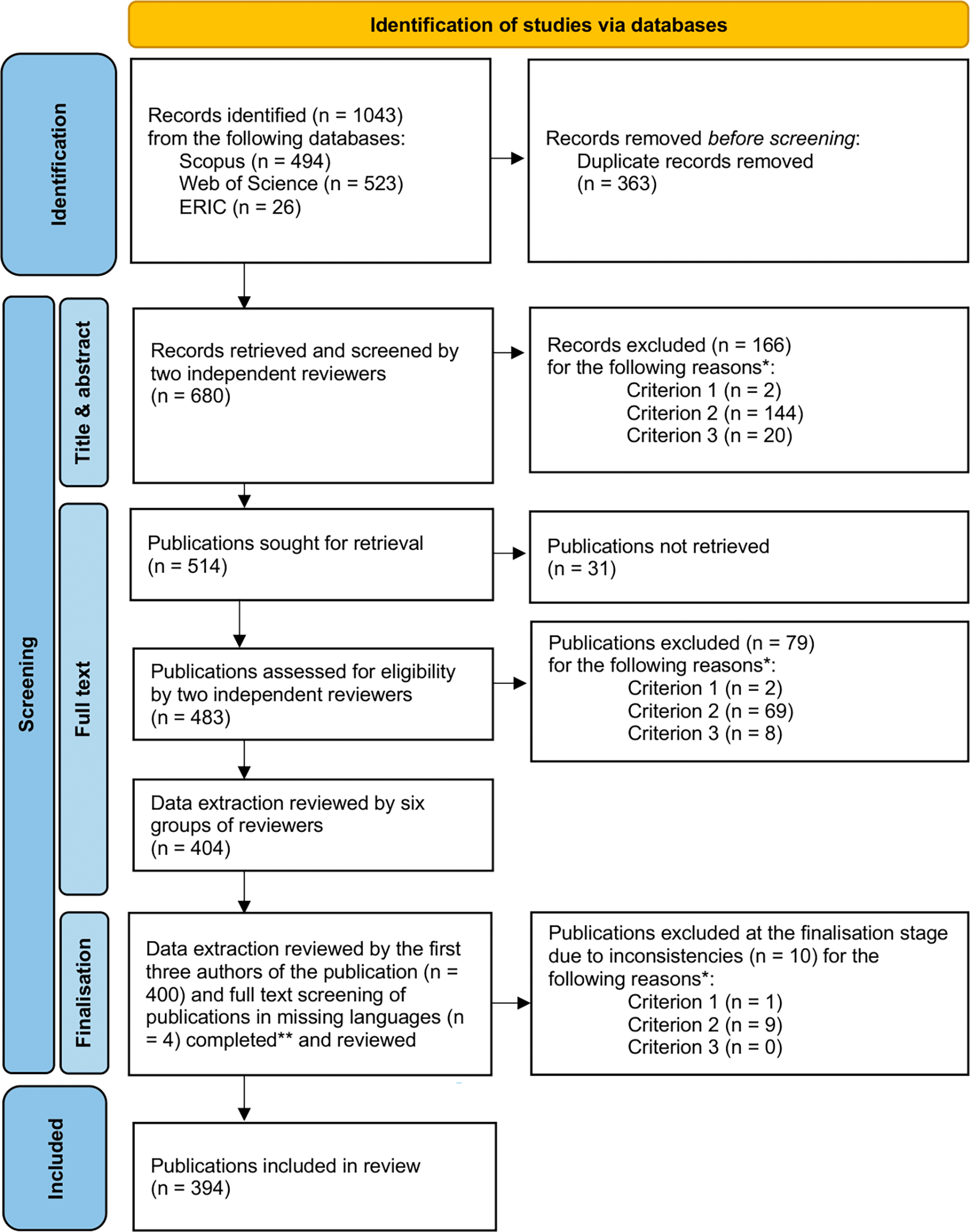
Reference management. Bibliographic data were managed using Zotero software. After removing duplicates, 680 records were compiled in May 2023 into an Excel file shared via Teams.

Selection process. The screening process consisted of two stages:

  • • Stage 1: Titles and abstracts were independently screened by two randomly assigned reviewers (intercoder reliability: 65%), with disagreements resolved by a third reviewer. This resulted in 514 records retained and 166 excluded.7 After removing 31 records without full-text access, 483 publications proceeded to full text screening.

  • • Stage 2: Full texts were independently screened by two randomly assigned reviewers (intercoder reliability: 79%), with disagreements resolved by a third reviewer.8 Publications in other languages (see section 2.2 for overview of languages of publication) were screened by two independent reviewers fluent in the respective language. Following the exclusion of 79 studies at this stage, the sample comprised 404 publications.9 A further 10 publications were excluded at the final stage, resulting in a final sample of 394 publications.

In total, 680 records were identified, 514 retained after title and abstract screening, 483 assessed at full-text stage, and 394 included in the final sample (see Figure 1). A list of studies excluded, together with reasons for exclusion, is available in the online repository accompanying this review (see Data Availability statement for details).

bffa7d9f-dea4-461f-81bd-090b135d26c2_figure1.gif

Figure 1. PRISMA diagram showing numbers of publications identified, screened, excluded and included in the analysis.

Source: created by the first author, using the template from Page et al. (2021).

Note: * The references were excluded because they did not align with one of the three criteria for inclusion. Criterion 1 – Publication date; Criterion 2 – Relevance; Criterion 3 – Publication type (for more details, see Selection criteria above). ** The screening of four publications (one in simplified Mandarin, one in Spanish, one in Turkish and one in Ukrainian) was not completed at the earlier stage of the screening due to unavailability of at least one reviewer. The screening of these four publications was completed only at the very final stage of the review.

Data collection process. During full-text screening, reviewers extracted key information on study objectives, methods and samples using a shared grid developed by a designated team. The unit of analysis was the publication, with particular attention to how each study conceptualised TNFs. Reviewers recorded quotations illustrating how TNFs were explicitly defined or implicitly understood, and provided a brief (one to two sentences) analytical summary of these conceptualisations in the additional coding column. Given the conceptual focus of the review, no outcome measures in the conventional sense were defined. Instead, data extraction focused on how the concept of transnational families is defined, operationalised, and used across studies. This included both quotations with explicit definitions and implicit conceptual uses, alongside study characteristics relevant to interpreting these patterns. Discrepancies in interpretation were resolved by a third reviewer and subsequently reviewed by one of the first three authors during the final phase (see Figure 1 below).

Data analysis and conceptual mapping. In the final phase, contributors were organised into six groups, each comprising scholars from various disciplines and countries, and assigned subsets of studies. The allocation was deliberate (rather than random), ensuring that each group included studies previously reviewed by at least one of its members, thereby balancing familiarity with the research corpus under review. Each group summarised key insights on the use of the TNF concept and proposed a possible structure for the resulting publication. The first three authors synthesised these inputs into a draft outline, which was discussed during a hybrid meeting in Vilnius (25–27 November 2024) and subsequently refined. The first three authors then systematically reviewed all extracted data and categorised studies according to their level of definitional engagement with the TNF concept, enabling comparative analysis (see Section 3 and Table 1 below). Citations reflecting explicit and implicit definitions of TNFs were grouped into initial patterns, which were refined through iterative discussion. This process resulted in a refined set of five conceptual patterns, presented through descriptive summaries (see Section 3) and a visual mapping (see Table 1). The analysis was complemented by an examination of dominant research foci and less researched aspects, interpreted as indicative of how each study approached the phenomenon of TNFs. These dimensions were identified through an iterative, team-based process involving comparison across studies and refinement of categories. Given the qualitative and conceptual nature of the review, formal assessments of heterogeneity, sensitivity, and certainty of evidence were not applicable; instead, the analysis relied on collective interpretation developed by the first three authors and refined through team discussion. The mapping of studies also included a general overview of research designs and methodologies, highlighting uneven distributions across methodological approaches and geographical coverage in recent TNF scholarship. Variation across studies was examined qualitatively, focusing on differences in conceptualisation, research focus, and geographical context; no formal statistical investigation of heterogeneity was conducted.

Table 1. Patterns in defining TNFs in the reviewed academic literature, 2018–mid-2023.

Emerging pattern Explanation of the pattern Example(s)
Pattern 1Explicit use of an already existing definition of ‘transnational families’ (analytical concept)Authors explicitly define transnational families by drawing on established, seminal definitions, most commonly those proposed by Bryceson & Vuorela (2002) and related work.Ahlin (2018)
Carella et al. (2022)
Popyk & Pustułka (2021)
Pattern 2Implicit use of the term ‘transnational families’ without providing a clear definition, but with a clearly conveyed meaning (analytical)25The term is used without an explicit definition; however, its meaning is clearly conveyed through the authors’ descriptions of family situations and their analytical focus. Although no formal definition is provided, the concept is sufficiently specified.Becker (2023)
Huang et al. (2022)
Martín-Bylund & Stenliden (2022)
Pattern 3Implicit use of the term ‘transnational families’, without a clear definition and without a clear specification of its meaning (descriptive)The term is used without an explicit definition and without clear specification of its meaning. In these cases, “transnational family” functions primarily as a broad label, loosely describing cross-border contexts, migrant backgrounds, cultural difference, or long-distance family arrangements.Kozminska & Zhu (2021)26
Purkarthofer et al. (2022)
Quah (2018)
Pattern 4Explicit author-developed definitions of transnational families (analytical concept)Authors develop and explicitly state their own definitions of transnational families by refining, nuancing or extending existing conceptualisations. These studies differentiate bi- and multi-national families, modify understandings of family and familyhood and/or reinterpret key elements such as separation, distance, and the role of the nation-state.Guizardi et al. (2018)
Herrera & Berg (2023)
Palash & Baby-Collin (2021)
Pattern 5Alternative terminology for similar phenomena (alternative concept)Studies that examine phenomena commonly associated with transnational families but using alternative terms and concepts. Transnational families are implied rather than explicitly named, with the term appearing only in keywords or references of the reviewed publication. Instead, authors employ concepts such as transnational households or global householding and related conceptualisations.Oso & Suárez-Grimalt (2018)
Yount-André (2018)
Zharkevich (2019)

Referencing. As the main data collection was conducted on 19 April 2023,10 the review captures all studies published up to that point, including articles available online ahead of print. In cases where the final publication date extends beyond 2023, references used in this publication reflect the year in which the publication was first made available and captured in our dataset.

Limitations. This review covers a relatively short period (2018–mid-2023), which helped maintain a manageable number of studies but limited the ability to capture longer-term patterns. While our search strategy allowed us to capture some studies in diverse languages published in journals indexed in major international databases, it did not cover the broader body of academic literature published in national languages in journals not indexed internationally,11 thereby narrowing linguistic and regional diversity. To further contain the scope, full monographs were excluded, which would merit separate analysis. The screening stages also presented challenges: lower intercoder reliability in title and abstract screening reflected differing interpretations of TNFs, and a few studies still needed to be excluded and some data extraction had to be corrected at the final stage. This was partly due to different understandings of TNFs, with scholars from linguistic or educational disciplinary backgrounds tending to include studies that used “transnational families” as a synonym for migrant families without addressing transnational dynamics. Most of these studies were excluded when sorting out reviewers’ disagreements with respect to the inclusion criteria. These disagreements were also partly spurred by the review’s conditions – conducted relying exclusively on voluntary contributions from a large team from TraFaDy network whose membership changed over time – making coordination more difficult and leading to inconsistencies in applying inclusion criteria and data extraction, requiring additional reviews. As a result, this review should be seen as mapping dominant applications of the concept of TNFs in recent, accessible, and largely Anglophone academic literature indexed in main international databases, rather than as an exhaustive account of all scholarship on TNFs.

Reporting bias. Given the conceptual focus of this review, no formal assessment of reporting bias was conducted. However, potential biases may arise from the database selection, keyword-based retrieval, and the predominance of English-language publications in the selected databases, which shape the visibility of particular research traditions and conceptualisations. These limitations are considered in the discussion and limitations sections.

Protocol and registration. The review was not prospectively registered. A retrospective protocol and all supporting materials – including the PRISMA checklist (see also Supplementary File 1), PRISMA flow diagram, search strategy, screening dataset, and coding file – are available in the online repository accompanying this article (see Data Availability statement) to ensure transparency and reproducibility.

2.2. Key characteristics of the included studies

The majority of included publications are based on empirical studies (n = 341), with qualitative research methods predominating (n = 295). These are most often based on interviews and ethnographic fieldwork (see also Kuti et al., forthcoming), which have shaped much of the existing knowledge on transnational families to date. The non-empirical publications form the second largest group (n = 53), including introductions to special issues and edited volumes, literature reviews and conceptual contributions that frame and advance key debates on TNFs. Quantitative designs are less common (n = 33), while mixed-methods studies represent the smallest share (n = 13). As reflected in the reviews focusing on quantitative and/or mixed method research, the limited number of such studies reflects persistent structural and methodological challenges, including difficulties in accessing reliable and detailed cross-border migration data, the resource-intensive nature of multi-sited large scale research, sampling and ethical constraints, as well as the inherent limitations of standard instruments in capturing the complexity and fluidity of family arrangements across nation-state borders (see Bennett et al., forthcoming; Schiefer et al., forthcoming). This scarcity constrains opportunities for generalisation and systematic cross-context comparison, while also limiting the potential to integrate statistical evidence with qualitative depth, as enabled by mixed-methods research designs.

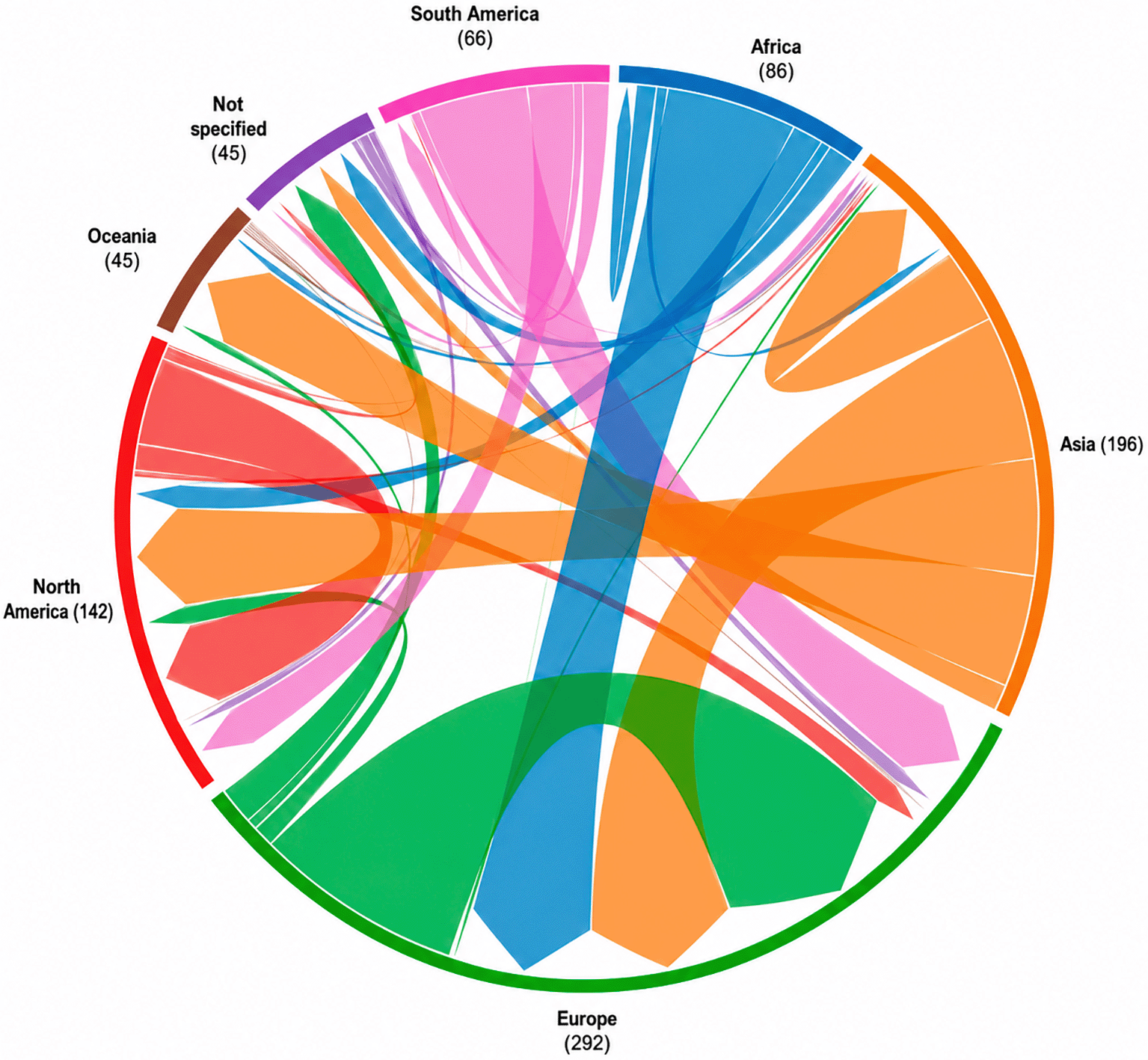
Geographically, most empirical studies focus on transnational family life between the so-called Global South and the Global North, with European and North American continents appearing as the most common destination regions (see Figure 2 below). The United States of America (USA), the United Kingdom (UK), Australia, Canada and several EU countries (mainly Germany, the Netherlands, Italy, and Spain) emerge as the most frequent destinations mentioned in the analysed corpus. These studies commonly examine family relations involving migrants from various countries, with transnational family ties created due to migration from Mexico to USA (e.g., Cruz-Manjarrez, 2023; Galvan et al., 2022; Tuñón Pablos & Mena Farrera, 2018), from China to USA (e.g., Liu, 2019; Xu et al., 2019; Zhao et al., 2018), Canada (e.g., Wu & Tarc, 2022; Zhu, 2020) and UK (e.g., Chen, 2022; Hu et al., 2022; Tu, 2023), and from Ecuador to Spain (e.g., Dávalos, 2020; Oso & Martínez-Buján, 2022) featuring prominently. Intra-regional mobility – particularly within Europe (e.g., Eastern to Western Europe) and within Asia and between Asia and Oceania is also well represented. In case of the former, transnational family ties resulting from migration from Poland to other EU member states (e.g., Barglowski, 2023; Fiałkowska, 2019; Kędra, 2023; Sokolowska, 2018) receive the most attention. In the case of migration from and within Asia, migration from the Philippines to Singapore (e.g., Acedera & Yeoh, 2019; Amrith, 2023), Australia (e.g., Cabalquinto, 2018, 2020) and Japan (e.g., Celero, 2023; Zulueta, 2023) emerge as the most researched flows.

bffa7d9f-dea4-461f-81bd-090b135d26c2_figure2.gif

Figure 2. Transnational family ties between world regions observed in the reviewed academic literature, 2018-mid-2023.

Source: Illustration created using RAWGraphs 2.0 online tool by the first author.

Note: The numbers represent the total number of publications based on empirical studies referring to flows both from and to the specific continent. If a publication discusses transnational families formed between multiple countries across different continents, it is counted multiple times – once for each country pairing mentioned. Therefore, the total number of links is far greater than the number of publications included in the review.

Additional note: To make the visualisation possible, countries were grouped by continent, with some regional specificities simplified. For example, Central America was not differentiated within the North American continent in the illustration; however, most of the North America-to-North America flow represents migration from Mexico to the USA. Similarly, European countries were not differentiated by EU or non-EU membership.

Fieldwork has been conducted in both receiving-country and sending-country contexts, with the former being more common. Quantitative studies in particular tend to be based on data collected within the receiving country, mainly in North America (e.g., Silver et al., 2018; Xu et al., 2019), Western Europe (e.g., Cela & Bettin, 2018; Eremenko & González-Ferrer, 2018) and Asia (e.g., Chiu et al., 2019; Lai & Fong, 2023),12 thus reflecting a host-country bias. While single-sited studies remain widespread in qualitative research, there is a growing number of multi-sited studies (e.g., Francisco-Menchavez, 2018) as well as research designs that examine different origin groups across multiple destination countries or compare transnational and non-transnational families (e.g., Caarls et al., 2018).

In terms of family relationships, reviewed research on TNFs is overwhelmingly centred on child–parent relations, with particular attention to underaged child (ren)–migrant parent relational dynamics, usually from the perspective of a parent (e.g., Bruhn & Oliveira, 2022) and older parent–adult migrant child dyads (e.g., Ahlin, 2018; Földes & Savu, 2018; Karpinska & Dykstra, 2019). Multigenerational ties (e.g., Ducu & Telegdi-Csetri, 2023; Juozeliūnienė et al., 2018; Liu & Ran, 2022) and relations with extended kin (e.g., Oso & Martínez-Buján, 2022; Silver et al., 2018) receive less systematic but still notable attention. Couple relationships (e.g., Acedera & Yeoh, 2020; Dito & Vanore, 2023),13 their separation or breakdown (e.g., Cebotari et al., 2018; Sportel et al., 2019) as well as sibling ties (e.g., Budginaitė-Mačkinė & Juozeliūnienė, 2023) appear only sporadically in the literature, and transnational families including members involved in non-heteronormative relations remain largely understudied, though with a few notable exceptions (e.g., Barglowski et al., 2018; Vuckovic Juros 2022; Zheng, 2023). A few studies investigate international student mobility as embedded in wider family networks (e.g., Zhao, 2019), particularly in the context of COVID-19 pandemic (e.g., Fandino & Banerjee, 2022; Hari et al., 2023; Hu et al., 2022).

While most of the reviewed literature focuses on life across borders, some studies examine the relational dynamics that unfold through family reunification and return after living at a distance. In these instances, authors analyse cases where underaged children join their migrant parents (e.g., Eremenko & González-Ferrer, 2018), spouses or partners reunite in the country of destination (e.g., Della Puppa, 2019), or older parents move abroad to join their adult migrant children (e.g., Bolzman, 2021). Other research considers transnational families reuniting in the country of origin after the return of the migrant family members (e.g., Parella & Petroff, 2023), as well as cases involving multiple reunifications across origin and destination countries (e.g., Christ & Etzold, 2022). Special attention is also paid to the challenges and insecurities to reunite faced by refugees and their family members (e.g., Christ & Etzold, 2022; Hiitola et al., 2023).

In terms of research participants, the largest share of studies involves migrants themselves, who may be identified as migrant workers, migrant parents, refugees or older migrants. A substantial number of studies also focus on non-migrants, most often older parents remaining in the country of origin after their adult children’s migration. Children who remain in the country of origin (e.g., Chen, 2020; Fresnoza-Flot, 2018), the first and/or 1.5 generation14 who (initially) reunite with their migrant parent(s) abroad (e.g., Ahrens, 2022; Celero, 2023; Fresnoza-Flot, 2018), children born abroad to migrant parents and defined as a second generation (e.g., Celero, 2023; Fresnoza-Flot, 2018) emerge as important, though less frequently directly researched groups. Carers in the country of origin (e.g., Chen, 2022; DePalma et al., 2022; Fresnoza-Flot, 2023) as well as spouses, partners (e.g., Acedera & Yeoh, 2018; Schlobach, 2019) and other family members (e.g., Schlobach, 2019) feature more occasionally as study participants. Finally, a notable strand of research employs multi-sited multi-perspective designs, interviewing both migrants and their non-migrant family members to capture relational dynamics across borders (e.g., Marinho, 2021; Zapata Martínez, 2021).

In terms of language, most studies were published in English (n = 369), reflecting the dominance of Anglophone scholarship in the reviewed databases, the centrality of English in disseminating research on transnational families, and the limitations associated with reliance on major scholarly databases for initial selection of the studies (see also above). A smaller number of studies included in the final sample were in Spanish (n = 13), French (n = 4), Romanian (n = 3) and Russian (n = 2), with individual contributions in simplified Mandarin, Lithuanian, Portuguese, Turkish and Ukrainian (n = 1 each).15 While this distribution confirms the prevailing prominence of English-language research in the reviewed databases, it also points to a degree of language diversity within the field, albeit with a broader trend of increasingly shifting to English as the dominant language of publications in smaller European countries (see also Budginaitė-Mačkinė et al., 2025).

3. Patterns in defining TNFs

Starting with the definition of transnational families, the literature generally shows five different patterns, as elaborated further below.

3.1 Clear and explicit, already existing definitions

As Table 1 above indicates, the studies falling under the first pattern provide a clear definition of TNFs. These studies comprise approximately one quarter of the literature under review. Taken together, the definitions usually highlight family ties maintained in the context of geographical and physical distance across national borders. Many focus on the provision and organisation of care, alongside the modes and patterns of communication among family members, framing distance as something to be actively overcome.

Most adopt definitions developed in seminal works, notably by Bryceson and Vuorela (2002: 3), who define TNFs as ‘families that live some or most of the time separated from each other, yet hold together and create something that can be seen as a feeling of collective welfare and unity, namely “familyhood”, even across national borders’. Similarly, research often draws on studies such as Baldassar et al. (2007), emphasising how everyday practices sustain transnational family life – particularly long-distance caregiving, emotional exchange and mobility. By emphasising the links maintained across borders, these definitions also resonate with earlier conceptualisations of transnational migration developed by Glick Schiller et al. (1992).

This body of research conceptualises TNFs as families that sustain a sense of unity, through practices such as sending (reverse) remittances, arranging long-distance caregiving and intergenerational bonding, often facilitated by information and communication technologies (ICTs) and visits (mobility). Such practices enable TNFs to navigate challenges arising from spatial separation and political borders, as well as structural inequalities in access to healthcare and other welfare provisions.

3.2 Implicit but operationalised definitions

About half of the studies use the term ‘transnational families’ but omit to provide an explicit definition (patterns 2 and 3). Studies discussed in this subsection apply the term in a more analytical way (pattern 2), arriving at analytical conclusions without a formal definition but providing sufficient information on how they approach the subject – the families’ situation and the authors’ analytical focus – to constitute an implicit definition and therefore a clear operationalisation.

The authors whose work falls into this group provide ample indication of the key characteristics informing their understanding of what constitutes a transnational family, with physical distance, crossing of national borders and the sending of remittances emerging as central elements. Terms like ‘separation’ and ‘left behind’ are also commonly used to signal the family’s transnational character, while a strong focus on patterns of caregiving, maintenance of family life and/or intimacy as well as gendered responsibilities indicates how familyhood is understood in this research strand (e.g., Kędra, 2020; Martín-Bylund & Stenliden, 2022).

3.3 Practical uses of the term

The studies falling under the third pattern omit to provide an explicit definition; rather than operationalising the term (as in the case of the second pattern), they use the term in a descriptive or practical way. In many of these articles the term ‘transnational’ functions primarily as a broad signifier for either ‘cross-border’, ‘migrant background’, ‘cultural differences’16 or ‘long-distance’ settings. In such cases, the research interest does not explicitly engage with how familyhood is maintained when family members live in different countries, or how the transnational dimension – understood as social, economic, political or other connectivity transcending national borders (cf. Bilgili & Bivand Erdal, 2025) shapes family life in the examined cases.

Several analytical ambiguities become apparent, when reviewing studies associated with this pattern. One ambiguity is whether it is the physical separation across different nation-states that shapes family life, including living under different welfare and immigration regimes, or is it simply long-distance separation. In other words, does familyhood change because of the separation by national borders, or merely because they live far apart, regardless of national borders? This ambiguity is particularly evident in some of the studies examining care and family bonding practices through ICT, which raises further questions (or leaves questions unanswered): what exactly constitutes the ‘transnational’ aspect of media use, and how does caring for family members differ in a transnational long-distance setting compared with a transnational short-distance setting or a long-distance care arrangement within the same national context?

A second issue arises in studies that use the term ‘transnational families’ as a synonym for migrant families (e.g., Kozminska & Zhu, 2021; Purkarthofer et al., 2022). Many studies of this kind were excluded during the screening process, as they did not meet the core inclusion criterion of focusing on the transnational dimension (see Methodology section above). However, insights from a few remaining studies in this review that still touch upon the transnational dimension at least to some extent, along with findings from other reviews on TNFs, show that such work often places little focus on transnational practices and dynamics and instead primarily focuses on the local dynamics of family life in the destination country context (see Budginaitė-Mačkinė et al., 2025).

Finally, some studies use the term TNFs to describe a cross-cultural setting (e.g., Quah, 2018), applying it as a broad descriptive synonym for people perceived as culturally ‘different’ /or with origins in another country – often one at significant actual or perceived distance to the country of residence. This usage may offer some explanation as to why (Western) Europeans who live abroad and come from countries traditionally considered to be destination countries are less often studied through the lens of ‘transnational families’, with some notable exceptions in the reviewed literature including studies by Alinejad (2019), Baldassar (2023), Bianchera et al. (2019), Brahic (2022), Christensen (2020), Marino (2019), Nedelcu and Wyss (2020), Wyss and Nedelcu (2020), and Zontini and Reynolds (2018).

3.4. Conceptual refinements and new definitions

The fourth pattern emerging from our review comprises studies in which some authors offer their own definitions of TNFs, typically refining, nuancing or building upon existing conceptualisations. Such work may specify/modify the concept of the family and familyhood – either broadening or narrowing it – or reframe it by expanding or narrowing the definition of key elements such as separation, distance, and nation-states. Such studies account for roughly one in thirteen publications.

One example is the work by Palash and Baby-Collin (2021), who in their study on social protection in transnational families differentiate between bi-transnational families – whose relations span across two countries – and multi-transnational families, involving connections across more than two countries (see also Bryceson 2019). This differentiation is particularly useful in terms of highlighting how immigration and welfare regimes shape family life and situations of individual family members.

Similarly concerned with distance and location, Guizardi et al. (2018) challenge the conceptually established link of family relations with separation and distance, inherent in dominant conceptualisations of TNFs (such as the one by Bryceson & Vuorela, 2002). Studying commuters in border regions (i.e., individuals that live in one country with their family but work short distance across the border in another country), they argue that such families should be recognised as ‘transnational families’ even though they are not separated in terms of living arrangements.

Others, such as Herrera and Berg (2023), place separation at the core of their conceptualisation. They emphasize the importance of distinguishing between different forces that lead to family separation. In this context, they propose the term ‘forced separation’ to highlight the forced removal of a family member by the authorities from the country of destination to the country of origin (in this case, from the USA to Ecuador). They identify this process as a driver of transnational family formation that disrupts networks and heightens vulnerability through the spatial separation of family members, with some family members remaining in the country of destination, while others are sent back to the country of origin.

While some work attributed to this pattern does not aim to redefine family membership, it offers a conceptual refinement by shifting attention to what it means to be a family. Wilding et al. (2020), for example, emphasise the importance of emotions for maintaining the families’ sense of familyhood across borders and distance. While acknowledging the crucial role of communication (through ICT, for example), they argue that it is ‘not just the act of sending a message or making a phone call that is significant, [but rather] the circulation of affect via digital media that is fundamental to the production and maintenance of the transnational family’ (Wilding et al., 2020: 642). This insight draws on earlier work in which they propose the notion of ‘digital kinning’ (Baldassar & Wilding, 2020), which identifies individuals and family members’ engagement with new technologies as key to maintaining supportive family relations/network.

3.5. Alternative terminologies for similar phenomena

The fifth pattern comprises studies that examine TNFs as a phenomenon but apply different terms and concepts – TNFs is thus only implied, appearing as a term only in keywords and/or references. This accounts for roughly one out of every six articles. Rather than explicitly describing the families under study as transnational families, these works use alternative terms such as transnational households or global householding.

While the analytical focus is still on maintaining family life across distance, different concepts are used to capture this. Examples include Zharkevich’s (2019) work on transnational connectivity, Yount-André’s (2018) conceptual development of the ‘Facebook family’, Uy-Tioco and Cabalquinto (2020) on transnational caregiving and dispersed families, Seidel et al. (2022) on unaccompanied minors and their distant families, transnational economic contributions by Gutierrez (2018), transnational householding by Fan (2021), transnational care ethics by Ducu (2020), transnational family solidarity by Baykara-Krumme and Fokkema (2019), transnational family figurations in displacement by Christ and Etzold (2022), or digital communication across borders by Ballaret (2023).

3.6 Reflection on the patterns of conceptualisation of TNFs

Building on the five patterns identified above, it becomes clear that the concept of TNFs is mobilised in diverse ways across the literature. Reflecting on these patterns of conceptualisation, it is possible to distinguish several important aspects.

Firstly, there seems to be a certain Western-centric bias in how the concept of TNFs is applied, inasmuch as the term ‘transnational family’ is frequently and sometimes exclusively applied to families originating from the Global South as well as Eastern Europe. Families from disadvantaged economic backgrounds are often categorised and researched as TNFs, notably when they migrate to or settle in Western Europe. By contrast, mobility among Western Europeans – within Europe or beyond – is rarely framed under this category, even when their families live across multiple countries. This is reflected in our literature review, where most destination countries are in the so-called Western world, with Western Europe, Australia, Canada and USA appearing prominently. The main countries of origin, in turn, are often in Asia and South America, with the Mexico–USA, China–USA/Canada/UK, and Ecuador–Spain corridors most frequently discussed, alongside Eastern European migration to Western Europe. As a result, the label “transnational families” is more commonly applied to mobility involving the Global South and Eastern Europe17. This reflects a broader tendency in migration research to focus on non-Western mobility, which can create a misleading impression that transnational family life primarily or exclusively involves populations from the Global South or Eastern Europe (cf. Dahinden, 2025 on de-migranticising migration research). At the same time, transnational family life linked to migration within the Global South and involving transit countries remains comparatively underexplored.

Secondly, the literature review highlights a related bias regarding race and ethnicity, class and skills which forms another manifestation of Western centrism. The question of ‘who is a subject of transnational migration and of a family?’ appears to depend not only on geographical origins but also on social markers such as race, ethnicity and class. Individuals with backgrounds that fall outside of the perceived European (and Western) norm are more frequently labelled as ‘transnational’ and/or ‘migrant’. By contrast, white, middle-class (Western) Europeans are often defined primarily by emphasising their professional positions and skills, described as ‘expats’ or ‘mobile professionals’ rather than as migrants or members of TNFs (see also Weinar & Klekowski von Koppenfels, 2020; Suter & Åkesson, 2020). To address this imbalance, researchers could adopt more inclusive practices when it comes to naming the families they are researching, such as using ‘transnational famil*’ as a keyword and analytical category to identify transnational family constellations across diverse social classes and mobility types, rather than giving the impression that they are limited to particular populations.

The third issue relates to conceptual slippage in the use of ‘transnational’. As spelled out above, the term ‘transnational’ is sometimes used as a signifier for long-distance, while the ‘transnational’ aspect of it, i.e., the practices and relations maintained across two or more different nation-states, is neither explicitly acknowledged nor examined. As will be demonstrated in the subsequent section, this ambiguity is also visible in thematic areas such as language and education, documenting how TNFs navigate heritage language maintenance, language loss, and multilingual educational trajectories. While it is clear that long-distance and/or migrant origin matter for the discussion presented, it remains unclear in what way the embeddedness of family members in two or more different states, and not just two different localities or regions, matter for shaping the families’ experiences, practices or strategies. This observation relates to some of the reviewed studies and reflects what Wimmer and Glick Schiller (2002) call ‘methodological nationalism’: the tendency to focus on processes within a nation state, taking it as a given analytical frame, even when examining phenomena that transcend national borders.

Lastly, although much of the literature contextualises TNFs within broader socio-political frameworks – such as global migration regimes, economic disparities, labour demands, welfare regimes and migration governance – these macro-structural dimensions are seldom examined in depth. This gap is particularly evident in emerging work on TNFs in studies on forced migration where asylum regimes and state immigration policies fundamentally determine family practices and solidarities. These issues are addressed more fully in the subsequent section.

4. Thematic patterns

4.1 Research foci

An analysis of research on transnational families between 2018 and mid-2023 reveals a strong thematic focus on care and ICT-mediated communication, which have become the dominant areas of inquiry. Other topics – such as intergenerational relations, remittances, education, language, wellbeing and gender norms receive comparatively less attention, though they remain represented. This section reviews these dominant research foci, considers how they shape the conceptualisation of transnational families in this research field, and determines which dimensions of family life are treated as most analytically important in recent scholarship.

Within this thematic landscape, care has emerged as the single largest focus of research. Studies consistently demonstrate that the care family members provide to each other – an essential form of every individual’s overall (transnational) social protection, irrespective of the welfare regime they are located in – does not stop at the borders of the nation-state but extends across two or more nation-states (e.g., Palash & Baby-Collin, 2021). Such studies have thus examined how transnational caregiving is organised and sustained, how care is provided, by whom and why (e.g., Reisenauer, 2018; Shubin, 2022). Taken together, these studies offer key insights into both the opportunities and obstacles of caregiving across national borders, highlighting its embeddedness in family, gender and institutional norms, as well as immigration and welfare regimes. Typically, studies investigate the care flows from the middle generation to children as well as to the older generations, shaped by cultural expectations on how care is given and/or perceived, and disproportionally carried out by adult women (e.g., Haagsman & Mazzucato, 2021; Hsu, 2018; Serra-Mingot, 2020). The COVID-19 pandemic further intensified scholarly interest in transnational care, as mobility restrictions disrupted care networks, deepened emotional and intergenerational tensions, and at once revived solidarities and reflections on global inequality (Hinkson et al., 2022; Herrera et al., 2022). In this continuously growing body of work, the care for children – and, to a lesser extent, for older parents – remains a priority concern, but relatively little research addresses caregiving for the individuals with illnesses or disabilities, or members of the middle generation such as siblings and kin-like others.

A large number of studies investigate how ICTs sustain care across distance, showing that maintaining familyhood relies heavily on digitally mediated interaction (e.g., Merla et al., 2021; Osei et al., 2023; Gordano Peile, 2018; Popyk & Pustułka, 2021; Schlobach, 2019; Share et al., 2018). Recent research demonstrates that, during the COVID-19 pandemic, digital communication became particularly indispensable for sustaining transnational care and family solidarity amid travel restrictions and health risks (Hinkson et al., 2022; Juozeliūnienė et al., 2021). Some studies adopt a critical stance, drawing attention to asymmetries in care roles between migrants and non-migrants (Arnold, 2021) or to the ambivalent nature of ‘elastic care work’, which intertwines fulfilment with frustration (Cabalquinto, 2020).

The above mentioned body of work connects caregiving practices to the second major focus in the reviewed literature: ICT-mediated communication within transnational families. In general, digital technologies are widely studied as central to maintaining family life at a distance, focusing on both modes and substance of such communication. Research shows how ICTs – such as messaging apps, video calls, and social media – help to preserve emotional bonds, support performing everyday family roles, and enable ritualised practices and familial displays. Moving beyond a view of ICTs as neutral tools or simple facilitators of connection, some reviewed recent work emphasises their ambivalent role: digital interactions can foster closeness but also reinforce absence, create an ‘illusion of togetherness and belonging’ while producing feelings of guilt (e.g., Kędra, 2020), generate intimacy while enabling surveillance (Zhao, 2019), and provide connectivity while simultaneously producing emotional strain (e.g., Wang & Lim, 2021). To capture the complexities of ICT-mediated communication in TNFs, scholars have introduced concepts such as ‘digital kinning’ (Baldassar & Wilding, 2020; Wilding et al., 2020; introduced in the section above) and ‘digital homing’ (Wilding et al., 2022), enabling an analysis of how families use technologies to sustain relations, (re)create belonging, and maintain transnational identities. Importantly, research also highlights the significance of silences and voids in transnational exchanges (e.g., Sampaio, 2020), strategic virtual absence to avoid conflict (e.g., Hsu, 2021), and disconnective practices to resist familial control and surveillance in transnational settings (e.g., Zhao, 2019). Despite these notable examples, the use of digital technologies as a tool of control, conflict or negotiation within transnational family relationships, remain understudied. At the same time, little attention has been given to the structural and technological conditions – such as migration regimes, legal status, or unequal internet access – that shape digital family life when engaging in transnational care.

Communication, central to studies on maintaining familyhood through digital means, is also a key concern in research on transnational families from the perspective of intergenerational solidarity. Methodologically, this strand is more balanced than those discussed above, with quantitative studies making up a substantial share (including the typology studies, among others). This body of work mainly shows how emotional, material and practical support continues to circulate between generations across borders, though varying in form, intensity, and over time. Most studies draw on the intergenerational solidarity paradigm (see Bengtson, 2001) and focus on dyads formed by adult children having migrated abroad and older parents having stayed in the country of origin (e.g., Földes & Savu, 2018; Karpinska & Dykstra, 2019).18 These dyads are usually studied from the perspective of a single member. While some research examines a single dimension of solidarity (e.g., Hărăguș et al., 2018, Popyk & Pustułka, 2021), others address several dimensions (e.g., Hărăguș & Telegdi-Csetri, 2018) or even propose typologies of intergenerational relations (e.g., Baykara-Krumme & Fokkema, 2019; Földes & Savu, 2018; Guo et al., 2018b; Karpinska & Dykstra, 2019). Recent studies show that the COVID-19 pandemic disrupted reciprocal intergenerational support (e.g., Maviza & Nzima, 2022) and reshaped digital family interactions, including identity negotiations between queer international students and their parents (e.g., Zheng, 2023). Finally, some important gaps remain: solidarity within a generation is rarely examined (with few exceptions, e.g., Budginaitė-Mačkinė & Juozeliūnienė, 2023); intergenerational ambivalence19 is addressed but not extensively (with few exceptions e.g., Gallo, 2019); and certain dimensions, such as consensual solidarity20 (e.g., Gallo, 2019) receive relatively little attention.

Wellbeing and (mental) health have started gaining more attention in recent years, particularly the well-being of underage children and their parents abroad. Studies examine the effects of geographical distance on migrant parents’ wellbeing (e.g., Butt, 2018; Lai & Fong, 2023), including undocumented parents (e.g., Galvan et al., 2022), and on the underage children who remain in the country of origin (e.g., Edelblute & Altman, 2018; Zhao et al., 2018). Other work considers children who migrate to join their parents (e.g., Ismail, 2019), children later sent back to the extended family in the country of origin (e.g., Bohr et al., 2018), and the long-term effects of parental separation in childhood on wellbeing in adulthood (e.g., Eremenko & Bennett, 2018). While children’s health and wellbeing receive increasing attention, measurement instruments do not always address children directly but rely on the assessments of the remaining parent (e.g., Edelblute & Altman, 2018). Some of the literature on intergenerational solidarity also examines its relationship with the wellbeing (e.g., Guo et al., 2018a) and health (e.g., Tezcan, 2018) of older parents who remain in the country of origin after their adult children’s migration (e.g., Guo et al., 2018a; Tezcan, 2018). Even if the importance of studying wellbeing from multiple viewpoints is increasingly recognised (e.g., Phoenix, 2019), most research still relies on data collected from a single family member. Recent studies also point to the COVID-19 pandemic as a period that exposed the vulnerabilities of transnational families, with mobility restrictions shaping wellbeing and revealing gendered differences in life satisfaction among migrants living apart from their families (e.g., Gerber & Ravazzini, 2022). Beyond parent-child relationships, some of the studies on transnational families address the health outcomes of migration for both migrants and their families (e.g., Gustafsson, 2018; Webb, 2018), the healthcare needs of relatives across borders (e.g., Lafleur & Romero, 2018), and the role of kin in chronic illness contexts (e.g., Lukman & Merry, 2023).

Another important body of research examines how gender roles and norms are reproduced, negotiated, or transformed in transnational family life. Women – particularly mothers – are most frequently studied as those who shoulder the emotional and logistical burden of maintaining family ties across borders, coordinating caregiving from afar and engaging in transnational mothering while working abroad. This emphasis reflects not only persistent gendered expectations surrounding caregiving within the studied families and communities, but also potential biases in research that foreground women’s roles. At the same time, some studies show that migration can increase women’s autonomy and decision-making power, particularly through their financial contributions to the family. By contrast, research on men’s roles in transnational families has been relatively limited. When addressed, men are often portrayed primarily as economic providers, with less attention paid to their emotional engagement or caregiving. Nevertheless, emerging research suggests that migration-related disruptions to family arrangements can prompt men remaining in the country of origin to assume roles that are considered non-traditional in their context, including caregiving (e.g., Ballaret & Lanada, 2022). A modest but growing body of research is also beginning to address transnational fatherhood (e.g., Hershberg & Lykes, 2019; Roy & Yumiseva, 2021). Overall, migration can both reinforce and reshape gender norms: it may empower women by strengthening their financial independence and authority within the household, while also creating openings for men to engage more actively in caregiving (e.g., Ballaret & Lanada, 2022). These shifts, however, are highly context-dependent – shaped by class, ethnicity, legal status, and the cultural frameworks of both origin and destination societies – and may either constitute temporary adjustments or lead to more enduring changes (e.g., Tolstokorova, 2018).

Research on remittances, education, and language also falls into the thematic scope of TNF studies, albeit to a lesser extent. Remittances are analysed not only as economic transfers but also as expressions of care and family continuity across distance (e.g., Bakuri & Amoabeng, 2023, Bruhn & Oliveira, 2022; Chikwira & Madziva, 2023; Kaur & Kaur, 2022; McCallum, 2022; Palash & Baby-Collin, 2021). The examined studies highlight how remittances sustain family support systems, securing access to education, healthcare and housing for family members who remain in the country of origin. Beyond their material function, they also serve as emotional and symbolic gestures (e.g., Zharkevich, 2019), that reinforce familial bonds and fulfil moral expectations of reciprocity. The COVID-19 pandemic also broadened the notion of remittances to include the exchange of safety norms and coping practices within transnational families living under different regimes of normality (e.g., Galstyan & Galstyan, 2021). Overall, gendered patterns are frequently emphasised, with women’s remittances more often tied to caregiving roles and social reproduction and men’s more commonly framed as financial provision (e.g., Singh, 2019). Some studies also explore the social cost of remittances, pointing to the emotional burden and precarity migrants experience, especially when these transfers become routinised or expected (e.g., Solari, 2019).

Education and language have been approached as both resources and areas of tension within transnational family life in the reviewed literature. Education is most often examined through the lens of mobility – more specifically, as a strategic decision made by migrant families to secure better future opportunities for their children. Research in this area explores parental strategies for managing educational opportunities across borders (including practices of long-distance parenting), as well as children’s educational outcomes and the ways these are shaped by the family’s transnational circumstances (e.g., Bakaari & Escandell, 2022; Cebotari et al., 2018; Demirsu, 2022). Language, often closely tied to education, is studied as both an identity marker and a medium of intergenerational cultural transmission and belonging (e.g., Alasmari, 2023; Cruz-Manjarrez & Baquadano-Lopez, 2020; Hirsch & Lee, 2018; Istanbullu, 2020; Lexander, 2021; Moustaoui Srhir, 2020). Research often explores family language policy, including parents’ language ideology, practices and tensions around language practices in transnational families (e.g., Alasmari, 2023). TNFs are shown to navigate multilingual environments, experience language loss, and also maintain their heritage language (i.e., the language spoken in the family and/or country of origin). Similarly, the studies also examine how destination country languages are used in the home setting (e.g., Huang et al., 2022). However, most of this scholarship tends to focus on parents’ and caregivers’ perspectives, with few studies examining children’s agency in shaping educational and linguistic trajectories across borders.

4.2. Less explored areas in transnational families research

Beyond identifying dominant themes, it is also important to consider less explored areas in the reviewed research strand and what they reveal about knowledge production within the field of TNF studies. As demonstrated in the previous section, our analysis of recent TNF studies indexed in major scholarly databases indicates a tendency to privilege certain practices (care), family roles (particularly mothers), and family structures (nuclear heterosexual families), while constraining engagement with intersectional and interdisciplinary analyses of how inequalities shape transnational families’ lives. In this section we highlight the less explored areas not because they are entirely absent – there are some studies addressing many of these aspects in TNF research within and beyond the corpus we analysed – but because they warrant greater attention to better capture the diversity of family structures, roles and practices.

Regarding family structures, most studies examine heterosexual, nuclear households – often reflecting Western family norms – while devoting comparatively limited attention to blended and reconstituted families, queer families, or polygamous arrangements. This emphasis yields a partial representation of transnational family life, in which Western-centric normative family models implicitly operate as a default model in TNF research. Additionally, family lives shaped by displacement, deportation or forced separation appear underrepresented within the TNF literature identified for this review, despite the significance of cross-border experiences. Greater attention to both voluntary and forced separations and reunifications across origin, transit and destination contexts would deepen the understanding of how state policies and broader structural constraints (re)shape who is recognized as family across borders.

At the same time, this pattern should not be interpreted as a lack of scholarship on these issues. A substantial body of research beyond the scope of this review examines forced migration, asylum regimes, deportability, and structurally constrained parenting practices, engaging with questions of transnational motherhood and family separation (e.g., Lijnders, 2023). However, this scholarship is typically situated within refugee and forced migration studies and does not necessarily frame these dynamics under the label of “transnational families”, instead employing alternative keywords that were not used to construct the initial corpus for this review. The relative marginality of these aspects in our findings may reflect both the limits of our keyword-based, specific databases-focused search strategy and a partial separation between research strands that address closely related empirical realities without consistently engaging in dialogue with one another.

The visibility of different voices in the reviewed TNF research is similarly uneven. While a significant share of research examines dyads involving migrant parents and underaged children remaining in the country of origin, children are often represented primarily through their parents and are less frequently interviewed directly. As a result, they are still too often portrayed as passive dependents rather than as active participants, and their agency in shaping transnational familyhoods remains less visible. Voices of siblings and extended kin networks – who are often central to sustaining care flows and emotional support across borders, particularly in arrangements involving older adults in the country of origin – are present, but rarely feature prominently in the analyses. Research focusing on transnational family members with disability, chronic illness or long-term dependency remains marginal, despite their significance for everyday family life, further contributing to a partial representation of TNFs. The uneven visibility can be partly shaped by research design and practical constraints, including ethical and logistical difficulties in interviewing children, and the challenges of multi-sited fieldwork needed to capture extended kin across locations. This underrepresentation is further heightened by challenges in accessing members of TNFs, particularly in the ‘Global South’, as research funding and resources tend to be concentrated in destination countries. The uneven visibility can also partially reflect the strong influence of transnational motherhood and care-oriented scholarship, as well as migration policies that privilege nuclear family categories, thereby reinforcing dyadic and parent–child-centred understandings of transnational family life.

Another limitation lies in the tendency to treat TNFs as static entities defined primarily by geographical separation, rather than as dynamic constellations embedded in relational and cultural contexts. This perspective risks overlooking the temporal dimension of transnational family life and the ways in which family roles and obligations, as well as relationships and intimacy, evolve over time. Longitudinal research designs are crucial for capturing these changing dynamics,21 including how separation, return and reunion transform emotional relationships, care arrangements and power relations within family units. On the one hand, practical constraints related to longitudinal, multi-sited research help explain the prevalence of cross-sectional designs that capture transnational families at a single moment. On the other hand, a predominant focus on the moment of separation and emphasis on spatial dispersion as defining features of transnationality may unintentionally underplay the possibility of reconfiguration and changes over time. A wider application of longitudinal multi-sited research coupled with a stronger focus on temporality would enable more researchers to examine not only the maintenance of transnational relationships but also on how they are (re)negotiated, strained, reconfigured, or potentially dissolved across the life course and shifting migration trajectories.

The patterns discussed above are also linked to gendered assumptions embedded in TNF research.22 Much of the reviewed literature focuses on transnational motherhood, frequently depicting migrant women – particularly from the Global South – as archetypal caregivers and primary bearers of emotional and practical responsibilities, often within a ‘care drain’ framing that implicitly problematises maternal mobility (cf. Dumitru, 2014). Migrant men are still predominantly portrayed as economic providers, with limited attention for their emotional lives and subjective experiences,23 despite growing evidence that transnational masculinities are deeply shaped by moral obligations, care responsibilities and bureaucratic constraints. This asymmetry not only relates to analytical preferences but also to broader gender norms and migration regimes that often continue to associate women with care and men with breadwinning. While some newer studies do examine men’s engagement in care duties in the countries of origin, especially fathering, the broader cultural and institutional frameworks that enable or constrain such involvement are rarely addressed in the studies included in this review. Changes in caregiving patterns are often framed as temporary adaptations to separation, rather than as potentially enduring transformations of gender relations. Beyond parenting, reviewed work also has addressed grandparenthood, typically highlighting grandmothers’ provision of childcare, but comparatively less attention is given to care provided by children, by older adults, or by and for siblings and kin-like relations. Virtually none address care in contexts of illness, disability, or long-term dependency, thereby reinforcing a narrowed understanding of care within TNFs.

The review of dominant research foci confirms a persistent imbalance between micro and macro-level analyses, already discussed in relation to the conceptualisation of transnational families in the previous section. Research has generated rich insights into how families provide care, communicate and exchange remittances across distance, yet these practices are seldom situated within the broader structural conditions that shape them, including visa regulations, migration and border regimes, and shifting geopolitical dynamics that delimit mobility and family reunification (cf. Christ & Etzold, 2022). ICT studies, for example, show how digital tools facilitate ‘digital kinning’ and ‘digital homing’, supporting emotional intimacy and everyday coordination. However, they rarely account for the uneven conditions under which such practices occur, including unequal access to digital infrastructure, restrictive migration regimes, and precarious legal statuses. Similarly, studies of remittances often focus on their symbolic and material significance for sustaining family ties, without embedding them in the political economy of global remittance flows or in the regulatory frameworks that condition their circulation. This relative neglect of structural factors risks portraying TNFs as self-contained units creatively managing distance, rather than as families embedded in global regimes of inequality and migration governance. At the same time, research that focuses exclusively on structure underplays the agency of family members, who adapt, resist, or navigate constraints. Greater use of scale-bridging approaches would help illuminate how structural forces and family agency are mutually constitutive rather than analytically separable.24

The COVID-19 pandemic underscored these dynamics in particularly stark ways. Families were caught between border closures, disrupted care chains and prolonged separations, which magnified financial, social and emotional vulnerabilities (see also Végh et al., 2025). Similarly, following Russia’s full-scale invasion of Ukraine, transnational family lives in contexts of forced displacement have received renewed scholarly attention, highlighting how war and geopolitical rupture reshape family configurations across borders (see also Schrooten, 2025). Yet few studies included in the review investigate how states actively construct these vulnerabilities by determining who can cross borders under ‘essential’ categories, thereby increasing inequalities between different groups of migrants and families. As recent work going beyond this review also shows, even within the same household, family members may experience unequal access to legal rights and mobility opportunities, producing divergent transnational trajectories and forms of belonging (e.g., Van Hook & Glick, 2020). These dynamics highlight the importance of examining TNFs not only as family units negotiating distance but also as subjects of governance, exposed to policy practices that render some families precarious while leaving others exempt. What is needed is a wider use of more dynamic analytical frameworks that capture the interaction between structure and agency, recognising families as both constrained by and actively shaping the socio-political landscapes they inhabit.
5. Conclusions

This review has shown how the concept of transnational families is applied in diverse and often inconsistent ways across analysed academic literature between 2018 and mid-2023. Although many studies refer to TNFs, only a subset engage explicitly with the transnational dimension as a central analytical focus. Five conceptual patterns were identified, ranging from explicit definitions to more descriptive or implicit uses.

Building on these findings, several broader patterns emerge. The notion of TNFs is disproportionately applied to families from the Global South and Eastern Europe, who are often framed as vulnerable. In contrast, Western mobile families – such as families of skilled professionals, mobile international students, or retirees – are seldom included under this label, despite their cross-border practices and networks. The reviewed research also tends to centre on voluntary cross-border mobility for typically lower-skilled work, overlooking experiences shaped by forced migration, including deportation and family separations due to restrictive family reunification policies. Rather than reflecting empirical absence, this asymmetry may indicate how TNF research can (unintentionally) contribute to reproducing hierarchies embedded in the global migration regime, where certain mobilities are normalised while others are problematised. This classificatory asymmetry is tied to nationality, ethnicity, race, class, skill level, and/or legal status, reinforcing inequalities structured by migration governance. At the same time, much of the research foregrounds micro-level practices such as digital communication and long-distance caregiving, but often does so without sufficiently engaging with the broader political, legal and economic conditions that shape these practices. Reviews of research on distance caregiving (Bei et al., 2023; Sethi et al., 2022) and studies of migrant care work (Schaab & Wagner, 2020) highlight how issues such as legal precarity, access to digital infrastructure, and welfare policies remain under-analysed. The COVID-19 pandemic underscored these less researched issues, exposing how selective border closures and reunification policies deepen the precarity of TNFs. As Merla et al. (2021) argue, there is a need to complement the ‘mobility turn’ in migration studies with closer attention for inequalities in caregiving capacities and access to support across borders.

Gender and family norms also shape academic research, with particular types of families receiving the most attention. Comparatively less attention is devoted to a range of other family constellations, including extended, blended and queer families. Building on ‘classic’ transnational family research and acknowledging diversification of family forms, the field would benefit from also moving beyond the nuclear household as the default analytical unit (cf. Hirsch & Lee, 2018; Nelson, 2020) and incorporating more fluid and extended kinship configurations and actors whose relevance to transnational care arrangements shift across the life-course. Despite devoting significant attention to care across borders, voices of children, siblings, older relatives and family members with disabilities remain still relatively underrepresented in analyses, precluding a more comprehensive understanding of transnational families.

Although there has been a significant increase in TNF scholarship, the field remains dominated by smaller-scale qualitative studies. While these generate valuable contextual insights, they limit systematic comparison and the identification of structural patterns across cases. Given the inherently relational, context-dependent, and heterogeneous nature of transnational family life, stronger emphasis on longitudinal, comparative, mixed-method and multi-sited research – such as advocated by Mazzucato (2021) – is needed to trace how family structures, solidarities and inequalities evolve over time and across settings. A life-course perspective is particularly crucial for analysing shifting roles, dependencies, and support configurations at different stages of family trajectories.

Moving forward, TNF research would benefit from greater reflexivity regarding the categories it employs. The term ‘transnational family’ should be used cautiously, not as a label that inadvertently reproduces global mobility hierarchies, but as an analytical lens applicable across diverse forms of cross-border family life, irrespective of geographic origin or socio-economic status. Introducing TNF more consistently as a keyword for varied constellations – including privileged mobilities and forced displacement contexts alike – could help rebalance current research agendas. At the same time, greater attention to the ‘de-migranticization’ of transnational family practices is needed (cf. Dahinden, 2025). Many dynamics central to TNF research – such as digital communication, care coordination, and family-making at a distance – are not exclusive to migrant families but also shape non-migrant households (cf. Odasso & Geoffrion, 2023). Recognising these continuities could help decentre migration as the sole defining frame and prevent the over-association of certain family practices with particular social groups. Situating micro-level practices within macro-structural conditions, engaging more systematically with underexplored family forms and geographies, and widening the use of cross-scale analytical frameworks would deepen theoretical coherence.

As geopolitical ruptures and mobility restrictions intensify, understanding how family ties are maintained, disrupted or denied across borders and the implications thereof requires sustained engagement both with lived experiences and structural conditions including migration, welfare and gender regimes. Balancing structural inequalities with family agency and integrating intersectional and comparative approaches will enhance our understanding of the phenomenon and has the potential to inform policies better aimed at supporting transnational families.

Ethics and consent

Ethical approval and consent were not required.

Data availability

Zenodo. Supplementary Materials for “Defining Transnational Families: A Systematic Review of Conceptual Patterns” https://doi.org/10.5281/zenodo.20116580. (Mačkinė, I. et al. 2026).

The materials deposited in the repository include the following underlying data:

  • • Data extraction-coding file.xlsx

  • • Data for Figure 1.docx

  • • Data for Figure 2.csv

  • • Figure 1_PRISMA FLOW DIAGRAM.png

  • • Figure 2_TNFs between world regions.png

  • • PRISMA_2020_checklist.docx

  • • Protocol (PROSPERO-style).docx

  • • README – Supplementary Materials Repository.docx

  • • Screening file.xlsx

Data are available under the terms of the Creative Commons Attribution 4.0 International license (CC-BY 4.0).

Acknowledgments

The authors would like to acknowledge that this article is based upon work from COST Action “Transnational Family Dynamics in Europe” (TraFaDy), CA1143, supported by COST (European Cooperation in Science and Technology).

The authors would like to thank several TaFaDy network members for their contributions to the initial phases of the review. First and foremost, we acknowledge the importance of the concept note prepared by Jasna Čapo, which helped shape the initial discussions and scope of the work, as well as her contributions to the early stages of conceptual development and abstract screening. TraFaDy network members Elena Fattorelli, Hariz Halilovich, Burcu Kömürcü-Akik, Heidi Martins, and Rahman Nurkovic also contributed to one of the early phases of data cleaning or screening respectively.

We extend our special thanks to Ying Yang, a postdoctoral fellow at the Education University of Hong Kong, and Svitlana Odynets, a researcher at Mid Sweden University and Vilnius University, for their support in screening publications in standard Mandarin and Ukrainian.

In line with the journal’s editorial policies, the authors acknowledge the responsible use of generative AI (ChatGPT-5.3) and Grammarly to support the expression of content in a non-native language, including grammar and style, followed by final proofreading by a professional editor. ChatGPT-5.3, in content generation mode, was used to assist in drafting an initial version of the additional plain-language summary required by ORE for dissemination purposes, based on the manuscript. This summary was subsequently revised and edited by the first author.

List of references

  •  Acedera KA, Yeoh BS: Facebook, Long-Distance Marriages, and the Mediation of Intimacies. Int. J. Commun. 2018; 12: 4123–2142. 1932–8036/20180005.
  •  Acedera KA, Yeoh BS: ‘Making time’: Long-distance marriages and the temporalities of the transnational family. Curr. Sociol. 2019; 67(2): 250–272. PubMed Abstract | Publisher Full Text | Free Full Text
  •  Acedera KA, Yeoh BS: ‘Until death do us part’? Migrant wives, left-behind husbands, and the negotiation of intimacy in transnational marriages. J. Ethn. Migr. Stud. 2020; 46(16): 3508–3525. Publisher Full Text
  •  Ahlin T: Only near is dear? Doing elderly care with everyday ICTs in Indian transnational families. Med. Anthropol. Q. 2018; 32(1): 85–102. PubMed Abstract | Publisher Full Text
  •  Ahrens J: Returning to Where? Onward Migration and Diverse ‘Return’ Mobilities amongst Nigerian Transnational Families in Europe. Afr Diaspora. 2022; 14(1): 35–63. Publisher Full Text
  •  Alasmari M: Religious identity construction in transnational family talks: An autoethnographic study. Children. 2023; 10(2). PubMed Abstract | Publisher Full Text | Free Full Text
  •  Alinejad D: Careful co-presence: The transnational mediation of emotional intimacy. Social Media+ Society. 2019; 5(2). Publisher Full Text
  •  Amrith M: Fleeting joy, divergent expectations and reconfigured intimacies: The visits home of Filipino migrant care workers in Singapore. Global Netw. 2023; 23(1): 203–217. Publisher Full Text
  •  Arnold L: Communication as care across borders: forging and co-opting relationships of obligation in transnational Salvadoran families. Am. Anthropol. 2021; 123(1): 137–149. Publisher Full Text
  •  Bakuri AZ, Amoabeng D: Doing kin work among Ghanaians home and abroad: A paradigm shift to ICT. Fam. Relat. 2023; 72(2): 585–600. Publisher Full Text
  •  Bakaari F, Escandell X: Ambivalent returns: Dhaqan celis and counter-diasporic migration among second-generation Somalis. Global Networks. 2022; 22(1): 51–64. Publisher Full Text
  •  Baldassar L: Migrant visits over time: Ethnographic returning and the technological turn. Global Netw. 2023; 23(1): 160–173. Publisher Full Text
  •  Baldassar L, Wilding R: Migration, aging, and digital kinning: The role of distant care support networks in experiences of aging well. The Gerontologist. 2020; 60(2): 313–321. PubMed Abstract | Publisher Full Text
  •  Baldassar L, Baldock CV, Wilding R: Families Caring Across Borders: Migration, Ageing and Transnational Caregiving. Palgrave Macmillan; 2007.
  •  Ballaret JR: Understanding the Transnational Care Arrangements: Experiences in Nonparental Care in the Case of the Filipino Transnational Families. Fam. J. 2023; 31(2): 255–261. Publisher Full Text
  •  Ballaret JR, Lanada JP: Redefining Fatherhood: The Lived Experiences of Stay-at-Home Fathers in a Filipino Transnational Family. Fam. J. 2022; 1–8. Publisher Full Text
  •  Barglowski K: Transnational parenting in settled families: Social class, migration experiences and child rearing among Polish migrants in Germany. J. Fam. Stud. 2023; 29(2): 893–910. Publisher Full Text
  •  Barglowski K, Amelina A, Bilecen B: Coming out within transnational families: Intimate confessions under Western eyes. Social Identities. 2018; 24(6): 836–851. Publisher Full Text
  •  Baykara-Krumme H, Fokkema T: The impact of migration on intergenerational solidarity types. J. Ethn. Migr. Stud. 2019; 45(10): 1707–1727. Publisher Full Text
  •  Becker ML: Unboxing care: Constructions of happiness and gratitude in a Brazilian transnational family’s video production in the United States. J. Early Child. Lit. 2023; 23(4): 725–750. Publisher Full Text
  •  Bei E, Morrison V, Zarzycki M, et al.: Barriers, facilitators, and motives to provide distance care, and the consequences for distance caregivers: A mixed-methods systematic review. Soc. Sci. Med. 2023; 321: 115782. PubMed Abstract | Publisher Full Text
  •  Bengtson V: Beyond the nuclear family: The increasing importance of multigenerational bonds. J. Marriage Fam. 2001; 63(1): 1–16. Publisher Full Text
  •  Bengtson VL, Roberts RE: Intergenerational solidarity in aging families: An example of formal theory construction. J. Marriage Fam. 1991; 53: 856–870. Publisher Full Text
  •  Bennett R, Cukut Krilić S, Despic J, et al.: Mixed Methods Research: Opportunities in the Study of Transnational Families.Schrooten M, Zabrodskaja A, Bäckström B, et al., editors. Navigating borders: Transnational family dynamics in and beyond contemporary Europe. Palgrave Macmillan; forthcoming.
  •  Bianchera E, Mann R, Harper S: Transnational mobility and cross-border family life cycles: A century of Welsh-Italian migration. J. Ethn. Migr. Stud. 2019; 45(16): 3157–3172. Publisher Full Text
  •  Bilgili Ö, Bivand Erdal M: Migrant Transnationalism. IMISCOE Short Reader. Springer; 2025.
  •  Bohr Y, Liu CH, Chen SH, et al.: Satellite babies: Costs and benefits of culturally driven parent-infant separations in North American immigrant families.de Guzman MRT , Brown J, Edwards CP, editors. Parenting from afar and the reconfiguration of family across distance. Oxford University Press; 2018; pp. 304–320. Publisher Full Text
  •  Bolzman C: Linked lives, dividing borders: From transnational solidarity to family reunification of an older parent.Repetti M, Calasanti T, Phillipson C, editors. Ageing and Migration in a Global Context: Challenges for Welfare States. Springer International Publishing; 2021; pp. 97–111. Publisher Full Text
  •  Brahic B: From expat mothers to migrant mothers: Narratives of transformations, lost privileges and the ‘quieter’ everyday in Brexit Britain. J. Ethn. Migr. Stud. 2022; 48(9): 2168–2186. Publisher Full Text
  •  Bruhn S, Oliveira G: Multidirectional carework across borders: Latina immigrant women negotiating motherhood and daughterhood. J. Marriage Fam. 2022; 84(3): 691–712. Publisher Full Text
  •  Bryceson D, Vuorela U: The Transnational Family: New European Frontiers and Global Networks. Berg Publishers; 2002.
  •  Bryceson DF: Transnational families in negotiating migration and care life cycles across nation-state borders. J. Ethn. Migr. Stud. 2019; 45(16): 3042–3064. Publisher Full Text
  •  Budginaitė-Mačkinė I, Juozeliūnienė IE: Siblings as overlooked potential for care and support across households and borders. Soc Inclus. 2023; 11(1): 234–245. Publisher Full Text
  •  Budginaitė-Mačkinė I, Albert I, Schrooten M, et al.: Defining transnational families across countries and time: an analysis of academic discourse on the phenomenon between 2003 and 2023. J. Fam. Stud. 2025; 32(1): 9–28. Publisher Full Text
  •  Butt L: Affects of unease: mother–infant separation among professional Indonesian women working in Singapore. Global Netw. 2018; 18(1): 151–167. Publisher Full Text
  •  Caarls K, Haagsman K, Kraus EK, et al.: African transnational families: Cross-country and gendered comparisons. Popul. Space Place. 2018; 24(7): e2162. Publisher Full Text
  •  Cabalquinto EC: Home on the move: negotiating differential domesticity in family life at a distance. Media Cult. Soc. 2018; 40(6): 795–816. Publisher Full Text
  •  Cabalquinto EC: Elastic carework: The cost and contradictions of mobile caregiving in a transnational household. Continuum. 2020; 34(1): 133–145. Publisher Full Text
  •  Carella M, García-Pereiro T, Pace R: Subjective well-being, transnational families and social integration of married immigrants in Italy. Soc. Indic. Res. 2022; 161(2): 785–816. Publisher Full Text
  •  Cebotari V, Siegel M, Mazzucato V: Migration and child health in Moldova and Georgia. Comp. Migr. Stud. 2018; 6(3): 3–22. PubMed Abstract | Publisher Full Text | Free Full Text
  •  Cela E, Bettin G: Returning to the country of origin in later life: Longitudinal evidence from the German Socio-Economic Panel. Area. 2018; 50(4): 483–491. Publisher Full Text
  •  Celero JO: International Marriage, Migration, and Transnational Family Life in Asia: Japanese-Filipino Families.Cienfuegos J, Brandhorst R, Bryceson DF, editors. Handbook of transnational families around the world. Springer International Publishing; 2023; pp. 131–145. Publisher Full Text
  •  Chen H: Left-behind children as agents: Mobile media, transnational communication and the mediated family gaze.Cabañes JVA, Uy-Tioco CS, editors. Mobile media and social intimacies in Asia: Reconfiguring local ties and enacting global relationships. Springer Netherlands; 2020; pp. 133–151. Publisher Full Text
  •  Chen H: The “connected” caregivers: Exploring the interplay of left-behind women’s socio-structural immobilities and communicative mobilities in transnational power geometries. J. Comput.-Mediat. Commun. 2022; 27(2): zmac003. Publisher Full Text
  •  Chikwira L, Madziva R: Transnational families and complex gender relations: Zimbabwean migrant women living in the United Kingdom.Cienfuegos J, Brandhorst R, Bryceson DF, editors. Handbook of transnational families around the world. Springer International Publishing; 2023; pp. 39–52. Publisher Full Text
  •  Chiu MY, Ghoh C, Chung G, et al.: Multistressed families in Singapore: A focus on transnational families. Child Youth Serv. Rev. 2019; 101: 372–382. Publisher Full Text
  •  Cho E, Allen TD: The transnational family: A typology and implications for work-family balance. Hum. Resour. Manag. Rev. 2019; 29(1): 76–86. Publisher Full Text
  •  Christensen PS: Revisiting the importance of distance in transnational family lives. Nord. J. Migr. Res. 2020; 10(1): 34–50. Publisher Full Text
  •  Christ S, Etzold B: Family figurations in displacement: Entangled mobilities of refugees towards Germany and beyond. J. Ethn. Migr. Stud. 2022; 48(18): 4419–4435. Publisher Full Text
  •  Connidis IA: Exploring ambivalence in family ties: Progress and prospects. J. Marriage Fam. 2015; 77(1): 77–95. Publisher Full Text
  •  Cruz-Manjarrez A, Baquedano-Lopez P: The new returnees of Yucatec Maya migration in the United States. Estudios Fronterizos. 2020; 21: e054. Publisher Full Text
  •  Cruz-Manjarrez A: Emigrar y retornar en el circuito migratorio península de Yucatán-California-Oregón-Oklahoma: experiencias de la segunda generación maya yucateca [Emigrating and returning in the Yucatan Peninsula-California-Oregon-Oklahoma migratory circuit: Experiences of the second-generation Yucatec Maya]. Mex Stud/Estud Mex. 2023; 39(1): 59–91. Publisher Full Text
  •  Čapo J: Concept note: Conceptualisation of transnational families. COST TraFaDy WG1.; 2023. Reference Source
  •  Dahinden J: … when the category ‘migration’ lost its innocence for migration scholars. And what now? A plea for dialogue. Comparative. Migration Studies. 2025; 13: 37. Publisher Full Text
  •  Dávalos C: Localizing masculinities in the global care chains: experiences of migrant men in Spain and Ecuador. Gend. Place Cult. 2020; 27(12): 1703–1722. Publisher Full Text
  •  Della Puppa F: Transnational families and migrant masculinities: The social institution of male adulthood and family reunification in the Bangladeshi diaspora in Italy. Dve domovini. 2019; 50(50): 111–129. Publisher Full Text
  •  Demirsu I: Watching them grow: Intergenerational video-calling among transnational families in the age of smartphones. Global Networks. 2022; 22(1): 119–133. Publisher Full Text
  •  DePalma R, Pérez-Caramés A, Verdía Varela V: Doing family: Nicaraguan transnational families’ narratives on motherhood. Global Netw. 2022; 22(2): 308–324. Publisher Full Text
  •  Dito BB, Vanore M: Gendered dimensions of African transnational couples’ reunification in the Netherlands.Cienfuegos J, Brandhorst R, Bryceson DF, editors. Handbook of Transnational Families Around the World. Springer International Publishing; 2023; pp. 251–266. Publisher Full Text
  •  Ducu V: Displaying grandparenting within Romanian transnational families. Global Netw. 2020; 20(2): 380–395. Publisher Full Text
  •  Ducu V, Telegdi-Csetri Á: Transnational relationships between Romanian grandparents and grandchildren: materiality, cultural identity, and cosmopolitanism.Cienfuegos J, Brandhorst R, Bryceson DF, editors. Handbook of Transnational Families Around the World. Springer International Publishing; 2023; pp. 83–95. Publisher Full Text
  •  Dumitru S: From “brain drain” to “care drain”: Women’s labor migration and methodological sexism. Womens Stud Int Forum. 2014; 47, Part B: 203–212. Publisher Full Text
  •  Edelblute HB, Altman CE: Father absence, social networks, and maternal ratings of child health: Evidence from the 2013 Social Networks and Health Information Survey in Mexico. Matern. Child Health J. 2018; 22(4): 626–634. PubMed Abstract | Publisher Full Text
  •  Eremenko T, Bennett R: Linking the family context of migration during childhood to the well-being of young adults: Evidence from the UK and France. Popul. Space Place. 2018; 24(7): e2164. Publisher Full Text
  •  Eremenko T, González-Ferrer A: Transnational families and child migration to France and Spain. The role of family type and immigration policies. Popul. Space Place. 2018; 24(7): e2163. Publisher Full Text
  •  Fan CC: Householding and split households: Examples and stories of Asian migrants to cities. Cities. 2021; 113: 1–10. Publisher Full Text
  •  Fandino I, Banerjee P: Temporary residents, lasting issues: International Graduate students and Covid-19. Can. Ethn. Stud. 2022; 54(3): 33–62. Publisher Full Text
  •  Fiałkowska K: Remote fatherhood and visiting husbands: seasonal migration and men’s position within families. Comp. Migr. Stud. 2019; 7(1): 1–17. Publisher Full Text
  •  Földes I, Savu V: Family practices across generations and national borders. Stud Univ Babes-Bolyai Sociol. 2018; 63(2): 143–169. Publisher Full Text
  •  Francisco-Menchavez V: Sukli: uneven exchanges of care work of children left behind in Filipino transnational families. Children's Geographies. 2018; 16(6): 604–615. Publisher Full Text
  •  Fresnoza-Flot A: Rethinking children’s place (s) in transnational families: Mobile childhoods in Filipino international migration.Ducu V, Nedelcu M, Telegdi-Csetri A, editors. Childhood and parenting in transnational settings. Springer International Publishing; 2018; pp. 11–24. Publisher Full Text
  •  Fresnoza-Flot A: Revisiting global care chains: Power inequalities in Filipino transnational families’ caregiving arrangements.Cienfuegos J, Brandhorst R, Bryceson DF, editors. Handbook of Transnational Families Around the World. Springer International Publishing; 2023; pp. 119–130. Publisher Full Text
  •  Gallo E: A broken chain? Colonial history, middle-class Indian migrants and intergenerational ambivalence. Int. J. Comp. Sociol. 2019; 60(1–2): 37–54. Publisher Full Text
  •  Galstyan N, Galstyan M: Social remittances during COVID-19: on the “new normality” negotiated by transnational families. Comp. Migr. Stud. 2021; 9(1): 51–19. PubMed Abstract | Publisher Full Text | Free Full Text
  •  Galvan T, Rusch D, Domenech Rodríguez MM, et al.: Familias Divididas [divided families]: Transnational family separation and undocumented Latinx immigrant health. J. Fam. Psychol. 2022; 36(4): 513–522. PubMed Abstract | Publisher Full Text | Free Full Text
  •  Gerber R, Ravazzini L: Life satisfaction among skilled transnational families before and during the COVID-19 outbreak. Popul. Space Place. 2022; 28(6): e2557. Publisher Full Text
  •  Glick Schiller N, Basch L, Blanc-Szanton C: Transnationalism: A new analytic framework for understanding migration. Ann. N. Y. Acad. Sci. 1992; 645(1): 1–24. Publisher Full Text
  •  Gordano Peile C: Transnational family communication during an economic crisis: Personal media repertoires of Moroccans and Ecuadorians in Spain.Karim KH, Al-Rawi A, editors. Diaspora and Media in Europe: Migration, Identity, and Integration. Springer International Publishing; 2018; pp. 127–146. Publisher Full Text
  •  Gough D, Oliver S, Thomas J: An introduction to systematic reviews. Sage Publications; 2012.
  •  Guizardi ML, Valdebenito F, Nazal E, et al.: Reflexiones sobre el transnacionalismo familiar en territorios de frontera [Reflections on family transnationalism in border territories]. Soc Cult. 2018; 21(2): 154–175. Publisher Full Text
  •  Guo M, Liu J, Xu L, et al.: Intergenerational relationships and psychological well-being of Chinese older adults with migrant children: Does internal or international migration make a difference?. J. Fam. Issues. 2018a; 39(3): 622–643. Publisher Full Text
  •  Guo M, Liu J, Xu L, et al.: Intergenerational relationships in Chinese transnational families: A typology study. J. Ethn. Cult. Divers. Soc. Work. 2018b; 27(4): 366–381. Publisher Full Text
  •  Gustafsson C: “For a better life …” A study on migration and health in Nicaragua. Glob. Health Action. 2018; 11(1): 1428467. PubMed Abstract | Publisher Full Text | Free Full Text
  •  Gutierrez A: Mediated remittances: transnational economic contributions from second-generation Filipino Americans. Global Netw. 2018; 18(3): 523–540. Publisher Full Text
  •  Haagsman K, Mazzucato V: Gendered transnational parenting.Mora C, Piper N, editors. The Palgrave handbook of gender and migration. Springer International Publishing; 2021; pp. 121–136. Publisher Full Text
  •  Hărăguș M, Földes I, Savu V: Older parents in Romania as a resource for their migrant adult children.Ducu V, Nedelcu M, Telegdi-Csetri A, editors. Childhood and Parenting in Transnational Settings. Springer International Publishing; 2018; pp. 155–173. Publisher Full Text
  •  Hărăguș M, Telegdi-Csetri V: Intergenerational solidarity in Romanian transnational families.Crespi I, Meda SG, Merla L, editors. Making Multicultural Families in Europe: Gender and Intergenerational Relations. Springer International Publishing; 2018; pp. 161–177. Publisher Full Text
  •  Hari A, Nardon L, Zhang H: A transnational lens into international student experiences of the COVID-19 pandemic. Global Netw. 2023; 23(1): 14–30. PubMed Abstract | Publisher Full Text | Free Full Text
  •  Herrera G, Berg UD: Vulnerability and (Im) mobilities: US Deportation and Post-deportation Lives Among Ecuadorian Transnational Families.Cienfuegos J, Brandhorst R, Bryceson DF, editors. Handbook of Transnational Families Around the World. Springer International Publishing; 2023; pp. 299–311. Publisher Full Text
  •  Herrera G, Espinosa MCC, Lara-Reyes R: Emotions, inequalities and crises: Ecuadorian migrants in Europe during the COVID-19 pandemic. Int. Migr. 2022; 62(4): 189–204. PubMed Abstract | Publisher Full Text | Free Full Text
  •  Hershberg RM, Lykes MB: Fathering within transnational and mixed-status Mayan families: An exploratory study. International Perspectives in Psychology. 2019; 8(2): 59–77. Publisher Full Text
  •  Hiitola J, Karimi Z, Leinonen J: Navigating affective (in)securities: forced migration and transnational family relationships.Tiilikainen M, Hiitola J, Ismail AA, et al., editors. Forced migration and separated families: Everyday insecurities and transnational strategies. Springer International Publishing; 2023; pp. 183–200. Publisher Full Text
  •  Hinkson GM, Huggins CL, Doyle M: Transnational caregiving and grief: An autobiographical case study of loss and love during the COVID-19 pandemic. Omega-J Death Dying. 2022; 90(1): 5–20. Publisher Full Text
  •  Hirsch T, Lee JS: Understanding the complexities of transnational family language policy. J. Multiling. Multicult. Dev. 2018; 39(10): 882–894. Publisher Full Text
  •  Hsu J: Negotiating gendered media: Learning ICTs in transnational Taiwanese families. Continuum. 2018; 32(2): 239–249. Publisher Full Text
  •  Hsu J: Filial technologies: Transnational daughterhood and polymedia environments in transnational Taiwanese families. Inf. Commun. Soc. 2021; 24(4): 507–522. Publisher Full Text
  •  Hu Y, Xu CL, Tu M: Family-mediated migration infrastructure: Chinese international students and parents navigating (im) mobilities during the COVID-19 pandemic. Chinese Sociological Review. 2022; 54(1): 62–87. Publisher Full Text
  •  Huang S, Yeoh BS, Liew JA, et al.: Who cares? Older Singaporeans negotiating care expectations and aging futures. Am. Behav. Sci. 2022; 66(14): 1828–1845. Publisher Full Text
  •  Istanbullu S: The language policy of trilingual transnational families living between Antioch. Paris and Berlin. Sociolinguistic Studies. 2021; 14(4): 563–588. Publisher Full Text
  •  Ismail AA: Transnational Finnish-Somali families and children’s wellbeing.Tiilikainen M, Al-Sharmani M, Mustasaari S, editors. Wellbeing of Transnational Muslim Families. Routledge; 2019; pp. 129–146. Publisher Full Text
  •  Ivanova D: (Un) folding places with care: Migrant caregivers ‘dwelling-in-folds’. Global Netw. 2022; 22(2): 211–225. Publisher Full Text
  •  Juozeliūnienė I, Budginaitė I, Bielevičiūtė I: Transnational Families in Lithuania: Multi-dimensionality and Reorganization of Relationships.Crespi I, Meda SG, Merla L, editors. Making Multicultural Families in Europe: Gender and Intergenerational Relations. Springer International Publishing; 2018; pp. 179–196. Publisher Full Text
  •  Juozeliūnienė I, Martinkėnė G, Budginaitė-Mačkinė I, et al.: Judumo ribojimai ir transnacionalinės šeimos: kaip COVID-19 pandemija paveiks šeimas ir vaikų globą? [Mobility Restrictions and Transnational Families: How COVID-19 Pandemic May Affect Families and Caring for Children?]. Filos Sociol. 2021; 32(4): 325–334. Publisher Full Text
  •  Karpinska K, Dykstra PA: Intergenerational ties across borders: a typology of the relationships between Polish migrants in the Netherlands and their ageing parents. J. Ethn. Migr. Stud. 2019; 45(10): 1728–1745. Publisher Full Text
  •  Kaur AP, Kaur G: Migration and remittances matrix: Family to village level perspective. Indian J Econ Dev. 2022; 18(2): 450–458. Publisher Full Text
  •  Kędra J: Performing transnational family with the affordances of mobile apps: A case study of Polish mothers living in Finland. J. Ethn. Migr. Stud. 2020; 47(13): 2877–2896. Publisher Full Text
  •  Kędra J: WhatsApp iconology: narratives on in-app photographic practices in (transnational) family communication. J. Ethn. Migr. Stud. 2023; 49(17): 4559–4575. Publisher Full Text
  •  Kozminska K, Zhu H: The promise and resilience of multilingualism: Language ideologies and practices of Polish-speaking migrants in the UK post the Brexit vote. J. Multiling. Multicult. Dev. 2021; 42(5): 444–461. Publisher Full Text
  •  Kuti S, Mačkinė I, Sulaj A, Cam F: Qualitative Methods in Transnational Family Research: A Literature Review, Slovak Ethnology.forthcoming.
  •  Lafleur JM, Romero MV: Combining transnational and intersectional approaches to immigrants’ social protection: The case of Andean families’ access to health. Comp. Migr. Stud. 2018; 6(14): 14–17. PubMed Abstract | Publisher Full Text | Free Full Text
  •  Lai Y, Fong E: Support or burden? Mental health and transnational family contact among female migrant domestic workers in Hong Kong. Popul. Space Place. 2023; 29(2): e2617, 1–e2613. Publisher Full Text
  •  Lexander KV: Polymedia and family multilingualism: Linguistic repertoires and relationships in digitally mediated interaction. Pragmatics and Society. 2021; 12(5): 782–804. Publisher Full Text
  •  Lijnders L: “We have to separate so we can be together again”: Eritrean mothers’ gendered racialisation and family separation within the Israeli and UK asylum regimes. Ethn. Racial Stud. 2023; 46(2): 338–357. Publisher Full Text
  •  Liu LS, Ran GJ: A conceptual framework studying transnational immigrant family experiences: The phenomenon of Chinese seasonal parents/grandparents in New Zealand. Popul. Space Place. 2022; 28(4): e2527. Publisher Full Text
  •  Liu X: Narratives of mothers in diaspora: Motherhood reconstruction in Chinese transnational families. Women's Stud. Int. Forum. 2019; 73: 16–23. Publisher Full Text
  •  Lukman NA, Merry L: Religion, support and self-care experiences: A qualitative descriptive study with Indonesian adults with the chronic disease living in Montreal, Canada. J. Adv. Nurs. 2023; 79(5): 1765–1777. Publisher Full Text
  •  Mačkinė I, Savić-Bojanić M, Suter B, et al.: Supplementary Materials for "Defining Transnational Families: A Systematic Review of Conceptual Patterns" (1.0). Zenodo. 2026. Publisher Full Text
  •  Marino S: Cook it, eat it, Skype it: Mobile media use in re-staging intimate culinary practices among transnational families. Int. J. Cult. Stud. 2019; 22(6): 788–803. Publisher Full Text
  •  Marinho L: Proximidade e distância nas famílias transnacionais entre Angola e Portugal – o contributo das tecnologias de informação e comunicação [Proximity and distance in transnational families between Angola and Portugal – The contribution of information and communication technologies]. Análise Soc. 2021; 56(2 (239): 342–362. Publisher Full Text
  •  Martín-Bylund A, Stenliden L: Closer to far away: Transcending the spatial in transnational families’ online video calling. J. Multiling. Multicult. Dev. 2022; 43(7): 587–599. Publisher Full Text
  •  Maviza G, Nzima D: Intergenerational kinship networks of support within transnational families in the era of COVID-19 in the South Africa–Zimbabwe migration corridor. S. Afr. Rev. Sociol. 2022; 52(4): 89–104. Publisher Full Text
  •  Mazzucato V: Mixed-method social network analysis for multi-sited transnational migration research. Global Netw. 2021; 21(3): 551–566. Publisher Full Text
  •  McCallum DG: Affectionate remittances: Materialism and care in Filipino transnational families in Japan. Curr. Sociol. 2022; 70(6): 843–859. Publisher Full Text
  •  Merla L, Kilkey M, Wilding R, et al.: Key developments and future prospects in the study of transnational families.Schneider NF, Kreyenfeld M, editors. Research Handbook on the Sociology of the Family. 2021; 439–451. Publisher Full Text
  •  Moustaoui Srhir A: Making children multilingual: Language policy and parental agency in transnational and multilingual Moroccan families in Spain. J. Multiling. Multicult. Dev. 2020; 41(1): 108–120. Publisher Full Text
  •  Näre L: Family lives on hold: Bureaucratic bordering in male refugees’ struggle for transnational care. J. Fam. Res. 2020; 32(3): 435–454. Publisher Full Text
  •  Nedelcu M, Wyss M: Transnational grandparenting: An introduction. Global Netw. 2020; 20(2): 292–307. Publisher Full Text
  •  Nelson RG: Beyond the household: Caribbean families and biocultural models of alloparenting. Annu. Rev. Anthropol. 2020; 49(1): 355–372. Publisher Full Text
  •  Odasso L, Geoffrion K: Doing family online:(in) formal knowledge circulation, information-seeking practices, and support communities. Fam. Relat. 2023; 72(2): 389–405. Publisher Full Text
  •  Osei OE, Mazzucato V, Haagsman K: Sustaining Ghanaian transnational parent–child relationships through WhatsApp: A youth-centric perspective.Cienfuegos J, Brandhorst R, Bryceson DF, editors. Handbook of Transnational Families Around the World. Springer International Publishing; 2023; pp. 97–111. Publisher Full Text
  •  Oso L, Martínez-Buján R: Welfare paradoxes and interpersonal pacts: transnational social protection of Latin American migrants in Spain. Social Inclusion. 2022; 10(1): 194–204. Publisher Full Text
  •  Oso L, Suárez-Grimalt L: Towards a theoretical model for the study of productive and reproductive strategies in transnational families: Latin American migration and social mobility in Spain. J. Fam. Stud. 2018; 24(1): 41–58. Publisher Full Text
  •  Page MJ, McKenzie J, Bossuyt PM, et al.: The PRISMA 2020 statement: an updated guideline for reporting systematic reviews. BMJ. 2021; 372: n71. PubMed Abstract | Publisher Full Text | Free Full Text
  •  Palash P, Baby-Collin V: Puzzling Social Protection across Several Countries: Opportunistic Strategy or Risky Compensation?.Rydnyk O, Suter B, Odden G, editors. Migration to and from Welfare States: Lived Experiences of the Welfare– Migration Nexus in a Globalised World. 2021; 177–235. Publisher Full Text
  •  Palash P, Souto A, Oso L, et al.: Berracas Caring. The Birth, Life and Death of Transnational Families: A Multi-Sited Ethnography Across Colombia, Spain and France. Popul. Space Place. 2025; 31(6): e70071, 1–e70013. Publisher Full Text
  •  Parella S, Petroff A: Causes, Consequences and Complications of Return Migration from Spain: Bolivian Women’s Transnational Family Reunification in Their Country of Origin.Cienfuegos J, Brandhorst R, Bryceson DF, editors. Handbook of Transnational Families Around the World. 2023; pp. 283–297. Publisher Full Text
  •  Peleman B, Lazzari A, Budginaitė I, et al.: Continuous professional development and ECEC quality: Findings from a European systematic literature review. Eur. J. Educ. 2018; 53(1): 9–22. Publisher Full Text
  •  Petticrew M, Roberts H: Systematic reviews in the social sciences: A practical guide. John Wiley and Sons; 2008.
  •  Phoenix A: Childhood, wellbeing, and transnational migrant families: Conceptual and methodological issues.Tiilikainen M, Al-Sharmani M, Mustasaari S, editors. Wellbeing of transnational Muslim families. Routledge; 2019; pp. 164–182. Reference Source
  •  Popyk A, Pustułka P: Transnational communication between children and grandparents during the COVID-19 lockdown: The case of migrant children in Poland. J. Fam. Commun. 2021; 21(3): 223–237. Publisher Full Text
  •  Purkarthofer J, Lanza E, Berg MF: Discourses between the public and the private: Transnational families at the crossroads. Appl. Linguis. 2022; 43(3): 563–586. Publisher Full Text
  •  Quah S: Cross-cultural families in Singapore: Transnational marriages and divorces. Family and Population Changes in Singapore. Routledge; 2018; pp. 163–179. Publisher Full Text
  •  Reisenauer E: Distant Relationships in Transnational Families and Kinship Networks: The Case of Turkish Migrants in Germany.Crespi I, Meda SG, Merla L, editors. Making Multicultural Families in Europe: Gender and Intergenerational Relations. Springer International Publishing; 2018; pp. 109–126. Publisher Full Text
  •  Roy K, Yumiseva M: Family separation and transnational fathering practices for immigrant Northern Triangle families. J. Fam. Theory Rev. 2021; 13(3): 283–299. Publisher Full Text
  •  Sampaio D: Caring by silence: How (un) documented Brazilian migrants enact silence as a care practice for aging parents. J. Intergenerational Relatsh. 2020; 18(3): 281–300. Publisher Full Text
  •  Samadov R: Masculinities of Tajik Labor Migrants: Transformations of Gender Roles and Practices in a Transnational Migration Context. The Steppe and Beyond. Palgrave Macmillan Singapore; 2024. Publisher Full Text
  •  Schaab T, Wagner L: Expanding transnational care networks: Comparing caring for families with caring for homes. Global Netw. 2020; 20(1): 190–207. Publisher Full Text
  •  Schiefer D, Siebel H, Kokonowskyj L, et al.: Quantitative research on transnational families. A scoping review. Paper to be submitted to Population, Space and Place. in preparation.
  •  Schlobach M: Famille transnationale, coprésence virtuelle et re-construction du sentiment familial. Enfances Familles Générations [Transnational family, virtual copresence and re-construction of familyhood]. Revue interdisciplinaire sur la famille contemporaine. 2019; 34. Reference Source
  •  Schrooten M: Navigating displacement: The Ukrainian refugee crisis in Europe. Global Networks. 2025; 25(2): e70006. Publisher Full Text
  •  Seidel FA, Hettich N, James S: Transnational family life of displaced unaccompanied minors – A systematic review. Child Youth Serv. Rev. 2022; 142: 1–21. Publisher Full Text
  •  Serra Mingot E: Ageing across borders: The role of Sudanese elderly parents in the process of kin and home making within transnational families.Pasveer B, Synnes O, Moser I, editors. Ways of home making in care for later life. Singapore: Springer Nature; 2020; pp. 249–269. Publisher Full Text
  •  Sethi B, Williams A, Leung JL: Caregiving across international borders: a systematic review of literature on transnational carer-employees. J. Cross Cult. Gerontol. 2022; 37(4): 427–461. PubMed Abstract | Publisher Full Text | Free Full Text
  •  Share M, Williams C, Kerrins L: Displaying and performing: Polish transnational families in Ireland Skyping grandparents in Poland. New Media Soc. 2018; 20(8): 3011–3028. Publisher Full Text
  •  Shubin S: The Emotional (Un) making of the Family in Cross-European Parent–Child Relations. Emot Hist Cult Soc. 2022; 6(2): 257–275. Publisher Full Text
  •  Silver AM, Edelblute H, Mouw T, et al.: Fractured families, connected community: Emotional engagement in a transnational social network. Int. Migr. 2018; 56(6): 153–168. Publisher Full Text
  •  Singh S: The gender and morality of money in the Indian transnational family.Hoang LA, Alipio C, editors. Money and moralities in contemporary Asia. Routledge; 2019; pp. 161–186. Publisher Full Text
  •  Sokolowska B: ‘Not Fit for Migration with Teenage Children’: Polish Transnational Immigrant Families in Ireland.Crespi I, Meda SG, Merla L, editors. Making Multicultural Families in Europe: Gender and Intergenerational Relations. Springer International Publishing; 2018; pp. 215–231. Publisher Full Text
  •  Solari CD: Transnational moral economies: The value of monetary and social remittances in transnational families. Curr. Sociol. 2019; 67(5): 760–777. Publisher Full Text
  •  Sportel I, de Hart B , Kulk F: Transnational families navigating the law: Marriage, divorce, and wellbeing.Tiilikainen M, Al-Sharmani M, Mustasaari S, editors. Wellbeing of Transnational Muslim Families. Routledge; 2019; pp. 94–111. Publisher Full Text
  •  Suter B, Åkesson L: Contemporary European Emigration - Situating Integration in New Destinations. Routledge; 2020. Publisher Full Text
  •  Tezcan T: On the move in search of health and care: Circular migration and family conflict amongst older Turkish immigrants in Germany. J. Aging Stud. 2018; 46: 82–92. PubMed Abstract | Publisher Full Text
  •  Tolstokorova A: ‘And They Shall Be One Flesh …’: Gender Convergence of Family Roles in Transnational Families of Ukrainian Migrant Women.Crespi I, Meda SG, Merla L, editors. Making Multicultural Families in Europe: Gender and Intergenerational Relations. Springer International Publishing; 2018; pp. 145–159. Publisher Full Text
  •  Tu M: Ageing, migration infrastructure and multi-generational care dynamics in transnational families. Global Netw. 2023; 23(2): 347–361. Publisher Full Text
  •  Tuñón Pablos E, Mena Farrera RA: Familias transnacionales y prácticas sociodigitales en Nueva York [Transnational Families and Socio-digital Practices in New York]. Norteamérica. 2018; 13(1): 33–55. Publisher Full Text
  •  Uy-Tioco CS, Cabalquinto ECB: Transnational mobile carework: Filipino migrants, family intimacy, and mobile media.Cabañes JVA, Uy-Tioco CS, editors. Mobile media and social intimacies in Asia: Reconfiguring local ties and enacting global relationships. Springer Netherlands; 2020; pp. 153–170. Publisher Full Text
  •  Van Hook J, Glick JE: Spanning borders, cultures, and generations: A decade of research on immigrant families. J. Marriage Fam. 2020; 82(1): 224–243. PubMed Abstract | Publisher Full Text | Free Full Text
  •  Végh J, Voicu B, Barroso MM, et al.: Emerging Ideas. Transnational family dynamics during the COVID-19 pandemic: A scoping review. Fam. Relat. 2025; 74: 2213–2234. Publisher Full Text
  •  Vuckovic Juros T: A lesbian, gay and bisexual migration tale: On the role of intimate citizenship for transforming sexual subjectivities. Sexualities. 2022; 27(3): 513–532. First published online May 20, 2022. Publisher Full Text
  •  Wang Y, Lim SS: ICTs and transnational householding: The double burden of polymedia connectivity for international study mothers.McAuliffe M, editor. Research handbook on international migration and digital technology. Edward Elgar Publishing; 2021; pp. 207–219. Publisher Full Text
  •  Webb MF: Transnational migration’s psychosocial impacts for Kaqchikel Maya migrants’ wives. Hum. Organ. 2018; 77(1): 32–41. Publisher Full Text
  •  Weinar A, Klekowski von Koppenfels A: Highly-Skilled Migration: Between Settlement and Mobility. Springer; 2020. IMISCOE Series Short Reader.
  •  Wilding R, Baldassar L, Gamage S, et al.: Digital media and the affective economies of transnational families. Int. J. Cult. Stud. 2020; 23(5): 639–655. Publisher Full Text
  •  Wilding R, Gamage S, Worrell S, et al.: Practices of ‘digital homing’and gendered reproduction among older Sinhalese and Karen migrants in Australia. J. Immigr. Refug. Stud. 2022; 20(2): 220–232. Publisher Full Text
  •  Wimmer A, Schiller NG: Methodological nationalism and the study of migration. European Journal of Sociology/Archives Européennes de Sociologie/Europäisches Archiv Für Soziologie. 2002; 43(2): 217–240. Publisher Full Text
  •  Wu X, Tarc P: Chinese international secondary school students as flexible citizens: Toward cosmopolitan learning. Discourse Stud Cult Polit Educ. 2022; 43(4): 645–658. Publisher Full Text
  •  Wyss M, Nedelcu M: Grandparents on the move: A multilevel framework analysis to understand diversity in zero-generation care arrangements in Switzerland. Global Netw. 2020; 20(2): 343–361. Publisher Full Text
  •  Xu L, Liu J, Mao W, et al.: Family relationships, friend network, and worry: A comparison among Chinese older adults in immigrant, transnational, and nonmigrant families. J. Ethn. Cult. Divers. Soc. Work. 2019; 28(3): 317–333. Publisher Full Text
  •  Yount-André C: Gifts, trips and Facebook families: children and the semiotics of kinship in transnational Senegal. Africa. 2018; 88(4): 683–701. Publisher Full Text
  •  Zapata Martínez A: El hogar en contextos transnacionales: una reflexión desde la migración de madres/padres colombianos a Santiago de Chile [Home in transnational contexts: A reflection on the migration of Colombian mothers/fathers to Santiago de Chile]. Antipoda. Revista de Antropología y Arqueología. 2021; 43: 75–96. Publisher Full Text
  •  Zhao C, Egger HL, Stein CR, et al.: Separation and reunification: mental health of Chinese children affected by parental migration. Pediatrics. 2018; 142(3): e20180313. PubMed Abstract | Publisher Full Text | Free Full Text
  •  Zhao X: Disconnective intimacies through social media: Practices of transnational family among overseas Chinese students in Australia. Media International Australia. 2019; 173(1): 36–52. Publisher Full Text
  •  Zharkevich I: Money and blood: Remittances as a substance of relatedness in transnational families in Nepal. Am. Anthropol. 2019; 121(4): 884–896. Publisher Full Text
  •  Zheng H: ‘The pandemic helped me!’ Queer international students’ identity negotiation with family on social media in immobile times. Int. J. Cult. Stud. 2023; 26(6): 714–731. Publisher Full Text
  •  Zhu Y: Transnationalizing lifelong learning: taking the standpoint of Chinese immigrant mothers. Glob. Soc. Educ. 2020; 18(4): 406–419. Publisher Full Text
  •  Zontini E, Reynolds T: Mapping the role of ‘transnational family habitus’ in the lives of young people and children. Global Netw. 2018; 18(3): 418–436. Publisher Full Text
  •  Zulueta JO: Caring from a distance: Ageing migrants in Japan and elderly kin in the Philippines.Cienfuegos J, Brandhorst R, Bryceson DF, editors. Handbook of Transnational Families Around the World. Springer International Publishing; 2023; pp. 203–214. Publisher Full Text

Footnotes

1 COST TraFaDy (CA1143) is an interdisciplinary network, supported by European Cooperation in Science and Technology (COST). For more information visit https://transnational-families.eu/

2 “Transnational families” (or related concept) are considered a key focus of the publication if the concept appears in the abstract, title or among key words (for the screening of titles, abstracts and key words) and is clearly identified as a central concept and hence a significant focus of the research question, aim and scope. Publications not referring to “transnational families” (or related concepts like “transnational mothering”, “transnational parenting”, “transnational care” etc.), were excluded.

3 Publications were excluded if TNFs were mentioned only in passing, without substantial discussion, or if the focus was on non-family domains or domestic family dynamics without a transnational component. Research on work, school, or community relationships was excluded unless explicitly framed as family-like. The publications which focused on reunification of TNF in one country were included, because they concern the “after-effects” of transnational family life.

4 Conference papers, book reviews, reports, theses below PhD level were excluded.

5 Scopus search string: TITLE-ABS-KEY (“transnational famil*”); WoS search string: TI = (“transnational famil*”) OR AB = (“transnational famil*”) OR AK = (“transnational famil*”) OR KP = (“transnational famil*”). Filters applied in both cases: publication years 2018–2023. Both searches conducted on 19 April 2023.

6 In ERIC due to limitations associated with using the asterisk symbol within quotation marks, searches were conducted for keywords “transnational family”, “transnational families” or “transnational familyhood” in title, abstract and indexed subject terms: TI(“transnational family” OR “transnational families” OR “transnational familyhood”) OR AB(“transnational family” OR “transnational families” OR “transnational familyhood”) OR SU(“transnational family” OR “transnational families” OR “transnational familyhood”). Filters applied: publication years 2018–2023. Search conducted on: 12 May 2023. Although the ERIC search was conducted at a later date than the searches in WoS and Scopus, this was not considered to substantially affect the review, as all identified publications had been published before April 2023. Consequently, the searches in the previously consulted databases were not repeated. As of the preparation of this manuscript, the ERIC search interface appears to differ from the version used in 2023, with identical search queries producing different results. However, given the limited number of publications included from this database, the review should be considered as primarily based on WoS and Scopus searches.

7 When preparing the documentation for submission to the repository, two coding mistakes were noticed: two publications – Cho and Allen (2019) and Ivanova (2022) – should have been included based on the results of abstract screening, but they were mistakenly recorded as “exclude” in the merge file.

8 For books, two reviewers independently verified whether they were edited volumes and, if so, selected relevant chapters. Disagreements for publications in English were resolved by the first author.

9 Four publications (one in simplified Mandarin, one in Spanish, one in Turkish, and one in Ukrainian) were not screened at this stage due to the unavailability of at least one reviewer. Their screening was completed at the final stage of the review. In addition to TraFaDy members fluent in these languages, two reviewers outside the TraFaDy network assisted with one publication in simplified Mandarin and one in Ukrainian. All non-English publications, except the publication in simplified Mandarin, were screened by two independent reviewers.

10 Searches in ERIC were carried out on 12 May 2023, but only publications that were published before 19 April 2023 were included.

11 The extent of this omission can be illustrated by examples from Lithuanian and Portuguese scholarship published in national-language outlets not indexed in major international databases; see Budginaitė-Mačkinė et al. (2025).

12 Mainly the USA and Canada; the United Kingdom, Germany, France, Spain, Italy, Netherlands, Belgium, Switzerland, Sweden; and other major migration hubs such as Australia, Singapore, and Hong Kong.

13 Although not always the main focus of studies, several studies in the transnational family literature have addressed divorced parents and partners, sometimes as a factor contributing to transnational arrangements – a pattern that aligns with the predominance of Western family models, where such situations are more common.

14 The “1.5 generation” describes individuals who migrate during childhood or adolescence.

15 Publication in simplified Mandarin (1) and publication in Turkish (1) were excluded from the final corpus at the final stage (see Methodology section above for more details).

16 The term ‘transnational families’ in such cases is used as a broad descriptive label when describing people perceived as culturally ‘different’ due to origins in another country, often one that is considered geographically or socially distant from the country of residence.

17 This Western-centric pattern is also reflected in the thematic focus of the literature, as demonstrated in the subsequent section.

18 There is a growing interest in the transnational relations between underage children and their grandparents (e.g., Ducu & Telegri-Csetri 2023, Popyk & Pustułka 2021). Most of the emerging literature is on children of migrants and their grandparents at origin. While indeed there is also research focusing on other relationship configurations, it is very little researched in comparison.

19 In the study carried out by Galo (2019), intergenerational ambivalence is understood as simultaneous presence of attachment and tension in parent-child relations. For broader conceptual discussion on ambivalence see Connidis (2015).

20 Consensus solidarity, according to Galo (2019), can be understood as an agreement on values, norms and family expectations. For a definition according to the intergenerational solidarity paradigm, see Bengtson and Robers (1991).

21 Such changing dynamics have been captured in recent research going beyond the time scope of the current research. For example, Palash et al. (2025).

22 For prior critiques of TNF literature’s focus on mothers and the ‘care drain’ framing, see, for example, Dumitru (2014).

23 For more on this aspect, see also examples from masculinity studies going beyond the scope of the current review (e.g., Näre 2020, Samadov 2024).

24 For examples of approaches going beyond the literature reviewed in this study, see, for example, Christ & Etzold (2022).

25 In the data analysis phase, patterns 2 and 3 were initially grouped together and coded as implicit definitions, which is reflected in the study materials provided in the repository (see Data Availability Statement). During the writing phase, this group of studies was reviewed and analytically divided into two subgroups, which are presented as separate patterns.

26 This publication was excluded at the final stage but retained as an example of this specific trend.