Introduction

Adolescence is a pivotal developmental window where lifestyle habits take root, profoundly shaping health and well-being throughout the life course.1 However, this critical window for habit formation is often missed. Despite robust evidence favoring active lifestyles and adequate sleep, many adolescents worldwide do not meet integrated movement behavior guidelines.2 These patterns are particularly pronounced among young people living in socioeconomically vulnerable and urban contexts, where environmental, social, and structural constraints compound individual-level barriers to healthy behavior adoption.3–5 This gap between recommended and actual movement behaviors triggers the early emergence of risk factors for non-communicable diseases (NCDs), cementing health inequities that persist well into adulthood.6,7 Because NCDs represent the leading causes of global morbidity and mortality,8 these early-life patterns carry grave consequences; physical inactivity alone is estimated to cause nearly 10% of premature deaths worldwide.9 In response to growing concerns about adolescent health, public health research has generated a diverse portfolio of interventions targeting movement behaviors - such as physical activity, sedentary behavior, and sleep - with the aim of promoting health and improving associated health outcomes among adolescents.10,11

However, many of these initiatives have demonstrated only modest or short-term effects, with particularly limited evidence of sustained impact in socioeconomically disadvantaged settings.11–13 A growing body of literature suggests that one contributing factor is the continued reliance on adult-centric, top-down, and uniform intervention models that insufficiently reflect adolescents’ lived experiences, social contexts, and capacity for agency.14,15 Adolescents are frequently positioned as passive recipients of predefined programs rather than as active contributors to the identification of problems and the co-development of solutions.14 This misalignment between intervention design and adolescents’ everyday realities has prompted increasing calls for participatory and co-creation approaches in youth health promotion.15,16

Co-creation and participatory methodologies seek to reposition adolescents as active agents within the research and intervention process, emphasizing shared decision-making, local knowledge, and collaborative problem-solving.17 Within adolescent health promotion, these approaches have been implemented across diverse methodological traditions, including Youth Participatory Action Research (YPAR), community-based participatory research, and co-design processes.18–20 These methods aim not only to enhance intervention relevance and acceptability, but also to engage with broader social and environmental determinants of health. However, the literature on co-creation in adolescent health remains conceptually fragmented, methodologically heterogeneous, and uneven in its evaluation practices, making it challenging to draw integrative conclusions regarding how, why, and under what conditions these approaches are effective.21–23

In parallel, systems thinking has emerged as a complementary lens for understanding and addressing the complexity of adolescent health behaviors.24 Movement behaviors are increasingly conceptualized as the product of dynamic interactions among individual, social, environmental, and policy-level factors rather than as the outcome of isolated behavioral choices.24 Systems-oriented approaches, including systems mapping and the identification of leverage points, offer tools for capturing these interdependencies and for guiding the design of interventions that are responsive to local contexts.24 Yet, the integration of systems thinking within youth-centered co-creation processes remains an evolving area of research, with limited synthesis of how such approaches have been operationalized and evaluated in practice.21,23,24

Furthermore, the evaluation of co-created and complex interventions poses significant methodological challenges. Traditional outcome-focused evaluation designs often fail to capture the iterative, context-sensitive, and relational dynamics of participatory processes. For example, mixed-methods application of the RE-AIM - an implementation and evaluation model used to assess the public health impact of interventions across five dimensions: Reach, Effectiveness, Adoption, Implementation, and Maintenance25 - framework to a participatory built environment intervention highlighted limitations in assessing implementation and maintenance across dimensions,26 and realist approaches emphasize the need for context- and mechanism-based evaluation beyond simple effectiveness measures.27

In response, alternative evaluation frameworks that emphasize process evaluation, implementation dynamics, and contextual fit have gained increasing prominence. Notably, extensions of traditional effectiveness-oriented models - such as the SUPER-AIM framework (an extension of the RE-AIM model): Systems, User perspectives, Participatory co- creation process, Effects, Reach, Adoption, Implementation, Maintenance - have been applied to better capture the sustainability, adaptability, and equity dimensions of co-created and context-dependent interventions, alongside realist approaches that foreground mechanisms and contextual conditions shaping implementation.16 Nevertheless, there is ongoing debate regarding the most appropriate strategies for evaluating co-created interventions and for assessing their sustainability, scalability, and transferability across settings.28–30

In light of these developments, there is a clear need for an integrative synthesis of the literature that positions co-creation and participatory approaches within the broader fields of adolescent movement behavior, systems thinking, and implementation science. A narrative literature review is particularly well suited to this purpose, as it enables the interpretation and integration of diverse conceptual frameworks, methodological approaches, and empirical evidence.31,32 The goal of this narrative literature review is to synthesize and critically examine existing theoretical and empirical literature on co-creation and participatory approaches in adolescent movement behaviors (physical activity, sedentary behavior, and sleep) and associated health outcomes in socioeconomically vulnerable contexts.

Specifically, and always focusing on studies of adolescent movement behavior, this review aims to:

Methods

The review was guided by an interpretive, theory-driven and purposive selection strategy, through which information-rich studies were deliberately selected based on their relevance to the review’s objectives, rather than through an exhaustive search.33 This approach is consistent with best-practice recommendations for rigorous narrative synthesis.31,34 Rather than applying rigid inclusion and exclusion criteria, studies were selected using four analytic criteria: (i) conceptual contribution to co-creation, participation, youth agency, or systems thinking; (ii) population relevance, focusing on adolescents or transferable evidence from children and community settings; (iii) context relevance to movement behaviors, health promotion, and socioeconomically vulnerable or urban settings; and (iv) methodological contribution, including participatory frameworks, implementation, evaluation, and sustainability.

The literature search was conducted between February and March 2026 in the Scopus, Web of Science, PubMed, and PsycINFO databases with no time restrictions and limiting the results to articles published in English and Portuguese. We then use the CADIMA platform to select studies, with two independent reviewers (ND, MFS) involved at all stages of screening, eligibility assessment, and final inclusion. The research strategy sought to answer the already mentioned research question: How have co-creation and participatory approaches been theorized, operationalized, and evaluated in adolescent health promotion, particularly in relation to movement behaviors (including physical activity, sedentary behavior, and sleep) in socioeconomically vulnerable contexts? To this end, the following search string was used across different databases: (“community participation” OR co-creation OR “co creation” OR co-design OR participatory OR “participatory action research” OR “youth participatory action research” OR YPAR OR “co-research” OR empowerment) AND (adolescent* OR youth OR “young people”) AND (“health promotion” OR “public health” OR “public health intervention*”) AND (“physical activity” OR “movement behavior*” OR “movement behavior*” OR sedentary OR sleep OR wellbeing OR well-being) AND (“systems thinking” OR “systems approach” OR “complex intervention*” OR complexity OR agency OR autonomy OR “decision making”) AND (evaluation OR “process evaluation” OR “implementation evaluation” OR RE-AIM OR “SUPER-AIM” OR “realist evaluation” OR sustainability OR scalability OR transferability OR maintenance).

Data extraction and analysis focused on interpretive comparison across studies, rather than descriptive summarization. For each publication, analysis targeted how co-creation and participation were defined, how adolescent agency was operationalized, which system levels were targeted, what mechanisms of change were proposed, and how processes and outcomes were evaluated. Through iterative reading and comparison, recurrent patterns and contrasts were identified and organized into higher-order themes. The findings of the narrative review are presented thematically, synthesizing evidence across five interrelated domains: (1) the evolution from top-down intervention models to youth agency and participation; (2) co-creation as a methodological approach in adolescent health research; (3) the application of systems thinking to complex health behaviors; (4) evaluation frameworks and methodological challenges in co-created interventions; and (5) issues of sustainability, scalability, and contextual transferability.

Results and discussion

Identification and screening of potential articles

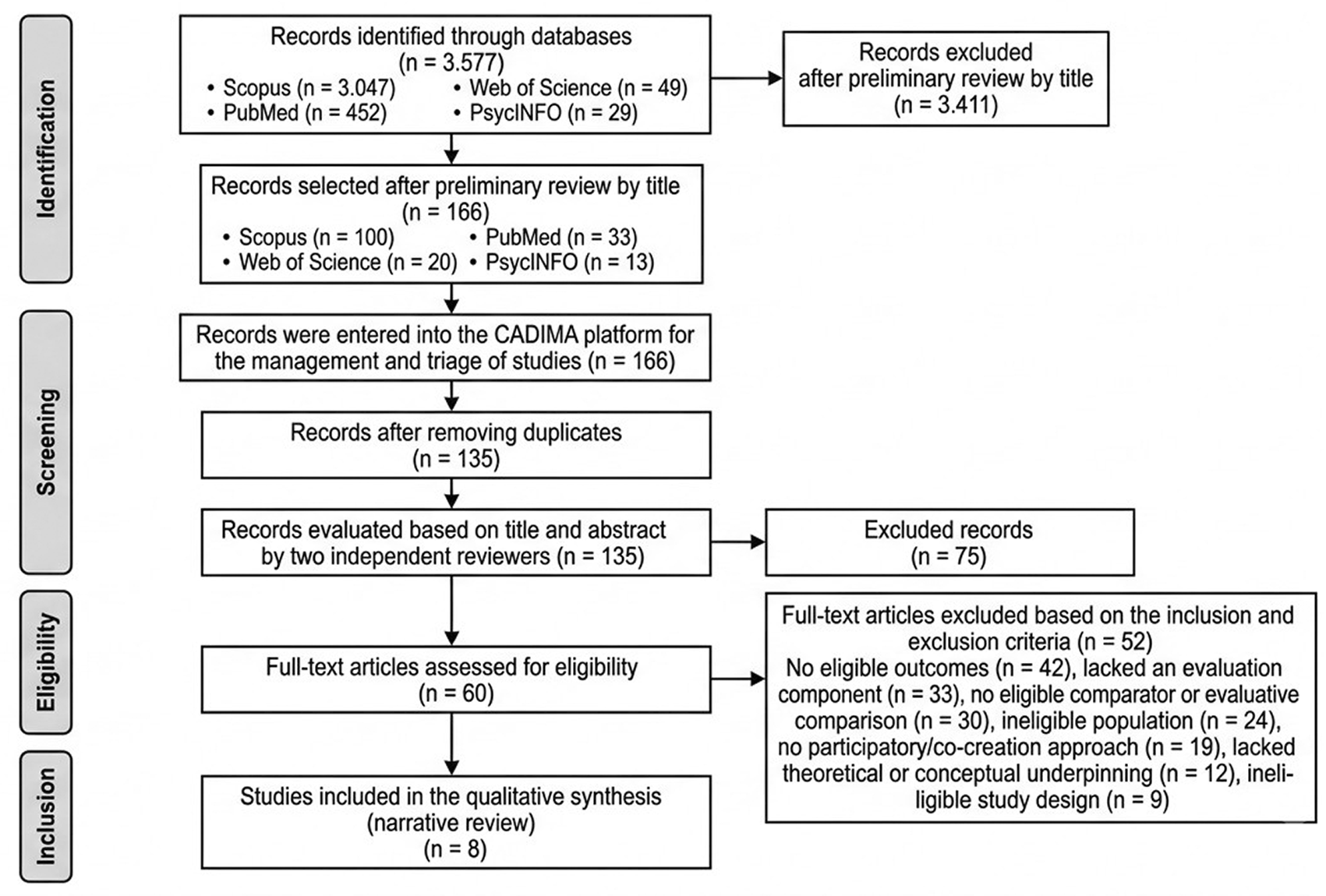
The initial search identified a total of 3,577 records (Scopus 3,047; PubMed 452; Web of Science 49; PsycINFO 29). Following a preliminary review of the titles, 100 articles were selected from Scopus, 20 from Web of Science, 33 from PubMed, and 13 from PsycINFO; these were subsequently entered into the CADIMA platform for study management and screening. The inclusion and exclusion criteria used in the CADIMA platform were predefined based on the population, participatory approach, health domain, conceptual and systemic dimensions, methodological design, socioeconomic context, and reported outcomes. Studies involving adolescents aged approximately 10 to 19 years were included, as well as studies with mixed age groups, only when data about adolescents could be clearly identified and analyzed separately. Studies in which data about the adolescent population could not be isolated were excluded.

Regarding participatory approaches, studies were included that explicitly described methodologies such as co-creation, co-design, co-production, Participatory Action Research, YPAR, co-research, or empowerment-based approaches. The studies had to fall within the field of health promotion or public health and address at least one of the following topics: physical activity, sedentary behavior, sleep, integrated movement behaviors, or well-being.

In addition, eligible studies were required to incorporate at least one of the following concepts: systems thinking, systems approaches, complex interventions, complexity, agency, autonomy, or decision-making processes. In terms of methodology, studies with a comparison group, pre-post intervention designs, or qualitative and mixed-methods studies that evaluated processes, mechanisms, or implementation - including realist or theory-driven approaches - were included. Editorials, commentaries, opinion pieces, and protocols without empirical results were excluded.

Regarding the socioeconomic context, only studies that explicitly referred to socioeconomically vulnerable populations - including low-income groups, socially disadvantaged populations, resource-poor communities, or underserved/marginalized groups - were included. Studies that did not clearly indicate the socioeconomic context were excluded.

Finally, studies were required to measure or describe at least one clearly defined and assessed outcome related to physical activity, sedentary behavior, sleep, or well-being. Studies were excluded if they did not report outcomes, lacked an operational definition of well-being, or did not explicitly link the reported outcomes to behavior or health indicators.

After removing duplicates, the records were assessed for title and abstract by two independent reviewers (n = 135), resulting in the exclusion of 75 articles. Sixty full-text articles were subsequently analyzed for eligibility, of which 52 were excluded because they did not meet one or more predefined eligibility criteria. The most common reasons for exclusion were the absence of eligible health-related outcomes (n = 42), lack of evaluation component (n = 33), absence of an eligible comparator or evaluative comparison (n = 30), ineligible study population (n = 24), interventions that did not employ a genuine participatory or co-creation approach (n = 19), insufficient theoretical or conceptual grounding (n = 12), and ineligible study design (n = 9). The narrative review ultimately included 8 studies in the final qualitative synthesis. The study selection process is presented in the PRISMA 2020 flow diagram ( Figure 1).

354986b6-872f-4a38-86e5-cf87bd7f99af_figure1.gif

Figure 1. Prisma flow diagram showing studying identification, screening, eligibility, and inclusion in the narrative literature review.

Data extraction and Results

The articles that were found to be eligible based on the full-text analysis underwent data extraction by two independent researchers (ND, MFS). See SUPPLEMENTARY TABLE 1.

Results and discussion

Results are presented thematically, synthesizing evidence across five interrelated domains:

  • (1) The evolution from top-down intervention models to youth agency and participation

    Across the included studies, a clear shift from older to newer studies was observed, as older publications presented traditional interventions led by experts, while newer publications presented approaches that put adolescents as active contributors to health promotion. Previous health programs14 relied on adults to identify priorities and then to conceive interventions for young people. In contrast, the reviewed studies involved more adolescents in identifying problems, creating solutions, and influencing and determining the content of implementation.

    The YPAR studies provided the most significant examples of this transition. In the physical activity promotion projects described by Abraczinskas and Zarrett35 and Lindquist-Grantz and Abraczinskas,17 youth conducted research, used photovoice to capture and analyze social/environmental factors, and advocated. Similarly, in the study of Watkins et al.,36 the adolescents set the priorities and content of the intervention. This type of intervention was also implemented in the study by Hannay et al.,37 in which youth formulated research questions, collected data, interpreted the results, selected collective narratives, developed action plans, presented the results publicly, and advocated for policy changes. Other research models reflected this same transition toward youth-led approaches. The Community-based participatory research study of Livingood et al.38 also demonstrated a high degree of autonomy; the young people served as advisors, photographers, facilitators, analysts, and presenters. Marco-Crespo et al.39 also involved young people who collected data, conducted interviews, reflected on the findings, formulated recommendations, and contributed to the planning of the intervention. Furthermore, in De Rosis et al.,40 youth participated in designing components of the intervention, developed communication strategies, disseminated health messages, presented their findings to policymakers, and served as health promoters among their peers. It was the same thing with Verloigne et al.,41 where adolescent girls selected physical activity-related behaviors to address, identified the barriers, generated ideas for interventions, designed promotional materials, and participated in the implementation. Beyond this transition from adult-led to participatory approaches, the selected studies also illustrate a progressive evolution in the depth of adolescents’ participation over time. Early participatory initiatives involved adolescents primarily in consultative roles and needs assessment and evaluation, where young people gave their opinions to inform the intervention design, but had limited influence in decision-making. More recent studies show a move towards a higher level of participation, characterized by shared decision making, by co-production and youth leadership throughout the entire research and intervention cycle. For example, Verloigne et al.41 involved female adolescents in the identification of priorities, in co-creation of intervention strategies and in the implementation of school activities, although researchers kept the responsibility of ensuring that the interventions remained evidence-informed. In contrast, the YPAR studies by Abraczinskas and Zarret35 and Lindquist-Grantz and Abraczinskas17 positioned adolescents as co-researchers who generated research questions, collected and analysed data, identified solutions and defended systemic changes. Similarly, Watkins et al.36 adopted a human-centered co-design, where adolescents actively shaped the intervention according to their own priorities and local context, while De Rosis et al.40 and Marco-Crespo et al.39 extended participation beyond intervention conception, involving adolescents in communication, dissemination, community engagement and interactions with policy stakeholders. Collectively, these studies suggest that health participatory promotion has evolved from a vision where adolescents were simple informants to recognizing them as legitimate partners, capable of contributing to the conception, implementation, evaluation, and long-term sustainability of health interventions. Nevertheless, a total transfer of control has hardly ever been observed, as adults and researchers continued to provide inputs and structure and methodological guidance.

  • (2) Co-creation as a methodological approach in adolescent health research

    In all included studies, Co-creation emerged as a flexible methodology instead of a single intervention model. Adolescents collaborated with researchers and other stakeholders to develop contextually relevant solutions addressing movement behaviors and healthy lifestyles. Different participatory approaches were identified, including the YPAR, co-production, and co-creation frameworks. Despite methodological differences, common principles included shared decision-making, iterative development, dialogue among stakeholders, and valuing adolescents’ experiential knowledge. The following studies (De Rosis et al.40; Livingood et al.38; Verloigne et al.41; Watkins et al.36) were coded as “Co-creation” as a primary theme.

    De Rosis et al.40 involved adolescents in designing, implementing, and evaluating the intervention in collaboration with professionals who served as facilitators. Livingood et al.38 similarly used Community-based participatory research with Youth Advisory Board, which incorporated youth perspectives into program development and community action processes. Watkins et al.36 highlighted the value of sustained collaboration with adolescents throughout the development process. Stakeholders collaboratively identified the issues and developed refined program strategies through a series of iterative workshops. Their findings showed that adolescents provided insights that improved intervention acceptability and ensured that health messages reflected young people’s priorities and lived experiences. In Verloigne et al.,41 girls from vocational and technical schools jointly designed and implemented the physical activity interventions with researchers. Each school created its own intervention, reflecting local needs and contexts. However, the study also showed that substantial researcher facilitation was necessary to guide the process to ensure that the interventions were evidence-based.

    In a similar vein, Abraczinskas and Zarrett35 engaged youth in conducting research, using photovoice, analyzing data, and advocating alongside adult partners/facilitators, who provided support instead of directing decisions. Likewise, Lindquist-Grantz and Abraczinskas17 positioned YPAR itself as a health intervention approach and demonstrated its application to both physical activity promotion and suicide prevention. In both contexts, young people served as co-researchers and agents of change throughout the investigation, analysis, and action processes.

    Marco-Crespo et al.39 also used a participatory approach in which adolescents contributed to the development and evaluation of a Chagas disease prevention programme. Young participants took part in workshops, interviews, reflection exercises, community exploration, data collection, and collective analysis, illustrating how co-research can increase contextual relevance and cultural appropriateness. Extending this approach, Hannay et al.37 demonstrated another form of participatory engagement by involving adolescents and community stakeholders in health promotion activities, reinforcing the importance of collaborative partnerships in intervention development. Participation was structured according to the principles of Photovoice: participants documented the community’s strengths and concerns through photography, engaged in dialogue, identified themes, and communicated their findings to policymakers to promote change.

    Although adolescents were consistently positioned at the center of the co-creation process, the successful interventions relied on the complementary contributions of multiple stakeholders, each playing distinct yet interconnected roles. Researchers act mainly as facilitators, methodology experts, and capacity builders rather than solo decision makers, providing training, ensuring scientific rigor, supporting data collection and analysis, and maintaining fidelity to health promotion objectives (Abraczinskas & Zarrett35; Lindquist-Grantz & Abraczinskas17; Verloigne et al.41; Watkins et al.36). Community stakeholders – including teachers, school staff, health professionals, youth workers, community organizations and policymakers – contributed by facilitating access to participants, providing contextual knowledge, supporting the implementation and creating opportunities for integration and the sustainability of youth-generated solutions (De Rosis et al.40; Hannay et al.37; Livingood et al.38; Marco-Crespo et al.39). However, the level of involvement varied across studies, going from consultation and logistic support to active planning, collaboration, implementation, and dissemination of the intervention. Rather than replacing professional expertise, co-creation redistributed responsibilities among stakeholders, with adolescents contributing experiential knowledge and contextual insights, researchers ensuring methodological quality, and community partners facilitating the translation of co-creation solutions into practice. This complementary distribution of roles emerged as a defining characteristic of operationalizing co-creation within adolescent health promotion.

    Across the included studies, several practical challenges were consistently reported. Keeping adolescents engaged required adaptation and flexibility regarding local schedules, as well as continuous facilitation by adults. Furthermore, researchers had to adopt different roles, such as moderators or trainers, to provide organizational support, instead of acting solely as traditional experts. Balancing adolescents’ autonomy with the need to preserve scientific rigor emerged as a recurring challenge. Additionally, contextual factors such as organization readiness, staff commitment, school support and available resources, strongly influenced implementation success. In general, the evidence suggests that co-creation is not a single, uniform method but rather a continuum of participatory approaches that requires a considerable investment in facilitation, adaptation and relationship-building. Ultimately, successful implementation depends not only on involving adolescents, but also on creating supportive environments that enable meaningful participation.

  • (3) The application of systems thinking to complex health behaviors

    Systems-oriented perspectives were evident across several studies; however, the robustness of their application varied substantially. The included studies demonstrated increasing acknowledgement that adolescent health behaviors are shaped by complex and interconnected systems rather than by isolated individual factors. Systems thinking terminology was not defined or used in a systematic manner across all studies; nevertheless, many interventions incorporated ecological principles and acknowledged the interactions occurring between individuals, social environments, organizations, and communities.

    The strongest application of systems thinking was observed in Abraczinskas and Zarrett35 and Lindquist-Grantz and Abraczinskas.17 Both studies explicitly described YPAR as operating simultaneously on youth development and the socioecological systems surrounding adolescents. There was an explicit socioecological and developmental systems orientation. The papers repeatedly discuss impacts across individuals, peer groups, schools, healthcare organizations, and communities. Also, first-order versus second-order change, structural inequities, multi-level influences feedback loops and sustainability through ongoing youth input. As noted in the research, “the study highlighted YPAR as an intervention strategy with the potential to produce a developmental cascade where changes in one domain or system influence another domain or system and there is a cumulative effect over time” Lindquist-Grantz and Abraczinskas.17 To achieve this, Lindquist-Grantz and Abraczinskas17 integrated Positive Youth Development theory with Bronfenbrenner’s ecological framework, describing adolescent development as occurring through reciprocal interactions across systems. Through this approach, youth gained confidence, empowerment, and research skills, while the participatory processes themselves stimulated continued community action and system-level change.

    Evidence of these systemic feedback loops was also apparent in the work of Abraczinskas and Zarrett.35 In their study, youth recommendations led programme staff to establish ongoing mechanisms for adolescent input. This successful implementation of youth-proposed changes created a self-reinforcing cycle - and a permanent feedback loop - in which increased empowerment and participation generated organizational change, which in turn supported continued, meaningful youth engagement.

    Verloigne et al.41 identified schools as critical contexts for influencing behaviors related to physical activity. Rather than implementing a single standardized intervention, each school developed context-specific strategies, acknowledging that small changes within local systems could lead to broader behavioral effects. However, the study also highlighted that the success of the implementation depended on the organization’s support and the existing school culture. Expanding this perspective to health care, Livingood et al.38 acknowledged that adolescents with chronic conditions interact with multiple systems simultaneously, including health services, families, and community organizations. Their participatory action approach sought to improve these connections by integrating the perspectives of patients and their families into the services delivered. As well, De Rosis et al.40 viewed a healthy lifestyle as the result of interactions between adolescents, professionals, schools, and communities. Although systems thinking terminology was mainly implicit, their process of co-production acknowledged that behavior change stems from interpersonal relationships and contextual influences, rather than individual knowledge alone. Marco-Crespo et al.39 similarly demonstrated how community participation could work as a leverage point for disease prevention, by connecting the efforts of adolescents, families, and local interested parts to control the Chagas disease. This approach acknowledged that a sustainable change demands action beyond individual participation. Alternatively, Hannay et al.37 and Watkins et al.36 focused primarily on participatory involvement and in community-level evaluation, instead of explicit systems concepts. However, both studies still acknowledged the importance of the local context and the influence of social environments on adolescents’ health behaviors.

    Overall, the findings suggest that systems thinking within adolescent health co-creation interventions in socially disadvantaged settings was predominantly achieved through ecological perspectives, iterative feedback mechanisms, and an acknowledgment of the interdependences between adolescents and their environments. Explicit systems mapping techniques were rarely utilized, and none of the included studies mentioned the formal use of causal loop diagrams or system dynamics models. Instead, systems thinking was largely embedded implicitly within participative processes and in socioecological frameworks.

  • (4) Evaluation frameworks and methodological challenges in co-created interventions

    Across the included studies, the evaluation approaches went beyond the traditional paradigm of randomized controlled trials (RCTs), acknowledging that co-creation interventions are complex, context-dependent adaptive processes. The evidence suggests that conventional efficacy designs alone are insufficient to capture the mechanisms by which participatory interventions influence adolescents’ health outcomes.

    Verloigne et al.41 used a case-control design, but they emphasized that each school created its own intervention, which means each context’s development is based on its own co-creation activities. There is a tension between methodological rigor and participative flexibility. Similarly, Abraczinskas and Zarrett35 utilized a mixed-method triangulation design without group control. Instead of focusing exclusively on behavioral outcomes, they measured empowerment subscales, participatory behavior, sociopolitical skills, and systems changes. Their study suggests that while causal inference regarding physical activity improvements is limited, youth-led changes to increase physical activity access have the potential to decrease health disparities by generating unique solutions likely missed when adults intervene alone. Ultimately, these findings demonstrate that process outcomes and systems changes represent meaningful indicators of success in their own right. Lindquist-Grantz and Abraczinskas17 further explicitly identified the need for a more rigorous evaluation of YPAR. At the same time, they emphasized that participative interventions produce effects across various socioecological levels. They recommended that evaluated outcomes should extend beyond individual behavior change to include youth development, community-level impacts, and long-term environmental change. The authors also underscore that process evaluation is essential because YPAR involves three interactive partnerships: researcher–community, researcher–youth, and community–youth. Similarly, Watkins et al.36 highlighted that the evaluation of coproduction must account for both final outcomes and the implementation process itself. Their human-centered co-design study examined participant engagement, stakeholder experiences, and intervention acceptability, alongside the contextual factors that facilitated or constrained program development, rather than relying solely on traditional effectiveness indicators.

    Other studies reinforced the value of mixed-method and process-oriented evaluation approaches. Hannay et al.37 combined the Photovoice method with focus groups to assess both the results of the community assessment and the adolescents’ involvement, illustrating how participatory methods can simultaneously generate data and serve as mechanisms for empowerment. Marco-Crespo et al.39 used YPAR and other evaluation approaches to analyze both the learning processes and the community-level implications of a Chagas disease prevention program, demonstrating a dual focus on both the implementation of the intervention and its outcomes. Likewise, De Rosis et al.40 evaluated a co-developed health promotion initiative using both process and outcome indicators, analyzing adolescents’ experiences, involvement, and perceptions, along with health-related outcomes. Among the included studies, Livingood et al.38 provided the clearest application of an implementation science framework, by using a multi-level ecological approach involving a community coalition, a primary health care network, and youth services – “Three-Tiered Approach to Community”. This approach enabled consideration not only of intervention effectiveness but also of its scalability, sustainability, and potential public health impact.

    Overall, the included studies indicate that co-created adolescent health interventions in socially deprived settings require evaluation approaches that accommodate adaptation and contextual variation, multiple levels of impact, non-linear pathways of change, stakeholder experiences, implementation processes, and sustainability considerations. Collectively, the evidence supports a shift away from exclusively RCT-based models toward mixed-method, process-oriented, and implementation-focused evaluation strategies. None of the included studies reported the use of realist evaluation or SUPER-AIM. While this may partly reflect the fact that SUPER-AIM is a recently developed framework that has not yet achieved the widespread adoption of RE-AIM,16 the findings nevertheless suggest that both approaches remain underutilized in adolescent co-creation research.

  • (5) Issues of sustainability, scalability, and contextual transferability

    A recurrent finding across the 8 included studies was that the long-run success of co-creation interventions depended less on the intervention itself and more on the extent to which local systems, organizations, and interested parties were willing and able to sustain the participative processes beyond the project’s formal period. Instead of facing sustainability as a continuation of a specific intervention, many studies conceptualize it as maintaining the adolescents’ engagement, stakeholders’ partnerships, and mechanisms for ongoing adaptation and decision-making.

    The strongest evidence about sustainability came from the YPAR studies. Abraczinskas and Zarrett35 reported that youth-generated recommendations led to organizational changes within after-school programs and that one site established an ongoing feedback mechanism allowing adolescents to continue participating in program decision-making after the intervention ended. The authors argued that sustainability was facilitated by institutional support and the integration of youth voice into existing organizational structures. Similarly, Lindquist-Grantz and Abraczinskas17 emphasized that participatory processes must be sustained beyond individual projects and that evaluations should examine the ongoing capacity of both young people and stakeholders to engage in iterative cycles of research and action: “sustainability of participatory processes should be planned from the outset and examined within the evaluation, especially the continued capacity of youth to engage in cycles of research and action as a means to affect long-term outcomes, and the capacity of stakeholders to continuing supporting youth in these endeavors”. Their conclusions suggested that sustainable impact depends on developing youth leadership, strengthening community partnerships, and incorporating participation into local systems, rather than treating it as a temporary component of intervention.

    Several studies have highlighted the challenges of scalability when interventions are intentionally adapted to local contexts. Verloigne et al.41 demonstrated that every school that participated in the study developed a singular intervention of physical activity through co-creation, reflecting the circumstances and local priorities. This increased the relevance and contextual acceptability but also created some challenges regarding replication and standardization. The authors proposed a model that local interventions can generate transferable lessons, keeping flexibility between different contexts. These findings suggest that scalability in co-creation interventions can occur through the dissemination of the principles and processes, instead of replication of identical intervention components. The importance of context adaptation was also clear in Watkins et al.,36 where the co-design, human-centered participatory process was specifically adapted to a rural school environment. The study evidenced how the development of the intervention was molded by the local resources, school structures, stakeholders’ priorities, and community characteristics. The authors argue that this approach produced a contextually relevant and testable intervention prototype while strengthening campus - community partnerships that may support future implementation and sustainability.

    The studies by Hannay et al.37 and Marco-Crespo et al.39 further reinforced the importance of local context. The former involved Latino adolescents in community evaluations through Photovoice and focus groups, where participants documented the community’s strengths and concerns, generating highly relevant results to their culture and environmental realities. Similarly, Marco-Crespo et al.39 used the youth participatory evaluation to guide a Chagas disease prevention program in Ecuador, demonstrating how community involvement and cultural relevance increased the credibility and acceptability of the intervention activities. Both studies suggested that interventions are more likely to succeed when local populations actively contribute to the identification of priorities and the elaboration of solutions.

    Livingood et al.38 addressed issues of transferability and sustainability in an indirect manner through Community - based participatory research approach. They involved youth, as members of the Youth Research Advisory Board, and included stakeholders interested in the community and the health area during the development of the intervention. The study focused on ensuring that the digital obesity prevention intervention reflected local needs, communication preferences, and implementation realities. The authors argue that this participatory development may increase the relevance, the acceptability, and the potential for future implementation of the intervention in vulnerable urban communities, although formal assessments of adoption, maintenance, scalability, or dissemination were not conducted. Similarly, De Rossis et al.40 observed that co-production promoted adolescent empowerment, autonomy, responsibility, and engagement, enabling participants to serve as healthy lifestyle promoters among their peers. The authors suggested that these participatory processes can trigger broader activation effects and community-wide dissemination, though notably, long-term sustainability beyond the project duration was not directly evaluated.

    Across the studies, several factors emerged consistently as determinants of intervention success or failure in different contexts. Successful interventions were characterized by strong stakeholder involvement, organizational readiness, institutional support, flexibility for local adaptation, and significant youth participation throughout the entire process. On the other hand, sustainability was threatened when projects depended heavily on outside researchers, lacked long-term commitment, or did not establish mechanisms for continued youth engagement after the conclusion of the project.
Limitations

Several limitations should be considered when interpreting the findings of this narrative literature review. First, because it is a narrative literature review and not a systematic review, the goal was to do a conceptual synthesis and not an exhaustive identification of all the available evidence. Although a comprehensive search strategy was applied in multiple databases, complemented by citation tracking, some relevant studies may be omitted. Second, only peer-reviewed studies published in English were included, and because of this, some valuable evidence reported in other languages and gray literature may have been left out. The included studies also present some important methodological limitations that limit the robustness of current evidence. The majority had small convenience samples, a lack of a control group or comparison, and reported only short-term outcomes. Objective behavior measures and long-term follow-up were infrequent, which limited the conclusions regarding long-term health effects and the attribution of causality. The considerable heterogeneity of the participatory approaches, intervention components, outcome measures, and evaluation methods also hindered direct comparison between studies. Finally, because this review focused on specific interventions involving adolescents in socioeconomically vulnerable situations, the findings may not be fully generalizable to more advantaged populations or different cultural and healthcare contexts.

Future research

Future studies should strengthen the theoretical and methodological bases of co-created adolescents’ health interventions. It’s necessary to have more robust study designs, including longer follow-up periods, objective behavioral measures, and pragmatic or hybrid effectiveness implementation designs capable of evaluating both intervention outcomes and implementation processes. Greater use of implementation science frameworks, like RE-AIM, SUPER-AIM, and realistic evaluation, would improve comprehension about how interventions work in different contexts and the reasons for their success or failure. Research should also continue to integrate systems thinking into the development and evaluation of interventions and examine the interactions at the individual level, interpersonal, organizational, community, and public policy levels. It’s necessary to conduct longitudinal studies to investigate if the improvement of autonomy, empowerment, and youth participation translates into sustained behavior changes and at the systems level. Almost none of the studies evaluated whether communities became better at co-creation after the intervention. Future research should move beyond behavioral outcomes to assess also whether co-creation interventions strengthen the long-term participatory capacity of schools, communities, and health systems. Such capacity may constitute an important intermediate outcome through which sustainable health improvements are achieved.

Ultimately, future research should report the participatory processes in more consistent ways, allowing for comparisons between interventions and contributing to the development of best practices guidelines to promote adolescents’ health through collaborative approaches, describing: The level of youth decision-making; stakeholder roles; facilitation strategies; adaptations made during implementation; systems components targeted; and sustainability mechanisms. Collectively, the reviewed studies suggest a sequential implementation pathway whereby youth participation strengthens contextual adaptation, which enhances stakeholder ownership, facilitates implementation, supports sustainability, and ultimately increases the likelihood of positive health outcomes.

Conclusion

This narrative review provides evidence that co-creation represents a significant shift in adolescents’ health promotion via movement behavior interventions in socioeconomically disadvantaged contexts, transcending the traditional expert-centred models toward approaches that acknowledge adolescents as active collaborators in the development, implementation, and evaluation of interventions. These results answer to the first two specific aims of the review. In the included studies, the participatory methodologies consistently expanded the context relevance, youth leading role, engagement of stakeholders, and the feasibility of the intervention, at the same time highlighting the importance of addressing health behaviors as products of complex social-ecological systems. The evidence also indicates that the co-creation intervention evaluation demands methodological approaches capable of capturing implementation processes, contextual adaptation, systems changes, and multiple levels of impact, instead of depending exclusively on conventional measures of effectiveness.

Taken together, these findings directly address the third, fourth, and fifth specific aims of the review by demonstrating how systems thinking and complexity perspectives are integrated into participatory adolescent health interventions, highlighting the methodological requirements and limitations of current evaluation and implementation approaches, and identifying conceptual, methodological, and empirical gaps that should inform the development of more sustainable, youth-centred, and systems informed movement behavior interventions. The evidence synthesized suggests that the primary mechanism through which co-created interventions influence adolescent health is not the intervention content itself, but the transformation of relationships, decision-making processes, and organizational practices that shape how interventions are conceived, implemented, and sustained. In this sense, co-creation should be understood as a systems intervention rather than a merely participatory methodology. Co-creation increasingly resembles a governance model. Rather than replacing professional expertise, successful co-creation interventions redistributed expertise across actors. Adolescents contributed contextual and experiential knowledge, researchers ensured methodological quality, and community stakeholders facilitated implementation and institution integration. This redistribution of roles may represent one of the defining characteristics of successful adolescent health co-creation.

Beyond demonstrating the potential of co-creation, this narrative review suggests that adolescent participation should be understood as mechanism for transforming the system through which health interventions are developed, implemented and sustained. Successful interventions were characterized not simply by involving adolescents, but by redistributing decision-making across young people, researchers, schools, communities, and health services, thereby generating greater contextual relevance, stakeholder ownership, and organizational learning. Importantly, sustainability appeared to depend less on maintaining individual intervention components than on institutionalizing participatory structures capable of supporting continuous youth engagement and adaptative decision-making. These findings point towards a new research agenda in which co-creation is conceptualized as a dynamic governance process embedded within complex systems, requiring implementation and evaluation frameworks capable of capturing system adaptation, participatory capacity, and long-term organizational change alongside conventional behavioral outcomes.

Software availability

No software was used or developed for this study.

Ethics and consent

Ethical approval and consent were not required.

Data and software availability

Source data

No source data was used for this study.

Underlying data

No underlying data was collected as part of this narrative review.

Extended data

The data underlying this article are available in the Open Science Framework (OSF): Co-creation and participatory methods in adolescent movement behaviors https://doi.org/10.17605/OSF.IO/9E5CX.42 This project contains the following extended data: Supplementary Table 1.docx (detailed extraction and thematic summary of the included studies). Data are available under the terms of the Creative Commons Attribution 4.0 International (CC BY 4.0) licence.

Acknowledgements

Not applicable.

References

  • 1.  Viner RM, Ross D, Hardy R, et al.: Life course epidemiology: Recognising the importance of adolescence. J Epidemiol Community Health. 2015; 69: 719–720. PubMed Abstract | Publisher Full Text | Free Full Text
  • 2.  Tapia-Serrano MA, Sevil Serrano J, Sánchez Miguel PA, et al.: Prevalence of meeting 24-Hour Movement Guidelines from pre-school to adolescence: A systematic review and meta-analysis including 387,437 participants and 23 countries. J Sport Health Sci. 2022; 11: 427–437. Publisher Full Text
  • 3.  Abrahamyan A, Soares S, Correia D, et al.: Childhood social adversity and clustering of health risk behaviours during early adolescence in a population-based birth cohort. Public Health. 2023; 220: 80–87. PubMed Abstract | Publisher Full Text
  • 4.  Ball K, Carver A, Downing K, et al.: Addressing the social determinants of inequities in physical activity and sedentary behaviours. Health Promot Int. 2015; 30: Ii8–ii19. PubMed Abstract | Publisher Full Text
  • 5.  Brug J, van Stralen MM, ChinAPaw MJM, et al.: Differences in weight status and energy-balance related behaviours according to ethnic background among adolescents in seven countries in Europe: The ENERGY-project. Pediatr Obes. 2012; 7: 399–411. PubMed Abstract | Publisher Full Text
  • 6.  Pinhas-Hamiel O, Zeitler P: The global spread of type 2 diabetes mellitus in children and adolescents. J Pediatr. 2005; 146: 693–700. PubMed Abstract | Publisher Full Text
  • 7.  Roulet C, Bovet P, Brauchli T, et al.: Secular trends in blood pressure in children: A systematic review. J Clin Hypertens. 2017; 19: 488–497. PubMed Abstract | Publisher Full Text | Free Full Text
  • 8.  Warburton DER, Nicol CW, Bredin SSD: Health benefits of physical activity: The evidence. CMAJ. 2006; 174: 801–809. PubMed Abstract | Publisher Full Text | Free Full Text
  • 9.  Lee IM, Shiroma EJ, Lobelo F, et al.: Effect of physical inactivity on major non-communicable diseases worldwide: An analysis of burden of disease and life expectancy. Lancet. 2012; 380: 219–229. PubMed Abstract | Publisher Full Text | Free Full Text
  • 10.  Baumann H, Singh B, Staiano AE, et al.: Effectiveness of mHealth interventions targeting physical activity, sedentary behaviour, sleep or nutrition on emotional, behavioural and eating disorders in adolescents: A systematic review and meta-analysis. Front Digit Health. 2025; 7. PubMed Abstract | Publisher Full Text | Free Full Text
  • 11.  Contardo Ayala AM, Parker K, Mazzoli E, et al.: Effectiveness of Intervention Strategies to Increase Adolescents’ Physical Activity and Reduce Sedentary Time in Secondary School Settings, Including Factors Related to Implementation: A Systematic Review and Meta-Analysis. Sports Med - Open. 2024; 10: 25. PubMed Abstract | Publisher Full Text | Free Full Text
  • 12.  Champion KE, Parmenter B, McGowan C, et al.: Effectiveness of school-based eHealth interventions to prevent multiple lifestyle risk behaviours among adolescents: A systematic review and meta-analysis. The Lancet. 2019; 1: e206–e221. Publisher Full Text
  • 13.  Craike M, Wiesner G, Hilland TA, et al.: Interventions to improve physical activity among socioeconomically disadvantaged groups: An umbrella review. Int J Behav Nutr Phys Act. 2018; 15: 43. PubMed Abstract | Publisher Full Text | Free Full Text
  • 14.  Staland LI, Nyman C, Svedberg P, et al.: Children and young people’s participation in developing interventions in health and well-being: A scoping review. BMC Health Serv Res. 2018; 18. PubMed Abstract | Publisher Full Text | Free Full Text
  • 15.  Leask CF, Sandlund M, Skelton DA, et al.: Framework, principles and recommendations for utilising participatory methodologies in the co-creation and evaluation of public health interventions. Res Involv Engagem. 2019; 5: 2. PubMed Abstract | Publisher Full Text | Free Full Text
  • 16.  Chinapaw MJM, Klaufus LH, Oyeyemi AL, et al.: Youth-centred participatory action approach towards co-created implementation of socially and physically activating environmental interventions in Africa and Europe: the YoPA project study protocol. BMJ Open. fevereiro de. 2024; 14(2): e084657. PubMed Abstract | Publisher Full Text | Free Full Text
  • 17.  Lindquist-Grantz R, Abraczinskas M: Using Youth Participatory Action Research as a Health Intervention in Community Settings. Health Promot Pract. 2020; 21: 573–581. PubMed Abstract | Publisher Full Text | Free Full Text
  • 18.  Anselma M, Altenburg TM, Emke H, et al.: Co-designing obesity prevention interventions together with children: Intervention mapping meets youth-led participatory action research. Int J Behav Nutr Phys Act. 2019; 16. Publisher Full Text
  • 19.  Branquinho C, Tomé G, Grothausen T, et al.: Community-based Youth Participatory Action Research studies with a focus on youth health and well-being: A systematic review. J Community Psychol. 2020; 48: 1301–1315. Publisher Full Text
  • 20.  Emke H, Vandendriessche A, Chinapaw M, et al.: Facilitating co-research: Lessons learned from reflection forms within three participatory action research projects. Health Res Policy Syst. 2024; 22. PubMed Abstract | Publisher Full Text | Free Full Text
  • 21.  Agnello DM, Anand Kumar V, An Q, et al.: Co-creation methods for public health research — characteristics, benefits, and challenges: A Health CASCADE scoping review. BMC Med Res Methodol 2025; 25: 251 60. PubMed Abstract | Publisher Full Text | Free Full Text
  • 22.  Chinsen A, Berg A, Nielsen S, et al.: Co-design methodologies to develop mental health interventions with young people: A systematic review. The Lancet. 2025; 9: 413–425. PubMed Abstract | Publisher Full Text
  • 23.  Freire K, Pope R, Jeffrey K, et al.: Engaging with Children and Adolescents: A Systematic Review of Participatory Methods and Approaches in Research Informing the Development of Health Resources and Interventions. Adolesc Res Rev. 2022; 7: 335–354. Publisher Full Text
  • 24.  Emke H, Altenburg T, Dijkstra C, et al.: Applying systems thinking in youth-centred participatory action research for health promotion in an underserved neighbourhood. Front Public Health. 2024; 12. Publisher Full Text
  • 25.  Glasgow RE, Harden SM, Gaglio B, et al.: RE-AIM Planning and Evaluation Framework: Adapting to New Science and Practice With a 20-Year Review. Front Public Health. 2019; 7. Publisher Full Text
  • 26.  Pawlowski CS, Schmidt T, Nielsen JV, et al.: Will the children use it?—A RE-AIM evaluation of a local public open space intervention involving children from a deprived neighbourhood. Eval Program Plan. 2019; 77: 101706. Publisher Full Text
  • 27.  Bonell C, Melendez PA, Torres GJ, et al.: Will it work here? A realist approach to local decisions about implementing interventions evaluated as effective elsewhere. J Epidemiol Community Health. 2021; 75: 46–50. Publisher Full Text
  • 28.  Grüne E, Popp J, Carl J, et al.: Examining the sustainability and effectiveness of co-created physical activity interventions in vocational education and training: A multimethod evaluation. BMC PUBLIC Health 221. 2022; 22. PubMed Abstract | Publisher Full Text | Free Full Text
  • 29.  Longworth GR, De Boer J, Goh K, et al.: Navigating process evaluation in co-creation: A Health CASCADE scoping review of used frameworks and assessed components. BMJ Glob Health. 2024; 9. Publisher Full Text
  • 30.  Popp J, Grüne E, Carl J, et al.: Co-creating physical activity interventions: A mixed methods evaluation approach. Health Res Policy Syst. 2021; 19: 37. PubMed Abstract | Publisher Full Text | Free Full Text
  • 31.  Baumeister RF, Leary MR: Writing Narrative Literature Reviews. Rev Gen Psychol. 1997; 1: 311–320. Publisher Full Text
  • 32.  Byrne JA: Improving the peer review of narrative literature reviews. Res Integr Peer Rev. 2016; 1: 12. PubMed Abstract | Publisher Full Text | Free Full Text
  • 33.  Palinkas LA, Horwitz SM, Green CA, et al.: Purposeful Sampling for Qualitative Data Collection and Analysis in Mixed Method Implementation Research. Adm Policy Ment Health Ment Health Serv Res. 2015; 42: 533–544. Publisher Full Text
  • 34.  Sukhera J: Narrative Reviews: Flexible, Rigorous, and Practical. J Grad Med Educ. 2022; 14: 414–417. Publisher Full Text
  • 35.  Abraczinskas M, Zarrett N: Youth Participatory Action Research for Health Equity: Increasing Youth Empowerment and Decreasing Physical Activity Access Inequities in Under-resourced Programs and Schools. Am J Community Psychol. 2020; 66: 232–243. PubMed Abstract | Publisher Full Text | Free Full Text
  • 36.  Watkins J, Greeven S, Heeter K, et al.: Human-centered participatory co-design with children and adults for a prototype lifestyle intervention and implementation strategy in a rural middle school. BMC PUBLIC Health 241. 2024; 24. PubMed Abstract | Publisher Full Text | Free Full Text
  • 37.  Hannay J, Dudley R, Milan S, et al.: Combining Photovoice and Focus Groups Engaging Latina Teens in Community Assessment. Am J Prev Med. 2013; 44: S215–S224. Publisher Full Text
  • 38.  Livingood WC, Monticalvo D, Bernhardt JM, et al.: Engaging adolescents through participatory and qualitative research methods to develop a digital communication intervention to reduce adolescent obesity. Health Educ Behav. 2017; 44: 570–580. Publisher Full Text
  • 39.  Marco-Crespo B, Casapulla S, Nieto-Sanchez C, et al.: Youth participatory research and evaluation to inform a Chagas disease prevention program in Ecuador. Evaluation and Program Planning. 2018; 69: 99–108. Publisher Full Text
  • 40.  De Rosis S, Pennucci F, Noto G, et al.: Healthy living and co-production: Evaluation of processes and outcomes of a health promotion initiative co-produced with adolescents. Int J Environ Res Public Health. 2020; 17: 1–19. PubMed Abstract | Publisher Full Text | Free Full Text
  • 41.  Verloigne M, Altenburg TM, Chinapaw MJM, et al.: Using a co-creational approach to develop, implement and evaluate an intervention to promote physical activity in adolescent girls from vocational and technical schools: A case control study. Int J Environ Res Public Health. 2017; 14. PubMed Abstract | Publisher Full Text | Free Full Text
  • 42.  Dias NMG, Souza MF, Palmeira AL, et al.: Co-creation and participatory methods in adolescent movement behaviors.2026. Publisher Full Text