Plain language summary
This data note is based on a dataset (Anegg et al., 2021) which described medicinal plant uses in the 19th century in historical Estonia, Livonia, Courland and Galicia, which were located in Northeast Europe. The studied region corresponds roughly to present-day Latvia (Livonia and Courland), Estonia and Ukraine (Galicia). The presented dataset is based on a digitized collection of German texts will be helpful to researchers who study the history of knowledge, science, and medicine.
Introduction
Recent studies are underlining the diverse application possibilities of historical ethnobotanical research and the re-valorised value of ethnobotanical data. The analysis of such data can contribute to understanding in which cultural fields plants are important and used, offer a rich basis of information for ethnobotanical and diachronic research, helping to understand better how societies and their folk culture develop and change over time, their dealing with natural resources, their interaction with and influence on ecosystems and the flora, as well as help in understanding modern medicinal practices better and contribute to the approval of new herbal medicines.
Methods
The primary sources included in the presented database were identified through literature research focusing on local medicinal plant use in the historical regions of Estonia, Courland, Livonia, and Galicia (Figure 1). In addition, we included in the sample publications published between 1805 and 1905 solely in the German language as inclusion criteria (Table 1). A range of relevant books and articles were used for extracting the historical indications of medicinal plant taxa which are treated as inclusion criteria (accessible botanical, historical, ethnographic literature describing the use of plants for medicinal purposes). Certain categories of sources are excluded from the dataset because of their non-circulating status (e.g., rare books). Main sources included the online libraries of the Online Catalogue ESTER (Estonian Library Network Consortium), the Biodiversity Heritage Library (Biodiversity Heritage Library), the Baltic Digital Library (Bałtycka Biblioteka Cyfrowa) and google scholar, as well as citations and mentions of other relevant German-speaking authors (searching for documents which possess keywords: “Volksmedizin”, “Volksheilmittel”, “Heilpflanzen”, “Oekonomisch-technische Flora”). The limited geographical and temporal scale allows conducting a comprehensive comparative study to understand the biocultural diversity of medicinal ethnobotany of the region and to create a sound scientific base for future comparisons with current field-work results from the region.
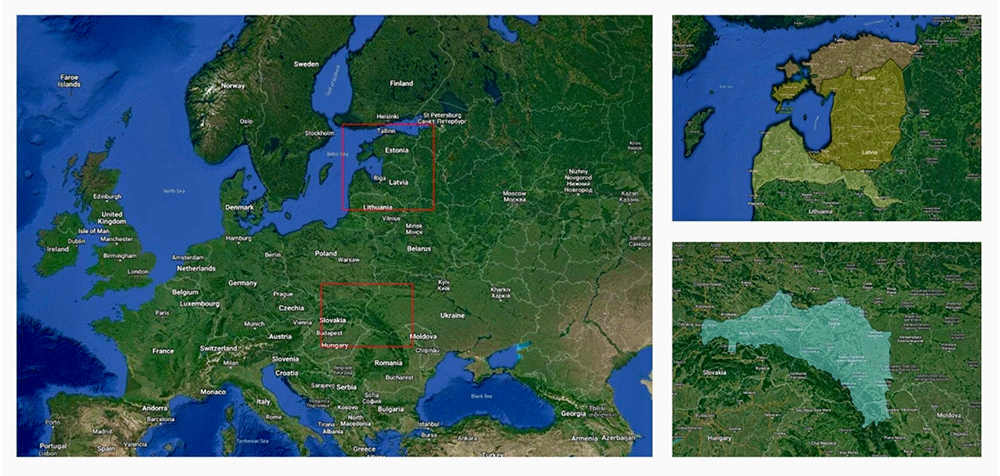
Figure 1. Map of the study area.
| Reference | Author | Title | Place of
publication |
|---|
| Friebe, 1805 | Friebe, Wilhelm Christian | Oekonomisch-technische Flora von Liefland, Ehstland
und Kurland | Riga |
| von Luce, 1829 | Luce, Johann Wilhelm Ludwig von | Heilmittel der Ehsten auf der Insel Oesel | Pernau |
| Hoelzl, 1861 | Hoelzl, Karl | Botanische Beiträge aus Galizien | Vienna |
| Wiedemann, 1876 | Wiedemann, Ferdinand Johann | Aus dem inneren und äusseren Leben der Ehsten | Vienna |
| Aaronson, 1891 | Aaronson, Dr. Emil | Über die Volksheilmittel der Letten | Mitau |
| Alksnis, 1894 | Alksnis, Jakobs | Materialien zur lettischen Volksmedizin | Dorpat |
| Bermann & Ludwig, 1904 | Bermann, P. und Ludwig, Mag.
Pharm. F. | Pflanzen des Rigaschen Krautinarktes | Riga |
| Ludwig, 1905 | Ludwig, Mag. Pharm. F. | Die Heilpflanzen des Rigaschen Krautmarktes | Riga |
The research was part of a wider study, namely the ERC-funded DiGe project, aiming to understand the patterns of change in ethnobotanical knowledge systems in Eastern European countries. Specifically, we have selected the period and space to fill the gap in historical ethnobotanical studies. German language was the dominant language of scientific communication in the studied period. So German language herbals devoted to Baltics were not studied from ethnobotanical point of view yet. The growing interest in the historical ethnobotany of Eastern Europe may be observed - it was already have done a dataset of medicinal plants, based on written sources in Estonian (Sõukand & Kalle, 2008). From historical point of view the ethnobotanical data affecting studied region was already systematised and analyzed by Estonian scholars (Kalle et al., 2022; Kalle & Sõukand, 2021). A more detailed analysis of medicinal plant records documented in the dataset was presented in the paper (Prakofjewa et al., 2022).
Due to the limited relevant written records in German language, every possible work was considered at first. For analysis purposes, we excluded primary sources that did not fulfil the following criteria: availability of local names and specific historical periods. In the next step, the selected public-domain books were carefully scanned and then was put into a Microsoft Excel 2013 spreadsheet. Thus, data on the local ecological knowledge and folk medicine were compiled from eight German historical ethnobotanical studies conducted in Estonia, Livonia, Courland, and Galicia, published between 1805 and 1905 (Table 1).
Every independent use in the sources was considered as a Use Report (UR) and was entered into a separate row in the spreadsheet. For each usage mentioned, the following information was elicited from the text, if present:
A. source
B. page number, where UI can be found
C. constituent type
D. constituent name stated in the original source
E. original German name of constituent, if provided
F. recent English interpretation
G. local name(s) of the constituent
H. preparation of constituent
I. plant part used (if applicable)
J. mode of administration
K. original usage of constituent
L. recent interpretation of medicinal usage
M. medicinal category (according to WHO, 2018)
N. recent interpretation of food usage
O. recent interpretation of other usage
P. additional comments
Besides recording all the medicinal usages of the different plants stated, information on other usages like food or veterinary medicinal uses were transcribed from the chosen texts and books as thoroughly as possible to allow further data mining and comparison possibilities in future studies. Moreover, non-plant constituents were transcribed for the same reason stated above. It should be noted that the “constituent name stated in original” reported plant names which are stated in German and Latin languages, but “local name” is always stated as indigenous name (if recorded).
In an additional step, important categories for analysis and future comparison with data from other investigations were unified according to the classifications used in other ethnobotanical and ethnomedicinal studies to facilitate comparisons with similar datasets.
These categories are
Q. plant name according to Plants of the World Online (POWO) (POWO, 2021)
R. plant family current
S. medicinal use according to the International Classification of Primary Care (ICPC-2) (WHO, 2012)
T. medicinal category short according to ICPC-2 (WHO, 2012)
U. medicinal category abbreviation according to ICPC-2 (WHO, 2012)
If an identification or accurate interpretation of a given constituent or any information of one of the categories stated above was not possible, the respective information was marked with a question mark in brackets ‘(?)’.
The stated plant parts that were used were categorised as follows (with their respective abbreviation in square brackets): bark [BARK], exudates (including gums, resins, and saps) [EXUD], flowers (including inflorescences and parts thereof) [FLOW], fruits [FRUI], herbs (= aerial parts, including branches and shoots) [HERB], leaves [LEAV], seeds [SEED], subterranean parts (including bulbs, rhizomes, roots, and tubers) [SUBT] and wood [WOOD]. If the part used was not stated, then the part was classified as herbs. This categorisation follows the terminology used by the authors contributing to this study. Statements concerning “die Pflanze” (the plant) or “Grünzeug“ (greens) were also classified as herbs. Otherwise, the parts stated by the authors were the same in English terms, hence the categorisation. Furthermore, other studies, like Staub et al. (2016) and Spałek et al. (2019), also used this categorisation.
The mode of administration was recorded and divided into either internally (internal ingestion in any manner) or externally (for example, in the form of ointments or compresses) administered.
The recent interpretation of the ailments stated was done according to the International Statistical Classification of Diseases and Related Health Problems, Version 11 (ICD-11) of the World Health Organisation (WHO) (WHO, 2018). This classification is divided into the following ailment categories:
1 - Certain infectious or parasitic diseases
2 - Neoplasms
3 - Diseases of the blood or blood-forming organs
4 - Diseases of the immune system
5 - Endocrine, nutritional or metabolic diseases
6 - Mental, behavioural or neurodevelopmental disorders
7 - Sleep-wake disorders
8 - Diseases of the nervous system
9 - Diseases of the visual system
10 - Diseases of the ear or mastoid process
11 - Diseases of the circulatory system
12 - Diseases of the respiratory system
13 - Diseases of the digestive system
14 - Diseases of the skin
15 - Diseases of the musculoskeletal system or connective tissue
16 - Diseases of the genitourinary system
17 - Conditions related to sexual health
18 - Pregnancy, childbirth or the puerperium
19 - Certain conditions originating in the perinatal period
20 - Developmental anomalies
21 - Symptoms, signs or clinical findings, not elsewhere classified
22 - Injury, poisoning or certain other consequences of external causes
X - Extension Codes (for example, for agents)
The unification of the recent interpretation of the ailments was carried out in accordance with the ICPC-2 of the World Organization of National Colleges, Academies and Academic Associations of General Practitioners/Family Physicians (WONCA) International Classification Committee (WHO, 2012). This classification consists of the following categories (with the respective abbreviations used by the authors in the database and analysis in square brackets):
A - General and Unspecified diseases [Geun]
B - Blood, Blood Forming Organs and Immune Mechanism [Blim]
C - Culture Bound Syndrome (CultB)
D - Digestive [Dige]
F - Eye [Eye]
E - Ear [Ear]
K - Cardiovascular [Card]
L - Musculoskeletal [Musc]
N - Neurological [Neur]
P - Psychological [Psyc]
R - Respiratory [Resp]
S -Skin [Skin]
T - Endocrine/Metabolic and Nutritional [Endo]
W - Pregnancy, Childbearing, Family Planning [Pcfp]
X - Female Genital [Genif]
Y - Male Genital [Genim]
Z - Social Problems [Soci]
Those categories were segmented further into symptoms/complaints, infections, neoplasms, injuries, congenital anomalies, and other diagnoses. This classification was used for further analysis. This ICPC-2 categorisation was used for further analysis because it will facilitate easier comparison with other studies in the future. Furthermore, the ICPC-2 is less clinical than the ICD, making the classification of reported ailments and symptoms easier and more applicable to the ‘ethnomedical reality’ (Staub et al., 2015; Staub et al., 2016). Despite the fact that in the documented historical sources it was not found special categories (e.g., Y- Male Genital), we kept the ICPC-2 categorisation for future perspective of the development of the database and adding new German-speaking authors. The category of ‘culture bound syndrome’ was added to reflect the uses associated with local customs and beliefs not attributable to the specific disease categories.
Additional categories were added by the authors to cover non-medicinal usages. They are as follows:
a) “Accessories and Decoration” [ACDE] – including usages like wreaths, added to bouquets, etc.
b) “Body” [BODY] – including usages for body hygiene, restoring hair, baths generally, etc.
c) “Food” [FOOD] – including usages of plants as food or in food and beverages.
d) “Harmful” [HARM] – including reports of poisonous plants or usages to kill someone.
e) “Insecticides” [INSE] – including usages as an insecticide or to drive away insects.
f) “Other” [OTHE] – including all usages which do not fit into any of the other categories.
h) “Veterinary” [VETE] – including veterinary-medicinal usages concerning animals and pets.
i) “Cultural” [CULT] – including culture-bound usages of plants in a specific cultural setting.
To avoid misidentifications and misinterpretations of plants or historical technical medicinal terms, several sources were used for crosschecking past pathologies and plant names, including the Atlas of the Estonian Flora (2020), Beiche (1872), the GenWiki of the Verein für Computergenealogie e.V. (2020), GBIF.org (2021), Genaust (2013), Hiller & Melzig (2006), POWO (2021) and Tutin et al. (1993).
Disclaimer: the database is designed to give a general overview of the sources to the best knowledge of the authors. In case of any need for clarification, consult the original source.