Introduction
In recent years, several firms have embarked on a trend towards automation and data exchange in their business processes, known as Industry 4.0 (I4.0)1. Among the I4.0 technologies2, blockchain technology (BCT) has recently emerged3 as a useful tool for firms to ensure transparency and trust in data management4.
From a general standpoint, I4.0 technologies enable firms to adopt new business models5 and gain competitive advantages6,7. However, many firms, especially small and medium-sized enterprises (SMEs), have difficulties understanding and using innovative I4.0 technologies8,9.
The objective of this study is to suggest measures to foster the diffusion of I4.0 technologies, including BCT, among firms in the Marche Region, in Italy, where many firms struggle to understand and implement I4.0 technologies10.
The regional context is of interest since the regional government is engaged in fostering the diffusion of innovative technologies in firms of its territory and supports it concretely with tenders11. Particularly, BCT has recently drawn the region’s attention and has been addressed in both its technological road map12 and Smart Specialisation Strategy (S3)13. Indeed, this study is part of an innovative PhD programme created by the University of Macerata, in Italy, and promoted by the Marche Region to strengthen the relationship between academic research and the local firms’ needs, as part of the POR FSE 2014/2020 Axis 1- P.I. 8.1- R.A. 8.514 which is financed with European funds.
Knowing that a triple helix (TH) approach consisting of the collaboration between government, academia, and firms in a specific territory15 can help with the diffusion of innovative I4.0 technologies among firms16,17, the measures suggested in this paper for the diffusion of I4.0 in firms in the Marche Region leverage collaborations between existing local TH actors and other innovation intermediaries that were individuated through an analysis of the regional context. Moreover, a survey of local innovative firms that are part of an exemplary innovation cluster is conducted to strengthen the findings. The survey is exploratory and aims at gathering insight for further, more in-depth, studies on the adoption of I4.0 in firm of the Marche region and their approach to innovative technologies.
This paper is structured as follows. The second paragraph presents the theoretical framework of I4.0 and its knowledge and use among firms in the Marche Region, with a focus on BCT. A TH theory applied to the diffusion of I4.0 in firms in the Marche Region is proposed. The third paragraph presents the methods. The fourth reports the findings of the analysis of the Marche Region context and institutions concerning I4.0 and the firms' answers to the survey. In the last paragraph, the results of the study are discussed, measures for the diffusion of I4.0 technologies, including BCT, among local firms are proposed, and suggestions for future research are given.
Theoretical framework
I4.0 and blockchain technologies
The term ‘Industry 4.0’ was first proposed in 2014 referring to the fourth industrial revolution1, enabled by a group of technologies that interconnect machines and equipment through the internet into automatic and intelligent networks9. I4.0 technologies include big data analytics, augmented reality, simulations, collaborative robots, 3D printing, horizontal and vertical integration, the Internet of Things (IoT), cloud storage and computing, and cybersecurity7. I4.0 technologies enable firms, especially SMEs, to adopt new business models5 and gain competitive advantages6,7. Factors that limit the diffusion of I4.0 in firms are mainly related to the small size of the firms8,9 and the lack of finances and specialized support in obtaining new technologies18, technical and digital knowledge7, and non-technical competencies19.
Among the I4.0 technologies, blockchain technology (BCT) has recently emerged3. A blockchain is a distributed database allowing peer-to-peer data sharing without the need for either intermediaries or trusted third parties to ensure data exchange and integrity20. This is possible because the data stored in a blockchain are tamper-proof, so nobody can modify or eliminate them, and are visible to all stakeholders21. Initially developed in 2008 to enable peer-to-peer transactions with the Bitcoin cryptocurrency, BCT has recently been used in many sectors as a means to make any kind of data immutable and visible to stakeholders22. Industrial applications of BCT aim at bringing transparency to business processes23 such as supply chain management24, product traceability25, accounting26, manufacturing27, and marketing28. Firms can store the data about their processes on a blockchain to make them tamper-proof and visible to interested parties, thus enabling data transparency23 which helps firms reduce information asymmetries with stakeholders29 and build trust with them30. BCT is transversal to all the other I4.0 technologies since it can be used together with each one of them31,32. However, firms’ digitalisation is a prerequisite for the adoption of BCT33, missing which the adoption is hindered34,35. Moreover, the lack of clear regulations on BCT might discourage firms from using it36,37. Finally, BCT is still not well known to firms: Caldarelli et al. (2021)38 stated that training by an expert consultant is crucial for the successful adoption of BCT in firms, while an Italian provider of BCT services interviewed by Compagnucci et al. (2022)39 declared that firms, especially SMEs, need support in understanding which kind of BCT solution to adopt.
TH and innovation intermediaries for the diffusion of I4.0 and BCT in firms
The purpose of this study is to suggest measures for the diffusion of I4.0 technologies, including BCT, in firms located in the Marche Region. Collaboration can be a source of value co-creation in an I4.0 context40 and encourages firms to adopt I4.0 business models16. The TH explains the positive effect of collaboration between academia, government, and firms in the economic development of territories15. Academia generates basic scientific knowledge for industrial innovation41 and can help firms in their technological transformation also by training skilled managerial figures who have a strong effect on the rate of diffusion of digital technologies42. Governments play a key role by funding universities43 and making policies that support the adoption of I4.0 in firms44, whereas a lack of governmental support can hinder it45. On BCT specifically, Compagnucci et al. (2022)39 suggest that national and regional institutions should support the adoption of BCT solutions through financial and organizational measures, promoting both the tools used to favour collaboration between firms, academia, and other institutions and those adopted to support the implementation of innovation.
Within a regional TH, some intermediaries can facilitate the flow of knowledge and innovation. As Letaba (2019)46 found, intermediary organizations play varying roles across TH models and their functions can range from being a performer, enabler, to facilitator. These organizations are crucial in aiding the transfer of knowledge, technology, and skills among the collaborating partners in the TH. They connect different skills and people to help with the change towards more digital and advanced manufacturing (Prodi et al., 2022)47, facilitating the exchange and the building of new knowledge, creating opportunities for experimentation, helping forming partnerships of private and public actors around common goals48. Their functions include process coordination and matchmaking between innovation seekers and potential solution providers, knowledge and finance brokering, testing49. Since innovation intermediaries increase knowledge and resource flows amongst TH institutions and the rest of the civil society50, a growing number of innovation policies rely on publicly-funded innovation intermediaries to provide knowledge-intensive services to firms, particularly SMEs51.
Methods
Ethical statement
The study was conducted following the Horizon Europe ethics-self-assessment regarding ‘personal data’ defined as ‘information relating to an identified or identifiable natural person’52 regulated by the EU Regulation 2016/679 (GDPR)53. No ethics issues were identified regarding personal data since the survey conducted for this study collected anonymised data which ‘has been rendered anonymous in such a way that the data subject can no longer be identified’ and considering that ‘completely anonymised data do not fall under the data protection rules’52. Moreover, ‘the need to ensure participants’ free informed consent (with particular attention to vulnerable categories of individuals such as children, patients, discriminated people, minorities, persons unable to give consent, etc.)’52 was respected in this study since information about the study was provided to the participants, who were not vulnerable people, and written informed consent was asked and obtained from them prior to their participation in the survey as seen in section one in the questionnaire54,55 and in column B ‘Consent to participate in the study’ of the participants’ answers56,57.
Study design
This study uses triangulation of data58 by combining different sources, specifically second-hand qualitative data from a literature review and retrieved from the Web, and first-hand data from an explorative qualitative survey. Thurmond (2001)59 argued that it is possible to generate a large amount of data as a result of data triangulation. Despite its limitations, researchers can use data triangulation to provide a confirmation and understanding of the phenomenon while minimizing the weaknesses of a monomethod.
A literature review was conducted to collect evidence on the relationship between the diffusion of I4.0 and TH. A search on Scopus conducted in September 2022 using the keywords ‘Industry 4.0’ and ‘triple helix’ in the title, abstract, and keywords fields of peer-reviewed research papers. The search string used was the following: TITLE-ABS-KEY ( "industry 4.0" AND "triple helix" ) AND ( LIMIT-TO ( DOCTYPE , "ar" ) ). All years of publication were included to increase the inclusivity of results. Articles written in English were selected to avoid comprehension issues and increase the replicability of results by the international research community. The search gave only 13 results, showing that evidence on the topic of I4.0 and TH is scarce. All the articles retrieved are recent and demonstrate a growing interest in the relationship between I4.0 and TH: one was published in 2018, one in 2020, two in 2021, and nine in 2022. The abstracts and, when possible, the content of the papers were read to search for recurring themes. All the papers state that TH can help with the implementation and diffusion of I4.0. Table 1 shows the results highlighting the role attributed to the TH concerning I4.0.
Table 1. The scientific literature on the relationship between TH and I4.0.
The table shows the results of a literature review conducted on Scopus in January 2023 using the keywords ‘Industry 4.0’ and ‘triple helix’ in the title, abstract, and keywords fields of peer-reviewed research papers. The table highlights, for each article retrieved, its methodology and the role of Triple Helix (TH) for the Industry 4.0 (I4.0) paradigm it describes.
Author(s) and date of
publication | Methodology | Role of the TH for I4.0 |
|---|
| (Reischauer, 2018)17 | Conceptual | Objective of policy-driven innovation discourse around I4.0. |
| (Steenkamp, 2020)68 | Conceptual | Create entrepreneurial leadership for innovation. |
| (Capetillo et al., 2021)69 | Case study | Evolving into a Penta Helix to foster the diffusion of I4.0 in firms. |
| (Majumdar et al., 2021)70 | Survey | Help overcome barriers to the implementation of I4.0 technologies in firms. |
| (AlMalki and Durugbo, 2022)71 | Interviews | Promote and enhance the co-evolution of institutions with technological I4.0
advances. |
| (Carayannis et al., 2022)72 | Conceptual | Offer references on how knowledge and innovation could proceed in co-evolution in
the context of a knowledge economy. |
| (Costa et al., 2022)73 | Conceptual | Help develop teaching-learning processes which use I4.0 technologies. |
| (Cucculelli et al., 2022)16 | Survey | Counterbalance the lower propensity of family managers to adopt I4.0 business
models. |
| (Khan et al., 2022)40 | Case study | Increase collaborative capabilities in an I4.0 ecosystem context. |
| (Lepore et al., 2022)74 | Case study | Enable innovation ecosystems for developing I4.0 solutions. |
| (Liu and Zhu, 2022)75 | Case study | Lead to a knowledge spillover effect in the field of I4.0 smart factories. |
| (Ojubanire et al., 2022)76 | Conceptual | Foster industrial I4.0 transformation. |
| (Tataj et al., 2022)77 | Case study | Help understand key success drivers that enable science parks to deliver outstanding
results in I4.0. |
Following a qualitative approach, the context of the Marche Region was analysed concerning the diffusion of I4.0 technologies, including BCT, among firms of the region, and policies addressing firms’ innovation, by retrieving information from secondary sources and subjectively selecting the kind of information considered relevant for the topics addressed in terms of I4.0 and collaborations linked to the TH. Institutions and policies relevant to the diffusion of I4.0, such as the Marche Region’s S3 for the two last programming periods13,60, and tenders11 were individuated by accessing the Marche Region’s institutional website61 and the Marche Innovazione website62 on the 8th of October 2022. The Marche Innovazione website is the regional portal for disseminating and developing strategies for intelligent, sustainable, and inclusive economic growth in the region. It includes sources to the regional S3 and tenders of the two programming periods divided by research and development (R&D), investments, and internationalization. Additionally, web searches were conducted using the keywords ‘Industria 4.0 Regione Marche’ between the 8th and 12th of October 2022, which allowed to recover institutional reports regarding the digital transformation of firms in the Marche Region63–66.
An explorative qualitative survey was sent on the 25th of October 2022 by sending an anonymous semi-structured questionnaire54,55 to all the firms with an active membership of the Fondazione Cluster Marche67, which is a Foundation representing the Technology Clusters in the Marche Region. The Foundation’s members were contacted for the survey since they are innovative firms located in the Marche Region that know or use I4.0 technologies and are valuable sources of information on the implementation of I4.0 technologies in business processes. Before that, there had been no contact between the Author and the Foundation’s members to ensure that their answers to the questionnaire would have been void of any bias or conflict of interest.
The questionnaire was built following a continuous feedback process with two experts in qualitative research methods, an expert in I4.0 technologies, and the representatives of the Fondazione Cluster Marche who gave the final approval to the questionnaire’s content before sending it. The questionnaire was not piloted prior to this study. The questionnaire was in Italian language because it was addressed to native Italian speakers.
The questionnaire was sent by a representative of the Fondazione Cluster Marche via e-mail and was self-administered as the respondents filled it in themselves78. Of the 149 firms to which the questionnaire was sent, seven compiled it, between the 25th and the 27th of October 2022. Even though firms had the option to respond until the end of November 2022, no additional questionnaires were completed after October 27, 2022.
The firms surveyed are part of technological clusters of the Marche Region, which are networks of public and private entities operating throughout the country in sectors such as industrial research, training, and technological transfer to promote excellence in research and innovation79. This may indicate that the firms surveyed are illustrative of firms that are open to innovation.
The questionnaire collected the following qualitative data56,57. The first section collected generic information about the firms, such as the size and economic activity classification. The second asked the respondents to state what I4.0 technologies were used in the firms and their knowledge and use of BCT. The third assessed the collaborations that the firms have or had concerning I4.0 technologies, dividing the collaborations per type and territorial level of collaboration partners. The fourth and final section addressed the respondents’ perceived usefulness of some measures for the diffusion of I4.0 in firms in the Marche Region, leaving open questions for them to suggest initiatives additional to those indicated.
Other data collection tools (e.g., focus group discussion with local innovative firms, semi-structured interviews with key informants, etc.) were excluded since this survey was intended to be a preliminary study to gather insights for further, more in-depth, studies that would use these collection tools.
Results
Marche Region’s context, key institutions, and policies
The Marche Region’s economy is mostly based on clusters of SMEs80 or industrial districts that comprise numerous firms engaged in related activities and which are in an identifiable local community where the sharing of a common set of values and norms facilitates the development of multiple formal and informal relations in a complex mix of cooperation and competition81.
Cappelli (2020)82 noted that these firms specialised in the classic industries of the Made in Italy, for example, those of timber, furniture, leather, footwear, and household appliances.
According to a report from the Intesa San Paolo bank83, the Marche region’s industrial districts are showing positive economic indicators after the COVID-19 pandemic. The export from Marche's districts amounted to 3.5 billion euros in the first nine months of 2022, showing an increase of 20.1% compared to the same period in 2021, and a 13.1% increase compared to the same period in 2019. This growth surpasses the Italian national average of districts, which stands at a 14% increase. In terms of economic and financial trends between 2018 and 2020, Marche is listed as having 24 “champion” enterprises that are outperforming others in key metrics, although it lags behind other regions like Lombardia and Veneto in this regard84.
While these two regions are leading in innovation, the Marche Region is only a moderate innovator, according to the innovation score. Indeed, many firms in the Marche Region struggle to understand and implement I4.0 technologies10. A 2021 report of the Osservatorio Impresa 4.064 found that the firms in the Marche Region show significant delays in the adoption of I4.0 technologies due to their limited size. Indeed, they are mainly micro-sized enterprises (94%), followed by small and medium (5.7%), and large (0.1%)65. Moreover, the report states that the delay is also caused by the lack of specific technical skills in firms and the lack of collaborations with developers of new technologies. Another factor causing the delay is the firms’ low level of digital knowledge and skills85. Regarding BCT in particular, the firms’ size seems to influence the level of knowledge on BCT as it is for other I4.0 technologies. A survey conducted in 2019 revealed that 80% of SMEs did not know about BCT, 16% knew it superficially, and only 4% understood it deeply, whereas larger firms showed higher levels of awareness and deep knowledge22. The lack of awareness of BCT among Italian firms was confirmed in the same year by a survey from the Italian Ministry for Economic Development86. A more recent survey by Bracci et al. (2022)87 found that Italian SMEs are quite aware of the existence of BCT but their level of knowledge is limited and the adoption rate is very low.
In the context of the region, some key institutions may help to increase the adoption of I4.0 technologies, including BCT, among firms. The authors of the 2021 report by the Osservatorio Impresa 4.064 state that a synergistic and complementary relationship between Punto Impresa Digitale (PID)63, Digital Innovation Hubs (DIHs), and Competence Centers can be leveraged in the Marche Region to help firms achieve a higher level of digitalisation and usage of I4.0 technologies. PID are an initiative of the Italian trade unions Camera di Commercio and Unioncamere offering a series of services and opportunities for firms such as basic courses on I4.0 and specific training, consultancy, or direct assistance to support digitization. DIHs are knowledge brokers that support firms and connect them with public and private actors such as universities, research centres, service providers, and corporations88. Competence Centers are public-private partnerships that were created by the Italian government to carry out guidance and training activities for firms on I4.0 as well as support them in the implementation of innovation, industrial research, and experimental development projects through I4.0 technologies66. Another institution which was not mentioned in the report but could have a role in the diffusion of I4.0 in the Marche Region is the Fondazione Cluster Marche67, which represents the Technology Clusters in the Marche Region. Technology Clusters are aggregations of companies, universities, and research institutes that work together to promote excellence in research and innovation. The purpose of the Fondazione Cluster Marche is to enhance the capabilities of the Marche Region innovation system through the development of collaborative research and technology transfer activities. The Fondazione Cluster Marche is one of the partners of i-Labs89, a laboratory which represents the physical centre of the regional Collaborative Platform on I4.0. Inside the laboratory, researchers and entrepreneurs develop, apply, and share solutions useful for improving production systems, to ensure rapid evolution towards I4.0. The i-Labs offers orientation and consultancy activities, research and development, training for companies towards I4.0 technologies, including BCT, and help firms in participating in national and regional tenders. These services are offered in cooperation with DIHs, Competence Centres, academia, and technology providers.
As for the policies, an important role in the diffusion of I4.0 in firms in the Marche Region could be played by the regional Smart Specialisation Strategy (S3)90, which aims to invest European community funds to build comparative advantages and sustainable growth in the long term by using the existing territorial resources and production capacities91. The first S3 plan of the Marche Region for the period 2014–202060 contributed to an increase in the propensity of regional companies to invest in R&D activities, innovate, collaborate with the academia, develop R&D and/or activities for innovation, and increase the number of placements of highly qualified personnel. Compared with the first S3 plan, the new regional S3 plan 2021–202713 emphasises the role of I4.0 for economic development and notes the delay in firms in the Marche Region in the adoption of these innovative technologies. Nevertheless, the new plan states that the effective implementation of the S3 requires the involvement of the research and innovation actors present in the Marche Region, for which a TH approach could be beneficial.
In the process of entrepreneurial discovery, the region has organized meetings with the stakeholders of the TH to identify needs and innovation trajectories. In particular, concerning the S3 for 2021–2027, blockchain is presented among the innovative trajectories identified. Indeed, new needs have emerged concerning new approaches based on technologies for authenticity, management, tracking and traceability also from a BCT perspective. The technology is presented as linked to competencies regarding digital technologies and engineering while the main market driver of this technology is related to inclusion and social innovation. Finally, the Marche Region expressed its interest in BCT with Regional Law number 36 of 202092, which states that the region promotes the use of a multifunctional IT platform based on BCT for registering and managing funds and tenders, tracing the typical products of firms of the Marche territory, and rewarding citizens for their participation to public endeavours.
Survey results
In order to provide an empirical basis for the measures suggested in this paper for the diffusion of I4.0 technologies in local firms, a questionnaire was sent to the 149 firms that are members of the Fondazione Cluster Marche, to which seven of them responded (Testi, 2023a)56,57. Four of them are large-sized, one is medium, and two are small. The recently updated ATECO 2007 classification of economic activities by Istat93 was used to classify the firms by sector. Four are manufacturers, one is in the sector of agriculture, forestry, and fishing, one offers services to firms, and one conducts professional, scientific, and technical activities (Table 2).
Table 2. Size and ATECO sector.
The table shows the size and sector of the firms that participated to the survey, numbered from 1 to 7.
| Firm n. | Size | Sector (ATECO 2007) |
|---|
| 1 | Large | C - Manufacturing |
| 2 | Large | C - Manufacturing |
| 3 | Large | C - Manufacturing |
| 4 | Large | A - Agriculture, forestry, and fishing |
| 5 | Medium | C - Manufacturing |
| 6 | Small | S - Other service activities |
| 7 | Small | M - Professional, scientific, and technical activities |
Figure 1 shows that the firms surveyed use at least two and at most five of the nine I4.0 technologies; bigger firms generally use more I4.0 technologies than smaller ones, except for Firm 7.
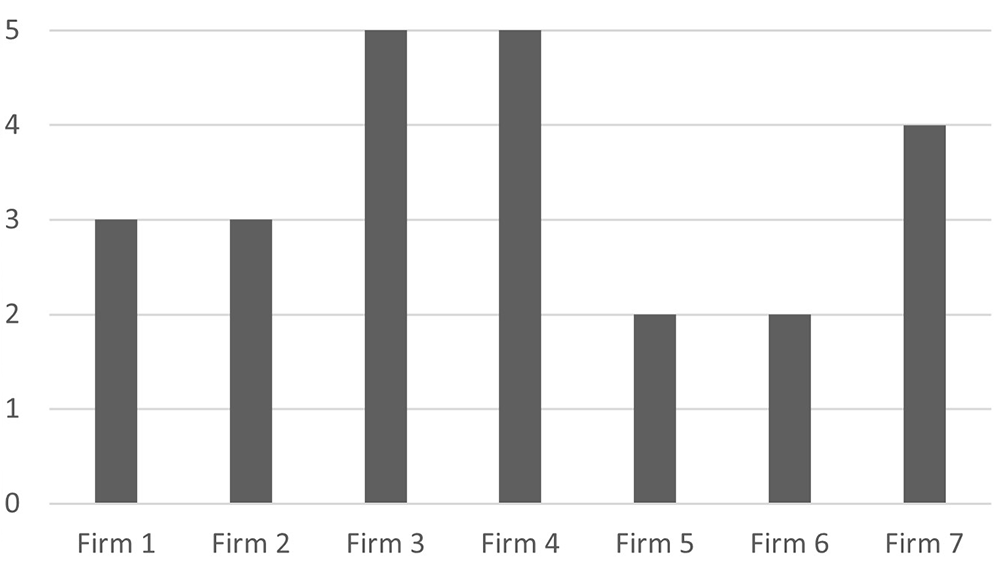
Figure 1. Number of I4.0 technologies used.
The firms surveyed use at least two and at most five of the I4.0 technologies.
As seen in Figure 2, the firms use especially cloud storage and computing, cybersecurity, and industrial IoT, followed by horizontal and vertical integration and 3D printing, and finally collaborative robots, simulation, and augmented reality. None uses big data analytics, i.e., techniques for managing large amounts of data through open systems that allow forecasts or predictions. All the firms surveyed declared knowing BCT but none of them uses it. Only one firm among those surveyed, which is large-sized, has analysed the potential use of BCT in its business processes, specifically for supply chain traceability.
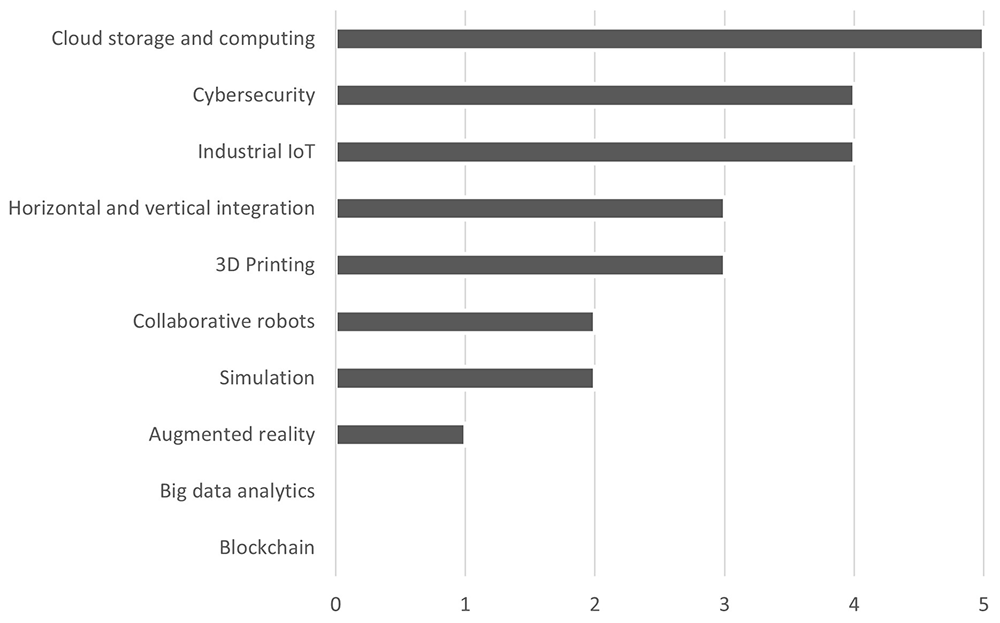
Figure 2. Most used I4.0 technologies.
The firms use especially cloud storage and computing, cybersecurity, and industrial IoT, followed by horizontal and vertical integration and 3D printing, and finally collaborative robots, simulation, and augmented reality. None uses big data analytics, i.e., techniques for managing large amounts of data through open systems that allow forecasts or predictions, and blockchain technology.
The firms surveyed collaborate with different kinds of actors from the Marche Region, other Italian Regions, and other countries. As seen in Table 3 small-sized firms report having more collaborations than larger firms.
Table 3. Collaborations by type of collaborator and territorial level.
1= in the Marche Region, 2 = in other Italian regions, 3 = in other countries. Small firms report a higher number of collaborations than larger firms.
| Firm | Size | Academia | Industry
Clusters | Governments | DIHs | Trade
ass. | Firms
using I4.0 | Firms
providing I4.0 |
|---|
| 1 | Large | 1, 2 | 1, 2 | - | - | 1 | - | 1, 2, 3 |
| 2 | Large | 1 | 1 | 1, 2 | 1, 2 | 1 | 1, 2 | 1, 2 |
| 3 | Large | 1, 2 | 3 | 2, 3 | - | 2 | - | - |
| 4 | Large | 1, 2 | - | 1, 2 | - | - | - | 1, 2 |
| 5 | Medium | - | - | - | - | - | 1 | 1, 2 |
| 6 | Small | 1 | 1, 2 | 1, 2, 3 | 1, 2 | 1, 2 | 1, 2 | 1, 2 |
| 7 | Small | 1, 2, 3 | 1, 2 | 1, 2, 3 | 1 | 1, 2 | 1, 2, 3 | 1, 2, 3 |
The number of collaborations was counted per type of collaboration (Figure 3): most are concentrated at the regional (30 collaborations) and national (26) levels, while collaborations in other countries are marginal (eight). A higher number of collaborations are with providers of I4.0 technologies (14), governmental institutions (12), and universities and research centres (11). Lower levels of collaboration are with other firms using I4.0 technologies (eight), Industry Clusters (eight), and Trade Associations (seven). Collaborations with Digital Innovation Hubs are the least present (four) and there is an absence of collaborations with trade associations and DIHs located in other countries. The firms reported no other kind of collaboration in addition to those presented in the answers.
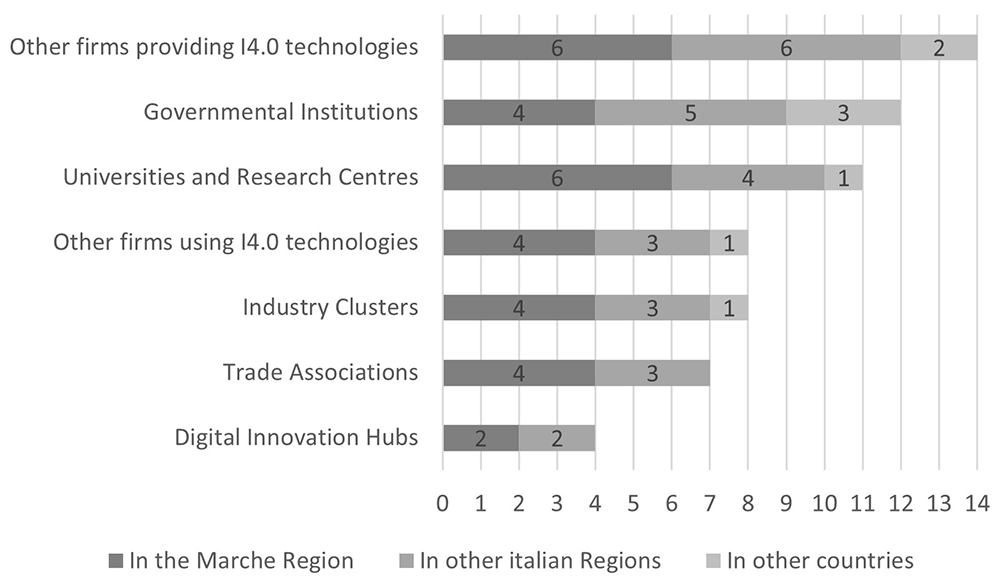
Figure 3. Total number of collaborations by kind of collaborator and territorial level.
Most collaborations are concentrated at the regional and national levels, while collaborations in other countries are marginal. A higher number of collaborations are with providers of I4.0 technologies, governmental institutions, and universities and research centres. Lower levels of collaboration are with other firms using I4.0 technologies, Industry Clusters, and Trade Associations. Collaborations with Digital Innovation Hubs are the least present and there is an absence of collaborations with trade associations and DIHs located in other countries.
The firms surveyed were asked to rate the importance of some measures for increasing the diffusion of enabling I4.0 technologies, including BCT, among firms in the Marche Region (Figure 4). Networking activities both with academia and other firms using I4.0 technologies were considered the most useful. Receiving more funding for the implementation of I4.0 technologies in firms was rated as quite useful by five firms out of seven, and very useful by the remaining two. Raising awareness about I4.0 technologies and training activities on them were rated as less useful overall but still of relevant importance. Lastly, given the lack of clear regulations on BCT, the firms rated the usefulness of clear laws on the business uses of BCT for its diffusion. The answers were mixed, with three firms considering clear regulations not useful and the other three considering them useful, while one firm did not know what to answer. The firm which was exploring the application of BCT in its business processes considered clear regulations to be very useful. The firms were also given the possibility to suggest additional measures: firm number two proposed ‘common projects’ and firm number three added ‘Skills development in young people’56.
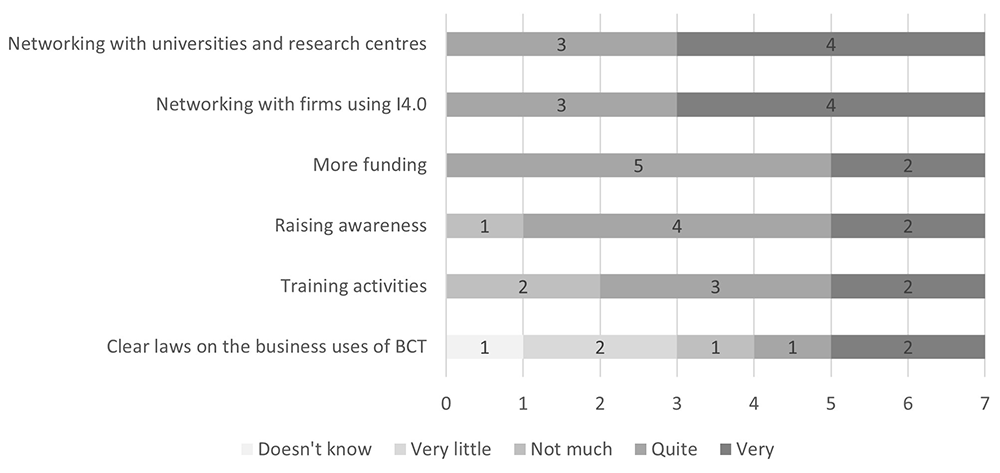
Figure 4. Perceived usefulness of measures for the diffusion of I4.0 technologies including BCT.
Networking activities both with academia and other firms using I4.0 technologies were considered the most useful by the firms surveyed. Receiving more funding for the implementation of I4.0 technologies in firms was rated as quite useful by five firms out of seven, and very useful by the remaining two. Raising awareness about I4.0 technologies and training activities on them were rated as less useful overall but still of relevant importance. The firms gave mixed ratings to the usefulness of clear laws on the business uses of BCT for its diffusion.
Discussion
The qualitative analysis of the economic context based on scientific papers and reports showed that firms in the Marche Region struggle to adopt I4.0 technologies. Factors hindering the implementation of these innovative technologies are the small size of firms and the lack of technical knowledge and collaborations with technology providers. However, the small firms interviewed for this study use I4.0 technologies as much as the bigger firms do. Indeed, as the 2021 report of the Osservatorio Impresa 4.0 stated, the limited size of firms is not an insurmountable obstacle to the implementation of I4.0 technologies64. Instead, collaborations are a driver for the use of I4.0: the firms surveyed for this study collaborate especially with other firms providing I4.0 technologies, leveraging on the providers’ technical expertise to use these innovative technologies. Moreover, they have a high number of collaborations with universities and research centres, confirming their role as knowledge and innovation generators41, and with governmental institutions, which confirms the importance of government support to firms for innovation43,44. This collaboration between firms, universities, and government may indicate the existence of a TH approach that allows the firms surveyed to be innovative. Although the collaborations are mostly with universities and governments in the Marche Region and other Italian regions, international collaborations are present too, confirming the importance of international ties and networking for innovation.
The firms surveyed also reported having strong ties with other firms using I4.0 technologies, industry clusters, and trade unions, showing the importance of being part of networks of actors with similar objectives and needs. However, in this case, the collaborations were mainly with Italian actors, which may indicate a lack of interest in, knowledge of, or access to the possibility to collaborate with firms, industry clusters, and trade unions in other countries. Moreover, it is surprising that the firms interviewed do not collaborate much with Italian DIHs and at all with European DIHs, since these are knowledge brokers that help firms implement innovative technologies and intermediaries that help them create collaborations with governments, academia, and other firms.
As for the usefulness of different measures for the local diffusion of I4.0 technologies, the firms interviewed considered very or quite useful the networking activities with other firms using I4.0 technologies and with academia, and they underlined the importance of government support with funding opportunities. This reinforces the validity of a TH approach for the diffusion of I4.0 technologies in the Marche Region, promoting collaborations and networking, indeed, one of the firms surveyed mentioned the need for collaboration in projects on I4.0. Raising awareness and training activities were found just slightly less useful. These activities are conducted not only by universities and governments but also by trade unions and industrial clusters, with which the firms surveyed collaborate. Again, it is notable that firms do not collaborate much with Italian DIHs and at all with European DIHs, whose activities supporting firms involve raising awareness and training on innovative technologies.
Finally, BCT has been addressed in the literature as the new pillar of I4.0 technologies3. The firms interviewed know BCT but only one of them studied its concrete applications to its business processes. This may be related to the novelty that this technology represents for Italian firms22. Firms were asked in the questionnaire to rate the usefulness of having clear regulations on BCT, of which the absence has been found as a barrier to its adoption in firms36,37. The responses were mixed, however, the firm which had studied the implementation of BCT in its business processes considered clear regulations to be very important.
This research was driven by the limited implementation of I4.0 technologies in firms in the Marche Region and thereby aims to suggest measures to promote the adoption of these technologies, including BCT, in the regional context. The findings suggest that a TH approach could be useful to foster the diffusion of I4.0 technologies in firms in the Marche Region, leveraging on local actors. Figure 5 shows how the TH model would work in the Marche Region. Innovation intermediaries such as DIHs, PID, Competence Centers, Fondazione Cluster Marche, and i-Labs are placed at the centre of the TH. These not only share knowledge with each other but also transfer to and receive knowledge from the typical stakeholders involved in the regional TH, namely academia, government, and industry, and intermediate the knowledge flow between these actors through collaborations which could be leveraged to spread the diffusion of I4.0 technologies in firms in the Marche Region.
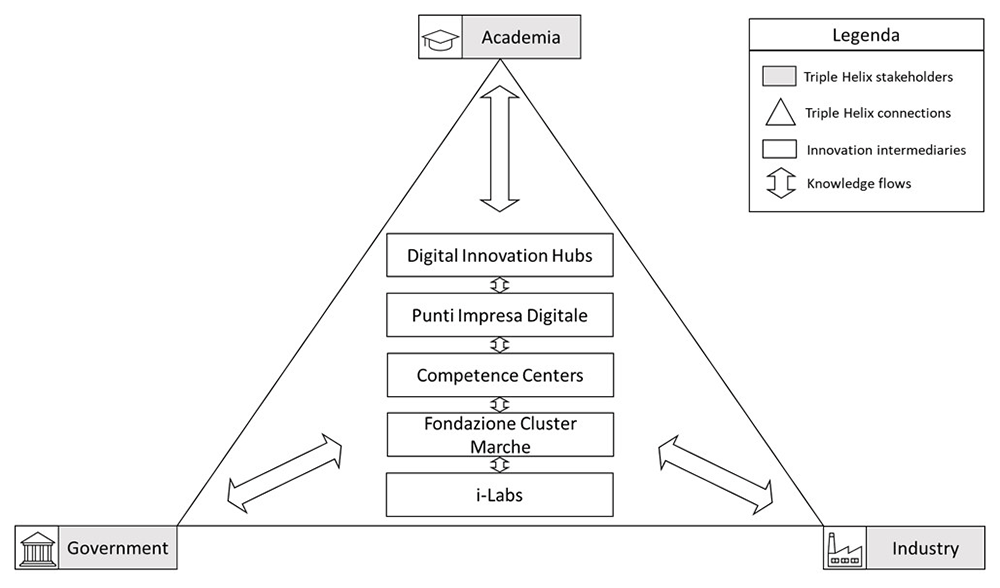
Figure 5. A TH model for the diffusion of I4.0 in firms in the Marche Region.
Innovation intermediaries in the Marche Region such as DIHs, PID, Competence Centers, Fondazione Cluster Marche, and i-Labs are placed at the centre of the TH: they share knowledge with each other and transfer to and receive knowledge from the typical stakeholders involved in the regional TH, and intermediate the knowledge flow between these actors through collaborations which could be leveraged to spread the diffusion of I4.0 technologies in firms in the Marche Region. Source: own elaboration.
It identifies institutions in its territory that may be part of a TH to support the diffusion of these innovative technologies. The TH model proposed is based on both an analysis of the economic context in the Marche Region and empirical evidence from a survey of seven innovative local firms that use I4.0 technologies. The survey was conducted to collect these firms’ opinions on what other firms may need to effectively adopt these technologies.
Conclusions
This survey, although exploratory, confirms the potential role of innovation intermediaries in managing relationships among multiple stakeholders for firms’ digital transformation; a topic which needs still more exploration as suggested by Crupi et al.88. Additionally, this survey tackles the adoption of BCT in innovative firms of the Marche region, which had not been addressed yet in the academic literature. However, caution is mandatory before generalising this study’s results. Indeed, although the seven surveyed firms’ expertise, based on the practical implementation and use of I4.0 technologies, is relevant to the objective of this study, their limited number and high level of digitalization make them not representative of all the firms in the Marche Region. Further, since this study focuses on the Marche region, the results may not be representative of other regions in Italy or other countries. However, since the questionnaire used for this survey is available in open access in Italian and English language and the questions are not directed exclusively to innovative firms, the survey can be repeated in other national and international territorial contexts to find similarities and differences with the results of this study.
As for this study’s implications, based on its results some measures to increase the diffusion of I4.0 in firms of the Marche region can be suggested. In the perspective of raising awareness on I4.0 technologies, policymakers may want to continue fostering a TH approach by helping strengthen the collaboration between some key institutions in the Marche Region: Punto Impresa Digitale (PID), Digital Innovation Hubs (DIHs), Competence Centers, Fondazione Cluster Marche, and i-Labs. These could have the role of innovation intermediaries, i.e., institutions that connect firms with governmental institutions and academia in the regional TH.
The survey evidenced a lack of collaboration with DIHs, despite their role as connectors among the three helices. DIHs can help firms with the practical implementation of I4.0 technologies and regional institutions by adjusting financial and training incentives to the needs of different firms. Additionally, DIHs can connect firms and institutions with other intermediaries around Europe to facilitate international access and exchange of knowledge, allowing them to gather experiences and best practices from other European contexts on the implementation of I4.0 technologies. Both policymakers and DIHs need to make firms more aware of the possibility to use DIHs to access knowledge from all around Europe. On one hand, policymakers need to reinforce the role of existing DIHs and give them more visibility with entrepreneurs. On the other hand, DIHs should organize events with firms and institutions of different European countries that already use Industry 4.0 technologies and BCT and are willing to share their direct experience, so that firms in the Marche Region can appreciate the value that DIHs can provide them.
As for the policies, an important role in the implementation of a TH for the diffusion of I4.0 has been individuated in the S3. The involvement of the key intermediaries in the Marche Region in the S3 must be fostered by policymakers to facilitate its implementation.
Finally, some research suggestions can be proposed. This research addressed the importance of the lack of clear legislation on BCT, on which the interviewees’ responses were mixed, thus inconclusive, and cannot be translated into recommendations for policymakers. However, they constitute a relevant topic for future research: the lack of consensus among firms about the usefulness of clear regulations on BCT needs to be further investigated, to understand if it is due to a lack of awareness of the legal implications of using BCT or other reasons. Furthermore, it would be of interest to develop multiple case studies to understand more in-depth if and how the TH influenced the adoption of I4.0 technologies in regional firms. Finally, it would be useful to collect insights from TH stakeholders and intermediaries to identify opportunities and challenges in collaborating with firms on I4.0 and specifically BCT.