Introduction
As part of the European Green Deal, the European Union (EU) has set the ambitious goal of reducing 55% of its greenhouse gas (GHG) emissions by 2030 and becoming the first continent in the world to be completely climate neutral by 20501,2. To achieve this challenging goal, significant changes will be required in the energy mix of most of the EU countries to reduce dependency on fossil fuels and their consequent GHG emissions. The two other related objectives, namely increasing energy efficiency to 36% and increasing renewable energy share to 38.5%, will be essential to achieve the target defined above. Renewable energy sources are those that renew themselves naturally at rates that are equivalent or higher than the rates of their use, such as solar energy, wind energy, hydropower, marine (tide, wave, ocean) and geothermal energy. They prevalently contribute to electric power and minimally to thermal request. In sharp contrast with all the other fuels, renewables have already shown their resilience to the coronavirus pandemic crisis3. The share of renewables in the energy use of the 27 EU member states was approximately 19.7% at the end of 2019, very close to the 20% target originally established for 20204,5.
On the other hand, the share of renewables in the worldwide electricity supply reached 27% in 20196, 7% below the EU for the same year (i.e., 34%)4, which shows that Europe is indeed ahead in the energy transition. Although technologies exploiting renewable energy sources are not always intrinsically ecofriendly, renewable energy is unquestionably important to ensure a sustainable society, in which both citizens and industries can benefit and develop while respecting the replenishing rate of natural resources. In this regard, the 7th Sustainable Development Goal (SDG) defined by the United Nations (UN) for 2030 is “Ensure access to affordable, reliable, sustainable and modern energy for all”, stating a clear goal of increasing the share of renewable energy in the total energy usage7,8. Among the renewables, solar energy is especially important, given the expected increase as part of the decarbonization process, for the energy mix both in EU and in the world. Novel photovoltaic (PV) technologies will play a crucial role in this process, and one of the most promising emerging PV technologies to be recently developed is hybrid halide perovskite solar cells (PSCs).
PSCs have enormously advanced the research and development of innovative PV technologies in the last decade. The power conversion efficiency (PCE) of the cells overcame the record value year by year, reaching 25.5% for single-junction PSC, 24.2% for tandem configuration coupling of the PSC technology with copper indium gallium selenide (PSC/CIGS), 29.5% for the PSC/silicon tandem9, and 17.9% for the perovskite solar module (PSM)10. The extremely high PCE, together with the availability of cell and module configurations, and the low cost of most raw materials and manufacturing techniques, were the pillars of research and development of PSC technology looking for industrialization and high competitivity on the PV market.
However, some not negligible drawbacks need to be overcome to allow PSCs to take the decisive step towards commercialization and thus enter the PV market. The long-term stability and rapid degradation of some components11, the choice of suitable materials and manufacturing procedures for massive industrial scale-up12, and environmental sustainability13 are still open issues that companies and the scientific community are trying to address.
Concerning environmental sustainability, several researchers pointed out the problem of lead (Pb), employed in the crystal configuration of the best performing PSCs. Pb is highly toxic for humans and ecosystems and, if absorbed by living organisms, it negatively affects many internal organs, including the brain, and can bioaccumulate within tissues14.
What makes it extremely dangerous for living organisms’ health is the high mobility and great diffusion potential in the environment that the Pb-containing compounds have. This is due to Pb’s chemical-physical characteristics and its widespread usage until the recent past14. For these reasons, the World Health Organization states that there is no safe level of Pb exposure15, and throughout the RoHS Recast (RoHS2) Directive16, the European Union is pushing for its removal and substitution from a range of electrical and electronic equipment. However, due to its particular characteristics and the scarcity of suitable substitute materials, Pb is still far from being replaced17. Regarding PV applications, although the RoHS2 Directive excludes solar panels from the restrictions (unless they are building or product integrated), as a precaution PSCs should respect 0.1% Pb content as the maximum concentration value tolerated by weight in “homogeneous material”. In this context, the ambiguity of the definition of “homogeneous material” represents a critical point, especially for a perovskite-based device that is characterized by several nano or microlayers made of different materials stacked on top of each other16,18.
Thus, the toxicity of Pb is one of the most relevant issues to address for safeguarding the environmental sustainability of future industrial production of PSCs. So far, many researchers have investigated the potential toxicological risks caused by the leakage of Pb during the life cycle of PSCs and modules19–24. At the same time, life cycle assessment (LCA) methodology has been applied to several PSC configurations to evaluate the eco-profiles of the technology25–39 and understand better which could be the relevant environmental hotspots along the whole PSC life cycle in addition to those related to the use of Pb-based compounds.
Therefore, the concerns regarding the high toxicity of Pb-based compound used in PSCs, and the possible mass production limitations related to the current legislation, are still open issues for which a widespread consensus among the scientific community and manufacturers has not been reached yet17.
This work aims to review all aspects connected with the sustainability and environmental assessment of Pb employed in PSCs to highlight the significant issues that should be taken into account to guarantee safe industrial development and massive exploitation of this technology. To do so, we first describe the physico-chemical properties of Pb, why it is pivotal for the PSC development and what are the potential risks for humans and the environment. Afterward, we outline the major outcomes of environmental analysis studies (LCA, toxicological and risk assessment) on PSCs, focusing on the toxicity-related environmental impacts. Next, we present the most recent mitigation and encapsulation techniques developed and published in last years, and finally, we outline the main end-of-life concerns and potential future recycling techniques.
Pb in PSCs
Conventional Pb-based perovskites show a distinctive crystal structure featuring the ABX3 pattern where A is an organic or inorganic cation (usually methylammonium, formamidinium or cesium), B is Pb, and X is a halide (usually iodine or bromine). Perovskite is the PSCs’ photoreactive compound, and it cooperates with several other materials and compounds in the cell to convert light into electricity (Figure 1).
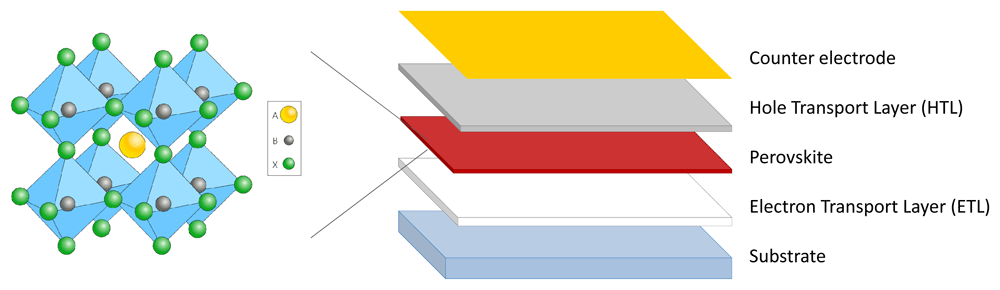
Figure 1. Crystal structure of perovskite (on the left) and conventional configuration of a perovskite solar cell (on the right).
The peculiarities of this crystal structure are the main factor that leads to the astonishing photoconversion efficiency PSCs have been showing so far. They are related to several optoelectronic parameters such as bandgap, absorption coefficient, carrier diffusion lengths, trap density, shallow defects and exciton binding energy40. For this reason, despite several attempts to replace Pb with other metals40–42 such as tin (Sn), germanium (Ge), bismuth (Bi), antimony (Sb) or indium (In), no viable, effective and compelling alternative has been found yet.
From an operational perspective, the highest efficiency recorded for a Pb-free PSC is 10.9%, reached with a Sn-based perovskite43,44. Sn has a similar electronic configuration to Pb, and it seems to be the most promising candidate to replace Pb in perovskite for PV applications. However, low PCE and concerns about the environmental impact of Sn-based perovskite21,24 have slowed down the development of Sn-based PSCs so far. In this context, several researchers are addressing their attempts and effort in the direction of investigating and examining in depth the potential risk of using Pb in PSCs.
Toxicology issues
Hailgnaw et al. analyzed Pb leakage in case of damage and exposure to rain of one Pb-based PSM19. Due to the high mobility and the potential solubility in water of Pb-based compounds originating from the perovskite (including also lead iodide, PbI2, that, despite its moderate solubility in water, can release not-negligible quantities of the metal over time), they showed almost all the Pb leaked from the module, generating relevant pollution in all the environmental compartments (i.e., water, soil, and air) in the surroundings of the PSM installation. The authors stated that the concentration of Pb in the soil could increase by about 70 ppm, where the typical range of concentration for natural uncontaminated soil is <10–30 ppm, and 50–200 ppm in urban areas19.
Babayigit et al. assessed the toxicity of the PbI2 compound by measuring the statistically derived dose descriptors LC50 (i.e., lethal concentration for 50% of the population) and EC50 (the effect concentration for 50% of the population) in a population of zebrafish21,22. The authors revealed that both death and adverse impacts on the organisms occurred at a low concentration of PbI2 in water. The synergistic effect of the exposure to Pb-based compounds and the decrease in pH caused by the formation of hydrogen iodide (HI) was crucial in obtaining these results.
Another valuable contribution for evaluating the toxicity of Pb-based compounds comes from Li et al., which experimented with the uptake of Pb-based perovskite in mint plants23. The authors measured the amount of Pb in roots, stems, and leaves of plants grown in contaminated soil. They found an increase of 10% in the amount of Pb in soil caused an increase of Pb content in plants higher than 100%. Furthermore, the presence of organic cations of the perovskite (methylammonium in this case) has a remarkable effect on the uptake.
Benmessaud et al. evaluated the cytotoxicity of Pb-based perovskite contamination in several human cells, highlighting the onset of different damaging effects, from a reduction in cell reproduction to cell death45.
Comparison with other sources of Pb emissions
Despite the need for a deepened, detailed, and all-encompassing investigation of the toxicity-related issues, the potential risk and damage to humans and ecosystems associated with pollution by Pb-based compounds seems to be sufficiently documented. Besides that, the appraisal of environmental implications connected to large production of PSCs with a prospective approach can help to determine the eco-profiles of electricity produced by this technology, thus being an essential contribution to appropriate assessment of the whole issue.
Fabini attempted to quantify the Pb content in PSCs that would be required to supply the electricity mix in the US, comparing this value with the amounts of Pb-based compounds emitted by other sectors20. Results are reported in Table 1.
Table 1. United States (US) lead (Pb) emission sources and hypothetical Pb content in perovskite solar cells (PSCs) to supply the entire US electricity sector.
The emission values have been detected in the years reported in brackets, but they are still relevant in 2021. Data is taken from Fabini, 201520.
| Lead Emission Source | Total Value
(tonnes/year) | Compartment |
|---|
| Automotive fuel (1973) | 2∙105 | Airborne emissions |
| Aviation fuel (2011) | 4.40∙102 |
| Metals processing (2011) | 1.20∙102 |
| Electricity generation (2011) | 3.50∙101 |
| Coal ash, blackwater (2011) | 5.90∙103 - 9.30∙104 | Liquid & solid content |
| Electronic solder (2012) | 6.20∙103 |
| PSCs to supply electricity | 1.60∙102 | Solid content |
Apart from Pb emissions generated by automotive fuels before tetraethyl lead (Pb(C2H5)4) was removed as an additive in gasoline, all other Pb emissions sources are still relevant and present in 2021. Given that only a small percentage of Pb employed in PSCs could be directly emitted into the environment, the analysis shows that potential pollution caused by future large-scale production of PSCs may be lower than or analogous to other current Pb emission sources. In this framework, the environmental compartment into which emissions flow considerably affects the behavior and potential toxicity of Pb-based compounds. Direct emission into the air could lead to diffused pollution, also affecting other environmental compartments, such as soil or water, and thus, indirectly, food. It is well known that treatment and disposal of coal ash and blackwater are hazardous, and could lead to environmental disaster20. In contrast, Pb content in perovskite is in a solid form and, if adequately encapsulated, its mobility could be adequately limited, and the consequent emission into the environment could be very low.
Hauck et al. performed a LCA to analyze the prospective contribution that large-scale production and installation of PSCs could make to the transition toward an energy system based on renewable sources25. In their work, the electricity produced by PSCs/Si modules in a tandem configuration is compared with the electricity produced by the average European electricity mix. Despite some significant assumptions and approximations, the authors concluded that a substantial reduction of Pb-based compound and GHG emissions could be achieved by replacing conventional energy production technologies with PSCs.
Billen et al. followed a similar approach by applying LCA to calculate the environmental impact and toxicity potential of electricity produced by Pb-based perovskite PV and comparing them to the US electricity mix eco-profile26. The major outcomes show that the environmental footprint of the kWh generated by PSCs could decrease Pb emissions by a factor of 2–4. The authors state that the potential Pb emissions related to PSCs could be marginal compared to those caused by conventional energy production technologies. In this context, the emission of toxic compounds that could potentially occur during the manufacturing phase, together with the unlikely emission of the whole Pb content during end-of-life, could be offset in only two years of operation.
Availability, viable alternatives and recyclability
The availability of raw materials and metals is one of the main issues to address when evaluating the sustainability of energy-generating technologies and innovative devices for the exploitation of renewable energy sources46. Among all the metals that could be employed in PSC devices, Pb shows some advantages, one of the most convincing being the availability of its natural reservoirs47–49 as shown in Figure 2, which is taken from the European Commission Raw Materials Information System (RMIS)50.
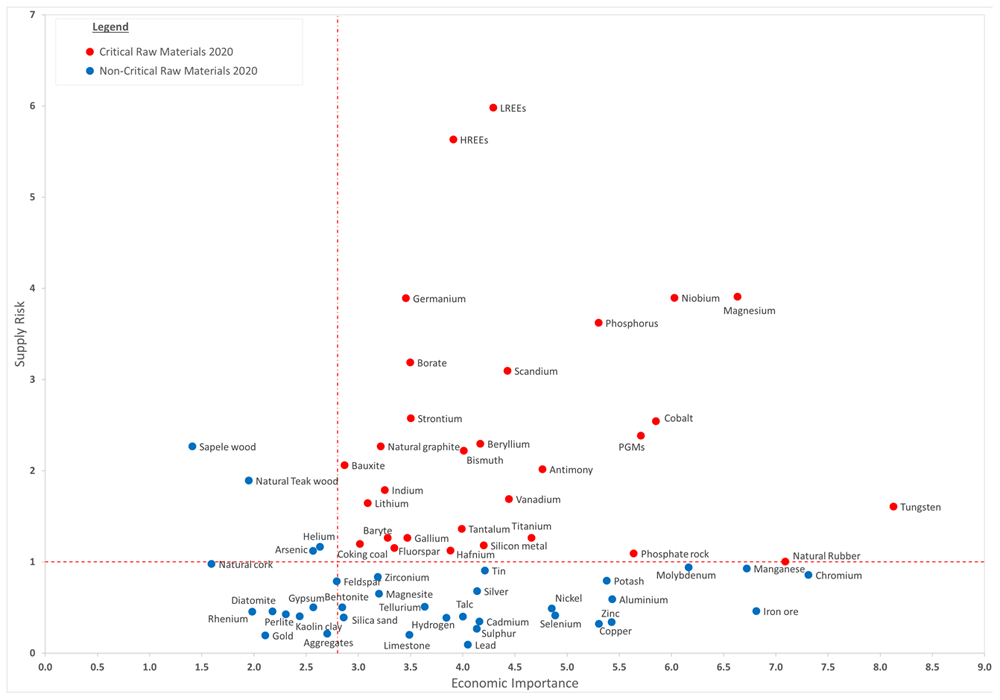
Figure 2. Critical Raw Materials list 2020 (Reproduced from “European Commission, Study on the EU’s list of Critical Raw Materials (2020)”70).
The critical raw material (CRM) diagram in Figure 2 points out that Pb ores have good availability, especially compared with other rare metals. In addition to this, due to the high recycling rate, a significant source of secondary Pb comes from recycling procedures48. In 2016, in the US, the amount of recycled Pb was more than 80%, while in Europe it was around 60%18,24.
The significant recycling rate of Pb allows for hypothetical end-of-life management of PSCs that could limit and hopefully totally ward off the disposal of Pb-based electronic waste in landfills51. As has already been done for conventional Si-based52 and CdTe53 panels, a strategic plan for PSC systematic recycling engaging producers, sellers, consumers, and electronic waste recovery companies needs to be implemented as soon as the commercialization of PSCs starts. In this regard, several authors have already explored and investigated the feasibility of the PSC recycling process54,55, highlighting the high recycling rate of Pb56 and the potential recovery of most to all of the PSC components57–64. Although these processes have been demonstrated at a laboratory scale and need to be scaled-up, the prospect of manufacturing PSCs with recovered materials, avoiding efficiency losses, has been already documented51,65–68.
Analyzing the possible replacement of Pb with other metals, some critical issues need to be addressed. As reported above, metals identified and tested as a viable alternative for metal-based perovskite in PSCs are Sn, Ge, Bi, Sb and In40. Figure 2 shows that most of these metals’ availability is lower than Pb. These elements are scarce or even very rare, and they are employed for other uses. Roughly comparing annual production, it can be noted that the total amount of some alternative metals produced would not be sufficient to be employed in PV device manufacturing24,49,69.
The potential replacement elements should fulfill some crucial performance standards to be competitive with Pb. In addition to the already mentioned natural availability and ease of recycling, alternative metals should form a stable perovskite structure that exhibits outstanding optoelectronic properties and excellent PCE, they should be characterized by a low-cost supply chain and manufacturing procedure, and they should satisfy some commercial requirements, such as long-term stability and scalability40.
Moreover, together with these stringent criteria, issues related to the whole life cycle of metals and their relative environmental sustainability must be considered. Nuss et al. performed a cradle-to-gate LCA of metals, illustrating the numerous interconnections among the manufacturing procedures and assessing the related environmental burdens71. One of the major outcomes of the study deals with the common sources and extraction procedures characterizing some elements. This aspect substantially influences the market availability and cost of some metals, whose production is commercially attractive only as a by-product of other metals24. From the environmental assessment perspective, among all metals, Pb displays one of the lowest impacts for all the environmental categories and indicators considered by Nuss et al. (i.e., GHG emissions, cumulative energy demand, terrestrial acidification, freshwater eutrophication, and human toxicity)71. In addition to this, the authors state that for some metals, the mining and concentration and the subsequent purification and refining steps exhibit approximately similar environmental burdens. These steps are also a major contributor to the environmental profile of the whole metal’s life cycle71. Thus, the impact could be strongly reduced using secondary recycled Pb and implementing a thorough end-of-life strategy for PSC technologies.
LCA for environmental assessment of Pb in PSCs
The LCA methodology has been extensively applied to assess PSCs manufacturing’s environmental impact and operational phase. Many different configurations of cells and modules employing several raw materials and chemical compounds and requiring various manufacturing procedures and deposition techniques have been analyzed in recent years17–29. To highlight the main potential environmental hotspots of PSCs, we performed a critical review and in-depth harmonization of LCA studies published (2019)36 in the frame of the H2020 Project “ESPResSo”. The major outcomes and results of the study are consistent with those reported in similar papers published more recently27,29, and they can be summarized as follows.
The main hotspots in terms of materials employed for PSCs production are gold (used as back contact), the conductive solar glass, and the electron transport material (ETM) due to raw materials consumed during the synthesis. Regarding the manufacturing procedures, the back contact deposition, the ETM deposition and the glass substrate preparation show remarkably high environmental impacts due to their direct energy consumption36. Some manufacturing techniques have been found to be better than others for bringing PSCs to the industrial production scale with competitive deposition efficiency (e.g., ink-jet printing, slot-die coating, spray-coating)27, and a global consensus on the replacement of gold as the material for back contact has been achieved36.
Concerning the toxicity issues of PSCs, and the use of Pb-based compounds in particular, nearly all of the studies come to similar conclusions17–29. From an LCA perspective, the Pb and Pb-based compounds’ burden on the environmental profile of PSCs can be considered substantially negligible. This is due to two main factors: i) the limited environmental impact that the production of Pb ore displays in LCA analysis71, and ii) the exiguous amount of Pb in PSCs and the relative contribution to the global environmental footprint of devices, which is some orders of magnitude lower than those of other materials and processes required in the manufacturing procedure. However, despite the relatively low overall burden, the presence of Pb contributes highly to the toxicity-related categories36. This outcome can be explained through the discussion of the so-called characterization factors (CFs) of metals that are applied in the life cycle impact assessment step as weighting factors to aggregate life cycle emissions into scores for human health and ecosystem health impacts.
Figure 3a, b and c show the CFs of Pb in comparison with those of other heavy metals Values are derived from the most updated version of the Environmental Footprint (EF) method, which includes the USEtox model72 for the evaluation of the potential toxicity of substances (the most highly recommended73,74 impact assessment method).
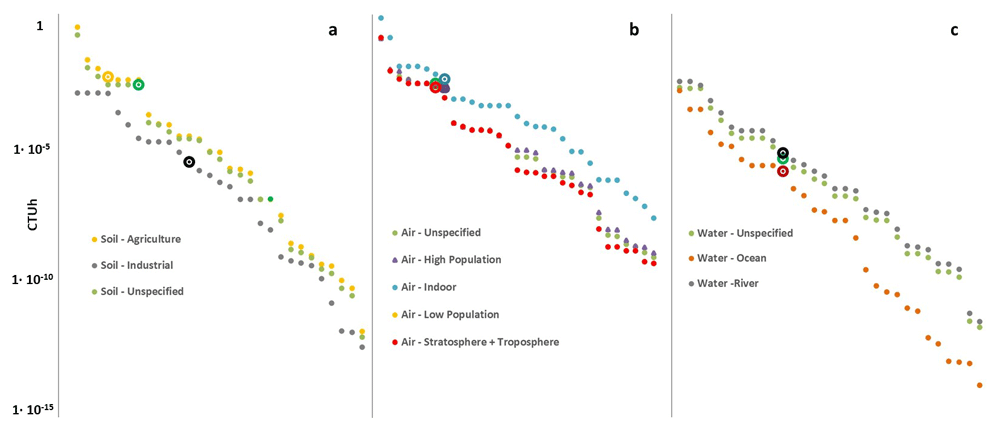
Figure 3.
Plot of the toxicity-related characterization factors of heavy metals including lead (larger dots in the chart) for the impact category human toxicity non-cancer effect, relative to the environmental compartment soil (a), air (b) and water (c).Characterization factors are expressed in comparative toxic unit for humans (CTUh). Data is taken from the Environmental Footprint Life Cycle Impact Assessment Method72,76.
Examining the characterization factors reported in Figure 3a, b and c, it is clear that Pb could generate non-negligible impacts and could be a potentially serious risk if it was emitted into the environment. For example, concerning the human toxicity non-cancer impact category relative to the soil and air compartments, the potential toxicities of Pb results are extremely high, especially if the Pb-based compounds are emitted in agricultural soil or indoor air. Moreover, Pb exhibits high potential toxicity for all air sub-compartments in the same category.
These outcomes agree with and strengthen those reported by studies focusing on toxicity modeling and risk assessment of Pb-compound emissions from PSCs19–24, suggesting that the evaluation of potential toxicity of Pb-based PSCs could be still an open question. The main risk is underestimating the potential damage of local emissions and danger associated with small-scale pollution during the manufacturing process, use phase and end-of-life management. The point is that since the toxicity of a metal depends on several physico-chemical parameters such as oxidation state, ligands, solubility, morphologies, characteristics of the environment, and many others, the effect on biological systems should not be assumed or taken for granted75. Therefore, there is a further need for reliable measurements and empirical tests to improve knowledge of the toxicity of Pb-based PSCs.
For this reason, it is important to specify that the application of LCA for the evaluation of toxicity of specific metal-based compounds might not be exhaustive and might lead to results with relatively high uncertainty. This is due to the inherent uncertainty of the USEtox model related to the lack of some physico-chemical parameters used to model the fate, exposure, and the potential toxicity of many metal-based compounds72.
Encapsulation as a viable solution to facilitate commercialization
The most promising solution to mitigate the risks associated with Pb emission and leakage during the use and end-of-life phases is the physical encapsulation of PSCs and PSMs. Encapsulation is a standard procedure that uses different materials to cover and protect the laminated module from external agents. This procedure allows enhancement of the module’s stability by limiting the oxidation and degradation of materials, and recent development demonstrates that physical encapsulation could also reduce Pb-based compounds’ emission by sequestrating most of the Pb in the PSCs77–79.
In recent studies, the encapsulated modules have been subjected to various stress tests, such as: i) mechanical shattering followed by water soaking77; ii) fire simulation78; and iii) mechanical damage followed by simulated rainfall79, and, definitively, all studies came to similar conclusions.
The limitation of Pb leakage from shattered and soaked PSCs in water was substantial, exhibiting percentages of sequestration efficiency higher than 96% of the total Pb mass for all test conditions (i.e., different water temperature, pH, and soaking time). In addition to this, the PCE of the PSCs encapsulated with Pb-adsorbing films showed no appreciable differences compared with the non-encapsulated PSCs77.
The results of the fire simulation tests outlined that glass encapsulation of the PSCs could avoid the formation of Pb-based compounds that are soluble in water, while facilitating the formation of Pb-based compounds that dissolved into the softened glass, thus limiting their emission into the surrounding environment. The monitoring of air emissions proved that the maximum simulated value of Pb emissions did not exceed the safety standards set by the European Commission78.
The encapsulation with epoxy resins and the subsequent exposure of PSCs to different weather conditions showed a remarkable reduction in Pb-based compound leakage. The most promising encapsulation method under the most severe rainfall simulation (i.e., acid rain) exhibits a reduction in Pb-leakage of more than two orders of magnitude, also thanks to the high temperatures that the device could tolerate under outdoor conditions79.
Recently Chen and co-authors80 showed the effectiveness of a a low-cost mesoporous sulfonic acid-based lead-adsorbing resin that, when incorporated into PSCs as a scaffold, immobilizes lead ions inside it even if PSCs are exposed to rainwater. Introducing the insulating scaffold not only does not decrease the device efficiency, but also can be scaled up to large-area modules
Conclusion
The environmental sustainability of PSCs and the issues related to the toxicity of Pb in perovskite have started to be extensively addressed in the scientific literature. Based on the studies published so far, it can be inferred that the topic should be approached from as many perspectives as possible due to the inherent uncertainty associated with the models describing the environmental impact of Pb compounds.
From the toxicological point of view, it seems clear that Pb and Pb-based compounds employed and eventually released by PSCs are extremely dangerous and toxic for living organisms. Strong efforts should be put into the further investigation and characterization of fate, exposure and potential toxicity of all Pb-based compounds that are used and could potentially be emitted during the whole life cycle of PSC devices.
On the contrary, from the LCA perspective, Pb shows a quite limited burden on PSCs’ environmental profile, mainly due to the small impact of the metal’s production process. According to the main outcomes of LCA studies on PSCs, the replacement of some raw materials, the reduction of some chemical compounds’ consumption, the improvement of energy requirements, and the implementation of a safe end-of-life phase are the crucial environmental hotspots that need to be addressed to accomplish industrialization and mass production. However, more detailed and in-depth LCA studies focusing on the life cycle of Pb-based compounds employed are necessary to evaluate the real sustainability of Pb-based PSCs. From this point of view, it would be beneficial to expand on the LCA models to customize the analysis for the specific conditions characterizing the investigated systems. Moreover, it should be considered that it is not the chosen life cycle impact assessment method that gives validity to the result of a LCA analysis, but the accuracy and awareness with which the results obtained are discussed, analyzed and contextualized by the operator.
At the same time, widening the perspective to mitigate risks along the whole value chain, for the technology to have a chance of entering the PV market firmly, manufacturing companies should put effort to i) guarantee the safety of the PSC manufacturing phase work environment, ii) develop reliable encapsulation techniques to prevent Pb leakage during the transportation and use phases, and iii) implement harmless and controlled end-of-life management procedures.
Data availability
No data are associated with this article.