Introduction
Companies in general and production companies in particular are affected by digitalization. You have to create products or services and hire digital talents (Sommer, 2023b) that meet the changing conditions. The term Industry 4.0 represents the upheaval, especially in the area of production. Another term is increasingly appearing in the context of the above discussion, that of the digital twin (Industry 4.0 and the Digital Twin, n.d.). Both terms express comprehensive challenges in the present and future, with DT representing a new facet - especially in the sense of medium-sized companies.
Industry 4.0. can be defined as follows: “Screws communicating with assembly robots, self-driving forklifts stocking high shelves with goods, intelligent machines coordinating independently-running production processes – people, machines, and products are directly connected with each other: the fourth industrial revolution has begun” (plattform-i40, n.d.). Different terms such as “.. smart manufacturing”, digital transformation, and fourth industrial revolution” should not be included in the study as they contribute to confusion (Culot et al., 2020). The implementation of Industry 4.0 can be seen, among other things, in the increase in digital processes in everyday production (Follath et al., 2022). In other words, the fourth industrial revolution has broad consequences for companies, for example a manager from Autodesk Germany, a global technology provider for design and manufacturing, comes to the following conclusion:
Until now, the technologies, platforms and skills required to implement and use the principles of Industry 4.0 have been reserved for those companies that had the necessary global presence to bear the costs of testing the relevant technologies. Now it's important to make this accessible to manufacturing companies of all kinds, regardless of size and budget. But as the world looks forward to this development, the continued triumph of technologies such as artificial intelligence (AI), IoT, analytics, robotics and 3D printing are already opening up new possibilities that suggest the dawn of another industrial revolution. (Lodhia, 2022)
Lodhia (2022), as Director of Autodesk Germany, refers in his assessment to the developing discussion about the topic of “Industry 5.0”. In contrast to Industry 4.0, this new revolution can be defined as follows: “If Industry 4.0 is about digitally connecting machines to enable a seamless flow of data and the highest possible optimization, Industry 5.0 is believed to bring humans back into the game for collaboration and introduce the human touch to manufactured products while simultaneously focusing on sustainable manufacturing” (Raja Santhi & Muthuswamy, 2023). Core principles of Industry 5.0 are: (a) Human-centricity; (b) Sustainability; (c) Resilience (Industry 5.0, n.d.).
In addition to the term industrial revolution, the term digital twin is also repeatedly mentioned in the context of the digitalization of production. In principle, this is not a completely new concept, but rather a concept with rapidly growing interest (Qi et al., 2021). From a scientific perspective, this concept can be defined as follows: “… digital twins have three main elements: a physical artifact, a digital counterpart, and the connection that binds the two together. The connection is the exchange of data, information, and knowledge between the physical and virtual counterparts, enabled by the development of advanced sensing .., internet of things .., high-speed networking, and advanced analytics ... technologies” (Sacks et al., 2020). An alternative definition - from a practical perspective - is provided by SAP's definition approach: "A digital twin is a virtual model of a physical product, process, or service whereby sensors utilizing Industry 4.0 technologies (artificial intelligence, Internet of Things, and big data) provide real-time conditions, diagnostics, and predictions through data analysis. As many put it, it’s the linkage between the physical and digital worlds” (SAP Digital Twin Archives, n.d.). In summary, it can be stated that the terminology shows a high level of coverage in theory and practice. Digital twins can be further subdivided based on the following criteria, among others: type, architecture and use case. Table 1 provides an overview (Verdouw et al., 2021)
Table 1. Types of Digital Twins.
| Types | Description |
|---|
| Imaginary Digital Twin | “A conceptual entity that depicts an object that does not yet exist in real-life” |
| Monitoring Digital Twin | “A digital representation of the actual state, behaviour and trajectory of a real-life physical object” |
| Predictive Digital Twin | “A digital projection of the future states and behaviour of physical objects using predictive analytics, such as
statistical forecasting, simulation and machine learning methods” |
| Prescriptive Digital Twin | “A smart digital object that adds intelligence for recommending corrective and preventive actions on the
real-life objects usually based on optimization algorithms and expert heuristics” |
| Autonomous Digital Twin | “Operates autonomously and fully controls the behaviour of real-life objects without on-site or remote
intervention by humans” |
| Recollection Digital Twin | “Maintains the complete history of the physical object, which no longer exists in real-life” |
The following classification is particularly relevant for the production-related area: (a) Product Digital Twin; (b) Process Digital Twins; (c) Operation Digital Twins (Bao et al., 2019). The implementation is a challenge, especially for medium-sized companies. There are different approaches to the architecture, shown in Table 2:
Table 2. Selected Architectures and Frameworks.
| Architecture / Framework | Year | Source |
|---|
| C2PS: A Digital Twin Architecture Reference Model for the Cloud-Based Cyber-Physical Systems | 2017 | (Alam & El Saddik, 2017) |
| An architecture of an Intelligent Digital Twin in a Cyber-Physical Production System | 2019 | (Talkhestani et al., 2019) |
| Digital twin-driven product design framework | 2019 | (Tao et al., 2019) |
| An application framework of digital twin and its case study | 2019 | (Zheng et al., 2019) |
| Six-layer digital twin architecture | 2020 | (Redelinghuys et al., 2020) |
| Generic Digital Twin Architecture for Industrial Energy Systems | 2020 | (Steindl et al., 2020) |
| A digital-twin visualized architecture for Flexible Manufacturing System | 2021 | (Fan et al., 2021) |
A Distributed Digital Twin Architecture for Shop Floor Monitoring Based on Edge-Cloud
Collaboration | 2021 | (Ouahabi et al., 2021) |
| Digital Twin as a Service (DTaaS) in Industry 4.0: An Architecture Reference Model | 2021 | (Aheleroff et al., 2021) |
| Use Case Scenarios for Digital Twin Implementation Based on ISO 23247 | 2021 | (Shao, 2021) |
Digital Twin—Cyber Replica of Physical Things: Architecture, Applications and Future Research
Directions | 2022 | (Qian et al., 2022) |
A Novel Digital Twin Architecture with Similarity-Based Hybrid Modeling for Supporting Dependable
Disaster Management Systems | 2022 | (Yun et al., 2022) |
| The Development of a Digital Twin Framework for an Industrial Robotic Drilling Process | 2022 | (Farhadi et al., 2022) |
In terms of use cases, the variety is also high. This ranges from the automotive sector, to production and smart cities, to healthcare (Singh et al., 2022).
Based on the above, the question now arises as to what connection exists between Industry 4.0 / 5.0 and digital twins? Here we can again draw on the statements by Lodhia (2022), according to which the feasibility of Industry 5.0 exists, among other things, when the modern platforms and resources are able to communicate with each other and thus enable effective collaboration between humans and computers, which means means companies need to develop even further. In his view, manufacturing companies will be exposed to the following trends in the next decade, in which digital twins play a relevant role (Lodhia, 2022):
Trend A “Product life cycle - planning and simulation”: Feedback loops between the phases of production are assumed, which explains, among other things, the need for digital twins. Networked phases in production are expected that exchange information, learn and optimize. Industry 5.0 will produce systems that allow for dependencies and enable optimization in real time. In other words, product development is becoming faster and systems are becoming more complex.
Trend B “New Internet – networking of digital twins”: Digital twins are, among other things, an expression of more comprehensive communication between systems and people or devices. It is assumed that a network will be created or required for this that operates in parallel to the existing Internet.
Trend C “Collaboration – people and machines thanks to further developed AI”: Machines are able to learn and work together with people. Artificial intelligence is currently experiencing high acceptance in the production sector. This form of intelligent and networked work promotes automation in production, which, among other things, increasingly enables the individualization of products.
Trend D “Manufacturing-as-a-Service”: Customers are increasingly being involved in production in such a way that they have products made to order. This can range from the color of the product to the dimensions. In other words, customers can, if necessary, send orders directly to production and thus trigger an order, virtually at the push of a button.
Trend E “Adaptation and speed - tailor-made products”: Short delivery times and the individualization of products are becoming increasingly important from the customer's perspective. This could have a significant impact on the systems and machines required, as well as the distribution or sale of the products to be produced. However, an important prerequisite for implementation is meeting the requirements in the Industry 4.0 environment. There are still relevant deficits in large and especially medium-sized companies.
The explanations suggest that there could be a relevant connection between Industry 4.0 / 5.0 and digital twins, which is confirmed, among other things, by literature research (Lv, 2023, p. 1):
“Equipment is the infrastructure of industrial scenarios, and the embedded intelligent upgrade for equipment is a Digital Twins primary condition”
“Digital Twins can provide automated real-time process analysis between connected machines and data sources, speeding up error detection and correction”
“Digital Twins can bring obvious efficiency improvements and cost reductions to industrial manufacturing”
“Digital Twins reflects its potential application value and subsequent potential value in Industry 5.0 through the prospect”
The results make it clear that digital twins play or will play an important function in the context of Industry 4.0 and 5.0. Current studies come to the conclusion that, on the one hand, digital twins act as “enablers of cyber-physical systems to a product lifecycle data integration and processing platform” (Stjepandić et al., 2022), but on the other hand their implementation in companies represents a challenge (Melesse et al., 2020). In other words, there are extensive studies on potential areas of application, architecture and types of digital twins (Singh et al., 2022); implementation in the sense of implementation as a project is obviously still a challenge. The authors Follath et al. (2022) to the realization that, on the one hand, the delimitation of the definitions of digital twins, especially in the areas of production and logistics, has not yet been sufficiently clarified and, on the other hand, there is still no generally accepted procedural model for implementation (Follath et al., 2022). From this, the authors derive the following requirements for such a model: “The process model helps to classify which use cases a digital twin can be developed for, which steps must be taken during implementation, and provides an overview of the requirements and complexity during development" (Follath et al., 2022). Scharch (2016) defines the term process model in the context of software development as "...form of a development scheme... (synonymous with process strategy, development approach)..." with the function of presenting the development process as a model.
Theoretical foundations
An important question in connection with digital twins and process models is whether they can be reduced to process models in the sense of software development. If you look at current publications, you will notice that the complexity of the digital twin also affects the complexity of the process models and their implementation. The real and virtual space of a digital twin requires not only an isolated process model for software development, but possibly additional process models with reference to the physical world as well as the data world. The challenge in this context is particularly the required interaction and management of the individual process models. The following Figure 1 uses a simple fictitious example to illustrate the different types of process models that could occur:
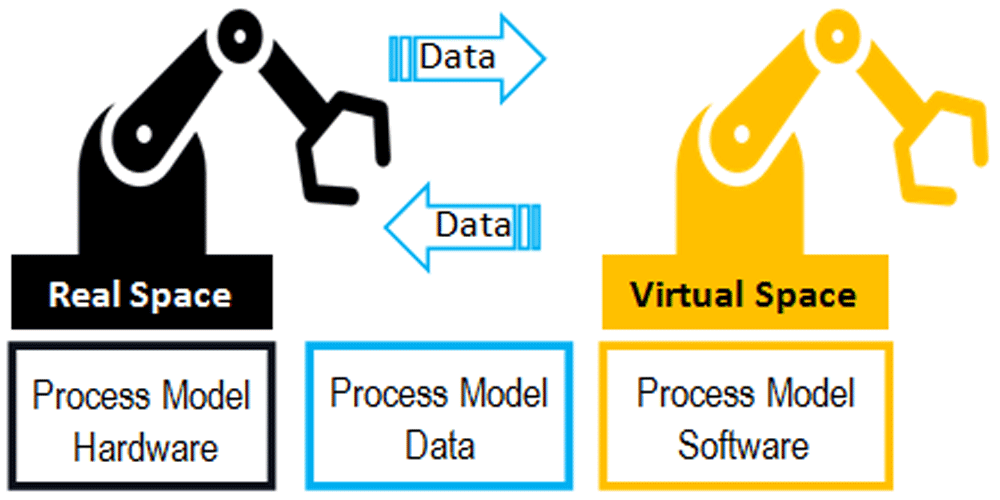
Figure 1. Interaction of the models.
Note. Description if the interaction between the models, modified version according to Tao et al. (2019).
In practice, the challenge of handling these different types of process models is solved, among other things, via so-called program management or program manager (Null et al., 2019), which is defined here as follows: “Program management combines several projects that are linked to one another are dependent. In this case, all projects serve to achieve an overarching goal. According to our definition, a program is, in short, a main project with many sub-projects” (Strasser & Schmidt-Sibeth, 2023). Consequently, on the one hand, the diversity of the relevant procedural models when implementing digital twins and, on the other hand, their handling via program management must be taken into account. As part of the work, a distinction will be made between four types of process models, which will be presented in the next chapter: (1) Process Model - Hardware; (2) Process Model - Data; (3) Process Model - Software; (4) Process Model – Various.
Process Models - Software
The software development life cycle (SDLC) deals with the creation of software and uses, among others, the following common process models: “… Incremental model, Prototype model, Spiral model, Iterative model, Waterfall model, V-model, RAD mode and Agile model… ” (Kyeremeh, 2019).
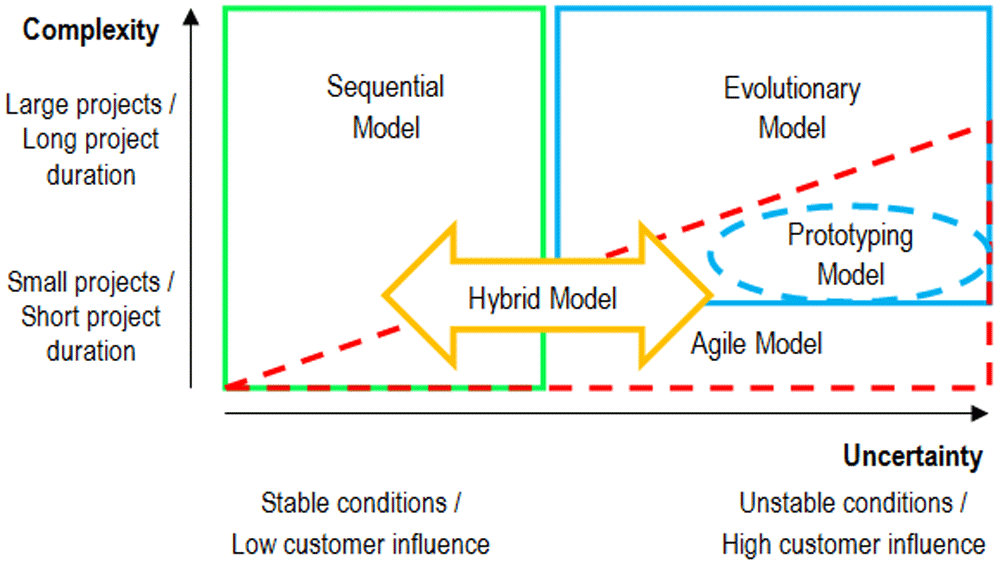
The definition by Ebert (2014), the process models of software development can be divided into four model families (Ebert, 2014, as cited in Scharch, 2016):
Sequential models are characterized by a separation into phases that are processed and completed one after the other in a top-down process. As part of this study, these models will include the classic “waterfall model with and without setbacks” (Scharch, 2016) and the “V-Shaped Model” as a variant of the waterfall model with integrated verification and validation of the product/order in relation to the fulfillment of customer requirements. In the “Parallel Model” the phases are processed in parallel, such as in simultaneous engineering (Scharch, 2016).
Evolutionary models are used when the requirements are not precisely defined at the start of the project. In the context of this work, these include the “Spiral Model”, which provides the option of planned jumps back to the individual phases of the classic waterfall model (= recursive character) as well as the “Rational Unified Process” – RUP Model – with an iterative or incremental character (Scharch, 2016).
Prototyping model (= creation of a usable preliminary version of the product), has the goal of carrying out an early evaluation or revision of a prototype in the interests of the customer (Scharch, 2016). This model is a subset of the Evolutionary Model.
Agile Models have the ability to respond quickly to changes in the environment/customers. “SCRUM” as a model is based on phased planning (= sprint), whereby the theoretical basis is the agile framework according to the agile manifesto. “Extreme Programming” (XP) attempts to implement ideas in an early phase of the project via prototype (Scharch, 2016).
The above model families should be supplemented by the “hybrid model” as a further form of process models:
Hybrid models are characterized by a combination of two or more models. What counts here are, among other things, combinations of traditional and agile approaches (Copola Azenha et al., 2021)
Furthermore, another model family is to be introduced:
This results in an adaptation of the approach of Ebert (2014) regarding the characterization of process models (Ebert, 2014, as cited in Scharch, 2016), on the one hand in the sense of supplementing hybrid models and on the other hand in re-evaluating the areas of application of agile Models (= dashed line) that can be used especially in the area of “unstable conditions and high customer influence” as shown in Figure 2:
In total, six model families can be derived within the framework of this work: (1) Sequential Model; (2) Evolutionary Model; (3) prototyping model; (4) Agile Model; (5) Hybrid model; (6) Other models. If a specific process model is chosen for software development, the methods and tools are also defined (Scharch, 2016, p.6). In the context of this work, following this logic, we will always talk about process models with assigned methods and tools.
The question still arises as to whether there is a need for research regarding process models for software development for digital twins. This question can be answered positively, as various authors, including Follath et al. (2022), Schweigert-Recksiek et al. (2020), Johansson et al. (2022), Reinhart et al. (2019) and Wu et al. (2021) are working or have worked on the development of their own process models.
Process Models - Data
There are various procedural models with regard to data mining. These include, among others, the classic approaches (Rotondo & Quilligan, 2020):
“Knowledge Discovery in Databases” (KDD)
“Cross Industry Standard Process for Data Mining” (CRISP-DM) and its more agile data mining variant “ASUM-DM” (Angée et al., 2018)
“Sampling - Exploring - Modifying - Modeling - Assessing” (SEMMA)
These models have been supplemented by new or modified models, such as Microsoft's “Team Data Science Process” (TDSP), which can be defined as follows: ... “is a flexible, iterative data science methodology for the efficient delivery of predictive analytics solutions and intelligent applications” (Microsoft, 2023). Another procedural model is “DASC-PM”, which is particularly concerned with the process of data science projects and the necessary skills (Schulz et al., 2020).
Since the “data” and “software” process models partly follow similar principles, the above models should also be assigned to the following model families (Scharch, 2016): (1) Sequential Model; (2) Evolutionary Model; (3) prototyping model; (4) Agile Model; (5) Hybrid model; (6) Various approaches.
Process Models - Hardware
This process model is about process models that are required when implementing the digital twin with regard to production technology (e.g. the implementation of actuators or sensors). The following models can be used for this:
“Lean Manufacturing”, “Six Sigma” or “Lean Six Sigma” (= DMAIC cycle) as relevant models, even in the age of Industry 4.0 (Antony et al., 2022)
“Design for Six Sigma”, if the focus is on a product (= less the process) as a digital twin (Psarommatis, 2021)
“Business process management” (BPM) aims to map processes that are not physical in nature. These are used to digitally map the process in order to then show, for example, resource bottlenecks, incorrect process execution or other waste (BOC Group, 2023; GBTEC Software AG, 2023)
“Total Quality Management” (Asana, n.d.)
“Theory of Inventive Problem Solving” (TRIZ) as an innovation approach for technological products and processes (Li et al., 2017; Sojka & Lepšík, 2020)
“ISO – Standards” (ISO.Org, 2023)
Since the “hardware” and “software” process models also have similarities, the above models should also apply here: (1) Sequential Model; (2) Evolutionary Model; (3) prototyping model; (4) Agile Model; (5) Hybrid model; (6) Various approaches. Models that cannot be assigned to the above three model types are assigned here. The topic of model families is treated analogously to the other model types.
Research Question and Hypotheses
In summary, it can be stated that there are comprehensive studies (Singh et al., 2021a) on types, areas of application ( Singh et al., 2022) and the architecture of digital twins, but the number of studies in relation is still limited to the methodical implementation of the implementation of digital twins in the sense of a step-by-step guide. This leads to questions, including which methods or tools should be suitable components of such a process model, e.g. data mining process methods (Rotondo & Quilligan, 2020), process improvement tools (Sojka & Lepšík, 2020) or hybrid approaches (Gemino et al., 2021). Which methods or tools are currently used? What trends are emerging for the future?
Due to the complexity and diversity of the topic, there is a focus on process models for product or process digital twins in the sense of the Reference Architecture ISO 23247 (Shao, 2021) or comparable - ideally with a production reference - which are suitable for the implementation of digital twins are. The subject of research is therefore the question (RQ) about existing process models, their analysis or comparison as well as the derivation of ideas for modified process models:
Taking into account the research questions, the state of science and the focus on production-related use cases, the following hypotheses H can be derived:
H1: The majority of the examined process models for implementing digital twins are based on sequential model families.
H2: The majority of the examined process models for implementing digital twins are based on the phase model of classic project management.
Method
The study is based on a shortened systematic literature search according to Nordhausen and Hirt (2022), whereby search strings were not used. The following structure of the study was chosen (Nordhausen & Hirt, 2022), presented in Table 3:
Table 3. Overview - Systematic Literature Search.
| Step-by-Step Approach - Systematic Literature Research | Implementation of the Procedure - Systematic
Literature Research |
|---|
| 1. Establishing the research principle | A sensitive principle was chosen that allows as many hits as possible to the question. |
| 2. Determination of search components | Digital twin, production, manufacturing, logistics |
| 3. Establishing databases | DBIS, e-library, EZB, Scopus, Web of Science, Google Scholar, EBSCO, ProQuest, DOAJ, BASE |
| 4. Determination of keywords | Project Management, Framework, Process Model, Design, Management, Planning,
Implementation, Methodology, Practical Guide, Hands On, Method |
| 5. Conducting the research | Implementation according to steps 1 – 4 |
| 6. Documentation of results | Implementation of the documentation |
The investigation is structured as follows, presented in Table 3:
Step 1: Carrying out a literature search and analysis of the process models found with regard to the assignment to different model families, such as Sequential Model, Evolutionary Model, Prototyping Model, Agile Model or Hybrid Model
Step 2: Comparative consideration of the process models in relation to the phases
Results
Carrying out Literature Research - Process Models
In order to derive different profiles for process models, the first step was to search for existing process models (PM), and the second step was to analyze the profile. The consideration was based on the following criteria: (a) name of the model; (b) brief description of the model; (c) assignment to the different types of process models (e.g. software); (d) Assignment of the process models to the defined “families”, e.g. sequential models. It should be noted at this point that assumptions had to be made about family membership as the available information was not always clear; (e) number of phases; (f) Mention of the title with reference to the source. The literature search provided the following results, summarised in Table 4:
Table 4. Overview – Selected Process Models.
| Profil of the Process Model (PM) |
|---|
Example I.
• PM - Title: Digital Twin-Driven Product Design (DTPD)
• PM - Description: A model with various methodologies/tools
• PM - Type: Diverse – New approach
• PM - Family: Sequential model – where the order can be changed and individual steps can take place in parallel (Tao et al., 2019),
which may indicate a “waterfall model or parallel model with few setbacks”.
• PM - Phases: 7x
• PM - Source: “Digital Twin-Driven Product Design (DTPD) Framework” (Tao et al., 2019) |
Example II.
• PM - Title: No title
• PM - Description: A model with recommendations for the use of different models in the respective phases
• PM - Type: Hard- and Software
• PM - Family: Hybrid model approach - sequential model as a roadmap (= e.g. waterfall or parallel model with few setbacks),
combined with evolutionary and agile models (e.g. SCRUM, Scaled Agile Framework - SAFe) in individual phases, e.g. in scaling
(Reinhart et al., 2019)
• PM - Phases: 5x
• PM - Source: “Digital twin - basics, fields of application and implementation strategies” (Reinhart et al., 2019) |
Example III.
• PM - Title: No title
• PM - Description: A model with some recommendations for methodologies / tools
• PM - Type: Software
• PM - Family: Sequential model with “Interdependence of Building steps” (Ariansyah et al., 2020). It can probably be assumed that
this is a “waterfall or parallel model with few setbacks”.
• PM - Phases: 8x
• PM - Source: “Digital Twin Development: A Step by Step Guideline” (Ariansyah et al., 2020) |
Example IV.
• PM - Title: DT Lifecycle
• PM - Description: A model with detailed requirements for implementation
• PM - Type: Hard- and Software
• PM - Family: Presumably an evolutionary model with many regressions, including a prototyping model
• PM - Phases: 10x
• PM - Source: “A Requirements Driven Digital Twin Framework: Specification and Opportunities” (Moyne et al., 2020) |
Example V.
• PM - Title: Integrated Five-Dimensional Framework & TRIZ Functional Model
• PM - Description: Integrated model, insists on Five-Dimensional Framework and TRIZ
• PM - Type: Hard- and Software
• PM - Family: Hybrid model approach – sequential model (= five-dimensional framework) with elements of an evolutionary model (= various jumps back), combined with the TRIZ model
• PM - Phases: 5x
• PM - Source: “Conceptual digital twin modeling based on an integrated five dimensional framework and TRIZ function model” (Wu et al., 2021) |
Example VI.
• PM - Title: The FA3St Approach
• PM - Description: A model with various methodologies/tools
• PM - Type: Hard- and Software
• PM - Family: Evolutionary model with many regressions; it is probably a “spiral model” or “prototyping model”
• PM - Phases: 6x
• PM - Source: “Methodology and Tools for Digital Twin Management - The FA3ST Approach” (Stojanovic et al., 2021) |
Example VII.
• PM - Title: Five-Dimension Digital Twin Model
• PM - Description: A model with various methodologies / tools, consisting of five dimensions for the implementation of a digital twin: Physical World - Virtual Model - Data Management - Services - Connections
• PM - Type: Hard- and Software as well as Data
• PM - Family: Sequential model
• PM - Phases: 5x
• PM - Source: “Enabling technologies and tools for digital twin” (Qi et al., 2021) |
Example VIII.
• PM - Title: Digital Twin – ISO 23247
• PM - Description: A model with various methodologies/tools
• PM - Type: Hard- and Software
• PM - Family: Sequential model in the sense of a “waterfall model with few setbacks”
• PM - Phases: 5x
• PM - Source: “ISO 23247 Part 1 – 4, Software Development Life Cycle – Traditional” (Shao, 2021) |
Example IX.
• PM - Title: No title
• PM - Description: A model with various sub-models
• PM - Type: Hard- and Software as well as Data
• PM - Family: Hybrid model approach - mix of sequential, evolutionary and agile models
• PM - Phases: 5x
• PM - Source: “Building Industrial Digital Twins: Design, develop, and deploy digital twin solutions for real-world industries using Azure Digital Twins” (Nath et al., 2021) |
Example X.
• PM - Title: No title
• PM - Description: A model based on the CRISP-DM approach
• PM - Type: Data and Software
• PM - Family: Evolutionary model with many possible regressions; it is probably a “spiral model” or “prototyping model”
• PM - Phases: 6x
• PM - Source: “A process model for the creation of digital twins for production and logistics” (Follath et al., 2022) |
Example XI.
• PM - Title: No title
• PM - Description: A model based on ISO 21500:2012
• PM - Type: Data and Software
• PM - Family: Hybrid model approach - sequential model, based on a “waterfall model with rare regresses” or “parallel model” or evolutionary model in the sense of a “spiral model / prototyping model with many regresses”
• PM - Phases: 5x
• PM - Source: “D4.3 Digital Twin Supported Lean Project Planning, Control and Risk Management” (Johansson et al., 2022) |
Example XII.
• PM - Title: No title
• PM - Description: A model based on the CRISP-DM approach
• PM - Type: Hardware and Data
• PM - Family: Evolutionary model with many possible regressions; it is probably a “spiral model” or “prototyping model”
• PM - Phases: 7x
• PM - Source: “Process Model for the Data-driven Identification of Machine Function Usage for the Reduction of Machine Variants” (Wagenmann et al., 2022) |
Example XIII.
• PM - Title: Small-Scale Digital Twin Implementation Framework
• PM - Description: A model with various methodologies/tools
• PM - Type: Hardware and Data
• PM - Family: Sequential model, based on a “waterfall model or parallel model with rare jumps”
• PM - Phases: 7x
• PM - Source: “Proposing a Small-Scale Digital Twin Implementation Framework for Manufacturing from a Systems Perspective” (Loaiza et al., 2023) |
Example XIV.
• PM - Title: No title
• PM - Description: A model with various technologies or methodologies/tools
• PM - Type: Hardware and Data
• PM - Family: Sequential model, based on a “waterfall model or parallel model with rare jumps”
• PM - Phases: 5x
• PM - Source: “Digital Twin: Technology Evolution Stages and Implementation Layers with Technology Elements” (Jeong et al., 2022) |
Example XV.
• PM - Title: No title
• PM - Description: A model with various methodologies/tools
• PM - Type: Hard- and Software
• PM - Family: Hybrid model approach - Based on a sequential model (= “waterfall model with rare regresses” or “parallel model”) or evolutionary model in the sense of a “spiral model / prototyping model with many regresses”
• PM - Phases: 7x
• PM - Source: “Advancing digital twin implementation: a toolbox for modelling and simulation” (Singh et al., 2021b) |
The above list of selected process models does not claim to be complete, but it does provide initial results with regard to the methods or tools used: (a) The process models often consist of a combination of several models; (b) The majority of procedure models for hardware and software are presented; (c) sequential and evolutionary models with more or fewer regressions or their combination dominate; (d) The number of phases ranges from 5 – 10 phases; (e) The models are generally not older than 4 years; (f) The boundary between architecture and process model is partially undefined; (g) Project management approaches are partly integrated into the process model.
The following Table 5 provides an overview of the assignment of the process models to model families and in particular the role of the hybrid process models, although it must be pointed out again that in some cases clear information regarding the assignment was missing and therefore certain assumptions had to be made.
Overall, it can be stated that the hybrid process models in the narrower sense (= agile with traditional) or broader sense (= non-agile with traditional) make up around 1/3 of all models. This result is interesting in that it confirms a trend that is also visible in the comparison between agile and classic project management (Pepino et al., 2021). In other words, for complex tasks with many people or partners involved and customer requirements that are generally difficult to predict, as is typically the case for the implementation of digital twins, hybrid approaches seem to be an important option.
Comparative Consideration - Process Models
In the second step, the above process models were examined in detail in relation to the process steps, i.e. the individual process steps were presented and examined according to patterns.
To summarise, the following main finding - based on Table 6a to Table 6e - were obtained: For examples II, III, IV, VI, IX, X, XI and XII, phases were discovered that can be found in a similar form in almost all the examples analysed. These phases included:
Table 6a. Overview – Process Steps of each selected model.
| Example I. | Example II. | Example III. |
|---|
| Step 1: Create Virtual Product | Step 1: Preparation (Vison/Team/Approach/Ressources) | Step 1: Define the requirements |
| Step 2: Analyze, Integrate and visualize data | Step 2: Design (Understanding/Idea/Prototyp/Validation) | Step 2: Develop the information flow |
| Step 3: Simulate behaviours | Step 3: Review (Business Plan/ Decision) | Step 3: Build the virtual representation |
| Step 4: Control behaviours | Step 4: Scaling (Traditional / Agiles Project Management) | Step 4: Develop the data exchange system |
| Step 5: Communicate with virtual product | Step 5: Controlling (Monitoring / Learning) | Step 5: Carry out analysis |
| Step 6: Measure data | | Step 6: Develop actions |
| Step 7: Use of the framework of digital twin-driven product design (DTPD) for design activities | | Step 7: Verify |
| | Step 8: Validate |
Source:
(Tao et al., 2019) | Source:
(Reinhart et al., 2019) | Source:
(Moyne et al., 2020) |
Table 6b. Overview – Process Steps of each selected Model.
| Example IV. | Example V. | Example VI. |
|---|
| Step 1: Envision | Step 1: “Perform a function analysis to identify and decompose the digital twin’s functions” | Step 1: Identify |
| Step 2: Design | Step 2: “Classify functions into corresponding modules of the five-dimensional framework” | Step 2: Model |
| Step 3: Develop | Step 3: “Construct the expanded TRIZ function model of the PE as the basis for the conceptual model” | Step 3: Develop (Configure/Deploy/Verify) |
| Step 4: Verify | Step 4: “The VE completes the data analysis to generate corresponding instructions and optimize the PE’s operation” | Step 4: Share |
| Step 5: Validate | Step 5: “Embody users in the conceptual model” | Step 5: Use |
| Step 6: Deploy | | Step 6: Validate |
| Step 7: Use | | |
| Step 8: Evaluate | Source:
(Wu et al., 2021) | Source:
(Stojanovic et al., 2021) |
| Step 9: Maintain | | |
| Step 10: Tune / Rebuild | | |
Source:
(Moyne et al., 2020) | | |
Table 6c. Overview – Process Steps of each selected Model.
| Example VII. | Example VIII. | Example IX. |
|---|
| Step 1: Tools for cognizing & controlling physical world | Step 1: “Select standards & technologies for data collection” | Step 1: Pre-Project |
| Step 2: Tools for digital twin modeling | Step 2: “Select standards & technologies for data control” | Step 2: Project Scoping |
| Step 3: Tools for digital twin data management | Step 3: “Select standards & technologies for communication between DCDCE and CE” | Step 3: Project Design / Development |
| Step 4: Tools for digital twin service applications | Step 4: “Select standards & technologies for digital representation” | Step 4: Project Validation |
| Step 5: Tools for connections in digital twin | Step 5: “Select standards & technologies for for communication between digital twins and users” | Step 5: Project Scaling |
Source:
(Qi et al., 2021) | Source:
(Shao, 2021) | Source:
(Nath et al., 2021) |
Table 6d. Overview – Process Steps of each selected Model.
| Example X. | Example XI. | Example XII. |
|---|
| Step 1: Operational understanding | Step 1: Initiating | Step 1: Situation Analysis |
| Step 2: System understanding | Step 2: Planning | Step 2: Problem Containment |
| Step 3: System preparation | Step 3: Implementing | Step 3: Alternative Solutions |
| Step 4: Modeling | Step 4: Controlling | Step 4: Selection of Solutions |
| Step 5: Evaluation | Step 5: Closing | Step 5: Consequences Analysis |
| Step 6: Application | | Step 6: Make Decision and Realization |
| | Step 7: Recapitulate and Learn |
Source:
(Follath et al., 2022) | Source:
(Johansson et al., 2022) | Source:
(Wagenmann et al., 2022) |
Table 6e. Overview – Process Steps of each selected Model.
| Example XIII. | Example XIV. | Example XV. |
|---|
| Step 1: “Define what processes, products, or system to twin in the virtual space” | Step 1: “Digital virtualization: digital representation and objectification process” | Step 1: “Cross-integration of multiple models to accurately simulate dynamic behaviors of a physical twin” |
| Step 2: “Install perception devices such as sensors, actuators, tags, and readers in the physical layer” | Step 2: “Digital twin synchronization: real-time mutual synchronization between real-world and virtual-world components” | Step 2: “Execution of DT model in “what-if” scenarios to facilitate forecasting, maintenance and risk assessment” |
| Step 3: “Create a database management system that give access to different type of databases” | Step 3: “Modeling and simulation: analyzing and predicting the real world” | Step 3: “Evolution of DT model over time, along with the physical twin” |
| Step 4: “Enable a digital thread that connects different types of data, devices, and systems” | Step 4: “Federated digital twin: interworking for mutual federation and collaboration between digital twins” | Step 4: “Reduction of model computation time and maintenance of model complexity” |
| Step 5: “Install a digital twin software that shows digital twin models and data and enables user’s operation” | Step 5: “Intelligent digital twin services: Managing digital twin service lifecycle” | Step 5: “Integration and control of real-time data” |
| Step 6: “Create digital twin models with their properties in the DT software” | | Step 6: “Calculation level of uncertainty in computed results and acquired data” |
| Step 7: “Enable digital twin functionalities such as feeding data to DT models” | | Step 7: “Validation and verification (V & V) of DT model” |
Source:
(Loaiza et al., 2023) | Source:
(Jeong et al., 2022) | Source:
(Singh et al., 2021b) |
Define / Initiating Phase: This phase includes necessary project preparations and measures for the project start, such as goal definition or situation analysis. Here, the above examples mostly show clear similarities, visible from the terms used, such as “define, preparation, identify, operational understanding, initiating or situation analysis”.
Design / Development / Planning Phase: Almost all examples are also characterized by the fact that they go through a design or development phase or both, recognizable by the terms “design, development, modeling, planning”.
Use / Scaling / Implementation Phase: Some models explicitly refer to the implementation phase.
Controlling / Review or Validation Phase: The majority of models go through this phase, which can be recognized by the terms “Controlling, Review, Validation, Validate, Evaluation”.
Closing / Lessons Leaned Phase: In the majority of models, the permanent implementation of the developed digital twin including lessons learned - combined with the completion of the project - also takes place in this phase. This can be seen in the terms “closing, maintain, application, recapitulate and learn”.
The five phases mentioned above in Table 7 represent a kind of intersection for the above examples II, III, IV, VI, IX, X, XI and XII. What is striking about these phases is that they can be found in a similar form in the Principles of Project Management, i.e. classic project management (Wysocki, 2007).
Table 7. Comparison of the Approaches – Implementation Process vs Project Management.
| Process Model | According to Wysocki (2007) | 5 Phases - Intersection |
|---|
| Phase 1 | Defining | Define / Initiating |
| Phase 2 | Planning | Design / Develop / Planning |
| Phase 3 | Launching | Use / Scaling / Implementation |
| Phase 4 | Monitoring and Controlling | Controlling / Review / Validation |
| Phase 5 | Closing | Closing / Lessons Leaned |
Although no pattern could be identified in the phases for Examples V., VII. and VIII., the similarity in terms of the procedure was striking. In these examples, the focus of consideration was on the use of suitable tools/technologies for the respective phases.
Examples I., XIII., XIV. and XV. could not be assigned to any of the above groups. What is characteristic of this group is that they describe the step-by-step implementation process, detached from a project management approach.
Discussion
Hypothesis Testing
If you look at the examined process models for digital twins, the following conclusions can be drawn from the hypotheses:
Hypothesis 1 was based on the assumption that sequential procedural models predominate. The results show that different model families are used. Sequential models represent the largest proportion of models (= sum of single and hybrid models), followed by evolutionary models. Hybrid model approaches as mixed forms appear in 1/3 of the models. Overall, Hypothesis 1 can therefore be confirmed.
Hypothesis 2 dealt with the question of whether the phase model of classic project management can be found in the majority of the process models examined. In this regard, it can be stated that in 8 of 15 models a large proportion of the relevant phases were actually recognizable, in the remaining 7 models this was negative, i.e. here too only a brief confirmation of hypothesis 2. For the 7 deviating models it can be seen that whose process models are either strongly oriented towards the implementation of the architecture of digital twins or on the connection between the process model and the tools/methods that can be used. In other words, the project management approach is not an essential part of the latter models.
Implications
The results allow the following conclusions to be drawn in practice:
(a) The examined process models for digital twins were mostly based on the phases of classic project management, some with a sequential character, which does not necessarily do justice to the complex challenges; (b) Evolutionary process models are a useful extension of the sequential model approach, but should be supplemented by agile project management with the appropriate method kit (e.g. Scurm, SAFe), since digital twin projects are usually larger projects with many project participants that require a supporting project management methodology. Evolutionary process models alone - without a suitable method kit - are not enough here; (c) Hybrid project management approaches as part of the process model - in the sense of combining classic and agile project management - could represent a useful addition, as these approaches offer more flexibility in terms of the requirements for the individual implementation steps. Agile approaches are often preferred in programming, whereas classic project management approaches still dominate in technology. Both areas are usually the subject of the development of digital twins, which suggests a compromise; (d) Hybrid models are not only reduced to agile and traditional approaches, the combination of other process models, such as the CRISP-DM approach for data management with a Lean Six Sigma approach for project management, could also seem sensible (Schäfer et al., 2018). The same applies to the combination of innovation approaches such as TRIZ with a process model for digital twins (Sojka & Lepšík, 2020); (e) Various process models lack the project management approach, e.g. Examples I., XIII., XIV. and XV. offer a flowchart - often based on the architecture of the digital twin - for the implementation of the digital twin. Such approaches should – if necessary and sensible – be supplemented by a project management approach; (f) Other process models, such as Examples V., VII. and VIII., focus on providing a toolbox that provides suitable tools and methodologies. These approaches are helpful because they already provide tools but should also be complemented by a project management approach; (g) Artificial intelligence approaches are still underused, although simple tools to support them are already available (Sommer, 2023a).
Limitation
However, the results of the study also show that the development of models is not yet complete and that the process models presented therefore only reflect the current interim status of development. It should also be noted that process models and project management approaches of the authors analysed were sometimes - consciously or unconsciously - combined with each other, which may lead to a lack of clarity in the results of this study. Further investigations are required in order to analyse the dynamic further development of the process models and to eliminate possible inaccuracies.
Conclusion and outlook
The fifteen process models examined document, on the one hand, that the implementation of digital twins based on suitable process models is an important topic in practice, but on the other hand, the discussion is still open about what such a process model looks like. With increasing interest in digital twins, the need for suitable process models is expected to grow steadily. Process models with a sequential character - with and without accompanying project management - dominate, but hybrid approaches are increasing in importance: (a) on the one hand as an integrated project management component, i.e. a combination of agile and classic project management, since these meet the digital twin requirements in terms of hardware (= rather classic approach), software (= more agile approach) and data management; (b) on the other hand as a combination of different models, such as CRISP-DM approach for data management with a lean approach for implementation in production.
The focus of further investigation should be the collection of empirical data regarding the success of the various model approaches in practice.