Disclaimer
The views expressed in this article are those of the author(s). Publication in Open Research Europe does not imply endorsement of the European Commission.
We report a remarkable correlation between the strike of major transform faults around the world and those of orogens and related contractional structures on adjacent continental margins. A striking characteristic of the orogens correlating with major transform faults is that they consistently strike highly oblique to orthogonal to the rift and mid-ocean ridge and parallel to the transform faults that offset the rift and mid-ocean ridge (Figure 1). Since the orogens are consistently older than the rifts and transforms with which they correlate (Figure 1), we propose that they played a central role in controlling the formation of the transform faults and in forcing the rift to step sideways and/or hindering (i.e., delaying or preventing) continental breakup, acting as potential barriers to rifting.
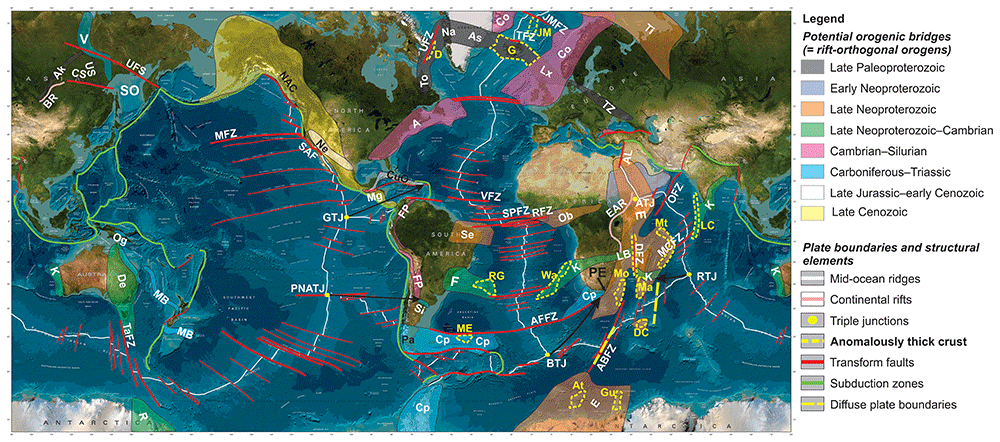
The diffuse plate boundaries in the southwestern Indian Ocean are from Chu and Gordon (1999). The basemap is from Jakobsson et al. (2004). Abbreviations: A: Appalachian Orogen; AFFZ: Agulhas–Falkland fault zone; Ak: Akitkan Orogen; AL: Aqaba–Dead-Sea–Levant fault zone; As: Ammassalik Belt; At: Astrid Ridge; ATJ: Afar Triple Junction; BR: Baikal Rift; BTJ: Bouvet Triple Junction; Ca: Cape Fold Belt; Co: Caledonian Orogen; CS: Cis–Stanovoy Orogen; CuO: Cuban Orogen; DC: Del Cano Rise; DFZ: Davie fault zone; E: East African–Antarctica Orogen; EAR: East African Rift; F: Dom Feliciano Belt; FP: Famatinian–Pampean Orogen; G: Greenland–Iceland–Faroe Ridge; GTJ: Galapagos triple junction; Gu: Gunnerus Ridge; JMFZ: Jan Mayen fault zone; K: Kuunga Orogen; LB: Lurio Belt; LC: Laccadive–Chagos Ridge; Lx: Laxfordian Orogen; Ma: Madagascar Ridge; MB: Median Batholith; MCFZ: Marie Celeste fault zone; ME: Maurice Ewing Bank; MFZ: Mendocino fault zone; Mg: Motagua Suture Zone; Mo: Mozambique Ridge; Mt: Mauritia; Na: Nagssugtoqidian Orogen; NAC: North American Cordillera; O: Ne: Nevadan Orogen; Ob: Oubangides/Central African Orogen; OFZ: Owen fault zone; Og: Omung Group metamorphics; Pa: Patagonia; PE: Port Elizabeth; PNATJ: Pacific–Nazca–Antarctica Triple Junction; Pu: Puerto Rico; R: Ross Orogen; RFZ: Romanche fault zone; RG: Rio Grande Ridge; RTJ: Rodrigues Triple Junction; SAC: South African Cordillera in Colombia and Venezuela; SAF: San Andreas fault; Se: Sergipano Belt; Si: Sierra de la Ventana Fold-and-Thrust Belt; SO: Sea of Okhotsk; SPFZ: Saint Paul fault zone; Ta: Tasman–Delamerian–New England–Lachlan–Thompson–Mosman Orogen; TaFZ: Tasman fault zone; TFZ: Tjörnes fault zone; Ti: Timanian Orogen; To: Torngat Orogen; TZ: Tornquist Zone; UFS: Ulakhan fault system; UFZ: Ungava fault zone; US: Ulkan Orogen/Suture; V: Verkhoyansk Fold-and-Thrust Belt; VFZ: Vema fault zone; Wa: Walvis Ridge.
It has been possible to establish this correlation in great part due to major improvements in the quality of seismic reflection imaging and partly to our ability to now identify major shear zones (e.g., Bird et al., 2016; Fazlikhani et al., 2017; Hedin et al., 2016; Lenhart et al., 2019; Phillips et al., 2016; Ye et al., 2020), thrust systems and related contractional structures, whose seismic facies are now well established (e.g., Koehl, 2020; Koehl, 2021; Koehl, 2024a; Koehl et al., 2022; Koehl et al., 2023a; Koehl et al., 2023b; Koehl et al., 2024; Koehl et al., 2025; Koehl & Stokmo, 2024; Morley et al., 2017). Although mylonitic detachments have been identified for some time on seismic data (e.g., Christensen, 1965; Fountain et al., 1984; Hurich et al., 1985), the spectrum of contractional structures correlated from onshore outcrops to subsurface seismic data was significantly broadened only very recently. It now includes stacks of thrust sheets separated by mylonitic shear zones, contractional duplexes, antiformal thrust stacks, and asymmetric (up to recumbent and isoclinal) folds within shear zones (Koehl, 2021; Koehl et al., 2022; Koehl et al., 2023a).
Plate tectonics, which evolved from Alfred Wegener’s Continental Drift Theory (1929), governs our vision of the evolution of Earth’s surface over time (e.g., Wilson, 1966). Surface movements are related to deep processes, which are thought to be a key component of present-day plate tectonics (e.g., Burke & Torsvik, 2004). However, deep processes do not explain all data, in particular offshore areas of anomalously thick crust (e.g., Iceland). Such crust typically displays continental affinities (e.g., Foulger et al., 2020a).
Some major transform faults in the Atlantic and Indian oceans, e.g., the Romanche and Andrew Bain fault zones (Figure 1), do not conform with typical transform fault geometries. Instead, they comprise multiple segments (Ligi et al., 2002) that bound slivers of lithosphere that switched movement direction as seafloor spreading progressed (the “oscillatory spreading” of Bonatti and Crane, 1982). These faults show the largest age offset of the mid-ocean ridges they truncate and most likely have a different thermal structure, i.e., they probably also involve cold lithosphere (Bonatti et al., 2001; Ligi et al., 2002). In addition, they do not lie on small circles about the Eulerian pole of rotation (Cande et al., 1988; Chu & Gordon, 1999; Sclater et al., 2005; Shaw & Cande, 1990), so their strikes do not fit well with the spreading direction. We explore the factors controlling the formation of major transform faults.
Large areas of (hyper-) extended continental crust have now been discovered offshore. New offshore continental blocks generally not included in full-plate-tectonic reconstructions (e.g., Cao et al., 2021; Domeier & Torsvik, 2014; Merdith et al., 2021; Young et al., 2019) include the Lomonosov Ridge (Knudsen et al., 2017; Rekant et al., 2019), the Alpha–Mendeleev Ridge (Foulger et al., 2024; Jackson & Chian, 2019), the De Long Islands block (Ershova et al., 2016), the Laptev Sea (Shipilov et al., 2021), portions of the Eurasian Basin (Jokat & Schmidt-Aursch, 2007), and the Chukchi Borderlands in the Arctic Ocean (Brumley et al., 2015; O’Brien et al., 2016). In the northeastern Atlantic Ocean, they include the Hovgård and East Greenland ridges (Dumais et al., 2020), Icelandia (Foulger et al., 2020a; Geoffroy et al., 2022a), the Jan Mayen Microcontinent Complex (Bott, 1985; Johnson & Heezen, 1967; Schiffer et al., 2018), the Rockall Plateau and Rockall Bank (Dickin, 1992; Roberts et al., 1973), and the Davis Strait High in the northwestern Atlantic Ocean (Dafoe et al., 2022). In the Central Atlantic Ocean, such blocks include the Newfoundland and Iberian margins (Lymer et al., 2019; Shillington et al., 2006). In the South Atlantic, blocks of continental affinity include the Walvis–Rio Grande Ridge (Fromm et al., 2017a; Fromm et al., 2017b; Santos et al., 2019), a wide portion of the continental margin off Namibia (Geoffroy et al., 2022b), and Maurice Ewing Bank and the Falkland Plateau (Chemale Jr. et al., 2018; Stanca et al., 2022). In the Indian Ocean, continental affinities are probable for the Mozambique and Madagascar ridges (Klimke et al., 2018; Ryzhova et al., 2022; Sato et al., 2022), the Del Cano Rise (Sato et al., 2022), Mauritia (Torsvik et al., 2013), and Zealandia in the southwestern Pacific Ocean (Luyendyk, 1995; Mortimer et al., 2006; Mortimer et al., 2017).
The issues around transform faults and relatively recently discovered offshore continental blocks have major implications for past and present-day plate tectonics, the formation of oceanic crust at mid-ocean ridges, and the repeated opening and closing of oceans between the continents (e.g., opening and closing of Iapetus between Laurentia and Svalbard followed by the opening of the northeastern Atlantic Ocean). They imply that current models are overly simplistic and that revisions to the basic model should be considered. We propose a new approach and views that can address these issues. Notably, we propose that major transform faults form along rift-orthogonal orogens and that RRR triple junctions form at the intersection of two or more orogens. This new approach would also help predict future tectonic evolution of Earth’s surface (e.g., propagation and steps in rift axis) and test the existence of paleo-transform faults. These ideas suggest less dynamism in paleo-plate tectonics. Whilst embracing modern plate tectonics, the new theory introduces a role for prolonged connection between continents locally and for limited time periods. This general concept was originally introduced in a simplistic form as Land Bridge Theory.
Every major transform fault on Earth strikes parallel to an orogen and related structures on one or several adjacent rifted margins. By “major transform faults” we mean transform faults showing offset of active mid-ocean ridges greater than a few tens of kilometers. By “orogens”, we mean belts deformed intensely during contractional strain for several tens of million years leading to the development of kilometer-wide, hundreds-of-kilometers long, kilometer-thick structures such as thrust faults, shear zones, folds, and other related fabrics. This process also forms crust thicker than regular, anorogenic 40 km-thick continental crust.
This relationship has been pointed out and investigated locally at a few margins by a few studies only (Buiter & Torsvik, 2014; Peace et al., 2018). However, the global pattern defined by transform faults and rift-orthogonal orogens has received little attention despite the potential significant implications. This may be because of the challenge of doing the required interdisciplinary science, inhomogeneity of necessary data, and conflicting opinions and methods. Contributing issues may be outdated, faulty assumptions about the geology of specific areas, incomplete data particularly from remote areas (e.g., the Arctic, Fram Strait, and Davis Strait), or areas of poor exposure that are covered by young basins and sediments. Geophysical data may also be limited in extent, especially in areas where it is more challenging to acquire, e.g., in mountainous onshore regions, whereas decades of exploration for natural resources in offshore areas like the North Sea have produced rich seismic reflection datasets.
In this paper, we review the relationship between major transform faults and preexisting orogens on adjacent margins across all oceans. Orogenic bridge theory (OrBiT) states that the style of continental rifting (e.g., orthogonal, oblique, transform) is controlled by preexisting orogens. Orogens parallel to a propagating rift will facilitate rifting and breakup, whereas orogens perpendicular to the opening rift form strong barriers and result in the development of orogenic bridges, which deflect the rift and/or delay breakup.
Preexisting orogenic belts striking parallel to a propagating rift will facilitate the opening and propagation of the rift and control the strike and geometry of structures formed during rifting. These include dominantly extensional structures such as brittle normal faults and ductile detachments bounding sedimentary basins and basement horsts and metamorphic core complexes (Figure 2a). This endmember (“rift-parallel endmember”) has been discussed in several papers (e.g., Brune et al., 2023; Chenin et al., 2015; Corti et al., 2022; Li et al., 2023; Osagiede et al., 2020; Péron-Pinvidic & Osmundsen, 2020; Péron-Pinvidic et al., 2022; Salazar-Mora et al., 2018).
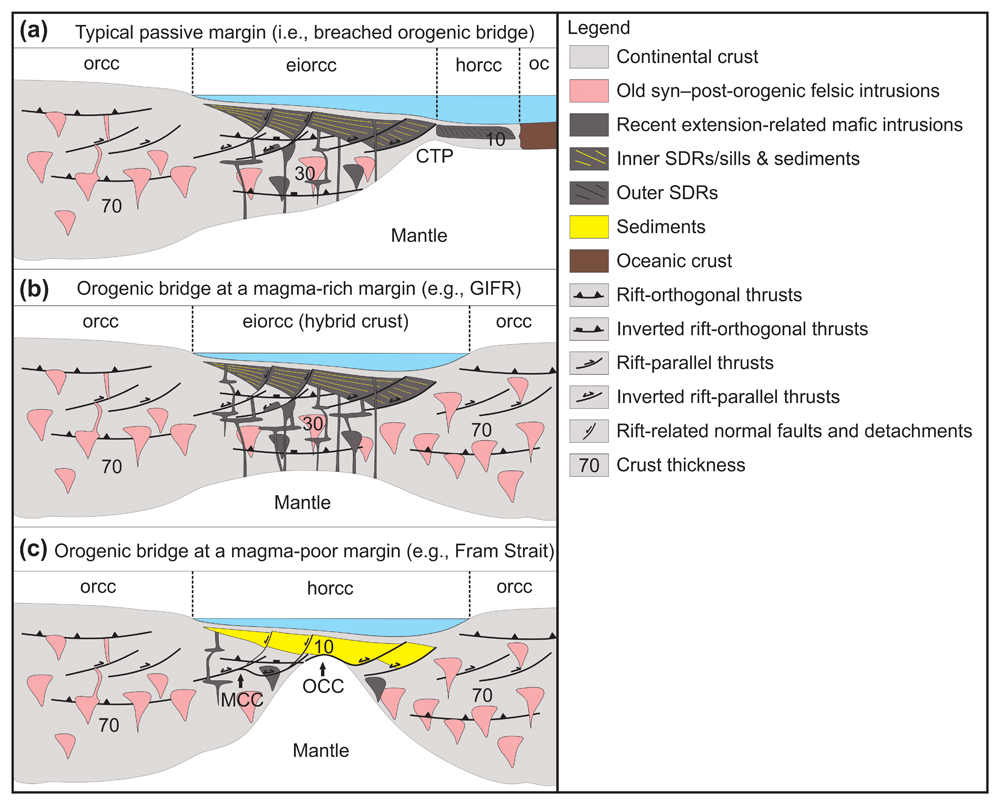
(a) Typical rifted margin with thinned continental crust, SDRs, and oceanic crust (based on the new classification of SDRs and new margin architecture by Geoffroy et al., 2022b). Note the occurrence of the continent–ocean boundary somewhat farther seaward than typically suggested. (b) Orogenic bridge at a magma-rich margin, e.g., the GIFR, where large amounts of mafic magma intruded thinned orogenic continental crust, thus producing hybrid continental crust (i.e., extensively intruded by mafic magma). (c) Orogenic bridge at a magma-poor margin, e.g., the Fram Strait, where metamorphic and oceanic core complexes formed both orthogonal (parallel to the section) and parallel (annotated on the sketch) to the active rift. In both (b) and (c), preexisting thrust systems parallel and perpendicular to the rift thinned the continental crust. This implies that the regions studied here were affected by at least two (non-coeval) orogenic events whose main stress were perpendicular to one another. Orogens (in the present case parallel to the propagating rift) generally show a dominant transport direction (i.e., the orogens are generally asymmetric rather than symmetric) and, therefore, the internal crustal asymmetry of continental margins in (b) and (c) is rather the rule than the exception. Abbreviations: CTP: Crustal Thin Point; eiorcc: extended and intruded orogenic continental crust; horcc: hyperextended orogenic continental crust; MCC: metamorphic core complex; oc: oceanic crust; OCC: oceanic core complex; orcc: orogenic continental crust; SDRs: seaward-dipping reflectors.
Conversely, orogens striking highly oblique to perpendicular to a propagating rift (“rift-orthogonal endmember”) will act as barriers and significantly hinder rift propagation, i.e., significantly delaying breakup or preventing the rift from opening in a linear fashion or from propagating. This endmember has thus far been little studied (Molnar et al., 2020). The term “orogenic bridge” refers to the orogenically thickened crust of a rift-orthogonal orogen, which was (hyper-) extended during rifting (Figure 2b and c) and is applied to areas of continental crust that extend further into the oceanic realm than normal passive margins. The term “bridge” is used in reference to the land bridges (also called Isthmian Links) inferred by the Land Bridge Theory to explain similar fauna and flora on separate continents, while rifting had already initiated (e.g., Gregory, 1929; Schuchert, 1932; von Ihering, 1931; Willis, 1932). All the previously proposed land bridge sites match the location of hereby proposed orogenic bridges, thus suggesting that parts of Land Bridge Theory may hold the key to unlocking a more advanced understanding of plate tectonics (Figure 1).
Despite the apparent correlation of the location of some of the proposed orogenic bridges with that of so-called land bridges, orogenic bridges are clearly different from land bridges. While land bridges imply continent fixity, orogenic bridges work in symbiosis with plate tectonics and extend and contract together with adjacent plate segments undergoing seafloor spreading. This is due to the fact that preexisting thrust systems at orogenic bridges strike dominantly oblique to orthogonal to the active rift (Figure 3a–b). As such, these structures are unsuitable to accommodate crustal thinning (Figure 3c). In addition, the low-angle character of thrust faults makes them unsuitable to accommodate transform movements. However, their rift-orthogonal orientation is suitable to control the formation of new subvertical transform faults. Thus, rift-orthogonal thrust systems hinder rifting, forcing the rift to jump or bypass certain areas (e.g., Greenland–Iceland–Faroe Ridge; Figure 3d). While oceanic crust forms on either side of orogenic bridges, the continental crust at orogenic bridges continues to stretch until break up occurs there too. Should there be any speed difference between seafloor spreading at mid-ocean ridges and stretching within the thinning orogenic bridge, these may be accommodated by transform faults at the continent–ocean boundary.
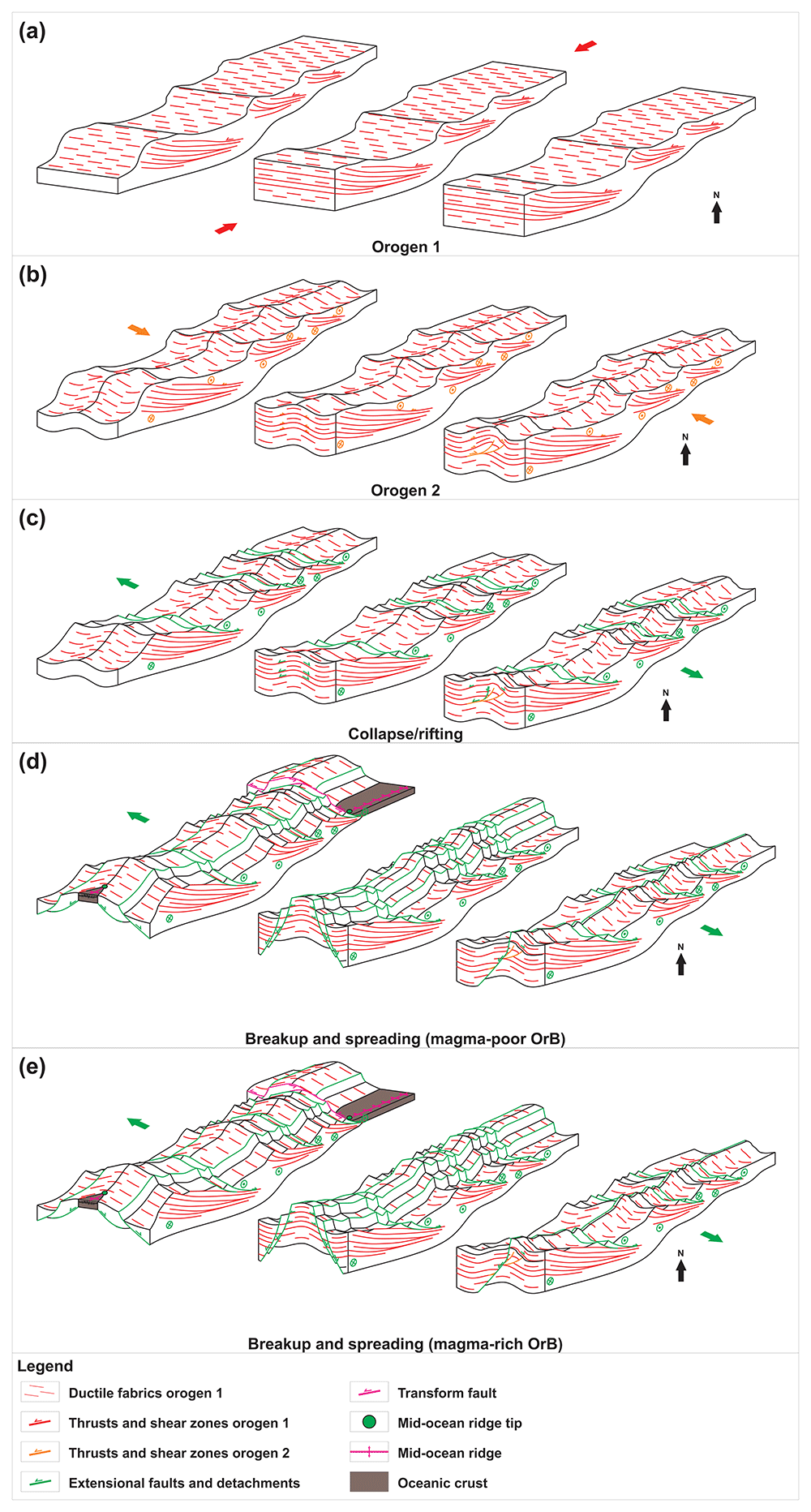
(a–b) Orogenic bridges typically form through at least two orogeneses perpendicular to one another, which allows tightening and locking of the crust, e.g., in the case of the GIFR (a) WNW–ESE-striking Laxofordian–Nagssugtoqidian Orogen and (b) NE–SW-striking Caledonian Orogen. (c) Several episodes of post-orogenic extension (e.g., in the Devonian, Permian–Triassic, and Jurassic–Cretaceous at the GIFR) are accommodated along extensional faults and detachments formed along inherited orogenic structures. (d) Breakup occurs along inherited, reactivated and/or overprinted orogenic structures. In the case of the GIFR breakup occurred first in the Cenozoic at the Reykjanes Ridge south of the GIFR and at the Ægir Ridge northeast of the GIFR. Note that any number of additional orogeneses and/or extensional collapse/rifting may be added in between these events. Abbreviations: GIFR: Greenland–Iceland–Faroe Ridge; TFZ: Tjörnes fault zone. Modified after Koehl et al. (2024).
Clear evidence of the reworking of orogenic bridges during orogenesis and rifting are shown in Koehl et al., (2024; 2025). Notably at the GIFR, WNW–ESE-striking late Paleoproterozoic thrust systems of the Laxfordian–Nagssugtoqidian Orogen interpreted within the GIFR and adjacent continental margins of the Faroe Islands and southeastern Greenland (Figure 3a) were reworked as 100–200 km wide open anticlines during the Caledonian Orogeny (i.e., shortened orogenic bridge; Figure 3b) and were later inverted during post-Caledonian extension, thus contributing to thinning the crust (extending orogenic bridge; Koehl et al., 2024 their figure 2e; Koehl et al., 2025; Figure 3c).
Should rifting continue long enough, rift-orthogonal orogens will force the rift to reorient locally (e.g., Molnar et al., 2017) to accommodate a major sideway step (Figure 3d) before propagating further or merging two propagating rifts on either side of an orogenic bridge. An example is the parallel northeastern Atlantic (Mohns Ridge) and Arctic rifts (Gakkel Ridge) that are linked via the oblique Fram Strait rift (Knipovich Ridge, Molloy Deep, and Lena Trough), which opened tens of millions of years after seafloor spreading initiated at the Mohns and Gakkel ridges. As a result, rift-orthogonal orogens are thought to localize the formation of major (> a few tens of kilometers lateral offset) transform faults.
Through the concept of offshore orogenic bridge (Figure 3a–d), Orogenic Bridge Theory suggests that a fair portion of the submarine areas around the globe consists of (hyper-) extended and/or extensively intruded (i.e., hybrid) orogenic continental crust (Figure 2b and c). Rift-related (hyper-) extension of continental crust, the intrusion of continental crust by large volumes of mafic magma at magma-rich rift segments, and the occurrence of thickened orogenic crust with structures striking orthogonal to propagating rifts all together may, thus, explain present-day datasets. Land bridges were once proposed by knowledgeable geoscientists in the early 20th Century. It is therefore not surprising that they may hold some truth after all.
OrBiT highlights a new relationship between major transform faults and rift-orthogonal orogens by demonstrating the occurrence of ridges of orogenically-thickened, (hyper-) extended continental crust (orogenic bridges) striking perpendicular to propagating rifts offshore. It suggests that the amount of oceanic crust on Earth and, consequently, the amount of horizontal movement by the continental blocks over the history of the Earth are currently overestimated. OrBiT also potentially enables the prediction of the location of future rift steps, transform faults, rift propagation, and breakup.
Large-scale relationships in the Atlantic Ocean were discussed by Lundin & Doré (2005). They noted a coincidence of Neoproterozoic–Phanerozoic fold-and-thrust belts with the volcanic segments of the continental rifted margins. However, the Central African Orogen/Oubangides branch of the Pan African Orogeny, which strikes E–W and separates the Sahara meta-craton from the Congo craton (e.g., Kouémo et al., 2014; Kröner & Stern, 2004; Toteu et al., 2022) and extends into northeastern Brazil as the Sergipano Belt (D’el-Rey Silva, 1999; Finoto Bueno et al., 2009; Oliveira et al., 2006; Oliveira et al., 2010; Oliveira et al., 2015; Figure 1) was not included. With the addition of this orogen, the relationship of volcanic margins with preexisting orogens and of non-volcanic margins with the absence of preexisting orogens becomes tenuous. Another disagreement is the occurrence of the Timanian Orogen at the magma-poor segment of the northeastern Atlantic rift in the Fram Strait along the western Svalbard–Barents Sea margin and the northern Greenland margin (Estrada et al., 2018a; Klitzke et al., 2019; Koehl, 2020; Koehl et al., 2022; Koehl et al., 2023a; Koehl, 2024b; Rosa et al., 2016).
Lundin et al. (2022) further highlighted the relationship of preexisting orogens with the location of major transform faults, showing that the continental crust at transform margins is on average thicker than the continental crust at rifted margins. This supports the orogenically-thickened character of the continental crust at major transform margins (e.g., Fram Strait). Other studies suggested that oblique and associated major transform fault systems may result in asymmetric hyperextended margins (e.g., Le Pourhiet et al., 2017). However, these studies did not address the causes of major rift offsets or steps.
Another relevant study is the modeling of the influence of preexisting zones of weakness in the crust and mantle on rifting (Dunbar & Sawyer, 1989). While mantle weaknesses were suggested to explain the formation of “wet” rifts with intense magmatism and narrow passive configurations, crustal weaknesses were associated to the formation of “dry” rifts and broad passive margins. Like Lundin & Doré (2005), this study attempted to relate zones of intense magmatism with preexisting structural fabrics.
Other studies investigated the impact of oblique preexisting discontinuities on rift segmentation and obliquity (e.g., Brune et al., 2017; Brune et al., 2018; Molnar et al., 2017; Zwaan et al., 2021). However, they did not address the formation of transform faults and the specific influence of preexisting orogens, which the present study attempts to generalize for the first time.
Potential Orogenic Bridges (OrBs)
Potential orogenic bridges we discuss include the Fram Strait (Dumais et al., 2020; Koehl, 2020; Koehl & Mottram, 2024; Koehl et al., 2025 awaiting peer review; Koehl et al., 2021), the Greenland–Iceland–Faroe Ridge (GIFR; Foulger et al., 2003; Foulger et al., 2020a; Foulger et al., 2020b; Foulger, 2006; Geoffroy et al., 2022a; Torsvik et al., 2015), and the Davis Strait (Dafoe et al., 2022; Dalhoff et al., 2006) in the North Atlantic region. We also discuss Maurice Ewing Bank and the Falkland Plateau (Chemale Jr. et al., 2018; Stanca et al., 2022) in the South Atlantic, and the Mozambique, Madagascar, and Gunnerus ridges and the Del Cano Rise (Klimke et al., 2018; Leitchenko et al., 2008; Sato et al., 2022) in the Indian Ocean.
Continuous Orogenic Bridges (OrBs)
The concept of continuous orogenic bridge implies that continental crust continues across a previously inferred oceanic domain. In such areas, true oceanic crust is proposed to be absent (i.e., not yet present and overestimated by 100%). Instead, these areas may include possible sections of hybrid crust (see Figure 2a and b) – continental crust capped by thick successions of volcanic rocks (e.g., lava flows) and extensively intruded by igneous rocks (e.g., seaward-dipping reflectors). Sections of hybrid crust are locally believed to extend the width of previously assumed oceanic domains. Three potentially continuous orogenic bridge are discussed here, the Timanian orogenic bridge in the Fram Strait, the Nagssugtoqidian–Torngat orogenic bridge in the Davis Strait, and the Greenland–Iceland–Faroe orogenic bridge (Figure 4).
Timanian orogenic bridge
The recent discovery of continuous, late Neoproterozoic Timanian thrust systems extending from northwestern Russia to the Svalbard Archipelago through the Barents Sea has dramatically changed our perception of the pre-Caledonian tectonic history in this entire region (Koehl, 2020; Koehl et al., 2022; Koehl et al., 2023a; Koehl et al., 2023b; Koehl, 2024b; Figure 4). Some of these structures can be traced across the magma-poor Fram Strait (e.g., in the Hovgård Ridge; Koehl, 2020 pp. 163–166; Koehl et al., 2021) into blocks of continental crust that are now known to be fully attached to Laurentia and Greenland’s continental crust (Dumais et al., 2020; Figure 4). While the Svalbard margin thins rapidly and is relatively narrow (< 200 km), the Greenland margin is much broader (up to 600 km at the East Greenland Ridge; Figure 4), which is possibly related to the dominant top-east vergence of Caledonian thrusts (rift-parallel endmember of OrBiT; e.g., Koehl, 2024b; Ohta et al., 1986; Ohta et al., 1995).
New magnetic data at the Knipovich Ridge by Dumais et al. (2020) and seismic reflection data between the Molloy and Spitsbergen fault zones (Koehl, 2020 pp. 167–180, Koehl et al., 2021 pp. 9–20; Figure 4) show that there is little to no oceanic crust sensu stricto along the Molloy Ridge. Seismic reflection data nevertheless show thin layers of volcanics and possibly mantle exhumed along extensional detachments, e.g., a possible core complex parallel to the Molloy fault zone (Koehl, 2020; Koehl et al., 2021). This together with the dramatically thin character of the continental crust on the northeastern Greenland margin indicate that the crust is hyperextended and is generally thinner than 12 km except at the Hovgård Ridge and East Greenland Ridge where it is about 12 km (Døssing et al., 2008; Dumais et al., 2020; Ritzmann et al., 2004). Furthermore, Timanian subduction-related magmatism was recently identified in northern Greenland (Estrada et al., 2018a; Rosa et al., 2016), Arctic Canada (Estrada et al., 2018b), and the Lomonosov Ridge (Rekant et al., 2019; Figure 4), further supporting the continuation of the Timanian Orogen across the northeastern Atlantic–Arctic rift.
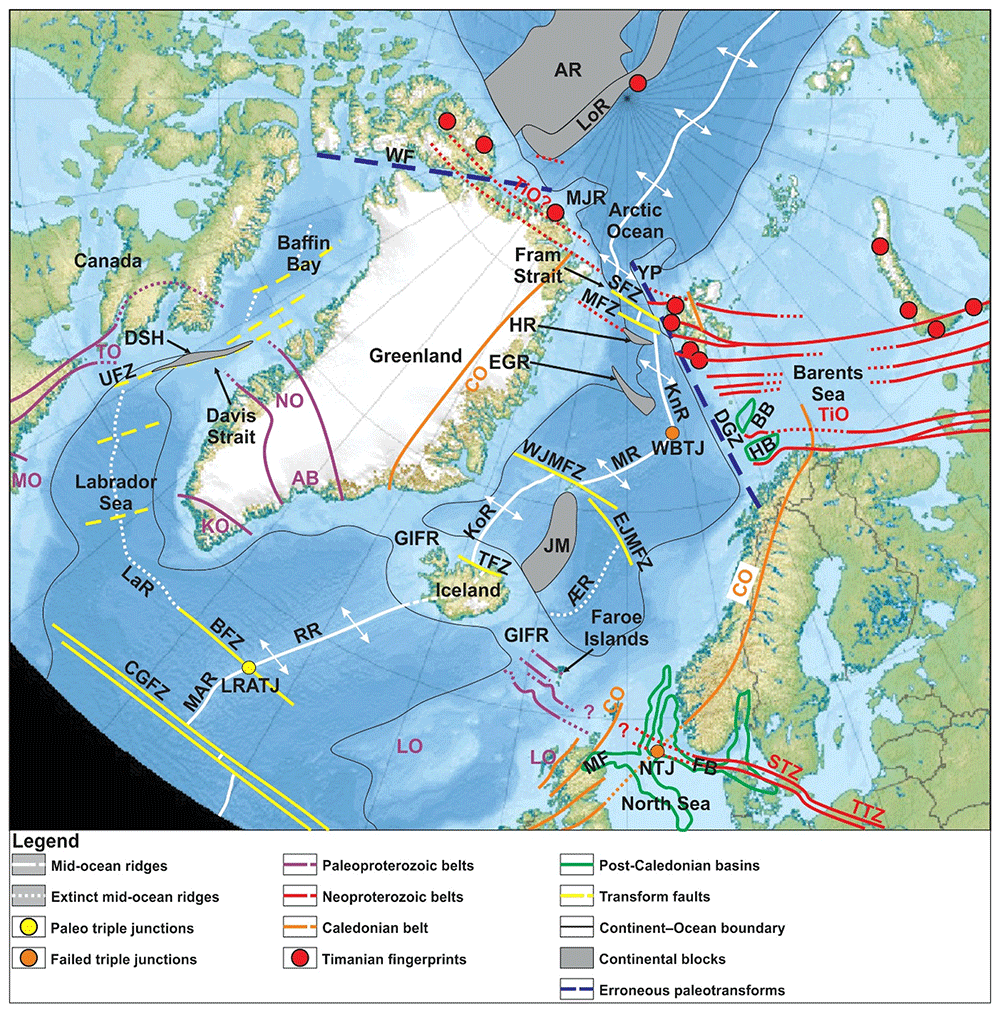
Three orogenic bridges are proposed in the area: the Timanian orogenic bridge in the Fram Strait, the Nagssugtoqidian–Torngat orogenic bridge in the Davis Strait, and the Greenland–Iceland–Faroe orogenic bridge between Greenland, Iceland, and the Faroe Islands (the Greenland–Iceland–Faroe Ridge – GIFR). Basemap is from Jakobsson et al. (2012). Abbreviations: AB: Ammassalik Belt; AR: Alpha–Mendeleev Ridge; BB: Bjørnøya Basin; BFZ: Bight fault zone; CGFZ: Charlie Gibbs fault zone; CO: Caledonian Orogen; DGZ: De Geer Zone; DSH: Davis Strait High; EGR: East Greenland Ridge; EJMFZ: East Jan Mayen fault zone; FB: Farsund Basin; HB: Hammerfest Basin; HR: Hovgård Ridge; JM: Jan Mayen Microcontinent Complex; KO: Ketilidian Orogen; KoR: Kolbeinsey Ridge; KnR: Knipovich Ridge; LO: Laxfordian Orogen; LaR: Labrador paleo-mid-ocean ridge; LoR: Lomonosov Ridge; LRATJ: Labrador–Reykjanes–Mid-Atlantic paleo triple junction; MAR: Mid-Atlantic Ridge; MF: Moray Firth; MFZ: Molloy Fault Zone; MJR: Morris Jesup Rise; MO: Makkovikian Orogen; MR: Mohns Ridge; NJT: North Sea failed triple junction; NO: Nagssugtoqidian Orogen; SFZ: Spitsbergen Fault Zone; STZ: Sorgenfrei–Tornquist Zone; TiO: Timanian Orogen; TO: Torngat Orogen; TTZ: Teisseyre–Tornquist Zone; UFZ: Ungava Fault Zone; WBTJ: Western Barents Sea failed triple junction; WF: Wegener Fault; WJMFZ: West Jan Mayen fault zone; YP: Yermak Plateau; ÆR: Ægir Ridge.
Most studies of seismic reflection data west of Svalbard show that the margin lacks evidence of strike-slip movements (Austegard et al., 1988; Eiken, 1994; Eiken & Austegard, 1987; Gabrielsen et al., 1990; Lasabuda et al., 2018; Riis & Vollset, 1988). This is surprising given the expectation of a major N–S-striking paleo-transform there, the so-called De Geer Zone (Figure 4), which has been inferred on the basis of the linear geometry of the Svalbard–Barents Sea margin and the conjugate margin in northern Greenland (du Toit, 1937; Harland, 1961; Harland, 1967; Harland, 1969; Horsfield & Maton, 1970; Wegmann, 1948). Recent studies show that several late Neoproterozoic Timanian thrust systems extend past the speculated location of the early Cenozoic De Geer Zone without any lateral offset (Koehl, 2024b). This suggests that Timanian thrusts may extend from northwestern Russia to northern Greenland thus forming a continuous orogenic bridge across the Fram Strait (Figure 4). The two active transform faults in the Fram Strait, the Molloy and Spitsbergen fault zones, strike parallel to and probably developed along preexisting Timanian thrusts (Koehl et al., 2021; Koehl & Mottram, 2024; Koehl et al., 2025 awaiting peer review).
The proposed late Neoproterozoic (650–550 Ma) age of the rift-orthogonal orogen in the Fram Strait, which is supported by various geochronological studies throughout Svalbard (Koglin et al., 2022; Koehl & Mottram, 2024; Manecki et al., 1998; Majka et al., 2008; Majka et al., 2012) is a conservative estimate. It is possible that the orogen in the Fram Strait and the Barents Sea may be part of the late Paleoproterozoic Svecofennian Orogen, which crops out in western Troms in northern Norway and displays the same structural trend (WNW–ESE) and dominant thrust vergence (top-SSW) as the Timanian Orogen (Bergh et al., 2010; Bergh et al., 2022). The Svecofennian Orogen is a time-equivalent to the Laxfordian and Nagssugtoqidian orogens, which if traces of late Paleoproterozoic orogenesis were to be found in Svalbard and the Barents Sea would suggest a first-order impact of this ca. 1.9–1.8 Ga orogenic event on Orogenic Bridge Theory and resulting plate tectonics.
Nagssugtoqidian–Torngat orogenic bridge
The Davis Strait connects the Labrador Sea, which is undoubtedly partly underlain by oceanic crust (e.g., Oakey & Chalmers, 2012; Peace et al., 2016), and Baffin Bay, where the existence of oceanic crust is more speculative (e.g., Funck et al., 2012; Welford et al., 2018). Along the strait, a major transform fault, the Ungava Fault Zone (Chalmers & Pulvertaft, 2001; Dafoe et al., 2022; MacLean et al., 1982; Oakey & Chalmers, 2012) along which the mid-ocean ridge is believed to have stepped, flanks a basement high, the Davis Strait High, which is thought to be of continental nature based on dredge samples (Dalhoff et al., 2006) and seismic reflection data (Dafoe et al., 2022).
On either side of the strait, numerous onshore studies have revealed well-developed Paleoproterozoic orogenic structures of the ENE–WSW-striking Nagssugtoqidian Orogen in western Greenland (Mengel et al., 1998; van Gool et al., 2002a) and of the N–S-striking Torngat Orogen in northeastern Canada (van Gool et al., 2002b; van Gool et al., 2005; Figure 1 and Figure 4). Despite being highly oblique, the two orogens are believed to merge with one another in the Davis Strait and to be part of the same (folded? Indented?) orogen. In northeastern Canada, the Torngat Orogen appears to curve into an ENE–WSW strike in northern Labrador–southeastern Baffin Island, thus potentially forming an arch hundreds of kilometers wide with the Nagssugtoqidian Orogen in map view (Figure 4).
This arch is interpreted as a potentially continuous orogenic bridge (Figure 4) given the continental nature of the Davis Strait High (Dafoe et al., 2022; Dalhoff et al., 2006). This is supported by consistent kinematics in both orogens, i.e., sinistral shear zones and top-SSE (i.e., hanging wall moving to the south-southeast) thrusts in the Nagssugtoqidian Orogen and sinistral shearing and top-east thrusting in the Torngat Orogen (Mengel et al., 1998; van Gool et al., 2002a; van Gool et al., 2002b; van Gool et al., 2005). The continuity character of the Nagssugtoqidian–Torngat orogenic bridge is consistent with the absence of apparent lateral offset of the orogen across the Ungava Fault Zone. The latter was recently proposed to have formed along preexisting late Paleoproterozoic structures of the Torngat Orogen based on seismic reflection interpretation and modeling (Heron et al., 2019; Peace et al., 2018). This calls for further reexamination of movements along this major fault.
The Greenland–Iceland–Faroe Ridge orogenic bridge
The 25–40 km thick crust below the GIFR (Darbyshire et al., 1998) has long been interpreted as thick oceanic crust formed through the activity of a deep mantle plume, with magmatism initiating at ca. 62 Ma or 54 Ma or even 252 Ma depending on the model (e.g., Torsvik et al., 2015; White & McKenzie, 1995). The anomalously thick crust nevertheless suggests that a continental/hybrid crustal model, i.e., continental crust extensive intruded by mafic magma (Figure 2a and b) should be considered (Foulger et al., 2003; Foulger et al., 2020a; Foulger, 2006; Geoffroy et al., 2022a). Foulger et al. (2020a) suggested that the GIFR might represent a section of previously orogenically-thickened but now stretched continental crust, which presented high resistance to rifting and continental breakup. They suggested that this anomalous crust could be the northern continuation of the western frontal thrust of the Caledonian Orogen in Scotland and might link with the Caledonides of southeastern Greenland.
This model is plausible considering the similarly abrupt (c. 90°) bend of the Scandinavian Caledonides in the southern Barents Sea (Gernigon & Brönner, 2012; Gernigon et al., 2014) from an overall NE–SW strike in Norway and Sweden (e.g., Corfu et al., 2014; Roberts, 2003) to a N–S trend in Svalbard (e.g., Harland et al., 1992; Manby, 1986; Witt-Nilsson et al., 1998). Other orogens worldwide show similar 90° bends (e.g., Verkhoyansk Orogen in northeastern Russia; Figure 1). However, the model neglects the Scandinavian Caledonides, which were proposed to represent the continuation of the southern Scottish Caledonides (e.g., Coward, 1990; Fossen, 2010; McClay et al., 1986; Norton et al., 1987).
If the Scottish Caledonides represent the continuation of the southeastern Greenland Caledonides, it is unclear how and where the Scandinavian Caledonides continue to the southwest. In addition, this model requires not one but two abrupt c. 90° bends of the Caledonian Orogen, and the required two bends of the Caledonian Orogen would have to be generated by overall NW–SE-oriented Cenozoic extension during rifting. This is unlikely because NW–SE extension is more likely to have inverted and overprinted NE–SW-striking Caledonian structures instead of deflecting them by 90°. Major post-Caledonian shear zones onshore southern and western Norway are now known to extend in a northeast–southwest strike offshore (Fazlikhani et al., 2017; Fossen & Hurich, 2005; Lenhart et al., 2019; Osagiede et al., 2020; Phillips et al., 2016; Serck et al., 2022) and to merge with their analogously striking counterparts in the northern UK (Bird et al., 2016; Coward et al., 1989; Platt & Cartwright, 1998).
An alternative source for orogenically thickened crust below the GIFR may be the Paleoproterozoic, WNW–ESE-striking Ammassalik Belt, the probable continuation of the Nagssugtoqidian Orogen in southeastern Greenland (Figure 1 and Figure 4; Bridgewater & Myers, 1979; Chadwick & Vasudev, 1989; Chadwick et al., 1989; van Gool et al., 2002b; van Gool et al., 2005). Major structures in the belt show top-SSW kinematics consistent with structures in the Nagssugtoqidian Orogen in western Greenland (Kalsbeek et al., 1993; van Gool et al., 2002b; van Gool et al., 2005). Another alternative is the Ketilidian Orogen in southern Greenland (Chadwick et al., 2000; Garde et al., 1997; Garde et al., 2002a), but it occurs further to the southwest. The coeval Ammassalik Belt is a possible candidate (Figure 4).
In northern Europe, the correlate of the Ammassalik Belt is the late Paleoproterozoic Laxfordian Orogen on the Rockall Plateau and northern Scotland. This orogen was thought to consists of WNW–ESE-striking, subvertical shear zones showing strike-slip kinematics (Attfield, 1987; Coward & Park, 1987; Dickin, 1992). However, recent mapping on reprocessed seismic reflection data has revealed that the Laxfordian shear zones onshore northern Scotland are part of much larger structures, namely tens of km thick, WNW–ESE-striking, dominantly NNE-dipping thrust systems around the Faroe Islands (Koehl et al., 2024). These were reworked into hundreds of km wide, NE–SW-striking open folds during the Caledonian Orogeny and extend beyond the seaward-dipping reflectors and previously assumed continent–ocean boundary off the Faroe Islands (Koehl et al., 2024). Ongoing seismic mapping at the GIFR indicates that these late Paleoproterozoic structures extend to below southeastern Iceland and thus that the Iceland–Faroe segment of the GIFR is largely continental (Koehl et al., 2025).
The hundreds of km wide, NE–SW-striking open folds mapped along the entire length of the GIFR by Hjartarson et al. (2017) coincide with the Caledonian folds reworking late Paleoproterozoic structures off the Faroe Islands and at the Iceland–Faroe Ridge (Koehl et al., 2024; Koehl et al., 2025). This may explain the thickness variations of the GIFR along its length (i.e., in a WNW–ESE direction; Hjartarson et al., 2017 their figure 3c). This also suggests that the ca. 1.8 Ga U–Pb age obtained for zircons from basalts in southeastern Iceland (Schaltegger et al., 2002), where Laxfordian thrust systems occur at shallow crustal level (c. a few km; Koehl et al., 2025), may be genuine. Further efforts should therefore concentrate on dating zircons from lavas in southeastern Iceland.
In eastern Europe, the WNW–ESE-striking Tornquist Zone, i.e., the Teisseyre–Tornquist Zone (Krzywiec et al., 2022; Mazur et al., 2015) and its probable continuation the Sorgenfrei–Tornquist Zone (Ponikowska et al., 2024), extends from the Black Sea (Mikolajczak et al., 2019; Narkiewicz et al., 2015) to the southern North Sea (Kalani et al., 2020; Phillips et al., 2018) and is a natural potential continuation for some of the Laxfordian structures at the GIFR and off the Faroe Islands (Koehl et al., 2024; Koehl et al., 2025; Figure 4). Available seismic reflection data in the central and northern North Sea and west of the Faroe Islands suggest that the Sorgenfrei–Tornquist Zone may continue as far north as the Shetland Plateau (e.g., Bird et al., 2016; Fossen & Hurich, 2005; Gabrielsen et al., 2015; Koehl, 2025; Serck et al., 2022). The Tornquist Zone accommodated significant contractional deformation and related crustal thickening as early as the Neoproterozoic during the closure of the Tornquist Ocean (Torsvik & Rehnström, 2003). The Tornquist Zone possibly consists of top-northeast (Abramovitz et al., 1999; Krzywiec et al., 2017; Lyngsie & Thybo, 2007; Mazur et al., 2015; Mazur et al., 2018) and top-SSW thrusts (Phillips et al., 2018 their figures 2 and 11; Koehl, 2025).
Both the Tornquist Zone in Europe and structures of the Ammassalik Belt in southeastern Greenland parallel the GIFR and the Tjörnes fault zone, a major right-lateral complex shear zone in northern Iceland that connects the Icelandic Northern Volcanic Zone and the Kolbeinsey Ridge, i.e., a c. 100 km offset of the rift axis (Einarsson, 1976; Einarsson, 1991; Khodayar, 2018; Khodayar & Björnsson, 2018; Rögnvaldsson et al., 1998; Young et al., 1985; Figure 4). We therefore propose that the GIFR represents a continuous orogenic bridge, which is currently preventing through-going propagation (or unzipping) of the Mid-Atlantic Ridge.
The c. 100 km offset of the rift axis along the Tjörnes fault zone is relatively modest. However, many major transform faults may have initiated with small offsets, e.g., the Andrew Bain, Charlie Gibbs, and San Andreas fault zones (e.g., Mueller & Jokat, 2019 their figure 15; Seton et al., 2012 their figures 4 and 10; Vormann & Jokat, 2021 their figure 3). The offset at the Tjörnes fault zone may grow over time should seafloor spreading continue and rifting possibly rupture the GIFR orogenic bridge. The Kolbeinsey Ridge only recently took over spreading (at ca. 22 Ma) from the now-extinct Ægir Ridge, which is offset from the Reykjanes Ridge by ≥ 350 km (e.g., Blischke et al., 2016; Gernigon et al., 2020). Thus, the small present offset at the Tjörnes fault zone may reflect its embryonic development stage.
Further analysis of geophysical data at the GIFR is ongoing. Further attention should be given to the expression of Paleoproterozoic structures of the Ammassalik Belt and Laxfordian Orogen on offshore seismic reflection data at the GIFR because of the well-constrained top-SSW kinematics and NNE-dipping geometry onshore (e.g., Kalsbeek et al., 1993) and offshore continuation into the GIFR (Koehl et al., 2024; Koehl et al., 2025), and our present ability to identify deep-seated orogenic structures and thrust systems on seismic reflection data (e.g., Fazlikhani et al., 2022; Freeman et al., 1988; Hedin et al., 2016; Juhlin et al., 2016; Koehl et al., 2022; Koehl et al., 2023a; Platt & Cartwright, 1998).
Previous studies have suggested that continental crust beneath Iceland is connected to the Jan Mayen Microcontinent Complex (Torsvik et al., 2015). Northeast of Jan Mayen, the West and East Jan Mayen fault zones are parallel to late Paleoproterozoic orogenic structures in northern and southern Scandinavia (Svecofennian–Svecokarelian Orogen; Bergh et al., 2010; Johansson et al., 2015; Saintot et al., 2011) and at the GIFR and northern Scotland (Coward & Park, 1987; Koehl et al., 2024; Koehl et al., 2025; Figure 4). These transform faults, as depicted in Blischke et al. (2022 their figure 5a), dip gently at depth and display a geometry more typical of thrust faults. This and the occurrence of wiggly seismic reflections along the entire length of the Jan Mayen Microcontinent Complex, which probably represent contractional asymmetric folds (e.g., Koehl, 2021; Koehl et al., 2022), strongly suggest that deep rift-orthogonal orogenic structures controlled the formation of the Jan Mayen fault zones. Like in northern Scotland, northern Norway, and elsewhere, these late Paleoproterozoic orogenic structures were mildly reworked during the Caledonian Orogeny (e.g., Koehl et al., 2024; Koehl et al., 2025).
Knowing that the Baltica craton already existed in the late Paleoproterozoic, it is logical that late Paleoproterozoic structures analogous to those found at the surface in northwestern Norway (the West Troms Basement Complex; Bergh et al., 2010; Bergh et al., 2015) and southern Sweden (Johansson et al., 2015; Saintot et al., 2011) continue at depth below Caledonian nappes to the northwest where they were reworked by Caledonian contraction. Their original geochronological signal was most likely overprinted in many places. Thus, late Paleoproterozoic rift-orthogonal orogenic structures should be expected at depth along the entire length of the Norwegian continental shelf in the northwest, including adjacent to the Jan Mayen Microcontinent Complex and Jan Mayen fault zones. The presence of such structures could be tested using the dense coverage of 2D–3D seismic reflection data in Norway. As such, the Jan Mayen Microcontinent Complex represents a ruptured segment of the discussed late Paleoproterozoic orogenic bridge between Greenland and Europe and was rifted in the Cenozoic from Europe by seafloor spreading at the extinct Ægir Ridge and from Greenland by ongoing oceanic crust formation at the Kolbeinsey Ridge (Figure 4).
Ruptured orogenic bridges
Numerous orogenic bridges were previously continuous and have now been ruptured by rifting. Here we discuss two notable examples – the late Paleozoic Cape Fold Belt in South Africa and its continuation into the Falkland Plateau and Maurice Ewing Bank off the southeastern coast of South America (Figure 5a–b) and the late Neoproterozoic East African–Antarctica Orogen, which extends from the Arabian–Nubian Shield in the north to Dronning Maud Land in Antarctica in the south (Figure 6). In the examples discussed, the overestimation of the extent of oceanic crust is in the order of c. 20–60% for the conjugate margin pairs.
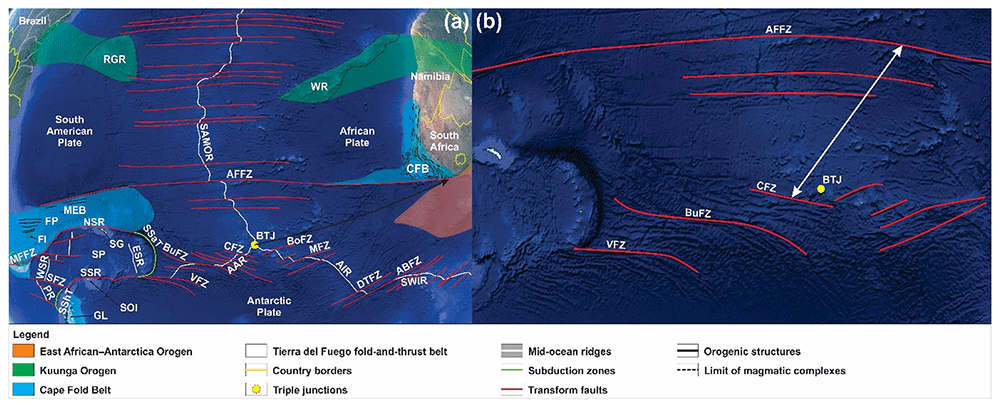
(a–b) Topographic–bathymetric map of the South Atlantic Ocean showing the ruptured Cape Fold Belt orogenic bridge. The black arrow in (a) links the Bouvet Triple Junction with the intersection of the Cape Fold Belt and East African–Antarctica Orogen prior to rifting. The orogenic structures of the Cape Fold Belt in the Falkland Islands, Falkland Plateau, and Maurice Ewing Bank are from Stanca et al. (2022). The extent of the Cape Fold Belt in Antarctica is from Elliott et al. (2019). Those in South Africa are from Paton et al. (2022). (b) better illustrates the parallelism between transform faults truncating the South Atlantic Mid-Ocean Ridge and those crosscutting the American–Antarctica Ridge, which is partly impeded in (a) due to the curvature of Earth’s surface. The white double arrow in (b) shows that the eastern portion of the Agulhas–Falkland fault zone is parallel to the Conrad fault zone. Basemap is from © Google Earth. Abbreviations: AAR: American–Antarctic Ridge; ABFZ: Andrew Bain fault zone; AFFZ: Agulhas–Falkland fault zone; AIR: Atlantic–Indian Ridge; BoFZ: Bouvet fault zone; BuFZ: Bullard fault zone; BTJ: Bouvet Triple Junction; CFB: Cape Fold Belt; CFZ: Conrad fault zone; DTFZ: Du Toit fault zone; ESR: East Scotia Ridge; FI: Falkland Islands; FP: Falkland Plateau; GL: Graham Land; MEB: Maurice Ewing Bank; MFFZ: Magallanes–Fagnano Fault Zone; MFZ: Moshes fault zone; NSR: North Scotia Ridge; PR: Phoenix Ridge; RGR: Rio Grande Ridge; SAMOR: South Atlantic mid-ocean ridge; SFZ: Shackleton fault zone; SG: South Georgia; SP: Scotia Plate; SOI: South Orkney Islands; SSaT: South Sandwich Trench; SShT: South Shetland Trench; SSR: South Scotia Ridge; SWIR: Southwest Indian Ridge; VFZ: Vinogradov fault zone; WR: Walvis Ridge; WSR: West Scotia Ridge.
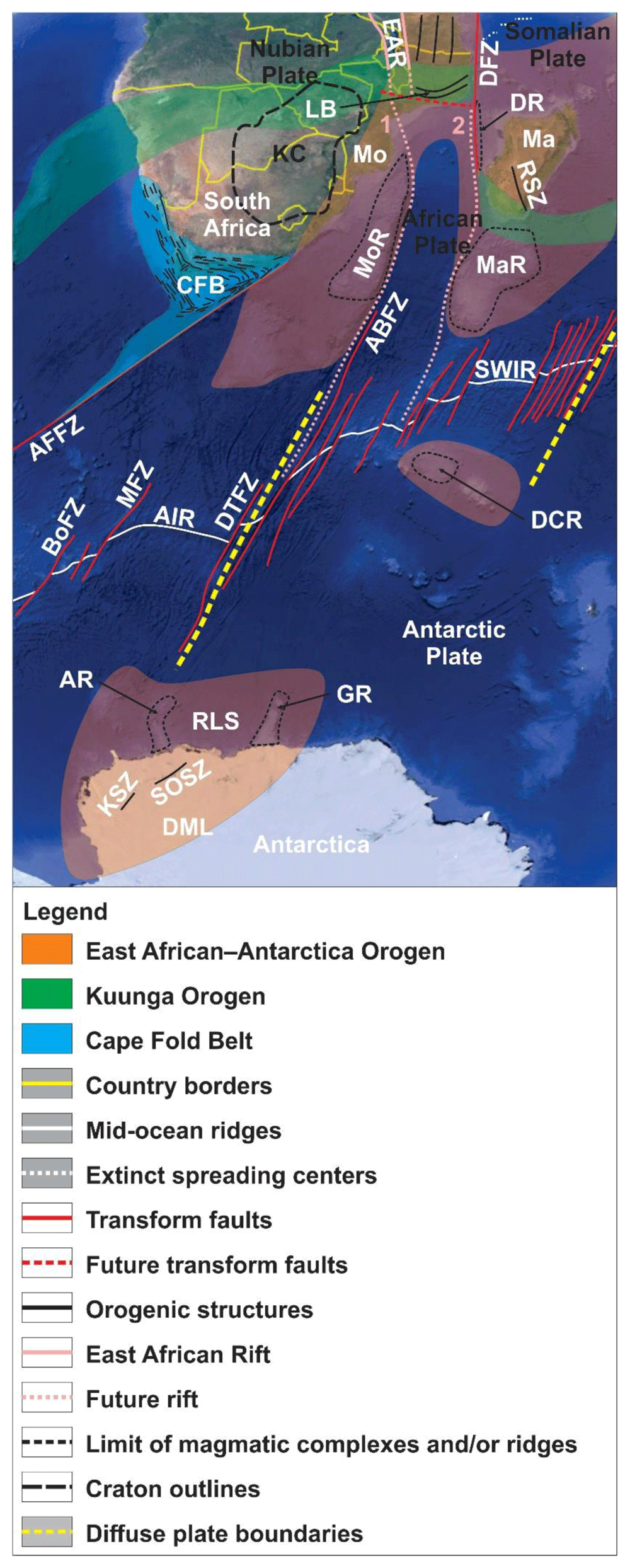
The orogenic bridge coincides with the Andrew Bain Fault Zone and other related major transform fault zones crosscutting the Southwest Indian Ridge. The orogenic structures in Antarctica, Africa, and Madagascar are from Jacobs (1999), Sacchi et al. (2000), Ruppel et al. (2015), Armistead (2019), and Paton et al. (2022). Basemap is from © Google Earth. Abbreviations: ABFZ: Andrew Bain Fault Zone; AFFZ: Agulhas–Falkland fault zone; AIR: Atlantic–Indian Ridge; AR: Astrid Ridge; BoFZ: Bouvet fault zone; DCR: Del Cano Rise; DFZ: Davie fault zone; DML: Dronning Maud Land; DR: Davie Ridge; DTFZ: Du Toit fault zone; GR: Gunnerus Ridge; KC: Kalahari Craton; KSZ: Kirwanveggen Shear Zone; LB: Lurio Belt; Ma: Madagascar; MaR: Madagascar Ridge; MFZ: Moshes fault zone; Mo: Mozambique; MoR: Mozambique Ridge; RLS: Riiser–Larsen Sea; RSZ: Ranotsara Shear Zone; SOSZ: South Orvin Shear Zone; SWIR: Southwest Indian Ridge.
The Appalachian–Caledonian orogenic bridge
The western Irish and Newfoundland margins form prominent salients of continental crust (Figure 7; Chian et al., 2001; Pe-Piper et al., 2013; Yang et al., 2021). The Newfoundland margin was subjected to Ordovician–Silurian contraction (up to Devonian in places) during the closure of the Iapetus and Rheic oceans, which resulted in the formation of the Appalachian Orogen (e.g., van Staal et al., 2012; van Staal et al., 2021). Offshore, Appalachian orogenic structures can be traced onto seismic reflection data up to Flemish Cap and Orphan Knoll, where they bend from a NNE–SSW to an ENE–WSW strike (Cawood et al., 2021; Yang & Welford, 2023), i.e., into parallelism with the Charlie Gibbs fault zone (Keen et al., 2014).
North of Orphan Knoll, the Charlie Gibbs fault zone can be traced on gravimetric and magnetic data, where it appears as an elongated negative gravimetric anomaly and truncates linear seafloor-spreading magnetic anomalies (Keen et al., 2014 their figures 2 and 3). In seismic reflection data, the Charlie Gibbs fault zone dips steeply to the north (Keen et al., 2014 their figure 10). In its footwall, upward-curving seismic reflections delineate a c. 10–20 km wide anticline, which matches the strike of Appalachian structures in the area (Cawood et al., 2021; Yang & Welford, 2023; Figure 7). In addition, basement rocks in the area show hundred meters to km-scale, asymmetric, wiggly, moderate- to high-amplitude reflections at a depth of 7.5–9.5 seconds (TWT) both in the footwall and hanging wall of the fault (Keen et al., 2014 their figure 10). These are typically interpreted as asymmetric folds along mylonitic thrust systems (e.g., Koehl, 2021; Koehl et al., 2022; Koehl et al., 2023a; Koehl & Stokmo, 2024; Koehl et al., 2024). It is thus probable that the Charlie Gibbs fault zone formed along inherited Appalachian folds and thrusts.
It has been suggested that the northern segment of the Charlie Gibbs fault zone merges with the Paleozoic Dover Fault, which separates the Ganderia terrane from the Avalonia terrane onshore Newfoundland (Keen et al., 2014; Figure 7). Given the similar strike and dip and proximity of the north-dipping Mekwe’jit Line (Iapetus Suture in Newfoundland; previously named Red Indian Line; van der Velden et al., 2004), it is more probable that the northern segment of the Charlie Gibbs fault zone merges with the Iapetus Suture and that the southern segment merges with the Dover Fault (Figure 7).
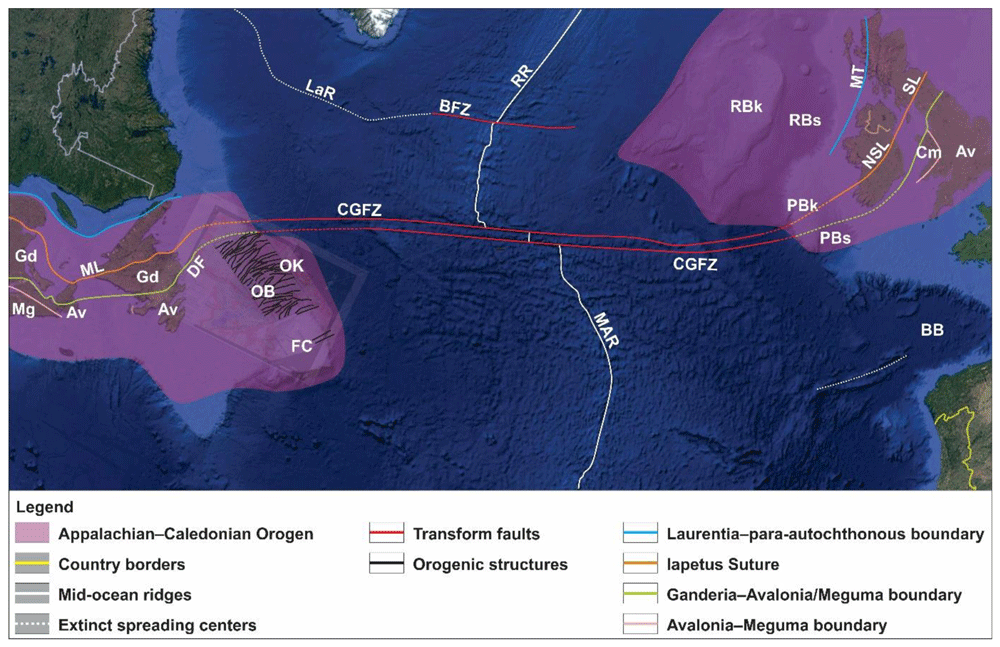
The north-dipping Caledonian thrust systems at the Iapetus Suture west of Ireland and their correlation in Newfoundland, the Mekwe’jit Line (previously Red Indian Line), coincide with and their dip matches that of the northern segment of the Charlie Gibbs fault zone. The thickened orogenic crust at the rift-orthogonal Appalachian–Caledonian Orogen and related E–W-striking structures were unsuitably oriented to thin the crust and forced the Mid-Atlantic rift to step laterally and across the orogen. The main onshore tectonic boundaries are from van Staal et al. (2021). Offshore structures off Newfoundland are from Keen et al. (2014; Charlie Gibbs fault zone and Dover Fault). Offshore structures off western Ireland are from Klemperer et al. (1991). The Appalachian structures in the Orphan Basin and Orphan Knoll are from Cawood et al. (2021) and from Yang & Welford (2023, their figures 8 and 9) at Flemish Cap. Basemap is from © Google Earth. Abbreviations: Av: Avalonia; BB: Bay of Biscay; BFZ: Bight fault zone; CGFZ: Charlie Gibbs fault zone; Cm: Cimru terrane (correlative of Meguma); DF: Dover Fault; FC: Flemish Cap; Gd: Ganderia; LaR: Labrador paleo-mid-ocean ridge; MAR: Mid-Atlantic Ridge; Mg: Meguma; ML: Mekwe’jit Line; MT: Moine Thrust; NSL: Navan Silvermines Line; OB: Orphan Basin; OK: Orphan Knoll; PBk: Porcupine Bank; PBs: Porcupine Basin; RBk: Rockall Bank; RBs: Rockall Basin; RR: Reykjanes Ridge; SL: Solway Line.
In Ireland and the southern UK, the Ordovician–Silurian (to Early Devonian?) Caledonian Orogen developed E–W- to NE–SW-striking thrusts and folds (Chew & Stillman, 2009; Chew & Strachan, 2013). The westwards offshore continuation of the Iapetus Suture in western Ireland coincides with the Charlie Gibbs fault zone off Porcupine Bank, and both display comparable E–W strikes (e.g., Chew & Stillman, 2009; Tietzsch-Tyler, 1996; Figure 7). Seismic reflection data west of Ireland show that Caledonian thrust systems dominantly dip to the north, e.g., the presumed Iapetus Suture (Klemperer et al., 1991), which is consistent with seismic reflection data east of the UK (Freeman et al., 1988). This attitude coincides with that of the north-dipping Charlie Gibbs fault zone, thus further supporting a controlling relationship of Caledonian thrust systems over this major transform fault.
Our interpretation is in agreement with Buiter & Torsvik (2014) who suggested that the Charlie Gibbs fault zone formed along a preexisting (Iapetus) suture zone. In this setting, E–W-striking Appalachian–Caledonian thrusts and related orogenic crust would have hindered rifting and delayed breakup between Newfoundland and Ireland. Repeated tectonic inversion of Appalachian–Caledonian structures may then have contributed to thinning the crust and to localize the formation of the Charlie Gibbs fault zone.
Alternatively, the ENE–WSW- to E–W-striking orogenic structures at Orphan Knoll and off western Ireland might be (partly?) Variscan (Lefort & Haworth, 1984; Lefort et al., 1993; Miliorizos et al., 2004). Thus, Appalachian–Caledonian and/or Alleghenian–Variscan preexisting orogenic structures may have controlled the formation of the Charlie Gibbs fault zone.
The Charlie Gibbs fault zone consists of two fault segments separated by a c. 40 km long spreading center (Figure 7). These faults offset the Mid-Atlantic Ridge by c. 340 km (Ligi et al., 2022). A noteworthy feature of this fault zone is that the mid-ocean ridge to the north and in between the two fault segments produced little basalt and are thus less magmatic than the Mid-Atlantic Ridge to the south (Basch et al., 2024; Skolotnev et al., 2021a). Given the dominant north-dipping geometry of the inherited Caledonian thrusts at the presumed Iapetus Suture west of Ireland (Klemperer et al., 1991), one may envision a formation of the Charlie Gibbs fault zone and related magmatism in a similar fashion to that suggested for the Molloy fault zone in the Fram Strait (Koehl et al., 2021; Koehl et al., 2025 awaiting peer review; Figure 8). In such a model, mantle is exhumed and partially melted in the footwall of the inverted Caledonian thrusts, i.e., south of the Charlie Gibbs fault zone.
In contrast, areas within and north of the inverted Caledonian thrust system are shielded by relatively dry and resistant continental crust because of the enrichment in tightly deformed and thus resistant mylonite along major thrusts. This model would explain the low degree of partial melting observed for recent igneous rocks within the Charlie Gibbs fault zone (Basch et al., 2024; Sanfilippo et al., 2024). Thus, the asymmetric amount of magmatism across major transform fault system may be controlled by the vergence of the preexisting thrust systems along which major transform faults develop. At Charlie Gibbs, such a trend seems to have persisted long after breakup (> hundred million years), thus suggesting that preexisting orogens have a long-term effect on partial melting of the mantle and, potentially, on its geochemistry. A hypothesis to be tested is that old (Appalachian–Caledonian) orogenic mylonitic shear zones also developed in the upper mantle and that part of these hyperextended shear zones remain near mid-ocean ridges and prevent rapid ascent of large amounts of melt at specific mid-ocean ridge segments, i.e., possibly compartmentalizing the mantle.
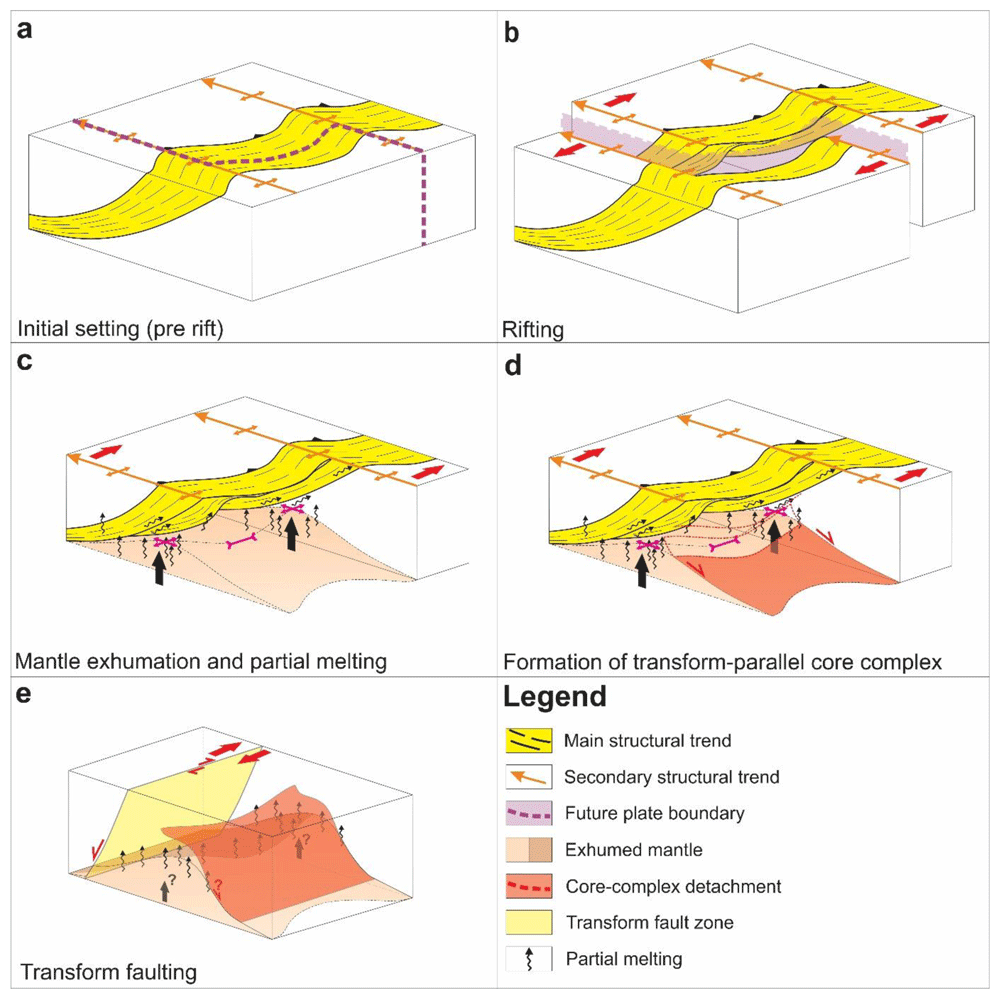
(a) The initial tectonic setting involves two sub-orthogonal structural trends, including major crustal-scale, mylonitic thrust systems and their reworking (e.g., folding) during a subsequent, suborthogonal contractional event. (b) Rifting thins the crust along the two inherited structural trends, cutting through the rift-orthogonal thrust systems in a step-like fashion, e.g., along the inherited thrusts and subsequent folds. (c) Exhumation of the mantle during breakup. Exhumation and partial melting preferentially occur in the footwall of inherited thrusts, with increased exhumation at anticlines where the combination of lateral (proto-transform) movements and erosion of the anticlinal hinge has a higher potential to create crustal imbalance. Magmatism occur dominantly in the footwall of the inherited rift-orthogonal thrust system, where the mantle is exhumed. The mylonitic character of the thrust system hinders the ascent of melt to the surface in the thrust hanging wall and preferentially channels magma along the thrust and in its footwall. (d) Hyperextension along the inverted rift-orthogonal thrust system leads to rift-orthogonal detachment faulting and the formation of transform-parallel oceanic core complexes. (e) Major transform faults form along the inherited crustal discontinuity, i.e., along the inverted rift-orthogonal thrust system.
Yet another feature of interest is that the Charlie Gibbs fault zone is considered by some to be the southern boundary of the zone of influence of the postulated Icelandic plume. As such, the Charlie Gibbs was interpreted as a major geochemical and rheological boundary (Basch et al., 2024; Sanfilippo et al., 2024). However, the area extending from the Fram Strait to the Charlie Gibbs fault zone (including Iceland) was influenced by, and, in some area (e.g., Greenland–Iceland–Faroe Ridge), includes remnants of, the Appalachian–Caledonian Orogen (Cawood et al., 2021; Horsfield, 1972; Klemperer et al., 1991; Koehl et al., 2024; Koehl et al., 2025; Yang & Welford, 2023). Thus, another possible interpretation is that the geochemical heterogeneity of the mantle between Iceland and Charlie Gibbs was inherited from the Appalachian–Caledonian Orogen and related tectonothermal processes, i.e., potentially further supporting a long-term influence of old orogens on the mantle.
At Orphan Knoll and Flemish Cap, continental to transitional crust potentially extends 80 km to the east (Welford et al., 2020). Taking into account the c. 1100 km distance to the mid-ocean ridge, this suggests an overestimation of the amount of oceanic crust by c. 7.2%. In contrast, the lack of published studies of seismic reflection data between Porcupine Bank and the Charlie Gibbs fault zone (e.g., Peace et al., 2019; Yang et al., 2021) makes it difficult to assess the extent of oceanic crust at this margin. However, should continental crust extend all the way to the eastern tip of the Charlie Gibbs fault zone (i.e., for an extra 350 km farther west), this would imply an overestimation of the extent of oceanic crust by c. 30.4% along the western Ireland margin, given the c. 1150 km distance to the mid-ocean ridge.
The Sergipano–Central African orogenic bridge
In western Africa, the northern boundary of the Congo Craton with the West African Craton in the northwest and the Saharan Metacraton in the north is defined by the Central Africa Orogen (also called Oubangides; Figure 9). The orogen consists of arc-related intrusions, syn-tectonic volcano-sedimentary successions, and late-orogenic granitoids (e.g., Toteu et al., 2022). It formed during the accretion of Gondwana in the late Neoproterozoic and was part of the Pan African Orogeny (Kouémo et al., 2014; Kröner & Stern, 2004; Toteu et al., 2022). It consists of several thousands km long, E–W- to ENE–WSW-striking, top-south thrusts, which were later reworked into dextral strike-slip mylonitic shear zones, e.g., ENE–WSW-striking Central African Shear Zone (Dorbath et al., 1986; Ibrahim et al., 1996; Kouémo et al., 2014; Schandelmeier & Pudlo, 1990; Toteu et al., 2022).
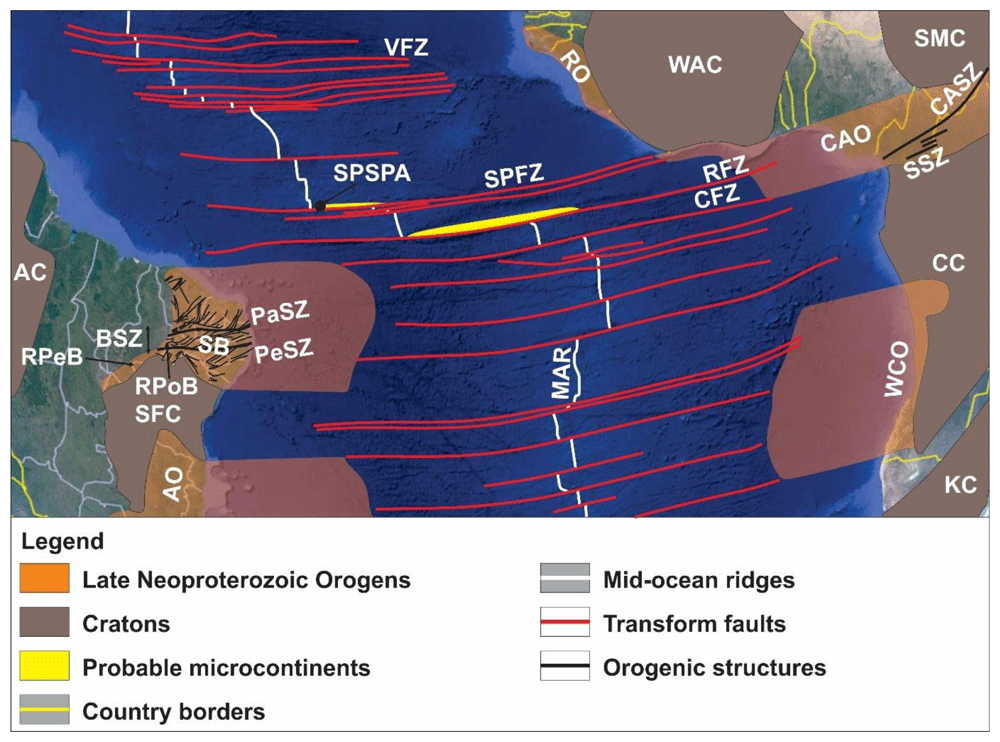
Microcontinents and major transform faults between Africa and Brazil are parallel to north-dipping shear zones in the Sergipano Belt and Central African Orogen and probably initiated along such structures. The extent of the late Neoproterozoic orogens offshore is based on the lack of seafloor-spreading-related linear magnetic anomalies in these areas (James, 2010). Thus, it is possible that the cratons also extend farther offshore or that late Neoproterozoic belts (e.g., Araçuaí Orogen and Sergipano Belt) merge with one another offshore. The probable microcontinents along the Romanche and St Paul fault zones are based on Bonatti et al. (1994), Davison et al. (2015), Gasperini et al. (2001), and Melson et al. (1972). Orogenic structures in northeastern Brazil are from Oliveira et al. (2010) and from Kouémo et al. (2014) in western Africa. Basemap is from © Google Earth. Abbreviations: AC: Amazonia Craton; AO: Araçuaí Orogen; BSZ: Borborema Shear Zone; CAO: Central African Orogen; CC: Congo Craton; CFZ: Chain fault zone; KC: Kalahari Craton; MAR: Mid-Atlantic Ridge; PaSZ: Patos Shear Zone; PeSZ: Pernambucano Shear Zone; RFZ: Romanche fault zone; RO: Rockelide Orogen; RPeB: Rio Preto Belt; RPoB: Riacho Ponto Belt; SB: Sergipano Belt; SFC: São Francisco Craton; SMC: Sahara Metacraton; SPSPA: St Peter and Pt Paul Archipelago; SSZ: Sanaga Shear Zone; STFZ: St Paul fault zone; VFZ: Vema fault zone; WAC: West African Craton; WCO: West-Congo Orogen.
In northern Brazil, the Sergipano Belt defines the northeastern boundary of the Sao Francisco Craton and consists of late Neoproterozoic volcanics, and arc- and syn-orogenic granite and syenite plutons (D’el-Rey Silva, 1999; Oliveira et al., 2010; Oliveira et al., 2015; Oliveira et al., 2017). The belt is deformed by major, E–W- to WNW–ESE-striking, mostly top-south mylonitic thrust systems reworked dominantly as dextral shear zone during the late stages of continental accretion (Oliveira et al., 2010; Oliveira et al., 2015). Thus, the kinematics of these structures are consistent with their counterparts in the Central African Orogen/Oubangides (D’el-Rey Silva, 1999; Kouémo et al., 2014; Oliveira et al., 2006; Oliveira et al., 2010; Oliveira et al., 2015; Toteu et al., 2022). Farther west, the Segipano Belt bends into an NE–SW strike, i.e., following the northern edge of the Sao Francisco Craton, and merges with the Riacho do Pontal and Rio Preto belts. These belts are oriented NE–SW to E–W and show structures with corresponding top-south and dextral strike-slip kinematics and, respectively, define the northern and northwestern boundary of the craton (Caxito et al., 2017). Notable structures of the Sergipano Belt include the Patos and Pernambucano shear zones of the Borborema system, which are believed to represent the western continuation of the Central African Shear Zone (Finoto Bueno et al., 2009; Fossen et al., 2022; Oliveira et al., 2006; Oliveira et al., 2010).
The E–W-striking Saint Paul, Romanche, and Chain fault zones extend from western Africa to northeastern Brazil at the boundary of the central and southern segments of the Atlantic Ocean and offset the Mid-Atlantic Ridge by a total of c. 1800 km sinistrally (De Caprona, 1992; Gregory et al., 2021; Heezen et al., 1964; Searle et al., 1994; Figure 9). The Romanche fault zone takes up half the total offset of the mid-ocean ridge and may be traced for ≥ 3500 km from a few hundred km off the coast of northeastern Brazil to a few hundred km south of Ivory Coast and Ghana (Figure 9). These transform faults are characterized by exhumed peridotite ridges (Bonatti et al., 1994; Gregory et al., 2021). The faults are thought to have formed during the opening of the Atlantic Ocean at ca. 50–45 Ma (Gregory et al., 2021; Heezen et al., 1964). The location of the Romanche and Chain fault zones coincides with that of segments of the Central African Shear Zone in Cameroon, e.g., Sanaga Shear Zone whose sinistral sense of shear matches that of the St Paul, Romanche, and Chain fault zones (Kouémo et al., 2014). Thus, the late Neoproterozoic, ENE–WSW-striking orogens and related structures in western Africa and northeastern Brazil likely controlled the formation of these major transform faults.
This would explain the occurrence of potential, elongated microcontinents along the St Paul and Romanche fault zones (Davison et al., 2015; Gasperini et al., 2001; Figure 9). Such microcontinents may represent lenses of orogenic crust (e.g., nappes or thrust sheets) separated by mylonitic shear zones within major thrust systems (Figure 10). For example, mylonitized and serpentinized mantle rocks of the St Peter and St Paul Archipelago along the St Paul fault zone were interpreted as relic continental lithosphere (da Costa Campos et al., 2005). This is supported by a ca. 835 Ma K–Ar age for hornblende in mylonitic rocks of the archipelago, which suggests that these igneous rocks were contaminated by continental material (Melson et al., 1972). This age matches that of early Neoproterozoic metamorphism along NE–SW-striking shear zones and sutures in the Arabia–Nubia Shield (Abdelsalam & Stern, 1993; Collins et al., 2021; Johnson, 2014; Johnson et al., 2011; Robinson et al., 2015), which are connected to the St Paul, Romanche, and Chain fault zones by the presumably late Neoproterozoic Central African Shear Zone (Ibrahim et al., 1996; Schandelmeier & Pudlo, 1990). Thus, a hypothesis to be tested is that the early Neoproterozoic NE–SW-striking orogen in the Arabian–Nubian Shield extends across Africa into the Central African Orogen and to northeastern Brazil in the Sergipano Belt. Alternatively, the elongated peridotite ridges along the St Paul and Romanche fault zones may have formed as transform-parallel core complexes through exhumation of continental mantle along inherited rift-orthogonal thrust systems (e.g., Figure 8).
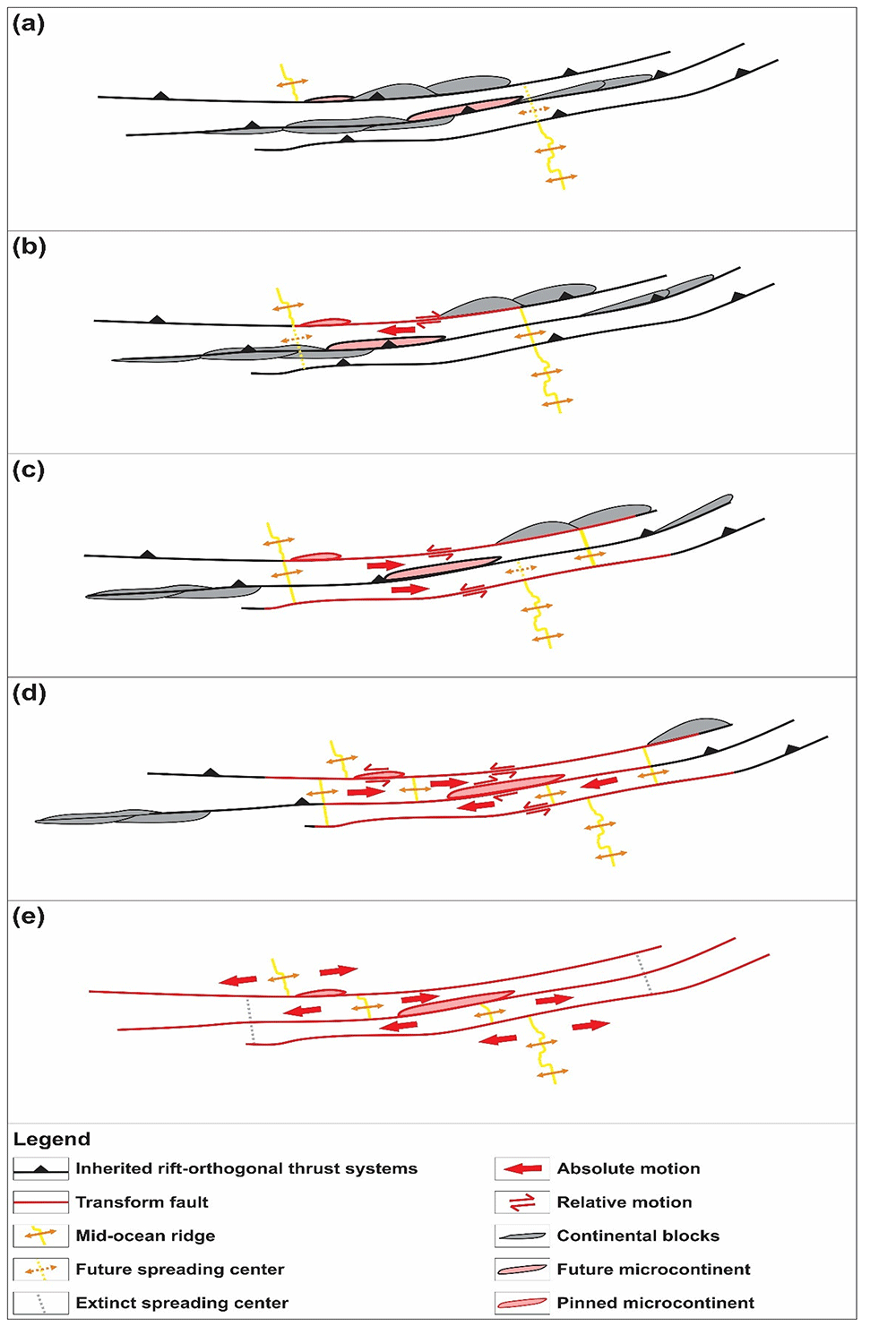
(a) Inherited rift-orthogonal thrust systems (black lines) hinder rifting and initially force the rift (yellow lines) to step and bypass the area of orogenically thickened continental crust. The major thrusts consist of complex shear fabrics at lithospheric scale, which result in the formation of hundreds of km long lensoidal continental blocks (grey-filled blobs) separated by zones of intense deformation. (b) Over time, the rift slowly cuts through the orthogonal thrust systems from on end, thus initiating transform faulting (red line). Some narrow continental blocks along inherited thrusts immediately become pinned and incorporated to proto-transform fault segments due to their lensoidal shape (pink-filled red blob), which allows extruded oceanic crustal material to passively slide by without entraining the newly formed microcontinent (e.g., St Peter and St Paul Archipelago along the St Paul fault zone). (c) Since the inherited rift-orthogonal thrust systems are inefficient at thinning the crust because they are oriented parallel to the extension direction and are gently to moderately dipping (i.e., inefficient at transform faulting), the rift opens from both ends and spreading centers within the proto-transform fault system become offset. Some elongated continental blocks along proto-transform fault segments become trapped and oscillate between the main two spreading centers (pink-filled black blob). (d) As the rift repeatedly cuts through the rift-orthogonal orogen, oscillating continental blocks stabilize and become incorporated along transform fault segments (pink-filled red blob; e.g., Romanche fault zone). New spreading centers develop within the transform fault system and are potentially offset and moved towards the center of the transform fault system due to continued spreading at other spreading centers. Alternatively, the new spreading centers directly develop with an offset and towards the center of the transform fault system without the need of coeval spreading centers. (e) Fully developed transform fault system with narrow (tens of km wide), elongated (hundreds km long), transform-parallel microcontinents. The model was developed from the geometries of the St Paul, Romanche, and Chain fault zones but is potentially applicable to other major transform fault systems potentially including elongated microcontinents, such as the Charlie Gibbs, Vema, and Andrew Bain fault zones and the GIFR.
Depending on the location of the continent–ocean boundary in the Gulf of Guinea and off northeastern Brazil, the amount of oceanic crust could be overestimated by up to 34.0% off northeastern Brazil and 50.0% in the Gulf of Guinea. This is based on the lack of linear magnetic anomalies related to seafloor spreading in these parts of the central and southern Atlantic Ocean (James, 2010). This suggests that the continent–ocean boundary may be up to c. 850 km away from the coast of Brazil (with a 2500 km distance to the mid-ocean ridge) and c. 1200 km off the coast of Cameroon (assuming a 2400 km distance to the mid-ocean ridge; Figure 9). An extension of the late Neoproterozoic Central African Orogen farther offshore in the Gulf of Guinea is probable given the proximity of the coeval Rockelide Orogen in westernmost Africa (Culver et al., 1991; Villeneuve et al., 2015; Wildman et al., 2022; Figure 9) and the prolonged connection between northeastern Brazil and western Africa (e.g., Jacobs et al., 2024).
Note that the N–S-striking Araçuaí–West Congo Orogen separates the West Africa Craton from the Sahara Metacraton in western Africa and continues farther south along the coasts of eastern Brazil and western Africa (Meert & Lieberman, 2008; Figure 9). This orogen is parallel to the South Atlantic mid-ocean ridge and, thus, probably localized rifting, facilitating breakup up to the rift-orthogonal Sergipano–Central African Orogen. The latter likely hindered rifting and forced the rift to step to the west (Figure 9). However, the Araçuaí–West Congo Orogen belongs to the rift-parallel endmember of OrBiT and is therefore not further discussed in the present study.
The Cape–Falkland orogenic bridge
The composition of the crust beneath the Falkland Plateau and Maurice Ewing Bank has long been debated. However, recent studies have provided robust evidence that the crust is continental (Chemale Jr. et al., 2018; Stanca et al., 2022), albeit relatively thin at Maurice Ewing Bank (e.g., Schimschal & Jokat, 2018). Offshore drilling at Maurice Ewing Bank penetrated continental crust consisting of Mesoproterozoic paragneisses metamorphosed to granulite facies during the late Mesoproterozoic (Chemale Jr. et al., 2018). Moreover, new interpretation of offshore seismic reflection, gravimetric, and magnetic data identified late Paleozoic fold and thrust structures on the Falkland Plateau and at Maurice Ewing Bank (Stanca et al., 2022; Figure 5a). Considering the c. 3250 km distance between the previous continent–ocean boundary proposed by Schimschal and Jokat (2018; see also figure 1 in Stanca et al., 2022) and the mid-ocean ridge and the c. 1900 km distance between the eastern tip of Maurice Ewing Bank (the continent–ocean boundary proposed in the present manuscript) and the mid-ocean ridge, the extent of oceanic crust on the South American side of this ruptured orogenic bridge is overestimated by c. 41.3%.
From plate paleogeographic reconstructions, folds and thrusts in the Falkland Plateau appear to have been parallel and adjacent to those of the Cape Fold Belt (e.g., Johnston, 2000; Martin et al., 1981; McKay et al., 2018; Mitchell et al., 1986; Newton, 1993; Storey et al., 1999; Veevers et al., 1994; Figure 5a). Thus, the late Paleozoic contractional structures on the Falkland Plateau represent the prolongation of the Cape Fold Belt, which rifted away from southeastern South Africa during the opening of the South Atlantic. In the west, onshore southern South America, the Cape Fold Belt correlates with contemporaneous structures onshore Patagonia, which shows both comparable structural trends and similar timing of formation (Castillo et al., 2017; du Toit, 1927; Falco et al., 2022; Falco et al., 2024; Grillo Vidal et al., 2024; Pankhurst et al., 2006; Figure 1 and Figure 5a).
The Cape Fold Belt in South Africa and the Falkland Plateau–Maurice Ewing Bank and its continuation onshore Patagonia parallel major transform faults in adjacent offshore areas. Hence, transform faults there all strike perpendicular to the active (East Scotia Ridge, American–Antarctic Ridge, and South Atlantic mid-ocean ridge) and paleo-mid-ocean ridges in the area (West Scotia Ridge and Phoenix Ridge; Figure 1 and Figure 5a). These transform faults include the Agulhas–Falkland fault zone in the South Atlantic (Barker, 1979; Ben-Avraham et al., 1997; Uenzelmann-Neben & Gohl, 2004), and also all major transforms in the southernmost Atlantic Ocean (Conrad, Bullard, and Vinogradov fault zones; Ligi et al., 1999; Mitchell et al., 2000; Sandwell & Smith, 2001) and the Scotia Plate (North Scotia Ridge, South Scotia Ridge, and Shackleton fault zone; Klepeis, 1994; Livermore et al., 2000; Ludwig & Rabinowitz, 1982; Pelayo & Wiens, 1989; Riley et al., 2019; Thomas et al., 2003; Figure 1 and Figure 5a). Notably, the Agulhas–Falkland fault zone parallels thrusts of the Cape Fold Belt both onshore and offshore southern South Africa (Paton et al., 2022) and on the Falkland Plateau and Maurice Ewing Bank (Stanca et al., 2022 their figures 4a, 5b, 12b–c, and 13a–c), which strike respectively NE–SW and E–W (Figure 5a). These late Paleozoic–earliest Mesozoic thrusts therefore likely controlled the strike and geometry of the Agulhas–Falkland fault zone. This relationship was previously noted by Buiter & Torsvik (2014) who suggested that the Agulhas–Falkland fault zone formed along an inherited suture zone between the Falkland Plateau and South Africa. The Falkland Plateau and Maurice Ewing Bank are thus proposed to represent a ruptured, probably partly hyperextended, late Paleozoic orogenic bridge, which forced the opening Mesozoic rift to step along orogen-parallel transform faults.
The southernmost segment of the overall N–S-trending, Cenozoic South America Cordillera in southern Patagonia, the Tierra del Fuego fold-and-thrust belt bends into a WNW–ESE strike (Fuentes, 2023; Klepeis, 1994), i.e., into parallelism with the Cape Fold Belt (Figure 5a). The Tierra del Fuego fold-and-thrust belt may therefore also have helped control the formation of major transform faults in the area. However, its geometry may have been controlled by the preexisting late Paleozoic fold-and-thrust belt (Cape Fold Belt) in the first place, so although Cenozoic structures may very well have controlled the formation of the local transform faults, the cause of this inherited E–W strike is more likely to be found in the late Paleozoic Cape Fold Belt.
The East African–Antarctica orogenic bridge
The late Neoproterozoic East African–Antarctica Orogen is a well-studied branch of the Pan African Orogeny. (e.g., Abdelsalam et al., 1998; Fritz et al., 2013; Shackleton, 1996; Stern & Kröner, 1993). N–S- to NNW–SSE-striking shear zones in Madagascar and eastern Africa potentially extend into the Davie, Mozambique, and Madagascar ridges (Figure 6). These three N–S- to NNW–SSE-striking bathymetric highs are likely cored by continental crust as suggested by new gravimetric and magnetic data and from recent density and plate tectonics modeling (e.g., Klimke et al., 2018; Ryzhova et al., 2022; Sato et al., 2022; Vormann et al., 2020). The Davie and Madagascar ridges are believed to have once been connected to the Gunnerus Ridge (Figure 6) prior to the opening of the southwestern Indian Ocean (Davis et al., 2016; Klimke et al., 2018; Mueller & Jokat, 2019; Vormann & Jokat, 2021).
More specifically, continental material, namely c. 1 Ga granulite rocks, was dredged at the Mozambique Ridge, thus suggesting that at least the southern part of the ridge is continental (Hartnady et al., 1992 and references therein). More recent geophysical studies then revealed that the northern part of the Mozambique Ridge consists of thinned continental crust and the southern part of intermediate crust, i.e., probably hyperextended continental crust as suggested by the southwards increase in the degree of extension and thinning of the crust, overlain by magmatism rocks (Evain et al., 2021; Matsinhe et al., 2021; Ryzhova et al., 2022). As such, the extent of oceanic crust at the Mozambique Ridge is currently overestimated by c. 55.9 % using a distance of 3400 km between the northern tip of the Mozambique Ridge (i.e., previously proposed continent–ocean boundary) and the mid-ocean ridge and a c. 1500 km distance from the southern tip of the Mozambique Ridge to the mid-ocean ridge (i.e., new continent–ocean boundary).
The northern part of the Madagascar Ridge is thought to be continental and consists of a complex basement structure, where the crust is 26–22 km thick (Goslin et al., 1981). The transition zone most likely consists of a thinned version of the northern segment since it is located at a rifted margin. In the southern part of the ridge, the 14-km thickness of the crust led previous workers to postulate thick oceanic crust despite the lack of bedrock samples in drilling attempts (Sato et al., 2022). Similarly at the Del Cano Rise, the 16 km crustal thickness was assumed to result from plume magmatism (oceanic Large Igneous Province; Sato et al., 2022). However, the lack of linear magnetic anomalies and thicker-than-normal character of the crust both in the southern Madagascar Ridge and Del Cano Rise clearly indicate that seafloor-related processes can be ruled out and the irregular magnetic anomalies may be explained by sporadic magmatic activity comparable to that which occurred at the continental Mozambique Ridge (Sato et al., 2022). Thus, the thicker-than-normal crust and low residual Bouguer anomalies at the southern Madagascar Ridge and Del Cano Rise were interpreted to reflect continental crust capped by mafic volcanics (Sato et al., 2022), a scenario also suggested for other areas of thickened offshore crust in the Indian Ocean, e.g., southern Kerguelen Plateau and Elan Bank (Jiang et al., 2021 their figure 4). A likely scenario, which should be further tested is that the southern Madagascar Ridge and Del Cano Rise consist of hyperextended (i.e., very thin) continental crust and/or rafted continental blocks (e.g., Péron-Pinvidic et al., 2015; Rime et al., 2024). This is suggested because they occur at rifted margins and by the similar gradual southwards thinning of the continental crust at the Mozambique Ridge in adjacent areas (Hartnady et al., 1992; Ryzhova et al., 2022). Thus, the extent of oceanic crust at the Madagascar Ridge is overestimated by c. 43.5% using (a) a c. 1150 km distance between the previously inferred continent–ocean boundary at the transition zone between the northern and southern parts of the Madagascar Ridge at 31°S and the mid-ocean ridge and (b) a c. 650 km distance between the southern tip of the southern Madagascar Ridge (i.e., the presently proposed continent–ocean boundary) and the mid-ocean ridge.
In Antarctica, the Gunnerus and Astrid ridges represent salients of continental crust off the coast of Dronning Maud Land (Leitchenko et al., 2008; Roeser et al., 1996; Figure 6). Considering the strike of the former, i.e., parallel to major late Neoproterozoic shear zones in Dronning Maud Land, e.g., the South Orvin and Kirwanveggen shear zones (Bauer & Siemes, 2004; Golynski & Jacobs, 2001; Jacobs, 1999; Ruppel et al., 2015; Figure 6), it is probable that structures of the East African–Antarctica Orogen extend offshore into the Gunnerus Ridge.
A relevant issue is the nature of the crust at the Astrid Ridge. Roeser et al. (1996) interpreted the northern part of the Astrid Ridge as oceanic. The authors of this work state (page 243, paragraph 1) that “seismic data were not obtained on the Astrid Ridge” and that they based their interpretation on existing magnetic data from Bergh (1987). The data show E–W-striking magnetic anomalies in the northern part of the Astrid Ridge, i.e., parallel to the mid-ocean ridge (Bergh, 1987 his figure 6). Roeser et al. (1996) argued that “except for their greater amplitude and irregularity, they (the E–W-striking magnetic anomalies in the northern Astrid Ridge) resemble those in the Riiser-Larsen Sea” (page 253, paragraph 5). However, they were unable to correlate these anomalies with anomalies in adjacent oceanic domains in the Riiser–Larsen Sea. Roeser et al. (1996) stress that the magnetic anomalies in the northern Astrid Ridge display a “greater amplitude and irregularity” than those in the adjacent oceanic domain (Riiser–Larsen Sea; page 253, paragraph 5).
In the light of recent studies of high-resolution seismic reflection data and magnetic data off various rifted margins showing that the outermost linear magnetic anomalies reflect mafic intrusions in continental crust (e.g., southeastern Greenland, Faroe Islands, Namibia; Geoffroy et al., 2022a their figure 1b, 3b–c, and 5; Geoffroy et al., 2022b their figures 2 and 3; Koehl et al., 2024 their figure 2e), it is more likely that the E–W-striking anomalies reflect mafic intrusions in continental crust. This reinterpretation is supported by the impossibility of correlating the magnetic anomalies in the northern Astrid Ridge with anomalies in adjacent oceanic domains (Riiser–Larsen Sea) and by their more irregular character and different amplitude from regular ocean-floor anomalies. The more irregular and high-amplitude character of seaward-dipping-reflector-related magnetic anomalies was specifically pointed out by Geoffroy et al. (2022a).
At the Astrid Ridge, the extent of oceanic crust could thus be overestimated by up to 20.6% using a c. 1700 km distance between the previously assumed continent–ocean boundary between the southern and northern parts of the Astrid Ridge (Roeser et al., 1996) and a c. 1350 km distance from the northern tip of the Astrid Ridge (new continent–ocean boundary). At the Gunnerus Ridge, and taking into account the Del Cano Rise, oceanic crust extent may be overestimated by as much as 25.0% using a c. 2800 km distance between the southern tip of the Gunnerus Ridge and the mid-ocean ridge and c. 2350 km from the northern tip of the Gunnerus Ridge (new continent–ocean boundary) and including a c. 250 km wide continental crustal domain at Del Cano Rise (Sato et al., 2022).
It is thus possible that late Neoproterozoic shear zones observed onshore Dronning Maud Land in Antarctica may extend into the (at least partly) continental crust at Del Cano Rise (Sato et al., 2022; Figure 5). Further analysis of seismic reflection data at the Gunnerus Ridge and Del Cano Rise should help answer this. Regardless, the sinistral kinematics late Neoproterozoic shear zones in Dronning Maud Land are consistent with that of relative block movements on either side of the Andrew Bain Fault Zone (e.g., Peyve et al., 2007; Sclater et al., 2005), which strike parallel to major late Neoproterozoic faults in Antarctica and the East Africa Orogen (Abdelsalam et al., 1998; Armistead, 2019; Bauer & Siemes, 2004; Boger et al., 2015; Collins et al., 2000; Collins et al., 2012; De Waele et al., 2011; Golynski & Jacobs, 2001; Hamimi et al., 2022; Jacobs, 1999; Johnson, 2014; Key et al., 1989; Mosley, 1993; Quick & Bosch, 1990; Ruppel et al., 2015; Shackleton, 1996; Stern & Kröner, 1993; Figure 6).
This also applies to other major transform faults in the region, e.g., the Du Toit, Moshes, and Bouvet fault zones between South Africa and Antarctica (Figure 5a and Figure 6; Ligi et al., 1999), and the Davie fault zone between Madagascar and eastern Africa (Figure 6; Davis et al., 2016). The analysis of seismic reflection data in Klimke et al. (2018) clearly shows low-angle thrusts in the westernmost part of the Davie Ridge (the area labelled “compressed sediments” in their figure 6). These contractional structures may represent the offshore continuation of thrust systems of the East African–Antarctica Orogen between Madagascar and eastern Africa. It is therefore probable that the Mozambique, Madagascar and Gunnerus ridges and possibly the Del Cano Rise are part of a disrupted orogenic bridge.
This is further supported by the location of a narrow plate boundary and of a diffuse plate boundary between the Somalia and Nubian plates and possibly the Lwandle plate (DeMets et al., 2010). This boundary was proposed by Chu & Gordon (1999) to help reconstruct past plate tectonics movements prior to the opening of the Indian Ocean, which is problematic at the Rodrigues Triple Junction (Minster & Jordan, 1978; Royer & Gordon, 1997). The narrow plate boundary coincides with major offsets of the Southwest Indian Ridge by the Andrew Bain Fault Zone and nearby transform faults, whereas the diffuse plate boundary matches the extent of the East African–Antarctica Orogen on either side of the Southwest Indian Ridge (Chu & Gordon, 1999; Meyzen & Schwarz-Schampera, 2023; Figure 1 and Figure 6).
The case of the Mozambique and Somali basins illustrate well the impact of orogenic bridges on rifting. Both basins host extinct, ENE–WSW-striking spreading centers and magnetic anomalies (e.g., Coffin & Rabinowitz, 1987; Davis et al., 2016; Norton & Sclater, 1979; Sauter et al., 2018; Simpson et al., 1979; Figure 6). A tectonic evolution similar to that proposed by Seton et al. (2012 their figure 15) and Vormann & Jokat (2021 their figure 3) is considered likely. In such as model, the Indian rift attempted to cut through the East African–Antarctica Orogen at suitably oriented zones of weakness in the (Late Jurassic?–) Early Cretaceous. An area with suitably oriented structures is the Lurio Belt in northeastern Mozambique (Bingen et al., 2009; Sacchi et al., 2000; Viola et al., 2008) and its counterpart in western India and Sri Lanka (Kuunga Orogen; Brandt et al., 2014; Dharmapriya et al., 2015; Ghosh et al., 2004; He et al., 2018; Hirayama et al., 2020; Srinivasan & Rajeshdurai, 2010). Both of these orogens consist of ENE–WSW-striking structures (Figure 1 and Figure 6). These structures were oriented perpendicular to the c. N–S extension direction and were thus suitable to efficiently thin the thickened orogenic crust of the East African–Antarctica Orogen. However, upon meeting the unsuitably oriented, major orogenic structure of the East African–Antarctica Orogen, e.g., N–S-striking contractional structures at the Davie Ridge (Klimke et al., 2018 their figures 2–6) and its southern prolongation, the Madagascar Ridge, the rift may have been forced to step laterally, i.e., in the northern Mozambique Basin, where suitably oriented structures of the E–W-striking Kuunga Orogen occur in adjacent areas onshore southern Madagascar (Armistead, 2019; Collins et al., 2003; Collins et al., 2012). Nevertheless, upon meeting yet another unsuitably oriented N–S-striking structure at the Mozambique Ridge (e.g., Matsinhe et al., 2021 their figures 2, 4, and 6), the Indian rift eventually stepped farther south into its present-day location at the South West Indian Ridge (Seton et al., 2012; Figure 1 and Figure 6).
Large-offset, slow-spreading transform such as the Andrew Bain, Vema (southern Caribbean orogenic bridge), Romanche (Sergipano–Central African orogenic bridge; Figure 1) and Charlie Gibbs fault zones (Appalachian–Caledonian orogenic bridge), display multiple transform segments and oscillatory spreading. Thus, slivers of lithosphere switch from one plate to the other as the plate boundary jumps from one transform fault segment to another (e.g., Bonatti & Crane, 1982). These large-offset transforms are slower to adapt their geometry to new stress field and plate kinematics (Maia, 2019). OrBiT suggests that elongated lithosphere slivers within these transform fault systems are likely continental (Figure 10). This would facilitate the switch of the plate boundary to another fault segment and the switch of movement direction of the lithosphere sliver because it would already be decoupled from the surrounding oceanic lithosphere (Figure 10). This would explain the lack of seafloor-spreading-related magnetic anomalies in between the fault segments of large-offset transform fault systems, e.g., Charlie Gibbs fault zone (Skolotnev et al., 2021b).
The presence of (hyper-) extended continental lithosphere could also explain the different thermal structure of large-offset, multi-segment transform fault systems. These fault systems involve cold crust and they are similar to continental strike-slip faults (Bonatti et al., 2001; Ligi et al., 2002) because they initially developed in continental crust. This agrees with the presence of rocks older than predicted by typical seafloor spreading within these transform fault system (Bonatti & Crane, 1982; Bonatti et al., 1996). Figure 10). In such a scenario, transform-parallel ribbons of continental crust become detached from adjacent continental margins and are entrained along major transform faults due to the occurrence of transform-parallel, preexisting zones of the weakness in the continental crust, such as major (mylonitic) thrust systems. These preexisting structures would facilitate rupture and dislocation of the crust along an axis parallel to the proto-transform faults and allow the inclusion and entrainment of the transform-parallel continental ribbons into the oceanic crustal domain during seafloor spreading (Figure 10). This model explains the earliest Cretaceous (c. 140 Ma; i.e., pre-breakup) carbonates at the transverse ridge along the Romanche fault zone, which may be a microcontinent of hybrid (continental–gabbroic) crust (Davison et al., 2015; Gasperini et al., 2001).
In the northern part of the East African Orogen, the Red Sea rift presents some interesting relationships with preexisting sutures and shear zones in the Arabian–Nubian Shield (Figure 11). There, N–S-striking Neoproterozoic shear zones, such as the Barka (–Adobha) and (Onib–) Hamisana shear zones (Collins et al., 2021; Johnson & Woldehaimanot, 2003; Stern & Kröner, 1993), coincide with zones of high seismicity and minor steps, bends/kinks, and narrowing of the Red Sea rift, which have been interpreted as potential (proto) transform faults (Bosworth et al., 2005; Dixon et al., 1987; Molnar et al., 2020). N–S-striking, late Neoproterozoic shear zones also parallel the Aqaba–Dead-Sea–Levant fault zone, a major transform fault (Molnar et al., 2020). Some of these shear zones have been reactivated in the order of km to tens of km and possibly localized the formation of the Aqaba–Dead-Sea–Levant fault zone and other proto-transform faults in the Red Sea (Bosworth et al., 2005). Conversely, NW–SE-striking late Neoproterozoic shear zones, e.g., Rehba shear zone (Johnson & Woldehaimanot, 2003) and Najd fault system (Hamimi & Fowler, 2021; Moore, 1979; Stern, 1985), strike parallel to the segmented Rea Sea spreading center, thus suggesting opening of the rift along preexisting late Neoproterozoic zones of weakness in the crust (rift-parallel endmember of orogenic bridge theory; Figure 11).
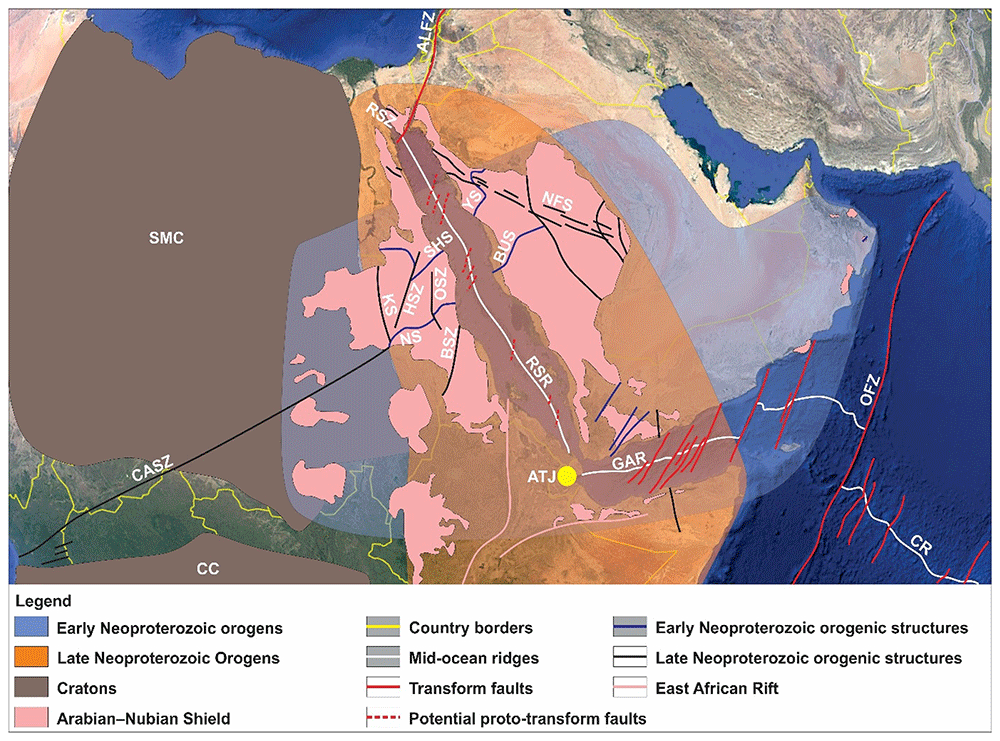
The map shows the relationship between the late Neoproterozoic, N–S-striking East African Orogen and the East African Rift and Red Sea Rift, which are parallel to one another. Another potential controlling relationship is that of early Neoproterozoic, NE–SW-striking orogenic structures with potential (proto-?) transform faults in the Red Sea rift and transform faults offsetting the Gulf of Aden Rift. Early and late Neoproterozoic orogenic structures are from Abdelsalam (2010), Alessio et al. (2017), Bosworth et al. (2005), Collins et al. (2021), Ibrahim et al. (1996), Johnson (2014), and Johnson & Woldehaimanot (2003). Basemap is from © Google Earth. Abbreviations: ALFZ: Aqaba–Dead-Sea–Levant fault zone; ATJ: Afar Triple Junction; BSZ: Barka (–Adobha) Shear Zone; BUS: B’ir Umq Suture; CASZ: Central African Shear Zone; CC: Congo Craton; CR: Carlsberg Ridge; GAR: Gulf of Aden Rift; HSZ: (Onib–) Hamisana Shear Zone; KS: Keraf Suture; NFS: Najd fault system; NS: Nakasib Suture; OFZ: Owen fault zone; OSZ: Oko Shear Zone; RSR: Red Sea rift; RSZ: Rehba Shear Zone; SHS: Sol Hamed Suture; SMC: Sahara Metacraton; YS: Yanbu Suture.
Passive margins
At passive margins, linear magnetic anomalies near typically interpreted continent–ocean boundaries do not necessarily reflect the presence of oceanic crust but of (dominantly mafic) igneous intrusions in continental to hybrid crust. In many cases, the continent–ocean boundary is likely to be located farther oceanward (e.g., Geoffroy et al., 2022b; Koopmann et al., 2014). Data from exploration wells that penetrate continental crust offshore are rarely included in current plate tectonics reconstructions. As a result, the extent of oceanic crust has likely been overestimated in some areas along passive margins around the globe (Geoffroy et al., 2022a), e.g., off the coast of Namibia (Geoffroy et al., 2022b), the Newfoundland–Iberian margin (Lymer et al., 2019; Shillington et al., 2006), the Rockall Plateau north of Ireland (Dickin, 1992; Roberts et al., 1973), and in the northeastern Atlantic and Arctic oceans (Foulger et al., 2024).
Namibia–Brazil margin
Off the coast of Namibia, seismic reflection, magnetic, and gravimetric data show that the true continent–ocean boundary lies 100 to 300 km farther oceanward (Geoffroy et al., 2022b). Given the c. 2800 km distance to the mid-ocean ridge in this area, this suggests an underestimation of the extent of continental crust of 3.5 to 10.7%. The mafic igneous rocks that comprise seaward-dipping reflectors produce linear magnetic anomalies that may be similar to mid-ocean-ridge-related anomalies (Geoffroy et al., 2022a; Geoffroy et al., 2022b; Koopmann et al., 2014; Reeve et al., 2021). Linear magnetic anomalies occur in highly thinned slivers of continental crust intruded by seaward-dipping reflectors along the Namibian passive margin (Geoffroy et al., 2022b). Not only can linear magnetic anomalies not be relied upon to discriminate oceanic and continental crust, it is now necessary to reevaluate the extent of continental versus oceanic crust at volcanic passive margin.
The crust below the Walvis Ridge shows a thickness and seismic velocities comparable to that below Iceland (Fromm et al., 2017a; Fromm et al., 2017b), which is likely continental (Foulger et al., 2020a; Koehl et al., 2024). In addition, basalts at the Walvis Ridge locally show traces of contamination by continental crust, which is similar to igneous province on continental crust, e.g., the Parana and Etendeka provinces (e.g., Eroshenko & Kharin, 2019).
On the conjugate South American margin, Proterozoic granite, gneiss, granulite, and gabbro were recovered from dredges on the Rio Grande Ridge (Santos et al., 2019). The large variety of rock types in the dredged samples at Rio Grande Ridge and the lack of a thick manganese coating/encrustation, typical for rocks exposed to seawater for extended periods of time, calls for caution when interpreting the origin of these samples, as these features suggest ice-rafted debris from Antarctica. However, the absence of manganese coating may also suggest an origin from recent slumps and/or fault scarps, where fresh bedrock may be exposed and not yet encrusted. This is probable for most of the dredged samples, which were collected near a major bathymetric escarpment (see figure 2 in Ventura Santos et al., 2019). The ca. 2.2–2.1 Ga, 1.4 Ga, 1.1 Ga, 540 Ma, and 480 Ma U–Pb zircon obtained for the samples at Rio Grande Ridge are typical for both Antarctica (Groenewald et al., 1995; Liu et al., 2014) and western Africa (which is a potential source for detrital zircon at Rio Grande Ridge) and Brazil (Basei et al., 2008; Santos et al., 2019). Thus, the geochronological record cannot distinguish the source area. Nevertheless, studies of the northern limit for icebergs and of circum-Antarctic currents in the South Atlantic Ocean suggest that only few icebergs (if any) make it to the Rio Grande Ridge area (e.g., Bornhold, 1983 his figure 1; Romanov et al., 2017; England et al., 2020 their figures 1 and 4; Starr et al., 2021 their figure 1; Orheim et al., 2023 their figures 1, 2, 6, and 7; Barkley et al., 2024 their figure 1; Bigg, 2024 his figures 2, 5, 6, and 7; van der Does et al., 2024 their figure 4). An origin as ice-rafted debris from Antarctica is therefore unlikely and the samples probably reflect continental crust at Rio Grande Ridge.
These new results indicate that the Walvis–Rio Grande Ridge most likely consists of continental to hybrid crust and that the continent–ocean boundary is located 400–850 km farther oceanward on both margins. This suggests that large portions of the offshore areas are underpinned by continental crust. At Rio Grande Ridge, the extent of oceanic crust could be overestimated by as much c. 46.2% using a c. 2600 km distance from the previously proposed continent–ocean boundary at the western edge of the Rio Grande Ridge and the mid-ocean ridge and c. 1400 km distance from the eastern tip of the Rio Grande Ridge (new continent–ocean boundary). At Walvis Ridge, the overestimation could be up to 34.7% using a 2450 km distance from the continental shelf break east of Walvis Ridge to the mid-ocean ridge and a distance of 1600 km from the central Walvis Ridge (new continent–ocean boundary) to the mid-ocean ridge.
This is further supported by the (respectively clockwise and anticlockwise) bending of the seafloor flowlines in map view at the Walvis Ridge and Rio Grande Ridge, which indicates right- and left-lateral relative movement along the northern flank of the ridges in the order of a few tens to a hundred km (Fairhead & Wilson, 2005) since breakup at ca. 125–100 Ma (Eagles, 2007; Scotchman et al., 2010), i.e., up to 1 mm per year. Such relative movements may be accommodated by either or a combination of bending (in map view) and strike-slip faulting. A possible cause for these relative movements is viscosity contrast between the continental-to-hybrid crust within the Walvis Ridge and Rio Grande Ridge and regular, c. 6 km thick oceanic crust in the north. A major limitation at Rio Grande Ridge and Walvis Ridge is that current seismic reflection data show poor reflectivity 1 second (TWT) into the bedrock (Sager et al., 2021) and, thus, cannot definitively yield the nature of the crust there (oceanic versus continental/hybrid). Nevertheless, the irregular and high-amplitude character of the magnetic anomalies at those ridges (Sager et al., 2021 their figure 17) is typical for intrusions (e.g., seaward-dipping reflectors) in continental crust (Geoffroy et al., 2022a; Geoffroy et al., 2022b).
Newfoundland–Iberian margin
Continental breakup at the Newfoundland and Iberian conjugate hyperextended margins is generally believed to have occurred later compared to the central and northern segments of the Atlantic rift (e.g., Causer et al., 2022). In line with the findings of Geoffroy et al. (2022a; 2022b), the ages of the earliest anomalies (145 and 120 Ma; Srivastava et al., 2000) contrast with the age inferred from drilling and dating the breakup unconformity (113 Ma; Boillot et al., 1988; Tucholke & Sibuet, 2007). This suggests that the continent–ocean boundary lies farther seaward than previously proposed. Extreme thinning of the continental crust at passive margins due to extreme extension along low-angle detachments is particularly well illustrated along the Iberian margin (e.g., Lymer et al., 2019; Pérez-Gussinyé, 2013). There, potential Variscan folds and thrusts in hyperextended continental basement seem to have controlled the formation of low-angle extensional detachments and show a top-east vergence (Lymer et al., 2019 their figures 5a–d and 7b), i.e., comparable to Variscan structures in the geosyncline onshore northern Iberia (e.g., Franke, 2006; Pastor-Galan et al., 2020; Shaw et al., 2012).
In contrast to the drastically thinned Iberian continental crust, the broad Newfoundland passive margin displays a relatively thick wedge of continental crust. There, Alleghenian thrusts show a top-east vergence that matches that of coeval Variscan structures on the conjugate Iberian margin (Lefort & Haworth, 1984; Lefort et al., 1993). The upper-plate geometry of the Newfoundland margin and lower-plate geometry (e.g., Lister et al., 1986) of the Iberian margin suggest that Variscan thrusts controlled the breakup and the asymmetry of the margin.
Rockall Plateau
Basement rocks in the Rockall Plateau have now been penetrated by multiple exploration wells, many of which show that the crust there was metamorphosed to amphibolite to granulite facies during the Paleoproterozoic Laxfordian–Ketilidian Orogeny (Attfield, 1987; Dickin, 1992). Despite Mesozoic–Cenozoic extension and associated emplacement of thick igneous rock successions (Johnston et al., 2001; Musgrove & Mitchener, 1996; Roberts et al., 1973), which culminated with the opening of the southern North Atlantic Ocean in the Cretaceous, the entire block is believed to be underlain by Paleoproterozoic continental crust (Dickin, 1992). Despite the Paleoproterozoic ages obtained for the crust there, the Rockall Plateau is rarely included in Paleoproterozoic–Paleozoic plate tectonic reconstructions (e.g., Domeier, 2016), thus giving the continental plates and blocks in these reconstructions more space for movement or resulting in large overlaps of adjacent plates (e.g., Johnston et al., 2001).
On restoration prior to breakup, all triple junctions linking three mid-ocean ridge segments (RRR), including paleo and failed triple junctions, appear to originate at the intersection of at least two major orogens that are oblique to one another. Most if not all RRR (may they be active-, paleo-, or failed-) triple junctions display a T-like geometry, that is two mid-ocean ridge segments parallel to one another and a third segment oblique to the other two. As such, of the three mid-ocean ridge segments involved at RRR triple junctions, two are crosscut by transform faults with the same strike. Given the control of rift-orthogonal orogens on the formation of major transform faults, a relationship between at least two orogens and RRR triple junctions is logical. OrBiT therefore predicts that RRR triple junctions form at the intersection of two preexisting orogens oblique to one another. To illustrate this, we explore the situation at the four currently active RRR triple junctions, the Bouvet, Rodrigues, Galapagos, and Pacific–Nazca–Antarctica triple junctions, as well as at a paleo-RRR triple junction (Labrador–Reykjanes–Mid-Atlantic) and two failed RRR triple junctions (western Barents Sea and North Sea rift; Figure 1, Figure 5a–b, and Figure 6).
Bouvet Triple Junction
In the southern Atlantic Ocean, the Bouvet Triple Junction connects the southern segment of the Mid-Atlantic Ridge with the American–Antarctic Ridge in the southwest, and with the Atlantic–Indian Ridge in the southeast (Ligi et al., 1999; Figure 1 and Figure 5a–b). Breakup at the southern Mid-Atlantic Ridge occurred at ca. 125–100 Ma (e.g., Eagles, 2007; Scotchman et al., 2010), i.e., later than along the South-West Indian Ridge at ca. 160 Ma (DeMets et al., 2021; Seton et al., 2012). The southern part of the Mid-Atlantic Ridge is crosscut by E–W- to NE–SW-striking transform faults such as the Agulhas–Falkland fault zone (Figure 1 and Figure 5a–b; Barker, 1979; Ben-Avraham et al., 1997; Uenzelmann-Neben & Gohl, 2004). The E–W-striking Agulhas–Falkland fault zone runs parallel to the late Paleozoic Cape Fold Belt in the Falkland Plateau and Maurice Ewing Bank (Johnston, 2000; Martin et al., 1981; Mitchell et al., 1986; Stanca et al., 2022; Storey et al., 1999) and onshore Patagonia (Castillo et al., 2017; du Toit, 1927; Falco et al., 2022; Falco et al., 2024; Grillo Vidal et al., 2024; Pankhurst et al., 2006; Figure 1 and Figure 5a). In South Africa, the fault shows a NE–SW strike and runs parallel to the Cape Fold Belt near Cape Town and Port Elizabeth (Figure 5a; Johnston, 2000; McKay et al., 2018; Newton, 1993; Veevers et al., 1994).
In the southwest, the American–Antarctic Ridge is offset by a series of transform faults including the Conrad, Bullard, and Vinogradov fault zones (Ligi et al., 1999; Mitchell et al., 2000; Sandwell & Smith, 2001), which also parallel transform faults in the Scotia Plate, e.g., the North Scotia and South Scotia ridges (Klepeis, 1994; Livermore et al., 2000; Ludwig & Rabinowitz, 1982; Pelayo & Wiens, 1989; Riley et al., 2019; Thomas et al., 2003; Figure 5a). All these faults also parallel the Cape Fold Belt; Figure 1 and Figure 5a). A potential hypothesis to be further tested for the West Scotia Ridge and Phoenix Ridge system in the west and the American–Antarctic Ridge in the east is a failed attempt of the West Scotia–Phoenix Ridge system to break the orogenically thickened continental crust between the Falkland Islands and Maurice Ewing Bank in the south and to merge with South Atlantic Mid-Ocean Ridge. Instead, seafloor spreading aborted there and the rift stepped to the west with seafloor spreading initiating at the American–Antarctica Ridge and succeeding in rupturing the orogenic bridge. This scenario is already supported by the left-lateral offset/step of the South Atlantic Mid-Ocean Ridge across the Agulhas–Falkland fault zone (Figure 5a–b) and by 137–93 Ma Ar–Ar ages for basalts at the northern tip of the West Scotia Ridge (Riley et al., 2019). The latter suggest that magmatism along the northern tip of the West Scotia Ridge died out at 93 Ma, i.e., at the onset or soon after the breakup in the South Atlantic Ocean at ca. 100 Ma (Eagles, 2007).
East of the Bouvet Triple Junction, the Atlantic–Indian Ridge is truncated by NE–SW- to NNE–SSW-striking transform faults, which include the Andrew Bain Fault Zone (e.g., Peyve et al., 2007; Sclater et al., 2005) and other minor faults such as the Du Toit, Moshes, and Bouvet fault zones (Figure 5a; Ligi et al., 1999). There, the transform faults parallel the East African–Antarctica Orogen and related shear zones, both in Antarctica (Bauer & Siemes, 2004; Golynski & Jacobs, 2001; Jacobs, 1999; Ruppel et al., 2015), eastern Africa (Abdelsalam et al., 1998; Hamimi et al., 2022; Johnson, 2014; Key et al., 1989; Mosley, 1993; Quick & Bosch, 1990; Shackleton, 1996; Stern & Kröner, 1993), and Madagascar (Armistead, 2019; Boger et al., 2015; Collins et al., 2000; Collins et al., 2012; De Waele et al., 2011; Figure 6).
Major transform faults offsetting the southern segment of the Mid-Atlantic Ridge and the American–Antarctic Ridge strike parallel to one another (Figure 5b), and both groups of transform faults parallel the late Paleozoic, E–W-striking Cape Fold Belt and its onshore continuation in Patagonia (Castillo et al., 2017; Falco et al., 2022; Falco et al., 2024; Grillo Vidal et al., 2024; Pankhurst et al., 2006; Stanca et al., 2022; Figure 5). However, major transform faults associated with the Atlantic–Indian Ridge (e.g., Andrew Bain Fault Zone) are oblique (c. 45°) to these transforms as they parallel the East African–Antarctica Orogen (Figure 5 and Figure 6; Collins et al., 2000; Collins et al., 2012; Ruppel et al., 2015; Shackleton, 1996). When restored to prior to opening of the three mid-ocean ridge segments, the Bouvet Triple Junction lies at the intersection of the Cape Fold Belt and the East African–Antarctica Orogen near the eastern tip of Maurice Ewing Bank, the eastern tip of the Cape Fold Belt in South Africa, and between the Grunehogna and Kalahari cratons prior to rifting (black arrow in Figure 1 and Figure 5a; e.g., Mueller & Jokat, 2019; Tomasi et al., 2021).
Rodrigues Triple Junction
Similar to the T-like Bouvet Triple Junction in the southern Atlantic Ocean (Figure 5a), the Rodrigues Triple Junction connects the NE–SW-striking Southwest Indian Ridge with the NW–SE-striking Southeast Indian and Central Indian ridges in the Central Indian Ocean (Figure 1 and Figure 12; Meyzen & Schwarz-Schampera, 2023; Munschy & Schlich, 1989; Patriat & Segoufin, 1988). The Southeast Indian and Central Indian ridges are crosscut by large NE–SW-striking transform faults such as the Marie Celeste fault zone (Figure 12; Chen et al., 2017; Mahoney et al., 1989; Mukhopadhyay & Iyer, 1993; Nauret et al., 2006). In contrast, the Southwest Indian Ridge is truncated by NE–SW- to N–S-striking transform faults (e.g., Andrew Bain Fault Zone; Figure 5a and Figure 12; Peyve et al., 2007; Sclater et al., 2005) that strike parallel to late Neoproterozoic structures of the East African–Antarctica Orogen (see previous sections and Figure 6).
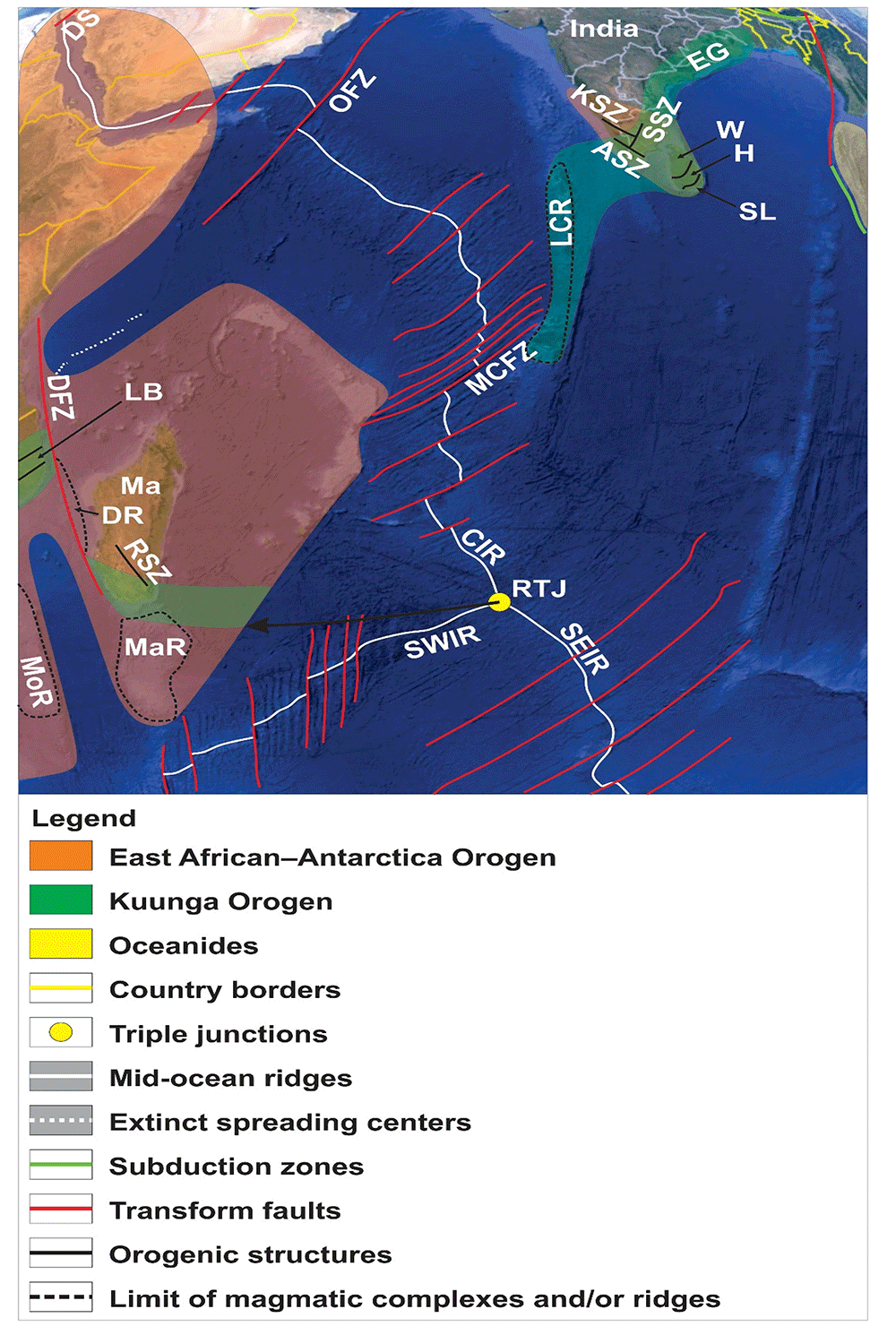
When restored prior to the opening of the Indian Ocean, the Rodrigues Triple Junction coincides with the intersection of the Kuunga and East African–Antarctica orogens in southern Madagascar (black arrow). The orogenic structures in India, Madagascar, and Mozambique are from Sacchi et al. (2000), Collins et al. (2003), Brandt et al. (2014), and Armistead (2019). Basemap is from © Google Earth. Abbreviations: ASZ: Achankovil Shear Zone; CIR: Central Indian Ridge; DFZ: Davie fault zone; DR: Davie Ridge; DS: Dead Sea Transform; EG: Eastern Ghats; H: Highland Complex; KSZ: Karur–Kambam–Painavu–Trichur Shear Zone; LB: Lurio Belt; LCR: Laccadive-Chagos Ridge; Ma: Madagascar; MaR: Madagascar Ridge; MCFZ: Marie Celeste fault zone; MoR: Mozambique Ridge; OFZ: Owen fault zone; RSZ: Ranotsara Shear Zone; RTJ: Rodrigues Triple Junction; SEIR: Southeast Indian Ridge; SL: Sri Lanka; SSZ: Suruli Shear Zone; SWIR: Southwest Indian Ridge; W: Wanni Complex.
Transform faults associated with the Southeast and Central Indian ridges show a comparable strike to that of NE–SW-striking folds, thrusts, and shear zones of the late Neoproterozoic–Cambrian Kuunga Orogen, including the Lurio Belt in northeastern Mozambique (Figure 12; Bingen et al., 2009; Collins et al., 2003; Sacchi et al., 2000; Viola et al., 2008) and their counterparts in southern India and Sri Lanka (Figure 12; Axelsson et al., 2020; Brandt et al., 2014; Dharmapriya et al., 2015; Ghosh et al., 2004; He et al., 2018; Hirayama et al., 2020; Srinivasan & Rajeshdurai, 2010). The dominantly sinistral strike-slip, NE–SW-striking shear zones within the Lurio Belt bend E–W westwards, suggesting a possible link with the late Neoproterozoic, WNW–ESE-striking Ranotsara Shear Zone in southern Madagascar, which also displays evidence of sinistral strike-slip kinematics (Figure 6 and Figure 12; Collins et al., 2003; Tucker et al., 2007). The latter was correlated with the Achankovil Shear Zone and/or the Karur–Kambam–Painavu–Trichur Shear Zone in southern India (Figure 12; Collins et al., 2003; Ghosh et al., 2004).
Since the NE–SW-striking, sinistral segment of the Karur–Kambam–Painavu–Trichur Shear Zone appears to continue southwards as the NE–SW-striking Suruli Shear Zone, it is probable that the Karur–Kambam–Painavu–Trichur Shear Zone and the Suruli Shear Zone correlate with NE–SW-striking sinistral shear zones in the Lurio Belt (Brandt et al., 2014; Srinivasan & Rajeshdurai, 2010). Transform faults in the central Indian Ocean, such as the Marie Celeste fault zone, notably parallel the NE–SW-striking segment of the Karur–Kambam–Painavu–Trichur and NE–SW-striking Suruli shear zones in southern India, the NE–SW-striking Eastern Ghats in eastern India, and the NNE–SSW- to NE–SW-striking Highland and Wanni complexes in Sri Lanka (Figure 12; Axelsson et al., 2020; Collins et al., 2003; Dharmapriya et al., 2015; Ghosh et al., 2004; He et al., 2018; Hirayama et al., 2020; Kitano et al., 2017; Meert, 2003).
Reconstruction of the Rodrigues Triple Junction prior to opening of the Indian Ocean shows that it most likely initiated near the southern tip of Madagascar and southern India, the northern tip of the Gunnerus Ridge, and just east of the Lurio Belt in northeastern Mozambique (e.g., Ghosh et al., 2004; Mueller & Jokat, 2019). Thus, the Rodrigues Triple Junction probably formed at the intersection of the N–S-trending East African–Antarctica Orogen in Madagascar (see black arrow in Figure 12; possibly including the Mauritia microcontinent; Torsvik et al., 2013), eastern Africa, and Dronning Maud Land in Antarctica with the NE–SW-striking Kuunga Orogen (e.g., Lurio Belt) in southern Madagascar (and Mauritia), southern India, and Sri Lanka (see black arrow in Figure 1 and Figure 12).
Galapagos triple junction
At the Galapagos triple junction, the transform faults crosscutting the E–W-striking Cocos–Nazca Rift (i.e., the Galapagos spreading center) are parallel to the Famatinian Orogen in Colombia and Ecuador (Garcia-Ramirez et al., 2017; Ramos, 2018; Zuluaga et al., 2017). The three major E–W-striking transform faults truncating the southern mid-ocean ridge segment are parallel to the bend in the late Cambrian–Ordovician Famatinian Orogen in Peru (Ramos, 2018). In the north, the E–W-striking transform faults crosscutting the East Pacific Rise are parallel to E–W-striking thrusts and shear zones and ophiolites (El Tambor Complex) of the Motagua Suture Zone in Honduras, Guatemala, and Mexico, a c. 400 km wide zone of contractional deformation including rocks metamorphosed up to blueschist and eclogite facies (Burke, 1988; Brueckner et al., 2009; Martens et al., 2007; Ratschbacher et al., 2009; Tsujimori et al., 2006). A major episode of metamorphism occurred in the earliest Cretaceous, but up to Grenvillian ages (ca. 1.1–1.0 Ga) were obtained, including early–mid Paleozoic metamorphic ages for E–W-striking igneous complexes (e.g., Chuacus complex) and shear zones. These suggest that the Motagua Suture Zone was part of the Taconic–Acadian orogen (Brueckner et al., 2009; Martens et al., 2007; Ratschbacher et al., 2009).
Upon reconstruction to prior to seafloor spreading at the Cocos–Nazca Rift and in the Caribbean Plate, it is thus possible that the Galapagos triple junction initiated at the intersection of early–mid Paleozoic (Taconic–Acadian and Famatinian) or older (latest Mesoproterozoic–earliest Neoproterozoic Grenvillian and early–mid Paleozoic Famatinian) orogens. The location of this intersection is uncertain but was likely (or may still be) along the eastern prolongation of the Motagua Suture Zone, possibly near Puerto Rico, where it was partly reworked and overprinted during the Cuban Orogen (see black arrow in Figure 1). This is supported by latest Mesoproterozoic–earliest Neoproterozoic ages in Cuba and Hispaniola and early Paleozoic ages northwest of Cuba (Dallmeyer, 1984; Iturralde-Vinent, 1994; Kamenov et al., 2011; Renne et al., 1989), which suggest the presence of old continental crust from Mexico to at least Hispaniola (Dominican Republic and Haiti; Figure 1).
Pacific–Nazca–Antarctica triple junction
The mid-ocean ridge segments merging at the Pacific–Nazca–Antarctica triple junction are crosscut by transform faults that parallel the Cape Fold Belt and Sierra de la Ventana Fold-and-Thrust Belt in South America (Castillo et al., 2017; Grillo Vidal et al., 2024; Limarino et al., 1999; Lopez-Gamundi, 2006; Pankhurst et al., 2006; Rapela et al., 2003; Stanca et al., 2022; von Gosen et al., 1990) and the late Paleozoic–Triassic fold belt in Indonesia (Brown et al., 1979; Davies, 1980; Harahap, 2012; Hill & Raza, 1999; Page, 1976; Pigram & Davies, 1987) and in the Antarctic Peninsula (Graham Land) and Ellsworth Mountains in Antarctica (Curtis, 2001; Elliott et al., 2019). In Papua (Indonesia) and Papua New Guinea, Silurian–Devonian rocks of the Omung Group were deformed into tight E–W-striking folds and metamorphosed to greenschist facies prior to the deposition of latest Paleozoic–Mesozoic sedimentary rocks and intrusion by Mesozoic igneous rocks (Brown et al., 1979; Davies, 1980; Hill & Raza, 1999; Page, 1976; Pigram & Davies, 1987).
In Antarctica, gneisses and granitoids of Permian–Triassic age suggest deformation related to the Cape Fold Belt (Curtis, 2001; Elliott et al., 2019). The mid-ocean ridge segments of the Pacific–Nazca–Antarctica triple junction are crosscut by only one trend of transform faults (Figure 1). Nevertheless, the triple junction occurs near the intersection of the E–W-striking, Permian Sierra de la Ventana Fold-and-Thrust Belt (Castillo et al., 2017; Limarino et al., 1999; Lopez-Gamundi, 2006; Rapela et al., 2003; von Gosen et al., 1990) and the N–S-striking, Cambrian–Ordovician Pampean and Famatinian orogens (Oriolo et al., 2021; Ramos, 2018; Rapela et al., 1998a; Rapela et al., 1998b; Rapela et al., 2001; Verdecchia et al., 2011). This RRR triple junction is thus no exception to the proposed controlling relationship and may have initiated at the intersection of Permian and Cambrian–Ordovician orogens.
Furthermore, the major transform faults crosscutting the East Pacific Rise in the southern Pacific Ocean strike parallel to late Paleozoic–early Mesozoic orogenic structures of the disrupted Gondwanide Orogen. In South America, they are parallel to structures of the Sierra de la Ventana Fold-and-Thrust Belt and Cape Fold Belt (Castillo et al., 2017; Grillo Vidal et al., 2024; Stanca et al., 2022; von Gosen et al., 1990). In Papua and Papua New Guinea, they are parallel to (Carboniferous–Permian?) E–W-striking the folds in the Omung Group (Brown et al., 1979; Davies, 1980; Hill & Raza, 1999; Page, 1976; Pigram & Davies, 1987; Figure 1). In New Zealand and northeastern Australia, they parallel NW–SE- to WNW–ESE-striking belts of Carboniferous–Triassic igneous and metamorphic rocks of the Median Batholith and Tuhua Orogen, which extend well into the Pacific plate (Allibone et al., 2009; Campbell et al., 2020; Gibson, 1992; McCoy-West et al., 2014; Mortimer et al., 1999; Robertson et al., 2019; Suggate, 1965).
Labrador–Reykjanes–Mid-Atlantic paleo-triple junction
The present-day Reykjanes Ridge, Mid-Atlantic Ridge, and paleo Labrador Ridge join at the Bight fault zone (Figure 1 and Figure 4). There, the E–W-striking Appalachian–Caledonian Orogen between Newfoundland and Great Britain (Chew & Stillman, 2009; van Staal et al., 2009; Yang & Welford, 2023) intersects the NW–SE-striking Ketilidian–Laxfordian Orogen between Greenland and Rockall Plateau (Dickin, 1992; Garde et al., 2002b; Hinchey, 2021; Figure 4).
A possible scenario to be further explored for this paleo-triple junction is that upon meeting the thickened orogenic crust of the WNW–ESE-striking, late Paleoproterozoic Ketilidian–Laxfordian Orogen towards Iceland, the rift tried to incise the continental crust along the Bight fault zone and then proceeded to open the Labrador Sea. There, the orogen incised the NE–SW-striking, late Paleoproterozoic Makkovikian–Ketilidian Orogen (Garde et al., 2002b; Hinchey, 2021) separating the North Atlantic Craton in western Greenland from the Nain Province in northeastern Canada. In the Davis Strait, rifting met yet another barrier of orogenically thickened crust, the N–S- to E–W-striking Nagssugtoqidian–Torngat orogen (van Gool et al., 2002a; van Gool et al., 2002b; van Gool et al., 2005; Figure 4), and stepped into Baffin Bay along the Ungava Fault Zone (e.g., Dafoe et al., 2022; Oakey & Chalmers, 2012). Eventually, rifting died out in the Labrador Sea and Baffin Bay and rifting proceeded into the northeastern Atlantic along the Reykjanes Ridge (Figure 4).
Western Barents Sea failed triple junction
Examples of failed RRR triple junctions include the Hammerfest and Bjørnøya basins in the southwestern Barents Sea (Figure 13). These basins are located at the intersection of the NE–SW-striking Caledonian and WNW–ESE-striking Timanian orogens (Olovyanishnikov et al., 2000; Roberts, 2003; Figure 13). Both basins and their boundary faults, e.g., Troms–Finnmark Fault Complex and Bjørnøyrenna Fault Complex, formed along Timanian thrusts and folds reworked into NE–SW-striking structures during the Caledonian Orogeny (Gernigon et al., 2014; Gudlaugsson et al., 1998; Koehl et al., 2018; Koehl et al., 2023a; Koehl & Stokmo, 2024). This suggests that rifting attempted to thin the crust along preexisting Caledonian (or reoriented Timanian) thrusts (Gernigon et al., 2014; Koehl et al., 2018; Koehl & Stokmo, 2024), but failed and merged with the Gakkel Ridge in the Arctic Ocean through delayed rifting in the Fram Strait (Koehl, 2020; Koehl & Mottram, 2024; Figure 4).
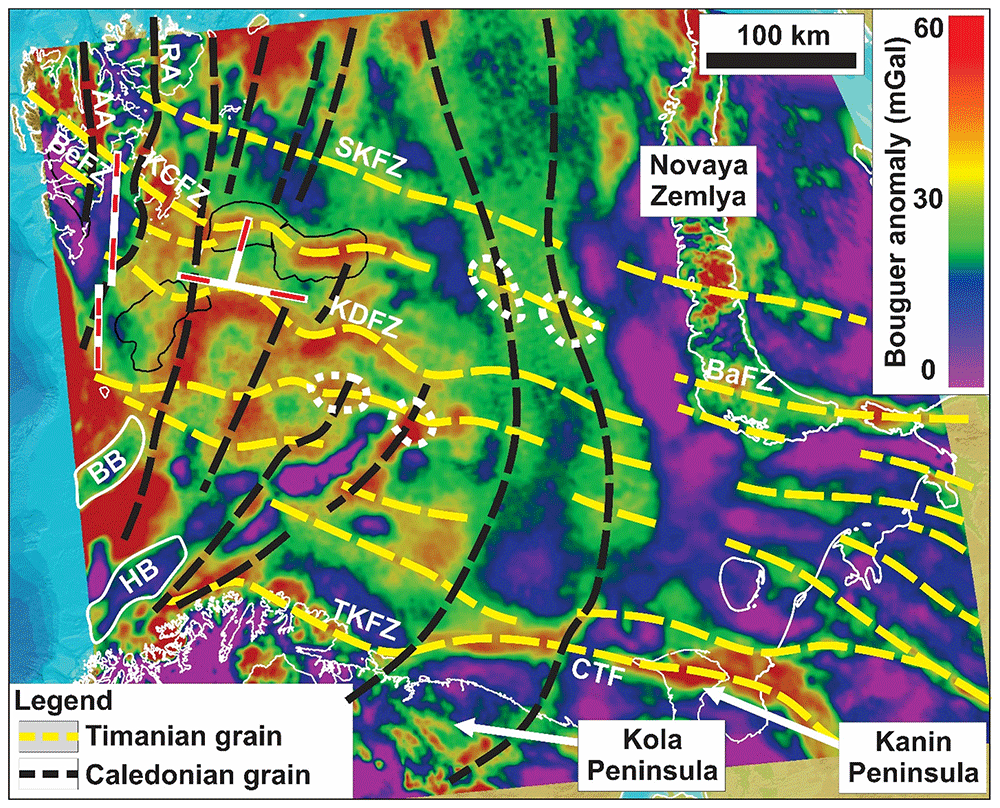
The map shows the interaction of NE–SW- to N–S-striking Caledonian (dashed black) and Timanian (dashed yellow) structural trends in the Barents Sea. Notice how the Hammerfest Basin (HB) and Bjørnøya Basin (BB) in the west parallel preexisting Caledonian grain. The data is from BGR. Modified after Koehl et al. (2022).
North Sea failed triple junction
The North Sea rift displays a triple-junction-like geometry in that it consists of three failed rift arm trends, including (a) an ENE–WSW-striking arm extending from Moray Firth to onshore the northern UK, (b) a WNW–ESE-striking arm extending from Denmark and including the Sorgenfrei–Tornquist Zone, and (c) a N–S to NNE–SSW-striking arm between the Shetland Islands and southern Norway (Figure 4). The N–S- to NNE–SSW- and ENE–WSW-striking arms clearly developed along inherited Caledonian structures as supported by numerous onshore field and offshore seismic reflection studies (e.g., Fazlikhani et al., 2017; Fossen et al., 2016; Fossen et al., 2024; Osmundsen & Andresen, 1994; Serck et al., 2022; Figure 4).
In contrast, the WNW–ESE-striking arm of the North Sea rift formed along the Laxfordian–Svecofennian Orogen. The latter includes WNW–ESE-striking Laxfordian shear zones onshore northern Scotland (Coward & Park, 1987), thrust systems around the Faroe Islands and in the Iceland–Faroe Ridge (Koehl et al., 2024), Svecofennian shear zones onshore southern Sweden (Saintot et al., 2011), and possibly the Sorgenfrei–Tornquist Zone (STZ; Ponikowska et al., 2024). There is evidence that rift-related basins in the North Sea formed along reactivated segments of the Sorgenfrei–Tornquist Zone (e.g., Farsund Basin; Phillips et al., 2018) and that these are related to WNW–ESE-striking late Paleoproterozoic thrust systems off the Faroe Islands and onshore northern Scotland (Koehl et al., 2024). Thus, the North Sea rift seems to have been completely controlled by preexisting orogens.
Afar triple junction
In the Arabian–Nubian Shield, the N–S-striking late Neoproterozoic shear zones and sutures of the East African Orogen probably controlled the formation of the Aqaba–Dead-Sea–Levant fault zone and related proto-transform faults in the Red Sea (see East African–Antarctica orogenic bridge section; Bosworth et al., 2005; Collins et al., 2021; Dixon et al., 1987; Johnson & Woldehaimanot, 2003; Molnar et al., 2020; Stern & Kröner, 1993; Figure 11). In addition, it is well established that these inherited, late Neoproterozoic structures also controlled the geometry of the East African Rift in Nubian basement rocks, e.g., providing suitably oriented N–S-striking foliation, faults, shear zones, and intrusions (e.g., Chorowicz, 2005; Corti et al., 2022). Furthermore, they also parallel the NNE–SSW-striking transform faults truncating the Gulf of Aden Rift, including the Owen fault zone (Fournier et al., 2011) and, thus, may as well have controlled the formation of these structures.
In addition, the Arabian–Nubian Shield is transected by older, early Neoproterozoic, NE–SW-striking shear zones and suture zones, e.g., Yanbu-Sol Hamed, Bi’r Umq–Nakasib, and Ambur–Delgo sutures (Abdelsalam & Stern, 1993; Collins et al., 2021; Johnson, 2014; Johnson et al., 2011; Robinson et al., 2015; Figure 11). These were reworked by E–W-oriented contraction during the late Neoproterozoic East African Orogeny, e.g., the NNW–SSE-striking sinistral Oko shear zone offsetting the NE–SW-striking Bi’r Umq–Nakasib suture (Abdelsalam & Stern, 1993; Abdelsalam, 2010). In addition, the location of some of these early Neoproterozoic structures coincide with that of late Neoproterozoic structures, e.g., the NE–SW-striking Bi’r Umq–Nakasib suture (Abdelsalam & Stern, 1993; Abdelsalam, 2010) and ENE–WSW-striking Central African Shear Zone (Ibrahim et al., 1996; Schandelmeier & Pudlo, 1990 their figure 5; Figure 11). The latter is part of the Central African Orogen in western Africa, an oblique arm of the late Neoproterozoic Pan African Orogeny (Dorbath et al., 1986; Kouémo et al., 2014).
In Yemen, NE–SW-striking Neoproterozoic shear zones and/or sutures bound Archean–Mesoproterozoic crust of the Abas and Al Mahfid blocks from island-arc rocks of the Al Bayda block, which record late Neoproterozoic greenschist-facies metamorphism (Johnson et al., 2011; Johnson, 2014; Whitehouse et al., 2001; Yeshanew et al., 2015; Figure 11). Similarly striking early Neoproterozoic structures also occur in Oman (Alessio et al., 2017; Blades et al., 2019). These zones of deformation strike parallel to the NE–SW-striking Gulf of Aden Rift. It is therefore possible that the rift was controlled by NE–SW-striking early Neoproterozoic orogenic structures. Thus, the Afar triple junction conforms with OrBiT in that it initiated at the intersection of the N–S-striking late Neoproterozoic East African Orogen with a NE–SW-striking early Neoproterozoic orogen and/or an oblique arm of the Pan African Orogeny (Central African Orogen; Figure 11).The plume model
Traditionally, offshore areas underlain by anomalously thick crust or shallow bathymetry where crustal thickness is unknown have been assumed to be oceanic crust thickened by extensive magmatism related to a nearby mantle plume. This has been proposed for example for the GIFR in the northeastern Atlantic (Morgan, 1971; White & McKenzie, 1995) and the Madagascar and Mozambique ridges and Del Cano Rise in the Southwestern Indian Ocean (e.g., Jacques et al., 2019; O’Connor et al., 2019; Ryzhova et al., 2022).
The Iceland area and the GIFR have been intensely researched for well over 50 years. The plume hypothesis for this feature, originally suggested in 1971 (Morgan, 1971) has been widely applied. Features such as the 25–40 km thick crust (e.g., Foulger, 2003), the extensive subaerial volcanism in Iceland with high surface temperature gradients at geothermal fields (50–100°C.km-1; (Flovenz & Sæmundsson, 1993; Hermance & Grillot, 1974), and early magnetoteluric data Eysteinsson & Hermance, 1985; Hermance & Grillot, 1974) were interpreted to indicate enhanced magmatism and high temperatures. This interpretation is currently under scrutiny (e.g., Foulger, 2025).
At the Mozambique Ridge, similar geochemical signatures suggest a genetic link between local basalts and the Karoo–Vestfjella flood basalts, both of which had been interpreted to originate from the same mantle plume (Jacques et al., 2019). At the Madagascar Ridge and the Del Cano Rise, the crust was interpreted to be of oceanic nature based on seismic refraction data, but previous studies could not explain the anomalously thick character of the crust there (Goslin et al., 1980; Goslin et al., 1981; Goslin & Diament, 1987; Suo et al., 2016).
Although geochemical data have been interpreted as consistent with the mantle plume hypothesis (e.g., in Iceland and the Mozambique and Madagascar ridges; Jacques et al., 2019; Kerr, 1995), not all data are reconciled by the model. In Iceland, there are several issues. For example, the thickness of the crust varies between 25 and 40 km (Darbyshire et al., 1998; Foulger et al., 2003). This is five times the thickness of typical 6-km-thick oceanic crust (Christeson et al., 2019). Seismic attenuation shows that the 20–30-km-thick lower crust is anomalously cold (Menke & Levin, 1994). The distance separating the oldest rocks formed at rift zones is nearly twice (c. 500 km instead of 290 km) what is predicted by the full-plate spreading rate and plate modeling for the North Atlantic Ocean (Foulger, 2006).
Magnetic anomalies in the GIFR do not conform to the typical character of seafloor-spreading-related (Foulger et al., 2020a; Gaina et al., 2017). Instead of showing narrow, continuous, linear anomalies, the GIFR displays broader, distorted, curving and disrupted, anomalies (Foulger et al., 2020a; Gaina et al., 2017), which resemble more closely the pseudo-linear disrupted anomalies correlated with intrusions in thinned continental crust off southeastern Greenland, the UK, the Faroe Islands, and Namibia (Geoffroy et al., 2022a; Geoffroy et al., 2022b; Figure 14). Their locally anastomosing character, branching off and forking, their V- or Ʌ-shaped geometry, and, in places, their rift-oblique strike (Figure 14) suggest that the magnetic fabrics at the GIFR are not only the product of Cenozoic rift-related intrusions and may interact with older magnetic fabrics, e.g., older intrusions and/or folded magnetic metasedimentary beds. The V- and Ʌ-shaped anomalies likely correspond to tight, northeast-plunging Caledonian folds in (Paleoproterozoic?) basement rocks (black lines in Figure 14). Such geometries are typical for Caledonian fold structures on magnetic data on adjacent margins, where they show comparable width and strike (e.g., Koehl et al., 2019 their figures 7e and 8a–b; Koehl & Stokmo, 2024 their figures 10–15). An interpretation of V- and Ʌ-shaped anomalies in the GIFR and Jan Mayen Microcontinent Complex is in agreement with recent work around the Faroe Islands, where dominantly NNE-dipping, late Paleoproterozoic thrust systems were reworked into northeast-plunging Caledonian folds (Koehl et al., 2024). This tends to suggest that the Jan Mayen Microcontinent Complex is a remnant of a major Caledonian anticline (black lines in Figure 14).
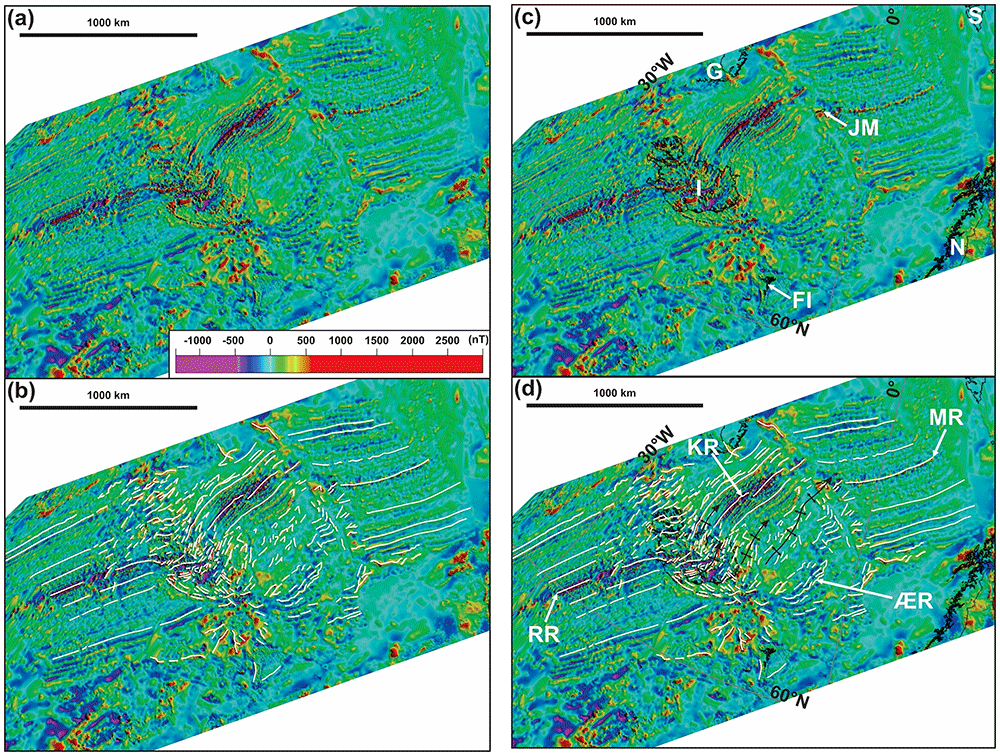
The data show that magnetic anomalies at the GIFR clearly differ from typically linear seafloor-spreading anomalies, which can be traced for hundreds to thousands of km. Instead, magnetic anomalies at the GIFR are typically < 100 km long and display anastomosing, splaying, and V- and Ʌ-shaped geometries, which are more typical of deformation structures and intrusions in continental crust. (a) and (b) respectively show the data uninterpreted and interpreted without coastlines and geographic coordinates to illustrate the contrast between the character of magnetic anomalies at GIFR and within the three rectangular oceanic crustal basins around the Reykjanes Ridge, Kolbeinsey Ridge, and Mohns Ridge (possibly also including a narrow oceanic domain at the Ægir Ridge). (c) and (d) respectively show the data uninterpreted and interpreted with the coastlines and geographic coordinates. The data are from Gaina et al. (2017). Abbreviations: FI: Faroe Islands; G: Greenland; I: Iceland; JM: Jan Mayen; KR: Kolbeinsey Ridge; MR: Mohns Ridge; N: Norway; RR: Reykjanes Ridge; S: Svalbard; ÆR: Ægir Ridge.
Reinterpretation of the RRISP seismic profile on the Reykjanes Ridge (Gebrande et al., 1980) also shows data compatible with cool, sub-solidus temperatures (e.g., Menke et al., 1995), a result that provides little support for a hot plume model (Foulger et al., 2003). Finally, ongoing seismic reflection mapping off the Faroe Islands and southeastern Greenland and within the GIFR suggest that basement-seated, late Paleoproterozoic thrust systems of the Laxfordian Orogen and Ammassalik Belt extend to Iceland (Koehl et al., 2024; Koehl et al., 2025). This most recent work suggests that the GIFR consists dominantly of continental crust and that breakup may not yet have occurred in Iceland despite the several km thick cap of lavas. A model for the thick Icelandic crust that includes a substantial component of continental material is thus currently under scrutiny (e.g., Yuan et al., 2020).
South of Africa and Madagascar, the Mozambique Ridge was arbitrarily assumed to be of volcanic origin (i.e., oceanic crust) with only weak geophysical evidence (magnetic data; König & Jokat, 2010). A continental composition of the crust thus cannot be excluded. This influenced later work (e.g., Jacques et al., 2019) and non-volcanic models for the Mozambique Ridge have been neglected. Seismic refraction and bathymetric data alone are insufficient to establish crustal affinity (e.g., Goslin et al., 1980; Goslin et al., 1981) as demonstrated by an early erroneous interpretation of the Falkland Plateau as oceanic crust (e.g., Schimschal & Jokat, 2018) and of the GIFR as thickened oceanic crust (e.g., White & McKenzie, 1995). This oceanic interpretation was invalidated by the penetrating of Mesoproterozoic continental crust by offshore drill holes (Chemale Jr. et al., 2018) and by evidence of the continuation of the late Paleozoic Cape Fold Belt into the Falkland Plateau and Maurice Ewing Bank (Stanca et al., 2022; Figure 5a). Moreover, the interpretation of gravimetric data leading to the assumption of anomalously thick oceanic crust had been based on the assumption that a mantle plume was present near the Mozambique Ridge (e.g., Goslin & Diament, 1987; Suo et al., 2016), an example of circular reasoning. It is now clear that both the Mozambique Ridge and the Madagascar Ridge are underlain by 15–30 km-thick continental (to hybrid?) crust (Ryzhova et al., 2022; Sato et al., 2022).
Geophysical evidence unambiguously suggests that, although theoretical mantle plumes may produce thick lava flows, they are unlikely to have formed thickened oceanic crust at the GIFR, Mozambique and Madagascar ridges, and Del Cano Rise (Foulger et al., 2003; Foulger et al., 2020a, Foulger et al., 2020b; Geoffroy et al., 2022a; Koehl et al., 2024; Koehl et al., 2025; Ryzhova et al., 2022; Sato et al., 2022). A genetic link between igneous rocks at the Mozambique and Madagascar ridges and those of the Karoo–Vestfjella province is not precluded by our model (e.g., East African–Antarctic Orogen; Figure 6). Nevertheless, certain issues need to be further studied, e.g., the tracking of old orogenic structures into these areas of anomalously thick offshore crust on seismic reflection data.
The wet” versus “dry” rift classification by Dunbar & Sawyer (1989) related the intensity of magmatism and width of the resulting rift with the existence of preexisting weaknesses in the crust and/or mantle. For example, preexisting mantle weaknesses would tend to form narrow “wet” rifts with intense magmatism (e.g., Iceland), whereas crustal weaknesses lead to the development of broad “dry” rifts (e.g., Iberia–Newfoundland). This work assumes that breakup has occurred at the Greenland–Iceland–Faroe Ridge, which is not (yet) the case (Koehl et al., 2024; Koehl et al., 2025). Thus, if the magma-rich Greenland–Iceland–Faroe Ridge is a through-going orogenic bridge where breakup has not yet occurred whereas breakup has occurred at magma-poor margins, e.g., in the Arctic Ocean (ultra-slow-spreading Gakkel Ridge), then intense magmatism and preexisting mantle weaknesses or plumes have less effect on breakup than previously assumed. Other factors, e.g., rift-parallel and rift-orthogonal orogens, must therefore be at play.
Progress in geophysical imagery tools, the gradual release of private geophysical data, and the increasing amount of offshore drill cores and exploration wells are generally revealing that the extent of oceanic crust on Earth has been overestimated. In other words, the extent of continental and hybrid crust (i.e., continental crust extensively intruded by mafic magma) has been significantly underestimated. Such crust should be considered a candidate in many areas where thick crust has traditionally been assumed to be entirely mafic and plume-generated (i.e., oceanic; e.g., Foulger et al., 2020a; Geoffroy et al., 2022a).
Propagation of the Gakkel Ridge towards northern Russia along the Verkhoyansk Orogen
OrBiT predicts that the Gakkel Ridge in the Arctic Ocean will propagate towards northern Russia along the parallel Verkhoyansk Orogen and then step along the E–W-striking segment of the Verkhoyansk Orogen, where a major transform may form (Figure 15a–b). Existing data suggest that this is already happening. Seismic data between the Russian tip of the Gakkel Ridge and northern Russia show numerous Mw ≥ 5.0 earthquakes suggesting normal focal mechanisms along major fault systems parallel to the Gakkel Ridge in the Laptev Sea and nearby onshore areas (e.g., Cook et al., 1986; Engen et al., 2003; Franke et al., 2001; Imaeva et al., 2018; Imaeva et al., 2019). These indicate extension off axis (Figure 15b). Rifting may thus be proceeding along the same trend as the Gakkel Ridge towards Tiksi in northern Russia, where the Verkhoyansk Orogen and associated structure strike N–S, i.e., parallel to the Gakkel Ridge (Kuzmichev & Danukalova, 2023; Pavlovskaia et al., 2022; Figure 15a).
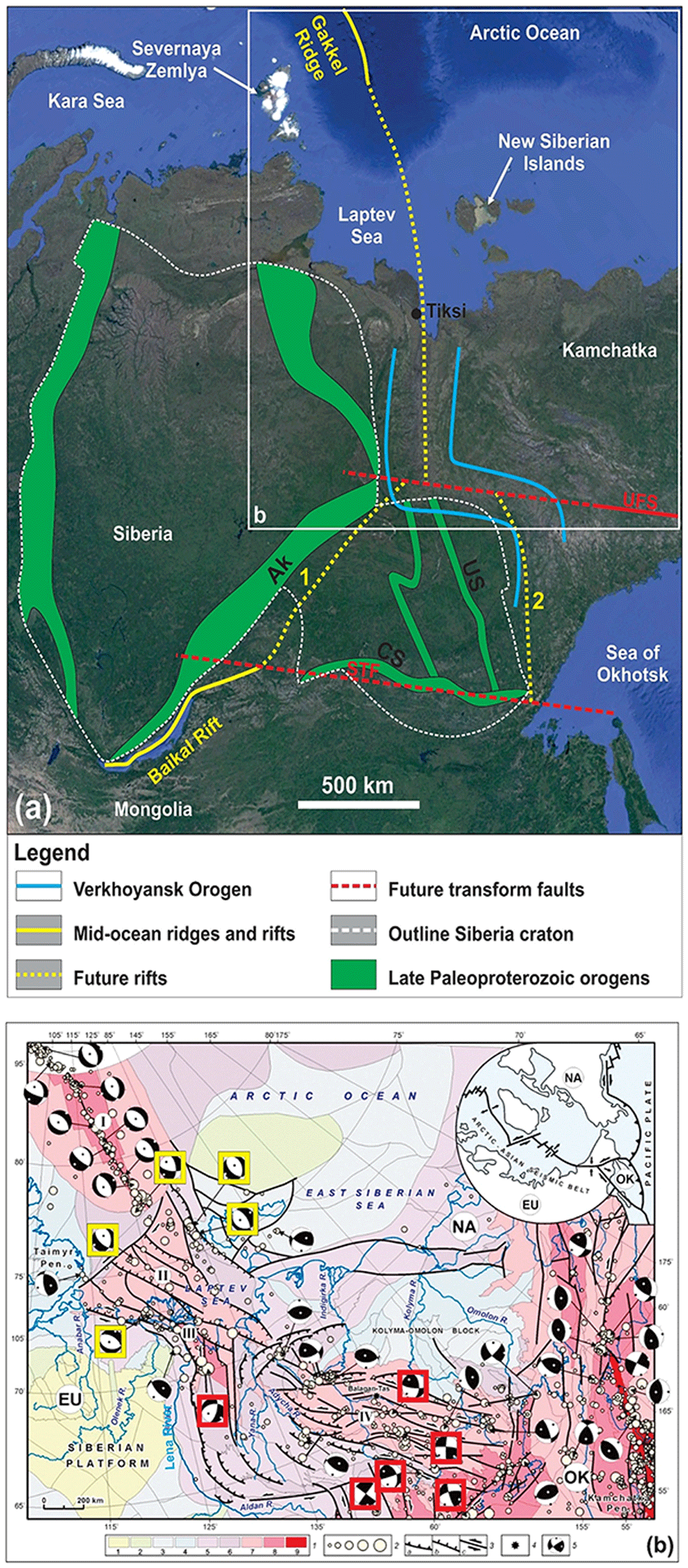
(a) Location map of the Gakkel Ridge, its termination in the Arctic Ocean, and possible future propagation (dotted yellow line) on the edge of the Siberian craton. The possible future propagation could occur along the N–S-striking segment of the Verkhoyansk Orogen in northern Russia, stepping sideways along a major future/proto transform fault (e.g., Ulakhan fault system) to form parallel to the E–W-striking segment of the orogen. Southward, the Gakkel Ridge may merge with the Baikal Rift either by stepping to the west along preexisting orogenic fabrics of the late Paleoproterozoic Akitkan Orogen (1) or along the southern continuation of the Verkhoyansk Orogen, i.e., following preexisting late Paleoproterozoic fabrics such as that of the Ulkan Orogen/Suture (2), and via another major step across another transform fault (the South Tukuringra fault). The outline of the Siberian craton and related orogens is from Donskaya (2020). Abbreviations: Ak: Akitkan Orogen; CS: Cis–Stanovoy Orogen; STF: South Tukuringra fault; UFS: Ulakhan fault system; US: Ulkan Orogen/Suture. (b) Seismicity related to neotectonic structures in the Laptev Sea and Verkhoyansk Orogen in northern Russia. This shows the dominance of normal movements along the N–S-striking arm of the Verkhoyansk Orogen (yellow squares) and strike-slip kinematics along the E–W-striking segment (red squares) at the location of the predicted future/proto transform fault. 1: Colored areas indicating increasing seismicity; 2: Earthquake epicenters by magnitude (≤ 4.0, 4.1–5.0, 5.1–6.0, 6.1–7.0); 3a: Thrust faults; 3b: Normal faults; 3c: Strike-slip faults; 4: Balagan–Tas volcano; 5: focal mechanisms of earhquakes (lower hemisphere). Modified after Imaeva et al. (2019).
Farther south, the Verkhoyansk Orogen bends c. 90° to an E–W to WNW–ESE strike (Pavlovskaia et al., 2022; Figure 15a). There, the focal mechanisms of Mw ≥ 5.0 earthquakes commonly involve a major component of sinistral strike-slip movement along a WNW–ESE-trending axis (e.g., Cook et al., 1986; Fujita et al., 1997; Imaeva et al., 2018; Imaeva et al., 2019), suggesting active, steep, strike-slip faults in the area (Figure 15b). These faults may be related to a major, dominantly sinistral transform plate boundary north of the Sea of Okhotsk possibly related to the Ulakhan fault system (Figure 1; see notably Fujita et al., 1997; Hindle et al., 2006; Hindle et al., 2019; Hindle & Mackey, 2011; Kozhurin et al., 2017; Parfenov et al., 1988).
Although these earthquakes may be related to westwards movements of the Pacific Plate towards the Sea of Okhotsk (e.g., Gorbatov et al., 1994; Gorbatov et al., 1997), should the Gakkel Ridge propagate to the E–W-striking arm of the Verkhoyansk Orogen (Figure 15a), it will meet sub-orthogonal folds and thrust structures crosscut by steeply dipping strike-slip faults in thickened, orogenic continental crust (probably an orogenic bridge). This will hinder the direct linear propagation of rifting (e.g., Molnar et al., 2017). Propagation of the Gakkel Ridge into northern Russia and to the Sea of Okhotsk has already been proposed (e.g., Cook et al., 1986; Fujita et al., 1997). OrBiT explains the variations in earthquake focal mechanisms in the area – normal movement along N–S-striking faults in the Laptev Sea and N–S-striking segment of the Verkhoyansk Orogen under E–W extension, and strike-slip movements at the E–W segment of the orogen where E–W-striking faults are parallel to the extension direction (Cook et al., 1986; Imaeva et al., 2018; Imaeva et al., 2019; Figure 15b). This suggests that the Gakkel Ridge will step along a major sinistral transform fault (Ulakhan fault system?) in the Verkhoyansk Orogen (Figure 15a) rather than propagate linearly through northern Russia as suggested by earlier works (e.g., Cook et al., 1986; Imaeva et al., 2019; Parfenov et al., 1988).
From the E–W-striking segment of the Verkhoyansk Orogen and the potential parallel future/proto transform related to the Ulakhan fault system, the Gakkel Ridge may step to the west and merge with the NE–SW-striking segment of the Baikal Rift (which is opening parallel to the late Neoproterozoic and Late Devonian–Mississippian Baikal–Patom Fold-and-Thrust Belt; e.g., de Boisgrollier et al., 2009) and late Paleoproterozoic Akitkan Orogen (Donskaya, 2020; Sears & Price, 2000). Alternatively, it may reactivate preexisting Devonian–Mississippian, NE–SW-striking rift-related structures of the Vilyui Rift in central Siberia (e.g., Kiselev et al., 2012; Polyansky et al., 2017; Ricci et al., 2013; see alternative “1” in Figure 15a). However, there is no indication in present-day data that this is occurring, and the Baikal Rift bends ENE–WSW to the northeast (e.g., Huang & Zhao, 2022; Klyuchevskii et al., 2022; Radziminovich et al., 2013; Figure 15a). Another possibility is that the Gakkel Ridge will step to the east towards the Kuril–Kamchatka volcanic arc possibly in a future backarc setting (alternative “2” in Figure 15a), where the Pacific Plate is subducted below the Sea of Okhotsk (Fujita et al., 1997; Gorbatov et al., 1994; Gorbatov et al., 1997; Parfenov et al., 1988; Rhea et al., 2010).
Farther south, the ridge may continue along the southern N–S-striking segment of the Verkhoyansk Orogen (i.e., south of the E–W-striking segment; Figure 15a). There it may follow preexisting late Paleoproterozoic structures of the Ulkan Orogen/Suture (Didenko et al., 2015; Donskaya, 2020; Sears & Price, 2000) and step back to the west to merge with the ENE–WSW-striking arm of the Baikal Rift across another major E–W-striking transform fault, the sinistral South Tukuringra fault in the Aldan Stanovoy Block (e.g., Imaeva et al., 2017; Ovsyuchenko et al., 2010; Parfenov et al., 1988; Figure 15a), which runs parallel to the E–W-striking Cis–Stanovoy Orogen (Donskaya, 2020). Thus, both proto-transform faults in the area (Ulakhan fault system and Tukuringra fault) also follow preexisting orogenic structures and fabrics (Figure 15a).
Southwards propagation of the East African Rift along the East African Orogen
The East African Rift is likely to propagate farther south along existing late Neoproterozoic–Cambrian structures of the East African Orogen (Figure 6). In northeastern Mozambique, it may either (1) propagate south into the N–S-striking Mozambique Ridge (alternative “1” in Figure 6) or (2) step east or west along suborthogonal structures of the Kuunga Orogen in northeastern Mozambique (alternative “2” in Figure 6). Propagation into the continental crust of the Mozambique Ridge (Ryzhova et al., 2022), which was likely deformed by the late Neoproterozoic East African Orogen like adjacent onshore rocks (e.g., Fritz et al., 2013; Shackleton, 1996; Stern & Kröner, 1993), seems the most likely scenario. This is supported by the coincidence of the narrow plate boundary between the Nubian and Somalia plates (Chu & Gordon, 1999) with the potential propagation of the East African Rift along the Mozambique Ridge and the Andrew Bain Fault Zone (Figure 6).
Initially, the NNW–SSE-striking East African Rift would have to propagate through the thickened continental crust of the late Neoproterozoic, NE–SW-striking Lurio Belt (Kuunga Orogen; Bingen et al., 2009; Sacchi et al., 2000; Viola et al., 2008; Figure 6). This may be problematic if the crust is thick. From there, it is hindered from stepping west since those areas comprise long-lived and dry continental crust of the Kalahari Craton (e.g., Oriolo & Becker, 2018; Figure 6). That crust is therefore difficult to extend and cut across (e.g., Peslier et al., 2010). A possible scenario is that the East African Rift steps east (along a major future transform formed parallel to the Lurio Belt?) and further propagates along potential late Neoproterozoic contractional structures of the East African Orogen in the Davie Ridge, Madagascar, and the Madagascar Ridge (Armistead, 2019; Boger et al., 2015; Collins et al., 2000; Collins et al., 2012; De Waele et al., 2011; Klimke et al., 2018; Sato et al., 2022; Vormann & Jokat, 2021), possibly also reusing younger structures (e.g., Davie fault zone; Davis et al., 2016; alternative “2” in Figure 6).
Regardless of whether it propagates through the Mozambique Ridge or the Davie and Madagascar ridges, the East African Rift would propagate within the diffuse plate boundary between the Somalian and Nubian plates inferred to comprise a prolongation of the East African–Antarctica Orogen across the Southwest Indian Ridge (Chu & Gordon, 1999; Meyzen & Schwarz-Schampera, 2023; yellow dashed lines in Figure 6). OrBiT may therefore help predict the location of future plate boundaries (e.g., future rifts and mid-ocean ridges) and explain the existence of diffuse plate boundaries as transitional plate boundaries, i.e., existing prior to full separation of two or more plates.
According to OrBiT, the new plate boundary and triple junction at the Southwest Indian Ridge would probably not consist exclusively of mid-ocean ridges, since RRR triple junctions likely form at the intersection of two orogens. In the southwestern Indian Ocean, only one orogen is known in the area where the East African Rift is believed to propagate towards the Southwest Indian Ridge, the East African Orogen (Figure 6). Thus, it is probable that part of the new plate boundary would comprise a transform fault segment, e.g., the Andrew Bain Fault Zone (Figure 6).
Testing the existence of tentative (paleo) transform faults
OrBiT can help test the plausibility or likelihood of tentative (paleo-) transform faults should any doubts be cast on their existence or kinematics. The theory predicts that the formation of major transform faults is controlled by orogens striking (sub-) orthogonal to propagating rifts. Any transform or paleo-transform fault that does not fulfill this condition is therefore unlikely according to OrBiT. Should the theory be further tested and substanciated, it would allow quick and smooth testing/troubleshooting of specific transform faults worldwide. Transform and paleo-transform faults not obeying OrBiT’s principles (i.e., formation parallel to preexisting rift-orthogonal orogen) could thus be discarded as a (paleo) transform faults or even in some cases as faults. Two such examples are the De Geer Zone in western Svalbard and the Wegener Fault between Greenland and Ellesmere Island (Figure 4).
The De Geer Zone
The De Geer Zone is a 1000-km-long, early Cenozoic paleo-transform fault that was assumed to run along the western Svalbard–Barents Sea margin and its postulated conjugate margin in northern Greenland (du Toit, 1937; Faleide et al., 1993; Faleide et al., 2008; Harland, 1961; Harland, 1967; Harland, 1969; Horsfield & Maton, 1970; Piepjohn et al., 2016; Wegmann, 1948; Figure 4). The existence of such a physiographic lineament was first proposed based on the linear geometry of both margins (De Geer, 1926). It was subsequently adopted with little criticism as a major paleo-transform fault and became broadly accepted as a fact (e.g., du Toit, 1937; Harland, 1961; Harland, 1967; Harland, 1969; Horsfield & Maton, 1970; Wegmann, 1948). Plate tectonic modeling over the last few decades has usually included the De Geer Zone to explain the opening of the northeastern Atlantic and Arctic oceans (e.g., Cianfarra & Salvini, 2015; Faleide et al., 1993; Harland, 1969; Torsvik & Cocks, 2016). During extension, the De Geer Zone was proposed to have accommodated c. 400 km of lateral movement of Svalbard to the south (Breivik et al., 1998; Faleide et al., 1993; Faleide et al., 2008; Håkansson & Pedersen, 2001; Harland, 1969).
Nevertheless, the De Geer Zone hypothesis does not take into account that nearly half of the transform movement (c. 200 km) was accommodated by the Spitsbergen and Molloy fault zones in the Fram Strait, which are oblique to the De Geer Zone (Figure 4), i.e., that the De Geer Zone cannot have accommodated more than 200 km displacement. Both the Molloy and the Spitsbergen fault zones are observed on various datasets (e.g., Crane et al., 1982; Johnson & Eckhoff, 1966; Myhre & Thiede, 1995; Thiede et al., 1990).
Recent interpretations of geophysical data in the Fram Strait, Svalbard, and the Barents Sea suggest that (1) the Timanian thrust systems continue into the Fram Strait and are found on the conjugate northeastern Greenland passive margin (Koehl, 2020; Koehl et al., 2021; Koehl & Mottram, 2024; Figure 2), (2) Timanian thrust systems west of Svalbard can be traced continuously without any lateral offset across the presumed De Geer Zone (Figure 4; Koehl, 2024b), and (3) N–S-striking listric fault segments of the De Geer Zone such as the Hornsund Fault Complex are extensional normal faults rather than strike-slip faults (e.g., Austegard et al., 1988; Eiken, 1994; Gabrielsen et al., 1990; Riis & Vollset, 1988; Schaaf et al., 2020). These observations also conflict with the presumed 400 km of dextral movements of Svalbard considered to have occurred along the N–S-striking De Geer Zone.
The postulated De Geer Zone strikes NNW–SSE (du Toit, 1937; Faleide et al., 1993; Faleide et al., 2008; Harland, 1961; Harland, 1967; Harland, 1969; Horsfield & Maton, 1970; Piepjohn et al., 2016; Wegmann, 1948), i.e., oblique to the WNW–ESE-striking Timanian Orogen and related thrust systems in Svalbard, the Barents Sea, and the Fram Strait (Koehl et al., 2022; Koehl et al., 2023a; Koehl, 2024b; Koehl & Mottram, 2024). Thus, in addition to the arguments presented by Koehl (2024b), based on OrBiT’s global correlation of major transform faults with inherited rift-orthogonal orogens on adjacent margins, the De Geer Zone is unlikely to have accommodated transform movements.
The Wegener Fault
The Wegener Fault is a hypothetical major early Cenozoic sinistral strike-slip fault proposed to exist on the basis of the linear morphology of the Nares Strait and the potential sinistral offset of rock units across the Strait (e.g., Taylor, 1910; Figure 4). It was later proposed to have formed as a major transform during the opening of the Labrador Sea and Baffin Bay (e.g., Piepjohn et al., 2016; Saalmann et al., 2005).
The latter is likely almost fully underlain mostly by continental crust (e.g., Welford et al., 2018) and, furthermore, late Neoproterozoic dykes are continuous across the proposed Wegener Fault (e.g., 627 Ma Kap Leiper Dyke) across the Nares Strait with no trace of lateral offset (Dawes, 2008; Hansen et al., 2011; Oakey & Damaske, 2006; Oakey & Stephensen, 2008; Rasmussen & Dawes, 2011). This fault is thus no longer a viable working hypothesis. Nevertheless, some studies continue to use the Wegener Fault hypothesis in tectonic models (e.g., Gilotti et al., 2018; von Gosen et al., 2019).
Structural trends of the Eurekan Orogen (and, more speculatively, of the Ellesmerian Orogen) in Arctic Canada and northern Greenland strike ENE–WSW (Piepjohn et al., 2016; Saalmann et al., 2005), i.e., oblique to the postulated Wegener Fault (Taylor, 1910). OrBiT suggests that since the Wegener Fault is not parallel to any known rift-orthogonal orogens in nearby areas (Figure 4), it is unlikely to have accommodated any transform movements. The Wegener Fault is not parallel to the other transform faults in the Labrador Sea and Baffin Bay either (e.g., Ungava Fault Zone; Figure 4). In addition, the absence of any offset of corresponding bedrock units and magmatic intrusions across the Nares Strait (Dawes, 2008; Hansen et al., 2011; Oakey & Damaske, 2006; Oakey & Stephensen, 2008; Rasmussen & Dawes, 2011) suggests that the Wegener Fault does not exist and that the negative topography characterizing the Nares Strait may not have been created by a fault. OrBiT can therefore be used to (1) predict the orientation of future transform and paleo-transform faults, and (2) test the plausibility of existing models and transform fault hypotheses.
We propose the existence of long-lived, continuous orogenic bridges, e.g., the late Neoproterozoic Timanian orogenic bridge in the Fram Strait, late Paleoproterozoic Nagssugtoqidian–Torngat orogenic bridge in the Davis Strait, and late Paleoproterozoic Nagssugtoqidian–Laxfordian Greenland–Iceland–Faroe orogenic bridge at the GIFR (Foulger et al., 2020a; Koehl & Mottram, 2024; Koehl et al., 2024; Koehl et al., 2025; Peace et al., 2018; Figure 3a–d and Figure 4). The theory suggests that past plate tectonics were less dynamic than commonly assumed in current plate models. Models involving the repeated opening of through-going Phanerozoic oceans, which split/unzipped continental blocks cleanly and completely at an early stage are too simplistic and are no longer viable solutions. Some continents are now known to be still connected by continuous (or recently ruptured) Precambrian orogenic bridges. Other orogenic bridges may have persisted for tens of Myr, and then subsided beneath sea level whilst progressively stretching of continental crust persisted, prior to rupturing relatively late.
The Iapetus Ocean and the northeastern Atlantic Ocean both opened between Norway and Greenland as suggested by Cambrian ophiolites and Caledonian metamorphism and thrusting in mid-Norway (e.g., Furnes et al., 1988; Slagstad et al., 2020). However, despite blueschist metamorphism of Caledonian age suggesting rapid subduction of mafic rocks to great depth in western Svalbard (Horsfield, 1972; Kosminska et al., 2014), it is unlikely that these two oceans fully opened between Svalbard and Greenland. This is because it would require rupture of a possibly still continuous late Neoproterozoic orogenic bridge (e.g., Timanian orogenic bridge between Svalbard and northern Greenland; Figure 4). This is supported by the mapping of late Neoproterozoic Timanian thrust systems without any offset or truncation (Koehl, 2020; Koehl et al., 2022; Koehl et al., 2023a; Koehl & Mottram, 2024; Koehl, 2024b) across Caledonian/Iapetus sutures in the Barents Sea and western Svalbard (Breivik et al., 2005; Horsfield, 1972; Kosminska et al., 2014). It is also supported by the delayed opening of the Fram Strait at ca. 24 Ma (Engen et al., 2008) or later (present study and Koehl et al., 2021), i.e., much later than the opening of the Mohns Ridge between Greenland and Norway and Gakkel Ridge in the Arctic Ocean at ca. 56 Ma (Faleide et al., 1993; Faleide et al., 2008; Gaina et al., 2002; Srivastana, 1985). If the late Neoproterozoic Timanian orogenic bridge had already been ruptured by opening of Iapetus, breakup in the Fram Strait would not have taken more time (or at least not much longer) to achieve than between Norway and Greenland.
This also applies to the Iapetus Ocean and northeastern Atlantic Ocean at the GIFR. If breakup had already occurred at the GIFR, transform faulting at the Tjörnes fault zone accommodating sliding of late Paleoproterozoic (or older) continental crust in the southwest against Cenozoic oceanic crust in the northeast would not have been required. Thus, although Iapetus did open and close in some places (e.g., between Norway and Greenland), it clearly did not in others (GIFR and Fram Strait).
Less magmatism at (both present-day and paleo) mid-ocean ridges does not necessarily imply less tectonic extension since orogenic bridges contract (during orogenesis) and extend (during rift-related stretching) together with adjacent oceanic domains (Figure 3). However, the recognition of orogenic bridges providing continental connections between continental blocks formerly assumed to be entirely separated by oceanic crust pins these blocks together. Examples are Baltica and Laurentia, which have been connected for the past 1.8 Gyr via a continuous late Paleoproterozoic orogenic bridge at GIFR, thus greatly restricting the amount of relative and absolute paleo plate movements of these two cratons This suggests significantly less dynamic plate tectonics. The Iapetus Ocean was probably much narrower than the previously suggested 5000 km (Fortey & Cocks, 2003; Torsvik & Trench, 1991). A ≤ 1000 km width similar to that of the present-day Northeastern Atlantic Ocean is more plausible because it would not have resulted in rupture of the Timanian and Greenland–Iceland–Faroe orogenic bridges. For example, if the late Paleoproterozoic Greenland–Iceland–Faroe orogenic bridge had ruptured, it would include traces of intense Caledonian deformation with possible suture zones, tight folds, and segments of oceanic crust. This is neither in line with current crustal thickness estimates across the GIFR (25–40 km), which suggest continental crust in Iceland’s lower crust (Foulger et al., 2003; Foulger et al., 2020a), nor with the open character of the Caledonian folds reworking the late Paleoproterozoic thrust systems at the GIFR, which indicate mild Caledonian deformation (Koehl et al., 2024; Koehl et al., 2025). Thus, models such as the rotation of Baltica in the Cambrian–Ordovician (e.g., Torsvik & Rehnström, 2001; Trench & Torsvik, 1992) are no longer viable alternatives.
This has implications for ophiolites and eclogite- and blueschist-facies metamorphism. It may indicate that some presumed ophiolites, e.g., km-wide blueschist units in western Svalbard (Agard et al., 2005; Horsfield, 1972; Kosminska et al., 2014), may simply correspond to lava flows and/or igneous rocks intruded into continental crust, which were later imbricated during subsequent (Caledonian) orogenesis. Thus, some presently assumed ophiolites may not necessarily reflect the closure of paleo-oceans (sutures) and may not even be ophiolites (e.g., Hamilton, 2019). If these presumed ophiolites were indeed deposited onto or intruded into and incorporated in together with continental crust (e.g., through tectonic imbrication), they would have been difficult to quickly subduct to great depth (≥ 50–70 km) due to the relative buoyancy of continental crust. Thus far, rapid subduction to great 50–70 km depth has generally been considered necessary to explain blueschist metamorphism (e.g., Agard et al., 2005; Agard et al., 2009). Hence, alternative models may need to be further considered for the formation of some high-pressure metamorphic rocks (Jamtveit et al., 2018; Luisier et al., 2019; Moulas et al., 2013; Yamato & Brun, 2016), and the interpretation of some rock units as ophiolites may need to be reexamined.
Models involving large lateral movements of terranes hundreds to thousands of kilometers in different directions over a few tens of million years (e.g., Harland et al., 1992; Majka et al., 2021) can no longer be used to explain local heterogeneities in basement rocks in continuous or recently disrupted orogenic bridges (e.g., Timanian orogenic bridge; Koehl, 2020; Koehl et al., 2022). A continuous/recently ruptured late Neoproterozoic orogenic bridge through the Barents Sea, Svalbard, and the Fram Strait suggests that such presumably early Paleozoic terrane movements are unlikely. Had they occurred the Timanian Orogen would have been disrupted and breakup in the Fram Strait would have been achieved quicker, which was not the case (Koehl, 2020; Koehl, 2024b; Koehl et al., 2021; Koehl et al., 2022; Koehl & Mottram, 2024).
The overestimation of the extent of oceanic crust on Earth, especially at orogenic bridges (e.g., Foulger et al., 2003; Foulger et al., 2020a; Foulger et al., 2020b; Foulger et al., 2024; Geoffroy et al., 2022a) and magmatic passive margins (e.g., Geoffroy et al., 2022a; Geoffroy et al., 2022b; Koopmann et al., 2014; Reeve et al., 2021), suggests that the intensity, amount, and speed of seafloor spreading at mid-ocean ridges may have been overestimated in many paleogeographic reconstructions. These reconstructions are in need of updating to incorporate the deformation and incorporation of continental crust in the oceans as hybrid crust. Future reconstructions should therefore address this issue by including updated (extended) domains of continental (including hybrid) crust.
An additional consequence of OrBiT already noted is its impact on faunal barriers (Koehl, 2024a), the use of faunal assemblages in paleogeographic reconstructions, e.g., to infer continental block separation (Fortey & Cocks, 2003), and faunal spreading between the continents via orogenic bridges, which remain emerged longer than adjacent areas along the strike of the rift (Jacobs et al., 2024). Previous works have argued that discrete faunal assemblages on two continents implied ≥ 1000 km distance between those continental blocks (Fortey & Cocks, 2003; Popov & Cocks, 2017). An example is the distinct trilobite assemblages of Svalbard and Laurentia with Baltica. Svalbard and Laurentia were dominated by Olenellus svalbardensis Kielan in the early Cambrian (Birkenmajer, 1978; Birkenmajer & Orlowski, 1977; Fritz, 1972; Kielan, 1960; Poulsen, 1974) and by Bathyurid trilobites in the Early Ordovician (Fortey & Bruton, 2013). Baltica was dominated by Holmia, Schmidtiellus, and Kjerulfia genera and Ptychopariid trilobites in the early Cambrian (Ahlberg, 1980; Ahlberg et al., 1986) and Asaphid trilobites in the Early Ordovician (Fortey & Cocks, 2003). The continuous character of late Neoproterozoic Timanian thrust systems through the Barents Sea, Svalbard, and possibly the Fram Strait indicates that Svalbard, Laurentian, and Baltica have been connected since at least the late Neoproterozoic (Koehl et al., 2022; Koehl, 2024b; Koehl & Mottram, 2024). Koehl (2024a) further illustrated the potential role of WNW–ESE-striking late Neoproterozoic thrust systems of the Timanian Orogen in forming a series of faunal barriers. These impeded exchange and mixing between fauna in Laurentia and Svalbard in the northern part of the Timanian Orogen and Baltica, which is mostly south of the Timanian Orogen (Koehl, 2024a). The impact of climatic belts on faunal distribution may also have been underestimated in previous paleogeographic reconstructions (Koehl, 2024a).
Further considerations need to be given to preexisting orogens when producing new paleogeographic reconstructions. Many of these commonly include cryptic, unrealistic transform plate boundaries (e.g., Cao et al., 2021; Domeier, 2016; Domeier, 2018; Domeier & Torsvik, 2014; Merdith et al., 2021; Torsvik & Cocks, 2016; Young et al., 2019). These cryptic transform boundaries generally do not fulfill the requirement set by OrBiT, i.e., formation of major transform faults parallel to preexisting, rift-orthogonal orogens, and should be reconsidered and/or speculated with greater care from now on.
1) Orogenic bridge theory suggests that the formation of major transform faults is controlled by preexisting structures in orogenically thickened continental crust oriented perpendicular to propagating rift axes. These are referred to as orogenic bridges.
2) Existing orogenic bridges oriented suborthogonal to a propagating rift form barriers of thickened continental crust that hinder the opening of a rift and delay full continental breakup.
3) Rupturing of orogenic bridges results in the formation of major transform faults and in lateral stepping of the propagating rift.
4) RRR triple junctions form at the intersection of (at least) two orogens.
5) Orogenic bridge theory permits large-scale predictions about the tectonic evolution of entire regions, e.g., rift stepping and propagation, and testing the existence of tentative (paleo-) transform faults.
6) Orogenic bridge theory suggests that the extent of oceanic crust has been overestimated, that more hybrid crust lies in the oceans than hitherto thought, and that therefore the extent of oceanic crust and nature (e.g., intensity, amount, and speed) of seafloor spreading should be reconsidered and decreased in many locations in future paleogeographic reconstructions.
Ethical approval and consent were not required.