Methods
Our aim is to produce connected reviews using a consistent method of qualitative systematic review. As such, the following description draws heavily on Cairney and Toomey (2024a), which adapts Kuckertz and Block’s (2021) guidance on describing systematic reviews then describes our response to key limitations.
Rationale. We seek to understand advice on how to improve policymaking with reference to systems leadership, as part of a wider focus on effective collaboration. We present the second review for the Horizon Europe project Healthy Working environments for all Ages: An evidence-driven framework (WAge). WAge’s Work Package 1 seeks to support collaborative policymaking to foster the uptake of usable evidence, which requires us to understand how collaborative policy processes or initiatives work. Further, our WP1 explores the idea that policy may change from the ‘top down’ or ‘bottom up’, and systems leadership informs both dynamics.
Engagement with previous reviews. Cairney leads a team conducting a series of qualitative systematic reviews that connect key aims or strategies to policy theory insights (Cairney et al., 2021; Cairney & Kippin, 2022; Cairney et al., 2023; Cairney & Toomey, 2024a). This is the fifth review submitted to Open Research Europe, but the second to focus on collaboration and seek advice from academic and grey sources.
Research/guiding questions. Our most general guiding question was: What advice do scholars and practitioners offer on systems leadership? We used these sub-questions to guide our initial search and reflection:
1. How many studies use the term ‘systems leadership’ to describe their object of study?
2. How do they describe systems leadership? For example, do authors describe their pursuit of better leadership and how to do it, or study efforts in organisations relevant to policy (e.g. governments)?
3. What factors do they describe as constraining or facilitating systems leadership?
4. In what context does this pursuit of systems leadership take place? For example, within one government or across multiple levels? Across policy sectors? To foster collaboration between government and non-governmental actors?
5. What findings or recommendations do they provide?
6. To what extent are these lessons transferable to other contexts?
We anticipated that each included text would define systems leadership (to some extent) then offer at least one of three kinds of advice:
1. Aspirational: what would good systems leadership look like?
2. General: what context-free advice do people give to foster systems leadership?
3. Context-specific: what works, for whom, and in what context, and what lessons are transferable to other contexts? While the wording is resonant with realist review, we did not expect to find enough information to review in that way (based on our previous experiences).
Databases and initial search terms. We began by searching for advice from one main database of peer reviewed academic texts (Web of Science, WOS) and two of the grey literature, including government, non-governmental organisation, academic and think tank reports (comparing Policy Commons, PC and Overton). We used the search term ‘systems leadership’, anticipating that it would (1) maximise coverage among texts using this term and require a high level of manual searching (which was inevitable, given our need to search manually for advice), and (2) provide partial coverage of relevant work using different terminology. We address the latter with an unusually high amount of snowballing (almost half of our total texts) to seek key sources for this field and identify some strongly connected terms (e.g. complexity leadership) while considering separate reviews for other terms (e.g. see Aoki et al., 2024 on whole of government approaches). We learned from our previous review that the addition of multiple academic databases would have rapidly decreasing returns compared to snowballing. Our initial experience with WOS and PC/Overton suggested that further broad searches would be a poor use of resources, and we found that snowballing helped to identify key academic (e.g. Senge et al., 2015) and grey sources (e.g. Ghate et al., 2013a; Ghate et al., 2013b).
Timeliness. We ran searches up to 10 July 2024 (WOS), 1st July (PC) and 8th July (Overton).
Manual searches and choices regarding initial inclusion. We used similar criteria for inclusion as our other four reviews, including publication in English and not restricting initial inclusion in relation to research method (we focused more on relevance). Our preference was to set an initially low inclusion bar to be able to immerse ourselves in the literature, identify the relevance of texts, and generate a narrative of the field to help to make sense of advice. We followed Cairney and Toomey (2024a) to remove the need for a grey literature report to engage with policy concepts to be included (previous reviews examined levels of conceptual engagement).
Toomey conducted a manual search of each text in a two-stage process to include texts that: (1) referred to the phrase ‘systems leadership’ (or close equivalent, such as system or complexity leadership) in the title, abstract, and/ or introduction, and (2) offered advice in the main text (or information to support advice, such as if describing the effectiveness of collaboration strategies) (Table 1 and Figure 1).
Table 1. Search results 2024.
| Database | Search results | Duplicates | No access | Excluded | Included |
|---|
| Web of Science | 249 | 7 | 29 | 174 | 39 |
| Policy Commons | 1620 | 139 | 11 | 1436 | 34 |
| Overton | 150 | 5 | 15 | 119 | 11 |
| Grand Total | 2019 | 151 | 55 | 1729 | 84 |
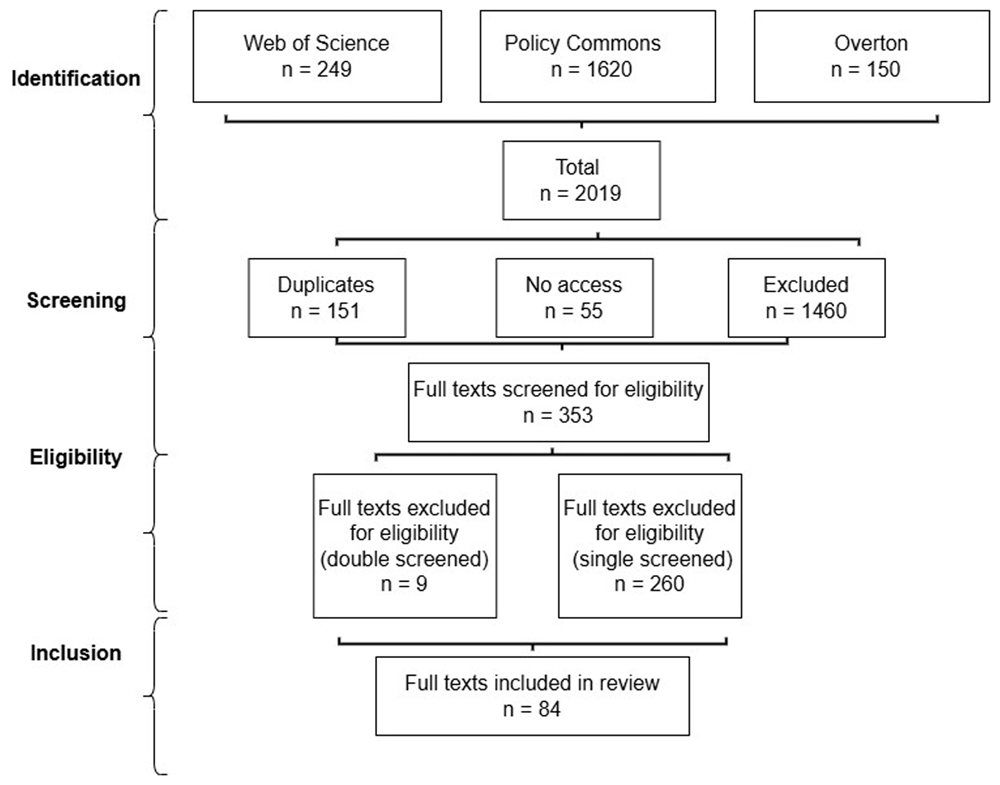
Figure 1. Review process flow chart.
Routine data collection. Toomey coded the following aspects (Excel):
Country/region of study. Publication in English skews the results to authors in Global North countries focusing on that country. Countries like the UK, US, Canada, and New Zealand command an unusually high proportion of entries. The WOS search skewed largely to UK (9/39) and US (8) and Canada (2), accounting for 19/39 or 49% (the other 20/39 had no notable pattern). PC skewed to Canada (12/34), New Zealand (8), UK (6), US (4), Australia (2), which accounted for 32/34 or 94% (plus one European Commission and 1 Spain). Overton was UK (8/11, 73%) plus 1 Canada, UN, and World Economic Forum.
Sectors or issues. Some specific issues are discussed frequently: health and social care integration in England (academic, government agency, and think tank publications), and education improvement in Canada (the numbers are misleading because Ontario’s Institute for Educational Leadership published many small documents). Beyond these examples, most studies related generally to issues such as the need for new forms of training, professional practice, advice for leaders, or organisational changes to support systems leadership (which made precise % coding difficult).
Methods or approaches. WOS articles (39) included qualitative interview (10), case study (8), discussion or conceptual analysis (7), literature review (5), mixed methods (4) and miscellaneous approaches (e.g. describing online training or simulation). Too few PC or Overton studies describe methods to justify further analysis here (although many think tank reports offer new data based on elite interview).
Definitions. Too few articles provide a clear definition of systems leadership to justify further analysis here.
Data analysis, aggregation, and presentation. As with previous reviews, Cairney used an inductive qualitative approach to analyse each text, generate themes manually (Results), and synthesise advice from the results (Results and Discussion). As each previous review notes, ‘the rules associated with this method are less prescriptive than with its quantitative equivalent, suggesting that we (a) describe each key judgement, and (b) foster respect for each authors methods and aims’ (Cairney & Kippin, 2022, citing Sandelowski & Barroso, 2007: xv). We did not perform any quantitative tests to assess risk of bias. We present a narrative systematic review (rather than qualitative coding aided by tests for inter-coder reliability).
Limitations relevant to data gathering and analysis
The nature of our task and limitations to our search influence our approach to data analysis and presentation. We identified five limitations in our first review (Cairney & Toomey, 2024a: 7), which we use to identify fewer limitations with the current review. First, although few authors define systems leadership, it is not used as loosely as ‘collaborative policymaking’. We were able to synthesise these texts to provide a broad definition with commonly described elements (Results). The more relevant limitation relates to our focus on systems leadership which highlights other leadership approaches (e.g. distributed) but without presenting a full review. Second, while many studies shelter under the same umbrella term, the systems leadership literature is less disparate, and authors show how it relates to other leadership terms. Third, the systems leadership literature is more likely to offer advice, such as to recommend new training for leadership skills. Fourth, while our grey literature searches produced a low ratio of effort to reward, our larger snowballing activity helped to reveal a useful common reference to key grey texts (the 80 snowballed texts was almost as large as the 84 texts included from searches). Further, the PC/Overton process helped to reach a sense of saturation (after WOS snowballing, few new OC or Overton texts gave us additional information or insights). Fifth, while much research identifies what we don’t know, a key message from systems leadership scholars is to embrace such uncertainty. Overall, the available research is better matched to our task than in our first review.
As with the first review, we respond in three ways: keeping the bar for inclusion low to encourage immersion in the field; snowballing to identify from key reference points, primarily by following up studies described in included texts as important sources (plus some texts from expert recommendations); and, making it explicit when we present our synthesis of insights and offer our interpretation of practical advice. This immersive approach threw up some curveballs (e.g. Williams, 2021) or texts that engage sparingly with the ‘systems leadership’ lexicon (e.g. Chow, 2013), but in the context of a fairly coherent collection of discussions that could be usefully synthesised.
Indeed, we were struck by high levels of awareness between academic and grey literatures, in general – for example, when multiple academic studies cite Ghate et al. (2013a) or grey reports cite Senge et al. (2015) - and in fields like UK healthcare and public health studies where think tank reports are key sources for (and draw on) academic work (e.g. Timmins, 2015). The snowballing process also helped to give us some more confidence in the grey literature searches, such as when they both highlighted the same reports or collections. There are also overlaps between academic and grey literatures in these databases (e.g. Overton lists Swanwick & McKimm, 2011).
The complete search protocol, PRISMA checklist, and structured bibliography is stored on Open Science Framework (OSF) https://osf.io/hr769/
Results
What is systems leadership?
Almost no included study defines ‘leadership’, partly because it defies common understanding. Indeed, some are sceptical about its usefulness for research (Hazy et al., 2007: 3; Silva, 2016). The exception is Dickson (2009: 295), who compares with a manager/administrator to define a leader as an actor who ‘goes first’ and ‘takes on the responsibility of acting to shape the future’ (see also Senge et al. (2015: 28), ‘to step across a threshold’, and Welbourn et al. (2012: 4) on management as ‘control’ and leadership as ‘influence’).
There is no single definition of systems leadership. However, we can identify frequently similar reference points or arguments, such as to: explain what systems leadership is not, to signal a shift in thinking; identify the need to respond more effectively to complexity; and, emphasise the value of new leadership approaches. This negative definition is more useful than it appears, since it allows us to identify a common origin story on which to build a definition: old approaches focused too much on great leaders, and new approaches shift our focus to leadership; they highlight the need to respond to wicked problems and policymaking complexity, and suggest that systems leadership may be more effective and democratic than top-down or hierarchical approaches. We summarise this argument in Table 2 then explore each element.
Table 2. Defining systems leadership.
| What systems leadership is not | Reject a fixation with heroic individual leaders and top-down leadership.
There is not – and should not be – a single centre of policymaking authority. |
| What systems leadership is | Foster collective action towards a common goal or vision. Harness the energy and
skills of many actors.
Span boundaries across policy sectors, government departments, levels of
government, or outside government |
| Addressing wicked problems | Collaborate to address problems that defy technical definitions and simple
solutions. |
| Navigating policymaking complexity | Navigate a complex policymaking system where high uncertainty and ambiguity are
features not bugs, and outcomes emerge in the absence of central control. |
The advantages of systems
leadership | Systems leadership is good for democracy and effectiveness. Doing the right thing
promises big rewards. |
Systems leadership is part of a
collection of new approaches | Systems leadership is part of a wider conceptual and normative movement to reject
old approaches to leaders and hierarchy. |
Old approaches to leadership focused too much on great leaders. New approaches shift our focus from leaders to leadership
Old studies emphasised personal qualities such as charisma and decisiveness. Effective leadership was hierarchical, policy was made from the top, and leaders had high influence on their followers (expected to carry out their aims):
‘Our traditional views of leaders – as special people who set the direction, make the individual decisions, make the key decisions, and energize the troops – are deeply routed in an individualistic and nonsystemic worldview. Especially in the West, leaders are heroes – great men (and occasionally women) who “rise to the fore” in times of crisis’ (Senge, 1990: 340; see also Bertini, 2019: 10 on the legacy ‘image of a senior UN official’ as an ‘older man’ from the ‘North’).
New approaches shift from heroic leaders to ‘the collective and relational dynamics of leadership practice’ (Bolden et al., 2020: 26). They identify the new attributes, mindsets, and skills required of many actors spread across a system, and shift from rationalist top-down approaches towards adapting to systems out of their control (Uhl-Bien et al., 2007: 299; 302). They accentuate a wider organisational and policymaking dynamic in which many actors contribute to leadership, such as to design and deliver a collective vision. These actors depend on each other to get things done, in systems characterised by the distribution of power and limited potential for central control (Avolio et al., 2009; Dickson, 2009: 295; Osborn et al., 2002: 799). For example:
‘accounts of effective systems leaders are about as distant from the idea of the traditional ‘hero leader’ - fearless, forceful and uncompromising - as it is possible to get … all about the skilful harnessing and holding in creative tension the energy in the wider system, rather than driving through change by sheer force of will and exercise of power … as frequently about ‘willingness to give things away’ as … achievement of one’s own goals or promoting of one’s own agency agenda’ (Ghate et al., 2013a: 8).
This focus on what systems leadership is not sets up a binary between top-down/hierarchical versus systems leadership (Lichtenstein & Plowman, 2009: 618; Onyx & Leonard, 2011: 496). Examples include:
From (1) ‘commanding, telling, persuading, influencing, motivating - conceived as activities in which there is a point of origin (leaders) and a point of reception (followers)’, to (2) ‘dialogue and sense-making - conceived as … mutually constituted social achievements’ (Drath et al., 2008: 639; 651).
From ‘prescriptive’ to ‘adaptive’, ‘individual organisations’ to ‘place-based’ and ‘whole system’, ‘centralised’ to ‘distributed participatory’ and ‘co-productive’, regulatory and policymaker accountability to ‘people and communities’, short to long-term, ‘competitive’ to ‘consensus-seeking’ (requiring us to surface rather than ‘avoid conflict’) (Edmonstone, 2020: 357).
From a ‘competitive’ to ‘collaborative mindset’, an internal organisational to a systemic focus, management skills (e.g. ‘planning, organizing’) to leadership skills (e.g. inspiration, visioning, change facilitation’), and, ‘top-down’ to more inclusive decision-making (Dickson, 2009: 300).
Replace ‘formal, managerial, institutional, competitive’ approaches that are ‘reliant on experts and specialists’ with new values ‘embodied in the development of an informal network marked by self-organization, collaboration, agility, wide participation and transparency’ (Taylor et al., 2020: 56).
From ‘a linear and narrow approach’ to ‘a complex adaptive arrangement spanning across organizations and institutions’ (Blankart et al., 2024: 2).
Develop teams rather than ‘just individuals’ and ‘leadership across systems of care rather than just institutions, and on followership as well as leadership’ (The King’s Fund, 2011; see also Anandaciva et al., 2018: 55).
Reject an ‘over-simplistic model of change management’ (in education) which ‘pays insufficient attention to the complexities of the policy process’ and ‘casts teachers in the role of passive implementers of policy, in the process de-professionalising teachers at all levels of the system whilst holding them accountable’ (Mowat, 2019: 65).
A role “not necessarily to lead people ‘over the top’ to a utopian future” but rather ‘to disappoint people at a rate they can manage’ (Grint, 2020: 2).
Replace heroic individual scientists (in the West or Global North) by developing local adaptive capacity among ‘academic biomedical researchers in Africa’ (Rose et al., 2024: 10).
One partial exception is Bertini’s (2019: 23) description of ‘Desirable qualities of a UN leader’, combining systems leader qualities (e.g. focusing on trust, self-awareness, listening, empowering staff) with traditional notions of courage, decisiveness, ‘Making difficult decisions’, and ‘maintaining a “toughness in leadership”’ (see also Club de Madrid & Edelman, 2021: 10–13; Onyx & Leonard, 2011: 503–6).
New approaches reflect the rise of wicked policy problems
The world’s most pressing problems are ‘wicked’: a term coined by Rittel and Webber (1973) and still used frequently as a shorthand for problems that defy rationalist policy analysis. Wicked problems resist simple technical definitions, and their size, severity and cause are contested. They defy simple solutions: it is difficult to know if all possible solutions have been identified or what is working, and trial-and-error learning is controversial since any policy produces major social and economic effects (1973: 161–67, summarised in Cairney & Kippin, 2024: 155). While Rittel and Webber (1973) used ‘wicked’ to compare with the ‘tame’ issues more amenable to technical definition and simple solutions, and these terms took off in academic and practitioner studies, they were never properly defined, and it is tempting to write off any tricky political problem as wicked (Turnbull & Hoppe, 2019). Further, Auld et al. (2021: 127–8) have ramped up this language to describe ‘super wicked problems’ in which ‘time is running out’, key actors are responsible for exacerbating and solving the problem, there is ‘no central authority’, and actors put too much value on the short-term costs of action at the expense of long-term benefits.
Nevertheless, ‘wicked’ serves a rhetorical purpose to note that, if policy problems are not easily defined or amenable to simple solutions, then old forms of leadership are ill-equipped to deal with them, necessitating the ‘new ways of thinking, working and collaboration’ (Bolden, 2020; Evans et al., 2021; Hunter, 2009; Taylor et al., 2020: 51). Accounts may describe wicked problems as our new reality, or relate them to a new crises, such as when the combination of reduced funding and higher demand for public services prompts the search for systems change:
‘Wicked challenges are complex, intractable, ambiguous, dynamic and open-ended. They cannot be solved with analysis or optimization. Instead, stakeholders must collaborate to define the problem and to find a mutually acceptable resolution. Wicked problems require negotiating values and identities’ (Talley & Hull, 2023: 1040).
‘Leaders talk of wrestling with persistent ‘wicked issues’ that shape-shift and resist resolution, and which cannot be solved by single agencies acting alone. They also talk of ‘a one-time opportunity’ to make changes that can streamline services sufficiently to withstand the turbulence and ensure their survival and even improvement into the future’ (Ghate et al., 2013a: 5).
Examples of problems requiring new leadership include: the Sustainable Development Goals (SDGs), ‘each representing complex systems – such as climate, food, health, cities – with myriad stakeholders’ (Dreier et al., 2019: 4), obesity, sustainable development (Bigland et al., 2020: 2), ‘food systems change’ (Enderton et al., 2017: 94; O’Malley et al., 2022; Public Policy Forum and CAPI, 2017), health systems and vaccination programmes in light of Covid-19 (Beharrell et al., 2021: 93; Gulati & Busari, 2022), water contamination management (Grey et al., 2023), social and economic inequalities (Taylor et al., 2020: 51); homelessness (Jang et al., 2016); road safety (US Department of Transportation (2016); regeneration after natural disaster (Department of the Prime Minister and Cabinet, 2017); and emergency management (Caro, 2016: 114; Club de Madrid and Edelman, 2021).
New approaches reflect the increasing complexity of policymaking or governance in which there is no single centre of authority or control
Complexity theory has some influence on systems leadership research, but many accounts do not explain this connection (they use citation delegation). Further, many define complex systems in different ways or with reference to different systems. For example, to relate systems leadership to our wider focus on policymaking, we begin by describing complex policymaking systems and how its features can relate to a lexicon including non-linearity, sensitivity to initial conditions, self-organisation, and emergence (see also Nel & Taeihagh, 2024):
1. “A complex policymaking system is greater than the sum of its parts those parts are interdependent – elements interact with each other, share information and combine to produce systemic behaviour.
2. Some attempts to influence complex systems are dampened (negative feedback) while others are amplified (positive feedback). Small actions can have large effects and large actions can have small effects.
3. Complex systems are particularly sensitive to initial conditions that produce a long-term momentum or ‘path dependence’.
4. They exhibit ‘emergence’, or behaviour that results from the interaction between elements at a local level rather than central direction.
5. They may contain ‘strange attractors’ or demonstrate extended regularities of behaviour which may be interrupted by short bursts of change” (Cairney, 2013, summarising Cairney, 2012: 348).
Such terms need translation to each context. For example, in political science, path dependence’ resonates with studies of historical institutionalism, in which choices and rules created in the distant past still influence current practices (Cairney, 2012: 350). Further, ‘punctuated equilibrium theory’ uses the language of feedback to describe ‘macropolitical’ policymaker attention lurching from issue to issue, contributing to a small number of major policy changes when attention is high and large number of minor changes when low (Baumgartner et al., 2023). ‘Self-organization’ also resonates with governance and implementation in which there may be ‘self-organizing networks’ (Rhodes, 1997: 50) or ‘self-selecting clusters of organisations in which a variety of public and private organisations cooperate’ (Hjern & Porter, 1981, cited in Cairney, 2012: 351), contributing to a sense that policy outcomes ‘emerge’ in the absence of central government control.
Compared to other complex systems (e.g. systems biology), it makes more sense in politics and policymaking to describe a centre of government with unclear influence on a system rather than the absence of a centre (Cairney & Geyer, 2015). This point is essential whenever we seek to:
1. explain attempts to translate complexity theory into advice for policymakers, such as to encourage long-term trial-and-error learning at local levels rather than maintaining high stakes and short-term centralised performance targets (Geyer, 2012), while
2. recognising that such advice is hard to reconcile with the language of democratic accountability (especially in Westminster political systems – Cairney et al., 2019).
Then, we can relate such ideas to different scales of policymaking activity, such as when policy problems transcend jurisdictional boundaries and there is an absence of one authoritative government (Auld et al., 2021).
The systems leadership literature is not as easy to sum-up, for three relevant reasons (see also Jackson, 2024: 32 and Cairney, 2024b). First, ‘systems leadership’ is an umbrella term under which many approaches seek shelter (compare with the vagueness of ‘systems thinking’, Carey et al., 2015: 3). In the included texts, we find a large set that capture a general sense of organisational, governance, or policymaking complexity, and a small subset of authors that relate systems leadership to properties of complex systems (often preferring terms such as ‘complexity leadership’, Uhl-Bien et al., 2007). Within the latter, scholars tend to pick their own nomenclature and origin story to inform leadership research. Lichtenstein and Plowman (2009: 626; 620) cite Lichtenstein (2007) on ‘14 complexity theories ... used to explore leadership’, while noting their own unusual preference to relate ‘complex adaptive systems theory’ to the work of Prigogine on chemical systems (compare with Dreier et al., 2019: 9). This variety is a wider feature of approaches to complex systems (Nel & Taeihagh, 2024). The technical language of complex systems is abstract, informed by different key authors or institutes in multiple disciplines, and amenable to multiple interpretations and translations, prompting leadership scholars to make sense of key terms in different ways.
For example, while for us ‘emergence’ can refer to policy outcomes that result from local rule development in policymaking systems, to others it can describe something bigger, such as the ‘emergence’ of ‘novel, “higher” level structures, patterns, processes, properties, dynamics, and laws’ (Hazy et al., 2007: 6) or to ‘new forms of social cooperation in social networks’ (Goldstein et al., 2010: 13). In other words, emergence may describe systems change. If so, we may all explore the emergence of phenomena that ‘seem to have a “life of their own”’ (2010: 13) but not what phenomena to expect (or desire). A similar point can be made of the philosophy of complex systems, which can be described as if they exist independent of our experience of them, or with reference to how actors perceive and respond to them in different ways (Jackson, 2024: 22).
Second, in systems leadership studies, the focus of study varies, such as on individual non-governmental organisations or a governance network comprised of many governmental and non-governmental organisations. We may be zooming in to analyse particular systems, or zooming out to identify systems of systems, without knowing how to separate such foci analytically. We need to recognise different conceptualisations of ‘networks’, ‘markets’, ‘collaborations’, and ‘social movements’ and encourage people to clarify what they mean by ‘whole systems’ approaches (Welbourn et al., 2012: 20). While Ospina (2017: 275–6) makes a convincing case to challenge the artificial separation between leadership studies in public and private sectors - not least because non-governmental organisations are increasingly a part of modern governance – this conceptual uncertainty matters.
Third, some focus on system leadership (singular), such as when addressing mental health (Deputy Prime Minister and Minister for Health, 2021), transport (Ministry of Transport, 2019), land information (Land Information New Zealand, 2015), schools (The Institute for Educational Leadership, 2014; The Institute for Educational Leadership, 2016; The Institute for Educational Leadership, 2017; The Institute for Educational Leadership, 2020), high performance sport (AIS, 2021), or a professional scientific role within a government department (Aston & Sweetland, 2024). The singular term can reflect country-specific usage, to refer to one specific system and omit the language of complex systems, such as when New Zealand government documents are describing a system of government agencies and partners to join-up.
Nevertheless, we can still identify useful broad themes throughout multiple accounts, such as in summaries of ‘complexity leadership’ in organisations:
‘leadership is viewed as an interactive system of dynamic, unpredictable agents that interact with each other in complex feedback networks, which can then produce adaptive outcomes such as knowledge dissemination, learning, innovation, and further adaptation to change … to achieve optimal performance, organizations cannot be designed with simple, rationalized structures that underestimate the complexity of the context in which the organization must function and adapt … Simply viewing the leader and follower in a simple exchange process won’t fly in terms of explaining the full dynamics of leadership’ (Avolio et al., 2009: 430)
‘Complexity Leadership Theory, a leadership paradigm that focuses on enabling the learning, creative, and adaptive capacity of complex adaptive systems (CAS) within a context of knowledge-producing organizations. This conceptual framework includes three entangled leadership roles (i.e., adaptive leadership, administrative leadership, and enabling leadership) that reflect a dynamic relationship between the bureaucratic, administrative functions of the organization and the emergent, informal dynamics of complex adaptive systems (CAS)’ (Uhl-Bien et al., 2007: 298).
Further, when expanding analysis from organisations to policy processes, we can identify similar reference points for a story of wicked policy problems and policymaking complexity, such as by using the shorthand of ‘volatile, uncertain, complex and ambiguous (VUCA)’ (Bigland et al., 2020: 2; Bolden et al., 2023: 339; Cady & Heykoop, 2024: 129; Jackson, 2024: 21; Education Scotland, 2019; Elliott et al., 2020: 202; Mangan & Lawrence-Pietroni, 2019: 83; Mangan & Pietroni, 2021: 1455; see also Osborn et al., 2002 on ‘stability, crisis, dynamic equilibrium, and edge of chaos’, and Caro, 2016: 116 on embracing ‘uncertainty, non-linearity and emergent behaviours’). This reference point may explain a new social and economic context for private companies - ‘driven by globalization, technology, deregulation, and democratization’ (Uhl-Bien et al., 2007: 300) – and connect systems leadership to public and private policy and policymaking (Goldstein et al., 2010; Jackson, 2024; Uhl-Bien & Arena, 2017; Wheatley, 1999).
In that context, we can relate complexity to practicality, such as to explore how to respond (and what training to seek):
‘Systems Leadership describes the way people need to behave when they face large, complex and seemingly intractable problems; where they need to juggle multiple uncertainties; where no one person or organisation can find the solution on their own; where everyone is grappling with how to make resources meet growing demand; and where the way forward lies in involving as many people’s energies, ideas, talents and expertise as possible’ (Edmonstone, 2020: 357; The Leadership Centre, 2015: 1).
Then, we can seek connections to narratives of changing policymaking (our preferred umbrella term) or governance, a term often preferred by scholars to note the limits to a focus on government when so many actors inside and outside of government make and influence policy (Rhodes, 1997). For example, new leadership relates to a new context of public management, in which scholars and practitioners are searching for ways to transition from:
1. The now-old ‘New Public Management’ (NPM) model, emphasising clear lines of accountability via leaders managing performance in a hierarchy, towards
2. More collaborative governance, emphasising wider collective action, shared responsibility, and the need to relate governance to democratic values such as stakeholder engagement and citizen participation as well as some moves towards decentralisation (Bolden et al., 2020: 27 on ‘New Public Service’; Osborne, 2006 on New Public Governance; see also Cairney & Toomey, 2024a).
While many accounts do not hang their argument on the peg of complex systems, they still describe new forms of governance requiring new forms of leadership:
‘The New Public Service and New Public Governance paradigms emphasize the relationship between public servants and citizens … collaborative forms of governance, such as networks for knowledge, information sharing, service delivery, and policy reform, and multistakeholder groups as well as formal multisector partnerships for collective problem solving. … the heroic leader in policy contexts gives way to collective forms in which leaders from all sectors share the goal of making life better for communities’ (Ospina, 2017: 276–7)
Many relate these ideas to key reference points in public administration, such as Moore’s (1995) ‘strategic triangle’ which lauds public managers pursuing ‘public value’ (see also O’Flynn, 2007). For example, Bryson et al. (2017: 641) describe a ‘new world’ that is a ‘polycentric, multi-nodal, multisector, multi-level, multi-actor, multi-logic, multi-media, multi-practice place characterized by complexity, dynamism, uncertainty and ambiguity in which a wide range of actors are engaged in public value creation and do so in shifting configurations” (also cited in Bolden et al., 2020: 27; Bolden et al., 2023: 338). This world is characterized by ambiguity and contestation to translate values and beliefs into policy, in a complex system in which outcomes emerge in the absence of central control, prompting systems leaders to develop new skills to facilitate collaboration and navigate policy and policymaking complexity (Bolden et al., 2020: 28).
The main theme, binding such approaches together, is that there is no single centre of power, authority, or control (some also argue that there should not be central control). Rather, in complex policymaking systems, outcomes emerge despite attempts by national central governments to exert control or, when we extend our focus beyond national jurisdictions, in the absence of one centre (see Cairney et al., 2019 on multi-centric policymaking). Top-down control and hierarchical leadership becomes inappropriate or ineffective or both (Edmonstone, 2020: 357; Marion & Uhl-Bien, 2001: 396; Onyx & Leonard, 2011: 496, citing Lichtenstein et al., 2006). Variations on this theme include systems leadership:
Within an organisation, when leadership does not relate solely to ‘line management responsibility’ (Timmins, 2015: 7).
In multi-organisational systems where ‘no single organisation can control the outcomes’ (Bigland et al., 2020: 1).
When designing systems and arguing that ‘approaches that involve diverse community-based organizations are more likely to be effective than those pursued by a single organization’ (Enderton et al., 2017: 86).
When seeking ‘coordination, collaboration and change in complex multi-stakeholder environments’ (Bolden et al., 2020: 26).
When fostering an ‘authorising environment’ conducive to collaboration, such as by avoiding the prioritisation of your organisation’s goals, not relying on ‘positional authority’, and encouraging ‘challenge’ to the status quo (Ghate et al., 2013a: 11).
When addressing problems that transcend jurisdictional boundaries and ‘no one has authority over all the stakeholders who must collaboratively construct a shared definition of the problem to be solved and the coordinated response to it’ (Talley & Hull, 2023: 1041).
When many policy instruments (including regulations) combine to produce a system over which ‘central authority is absent and cooperative relationships are required for progress’, prompting a search for alternatives to ‘top-down decision-making’ (Grey et al., 2023: 71; see also Cairney, 2024b).
Systems leadership is more effective and democratic
Policymakers in formal power are not the only actors essential to policy design and delivery (Bolden et al., 2020: 27), and systems leadership ‘extends individual leaders well beyond the usual limits of their formal responsibilities and authority’ (Ghate et al., 2013a: 5). It involves influencing others by drawing on leadership skills rather than only exerting influence through formal power (although people in positions of power are essential to this approach’s success). Claims for this leadership approach’s value include that it is more:
effective at addressing wicked problems not amenable to simple solutions delivered from the top-down
efficient, if public services find synergies
engaged with stakeholders and communities, and
equitable, when including diverse voices and ‘bringing marginalised groups into the design and delivery of services’ (Bolden, 2020: 2; Stabler & Kempton, 2020: 1).
The case for effectiveness relates to responding to a new policymaking reality:
‘single agencies can no longer respond effectively to wicked issues unless they work collectively and across the system. Single agencies have neither the budget nor the human resources to respond to the current level of expectation and demand; nor do they have sufficient know-how for solving complex multi-dimensional problems unless they pool information and skills with others. This … is consistent with the now substantial evidence about what service users (and especially those with greatest needs) want and need from public services, which is not usually a ‘single service response’ … but a joined up, multi-dimensional response to a series of interlocking issues’ (Ghate et al., 2013a: 9).
This argument resonates among research interviewees seeking wider systems thinking and cross-organisational perspectives (Evans et al., 2021: 26). It has also taken off in contexts – such as health and social care integration in England – where many ‘local leaders’ seek ‘a cohesive approach to working together’ to co-create ‘clear, shared priorities that are grounded in the needs of their communities and not in the interests of individuals or their organisation’ (NHS Confederation, 2014, cited in Bigland et al., 2020: 2; see also Moore et al., 2023: 364).
Some argue that systems leadership is necessary and good. The emphasis is on widening democracy (e.g. the diversity and equality of participation) and reaping the benefits. The right thing to do promises big rewards. This argument often comes from inspiring stories of systems change, facilitated by systems leaders, and recounted by trainers and observers. According to Senge et al.’s (2015: 28) influential account, systems leaders’ passionate commitment inspires commitment in others, their ability to see through another’s eyes prompts others to be ‘more open as well’, their willingness to listen and learn helps to build trust, then trust aids collaboration, people feel empowered to face uncertainty by asking questions and learning, and more ‘system leaders emerge’ to produce better outcomes:
‘situations previously suffering from polarization and inertia become more open, and what were previously seen as intractable problems become perceived as opportunities for innovation. Short-term reactive problem solving becomes more balanced with long-term value creation. And organizational self-interest becomes re-contextualized, as people discover that their and their organization’s success depends on creating well-being within the larger systems of which they are a part’ (Senge et al., 2015: 28).
Systems leadership is part of a collection of new approaches
A sub-set of systems leadership articles describe properties of complex systems, connecting leadership to other terms – including ‘systems thinking’ and ‘whole systems approaches’ – that emphasise the need to understand complex systems that are greater than the sum of their parts (e.g. Bigland et al., 2020: 2; Lichtenstein et al., 2006; Lichtenstein & Plowman, 2009; Lichtenstein, 2007; Mayanja et al., 2021; Uhl-Bien & Arena, 2017) and require ‘non-linear and emergent leadership approaches’ (e.g. Edmonstone, 2020: 357; see also Meyers, 2024: 303; Enderton et al., 2017: 86; Gupta et al., 2023: 522 on the broad usage of terms like ‘systems change’ or ‘systemic change’; and Caro, 2016: 116 on ‘complex adaptive leadership’). ‘Emergent leadership’ may also help to describe ‘community development’ processes in complex social systems (Onyx & Leonard, 2011: 493). In that context, Jackson (2024: 210) argues that such connections are too superficial unless complexity scholars make full use of available tools and insights from systems thinking (informing ‘critical systems leadership’).
Systems thinking may also connect to policy design, accompanied by models or techniques relevant to leadership (and collaborative policymaking – Cairney & Toomey, 2024a), including:
‘Boundary Critique’ to identify who should be supported in collaboration, and ‘Critical Systems Heuristics’ to explore who should benefit from a service and be included in design.
‘Strategic Choice Approach’, to ‘shape people’s understandings of the multi-dimensional problem; design several packages of possible policy responses; compare these packages; and choose between them’.
‘Viable System Model’ to assess ‘the responsiveness of an organisation or multi-agency system to a changing world’.
‘Soft Systems Methodology’ to explore ‘different stakeholder perspectives’, and ‘Community Operational Research’ which ‘resists the top-down design and implementation of policy in favour of co-design and co-production with multiple stakeholders, communities and citizens’ (Hobbs & Midgely, 2020: 2–3).
Most texts connect to a collection of leadership approaches that tell a similar origin story about the need to move on from heroic leaders and top-down approaches. The vagueness of leadership terms, and an incentive for academics and consultants to invent new descriptions, has prompted a plethora of terms that overlap with the general story of systems leadership, including ‘shared’, ‘collective’, ‘collaborative’, ‘plural’, ‘distributed’, ‘integrative’, ‘emergent’, ‘co’ and ‘democratic’ leadership” (Ansell & Gash, 2012; Bolden, 2011: 251; Bolden et al., 2020: 26; Bolden et al., 2023: 339; Spillane, 2006). Systems leadership is the ‘close relative of adaptive leadership, and characterised by many of the same flexible, agile and nimble qualities needed by those leading complex organisations through change’ (Ghate et al., 2013a: 8; see also Lichtenstein & Plowman, 2009: 626). It may connect to ‘servant leadership’, which ‘is demonstrated by empowering and developing people; by expressing humility, authenticity, interpersonal acceptance, and stewardship’ (Van Dierendonck, 2011: 1228). There are many accounts of these connections, including:
‘Theoretical strands in the collective leadership literature include network … complexity … discursive … and constructionist collective leadership … They share a view of leadership as an emergent, interactive process intended to cultivate group members’ capacity and adaptability to navigate complexity’ (Ospina, 2017: 281).
Some relate their terminological preference to a stated aim. For example, Rissola and Haberleithner’s (2020) reference to integrative leadership reflects the European Commission’s pursuit of policy coherence and policymaking integration, supporting ‘entrepreneurs’ to connect government and business:
‘Integrative leadership is an emerging leadership approach that fosters collective action across many types of boundaries in order to achieve the common good. It brings together leadership concepts and practice rooted in five major sectors of society—business, government, nonprofits, media, and community. It focuses on leadership development at all levels, from individual to global’ (Crosby, 2008, cited by Rissola & Haberleithner, 2020: 7).
Van Dyke (2013: 5) describes leadership focused on sparking or managing systems change, including ‘catalytic’ or ‘transformational’ leadership or ‘leadership of emergence’, often focused on place or community (place-based or civic leadership) (compare with the ‘firestarter’ in ‘collaborative leadership’ for ‘deep systemic change’ in Dolezal, 2014: 2–4). Taylor et al. (2020: 50) describe overlaps between systems leadership ideas and a social movement for policy change (in the ‘2025 Movement’ to end avoidable health inequalities’ in North Wales by 2025). If community engagement describes one element of systems leadership, it connects to terms like ‘asset-based community development, participatory action research, local engagement, and public participation’ and invokes a range of levels of engagement described as ‘Inform, Consult, Involve, Collaborate, and Empower’ (Enderton et al., 2017: 86).
Rigby et al. (2019: 486) describe leadership with a value-based purpose: equitable systems leadership. It connects to terms – including ‘social justice leadership’, ‘distributed social justice leadership’, and ‘transformative leadership’- focused on combining ‘public activism’ and leadership to challenge racism and support marginalised populations in schools. The aim is to facilitate the leadership capacity of school staff, community members, and students and encourage self- and collective reflection on the inequitable practices maintained in school education (2019: 488; see also Gupta et al., 2023 on ‘early intervention system leaders’ supporting early years children with disabilities). These roles bolster ‘shared and collaborative’ leadership capacity across professions and schools, ‘so that each school has multiple leaders to continually change practice’ (Wratten, 2018: 9; 16).
There are multiple connections to a wider lexicon on leadership and values. A focus on rejecting top-down and inflexible managerialism, coupled with the need to humanise and empower people to work together – across traditional boundaries - to face uncertainty and complexity, connects to creative bureaucracy (Landry & Caust, 2017). Inclusive collaboration for social system change connects to transformative feminist leadership (Batliwala & Friedman, 2014). The focus on relationships, curiosity, and space for creativity, experimentation, and learning connects to ideas on the moral imagination for peace building and conflict resolution (Lederach, 2005).
There are also connections to governance studies in which leadership plays a part, such as regarding ‘public value’ when the shift from NPM and search for more collaborative or decentralised governance is a common focus (e.g. Hartley et al., 2019). In such cases, ‘systems leaders’ could perform roles in a system including: ‘entrepreneurs’ (providing challenge or new ideas), ‘insider-outsiders’ (seeking to bring in other actors), ‘commissioners’, ‘investors’ and ‘framework setters’ (allocating public and private resources to, and setting boundaries for, new ideas or practices), ‘historians’ (explaining how and why a system has come to this point), ‘visionaries’ (creating a vision for the future), ‘consumers’ (the early adopters, trying out new ideas), ‘scalers’ and ‘exiters’ (scaling up new and winding down old ideas), and ‘evaluators’ (seeking new ways to measure performance) (Leadbeater & Winhall, 2020: 39–44 on systemic innovation).
Overall, we find that many approaches - including ‘systems leadership’ - tell a common origin story, emphasising the need to reject the old focus on heroic leaders and engage with wicked issues and policymaking complexity. This new story can promise more effective and/or more democratic approaches to leadership. From that origin, there is the choice of two paths. One seeks insights from complexity theory to situate leadership in complex systems. Another uses ‘systems’ loosely and connects to other leadership scholarship. Or, many leadership studies try to pursue both paths (if only to cite studies on complexity theory to contextualise their account).
What is required for systems leadership?
Most accounts emphasise the strong connection between systems leadership, collective or collaborative action, and boundary spanning. There is a remarkably long list of required attributes, mindsets, and skills, prompting the need for more training and capacity, and for a policymaking environment or architecture conducive to systems leadership strategies. We summarise these requirements in Table 3.
Table 3. Requirements for systems leadership.
| Collective action | Collaboration among policy actors across and
outside of government |
| Boundary spanning | Working across traditional organisational,
policy sector, professional, and disciplinary
boundaries |
| General requirements | Principles and practices, roles, competencies,
capacity |
| Relational attributes | Humility, reflection, self-awareness,
supportiveness, empathy, compassion |
| Mindsets | Focused on the big picture
Open-minded and collaborative
Flexible, agile, curious, and open to learning
Serving a moral purpose
Ambition tempered by realism |
| Skills | Delegation, enabling, brokerage and linking,
facilitating support and capacity towards
systems change
Evaluation
Conflict resolution and political astuteness |
A supportive environment or
architecture for new strategies
or a collective vision | Political support
A supportive culture or climate
Performance management support
The time and space for development
Training support
A common focus, such as Place or Equity.
Creative tension
The accumulation of insights and learning |
Collective or collaborative action (inside and outside government)
A key focus is on widespread collaboration across and inside/outside of government (compare with Cairney & Toomey, 2024a). This requirement may reflect a systemic context, characterised by interconnected or interdependent actors and organisations, and a democratic impetus, such as to generate stakeholder ownership and citizen participation (Atkinson et al., 2015: 9; Bolden et al., 2023: 338; Evans et al.., 2021: 24, citing Ghate et al., 2013a; Gulati & Busari, 2022). If so, collective leadership involves ‘a range of organisational and stakeholder cultures, often without direct managerial control of resources and working on issues of mutual concern that cannot be addressed by any one person or agency’ (Edmonstone, 2020: 357). This approach should be reflected in accountability, where system actors take collective responsibility for collective action (Beharrell et al., 2021: 94). The aim is to support more democratic and collegial decision-making in the pursuit of improvement in a system (Malby et al., 2018: 794), relating leadership to ‘coalition-building’ in communities and complex systems (Dreier et al., 2019: 4). A collective approach requires ‘many people working at different levels and in different places, crossing boundaries’ (Castelyn, 2024: 1).
Boundary spanning
Boundaries can be social, cultural, or professional, and relate to forms of knowledge production, geography, or levels or types of government (O’Flynn, 2013: 13). Many boundaries have been constructed to serve a purpose (such as to assign resources to a well-defined organisation or aim) and endure regardless of efforts to cross them (2013: 13). Actors tell different stories about why they seek to cross boundaries, including to: foster coordination across organisations, manage the unintended consequences of creating boundaries (including policy incoherence or policymaking fragmentation), deal with complex problems that do not respect boundaries associated with government departments or policy sectors, foster ‘synergies’ between actors and organisations, and pool resources to work more effectively or produce better value (2013: 13–23). They may also pursue informal cooperation on an ad hoc or regular basis, and/or formalised coordination to ‘join up’ policy or create new networks subject to incentives and performance measures to oblige cooperation (2013: 23–36).
For example, included texts describe actors working in ‘complex, multi-player environments’ (Gulati & Busari, 2022: 139), seeking ‘multicomponent, multisector, multisetting, and multilevel interventions’ (Enderton et al., 2017: 86), or performing leadership ‘across organizational and geopolitical boundaries, beyond individual professional disciplines, within a range of organizational and stakeholder cultures, and often without managerial control’ (Van Dyke, 2013: 4). Many are trying to cut across boundaries between policy sectors (e.g. Public Policy Forum and CAPI, 2017: 6 on agri-food systems), geographies (Edmonstone, 2020: 357), or ‘physical and virtual’ boundaries (Evans et al., 2021: 24, citing Ghate et al., 2013a). As soon as they cross boundaries, many lose their ‘hierarchical authority to direct’, prompting them to ‘lead through influence, relationships and empowering others to catalyse change’ (Grey et al., 2023: 71). This process requires new perspectives, to understand ‘entire systems’ and work ‘in situations of deep complexity’ (Talley & Hull, 2023: 1041).
Essential attributes, mindsets, and skills
We follow Mintrom (2019: 308, on ‘policy entrepreneurs’) to distinguish between attributes that ‘can be nurtured’ (e.g. ‘sociability’ and ‘tenacity’), skills that ‘can be learned’ (e.g. ‘team building’, ‘networking’), and strategies that rely on attributes/skills (e.g. ‘leading by example’, ‘scaling up change processes’). These elements are often hard to separate in overall descriptions of system leadership qualities, including:
‘leaders whose personal styles and attributes build strong relationships based on agreement around shared values; whose focus is on outcomes rather than compliance with processes; who can tolerate ambiguity and bring clarity to complex analyses; who understand that risk of failure inevitably accompanies experimentation and innovation; whose relentless curiosity and reflective style has led them to understand the perspectives of others; and who value the challenge that others bring to the table as strongly as they understand their own core objectives’ (Ghate et al., 2013a: 9).
‘individuals who can foster collective leadership in the face of systemic challenges in order to exceed the reach of existing institutions and their hierarchical structures of authority. … such leaders listen, empathise, cultivate networks of trust, instigate collaborations and pay particular attention to change at a larger scale’ (Beharrell et al., 2021: 93, citing Senge et al., 2015).
‘systems leaders understand systems, encourage reflection, empathize with differing perspectives and prompt innovation. Their focus is on proactive problem-solving and value creation’ (Talley & Hull, 2023: 1041).
Systems leaders need to face ‘a conflicting combination of constancy of purpose and flexibility’, foster a ‘coalition of the willing’, enjoy some stability in terms of the leadership team, include partners (such as citizens or stakeholders), consolidate the evidence for change, and ‘give away ownership’ and any credit for change (Timmins, 2015: 8).
Still, a common starting point is to relate leadership to the context in which people interact. For example, Osborn et al. (2002: 800) argue that many approaches assume ‘stability’ when really we need to capture how to respond to ‘crisis’ involving ‘dramatic departure from prior practice’, ‘dynamic equilibrium’ when organisations are in ‘change mode’ to reflect new competition or technology, and the ‘edge of chaos’ or ‘transition zone delicately poised between order and chaos that many complex adaptive systems seem to naturally evolve toward’, requiring more collective and dynamic conceptions of leadership.
Then, studies relate crisis, dynamism, or transition to ‘personality traits’ and a ‘mindset’ which ‘nurtures a collegiate sense of problem solving’ (Beharrell et al., 2021: 96). Systems leaders need many relational attributes and skills to foster trust and collective action including: an open-mind, listening skills to facilitate joint understandings and reduce needless conflict across a system, resilience in the face of high stress and failure, flexibility rather than an attempt to assert authority, an investment of values and emotion into a joint vision, and the ability to deal with contradictory dynamics (e.g. when a system contains top-down and bottom-up elements) and uncertainty (Bigland et al., 2020: 7–12). These kinds of ‘systems thinking competencies’ help actors ‘to serve as catalysts for collective action leading to systems change .. working with diverse stakeholders in situations of informal and lateral authority’ (Talley & Hull, 2023: 1041).
There are many useful attempts to distil these requirements into one coherent account of leadership. For example, Senge et al. (2015: 28–30) argue that systems leaders exhibit the energy, tenacity, and long-term commitment to develop three ‘core capabilities’:
1. Perspective. To see, and help others to see, the ‘larger system’ (e.g.to understand its ‘counterintuitive behaviour’ and potential to cause unintended consequences).
2. Reflection. To foster ‘reflection and more generative conversations’, which includes hearing other perspectives and ‘thinking about our thinking’ (to challenge our assumptions, be vulnerable, and be willing to ‘let go of pre-set goals and agendas’).
3. Co-creation. To shift the ‘collective focus from reactive problem solving to co-creating the future’ (e.g. helping people to face ‘difficult truths about the present reality’ and ‘inspire truly new approaches’).
Ghate et al. (2013a: 6–8) relate leadership qualities to ‘ways of …’:
feeling, using personal values to drive motivation
perceiving the big picture
hearing diverse voices
relating to many other essential actors
doing, such as to stimulate discussion, facilitate cooperation, and enable others to take responsibility, and,
being, from having ‘energy, drive and determination; bravery and resilience; confidence and the willingness to take risks’ to ‘humility and magnanimity’ and ‘patience’.
Their visualisation (2013a: 10; reproduced in Atkinson et al., 2015: 3) of these ‘ways of …’ relates them to: (1) characteristics or aims of systems leadership, including ‘distributed’, ‘collective and participatory’, ‘shared power’, ‘relationship based’, influencing and nudging’, ‘shared vision and values’, ‘experimental and innovative’, and ‘disturbs the system’; and (2) the UK ‘public service context’, characterised by ‘decreasing resources’, ‘wicked issues’, ‘regulation and inspection’, ‘opportunity’, ‘paradox’, ‘interdependency and interconnectedness’, ‘risk’, and ‘VUCA’.
Jackson’s (2024: 210–12) list of requirements for ‘critical systems leadership’ (CST) are:
1. ‘Collective leadership and collaboration’ rather than heroic individual leaders.
2. ‘Communication of a vision and open dialogue’, using ‘softer skills … advocacy, shaping, influencing, enabling, consensus building and helping others live with uncertainty’
3. ‘Co-creation’ of that vision, by helping to assemble and empower coalitions of ‘willing stakeholders’.
4. ‘Managing the collaboration’, attending to the balance between diversity of opinion to spark innovation and open conflict that might undermine collaboration.
5. ‘An open approach to learning’, to question our own assumptions, listen, encourage challenge, and remain flexible in the face of uncertainty.
6. ‘An ethical orientation’, built on ‘honestly, integrity, transparency, humility, authenticity, compassion, understanding and self-awareness’.
7. ‘Promotion of appropriate evaluation’, seeking ways to monitor positive progress that are consistent with complexity theory insights (compare with Geyer, 2012; Ghate, 2016 on ‘whole system improvement’; Begg, 2020: 14: see also National Leadership Centre, 2020).
There is also a remarkably wide range of ways to describe essential requirements of systems leadership, from zooming into some attributes to zooming out to organise attributes, mindsets, and skills into an overall framework. The following list demonstrates our attempt to respect a variety of overlapping ways to describe systems leadership qualities.
General requirements of systems leadership
Principles and practices. Uhl-Bien and Arena (2017) describe ‘five principles of enabling leadership (apply complexity thinking, enable adaptive space, leverage network structures, engage complexity dynamics, play in the pressures) and six practices of enabling leadership (brokerage, leveraging adaptive tension, linking up, tags and attractors, simple rules, network closure)’ (summary by Bolden et al., 2020: 33).
Roles. Ansell and Gash (2012: 2) describe collaborative leadership roles performed by external actors or emerging leaders from within: ‘Stewards … helping to convene collaboration and maintain its integrity [before widespread ownership is possible]. Mediators … managing conflict and arbitrating exchange between stakeholders. Catalysts … helping to identify and realize value-creating opportunities [motivating many people to act]’.
Competencies. Talley and Hull (2023: 1043–4) describe ‘competencies’ for leadership in complex systems, to enable a collective account of the direction of policy (skills in futures thinking, comparing the current and desired state), how to align future change with aims and objectives (strategic skills), and to foster collective commitment (facilitation skills through humility, sacrificing individual aims, fostering trust, and seeing things from multiple perspectives).
Capacity. To foster systems leadership capacity across government, such as to ‘set the tone for an organisation to work more systemically and encourage staff to embed systems approaches in their work’, foster ‘cross-departmental and cross-directorate relationships so there are shared understanding of goals and of the system’, and use ‘systems principles and tools for complex problems’ (such as systems mapping) (Government Office for Science, 2023: 2). Aston and Sweetland (2024: 22–3) describe ‘system leadership’ for Chief Science Advisers in UK government departments, shifting from an individualist role (‘being a pure adviser and technical expert’) towards managing a large staff to ‘elevate science’ across the department, and connecting to other CSAs across government.
Most accounts focus on the practices, roles, competencies, or capacity to deliver a vision for long-term systems change. Some try to squeeze such requirements into an acronym-based approach, such as the ‘CLEAR Framework for Leading Systems Change’: ‘convene and commit’ to foster stakeholder dialogue; ‘look and learn’, to generate collective understanding of a system; ‘engage and energize’ to ‘build trust, commitment, innovation and collaboration’; ‘act with accountability’ with reference to shared goals; and, ‘Review and revise’ regularly to reflect shifting contexts and the need for ‘an agile, flexible, innovative and learning-centered approach’ that welcomes ‘experimentation’ (Dreier et al., 2019: 4).
Relational attributes of systems leaders
Humility. Stay humble, don’t seek credit, and try to see the world from other people’s eyes (Timmins, 2015: 18). Motivate others with reference to shared values and vision, balance short and long term goals, exhibit curiosity, ‘embrace ambiguity’, ‘cultivate empathy’, and ‘play the role of an orchestra conductor … spotting and encouraging talent in a way that is harmonious and smooths out discordant notes’ (Hagel & Mortensen, 2018: 9).
Reflection. The ‘successful improvement leader’ is flexible, reflective, and willing to learn, and seeks ideas to incorporate ‘experiences and voice of staff, service users and the community’ (Fawkes, 2013: 23).
Self-awareness, including reflection on how your verbal and non-verbal communication combine (Williams, 2021: 92). Avoid an ‘evangelical’ approach, in favour of fostering mutual learning and adapting to the routines and expectations of stakeholders (Haynes et al., 2020; also AIS, 2021 on ‘stakeholder management’)
Supportiveness and empathy (West et al., 2017: 2)
Compassion, to ‘be aware of, and seek to alleviate, the suffering of others’ (Schroeder & Rowcliffe, 2019: 3; see also Cady & Heykoop, 2024: 131; Chow, 2013: 69)
Compassionate systems leadership emphasises ‘psychological safety and valuing diversity and positive attitudes to differences, to support a space where all voices can be heard’ and ‘creating space and freedom for individuals to experiment, discover and apply’ (Koopmans et al., 2022: 8). Requirements include ‘personal mastery (self-leadership)’ combined with ‘interpersonal skills (leading relationally), and systems thinking (connections between individuals, groups, and the wider community)’ (Koopmans et al., 2022: 3). Some compassionate roles relate to context, such as early years policies in Canada addressing ‘childhood vulnerability’, and a recognition that authors ‘learned from our Indigenous colleagues’ (Schroeder & Rowcliffe, 2019: 3–6).
Similarly, humanistic leadership describes:
‘authentic leaders who are astute, empathic and possess cogent insight into human behaviours. Such leaders build relational and social capital upon which cogent collaboration is forged. Ethical behaviour, honesty and integrity are of paramount importance. Caring and compassionate leadership must prevail as an inspiration to all in the throes of emergencies. Courage and equanimity are also essential qualities of emergency leaders. Finally, humanistic leaders constantly challenge the status quo and strive for transformational changes in the best interests of the public’ (Caro, 2016: 126)
Some actors may perform a ‘shepharding’ role to foster greater citizen participation in social systems or communities, such as to boost capacity when citizens have limited time and energy for participation, and guide citizens from broad interest to concerted action: ‘Shepherding is an intentional process of fostering trust, connecting … systems actors, tracking readiness, and making strategic requests to help interested community members define … system roles for themselves’ (Enderton et al., 2017: 85 on food systems).
Mindsets of systems leaders
Focused on the big picture. A ‘systems thinking’ mindset focused on ‘wicked problems’ and a ‘holistic view’ informed by ‘multiple perspectives’ (Nguyen et al., 2023: 7). The ability to work with many ‘across whole systems’ (Taylor et al., 2020: 51). Making connections, having an open mindset, seeking multiple perspectives, being entrepreneurial and flexible in the face of uncertainty, fostering relationships, distributing leadership, and facilitating a ‘compelling vision which is shared by all partners in the whole system’ (Welbourn et al., 2012: 21). Connecting leadership to a wider focus on what is needed, including more flexible and participatory ways to design policy, stakeholder inclusion, trust building, learning, ‘local facilitation capacity, and new measures of systems change progress (O’Malley et al., 2022: 4)
Open-minded and collaborative. Passionate and committed open-minded learners, curating conversations with stakeholders, challenging unequal power, and encouraging ‘innovation through ‘co-creation’ (Dreier et al., 2019: 35). Relating policy or subject expertise to a ‘collaborative culture’ that is inclusive of a ‘diverse groups of stakeholders’, being bold enough to challenge others, and being ‘agile and adaptive’ to anticipate and respond to change (Jang et al., 2016: 90).
Flexible, agile, curious, and open to learning. Committed to continuous reflection and learning (Beharrell et al., 2021: 94). To remain flexible, comfortable with uncertainty, and learn from trial and error (Begg, 2020: 10). To embrace paradoxes and tensions, such as when people make sense of problems in complementary or competing ways, prefer to work formally or informally, or seek to include or exclude certain actors (Bolden et al., 2023: 340).
Serving a moral purpose. From the ‘great man’ focus on ‘charisma, intelligence, energy and dominance’ towards the ‘servant leader’ focus on ‘values, ethics and morals’ (Swanwick & McKimm, 2011: 24, citing Greenleaf, 1970). Systems leaders exhibit ‘a clear moral purpose’, are role models, build networks and support others, set a ‘clear vision and direction’ and focus on ‘performance’ but not just in the short-term in one organisation (Education Scotland, 2019).
Ambition tempered by realism. Gupta et al. (2023: 529–36) describe the incongruence between new practices (to encourage systems change) and ‘business-as-usual’ or ‘how we do things’ when guiding practitioners, prompting new and reliable routines or procedures, ‘readying’ people for change through signposting and training, the maintenance of relationships across systems, and the provision of ‘systems interventions’ to ensure that changes are backed by financial and organisational resources.
For Jackson (2024: 212) a vague reference to ‘mindset’ – to see the whole system - is inadequate without methods to guide thinking. For example, the ‘Explore’ phase involves seeing a ‘situation of interest’ from five ‘systemic perspectives’: (1) ‘mechanical’ to clarify a goal and establish if necessary parts of a system help you to achieve it; (2) ‘interrelationships’ to anticipate systemic phenomenon such as ‘feedback loops’; (3) ‘organismic’, to treat one part of a system as the ‘brain’, able to learn from the operation of semi-autonomous elements; (4) ‘purposeful’, to accept that aspects of systems are socially constructed and be aware of social and political issues that may arise; and (5) ‘societal/environmental’, to foster democratic processes (e.g. are all voices heard, or some marginalised?) and ask if policies are sustainable (2024: 92–100).
Skills for systems leadership
Delegation. To foster meaningful delegation to share responsibility, in the context of clear aims and instructions (Williams, 2021: 92). To help colleagues use their empowerment but avoid ‘management anarchy’ associated with uncertainty about the bigger picture (Senge & Sterman, 1992).
Enabling skills, to project impartiality, avoid ego, observe, reflect, be inquisitive, empathetic, generous, and knowledgeable of multiple models and perspectives (to encourage ‘creativity’) (Atkinson et al., 2015: 11–13).
Brokerage and linking to help people share ideas across networks, ‘leveraging adaptive tension’ to seek some conflict between ideas, and ‘tags and attractors’ that symbolize new ways of thinking, aided by ‘simple rules’ to guide such behaviour (Uhl-Bien & Arena, 2017: 17).
Facilitation of support and capacity towards systems change. Facilitated systems leadership – by an ‘enabler’ chosen for their place-based knowledge or positive reputation - generates: (1) a ‘shared sense of commitment’ to address the same wicked problem, ideally based on previous positive collaborations or backed by a written agreement to collaborate, (2) proper recognition of the need to change current routines, via problem-solving exercises to boost ‘experiential learning’ or direct engagement with citizens and stakeholders to challenge taken-for-granted perspectives, (3) a high and sustainable level of national and local level support for the policy agenda and change process (as well as the need to not prioritise more top-down processes), which (4) authorises less senior people to take forward collaborative work with stakeholders or take responsibility for action without facing blame (Bolden et al., 2020: 26–33).
Orchestration. Reypens et al. (2021: 79) compare two approaches in networks: ‘dominating orchestration’ includes practices to design an initial proposal, assign roles, stimulate interaction, and connect stakeholders; ‘consensus-based orchestration’ involves supporting ‘bottom-up’ innovation, such as by motivating others, fostering smaller working groups, facilitating conversation, and monitoring progress.
Arnold and Wade (2017: 3–6) describe, ‘a complete set of systems thinking skills’ including to: see a whole system from multiple perspectives (some of which may challenge your initial beliefs); develop mental models, and reflect on how to act; make decisions in the face of uncertainty about the problem and effective of solutions; set boundaries around a system, and describe its properties accurately; identify and characterize relevant relationships; and understand past systemic behaviour (including feedback loops) to inform future action’ (see also Talley & Hull, 2023: 1040).
Further, The Policy Project (2015: 3–8) (New Zealand government) relates skills to roles, including: policy analysts and managers incentivised to gain experience across or outside of government, and empowered to take risks when innovating; the Head of the Policy Profession seeking a profession aligned to system-wide work; and, the role of ‘System Policy Capability’ to deal with ‘cross-cutting, systemic and complex issues’ ‘sharing talent’ and building trusting relationships across agencies (in the context of internal and external competition for staff). For example, the Inland Revenue (2021: 5) describes a process to help staff understand a shift of direction towards being more ‘customer-centric’ and creating larger and more flexible staff teams. Barker (2016: 4) describes a managed approach to ‘breaking out of team silos’ within government departments, such as by planning and resourcing a rotation of policy staff (culture and heritage policy).
We also identify the skill of evaluation in a field containing systems enthusiasts that may struggle to persuade their colleagues to take a leap of faith (Jang et al., 2016: 90). It is difficult to generate the ‘hard’ evidence required of investable policy reforms (Bigland et al., 2020: 11; Nguyen et al., 2023: 8). Skills relate to making strategic or business cases while moving from top-down approaches associated with NPM performance management or implementation science (not to be confused with policy implementation studies – Nilsen et al., 2013): ‘change the question from “how do I implement my evidence-based programme with the highest fidelity?” to “how can my evidence-based programme be implemented in a way that brings about systems change?”’ (Begg, 2020: 14). This may require advocates to work with ‘a coalition of the willing’ to ‘build an evidence base’ (Timmins, 2015: 13–17).
Conflict resolution and political astuteness
There is occasional reference to conflict resolution during difficult conversations on systems change (Barkell & Snyder, 2021: 8 on ‘just culture’ approaches to patient safety). However, very few included studies relate leadership explicitly to political skills. Leaders need political astuteness when seeking change and relating political feasibility to, for example, the promises of a national governing party or beliefs of the multiple stakeholders necessary for collaboration. For example, when ‘whole systems’ approaches to reduce health inequalities - by addressing the ‘social determinants of health’ - falter, politicians may revert to individualist approaches with fewer political costs (Hunter, 2009: 203). Here, political skills combine with tenacity to not lose enthusiasm following policy failure when dealing with ‘wicked issues’ (Evans et al., 2021: 27).
A collection of snowballed articles address the need to incorporate ‘micro politics’ or ‘organisational politics’ in leadership (in UK health and social care) (Clarke et al., 2021: 3). Many organisations – or actors or stakeholders within them – may exhibit different beliefs or preferences. If they use their power to get what they want, they may compete rather than collaborate in systems, especially if they have more resources than others (Waring et al., 2023a). Some may use their position or professional power to resist changes proposed by others (Waring et al., 2018: 2). Or, ‘street level bureaucrats’ may use their discretion to deliver policies in a way undermines collective aims (Gale et al., 2017: 9). The overall result could be a dispiriting sense of unfairness when actors perceive ‘winners and losers’ rather than the win-win aims of systems leadership (Waring et al., 2023a: 233).
In each case, the need to deal with the politics of systems change should be a key aspect of leadership training rather than wishing it away, pretending it does not exist, then learning from painful experience (Waring et al., 2018: 2–3; although Waring et al., 2022; Waring et al., 2023b show that professionals learn political skills from experience). This is important when ‘micro politics’ result from an unpredictable recurrence of bigger conflicts over values or grudges relating to perceptions of the power of other actors (Waring et al., 2023a: 241; compare with managing distrust in collaborative policymaking – Cairney & Toomey, 2024a: 18).
Political skills can relate to challenging unequal power dynamics by harnessing informal influence (e.g. to protect the role of each profession in health settings), working collectively as a profession (e.g. influencing national government policy), understanding ‘political dynamics’ to form alliances with useful actors (Clarke et al., 2021: 5–10), and ‘deal making’ to mitigate a sense among some actors that others were the bigger winners of collaboration (Waring et al., 2023a: 239). These skills supplement the collaborative skills emphasised in systems leadership, such as: ‘street level diplomacy’ to join-up initiatives at the point of delivery (Gale et al., 2017: 15); the role of clinical/medical directors in translating insights ‘between domains and forms of knowledge’, using diplomacy to anticipate and address levels of contestation that would not be recognised by non-specialists, and trying to ‘repair’ relationships after conflict (e.g. between hospital managers and clinicians) (Jones & Fulop, 2021: 3–6; see also the overlap with ‘policy entrepreneur’ skills - Mintrom, 2019; Cairney, 2021).
A supportive architecture and environment for new strategies
We use ‘architecture’ to emphasise the scope to design support into strategies or approaches and ‘environment’ to describe conditions largely out of the control of participants (actors adapt to their wider environment). A supportive architecture for a collective vision for systems change may foster ‘direction, alignment and commitment’ (DAC) (Talley & Hull, 2023: 1041). These terms map onto competences to promote a collectively agreed:
Direction, to describe a positive future state and how to get there in cooperation with stakeholders (subject to competing beliefs)
Alignment, to describe essential outcomes and milestones and anticipate obstacles (subject to trade-offs between objectives)
Commitment, to consider ethical choices and unequal costs and benefits to action (subject to ‘overwhelming uncertainty of complex adaptive systems’) (2023: 1042, drawing on Drath et al., 2008)
To that end, supportive elements can include:
Political and performance management support, to allocate resources to develop relationships, foster continuous training and support, and identify policy champions, backed by evaluations that value collaboration and long-term thinking (Edmonstone, 2020: 359–61; Emmenegger et al., 2019). To ‘build creativity and innovation into the appraisal and performance systems’ and avoid treating creative people as ‘mavericks’ in bureaucracies (Bolden & O’Regan, 2018: 46–7).
A supportive culture or climate. West et al. (2017: 1) use the phrase ‘compassionate leadership’ to identify the ‘altruism’ and ‘intrinsic motivation’ of public service staff (in this case UK healthcare) and need for a culture conducive to systems thinking and leadership. It requires the shift from ‘a culture characterised by blame, fear and bullying’ to a:
‘culture of learning, where risk-taking (within safe boundaries) is encouraged and where there is an acceptance that not all innovation will be successful … staff feel confident in speaking out about errors, problems and uncertainties and feel empowered and supported to develop and implement ideas … They also work more co-operatively and collaboratively … in a climate characterised by cohesion, optimism and efficacy’ (2017: 2).
Similarly, Koopmans et al. (2022: 3, citing West et al., 2017) describe requirements ‘for innovation to occur under compassionate leadership … (1) inspiring vision and strategy, (2) positive inclusion and participation, (3) enthusiastic team and cross boundary working, and (4) support and autonomy … [to] foster an environment that can provide space to think differently’. A key aim is to ‘foster inclusion, by acknowledging that individuals arrive with diversity in culture, education, experience, and discipline (professional background)’ (Koopmans et al., 2022: 8)
The time and space for organic development. Onyx and Leonard’s (2011: 503–6) synthesis of community leadership highlights ‘seven elements’ of ‘successful development’, including: leaders are ‘embedded’ in social networks but not initially in formal authority; decisions are shared at the ‘grass roots’ level; leaders recognise connections between multiple networks; they share a vision rooted in their knowledge of the community; they have practical management skills, including planning and organisation; there is succession planning; and they have clear ‘energy’ and ‘commitment’. Hulks et al. (2017: 5–11) relate the production of ‘a shared purpose and vision’ (such as in a strategic plan produced by multiple organisations) to the promise to work ‘together for the longer term’. This commitment may be bolstered by ‘frequent personal contact’ to build trust, ‘surface and resolve conflicts’ to anticipate issues before they cause major conflict, and ‘behave altruistically towards each other’, to avoid the unintended consequences of individualism or competition.
Training support. The case for reforms to leadership training have been made many times (e.g. Benington & Hartley, 2009 on the UK civil service) albeit with limited evidence of their roll out beyond specific case studies. For example, Beharrell et al.’s (2021: 94) case study interviewees had been identified following ‘training in leadership culture’.
A common focus such as Place. A focus on ‘place’ or a defined local area (or ‘whole area’) may foster a collective vision to be taken forward by actors or organisations with a clear and enduring role (e.g. UK Government ‘Total Place’; health and local government initiatives in England - Atkinson et al., 2015; Goss, 2021; Local Government Association, 2018; Stabler & Kempton, 2020).
A common focus such as Equity. Acosta et al. (2021: 12–18) relate systems thinking to an ‘integrative resilience agenda’ that seeks to mainstream equity foci - in relation to initial context, the costs/benefits of action, and the rules of decision-making - in complex systems that can otherwise ‘reinforce persistent inequities if those systems are handled in sector-based silos.
Creative tension. Drivers of ‘adaptive leadership’ can include ‘collective identity formation’ when multiple actors interact, and ‘tension’ between ideas or when new information arrives (Lichtenstein et al., 2006: 5–6).
The accumulation of insights and learning from long-term applications. A supportive architecture and systems approach may become mutually reinforcing. For example, the language of systems and leadership is prevalent in aspects of Canadian education/ schools policy (albeit used generally with little mention of complexity theory). Here, the context is of school and student performance, where short-term goals for students matter, and the balance of accountability (e.g. between students, teachers, schools, and government) can be high stakes and contested (compare with Welsh Government, 2016). These ideas also matter to school district reforms exhibiting ‘growing pains’ and requiring meaningful communication with stakeholders (The Institute for Educational Leadership, 2014: 1; 5). In that context, systems leadership combines with ideas about school improvement, individual motivation, and community engagement. ‘Collaborative professionalism’ and ‘coaching’ roles (The Institute for Educational Leadership, 2019: 2; The Institute for Educational Leadership, 2020: 2–3) support leadership ‘driven by a process of collaboration and reciprocity’, which ‘can be exercised by different people (school leaders, system leaders, parents and teaching staff)’ (The Institute for Educational Leadership, 2017: 3). Leaders should engage in ‘systems thinking’, including ‘futures thinking’ and ‘to understand the dense, complex and reciprocal connections among different elements of an organization’ (The Institute for Educational Leadership, 2021a: 2). Individual attributes include ‘optimism’ (e.g. seeing good in others), ‘self-efficacy’ (e.g. trying again), ‘resilience’ (e.g. celebrating ‘small victories’), and ‘proactivity’ (e.g. with a ‘growth mindset’) (The Institute for Educational Leadership, 2021b: 9–10). Practices should include: ‘setting the direction’ by building and communicating a vision, identifying ‘shared short-term goals’, ‘creating high expectations’, fostering professional capacity, and maintaining relationships; ‘support desired practice’ such as by ‘building collaborative cultures and distributing leadership’; and fostering shared accountability for outcomes (The Institute for Educational Leadership, 2014: 5–13). Learning from research and practice, and sharing practice-based lessons, is essential during high uncertainty and major policy change (Leithwood & McCullough, 2015: 31). Leaders fostering collaboration should engage in ‘courageous conversations’ to challenge ‘current practices’ and seek innovation (Waterloo Catholic District School Board, 2011: 6).
What are the barriers or constraints to systems leadership, and how can systems leaders respond?
There are many barriers to systems leadership, relating to: its ambiguity and potential to be co-opted, governance arrangements that are not conducive to collaboration and boundary spanning, and a lack of political support for systems change. There is some debate on how to respond and how influential systems leaders can be, from recommending the humility to recognise a lack of control to seeking the right levers to produce disproportionate change. There is similar debate on the evidence of progress towards more effective systems leadership. There is more agreement on the scale of the task, in relation to limited capacity and progress, albeit with a tendency for positive accounts to relate them to opportunities (while narrating the need for systems leadership). We summarise these barriers in Table 4.
Table 4. Barriers to systems leadership.
| Ambiguity | Many actors use the language of systems leadership without clarity, energy, or
sincerity. |
Wicked problems and complex
governance | The reasons to foster systems leadership are also the causes of its limited
traction or progress. |
An unsupportive environment or
architecture | Systems leadership has not replaced traditional ideas of authority.
High stakes political accountability produces short-termism and blame games.
New approaches do not compete well with the old.
There are limited opportunities to experiment and learn. |
| Low capacity and limited training | There is limited tangible support to develop systems leadership capacity across
systems. |
| Unclear or contested responses | There is uncertainty about how to respond to barriers (reflecting debate on the
potential influence of leaders in complex systems). |
| Unclear or contested evidence | There is (and may necessarily be) limited evidence for the success of systems
leadership approaches. |
From positive stories to dispiriting experiences of systems leadership
When focusing on aspiration, we describe stories of the potential for systems leadership to produce more effective and democratic governance. For example, if there are meaningful levels of decentralisation and local autonomy, systems leaders come into their own: helping many actors to shift from a focus on delivering top-down aims to working across boundaries to coordinate the design of local policies, and working with stakeholders and citizens expressing a diverse range of views. When focus on policymaking reality, we find that practitioners are navigating contradictory dynamics: they face pressures to deliver on top-down aims and perform the role of semi-autonomous leaders (Bolden et al., 2020: 27).
In other words, ‘systems leadership’ can be used to describe one thing or its opposite. For some, it reflects the pursuit of a positive vision of systems change, driven from the bottom-up to harness the energy of policymakers, practitioners, stakeholders, and citizens to improve health, education, or social services (2020: 29). For others, it reflects the co-option of a yet another new term to maintain old aims: the delivery of top-down policies by systems leaders, or the mild impetus to do things differently without addressing imbalances of power (e.g. national-local, senior-junior, health-other, or practitioner-citizen) (2020: 34). This dynamic can be represented simply in Figure 2 as a continuous cycle of similar problems and responses.
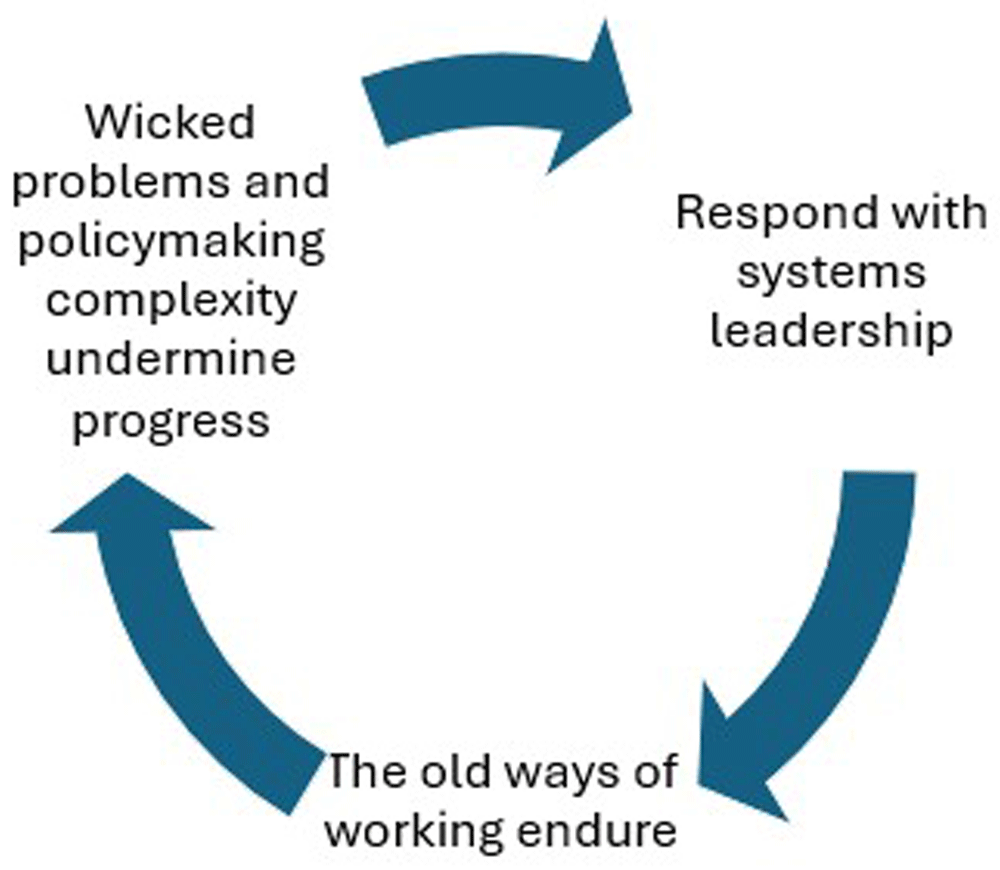
Figure 2. The systems leadership loop.
Various accounts present variations on these positive and negative themes. Nguyen et al. (2023: 13) find positive narratives from interviews with UK civil servants: a ‘top-down approach to advancing systems thinking adoption’ is essential to its use even if it has not yet taken off (Nguyen et al., 2023: 13). Further, systems leaders may need to be in senior positions (such as Director General in the UK) or have ‘sufficient standing and authority in Whitehall to be viewed as influential’ (Aston & Sweetland, 2024: 22; see also Barker, 2016; Education Scotland, 2019: 16; Government Office for Science, 2023). Similarly, Haynes et al.’s (2020: 69) interviews with Australian health ministry civil servants found that they enjoyed the opportunity to work closely with ‘great thinkers and practitioners’. In that context, when systems leaders ‘see new opportunities arising just as we see our capacity to exploit them diminishing’ they treat such difficulties as a justification for systems leadership (Atkinson et al., 2015: 8). Indeed, systems leadership may resonate with ‘an ambitious narrative about public service improvement, including how to create an optimal balance between localism and centralisation’ and a sense that powerful leaders had failed and caused the current crisis (Ghate et al., 2013a: 9).
More critical accounts describe the use of systems language as a sleight-of-hand by national governments to shift the blame for policy failure onto local policy actors:
“In the last decade, alongside the increased focus on whole systems working, people-centred design, and integration of public services, many countries have faced a significant decline in public funding, whilst demand for services continues to rise … Despite the rhetoric of greater local involvement in decision-making, centralized control mechanisms and decreasing funding greatly limit the capacity of local leaders to deliver services, whilst at the same time shifting accountability and responsibility from the central state to local partners’” (Bolden et al., 2020: 29).
Mowat (2019: 67–98) expresses the same caution that a national government may use ‘systems leadership’ as a vaguely aspirational aim without reforming top-down structures or providing resources to make meaningful changes. ‘Systems leadership’ becomes a process of co-opting an aspirational term to protect top-down practices.
Such accounts present variations on the theme of low clarity, congruence, and capacity (see Cairney et al., 2022), when vaguely new ways of thinking do not fit with the old ways of doing things, and there are limited resources for change. This problem begins with insufficient clarity to guide preparation: attachment to a vague aspirational term does not allow you to explore the ‘tensions, paradoxes and dilemmas this poses for leaders and their organizations or how they can be addressed’ and may prove to be ‘empty rhetoric’ describing something new to gloss over the old NPM (Bolden et al., 2020: 26; 34). Consequently, government may be unconducive to ‘systems thinking’ approaches when staff face an ambiguous complexity language, struggle to connect it to the ‘dynamics of policymaking’ and ‘political context’ or ‘policy culture’, especially when faced with factors – including ‘time and resource constraints’ and ‘high turnover’ – that disrupt learning (Nguyen et al., 2023: 8; see also Barker, 2016: 5–6). People may agree on the aim, but it is hard to: ‘get started’ when there is a lack of clarity on what to do (or a lack of a crisis to focus minds); ‘maintain momentum’ when there is ‘no cookbook’ for collective action and resources for coordination are limited; form meaningful relationships built on the familiarity and trust that comes from long-term engagement; or use trust to encourage ‘vulnerability’ during experimentation (Bigland et al., 2020: 4–7). Examples of this theme include:
New systems versus old hierarchies. In domestic (country level) accounts, progress is ‘painfully slow’ whenever systems leadership is incongruous with routine government business ‘amongst individuals and organizations habituated to working in bureaucracies, where professional expertise, hierarchical position and rules and processes are prevalent’ (Bolden et al., 2023: 338). Systems leadership may be catching on, but in public services dealing with wicked issues, facing increasing demand but lower resources, and subject to regulations, inspections, and performance measures that undermine collaboration across services for the long-term (Atkinson et al., 2015: 8). It is also hard to reconcile systems thinking with other forms of leadership based on authority, such as clinical leadership in hospitals (Onyura et al., 2019: 626). These competing forms of responsibility need to be reconciled, such as to harness ‘clinical expertise and credibility’ but also ‘consultancy functions that share expertise within the wider system; leadership for culture change’ (Manley et al., 2016: 5; see also Swanwick & McKimm, 2011). Similarly, in public health, systems approaches compete with other approaches to wicked policy problems, such as ‘acute care and epidemiological models that focus on isolating independent actionable causes’, and in policymaking where the uptake of systems leadership is limited (Haynes et al., 2020: 66 on Australia).
In international accounts, the development of systems leadership in one context may be undermined by another, such as when Rose et al. (2024: 14) identify the development of local adaptive capacity among ‘academic biomedical researchers in Africa’ but power imbalances in favour of foreign funders in ‘an environment of research colonialism’. As such, advice for systems leadership relates to the mindsets of participants and the wider environment that can facilitate or constrain new dynamics. Fast and Bennett (2020: 12; and Holloway et al., 2020: 23) make a similar point about ‘the dominance of international actors in the leadership and coordination of the humanitarian system’, making ‘local contributions … consistently undervalued’.
Error versus failure. An emphasis on curiosity and learning is not a good match to high-stakes policy and high-pressure practice where experiential trial-and-error learning would be equated with failure and blame-based accountability (Evans et al., 2021: 26).
A new moral focus lacks capacity or support. It is difficult to maintain a ‘focused moral purpose’, adapt ‘infrastructures and strategies across time’, and build professional capacity to ‘match shifting demands’ (Meyers, 2024: 302), especially when a profession of systems leaders has not yet developed (Dreier et al., 2019: 12). Further, some advocates of systems thinking may exacerbate tensions in government; ‘evangelical researchers’ contribute to ‘painful discussions’ that threaten to ‘alienate policy-makers’, such as by dismissing requests by new audiences for concrete examples (Haynes et al., 2020: 69–70)
A burst of ideas and potential but lack of training. Several studies (Chavez et al., 2019; DeClerk et al., 2022; Hardin et al., 2022; Thompson & Nelson-Marten, 2011) show that online scenario-based, postgraduate, and bespoke training are possible, while Talley and Hull (2023) describe the potential for training on addressing sustainability challenges including ‘climate change, water security, poverty and supply chain resiliency’, and the Centre for Effective Leadership (2023: 1) describes ‘developing the leadership skills and mindsets needed to be effective and adaptable in an increasingly complex government system’. Yet, the need for systems leadership capacity does not correspond to modes of training in field such as nursing, medicine, or public health (Bigland et al., 2020: 2; Evans et al., 2021: 26; Rose et al., 2024). There are too few people trained in systems leadership; too few people understand what it is or why it is necessary (O’Malley et al., 2022: 11).
The impetus for systems leadership also undermines it. The need for joined-up thinking is undermined by public sector fragmentation and a tendency for weak links between organisations, such as within healthcare (Manley et al., 2016: 5), across health and local government in England (Evans et al., 2021: 27), and across UK government departments (Nguyen et al., 2023: 8).
Such problems have prompted meaningful reflection in leading countries such as New Zealand. For example, the Deputy Prime Minister and Minister for Health (2021: 8) describe a sincere pursuit of ‘system leadership’ for mental health and addiction policy, undermined by a tendency to treat funding as ‘a collection of individual components and not a unified programme of delivery’, and the inability of the Ministry of Health to ‘exercise system leadership over this Programme’ (outside of health policy). The proposed response is to grow and train a workforce with system leadership skills, Ministry ‘stewardship’ over the cross-government programme, and more strategic capacity in ‘planning and reporting’ (2021: 10–11; compare with Hallsworth, 2011: 13 using ‘system stewardship’ to describe a necessary shift of mindset of policymakers). Similarly, the Ministry of Transport (2019: 57) identified a need to ‘Strengthen system leadership, support and coordination’ when addressing road safety, followed by the appointment of a ‘programme director’ to ‘provide cross-system leadership and agency integration’ and monitor performance (Ministry of Transport, 2022: 82)
How can systems leaders respond? With humility or heroism?
Although we have identified a common origin story, it is important not to use it to hide important differences of approach and expectations. Rather, ‘systems thinking’ can inform contrasting ambitions for leaders, from the ability to have a disproportionately strong impact on systems change (finding ‘leverage points’- see Meadows, 1999), to the need for humility to recognise that the requirement of collective action across a system precludes the disproportionate impact of a heroic leader (Cairney, 2021).
We find examples of each exposition of leadership in complex systems. The strongest ‘leverage point’ assertion is by Reinertsen et al. (2008: 6), to describe ‘healthcare organizations and communities’ as complex adaptive systems, and argue that ‘If leaders could choose the right system attributes (“leverage points”) and make small, perhaps difficult, but important changes, very large performance change might result (e.g. to set systems-level performance measures, identify a system-wide change strategy, boost leadership, engage staff and service users, get finance on board, and build capacity for improvement). Similarly, Hagel and Mortensen (2018: 6) argue that ‘the important thing is to achieve the greatest possible impact with the least amount of effort. Successful systems leaders always search for the so-called “leverage points” in the systems they are trying to change – the particular elements that play a disproportionate role in shaping the evolution of the overall system’. In contrast, Bolden et al. (2023: 339) cite Stacey’s (2006: 30) warning to avoid a ‘naive form of systems thinking’ in which a leader can step outside of a system to influence it, which “greatly exaggerates the potential for ‘system leaders’ to exert system-wide influence” and underplays the role of emergence from local interactions. Rather, seek ways to contribute effectively to a collective enterprise (Walker et al., 2022: 3 also warn against the language of levers).
Within this range, we find mildly positive accounts based on documenting personal experiences (The Leadership Centre, 2015; see also Coffey, 2010). There are also some modest ambitions to facilitate ‘emergence’ as part of a collective enterprise. Marion and Uhl-Bien (2001: 396–406) describe individuals who can influence systemic processes in the absence of control, producing a language consistent with the former, such as to foster or catalyze the construction of networks, act as ‘tags’ to symbolise ideas, and ‘drop seeds of emergence’. Further, Lichtenstein and Plowman (2009) suggest that this process begins by understanding four ‘conditions’ for positive outcomes to emerge from complex systems then encouraging ‘leadership behaviours’ that facilitate these processes:
1. ‘Dis-equilibrium state’.
• There is a notable ‘disruption’ in a system that causes instability, which ‘sparks emergent change processes’.
• Response: ‘embrace uncertainty’ and encourage system members to reflect on why this disruption has occurred, and ‘surface conflict and create controversy’ to prompt members to ‘generate novel opportunities and solutions’.
2. ‘Amplifying actions’.
• In this disequilibrium state, one part of a system can amplify action in another. Response: ‘amplify actions’ by fostering ‘experiments and fluctuations’, and ‘encourage rich interactions’ and ‘collective action’ in which many actors amplify ideas or responses by others.
3. ‘Recombination/Self-organization’.
• Amplifying activity puts pressure on a system to the extent that it ‘can either collapse or re-organize’.
• Response: foster ‘sensemaking’ and ‘sensegiving’ to encourage the generation of new ‘language and symbols’ that promote ‘correlation’, or a new ‘shared understanding of the system’. Use that new understanding to encourage the ‘recombination’ of systemic resources for a new purpose. Assume the role of ‘tags’, to represent ‘a valued set of behaviors’, draw attention to ‘things that are important’, and symbolize key messages.
4 ‘Stabilizing feedback’.
• A ‘new emergent order’ is apparent when there is less instability and key parts of a system dampen any impetus for change.
• Response: balance the pressure for change with the need to ‘integrate local constraints’ that could otherwise foster new forms of instability (2009: 620–1; 622–5).
Lichtenstein and Plowman (2009) recognise the small-N nature of such research and the possibility of cherry-picking experiences. Other small-N studies promote different conclusions, such as when Buchanan et al. (2007: 1086) describe a successful project in retrospect without being able to use it to design similar success (beyond developing skills for dealing with ‘fluid’ settings when there appears to be ‘nobody in charge’). Further, larger-N studies in political science emphasise not only the lack of individual ability to influence punctuated change, but also a researcher’s lack of ability to predict these dynamics (Baumgartner et al., 2023).
What is the evidence for progress, and how should we interpret the evidence?
The gap between aspiration and reality is costed into romantic systems narratives, so it is possible to find two contrasting interpretations of current progress. Senge et al. (2015: 30) go positive. They note that systems leadership involves ‘Bringing together diverse stakeholders with little history of collaboration, different mental models, and different and even apparently competing aims’, which ‘is a high-risk undertaking’. Then, they relate systems leadership to the ‘discipline’ and commitment of leaders, aided by tools to see the larger system (e.g. systems maps), facilitate reflection and conversation (e.g. ‘peer shadowing’ and ‘learning journeys), and co-create a future vision (e.g. an ‘appreciative inquiry summit’) (2015: 32). Their enduring commitment allows them to develop skills as they ‘learn on the job’, balance their ‘advocacy and inquiry’ roles, reach ‘across boundaries’ to engage, ‘follow the energy’ of the group, learn what tools work for them, reflect with other systems leaders (as we make progress towards ‘critical mass’), and help people avoid ‘fatalism’ as they seek meaningful change in systems (2015: 32–3).
On the other hand, a key tenet of complex systems analysis is to avoid individualising leadership roles. Wicked policy problems and complex policymaking processes are not – and could not be - in the control of even the most tenacious leaders. Further, being uncritically optimistic may lead people to assume that, for example, ‘collaboration is good and that pooling resources will automatically result in positive outcomes’ rather than research what ‘effective collaboration means or looks like’ (Jang et al., 2016: 88). This problem begins with a tendency to use the phrase ‘systems leadership’ without conceptual clarity or substantive empirical evidence on which to draw (Begg, 2020: 6; Bigland et al., 2020; Carey et al., 2015; Evans et al., 2021; Fawkes, 2013: 21; Health Foundation, 2010; Miller, 2020: 3; notes that this lack of evidence for effectiveness is a broader feature of leadership training). It can easily become a distracting buzzword, bandied around without clear definition (Gordon et al., 2023). This problem with clarity may seem academic, but could explain a shaky foundation for concerted action and the potential for demoralisation.
Example: systems leadership for health and social care in England
In that context, the much-studied process for health and social care integration (and public service reform) in England is a key reference point and source of contested ideas of progress. The most positive account of progress is by NHS England (2018: 58) when reflecting on the use of systems leadership for its major change programme in the National Health Service:
‘This way of working has a solid evidence base, encompassing leadership thinking, research and practice from around the world’ … the ‘national systems leadership programme … backed by the NHS, local and national government, social care, public health and other sectors … has helped people make real progress in changing how they think, how they behave and what happens on the ground as a result, as evidenced in independent evaluation and in reports from the places themselves’ (here, ‘evaluation’ refers to Ghate et al. (2013a) and The Leadership Centre (2015)).
Other positive accounts describe the benefits of systems leadership without defining it or explaining the mechanisms of change, such as: a ‘systematic review of complex healthcare interventions … emphasised the quality of systems leadership as an important aspect in the success of interventions’ (Baxter et al., 2019: 6); and, ‘The investment in a clinical leadership programme focused on systems leadership for quality generates value for the NHS’ (Malby et al., 2018: 793). Similarly, De Brún et al.’s (2019: 15–17) systematic review of ‘interventions to develop collectivistic leadership in healthcare settings’ (not systems leadership in particular) identified a range of approaches reporting positive outcomes (e.g. a higher sense of empowerment and lower staff turnover) – including ‘co-design’, ‘co-leadership’, ‘service improvement’, ‘team training’, and ‘individual team development’ interventions – but a ‘paucity of research’ of sufficient transparency and quality.
Other accounts of health and social care systems change in England suggest that it exemplifies the gulf between the frequent promotion of systems leadership (Local Government Association, 2018; Miller, 2020: 3) and the lack of conduciveness for this approach in the system. There is an iterative discussion of barriers and opportunities, in which reports describe the value of systems thinking and leadership, acknowledge the barriers and lack of progress, then reflect on how to use systems leadership principles or practices to respond (see Figure 2).
For example, Timmins’ (2015) summary of interviews with systems leaders describes it as: ‘not easy’, time consuming, and not supported well enough in terms of organisational and staff learning, financial allocations, or current incentives in healthcare organisations:
‘The pressures of regulation, financial balance and organisational targets are still leading people and organisations to draw in their horns and ‘hunker down’ to survive, rather than seeing the way forward in terms of changes that will alter and, in some cases, downsize what their organisation does. Regulation, in particular, needs to be reformed. All too often, the current system gets in the way of system change, and thus system leadership’.
Gordon et al.’s (2023) interviews with healthcare system chief executives suggest that their systems do not support systems leadership, since elements such as financial allocations, regulations, and organisational structures are geared towards hierarchy, performance management, and holding senior leaders responsible. Leaders face contradictory dynamics that encourage systems leadership rhetorically but ‘sacks’ chief executives for failure to meet short-term targets (Gordon et al., 2023, citing Anandaciva et al., 2018: 31–2). The legacy of high stakes internal market competition is two-fold: competition accentuated the ‘heroic’ manager image so prominent in politics and clinical work (Fillingham & Weir, 2014: 14); and, it pitted managers against each other (Anandaciva et al., 2018: 57; 64). Consequently, many people in leadership positions ‘don’t have a collaborative bone in their body’, much of the language of recruitment in key positions is ‘about looking for someone who still runs a tight ship’, and many are willing to engage in training and learning but subject to ‘operational pressures’ that rules it out (Anandaciva et al., 2018: 57; 64).
Similar tensions are apparent between and within health bodies and local government (The Leadership Centre, 2015: 5; Miller, 2020: 3) or across the public service. Walker et al.’s (2022: 3) interviews with local government officers highlights barriers to ‘the adoption of system thinking’ including low capacity and funding, a ‘culture of risk aversion among many in leadership positions’ and ‘institutional disconnect between agencies involved in health and wellbeing’. Taylor et al. (2020: 56) describe obstacles to new ways of thinking and working across social movements:
‘initial challenges were received from organizations that did not understand the approach and the structure of an informal partnership to drive change. Traditionally, public-sector bodies and even many third-sector organizations in the UK operate with a focus on hierarchical decision-making and governance structures, which are counter to an approach founded upon systems leadership. Systems leadership is an “art” approach to change making and not a “science.” It is founded in ways of feelings, perceiving, thinking, relating, doing and being, where strong relationships and trust are key’.
For example, they suggest that some senior public sector leaders challenged this approach to their social movement perhaps because they feared the loss of their own power (2020: 56) or knew that they would still be subject to harsher accountability regardless of their additional role.
Other accounts from practitioners invested in systems leadership (as facilitators or trainers) express some disappointment with progress, including:
‘What is shocking is how little time is being put aside for reflection in many major systems changes and how powerful the ‘wilful blindness’ has already become. I have been working in a number of places where those people exposed to system leadership thinking, and therefore reflecting hard, are struggling to get other senior leaders around them to reflect or learn’ (Goss, 2021: 15 on UK policymaking).
Similarly, The Leadership Centre (2015: 5) describes ‘scepticism among senior leaders’: they see systems leadership as another fad and have witnessed demoralising ‘historical, failed attempts to re-engineer the system’.