Introduction
The increasing concentration of carbon dioxide (CO2) in the atmosphere due to human activities is the main driver of climate warming (IPCC, 2018). To limit global warming to below 2°C, CO2 emissions must decline to net zero as quickly as possible and excess CO2 must be removed from the atmosphere using carbon dioxide removal (CDR) technologies (IPCC, 2018). In response, scientists across various fields are exploring and optimizing CDR technologies. One such CDR technology is enhanced weathering (EW), which accelerates the naturally occurring process of mineral weathering (Hartmann et al., 2013; Köhler et al., 2010). In mineral weathering, dissolved carbonic acid (which is in equilibrium with gaseous CO2) reacts with minerals to form water-soluble bicarbonate ions, increasing dissolved inorganic carbon (DIC), part of which may not be degassed back to the atmosphere for millennia (Berner, 2004; Hartmann et al., 2013; Köhler et al., 2010). During the mineral weathering process, disintegrating rocks also release cations and silica (Beerling et al., 2018; White & Buss, 2014), and part of the formed DIC and cations (e.g., Ca2+) may react and precipitate carbonate minerals, forming solid inorganic carbon (SIC) and releasing part of the CO2 originally sequestered (Hartmann et al., 2013).
Natural weathering rates can be vastly accelerated by, amongst others, grinding minerals to increase reactive surface areas, which gave rise to the term EW. EW could exploit significant quantities of waste rock streams (Renforth, 2019) and may have agricultural co-benefits (Beerling et al., 2018). Moreover, EW does not compete for land with other CDR technologies such as soil organic carbon sequestration, reforestation or bio-energy production with carbon capture and storage (BECCS) and may thus be combined with these CDR technologies (Horton et al., 2021; Janssens et al., 2022). However, care must always be taken to ensure that the added minerals will not increase heavy metal availabilities beyond risk-bearing thresholds (Dupla et al., 2023; Gastmans et al., 2016; Vienne et al., 2022).
To date, efforts to accelerate mineral weathering have predominantly focused on a suite of abiotic variables, such as mineral type and grain size. The potential impacts of biotic factors are often overlooked (Vicca et al., 2022), despite the fact that studies have shown that biota can potentially boost weathering. For example, fungal and bacterial species can actively facilitate the weathering of silicate minerals (Berner, 2004; Finlay et al., 2020). One mechanism by which biota accelerate mineral weathering is their respiration, increasing the CO2 pressure of the system. Consequently, due to Henry’s law, concentrations of the weathering agent carbonic acid increase and CDR is stimulated (Dontsova et al., 2020; Gerrits et al., 2020; Perez-Fodich & Derry, 2019; Vicca et al., 2022). Besides CO2 pressure, a manifold of biotic factors, such as enzymes and siderophores (chelators) could further stimulate weathering (Vicca et al., 2022; Wild et al., 2022). To date, the complexity of biota-weathering relationships is far from resolved (Milici et al., 2024), and Deng et al. (2023) recommended future research aimed at improving understanding of the roles of biotic-abiotic interactions in controlling EW efficiency.
In soils, quantification of EW is exceptionally difficult, among others because the increases in DIC and total alkalinity (TA) following mineral weathering can be undone by secondary mineral precipitation, which may remove DIC and TA from the soil solution (Amann et al., 2022; Kelland et al., 2020; Niron et al., 2024). In real-world situations, e.g., in agricultural experiments, this is aggravated by the fact that soils are extremely heterogeneous in almost every aspect, often rendering soil samples poorly representative for the total soil. For this reason, EW experiments are often conducted in controlled environments, such as column experiments, to ease the quantification by homogenizing many of the variables potentially affecting EW rates. Given the myriad of abiotic and biotic drivers at play, along with their broad potential ranges, it is virtually impossible to test every conceivable combination of experimental settings in a repeated multifactorial experiment. Therefore, experiments that aim to simultaneously test the many possible drivers and their interactions inevitably result in complex datasets that make traditional statistical methods ineffective. The mostly unreplicated driver combinations in such complex experiments, as well as relatively small amounts of data compared to the number and possible ranges of possible drivers, open the door to a machine learning (ML) approach.
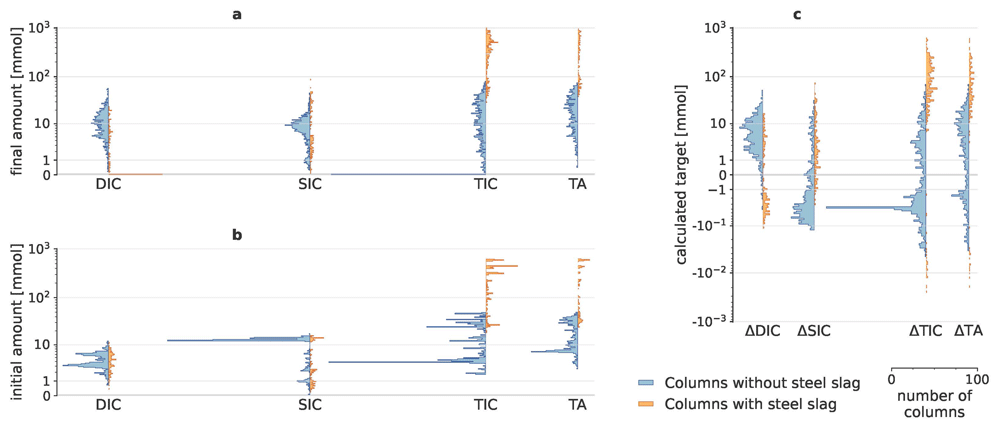
Most EW studies focused on the effects of only one driver or at best a combination of two or three drivers. This leaves the interaction effects of multiple drivers on EW largely unknown. Here, to simultaneously test the impacts of 30 potential biotic and abiotic drivers of EW, each with multiple different added amounts or size classes, an extensive column experiment was set up with unique combinations of rock powders, organic amendments, biota and biotic products (Calogiuri et al., 2023). These column inputs were chosen to explore several research questions. For example, steel slags are known to weather faster than basalt, but may lead to unlivable conditions for biota due to potential rapid increases in pH and heavy metals. Therefore, various rock types were assessed individually and in mixtures. Second, studies have shown that finer grain sizes increase weathering rates due to increased reactive surface area (Basak et al., 2021; Vanderkloot & Ryan, 2023). However, fine grain sizes may block or retard water infiltration, leading to pore water oversaturation and precipitation of newly formed minerals that may even inhibit further weathering (Amann et al., 2022). In our experiment, grain sizes were therefore varied and often mixed. Additionally, as biochar may scavenge base cations from solution and theoretically shift the equilibrium of mineral weathering (Amann & Hartmann, 2019), biochar was added to some of the applied mixtures. To test the impact of biota on the weathering rate, species of bacteria and fungi that were previously shown to induce mineral weathering, amongst others through production of enzymes and siderophores and through formation of biofilms on rock surfaces (Corbett et al., 2024; Gerrits et al., 2020; Gostincar et al., 2014; He et al., 2021; Kim et al., 2005; Niron et al., 2024; Nwoko et al., 2021), were added to the mixtures. Also earthworms were added, primarily for their soil mixing activity, removing precipitated secondary minerals from the silicate surfaces, and to stimulate microbial activity (Vicca et al., 2022). To support the activity of the microbes and earthworms and fuel their respiration, different types of organic amendments were added. Moreover, we tested the effect of adding nitrogen and phosphorus on EW via a potential effect on microbial activity. Last, the addition of enzymes and organic acids was assessed. The columns were then irrigated at different frequencies and throughput rates. Due to the open column setup, CO2 and thus CDR could not be directly measured. Instead, the impact of the inputs on CDR through mineral weathering was assessed based on measurements of SIC, DIC and TA, and on the inorganic carbon (IC) and TA initially present in the system. These are commonly used indicators of silicate weathering (Clarkson et al., 2024). The change in DIC leaching and in SIC sum up to the total inorganic carbon (TIC) sequestration. TA can provide further insight into differences in weathering dynamics between treatments.
The resulting data was thereafter analysed using an ML approach that combined predictive modeling and model explainability, as has previously been done for other high-dimensional setups, e.g., in pharma industry (Bannigan et al., 2023; Luo et al., 2024), health industry (Raihan et al., 2023) and to study water- and air quality (Bacanin et al., 2024; Park et al., 2022; Wang et al., 2021). We selected three predictive ML models; least absolute shrinkage and selection operator regularization (Lasso), Random Forest (RF), and eXtreme Gradient Boosting (XGB), which are popular tools in literature and which we chose for the following desirable characteristics; Lasso performs linear regression combined with feature selection by penalizing less important variables, which is particularly useful in high-dimensional settings where many predictors may be irrelevant (Santosa & Symes, 1986; Tibshirani, 1996). This feature selection is achieved through L1 regularization, i.e., by adding a penalization term to the L1-norm of the coefficients in the regression model. This results in a sparse solution where some coefficients are exactly zero (Tibshirani, 1996). Consequently, Lasso excludes unimportant predictors, which simplifies the model and enhances the accuracy. Weathering reactions, such as those promoted in enhanced weathering experiments, are driven by thermodynamics and are, in absence of biotic interactions, highly linear such that their kinetics can be modelled well (Curtis, 1976; Heřmanská et al., 2022; Heřmanská et al., 2023). Model outputs may be transformed to yield linear relationships or normal distributions, enabling parametric statistical approaches to elucidate results from experiments or variability in time series. However, in situ, microbes will respond to the altered environmental conditions and availability of elements in soils, among others by altering their respiration, exudation of organic acids, or taking up reaction products. These microbial responses thus elicit a suite of feedbacks that the current generation of geochemical models cannot reproduce, rendering some geochemical reactions unpredictable and highly non-linear. Under these real-world conditions where reaction kinetics cannot be reproduced by existing models, machine learning that can cope with non-linear relationships may enable the attribution of observed changes in weathering reactions to potential drivers.
RF and XGB allow modeling nonlinear relations and employ ensemble tree learning to improve the prediction accuracy (Chen & Guestrin, 2016; Ho, 1995). RF achieves this through bootstrapping decision trees and the final prediction is obtained by averaging the outputs of all the trees, effectively reducing overfitting and increasing model robustness (Ho, 1995). As a result, RF is increasingly used for ecological applications, e.g., Xie et al. (2021); Shi et al. (2021). XGB is an advanced boosting technique that refines its predictions by iteratively training new trees to correct the errors of the previous trees, often leading to superior performance (Chen & Guestrin, 2016). Furthermore, XGB includes mechanisms for regularization, which helps prevent overfitting by controlling the complexity of the model, making it both a flexible and robust choice for predictive modeling in ecological and environmental studies. Although XGB often outperforms RF, application of XGB in ecology (e.g., Huang et al. (2019); Park et al. (2022); Valavi et al. (2022)) is less prevalent. Other ML models have shown little added value compared to XGB on small, tabular datasets; with e.g., neural networks underperforming on such datasets and proving harder to explain (Shwartz-Ziv & Armon, 2022), and support vector machines often being more complicated to tune and not as accurate.
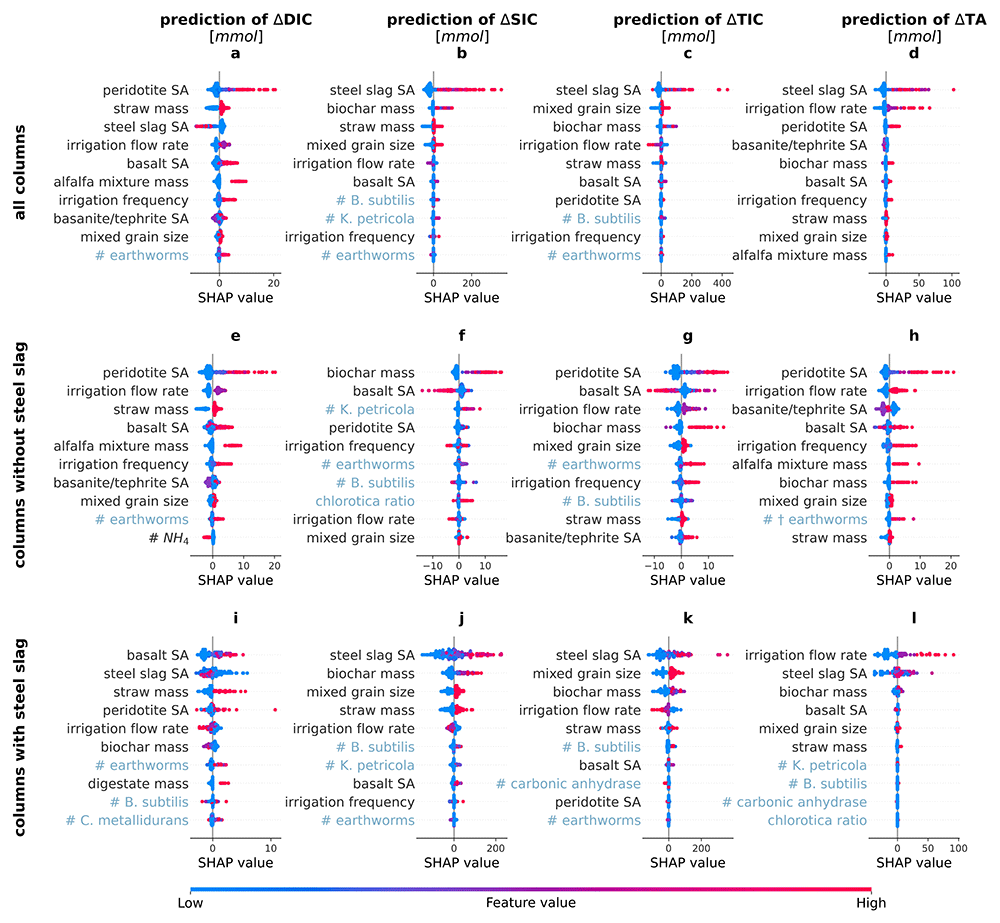
The main drawback of RF and XGB is that they, like most ML models, are black box models, meaning that they are not inherently interpretable (Lucas, 2020). This drawback can be largely overcome by combining the black box ML models with explainability techniques such as Shapley Additive exPlanations (SHAP) (Lundberg et al., 2017) or Local Interpretable Model-agnostic Explanations (LIME) (Ribeiro et al., 2016). These techniques provide information on the importance of the input features to the predictions and have previously been used in ecology to study, amongst others, species distribution models (Ryo et al., 2021), water ecosystems (Kruk et al., 2021), water quality (Park et al., 2022; Wang et al., 2021), tree species richness (Brugere et al., 2023) and plant phenology (Mortier et al., 2024). We used SHAP values to enhance the interpretability of the black-box models, as they are model-agnostic, can account for interactions between features and are often used in ecology (Brugere et al., 2023; Kruk et al., 2021; Mortier et al., 2024).
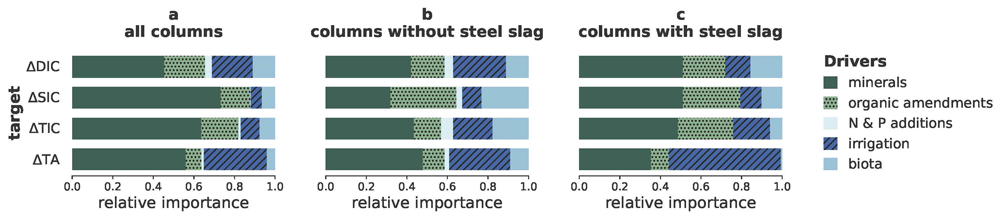
Notwithstanding that DIC resembles TA in most organic-poor systems, in organic-rich systems, TA has an inorganic and organic component (Song et al., 2020). Moreover, in a purely abiotic system, DIC and SIC are in equilibrium (yet controlled by kinetic rate constants of carbonate precipitation and dissolution), implying that a driver that accelerates or decelerates SIC formation would induce opposite changes in DIC and SIC, relative to comparable columns without the driver. However, biota can influence these kinetic rates, e.g., by exuding acids or the enzyme carbonic anhydrase, or by kickstarting precipitation due to cells functioning as carbonate nucleation sites. Therefore, we hypothesise that the prediction of change in amount of SIC (∆SIC), change in amount of DIC (∆DIC) and change in amount of TA (∆TA) will be driven by different features.
This study aims to uncover how mineral weathering results in CDR by combining insights in the key drivers of four different mineral weathering indicators. First, this paper summarizes the extensive column experiment designed to test the effects of 30 potential abiotic and biotic drivers on EW. Next, the weathering process is evaluated by calculating four different indicators of mineral weathering rate, i.e., ∆DIC, ∆SIC, change in amount of TIC (∆TIC) and ∆TA. To address the challenges posed by the complexity and dimensionality of the dataset, we first employed a range of regression models, including Lasso, RF, and XGB, to predict the CDR indicators based on the input materials of the columns. Finally, by integrating these ML models with explainability through SHAP values, we gained deeper insights into the underlying mechanisms of mineral weathering, making this approach a powerful tool for optimizing enhanced weathering strategies.