Introduction

The umbrella term policy integration shelters a collection of hopes for better coordinated policy processes and more coherence policies. We need better forms of coordination because complex policy problems transcend traditional policy sectors and jurisdictions and there is no single centre of authority. We need to pursue a coherent policy mix to anticipate the ability of many jurisdictions to produce their own instruments, which contribute to a messy incoherent mix of policies. Yet, political science research shows that there is a major and persistent gap between requirements versus policymaking reality. It uses a wide range of policy integration concepts to describe the often vague and rhetorical commitment to coordination and coherence and explain major gaps between stated commitments and real-world outcomes. While this academic case is convincing, it is not entirely helpful: policymakers do not have the luxury of enjoying a well-explained lack of progress, and still face the need to produce better coordinated processes and more coherent policies. It is essential to take this imperative seriously and establish how a wealth of policy integration research can help to guide real world action.

To that end, I present a qualitative systematic review of advice for policy integration in the pursuit of policy coherence. I draw on studies sheltering under that umbrella description, including whole-of-government and joined-up government approaches (Aoki et al., 2024a), policy integration, holistic governance, intersectoral action, policy coordination, and mainstreaming (Trein et al., 2023). I synthesise their insights to strengthen the connection between research and advocacy in policy analysis: academic research should be relevant to real-world policymaking and policymaking should be informed by academic research.

This review is also part three of a series that seeks advice on collaborative policymaking more generally (Cairney & Toomey, 2024; Cairney & Toomey, 2025). It seeks usable evidence to learn what makes policymaking more effective, while reflecting on contestation on how to learn and to define what is effective. Policy learning is part of the politics of policymaking, not a technical exercise to identify optimality (Cairney et al., 2024; Dunlop & Radaelli, 2013; Rietig & Perkins, 2018). For example, in this review my aims seem like valence issues: who would not want holism, integrated policymaking, and coherent policy? However, they are misleadingly attractive, too ambiguous to be useful, and potentially damaging to progress. When prompted to be more precise, there are good reasons to expect contested ways to integrate policymaking, including:

In other words, one author’s fragmentation and incoherence is another’s legitimate division of powers and freedom to tailor policy to context. Indeed, the starting point for each of the three reviews is the frequent rejection of top-down central control as not possible or desirable (Hooghe & Marks, 2003). Impossibility relates to complex policy problems, which ‘do not respect traditional government boundaries, and require collaborative responses across government and between governmental and non-governmental actors’ (Cairney, 2024: 4). Undesirability relates to a normative alternative to distribute policymaking responsibilities to reflect: legitimate demands for subnational political autonomy, the value of specialist and semi-autonomous policymaking organisations, and the drive to incorporate local citizens and stakeholders in policymaking (Cairney et al., 2019, 2022a). When policymaking responsibilities are distributed across sectors and political systems, some may seek central control to prioritise the coherence of a policy mix. Others are searching for advice on more voluntary collaborative ways to improve policymaking and coherence while protecting their autonomy. Resolving this ambiguity involves exercising power rather than consulting a dictionary.

Such contestation informs this three-part series’ search for advice, to connect aspirations to theory-informed research. Aspirational stories involve different elements, such as rationalist imperatives towards centralised coherence or alternative democratic imperatives that favour decentralisation and voluntary collaboration. Therefore, policy theory-informed studies inform different aspects of the gap between our requirements of policymaking versus reality, such as the inability of: one governing centre to assert its control in a complex system, or a collaborative initiative to succeed on its own terms. Different stories create different demands for, and interpretations of, advice on how to make policymaking more integrated and policy more coherent.

This is the most ambitious of the reviews (of 770 texts). I make it manageable as follows. First, drawing on established reviews without performing new database searches. Key scholars have performed the initial stages, to identify large literatures (705 texts) as part of their systematic reviews: Aoki et al. (2024a, 2024b) on ‘whole-of-government and joined-up government’ (WG/JUG) and Trein et al. (2023) and Trein (2022) on ‘policy integration’ (PI) (I now use PI and WG interchangeably unless stated otherwise). Conducting another search would be inefficient but additional analysis is essential. Second, I seek insights from grey literatures, via snowballing not database search, based on previous dispiriting experiences of searching in grey literature databases when reports use aspirational policymaking terms loosely (Cairney & Toomey, 2024, 2025).

I use the same approach to analyse the data, report, and reflect on the results. My search is for ‘pragmatic advice that offers hope’ but acknowledges policymaking constraints (Cairney & Toomey, 2024: 4). I cast a wide net to catch any relevant advice, including ‘aspirational advice’ on what holism or integration might look like, and ‘pragmatic and context-specific accounts of what worked’ (2024: 4). The Methods section describes the same rationale and context for this review. The Results section situates the search for advice in the context of conceptual ambiguity: what do ‘whole-of-government’ and ‘policy integration’ mean, how do they inform policymaking aspirations or advice, what are the gaps between aspiration and reality, and how do they affect coherence?

The Discussion section synthesises research insights to produce actionable lessons, but not a how-to-guide, for policy integration in the service of policy coherence. I use a cautionary tale approach to identify five themes. Explain what policy integration means. Identify your rationale, model, and theory of change. Engage with trade-offs between top-down and bottom-up approaches. Explain why the pursuit of integration has advantages over a reasonable alternative. Learn about facilitators from studies of success and barriers from studies of limited progress. These themes help to address limited progress in relation to clarifying aims, connecting them to routine government business, and making sure there is capacity to deliver. If this advice seems obvious, it should prompt us reflect on why it remains essential despite the stated intentions of so many governments. The idea of policy integration in the service of policy coherence has high rhetorical weight but low real-world traction: governments have a limited willingness and ability to integrate.

Methods

The series aims to produce connected reviews using a consistent method, so the following description draws on Cairney and Toomey (2024, 2025, see also Cairney, 2025b for added details), which adapts Kuckertz and Block’s (2021) guidance.

Rationale. I seek advice on how to improve policymaking with reference to whole-of-government and integration approaches, to inform the Horizon Europe project Healthy Working environments for all Ages: An evidence-driven framework (WAge). WAge’s Work Package 1 supports the uptake of evidence, which requires us to understand how evidence-informed collaborative policy processes work, and how they contribute to policy coherence (an integrated ‘healthy working environment’ strategy involves policy responsibilities spread across political systems).

Engagement with previous reviews. Cairney leads a team conducting qualitative systematic reviews that connect key aims to policy theory insights (Cairney et al., 2021a, 2023; Cairney & Kippin, 2022; Cairney & Toomey, 2024, 2025).

Research/guiding questions. My general guiding question was: What advice do scholars and practitioners offer on policy integration and policy coherence? I used sub-questions to guide analysis:

I anticipated that each text would define integration to some extent then offer at least one of three kinds of advice:

Databases and initial search terms. I use databases produced by Aoki et al. (2024a, 2024b), Trein et al. (2023) and Trein (2022). Kristin Nicolson downloaded the articles and produced a consolidated bibliography. Aoki et al. (2024a) searched Scopus and Web of Science for ‘whole-of-government’ and ‘joined-up government’. Trein et al. (2023: 4–5) searched Web of Science (2010–21) for: “Policy integration” OR “Comprehensive planning” OR “Policy coherence” OR “Holistic government” OR “Joined-up government” OR “Whole of government” OR “Horizontal governance” OR “Holistic governance” OR “Policy mainstreaming” OR “Boundary spanning policy regime”. I used snowballing to identify 54 academic and 11 grey texts described by researchers as underpinning their work.

Timeliness. Aoki et al. (2024a) searched from 1992–2021. Trein et al. (2023) searched from 2010–2021 (July).

Manual searches and choices regarding initial inclusion. Both teams prioritised academic journal articles in English, and included WG/JUG articles, but have different criteria: Trein et al. (2023) searched for more concepts over less time, and included only empirical studies. For Aoki et al. (2024a: 736) ‘the exact phrase of WG and or JUG had to feature at least once in the article, excluding references, at the outset. The article also had to elaborate on or exemplify these concepts … for at least one paragraph in the main body of the text’. Trein et al. (2023: 5) relate inclusion to: (1) ‘the extent to which they deal with the phenomenon of policy integration (by explicitly referring to policy integration or synonyms of it)’, then (2) ‘articles contained papers that clearly operationalize and examine policy integration empirically’.

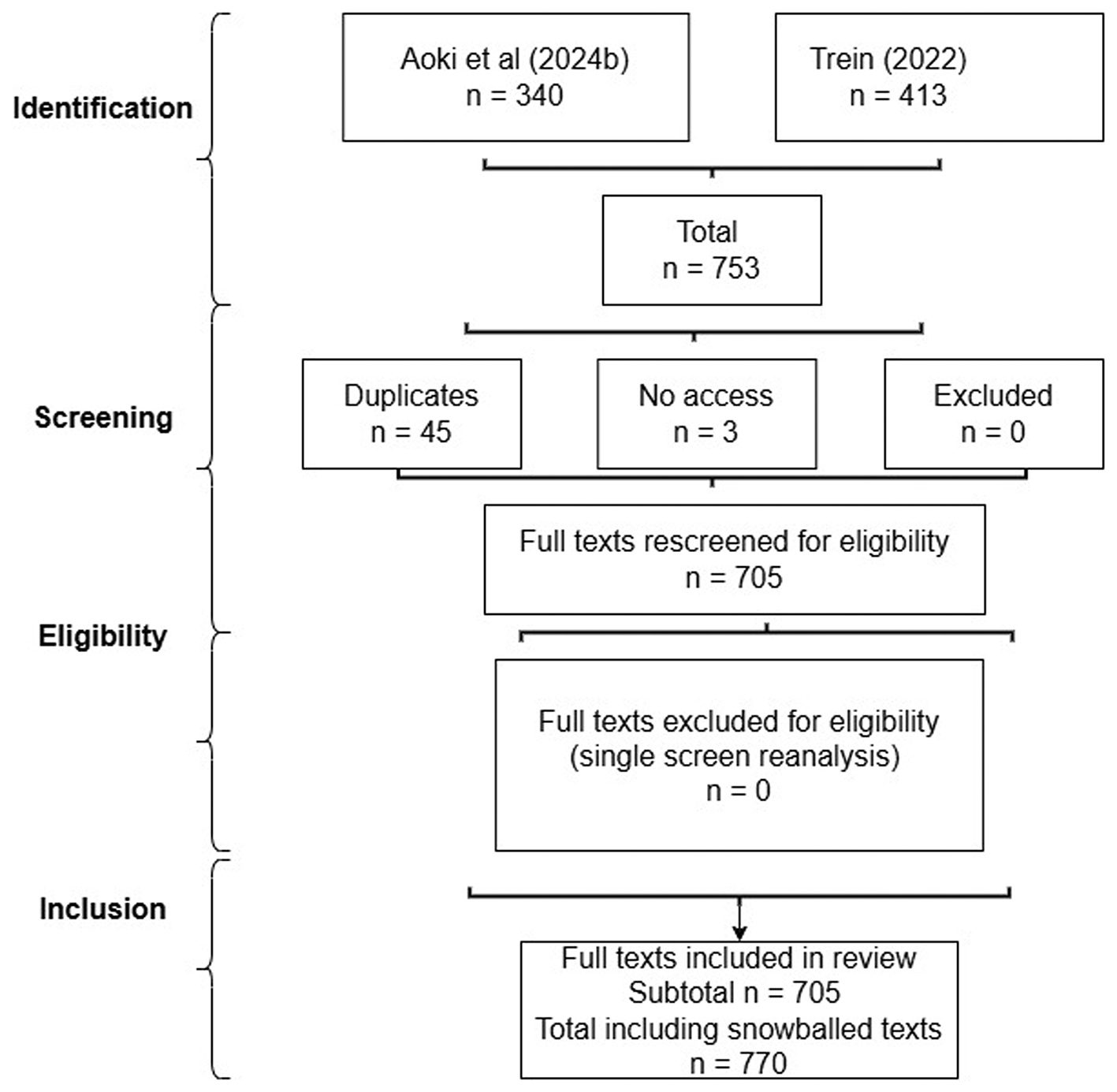
Search results and initial screening ( Table 1, Figure 1). Aoki et al. (2024a: 737) report: 517 texts relevant for screening, 9 not found, 39 wrongly classified, 129 not relevant, leaving 340 (259 WG, 140 JUG, 59 overlaps). Trein et al. (2023: 5) report: 1082 texts relevant for screening, 423 eligible, 10 not found (and I identified a database duplicate), leaving 412. There were 44 duplicates/overlaps between both reviews, and 3 no access (Subtotal 705). I did not introduce additional inclusion requirements, but my Results narrative only includes key contributions to my findings (Cairney, 2025b has a fuller 36000-word account).

Table 1. Modified search results 2024–25

SourceSearch resultsDuplicatesNo accessExcluded Included
Aoki et al. (2024b)34044 (with Trein)30293
Trein (2022)4131 (database error)-0412
Subtotal 753 45 3 0 705
Snowballing65---65
Grand total8184530770
eeeffcfd-96a4-4c98-ac71-17d74a10818f_figure1.gif

Figure 1. Flow diagram (reanalysis).

Routine data collection. Aoki et al. (2024a) describe:

Trein et al. (2023: 8–12, 2019) add the following:

Data analysis, aggregation, and presentation. I use an inductive qualitative approach to analyse each text, generate themes manually (Results), and synthesise advice (Results and Discussion) as part of a narrative review (with no numerical qualitative coding). As each review notes, ‘the rules associated with this method are less prescriptive than with its quantitative equivalent, suggesting that we (a) describe each key judgement, and (b) foster respect for each authors methods and aims’ (Cairney & Kippin, 2022, citing Sandelowski & Barroso, 2007: xv).

There is limited space to synthesise insights from 770 studies, which I addressed initially by producing a 36,000 word account (not including bibliography) (Cairney, 2025b). Even so, I drew sparingly on 350-400 texts which did little more than express the need for a WG or integrated approach to a policy problem (Cairney, 2025b notes their applications largely to health, environmental, and foreign and defence sectors). I also synthesized insights from 55 texts which provided a wide range of procedural and analytical requirements for policy coherence, usually without connecting their aims to other sources or a wider literature. I consolidated their insights and requirements to construct the concept of ‘perfect policy coherence’ and prompt debate on researcher aims for coherence (in Table 4, but also published separately as Cairney, 2025c). Most of the remaining articles use many different terms to describe the WG or PI efforts of governments and very few provide explicit policy process advice for integrators. Still, many provided indirect advice by criticizing aspects of the process (such as to caution against too-centralised or top-down approaches) or highlighting the need to account for inevitable barriers to progress. Hence, in the Results section, I try to make sense of the field by categorising PI terms ( Table 2), and the stated purpose of PI ( Table 3), then highlighting debates about the purpose of PI ( Table 5) to provide context for studies of the facilitators and barriers to PI ( Tables 6 and 7), while using considerable space to compare multiple key examples in the literature. Throughout, I draw on a broad reference to mainstream policy process theory insights, on bounded rationality and policymaking complexity, to frame my analysis (Simon, 1976; Cairney, 2020).

Limitations relevant to data gathering and analysis

Two previous reviews note five key limitations regarding collaborative policymaking research: the minimal definition of key terms, an umbrella term covers many activities, a limited focus on advice, a dispiriting search for grey literature, and a lack of knowledge (in aspirational research) about how policy processes work (Cairney & Toomey, 2024, 2025). Our wider suite of reviews also notes that the use of English-language texts exacerbates a bias towards Global North authorship and country coverage. Here, Aoki et al. (2024a) and Trein et al. (2023) confirm this skewing of included texts to Western and European contexts. Further, while their reviews aid terminological coherence, most of their included studies do not, and most engage sparingly with policy theories or discuss obstacles to progress without advising how to respond. I respond by: keeping the bar for inclusion low to encourage immersion in the field; snowballing to identify key reference points (plus texts from expert recommendations); and, making it explicit that I present advice based on my synthesis of insights.

My search protocol, PRISMA checklist, structured bibliography, and longer draft (Cairney, 2025b) is stored on Open Science Framework (OSF) https://osf.io/hrbm2/.

Results

The policy integration literature describes an aim that might seem universally appealing: we need better forms of coordination to pursue a coherent policy mix. Yet, its appeal results from unresolved ambiguity in research and policy when there are too many vague aims and rhetorical commitments. Resolving ambiguity requires researchers and policymakers to explain what integration and coherence would mean in practice, then face trade-offs between competing models of top-down or bottom-up integration. Further, when we examine real world policymaking, we find routine barriers to the vague forms of integration envisaged by reformers. Engaging with these issues of unresolved ambiguity and systemic barriers to integration is the first step to synthesizing feasible advice to guide real world action. To that end, I divide the results into a six-part structure to identify:

The wide variety of concepts and definitions: a clear definition of policy integration is elusive

The study and practice of integration and coherence lacks integration and coherence, partly to reflect incentives in government and academia to reinvent terms or use aspirational slogans (Cairney & Toomey, 2025; Tosun & Lang, 2017: 554). The umbrella term ‘policy integration’ shelters many variations on a vague theme with no clear origin story. I highlight a full range of concepts in Table 2 then separate two key elements: (1) the pursuit of policymaking integration or integrated policy processes, and (2) the pursuit of policy coherence or a coherent policy mix.

Table 2. Variations on the theme of policy integration and policy coherence.

ConceptSummary of aimsExample or citation
Policy coherence Ensure that all relevant policies contribute to a well-coordinated set of aims. Collaborate across sectors to improve the coherence of policy instrumentsOECD and UN Sustainable Development Goals (SDGs)
Whole-of-government approaches Coordinate government action and public service delivery towards a shared goalPopulation health or climate change policies
Joined-up government (and holistic government) Coordinate government and public sector functions to produce coherent and efficient responses to a problem (e.g. new incentives, departments, or units)UK Labour government
Policy integration Be aware of the effect of policy in one domain on another, and integrate aims and instrumentsEnvironmental or climate policy integration
Comprehensive planning Centralise the coordination of policy goals or instruments to support a unifying aimUrban planning
Strategic state Create a country-wide vision, informing aims and objectives, backed by organisations and policy instrumentsOECD reports on country government performance (Elliott & Roberts, 2024)
Mainstreaming Address this aim or problem in all policiesGender mainstreaming
Multi- or inter-sectoral action or governance Collaboration across policy sectors (inside and outside of government) to share responsibilities for cross-cutting aimsHealth in All Policies (HiAP)
Holistic governance Start with clear aims then identify the organisations and instruments to support themResearch and policy agendas for government and public sector reform (e.g. 6, 1997; 6, 2004)
Horizontal governance Coordinate policy and delivery among governmental and non-governmental organisations, emphasising collaboration and shared responsibilityPolicies harnessing the involvement of non- government stakeholders (e.g. Ferguson, 2009)
Network governance A decentralised or pluralist way to coordinate policy across governmental and autonomous/ non-governmental organisations. Models may include self-organisation, one leader, or a dedicated administrative structure (Provan & Kenis, 2008)(1) Academic research, informing (2) how governance through networks may be effective (Lewis, 2011a; Sørensen & Torfing, 2007)
Collaborative governance Policymaking ‘across the boundaries of public agencies, levels of government, and/or the public, private and civic spheres’ in relation to a common aim(Emerson et al., 2012: 2)
Polycentric governance Many policymaking ‘centres’ have high autonomy to act independently, but are motivated to engage in collective action (including to make and follow rules)Inspired by Ostrom and Ostrom’s ‘Bloomington school’ (Aligica & Tarko, 2012; Cairney et al., 2019; Jordan et al., 2015)
Boundary-spanning policy regime (or functional regulatory space) Research about the integration of policies and dynamics of subsystems (across multiple policymaking scales or levels). See also Morin and Orsini (2014) on ‘regime complexes’ (networks of international regimes)Academic research (e.g. Jochim & May, 2010; Varone et al., 2013, Trein, 2017).
Policy coordination Examine if decisions associated with policy programmes or organisations contribute to the same strategy (positive) or do not conflict with others (negative)Academic research (e.g. Peters, 2015; Peters, 2018; Russel et al., 2020: 5)
Policy mix coherence Research on the extent to which multiple policy instruments combine to complement or contradict each other‘New policy design’ (e.g. Howlett, 2014; Peters et al., 2018; see also Simoes et al., 2015)

This analytical distinction between policy processes and outputs reflects existing distinctions in research between a policy theory focus on policy processes and research and advice on policy analysis (Cairney, 2020, 2021a; Peters et al., 2018; Trein & Maggetti, 2020: 199; Trein et al., 2021: 1411; Weible, 2023). These literatures may inform different searches for advice or frame that advice in different ways.

Policy processes: to make and influence policy, to turn beliefs or aims into policy. The practical aim of policymaking integration is to transform policy processes to oblige integration or foster voluntary collaboration among multiple actors. Collaboration can be designed to transcend policy sectors, government departments or agencies, or inside/outside of government. Collaboration can boost ‘policy capacity’, or the ability of many organisations, or networks of public and private actors, to harness resources (Williams & McNutt, 2013).

The research aim of policy theories is to compare these intentions with real-world practices and identify the causes of gaps (Cairney & Toomey, 2024, 2025). For example, our review of Health in All Policies (HiAP) identified strong reasons for specialisation in ‘subsystems’:

“classic studies of ‘policy communities’ highlight a logic of delegating policy responsibility to junior civil servants, engaged in routine consultation with a limited number of actors who trade information and advice for access … Most policy is processed in silos that seem to defy central coordination. Silos develop rules appropriate to their own contexts, and their logics do not change simply because the overall effect looks like uncoordinated and incoherent policymaking … [while some describe] these dynamics as obstacles to be overcome, policy studies present them as ever-present forces to which to adapt. A lack of intersectoral action seems incoherent to some but makes sense to others” (Cairney et al., 2021a: 24–5; see also Cejudo & Trein, 2023; Jochim & May, 2010: 304; Peters, 2015; Peters, 2018: 4–5; Tosun & Lang, 2017: 554).

This argument that silos and subsystems make sense reflects positive and negative drivers including:

This argument also cautions researchers to see fragmentation as evergreen: ‘Policy integration is … not a single moment when those tensions are solved … but a political process that requires deliberate efforts to overcome the pull toward sector-specific’ dynamics (Cejudo & Trein, 2023: 9).

Policy outputs: the instruments to influence individual, social, or organisational action to change policy outcomes. The practical aim is to pursue policy coherence, such as to design and deliver a coherent policy mix. This mix can consist of policy instruments to redistribute or distribute resources, regulate social or market behaviour, build organisational capacity, and/or gather evidence and share information. It may be produced by organisations spread across multiple scales or levels of policymaking. Each instrument may have different ‘targets’ and ‘beneficiaries’ (Flanagan et al., 2011: 707; Hood & Margetts, 2007; Howlett, 2014; Rogge & Reichardt, 2016).

The research aim is to explain why individual instruments have limited effects, or why the mix is incoherent (Howlett et al., 2015; Peters et al., 2018). Studies find an unclear connection between design processes and instruments (Howlett, 2014; Peters et al., 2018). This disconnect is multiplied when many policymaking organisations are spread within or across policy sectors and levels of government, and have some powers to produce some instruments for different purposes and make or deliver policy at different times, thus prompting an overall approach and policy mix that is difficult to coordinate and cohere (Bahn-Walkowiak & Wilts, 2017: 165; Biesbroek & Candel, 2020: 64; Cairney, 2021a; Cairney et al., 2022a; Candel & Biesbroek, 2016; Howlett et al., 2017: 72; May et al., 2006: 383; Righettini & Lizzi, 2020; Sandström et al., 2020; Simoes et al., 2015).

This simple analytical distinction between policy processes (policymaking integration) and outputs (policy coherence) is difficult to maintain but provides a useful lens through which to view each major approach to PI.

Whole-of-government and joined-up government approaches

WG and JUG are vague terms (Christensen & Lægreid, 2007) and Aoki et al. (2024a: 736) treat them as ‘interchangeable’. Descriptions of JUG could be of WG, including ‘the aspiration to achieve horizontally and vertically co-ordinated thinking and action’ (Pollitt, 2003: 35 in Davies, 2009: 81; Hodges, 2012: 30; Karré et al., 2013: 63; Wiggan, 2007: 415). Here, horizontal may describe coordination across the same level of government, while vertical may describe coordination across multiple levels (but it is always worth checking what the authors mean).

To some, WG represents an attempt to shift away from New Public Management (NPM). Its focus on ‘structural devolution, disaggregation, and single-purpose organizations’ produced a fragmented government and public sector, which left it ill-placed to address the ‘wicked’ policy problems that transcended sectoral and organisational responsibilities (Christensen & Lægreid, 2007: 1059, citing OECD, 2005; see also Exworthy & Powell, 2004; Flinders, 2002: 53; Halligan et al., 2011: 78; Kraak, 2011: 345–8). Central governments who had embraced NPM – especially in the UK, New Zealand, and Australia – sought to deal with the unintended consequences: they had sought to delegate responsibilities and share accountability but lost central control and faced the blame for poor outcomes (2007: 1060; Verhoest et al., 2007: 326; see Flinders, 2002: 57–60; Heppell, 2011; Hodges, 2012; Kavanagh & Richards, 2001: 3–8; Lewis, 2011b on the UK).

There are country-level variations to reflect scale, political system, and the chosen balance between centralisation and local autonomy and collaboration (Halligan et al., 2011: 77; Ling, 2002: 619–21). Still, commonalities include to foster integration by treating citizens or service users as customers, perhaps as part of a ‘one-stop-shop’ (Hammerschmid et al., 2019). Further, while narratives of policy problem ‘wickedness’ are vague (Daviter, 2017: 575), they are strong enough to convince governments to reassert control over their response to multiple existential security, environmental, and other crises (2007: 1060) and to address the lack of clarity regarding formal responsibilities (e.g. Ison et al., 2018; Yusuf et al., 2022: 487; Young & Grant, 2015: 16).

Policy integration

Tosun and Lang (2017: 553) use ‘policy integration’ as the umbrella term to describe (1) ‘the collaboration of actors from two or more policy domains’ to (2) ‘integrate aims and concerns derived from one policy domain into another’. Cejudo and Trein (2023: 9) also describe the political activity and intended output:

  • ‘Policy integration is a political process that entails the coordination of actors and agencies across policy subsystems, the combination of instruments from different policy sectors, as well as arrangements for their consistent implementation and evaluation, as a response to a complex policy problem that not one policy sector, policy instrument, or agency can solve.’

Rayner and Howlett’s (2009: 99–100) definition of ‘integrated policy design’ focuses on the outputs and outcomes:

  • “Integration is the replacement of specific elements of existing policy ‘mixes’ or ‘regimes’ – the goals, objectives and calibrations of existing policy tools and goals – by a new policy mix, in the expectation of avoiding the counterproductive or sub-optimal policy outcomes that arise from treating interrelated policy regimes and components in isolation from one another”.

Environmental and climate policy accounts for much research, reflecting strong rhetorical commitments by governments and ‘international governmental organisations’ (IGOs) to environmental policy integration (EPI) and growing commitment to climate policy integration (CPI) (Cejudo & Trein, 2023: 11; Tosun & Peters, 2018a; Tosun & Peters, 2018b: 90). While ‘integration’ is vague, approaches can signal high ambitions. For example, integrated policy strategies (IPS) describes the pursuit of ‘a set of integrated goals by a polity as a whole’ which may involve a new ‘complex multilevel’ policy mix to reflect its importance across policy sectors and levels of government, backed by ‘legislation, programmes and/or high-level agreements’ (Candel, 2017: 520). Examples include IPS for ‘food insecurity, climate change, or homeland security’ (2017: 520). Here, policy actors attempt ‘to re-design entire policy regimes around new policy paradigms, such as sustainability’ (Rayner & Howlett, 2009: 100). See also ‘strategic state’ approaches regarding the ‘creation and delivery of an effective strategy at a country-wide level’ (Elliott, 2020: 286; Elliott & Roberts, 2024: 5; Joyce, 2022; Joyce & Drumaux, 2014; OECD, 2013: 58).

Mainstreaming

Mainstreaming is to consider one problem or aim in all policy. Examples include environmental, climate adaptation, or ‘ecosystem services’ mainstreaming (Nunan et al., 2012; Rauken et al., 2015; Rosenberg, 2020; Schleyer et al., 2015; Schubert et al., 2018; Wamsler et al., 2014; Wamsler & Pauleit, 2016; Widmer, 2018) and HiAP (Cairney et al., 2021a; Peters et al., 2016; Ramirez-Rubio et al., 2019). ‘Policy coherence for development’ (PCD) or ‘sustainable development’ (PCSD) (OECD, 2023) seeks to mainstream economically developing country concerns in developed country policies (Adelle & Jordan, 2014; Carbone & Keijzer, 2016; Fritz & Raza, 2017; Janský, 2015; Mbanda & Fourie, 2020; Nshimbi, 2019; Prontera, 2016: 299; Verschaeve et al., 2016; Zeigermann & Böcher, 2020).

Mainstreaming may also reflect the need to address the gendered or racialised division of power that marginalises some social groups from meaningful partnerships or collaborative efforts (Scott & Thurston, 2004). For example, ‘gender mainstreaming’ (GM) may begin strongly, such as when the Council of Europe (1998: 15) defined it as ‘the (re) organization, improvement, development, and evaluation of policy processes, so that a gender equality perspective is incorporated in all policies at all levels at all stages, by actors normally involved in policy making’. However, the means to achieve GM vary markedly: some governments exhort or set benchmarks, while others produce substantive regulatory or redistributive policy instruments. This responsibility is shared across levels, often causing policy dilution (Cairney et al., 2021b, 2022a: 147; Pollack & Hafner-Burton, 2010: 293, citing e.g. Abbott & Snidal, 2000; Beveridge, 2012; Daly, 2005; MacRae, 2010; Peck, 2002: 332; see also the new review by St. Denny & Cairney, 2026).

Vague aspirations for whole-of-government approaches and integration

Cairney (2025b) summarises the large number of studies (most of the 705 texts) that contribute to at least one of four statements:

  • 1. I recommend a whole-of-government or integrated approach to this wicked policy problem.

  • 2. Here is what a whole-of-government or integrated approach would look like.

  • 3. This government describes an aspiration to take a whole-of-government or integrated approach, but in a vague way.

  • 4. This government has used a WG approach successfully, but it is difficult to connect its success to WG factors.

Most of this literature uses the general PI lexicon to exhort a holistic understanding of a wicked problem, encourage more coordination, then find limited progress, and push for change. Cairney (2025b) summarises hopes for WG approaches to:

  • • Public health. Health protection, health improvement, mainstreaming public health in foreign and domestic policy, boosting citizen participation in health governance, a One Health approach (connecting humans, animals, environments), and integrating public services.

  • • Sustainability, environmental protection, climate mitigation and adaptation, and disaster preparedness. Sustainable development, a ‘nexus’ between energy, land, water, and natural resources, plus conservation and biodiversity management, and disaster management or mitigation.

  • • National security. Integrate domestic and international affairs, including foreign policy, security, terrorism, defence, peacebuilding, diplomacy, and aid policies.

  • • Governance issues, including the patchy and often unsuccessful use of information and communication technology (ICT), development of Whole of Government Accounts (WGA), and efforts to collaborate with indigenous communities.

Such studies identify general ‘enablers’ including capacity, communication, collaborative governance, leadership, evidence generation, backed by accountability measures (e.g. Agrawal et al., 2021: S28; Alexander & Haward, 2019: 35–6; Cavallo et al., 2017; Cavallo et al., 2018; Gerhardinger et al., 2019; Hassler et al., 2018; Mascarenhas et al., 2015; Mongruel et al., 2013; Morf et al., 2019: 206–8; Nalau et al., 2016: 372; Orderud & Naustdalslid, 2020: 25; Sander, 2018; Schubert et al., 2018: 308; Wurtzebach et al., 2019: 130).

There are some success stories in country studies of COVID-19, citing factors such as: clarity of purpose, effective leadership and collaboration (Hsieh et al., 2021: 310–12), ‘collaborative innovation’ to bolster investment in ICT capabilities (Lee et al. (2023: 340); ‘collaboration from non-government organisations and private sectors’ (Ang et al., 2021); and, ‘strong resource mobilization and control of government departments, companies, and citizen communities’ (Jing & Xue, 2021: 31). However, it is difficult to identify (1) a clear link between identified WG mechanisms and the successful outputs described in these accounts (although Hsieh et al., 2021 and Lee et al., 2023 reflect on preparedness after a previous SARS outbreak), or (2) how these approaches differed from the countries who used similar WG measures (e.g. the UK – Cairney, 2021b) (see also the new review of COVID-19 policy by Cairney & Intropido, 2025).

The need for conceptual clarity: what exactly does policy integration mean?

Most PI studies produce too-general aspirations with an unclear connection to action. This field would be more conducive to coordinated growth if informed by the following guiding questions summarised in Table 3.

Table 3. What is the point of policy integration?

Terminology Whole-of government, joined up government Policy integration
Sincerity To do something To look like you are doing something
Origin story Seek central government control in response to crisis
Assert national central government control in a multi-level system
Address the unintended consequences of previous reforms
Address a wicked policy problem more effectively
Improve democracy to improve policymaking
Priority Coordinate policies from international to local action
Remove barriers to cooperation across sectors, departments, silos
Produce one plan for government in a country
Foster collaboration across public services
Make policy in collaboration with stakeholders and citizens
Level One level of government, focused on horizontal coordination
Multiple levels, focused on vertical integration (e.g. central-local)
Scale of inclusion Policymakers across government departments
Actors who make and deliver policy across the public sector
Actors inside and outside of government
Method, means, strength Centralised and top-down or decentralised and bottom-up
Hierarchy, market, or network mechanisms
Hard or soft measures
Intensity of coordination More information sharing by many autonomous actors
One strategy enforced on all actors
One unit to make and deliver all policy
A ‘one stop shop’ to coordinate all relevant public services
Policy problem Wicked or tame issues
Requires an ambitious policy mix, produced by many sectors
Requires one overarching strategy and regulatory framework
Timeframe Rapid reform for immediate impact
Anticipation, prevention, planning for the long-term
Measure of progress The reform is popular
The process enjoys legitimacy and ownership
There is evidence that the policy works as intended when
implemented

Terminology: what terms are used and what do they mean?

Governments and advocates describe WG vaguely, without clarifying what it would look like if successful. In research, PI is broad and varying usage creates confusion (Trein et al., 2023: 3–4). If PI can describe so many activities ( Table 3), actors should avoid using it loosely.

Sincerity: what is the level of commitment to reform?

Serious reformers seek a meaningful shift in thinking and behaviour (Keast, 2011: 230; Molenveld et al., 2021: 124). Others use ambiguity strategically, using ‘buzzwords’ to pretend to act (Christensen & Lægreid, 2007: 1061, citing Gregory, 2006). Given this range of possibilities, PI means little unless backed by a means to translate ambition into deliverable instruments.

Origin story: what is the main motivation for integration?

We require a clear stated rationale when the field contains many motivations. First, to assert power or control. It includes to reassert central government power when addressing crises or managing coalition politics (Halligan et al., 2011: 79–80; Verhoest et al., 2007: 341). Or, to reassert national central government in multi-level governance arrangements where responsibilities may be shared (Trein & Maggetti, 2020: 20; Trein et al., 2021).

Second, to respond to the unintended consequences of previous reforms. NPM exacerbated silos and fragmentation and undermined central coordination (James, 2001; Tosun & Lang, 2017: 557).

Third, to address a ‘wicked’ policy problem more effectively (Verhoest et al., 2007: 341; Tosun & Lang, 2017: 561–46, 1997). To avoid the costs of a lack of coordination, including: ‘duplications’ of effort; ‘contradictions’ between instruments with their own rationales; ‘displacement’ of work; too much focus on ‘vertical management’ within a hierarchy rather than horizonal cooperation; and, a lack of response to ‘changing demands’ or ‘cross-cutting problems’ (Peters, 2018: 4). Further, some left-wing parties are more interested in joining-up state intervention for HiAP, environmental justice, or social investment (Trein & Ansell, 2021: 1148–9).

Fourth, to seek the benefits of improving participatory or deliberative democracy. The inclusion of citizens and stakeholders can boost policymaking knowledge and policy ownership (Tosun & Lang, 2017: 563; e.g. Franzén et al., 2011; Milhorance & Bursztyn, 2018; Mullally et al., 2018; Nadin et al., 2021: 794–5; Zhang et al., 2020).

Or, the origin story may be holistic, such as to describe the NPM legacy and inability of fragmented governments to address wicked problems, then present a vision for more anticipatory and preventive policymaking that fosters trust-based collaboration and empowers public sector workers to meet the needs of their population (6, 1997; 6 et al., 2002).

Priority: what is the main aim of integration?

The aim may be enduring coherence when policy is produced and delivered by multiple countries and international organisations (Tosun & Lang, 2017: 556–7; citing OECD, 2009; see also Desta & McMahon, 2015; Hezri & Dovers, 2009; Koff et al., 2020; Le Blanc, 2015; Mohammadi et al., 2019; OECD, 2019, 2023, 2024; Ruffing, 2010; Wong, 2019a). WG focuses on issues like government departmental silos to be knocked-down or joined-up. Terms like ‘comprehensive planning’ described centralised coordination to manage ‘multiple goals in urban planning’ (2017: 556; Jun, 2017; Jun & Conroy, 2013; Jun & Conroy, 2014; Trein et al., 2023: 8). ‘Strategic state’ extends the scale of planning to a country’s government (Elliott & Roberts, 2024). Other terms focus more on governance, to foster less hierarchical coordination of public service management or policy delivery, or to prioritise stakeholder or citizen engagement (Tosun & Lang, 2017: 556–61). This framing of priorities matters whenever broad aims cohere in theory but collide in practice.

Scale of inclusion: which actors or organisations are essential to coordination?

Initiatives may envisage a core group of actors coordinating across a central government, a larger group facilitating action across the entire public sector, or participation on a grander scale and inside and outside government.

Level: how many, and what levels of government are involved?

Initiatives can promote horizontal and/or vertical coordination. One WG response to NPM was to refocus on cooperation across government departments (horizontal) and address problems with the performance management of local service delivery (vertical) (Christensen & Lægreid, 2007: 1060).

Method: what are the means to ensure integration, and how strong are they?

Integration can be driven by one central government or decentralisation and collaboration in relation to delivery and local engagement (Keast, 2011: 222). Studies distinguish between coercive central government ‘mechanisms’ for ‘hierarchy’, ‘market’ mechanisms such as incentives and internal-markets, and ‘network’ mechanisms to coordinate via ‘consensus, trust, and mutual dependence’ (Molenveld et al., 2020: 1; Verhoest et al., 2007: 332). Christensen and Lægreid (2007: 1061–62) distinguish between:

  • • ‘hierarchical-instrumental’, an ‘aggressive top-down style’

  • • ‘negotiation-instrumental’, a pragmatic search for collaboration

  • • ‘cultural-institutional’, a more organic ‘evolution’ of public service

  • • ‘myth-institutional’, or stories of reforms which could be ‘fads’ or ‘window dressing’.

‘Top-down’ can be used negatively to warn against unintended consequences or normative problems (Christensen & Lægreid, 2007: 1061, citing Richards & Smith, 2006). Or, positive usage describes much-needed direction (e.g., Sander, 2018). The latter informs the distinction between ‘hard’ and ‘soft’ measures of substance:

  • • ‘Hard’ describes ‘three dimensions of obligation, precision, and delegation, with (1) binding provisions entailing (2) precise responsibilities and commitments, backed by (3) strictly enforced positive and negative sanctions for compliance and noncompliance’.

  • • ‘Soft’ measures include ‘(a) non-binding provisions with (b) vague or imprecise aims and (c) little or no attempt to monitor and sanction officials for compliance and noncompliance’ (Pollack & Hafner-Burton, 2010: 292, citing Abbott & Snidal, 2000 on GM; Tosun & Lang, 2017: 562; see also Widmer, 2018: 72). For example, UN SDGs represent ‘the softest of all global governance tools’ (Wong, 2019a: 2).

Intensity: what is the level of obligation to integrate or collaborate?

Metcalfe (1994: 281) describes an ascending scale of policy co-ordination within a country, from independent decisions, to ‘information exchange’, ‘consultation’ and ‘feedback’, ‘avoiding divergences’, ‘search for agreement’, ‘arbitration of policy differences’, ‘setting limits’ on the extent to which one policymaker can diverge, ‘establishing central priorities’, and one ‘government strategy’. This scale is a tool to gauge or encourage horizontal coordination (1994: 287–8; Dafinova, 2021: 466; Flinders, 2002: 61; Wilkins, 2002: 117; Wong, 2019a: 2).

Equivalent efforts towards vertical integration include a push towards ‘shared services’ (Valkama et al., 2016) or a ‘one stop shop’ to offer citizens a single contact for public services (Wiggan, 2007; Wilkins, 2002: 115–6). If such coordination relates to non-governmental or semi-autonomous organisations, and the means is unclear, even the strongest ambition has limited impact (Molenveld et al., 2020: 11). Consequently, there are also measures of cooperation, such as participation at multiple decision points, partnership working, compromise, or other means to boost stakeholder ownership (Aurich-Beerheide et al., 2015: 382; Ribalaygua Batalla & García Sánchez, 2016, citing Pollitt & Bouckaert, 2011).

Policy problem: how wicked is the issue, and to what extent does it transcend sectors?

Richards (2001, in Christensen et al., 2014: 243) distinguishes between ‘wicked problems’ that transcend sectoral and jurisdictional boundaries, ‘tame’ issues conducive to top-down coordination, and ‘seamless services’ aided by ICT. WG cooperation is key when multiple actors are responsible for redistributive and regulatory policies (e.g. HiAP), while PI is more of a feature of regulatory approaches (e.g. climate change agreements) (Trein et al., 2019: 340). That said, reframing climate change to justice would prompt attention to a wider suite of instruments, such as to include measures to recognise the role of participants and promote fair processes as well as to monitor unequal outcomes (Cairney et al., 2023).

Timeframe: how long will it take to reform and see results?

Ambitious reforms may have visible short-term effects but uncertain long-term consequences (Christensen & Lægreid, 2007: 1063). There is no commonly agreed language or metric to describe or gauge such progress (May et al., 2006).

Measure of progress: what determines policy success?

Studies may examine how evidence-informed is the strategy and its evaluation: does advice relate only to aspiration or is it backed by well-documented evaluation? This focus on evaluation and appraisal is political: there is contestation to determine the goals, measures, and evidence for success or failure. Debates juggle three broad criteria to assess success:

  • • Political. Does it boost trust in government or policymaker popularity?

  • • Process. Is it possible to create and maintain legitimacy and support for this policy?

  • • Programmatic. Does this policy achieve its stated goals and outcomes? (McConnell, 2010; see e.g. Scott & Boyd, 2023)?

If success relates as much to a strategy’s impact on popularity as its socioeconomic impact, we return to the need to establish meaning (is this policy largely rhetorical to stay popular?).

What exactly is policy coherence? Aspiration and reality

I argue above that PI research describes (and often conflates) two aspects: (1) coordination to support policymaking integration, in the service of (2) policy coherence or a coherent policy mix. Here, I note the same problem of conflation in studies of policy coherence. Policy coherence research began as a broad way to describe a policy mix: ‘various policies go together because they share a set of ideas or objectives’. However, my review identifies an expansion of meanings and ambitions associated with this term: many ‘policy coherence’ studies seek to go further, to describe the need for multiple efforts towards policymaking integration (coordinative practices) and multiple measures of policy mix coherence (see Cairney, 2025b for a full bibliography). The outcome of literature synthesis is a long and potentially confusing shopping list of requirements that could not all be met ( Table 4). Indeed, by producing and analysing this list, we can see that advocates of policy coherence often present very different visions of the processes involved, including relatively top-down and centralist versus bottom-up and decentralist ambitions. I explain this argument more fully in Cairney (2025b) and Cairney (2025c) which uses this list to construct an ideal-type ‘perfect policy coherence’ to compare with policymaking in the real world (drawing on Hogwood & Gunn, 1984 on ‘perfect implementation’). Here, I describe each indicator briefly and identify the competing ideas that emerge.

Table 4. Indicators of policy coherence.

CategoryExample
ProceduresThe policy process is clear, consistent, and predictable
Actors know when to get involved or share evidence
AgendasThere is high attention and priority to a policy problem
The problem’s definition (framing) is clear and consistent
AnalysisProblem diagnosis is evidence-based
Solutions will work as intended if implemented
Normative beliefs align with empirical expectations
There is a clear and convincing theory of change
ActorsThere is substantive involvement among all relevant actors
Key actors share responsibility for the problem and ownership of solutions
Consensus seekingThere are effective ways to manage competing beliefs and interests
Seek consensus through collaboration, not imposition
Levels of governmentThere is a means to coordinate a coherent strategy or ensure that strategies do not
undermine each other
InstrumentsA policy mix contains mutually supportive instruments
ImplementationDelivery resources are in place
Delivery does not undermine strategy
OutcomesThe strategy works as intended
The policy mix sends clear signals. Recipients experience coherence
Monitoring and evaluationThere are agreed targets. Reaching a target signals substantive progress.
There is high agreement on indicators of success
TimeA strategy and mix remains coherent in the short- and long-term
Fit for purposeThe strategy is credible and durable

Empirical studies seeking policy coherence

Elements of Table 4 can be used to promote change, such as to:

Some approaches seek to combine multiple Table 4 elements to produce a sophisticated empirical model of coherence. For example, Pham-Truffert et al. (2020) draw on Nilsson et al.’s (2018) ‘seven types of interactions between SDG targets’ to identify which actions create ‘co-benefits without much risk of producing trade-offs’ and which have with the most potential to shift from negative to positive cycles (2020: 1247; see also Kettner & Kletzan-Slamanig, 2020: 144–5; Martin et al., 2014: e391–95; Mickwitz et al., 2009; Niedertscheider et al., 2018: 11; Nykiforuk et al., 2019: 34; Pengilley & Kelly, 2018: 5; Ronzon & Sanjuán, 2020; Rudd et al., 2018: 4; Russel et al., 2018a: 45; Shill et al., 2012: 169; Šumrada et al., 2020; Taylor & McAllister, 2014: 514–15; Zinngrebe, 2018: 155–56).

Some approaches identify the policy instruments essential to policy integration (coordinative or procedural) or a comprehensive mix (substantive). Coordinative instruments include to reform structures and manage collaborations (Verhoest et al., 2007: 345; see also Antwi-Agyei et al., 2017: 5; Aubrechtová et al., 2020: 4; Baulenas & Sotirov, 2020: 3; Becken et al., 2020: 1611; Benson & Lorenzoni, 2017: 1924; Kelleher et al., 2019; Koff, 2020: 414; Okpara et al., 2018; Oliveira et al., 2019; Reyes-Mendy et al., 2014). Similarly, procedural instruments foster cross-government collaboration and the alignment of multiple subsystems (Lang, 2019). Examples of substantive policy instruments include the ‘priority interventions’ on non-communicable diseases (Mwangi et al., 2021: 11), ‘upstream’ interventions to address ‘substance misuse’ (Vimpani, 2005: 116–20), ‘food security’ coherence via production, provision, nutrition, and resilience to extreme events (Lowitt et al., 2016), or regulations, standards, and guidance for sustainable cities (van Stigt et al., 2013: 226).

Competing perspectives and barriers to policy coherence

From what or whose perspective should we understand coherence?

Top-down and bottom-up perspectives. Table 4 largely produces a top-down view, to imagine one centre of authority seeking to design and deliver a coherent strategy, then trying to close an implementation gap. Multiple studies explore coherence from other perspectives, such as among the local governments or street-level bureaucrats trying to make sense of policy in practice (Sevä & Sandström, 2017, drawing on Lipsky, 1980; see also Jessen & Tufte, 2014; Røysum, 2013; van Stigt et al., 2013: 231). The normative issue regards who is in charge and if they have sufficient coordinative resources (e.g. Antonson et al., 2016; Berg et al., 2010; Berke et al., 2013: 458; Bjärstig et al., 2018; da Costa Canoquena, 2013; Velázquez Gomar, 2016). The practical or empirical issue regards what happens when top-down expectations for overall strategic coherence (e.g. at the international or national central government level) meet with bottom-up practices that give other levels of government or organisations the discretion to go their own way. Combining these normative and empirical issues, we find not only contestation about how to pursue coherence, but also how to describe it: a top-down perspective focused on vertical PI (integration across levels of government to boost overall coherence), may identify incoherence at local levels, while a bottom-up approach may identify a coherent approach in each local context (see next section on competing approaches to PI).

Sectoral perspectives. Similar tensions exist between separate efforts towards integration without an agreed focal point in a place or sector (Khan et al., 2018). Different actors may perceive ‘their’ issue to be at the heart of integrative efforts, and an issue treated as the main priority for one subsystem may be largely ignored in another.

Critical perspectives. Critical scholarship questions the purpose and power dynamics associated with coherence agendas. For example, sustainable development may be a vehicle to address climate change while prioritising economic growth and maintaining the primacy of capitalism, rather than a radically new model of social, economic, and political activity (e.g. Cairney et al., 2023; Kurze & Lenschow, 2018; see also Kivimaa & Virkamäk, 2014; Rauken et al., 2015; Sjöstedt & Kleinschmit, 2016). If so, only measuring coherence misses the bigger picture.

The coherence gap: vague and contested aims with unclear outcomes

These competing perspectives throw up the possibility of periods of coherence and incoherence over time, such as if one governmental, sectoral, or procedural approach dominates, followed by bursts of enthusiasm for modifying priorities or approaches (e.g. Di Gregorio et al., 2017; Eadson, 2016; Göpfert et al., 2019; Hommels et al., 2013: 455–6; Mullally et al., 2018: 75; Rouillard et al., 2013). They inform the second main purpose of Table 4: to use each requirement to explain an absence of policy coherence (Sahin & Feaver, 2013: 1075; Scobie, 2016: 27). Comparing requirement with reality helps to identify problems with:

Procedures, such as the absence of a process to resolve multiple sources of incoherence, including internal (competing aims), vertical (competing central-local priorities), horizontal (competing sectoral aims), and transnational (national outcomes do not fulfil international commitments) (Mallory, 2016).

Agendas, when incoherence reflects low priority, attention, or action (Feola et al., 2019; Füller et al., 2018; Ruckert et al., 2017: 86; Soria et al., 2020).

Analysis, including unresolved trade-offs between aims (Rietig, 2013: 298).

Actors, such as when networks do not fully include actors essential to design and implementation (Locatelli et al., 2020).

Consensus seeking, such as tokenistic collaboration (Satumanatpan & Chuenpagdee, 2015: 16; Schunz et al., 2021; Selianko & Lenschow, 2015; Vasileiadou & Tuinstra, 2013; Zegras & Rayle, 2012: 313). Unresolved conflicts of beliefs lead to policy changes without the participation of some groups (Sarvašová et al., 2013: S70–71) often ‘to the extent that actors disrespect integration mandated and incentivized by laws’ (Metz et al., 2020: 8).

Levels of government, such as when the ambiguity of a high-level strategy reflects a lack of senior policymaker support, unresolved sectoral or organisational competition, and limited staff resources to translate key aims during local implementation (Russel et al., 2018a: 48–49).

Instruments, when some instruments are more developed and supported than others (Makkonen et al., 2015: 161; Nadin et al., 2021: 796).

Implementation, including ‘barriers’ to progress beyond strategies (Karlsson-Vinkhuyzen et al., 2018: 134; Miller et al., 2018; Waylen et al., 2019; Zinngrebe, 2018: 157). A major strategy is too (a) vague, superficial, or tokenistic, and (b) disconnected from implementation or delivery, to give any confidence on its likely effect (e.g. Isoaho et al., 2019; Kalaba et al., 2014; Larsen & Powell, 2013; Ranabhat et al., 2018: 975; Rouillard et al., 2013: 384; Steurer & Berger, 2011).

Outcomes, when policy instruments do not work as intended when implemented (Hapuarachchi et al., 2016; Metz & Glaus, 2019: 1).

What is required for policy integration?

Our review of systems leadership identified training requirements, to develop the mindsets and skills for collaboration and boundary spanning, within a supportive governance architecture (Cairney & Toomey, 2025). In PI research, there is a more contested account of what is required ( Table 5), reflecting competing ideas on what PI is or should be ( Table 3). Debate begins with the merits of integration versus specialisation. Peters et al. (2018; see also Daviter, 2017) outlines reasons to not prioritise collaboration if:

  • • it undermines benefits of specialization

  • • it limits the freedom of scientists or sources of innovation

  • • overlaps and ‘redundancies’ are useful, to maintain resilience

  • • information sharing across public agencies undermines privacy and civil liberties

  • • it fudges accountability.

Table 5. Contested requirements for policy integration.

How to proceed Demonstrate why integration would be more effective than specialisation
Foster networks and collaboration or hierarchy to promote integration
Trade-offs between strategy Foster high-level political debates to boost the authorizing environment
Maintain informal ways to seek long-term agreements and windows of opportunity
Co-existing strategies will have: Negative consequences (e.g. national performance measures undermine autonomous local collaboration) Positive consequences (e.g. hierarchical direction, network collaboration, market innovation)
Proxies of success include Formal evaluation: a clear link between stated intentions and outcomes Autonomy: meaningful decentralisation of authority Vision: a formal strategy with clear intent and steps to delivery Ownership: stakeholder awareness, inclusion, and buy-in Satisfaction: customer and job satisfaction with ‘one stop shops’

Then, there is contestation on the best means to integrate: maintain networks of specialist policy actors across and outside of government, and foster collaboration to establish a common framing and response to a problem; or, assert hierarchy via formalised means of centralised coordination, such as to set strategy, legislate, establish conditionality for funding, appoint a ‘czar’ to oversee delivery, or use internal markets for public sector competition (Peters, 2018: 6–9). There are also dilemmas about the trade-offs between high-level debates among elected politicians, to boost the authorising environment for change, and low-level means for officials to broker agreements and work for the long-term (Deslatte et al., 2017: 430; Deters, 2018: 367; Hrelja, 2015:12; Rietig, 2019: 244; Vantaggiato, 2020: 654; 665).

In practice, these approaches co-exist. The choice is not simply to pick one but also consider its impact on others (e.g. Daviter, 2017; Vanhoonacker & Neuhold, 2015). Negative consequences occur when hierarchical performance measures or internal markets create competition between actors who would otherwise collaborate, cultures develop within specialist networks that thwart centralisation, or a lack of collaboration reduces the exchange of policy relevant information and ‘ownership’ of policy (Peters, 2018: 8; see also Jordan & Maloney, 1997). Or, there are mutual benefits. Wong (2019b: 7) describes reinforcing roles during SDG integration: networks maintain relationships between actors to cross sectoral boundaries, build capacity, and deliberate; hierarchy provides direction and resolves disputes; and a ‘market’ for ideas aids innovation (see also Nunan et al., 2012).

This contestation between approaches exacerbates uncertainty. Sophisticated formal evaluations of success are rare, the results are inconclusive, and measures of coherence are unclear (Candel, 2017; Careja, 2011; Jordan & Lenschow, 2010: 155; May et al., 2006: 383; Trein et al., 2023: 9–10). Studies engage with the idea of success but express high uncertainty on how to avoid unintended consequences (e.g. Rayner & Howlett, 2009; Vince, 2015). A range of proxy measures of success can include:

Carey et al.’s facilitators of WG or JUG

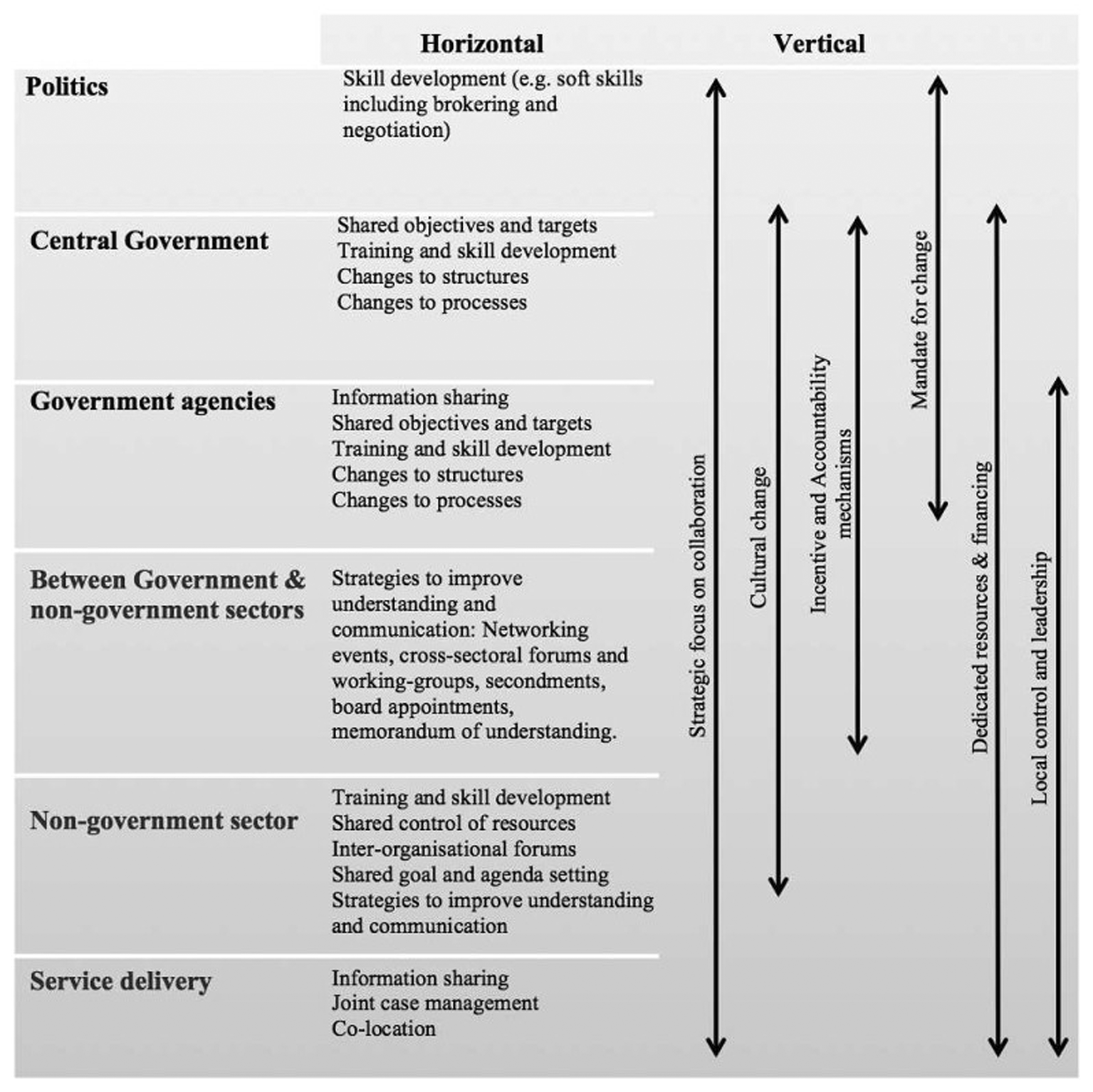
These elements – uncertainty, co-existence, trade-offs – inform pragmatic advice on how to join-up policymaking. Rather than a simple how-to guide, the emphasis is on balancing multiple concerns during continuous action. Carey and colleagues identify ‘top-down’ and ‘bottom-up’ dynamics to support a flexible:

  • 1. Vision. Establish an overall purpose tailored to local contexts.

  • 2. Source of direction. Highly centralised measures are inadequate. Governments rely on actors across and outside of government.

  • 3. Plan for action in multiple ‘operational’ levels. Secure high-level support for ‘strategic government’, and support ‘champions’ in ‘managerial’, ‘practitioner’, and ‘community’ contexts.

  • 4. Approach to organisational change. Maintain multiple functions, including to create units for ‘shared leadership’ while noting that new arrangements can undermine collaboration. Maintain relationships between managers of each organisation, adjust regulatory and budget processes to align with the vision, and work continuously on ‘cultural and institutional change’.

  • • Mix of ‘hard’ and ‘soft’ measures. Hard measures produce a ‘mandate for change’, ‘accountability and incentive mechanisms’ suitable to the task, and ‘dedicated resources’ to be used flexibly at local levels. Soft measures influence cultural practices such as to support collaboration, training, and information sharing (Carey et al., 2014: 7–9; Carey & Crammond, 2015: 1026–27; see also Eppel & Lips, 2016: 41; Vincent, 1999).

Carey (2016: 78) visualises these dynamics in Figure 2. For example, ‘soft’ skills are essential to cooperation across all contexts: central governments may focus more on structural and process changes, and others may be essential to networks, with all contributing to ‘cultural change’ and a ‘mandate’ for change.
eeeffcfd-96a4-4c98-ac71-17d74a10818f_figure2.gif

Figure 2. Carey’s ‘evidence-based heuristic for joined-up governance’.

Source: Carey (2016: 78).

Facilitators of policy integration

Table 6 identifies broadly similar facilitators as in Carey et al.’s work (and in our review of systems leadership - Cairney & Toomey, 2025). These facilitators relate to multiple contexts characterised by varying levels of centralisation, public body autonomy, trust and collaboration cultures.

Table 6. Facilitators of policy integration.

Vision Establish a clear rationale and strategy for change (short- and long-term)
Leadership in networks Boost the authorising environment for change
Invest in collaborative capacity
Foster and use relational skills
Boundary spanning Adapt to varying rules, norms, and expectations in each context
Help actors understand and reduce barriers to cooperation
Supportive architecture ‘Hard’ measures to reform and regulate
‘Soft’ measures to foster high-trust relationships and collaboration

An overall vision

‘Vision’ can relate to high-level aims shared across organisations, sectors, a country’s government or public sector, or multi-level jurisdictions. A long-term vision is important given PI timescales. Otherwise, actors may be dispirited by the lengthy gaps between an impetus for change, coherent strategy, and progress in implementation. Analyses of action during crisis also show that a clear vision can be produced quickly when the issue generates attention and the political rewards for action are high, prompting high expectations for joint-working and for the blocking power of vested interests to diminish (Carayannopoulos, 2017; Carayannopoulos & McConnell, 2018: 357). If so, one strategy is to present more enduring wicked problems as extraordinary, urgent, and escalating threats that are not served by the status quo, prompting the need for rapid change and new ways of thinking (2018: 365; Blackburn, 2014, 2016; Löschner & Nordbeck, 2020: 11). Another is to relate vision to (1) high ideals, such as a public service’s ‘spirit of service to the community’, and (2) the sense that delivery is feasible, such as by identifying a few key priorities, backed by targeted and high quality analysis (as in New Zealand approaches - Scott & Bardach, 2019: 200–2; Scott & Boyd, 2023; Scott & Macaulay, 2020: 579; Washington & Mintrom, 2018: 31–2).

Leadership in networks: fostering collaborative capacity and trust

Our review of systems leadership (Cairney & Toomey, 2025) emphasised the need for training to foster new attributes, mindsets, and skills essential to foster collaboration and trust between participants. The aim is to not only to secure support from the most senior people in government (e.g. Treffgarne, 2019) but also distribute leadership among many actors in a system, such as to harness the ‘energy, enthusiasm and commitment’ of many well-trained actors, including ‘champions and sponsors’ (Vincent, 1999: 51). This is not heroic top-down leadership, but rather the skill to facilitate collective action. There is a continuous need to nurture ‘soft’ relational approaches in leaders, to bring people together, harness collective skills, and maintain a contextual or institutional memory for joint work (Carey & Harris, 2016: 116; see also Murti et al., 2020: 7). Partnerships may need senior leaders to provide the authority and resources to invest in relational approaches (Boston & Pallot, 1997: 394; Carstensen & Bason, 2012; Scott & Thurston, 2004; Waterhouse & Lewis, 2004: 371). This investment would connect ‘system capacity’, including shared ownership of aims backed by legislation and data, with ‘human capacity’, including multiple leadership and ‘soft skill’ roles (political, administrative, mediation, boundary spanning, change agents) (Von Heimburg & Hakkebo, 2017: 75).

Indeed, some articles describe success in relation to systems leadership-style approaches. O’Flynn et al. (2011: 250–53) cite Bardach (1998) on a ‘craftsmanship approach’ including: listening, accommodating and including others, giving colleagues the power to innovate and take risks, and maintaining a clear link to local communities via staff recruitment and network management (see also Ross et al., 2011: 137; Schmied et al., 2010: 3522). Delany-Crowe et al. (2019a: 180–3) describe high trust in a ‘process’ to foster collaborative HiAP approaches in South Australia, such as to build on fruitful cooperation and reciprocity between individuals or organisations, ensure that the strategy reflects shared goals, and assure participants that they can communicate directly with senior policymakers. Further studies emphasise success in ‘capacity-building’ (Connolly & Pyper, 2020), evidence-informed collaboration (Samaratunge et al., 2017), and relational skills of policy ‘champions’ Wamsler et al. (2020: 3–8).

Others highlight the role of hierarchical or elected political authority to facilitate concerted action or overcome barriers. For example, a successful WG approach to immigration in Portugal required (1) clear leadership and collaboration based on an enduring cross-political-party consensus that extends to positive relations between ‘politicians, bureaucrats, and civil society groups’, then (2) the use of this consensus to give organisations the ‘autonomy and political support’ to collaborate and innovate without risking political fallout (Cook, 2018: 771; see also Askim et al., 2009: 1022; Christensen et al., 2014: 448; Lægreid & Rykkja, 2015: 974 on appointing a senior leader to mitigate contestation arising from WG reforms).

Boundary spanners

Boundaries ‘can be social, cultural, or professional, and relate to forms of knowledge production, geography, or levels or types of government’ (Cairney & Toomey, 2025: 15, citing O’Flynn, 2013: 13). The literature describes attempts to cross geographical borders (Janßen et al., 2018) or policy sectors (Kim & Bramwell, 2019) or brokerage to connect climate mitigation and adaptation actors (Locatelli et al., 2020: 367–8). Boundary problems can be:

Carey et al. (2017) describe ‘boundary spanners’, connecting different ‘cultural’ and ‘functional’ dynamics within or across government departments or units. These facilitative and translation roles are essential even following formal reforms, which do not remove the need for informal collaboration or the potential for turf wars (see also Crosbie et al., 2018: 10; Hoggett, 2003: 120; Larner & Craig, 2005; Lips et al., 2011). Jackson and Stainsby’s (2000: 13–15) account of network governance signals similar skills and mindsets, including: diplomacy and conflict resolution, brokerage, and facilitation. Smucker et al. (2020: 12) also describe bridging organisations, using methods for collaboration (‘participatory vulnerability and capacity assessment’) to boost local networks of public and private actors. Conversely, a tendency for public health advocates to use their own language of ‘evidence-based argument’ to justify action, rather than making a normative case to their wider audience, reduces traction across government (Crammond & Carey, 2017; Nutbeam & Boxall, 2008: 753; Nykiforuk et al., 2019).

A supportive architecture and environment for new strategies

A supportive ‘architecture’ changes ‘incentives, provides authority, builds long-term trusting-based relationships, and recognizes and rewards cooperative behaviors’ (O’Flynn et al., 2011: 248). It consists of ‘hard’ or ‘structural’ measures to provide ‘political backing’ for reform and ‘soft’ measures to foster collaboration (Candel, 2017: 531; Carey et al., 2014: 9). This architecture is apparent at different scales of activity, including:

Here, the metaphor ‘architecture’ can have subtly different meanings. In some cases, ‘architecture’ suggests that a supportive process can be designed anew. For example, a South Australia model often provides positive lessons when demonstrating the value of leadership and accountability, clarity, assigning resources, supportive networks, and good communication (Ballintyne & Mintrom, 2018; Baum et al., 2010; Cairney et al., 2021a; van Eyk et al., 2020: 968). In other cases, ‘architecture’ suggests something more established on which to build further. For example, Christensen et al. (2007: 391–2) relate WG reforms to a long-term Norwegian context characterised by supportive factors, including consensus seeking political parties, a ‘significant tradition of local self-government’, civil service leeway resulting from ‘high levels of mutual trust and shared attitudes and norms among political and administrative leaders’. New WG measures interact with established cultures in more-or-less autonomous levels or types of government (2007: 394–5). We can situate other cases within that range of old and new cultures. For example, Luan’s (2010) account of successful water policy in Singapore cites long-term plans facilitating shorter-term decisions. Plowden’s (2020: 160) explanation of the success of London’s Healthy Streets programme also signals a legacy on which to draw.

What are the barriers to policy integration?

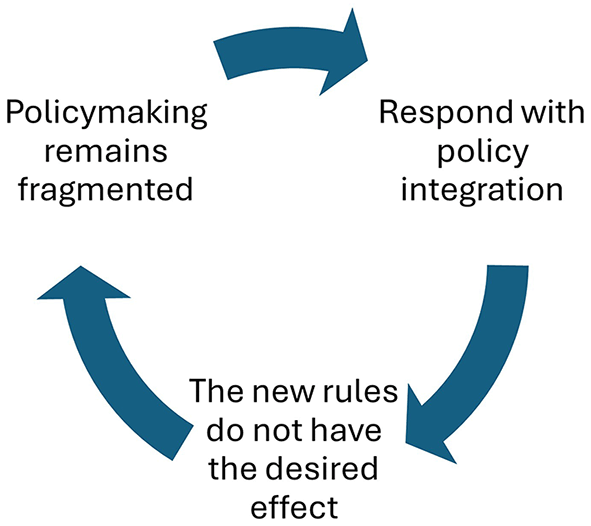
I introduce Figure 3 to describe a cycle in which the problems prompting reform also undermine it: complex policymaking systems seem to drive fragmentation, a new PI initiative does not have the desired effect, and the rediscovery of fragmentation produces a new impetus for integration (compare with Serrao-Neumann et al., 2014: 491). Further, the production of multiple new and unconnected PI strategies may exacerbate this fragmentation in central government departments (6 & Peck, 2004) or public service delivery (Davies, 2009: 86).
eeeffcfd-96a4-4c98-ac71-17d74a10818f_figure3.gif

Figure 3. The policy integration cycle.

Table 7 summarises many variations on this theme, such as to describe low ‘political will’ to overcome this dispiriting cycle; a sense that integration seems more possible during formulation than implementation; and, a focus on policy subsystems which exhibit varying commitments to each other’s integration agenda (Cejudo & Trein, 2023: 12).

Table 7. Barriers to policy integration.

Evergreen drivers against integration High-level efforts are designed to not threaten the status quo
More substantive efforts provoke successful opposition
Entrepreneurs and champions can make a modest difference
Integration efforts expose competing goals, rules, incentives
New barriers following NPM Hierarchies, silos, internal competition, service delivery fragmentation
Merging new policy with the old New rules are layered onto existing institutions
New instruments are added to an existing mix
PI measures lack clarity, congruity, and capacity Reform agendas are vague (by accident or design)
New aims do not fit with routine government business
There are competing ‘logics’ to policymaking
There are limited resources to collaborate or coordinate (an amplified implementation gap)
Strategic aims are clear in theory but unclear or contested in practice
Unclear accountability and measures of success PI fudges policymaking responsibilities and accountability
The overall effect of multiple forms of accountability is unclear
Political measures of success may trump programmatic aims
Top-down approaches are inadequate Many governments persist with a top-down view of PI
Ill-resourced top-down initiatives have a limited local impact
Centralised approaches do not boost local capacity and collaboration
Sectoral dominance: some aims are more important than others Win-win strategies have limited success
Economic growth remains the main priority
Environmental and public health aims need to support that priority
International peace and development has symbolic support
National security and stability has substantive support

There are evergreen drivers against integration

Policy sectors have their own agendas, subsystems produce their own policy instruments, and public or non-governmental organisations implement and evaluate policies with reference to ‘their own priorities and targets’ (Cejudo & Trein, 2023: 12). This dynamic suggests that: ‘any policy integration initiative may fall victim to the dominance of subsystem logic of policymaking, as actors are likely to dismantle, dilute, or neutralize efforts toward integrated policies during agenda-setting, decision-making, and implementation’ (2023: 12). Cejudo and Trein (2023: 15–21) relate this context to a pattern of activity characterised by:

1. High-level strategic action

Heightened concerns about ‘wicked’ problems are often addressed at high levels of political systems, or grand-scale international agendas.

2. A vague response, producing limited opposition (and capacity)

Such processes produce vague strategies that provoke limited opposition or conflict among actors with competing interests, but also provide limited new capacity. Coordination strategies avoid conflict and emphasise information sharing and learning (Rietig & Perkins, 2018: 502; Russel et al., 2020: 15; Wong & van der Heijden, 2019: 841–3). Policy instrument strategies rely more on ‘soft’ than ‘hard’ measures (Pollack & Hafner-Burton, 2010: 292). Softening strategies include ‘watering down, issue redefinition, and the setting of targets without actions’ (Deters, 2018: 359; Sotirov et al., 2020: 19). The result is a window of opportunity for a general strategy with limited follow-through and the postponement of debate on competing objectives.

3. Occasional attempts to change the status quo provoke opposition

Some may seek to reallocate capacity and challenge the usual ways of working, provoking more opposition in established subsystems. If so, actors in subsystems can constrain progress, such as if the number of ‘veto players’ increases whenever joint action is necessary (and policymakers in each subsystem prioritise their ‘clients’ over integration - Howlett and Rayner, 2021).

4. There is some scope for key actors to make a difference

Some actors may facilitate progress, such as the entrepreneurs or brokers, in formal or informal roles, seeking opportunities for policy change, collaboration, or to offer integration with their sector as a solution to another sector’s problem (Bocquillon, 2018; Garcia Hernandez & Bolwig, 2021: 74; Kim, 2014: 334; Maltby, 2013; Namugumya et al., 2020: 5; Rietig & Perkins, 2018; Storch & Winkel, 2013; Svensson, 2019; Vantaggiato, 2020). Local ‘public managers’ and ‘street-level bureaucrats’ may also be influential if given the flexibility and autonomy to collaborate with stakeholders (Cejudo & Trein, 2023: 21; Lambelet, 2023: 163; Sevä & Sandström, 2017).

5. Competing goals and incentives remain

In this fragmented and competitive context, policy actors respond to contradictory incentives. Many welcome WG in principle but in practice assign most ‘policy capacity’ to more pressing departmental or sectoral incentives, rewards, and accountability mechanisms (Flinders, 2002: 56–7; Kavanagh & Richards, 2001: 9; Hughes et al., 2015: 233). The will to ‘share services’ may be strong but comes with risks associated with separate budgets and core objectives, different rules or cultures that are difficult to align, and limited knowledge of how to manage when there is little training or experience on which to draw (Valkama et al., 2016: 32–4). This dynamic is apparent in each level of government, including:

  • • International level: delivering the SDGs. Strategies have long lists of aims, without a proper sense of priorities or trade-offs (Azizi et al., 2019: 446–7). Lead units formulate strategy without sufficient collaboration with others, which limits clarity on jurisdictional responsibilities (Happaerts, 2012; Pilato et al., 2018) and delays inevitable ‘turf wars’ between actors representing environmental, economic, and social concerns. Such problems emerge during implementation (Abazaj et al., 2016; Babu et al., 2018).

  • • Supranational level: examples from the EU. Some countries treat EU Directives as top-down measures requiring expert-informed compliance; others as opportunities to foster meaningful stakeholder involvement (Atkinson & Klausen, 2011: 239; Elbakidze et al., 2015). New hard instruments are layered onto old systems (Indset & Stokke, 2015: 980; 995). The idea of integrating economic and environmental aims has strong symbolic or rhetorical value, but shows minimal progress when economic drivers dominate (Winkel & Sotirov, 2016). The rhetoric for integration aids ‘disintegration’ by providing a useful veneer to cover inactivity (2016: 510). Long-term progress relies on partnerships between specialist EU and member state agencies that are vulnerable to national horizontal integration (Egeberg & Trondal, 2016).

  • • National and subnational dynamics. Cairney et al. (2021b) describe multi-level GM in which responsibility is distributed across a system and shared by different levels of government (2021: 419–21; see also Shill et al., 2012: 168). Policy incoherence is baked into policymaking design, since shifting responsibilities up to the EU and down to Scotland allowed each level to go its own way with only some obligations to cooperate and cohere. Partisan competition in national and subnational contexts creates tensions, such as when the Scottish Government describes being stymied by relative UK inaction.

Overall, such insights signal an uncertain connection between the short-term impetus for integration and the longer-term dynamics when normal service resumes.

There are new barriers following NPM

WG often represents a top-down response to the unintended consequences of NPM reforms, but the NPM legacy remains. Managerial hierarchies, silos, internal competition, the delegation of administration to agencies, and the shift of responsibility for policy delivery to a mix of public, private, and third sector organisations, still undermine collaboration and coordination across government and the public sector. Governments face the choice between soft measures of coordination which will gain little traction in competition with the core business of government departments, or another round of painful structural reforms with uncertain effects (Christensen & Lægreid, 2007: 1063). The consequence is that many governments have used the same vague WG language but overseen different approaches with unclear short-term results (2007: 1063–4; e.g. Askim et al., 2009: 1022; Aulich & Hein, 2005: 43; Christensen et al., 2014: 447).

Laffin et al. (2014: 763–5) also identify low expectations for relatively decentralised or pluralist network governance forms of WG. This hope ignores ‘the realities of contemporary public service delivery’ when policy remains driven by hierarchical government and economic or business interests are more powerful than others (e.g. Lance et al., 2009: 253, citing Ling, 2002: 626; Whitehead, 2003: 12; 6, 2004: 126).

Merging new policy with the old: there is no blank page

Rayner and Howlett (2009: 99–100) relate policy design to ‘the legacies of past policies’ that ‘constrain present opportunities’. Designing a policy mix is ‘about re-aligning or de-aligning and replacing certain elements of established regimes and overcoming the “stickiness” of these elements is critical to the success of policy integration’. Studies of new institutionalism show how policymaking rules change through modification rather than simple replacement, when:

  • • new rules are added to the old (‘layering’)

  • • old rules no longer address a changing problem or new goals (‘drift’)

  • • different rules or instruments are repurposed to address established goals (‘conversion’)

  • • a different (established) institution is used to solve the problem (‘displacement’)

  • • or, a policy regime collapses when it proves to be un- or counter-productive (‘exhaustion’) (e.g. Thelen, 2004 in Rayner & Howlett, 2009: 103).

The result could be incoherent policy design if layered slowly onto existing policies rather than redesigned with urgency and new capacity (Vince, 2015: 162; 174–5). Or, there could be transformative change, but with no guarantee that it relates to coherent intent. Rayner and Howlett (2009: 99–100) show that budding integrators face an ‘insidious’ problem when a policy mix has survived through ad hoc modifications, produced by different actors for different political purposes, and contributing to their complexity, costs, and resistance to change ‘since even dysfunctional elements of existing regimes can confer benefits on well-entrenched interests who may resist their alteration or elimination’ (2009: 100; 103). Or, reformers can exploit a clearer but rarer opportunity for ‘replacement’ following ‘exhaustion’ and a widespread perception of regime failure (2009: 103). In other words, modify a modestly successful approach or wait for a window for redesign following major failure. Of course, determining the success of current policy, and how to respond, is an exercise of power, not a technical act of evaluation (e.g. Sotirov & Storch, 2018: 986–7).

These issues are magnified when a policymaking system contains many cross-cutting plans that are not well integrated, contributing to coordination fatigue (Isaksson et al., 2017; Pengilley & Kelly, 2018: 3). Or, a push for coherent spatial planning, such as to promote the equitable allocation of public services, may be low priority or a vote loser (Santinha, 2016: 173; Schmitt & Smas, 2023 and Storbjörk & Hjerpe, 2014).

PI agendas and strategies lack clarity, congruity with routine government business, and the capacity to deliver ambitious aims

Our reviews draw on Cairney et al. (2022b) to describe three limitations to progress: low clarity, congruity, and capacity. A policy means too many things to too many people, is difficult to reconcile with routine government business, and lacks the political and systemic capacity to ensure proper delivery or implementation. Competing interpretations argue that:

1. Low clarity, congruity, and capacity can be avoided or overcome.

Studies focus on the weak leaders who make vague promises without understanding the evidence, changing the rules to accommodate policy change, or assigning resources. Such studies bemoan:

2. Low clarity, congruity, and capacity are evergreen features to which to adapt.

Studies describe these limits as features of policymaking systems: uncertainty is inevitable and assigning meaning is an exercise of power; there are too many rules to accommodate; and, capacity is largely about reassigning tasks and collaborating across organisations (see also Biesbroek et al., 2020; Collste et al., 2017; Guerrero & Castañeda, 2021 on technologies to reduce uncertainty). Then, they emphasise the politics of coordination to avoid a technocratic language of collaboration and ‘evidence based’ policy designed to somehow overcome politics and ideology (Davies, 2009: 83). Problems may include:

  • • Superficial agreement. Organisations use a vague vision, but ‘shallow consensus’ is not enough to contain or overcome ‘political value conflicts’ (Davies, 2009: 80). Conflicts may be party political, or subtler differences between rules used by public bodies to act and evaluate progress (2009: 87).

  • • Mainstreaming overload, when multiple strategies or elements of each strategy compete for attention (Nunan et al., 2012: 265, citing Agrawala & Van Aalst, 2008).

  • • Cultural differences. Less visible tensions arise between actors committed to change, but facing routine barriers to cooperation associated with sectoral organisation and budgets, perspectives and conceptual models, and measures of progress (Waylen et al., 2019: 11; White et al., 2020: 500).

A lack of clarity: the double-ambiguity of PI

PI may exhibit double-ambiguity when policy aims are unclear and a WG approach is vague (Ross et al., 2011: 135). This lack of clarity kicks the can down the road, and may exacerbate ‘constant power struggles between different authorities’ during implementation (Söderberg, 2016: 90). Or, ambiguity may be used strategically to limit follow-through (Candel, 2017: 530; Casado-Asensio & Steurer, 2016a), allow different elements of policy to appeal to competing actors (e.g. Borrass et al., 2017: 22), and avoid full scrutiny (Walker, 2001, 2009; Warren, 2012; Wines & Scarborough, 2015: 136; Wise, 2006: 70). Either way, the inability to foster clear WG approaches, and assign ‘principled priority’ to the aim, contributes to a lack of coordination and commitment (Aall et al., 2015: 979; Kissinger et al., 2021: 91; citing Lafferty & Hovden, 2003).

In some cases, research focuses on the need to reduce ambiguity by addressing a knowledge-deficit among some actors. The solution is to explain their preferred frames better and improve the use of scientific models when they are too technical for most policymakers to understand (e.g de Smedt, 2010). HiAP research characterises this approach, to describe low ‘public health literacy’ and a lack of knowledge of social determinants of health (Carmichael et al., 2012: 189; Pengilley & Kelly, 2018: 4). This knowledge-deficit contributes to a lack of integration in health and equity strategies when a social determinants frame is not consistent with an individual lifestyles frame (Delany-Crowe et al., 2019b: 10; Pescud et al., 2019: 8; Peters et al., 2016: 294). The problem is further exacerbated by the ambiguity of ‘integrated public health policy’ (Tubbing et al., 2015), and absence of ‘clear operational criteria and defining characteristics’ (Hendriks et al., 2014: 174).

In other cases, the dynamic reflects underexplored ambiguity. Hezri and Dovers (2009: 303) find a lack of progress on ‘ecological sustainable development’ because it ‘is ambiguous and fraught with contradictions’. Similarly, the food-water-energy ‘nexus’ has broad rhetorical support but is difficult to translate into practice, especially if it does not address tensions between separate sectoral ‘mandates’, ‘expectations and objectives’ or assign clear roles for integration (Venghaus & Hake, 2018: 190). See also interpretations of ‘landscape’ in policy and planning (Keller & Backhaus, 2020: 113; Kristensen & Primdahl, 2020; Sandström & Hedfors, 2018; Svensson et al., 2020; van Oosten et al., 2018).

Or, ambiguity reflects visible contestation when actors define aims for their purposes (e.g. Tosun & Leininger, 2017 on the SDGs). Jordan and Lenschow’s (2010: 148–53) analysis of EPI progress finds major disagreements on what it represents, such as a broad ambition or detailed strategy, and a means to coerce or encourage change. Contested meaning contributes to varying commitment and approaches across time or countries, and a lack of embeddedness ‘into everyday political practices’ (see also Biesbroek et al., 2010; Kettner et al., 2015; Kettner & Kletzan-Slamanig, 2020). Aubrechtová et al. (2020: 13) describes different sectors pursuing different conceptions of a problem (e.g. ‘biocentric’ or ‘anthropocentric’). A lack of clarity can also reflect disagreement and compromises that suit no actor fully (e.g. Lajeunesse, 2021). Or, vague terms like complexity and WG hide political choices, such as to exclude some experts and take some issues off the agenda (Ulijaszek, 2015: 224).

These perceptions of the causes of ambiguity inform competing views on how to resolve it. One response is to seek agreement on a more attractive term that actors can get behind. However, the unintended consequence is a hodgepodge of faddish and unconnected terms (Cairney et al., 2021a on HiAP; Bahn-Walkowiak & Wilts, 2017). Entrepreneurs can also use ambiguity to rally initial change but struggle to institutionalise substantive responses (e.g. Bocquillon, 2018). In that context, studies seek centralised or decentralised means to boost clarity, including:

Some accounts suggest that this ambiguity can be reduced over time, such as by exploiting crisis and windows of opportunity for change. MacCarthaigh and Boyle (2011: 219–20) describe the Irish government’s initially loose and un-strategic use of the WG language, which reflected a tendency to ‘oscillate between preferences for specialization and integration’. By 2015, it had overseen ‘unprecedented and systemic public sector reforms’, partly on the back of economic crisis (MacCarthaigh & Hardiman, 2020: 179).

A lack of congruity: new expectations interact with how things work around here

Reformers have a notional choice between maintaining vague aims to bolster a superficial consensus or clear and substantive change that will provoke opposition. Many examples find visible ‘turf wars’ (Baum et al., 2010: 479; Bizikova et al., 2015; Karré et al., 2013: 71; Rosenberg, 2020). Some find less visible cultural differences or routine processes of maintaining business-as-usual (Boothby, 2017: 35; Cashmore & Axelsson, 2013: 10; Essex & Carmichael, 2017: 274).

In some areas, we find a wider tension between competing policymaking ‘logics’. For example, centralised and top-down may compete with decentralised and polycentric strategies on the same issue (Sandström et al.’s, 2020). Or, in environmental policy there may be a disconnect between the choice to favour boundaries based on territorial autonomy and ‘administrative logic’ versus an ‘ecological logic’ when nature does not fit into human-designed boundaries (2020: 7–8; Satumanatpan & Chuenpagdee, 2015: 13; Stjernström et al., 2018). Further, Russel et al. (2018b: 1360–61) identify multiple competing ‘logics’ of appraisal associated with different levels (e.g. local, national, supranational) or types of governing organisation, across policy sectors and professions, and in theory versus practice. One dominant political logic may encourage the performance of appraisal, often by consultants depending on this work, for symbolic purposes rather than to reflect on programmatic success (2018: 1364–65).

A lack of capacity: integration gaps akin to implementation gaps

This limitation may relate generally to a gap between aspirations versus resources for collaborative policymaking (Bishop & Flynn, 1999: 74; Caudle & de Spiegeleire, 2010: 9; 17; Young & Grant, 2015), a failure to reallocate resources when reorganising responsibilities (Sheperdson et al., 2014), or unanticipated problems such as the poor use of ICT to facilitate WG (see Cairney, 2025b). This limitation may also follow legislation, such as when multiple countries passed Climate Change Acts to strengthen international commitments, but lacked sectoral targets or meaningful sanctions for slow progress (Nash & Steurer, 2019: 1061–62; see also De Roeck et al., 2018: 40; Zingraff-Hamed et al., 2020: 466–70). The effect of limited capacity and coordination may be cumulative and demoralising (6 & Peck, 2004: 9; see also Blockley, 2010: 198; Signoretta & Craglia, 2002: 71–2).

This focus on capacity resembles a traditional focus on implementation. The rather limited study of decentralised or bottom-up capacity does not hold out much hope for progress (e.g. Casado-Asensio & Steurer, 2016b: 275; Hoff et al., 2019; Persson, 2013; Steurer & Clar, 2015; Walker et al., 2015). However, most research adopts a relatively top-down perspective in which PI requires the initial integration of goals, and coherence of instruments, then consistency of application (Lambelet, 2023). If so, there is always a gap between PI strategy and delivery (e.g. Chaya et al., 2019; Wretling et al., 2018), such as in the absence of a senior leadership with a clear ‘mandate’ to overcome ‘turf wars’ and other problems (Glasson et al., 1997; Kavanagh & Richards, 2001: 10–12; Karré et al., 2013: 71; Kendig et al., 2014; Wilson & Wileman, 2005).

Political dynamics change when shifting from PI design at a supranational or national level to delivery at a local level or within each policy sector, enabling different ways to frame the policy problem, set goal priorities, and manage interests in networks, or prompting blame game strategies to avoid responsibility for the failure of a strategy designed elsewhere (Candel, 2017: 530; Jordan & Lenschow, 2010: 153; Neto et al., 2018; Nilsson et al., 2012; Sarti, 2023; Widmer, 2018: 77). This capacity gap may also reflect insufficient engagement with key actors across government (Kayiwa et al., 2019: 176–9), and a ‘lack of inter-agency and inter-ministerial approaches for building partnerships with other stakeholders’ (Antwi-Agyei et al., 2017: 1; Antwi-Agyei et al., 2018). Such obstacles should be seen as continuous features of policymaking rather than closable gaps (e.g. Biesbroek & Candel, 2020: 79; Carbone & Keijzer, 2016: 39–40; Feiock et al., 2017; Namugumya et al., 2020).

Unclear accountability and competing measures of success

Successful PI requires shared responsibility and effective measures of success. However, WG approaches complicate who is responsible for what. Christensen et al. (2014: 444; see also Bovens, 1998; Christensen & Lægreid, 2011; Sullivan, 2003: 355) describe competing accountability, including:

  • • Political, such as when parliaments scrutinise ministers (and connect this activity to electoral accountability).

  • • Administrative, such as when ministers use measures to direct civil servants.

  • • Legal, to regulate behaviour and ensure ‘equal treatment’.

  • • Professional, when professional bodies regulate their own members.

  • • Social, in partnerships with stakeholders or when reporting to citizens on services. In many such cases, policy actors may be key to collaboration but have no formal powers or means to be held to account (Wilkins, 2002: 118). Or, ‘community governance’ and accountability may be a hard sell to citizens and stakeholders (Matthews, 2014: 454).

In that context, WG measures to create new forms of accountability contribute to a fudge of measures (Christensen et al. 2014: 453). ‘Horizontal’ coordination, involving many organisations collaborating, clash with ‘vertical’ measures for accountability, involving a national government setting targets or regulating delivery organisations. Shared public service performance measures co-exist with separate forms of professional accountability (2014: 445–6; 453). One-stop-shops fudge political accountability while emphasising service accountability (2014: 445–6; 450–1). New informal ways of collaborating operated alongside old ways of monitoring sectoral organisations (Lægreid & Rykkja, 2022: 699).

Such experiences suggest that reforms are inadequate unless they address immediate administrative obstacles and longer term cultural changes (Ryan & Walsh, 2004: 629). Formal reorganisations change mechanisms of accountability, and meaningful change also requires policy actor buy-in, collaboration, and external acknowledgement of the value of new forms of accountability (Lægreid & Rykkja, 2022: 687). However, the incentives to produce such reforms are unclear whenever there are competing measures of success. Declared success can relate to a strategy’s impact on government popularity, its stakeholder legitimacy, or socioeconomic impact (McConnell, 2010). This dynamic combines with fudged accountability to amplify the potential for failure, when actors use a WG approach ‘for political gain or blame avoidance’ rather than invest their reputations on longer-term success (Stack et al., 2018: 126–7; Vince, 2015: 162).

Top-down or centralised approaches are inappropriate or inadequate

Central governments do not respond well to these evergreen and inevitable constraints to PI. Their NPM reforms have created or exacerbated the problem, they have responded with unclear and ill-resourced strategies, and they tend to see the policymaking problem from the top-down, prioritising central control over local autonomy and wider collaboration.

Carey et al. (2015a, 2015b: 167) describe such top-down WG approaches as inadequate, since producing an integrated central government strategy is no guarantee of concerted action and coherent outcomes in local government and ‘street-level’ contexts. Local ‘implementing organisations’ become dispirited with waves of top-down reforms, and their commitment to the next initiative wanes (Molenveld et al., 2020: 9). This sense of commitment matters whenever organisations have some autonomy and discretion to use limited resources to fulfil obligations, albeit within a framework of regulation and performance management (Molenveld et al., 2021: 127–9). Their commitment to collaboration rises if included by central government in policy design and they can tailor national policy to local contexts, if they have enough autonomy and resources to innovate (2020: 9; 2021: 145) or if street level organisations exercise discretion to join-up fragmented aims (Fisher, 2013; Oldeide et al., 2021: 382). Yet, many governments persist with simplistic centralised policymaking, producing unintended consequences (e.g. Maghsoodi Tilaki & Hedayati, 2015).

Country studies of barriers to top-down or centralised PI: UK, Australian, and Nordic experiences

The PI and WG literatures provide a wealth of country case studies on the limitations of top-down approaches. Here, I use the UK as an exemplar of a top-down approach with multiple unintended consequences, followed by Australia, then Nordic examples in which there may be greater bottom-up expectations.

Barriers to top-down PI in the UK

The UK exemplifies top-down approaches to PI, often studied through the lens of former Prime Minister Blair’s pursuit of joined-up government (JUG). Some accounts note that the UK was world-leading in key respects, such as to invest in research and foresight activities to anticipate complex problems (Ulijaszek, 2015). However, most describe ill-considered and poorly resourced centralisation efforts that were doomed to fail. There are five general reasons to expect a lack of JUG progress under the Blair-led government from 1997 then Brown-led from 2007–10 (Campbell, 2007; see also 6, 1997; 6 et al., 2002; Matthews, 2013: 55–79).

First, JUG relates to the ‘Holy Grail’ of addressing ‘wicked issues’ without enough research knowledge or political agreement on their causes or solutions (Lewis, 2011b).

Second, the UK approach was to devote limited resources to coordination. It sought to address tensions between government departments, but to ‘renovate’ existing central government structures rather than reform functions or provide new, clear and systematic incentives for departments to collaborate (Campbell, 2007: 391–4). Rather than encouraging collaboration between well-resourced organisations in central government and the public sector, a small core executive took on key tasks and overloaded its capacity to oversee progress (before the Treasury took over – James, 2004).

Third, UK governments had concerns about blurred lines of accountability compared to the established Westminster focus on individual ministers, coupled with a lack of sophisticated performance measures for collaborative work (Flinders, 2002: 62; Kavanagh & Richards, 2001: 14).

Fourth, the UK central government maintained contradictory objectives, to empower local public bodies and foster network governance but maintain central control (Sullivan, 2005: 10). It was asking local public bodies in England to collaborate, but obliging health, local, and other authorities to meet sectoral targets (Hoggett, 2003: 118; Ison et al., 2018: 1215; although see Moore & Keen, 2007 and Moore et al., 2007).

Fifth, the UK government’s remit is often England-only, with the expectation (from 1999) that devolved governments in Scotland, Wales, and Northern Ireland would go their own way. Further, similar PI issues arose even in contexts where a more joined-up approach was expected. In particular, there were some hopes in Scotland and Wales that devolution would bolster JUG, partly to reflect a pre-devolution legacy: ‘territorial departments had always been pioneers of non-departmentalism because of their small scale and territorial, rather than functional, focus’ (Parry, 2012: 254). Devolution in Wales in 1999, coupled with a legal duty to ‘promote sustainable development’, and a scale and approach conducive to policy community development, prompted some hopes for a new ‘powerful force for collaborative government’ (Bishop & Flynn, 1999: 62). However, stakeholders identified a tendency to perform participatory policymaking in a system where Welsh and UK responsibilities were unclear (Chaney, 2016). Further, the Welsh government pursued multiple competing objectives, to foster collaboration and learning via local government autonomy and network governance but also exert central control and planning (Sullivan & Williams, 2009: 166–77). Similarly, fuelled by its own story of better and longer-term partnership working and community engagement, the Scottish Government appeared to take a less centralist or hierarchical approach than the UK government to ‘community planning partnerships’ and local service delivery (Matthews, 2014). This story widened a gap between aspirational rhetoric and reality (2014: 455–9; 468; Cairney & St. Denny, 2020). In contrast, Knox (2003) describes the initial absence of interest in JUG in Northern Ireland. The same optimism that devolved governance could improve on UK government approaches did not arise until a decade later (Knox, 2015: 29).

Overall, the UK’s energetic approach to top-down JUG has produced a range of experiences with wider lessons. First, a WG approach is no substitute for clear priorities or choices between competing aims. Multiple examples highlight a superficial commitment to many aims, but with most losing out to a higher – economic or healthcare – priority (Baggott, 2010: 147; Exworthy & Powell, 2004: 272–4; Gagnon & Labonté, 2013: 4–8; 12; Hayden & Benington, 2000: 30).

Second, assign clear priority to your preferred modes of WG. JUG across central and local government has a ‘superficially attractive logic’ but ‘disguises the degree to which different forms of joining up may conflict’ (Cowell & Martin, 2003: 159). Potential actions can include customer-focused service delivery, collaboration across different scales of English local authority, the search for local coherence when combining EU, UK, and local government instruments, and local government contracts with the UK Treasury to connect local delivery to financial rewards for meeting national targets (2003: 162). Further, broad objectives can include ‘service improvement’, ‘community leadership’ keeping ‘in touch’ with citizens, ‘local accountability’, and ‘public confidence’ measures which lead to incoherent local packages of reform (2003: 165).

Third, anticipate obstacles when existing commitments undermine new policy priorities. For example, the WG pursuit of data sharing across the public sector conflicted with EU-wide data protection rules (6 et al., 2005; Bellamy et al., 2005; Combe, 2009; Higgs et al., 2003; Higgs et al., 2005; Signoretta & Craglia, 2002: 71–2; contrast with McGuirk et al.’s 2015).

Fourth, the absence of clear new directions will prompt organisations to rely on old rules. Dunlop and Russel (2012) find that vague government ambitions and messy signals to public bodies prompted regulators to fall back on their own rules. The unintended consequence was the lack of integration of the goals or performance measures among multiple regulatory agencies, contributing to “frequent ‘turf wars’” (Cope & Goodship, 1999: 3; Goodship & Cope, 2001: 44).

Fifth, expect ill-resourced top-down initiatives to have limited local impacts. Numerous examples of modest impacts include on local community development, economic regeneration, strategic partnerships, health and social care integration, and performance management (Catney, 2009: 62–3; Darlow et al., 2007: 127; Exworthy & Powell, 2004: 276; Holman, 2013: 82; Lindsey, 2014: 327; Martin & Downe, 2014: 43–4; Maddock, 2000: 67; McGhee, 2003: 364; Pemberton & Winstanley, 2010: 35).

Sixth, these negative experiences contribute to lower expectations for – or more resistance to - reform. The outcomes contribute to a general cycle of ‘fits of enthusiasm yielding to bursts of disillusion’ (Challis et al., 1988 in Easen et al., 2000: 355). Joined-up-service agendas can also prompt professions to protect their values and roles rather than shared aims (Burnett & Appleton, 2004: 34). A hierarchical conception of local partnership fuelled by short-term targetry undermines partnership development (Maddock, 2000: 65). The adversarial and imbalanced relationship between central and local government exacerbates blame games even when the centre claims to be seeking respectful reforms (Masson, 2006: 241–2).

Australian and Nordic experiences of top-down approaches to PI

Wider international examples reinforce this criticism of inflexible and ill-resourced top-down approaches (e.g. Andoh & Lee, 2018: 18; Kelly et al., 2020; Schiappacasse et al., 2020: 4–5). For example, the Australian federal government’s ‘vision for social inclusion’ was not well resourced (Carey et al., 2015a: 180–3; Carey et al., 2015b: 167). It struggled to influence delivery and exacerbated third sector distrust of government (2015b: 176). Similarly, Hendrix et al. (2020: 36–7) identify the consequences of top-down Australian policies for ‘indigenous governance’: patchy short-term contracting for services undermined collaboration and coherence (see also Sidhu & Taylor, 2009: 668–9). O'Flynn et al. (2011: 248) relate poor progress to the ‘lack of a JUG-Supportive Architecture’, in which the government:

  • • Did not ‘reset authority relationships’ to allow one agency to direct another (or oblige them to contribute to common efforts) (2011: 248).

  • • Maintained old ways of funding, managing performance, and holding organisations to account, which reinforced silos and minimised incentives to take resources from core agency business (2011: 249).

  • • Centralised policy authority, undermining the ability of local actors to collaborate meaningfully with communities (2011: 249–50; see also Humpage, 2005: 47).

Nordic examples contrast national top-down initiatives with expectations for local government autonomy. Synnevåg et al. (2018, 2019) describe a HiAP dilemma in Norway, where the aim to institutionalise public health aims into national strategy, and see it carried out: (1) competes with the aim to foster meaningful local collaboration, and (2) threatens local professional identities if they perceive national moves as ‘health imperialism’ (see also Kågström & Dovlén, 2019: 509; Tennøy & Øksenholt, 2018: 93; 106). Holt et al.’s (2018: 49) study of internal Danish municipality reforms finds that top-down reorganisations to boost intersectoral action had unintended consequences, to shift people from the roles they had performed well, reduce a sense that joint meetings were fruitful, and ‘reproduce the organizational problems they are intended to overcome’.

Sectoral dominance: some aims are more important than others

PI may be portrayed as a win-win strategy to serve multiple policy aims, but multiple accounts highlight contestation across organisations and sectors to assign priorities. The rhetorical aim may be to find synergies across policy sectors, but some aims, such as economic growth and national security, tend to overshadow others, such as public health and climate policies.

Economic dominance in sustainable development and public health

Governments signal ‘sustainable economic growth’ in theory but favour economic growth in practice (Smith et al., 2014: 2627). The mainstreaming of this idea fosters an economic imperative across sectors, including environmental, and land and water use policies which are treated as potential impediments to growth rather than independently laudable aims (2014: 2628). Or, ‘sustainable development’ is led by low power units (Coffey, 2013: 66–70). Efforts to mainstream climate action or biodiversity may be driven by the rules of a more dominant sector, such as to require a political case - for combining economic development and climate change aims - to policymakers worried about the political costs (Kalafatis, 2018), or ‘business case’ for conservation (Karlsson-Vinkhuyzen et al., 2018: 134). This economic lens informs trade-offs in energy and climate policies. There is support for CPI in ‘oil-producing countries’ if it does not threaten the economic benefits of fossil fuel production (Al-Sarihi & Mason, 2020: 1226; Warren et al., 2016: 8–9) or in the EU if renewable energy policy does not undermine ‘energy security’ or ‘rural economic development’ (Rietig, 2019: 228). Similarly, water advocates are subordinate to more powerful energy actors in Jordan (Al-Masri et al., 2019: 200) and the EU (Abazaj et al., 2016) or economic aims in China (Sun et al., 2019).

In HiAP studies, the priority of economic growth, combined with a preference for markets and personal responsibility, overshadows the case for state responsibility for population health (Cairney et al., 2021a). Accounts describe the disproportionate power of industries to block WG strategies based on public health evidence (Baggott, 2010; Battams & Townsend, 2019; Butler, 2009; Carey & Harris, 2016; Labonté et al., 2018; Lencucha et al., 2015; Lencucha & Thow, 2020; Moschitz, 2018; van Eyk et al., 2019). The strongest contrast between vague support for HiAP as a collaborative process versus a vehicle for major policy change is in health equity (Cairney et al., 2021a; van Eyk et al., 2017). Some research highlights WG obstacles whenever some actors are involved (e.g. tobacco interests), policy change is incremental (2015: 847), or public health actors are key to health departments but peripheral to economic and industry departments (Butler, 2009: 344; Clarke et al., 2021; Lencucha & Thow, 2020).

These experiences lead many public health actors to object to governments collaborating with industry, which can prompt further conflict across actors and departments (e.g. food regulation – Shill et al., 2012: 168; Trevena et al., 2015). Or, public health research identifies too few influential actors promoting health aims, such as when ‘nutrition’ is marginalised in foreign food trade (Baker et al., 2019: 2329; Friel et al., 2019; Reeve et al., 2018; Ruckert et al., 2017). In exceptional cases of success, health actors build up networking and advocacy capacity, and understand trade policymaking to maximise their impact (Thaiprayoon & Smith, 2015; see also Thow & Priyadarshi, 2013; Thow et al., 2018). However, success relates more to strategy than resource allocation (Haber & Day, 2014: 305–6).

Economic and agricultural dominance in the EU: sustainable agriculture and neoliberal approaches to policy coherence for development

Multiple examples demonstrate economic and agricultural interests overshadowing EPI or CPI (or sustainable transport - Dyrhauge, 2014: 985). Alons (2017: 1604–08) describes a rise in ‘environmental discourse or rhetoric’ and ‘significant changes’ to the EU Common Agricultural Policy (CAP), but a weak model of integration ‘due to low priority of environmental issues and a closed agricultural policy network’ (see also Feindt, 2010). Most substantive reforms were a by-product of economic considerations (Alons, 2017: 1612) or small-scale local initiatives (Buizer et al., 2016; see also Huttunen, 2015). Few actions had strong positive effects on biodiversity (Šumrada et al., 2020). Further, the impact of EU water directives on agriculture is mediated through member states: the EU favours hard measures, but states use voluntary measures and guidance to influence agricultural actors (Wiering et al., 2020: 15). More generally, climate and agricultural strategies have ‘co-existed’ rather than been integrated (Schmidt, 2020: 908; see also Schmidt & Fleig, 2018).

EU studies identify similar drivers against PCD in relation to business interests and migration policies (Adelle & Jordan, 2014: 388–9). PCD has few powerful advocates and often struggles to gain political traction in practice (Carbone, 2008; Carbone & Keijzer, 2016: 39–40; de Roeck et al., 2018; Fritz & Raza, 2017; Guerrero & Castañeda, 2021; Larsen & Powell, 2013; Pilke, 2016; Prontera, 2016: 313; Stroß, 2017; Verschaeve & Orbie, 2018; Vieira & Lange, 2012; Zeigermann & Böcher, 2020; compare with Koch, 2018; European Commission, 2019). EU policies on migration management and PCD foster ‘neoliberal’ free trade ideas, as well as migration control, international security, and stability, over economic and social development in African states (Koff, 2020; Schmitz & Eimer, 2020; Sørensen, 2016; Stocchetti, 2016; Thede, 2013). In such contexts, Horký, (2010: 249) describes two strategies: to criticise more powerful actors for blocking development policy, or emphasise “’win-win’ situations and new synergies”. However, the EU fosters ‘coheritization’: welcoming unthreatening criticism and sidelining harsh critics (2020: 643; compare with Radaelli, 2023).

The dominance of foreign policy and national security

At a wider international level, dominant aims relate largely to foreign/defence policy (see also Cairney, 2025b on examples including tourism and WGA). The starting point is high attention and unresolved conflict, such as regarding the purpose of international peacebuilding integration efforts (e.g. Calabrese, 2020: 307; de Coning & Friis, 2011: 263; Hu, 2020). Here, problems of coherence could reflect shifts in the balance of power internationally, or new responses within countries following policy learning or elections (2011: 270–2; Dafinova, 2021: 460–63; Ekhaugen, 2022; Leprince, 2013: 368–9; Marten, 2010). Further, PI barriers relate to low attention, such as when governments use the WG language insincerely to signal foreign policy actions without expecting follow through, or to downplay the fact that they prioritise domestic national security rather than peace and prosperity in foreign states (Baranyi, 2014: 171; Desrosiers & Lagassé, 2009: 659–60; Ekhaugen, 2019; Ekhaugen, 2022: 685–6; Gabler, 2010; Johanson, 2017: 103; Olsen, 2013: 1839; Saideman, 2017: 135).

Discussion

The search for practical lessons from policy integration and policy coherence research feels like a fool’s errand, since the literature consists largely of (1) interdisciplinary research on how policymaking should work, with few clarifying their approach to PI or drawing on political science to inform feasible aspirations or advice, then (2) political science research on how policymaking works, with few focusing on how it should work or offering explicit lessons for practice. The result plays out in a series of tables in which: there are many terms to describe aspects of PI ( Table 2), the purpose of PI and the preferred means to foster policy coherence remains unclear and contested ( Tables 3–5), and PI research identifies some facilitators ( Table 6) but far more barriers ( Table 7). The overall lesson for academic research may be that: vaguely expressed aspirations for more integrated policy processes and coherent policies are worthy but unproductive unless they take seriously the evergreen barriers to PI, but political science research needs to step up to offer more practical advice. The overall lesson for practice is to beware the vague promotion of policy integration and coherence, regardless of its source: the good policy actors who have not interrogated their own aspirations, bad actors who are hoping that you don’t interrogate their claims, or experienced, pragmatic, or stoical actors who know that vague high level aspirations may be the best they can do if they need many country and sectoral interests to agree. In that context, while I can present a more detailed overview of lessons below, these lessons are less specific and less practical than in the two previous reviews (Cairney & Toomey, 2024, 2025).

General lessons for policy integration and policy coherence

Table 8 summarises a long list of lessons, which I use to produce an integrated account of the field and coherent story about how to proceed.

Table 8. Cautionary tales to inform policy integration.

ThemeProblem to addressPractical advice and actionable lessons
PI and WG lack clarityPI is a broad umbrella term sheltering many empirical and normative approachesDescribe what term to use, for what purpose Process aims include to coordinate policymaking. Policy aims include to produce a coherent policy mix
Too many studies and strategies describe aspirations, not feasible plansToo much research exhorts WG without clarity Too many governments signal tokenistic support Success stories credit WG without a clear link between approach and outcomeDefine WG to include the:
Rationale and priority
Level and scale of inclusion
Means and intensity of coordination
Policy problem, timeframe, and measure of success
Produce a clear theory of change
There is no best way to pursue coherenceThere is no single clear, well-understood, and manageable definition of policy coherence The list of requirements resembles an ideal-type Few studies identify a coherent and deliverable policy mixAsk: coherence from what perspective?
Top-down favours strategic coherence and faithful implementation
Bottom-up favours flexibility and
collaboration
Specify a policy mix connecting goals to
instruments and intended outcomes
There is no single, self-evidently good PI modelIntegration and coherence are not self-evidently good There are competing modes, and trade-offs between strategies Success measures are unclearShow how integration and coherence would benefit policymaking and policy Clarify the value of hierarchy and networks Connect high and low level, formal and informal, strategies Establish which proxies for success matter
There is some guidance on PIFacilitators include vision, leadership, boundary spanning, and a supportive architectureProduce a clear vision for policy change
Boost collaborative Capacity
Empower actors to cross boundaries
Combine hard and soft measures
Most guidance emerges from cautionary talesPolicymaking fragmentation and policy incoherence are features, not bugs If ill-prepared, the barriers to PI could become overwhelming Assigning priorities and measuring success are political choices to be confrontedIdentify realistic expectations Clarify aims and means Anticipate how new rules and instruments will interact with established policy Support PI with political, financial, and organisational resources Learn from experiences of the unintended consequences of top-down approaches Establish clear priorities Connect political, process, and programmatic measures of success

If making a commitment to policy integration, explain what it means

Policy research and practice share a common focus on vague aspirational concepts to foster policy integration in the service of policy coherence. When scholars use PI as an umbrella term, it shelters many empirical and normative approaches. Most articles describe high ambition but not a clear and substantive approach to strategy, instruments, delivery, or outcomes.

Most governments use WG rhetorically and ambiguously, without explaining what it would mean in practice, how it would change practices, the capacity to deliver, what success would look like, or how a typical citizen could learn about progress. This problem runs so deep that a rhetorical commitment could signal sincere and substantive commitment or the opposite.

To explain what PI means, identify your rationale, preferred model, and theory of change

This rationale can combine multiple aims in a coherent origin story, such as a desire to reassert central government control to reduce fragmentation and address wicked problems. It also highlights dilemmas when seeking top-down control and local collaboration inside and outside of government. Therefore, establish clear priorities rather than muddle through with contradictory rules and expectations. This push for clarity informs design, to establish the complexity of the problem, the actors to include, at what levels of government, the intensity of coordination, and how to define and measure success. Produce a theory of change, from statement of commitment to intended outcomes.

Provide a coherent account of the pursuit of policy coherence

It is possible to produce a superficially coherent story, where the aim is to: maintain consistent policymaking rules and procedures, keep a well-defined and high-priority problem high on the agenda, combine values and evidence, involve all relevant actors, coordinate across levels of government, and ensure that a coherent strategy translates into an effective policy mix in design and delivery. However, there is a clear gap between this aim and reality, and unresolved dilemmas regarding choices:

  • 1. To favour a top-down approach to coherence, emphasising the faithful implementation of a coherent high-level strategy, or a bottom-up approach, emphasising the autonomy to collaborate and flexibility to tailor policy to local contexts. These co-existing models can complement or contradict each other.

  • 2. To establish which sectors or objectives are the priority. The pretence is that every sector or interest can be involved. The reality is that some matter more than others. Without an explicit discussion of trade-offs and priorities, many actors will be involved then disappointed then demoralised.

Explain why this approach has advantages over a reasonable alternative

Do not take integration to be self-evidently valuable. Acknowledge key trade-offs. The first is between specialisation and collaboration, requiring a clearer sense of how they combine in theory, and obstacles to collaboration in practice. The second is between modes of PI, such as hierarchy, collaboration, and market mechanisms. The hope is to design a mutually reinforcing mix, to provide direction and resources, support collaboration, and encourage innovation. The fear is that ill-resourced top-down approaches will provide insufficient direction and undermine bottom-up innovation and collaboration, or that specialisation and narrow collaboration in subsystems will thwart wider aims.

Identify PI facilitators from studies of success

The literature highlights general facilitators: collaborate to produce a vision; use leadership to provide direction, boost the authorising environment, and support collaborative skills; nurture boundary spanners; and, maintain a ‘supportive architecture’ combining ‘hard’ and ‘soft’ measures.

Use studies of failure or limited progress to understand and respond to PI barriers

Most research provides insights to learn from dispiriting experience and inform repeated efforts. It helps to identify realistic expectations, especially when finding vague aspirations backed by limited resources, or a fragile superficial consensus. There are examples of entrepreneurs finding windows of opportunity for change, but to initiate rather than deliver long-term reforms. Reformers should avoid seeing PI as design from a blank page. They face a legacy of competing rules and norms and fragmentation and competition among venues responsible for policymaking and delivery. They layer new rules and instruments onto old. In strategy, they describe high ideals combining multiple sectoral aims. In practice, they prioritise economic and national security aims.

Attend to clarity, congruity, and capacity

In a nutshell, the aim is to boost the 3Cs:

  • • Clarity. Establish the aims and means of PI, attending to trade-offs, setting priorities, and establishing mechanisms for monitoring progress and fostering accountability.

  • • Congruity. Identify how to make new PI efforts consistent with government business, or how reforms will shift rules, expectations, and priorities. Ensure that PI efforts are popular, credible and legitimate, and likely to produce improved social and economic outcomes.

  • • Capacity. Assign resources to reform, including political support and strategic direction, and budgets and organisational support for innovation and collaboration.

Take these cautionary tales seriously. Don’t wish them away then reinvent the wheel

This pursuit of clarity, congruity, and capacity is based on cautionary tales and aspirational advice: we know that the 3Cs matter because their absence has undermined reforms (Cairney et al., 2022b). WG efforts are notoriously vague and tokenistic. Governments have struggled to reconcile new and old aims and rules, and to combine the benefits of top-down direction and bottom-up collaboration. They have underappreciated the resources required to translate coherent strategies into positive outcomes. There are too many studies, identifying a stark gap between the coherence of broad strategies versus real-world delivery, to think that a single top-down strategic statement will produce coherent results. Treat integration processes as a continuous cycle of activity to identify the scope for better coordination and policy integration, and the lack of synergy and push to integration, then reflect on how to make repetitive efforts produce cumulative results.

Conclusion

The PI literature ranges from broad aspiration to substantive progress:

Most studies are in categories 1–3: researchers and governments express the need to promote policy integration, and high hopes for success, but without demonstrating what integration or success would look like. The result is advice that seems sensible because it is vague. It informs a speculative theory of change: if you engage in this activity, you should see these results. More sophisticated advice is based on a far smaller number of context-specific studies of progress (category 5). The remaining studies are category 4, to highlight barriers and the limited willingness and ability of governments to overcome them. If we seek actionable advice from this vast literature, it must be built as much on cautionary tales as success stories, summed up as:

Expressing advice in this way has three main advantages. First, it anchors new aspirations to experience. If this advice seems obvious, but still needs to be shared, it provides a wake-up call to reformers who think that expressing a rhetorical commitment to WG has any substantive weight. There is too much faith in process-based aspiration. Too few studies describe the substance of the policy instruments to be coordinated, the overall policy mix to deliver, the trade-offs to address, and the means to address inevitable integration and coherence gaps.

Second, it connects empirical experience to insights from policy theories. A too-high proportion of the literature presents an image of policymaking that resembles an ideal-type of centralised policymaking, as if coherence could be related to a single brain and coordination to one authority. Policy theories remind us that real world processes are not so amenable to coherence and control: incoherence reflects uncertainty and ambiguity, and fragmentation is a feature of policymaking systems to which to adapt.

Third, it places political dilemmas and choices at the heart of PI studies, such as when seeking a balance between top-down direction and bottom-up autonomy. When debating incoherence or unintended consequences, some blame excessive centralisation while others blame a lack of strategic clarity and direction from the top. The point is to recognise the trade-offs between top-down and bottom-up approaches, then ensure that Goldilocks-style balance is consistent rather than a fudge between aims.

These results are not entirely dispiriting, but they warn against a naïve expectation that attempts to foster better processes produce better policies. They remind us that the search for integration and coherence is a political process and exercise of power to produce winners and losers, in a complex policymaking system over which no government has full understanding or control. This point may be self-evident to political scientists. However, it is essential to a field characterised by a vague aspirational language that can make political problems seems like technical problems to be solved or temporary conflicts to be resolved through collaboration. This review shows that such wishful thinking will get us nowhere.

Ethics and consent

Ethical approval and consent were not required.

Dedication

The late Professor Gemma Carey was a key contributor to this field, and her work has its own section in this paper. See Dickinson et al. (2025) on Gemma’s contribution to policy scholarship, advocacy, practice, and our profession.

Data availability

No additional data are associated with this article.

Extended data

Open Science Framework: Policymaking integration (Cairney, 2025a) https://osf.io/hrbm2/

This project contains the following extended data:

Data are available under the terms of the Creative Commons Attribution 4.0 International license (CC-BY 4.0) (Cairney, 2025a).

Reporting guidelines

Open Science Framework: Policymaking integration https://osf.io/hrbm2/ (DOI 10.17605/OSF.IO/HRBM2)

The project contains the following additional information:

PRISMA checklist for Policymaking integration, policy coherence, and whole-of-government approaches: a qualitative systematic review of advice for policymakers https://osf.io/m2uzs

Data are available under the terms of the Creative Commons Attribution 4.0 International license (CC-BY 4.0) (Cairney, 2025a).

Acknowledgement

Kristen Nicolson spent over two full-time working weeks downloading the articles listed by Aoki et al. (2024b) and Trein (2022), formatting the bibliography of the former, and producing a new bibliography for the latter. Philipp Trein provided highly valuable further information. The Aoki et al. and Trein et al. teams deserve high praise for their original reviews and databases.

References

  •  6 P: Holistic government. London: Demos; 1997. Reference Source
  •  6 P: Joined-up government in the Western World in comparative perspective: a preliminary literature review and exploration. Journal of Public Administration Research and Theory: J-PART. 2004; 14(1): 103–138. Reference Source
  •  6 PLeat E, Seltzer K, et al.: Towards holistic governance.London: Palgrave; 2002. Reference Source
  •  6 PPeck E: Modernization the ten commitments of new labour’s approach to public management. Int Public Manag J. 2004;7(1). Reference Source
  •  6 PRaab C, Bellamy C: Joined-up government and privacy in the United Kingdom: managing tensions between data protection and social policy. Part I. Public Administration. 2005;83(1): 111–133. Publisher Full Text
  •  Aall C, Dodds R, Sælensminde I, et al.: Introducing the concept of environmental policy integration into the discourse on sustainable tourism: a way to improve policy-making and implementation? J Sustain Tour. 2015; 23(7): 977–989. Publisher Full Text
  •  Abazaj J, Moen Ø, Ruud A: Striking the balance between renewable energy generation and water status protection: hydropower in the context of the European renewable energy directive and water framework directive. Environ Policy Gov. 2016; 26(5): 409–421. Publisher Full Text
  •  Abbott KW, Snidal D: Hard and soft law in international governance. International Organization. 2000; 54(3): 421–456. Publisher Full Text
  •  Adelle C, Jordan A: Policy coherence for development in the European Union: do new procedures unblock or simply reproduce old disagreements? J Eur Integr. 2014; 36(4): 375–391. Publisher Full Text
  •  Agrawal D, Patil B, Kapoor D, et al.: Intersectoral action for early childhood development in India: opportunities, challenges and the way forward. Indian Pediatr. 2021; 58(Suppl 1): S28–S31. PubMed Abstract | Publisher Full Text
  •  Agrawala S, van Aalst M : Adapting development cooperation to adapt to climate change. Clim Policy. 2008; 8(2): 183–193. Publisher Full Text
  •  Alexander KA, Haward M: The human side of marine Ecosystem-Based Management (EBM): ‘Sectoral Interplay’ as a challenge to implementing EBM. Mar Policy. 2019; 101: 33–38. Publisher Full Text
  •  Aligica P, Tarko V: Polycentricity: from polanyi to ostrom, and beyond. Governance. 2012; 25(2): 237–262. Publisher Full Text
  •  Al-Masri RA, Chenoweth J, Murphy RJ: Exploring the status quo of water-energy nexus policies and Governance in Jordan. Environ Sci Policy. 2019; 100: 192–204. Publisher Full Text
  •  Alons G: Environmental policy integration in the EU’s common agricultural policy: greening or greenwashing? J Eur Public Policy. 2017; 24(11): 1604–1622. Publisher Full Text
  •  Al-Sarihi A, Mason M: Challenges and opportunities for climate policy integration in oil-producing countries: the case of the UAE and Oman. Clim Policy. 2020; 20(10): 1226–1241. Publisher Full Text
  •  Andersson T, Liff R: Multiprofessional cooperation and accountability pressures. Public Manag Rev. 2012; 14(6): 835–855. Publisher Full Text
  •  Andoh J, Lee Y: Forest transition through reforestation policy integration: a comparative study between Ghana and the Republic of Korea. For Policy Econ. 2018; 90: 12–21. Publisher Full Text
  •  Ang ZY, Cheah KY, Shakirah MS, et al.: Malaysia’s health systems response to COVID-19. Int J Environ Res Public Health. 2021; 18(21): 11109. PubMed Abstract | Publisher Full Text | Free Full Text
  •  Antonson H, Isaksson K, Storbjörk S, et al.: Negotiating climate change responses: regional and local perspectives on transport and coastal zone planning in South Sweden. Land Use Policy. 2016; 2016: 297–305. Publisher Full Text
  •  Antwi-Agyei P, Dougill AJ, Agyekum TP, et al.: Alignment between nationally determined contributions and the sustainable development goals for West Africa. Clim Policy. 2018; 18(10): 1296–1312. Publisher Full Text
  •  Antwi-Agyei P, Dougill AJ, Stringer LC: Assessing coherence between sector policies and climate compatible development: opportunities for triple wins. Sustainability. 2017; 9(11): 2130. Publisher Full Text
  •  Aoki N, Tay M, Rawat S: Whole-of-government and joined-up government: a systematic literature review. Public Administration. 2024a; 102(2): 733–752. Publisher Full Text
  •  Aoki N, Tay M, Rawat S: Supporting information for “Whole-of-Government and joined-up government: a systematic literature review”. (A: 16.1.25), 2024b. Reference Source
  •  Arbeiter J, Bučar M, Udovič B: Slovenian development cooperation and commercial diplomacy: twins or rivals? Teorija in Praska. 2019; 56: 454–471. Reference Source
  •  Askim J, Christensen T, Fimreite AL, et al.: How to carry out joined-up government reforms: lessons from the 2001–2006 Norwegian welfare reform. Int J Public Adm. 2009; 32(12): 1006–1025. Publisher Full Text
  •  Atkinson R, Klausen JE: Understanding sustainability policy: governance, knowledge and the search for integration. J Environ Policy Plan. 2011; 13(3): 231–251. Publisher Full Text
  •  Aubrechtová T, Semancíková E, Raška P: Formulation matters! the failure of integrating landscape fragmentation policy. Sustainability. 2020; 12(10): 3962. Publisher Full Text
  •  Aulich C, Hein J: Whole-of-Government approaches to outsourcing and market testing by the Commonwealth Government. Aust J Public Adm. 2005; 64(3): 35–45. Publisher Full Text
  •  Aurich-Beerheide P, Catalano SL, Graziano PR, et al.: Stakeholder participation and policy integration in local social and employment policies: Germany and Italy compared. J Eur Soc Policy. 2015; 25(4): 379–392. Publisher Full Text
  •  Azizi D, Biermann F, Kim RE: Policy integration for sustainable development through multilateral environmental agreements: an empirical analysis, 2007–2016. Global Governance: A Review of Multilateralism and International Organizations. 2019; 25(3): 445–475. Publisher Full Text
  •  Babel A, Thieme S, Grabska K: Negotiating one position: Switzerland at the global forum on migration and development. Dev Pract. 2015; 25(6): 856–866. Publisher Full Text
  •  Babu SC, Mavrotas G, Prasai N: Integrating environmental considerations in the agricultural policy process: evidence from Nigeria. Environ Dev. 2018; 25: 111–125. Publisher Full Text
  •  Baggott R: A modern approach to an old problem? Alcohol policy and new labour. Policy Politics. 2010; 38: 135–152. Reference Source
  •  Bahn-Walkowiak B, Wilts H: The institutional dimension of resource efficiency in a multi-level governance system—implications for policy mix design. Energy Res Soc Sci. 2017; 33: 163–172. Publisher Full Text
  •  Baker P, Friel S, Gleeson D, et al.: Trade and nutrition policy coherence: a framing analysis and australian case study. Public Health Nutr. 2019; 22(12): 2329–2337. PubMed Abstract | Publisher Full Text | Free Full Text
  •  Ballintyne K, Mintrom M: Towards whole-of-government enhancement of public value: an Australian case. Policy Des Pract. 2018; 1(3): 183–193. Publisher Full Text
  •  Baranyi S: Canada and the security-development nexus in Haiti: the “Dark Side” or changing shades of gray? Can Foreign Policy J. 2014; 20(2): 163–175. Publisher Full Text
  •  Bardach E: Getting agencies to work together.Washington, DC: Brookings Institution Press; 1998. Reference Source
  •  Battams S, Townsend B: Power asymmetries, policy incoherence and noncommunicable disease control - a qualitative study of policy actor views. Crit Public Health. 2019; 29(5): 596–609. Publisher Full Text
  •  Baulenas E, Sotirov M: Cross-sectoral policy integration at the forest and water nexus: national level instrument choices and integration drivers in the European Union. For Policy Econ. 2020; 118: 102247. Publisher Full Text
  •  Baum F, Newman L, Biedrzycki K, et al.: Can a regional government’s social inclusion initiative contribute to the quest for health equity? Health Promot Int. 2010; 25(4): 474–482. PubMed Abstract | Publisher Full Text
  •  Becken S, Whittlesea E, Loehr J, et al.: Tourism and climate change: evaluating the extent of policy integration. J Sustain Tour. 2020; 28(10): 1603–1624. Publisher Full Text
  •  Bellamy C; 6 PRaab C: Joined-up government and privacy in the United Kingdom: managing tensions between data protection and social policy part II. Public Adm. 2005; 83(2): 393–415. Publisher Full Text
  •  Benson D, Lorenzoni I: Climate change adaptation, flood risks and policy coherence in integrated water resources management in England. Reg Environ Change. 2017; 17(7): 1921–1932. Publisher Full Text
  •  Berg PG, Eriksson T, Granvik M: Micro-comprehensive planning in Baltic Sea urban local areas. Eng Sustain. 2010; 163(4): 219–232. Publisher Full Text
  •  Berke P, Spurlock D, Hess G, et al.: Local comprehensive plan quality and regional ecosystem protection: the case of the Jordan Lake watershed, North Carolina, U.S.A. Land Use Policy. 2013; 31: 450–459. Publisher Full Text
  •  Beveridge F: Going soft? Analysing the contribution of soft and hard measures. In: Forest M, Lombardo E, editors. The Europeanization of Gender Equality Policies. London: Palgrave; 2012; pp. 28–48.
  •  Biesbroek R, Badloe S, Athanasiadis IN: Machine learning for research on climate change adaptation policy integration: an exploratory UK case study. Reg Environ Change. 2020; 20: 85. Publisher Full Text
  •  Biesbroek R, Candel JJL: Mechanisms for policy (dis)integration: explaining food policy and climate change adaptation policy in the Netherlands. Policy Sciences. 2020; 53: 61–84. Publisher Full Text
  •  Biesbroek GR, Swart RJ, Carter TR, et al.: Europe adapts to climate change: comparing national adaptation strategies. Glob Environ Change. 2010; 20(3): 440–450. Publisher Full Text
  •  Bigdeli M, Rouffy B, Lane BD, et al.: Health systems governance: the missing links. BMJ Glob Health. 2020; 5(8): e002533. PubMed Abstract | Publisher Full Text | Free Full Text
  •  Bishop K, Flynn A: The national assembly for wales and the promotion of sustainable development: implications for collaborative government and governance. Public Policy Adm. 1999; 14(2): 62–76. Publisher Full Text
  •  Bizikova L, Metternicht G, Yarde T: Advancing environmental mainstreaming in the caribbean region: the role of regional institutions for overcoming barriers and capacity gaps. Sustainability. 2015; 7(10): 13836–13855. Publisher Full Text
  •  Bjärstig T, Thellbro C, Stjernström O, et al.: Between protocol and reality – Swedish municipal comprehensive planning. Eur Plan Stud. 2018; 26(1): 35–54. Publisher Full Text
  •  Blackburn G: Elements of successful change: the service Tasmania experience to public sector reform. Aust J Public Adm. 2014; 73(1): 103–114. Publisher Full Text
  •  Blackburn G: One-stop shopping for government services: strengths and weaknesses of the service Tasmania experience. Int J Public Adm. 2016; 39(5): 359–369. Publisher Full Text
  •  Blockley DI: The importance of being process. Civ Eng Environ Syst. 2010; 27(3): 189–199. Publisher Full Text
  •  Bocquillon P: (De-)Constructing coherence? Strategic entrepreneurs, policy frames and the integration of climate and energy policies in the European Union. Env Policy Gov. 2018; 28(5): 339–349. Publisher Full Text
  •  Bolleyer N: The influence of political parties on policy coordination. Governance. 2011; 24(3): 469–494. Publisher Full Text
  •  Boothby N: U.S. Government action plan on children in adversity: in pursuit of a coherent foreign assistance framework for vulnerable children. Peace Confl. 2017; 23(1): 31–37. Publisher Full Text
  •  Borrass L, Kleinschmit D, Winkel G: The “German model” of integrative multifunctional forest management—Analysing the emergence and political evolution of a forest management concept. For Policy Econ. 2017; 77: 16–23. Publisher Full Text
  •  Boston J, Pallot J: Linking strategy and performance: developments in the New Zealand public sector. J Policy Anal Manage. 1997; 16(3): 382–404. Publisher Full Text
  •  Bovens M: The quest for responsibility. Cambridge: Cambridge University Press; 1998.
  •  Bressanelli E: Competitive and coherent? Profiling the Europarties in the 2009 European parliament elections. J Eur Integr. 2013; 35(6): 653–668. Publisher Full Text
  •  Briassoulis H: Governing desertification in meditterranean Europe: the challenge of environmental policy integration in multi-Level governance contexts. Land Degrad Dev. 2011; 22(3): 313–325. Publisher Full Text
  •  Buizer M, Arts B, Westerink J: Landscape governance as policy integration ‘from below’: a case of displaced and contained political conflict in the Netherlands. Environ Plann C Gov Policy. 2016; 34: 448–462. Publisher Full Text
  •  Burnett R, Appleton C: Joined-up services to tackle youth crime: a case-study in England. Br J Criminol. 2004; 44(1): 34–54. Publisher Full Text
  •  Butler S: Obstacles to the implementation of an integrated national alcohol policy in Ireland: nannies, Neo-Liberals and joined-up government. J Soc Policy. 2009; 38(2): 343–359. Publisher Full Text
  •  Cairney P: Understanding public policy. London: Red Globe; 2020.
  •  Cairney P: The politics of policy design. EURO J Decis Process. 2021a; 9: 100002. Publisher Full Text
  •  Cairney P: The UK government’s COVID-19 policy: what does “guided by the science” mean in practice? Front Polit Sci. 2021b; 3: 1–14. Publisher Full Text
  •  Cairney P: An academic story of contemporary policy and policymaking problems.Paul Cairney: Politics & Public Policy. (A: 14.8.24). 26 April, 2024. Reference Source
  •  Cairney P: Policymaking integration. OSFHOME; 2025a. https://osf.io/hrbm2/
  •  Cairney P: Policymaking integration, policy coherence, and whole-of-government approaches: a qualitative systematic review of advice for policymakers (pre-pre-print version 28.2.25). :OSFHOME; 2025b. https://osf.io/zjngf
  •  Cairney P: Why perfect policy coherence is unattainable (and may be ill-advised). Policy Sci.2025c; 58(3): 619–642. Publisher Full Text
  •  Cairney P, Boswell J, Ayres S, et al.: The state of British policymaking: how can UK government become more effective? Parliam Aff. 2024; 77(4): 837–864. Publisher Full Text
  •  Cairney P, Heikkila T, Wood M: Making policy in a complex world. Cambridge: Cambridge University Press; 2019. Publisher Full Text
  •  Cairney P, Intropido S: The pursuit of equity in COVID-19 policy and policymaking: A qualitative systematic review [version 1; peer review: 1 approved, 1 approved with reservations]. 18 Jun 2025, 5:167. Publisher Full Text
  •  Cairney P, Keating M, Kippin S, et al.: Public policy to reduce inequalities across Europe: hope versus reality. Oxford: Oxford University Press; 2022a. Publisher Full Text
  •  Cairney P, Kippin S: The future of education equity policy in a COVID-19 world: a qualitative systematic review of lessons from education policymaking [version 2; peer review: 2 approved]. Open Res Eur. 2022; 1: 78. PubMed Abstract | Publisher Full Text | Free Full Text
  •  Cairney P, St. Denny E : Why isn't government policy more preventive? Oxford: Oxford University Press; 2020. Publisher Full Text
  •  Cairney P, St Denny E, Boswell J: Why is health improvement policy so difficult to secure? [version 2; peer review: 2 approved, 1 approved with reservations]. Open Res Eur. 2022b; 2: 76. PubMed Abstract | Publisher Full Text | Free Full Text
  •  Cairney P, St Denny E, Kippin S: Policy learning to reduce inequalities: the search for a coherent Scottish gender mainstreaming policy in a multilevel UK. Territ Politic Gov. 2021b; 9(3): 412–433. Publisher Full Text
  •  Cairney P, St Denny E, Mitchell H: The future of public health policymaking after COVID-19: a qualitative systematic review of lessons from Health in All Policies [version 2; peer review: 2 approved]. Open Res Eur. 2021a; 1: 23. PubMed Abstract | Publisher Full Text | Free Full Text
  •  Cairney P, Timonina I, Stephan H: How can policy and policymaking foster climate justice? A qualitative systematic review [version 2; peer review: 2 approved]. Open Res Eur. 2023; 3: 51. PubMed Abstract | Publisher Full Text | Free Full Text
  •  Cairney P, Toomey C: Collaborative policymaking: a qualitative systematic review of advice for policymakers [version 1; peer review: 3 approved]. Open Res Eur. 2024; 4: 204. PubMed Abstract | Publisher Full Text | Free Full Text
  •  Cairney P, Toomey C: Systems leadership: a qualitative systematic review of advice for policymakers [version 1; peer review: 2 approved]. Open Res Eur. 2025; 5: 6. PubMed Abstract | Publisher Full Text | Free Full Text
  •  Calabrese J: Assuring a Free and Open Indo-Pacific – rebalancing the US approach. Asian Affairs. 2020; 51(2): 307–327. Publisher Full Text
  •  Campbell C: Spontaneous adaptation in public management: an overview. Governance. 2007; 20(3): 377–400. Publisher Full Text
  •  Candel J: Holy Grail or inflated expectations? The success and failure of integrated policy strategies. Policy Stud. 2017; 38(6): 519–552. Publisher Full Text
  •  Candel JJ, Biesbroek R: Toward a processual understanding of policy integration. Policy Sci. 2016; 49: 211–231. Publisher Full Text
  •  Carayannopoulos G: Whole of government: the solution to managing crises? Aust J Publ Admin. 2017; 76(2): 251–265. Publisher Full Text
  •  Carayannopoulos G, McConnell A: Bringing lessons from crisis management into the realm of wicked problems. Aust J Polit Sci. 2018; 53(3): 353–369. Publisher Full Text
  •  Carbone M: Mission impossible: the European Union and policy coherence for development. J Eur Integr. 2008; 30(3): 323–342. Publisher Full Text
  •  Carbone M, Keijzer N: The European Union and Policy Coherence for Development: reforms, results, resistance. Eur J Dev Res. 2016; 28: 30–43. Publisher Full Text
  •  Careja R: Paths to policy coherence to create market economies in Central and Eastern Europe. Int Polit Sci Rev. 2011; 32(3): 345–366. Publisher Full Text
  •  Carey G: Grassroots to Government. Melbourne: Melbourne University Press; 2016. Reference Source
  •  Carey G, Buick F, Pescud M, et al.: Preventing dysfunction and improving policy advice: the role of intra-departmental boundary spanners. Aust J Publ Admin. 2017; 76(2): 176–186. Publisher Full Text
  •  Carey G, Crammond B: What works in Joined-up government? An evidence synthesis. Int J Public Admin. 2015; 38(13–14): 1020–1029. Publisher Full Text
  •  Carey G, Crammond B, Keast R: Creating change in government to address the social determinants of health: how can efforts be improved? BMC Public Health. 2014; 14(1): 1087. PubMed Abstract | Publisher Full Text | Free Full Text
  •  Carey G, Crammond B, Riley T: Top-down approaches to joined-up government: examining the unintended consequences of weak implementation. Int J Public Admin. 2015b; 38(3): 167–178. Publisher Full Text
  •  Carey G, Harris P: Developing management practices to support Joined-Up Governance. Aust J Publ Admin. 2016; 75(1): 112–118. Publisher Full Text
  •  Carey G, McLoughlin P, Crammond B: Implementing joined-up government: lessons from the Australian Social Inclusion Agenda. Aust J Public Admin. 2015a; 74(2): 176–186. Publisher Full Text
  •  Carmichael L, Barton H, Gray S, et al.: Integration of health into urban spatial planning through Impact Assessment: identifying governance and policy barriers and facilitators. Environ Impact Assess Rev. 2012; 32(1): 187–194. Publisher Full Text
  •  Carstensen HV, Bason C: Powering collaborative policy innovation: can innovation labs help. Innov J. 2012; 17(1): 1–26. Reference Source
  •  Casado-Asensio J, Steurer R: Bookkeeping rather than climate policy making: National Mitigation Strategies in Western Europe. Clim Policy. 2016a; 16(1): 88–108. Publisher Full Text
  •  Casado-Asensio J, Steurer R: Mitigating climate change in a Federal Country committed to the Kyoto Protocol: how Swiss federalism further complicated an already complex challenge. Policy Sciences. 2016b; 49: 257–279. Publisher Full Text
  •  Cashmore M, Axelsson A: The mediation of Environmental Assessment's influence: what role for power? Environ Impact Assess Rev. 2013; 39: 5–12. Publisher Full Text
  •  Catney P: New labour and Joined-Up urban Governance. Public Policy Admin. 2009; 24(1): 47–66. Publisher Full Text
  •  Caudle SL, De Spiegeleire S : A new generation of national security strategies: early findings from the Netherlands and the United Kingdom. J Homel Secur Emerg Manag. 2010; 7(1). Publisher Full Text
  •  Cavallo M, Elliott M, Quintino V, et al.: Can national management measures achieve good status across international boundaries? - A case study of the Bay of Biscay and Iberian Coast Sub-Region. Ocean Coast Manag. 2018; 160: 93–102. Publisher Full Text
  •  Cavallo M, Elliott M, Touza J, et al.: Benefits and impediments for the integrated and coordinated management of European Seas. Mar Policy. 2017; 86: 206–213. Publisher Full Text
  •  Cejudo GM, Trein P: Pathways to policy integration: a subsystem approach. Policy Sciences. 2023; 56(1): 9–27. PubMed Abstract | Publisher Full Text | Free Full Text
  •  Challis L, Fuller S, Henwood M, et al.: Joint approaches to social policy: rationality and practice. Cambridge: Cambridge University Press; 1988. Publisher Full Text
  •  Chaney P: Civil Society Organizations’ experiences of participative environmental mainstreaming: a political systems perspective of a regional European polity. Environ Policy Gov. 2016; 26(6): 510–526. Publisher Full Text
  •  Chaya W, Jesdapipat S, Tripetchkul S, et al.: Challenges and pitfalls in implementing Thailand's ethanol plan: integrated policy coherence and gap analysis. Energy Policy. 2019; 132: 1050–1063. Publisher Full Text
  •  Christensen T, Anne LF, Lægreid P: Reform of the employment and welfare administrations — the challenges of co-coordinating diverse public organizations. Int Rev Admin Sci. 2007; 73(3): 389–408. Publisher Full Text
  •  Christensen T, Fimreite AL, Lægreid P: Joined-up government for welfare administration reform in Norway. Public Organ Rev. 2014; 14(4): 439–456. Publisher Full Text
  •  Christensen T, Lægreid P: The whole-of-government approach to public sector reform. Public Admin Rev. 2007; 67(6): 1059–1066. Publisher Full Text
  •  Christensen T, Lægreid P: Democracy and administrative policy: contrasting elements of NPM and post-NPM. Eur Polit Sci Rev. 2011; 3(1): 125–146. Publisher Full Text
  •  Clarke B, Kwon J, Swinburn B, et al.: Understanding the dynamics of obesity prevention policy decision-making using a systems perspective: a case study of Healthy Together Victoria. PLoS One. 2021; 16(1): e0245535. PubMed Abstract | Publisher Full Text | Free Full Text
  •  Cleaver S, Hunt M, Bond V, et al.: Disability Focal Point Persons and policy implementation across sectors: a qualitative examination of stakeholder perspectives in Zambia. Front. Public Health. 2020; 8: 496. PubMed Abstract | Publisher Full Text | Free Full Text
  •  Coffey B: Strategic policy, planning and assessment for sustainability: insights from Victoria, Australia. Sustain Account Manag Policy J. 2013; 4(1): 56–74. Publisher Full Text
  •  Colesky T, Raath R: Political will as an enabler for a customs administration to implement coordinated border management: a practical example. World Cust J. 2015; 9(2): 85–96. Publisher Full Text
  •  Collste D, Pedercini M, Cornell SE: Policy coherence to achieve the SDGs: using integrated simulation models to assess effective policies. Sustain Sci. 2017; 12(6): 921–931. PubMed Abstract | Publisher Full Text | Free Full Text
  •  Combe C: Observations on the UK transformational government strategy relative to citizen data sharing and privacy. Transform Gov: People Process Policy. 2009; 3(4): 394–405. Publisher Full Text
  •  Connolly J, Pyper R: Developing capacity within the British civil service: the case of the stabilisation unit. Public Money Manag. 2020; 40(8): 597–606. Publisher Full Text
  •  Cook ML: Portugal’s immigration and integration policies: a case apart? J Int Migr Integr. 2018; 19(3): 771–789. Publisher Full Text
  •  Cope S, Goodship J: Regulating collaborative government: towards joined-up government? Public Policy Adm. 1999; 14(2): 3–16. Publisher Full Text
  •  Council of Europe: What is gender mainstreaming? Council of Europe, 1998; (A:17.3.25). Reference Source
  •  Cowell R, Martin S: The joy of joining up: modes of integrating the local government modernisation agenda. Environ Plann C Gov Policy. 2003; 21(2): 159–179. Publisher Full Text
  •  Crammond BR, Carey G: Policy change for the social determinants of health: the strange irrelevance of social epidemiology. Evid Policy. 2017; 13(2): 365–374. Publisher Full Text
  •  Crosbie E, Thomson G, Freeman B, et al.: Advancing progressive health policy to reduce NCDs amidst international commercial opposition: tobacco standardised packaging in Australia. Glob Public Health. 2018; 13(12): 1753–1766. PubMed Abstract | Publisher Full Text | Free Full Text
  •  da Costa Canoquena JM : Reconceptualising policy integration in road safety management. Transp Policy. 2013; 25: 61–80. Publisher Full Text
  •  Dafinova M: Whole of (coalition) Government: comparing Swedish and German experiences in Afghanistan. Eur J Int Secur. 2021; 6(4): 459–480. Publisher Full Text
  •  Daly ME: Gender mainstreaming in theory and practice. Soc Polit. 2005; 12(3): 433–450. Publisher Full Text
  •  Danaeefard H, Ahmadi H, Pourezzat AA: Expert consensus on factors reducing policy coherence in the context of Iran: Delphi-AHP. International Journal of Public Administration. 2019; 42(1): 66–75. Publisher Full Text
  •  Darlow A, Percy-Smith J, Wells P: Community strategies: are they delivering Joined Up Governance? Local Gov Stud. 2007; 33(1): 117–129. Publisher Full Text
  •  Davies JS: The limits of Joined-Up Government: towards a political analysis. Public Administration. 2009; 87(1): 80–96. Publisher Full Text
  •  Daviter F: Coping, taming or solving: alternative approaches to the governance of wicked problems. Policy Studies. 2017; 38(6): 571–588. Publisher Full Text
  •  de Coning C , Friis K: Coherence and coordination the limits of the comprehensive approach. J Int Peacekeep. 2011; 15(1–2): 243–272. Publisher Full Text
  •  De Roeck F, Orbie J, Delputte S: Mainstreaming climate change adaptation into the European Union’s development assistance. Environ Sci Policy. 2018; 81: 36–45. Publisher Full Text
  •  De Smedt P: The use of impact assessment tools to support sustainable policy objectives in Europe. Ecol Soc. 2010; 15(4): 30. Publisher Full Text
  •  Delany-Crowe T, Marinova D, Fisher M, et al.: Australian Policies on water management and climate change: are they supporting the sustainable development goals and improved health and well-being? Global Health. 2019b; 15(1): 68. PubMed Abstract | Publisher Full Text | Free Full Text
  •  Delany-Crowe T, Popay J, Lawless A, et al.: The role of trust in joined-up government activities: experiences from health in all policies in South Australia. Aust J Publ Admin. 2019a; 78(2): 172–190. Publisher Full Text
  •  Deslatte A, Swann WL, Feiock RC: Three sides of the same coin? A Bayesian analysis of strategic management, comprehensive planning, and inclusionary values in land use. J Public Adm Res Theory. 2017; 27(3): 415–432. Publisher Full Text
  •  Desrosiers M, Lagassé P: Canada and the bureaucratic politics of state Fragility. Dipl Statecraft. 2009; 20(4): 659–678. Publisher Full Text
  •  Desta MG, McMahon JA: The common agricultural policy and the UN development goals: can do better? J World Trade. 2015; 49(4): 699–734. Publisher Full Text
  •  Deters H: Policy coherence by subterfuge? Arenas and compromise-building in the European Union's energy efficiency policy. Environ Policy Gov. 2018; 28(5): 359–368. Publisher Full Text
  •  Di Gregorio M, Nurrochmatc DR, Paavola J, et al.: Climate policy integration in the land use sector: mitigation, adaptation and sustainable development linkages. Environ Sci Policy. 2017; 67: 35–43. Publisher Full Text
  •  Dickinson H, Yates S, Brown J, et al.: Vale gemma carey: warrior, scholar, friend. Aust J Publ Admin. 2025: 1–3. Publisher Full Text
  •  Downs SM, Thow A, Ghosh-Jerath S, et al.: The feasibility of multisectoral policy options aimed at reducing trans fats and encouraging its replacement with healthier oils in India. Health Policy Plan. 2015; 30(4): 474–484. PubMed Abstract | Publisher Full Text
  •  Dunlop C, Radaelli C: Systematising policy learning: from monolith to dimensions. Polit Stud Rev. 2013; 61(3): 599–619. Publisher Full Text
  •  Dunlop CA, Russel D: Watching the detectives: explaining regulators' roles in the integration of sustainable development in UK public services. Public Management Review. 2012; 14(5): 681–704. Publisher Full Text
  •  Dupont C, Primova R: Combating complexity: the integration of EU climate and energy policies. European Integration online Papers. 2011; 15(8). Reference Source
  •  Dyrhauge H: The Road to environmental policy integration is paved with obstacles: intra- and inter-organizational conflicts in EU transport decision-making. J Common Mark Stud. 2014; 52(5): 985–1001. Publisher Full Text
  •  Eadson W: State enrolment and energy-carbon transitions: syndromic experimentation and atomisation in England. Environ Plann C Gov Policy. 2016; 34(8): 1612–1631. Publisher Full Text
  •  Easen P, Atkins M, Dyson A: Inter-professional collaboration and conceptualisations of practice. Child Soc. 2006; 14(5): 355–367. Publisher Full Text
  •  Egeberg M, Trondal J: Why strong coordination at one level of government is incompatible with strong coordination across levels (and how to live with it): the case of the European Union. Public Adm. 2016; 94(3): 579–592. Publisher Full Text
  •  Ekhaugen L: Coordination as showcasing: the establishment of Norway’s Afghanistan forum. Def Stud. 2019; 19(3): 257–276. Publisher Full Text
  •  Ekhaugen L: Whole-of-government coordination for complex operations: symbolic politics or coordination failure? J Strat Stud. 2022; 45(5): 668–691. Publisher Full Text
  •  Elbakidze M, Dawson L, Andersson K, et al.: Is spatial planning a collaborative learning process? A case study from a rural–urban gradient in Sweden. Land Use Policy. 2015; 48: 270–285. Publisher Full Text
  •  Elliott IC: The implementation of a strategic state in a small country setting—the case of the ‘Scottish approach’. Public Money Manag. 2020; Publisher Full Text
  •  Elliott IC, Roberts A: The concept of the strategic state: an assessment after 30 years. Aust J Publ Admin. Early View. 2024: 1–12. Publisher Full Text
  •  Emerson K, Nabatchi T, Balogh S: An integrative framework for collaborative governance. J Publ Adm Res Theor. 2012; 22(1): 1–29. Publisher Full Text
  •  Eppel E, Lips M: Unpacking the black box of successful ICT-enabled service transformation: how to join up the vertical, the horizontal and the technical. Public Money Manag. 2016; 36(1): 39–46. Publisher Full Text
  •  Essex J, Carmichael L: Restructuring development expertise and labour in the CIDA-DFAIT merger. Can Geogr. 2017; 61(2): 266–278. Publisher Full Text
  •  European Commission: EU report on policy coherence for development (commission staff working document). (Brussels: European Commission), 2019., 2019; Reference Source
  •  Exworthy M, Powell M: Big windows and little windows: implementation in the ‘congested state’. J Public Adm. 2004; 82(2): 263–281. Publisher Full Text
  •  Falaleeva M, O’Mahony C, Gray S, et al.: Towards climate adaptation and coastal governance in Ireland: integrated architecture for effective management? Mar Policy. 2011; 35(6): 784–793. Publisher Full Text
  •  Farmery AK, Kajlicha L, Voyera M, et al.: Integrating fisheries, food and nutrition – insights from people and policies in Timor-Leste. Food Policy. 2020; 91: 101826. Publisher Full Text
  •  Feindt PH: Policy-learning and environmental policy integration in the common agricultural policy, 1973–2003. Public Adm. 2010; 88(2): 296–314. Publisher Full Text
  •  Feiock RC, Krause RM, Hawkins CV: The impact of administrative structure on the ability of city governments to overcome functional collective action dilemmas: a climate and energy perspective. J Public Adm Res Theory. 2017; 27(4): 615–628. Publisher Full Text
  •  Feola G, Suzunaga J, Soler J, et al.: Ordinary land grabbing in peri-Urban spaces: land conflicts and governance in a small Colombian city. Geoforum. 2019; 105: 145–157. Publisher Full Text
  •  Ferguson D, Cheah KY, Shakirah MS, et al.: Understanding horizontal governance. Ottowa: Centre for Literacy; 2009. Reference Source
  •  Fisher DR: Understanding the relationship between subnational and national climate change politics in the United States: toward a theory of boomerang federalism. Environ Plann C Gov Policy. 2013; 31(5): 769–784. Publisher Full Text
  •  Flanagan K, Uyarra E, Laranja M: Reconceptualising the ‘policy mix’ for innovation. Res Policy. 2011; 40(5): 702–713. Publisher Full Text
  •  Flinders M: Governance in Whitehall. Public Adm. 2002; 80(1): 51–75. Publisher Full Text
  •  Franzén F, Kinell G, Walve J, et al.: Participatory social-ecological modeling in eutrophication management: the case of Himmerfjärden, Sweden. Ecol Soc. 2011; 16(4): 27. Publisher Full Text
  •  Friel S, Baker P, Thow AM, et al.: An exposé of the realpolitik of trade negotiations: implications for population nutrition. Public Health Nutr. 2019; 22(16): 3083–3091. PubMed Abstract | Publisher Full Text | Free Full Text
  •  Fritz L, Raza W: Living up to policy coherence for development? The OECD’s disciplines on tied aid financing. Dev Policy Rev. 2017; 35(6): 759–778. Publisher Full Text
  •  Füller H, Helbrechta I, Schlütera S, et al.: Manufacturing marginality. (Un-)governing the night in Berlin. Geoforum. 2018; 94: 24–32. Publisher Full Text
  •  Gabler M: Norms, institutions and social learning: an explanation for weak policy integration in the WTO’s committee on trade and environment. Glob Environ Polit. 2010; 10(2): 80–117. Reference Source
  •  Gagnon ML, Labonté R: Understanding how and why health is integrated into Foreign policy - a case study of health is global, a UK Government strategy 2008–2013. Global Health. 2013; 9: 24. PubMed Abstract | Publisher Full Text | Free Full Text
  •  Garcia Hernandez AL, Bolwig S: Understanding climate policy integration in the global south through the multiple streams framework. Clim Dev. 2021; 13(1): 68–80. Publisher Full Text
  •  Gerhardinger LC, Quesada-Silvab M, Gonçalvesa LR, et al.: Unveiling the genesis of a marine spatial planning arena in Brazil. Ocean Coast Manag. 2019; 179: 104825. Publisher Full Text
  •  Glasson J, Jennings S, Wood D: Regional planning in Western Australia: new initiatives, but old problems? Urban Policy and Research. 1997; 15(1): 31–41. Publisher Full Text
  •  Goodship J, Cope S: Reforming public services by regulation: a partnership approach? Public Policy Adm. 2001; 16(4): 34–46. Publisher Full Text
  •  Göpfert C, Wamsler C, Lang W: A framework for the joint institutionalization of climate change mitigation and adaptation in city administrations. Mitig Adapt Strateg Glob Chang. 2019; 24: 1–21. PubMed Abstract | Publisher Full Text | Free Full Text
  •  Gössling S: Urban transport transitions: Copenhagen, city of cyclists. J Transp Geogr. 2013; 33: 196–206. Publisher Full Text
  •  Gregory R: Theoretical faith and practical works: de-autonomizing and joining- up in the New Zealand state sector. In: Christensen T, Lægreid P, editors. Autonomy and Control: Coping with Agencies in the Modern State. Cheltenham, UK: Edward Elgar; 2006; pp. 137–161. Publisher Full Text
  •  Guerrero OA, Castañeda G: Quantifying the coherence of development policy priorities. Dev Policy Rev. 2021; 39(2): 155–180. Publisher Full Text
  •  Haber PS, Day CA: Overview of substance use and treatment from Australia. Subst Abus. 2014; 35(3): 304–308. PubMed Abstract | Publisher Full Text
  •  Halligan J, Buick F, O’Flynn J: Experiments with joined-up horizontal and whole- of- government in Anglophone countries. In: Massey A, editor. International Handbook On Civil Service Systems. Cheltenham, England: Edward Elgar Publishing Limited; 2011; pp. 74–102. Publisher Full Text
  •  Hammerschmid G, Van de Walle S, Andrews R, et al.: New public management reforms in Europe and their effects: findings from a 20-Country top executive survey. Int Rev Adm Sci. 2019; 85(3): 399–418. Publisher Full Text
  •  Happaerts S: Does autonomy matter?: Subnational governments and the challenge of vertical policy integration for sustainable development: a comparative analysis of Quebec, Flanders, North Rhine-Westphalia and North Holland. Can J Polit Sci. 2012; 45(1): 141–161. Publisher Full Text
  •  Hapuarachchi AB, Hughey K, Rennie H: Effectiveness of Environmental Impact Assessment (EIA) in addressing development-induced disasters: a comparison of the EIA processes of Sri Lanka and New Zealand. Nat Hazards. 2016; 81: 423–445. Publisher Full Text
  •  Hassler B, Gee K, Gilek M, et al.: Collective action and agency in Baltic Sea marine spatial planning: transnational policy coordination in the promotion of regional coherence. Mar Policy. 2018; 92: 138–147. Publisher Full Text
  •  Hayden C, Benington J: The modernisation and importance of government and public services: multi-level networked governance—reflections from the better Government for older people programme. Public Money Manag. 2000; 20(2): 27–34. Publisher Full Text
  •  Hendriks A, Habraken J, Jansen MWJ, et al.: 'Are we there yet?' - Operationalizing the concept of integrated public health policies. Health Policy. 2014; 114(2–3): 174–182. PubMed Abstract | Publisher Full Text
  •  Hendrix BA, Delaney D, Witmer RC, et al.: Building capacity in indigenous governance: comparing the Australian and American experiences. Aust J Publ Admin. 2020; 79(1): 26–40. Publisher Full Text
  •  Heppell T: Departmental restructuring under new labour. Polit Q. 2011; 82(3): 425–434. Publisher Full Text
  •  Hezri AA, Dovers SR: Australia's indicator-based sustainability assessments and public policy. Aust J Publ Admin. 2009; 68(3): 303–318. Publisher Full Text
  •  Higgs G, Darren PS, Myles IG: Realising 'Joined-Up' geography in the National Health Service: the role of geographical information systems? Environ Plann C Gov Policy. 2003; 21(2): 241–258. Publisher Full Text
  •  Higgs G, Smith DP, Gould MI: Findings from a survey on GIS Use in the UK National Health Service: organisational challenges and opportunities. Health Policy. 2005; 72(1): 105–117. PubMed Abstract | Publisher Full Text
  •  Hjalmarsson L: Biogas as a boundary object for policy integration - the case of Stockholm. J Clean Prod. 2015; 98: 185–193. Publisher Full Text
  •  Hodges R: Joined-up government and the challenges to accounting and accountability researchers. Financ Account Manag. 2012; 28(1): 26–51. Publisher Full Text
  •  Hoff H, Alrahaife SA, El Hajj R, et al.: A nexus approach for the MENA region—from concept to knowledge to action. Front Environ Sci. 2019; 7: 48. Publisher Full Text
  •  Hoggett P: Overcoming the desire for misunderstanding through dialogue. Local Gov Stud. 2003; 29(3): 118–127. Publisher Full Text
  •  Hogwood B, Gunn L: Policy analysis for the real world. Oxford: Oxford University Press; 1984. Reference Source
  •  Holman N: Effective strategy implementation: why partnership interconnectivity matters. Environ Plann C Gov Policy. 2013; 31(1): 82–101. Publisher Full Text
  •  Holt DH, Carey G, Rod MH: Time to dismiss the idea of a structural fix within government? An analysis of intersectoral action for health in Danish municipalities. Scand J Public Health. 2018; 46(22_suppl): 48–57. PubMed Abstract | Publisher Full Text
  •  Homel P: A short history of crime prevention in Australia. Can J Criminol Crim Justice. 2005; 47(2): 355–368. Reference Source
  •  Hommels A, Egyedi TM, Cleophas E: Policy change and policy incoherence: the case of competition versus public safety in standardization policies. J Eur Integr. 2013; 35(4): 443–458. Publisher Full Text
  •  Hood C, Margetts H: The tools of government in the digital age. Basingstoke: Palgrave; 2007. Reference Source
  •  Hooghe L, Marks G: Unraveling the Central State, but how? Types of multi-level governance. Am Polit Sci Rev. 2003; 97(2): 233–243. Publisher Full Text
  •  Horký O: Policy coherence for development of the Czech Republic: case studies on migration and trade. In: Hoebink P, editor. European Development Cooperation. Amsterdam: Amsterdam University Press; 2010; pp. 223–260.
  •  Howlett M: From the 'old' to the 'new' policy design: design thinking beyond markets and collaborative governance. Policy Sci. 2014; 47: 187–207. Publisher Full Text
  •  Howlett M, Mukherjee I, Woo JJ: From tools to toolkits in policy design studies: the new design orientation towards policy formulation research. Policy Politics. 2015; 43(2): 291–311. Publisher Full Text
  •  Howlett M, Rayner J: Administrative clientelism and policy reform failure: the Western Canada integrated land management experience 1990–2015. Acta Polit. 2021; 56: 622–638. Publisher Full Text
  •  Howlett M, Vince J, del Río P : Policy integration and multi-level governance: dealing with the vertical dimension of policy mix designs. Politics Gov. 2017; 5(2): 69–78. Publisher Full Text
  •  Hrelja R: Integrating transport and land-use planning? How steering cultures in local authorities affect implementation of integrated public transport and land-use planning. Transp Res A. 2015; 74: 1–13. Publisher Full Text
  •  Hsieh CW, Wang M, Wong NW, et al.: A whole-of-nation approach to COVID-19: Taiwan's national epidemic prevention team. Int Polit Sci Rev. 2021; 42(3): 300–315. Publisher Full Text
  •  Hu W: The United States, China, and the Indo-Pacific strategy: the rise and return of strategic competition. China Rev. 2020; 20(3): 127–142. Reference Source
  •  Hughes A, Gleeson D, Legge D, et al.: Governance and policy capacity in health development and implementation in Australia. Policy Soc. 2015; 34(3–4): 229–245. Publisher Full Text
  •  Humalisto NH: Climate policy integration and governing indirect land-use changes—actors in the EU's biofuel policy-formulation. Land Use Policy. 2015; 45: 150–158. Publisher Full Text
  •  Humpage L: Experimenting with a 'Whole of Government' Approach: Indigenous Capacity Building in New Zealand and Australia. Policy Stud. 2005; 26(1): 47–66. Publisher Full Text
  •  Huttunen S: Farming practices and experienced policy coherence in agri-environmental policies: the case of land clearing in Finland. J Environ Policy Plan. 2015; 17(5): 573–592. Publisher Full Text
  •  Indig D, Grunseit A, Greig A, et al.: Development of a tool for the evaluation of obesity prevention partnerships. Health Promot J Austr. 2019; 30(1): 18–27. PubMed Abstract | Publisher Full Text
  •  Indset M, Stokke KB: Layering, administrative change and national paths to Europeanization: the case of the water framework directive. Eur Plan Stud. 2015; 23(5): 979–998. Publisher Full Text
  •  Isaksson K, Antonson H, Eriksson L: Layering and parallel policy making – complementary concepts for understanding implementation challenges related to sustainable mobility. Transp Policy (Oxf). 2017; 53: 50–57. Publisher Full Text
  •  Ishii A, Langhelle O: Toward policy integration: assessing carbon capture and storage policies in Japan and Norway. Glob Environ Change. 2011; 21(2): 358–367. Publisher Full Text
  •  Isoaho K, Moilanen F, Toikka A: A big data view of the European energy union: shifting from ‘a floating signifier’ to an active driver of decarbonisation? Politics Gov. 2019; 7(1): 28–44. Publisher Full Text
  •  Ison R, Alexandra J, Wallis P: Governing in the anthropocene: are there cyber-systemic antidotes to the malaise of modern governance? Sustain Sci. 2018; 13(5): 1209–1223. PubMed Abstract | Publisher Full Text | Free Full Text
  •  Jackson PM, Stainsby L: The public manager in 2010: managing public sector networked organizations. Public Money Manag. 2000; 20(1): 11–16. Publisher Full Text
  •  James O: Evaluating executive agencies in UK Government. Public Policy Adm. 2001; 16(3): 24–52. Publisher Full Text
  •  James O: The UK core executive's use of public service agreements as a tool of governance. Public Adm. 2004; 82(2): 397–419. Publisher Full Text
  •  Janßen H, Varjopuro R, Luttmann A, et al.: Imbalances in interaction for transboundary marine spatial planning: insights from the Baltic Sea region. Ocean Coast Manag. 2018; 161: 201–210. Publisher Full Text
  •  Janský P: ‘Updating the rich countries’ commitment to development index: how they help poorer ones through curbing illicit financial flows. Soc Indic Res. 2015; 124: 43–65. Publisher Full Text
  •  Jessen JT, Tufte PA: Discretionary decision-making in a changing context of activation policies and welfare reforms. J Soc Policy. 2014; 43(2): 269–288. Publisher Full Text
  •  Jing W, Xue W: The case of China: the societal impact of the “whole of government approach”. Int J Soc Qual. 2021; 11(1–2): 31–57. Publisher Full Text
  •  Jochim AE, May PJ: Beyond subsystems: policy regimes and governance. Policy Stud J. 2010; 38(2): 303–327. Publisher Full Text
  •  Johanson T: Weapon of mass distraction: New Zealand’s National Security System. Democr Secur. 2017; 13(2): 103–116. Publisher Full Text
  •  Jordan AJ, Huitema D, Hildén M, et al.: Emergence of polycentric climate governance and its future prospects. Nature Clim Change. 2015; 5(11): 977–982. Publisher Full Text
  •  Jordan A, Lenschow A: Environmental policy integration: a state of the art review. Environ Policy Gov. 2010; 20(3): 147–158. Publisher Full Text
  •  Jordan AG, Maloney WA: Accounting for sub governments: explaining the persistence of policy communities. Adm Soc. 1997; 29(5): 557–583. Publisher Full Text
  •  Joyce P: Strategic management and governance. London: Routledge; 2022. Reference Source
  •  Joyce P, Drumaux A, editors: Strategic management in public organizations: European practices and perspectives. London: Routledge; 2014. Publisher Full Text
  •  Jun H: The link between local comprehensive plans and housing affordability: a comparative study of the Atlanta and Detroit metropolitan areas. J Am Plann Assoc. 2017; 83(3): 249–261. Publisher Full Text
  •  Jun H, Conroy MM: Comprehensive planning and sustainability in Georgia's exurbs. J Environ Policy Plan. 2013; 15(3): 329–351. Publisher Full Text
  •  Jun H, Conroy MM: Linking resilience and sustainability in Ohio township planning. J Environ Plan Manag. 2014; 57(6): 904–919. Publisher Full Text
  •  Kågström M, Dovlén S: Barriers and openings for transforming Swedish planning practice – examples of landscape and health policy integration. Plan Theory Pract. 2019; 20(4): 494–511. Publisher Full Text
  •  Kalaba FK, Quinn CH, Dougill AJ: Policy coherence and interplay between Zambia’s forest, energy, agricultural and climate change policies and multilateral environmental agreements. Int Environ Agreem. 2014; 14: 181–198. Publisher Full Text
  •  Kalafatis SE: When do climate change, sustainability, and economic development considerations overlap in cities? Env Polit. 2018; 27(1): 115–138. Publisher Full Text
  •  Karlsson-Vinkhuyzen S, Boelee E, Cools J, et al.: Identifying barriers and levers of biodiversity mainstreaming in four cases of transnational governance of land and water. Environ Sci Policy. 2018; 85: 132–140. Publisher Full Text
  •  Karré PM, Van der Steen M, Van Twist M: Joined-up government in the Netherlands: experiences with program ministries. Int J Public Adm. 2013; 36(1): 63–73. Publisher Full Text
  •  Kavanagh D, Richards D: Departmentalism and joined-up government. Parliam Aff. 2001; 54(1): 1–18. Publisher Full Text
  •  Kayiwa J, Kasule JN, Ario AR, et al.: Conducting the joint external evaluation in Uganda: the process and lessons learned. Health Secur. 2019; 17(3): 174–180. PubMed Abstract | Publisher Full Text
  •  Keast R: Joined-up governance in Australia: how the past can inform the future. Int J Public Adm. 2011; 34(4): 221–231. Publisher Full Text
  •  Kelleher L, Henchion M, O’Neill E: Policy coherence and the transition to a bioeconomy: the case of Ireland. Sustainability. 2019; 11(24): 7247. Publisher Full Text
  •  Keller R, Backhaus N: Integrating landscape services into policy and practice - a case study from Switzerland. Landsc Res. 2020; 45(1): 111–122. Publisher Full Text
  •  Kelly C, Wynants M, Munishi LK, et al.: 'Mind the Gap': reconnecting local actions and multi-level policies to bridge the governance gap. An example of soil erosion action from East Africa. Land. 2020; 9(10): 352. Publisher Full Text
  •  Kendig H, Elias A, Matwijiw P, et al.: Developing age-friendly cities and communities in Australia. J Aging Health. 2014; 26(8): 1390–1414. Publisher Full Text
  •  Kettner C, Kletzan-Slamanig D: Is there climate policy integration in European Union energy efficiency and renewable energy policies? Yes, No, maybe. Environ Policy Gov. 2020; 30(3): 141–150. Publisher Full Text
  •  Kettner C, Kletzan-Slamanig D, Köppl A: Climate policy integration: evidence on coherence in EU policies. In: Kreiser L, Andersen MS, Olsen BE, et al., editors. Environmental Pricing. Cheltenham, England: Edward Elgar Publishing; 2015; pp. 3–17. Reference Source
  •  Khan A, Charles A, Armitage D: Place-based or sector-based adaptation? A case study of municipal and fishery policy integration. Clim Policy. 2018; 18(1): 14–23. Publisher Full Text
  •  Kim S, Bramwell B: Boundaries and boundary crossing in tourism: a study of policy work for tourism and urban regeneration. Tour Manag. 2019; 75: 78–89. Publisher Full Text
  •  Kim Y: International norms and distinctive policy choices in global AIDS funding: comparative case studies of Norway and Belgium. Comp Eur Polit. 2014; 12: 319–342. Publisher Full Text
  •  Kissinger G, Brockhaus M, Bush SR: Policy integration as a means to address policy fragmentation: assessing the role of Vietnam’s national REDD+ action plan in the central highlands. Environ Sci Policy. 2021; 119: 85–92. Publisher Full Text
  •  Kivimaa P, Virkamäki V: Policy mixes, policy interplay and low carbon transitions: the case of passenger transport in Finland. Environ Policy Gov. 2014; 24(1): 28–41. Publisher Full Text
  •  Knox C: ‘Joined-up’ government: an integrated response to communal violence in Northern Ireland? Policy Politics. 2003; 31(1): 19–35. Publisher Full Text
  •  Knox C: Sharing power and fragmenting public services: complex government in Northern Ireland. Public Money Manag. 2015; 35(1): 23–30. Publisher Full Text
  •  Koch D: Measuring long-term trends in policy coherence for development. Dev Policy Rev. 2018; 36(1): 87–110. Publisher Full Text
  •  Koff H: Perpetuating crises at the source?: (Inter) Regionalism and normative incoherence for sustainable migration in Africa. Politikon. 2020; 47(4): 400–421. Publisher Full Text
  •  Koff H, Challenger A, Portillo I: Guidelines for operationalizing Policy Coherence for Development (PCD) as a methodology for the design and implementation of sustainable development strategies. Sustainability. 2020; 12(10): 4055. Publisher Full Text
  •  Kraak A: Horizontal coordination, government performance and national planning: the possibilities and limits of the South African state. Politikon. 2011; 38(3): 343–365. Publisher Full Text
  •  Kristensen LS, Primdahl J: Landscape strategy making as a pathway to policy integration and involvement of stakeholders: examples from a Danish action research programme. J Environ Plan Manag. 2020; 63(6): 1114–1131. Publisher Full Text
  •  Kuckertz A, Block J: Reviewing systematic literature reviews: ten key questions and criteria for reviewers. Manag Rev Q. 2021; 71(3): 519–524. Publisher Full Text
  •  Kurze K, Lenschow A: Horizontal policy coherence starts with problem definition: unpacking the EU integrated energy-climate approach. Environ Policy Gov. 2018; 28(5): 329–338. Publisher Full Text
  •  Labonté R, Lencucha R, Drope J, et al.: The institutional context of tobacco production in Zambia. Glob Health. 2018; 14(1): 5. Publisher Full Text
  •  Lægreid P, Rykkja LH: Hybrid collaborative arrangements: the welfare administration in Norway – between hierarchy and network. Public Manag Rev. 2015; 17(7): 960–980. Publisher Full Text
  •  Lægreid P, Rykkja LH: Accountability and inter-organizational collaboration within the state. Public Manag Rev. 2022; 24(5): 683–703. Publisher Full Text
  •  Lafferty W, Hovden E: Environmental policy integration: towards an analytical framework. Env Polit. 2003; 12(3): 1–22. Publisher Full Text
  •  Laffin M, Mawson J, Ormston C: Public services in a ‘postdemocratic age’: an alternative framework to network governance. Environ Plann C Gov Policy. 2014; 32(4): 762–776. Publisher Full Text
  •  Lajeunesse A: Canada’s Arctic Offshore and Patrol Ships (AOPS): their history and purpose. Mar Policy. 2021; 124: 104323. Publisher Full Text
  •  Lambelet S: Unintended policy integration through entrepreneurship at the implementation stage. Policy Sci. 2023; 56(1): 161–189. Publisher Full Text
  •  Lance KT, Georgiadou Y, Bregt AK: Cross-agency coordination in the shadow of hierarchy: ‘joining up’ government geospatial information systems. Int J Geogr Inf Sci. 2009; 23(2): 249–269. Publisher Full Text
  •  Lang A: Collaborative governance in health and technology policy: the use and effects of procedural policy instruments. Adm Soc. 2019; 51(2): 272–298. Publisher Full Text
  •  Larner W, Craig D: After neoliberalism? Community activism and local partnerships in Aotearoa New Zealand. Antipode. 2005; 37(3): 402–424. Publisher Full Text
  •  Larsen RK, Powell N: Policy coherence for sustainable agricultural development: uncovering prospects and pretence within the Swedish policy for global development. Dev Policy Rev. 2013; 31(6): 757–776. Publisher Full Text
  •  Le Blanc D: Towards integration at last? The sustainable development goals as a network of targets. Sustain Dev. 2015; 23(3): 176–187. Publisher Full Text
  •  Lee C, Lee JM, Liu Y: Catalysing innovation and digital transformation in combating the Covid-19 pandemic: whole-of government collaborations in ICT, R&D, and business digitization in Singapore. Public Money Manag. 2023; 43(4): 340–348. Publisher Full Text
  •  Lencucha R, Drope J, Chavez JJ: Whole-of-government approaches to NCDs: the case of the Philippines interagency committee-tobacco. Health Policy Plan. 2015; 30(7): 844–852. PubMed Abstract | Publisher Full Text
  •  Lencucha R, Thow AM: Intersectoral policy on industries that produce unhealthy commodities: governing in a new era of the global economy? BMJ Glob Health. 2020; 5(8): e002246. PubMed Abstract | Publisher Full Text | Free Full Text
  •  Leprince C: The Canadian-led Kandahar provincial reconstruction team: a success story? Int J. 2013; 68(2): 359–377. Publisher Full Text
  •  Lewis J: The future of network governance research: strength in diversity and synthesis. Public Administration. 2011a; 89(4): 1221–1234. Publisher Full Text
  •  Lewis J: The search for coordination: the case of the central policy review staff and social policy planning, 1971–77. Soc Policy Adm. 2011b; 45(7): 770–787. Publisher Full Text
  •  Lindsey I: Prospects for local collaboration into an uncertain future: learning from practice within labour's partnership paradigm. Local Gov Stud. 2014; 40(2): 312–330. Publisher Full Text
  •  Ling T: Delivering joined–up Government in the UK: dimensions, issues and problems. Public Adm. 2002; 80(4): 615–642. Publisher Full Text
  •  Lips AMB, O’Neill RR, Eppel EA: Cross-agency collaboration in New Zealand: an empirical study of information sharing practices, enablers and barriers in managing for shared social outcomes. Int J Public Adm. 2011; 34: 255–266. Publisher Full Text
  •  Lipsky M: Street-level bureaucracy. New York, NY: Russell Sage Foundation; 1980. Reference Source
  •  Locatelli B, Pramova E, Di Gregorio M, et al.: Climate change policy networks: connecting adaptation and mitigation in multiplex networks in Peru. Clim Policy. 2020; 20(3): 354–372. Publisher Full Text
  •  Löschner L, Nordbeck R: Switzerland’s transition from flood defence to flood-adapted land use-a policy coordination perspective. Land Use Policy. 2020; 95: 103873. Publisher Full Text
  •  Lowitt K, Saint Ville A, Keddy CSM, et al.: Challenges and opportunities for more integrated regional food security policy in the Caribbean Community. Reg Stud Reg Sci. 2016; 3(1): 368–378. Publisher Full Text
  •  Luan IOB: Singapore water management policies and practices. Int J Water Resour Dev. 2010; 26(1): 65–80. Publisher Full Text
  •  MacCarthaigh M, Boyle R: Joined-up government in Ireland: from un-strategic choices to patriotic imperatives. Int J Public Adm. 2011; 34(4): 213–220. Publisher Full Text
  •  MacCarthaigh M, Hardiman N: Exploiting conditionality: EU and international actors and Post-NPM reform in Ireland. Public Policy Adm. 2020; 35(2): 179–200. Publisher Full Text
  •  MacRae H: The EU as a gender equal polity: myths and realities. J Common Mark Stud. 2010; 48(1): 155–174. Publisher Full Text
  •  Maddock S: Managing the development of partnerships in health action zones. Int J Health Care Qual Assur. 2000; 13(2): 65–74. Publisher Full Text
  •  Maghsoodi Tilaki MJ, Hedayati M: Exploring barriers to the implementation of City Development Strategies (CDS) in Iranian cities: A qualitative debate. J Place Manag Dev. 2015; 8(2): 123–141. Publisher Full Text
  •  Mahlangu P, Vearey J, Goudge J: Multisectoral (in)action: towards effective mainstreaming of HIV in public sector departments in South Africa. Afr J AIDS Res. 2018; 17(4): 301–312. PubMed Abstract | Publisher Full Text
  •  Makkonen M, Huttunen S, Primmer E, et al.: Policy coherence in climate change mitigation: an ecosystem service approach to forests as carbon sinks and bioenergy sources. For Policy Econ. 2015; 50: 153–162. Publisher Full Text
  •  Mallory TG: Fisheries subsidies in China: quantitative and qualitative assessment of policy coherence and effectiveness. Mar Policy. 2016; 68: 74–82. Publisher Full Text
  •  Maltby T: European Union energy policy integration: a case of European Commission policy entrepreneurship and increasing supranationalism. Energy Policy. 2013; 55(100): 435–444. PubMed Abstract | Publisher Full Text | Free Full Text
  •  Marten K: From Kabul to Kandahar: the Canadian forces and change. Am Rev Can Stud. 2010; 40(2): 214–236. Publisher Full Text
  •  Martin S, Downe J: Performance measurement of local public service networks. Stud Public Non-Profit Gov. 2014; 3: 43–64. Publisher Full Text
  •  Martin J, Peeters A, Honisett S, et al.: Benchmarking government action for obesity prevention—an innovative advocacy strategy. Obes Res Clin Pract. 2014; 8(4): e388–e398. PubMed Abstract | Publisher Full Text
  •  Mascarenhas A, Ramos TB, Haase D, et al.: Ecosystem services in spatial planning and strategic environmental assessment—a European and Portuguese profile. Land Use Policy. 2015; 48: 158–169. Publisher Full Text
  •  Masson J: The Climbié inquiry - context and critique. J Law Soc. 2006; 33(2): 221–243. Publisher Full Text
  •  Matthews F: Complexity, fragmentation, and uncertainty. Oxford: Oxford University Press; 2013. Reference Source
  •  Matthews P: Being strategic in partnership – interpreting local knowledge of modern local government. Local Gov Stud. 2014; 40(3): 451–472. Publisher Full Text
  •  May P, Sapotichne J, Workman S: Policy coherence and policy domains. Policy Stud J. 2006; 34(3): 381–403. Publisher Full Text
  •  Mbanda V, Fourie W: The 2030 Agenda and coherent national development policy: in dialogue with South African policymakers on policy coherence for sustainable development. Sustain Dev. 2020; 28(4): 751–758. Publisher Full Text
  •  McConnell A: Understanding policy success: rethinking public policy. Basingstoke: Palgrave Macmillan; 2010. Reference Source
  •  McGhee D: Joined-up government, ‘Community safety’ and lesbian, gay, bisexual and transgender ‘active citizens’. Crit Soc Policy. 2003; 23(3): 345–374. Publisher Full Text
  •  McGuirk PM: ONeill PM, Mee KJ: Effective practices for interagency data sharing: insights from collaborative research in a regional intervention. Aust J Public Admin. 2015; 74(2): 199–211. Publisher Full Text
  •  Metcalfe L: International policy co-ordination and public management reform. Int Rev Admin Sci. 1994; 60(2): 271–290. Publisher Full Text
  •  Metz F, Angst M, Fischer M: Policy integration: do laws or actors integrate issues relevant to flood risk management in Switzerland? Global Environ Change. 2020; 61: 101945. Publisher Full Text
  •  Metz F, Glaus A: Integrated water resources management and policy integration: lessons from 169 years of flood policies in Switzerland. Water. 2019; 11(6): 1173. Publisher Full Text
  •  Mickwitz P, Aix F, Beck S, et al.: Climate policy integration, coherence and governance. (No. 2) Brussels: Peer; 2009. Reference Source
  •  Milhorance C, Bursztyn M: Emerging hybrid governance to foster low-emission rural development in the amazon frontier. Land Use Policy. 2018; 75: 11–20. Publisher Full Text
  •  Miller RL, Marsh H, Cottrell A, et al.: Protecting migratory species in the Australian marine environment: a cross-jurisdictional analysis of policy and management plans. Front Mar Sci. 2018; 5: 229. Publisher Full Text
  •  Mohammadi KN, Sayyari A, Farshad A, et al.: From MDGs to SDGs: new impetus to advance health in Iran. Health Scope. 2019; 8(3): e86420. Publisher Full Text
  •  Molenveld A, Verhoest K, Voets J, et al.: Images of coordination: how implementing organizations perceive coordination arrangements. Public Admin Rev. 2020; 80(1): 9–22. Publisher Full Text
  •  Molenveld A, Verhoest K, Wynen J: Why public organizations contribute to crosscutting policy programs: the role of structure, culture, and ministerial control. Policy Sci. 2021; 54(1): 123–154. Publisher Full Text
  •  Mongruel R, Vanhoutte-Brunier A, Fiandrino A, et al.: Why, how, and how far should microbiological contamination in a coastal zone be mitigated? An application of the systems approach to the Thau Lagoon (France). J Environ Manage. 2013; 118: 55–71. PubMed Abstract | Publisher Full Text
  •  Moore J, Keen J: Accounting for joined-up government: the case of intermediate care. Public Money Manag. 2007; 27(1): 61–68. Publisher Full Text
  •  Moore J, West RM, Keen J, et al.: Networks and governance: the case of intermediate care. Health Soc Care Community. 2007; 15(2): 155–164. PubMed Abstract | Publisher Full Text
  •  Morf A, Moodie J, Gee K, et al.: Towards sustainability of marine governance: challenges and enablers for stakeholder integration in transboundary marine spatial planning in the Baltic Sea. Ocean Coast Manag. 2019; 177: 200–212. Publisher Full Text
  •  Morin JF, Orsini A: Policy coherency and regime complexes: the case of genetic resources. Rev Int Stud. 2014; 40(2): 303–324. Publisher Full Text
  •  Moschitz H: Where is urban food policy in Switzerland? A frame analysis. Int Plan Stud. 2018; 23(2): 180–194. Publisher Full Text
  •  Mullally G, Dunphy N, O’Connor P: Participative environmental policy integration in the Irish energy sector. Environ Sci Policy. 2018; 83: 71–78. Publisher Full Text
  •  Murti R, Mathez-Stiefel SL, Garcia VR, et al.: Engaging national policy makers in ecosystem based disaster risk reduction through social learning: lessons from workshops in Africa, Oceania, Latin America and the Caribbean. Int J Disaster Risk Reduct. 2020; 45: 101463. Publisher Full Text
  •  Mwangi K, Gathecha G, Nyamongo M, et al.: Reframing non-communicable diseases and injuries for equity in the era of Universal Health coverage: findings and recommendations from the Kenya NCDI Poverty Commission. Ann Glob Health. 2021; 87(1): 3. 33505862 10.5334/aogh.3085 7792462.
  •  Nadin V, Stead D, Dąbrowski M, et al.: Integrated, adaptive and participatory spatial planning: trends across Europe. Reg Stud. 2021; 55(5): 791–803. Publisher Full Text
  •  Naidoo V: The challenges of policy coordination at a programme level: why joining-up is hard to do. Dev South Afr. 2013; 30(3): 386–400. Publisher Full Text
  •  Nalau J, Handmer J, Dalesa M, et al.: The practice of integrating adaptation and disaster risk reduction in the south-west Pacific. Clim Dev. 2016; 8(4): 365–375. Publisher Full Text
  •  Namugumya BS, Candel JJL, Talsma EF, et al.: A mechanisms-based explanation of nutrition policy (dis) integration processes in Uganda. Food Policy. 2020; 92: 101878. Publisher Full Text
  •  Nash SL, Steurer R: Taking stock of climate change acts in Europe: living policy processes or symbolic gestures? Climate Policy. 2019; 19(8): 1052–1065. Publisher Full Text
  •  Negev M: Interagency aspects of environmental policy: the case of environmental health. Environ Policy Gov. 2016; 26(3): 205–219. Publisher Full Text
  •  Neto S, Camkin J, Fenemor A, et al.: OECD Principles on water governance in practice: an assessment of existing frameworks in Europe, Asia-Pacific, Africa and South America. Water Int. 2018; 43(1): 60–89. Publisher Full Text
  •  Niedertscheider M, Haas W, Görg C: Austrian climate policies and GHG-emissions since 1990: what is the role of climate policy integration? Environ Sci Policy. 2018; 81: 10–17. Publisher Full Text
  •  Nilsson M, Chisholm E, Griggs D, et al.: Mapping interactions between the sustainable development goals: lessons learned and ways forward. Sustain Sci. 2018; 13(6): 1489–1503. PubMed Abstract | Publisher Full Text | Free Full Text
  •  Nilsson M, Zamparutti T, Petersen JE, et al.: Understanding policy coherence: analytical framework and examples of sector-environment policy interactions in the EU. Environ Policy Gov. 2012; 22(6): 395–423. Publisher Full Text
  •  Nshimbi CC: SDGs and decentralizing water management for transformation: normative policy coherence for water security in SADC river basin organizations. Phys Chem Earth, Parts A/B/C. 2019; 111: 1–12. Publisher Full Text
  •  Nunan F, Campbell A, Foster E: Environmental mainstreaming: the organisational challenges of policy integration. Public Adm Dev. 2012; 32(3): 262–277. Publisher Full Text
  •  Nutbeam D, Boxall AM: What influences the transfer of research into health policy and practice? Observations from England and Australia. Public Health. 2008; 122(8): 747–753. PubMed Abstract | Publisher Full Text
  •  Nykiforuk CIJ, McGetrick JA, Raine KD, et al.: Advocacy coalition impacts on healthy public policy-oriented learning in Alberta, Canada (2009–2016): a difference-in-differences analysis. Soc Sci Med. 2019; 220: 31–40. PubMed Abstract | Publisher Full Text
  •  OECD(Organization for Economic Cooperation and Development): Modernising Government: the way forward. Paris: OECD; 2005. Reference Source
  •  OECD (Organization for Economic Cooperation and Development): Building blocks for policy coherence for development. Paris: OECD; 2009.
  •  OECD (Organization for Economic Cooperation and Development): Poland: implementing strategic-state capability. Paris: OECD; 2013. Publisher Full Text
  •  OECD (Organization for Economic Cooperation and Development): Policy coherence for sustainable development 2019. Paris: OECD; 2019. Reference Source
  •  OECD (Organization for Economic Cooperation and Development): Driving policy coherence for sustainable development. Paris: OECD; 2023. Reference Source
  •  OECD (Organization for Economic Cooperation and Development): Unleashing policy coherence to achieve the SDGs. Paris: OECD; 2024. Reference Source
  •  O'Flynn J: Crossing boundaries: the fundamental questions in public management and policy. In: Flynn OJ, Blackman D, Halligan J, editors. Crossing boundaries in public management and policy. The international experience. London: Routledge; 2013; pp. 11–44. Reference Source
  •  O'Flynn J, Buick F, Blackman D, et al.: You win some, you lose some: experiments with joined-up government. Int J Public Adm. 2011; 34(4): 244–254. Publisher Full Text
  •  Okpara UT, Stringer LC, Dougill AJ: Integrating climate adaptation, water governance and conflict management policies in lake riparian zones: insights from African drylands. Environ Sci Policy. 2018; 79: 36–44. Publisher Full Text
  •  Oldeide O, Fosse E, Holsen I: Local drug prevention strategies through the eyes of policy makers and outreach social workers in Norway. Health Soc Care Community. 2021; 29(2): 376–384. PubMed Abstract | Publisher Full Text
  •  Oliveira A, Calili R, Almeida MF, et al.: A systemic and contextual framework to define a country’s 2030 agenda from a foresight perspective. Sustain. 2019; 11(22): 6360. Publisher Full Text
  •  Olsen GR: Whole-of-government approaches to fragile states in Africa. Third World Quarterly. 2013; 34(10): 1828–1842. Publisher Full Text
  •  Orderud GI, Naustdalslid J: Climate change adaptation in Norway: learning−knowledge processes and the demand for transformative adaptation. Int J Sustain Dev World Ecol. 2020; 27(1): 15–27. Publisher Full Text
  •  Parry R: What can UK public administration learn from the devolved nations? Public Policy Adm. 2012; 27(3): 248–264. Publisher Full Text
  •  Paylor I, Simmill-Binning C: Evaluating youth justice in the UK. Am J Eval. 2004; 25(3): 335–349. Publisher Full Text
  •  Peck J: Political economics of scale: fast policy interscalar relations, and neoliberal workfare. Econ Geogr. 2002; 78(3): 331–360. Publisher Full Text
  •  Pemberton S, Winstanley R: Moving beyond the limits of joined-up government? Meta-governance, quality of relations and addressing the politics of joining-up. Urban Res Pract. 2010; 3(1): 25–38. Publisher Full Text
  •  Pengilley AJ, Kelly PM: Building the machine: the importance of governance in obesity policy. Front Public Health. 2018; 6: 221. PubMed Abstract | Publisher Full Text | Free Full Text
  •  Persson C: Deliberation or doctrine? Land use and spatial planning for sustainable development in Sweden. Land Use Policy. 2013; 34: 301–313. Publisher Full Text
  •  Pescud M, Sargent G, Kelly P, et al.: How does whole of government action address inequities in obesity? A case study from Australia. Int J Equity Health. 2019; 18(1): 8. PubMed Abstract | Publisher Full Text | Free Full Text
  •  Peters BG: Pursuing horizontal management: the politics of public sector coordination. Lawrence: University Press of Kansas; 2015. Reference Source
  •  Peters BG: The challenge of policy coordination. Policy Des Pract. 2018; 1(1): 1–11. Publisher Full Text
  •  Peters BG, Capano G, Howlett M, et al.: Designing for policy effectiveness: defining and understanding a concept. Cambridge: Cambridge University Press; 2018. Publisher Full Text
  •  Peters D, Harting J, van Oers H , et al.: Manifestations of integrated public health policy in Dutch municipalities. Health Promot Int. 2016; 31(2): 290–302. PubMed Abstract | Publisher Full Text
  •  Pfau SF, Hagens JE, Dankbaar B: Biogas between renewable energy and Bio-economy policies—opportunities and constraints resulting from a dual role. Sustain Soc. 2017; 7: 17. Publisher Full Text
  •  Pham-Truffert M, Metz F, Fischer M, et al.: Interactions among Sustainable Development Goals: knowledge for identifying multipliers and virtuous cycles. Sustain Dev. 2020; 28(5): 1236–1250. Publisher Full Text
  •  Pilato G, Sallu SM, Gaworek-Michalczenia M: Assessing the integration of climate change and development strategies at local levels: insights from Muheza District, Tanzania. Sustainability. 2018; 10(1): 174. Publisher Full Text
  •  Pilke R: Partnerships in transition: the case of the EU and Middle-Income Countries (MICs). Dev Pract. 2016; 26(6): 719–730. Publisher Full Text
  •  Plowden B: Creating healthy streets for sustainable cities — delivering public health benefits through redesigning London’s streets. Cities Health. 2020; 4(2): 156–161. Publisher Full Text
  •  Pollack MA, Hafner-Burton EM: Mainstreaming international governance: the environment, gender, and IO performance in the European Union. Rev Int Organ. 2010; 5(3): 285–313. Publisher Full Text
  •  Pollitt C: Joined up government: a survey. Polit Stud Rev. 2003; 1(1): 34–49. Publisher Full Text
  •  Pollitt C, Bouckaert G: Public management reform: a comparative analysis. Oxford: Oxford University Press; 2011. Reference Source
  •  Prontera A: Subsystem politics and policy coherence in development cooperation: evidence from four EU member states. Comp Eur Polit. 2016; 14(3): 298–318. Publisher Full Text
  •  Provan KG, Kenis P: Modes of network governance: structure, management, and effectiveness. J Public Adm Res Theory. 2008; 18(2): 229–252. Publisher Full Text
  •  Radaelli CM: Occupy the semantic space! Opening up the language of better regulation. J Eur Public Policy. 2023; 30(9): 1860–1883. PubMed Abstract | Publisher Full Text | Free Full Text
  •  Ramirez-Rubio O, Daher C, Fanjul G, et al.: Urban health: an example of a “health in all policies” approach in the context of SDGs implementation. Global Health. 2019; 15(1): 87. PubMed Abstract | Publisher Full Text | Free Full Text
  •  Ranabhat S, Ghate R, Bhatta LD, et al.: Policy coherence and interplay between climate change adaptation policies and the forestry sector in Nepal. Environ Manage. 2018; 61(6): 968–980. PubMed Abstract | Publisher Full Text
  •  Rauken T, Mydske PK, Winsvold M: Mainstreaming climate change adaptation at the local level. Local Environ. 2015; 20(4): 408–423. Publisher Full Text
  •  Rayner J, Howlett M: Introduction: understanding integrated policy strategies and their evolution. Policy Soc. 2009; 28(2): 99–109. Publisher Full Text
  •  Reeve E, Thow AM, Bell C, et al.: Implementation lessons for school food policies and marketing restrictions in the philippines: a qualitative policy analysis. Glo Health. 2018; 14(1): 8. PubMed Abstract | Publisher Full Text | Free Full Text
  •  Rega C, Bonifazi A: Strategic environmental assessment and spatial planning in Italy: sustainability, integration and democracy. J Environ Plan Manag. 2014; 57(9): 1333–1358. Publisher Full Text
  •  Reyes-Mendy F, Arriagada RA, Reyes-Paecke S, et al.: Policy statement coherence: a methodological proposal to assess environmental public policies applied to water in Chile. Environ Sci Policy. 2014; 42: 169–180. Publisher Full Text
  •  Ribalaygua Batalla C, García Sánchez F: Creating a sustainable learning district by integrating different stakeholders’ needs. In: Filho WL, Brandli L, editors. Engaging Stakeholders in Education for Sustainable Development at University Level. London: Springer; 2016; pp. 3–20. Publisher Full Text
  •  Richards S: ‘Appendix 2. Four types of joining up government and the problem of accountability. Appendix 2’ in National Audit Office (2001). Joining Up to Improve Public Services. London: The Stationary Office; 2001. Reference Source
  •  Richards D, Smith M: The tension of political control and administrative autonomy: from NPM to a reconstituted Westminster model. In: Christensen T, Lægreid P, editors. Autonomy and Control: Coping with Agencies in the Modern State. Cheltenham, UK: Edward Elgar; 2006; pp. 181–202. Publisher Full Text
  •  Rietig K: Sustainable climate policy integration in the European Union. Environ Policy Gov. 2013; 23(5): 297–310. Publisher Full Text
  •  Rietig K: The importance of compatible beliefs for effective climate policy integration. Env Polit. 2019; 28(2): 228–247. Publisher Full Text
  •  Rietig K, Perkins R: Does learning matter for policy outcomes? The case of integrating climate finance into the EU budget. J Eur Public Policy. 2018; 25(4): 487–505. Publisher Full Text
  •  Righettini MS, Lizzi R: Governance arrangements for transboundary issues: lessons from the food waste programs of Italian regions. Rev Policy Res. 2020; 37(1): 115–134. Publisher Full Text
  •  Rogge KS, Reichardt K: Policy mixes for sustainability transitions: an extended concept and framework for analysis. Res Policy. 2016; 45(8): 1620–1635. Publisher Full Text
  •  Ronzon T, Sanjuán AI: Friends or foes? A compatibility assessment of bioeconomy-related Sustainable Development Goals for European policy coherence. J Clean Prod. 2020; 254: 119832. PubMed Abstract | Publisher Full Text | Free Full Text
  •  Rosenberg J: Adaptation, official development assistance, and institution building: the case of the Caribbean Community climate change centre. Sustainability. 2020; 12(10): 4269. Publisher Full Text
  •  Ross S, Frere M, Healey L, et al.: A whole of government strategy for family violence reform. Aust J Publ Admin. 2011; 70(2): 131–142. Publisher Full Text
  •  Rouillard JJ, Heal KV, Ball T, et al.: Policy integration for adaptive water governance: learning from Scotland's experience. Environ Sci Policy. 2013; 33: 378–387. Publisher Full Text
  •  Røysum A: The reform of the welfare services in Norway: one office – one way of thinking? Eur J Soc Work. 2013; 16(5): 708–723. Publisher Full Text
  •  Ruckert A, Schram A, Labonté R, et al.: Policy coherence, health and the Sustainable Development Goals: a health impact assessment of the Trans-pacific Partnership. Critical Public Health. 2017; 27(1): 86–96. Publisher Full Text
  •  Rudd MA, Dickey-Collas M, Ferretti J, et al.: Ocean ecosystem-based management mandates and implementation in the North Atlantic. Front Mar Sci. 2018; 5: 485. Publisher Full Text
  •  Ruffing KG: The role of the organization for economic cooperation and development in environmental policy making. Rev Environ Econ Policy. 2010; 4(2): 199–220. Publisher Full Text
  •  Russel D, Castellari S, Capriolo A, et al.: Policy Coordination for National Climate Change Adaptation in Europe: All Process, but Little Power. Sustainability. 2020; 12(13): 5393. Publisher Full Text
  •  Russel DJ, den Uyl RM , de Vito L : Understanding policy integration in the EU—insights from a multi-level lens on climate adaptation and the EU’s coastal and marine policy. Environ Sci Policy. 2018a; 82: 44–51. Publisher Full Text
  •  Russel D, Turnpenny J, Jordan A: Mainstreaming the environment through appraisal: integrative governance or logics of disintegration? Environ Plan C: Politics Space. 2018b; 36(8): 1355–1370. Publisher Full Text
  •  Ryan C, Walsh P: Collaboration of public sector agencies: reporting and accountability challenges. Int J Public Sect Manag. 2004; 17(7): 621–631. Publisher Full Text
  •  Sahin SB, Feaver D: The politics of security sector reform in ‘Fragile’ or ‘Post-conflict’ settings: a critical review of the experience in Timor-Leste. Democratization. 2013; 20(6): 1056–1080. Publisher Full Text
  •  Saideman SM: What the Afghanistan mission teaches Canada. Int J. 2017; 72(1): 131–141. Publisher Full Text
  •  Samaratunge R, O'Neill D, Coghill K, et al.: Building horizontal coordination in Sri Lanka. Public Adm Dev. 2017; 37(5): 319–330. Publisher Full Text
  •  Sandelowski M, Barroso J: Handbook for synthesising qualitative research. New York: Springer; 2007. Reference Source
  •  Sander G: Ecosystem-based management in Canada and Norway: the importance of political leadership and effective decision-making for implementation. Ocean Coast Manag. 2018; 163: 485–497. Publisher Full Text
  •  Sandström UG, Hedfors P: Uses of the word 'Landskap’ in ‘Swedish municipalities’ comprehensive plans: does the European landscape convention require a modified understanding? Land Use Policy. 2018; 70: 52–62. Publisher Full Text
  •  Sandström A, Söderberg C, Lundmark C, et al.: Assessing and explaining policy coherence: a comparative study of water governance and large carnivore governance in Sweden. Environ Policy Gov. 2020; 30(1): 3–13. Publisher Full Text
  •  Santinha G: Policy integration: placing the spatial dimension in the health agenda. Evidence from Portugal. Space Polity. 2016; 20(2): 158–176. Publisher Full Text
  •  Sarti F: The policy integration game? Congruence of outputs and implementation in policy integration. Policy Sci. 2023; 56(1): 141–160. Publisher Full Text
  •  Sarvašová Z, Šálka J, Dobšinská Z: Mechanism of cross-sectoral coordination between nature protection and forestry in the Natura 2000 formulation process in Slovakia. J Environ Manage. 2013;127 Suppl: S65–S72. PubMed Abstract | Publisher Full Text
  •  Satumanatpan S, Chuenpagdee R: Assessing governability of environmental protected areas in Phetchaburi and Prachuap Kirikhan, Thailand. Marit Stud. 2015; 14: 17. Publisher Full Text
  •  Schiappacasse P, Müller B, Linh LT, et al.: Construction aggregates and environmental policy integration in a one-party state: the case of Hoa Binh, Vietnam. Sustainability. 2020; 12(17): 6890. Publisher Full Text
  •  Schleyer C, Görg C, Hauck J, et al.: Opportunities and challenges for mainstreaming the ecosystem services concept in the multi-level policy-making within the EU. Ecosyst Serv. 2015; 16: 174–181. Publisher Full Text
  •  Schmidt NM: Late bloomer? Agricultural policy integration and coordination patterns in climate policies. J Eur Public Policy. 2020; 27(6): 893–911. Publisher Full Text
  •  Schmidt NM, Fleig A: Global patterns of national climate policies: analyzing 171 Country Portfolios on Climate Policy Integration. Environ Sci Policy. 2018; 84: 177–185. Publisher Full Text
  •  Schmied V, Mills A, Kruske S, et al.: The nature and impact of collaboration and integrated service delivery for pregnant women, children and families. J Clin Nurs. 2010; 19(23–24): 3516–3526. PubMed Abstract | Publisher Full Text
  •  Schmitt P, Smas L: Dissolution rather than consolidation - questioning the existence of the comprehensive-integrative planning model. Planning Practice & Research. 2023; 38(5): 678–693. Publisher Full Text
  •  Schmitz L, Eimer TR: From coherence to coheritization: explaining the rise of policy coherence in EU external policy. Globalizations. 2020; 17(4): 629–647. Publisher Full Text
  •  Schubert P, Ekelund NGA, Beery TH, et al.: Implementation of the ecosystem services approach in Swedish municipal planning. J Environ Policy Plan. 2018; 20(3): 298–312. Publisher Full Text
  •  Schunz S, De Botselier B, López Piqueres S: The European Union’s Arctic policy discourse: green by omission. Environ Polit. 2021; 30(4): 579–599. Publisher Full Text
  •  Scobie M: Policy coherence in climate governance in Caribbean Small Island Developing States. Environ Sci Policy. 2016; 58: 16–28. Publisher Full Text
  •  Scott RJ, Bardach E: A comparison of management adaptations for joined-up government: lessons from New Zealand. Aust J Public Adm. 2019; 78(2): 191–212. Publisher Full Text
  •  Scott RJ, Boyd R: Determined to succeed: can goal commitment sustain interagency collaboration? Public Policy Admin. 2023; 38(1): 3–33. Publisher Full Text
  •  Scott RJ, Macaulay M: Making sense of New Zealand’s ‘spirit of service’: social identity and the civil service. Public Money Manag. 2020; 40(8): 579–588. Publisher Full Text
  •  Scott CM, Thurston WE: The influence of social context on partnerships in Canadian health systems. Gend Work Organ. 2004; 11(5): 481–505. Publisher Full Text
  •  Selianko I, Lenschow A: Energy policy coherence from an intra-institutional perspective: energy security and environmental policy coordination within the European Commission. European Integration online Papers. 2015; 19(1): 1–29. Publisher Full Text
  •  Serrao-Neumann S, Crick F, Harman B, et al.: Improving cross-sectoral climate change adaptation for coastal settlements: insights from South East Queensland, Australia. Reg Environ Change. 2014; 14: 489–500. Publisher Full Text
  •  Sevä M, Sandström A: Decisions at street level: assessing and explaining the implementation of the European water framework directive in Sweden. Environ Policy Gov. 2017; 27(1): 74–89. Publisher Full Text
  •  Sheperdson P, Clancey G, Lee M, et al.: Community safety and crime prevention partnerships: challenges and opportunities. Int J Crime Justice Soc Democr. 2014; 3(1): 107–120. Publisher Full Text
  •  Shill J, Mavoa H, Allender S, et al.: Government regulation to promote healthy food environments – a view from inside state governments. Obes Rev. 2012; 13(2): 162–173. PubMed Abstract | Publisher Full Text
  •  Sidhu RK, Taylor S: The trials and tribulations of partnerships in refugee settlement services in Australia. J Educ Policy. 2009; 24(6): 655–672. Publisher Full Text
  •  Signoretta P, Craglia M: Joined-up government in practice: a case study of childrens needs in Sheffield. Local Gov Stud. 2002; 28(1): 59–76. Publisher Full Text
  •  Simeonova V, Achterberg E, van der Grift EA : Implementing ecological networks through the Red for Green Approach in a densely populated country: does it work? Environ Dev Sustain. 2019; 21: 115–143. Publisher Full Text
  •  Simeonova V, van der Valk A : The role of an area-oriented approach in achieving Environmental Policy Integration in the Netherlands, and its applicability in Bulgaria. Eur Plan Stud. 2010; 18(9): 1411–1443. Publisher Full Text
  •  Simon H: Administrative Behavior. 3rd ed.London: Macmillan; 1976.
  •  Simoes S, Huppes G, Seixas J: A tangled web: assessing overlaps between energy and environmental policy instruments along the electricity supply chain. Environ Policy Gov. 2015; 25(6): 439–458. Publisher Full Text
  •  Sjöstedt V, Kleinschmit D: Frames in Environmental Policy Integration: are Swedish sectors on track? Environ Plann C Gov Policy. 2016; 34(3): 515–528. Publisher Full Text
  •  Smith HM, Blackstock KL, Wall G, et al.: River basin management, development planning, and opportunities for debate around limits to growth. J Hydrol. 2014; 519(Part C):2624–2631Publisher Full Text
  •  Smucker TA, Oulu M, Nijbroek R: Foundations for convergence: sub-national collaboration at the Nexus of climate change adaptation, disaster risk reduction, and land restoration under multi-level governance in Kenya. Int J Disaster Risk Reduct. 2020; 51: 101834. Publisher Full Text
  •  Söderberg C: Institutional conditions for multi-sector Environmental Policy Integration in Swedish bioenergy policy. Environ Polit. 2011; 20(4): 528–546. Publisher Full Text
  •  Söderberg C: Complex governance structures and incoherent policies: implementing the EU water framework directive in Sweden. J Environ Manage. 2016; 183: 90–97. PubMed Abstract | Publisher Full Text
  •  Sørensen NN: Coherence and contradictions in Danish migration-development policy and practice. Eur J Dev Res. 2016; 28(1): 62–75. Publisher Full Text
  •  Sørensen E, Torfing J: Theoretical approaches to democratic network governance. In: Theories of democratic network governance. London: Palgrave; 2007; pp. 233–246. Publisher Full Text
  •  Soria KY, Palacios MR, Gomez CAM: Governance and policy limitations for sustainable urban land planning. The case of Mexico. J Environ Manage. 2020; 259: 109575. PubMed Abstract | Publisher Full Text
  •  Sotirov M, Pokorny B, Kleinschmit D, et al.: International forest governance and policy: institutional architecture and pathways of influence in global sustainability. Sustain. 2020; 12(17): 7010. Publisher Full Text
  •  Sotirov M, Storch S: Resilience through policy integration in Europe? Domestic forest policy changes as response to absorb pressure to integrate biodiversity conservation, bioenergy use and climate protection in France, Germany, the Netherlands and Sweden. Land Use Policy. 2018; 79: 977–989. Publisher Full Text
  •  St. Denny E , Cairney P:How can gender mainstreaming policy and policymaking foster gender equality? A qualitative systematic review of lessons learned from GM research [version 1; peer review: 1 approved with reservations].15 May 2026, 6:169. Publisher Full Text
  •  Stack R, Leal N, Stamp S, et al.: Complex evaluations in the political context: engaging stakeholders in evaluation design. Eval J Australas. 2018; 18(2): 122–131. Publisher Full Text
  •  Steurer R, Berger G: The EU's double-track pursuit of sustainable development in the 2000s: how Lisbon and sustainable development strategies ran past each other. Int J Sustain Dev World Ecol. 2011; 18(2): 99–108. Publisher Full Text
  •  Steurer R, Clar C: Is decentralisation always good for climate change mitigation? How federalism has complicated the greening of building policies in Austria. Policy Sci. 2015; 48: 85–107. Publisher Full Text
  •  Stjernström O, Pettersson O, Karlsson S: How can Sweden deal with forest management and municipal planning in the system of ongoing land-use and multilevel planning? Eur Countrys. 2018; 10(1): 23–37. Publisher Full Text
  •  Stocchetti M: A perfect post-2015 partner? Analysing EU’s development and trade agendas for global development partnership. Eur J Dev Res. 2016; 28: 76–90. Publisher Full Text
  •  Storbjörk S, Hjerpe M: “Sometimes climate adaptation is politically correct”: a case study of planners and politicians negotiating climate adaptation in waterfront spatial planning. Eur Plan Stud. 2014; 22(11): 2268–2286. Publisher Full Text
  •  Storch S, Winkel G: Coupling climate change and forest policy: a multiple streams analysis of two German case studies. For Policy Econ. 2013; 36: 14–26. Publisher Full Text
  •  Strambo C, Nilsson M, Månsson A: Coherent or inconsistent? Assessing energy security and climate policy interaction within the European Union. Energy Res Soc Sci. 2015; 8: 1–12. Publisher Full Text
  •  Stroß S: Royal roads and dead ends. How institutional procedures influence the coherence of European Union policy formulation. J Eur Integr. 2017; 39(3): 333–347. Publisher Full Text
  •  Sullivan H: New forms of local accountability: coming to terms with ‘many hands’? Policy and Politics. 2003; 31(3): 353–369. Publisher Full Text
  •  Sullivan H: Is enabling enough? Tensions and dilemmas in new labour's strategies for joining-up local governance. Public Policy Adm. 2005; 20(4): 10–24. Publisher Full Text
  •  Sullivan H, Williams P: The limits of co-ordination: community strategies as multi-purpose vehicles in wales. Local Gov Stud. 2009; 35(2): 161–180. Publisher Full Text
  •  Šumrada T, Lovec M, Juvančič L, et al.: Fit for the task? Integration of biodiversity policy into the post-2020 Common Agricultural Policy: illustration on the case of Slovenia. J Nat Conserv. 2020; 54: 125804. Publisher Full Text
  •  Sun F, Sheng D, Ma M, et al.: Evaluation on implementation of water law in China. Water Resour Manage. 2019; 33: 2599–2613. Publisher Full Text
  •  Svensson P: Formalized policy entrepreneurship as a governance tool for policy integration. Int J Public Adm. 2019; 42(14): 1212–1221. Publisher Full Text
  •  Svensson J, Neumann W, Bjärstig T, et al.: Landscape approaches to sustainability—aspects of conflict, integration, and synergy in national public land-use interests. Sustainability. 2020; 12(12): 5113. Publisher Full Text
  •  Synnevåg ES, Amdam R, Fosse E: Intersectoral planning for public health: dilemmas and challenges. Int J Health Policy Manag. 2018; 7(11): 982–992. PubMed Abstract | Publisher Full Text | Free Full Text
  •  Synnevåg ES, Amdam R, Fosse E: Legitimising inter-sectoral public health policies: a challenge for professional identities? Int J Integr Care. 2019; 19(4): 1–10. Publisher Full Text
  •  Taylor BM, McAllister RRJ: Bringing it all together: researcher dialogue to improve synthesis in regional climate adaptation in South-East Queensland, Australia. Reg Environ Change. 2014; 14: 513–526. Publisher Full Text
  •  Tennøy A, Øksenholt KV: The impact of changed structural conditions on regional sustainable mobility planning in Norway. Planning Theory & Practice. 2018; 19(1): 93–113. Publisher Full Text
  •  Thaiprayoon S, Smith R: Capacity building for global health diplomacy: Thailand's experience of trade and health. Health Policy Plan. 2015; 30(9): 1118–1128. PubMed Abstract | Publisher Full Text | Free Full Text
  •  Thede N: Policy coherence for development and securitisation: competing paradigms or stabilising North–South hierarchies? Third World Q. 2013; 34(5): 784–799. Publisher Full Text
  •  Thelen K: How institutions evolve: the political economy of skills in Germany, Britain, the United States, and Japan. Cambridge: Cambridge University Press; 2004. Reference Source
  •  Thow AM, Jones A, Hawkes C, et al.: Nutrition labelling is a trade policy issue: lessons from an analysis of specific trade concerns at the World Trade Organization. Health Promot Int. 2018; 33(4): 561–571. PubMed Abstract | Publisher Full Text
  •  Thow AM, Priyadarshi S: Aid for trade: an opportunity to increase fruit and vegetable supply. Bull World Health Organ. 2013; 91(1): 57–63. PubMed Abstract | Publisher Full Text | Free Full Text
  •  Tolley H, Snowdon W, Wate J, et al.: Monitoring and accountability for the pacific response to the non-communicable diseases crisis. BMC Public Health. 2016; 16(1): 958. PubMed Abstract | Publisher Full Text | Free Full Text
  •  Tosun J, Lang A: Policy integration: mapping the different concepts. Policy Stud. 2017; 38(6): 553–570. Publisher Full Text
  •  Tosun J, Leininger J: Governing the interlinkages between the sustainable development goals: approaches to attain policy integration. Glob Chall. 2017; 1(9): 1700036. PubMed Abstract | Publisher Full Text | Free Full Text
  •  Tosun J, Peters BG: Dataset of statements on policy integration of selected intergovernmental organizations. Data Brief. 2018a; 28(17): 1391–1404. PubMed Abstract | Publisher Full Text | Free Full Text
  •  Tosun J, Peters BG: Intergovernmental organizations’ normative commitments to policy integration: the dominance of environmental goals. Environ Sci Policy. 2018b; 82: 90–99. Publisher Full Text
  •  Treffgarne CBW: Joined-up government? Insights from education during DFID's first decade. Int J Educ Dev. 2019; 68: 45–55. Publisher Full Text
  •  Trein P: Coevolution of policy sectors: a comparative analysis of healthcare and public health. Public Adm. 2017; 95(3): 744–758. Publisher Full Text
  •  Trein P: Review policy integration.Harvard Dataverse.2022; (A: 16.1.25). Publisher Full Text
  •  Trein P, Ansell CK: Countering fragmentation, taking back the state, or partisan agenda-setting? Explaining policy integration and administrative coordination reforms. Governance. 2021; 34(4): 1143–1166. Publisher Full Text
  •  Trein P, Fischer M, Maggetti M, et al.: Empirical research on policy integration: a review and new directions. Policy Sci. 2023; 56(1): 29–48. Publisher Full Text
  •  Trein P, Maggetti M: Patterns of policy integration and administrative coordination reforms: a comparative empirical analysis. Public Adm Rev. 2020; 80(2): 198–208. Publisher Full Text
  •  Trein P, Maggetti M, Meyer I: Necessary conditions for policy integration and administrative coordination reforms: an exploratory analysis. J Eur Public Policy. 2021; 28(9): 1410–1431. Publisher Full Text
  •  Trein P, Meyer I, Maggetti M: The integration and coordination of public policies: a systematic comparative review. J Comp Policy Anal. 2019; 21(4): 332–349. Publisher Full Text
  •  Trevena H, Kaldor JC, Downs SM: 'Sustainability does not quite get the attention it deserves': synergies and tensions in the sustainability frames of Australian food policy actors. Public Health Nutr. 2015; 18(13): 2323–2332. PubMed Abstract | Publisher Full Text | Free Full Text
  •  Tubbing L, Harting J, Stronks K: Unravelling the concept of integrated public health policy: concept mapping with Dutch experts from science, policy, and practice. Health Policy. 2015; 119(6): 749–759. PubMed Abstract | Publisher Full Text
  •  Ulijaszek S: With the benefit of foresight: obesity, complexity and joined-up government. BioSocieties. 2015; 10(2): 213–228. Publisher Full Text
  •  Valkama P, Asenova D, Bailey SJ: Risk management challenges of shared public services: a comparative analysis of Scotland and Finland. Public Money Manag. 2016; 36(1): 31–38. Publisher Full Text
  •  van der Lijn J : Comprehensive approaches, diverse coherences: the different levels of policy coherence in the Dutch 3D approach in Afghanistan. Small Wars Insurg. 2015; 26(1): 72–89. Publisher Full Text
  •  van Eyk H , Baum F, Delany-Crowe T: Creating a whole-of-government approach to promoting healthy weight: what can health in all policies contribute? Int J Public Health. 2019; 64(8): 1159–1172. PubMed Abstract | Publisher Full Text
  •  van Eyk H , Delany-Crowe T, Lawless A, et al.: Improving child literacy using South Australia’s health in all policies approach. Health Promot Int. 2020; 35(5): 958–972. PubMed Abstract | Publisher Full Text
  •  Van Eyk H, Harris E, Baum F, et al.: Health in all policies in South Australia-did it promote and enact an equity perspective? Int J Environ Res Public Health. 2017; 14(11): 1288. PubMed Abstract | Publisher Full Text | Free Full Text
  •  van Oosten C , Uzamukunda A, Runhaar H: Strategies for achieving Environmental Policy Integration at the landscape level. A framework illustrated with an analysis of landscape governance in Rwanda. Environ Sci. Policy. 2018; 83: 63–70. Publisher Full Text
  •  van Stigt R , Driessen PPJ, Spit TJM: Compact city development and the challenge of environmental policy integration: a multi-level governance perspective. Environ Policy Gov. 2013; 23(4): 221–233. Publisher Full Text
  •  Vanhoonacker S, Neuhold C: Dynamics of institutional cooperation in the European Union: dimensions and effects. An Introduction. European Integration Online Papers. 2015; 19(1): 1–15. Reference Source
  •  Vantaggiato FP: Networks as first best? Network entrepreneurship and venue shifting in the establishment of the network of Euro–Mediterranean energy regulators. J Common Mark Stud. 2020; 58(3): 654–671. Publisher Full Text
  •  Varone F, Nahrath S, Aubin D, et al.: Functional regulatory spaces. Policy Sciences. 2013; 46: 311–333. Publisher Full Text
  •  Vasileiadou E, Tuinstra W: Stakeholder consultations: mainstreaming climate policy in the energy directorate? Environ Polit. 2013; 22(3): 475–495. Publisher Full Text
  •  Velázquez Gomar JO: Environmental policy integration among multilateral environmental agreements: the case of biodiversity. Int Environ Agreem. 2016; 16: 525–541. Publisher Full Text
  •  Venghaus S, Hake JF: Nexus thinking in current EU policies – the interdependencies among food, energy and water resources. Environ Sci Policy. 2018; 90: 183–192. Publisher Full Text
  •  Verhoest K, Bouckaert G, Guy Peters B: Janus-faced reorganization: specialization and coordination in four OECD countries in the period 1980—2005. Int Rev Adm Sci. 2007; 73(3): 325–348. Publisher Full Text
  •  Verschaeve J, Delputte S, Orbie J: The rise of policy coherence for development: a multi-causal approach. Eur J Dev Res. 2016; 28: 44–61. Publisher Full Text
  •  Verschaeve J, Orbie J: Ignoring the elephant in the room? Assessing the impact of the European Union on the development assistance committee's role in international development. Dev Policy Rev. 2018; 36(S1): O44–O58. Publisher Full Text
  •  Vieira AVG, Lange SK: Beyond continuity: analysis of the effects of the first trio presidency on policy coherence for development. European Integration online Papers. 2012; 16: 14. Publisher Full Text
  •  Vimpani G: Getting the mix right: family, community and social policy interventions to improve outcomes for young people at risk of substance misuse. Drug Alcohol Rev. 2005; 24(2): 111–125. PubMed Abstract | Publisher Full Text
  •  Vince J: Integrated policy approaches and policy failure: the case of Australia’s oceans policy. Policy Sci. 2015; 48(2): 159–180. Publisher Full Text
  •  Vincent I: Collaboration and integrated services in the NSW public sector. Aust J Publ Admin. 1999; 58(3): 50–54. Publisher Full Text
  •  Von Heimburg D, Hakkebo B: Health and Equity in All Policies in local government: processes and outcomes in two Norwegian municipalities. Scand J Public Health. 2017; 45(18_suppl): 68–76. PubMed Abstract | Publisher Full Text
  •  von Lüpke H , Well M: Analyzing climate and energy policy integration: the case of the Mexican energy transition. Clim Policy. 2020; 20(7): 832–845. Publisher Full Text
  •  Voyer M, Farmery AK, Kajlich L, et al.: Assessing policy coherence and coordination in the sustainable development of a blue economy. A case study from Timor Leste. Ocean Coast Manage. 2020; 192: 105187. Publisher Full Text
  •  Walker RG: Reporting on service efforts and accomplishments on a whole of government ‘basis’. Aust Account Rev. 2001; 11(25): 4–16. Publisher Full Text
  •  Walker RG: Public sector consolidated statements—an assessment. Abacus. 2009; 45(2): 171–220. Publisher Full Text
  •  Walker BJA, Adger WN, Russel D: Institutional barriers to climate change adaptation in decentralised governance structures: transport planning in England. Urban Stud. 2015; 52(12): 2250–2266. Publisher Full Text
  •  Wamsler C, Luederitz C, Brink E: Local levers for change: mainstreaming ecosystem-based adaptation into municipal planning to foster sustainability tansitions. Glob Environ Change. 2014; 29: 189–201. Publisher Full Text
  •  Wamsler C, Pauleit S: Making headway in climate policy mainstreaming and ecosystem-based adaptation: two pioneering countries, different pathways, one goal. Climatic Change. 2016; 137: 71–87. Publisher Full Text
  •  Wamsler C, Wickenberg B, Hanson H, et al.: Environmental and climate policy integration: targeted strategies for overcoming barriers to nature-based solutions and climate change adaptation. J Clean Prod. 2020; 247: 119154. Publisher Full Text
  •  Warren K: Developing a government's balance sheet—does it improve performance? Public Money Manag. 2012; 32(1): 9–14. Publisher Full Text
  •  Warren B, Christoff P, Green D: Australia’s sustainable energy transition: the disjointed politics of decarbonisation. Environ Innov Soc Transit. 2016; 21: 1–12. Publisher Full Text
  •  Washington S, Mintrom M: Strengthening policy capability: New Zealand's Policy Project. Policy Des Pract. 2018; 1(1): 30–46. Publisher Full Text
  •  Waterhouse J, Lewis D: Communicating culture change. Public Management Review. 2004; 6(3): 353–376. Publisher Full Text
  •  Waylen KA, Blackstock KL, Tindale SJ, et al.: Governing integration: insights from integrating implementation of European water policies. Water. 2019; 11(3): 598. Publisher Full Text
  •  Weible C: Theories of the Policy Process. 5th ed.London: Routledge; 2023. Reference Source
  •  White PCL, Guégan J, Keune H, et al.: Integrative policy development for healthier people and ecosystems: a European case analysis. Area. 2020; 52(3): 495–504. Publisher Full Text
  •  Whitehead M: ‘In the shadow of hierarchy’: meta-governance, policy reform and urban regeneration in the West Midlands. Area. 2003; 35(1): 6–14. Publisher Full Text
  •  Widmer A: Mainstreaming climate adaptation in Switzerland: how the national adaptation strategy is implemented differently across sectors. Environ Sci Policy. 2018; 82: 71–78. Publisher Full Text
  •  Wiering M, Liefferink D, Boezeman D, et al.: The wicked problem the Water Framework Directive cannot solve. The governance approach in dealing with pollution of nutrients in surface water in the Netherlands, Flanders, Lower Saxony, Denmark and Ireland. Water. 2020; 12(5): 1240. Publisher Full Text
  •  Wiggan J: Reforming the United Kingdom's public employment and social security agencies. Int Rev Adm Sci. 2007; 73(3): 409–424. Publisher Full Text
  •  Wilkins P: Accountability and joined-up government. Aust J Public Adm. 2002; 61(1): 114–119. Publisher Full Text
  •  Willems JJ, Kenyon AV, Sharp L, et al.: How actors are (dis) integrating policy agendas for multi-functional blue and green infrastructure projects on the ground. J Environ Policy Plan. 2021; 23(1): 84–96. Publisher Full Text
  •  Williams T: Community participation in road safety policy development and strategy planning. J Australas Coll Road Saf. 2019; 30(4): 60–66. Publisher Full Text
  •  Williams RA, McNutt K: Climate change adaptation and policy capacity in the Canadian finance sector: a meso analysis. Rev Policy Res. 2013; 30(1): 91–113. Publisher Full Text
  •  Wilson P, Wileman B: Developing a "Safe City" strategy based on cpted research: an Australian case study. J Archit Plann Res. 2005; 22(4): 319–329. Reference Source
  •  Wines G, Scarborough H: Australian government budget balance numbers. Account Res J. 2015; 28(2): 120–142. Publisher Full Text
  •  Winkel G, Sotirov M: Whose integration is this? European forest policy between the gospel of coordination, Institutional competition, and a new spirit of integration. Environ Plann C Gov Policy. 2016; 34(3): 496–514. Publisher Full Text
  •  Wise V: Cross-sector transfer of consolidated financial reporting - conceptual concerns. Aust J Publ Admin. 2006; 65(3): 62–73. Publisher Full Text
  •  Wong R: What makes a good coordinator for implementing the Sustainable Development Goals? J Clean Prod. 2019a; 238: 117928. Publisher Full Text
  •  Wong R: Balancing institutions for implementing the Sustainable Development Goals through ‘Network’ within hierarchy. Sustainability. 2019b; 11(16): 4498. Publisher Full Text
  •  Wong R, van der Heijden J : Avoidance of conflicts and trade-offs: a challenge for the policy integration of the United Nations Sustainable Development Goals. Sustain Dev. 2019; 27(5): 838–845. Publisher Full Text
  •  Wretling V, Gunnarsson-Östling U, Hörnberg C, et al.: Strategic municipal energy planning in Sweden - examining current energy planning practice and Its influence on comprehensive planning. Energy Policy. 2018; 113: 688–700. Publisher Full Text
  •  Wurtzebach Z, Casse T, Meilby H, et al.: REDD+ policy design and policy learning: the emergence of an integrated landscape approach in Vietnam. For Policy Econ. 2019; 101: 129–113. Publisher Full Text
  •  Yin Y, Rader Olsson A, Håkansson M: The role of local governance and environmental policy integration in Swedish and Chinese Eco-City development. J Clean Prod. 2016; 134(Part A): 78–86. Publisher Full Text
  •  Young R, Grant J: Is strategy implemented by projects? Disturbing evidence in the state of NSW. Int J Proj Manag. 2015; 33(1): 15–28. Publisher Full Text
  •  Yusuf JEW, Covi M, Considine C, et al.: Toward a whole-of-government and whole-of-community approach for regional adaptation to Sea Level Rise. In: Schelly C, Banerjee A, editors. Environmental policy and the pursuit of sustainability. London: Routledge; 2018; pp. 47–62. Publisher Full Text
  •  Yusuf J, Nicula JG, St. John B III, et al.: Developing an institutional arrangement for a whole-of-government and whole-of-community approach to regional adaptation to Sea Level Rise: the Hampton Roads Pilot Project. Int J Public Adm. 2022; 45(6): 486–498. Publisher Full Text
  •  Zegras C, Rayle L: Testing the rhetoric: an approach to assess scenario planning's role as a catalyst for urban policy integration. Futures. 2012; 44(4): 303–318. Publisher Full Text
  •  Zeigermann U, Böcher M: Challenges for bridging the gap between knowledge and governance in sustainability policy - the case of OECD ‘focal points’ for Policy Coherence for Development. For Policy Econ. 2020; 114: 102005. Publisher Full Text
  •  Zhang L, Lin Y, Hooimeijer P, et al.: Heterogeneity of public participation in urban redevelopment in Chinese cities: Beijing versus Guangzhou. Urban Stud. 2020; 57(9): 1903–1919. Publisher Full Text
  •  Zhou L, Seethal CEP: Tourism policy, biodiversity conservation and management: a case of the Kruger National Park, South Africa. Int J Sustain Dev World Ecol. 2011; 18(5): 393–403. Publisher Full Text
  •  Zingraff-Hamed A, Schröter B, Schaub S, et al.: Perception of bottlenecks in the implementation of the European water framework directive. Water Altern. 2020; 13(3): 458–483. Reference Source
  •  Zinngrebe YM: Mainstreaming across political sectors: assessing biodiversity policy integration in Peru. Environ Policy Gov. 2018; 28(3): 153–171. Publisher Full Text