In the present study, the profile of respondents was different from the actual average found in the agrarian sector in terms of gender, type of farming activities, and fertiliser produced, among others (Eurostat, 2020). Although the sample achieved in the survey’s collection does not fit the European agrarian sector, it is interesting to conduct a qualitative discussion. It is remarkable to consider this fact to make comparisons. The most common nationalities were Germany (34.7%), Spain (34.2%), and Italy (24.2%). The remaining 6.9% of the remaining countries have accumulated. Thus, specific conclusions and recommendations were considered for the three main countries.
Descriptive analysis of the responses
Willingness of using CFs
After obtaining an overview of the participants’ profiles, they were asked other interesting questions. In this way, the willingness of using CFs was evaluated by the respondents’ preferences and the circumstances (economic and production) under which they would use a CF. Respondents scored seven factors individually according to their preferences when choosing a fertiliser (
Table 5).
Table 5. Factors scored according to their relevance for selecting a fertiliser by end-users.
| Non important | Slightly important | Moderately important | Very important |
Extremely important |
|---|
| Form
| 7.5% | 18.1% | 28.9% | 33.6% | 10.6% |
| Ease of use
| 0.3% | 5.1% | 22.8% | 53.4% | 18.4% |
| Currently used machinery
| 2.5% | 12.0% | 30.0% | 43.7% | 11.8% |
| Nutrient content/composition
| 0.3% | 2.2% | 23.5% | 35.8% | 38.3% |
| Cost
| 0.0% | 3.4% | 21.2% | 36.6% | 38.9% |
| Environmental aspects
| 0.3% | 7.5% | 31.3% | 35.8% | 24.7% |
| Production sustainability
| 0.8% | 7.0% | 24.4% | 44.7% | 22.8% |
The maximum concern was linked to the costs (75.5% agreed that this topic is very or extremely important), nutrients and composition associated with fertilisers (74.1% of respondents answered very or extremely important), in agreement with similar studies conducted in 2019 (Case et al., 2017; Egan et al., 2022; Laborda et al., 2023; Smol, 2021). Referring to economic concerns, these data indicate that subsidies must be economically appealing to attract new adopters to these new products, even if the farmer knows the CF, as shown in a study on manure tacking case (Hou et al., 2018). Up to this point, the estimations suggest that the price for a CF at the 30–46% discount compared to the price of an equivalent mineral fertiliser would maximize the market share of the product (Moshkin et al., 2023). Subsidies must cover this price.
Ease of use was also rated as a cardinal preference point. Yield is an endpoint, and farmers seem to be concerned about the middle stages of their processes. For this reason, 71.3% of the farmers rated it as very or extremely important to receive clear ease of use from fertiliser-producing companies.
The production sustainability and environmental aspects of the products were rated as middle importance factors, according to 67.7% and 60.7%, highlighting them as very or extremely important. Farmers claim proper sustainability and environmental regulation for the products they consume. The analysis of circular products from waste products will satisfy these requirements. This might result in a perception of safety among farmers when they buy CFs from waste by-products. These waste sources tend to accumulate large amounts of microplastics, which is one of the reasons for the poor reputation of these fertilisers (Estoppey et al., 2024). In 2019, Regulations (EC) No. 1069/2009 and (EC) No 1107/2009 started setting new rules (
European Parliament, 2019). However, currently, the imposition of performing quality tests on these products is still under construction.
The less important factors were the form of the product (44.8% rated as important or very important) and whether they could use their currently used machinery with the new product (55.5% of important or very important answers). This indicates that a fraction of respondents was not too worried about how to spread the fertiliser over the field. These findings are noteworthy because sociological studies point out that farmers make rational decisions about fertiliser use, striving to maximize utility. This means that farmers’ choices are strongly linked to their perceptions of utility (Daadi & Latacz-Lohmann, 2021; Garmendia-Lemus et al., 2024).
Economic circumstances
The importance of local production (
Figure 1A) and the easiness of finding CF locally (
Figure 1B) are shown. Finally, the probability of participants to switch their current fertiliser to a circular one is also displayed (
Table 6).
Figure 1A shows that the local production of a CF is important for 59.2% of the surveyed people. However, it is not easy to find it, as observed in
Figure 1B, where 66.7% considered no easy (10.3%), slightly easy (15.6%), or moderately easy (40.8%) access to these fertilisers. This highlights the need for logistic impediments to increase the use of CFs. This finding is not serendipitous, and older studies have identified this problem (Case et al., 2017).
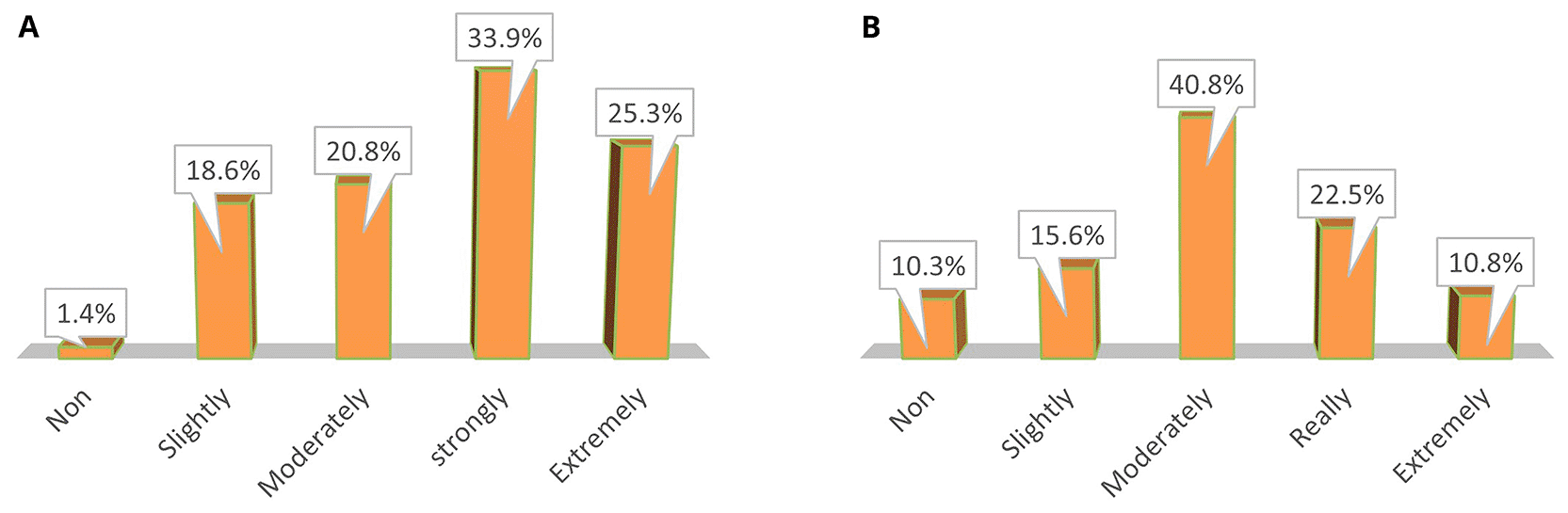
Figure 1.
Farmers’ concern about the availability of CFs: A) importance of producing them in surrounding areas, and B) the ease of finding CFs locally.
Table 6. Key conditions and probability to change from a mineral to a CF.
| Key conditions
| Not willing to substitute | 1.0% |
| I already use them | 15.0% |
| Subsidized or free of charge | 34.0% |
| Cheaper | 34.0% |
| Same price | 13.0% |
| Slightly expensive | 3.0% |
| Probability
| No likelihood | 6.5% |
| Slightly likelihood | 20.0% |
| Moderately likelihood | 41.5% |
| Strongly likelihood | 24.0% |
| Extremely likelihood | 8.0% |
The Krukal-Wallis test about how important it is for farmers that a CF is locally produced revealed a strong and highly significant country effect (Hadj = 85.5 and p < 0.001), with a relatively large effect size (ε2 = 0.26). This suggests that the country of residence, among the three studied countries, substantially shapes how much value farmers place on local production. Mean ranks showed that German farmers attach the greatest importance to local production, closely followed by Italian farmers, whereas Spanish farmers again stand out with clearly lower scores. Dunn’s post hoc tests with Bonferroni correction confirmed that both Germany and Italy differ very significantly from Spain, with farmers in these two countries attributing much higher importance to local production of CFs. In contrast, the Italy–Germany comparison was not statistically significant, suggesting that these two countries show similarly high levels of concern on this aspect.
On the other hand, the analysis about how easy it is to find CFs locally revealed a small but statistically significant country effect (Hadj = 7.77 and p = 0.02). Mean ranks suggest that Italian farmers perceive CFs as more easily available than their German counterparts, while Spanish farmers occupy an intermediate position. Dunn’s post hoc tests with Bonferroni correction showed that only the Italy–Germany contrast remained significant, whereas Spain did not differ significantly compared to Italy and Germany. Taken together, these results indicate that perceived local availability of CFs varies across countries, but the magnitude of these differences is modest.
However, local access to these fertilisers is not the only obstacle. As previously mentioned, cost is one of the key factors in selecting one fertiliser (
Table 5). In this way, another economic question was asked to know likely a farmer would change a traditional fertiliser by a circular one (
Table 6). Farmers would likely use a CF instead of a mineral fertiliser if the former is subsidized/free of charges or cheaper than the latter (68% of the total). This percentage increases to 81% when the price is not higher than the mineral fertilisers. Therefore, achieving a circular economy within the agricultural sector is extremely important.
Finally, a question was asked to determine the real willingness to use CFs was performed. As shown in
Table 6, 68% of the participants were moderately (41.5%), slightly (20%), or non-predisposed (6.5%) to switch from a mineral fertiliser to a CF. These results suggest that farmers may select CFs only if the price and local availability compete against mineral fertilisers.
The statistical analysis about farmers’ likelihood of switching from their current fertiliser to a circular alternative showed a statistically significant but small country effect (Hadj = 9.5, p = 0.009; ε2 = 0.028). Mean ranks indicate that Italy and Germany exhibited nearly identical levels of willingness to switch. In contrast, Spain scored notably lower, suggesting, by comparison, a reduced intention to adopt CFs among Spanish farmers.
Dunn’s post hoc tests revealed a significant difference between Germany and Spain after Bonferroni correction (p = 0.017), while the Italy–Germany comparison was non-significant. The Italy–Spain contrast can be considered as borderline significant (p = 0.049). Overall, these results indicate that the most pronounced separation occurs between Germany and Spain.
Not in my backyard effect
After evaluating the importance of the local production and an easy access to CFs, another interesting parameter was analysed the NIMBY (Not In My Back Yard) effect. This effect assesses the willingness of a local community to allow a facility settlement in its surroundings, showing positive behavior towards a certain type of industry (Case et al., 2017). To contrast this behavioral attitude, two extra questions were assessed to shed light on the opinions of CFs and circular economy among respondents.
Referring to this topic, 60.9% of the participants were not worried about having a production plant of CF near their area, knowing that they came from secondary raw materials (
Figure 2A). For those who answered yes (141 people), the survey included a question to determine the minimum distance at which the facility settlement would be accepted (
Figure 2B). A total of 55% (77 people in this group) ranged from 2 km to 15 km. Therefore, it may be considered that the surveyed people were not against the implementation of CF plants in their surroundings. This would reduce the logistic impediment of import-fertilizing products. To have a larger acceptability, an intermediate solution could be analyzed; the implementation of a CF facility should not be further than 15 km. In this way, the acceptability would rise to 82.2%, and the logistics costs might not significantly increase.
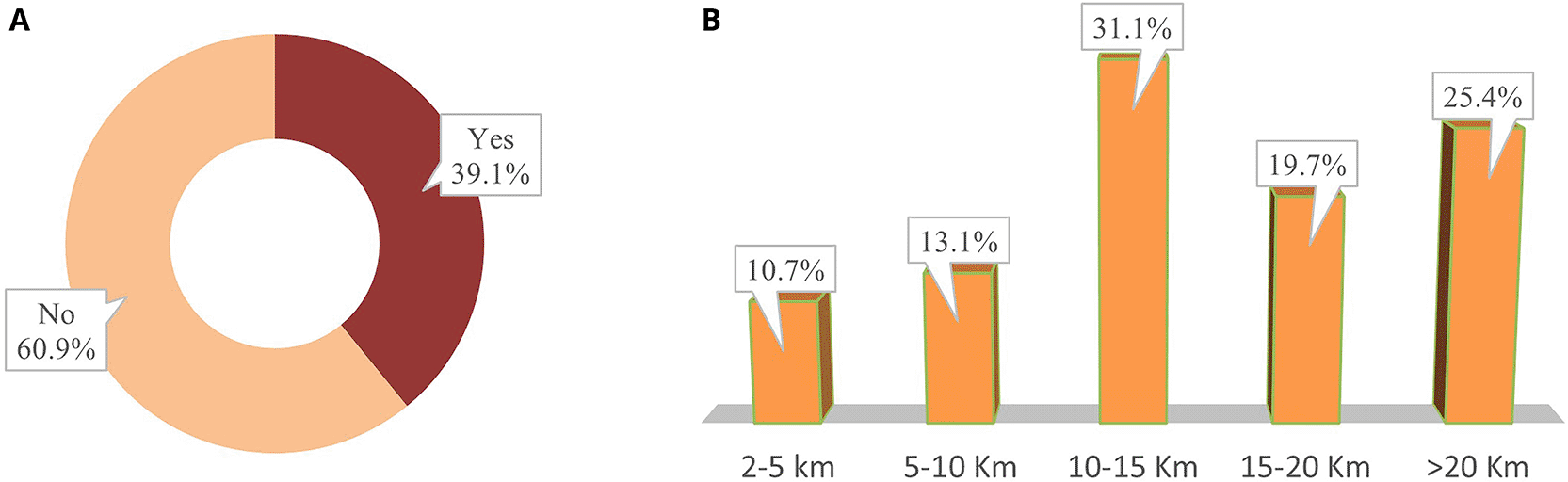
Figure 2.
Results obtained of participants about their A) concerns about having a CF factory less than two kilometres from their home and their B) desirable distance to have a CF production nearby.
To continue analyzing their possible attitudes and support, two questions were asked. They answered based on their agreement with the following two statements: 1) the inconvenience that CF production could cause, and 2) if it is offset by the benefits of circularity that they provide (
Table 7).
Table 7.
Degree of agreement with the idea that a) the inconvenience that CF production is offset by the benefits they provide and b) supporting CFs due to the circular advantages they provide.
| a) The inconvenience that circular fertiliser production is offset by the benefits they provide |
b) Supporting circular fertilisers due to the circular advantages they provide |
|---|
| Non important
| 1.2% | 2.8% |
| Slightly important
| 22.5% | 12.0% |
| Moderately important
| 39.6% | 39.8% |
| Really important
| 20.4% | 27.5% |
| Extremely important
| 16.2% | 17.9% |
Both questions show non-well-defined opinions, being the most repeated answer to the neutral one: “moderately agree.” Nevertheless, the plots exhibit slightly more followers than refusers, showing a positive attitude towards CFs.
Therefore, it is important to ensure the reliability of business models. Life cycle impact assessments of CFs are scarce, removing legitimacy from the circular benefits that they can provide. If circular products can provide fair information and details about their production processes and the advantages they procure, new adopters can be engaged.
Referring to the first question (
Table 7, Question a), this statement still had many undecided voters. On the one hand, the extremely agree selections were slightly higher than non-agree
ones. On the other hand, the slightly agree selections were similar to the really agree ones. According to the results, the circular economy might not be a clear alternative to the traditional agricultural system.
Knowledge and trustworthiness
In this section, farmers’ trustworthiness and their perceptions of the legislation are presented. This behavior is key to understanding the current state of European farms. The lack of reliable information for stakeholders is the most typical barrier to market acceptance (Simpson, 2017).
In the present study, the lack of awareness regarding fertilisers’ legislation is reflected in 48.9% of farmers who declare check updates less than once per year. Among the contestants, 35% consulted the national legislation annually, 30% checked regional legislation, and 11% checked European legislation. Only 11% of the respondents checked the three legislation levels. These data indicate that those farmers might not perceive checking legislation as useful, especially in Europe.
One of the most important aspects extracted from the survey was trustworthiness. Respondents were invited to answer on a five-point Likert scale the trustworthiness of eight key value-chain actors: specialized press, neighboring farmer, farmers’ association, fertiliser producers, salespersons, environmental non-governmental organization (NGOs), technical advisors and public authorities (
Table 8). By evaluating the reliance of end users on their environment, miscellaneous ideas were extracted.
1. In general, farmers have moderate trustworthiness in their neighbors (52%), fluctuating notably among countries and types of farming.
2. Farmers’ associations were trustworthy sources; 34.7% of respondents ensured that those groups were very or extremely trustworthy. The answers still varied notably between countries and farming types.
3. The most fixed and reliable sources were technical advisors; 44.3% of respondents found them very or extremely reliable. However, salespersons and NGOs were the most discredited, with 42% of farmers who did not or slightly trusted them.
4. Based on consortium knowledge, fertiliser producers already detect that farmers do not trust sales representatives. To solve this problem, the fertiliser industry is hiring external technical advisors.
5. The fact that NGOs are underrated in this classification may be explained by the perception of stakeholders that these organizations are disconnected from the real farmers’ necessities.
6. Public authorities have a bad reputation, disrupting key conflicting voting processes during election periods. These institutions are becoming involved in coordinating and supporting action projects, working among real user problems, and reaching reliability among them.
Table 8. Degree of trustworthiness among: specialised press, neighbour farmers, farmers association, fertiliser producers, salespersons, environmental non-governmental organizations, technical advisors and public authorities.
| Non-trustworthy | Slightly trustworthy | Moderate trustworthy | Very trustworthy |
Extremely trustworthy |
|---|
| Specialised press
| 7.2% | 15.3% | 43.6% | 31.7% | 1.9% |
| Neighbour farmers
| 7.3% | 19.6% | 52.% | 15.9% | 5.3% |
| Farmers associations
| 5.3% | 20.8% | 38.9% | 21.4% | 13.3% |
| Fertiliser producers
| 8.9% | 21.1% | 43.9% | 23.1% | 2.5% |
| Salespersons
| 11.4% | 30.1% | 49.3% | 8.4% | 0.3% |
| Environmental NGOs
| 15.9% | 19.8% | 50.7% | 11.4% | 2.2% |
| Technical advisors
| 0.8% | 10.6% | 44.3% | 30.3% | 14% |
| Public authorities
| 6.2% | 22.1% | 40.8% | 27.9% | 3.1% |
In order to complement the descriptive patterns observed in
Table 8 and to determine whether the differences in trust across Italy, Germany and Spain are statistically meaningful for the eight stakeholder groups, the Kruskal-Wallis H test was carried out. For seven of the eight stakeholder groups, the Kruskal–Wallis H test indicated significant country effects at α = 0.05 among Italy, Germany and Spain. The only exception was the stakeholder specialised press (Hadj = 5.32, p-value = 0.07), where no statistically reliable differences in trust between Italy, Germany and Spain were detected. Effect sizes (ε2) ranged from small to large: they were smallest for specialised press (ε2 = 0.016) and modest for technical advisor and neighbouring farmer (ε2 = 0.03 and 0.02, respectively), while clearly larger effects were observed for fertiliser producers (ε2 = 0.14), salesperson and farmers association (ε2 = 0.23 and 0.22), and moderate ones for environmental NGOs and public authorities (ε2 = 0.04–0.05).
Dunn’s post hoc tests with Bonferroni correction (three pairwise comparisons per stakeholder; adjusted α = 0.05/3) showed that for fertiliser producers in Spain had markedly higher mean ranks than both Italy and Germany; the Italy–Germany contrast was only borderline after correction (p = 0.05). For technical advisors, only the Germany–Spain comparison remained significant, indicating a moderate separation between these two countries, with Italy in an intermediate position. In line with the test results, none of the pairwise contrasts for specialised press survived Bonferroni adjustment.
For neighbouring farmers, the test suggested a small but significant effect; however, all pairwise comparisons were either non-significant or borderline once Bonferroni correction was applied, so these differences should be interpreted with caution. In contrast, salespersons showed very strong and consistent country differences: all three pairwise comparisons were highly significant after adjustment, with Germany displaying the lowest mean ranks and Spain the highest. A similar pattern emerged for farmers associations, where Germany’s mean rank was substantially lower than that of both Italy and Spain, and both Germany–Italy and Germany–Spain comparisons were highly significant. For environmental NGOs, Spain exhibited significantly higher trust than both Italy and Germany, whereas Italy and Germany did not differ from each other after correction. Finally, for public authorities, Germany showed significantly higher mean ranks than both Italy and Spain, which did not differ significantly between themselves.
Overall, these results indicate that the effect of country of residence on trust is stakeholder-specific, ranging from negligible (specialised press) to large (e.g. salespersons, farmers associations), and that many of the strongest contrasts involve Germany versus Spain and/or Italy, rather than systematic differences between Italy and Spain.
Evaluation of results according to the social acceptance and legitimacy theories
Both concepts are essential for the success of new technologies such as CFs. They operate on different levels: social acceptance focuses more on the practical realities of adoption, while legitimacy concerns the societal justification for innovation.
Social acceptance
As mentioned in previous sections, social acceptance is a widely recognized concept that reflects a societal trend across various levels, such as national, regional, community, and organizational. It encompasses different cognitive dimensions, including perception, opinion, attitudes, and behaviors, all of which are closely intertwined with a specific technology or technical system (Upham et al., 2015; Wolsink, 2010). In the present section, the three main dimensions of social acceptance theory are covered: socio-political, market, and community. The questions necessary to conduct this assessment are presented in Supplementary Table 2.
Socio-political acceptance
Socio-political acceptance refers to the endorsement, support, or resistance of technologies or projects at the macro-level by key stakeholders such as governments, NGOs, and the general public. Within this dimension, strong institutional capacity and political commitment were addressed from the farmers’ perspective.
a) Strong institutional capacity
Strong institutional capacity can be indirectly evaluated under the FER-PLAY context by the question: What are the perceptions of farmers about political institutions?
The findings indicate a negative trend in social acceptance of political institutions. A significant proportion of farmers lacked trust in public administration: 28% expressed mistrust, while 41% remained neutral. This ambivalence contributes to a general sense of unreliability and the weak legitimacy surrounding these institutions. Although there are some strategies (e.g., farm-to-fork and zero pollution action plans) to limit chemical products in crops to achieve a circular economy, mistrust in political institutions might hamper the adoption of CFs in European crops. To address this issue, political institutions should involve active stakeholders in the debate, instead of implementing these strategies without a social consensus. Additionally, it may be useful if political entities can adapt policies to local realities, which may increase farmers’ trust.
b) Political commitment
The authors wanted to assess the question: Are the communication channels among farmers and institutions beneficial? In the FER-PLAY context, political commitment refers to political institutions’ willingness and active efforts to foster the implementation of CFs. Political commitment was partially mentioned in the previous section. The European Commission is focused on reducing dependence on mineral and fossil resources and driving the use of organic resources. Kurniawati et al. (2023) reported a complete list of policies linked to fertilisers in the European Union.
In this way, the effective implementation of CFs as a real option goes through the knowledge of these regulations and their updates, such as the new categories: product function category (PFC) and component material category (CMC). However, only 10.9% of the respondents were aware of the current legislation regarding fertilisers at the European, national, and regional levels, 9.1% at the national and regional levels, and 4.6% at the European and national levels. Most participants were aware only at the national or regional level (34.6% and 30.3%, respectively). Furthermore, 49% of participants reviewed the legislation (at any level) at least once per year.
This can be caused by policymakers’ inability to establish effective communication channels, which may stem from a prevailing atmosphere of distrust among stakeholders, as reported by Mariano Zapata (LinkedIn, 2024) and WWF (2024).
Therefore, European projects play a crucial role as intermediaries among the value chain actors. These initiatives represent a promising starting point for fostering a positive dynamic within the socio-political dimension, especially by increasing the visibility of relevant topics and bridging communication gaps.
Market
This subsection addresses three interesting aspects linked to social acceptance: i) competitive properties of new products, ii) mechanisms of information and feedback, and iii) access to subsidies.
a) Competitive properties of the new products
The competitive properties of new products are highly relevant within the market dimension of social acceptance theory, as a product must be perceived as competitive in terms of price, performance, quality, and added value compared to existing alternatives to gain acceptance by stakeholders. In this way, it is necessary to show farmers’ concerns and preferences to assess whether farmer’s concerns and preferences are addressed by the market.
According to Egan et al. (2022), one of the key challenges is the high cost and availability of organic fertilisers. This is in line with the results obtained, where the main competitive property considered by the respondents was cost (75.4%), followed by nutrient composition (74%). Moreover, most respondents (75.8%) would be willing to switch from a mineral fertiliser to a CF if the latter is subsidized, cheaper, or the same price as the former. On the other hand, the availability of CFs at a local level was also evaluated. According to participants, the local production of CFs was strongly or extremely important (59.2%). However, it is easy or extremely easy to find local CFs in 33.3% of cases. The country-level differences in local availability were already statistically analysed in Section 3.1.2.
As previously mentioned, the composition of CFs is another property that should be considered together with the cost. According to The CFs present lower concentrations of nutrients than mineral ones; up to 20 times lower according to the International Fertiliser Association (IFA, 2024). A potential short-term solution may be the use of minerals and CFs. Some studies have reported that the combination significantly improved the total and available content of macronutrients and, at the same time, reduced costs (Luo et al., 2024; Mi et al., 2022).
b) Mechanisms of information and feedback
Effective mechanisms of information and feedback build trust, inform stakeholders about product benefits, and address concerns and misconceptions. These factors are crucial in fostering market acceptance. Thus, it is necessary to address the question: Are farmers’ communication channels with the CF stakeholders reliable?
To evaluate the present characteristics, it is important to assess farmers’ trust in different information sources. The most trustworthy stakeholders were technical advisors, farmers’ associations, and specialized press (44.3%, 34.8%, and 33.7% rated them as very or extremely reliable, respectively), whereas the lowest rating was for environmental NGOs and salespersons (13.6% and 8.9% considered very or extremely trustworthy, respectively). Public authorities and fertiliser producers were considered very or extremely reliable at 31% and 25.7%, respectively. However, a similar percentage considered them to be non-reliable or slightly reliable. Detailed statistical differences in trust levels across countries can be found in Section 3.1.4.
The evaluation of the information and feedback mechanisms highlights the significant role of trust in fostering market acceptance. Farmers tend to rely more on technical advisors, farmers’ associations, and specialized presses for information, reflecting the credibility and reliability of these channels. Conversely, limited trust in environmental NGOs and salespersons indicates a gap in their perceived legitimacy or alignment with farmers’ interests. The mixed perception of public authorities and fertiliser producers underscores the importance of improving transparency and tailored communication to strengthen trust. Enhancing the reliability and effectiveness of communication channels is essential for aligning stakeholders and addressing broader goals of market acceptance in the context of sustainable agricultural practices.
It is also interesting to mention another point that influenced this section. The fertiliser Product Regulation (FPR) 2019/1009, intended to promote organic and waste-based fertilisers, has been partially implemented despite promises since 2016. This may be perceived as a lack of commitment to fulfilling promises and reducing farmers’ trust. As of 2024, delays persist owing to the absence of notified bodies and harmonized testing methods. To address this, the EU supports “living labs,” where pilot farms test new products publicly, combining results with techno-economic and toxicological analyses (BioSOILUTIONS, 2024; ICOSHELL, 2024) Obtaining feedback from the pilot farms test into regulatory adjustments can enhance trust among stakeholders, which can be essential for closing the communication loop.
c) Access to subsidies
Although subsidies can be considered in the social-political section, they are included in the market because access to subsidies is directly related to stakeholders’ interactions with the product in terms of economic viability, competitiveness, and adoption drivers. That is, if farmers perceive subsidies as essential, this signals a barrier to market acceptance, tying subsidies to the market dimension. Hence, the following question was addressed: do the farmers feel the necessity of subsidising these products?
fertiliser prices have been increasing worldwide since the end of 2021. In this context, the value of organic fertilisers has changed from the farmers’ perspective (Daadi & Latacz-Lohmann, 2021). In this way, the results of the survey clearly showed that farmers perceived the necessity of subsidies to switch from a mineral fertiliser to a circular one: 43.6% of the participants would switch only if the CF was subsidized or cheaper than the mineral fertiliser. This may be related to only 36.6%, considering that the benefits of CFs outweigh the inconveniences.
The Common Agricultural Policy (CAP) involves several proposals to address circular solutions for farms. In total, €387 billion of funding has been allocated to the CAP as part of the EU’s long-term budget, which is the multiannual financial framework (2021–2027) (Eurostat, 2023). Even in the above-mentioned living labs, the EU subsidizes part of the detrimental effects of the harvest, if any. To strengthen market acceptance, it is essential to ensure that subsidy programs are complemented by alternative economic incentives, such as innovation grants or tax relief for early adopters of CFs. Additionally, robust quality control mechanisms must accompany funding decisions to mitigate the risks associated with production facility relocation. Clear and transparent criteria for stakeholder selection can enhance the perceived fairness and effectiveness of subsidies, further driving their acceptance and integration into the market.
Community
Within the community dimension, the use and recognition of externalities and positive public images are discussed.
a) Use
Community use is central to this dimension because it reflects the direct impact of a solution, which is key to gaining local acceptance. For this reason, the posed question will farmers purchase local CFs in their business? was addressed.
To answer this question, farmers’ perceptions were first shown. Farmers considered very or extremely important that fertilisers were sustainable and environmentally friendly (66.9% in combination). Moreover, 72.5% of respondents believed that CFs improved soil health. The statistical assessment is shown in Section 3.2.2.1 a).
However, two other important factors must be evaluated: cost and availability/accessibility limitations. Although it seems that farmers were interested in CFs, only 3.6% of the participants would be willing to pay a bit more for a CF, and 10.3% would use a CF if the cost was the same as a mineral option. On the other hand, only 33.3% easily found local CFs, and 36.6% considered that the benefits outweigh the disadvantages. This might explain why only 32% of the participants were predisposed to switch from a mineral fertiliser to a CF. Additionally, farmers tend to use fertilisers with texture and characteristics similar to mineral options (Tur-Cardona et al., 2018), which may hamper the adoption of CFs. To address this fact, extra efforts in fostering properties and parameters desired by farmers must be made, besides spreading the obtained results from living labs, as mentioned in the mechanisms of information and feedback section. The combination of demonstration programs, incentives (as mentioned in the subsidies section), and partnerships with local suppliers could foster a more favourable perception of CFs and accelerate their integration into farming practices.
b) Recognition of externalities or positive public image
In the context of community acceptance, recognizing the broader environmental and social benefits of CFs is key to fostering positive perceptions. As key stakeholders in agricultural sustainability, farmers play a crucial role in determining the success of these products. Their attitudes are shaped not only by their direct impact on their farming practices but also by their understanding of the larger environmental benefits. This raises the following question: Do farmers perceive these products as goods?
The perception of CFs at the local level revealed mixed attitudes: 32% of farmers viewed CFs positively and 26% opposed them, whereas the remaining 42% expressed indifference (moderate agreement). Farmers’ concerns about soil health and the environmental impact of mineral fertilisers drive a slightly proactive attitude towards circular products. These concerns stem from tangible, local-level impacts, such as degraded soil quality, which directly affect their livelihoods. However, while some farmers recognize the potential benefits of CFs, many remain unconvinced or indifferent. This indifference may be due to the lack of clear communication or direct evidence of the benefits of CFs in their specific contexts.
In summary, although farmers’ recognition of externalities remains limited, targeted improvements in information dissemination, political support, and engagement can shift perceptions. Addressing farmers’ indifference and leveraging their environmental concerns through effective feedback mechanisms and localized outreach initiatives will be essential for enhancing community acceptance.
Legitimacy
As previously mentioned, legitimacy explains how innovations, policies, and organizations gain societal approval by aligning with norms, values, and expectations. Therefore, the present section discusses the three primary forms of legitimacy (pragmatic, cognitive, and moral) within the FER-PLAY project concept. The questions necessary to conduct this assessment are presented in Supplementary Table 2.
Pragmatic
The pragmatic form is based on audience self-interest and their perception of tangible benefits, such as economic advantages, efficient resource use, and direct practical value to end users.
a) Exchange
Exchange legitimacy is based on the perceived direct benefits stakeholders receive from the initiative, such as cost savings or increased crop yields in the FER-PLAY project context. In this way, the question arose: Are CFs ready to foster soil quality or other farmers’ concerns as sustainability, cost, etc.?
One of the main concerns among farmers is the cost, nutrient content and ease of use (75.4%, 74.1% and 71.3% considered it as very/extremely important, respectively) of the CFs. Other preoccupations were process sustainability (67.7%), environmental aspects (60.7%), and the necessity of new machinery and product formats (55.5%).
One of the most important factors affecting CFs is how they are perceived in the context of soil health. In this case, the majority of the respondents (72.5%) considered that CFs improve soil health. Concerning the statistical Kruskal-Wallis test, there is a very strong and highly significant country effect (Hadj = 106.8 and p < 0.001). The associated effect size (ε2 = 0.32) indicates that country of residence explains a substantial share of the variability in perceived soil-health benefits. Mean ranks showed a clear gradient: German farmers expressed the strongest belief in the positive impact of CFs on soil health, followed by Italian farmers. Spanish farmers were markedly more sceptical compared to the other countries.
Dunn’s post hoc tests with Bonferroni correction confirmed that both Germany and Italy differ very significantly from Spain, with farmers in these two countries showing much higher confidence that CFs will improve soil health. In contrast, the difference between Germany and Italy was not statistically significant after correction, suggesting broadly similar levels of optimism in these two countries.
With the ongoing status of technology in the fertiliser sector, circular alternatives are ready to solve the detriment in soil quality. Although their performance is lower in general, scientists already postulate that the correct mindset is to mix circular and mineral products, as long-term trials show with manure (Jate & Lammel, 2022). With this mix, farmers can achieve proper yields in addition to other qualities, such as soil-improving qualities.
However, it is necessary to discuss whether farmers are ready to switch from a mineral fertiliser to a CF. Thus, 42% of the patients were moderately predisposed to do so. This might be linked to the ease of finding them at the local level, as 40.8% answered that it was moderately easy. Additionally, 39.6% of respondents considered that the inconveniences caused by the production of CFs were offset by their benefits. Therefore, these issues must be addressed to accelerate the implementation of CFs in European soils. The statistical assessment about farmers’ predisposition to switch to CFs and the ease of finding them was previously discussed.
b) Dispositional
Disposition is linked to trust in the intentions, values, and goodwill of an entity promoting the initiative. For instance, if stakeholders accept a solution, they believe that policymakers or developers are acting in their best interests. Thus, a question was posed in the FER-PLAY context: Are public administrations, NGOs and farmers’ associations perceived as trustworthy?
The survey’s results showed that respondents had more extreme trust in farmers’ associations than in public authorities (34.8% and 31%, respectively), whereas only 13.6% thought NGOs were extremely trustworthy. In contrast, it is interesting to mention that the three groups were perceived as moderately trustworthy: 50.7% (NGOs), 40.8% (public authorities), and 39% (farmers’ associations). The Kruskal-Wallis test was discussed in Section 3.1.4.
Cognitive
Cognitive legitimacy occurs when technology, policy, or practice is seen as inevitable or aligned with societal expectations. It is often linked to widespread awareness and understanding of the initiative’s role in solving existing problems such as the transition to circular economies.
a) Comprehensive
The comprehensive view is derived from the understanding and awareness of how a solution works and its purpose in addressing societal needs. In this context, the following question was posed: Do CFs offer an easy transition?
Currently, there are very few long trials on CFs. Scientists strive to test as many new CFs as possible. Toxicological assessments, detection of specific chemical compounds (such as certain types of microplastics), and other tests are being conducted. Therefore, it could be said that the transition is not currently easy, as some issues linked to CFs need to be studied in depth.
Furthermore, the transition could not be effective if a wide majority of the participants (60%) did not know if there was any limitation on the availability/accessibility of CFs in their areas, whereas 17% answered that there were limitations. In line with this, only 33.3% of the participants answered that it was really or extremely easy to find CF locally. Hence, it is required that the stakeholders driving CFs implementation act to reverse this situation.
Additionally, a test was added to the survey to evaluate participants’ knowledge of CFs. This may show that the transition from traditional fertilisers to CFs can be realistic in the mid-term. The use of CFs may require additional training as the nutrient composition varies; they can require specific storage conditions and regulatory and certification requirements (IFFCO Nano Urea, 2024; Javatpoint, 2024; Tur-Cardona et al., 2018). However, only 33.2% of the participants knew that CFs may require additional training.
On the other hand, 52.4% of the participants knew that CFs have lower nutrient content compared to the mineral ones and, thus, the use of CFs would not be correctly applied by about 50% of them. Moreover, 54.8% of respondents did not know that CFs have some limitations depending on the soil and crop. Nevertheless, circular alternatives to mineral fertilisers offer a variety of improvements (Barzee et al., 2019; Egan et al., 2022; O’Donnell et al., 2022). These enhancements have turned into solutions to the current farming problems.
b) Taken-for-granted
This form of legitimacy arises when a solution becomes normalized and is no longer questioned, because it is seen as a standard or inevitable solution. For instance, within the FER-PLAY context, CFs could be perceived as the default option in agriculture owing to its widespread use. In this way, the posed question to answer was: how are the CFs perceived in terms of environment improvement?
Among respondents, 41.8% were concerned about the environmental impact of fertilisers, 66.9% considered very/extremely important that the fertiliser be sustainable and environmentally friendly, and, as previously mentioned, 72.5% thought that the soil health improved by using CFs. Additionally, 36.8% of respondents considered that the inconveniences linked to CFs production were offset by its benefits. Therefore, it seems that the use of fertilisers from secondary raw materials could be a default option in the mid-term.
To complement this section, the Kruskal-Wallis test was performed. In this way, the analysis revealed significant cross-country differences in concern about the environmental impact of fertilisers (Hadj = 19.08 and p < 0.001). Dunn’s post hoc tests confirmed a strong and statistically robust difference between Italy and Spain after Bonferroni correction; whereas, the contrast between Germany and Spain was borderline. Finally, mentioning that the Italy–Germany comparison showed only a trend but was not statistically significant. Taken together, these findings suggest that Italian respondents are notably more concerned about the environmental impact of fertilisers compared with Spanish respondents, whereas Germany occupies an intermediate position without clearly differing from either country under conservative post hoc criteria. This indicates that country-level differences exist but are not uniform, with the most pronounced gap observed between Italy and Spain.
On the other hand, analysing how important it is for farmers that fertilisers are sustainable and environmentally friendly, the Kruskal–Wallis test indicated a very strong and highly significant country effect (Hadj = 93.6 and p < 0.001). The adjusted epsilon-square was around 0.28, pointing to a large influence of country of residence on the perceived importance of fertiliser sustainability. Mean ranks showed that Italy and Germany place similarly high importance on sustainability; whereas, Spain scores much lower. Dunn’s post hoc tests with Bonferroni correction confirmed this pattern: Italy–Spain and Germany–Spain differences were both highly significant, indicating that Spanish respondents attach substantially less importance to sustainable and environmentally friendly fertilisers than their Italian and German counterparts. In contrast, the Italy–Germany comparison was not significant after correction, suggesting that farmers in these two countries are similarly aligned in giving high priority to sustainability attributes.
Normative
The normative section is related to moral legitimacy, which is based on the perception that the initiative is “the right thing to do” according to shared values, ethics, and cultural standards. It emphasizes fairness, justice, and long-term benefits over immediate personal gains.
a) Procedural
Procedural legitimacy is based on the fairness and inclusiveness of processes used to implement or regulate a product. For instance, farmers are more likely to accept policies on CFs if they are actively involved in the decision-making processes. Taking into account the survey performed in the course of the FER-PLAY project, the posed question aligned with procedural legitimacy was: how can public administrations involve stakeholders on the CFs use?
First, it is important to highlight that farmers’ trust in public administrations is notably low, with 68.8% considering them either untrustworthy or moderately trustworthy. Improving the public image of these institutions is essential to fostering stakeholder engagement. Additionally, administrations should establish stronger communication channels with farmers to assess their understanding of current fertiliser legislation and provide targeted support to enhance their involvement. Notably, only 11% of the respondents were familiar with the legislation at the European, national, and regional levels, and only 9% were aware of it at the national and regional levels.
From an economic perspective, public administrations need to evaluate and address the cost of CFs if they want to be effectively implemented. On the one hand, 82.1% of the participants were moderately or extremely concerned about the cost of fertilisers (27.9% and 54.2%, respectively). In this way, 28.9% would be willing to use CFs if they were subsidized or cheaper than the conventional ones, 14.7% if these were subsidized, 13.9% if they were cheaper than the conventional fertilisers, and 10.3% if they presented the same price. In total, 67.7% would be willing to use CFs if the price was at least the same as that of conventional fertilisers. Only 3.6% of contestants would be willing to change if the circular alternative included a slightly more expensive price. Therefore, public administrations and policymakers should keep in touch with these concerns if they want an effective implementation of the circular economy in the agricultural sector. Moreover, considering that one of the most important EU strategies is to reach a real circular economy, the points related to the price and availability of CFs are highly recommended for further policy discussions involving the affected stakeholders. It is crucial to keep addressing farmers with easy reports and documents that disseminate reliable information to engage in more legitimacy in order to reduce, for example, the lack of knowledge about the decision-making process, as reported by Egan et al. (2022).
The Kruskal-Wallis test applied on the concern about cost of fertilisers results indicated a highly significant country effect (Hadj = 60.44, p < 0.001). Mean ranks revealed a clear pattern: Italian respondents reported the highest concern, whereas Germany and Spain formed a much lower and more homogeneous group. Dunn’s post hoc tests with Bonferroni correction confirmed that Italy differs very strongly from both Germany and Spain, with both pairwise comparisons remaining highly significant after adjustment. By contrast, the Germany–Spain comparison was non-significant, indicating that these two countries do not differ meaningfully in their perceived concern about fertiliser costs.
b) Structural
Structural legitimacy relates to whether the private or public entity promoting the initiative is seen as capable, credible, and aligned with societal values. In this sense, the following question was posed: can farmers’ concerns be solved by the current status of the CFs?
Structural legitimacy combines the results of different questions. On one hand, the factors considered by the participants were relevant, as previously mentioned. The cost was at the top of the factors, in addition to the nutrient content (75.4% and 74%, respectively). In this way, CFs can be cheaper than mineral CFs if they are locally produced as additional transport, processing, etc. can increase their costs (Kurniawati et al., 2023). This is directly linked to the fact that 67.7% of the respondents mentioned that it is non-, slightly-, or moderately easy to find local CFs. Moreover, as mentioned in the procedural legitimacy section, only 3.6% of the participants would be willing to change if the circular alternative included a slightly more expensive price. The Kruskal-Wallis test about the how easy it is to find CFs was discussed in Section 3.1.2.
In terms of nutrient content, CFs presented some advantages, such as the improvement of soil health, as perceived by 72.5% of the participants. However, some CFs have a lower nutrient density, which translates to a larger application requirement. This might explain why 68% of participants were non-, slightly-, or moderately predisposed to switch to a CF, and 63% considered that the inconveniences caused by CFs production do not, slightly, or moderately compensate for their benefits.
Additionally, it is mandatory to mention the participants’ trustworthiness in those stakeholders driving the implementation of CFs: 86.4% and 69% considered non-trustworthy, slightly trustworthy, and public administration, respectively. By contrast, technical advisors were considered very or extremely trustworthy by 44.3% of the participants. These advisors may be a good driving force to improve the current CFs situation.