Study preregistration
This protocol has been pre-registered on AEA RCT Registry RCT ID: AEARCTR-0015304
Socioeconomic inequalities in children’s cognitive and social-emotional development are pervasive globally and play a pivotal role in perpetuating existing economic and social disparities. These gaps, which often emerge early in life, create cycles of disadvantages with lasting repercussions for individual and inter-generational opportunities in education, the labor market, and health (Almond et al., 2018; Currie & Almond, 2011; Heckman & Mosso, 2014). Parental beliefs and preferences are key drivers of this gap due to how they influence parental choices and investments, and therefore, how children ultimately develop skills. Parental income, educational attainment, information, time available, and beliefs around children’s ability and school performance are well-documented drivers of inequalities in child development outcomes by socioeconomic status (SES) (Boneva & Rauh, 2018; Dizon-Ross, 2019; Duhon, 2023; Falk et al., 2021).
A less-studied potential driver of the skill gap relates to differences in parenting styles by SES. Parenting styles -- the way parents1 establish rules, provide guidance, and respond to their children’s needs and behaviors -- consistently predict child health, education, and social-emotional outcomes across diverse cultures (Devlin et al., 2018). Evidence shows that households with lower SES are more likely to adopt harsher and less supportive parenting styles (Beatriz & Salhi, 2019), which are linked to poorer child outcomes. Understanding why parents adopt certain parenting styles is essential for designing effective interventions to enhance children’s development and reduce SES-based inequalities. Previous studies have investigated the economic drivers of parenting styles (e.g., Doepke & Zilibotti, 2017; Doepke et al., 2019). However, the role of parental beliefs and preferences in driving parenting style choices remains understudied, especially in low-and middle-income country contexts. Investigating these questions in the context of low-and middle-income countries is critical, as child development outcomes are lower, inequalities in these outcomes by parental SES are larger, and parents tend to adopt harsher parenting styles (Beatriz & Salhi, 2019; Hanushek & Woessmann, 2008).
Parenting programs that support parents to adopt more supportive, evidence-based practices and authoritative parenting styles with the goal of promoting child well-being are common (Knerr et al., 2013). However, the mechanisms behind parenting style choices and how such programs can affect these choices are a relatively unexplored area of investigation in the literature on parenting styles and programs across psychology and economics (List et al., 2021; Sandler et al., 2015). If harsher parenting styles (authoritarian) persist because parents do not believe that less harsh styles (authoritative) are effective, interventions that target such beliefs may be most impactful at a relatively low cost. Conversely, if less-harsh styles are perceived as too resource-intensive, interventions that alleviate time or cost constraints may yield better results, especially for lower-SES families.
In this protocol, we describe the methodology we will use to address this gap. Specifically, we will address the following research questions:
1. Do parental beliefs about the effectiveness of human capital inputs (parental time investments and children’s skills) vary when parents are presented with different parenting styles?
2. Do parents perceive a higher utility cost when adopting one parenting style than the other?
3. Does limited time availability influence parenting style choices and time investment decisions?
4. What roles do beliefs, preferences, children’s skills, and utility costs of adopting a parenting style play in determining a parenting style choice? Do these beliefs, preferences, utility costs, and parenting style choices vary according to parental SES?
5. Can parenting interventions influence parents’ preferences, beliefs, and utility costs? Do these effects vary according to SES?
To answer these questions, we will use a novel survey experiment to elicit subjective expectations about the perceived long-run returns to different parenting styles and the utility costs associated with exerting each style. With this information, we will later estimate the preferences for child outcomes. Our study will target 2,400 parents of adolescent children (aged around 13/14 years) in Ghana. By relying on scenario-based questions, we will collect data on parental beliefs about the effectiveness of parenting styles, time investments, and skills levels, as well as costs and hypothetical choices that can be used to estimate preferences for skill outcomes. We will randomly vary children’s skills and sex to examine the heterogeneity in our variables of interest across these dimensions. Our sample is embedded in a large-scale field experiment of a parenting program focused on promoting authoritative parenting styles, see Sample section. Thus, we will exploit the variation induced by randomized assignment to this parenting program to investigate whether the program shifted parents’ preferences, beliefs, and utility costs as key potential mechanisms for program effectiveness.
Following Cunha et al. (2013) and Cunha (2015), we developed a model of parenting style choice to support our survey design and analytical approach. Parents derive utility from children’s outcomes and non-parenting activities. Parents have to choose between two parenting styles and how much time to spend with their child versus non-parenting activities (e.g., work, leisure, household chores, etc.).2 Moreover, parents are constrained by the time they have available.3 Parents adopt either an authoritative (high warmth and no harsh discipline) or authoritarian (low warmth and harsh discipline) parenting style. Parental time investments in children, along with children’s skill levels at a given time, determine children’s future outcomes. Parenting style influences the efficiency with which time and skills affect children’s outcomes. The model incorporates parental beliefs about the effectiveness of these inputs, which vary according to parenting style. The parent optimization problem is expressed as follows:
subject to the constraint:
where ηi is the time spent on non-parenting activities, xi is the time spent with the child, ρi ∈ {w,c} is the parenting style, with c describing an authoritarian style (low warmth, harsh discipline) and w an authoritative style (high warmth, no harsh discipline). hi is the child’s life outcome (income at age 30 or support for the family; see the next section). δ represents preferences for a child’s outcomes, while v is the disutility of exerting an authoritarian parenting style.4
The human capital function of future life outcomes for child i is:
where Aρ is the general productivity5, xi represents parental time investment, and θi denotes the child’s skill level during adolescence (measured as the child’s rank in class). The parameters βρ and γρ represent the productivity of time investments and children’s contemporaneous skills, respectively, which depend on parenting style ρi.
The data collected for this study are part of a larger randomized controlled trial (RCT) conducted with ~2,400 families in the Greater Accra, Eastern, and Central regions of Ghana as part of the ERC-funded “Leveraging Early-Adolescence for Development: Longitudinal and Experimental Data from Ghana” (LEAD)6. Half of the sample families were randomized to participate in a parenting program, the Pempamsie Family Program (PFP) (Aurino et al., 2025b). PFP promotes culturally adapted parenting practices that previous evidence has shown to support adolescent development, including reducing harsh discipline, stress management, and improving communication between parents and adolescents. After finalizing the main parents’ questionnaire for LEAD, parents will be asked if they consent to complete an additional module as part of this survey experiment. Parents’ informed consent will be solicited via a written form and parents must provide their consent to be eligible to participate in this additional module. The written consent form will ensure that parents are adequately informed of the voluntary nature of their participation, along with an estimate of the time required to complete the additional survey instruments as part of this survey experiment (approximately 30 minutes, in addition to the 45 minutes of the main parent questionnaire). For this additional time commitment, parents will be thanked with 20 Ghanaian cedis of airtime for their phone. The survey experiment is described in the remainder of this section.
Our experimental design includes belief and cost scenarios to be administered to the sample parents (respondents). We describe these scenarios in detail below. Experimental script, questionnaires and consent forms are deposited in Aurino et al. (2025a).
Belief scenarios
In the belief scenarios, respondents will be presented with a given description of a hypothetical adolescent child and her parents, who live in a community like one of the respondents. Each scenario will present a situation in which key inputs of our theoretical model -- parenting styles, parental time investments, and children’s contemporaneous skills -- vary one at a time. Based on this information, respondents will be asked to state their expectations about two future life outcomes for the hypothetical child: the child’s income at age 30 and the probability of support for the family when the parents grow old7.
For future income, parents will be asked to report the expected monthly earnings of a hypothetical child in terms of today’s Ghana Cedis. This will allow us to compute the expected monetary returns based on a child’s inputs and different parenting choices. For family support, we will elicit the expected support for the family (parents and younger siblings) exerted by the hypothetical child when their parents grow older. In collectivistic Ghanaian society, besides income and education, parents highly value their old-age support from their children. Parents’ expectations regarding family support will be measured in a probabilistic format using 10 counters, where each counter represents one chance out of 10. Respondents will rate the likelihood on a scale from 0 (low chance) to 10 (high chance).
Based on the variation induced by the scenarios, we will be able to elicit respondents’ beliefs about the productivity of different inputs (parenting styles, child skills, and time spent in parenting activities) for children’s future outcomes. Parenting styles will be described as styles exerted by hypothetical parents, with Scenario 1 describing an authoritarian parenting style and Scenario 2 describing an authoritative parenting style. Parental time investments will be described to respondents as the time spent with the child by the hypothetical parent (in minutes per day), while the hypothetical child’s skill level will be described through the child’s ranking in his/her class (a common way to present children’s academic progress in Ghana). Appendix A.1 presents the full script of each scenario (see data availability statement).
To limit survey length and respondent fatigue, we will randomize belief scenarios along two main axes: the child’s skill level and the amount of time hypothetical parents usually spend with the child. This will prevent any given respondent from having to go through all possible combinations of parenting styles, child skills, and parental time investments (for a graphical illustration, see Figure 1). For respondents who will be presented with scenarios describing children’s skills (50% of the total sample), we will further randomize the administration of scenarios that vary the level of the skills; for half of these respondents, the scenario will describe a child with high skills, whereas for the other half, it will describe a child with low skills. By fixing these skill levels, we will elicit respondents’ beliefs about the child’s long-term outcomes for the following four scenarios:
(i) High parental time investments, and authoritarian style
(ii) Low parental time investments, and authoritarian style
(iii) High parental time investments, and authoritative style
(iv) Low parental time investments, and authoritative style
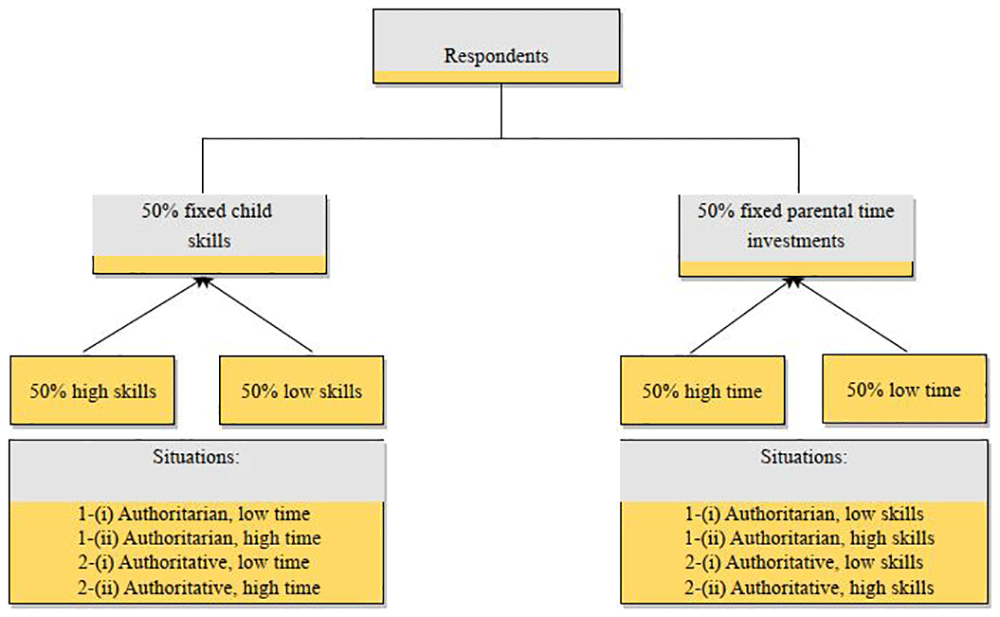
Child skill levels are fixed in the scenario descriptions for half of the sample, whereas parental time investments are fixed for the other half. Within these two groups, we will further randomize the levels of child skills and parental time investments as either high or low. Based on this randomization, respondents will be asked to state their beliefs about the returns to these investments across four different scenarios that vary in parenting styles and child skills/time.
For the remaining half of the respondents, we will fix parental time investments. Within this set, we will randomize the time spent with children, assigning half of the respondents to high parental time investment and the other half to low parental time investment. Respondents will then be asked to estimate the child’s long-term outcomes for the following four scenarios:
(i) High skills and authoritarian style
(ii) Low skills and authoritarian style
(iii) High skills and authoritative style
(iv) Low skills and authoritative style
Building on this general setup, we will also randomize the sex of the hypothetical child described in the scenario by using children’s names that are familiar in the local context to estimate heterogeneity in parental beliefs by child sex. Moreover, we will randomize the order of the belief scenarios and answer options available to avoid anchoring and order bias. All belief scenarios will be presented with visual aids to help respondents distinguish between the different scenarios and recall key experimental details (Appendix A.2 - see data availability statement).
Robustness checks will be embedded in our survey design8. First, we will elicit parents’ perceived returns regarding two future outcomes: support for the family and income at age 30. Although we do not expect beliefs about the effectiveness of human capital inputs and preferences to have equal magnitudes for these outcomes, having two future outcomes will serve as a comparison for the main takeaways of our investigation. Additionally, we will include a question to check whether the respondents correctly understood the concept of probability (Appendix A.1). We will do so following the methodology introduced by Walker et al. (2024). Further, following Kiessling (2021), we include a question about how certain respondents are about their answers so that we can run a robustness check by excluding the responses of participants who are less certain about their answers. Thus, we will be able to test the extent to which noise drives our findings.
Cost scenarios
The cost scenarios are hypothetical situations that present trade-offs between the time devoted to parenting and non-parenting activities. By administering cost scenarios, we aim to elicit parental preferences and perceived constraints related to time investments and different parenting styles. We will start by asking respondents to advise a hypothetical parent on how to allocate their time between parenting and non-parenting activities. The time will be measured in minutes per day for each activity. By doing so, we aim to elicit respondents’ general preferences with regard to spending time on child-related activities versus time spent on other activities. After this, we will describe a scenario involving a specific challenge that a hypothetical child encounters and ask respondents to advise the hypothetical parent on how to interact with their child. We will elicit such parental preferences using two scripts describing different parental reactions, which point to two underlying parenting styles. Then, we will present respondents with the same situation (child having a challenge), but in two additional scenarios, we will vary the time available for the hypothetical parent to deal with the situation (little versus more time). In doing so, we will be able to elicit the utility costs associated with a certain parenting style. The full text is provided in Appendix A.3 (see data availability statement). In this cost module, we will also randomize the sex of the hypothetical child, as well as the order of cost scenarios and answer options.
Additional data
The respondent sample is part of a broader, ongoing study, where we collected rich data on parental stress (as measured by Perceived Stress Scale, Cohen et al., 1983), parenting behaviors (e.g. to map styles, measured through the Alabama Parenting Questionnaire; Essau et al., 2006), randomized assignment to a parenting intervention, and sociodemographic characteristics such as parent and child sex, parent education, and household poverty, as measured via the Poverty Scorecard for Ghana (Schreiner & Woller, 2015). Some of the available data may be used to explore additional heterogeneity or research questions.
We will use a three-step estimation strategy to estimate the parameters needed to answer our research questions. Some of the estimations are derived from the theoretical model explained previously. The first step will involve estimating parental beliefs about the effectiveness of inputs for children’s outcomes, followed by the estimation of parental preferences for child outcomes, and finally, the estimation of the utility cost parameter associated with adopting different parenting styles. In this paper, we present our main estimation approach for the three main parameters of interest. We only briefly do discuss robustness analysis that we may run to further validate our results.
Step 1: Estimation of beliefs on effectiveness of inputs
RQ1: Do parental beliefs about the effectiveness of inputs (time investments and children’s skills) vary when parents are presented with different parenting styles?
To address this question, using data from the belief scenarios, we will estimate the parameters that capture parental beliefs about the effectiveness of inputs (parental time investments and children’s skills) in influencing future outcomes for these children, depending on the parenting style described in each scenario. Operationally, we will estimate the following equation derived by taking the logarithm of the human capital function:
where yi,k represents the expected future outcome of the child (income at age 30 or support for the family) based on respondent i estimate in scenario k. xk represents parental time investments described in the scenario (minutes per day spent with the child). θi,k is the skill value of the hypothetical child in scenario k, being measured by the child’s ranking in the class. To control for respondents’ characteristics across different scenarios, we include respondent fixed effects μi. εi,k is the error term clustered at the respondent level. We will run Equation 4 separately for scenarios that present respondents with authoritarian and authoritative styles to estimate the effectiveness parameters for each style. In this estimation, βρ describes parental beliefs about the effectiveness of time investments and γρ reflects the perceived impact of skills within each parenting style. With these parameters, we will then test whether parents have different beliefs about the effectiveness of inputs by testing for the significant difference between the estimated parameter for authoritarian and authoritative styles (using t-tests). If we detect a significant difference, we can quantify how parental beliefs about the effectiveness of inputs vary, depending on the parenting style used.
Step 2: Estimation of preferences for child outcomes
In the second step, we will estimate the preference parameters for child outcomes relative to non-parenting time using data from the cost scenarios, where each respondent i receives j ∈ {w,c} scenarios varying the total time available to allocate to non-parenting time ηi,j and the time spent with the child xi,j. These scenarios will be described for a hypothetical parent to whom the respondent will be asked to offer advice. We will assume that, in this case, the respondent will apply the same decision-making model that she uses in her everyday life to allocate her time to give such advice (see Equation 1). Using the first-order conditions derived from the theoretical model, we will estimate the following equation:
where xi,j is the time investment and ηi,j is the non-parenting time of the hypothetical parents advised by respondent i in scenario j. Using the data from the cost scenarios, we will estimate the preference parameter for child outcomes over non-parenting time, δ, by plugging in the productivity parameter for time investments, βρ, from Step 1. We will estimate Equation 5 using ordinary least squares (OLS) and cluster the standard errors at the respondent level.
Step 3: Estimation of utility costs of exerting parenting styles and simulations
RQ2:Do parents perceive a higher utility cost when adopting one parenting style than the other?
Our final step will involve estimating the utility costs associated with adopting different parenting styles. This will be done using a logit model based on the observed choices of parenting styles in hypothetical cost scenarios. Respondents may offer advice by focusing on an authoritarian style if they think the utility U of the hypothetical parent for choosing this style will be higher than that of following an authoritative style. Therefore, for each cost scenario, we can calculate the utility value given the optimal choices by using the theoretical model outlined in Equation 1. The only parameter that we have not identified in the utility function at this stage is v, the utility cost of adopting an authoritarian style instead of an authoritative style. For the logit model, we will express the difference in utilities as Vc–Vw = x'β. Through this difference, we will calculate each utility value using the previously estimated parameters and model solution, excluding the utility cost of exerting a style. To identify v, we will regress parenting style choices on the difference in utility values. The specification for estimating utility cost will be follows:
where X1 is the difference in utility computed using the optimal choices from the model solution. Thus, β0 gives us the difference in the utility costs of adopting authoritarian parenting style versus authoritative style (v). If v is different from zero, we can infer that parents have a higher cost of exerting a particular parenting style.
RQ3: Does limited time availability influence parenting style choices and time investment decisions?
Using the parameters estimated in Steps 1–3, we will be able to see the role of each of the choice determinants (e.g., time available, beliefs, utility from child outcomes, child skills, etc.). We plan to explore the role of these choice determinants by using parameter estimates and model simulations. For example, we can simulate how parents’ choices vary if they have more time available. In this way, we can examine whether time availability drives parenting style choices and time investment.
RQ4: What are the roles of beliefs, preferences, skills, and utility cost of adopting a parenting style in determining a parenting style choice? Do these beliefs, preferences, utility costs and parenting style choices vary according to parental SES?
We will simulate how choices would vary if children have higher skill levels, parents have different preferences, there are no costs associated with parenting styles, or parents have different beliefs about the effectiveness of these styles. This will allow us to further explore the role of different choice determinants. We will also examine whether the parameters vary by parental SES, using respondents’ education or related SES variables as proxies. To do so, we will interact with an indicator of high SES using these parameters. This will allow us to examine whether beliefs, preferences, and the disutility of exerting a parenting style vary by SES, which is a crucial question for designing and targeting parenting interventions.
RQ5: Can parenting interventions influence parents’ preferences, beliefs, and utility costs? Do these effects vary according to SES?
In addition, our objective is to examine whether parameter estimates vary according to the treatment status of the PFP parenting intervention, and to see whether the parenting program shifted parameters relevant to parenting style choices. Moreover, from the cost scenarios, we will test whether respondents advise different parenting styles when they have been part of the intervention and if these changes vary by SES. In doing so, we will test whether the parenting program affects parental preferences, beliefs, costs, and behaviors, and whether these impacts vary by SES and influence choices.
Other exploratory research questions
We also aim to explore the following research questions:
Do beliefs, utility costs, and preferences vary according to the hypothetical child’s sex?
Do beliefs, utility costs, and preferences vary by respondent’s sex?
Do beliefs, utility costs, and preferences vary according to the respondent’s level of stress and mental health status?
Minimum detectable effect sizes
To simulate the minimum detectable effect sizes, we conducted a pilot study with a sample of 33 parents with characteristics similar to those of our target sample.9 Given the limited size of this sample, as well as the initial wording of questions and procedures used in the pilot (which we refined after the pilot), these data are expected to be noisier than those we will obtain from our target sample. To estimate the minimum detectable effect size, we simulated the effect sizes for the main specification (Equation 4), aiming for 80% power with our target sample of 2,400 respondents. Our approach follows that of Campos-Mercade (2024). To do so, we use the mean and standard deviation of log earnings in the pilot data as dependent variables. According to these simulations, for βρ, the productivity of time investments, we detect parameter sizes larger than 0.045 SD (0.059 SD when clustering at the individual level) of the outcome variable (log earnings). With pilot data variation, this estimate corresponds to a face value of 0.07 (0.09) for βρ (corresponding to a minimum detectable increase of 0.07% (0.09%) in log earnings for 1% increase in time investments). For γρ, the productivity of child skills, we detect parameters larger than 0.105 SD (0.135 SD when clustering at the respondent level), with a face value of 0.17 (0.21), (corresponding to a minimum detectable increase of 0.17% (0.21%) in log earnings for a 1% increase in skills).10
Research ethics approval
The study is in line with ethical guidelines for human subject research and has received ethical approval from the Institutional Review Boards of the University of Barcelona (IRB number: N/A; approval date: November 05, 2024) and Ghana Health Services (IRB number: GHS-ERC: 005-07-23; approval date: November 26, 2024). The latter is the most important ethical board for trials involving human participants in Ghana. This is not a clinical trial, but rather a survey experiment, where parents are randomly assigned to different hypothetical scenarios. Thus, all study instruments are non-invasive and pose minimal risks to parents. See Aurino et al. (2025a) for the consent forms and information sheets.
Consent
Written informed consent for parents regarding their participation will be sought prior to the start of the study and before participation in any data collection activity. The consent statement will ensure that parents are informed of the purpose of the study, the survey instruments and procedures, potential risks and benefits, their rights as participants, and confidentiality of the data. Participants will be informed that their participation is voluntary and that they are free to withdraw without providing reasons at any time without any side effects. All data procedures will be in line with the European General Data Protection Regulation (GDPR) and the Data Protection Act of Ghana. Under these regulations, and at the request of the participants, all the information collected from these participants will be destroyed. The study will strive to protect the privacy of research participants, and the research team will sufficiently aggregate the analysis and presentation of research findings in a way that does not identify research participants. Participants will also be encouraged to participate in the survey in a private setting.
We will engage in dissemination activities to communicate the study findings with a multitude of different audiences, including policymakers, academics, and public audiences. Using social media and a project website, the results and instruments of the study will be processed in a way that is easily accessible. The research team will also communicate their findings, including the key constraints of parenting styles at various international scientific conferences and beyond, through accessible open dialogue workshops as well as blog/op-eds and newsletters entries. Article publication is a core component of the research team’s dissemination approach. The results of this study will be published as a working paper first and later disseminated through peer-reviewed journal. The study instruments, procedures, and accepted publications will be stored in the digital repository of the University of Barcelona (https://diposit.ub.edu/dspace/). Through policy briefs and webinars, as well as our local partner Innovations for Poverty Action, the research team will engage with the Ghana Ministry of Education (MOE), Ministry of Health, other relevant ministerial bodies and parent-teacher associations to provide an accessible summary of findings and enhance societal and policy impacts.
Scenario content and visual aids were pilot tested in the local context to ensure respondents’ understanding of questions and concepts. At the time of submission of this protocol, data collection was ongoing. Fieldwork began in January 2025 and was implemented by the NGO, Innovation for Poverty Action Ghana. About 1245 parents had already completed the experiment. We do not have access to the data collected thus far, and we anticipate that data collection will end in May 2025.
Through this survey experiment, we will explore the factors that impact parenting style choices among a sample of Ghanaian parents. The goal of this study is to fill a gap in existing literature by examining how beliefs, preferences, and constraints shape parenting choices to affect children’s skill development. This objective is relevant, especially (i) in low-and middle-income countries where skills are lower, skills gaps are larger by household SES, and parents continue to adopt harsher parenting styles, and (ii) for designing effective parenting programs, which have been increasingly used by national governments and international organizations to address the SES skills gap. Methodologically, this study will combine information on parental beliefs and hypothetical parenting choices with strategically designed survey measures to elicit beliefs and preferences. While the hypothetical scenario approach has already been used in the literature, this is the first study to employ such a method in the context of parenting styles. Ultimately, our findings will offer insights into the influence of underlying structural primitives in parents’ decisions on how to nurture, communicate, and discipline their children.
The study is in line with ethical guidelines for human subject research and has received ethical approval from the Institutional Review Boards of the University of Barcelona (IRB number: N/A; approval date: November 05, 2024) and Ghana Health Services (IRB number: GHS-ERC: 005-07-23; approval date: November 26, 2024). The latter is the most important ethical board for trials involving human participants in Ghana. This is not a clinical trial, but rather a survey experiment, where parents are randomly assigned to different hypothetical scenarios. Thus, all study instruments are non-invasive and pose minimal risks to parents. See Aurino et al. (2025a) for the consent forms and information sheets.
Written informed consent for parents regarding their participation will be sought prior to the start of the study and before participation in any data collection activity. The consent statement will ensure that parents are informed of the purpose of the study, the survey instruments and procedures, potential risks and benefits, their rights as participants, and confidentiality of the data. Participants will be informed that their participation is voluntary and that they are free to withdraw without providing reasons at any time without any side effects. All data procedures will be in line with the European General Data Protection Regulation (GDPR) and the Data Protection Act of Ghana. Under these regulations, and at the request of the participants, all the information collected from these participants will be destroyed. The study will strive to protect the privacy of research participants, and the research team will sufficiently aggregate the analysis and presentation of research findings in a way that does not identify research participants. Participants will also be encouraged to participate in the survey in a private setting.