Introduction

As a political initiative, the European Commission introduced the European Union (EU) Strategy on the Rights of the Child ( European Commission, 2021a) and the European Child Guarantee (ECG) ( European Commission, 2021b) to advance children’s rights and strengthen protection. Adopted in 2021, the ECG forms part of the EU’s broader social rights agenda, which aims to reduce the number of people at risk of poverty or social exclusion by at least 15 million by 2030 – of whom at least 5 million should be children. Achieving this goal requires targeted measures for children in vulnerable situations and calls on Member States to ensure access to essential services.

This study was produced as part of the work of coordination project Coordinating the participation and inclusion of children, young people and families, which supports national and regional projects under specific objective 4.3 (equitable inclusion) of the Innovation and Skills in Finland 2021–2027 programme. The programme falls under priority area 4 of the EU cohesion policy (A competent and inclusive Finland that provides work). The coordination project, funded by the European Social Fund Plus (ESF+), is implemented in cooperation by two organisations (SOS Children’s Village and Youth Academy) and one government agency (the Finnish National Agency for Education) under the guidance of the Ministry of Education and Culture. While this study focuses on specific objective 4.3, we acknowledge that efforts to promote children’s rights extend across the broader programme and beyond.

Previous research has examined the operationalisation of the United Nations Convention on the Rights of the Child (UNCRC) in Finland (Hakalehto, 2020; Tolonen, 2020; Tolonen et al., 2020) and more broadly in Europe (ia. Heimer & Palme, 2016; Lyons, 2018; Powell & Muddiman, 2024). Some studies have also addressed the UNCRC’s integration into EU policy (Lundy, 2012; Skivenes & Søvig, 2019). However, the visibility of UNCRC-based strategies in EU-funded projects appears not to have been systematically studied. This study explores whether national authorities have allocated funding in ways that reflect international human rights obligations and strategic priorities at both EU and national levels. A critical review of these practices can inform the future use of financial instruments and improve project coordination in upcoming programming periods.

In Finland, services for children and families are organised as part of a universal, publicly funded welfare system. Municipalities are responsible for providing core services such as early childhood education and care, primary and secondary education, and basic social and health services, while wellbeing services counties organise more specialised social and health care, including child protection and family support services. The Finnish system is grounded in the principles of universality, equity and early intervention via preventive services. National strategies and legislation guide the overall framework, while local authorities retain considerable autonomy in service operationalisation (Ministry of Social Affairs and Health, 2026; Association of Finnish Local and Regional Authorities, 2026).

Despite the overall strong welfare system, inequalities between children and families have grown (Kauppinen et al., 2022; Kiviruusu et al., 2024; Read et al., 2024), particularly in mental health (Blomgren et al., 2025) and learning outcomes (Pulkkinen et al., 2024). National monitoring reports indicate increasing levels of anxiety, loneliness, and psychological distress among children and adolescents (Blomgren et al., 2025). Regional disparities have also been identified: children’s access to early support and specialised services varies between municipalities and wellbeing services counties, raising concerns about equity in the realisation of children’s rights (Kesanto-Jokipolvi et al., 2023). In addition, socioeconomic differences are reflected in children’s wellbeing, as families experiencing poverty or unstable employment face higher risk of marginalisation, reduced participation, and limited access to leisure time activities (Bucelli & McKnight, 2024). These patterns highlight persistent gaps between the principles of universalism and the everyday operationalisation of children’s rights in Finland (UNICEF Innocenti, 2025). Comparable national-level studies focusing specifically on EU-funded programme documents and funding calls related to children and families remain limited, particularly in terms of comparative analyses of how children’s rights strategies are translated into concrete funding instruments.

The Convention on the Rights of the Child

The United Nations Convention on the Rights of The Child (UNCRC) (United Nations, 1989) provides the overarching normative framework for this study. The UNCRC is founded on four general principles: non-discrimination, the primacy of the best interests of the child, the right to life and development, and respect for the child’s view. These rights apply to all individuals under the age of 18. The Convention is formulated in general terms, and its effective implementation requires each state to enact national legislation and engage in strategic planning (Powell & Muddiman, 2024). Following ratification, the rights of the child have been incorporated into Finnish national legislation, and the National Child Strategy has been developed to promote these rights within society (Finnish Government, 2021). To meaningfully assess the implementation of the UNCRC principles at the national level, it is essential to include relevant European and national policy documents in the review. As an international human rights treaty, the UNCRC is implemented through national legislation and policy frameworks, and states retain discretion in how its principles are interpreted and operationalised within their specific legal, institutional, and social contexts. Consequently, variation in national strategies reflects not only differences in prioritisation but also legitimate processes of localisation.

Rather than being analysed as a source document alongside EU and national strategies, the UNCRC functions as a legal and ethical reference point that informs the interpretation of children’s rights commitments within European and national policy frameworks. EU strategies, such as the EU Strategy on the Rights of the Child ( European Commission, 2021a) and the European Child Guarantee ( European Commission, 2021b), represent contextualised and operational policy instruments through which UNCRC principles are prioritised and translated into concrete guidance within the EU governance context.

The rights of the child in the strategies guiding the services of children, young people and families

The EU Strategy on the Rights of the Child ( European Commission, 2021a) opens with a quote from children at the 13th European Forum on the rights of the child: “We need a strategy that is inclusive of all children and that supports children in vulnerable situations, and we need a strategy that promotes and supports our right to participate in decisions that affect us. Because nothing that is decided for children should be decided without children. It’s time to normalise child participation.” The strategy’s overarching goal is to build the best possible life for children in the EU and globally by fostering healthier, more resilient, fair and equal societies – together with children.

The Council Recommendation of establishing a European Child Guarantee (ECG) ( European Commission, 2021b) ensures access to essential services for all children, especially those in vulnerable situations. The ECG’s aim is to combat social exclusion and promote equal opportunities. It builds on the European Pillar of Social Rights and the EU Strategy on the Rights of the Child. In Finland, the ECG and UNCRC are implemented alongside national legislation through the National Child Strategy published in 2021. Designed to extend beyond individual government terms, the strategy provides a long-term framework for promoting children’s rights (Finnish Government, 2021). It was prepared by parliamentary committee and was based on the project Child’s Time – Towards a National Strategy for Children 2040, launched in 2018 (Finnish Government, 2021).

European Social Fund Plus (ESF+) funding in Finland

The ESF+, funded by the EU, allocates approximately €602 million to Finland. In Finland, ESF+ supports development projects promoting employment, competence and inclusion under five objectives: pathways to employment, new competence to working life, equitable inclusion, safety nets for the future of young people, and resources for life (Ministry of Economic Affairs and Employment of Finland, 2022a). These objectives are defined in the Innovation and skills in Finland 2021–2027 EU Regional and Structural Policy Programme (Ministry of Economic Affairs and Employment of Finland, 2023), which complements and supports EU strategies. The programme’s policy objective 4 focuses on a more social and inclusive Europe. Part of the funding is allocated to national themes of strategic importance coordinated by various ministries. One theme is the Development of services for children, young people and families and promotion of well-being towards equality, with a total allocation of €23 million. The theme’s actions support the implementation of the EU Strategy on the Rights of the Child, particularly by promoting equal opportunities for children and young people in vulnerable situations and advancing the ECG. A cross-cutting aim is to strengthen everyday cooperation across different actors and administrative sectors (Ministry of Economic Affairs and Employment of Finland, 2022b).

Development projects under this national theme focus on the three areas: 1) Identifying and supporting vulnerable children, young people, and families in everyday life, particularly those facing inter-generational exclusion, learning disparities, low-income, or labor market exclusion. 2) Strengthening the competence of professionals working with children, young people, and parents by developing inclusive practices and guidance across all levels of education and educational transitions. 3) Promoting equal access to cultural, sports, and guided leisure activities for children, young people, and their parents (Ministry of Economic Affairs and Employment of Finland, 2022b).

The first national funding call under this theme was launched in 2023, followed by calls in 2024 and 2025. Applicants are instructed to align their project plans with the objectives of the Innovation and Skills in Finland 2021–2027 programme and its underlying strategies. Applicants may be either national or regional actors, third-sector organisations, or companies. Typically, the applications are multidisciplinary consortia consisting of several types of project implementers.

Social sustainability in the contexts of child and family policy

United Nations (2015) define sustainable development in their Agenda for Sustainable Development as comprising social, environmental, and economic dimensions. Social sustainability, understood as a dynamic and evolving concept, refers to forms of participation that are deeply embedded in everyday practices and operating cultures, promoting communality rather than individualism. Social sustainability entails a commitment to human dignity, expressed through values such as equality, justice, and compassion (Salonen, 2010). In a socially sustainable society, citizens are able to strengthen their social capital—that is, their networks of relationships—and participate in decision-making processes that affect them (Padovan, 2008).

Practices that foster socially sustainable participation can promote equality and justice and help prevent social exclusion (Weckström et al., 2022). Numerous sustainability programmes and initiatives are currently implemented across different sectors at global, national, regional, and local levels (Saikkonen, Rotko & Vaalavuo 2025). Strengthening social sustainability also contributes to the realisation of children’s rights: on the one hand, children have the right to participate in discussions concerning social sustainability, and on the other hand, the objectives of social sustainability directly concern children through the implementation of children’s rights (Weckström et al., 2022).

Children’s rights perspective as an analytical lens

While this study does not apply a formal theory-driven framework, it is grounded in a normative children’s rights perspective informed by the UNCRC and related research on social justice and social sustainability. From this perspective, policy documents are not understood merely as descriptive texts but as instruments that shape social realities by defining priorities, responsibilities, and the allocation of resources. Consequently, omissions in strategic guidance are analytically relevant, as they may affect the visibility of children’s needs and the realisation of their rights, particularly through development funding and project-based instruments.

Aim and research questions

The aim of this study is to examine three national ESF+ 4.3 funding calls that focus on developing services for children, young people, and families These calls are analysed in relation to the following strategic frameworks: the EU Strategy on the Rights of the Child, the Council Recommendation of establishing the ECG, Finland’s National Child Strategy, the Innovation and Skills in Finland 2021–2027 programme, and the official thematic description of special objective 4.3.

The research questions are as follows:

  • 1. How are the EU Strategy on the Rights of the Child and the Council Recommendation on establishing the European Child Guarantee reflected in Finland’s National Child Strategy and the Innovation and Skills in Finland 2021–2027 programme, particularly within the theme Development of services for children, young people and families and promotion of well-being towards equality?

  • 2. To what extent and in what ways are these guiding strategies reflected in the ESF+ funding calls under specific objective 4.3?

This study explores how EU-level strategic policies are translated into national guidance documents and project funding calls. The aim is to generate insights into key considerations for policy operationalisation and to inform the future formulation of funding calls. It is both important and ethically necessary to critically examine how funding is allocated, especially when it concerns children’s rights and well-being.
Materials and methods

Data and sample selection

This study is based on policy and strategy documents produced by the European Commission, the Finnish Government, the Ministry of Economic Affairs and Employment of Finland, the Ministry of Education and Culture, and the Ministry of Social Affairs and Health. The data were collected from official websites and examined in a structured manner using qualitative documentary analysis. All documents used are publicly available.

The documents were selected based their relevance to the ESF+ funding framework examined in this study. First, as this national theme represented a new and explicit ESF+ funding framework in Finland focusing on children, young people, and families, the three funding calls under the theme Development of services for children, young people and families and promotion of well-being towards equality were selected as the primary object of analysis. The Innovation and Skills in Finland 2021–2027 programme was included because it defines the ESF+ programme structure in Finland and introduces the national themes of strategic importance, including the theme examined in this study.

Second, because the programme and this national theme explicitly aim to support the operationalisation of Finland’s National Child Strategy, the strategy was included in the analysis. Third, as the programme and the national theme also contribute to advancing the ECG in Finland, the ECG was included as a key EU-level policy document. The EU Strategy on the Rights of the Child was included because it provides the broader EU-level children’s rights framework on which the ECG builds and against which the national operationalisation of child rights objectives can be meaningfully examined.

Finally, since these EU-level documents are grounded in the rights of the child, the UNCRC was included as the overarching normative reference informing the interpretation of the analysed documents. The analysis therefore focuses on how children’s rights commitments are articulated at the level of policy documents and ESF+ funding calls, rather than on the implementation or outcomes of services in practice. The document corpus was therefore purposefully defined rather than generated through a systematic search procedure.

Document hierarchy and scope of analysis

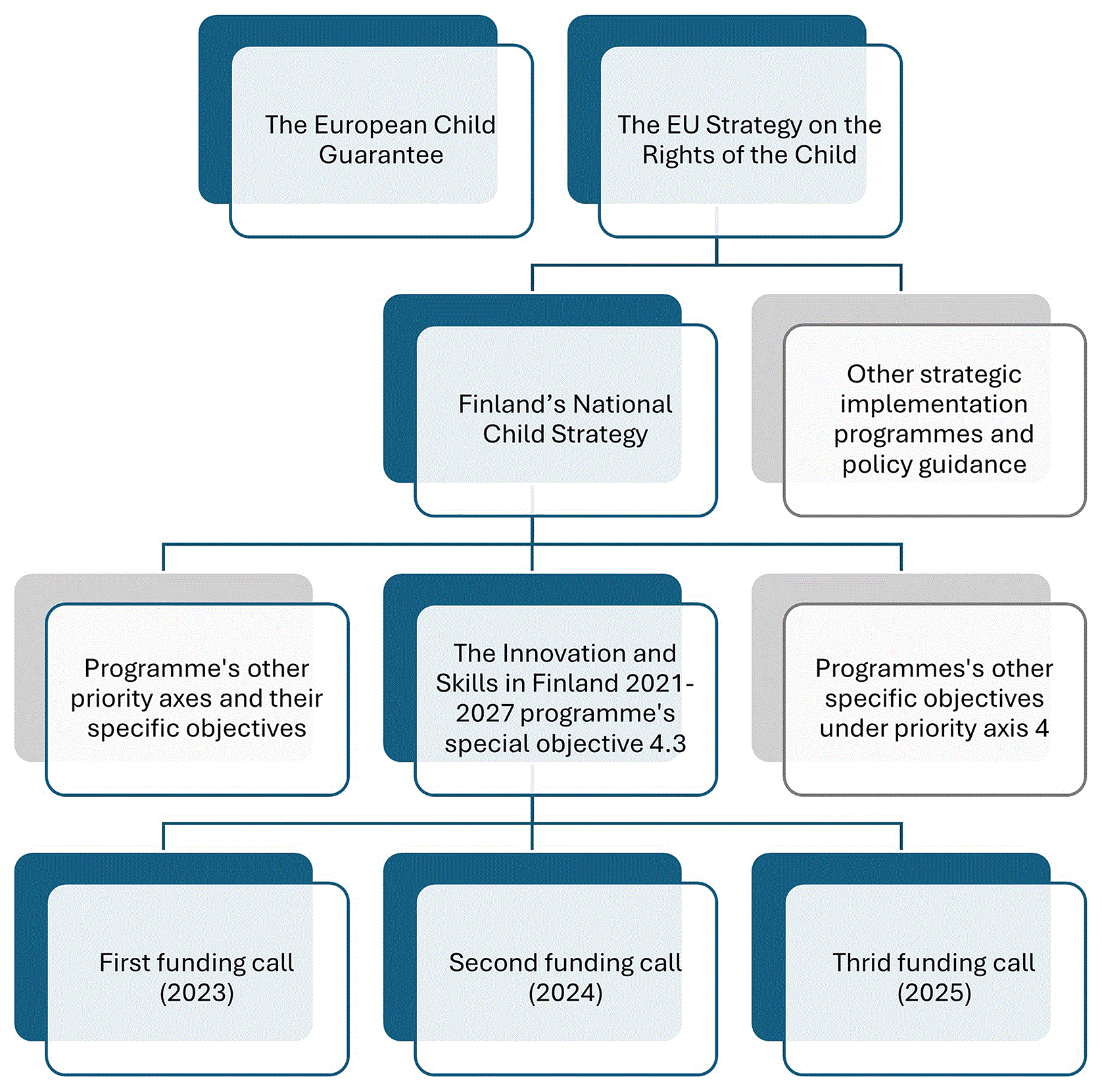
The analysis includes EU-level policy documents (EU Strategy on the Rights of the Child ( European Commission, 2021a) and the council recommendation of establishing a European Child Guarantee ( European Commission, 2021b)) and national-level policy documents (Finland’s National Child Strategy (Finnish Government, 2021) and the Innovation and Skills in Finland 2021–2027 programme (Ministry of Economic Affairs and Employment of Finland, 2023)). Unless otherwise specified, references to EU-level or national-level policy strategies in the analysis refer to these document groups. The programme’s national theme Equality of the children, young people and families (Ministry of Economic Affairs and Employment of Finland, 2022b), as well as the three national funding calls launched under this objective (Häme ELY Centre, 2023, 2024, 2025) are collectively referred to as funding calls. The strategic hierarchy of the analysed documents is illustrated on Figure 1.

d8fa9736-71ae-4119-b0c9-149da2a93939_figure1.gif

Figure 1. Strategic hierarchy of child rights policies in the EU and Finland.

Analysed documents are highlighted.

The analysis focuses on special objective 4.3, which explicitly aims to operationalise the National Child Strategy through development funding. As such, it provided a relevant case for examining how EU-level children’s rights strategies are translated into national funding instruments. The Innovation and Skills in Finland 2021–2027 programme guides ESF+ project funding and complements EU strategies. Together, these guiding documents form a coherent framework that is meaningful to examine as an integrated entity.

Analysis process

The qualitative documentary analysis was conducted deductively (Krippendorf, 2013), using the EU-level strategies as an analytical framework for examining the other documents included in the study. Document analysis is a structured, low-cost method for reviewing and evaluating data to generate empirical knowledge and deepen understanding. It is unobtrusive and nonreactive, requiring the researcher to maintain both objectivity and sensitivity throughout the process. (Bowen, 2009). The analytical framework consists of two complementary components:

  • 1. Thematic priorities derived from the EU Strategy on the Rights of the Child, based on 25 requests made by the European Commission to Member States. These requests were grouped into themes related to participation in democratic life, socioeconomic inclusion and equal opportunities, healthcare, education, protection from violence, child-friendly justice, and the digital environment. Actions assigned exclusively to EU institutions or private information and communication technology (ICT) actors were excluded.

  • 2. Service-oriented commitments set out in the ECG, specifically the six core service guarantees: (a) combating child poverty and social exclusion; (b) early childhood education, general education, and healthcare; one to access to nutrition and housing; one to the governance and reporting; and one to monitoring and evaluation.

In this study, the term operationalised refers to the explicit reflection of strategic priorities in policy documents or funding calls, not to their implementation or effectiveness in practice.

Finland’s National Child Strategy and the Innovation and Skills in Finland 2021–2027 programme were first examined against this analytical framework. Subsequently, three ESF+ funding calls under specific objective 4.3 were analysed using the same criteria.

To enhance analytical transparency, Table 1 provides an illustrative example of how EU-level children’s rights commitments were translated into analytical categories and examined across national policy documents and funding calls. The table is intended to demonstrate the analytical procedure rather than to present the full set of findings.

Table 1. Illustrative example of the analytical procedure.

Analytical stepEU sourceAnalytical categoryExample from national documentInterpretation
Identification of EU requestEU Strategy on the Rights of the ChildChild participation“Children’s participation will be addressed systematically …”EU-level participation priority reflected in national strategy
Identification of EU commitmentEuropean Child GuaranteeAccess to healthcareNo explicit reference in funding callsCommitment not visibly operationalised at funding level

Findings

The findings highlight both areas where EU-level children’s rights priorities are reflected in national strategies and funding calls, and areas where they remain unaddressed or only implicitly present. The results are presented in relation to (1) the EU Strategy on the Rights of the Child, (2) the ECG, and (3) the ESF+ funding calls under specific objective 4.3.

Reflections of the EU Strategy on the Rights of the Child in national policy documents

Several thematic priorities of the EU Strategy on the Rights of the Child are reflected in Finland’s National Child Strategy and in the Innovation and Skills in Finland 2021–2027 programme. These include participation in political and democratic life, access to healthcare, inclusive and quality education, protection from violence, and a safe digital environment. However, the theme of child-friendly justice – which includes recommendations such as supporting judicial training, promoting restorative justice, and implementing the Council of Europe guidelines on children with imprisoned parents – is not addressed in national documents. Other themes, such as the digital environment, are addressed at a general level but are not consistently connected to child-specific recommendations articulated in the EU Strategy.

Table 2 illustrates through examples how selected themes of the EU Strategy on the Rights of the Child are reflected in Finland’s National Child Strategy and the Innovation and Skills in Finland 2021–2027 programme, highlighting both areas of convergence and omission.

Table 2. Correspondence between the themes of the EU Strategy on the Rights of the Child and their reflections in Finland’s National Child Strategy and the Innovation and Skills in Finland 2021–2027 programme: illustrative examples from the analysis.

Theme of the EU Strategy on the Rights of the ChildExpression in the National Child StrategyExpression in the Innovation and Skills in Finland 2021–2027 programme
Participation in political and democratic lifeChildren’s rights and status will be mainstreamed, ensuring that children are consistently taken into consideration in all policies and activities alongside with other members of society and that they are informed of their rights.Development of citizen-oriented activities and community-based services, along with the promotion of participation by minority and special groups in service planning. (Priority 4. Specific objective 4.3 equitable inclusion.)
Socio-economic inclusion, health and education: Building inclusive, quality educationThe preconditions for children’s learning and development as well as support for school attendance, the work of educational and teaching staff, and pupil and student welfare services will be secured. The realization of multidisciplinary cooperation must be ensured to provide adequate holistic support for children and families. Existing means will be used, and new ones will be sought with a multidisciplinary approach, to prevent dropping out and social exclusion. Particular attention will be paid to the transition stages of education. The possibility of completing at least a secondary level qualification following basic education will be secured for each child.Models are developed to increase the diversity competence of education providers and employers. The needs of the disabled are considered, e.g. in the preparation of training materials and in the accessibility of communication and services. Equality and equality planning is being developed so that challenges can be better met in education and working life, e.g. segregation and the effects of stereotypes. (Priority 2.4.2 Specific objective 4.g New skills for working life.)
Digital and information societyThe importance of the digital environment for children’s close and peer relationships will be recognized, and children’s media and interaction skills will be built up, also in relation to electronic communication.Digital services are developed to be customer-oriented, secure and make extensive use of digital opportunities. Digitalization of the public sector and bold experiments bring a significant boost to the functioning of ecosystems. (Priority 2.1.2 Specific objective 1.ii Exploiting the benefits of digitization for citizens, companies and public administration.)

Visibility of the European Child Guarantee in national strategies and ESF+ funding

The ECG establishes six core service guarantees aimed at reducing child poverty and ensuring access to essential services. The analysis shows that several of these guarantees (particularly those related to child poverty and exclusion, early childhood education, and inclusive education) are explicitly addressed in Finland’s National Child Strategy and, to a lesser extent, in the Innovation and Skills in Finland 2021–2027 programme.

However, the visibility of ECG commitments weakens substantially at the level of ESF+ funding calls under specific objective 4.3. Guarantees related to healthy nutrition, adequate housing, and child-specific healthcare are largely absent from the analysed funding calls, despite their central role within the ECG framework. While Finland may address these needs through other policy instruments and universal service systems, their absence from ESF+ funding calls limits the visibility of these rights within this funding framework and constrains opportunities for targeted development through project funding.

Table 3 summarises how the six core service guarantees of the European Child Guarantee are reflected across the National Child Strategy and programme-level guidance.

Table 3. Correspondence between the themes of the ECG and their reflections in Finland’s National Child Strategy and the Innovation and Skills in Finland 2021–2027 programme: illustrative examples from the analysis.

ECG service guaranteeExpression in the National Child StrategyExpression in the Innovation and Skills in Finland 2021–2027 programme
Combating child poverty and social exclusionPoverty among families with children will be reduced through determined measures taken across society. Ensuring an adequate income for families with children and reducing poverty among them will be highlighted as a priority in the development of social security.Intergenerational marginalization and poverty are prevented by supporting families and promoting parents’ participation in education and working life. Support for low-income families is strengthened through multiprofessional collaboration, and children’s participation is promoted by guiding them into leisure activities. Existing structures, such as local and regional family and adult social work, are utilized in these measures. Young people are supported holistically on their pathways to education and working life, and their functional capacity and capabilities are strengthened, for example through psychosocial means. (Priority 4. Specific objective 4.3 equitable inclusion.)
Early childhood education, inclusive education and school-based activities (including healthy meals)In the Finland of the vision, high-quality, equal and diverse early childhood education and care and education will help realise the child’s right to growth, development and learning.Gender equality is promoted by dismantling and addressing structures that maintain gender-based segregation in educational and career pathways. (Priority 2.1.2 Specific objective 1.ii Exploiting the benefits of digitization for citizens, companies and public administration.)
Gender equality and the reduction of segregation in education and working life are supported. (Priority 2.4.1 Specific Objective 4.1: Pathways to work.)
Educational structures and learning environments that enable continuous learning, as well as pedagogy that supports learning, are developed. (Priority 2.4.2 Specific objective 4.g New skills for working life.)
Access to healthcareTo improve the effectiveness of social welfare and healthcare services, cooperation with education, leisure services and various organisations will be strengthened.Services and support measures based on the needs of children and young people are developed to be easily and quickly accessible. These services are produced locally in multi-actor networks, while listening to the needs of children and young people. Such services may include, for example, mental health and substance abuse services; smooth healthcare processes; support for participation and leisure activities through cultural and sports activities; support in studies and applying for education; support for coping with everyday life, housing, and household management; and support for employment and transitions into working life. (Priority 2.5.1 Specific objective 5.1 Safety nets for the future of young people.)
Access to healthy nutritionSecuring an adequate standard of living and social security for families with children and reconciling work and family life.In its 2019 country-specific recommendations, the Commission recommends that Finland mitigate material deprivation by distributing food to the most deprived and by providing accompanying measures. These measures also contribute to supporting the principle of equal opportunities under the European Pillar of Social Rights. (Priority 6. Specific Objective 6.1: Material assistance.)
Access to adequate housingSecuring an adequate standard of living and social security for families with children and reconciling work and family life.Services and support measures based on the needs of children and young people are developed to be easily and quickly accessible. These services are produced locally in multi-actor networks, while listening to the needs of children and young people. Such services may include, for example, mental health and substance abuse services; smooth healthcare processes; support for participation and leisure activities through cultural and sports activities; support in studies and applying for education; support for coping with everyday life, housing, and household management; and support for employment and transitions into working life. (Priority 5. Specific objective 5.1 Safety nets for the future of young people.)
Governance, monitoring, and evaluationChildren’s equality will be promoted through systematic measures. Data on wellbeing gaps and their causes will be collected and utilised, and measures that are as effective as possible and respect the rights of the child will be taken to narrow these gaps.no expression

Nationally specific priorities extending EU-level frameworks

In addition to themes originating from EU-level strategies, the analysis identified two nationally specific priorities that extend beyond the explicit thematic framing of both the EU Strategy on the Rights of the Child and the ECG. First, the promotion of family-friendliness and reconciliation of work, studies, and family life, emerges as a distinct national priority. This theme is embedded throughout Finland’s National Child Strategy and is strongly reflected in ESF+ funding calls, particularly those focusing on parenting support, low-threshold family services, and support for diverse family forms. Although EU-level strategies address equality, inclusion, and social participation, they do not frame family-friendliness as a standalone policy priority. In the Finnish context, however, this theme is elevated to a strategic objective and actively operationalised through development funding.

Second, children’s right to meaningful leisure time and hobbies constitutes a further national priority. This theme is particularly visible in the third ESF+ funding call under specific objective 4.3, which emphasises equal access to cultural, artistic, and sports activities and the promotion of leisure-time participation during the school day. While elements related to well-being and participation are present in EU-level strategies, the explicit focus on leisure activities as a children’s rights issue reflects national policy choices and contextual considerations rather than direct EU-level prioritisation.

These nationally specific priorities should not be interpreted as deviations from EU objectives. Rather, they represent legitimate national extensions and contextualisation of shared children’s rights commitments, reflecting domestic policy agendas, demographic considerations, and existing welfare structures.

ESF+ funding calls under specific objective 4.3

The three ESF+ funding calls issured under theme Developing services for children, youth and families and promoting well-being towards equality place strong emphasis on participation, inclusion, and competence development. Across the calls, priorities include strengthening parental support, promoting children’s and young people’s participation in leisure activities, and enhancing professionals’ capabilities through cross-sectoral collaboration.

At the same time, several EU-level themes remain unaddressed at the level of funding calls. Child-friendly justice is entirely absent, and commitments related to child-specific healthcare, digital safety, healthy nutrition, and adequate housing are only weakly or indirectly referenced. This pattern suggests that while ESF+ funding under objective 4.3 effectively operationalises selected national and EU priorities, it also contributes to a selective interpretation of children’s rights commitments within development funding.

Table 4 provides illustrative examples of how themes from the EU Strategy of the Rights of the Child are reflected across the three ESF+ funding calls.

Table 4. Key contents of ESF+ funding calls in relation to guiding strategies.

Strategic documentFirst call (2023)Second call (2024)Third call (2025)
EU Strategy on the Rights of the Child Promoting the well-being and inclusion for vulnerable children, youth and families in everyday life.

Strengthening professionals’ skills across sectors and developing early childhood education and care (ECEC) and education.
Development of primary services and flexible models to support family functioning and participation.Strengthening mental health and community belonging. Equal access to arts and cultural heritage. Activities organized in cooperation with schools and educational institutions.
European Child Guarantee (ECG) Cross-sectoral cooperation to promote family well-being, parent’s education and working, and prevent child poverty.

Development of inclusive guidance, support practices, and language awareness in ECEC and all levels of education. Strengthening professionals’ competence and cross-sectoral collaboration to support children, youth and families from diverse linguistic and cultural backgrounds.
Addressing intergenerational exclusion and supporting protective factors in children’s development.

Integration of child and youth perspectives into adult services.

Strengthening professionals’ skills in empowering guidance.
Focus on groups at risk of social exclusion.

Children and young people’s participation in cultural activities and workshops.

Activities are organized in collaboration with schools and educational institutions.
Finland’s National Child Strategy Supporting children, young people and their families for equal participation in cultural and leisure activities.
Development of primary services and models for holistic family support, especially supporting parents’ and families’ active participation and agency in education and labour.

Strengthening youth guidance and developing methods to enhance parents’ ability to support children and youth in engaging with cultural, sports and leisure activities.
Strengthening parenting support across diverse family structures and life stages. Multisectoral cooperation in family services.

Development of primary services, support and flexible models to strengthen:
- systematic parenting support within wellbeing services
- co-creation of family-centred and multidisciplinary support
- recognition of family diversity, gender equality and inclusion in parenting
- support for parents in life transitions and crises
- prevention of regional segregation and family isolation through community-based and peer support in everyday environments
Promoting youth well-being, mental health and community belonging through free hobbies during school days. Activities must base on youth preferences.

Using the best practices from the Finnish Model for Leisure Activities.

Discussion

Discussion of findings

Strategic recommendations and national priorities addressed by ESF+ funding

From a children’s rights perspective, the absence of explicit policy attention has tangible implications for how children’s needs are recognised and prioritised. The operationalisation of ESF+ funding in Finland is influenced not only by EU-level strategies but also by national political priorities, particularly those outlined in the Government Programme a Strong and Committed Finland (Finnish Government, 2023). National strategies are prepared through multi-actor processes involving ministries, expert bodies, and, in some cases, participatory mechanisms for children and young people, which also influence prioritisation. As demonstrated in this study, ESF+ funding calls under specific objective 4.3 do not aim to comprehensively reflect all priorities articulated in EU strategies and national policy documents, but rather emphasise selected recommendations considered particularly relevant in the Finnish policy context.

The emphases are closely connected to Finland’s demographic development, where population growth is projected to slow and decline (see Alho & Valkonen, 2024), while labour supply challenges are expected to intensify. In this context, ESF+ funding has been strategically directed towards initiatives that promote inclusion, participation, and competence development among children, young people, and families in vulnerable situations.

The Government Programme highlights the importance strengthening democracy, participation, and social cohesion, with a specific focus on children and young people. Previous research underscores the need to address inequality and structural barriers within Finnish education and early childhood education and care. For example, Helakorpi et al. (2023) demonstrate that students with immigrant backgrounds in Nordic countries face increased risk of discrimination, bullying, and educational discontinuation. Similarly, Loukola (2023) identifies manifestations of racism and white normativity in Finnish early childhood education, while also noting professionals’ willingness to develop more inclusive practices. These findings provide important contextual grounding for understanding why inclusion-oriented priorities have been foregrounded in ESF+ funding.

The first and third ESF+ funding calls under specific objective 4.3 emphasised guidance for children and young people in cultural, sports, and structured leisure activities. These calls supported the development and piloting of supervised leisure activities in arts, culture, and sports for young people aged 15–19, as well as cultural activities for children aged 7–19. This focus reflects the Government Programme’s identification of physical inactivity as a significant societal challenge. Only one in three children and young people in Finland engage in sufficient physical activity to maintain health, with far-reaching consequences for learning, work capacity, national defence, and the economy. The estimated annual societal cost of physical inactivity is approximately €3.2 billion.

To address these challenges, the Government calls for a comprehensive, cross-sectoral approach starting in early childhood services. It aims to ensure that every child and young person has access to at least one meaningful leisure activity of their choice, with special attention to those without a hobby or who have dropped out. Initiatives such as the national Schools on the Move programme (LIKES, 2025) support these objectives, including mapping opportunities for leisure activities during school holidays.

In parallel, ESF+ funding has contributed to sustaining cultural and sports services at time when the Ministry of Education and Culture faces approximately €125 million in funding cuts to subsidies affecting the independent arts and culture sector (Sokka & Nokela, 2025). This raises the question of whether, in this context, ESF+ funding may also partly function not only as a social inclusion instrument but also as a means of supporting cultural infrastructure relevant to children and young people.

National Child Strategy priorities and ESF+ funding

Although the implementation plan of Finland’s National Child Strategy (Finnish Government, 2022) extends beyond individual government terms, the ESF+ funding calls under objective 4.3 reflect several of its core priorities. These include strengthening family-friendly policies, supporting the reconciliation of work, studies, and family life, and recognising the diversity of families. The second funding call focused on parenting support and low-threshold services for families, reflecting priorities from both the National Child Strategy and the Government Programme. The Government aims to provide low-threshold services for families, with attention to couple and parenting support, the best interests of the child, and the individual circumstances of families, with particular attention to the challenges faced by families with small children, single parents, student families, and families with multiple children.

Despite Finland’s comparatively strong position in terms of gender equality and women’s labour market participation, socioeconomic and cultural differences between families continue to affect children’s well-being. European research (e.g. Dewilde, 2025) highlights the individual and societal impacts of child poverty and socioeconomic disadvantage. Preventing the intergenerational transmission of disadvantage (see Dewilde, 2025) can been influenced, for instance, through strategic allocation of funding.

Strategic gaps and unaddressed themes

While many EU and national priorities are reflected in the ESF+ funding calls, the analysis also reveals significant gaps. One overarching theme, child-friendly justice, is entirely absent from the analysed national strategies, thematic descriptions, and funding calls. However, the government’s shared learning platform eOppiva (HAUS, n.d.), includes several modules on child-friendly justice, and is widely used across sectors, including municipalities and educational institutions.

In addition, several core elements of the ECG, including explicit references to access to adequate nutrition, adequate housing, and comprehensive child-specific healthcare, receive limited or no attention in the analysed documents. These omissions do not imply that such needs are not addressed elsewhere within Finnish policy or service systems. Finland provides free school meals to all children in comprehensive education, thereby responding to the ECG’s recommendation of ensuring access to at least one healthy meal each school day. Moreover, issues related to child poverty and nutrition are addressed within other ESF+ priority axes, such as priority axis 6 (Combating material deprivation), which were outside the scope of this analysis.

It is important to notice, that the present analysis does not assess the availability ir quality of child health services in Finland. Rather, it examines how child-related health commitments are articulated or remain implicit within selected EU- and national-level strategy documents and ESF+ funding calls. At the EU-level, previous research has raised concerns regarding the practical realisation of the health-related aims of the ECG, particularly for children in vulnerable situations (Rigby, 2021). These discussions highlight broader challenges in translating child health commitments into concrete measures across governance levels. In this study, references to health-related gaps should therefore be understood as observations about the visibility of such commitments within selected funding frameworks, rather than as assessments of national service provision.

Digitalisation, despite its prominence in national strategies, is not clearly visible in the examined funding calls. This may be since EU-level recommendations have already been extensively operationalised in Finland. Digital competence is embedded in national education steering documents, and the Ministry of Education and Culture, together with the Finnish National Agency for Education, actively promotes digitalisation. Strategic goals include ensuring digital skills for all, fostering innovation, and positioning Finland as a global leader in technology education. These goals are supported by initiatives such as alignment papers on digitalisation in education (see Berisha et al., 2023). Thus, Finland has invested in digitalisation in other forums than funding of ESF+. Despite Finland’s progressive approach to digitalisation, certain risks remain concerning digital safety, as well as the accessibility and equity of increasing digitalised services (cf. Alexopoulou, 2025). In Finland, the entertainment-oriented media use of digitally native children and youth during leisure time may not be in balance with the pedagogical use of digital platforms in education (Mertala, 2020). Investing in the digital skills and safety of vulnerable groups – especially children – would be of considerable importance.

However, from a children’s rights perspective, the absence of these themes within the analysed funding framework remains significant. Funding calls influence what types of development work are prioritised and how children’s needs are conceptualised within institutional boundaries. When certain rights-related themes are consistently omitted from funding instruments framed as promoting inclusion and equality, there is a risk that these issues remain less visible in cross-sectoral development efforts.

Fragmentation, strategic coherence, and accountability

EU child rights strategies function primarily as normative and coordinative instruments: while they articulate shared objectives and principles, responsibility for prioritisation, service organisation, and funding allocation remains largely at the national and sub-national levels, in line with the principles of subsidiarity and proportionality.

The ESF+ is the EU’s main instrument for investing in people and supporting the implementation of the European Pillar of Social Rights. With a budget of €142.7 billion for the period 2021–2027, the ESF+ provides a substantial contribution to the EU’s employment, social, education and skills policies, including structural reforms in these areas. (European Commission, n.d.) Given its scale and policy significance, it is justified to examine how ESF+ funding allocation contributes to the operationalisation of key strategic objectives related to children’s rights.

As Rapley (2021) notes, documents do not merely describe realities but actively produces them, and the realities they construct have tangible effect. In this study, these effects are traced through documentary analysis, as they are presumed to have great importance for the realisation and visibility of children’s rights within funding processes.

The analysis revealed that while EU-level strategies provide a broad normative framework, their operationalisation at the national level is shaped by country-specific needs, priorities, and governance structures. Finland’s approach reflects this dynamic: although numerous strategies exist across different administrative levels – European, Nordic, and national – not all are fully integrated into the National Child Strategy, nor is such integration necessarily required. National programming must remain responsive to domestic contexts and policy needs.

However, the fragmented nature of strategic guidance raises questions about coherence, coordination, and accountability in the operationalisation of children’s rights. When multiple strategies intersect without a clear overarching framework, it becomes difficult to assess whether the entirety of the strategic landscape is truly governed or understood by any single actor. From a children’s rights perspective, this fragmentation may pose ethical and practical concerns. If the totality of funding allocated to children is not examined holistically, there is a risk that certain priorities, such as child-friendly justice, remain consistently outside the scope of development funding, not due to deliberate policy choices but because they fall between institutional mandates. Such omissions are particularly relevant in the context of EU-level commitments that emphasise equality among children across Member States.

At the same time, the findings no not suggest that national prioritisation is inherently problematic, nor that EU-level strategies should override domestic decision-making. On the contrary, the localisation of international and European commitments is both necessary and legitimate. However, from a children’s rights perspective, consistent omissions of certain rights-related themes raise concerns about whether all children’s needs are equally visible within funding instruments that explicitly aim to promote inclusion and well-being. The funding priorities observed reflect a view of children primarily as future learners and participants, rather than as rights-holders with immediate and diverse needs.

Finally, these observations raise broader questions about how the best interests of the child and the rights enshrined in the UNCRC are balanced against broader economic, demographic, and political considerations in funding decisions. If allocation decisions are driven primarily by economic imperatives, there is a risk that normative commitments to children’s rights receive less systematic attention. Addressing these tensions requires not uniformity across governance levels, but greater transparency regarding prioritisation and clearer accountability for how children’s rights are operationalised in multi-level funding frameworks.

Differences between EU-level strategies and national or local policy priorities should therefore not be interpreted as failures of implementation. Rather, they may reflect necessary processes of localisation, translation, and adaptation pf children’s rights commitments to distinct social, cultural, and institutional contexts. In this context, concerns about strategic coherence do not imply that domestic demographic or political considerations should be subordinated to EU-level priorities; rather, they highlight the need for transparency regarding how children’s rights considerations are weighed alongside other legitimate national objectives.

Limitations and further research

As document analysis typically involves data not originally produced for research purposes, the data are independent of the researcher and may present limitations in terms of scientific rigor (Voutilainen et al., 2018). As a subjective interpreter of such data, the researcher must ensure analytical transparency and methodological rigor throughout the process (Bowen, 2009). One challenge in this study was the structural heterogeneity of the documents. Reliability was strengthened through researcher triangulation, careful documentation, and ensuring transparency in each phase of the analysis process.

The scope of this study was deliberately limited to the theme Development of services for children, young people and families and promotion of well-being towards equality under the specific objective 4.3 in the Innovation and Skills in Finland 2021–2027 programme. While other priority axes and objectives were excluded from detailed analysis, a light comparison was conducted, acknowledging that goals of the EU strategies may also be addressed through measures beyond objective 4.3.

The generalisability of the findings should be approached with caution, as the implementation of the UN Convention on the Rights of the Child varies across national strategies (Powell & Muddiman, 2024). However, the inclusion of both European strategies and national programming documents enhances the reliability and broader relevance of the results.

As the Innovation and Skills in Finland 2021–2027 programme period progresses, further analysis will be conducted on the project plans of funded projects under the theme of Development of services for children, young people and families and promotion of well-being towards equality. These reviews will reflect the strategic documents discussed in this article. In time, it will also be possible to assess the practical operationalisation of children’s rights in line with EU strategies and evaluate the outcomes of the funded projects. Future research should explore how strategic coherence and rights-based prioritisation can be strengthened in multi-level governance contexts, ensuring that no essential aspect of children’s well-being is left behind.

Conclusion

The findings reflect both significant progress in advancing children’s rights and persistent fragmentation across strategies and funding frameworks. This study highlights the complex interplay between EU-level strategic guidance and national priorities in the operationalisation of ESF+ funding. While Finland has actively aligned its funding calls with domestic policy goals – particularly in the areas of physical activity, cultural participation, and family support – certain EU-level themes, such as child-friendly justice and digital safety, remain underrepresented.

The findings underscore the need for improved strategic coordination and transparency in funding allocation. Ensuring that children’s rights are systematically and comprehensively addressed requires a more coherent approach across governance levels. Future efforts should focus on strengthening the visibility of underrepresented themes and enhancing the role of children’s rights in funding decision.

Ethics and consent

Ethical approval and consent were not required.

Data and software availability

Data are available under the terms of the Creative Commons Zero “No rights reserved” data waiver (CC0 1.0 Public domain dedication).

Source data

The European Child Guarantee: https://eur-lex.europa.eu/legal-content/EN/TXT/?uri=CELEX%3A32021H1004

Citation: European Commission (2021b). Council recommendation of establishing a European Child Guarantee (ST/9106/2021/INIT).

The EU Strategy on the Rights of the Child: https://eur-lex.europa.eu/legal-content/EN/TXT/?uri=celex:52021DC0142

Citation: European Commission (2021a). Communication from the Commission to the European Parliament, the Council, the European Economic and Social Committee and the Committee of the Regions EU strategy on the Rights of the Child (COM/2021/142).

Finland’s National Child Strategy: https://julkaisut.valtioneuvosto.fi/items/eb477644-6c32-48f9-bd3c-b60d80d782f8

Citation: Finnish Government (2022). Implementation plan for the National Child Strategy. Publications of the Finnish Government 2022:38.

The Innovation and Skills in Finland 2021–2027 progamme: https://rakennerahastot.fi/documents/ 91635434/120111163/Uudistuva+ja+osaava+Suomi+2021-2027+ohjelma.pdf/deb0126a-d68f-bc5d-5f2e-dac95d97a451/ Uudistuva+ja+osaava+Suomi+2021-2027+ohjelma.pdf?t=1684927591791

Citation: Ministry of Economic Affairs and Employment of Finland (2023). Innovation and skills in Finland 2021–2027 EU:n alue- ja rakennepolitiikan ohjelma.

First ESF+ funding call under the theme of development of services for children, young people and families and promotion of well-being towards equality: https://eura2021.fi/hakuilmoitukset/hakuilmoitus/dca16f9e-54ba-4afc-a90d-c30ec94fb400/

Citation: Häme ELY Centre (2023). Valtakunnallinen hankehaku: Lasten, nuorten ja perheiden palveluiden kehittäminen ja hyvinvoinnin edistäminen kohti yhdenvertaisuutta. [National funding call: Developing services for children, young people and families and promoting well-being towards equality].

Second ESF+ funding call under the theme of development of services for children, young people and families and promotion of well-being towards equality: https://eura2021.fi/hakuilmoitukset/hakuilmoitus/ed80cd96-355b-4ac5-9c05-554c98b73219/

Citation: Häme ELY Centre (2024). Valtakunnallinen hankehaku: Lasten, nuorten ja perheiden palveluiden kehittäminen ja hyvinvoinnin edistäminen kohti yhdenvertaisuutta. [National funding call: Developing services for children, young people and families and promoting well-being towards equality].

Third ESF+ funding call under the theme of development of services for children, young people and families and promotion of well-being towards equality: https://eura2021.fi/hakuilmoitukset/hakuilmoitus/01c1aeda-eb64-4032-a328-c542f3155f0a/

Citation: Häme ELY Centre (2025). Valtakunnallinen hankehaku: Lasten, nuorten ja perheiden palveluiden kehittäminen ja hyvinvoinnin edistäminen kohti yhdenvertaisuutta. [National funding call: Developing services for children, young people and families and promoting well-being towards equality].

References

  •  Alexopoulou S: Paradigm shift: exploring the impact of digital technologies on the welfare state through a systematic literature review. Social Policy Administration. 2025; 59(1): 135–157. Publisher Full Text
  •  Alho J, Valkonen T: Suomen väestökehitys 2025-2070. [Population development in Finland 2025–2070].ETLA Brief nro 148.ETLA Economic Research, 2024; Retrieved September 11, 2025. Reference Source
  •  Association of Finnish Local and Regional Authorities: Functions of municipalities and joint municipal authorities.2026; Retrieved May 19, 2026. https://www.localfinland.fi/functions-municipalities-and-joint-municipal-authorities
  •  Berisha AK, Francke L, Hakalisto L, et al.: Target state of digitalisation in early childhood education and care, pre-primary, primary and lower secondary education. Publications of the Ministry of Education and Culture, Finland. 2023; 54. Reference Source
  •  Blomgren J, Kiviruusu O, Parikka S, et al.: Mielenterveys. In Kestilä L, Karvonen S, editors. Ratkaisuja kestävän yhteiskunnan rakentamiseen. [Solutions for building a sustainable society. Population Health and Wellbeing Report 2025.] THL Reports 1:2025.Finnish Institute for Health and Welfare; 2025; pp. 42–46.
  •  Bowen GA: Document analysis as a qualitative research method. Qual Res J. 2009; 9: 27–40. Publisher Full Text
  •  Bucelli I, McKnight A: Review of the mechanisms underlying the intergenerational transmission of poverty.Itla Reports 2024:3.ItlaChildren’s Foundation; 2024. https://itla.fi/wp-content/uploads/2024/10/Review-of-the-mechanisms.pdf
  •  Dewilde C: The intergenerational transmission of financial disadvantage across Europe. Social Policy Administration. 2025; 59(3): 487–510. Publisher Full Text
  •  European Commission: Communication from the Commission to the European Parliament, the Council, the European economic and social Committee and the Committee of the regions EU strategy on the Rights of the Child (COM/2021/142).2021a. Reference Source
  •  European Commission: Council recommendation of establishing a European Child Guarantee (ST/9106/2021/INIT).2021b.
  •  European Commission: What is the ESF+? (n.d.) Retrieved September 11, 2025. Reference Source
  •  Finnish Government: National Child strategy committee report. Publications of the Finnish Government 2021:8.2021. Reference Source
  •  Finnish Government: Implementation plan for the National Child Strategy. Publications of the Finnish Government 2022:38.2022. Reference Source
  •  Finnish Government: A strong and committed Finland: programme of Prime Minister Petteri Orpo’s Government. Publications of the Finnish Government 2023:60.2023. Reference Source
  •  Hakalehto S: Constitutional protection of children’s rights in Finland. In: Haugli T, Nylund A, Sigurdsen R, et al., editors. Children’s constitutional rights in the Nordic countries. Brill; 2020; pp. 58–82. Publisher Full Text
  •  Häme ELY Centre: Valtakunnallinen hankehaku: Lasten, nuorten ja perheiden palveluiden kehittäminen ja hyvinvoinnin edistäminen kohti yhdenvertaisuutta. [National funding call: Developing services for children, young people and families and promoting well-being towards equality].2023; Retrieved September 11, 2025. Reference Source
  •  Häme ELY Centre: Valtakunnallinen hankehaku: Lasten, nuorten ja perheiden palveluiden kehittäminen ja hyvinvoinnin edistäminen kohti yhdenvertaisuutta. [National funding call: Developing services for children, young people and families and promoting well-being towards equality].2024; Retrieved September 11, 2025. Reference Source
  •  Häme ELY Centre: Valtakunnallinen hankehaku: Lasten, nuorten ja perheiden palveluiden kehittäminen ja hyvinvoinnin edistäminen kohti yhdenvertaisuutta. [National funding call: Developing services for children, young people and families and promoting well-being towards equality].2025; Retrieved September 11, 2025. Reference Source
  •  HAUS: Learning is for everyone.(n.d.) Retrieved September 11, 2025. Reference Source
  •  Heimer M, Palme J: Rethinking child policy post-UN Convention on the Rights of the Child: vulnerable children’s welfare in Sweden. Journal of Social Policy. 2016; 45(3): 435–452. Publisher Full Text
  •  Helakorpi J, Dovemark M, Rasmussen A, et al.: Positions of newly arrived students in Nordic education policies and practices. Nordic Studies. Education. 2023; 43(2): 111–127. Publisher Full Text
  •  Kauppinen TM, van Ham M , Bernelius V: Understanding the effects of school catchment areas and households with children in ethnic residential segregation. Housing Studies. 2022; 37(9): 1625–1649. Publisher Full Text
  •  Kesanto-Jokipolvi H, Vuorenmaa M, Klemetti R: Vauvaperheiden vanhempien kokemukset lapsiperheiden palvelujen riittävyydestä vaihtelevat hyvinvointialueen ja vanhempien taustatekijöiden mukaan. Finnish Institute of Health and Welfare (THL). 2023. https://www.julkari.fi/server/api/core/bitstreams/1aab5ee1-0606-43e3-b00a-ed354ee9b2ee/content
  •  Kiviruusu O, Ranta K, Lindgren M, et al.: Mental health after the COVID-19 pandemic among Finnish youth: a repeated, cross-sectional, population-based study. Lancet Psychiatry. 2024; 11(6): 451–460. PubMed Abstract | Publisher Full Text
  •  Krippendorf K: Content analysis. An introduction to its methodology. Sage: London;2013. Publisher Full Text
  •  LIKES Concept: Concept: Schools on the move.LIKES Research Centre for Physical Activity and Health.2025; Retrieved September 11, 2025. Reference Source
  •  Loukola S: “Not in our daycare”? Commitments and obstacles to antiracism in finnish ECEC. Early Child Educ J. 2023; 53: 11–19. Publisher Full Text
  •  Lundy L: Children’s rights and educational policy in Europe: the implementation of the United Nations Convention on the Rights of the Child. Oxf Rev Educ. 2012; 38(4): 393–411. Publisher Full Text
  •  Lyons D: Domestic implementation of the donor-conceived child’s right to identity in light of the requirements of the UN Convention on the Rights of the Child. Int J Law Policy Family. 2018; 32(1): 1–26. Publisher Full Text
  •  Mertala P: Paradoxes of participation in the digitalization of education: a narrative account. Learn Media Technol. 2020; 45(2): 179–192. Publisher Full Text
  •  Ministry of Economic Affairs and Employment of Finland: European Social Fund plus (ESF+).2022a; Retrieved September 11, 2025. Reference Source
  •  Ministry of Economic Affairs and Employment of Finland: Development of services for children, young people and families and promotion of well-being towards equality.2022b; Retrieved September 11, 2025. Reference Source
  •  Ministry of Economic Affairs and Employment of Finland: Innovation and skills in Finland 2021–2027 EU:n alue- ja rakennepolitiikan ohjelma.2023; Retrieved September 11, 2025. Reference Source
  •  Ministry of Social Affairs and Health: Health and social services.Retrived May 19, 2026. Reference Source
  •  Padovan D: Social capital, lifestyles and consumption patterns. In Tukker A, Charter M, Vezzoli C, et al., editors. System Innovation for Sustainability 1: Perspectives on Radical Changes to Sustainable Consumption and Production.Greenleaf Publishing; 2008; pp. 271–287.Publisher Full Text
  •  Powell R, Muddiman E: State-civil society relations. The importance of civil society for the implementation of the United Nations Convention on the Rights of the Child. The International Journal of Children’s Rights. 2024; 32: 1–26. Publisher Full Text
  •  Pulkkinen J, Hildén R, Ketonen L, et al.: Arviointiuudistuksen alkutaipaleella: Perusopetuksen päättöarviointitutkimuksen loppuraportti [First stages of the restructuring of final assessments in comprehensive school education: Final report of the research project].Publications of the Ministry of Education and Culture: Ministry of Education and Culture ; 2024: 6. Reference Source
  •  Rapley T: Doing conversation, discourse and document analysis. London: SAGE;2021. Publisher Full Text
  •  Read S, Salmela-Aro K, Kiuru N, et al.: The cohort trends of social connectedness in secondary school students in Finland between 2017 and 2021. PLoS One 2024; 19(10): e0312579. Publisher Full Text
  •  Rigby MJ: European Union Child Guarantee – challenges raised by the welcome promise of free healthcare for marginalized children. European Journal of Public Health. 2021; 31(5): 943–950. PubMed Abstract | Publisher Full Text | Free Full Text
  •  Saikkonen P, Rotko T, Vaalavuo M: Kestävä yhteiskunta – tekemistä vaille valmis. [Sustainable society – ready to do.] Yhteiskuntapolitiikka. 2025; 90(3): 299–305.
  •  Salonen AO: Sustainable development and its promotion in a welfare society in a global age.University of Helsinki, Faculty of Behavioral Sciences; 2010. Research Report 318.
  •  Skivenes M, Søvig KH: Child rights and international discrimination law. Implementing article 2 of the Unites Nations Convention on the Rights of the Child. Routledge Research in International Law;2019. Reference Source
  •  Sokka S, Nokela S: Katsaus taiteen ja kulttuurin vapaan kentän rahoitusleikkauksiin ja niiden alueelliseen kohdentumiseen. [Review of funding cuts in the independent arts and culture sector and their regional allocation]Center for Cultural Policy Research; 2025; Retrieved September 11, 2025. Reference Source
  •  Tolonen H: Children’s right to participate and their developing role in finnish proceedings. In: Haugli T, Nylund A, Sigurdsen R, et al., editors. Children’s constitutional rights in the Nordic countries. Brill; 2020; pp. 225–248. Publisher Full Text
  •  Tolonen H, Koulu S, Hakalehto S: Best interests of the child in finnish legislation and doctrine: what has changed and what remains the same? In: Haugli T, Nylund A, Sigurdsen R, et al., editors. Children’s constitutional rights in the Nordic countries. Brill; 2020; pp. 159–184. Publisher Full Text
  •  UNICEF Innocenti – Global Office of Research and Foresight. Innocenti Report Card 19: Child well-being in an unpredictable world. Florence: UNICEF Innocenti; 2025. Reference Source
  •  United Nations: Convention on the Rights of the Child. Treaty Series. 1989; 1577. Reference Source
  •  United Nations: Transforming our world: the 2030 agenda for sustainable development. A/RES/70/1. 2015.
  •  Voutilainen A, Kapanen S, Kangasniemi M: Division of work in documents of the Ministry of Social Affairs and Health – document analysis. Journal of Social Medicine. 2018; 55: 212–224. Publisher Full Text
  •  Weckström E, Lastikka A-L, Havu-Nuutinen S: Constructing a Socially Sustainable Culture of Participation for Caring and Inclusive ECEC. Sustainability. 2022; 14(7): 3945. Publisher Full Text