Introduction
As a political initiative, the European Commission introduced the European Union (EU) Strategy on the Rights of the Child ( European Commission, 2021a) and the European Child Guarantee (ECG) ( European Commission, 2021b) to advance children’s rights and strengthen protection. Adopted in 2021, the ECG forms part of the EU’s broader social rights agenda, which aims to reduce the number of people at risk of poverty or social exclusion by at least 15 million by 2030 – of whom at least 5 million should be children. Achieving this goal requires targeted measures for children in vulnerable situations and calls on Member States to ensure access to essential services.
This study was produced as part of the work of coordination project Coordinating the participation and inclusion of children, young people and families, which supports national and regional projects under specific objective 4.3 (equitable inclusion) of the Innovation and Skills in Finland 2021–2027 programme. The programme falls under priority area 4 of the EU cohesion policy (A competent and inclusive Finland that provides work). The coordination project, funded by the European Social Fund Plus (ESF+), is implemented in cooperation by two organisations (SOS Children’s Village and Youth Academy) and one government agency (the Finnish National Agency for Education) under the guidance of the Ministry of Education and Culture. While this study focuses on specific objective 4.3, we acknowledge that efforts to promote children’s rights extend across the broader programme and beyond.
Previous research has examined the operationalisation of the United Nations Convention on the Rights of the Child (UNCRC) in Finland (Hakalehto, 2020; Tolonen, 2020; Tolonen et al., 2020) and more broadly in Europe (ia. Heimer & Palme, 2016; Lyons, 2018; Powell & Muddiman, 2024). Some studies have also addressed the UNCRC’s integration into EU policy (Lundy, 2012; Skivenes & Søvig, 2019). However, the visibility of UNCRC-based strategies in EU-funded projects appears not to have been systematically studied. This study explores whether national authorities have allocated funding in ways that reflect international human rights obligations and strategic priorities at both EU and national levels. A critical review of these practices can inform the future use of financial instruments and improve project coordination in upcoming programming periods.
In Finland, services for children and families are organised as part of a universal, publicly funded welfare system. Municipalities are responsible for providing core services such as early childhood education and care, primary and secondary education, and basic social and health services, while wellbeing services counties organise more specialised social and health care, including child protection and family support services. The Finnish system is grounded in the principles of universality, equity and early intervention via preventive services. National strategies and legislation guide the overall framework, while local authorities retain considerable autonomy in service operationalisation (Ministry of Social Affairs and Health, 2026; Association of Finnish Local and Regional Authorities, 2026).
Despite the overall strong welfare system, inequalities between children and families have grown (Kauppinen et al., 2022; Kiviruusu et al., 2024; Read et al., 2024), particularly in mental health (Blomgren et al., 2025) and learning outcomes (Pulkkinen et al., 2024). National monitoring reports indicate increasing levels of anxiety, loneliness, and psychological distress among children and adolescents (Blomgren et al., 2025). Regional disparities have also been identified: children’s access to early support and specialised services varies between municipalities and wellbeing services counties, raising concerns about equity in the realisation of children’s rights (Kesanto-Jokipolvi et al., 2023). In addition, socioeconomic differences are reflected in children’s wellbeing, as families experiencing poverty or unstable employment face higher risk of marginalisation, reduced participation, and limited access to leisure time activities (Bucelli & McKnight, 2024). These patterns highlight persistent gaps between the principles of universalism and the everyday operationalisation of children’s rights in Finland (UNICEF Innocenti, 2025). Comparable national-level studies focusing specifically on EU-funded programme documents and funding calls related to children and families remain limited, particularly in terms of comparative analyses of how children’s rights strategies are translated into concrete funding instruments.
The Convention on the Rights of the Child
The United Nations Convention on the Rights of The Child (UNCRC) (United Nations, 1989) provides the overarching normative framework for this study. The UNCRC is founded on four general principles: non-discrimination, the primacy of the best interests of the child, the right to life and development, and respect for the child’s view. These rights apply to all individuals under the age of 18. The Convention is formulated in general terms, and its effective implementation requires each state to enact national legislation and engage in strategic planning (Powell & Muddiman, 2024). Following ratification, the rights of the child have been incorporated into Finnish national legislation, and the National Child Strategy has been developed to promote these rights within society (Finnish Government, 2021). To meaningfully assess the implementation of the UNCRC principles at the national level, it is essential to include relevant European and national policy documents in the review. As an international human rights treaty, the UNCRC is implemented through national legislation and policy frameworks, and states retain discretion in how its principles are interpreted and operationalised within their specific legal, institutional, and social contexts. Consequently, variation in national strategies reflects not only differences in prioritisation but also legitimate processes of localisation.
Rather than being analysed as a source document alongside EU and national strategies, the UNCRC functions as a legal and ethical reference point that informs the interpretation of children’s rights commitments within European and national policy frameworks. EU strategies, such as the EU Strategy on the Rights of the Child ( European Commission, 2021a) and the European Child Guarantee ( European Commission, 2021b), represent contextualised and operational policy instruments through which UNCRC principles are prioritised and translated into concrete guidance within the EU governance context.
The rights of the child in the strategies guiding the services of children, young people and families
The EU Strategy on the Rights of the Child ( European Commission, 2021a) opens with a quote from children at the 13th European Forum on the rights of the child: “We need a strategy that is inclusive of all children and that supports children in vulnerable situations, and we need a strategy that promotes and supports our right to participate in decisions that affect us. Because nothing that is decided for children should be decided without children. It’s time to normalise child participation.” The strategy’s overarching goal is to build the best possible life for children in the EU and globally by fostering healthier, more resilient, fair and equal societies – together with children.
The Council Recommendation of establishing a European Child Guarantee (ECG) ( European Commission, 2021b) ensures access to essential services for all children, especially those in vulnerable situations. The ECG’s aim is to combat social exclusion and promote equal opportunities. It builds on the European Pillar of Social Rights and the EU Strategy on the Rights of the Child. In Finland, the ECG and UNCRC are implemented alongside national legislation through the National Child Strategy published in 2021. Designed to extend beyond individual government terms, the strategy provides a long-term framework for promoting children’s rights (Finnish Government, 2021). It was prepared by parliamentary committee and was based on the project Child’s Time – Towards a National Strategy for Children 2040, launched in 2018 (Finnish Government, 2021).
European Social Fund Plus (ESF+) funding in Finland
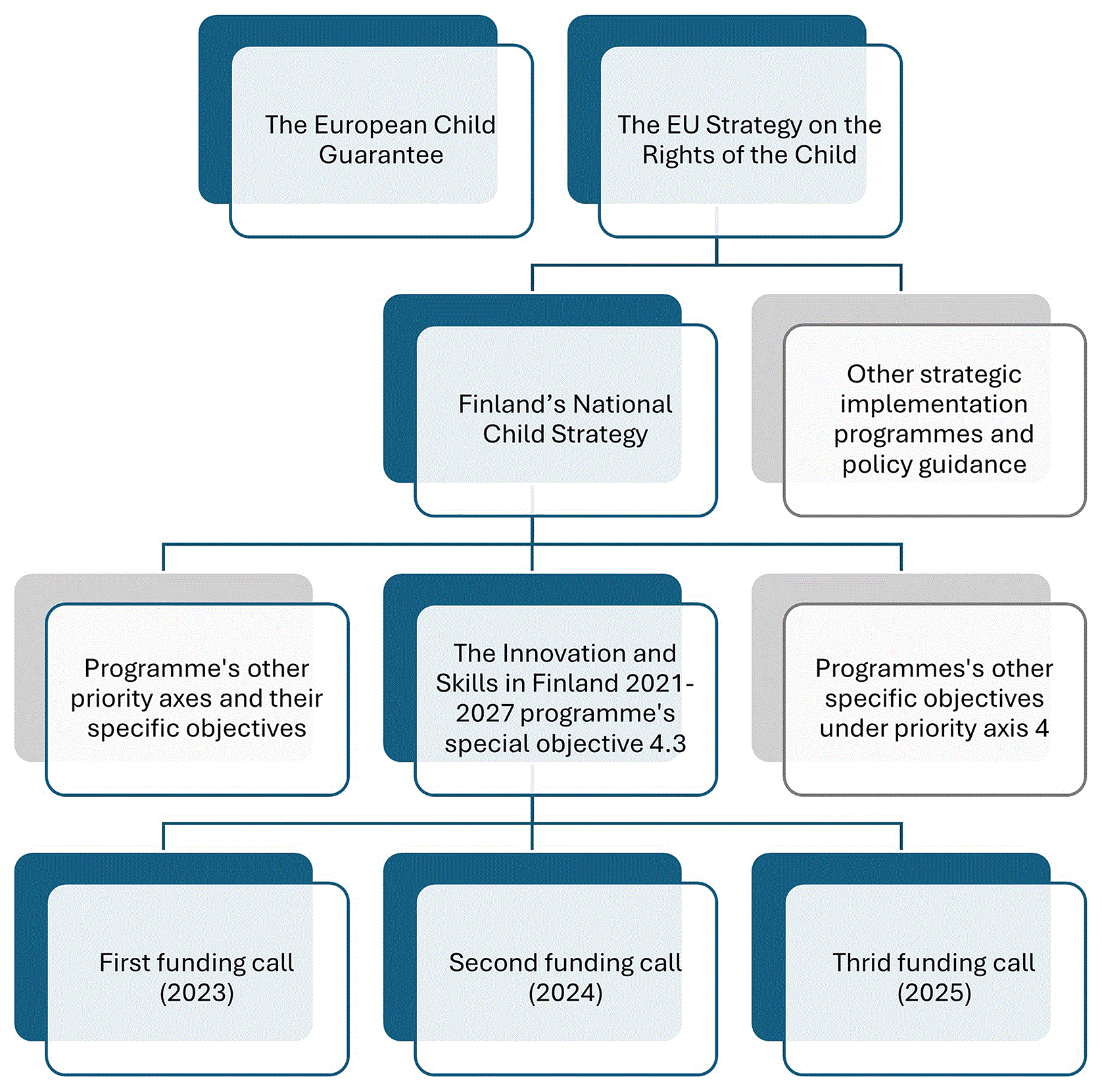
The ESF+, funded by the EU, allocates approximately €602 million to Finland. In Finland, ESF+ supports development projects promoting employment, competence and inclusion under five objectives: pathways to employment, new competence to working life, equitable inclusion, safety nets for the future of young people, and resources for life (Ministry of Economic Affairs and Employment of Finland, 2022a). These objectives are defined in the Innovation and skills in Finland 2021–2027 EU Regional and Structural Policy Programme (Ministry of Economic Affairs and Employment of Finland, 2023), which complements and supports EU strategies. The programme’s policy objective 4 focuses on a more social and inclusive Europe. Part of the funding is allocated to national themes of strategic importance coordinated by various ministries. One theme is the Development of services for children, young people and families and promotion of well-being towards equality, with a total allocation of €23 million. The theme’s actions support the implementation of the EU Strategy on the Rights of the Child, particularly by promoting equal opportunities for children and young people in vulnerable situations and advancing the ECG. A cross-cutting aim is to strengthen everyday cooperation across different actors and administrative sectors (Ministry of Economic Affairs and Employment of Finland, 2022b).
Development projects under this national theme focus on the three areas: 1) Identifying and supporting vulnerable children, young people, and families in everyday life, particularly those facing inter-generational exclusion, learning disparities, low-income, or labor market exclusion. 2) Strengthening the competence of professionals working with children, young people, and parents by developing inclusive practices and guidance across all levels of education and educational transitions. 3) Promoting equal access to cultural, sports, and guided leisure activities for children, young people, and their parents (Ministry of Economic Affairs and Employment of Finland, 2022b).
The first national funding call under this theme was launched in 2023, followed by calls in 2024 and 2025. Applicants are instructed to align their project plans with the objectives of the Innovation and Skills in Finland 2021–2027 programme and its underlying strategies. Applicants may be either national or regional actors, third-sector organisations, or companies. Typically, the applications are multidisciplinary consortia consisting of several types of project implementers.
Social sustainability in the contexts of child and family policy
United Nations (2015) define sustainable development in their Agenda for Sustainable Development as comprising social, environmental, and economic dimensions. Social sustainability, understood as a dynamic and evolving concept, refers to forms of participation that are deeply embedded in everyday practices and operating cultures, promoting communality rather than individualism. Social sustainability entails a commitment to human dignity, expressed through values such as equality, justice, and compassion (Salonen, 2010). In a socially sustainable society, citizens are able to strengthen their social capital—that is, their networks of relationships—and participate in decision-making processes that affect them (Padovan, 2008).
Practices that foster socially sustainable participation can promote equality and justice and help prevent social exclusion (Weckström et al., 2022). Numerous sustainability programmes and initiatives are currently implemented across different sectors at global, national, regional, and local levels (Saikkonen, Rotko & Vaalavuo 2025). Strengthening social sustainability also contributes to the realisation of children’s rights: on the one hand, children have the right to participate in discussions concerning social sustainability, and on the other hand, the objectives of social sustainability directly concern children through the implementation of children’s rights (Weckström et al., 2022).
Children’s rights perspective as an analytical lens
While this study does not apply a formal theory-driven framework, it is grounded in a normative children’s rights perspective informed by the UNCRC and related research on social justice and social sustainability. From this perspective, policy documents are not understood merely as descriptive texts but as instruments that shape social realities by defining priorities, responsibilities, and the allocation of resources. Consequently, omissions in strategic guidance are analytically relevant, as they may affect the visibility of children’s needs and the realisation of their rights, particularly through development funding and project-based instruments.
Aim and research questions
The aim of this study is to examine three national ESF+ 4.3 funding calls that focus on developing services for children, young people, and families These calls are analysed in relation to the following strategic frameworks: the EU Strategy on the Rights of the Child, the Council Recommendation of establishing the ECG, Finland’s National Child Strategy, the Innovation and Skills in Finland 2021–2027 programme, and the official thematic description of special objective 4.3.
The research questions are as follows:
1. How are the EU Strategy on the Rights of the Child and the Council Recommendation on establishing the European Child Guarantee reflected in Finland’s National Child Strategy and the Innovation and Skills in Finland 2021–2027 programme, particularly within the theme Development of services for children, young people and families and promotion of well-being towards equality?
2. To what extent and in what ways are these guiding strategies reflected in the ESF+ funding calls under specific objective 4.3?
This study explores how EU-level strategic policies are translated into national guidance documents and project funding calls. The aim is to generate insights into key considerations for policy operationalisation and to inform the future formulation of funding calls. It is both important and ethically necessary to critically examine how funding is allocated, especially when it concerns children’s rights and well-being.