Method
Voyant Tools is a web-based reading and analysis environment for digital texts. It was created in 2003 by Stéfan Sinclair and Geoffrey Rockwell and has been regularly updated since then (after Sinclair's demise in 2020, Andrew MacDonald and Cecily Raynor have played an active role). These tools are neither the first nor the only ones of their kind – AntConc (https://www.laurenceanthony.net/software/antconc/) and WordSmith Tool (https://www.lexically.net/wordsmith/) are also well-known tools developed in the field of corpus linguistics that have been used for literary analysis (Al-Rawi, 2017; Wan, 2022). However, Voyant Tools are certainly among the most user-friendly for quantitative approaches without the need for programming skills. The possibilities they offer are numerous and can be applied to a unified or composite corpus (such as the different collections of a single author, or the complete works of different authors), thus facilitating a comparative or evolutionist reading.
Voyant Tools provide information that can be crucial on the level of semantics, such as word frequency (WF), immediate context and collocates for selected words. Moreover, they allow the tracing of how selected words trend in the entire corpus with insightful visualizations. Furthermore, and this is crucial for the study of literature, they offer the possibility to see a word within the context of the entire corpus, so one can practice a parallel close reading to avoid possible distant reading mistakes. The added possibility to extract all or parts of the information in various formats allows the recruitment of LLMs to offer insights on big data, such as long catalogues of different contexts for a specific word. In addition, Voyant Tools include useful features for the discussion of style, such as vocabulary density (VD), average words per sentence (AWpS) and readability index (RI). Other features of Voyant Tools, such as topic modelling for the automatic designation of major topics, tend to be rather less reliable when it comes to literary corpora. The usefulness of this suite of digital open-access and easy-to-use tools is not hard to understand, and it offers an excellent way to comprehend as well as qualify the original insights that quantitative methods can offer to the study of literature.
This paper is based on an open-access dataset created as part of a seminar in the Department of Philology at the University of Crete.1 The slightly modified and richer corpus used here (accessible and ready-to-use on Voyant Tools: https://voyant-tools.org/?corpus=ffc9e171c756cdf2e60adb8c0d23711a) comprises over 600 poems by a group of interwar Greek poets, namely Tellos Agras, Fotos Giofyllis, Romos Filyras, Kostas Karyotakis, Napoleon Lapathiotis, Kostas Ouranis, Mitsos Papanikolaou, and Maria Polydouri. With the notable exception of Kostas Karyotakis, the most prominent figure of this group who is recognized as a major Greek poet, the interwar poets are often referred to collectively, with an emphasis on their shared features. Melancholy, pessimism, and existential anxiety, stemming among other sources from the frustration of national expansionist aspirations and the dire sociopolitical reality of Greek interwar, as well as an added emphasis on nostalgia and a sotto voce quality, all of which are ascribed to neoromanticism and/or neo/post-symbolism,2 are the most frequently repeated features of these lyrical poets (Beaton, 1994: 122–125; Vitti, 2003: 364–365).
Voyant Tools offers the means to explore these semantic and stylistic similarities quantitatively, as well as to discern diverging tendencies among the different poets. The features of WF, the interpretation of the list of collocates and contexts of significant words, visualizations, VD, and AWpS will be used to this purpose. The same features may also prove useful as a means to compare the rest of the group to the central figure of Kostas Karyotakis, in terms of both style and semantics. Due to restrictions of space, this paper offers only a number of indicative observations, but Voyant Tools may offer material for a much more detailed analysis of themes and style.
Results and discussion
Vocabulary is a fairly trustworthy index for the designation of theme as well as the ‘atmosphere’ or mood – in other words the sentiment surrounding the theme. Excluding stopwords – such as articles and pronouns or the verb ‘to be’ – the most frequent word in the corpus is ‘now’ (τώρα, 357), positioning the poems repeatedly in the present, indicating a difference from past times that is concomitant with nostalgia (the word itself is not infrequent, νοσταλγ* 78). The very next ones are ‘soul’ (ψυχή*, 330 / but it jumps to an astounding 427 if we add the cognates by searching for ψυχ*), ‘eyes’ (μάτια, 319) and ‘heart’ (καρδιά*, 298), indicating the prevalence of sentiment and the importance of inner life. In these poems, heart and soul are practically interchangeable as the seat of sentiment and the innermost part of self, whereas eyes are considered explicitly or implicitly to be the expression of heart and soul. The most frequent collocate for all three words is the first-person personal pronoun (μου, 153, 83, 139 counts respectively) indicating a centering around personal feelings. The second most frequent collocate, the second-person personal pronoun (σου, 37, 58, 38 counts respectively), indicates a directionality of feeling towards another person. The next most frequent meaningful word is ‘life’ (ζωή*, 322), with ‘my’ (μου, 135) as its most frequent collocate, which supports the lyrical character of these poems. Very high in the catalogue of frequent words we find also ‘hands’ (χέρια, 196) and ‘love’ (αγάπη, 171). The contexts of ‘hands’ often indicate connection with a person, most frequently a loved one; its metaphorical uses center around power, protection, love, and care. This is my own assessment of the catalogue, but it is also one supported by the LLM Claude (2025) after exporting the data concerned in text format (since Voyant Tools allows for different forms of data export). Returning to the analysis, the overall idea given by these findings is a corpus of lyrical poems situated in the present, centering around the poetic persona and his/her sentimental world. The prevalence of these words further indicates that this preoccupation is not expressed in a subtle, evocative manner, but it is rather displayed in plain view, with direct reference to the seat of self and feeling.
If these findings give a fairly accurate picture of the thematic center of these poems – self and feeling, particularly love –, it is worth looking for the mood surrounding it, given the repeated mentions of melancholy in the bibliography concerning these poets. Surprisingly, the words ‘light’ (φως, 215) and ‘joy’ (χαρά, 198) are among the most frequent. Their most recurring collocate is again ‘my’/’to me’ (μου, 41 and 46 respectively), reinforcing the lyrical character of the texts. Interestingly, however, ‘joy’ is also paired with sorrow (λύπη 7, θλίψη 4). Turning to the immediate contexts, one finds that light is often that of the moon or the artificial light of a room; that it’s dim, little or fading, scared or trembling, a pale agony. As for joy, it is sometimes sweet, even unmeasured, or someone is full of it. But it is also preceded by ‘without’; joy is usually withered, passed, or lost, silent, unspoken, little and unexpected, short-lived, superficial, pale, a bloody rose, pain itself, flown away. So, light and joy, far from indicating positive feelings, are used within contexts that give them an opposite meaning. Indeed, one might suggest that light and joy are repeatedly evoked only to be frustrated. On the other hand, words at the other end of the spectrum seem to be less frequent when taken individually: darkness (σκοτάδ* 57), death (θάνατ* 79, θανάτ* 45) melancholy/ic (μελαγχολ* 17), sorrow/ful (λύπ* 47, λυπ* 47), sad/ness (θλιβ* 67, θλίψ* 49). But, added together, they make a sizeable quantity (405) that supports the perceived idea of these works as mostly melancholic. It seems, however, that these feelings are described more frequently negatively, through their opposites, as a lack or qualification of joy and light, rather than in immediate terms. So, even though the center of lyricism – heart and soul – is displayed in plain view, the moods and emotions surrounding it are presented more suggestively.
If we turn to seasons, that have an added symbolic value as well as an import on the mood of the poem, we will find an interesting pattern of use. Spring (άνοιξη*/άνοιξες 58) and summer (καλοκαίρι* 30) are used less frequently than autumn (φθινόπωρ* 25) and winter (χειμών* 77), i.e. 88 and 102 times respectively. But their contexts differ significantly. Spring is indeed very often sweet, full of light, bringing joy, sending all cares away, bringing its gifts, blossoming, light-weighted; but there is also a question as to its use, a certainty that it will end, that this is the last one, it’s dying, it’s being given to the hands of death. Spring is just another season in the year, a virgin no more, with no swallows, it stinks; springs are indifferent. Summer has more frequently negative associations: it’s dying, over, fading, withered, passing, gone; what remains is the ashes of its fruits; it's when the lovers met, but now they are separating; the poet doesn’t know why it even came; it’s here yet it’s still snowing. The positive associations are very rare indeed, limited to the sweet weather and its freshness. Here, one might discern a pattern of use that is fairly similar to that of ‘light’ and ‘joy’ – evoked mostly to be emptied of their positive meaning.
Autumn is the season linked par excellence to symbolism, due to its waning and fading qualities which are congruous with decadence; furthermore, the autumn's lack of vividness, its long shadows and half-lights are also linked to the suggestiveness much praised by the symbolists as the core of poetic expression (Polychronakis, 2016: 290–320). However, the word itself is not particularly frequent. But its contexts are, indeed, mostly congruous with waning and fading, melancholia and death: autumn passes through a life permeated with silence; it is associated with lies, nostalgia, sadness, loneliness; it fills the earth with withered leaves; it is announced by the deadly sound of the creaking leaves; it resides in the soul of the poet, it’s in their voice; the poet will die in an autumn evening. The single positive connotation (golden autumns) is again used to mark lost happiness. As for winter, it is associated with exile, mourning, death, orphanhood, bitterness, ennui, nostalgia, fear, cold, black streets, night and paleness, decay; its positive associations are very rare: an association with the quiet pleasures of old age, the telling of fairytales marking the season, some sweet hours towards its end. Overall, with the partial exception of spring, for which there are almost as many positive associations as there are negatives, the same pattern is discernible: entities with a positive commonplace symbolic use (spring and summer) are imbued with negative meaning, whereas those with common negative associations (autumn and winter) are further corroborated as such within negative contexts.
Let’s have a final look at the weather, so commonly associated with mood: Rain and its cognates (βροχ* 120, βρεχ* 52), are amongst the most frequent words of the corpus (172), with sun (ήλιo*147) coming a little behind. As expected, rain comes in almost entirely negative contexts with the rare exceptions of a refreshing, clean, or fertile spring rain. Other than that, it is repeatedly associated with cold, night, monotony, loneliness, frustration, melancholy, and death. The sun has a lot of positive associations, linking it mostly to hope, love, and joy – sometimes also playfulness. But it has almost as many negative ones: old memories drying their mold in the sun like cheap linen; Don Quixote showing his vain wound to the sun; a shadow won’t let the poet see the sun; a life is lost following the setting sun; more generally, the sun is repeatedly setting, dead or dying. Again, overall, the negative associations of these elements overrun the positives.
Lastly, one final indication of mood is the vastly unequal uses of day/dawn (μέρα* 125, ξημερ* 6) and night/evening (νύχτ* 188/βραδ* 124). The difference between 131 and 312 occurrences respectively gives a clear image of the preferred time of the day for these neoromantic poems, that value the associations and suggestiveness of darkness more highly than those of the broad daylight.
However, other indications relating these poems to neoromanticism and post-symbolism are not as easy to spot. Filokyprou (2009: 83–157) discusses eight major themes in Greek post-symbolist poets. Some of them, like social reality, truth, self-determination, are not readily traceable through Voyant Tools. Others, like nature (and its counterpart, city), nostalgia and a wish to escape, poets and poetry, are more conducive to this sort of analysis, although not in a straightforward manner. ‘Nature’ itself (φύση* 47) has few counts, but if we added ‘sea’ (θάλασσα* 136), mountain/s (βουν* 53), tree/s (δέντρ* 92), garden/s (κήπ* 58), as well as all the specific types of trees/flowers, the image could be quite different. A high word frequency is always telling but a low frequency might not be telling the whole story. Of those, the prominence of sea, particularly in Ouranis and Papanikolaou, as well as its contexts, makes apparent its connection with a longing for travel and escape. As for the urban setting, often substituting nature as setting and theme (Filokyprou, 2009: 92), there is a very high frequency of street/s (δρομ* 273) but just two occurrences of avenue/s (λεωφόρ* 2), indicating a small scale; these poems operate on the level of neighborhood or small town, not the big city (of course, Athens was far from being a metropolis at the time). Houses (σπίτ* 141) and rooms (κάμαρ* 80) also have a marked presence, followed by windows (παράθυρ* 72). Contexts indicate that windows are typically the boundary between the inner space and the outside world – outsiders or neighbors peeking in, goblins threatening to break in; but mostly the poet looking at the world: the passers-by, the weather, the gray sky, the trees, the moon – contemplating or waiting; the windows are open or closed, letting the light in or not, indicating (often frustrated) hope or hopelessness.
Prying themes in this manner can provide some interesting insights. ‘Poetry’ (ποίη* 7) as such does not have much of a presence in this corpus. Poets (ποιη* 76) have a far more marked presence, confirming the self-centeredness of these works. Art (τέχνη* 24), sometimes with the meaning of craftmanship, has also a low frequency. On the other hand, writing and its cognates are far more frequent (γραφ* 47, γράφ* 28, γράμμα* 25), bringing the total to 100. And ‘song’ (τραγούδ* 134), most frequently a metaphor for poetry conceived through the musical emphasis placed on it by symbolism, is also found abundantly. So, this corpus doesn’t speak so much of art and poetry as of poets and their songs and writing. Poetry is then more of an identity, a craft, a mode of lyrical expression, and less of a high art.
Turning to the specificities of each poet, it is interesting to take an indicative look at the dispersion of some of these findings across the corpus. Besides raw word count, Voyant Tools calculates relative frequencies to adjust for imbalances in document length, thus allowing for comparison among different parts of the corpus, in this case the work of different poets. The Figure below (Figure 1) shows the relative frequencies of the words ‘soul’, ‘eyes’, ‘heart’ and ‘love’, whose centrality became evident from the beginning. In comparison to everyone else, the poetry of Polydouri, recognized for the expression of strong emotions and for making of love a central theme, has indeed the highest frequency of ‘heart’ (καρδιά, in turquoise) and ‘love’ (αγάπη, in orange); Ouranis, whose lack of sentiment is distinctive (Filokyprou, 2009: 59), has the lowest use of both these words. Papanikolaou comes second in the use of ‘heart’ but he has the lowest use of ‘love’ compared to every other poet. Almost equally low is the use of ‘love’ in Lapathiotis, while ‘heart’ has the highest frequency. One could discern in these two gay poets a reluctance to speak of love per se, since theirs is ‘a love that dare not speak its’ name’ as Wilde famously put it. Except for Giofyllis, whose work has a greater thematic variety that might account for a low use of ‘love’, the rest of the poets, i.e. Filyras, Ouranis, Karyotakis, and Agras, use the two words with about the same frequency - and there is also little difference amongst them.
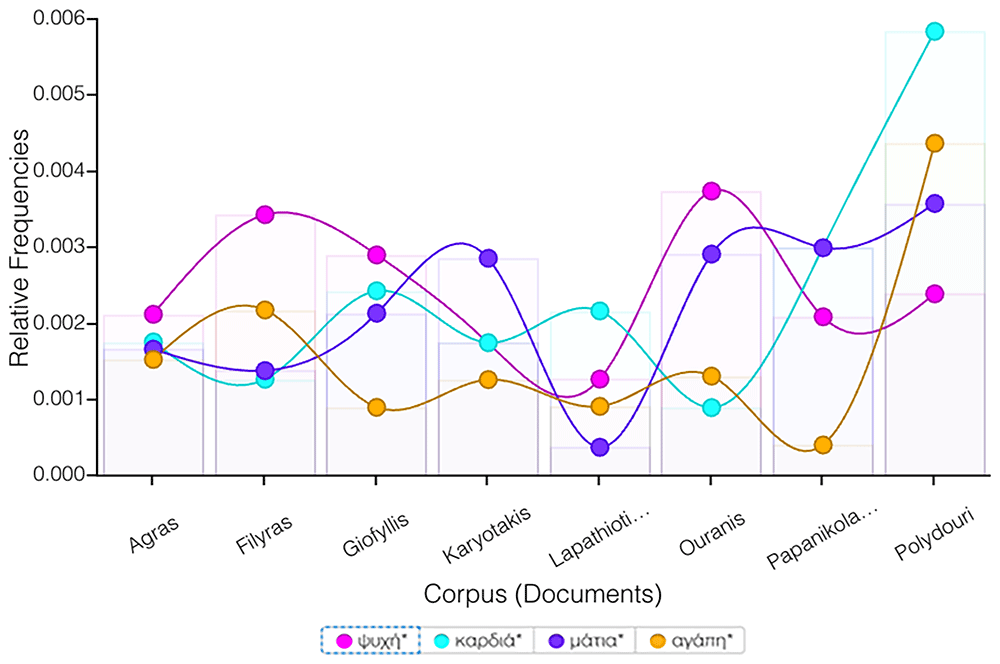
Figure 1. Highly frequent words: soul, heart, eyes, love.
When it comes to ‘soul’ (ψυχή, in fuchsia), Ouranis, Filyras and Giofyllis score a little higher than the rest, but not in a particularly distinctive manner compared to the group. However, Filyras, a poet with a serious mental health condition, uses ‘soul’ far more frequently than any of the other three words. Nonetheless, ‘soul’ is the word with the most even distribution across the corpus, which gives it a central role, supporting the hypothesis made initially by its particularly high frequency in the entire corpus. The same could almost be said about ‘eyes’ (μάτια, in purple), with the exception of Filyras and Lapathiotis that don’t use it very much. It is interesting to note that Agras, who was also a fair and astute critic of the group, whose work (the longest in the corpus) expands over his long life and is particularly noted for a lack of center and a sense of incessant oscillation (Filokyprou, 2009: 31–32) scores average on the use of these words compared to the rest. He doesn’t even seem to have a very distinct preference for any one of them – but even so, his most frequently used word of the four (even by a small margin) is ‘soul’, the most typical for all of them. Karyotakis’ use of these words is also rather average compared to the rest, and generally balanced. He makes an exception for ‘eyes’, which is his own most frequent word of the four (and generally his own most frequent meaningful word, with 41 occurrences); this is a word marked for its subtlety, as well as a certain distance, compared to the rest.
Interestingly, as seen in Figure 2, Karyotakis has also the highest combined frequency for 'seeing' and ‘gaze’ (βλέπ* in blue, βλέμμα* in green) compared to the rest – Papanikolaou follows suit, as he also does with the word ‘eyes’ (see Figure 1). This preoccupation with the gaze seems in tune with the symbolist distancing from immediate reality, where the artist, instead of talking about things themselves, talks about the act of observation (Polychronakis, 2016: 318). The contexts reveal that this is to do with the poet's own act of watching as with the others' perception of himself, whereas there is also no little self-reflection.
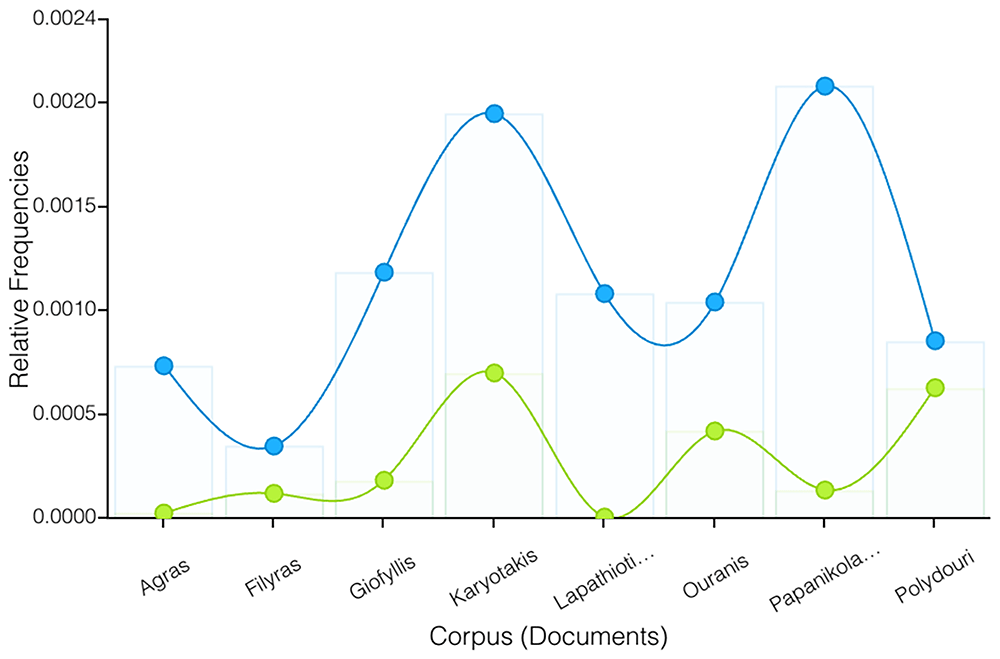
Figure 2. Seeing and gaze.
A graph that I find particularly revealing in terms of comparison is to do with the uses of the words ‘I’ (εγώ in fuchsia) and ‘you’ (εσύ, in blue) (Figure 3).
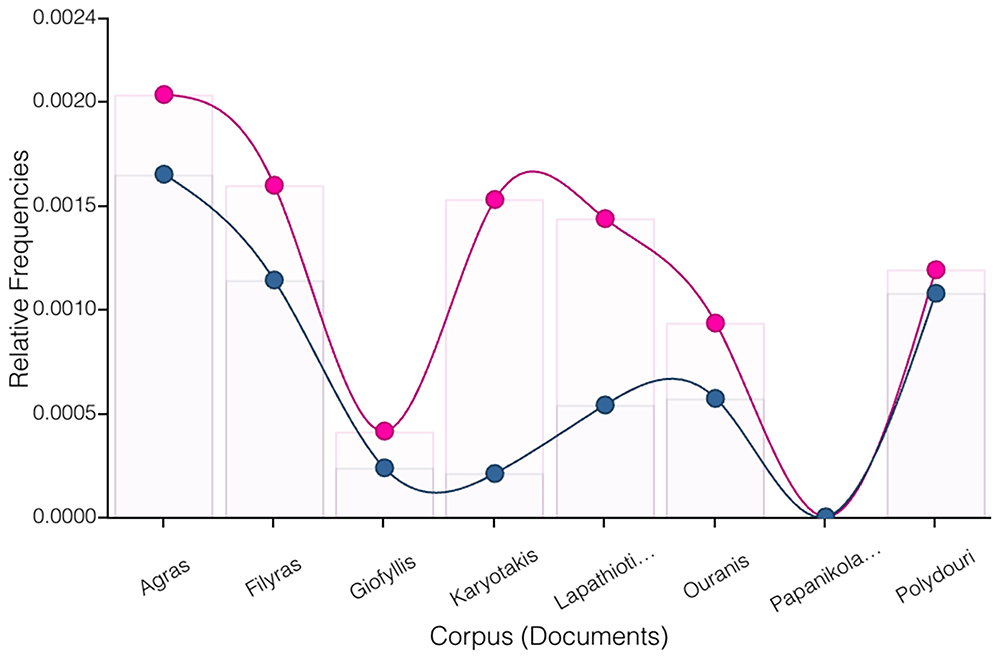
Figure 3. Uses of ‘I’ and ‘you’.
Although these words alone do not account for all instances of an I-thou relation and theme, they are fairly indicative. In almost all the poets, ‘I’ has a prevalence, but it is closely followed by ‘you’. This is particularly the case of Polydouri with her focus on interpersonal relations. On the other end we find Papanikolaou, a poet moving away from lyricism, with practically null use of these words. Karyotakis stands out, as he has the most divergent use of the two, with a clear preference for ‘I’. The second person seems to be rarely acknowledged in his corpus, accounting for a sense of loneliness and despair in his work. A similar pattern with a comparable feeling is also to be found to some extent in Lapathiotis, although far less acute.
Turning to stylistic observations, the use of simile (detectable through the use of 'like'/'as', 'σαν'/'σα', Figure 4) tends to be fairly similar across the corpus, with two notable exceptions: Filyras, the first one to publish a poem amongst these poets (in Noumas in 1903), displays the greatest use of it, whereas Papanikolaou, who became gradually an admirer and translator of modernist and avant-guard poetry (Bakogiannis, 2024: 51, 55–58), the least. Even allowing for some cases of alternative meanings of these words (such as 'when' and 'if'), which are secondary and rather infrequent, the difference is still significant. The simile is a trope used more broadly in older poetry, steadily giving way to metaphor, symbol and other expressive tropes. Filyras and Papanikolaou seem to hold the two ends of the spectrum that this poetry occupies between traditional tropes and modernist experimentations. Interestingly, Karyotakis scores average for both words. Unfortunately, Voyant Tools have a limitation when it comes to the detection of other major tropes in this poetry, such as irony and allusion.
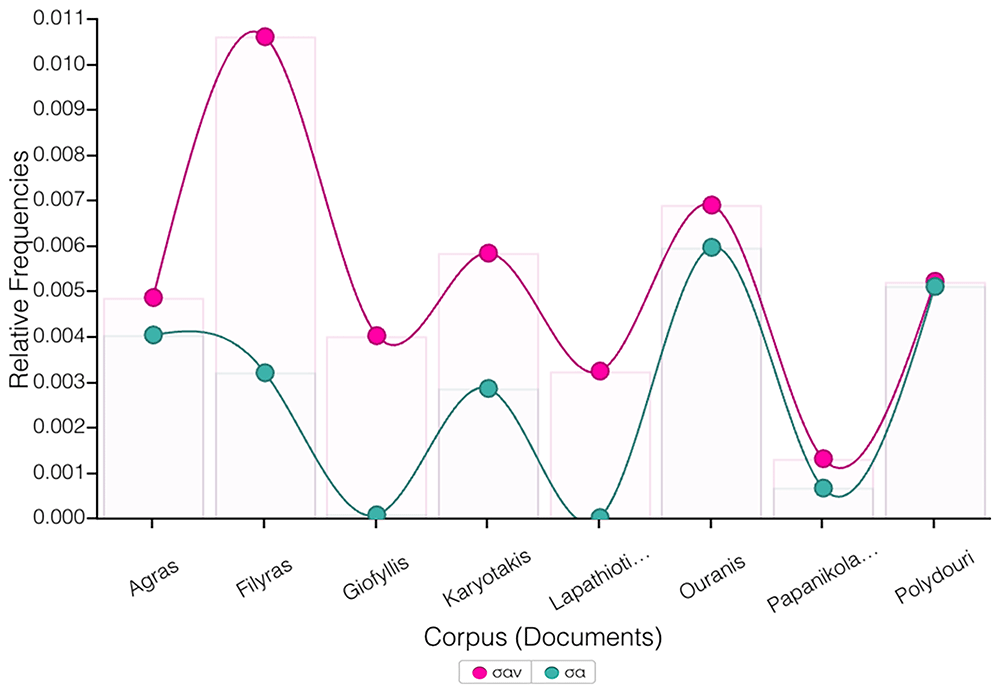
Figure 4. Exploring the use of simile.
Regarding vocabulary density, i.e. the variety of words used (Figure 5), Filyras, noted for his use of “sometimes irrelevant, and often ridiculous words” (Agras, 1942: 955), scores the highest; Agras, far more self-restrained, occupies the other end, demonstrating the least variety, whereas Giofylis and Karyotakis occupy the middle ground.
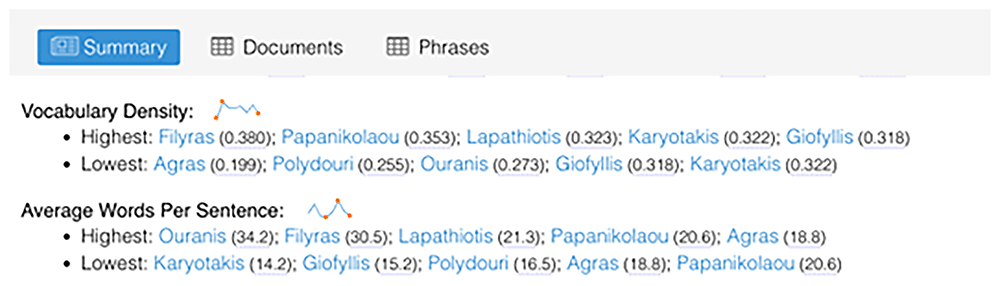
Figure 5. Vocabulary density and Average words per sentence.
Finally, as regards sentence length, Ouranis scores the highest with 33,4 average words per sentence, whereas Karyotakis the lowest with 14,2.
Excepting the short sentence length, which accounts for greater immediacy and a rather modern style, and the divergent use of the words ‘I’ and ‘you’, which show the poet mostly alone and self-centered, on most other counts Karyotakis seems to occupy a middle ground among these poets. Voyant Tools by no means capture the depth of his poetry, much less explain the enduring appeal of his work, but they do give us a glimpse of both his sides as representative and exceptional at the same time.