1. Introduction
The steel industry is a cornerstone of modern development, providing essential materials for infrastructure, transport, and manufacturing. In 2024, global crude steel production reached approximately 1.88 billion tons, underscoring the sector’s strategic importance for both industrialized and emerging economies1. However, steelmaking remains one of the most carbon-intensive industrial activities, accounting for nearly 7–8% of total global CO2 emissions2. Within this framework, the cokemaking stage—where fossil coal blends are converted into metallurgical coke through high-temperature pyrolysis—represents a major contributor to the industry’s carbon footprint. Decarbonizing this process is therefore essential to align steel production with the goals of the European Green Deal and the EU 2050 climate-neutrality target.
The BioCoDe project (Biomass for Cokemaking Decarbonization, Grant Agreement No. 101112264) addresses this challenge by exploring the use of biomass as sustainable substitutes for fossil coal in cokemaking. It aims to demonstrate the feasibility of replacing up to 10% of fossil carbon with biochar, a carbon-rich solid obtained via pyrolysis or torrefaction of locally available biomass. By valorizing agricultural and forestry residues, such as olive pruning, pine wood, and industrial packaging waste, the project promotes a circular-economy approach that converts low-value organic by-products into high-performance materials for metallurgical applications. The initiative also leverages short supply chains to minimize transport-related emissions, focusing on the biomass resources available in southern Italy, particularly in the area of the Acciaierie d’Italia steelwork in Taranto.
The pyrolysis step is critical in this approach, as it converts raw biomass, naturally rich in volatile compounds and oxygenated functionalities, into a stable, carbonaceous solid (biochar) with enhanced fixed-carbon content, reduced volatiles, and improved thermal stability. These features are essential to achieve compatibility with metallurgical processes, where coke must ensure mechanical strength, and reductive efficiency at high temperatures. Consequently, understanding and controlling the thermochemical decomposition of biomass is fundamental to producing a biochar whose properties (porosity, carbon yield, ash content, and reactivity) meet the requirements of cokemaking3–5. In this framework, a two-stage experimental strategy was adopted.
First, thermogravimetric analyses (TGA) were performed on selected biomass to determine their intrinsic kinetic behavior under controlled heating conditions. This step provided insight into the degradation profile of lignocellulosic components (hemicellulose, cellulose, and lignin) and allowed the evaluation of the activation energy and reaction mechanism through kinetic modeling.
Second, based on these results, the same biomasses were processed in a lab-scale pyrolysis rig at RINA–CSM, designed to operate under an inert argon atmosphere, enabling the separation and quantification of biochar, tar, and gas fractions. This setup replicates the inert and reducing conditions typical of industrial carbonization, thereby bridging the gap between analytical characterization and process-scale feasibility.
A detailed understanding of biomass-pyrolysis kinetics is therefore essential to optimize these conversion parameters and predict product yields. Biomass pyrolysis is a complex multi-stage process involving the overlapping decomposition of hemicellulose, cellulose, and lignin, typically occurring within 220–315°C, 315–400°C, and 250–500°C, respectively6,7. These reactions are influenced by the feedstock’s composition and structure, resulting in variations in activation energy and decomposition rate8.
Several kinetic models have been developed to describe these transformations. Model-free (iso-conversional) methods such as Friedman, Kissinger–Akahira–Sunose (KAS), and Ozawa–Flynn–Wall (OFW) enable the estimation of activation energy as a function of the conversion degree without assuming a specific mechanism9–11. Conversely, model-fitting approaches, including single-step, multi-step, and mechanistic formulations, rely on assumed kinetic functions that relate conversion rate to temperature and reaction order12,13. Among these, the Coats–Redfern integral method remains one of the most widely applied tools for non-isothermal solid-state reactions, owing to its mathematical simplicity and robust performance in estimating kinetic parameters from TGA data14–16. It enables the determination of activation energy (Ea) and pre-exponential factor (A) through a linearized Arrhenius-type relationship, assuming constant heating rates.
Numerous studies have validated the Coats–Redfern approach for a variety of lignocellulosic feedstocks, including agricultural residues, palm shells, and wood waste10,14–16. Reported values of activation energy vary widely, typically between 50 and 200 kJ·mol–1, depending on the chemical composition and mineral content of the biomass. Recent investigations also suggest that synergistic effects in co-pyrolysis systems (e.g., biomass and plastics or catalytic additives) can alter degradation kinetics and product yields13,16. These findings highlight the necessity of case-specific kinetic analyses to guide the design of efficient conversion processes.
Despite extensive literature on biomass pyrolysis, few studies have examined feedstocks relevant to the European steel sector, particularly those abundant in Mediterranean regions such as olive-wood residues and industrial packaging waste. Furthermore, the application of kinetic modeling to support biochar design for cokemaking remains limited, even though achieving the required levels of fixed carbon, porosity, and reactivity is crucial for metallurgical performance17–19.
In this context, the present study experimentally investigates the pyrolysis behavior and kinetic parameters of five representative biomass, such as olive branches, olive trunks, pine, pallet wood, and wooden crates. The kinetic evaluation was conducted through TGA coupled with Coats–Redfern modeling, while the lab-scale pyrolysis experiments enabled the recovery and analysis of distinct product fractions. The comparative interpretation of these results provides insight into how feedstock composition and conversion conditions affect thermal behavior and char yield, supporting the selection of optimal biomass precursors for high-quality biochar production. Ultimately, the outcomes support the technical feasibility of integrating biomass-derived carbon carriers into cokemaking as a viable step toward the progressive decarbonization of the steel industry.
2. Materials and methods
2.1 Biomass feedstock and pre-treatments
A preliminary screening of nine biomasses (Figure 1) was conducted to identify suitable feedstocks to produce biochar intended as a renewable carbon source for partial substitution of fossil coke in cokemaking. Table 1 summarizes the origin and classification of the studied biomasses.
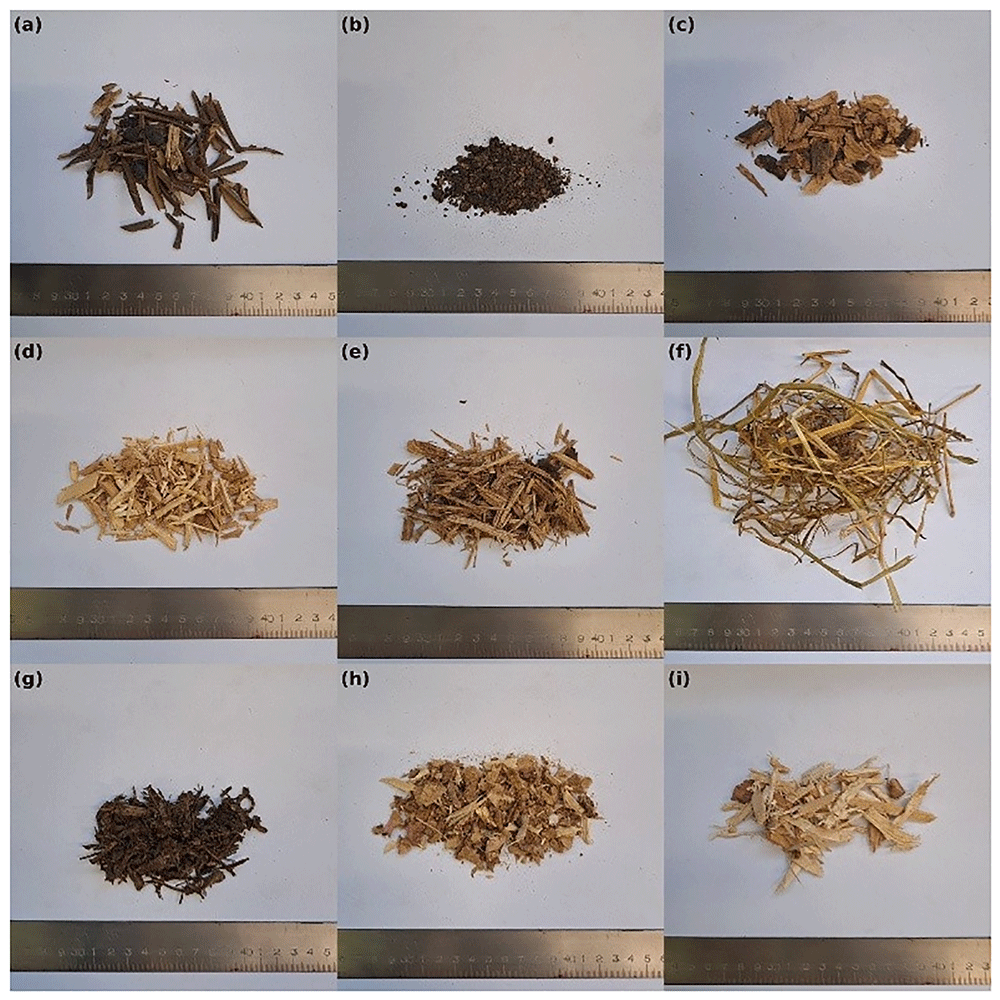
Figure 1.
Photographs of the biomass feedstocks used in this study: (a) olive branches, (b) olive pomace, (c) olive trunks, (d) pallet wood, (e) pine wood, (f) straw, (g) vine pruning, (h) wooden crates (chipboard bottom), and (i) wooden crates (plywood bottom).
Table 1. Origin and classification of the studied biomass.
| Biomass | Source |
|---|
| Olive branches | Pruning residues from olive groves |
| Olive trunks | End-of-life olive trees |
| Pine wood | Forestry residues |
| Vine pruning | Vineyard maintenance residues |
| Straw | Agricultural by-product |
| Pallet wood | Packaging and transport waste |
| Wooden crates (plywood bottom) | Packaging waste |
| Wooden crates (chipboard bottom) | Packaging waste |
| Olive pomace | By-product from olive oil production |
The selection aimed to represent the main classes of lignocellulosic materials available near the Taranto steelmaking district in Southern Italy, combining agro-forestry residues and industrial recycled woods. The choice criteria included:
(i) local availability and logistics, to ensure supply continuity and low transport impact;
(ii) chemical and structural characteristics, such as high fixed carbon and low ash, sulfur, and phosphorus contents; and
(iii) potential compatibility of the resulting biochar with metallurgical coke quality standards.
All the collected biomasses were air-dried at ambient temperature and subsequently oven-dried at 105 °C for 24 h to remove residual moisture. After drying, the materials were ground to particles below 2–3 mm to ensure homogeneous heat transfer during thermal analysis. All compositional analyses were carried out on a dry basis.
The proximate and ultimate analyses, summarized in Table 2, represent the main thermochemical parameters relevant to the pyrolytic conversion process.
Table 2. Combined proximate and ultimate analysis of the investigated biomass (dry basis).
| Biomass | Ash
(%) | Volatile matter
(%) | Fixed carbon
(%) | C
(%) | H
(%) | O
(%) | N
(%) | S
(%) |
|---|
| Olive branches | 4.32 | 77.30 | 18.38 | 47.82 | 4.74 | 41.71 | 1.17 | 0.07 |
| Olive trunks | 3.18 | 72.02 | 24.80 | 53.49 | 4.64 | 37.63 | 0.81 | 0.14 |
| Pine wood | 1.37 | 65.24 | 33.39 | 51.70 | 6.42 | 39.00 | 1.43 | 0.03 |
| Vine pruning | 3.00 | 77.00 | 20.00 | 46.08 | 4.06 | 45.76 | 0.99 | 0.08 |
| Straw | 9.13 | 72.10 | 18.77 | 49.08 | 5.60 | 33.63 | 2.05 | 0.13 |
| Pallet wood | 0.42 | 80.89 | 18.69 | 51.91 | 3.96 | 42.93 | 0.75 | 0.04 |
| Wooden crates (plywood bottom) | 0.93 | 78.26 | 20.81 | 49.99 | 4.68 | 43.65 | 0.69 | 0.07 |
| Wooden crates (chipboard bottom) | 1.40 | 77.39 | 21.21 | 50.72 | 5.34 | 41.31 | 1.16 | 0.04 |
| Olive pomace | 3.13 | 81.55 | 15.32 | 59.03 | 6.57 | 29.47 | 1.70 | 0.06 |
Overall, the volatile matter content of all biomasses ranged between 65 and 82 wt.%, markedly higher than that of conventional metallurgical coal, indicating greater reactivity and gas release potential during pyrolysis. The fixed carbon content ranged from 15 to 33 wt.%, with pine and olive-derived samples showing the highest value.
Ash content remained below 5 wt.% for most samples except straw, while sulfur levels were negligible (< 0.15 wt.%), confirming the environmental advantage of these materials.
The high oxygen and hydrogen fractions observed reflect the typical structure of lignocellulosic feedstocks and suggest the need for controlled thermal pre-treatment to enhance their carbonization behavior.
Based on the compositional data and the logistic constraints associated with biomass availability, five biomass feedstocks, namely olive branches, olive trunks, pine wood, pallet wood, and wooden crates, were selected for further thermogravimetric and pyrolysis investigations. The selection was guided by three main criteria:
(i) a fixed carbon content above 18 wt.%, ensuring a sufficient solid yield in char;
(ii) low ash and sulfur fractions (<5 wt.% and <0.15 wt.%), minimizing impurities in the resulting biochar;
(iii) availability and mechanical stability, which make these materials easier to handle and scale for industrial applications.
In addition, these feedstocks represent both natural (olive, pine) and recycled (pallets, crates) sources, thus reflecting the dual sustainability objective of the project: valorizing regional biomass resources, while promoting circular use of wood residues from industrial supply chains.
These selected biomasses were therefore considered the most promising candidates for producing biochar suitable for partial substitution of fossil coke in cokemaking processes, as discussed in the following sections.
2.2 Thermogravimetric analysis
The pyrolysis experiments were conducted through a two-step approach aimed at correlating the thermogravimetric behavior of raw biomass with the kinetic parameters derived under controlled laboratory conditions.
First, thermogravimetric analysis (TGA) was used to identify the characteristic degradation intervals of each biomass.
Then, all quantitative parameters, mass loss, conversion degree, and kinetic constants, were determined from the experimental data obtained in the lab-scale tubular reactor. This configuration made it possible to reproduce heating and residence conditions close to those of industrial pyrolysis, thereby providing reliable inputs for kinetic modelling.
Preliminary thermogravimetric analyses were carried out using a vertical furnace developed at RINA-CSM laboratories (Figure 2).
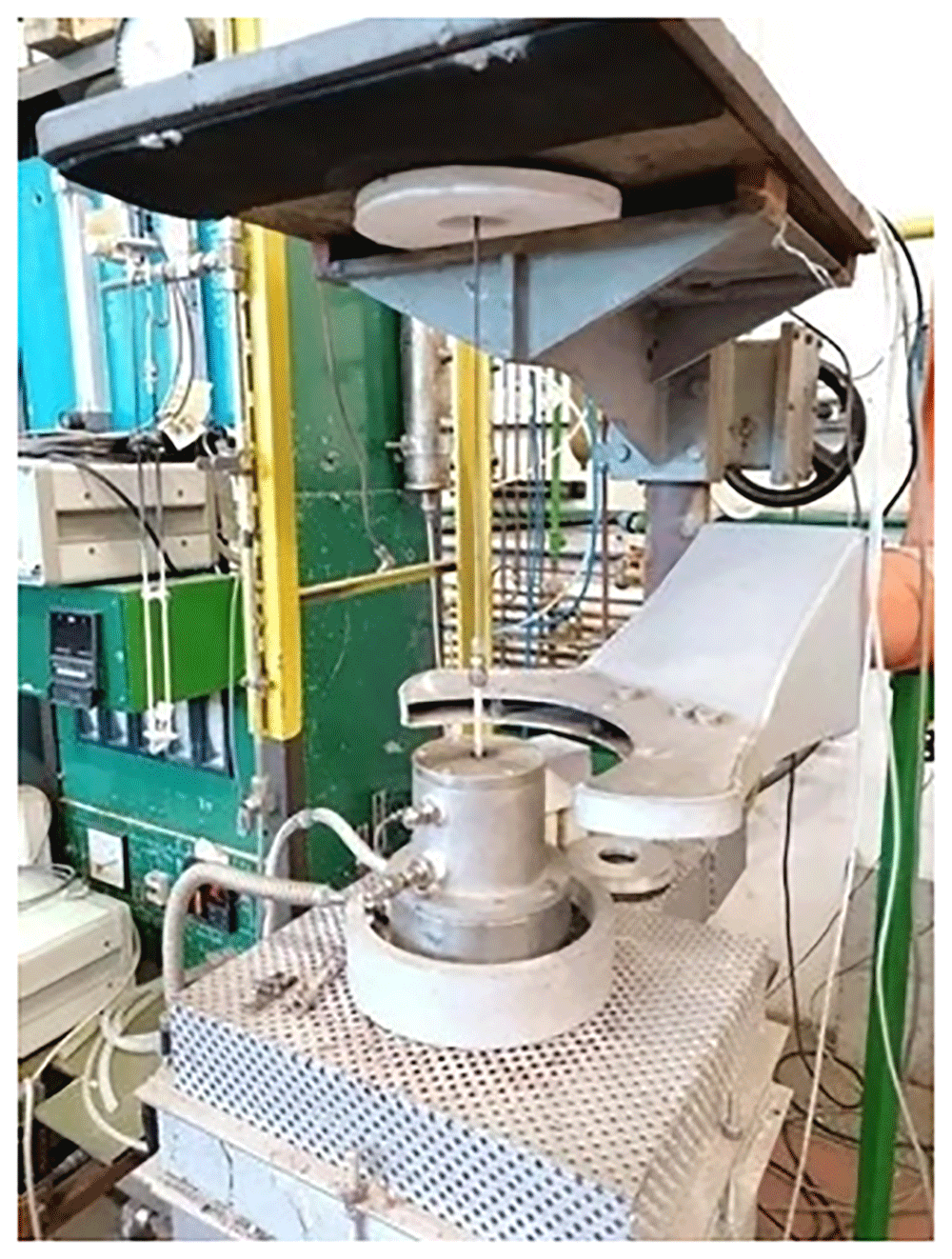
Figure 2. Vertical tubular furnace used for thermogravimetric analysis at RINA-CSM.
The furnace includes an alumina tube heated by four Super-Kantal elements, and inte-grates a balance for in situ mass monitoring under inert atmosphere up to 1000 °C. The setup is specifically employed for characterizing the devolatilization behavior of bio-mass and carbonaceous materials relevant to cokemaking applications.
Each sample, previously oven-dried to constant weight, was heated from 25 °C to 1000 °C at a constant rate (5°C min-1) under argon flow to ensure inert atmosphere. TGA measurements were acquired at this heating rate to resolve the characteristic hemicellulose–cellulose–lignin degradation windows with sufficient temporal and thermal separation, and to inform the design of the subsequent reactor temperature profiles.
The sample mass (ranging between 1.6 and 4.9 g, depending on bulk density) was continuously monitored by a precision microbalance connected to the data acquisition system.
The results allowed distinguishing three main thermal zones typical of lignocellulosic materials:
(1) dehydration below 150 °C,
(2) active devolatilization between 200 and 450 °C, mainly associated with hemicellulose and cellulose decomposition, and
(3) slow carbonization above 500 °C, dominated by lignin degradation and fixed carbon formation.
These data were not used directly for kinetic fitting, but rather to determine the temperature windows of maximum reactivity and to support the definition of the heating profiles adopted in the subsequent lab-scale tests.
2.3 Lab-scale pyrolysis reactor and kinetic modelling
Quantitative pyrolysis experiments were conducted in a horizontal tubular furnace (Figure 3) equipped with six resistive heating zones (three on the upper and three on the lower side). A stainless-steel shell enclosed a high-purity alumina tube containing the biomass charge. The apparatus was developed at RINA-CSM for thermal conversion studies of biomass, biochar, and carbon blends under inert conditions. The system was operated under a constant argon flow of 60 NL·h–1, a value selected to ensure an oxygen-free environment and an adequate sweeping of the evolved gases, in line with operational experience at RINA-CSM for reactors of this size.
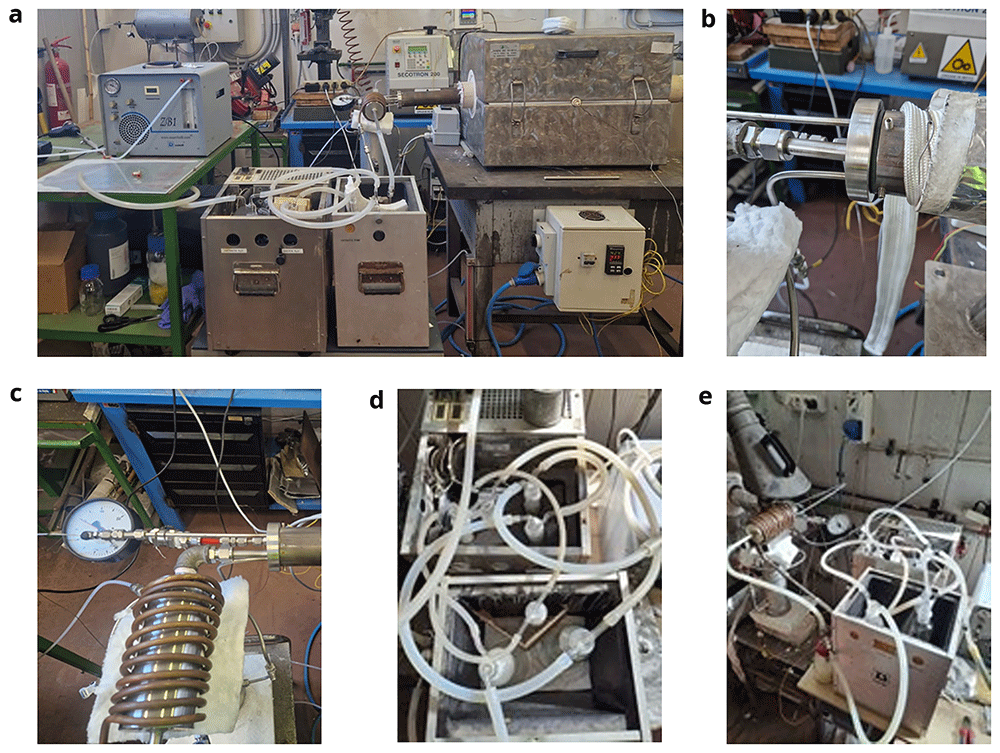
Figure 3.
Laboratory-scale horizontal tubular reactor developed at RINA-CSM: (a) General view of the lab-scale pyrolysis setup including the horizontal tubular furnace with six-zone heating and argon flow control system; (b) close-up of the alumina reactor tube and hinged sealing flange; (c) water-cooled condenser and pressure gauge; (d) cold solvent traps maintained at ±20 °C for light tar collection; (e) overall view of the gas sampling line with silicone tubing and connections to the syngas storage system.
Each test followed a heating program from ambient temperature up to approximately 900°C, with a total duration of about 3 hours, including both the heating and isothermal holding phases. At the reactor outlet, a multi-stage condensation and collection train was installed to recover the three pyrolysis products (heavy tar, light tar and gas) separately.
The first stage consisted of an expansion chamber for heavy tar condensation, followed by six isopropanol bubblers (three maintained at –5°C and three at 25°C) to trap lighter condensable tar.
Downstream, the gas stream passed through activated carbon filters and was finally collected in Tedlar® bags for composition analysis when the in-line thermocouple indicated approximately 500°C at the heated section.
Each experiment was performed with about 40–50 g of biomass, depending on density and packing. After completion of the experiment, the system was cooled under argon to room temperature, and the biochar yield was determined gravimetrically.
The mass balances were performed by comparing the collected quantities of char, tar, and gas, with an overall closure exceeding 95% for all tests. The experimental data from the lab-scale reactor were used to calculate the conversion degree α as a function of temperature and time, according to:
where m0 is the initial dry mass of the biomass, mt is the residual mass at temperature T, and mf is the final mass after the thermal treatment (biochar yield).
This formulation allowed expressing the fraction of material converted into volatiles and gases at each temperature step, linking mass loss directly to reaction progress.
Unlike conventional TGA, where heating rates are low and sample typical weights are of the order of milligrams, this configuration ensured macro-scale conditions representative of real pyrolysis, with realistic temperature gradients and gas-solid interactions. For each biomass, the effective heating rate β used in kinetic calculations was computed from the reactor thermograms as:
where Ti, Tf, ti, tf are the temperatures and times corresponding to the tests start and end. For all biomasses, with negligible variations for each of them.
The α–T curves were obtained from the experimental temperature recording and instantaneous α measurements.
The kinetic analysis was performed using the Coats–Redfern integral approach, which allows estimating the activation energy Ea and pre-exponential factor A from a single heating rate.
The method assumes a general solid-state reaction rate law:
with f(α) the differential model. Under non-isothermal conditions at constant
Rearranging this expression:
Integrating both sides from the start of decomposition (α0, T0) to a generic point (α, T):
The left-hand side is defined as the integral form of the reaction model g(α):
so that:
The integral on the right-hand side has no exact analytical solution and is commonly approximated through a first-order Taylor expansion of the Arrhenius term under the condition which is generally satisfied during pyrolysis. This leads to the standard Coats–Redfern approximation:
Substituting this term into the previous expression gives:
Taking the natural logarithm of both sides yield:
Rearranging to isolate the logarithmic term with T2:
In most cases, the correction factor is very close to 1 (since Ea ≫ RT) and can be neglected, leading to the simplified linear form used in practice:
For the n-th-order model f(α) = (1 – α)n, the integral form is:
All calculations were performed within Microsoft Excel.
For each reaction order (n = 0.5, 1.0, 1.5, 2.0, 2.5, 3.0), the terms were computed, and the resulting linear regressions provided slope (m) and intercept (b):
From these it’s possible to evaluate the activation energy and the pre-exponential factor:
Using the estimated parameters:
This workflow provides both scalar kinetic parameters (Ea, A) and continuous α(T) curves for direct comparison with the experimental data obtained in the lab-scale reactor.
The fitting procedure was performed for each biomass considering reaction orders n ≠ 1, and the coefficient of determination (R2) was adopted as the primary criterion to identify the most representative kinetic order.
Values of Ea and A were then calculated from the regression slope and intercept, respectively, while the temperature range below 200°C was excluded to avoid interferences from moisture evaporation and early devolatilization effects.
Among the five types of biomasses analyzed, the best correlations were obtained for reaction orders between 2.0 and 3.0, confirming a mixed kinetic regime governed by both diffusion-controlled and random nucleation mechanisms.
The combination of detailed mass balance data with the Coats–Redfern integral model yielded a coherent description of biomass degradation under inert atmosphere.
In particular, the kinetic parameters derived from the reactor-scale experiments were consistent with the observed conversion trends, effectively bridging the gap between small-scale TGA results and realistic process conditions.
Overall, this integrated methodology provides a reliable framework for comparing the pyrolytic reactivity of different feedstocks and supports the selection of the most suitable biomass for producing biochar as a renewable carbon carrier in cokemaking applications.
3. Results
3.1 Mass balance and product yields
The pyrolysis experiments performed on the five selected biomasses—olive branches, pine, wooden pallets, wooden crates, and olive trunks—provided a comprehensive understanding of their thermal decomposition behavior under inert conditions. All experiments were conducted in the laboratory-scale horizontal tubular reactor developed at RINA-CSM previously shown in Figure 3, under a controlled argon flow of 60 NL·h–1, a heating rate of approximately 2.5 °C·min–1, and a maximum temperature of about 900 °C. The condensed, solid, and gaseous products were collected and quantified, allowing complete mass balances to be established. The results are summarized in Table 3, which reports the initial and final masses, as well as the distribution of tar, biochar, and gas fractions for each feedstock.
Table 3. Product yields from laboratory-scale pyrolysis tests.
| Biomass | Initial mass (g) | Final mass (g) | TAR (%) | Biochar (%) | Gas (%) |
|---|
| Olive branches | 41.1 | 11.28 | 28.7 | 27.4 | 43.8 |
| Pine | 48.2 | 10.6 | 41.8 | 22.0 | 36.2 |
| Pallet | 46.71 | 9 | 18.3 | 19.3 | 62.5 |
| Wooden crates | 40.9 | 11.5 | 62.0 | 28.1 | 9.9 |
| Olive trunks | 49.8 | 12.5 | 36.0 | 25.1 | 38.9 |
For all experiments, the overall mass balance exceeded 95%, confirming the accuracy of the experimental setup, including the temperature control, the condensation system for tar collection, and the gas quantification line equipped with isopropanol traps and activated carbon filters.
The data reveals a marked variability among the different biomass, reflecting the combined effects of their chemical composition, structure, and pre-treatment history.
Olive branches, representing light and porous pruned residues, displayed a balanced decomposition profile with almost equivalent contributions of condensable (tar, 28.7%) and non-condensable gases (43.8%), resulting in a stable solid residue of 27.4%. Such a distribution indicates efficient devolatilization but also sufficient aromatic condensation to ensure a compact biochar, consistent with the moderate lignin content typically found in olive wood. Pine exhibited a similar trend, with a slightly higher tar production (41.8%) and a lower char yield (22.0%). Its greater proportion of hemicellulose and cellulose promotes faster and broader decomposition, leading to more pronounced gas release but reduced carbon fixation in the solid phase.
The processed wood materials, pallets and wooden crates, showed significantly different behavior. Pallets, characterized by industrial origin and possible residual adhesives, generated the largest gas fraction (62.5%), indicative of extensive cracking and decomposition of lighter volatile components. The resulting char yield was the lowest among the five feedstocks (19.3%), consistent with the relatively low activation energy determined later in the kinetic analysis. Wooden crates, instead, were dominated by the production of condensable tars (62.0%), suggesting the occurrence of polymeric coatings or binding agents that enhance condensation and inhibit the secondary cracking of heavy volatiles. Their gas evolution was minimal (9.9%), while the solid fraction remained moderate (28.1%), a profile coherent with materials subjected to multiple processing steps that modify their natural lignocellulosic structure.
Olive trunks exhibited a decomposition behavior intermediate between these two groups. Due to their higher density and lignin content, they underwent slower devolatilization, producing a stable char fraction (25.1%) and intermediate amounts of tar (36.0%) and gas (38.9%). The dense microstructure of olive trunk wood enhances cross-linking reactions during carbonization, promoting the formation of a compact carbon network and explaining the longer decomposition tail observed in the kinetic profiles discussed below.
Macroscopic inspection of the recovered chars confirmed these trends. The olive-derived chars appeared dense, coherent, and with a fine-grained texture, indicative of uniform devolatilization and efficient solid-phase reorganization. Pine and pallet chars were more porous and friable, revealing higher volatile loss and less structural stability. Crate-derived char exhibited a darker, oily surface, associated with condensed tar residues.
From a technological standpoint, the biochar yields between 19 and 28 wt.% are compatible with the requirements for developing renewable carbon carriers. The non-condensable gases and tars also represent valuable by-products that can be harnessed for heat recovery within the pyrolysis loop, contributing to the energy self-sufficiency of the process. Nevertheless, maximizing the solid carbon fraction remains the main goal for metallurgical applications, making the olive-based biomass the most attractive candidates for further scale-up investigations.
3.2 Kinetic analysis and model fitting
The conversion curves α(T) derived from the reactor tests were analyzed using the Coats–Redfern integral method, allowing the determination of the apparent activation energy (Ea), pre-exponential factor (A), and reaction order (n) for each feedstock. The heating rate (β) was estimated from the experimental temperature profiles as (Tf – Ti)/(tf – ti), resulting in an average value of 2.5 °C·min–1. The kinetic parameters are summarized in Table 4.
Table 4. Kinetic parameters of the investigated biomass.
| Biomass | n | Ea [kJ mol-1] | A [s-1] | β [°C min-1] | R2 |
|---|
| Olive branches | 2 | 23.25 | 6.03 | 2.5 | 0.979 |
| Pine | 2 | 49.97 | 2253.23 | 2.5 | 0.985 |
| Pallet | 2.5 | 67.14 | 89010.22 | 2.5 | 0.967 |
| Wooden crates | 2.5 | 58.87 | 11911.69 | 2.5 | 0.963 |
| Olive trunks | 3.5 | 61.21 | 181925.12 | 2.5 | 0.971 |
The activation energies obtained ranged from 23.25 to 67.14 kJ·mol–1, values that fall within the range typically reported for slow pyrolysis of lignocellulosic materials under inert atmospheres5,11,13. The corresponding reaction orders varied between 2.0 and 3.5, indicating a gradual transition from diffusion-controlled to nucleation-and-growth-controlled kinetics as the structural compactness and lignin content increased.
The experimental and modeled conversion curves and the corresponding residual distributions are presented in Figures from Figure 4 to Figure 8.
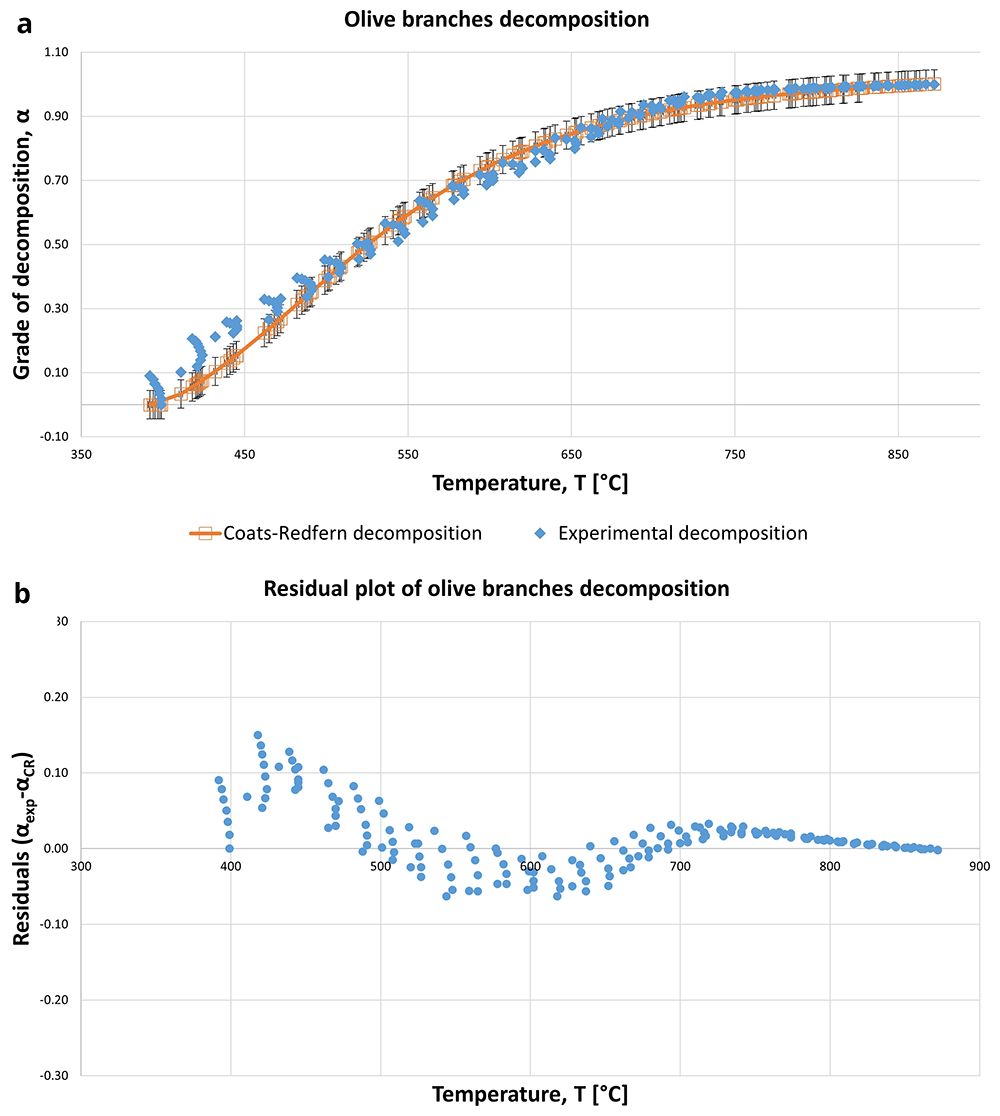
Figure 4.
Olive branches decomposition: (a) experimental and Coats–Redfern modelled conversion degree α(T) as in Table 4; (b) residuals (αexp – αCR) as a function of temperature.
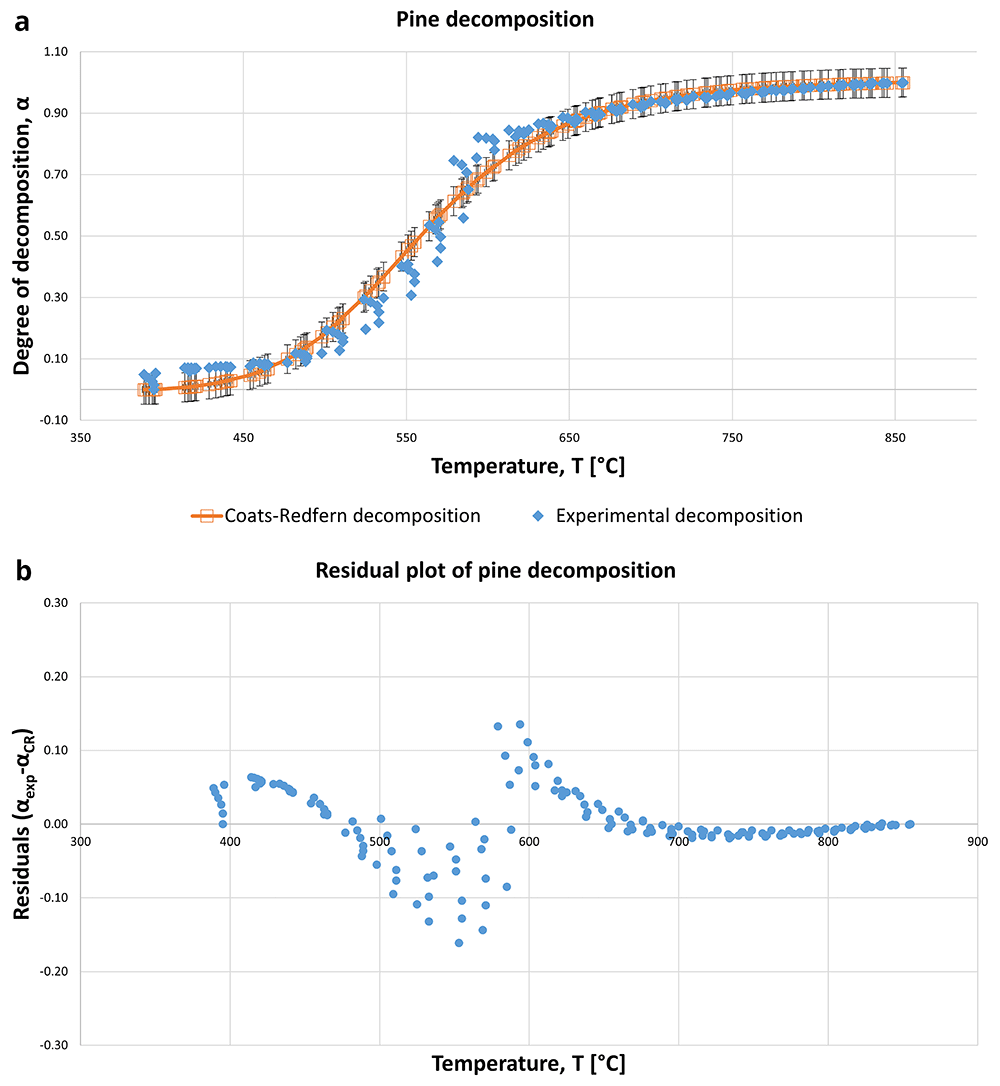
Figure 5.
Pine decomposition: (a) experimental and Coats–Redfern modelled conversion degree α(T) as in Table 4; (b) residuals (αexp – αCR) as a function of temperature.
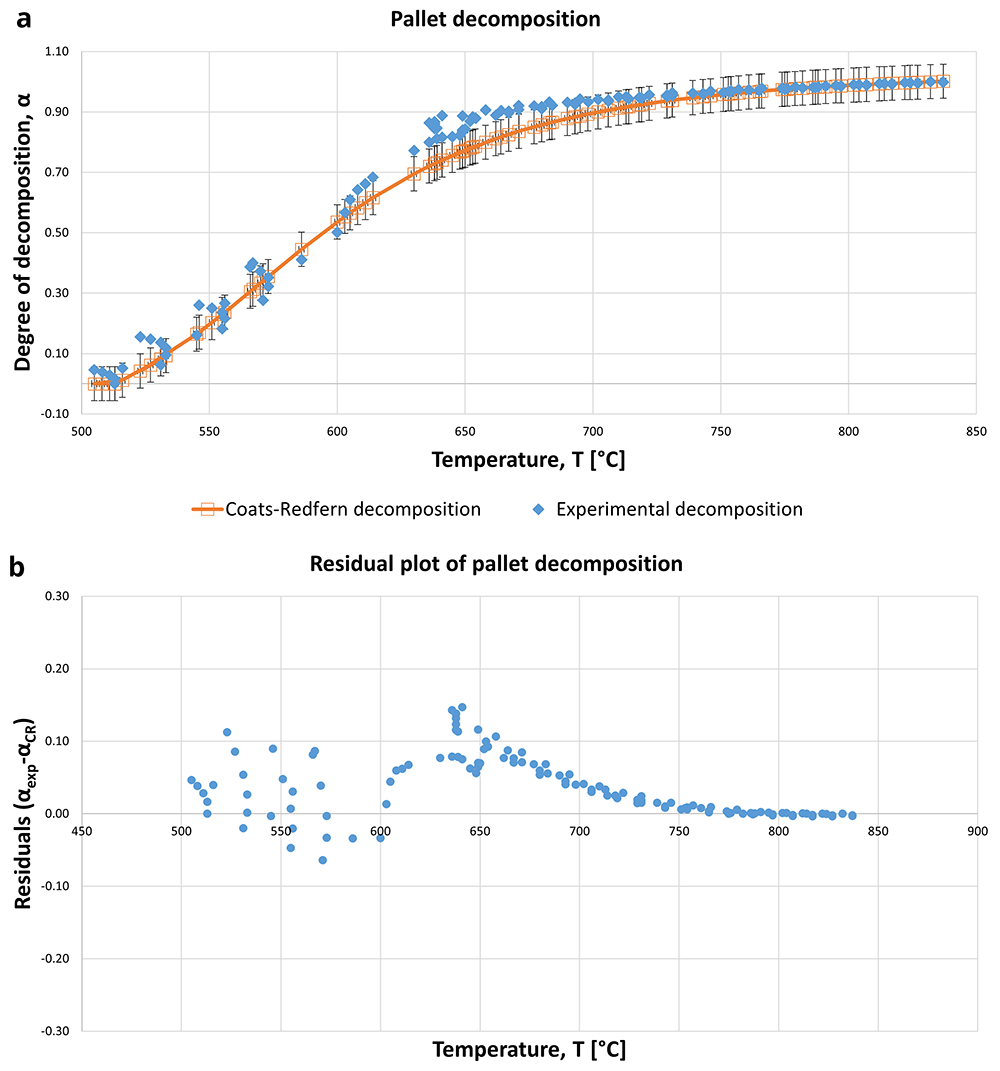
Figure 6.
Pallet decomposition: (a) experimental and Coats–Redfern modelled conversion degree α(T) as in Table 4; (b) residuals (αexp – αCR) as a function of temperature.
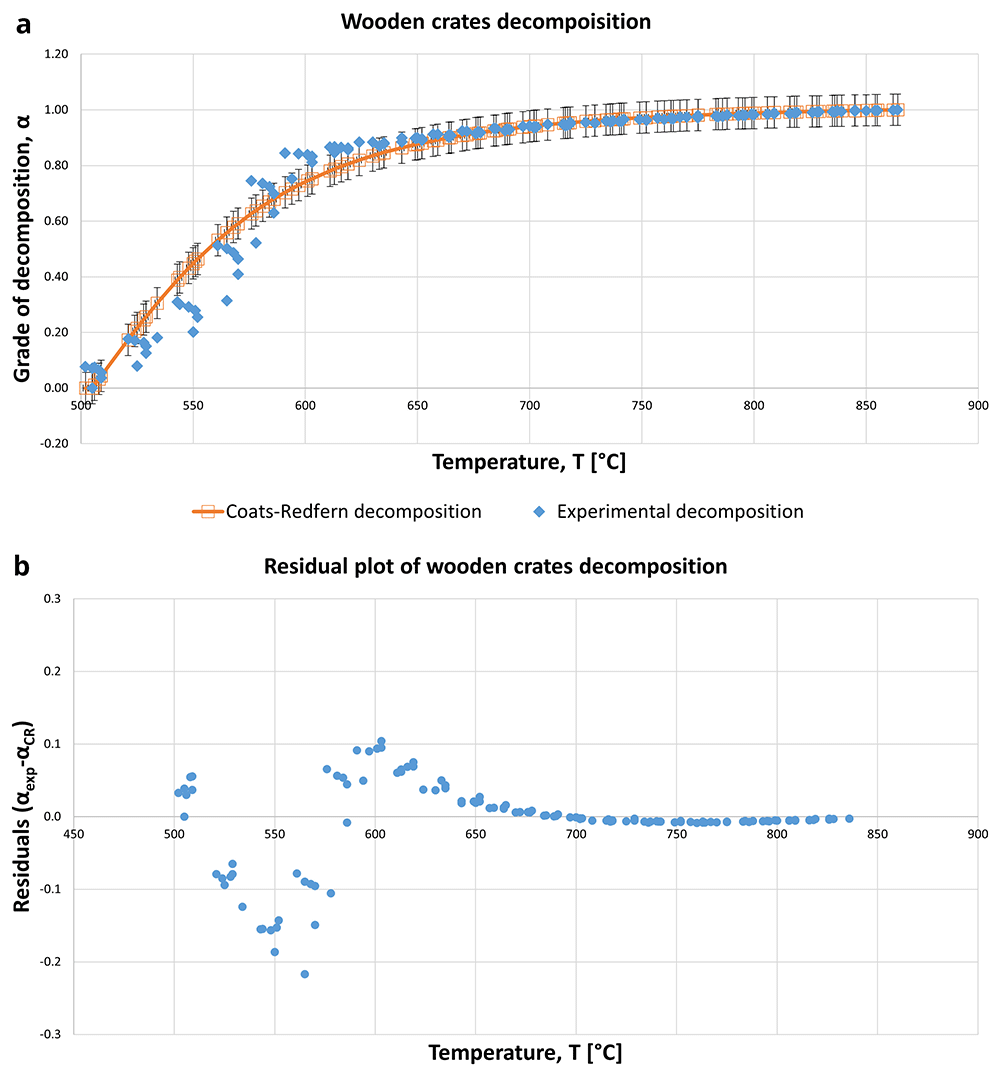
Figure 7.
Wooden crates decomposition: (a) experimental and Coats–Redfern modelled conversion degree α(T) as in Table 4; (b) residuals (αexp – αCR) as a function of temperature.
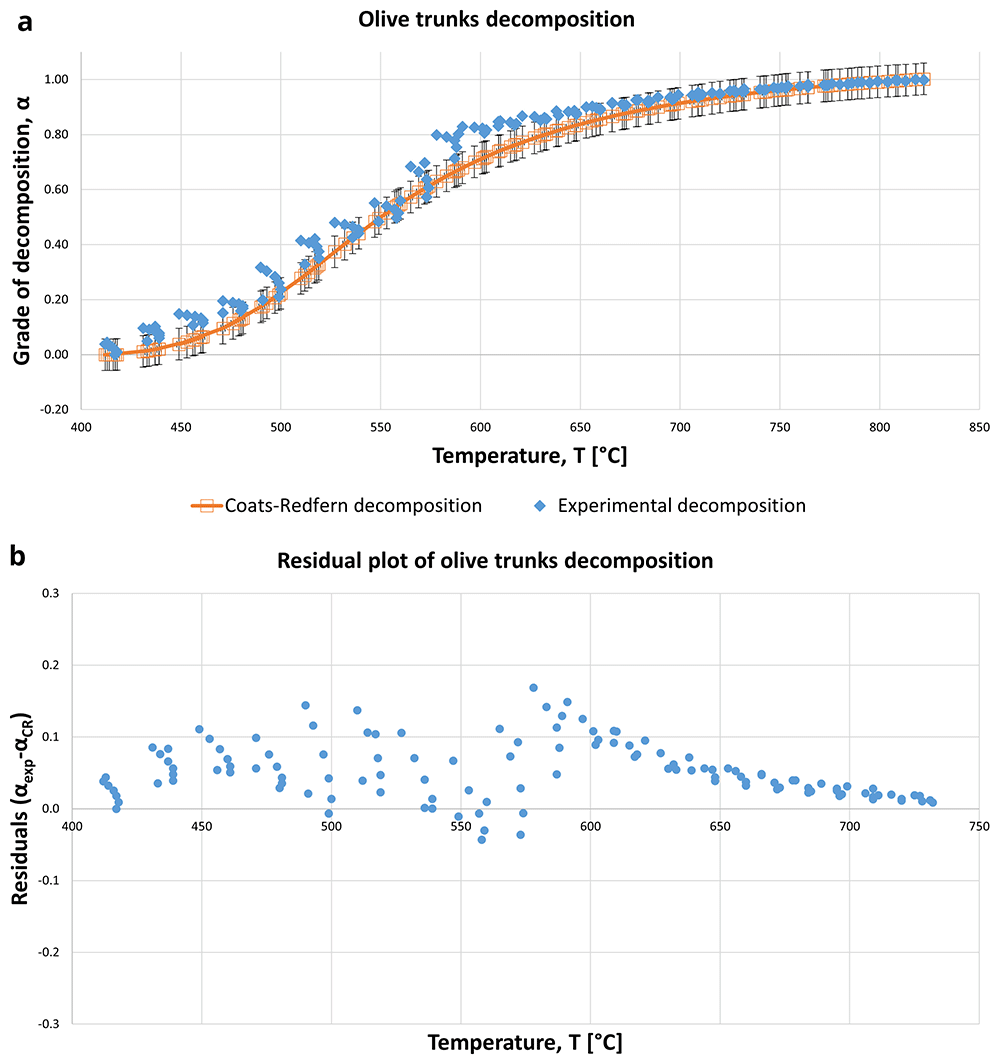
Figure 8.
Olive trunks decomposition: (a) experimental and Coats–Redfern modelled conversion degree α(T) as in Table 4; (b) residuals (αexp – αCR) as a function of temperature.
For olive branches (Figure 4), the α(T) curve displays an early onset of conversion, followed by a steep increase in the 350–550 °C interval and a smooth plateau approaching complete conversion. The Coats–Redfern model reproduces the overall trend accurately (R2 ≈ 0.97), though it slightly underestimates the initial reactivity below 450 °C and marginally overestimates the conversion rate around 500–600 °C. The residuals confirm this behavior, with a mild transition from positive to negative values before stabilizing around zero above 700 °C. This behavior reflects the relatively low activation energy (23.25 kJ·mol–1) and homogeneous structure of the feedstock, favoring a fast yet uniform devolatilization process. The balanced distribution of tar, gas, and char observed experimentally supports this kinetic interpretation, confirming that olive branches yield a stable carbonaceous residue suitable for metallurgical reuse.
In the case of pine (Figure 5), the decomposition begins at slightly higher temperatures and extends over a wider range, consistent with its more crystalline cellulose structure and higher resin content. The Coats–Redfern model reproduces the overall behavior well (R2 = 0.985), though a slight overestimation occurs below 450 °C and a corresponding underestimation in the 470–550 °C region. This alternating pattern, visible in the residual plot, reflects the sequential degradation of hemicellulose and cellulose followed by slower lignin conversion. Above 600 °C, the experimental and modeled α(T) curves converge, confirming the model’s adequacy in describing the final decomposition stage. The activation energy (49.97 kJ·mol–1) and reaction order n = 2 are consistent with a kinetically moderate but well-controlled process, yielding 22 wt.% biochar. These features highlight pine’s potential as a stable and reactive feedstock for biochar production within metallurgical applications.
The pallet material (Figure 6) shows a distinct delay in the onset of conversion and a broad α(T) curve extending beyond 700°C. This behavior is coherent with its higher activation energy (67.14 kJ·mol–1) and suggests overlapping decomposition mechanisms caused by the heterogeneous composition of the feedstock. The Coats–Redfern model reproduces the general trend but shows alternating deviations: it slightly underestimates the conversion below 550 °C, overestimates it between 550 and 600 °C, and underestimates it again from 600 to 650 °C before realigning with the experimental data. This oscillatory residual pattern reflects the multi-step degradation of additives and coatings typical of processed wood. The resulting low char yield (19.3 wt.%) and high gas fraction (62.5 wt.%) confirm the extensive volatilization, indicating that pallet wood is less suitable for char production unless pretreated or blended.
For wooden crates (Figure 7), α(T) profile exhibits a two-step behavior with a clear shoulder between 450 and 550 °C, indicating the coexistence of different reaction phases. The Coats–Redfern model underestimates the first decomposition stage at low temperatures but reproduces the high-temperature region accurately, as confirmed by the residual distribution. The observed kinetic complexity aligns with the high tar production (62%) and limited gas release (9.9%), confirming that condensation reactions dominate. The relatively high activation energy (58.87 kJ·mol–1) and intermediate reaction order (n = 2.5) point to a system where both diffusion and surface reaction limitations coexist. Although the overall correlation remains good (R2 = 0.963), the kinetic heterogeneity suggests that a single-step model only partially captures the real behavior.
Finally, olive trunks (Figure 8) demonstrate a slower but more progressive conversion, characterized by a delayed onset and an extended tail toward higher temperatures. This trend reflects the denser structure and higher lignin fraction of the material, which enhance cross-linking reactions and retard devolatilization. The Coats–Redfern model captures the general trend with good accuracy (R2 = 0.971), slightly underestimating the conversion in the intermediate temperature range (450–600 °C) and marginally overestimating it above 650 °C. The residuals confirm this trend, showing a transition from positive to slightly negative values as temperature increases. Such behavior is consistent with the gradual formation of stable aromatic structures within the char matrix at high temperatures. The resulting biochar, accounting for 25% of the initial mass, appears dense and mechanically robust, a desirable feature for metallurgical reuse.
Overall, the coupling between reactor-scale experiments and kinetic modeling provides a solid framework for interpreting biomass conversion. The α(T) curves and their residual distributions reveal that olive branches, pine, and olive trunks follow relatively homogeneous kinetics that can be effectively modeled, whereas processed wood such as pallets and crates show overlapping phenomena indicative of chemical heterogeneity.
3.3 Comparative assessment and implications for cokemaking
The combined evaluation of mass balances, kinetic parameters, and model performance allows a comparative assessment of the five investigated biomasses and their suitability as renewable carbon carriers for cokemaking.
Overall, the experimental and kinetic results reveal two distinct patterns. Natural biomasses (olive branches, olive trunks, and pine) showed consistent and predictable decomposition, while industrial residues (pallets and wooden crates) exhibited more complex and heterogeneous kinetics due to previous treatments and additives.
Among all feedstocks, olive branches and olive trunks represent the most promising candidates. Olive branches combine low activation energy, uniform decomposition, and a balanced product distribution, producing a reactive yet stable biochar (≈27 wt.% yield) suitable for blending with metallurgical coke. Olive trunks, although characterized by slower kinetics and higher activation energy, generate a dense and cohesive char (≈25 wt.%) with greater mechanical strength and likely higher graphitization degree, features essential for maintaining coke integrity during cokemaking. Their complementary properties suggest a synergistic potential when jointly used: olive branches enhancing reactivity and devolatilization, and olive trunks providing structural stability.
Pine shows intermediate behavior, with moderate activation energy and good model predictability (R2 = 0.985). Its higher gas fraction makes it less favorable for maximizing solid yield but potentially valuable in energy-integrated systems where pyrolysis gases are recovered for processing heating.
Conversely, pallet and crate woods demonstrated kinetic heterogeneity, reflected by oscillatory residuals and irregular α(T) profiles. These features, together with lower char yields (≈20–28 wt.%) and high tar or gas production, result from the presence of resins, coatings, and adhesives that introduce overlapping decomposition mechanisms. While unsuitable as primary char sources, such residues could still be exploited as secondary components in blended feeds after pre-treatment (e.g., torrefaction or surface cleaning), thus aligning with circular-economy objectives.
The general relationship observed between chemical structure and kinetic behavior confirms that higher lignin and fixed-carbon contents enhance char formation and delay decomposition, while higher cellulose and volatile matter contents lead to lower activation energies and faster conversion. Such correlations are in full agreement with literature5,6,11, reinforcing the validity of the experimental approach adopted in this study. The observed kinetic behavior can be rationalized by considering the results of the ultimate and proximate analyses previously performed on the same biomass (see Section 2.1). These analyses revealed consistent correlations between chemical composition and pyrolytic response.
Olive-derived materials and pine exhibited relatively high fixed-carbon contents and moderate volatile fractions compared with the other investigated feedstocks. Pine, in particular, combined a high fixed-carbon level with a comparatively low ash content, whereas pallet wood and crates showed higher volatile fractions and traces of additives and inorganic residues that modified their natural decomposition pathways.
The C/H/O ratios further support these distinctions: olive branches and trunks displayed C/H ratios above 15, typical of lignin-rich and aromatized matrices, whereas pine and the processed woods showed lower C/H values (10–12), reflecting a greater proportion of oxygenated functional groups associated with cellulose and hemicellulose.
Nitrogen was negligible in all samples (<0.5%), confirming that no significant nitrogenous emissions were expected during thermal degradation.
These compositional features directly influenced the kinetic parameters. Materials with higher fixed carbon and lignin fractions, such as olive trunks, required higher activation energies and exhibited delayed decomposition, consistent with their more cross-linked aromatic structure. Conversely, the high-volatile, low-lignin feedstocks (pine and olive branches) decomposed rapidly at lower Ea, following smoother α(T) profiles and yielding lighter, more reactive chars.
The processed woods deviated from these natural trends because of chemical heterogeneity introduced by industrial treatments: coatings and adhesives generated condensed tars and induced multi-step kinetics with overlapping mechanisms, as evidenced by oscillatory residual patterns.
The comparison between kinetic and chemical data thus confirms that feedstocks richer in lignin and fixed carbon favor the production of dense and mechanically stable biochar, whereas volatile-rich materials primarily generate gases and condensable. This dual interpretation—linking chemical structure to kinetic response, reinforces the rationale for selecting olive-derived biomass as optimal precursors for biochar in metallurgical applications. Their balanced carbon composition and controlled reactivity align with the requirements of cokemaking processes, where both structural integrity and surface reactivity are critical to ensure effective substitution of fossil coke.
From an industrial perspective, these results provide a practical foundation for designing biochar feedstocks tailored to metallurgical requirements. Olive-derived biomass exhibits the optimal compromise between carbon yield, kinetic accessibility, and char strength, thereby fulfilling the dual criteria of reactivity and durability essential for partial coke substitution.
The combination of experimental mass balances, α(T) modeling, and residual analysis thus offers a comprehensive understanding of how different biomass behave under controlled pyrolytic conditions. These insights establish the scientific basis for subsequent pilot-scale carbonization trials.
4. Discussion
The pyrolysis experiments and kinetic analyses carried out in this study provided a comprehensive picture of the thermal behavior of selected biomass and their potential for conversion into renewable carbon carriers for cokemaking. The combination of mass balance data, chemical composition, and kinetic modelling allowed establishing meaningful correlations between feedstock properties, devolatilization dynamics, and the characteristics of the resulting biochar. The different thermal reactivities observed among the five feedstocks can be directly related to their elemental and proximate compositions reported in Section 2.1. Olive-based materials, especially branches and trunks, exhibited higher lignin and fixed-carbon content compared with pine and processed woods, whereas pine displayed a higher fraction of volatile matter and oxygen-bearing species. These differences critically influenced both the activation energies and product distributions.
Feedstocks rich in lignin typically undergo slower degradation and yield chars with higher aromaticity and mechanical integrity3,5,13. In the present study, olive trunks confirmed this trend: their conversion proceeded gradually with a reaction order of 3.5 and an apparent activation energy of about 61 kJ·mol–1, producing a compact, carbon-rich residue. Conversely, materials dominated by cellulose and hemicellulose, such as pine, decomposed at lower temperatures, releasing a higher fraction of volatiles and showing lower Ea values (≈50 kJ·mol–1). Similar correlations between composition and activation energy have also been reported by Várhegyi et al.9 and Lam et al.7, who identified the degree of polymerization and the oxygen content as primary descriptors of reactivity.
The behavior of the processed woods (pallet and wooden crates) reveals the complexity introduced by coatings, adhesives, and previous thermal histories. These materials exhibited wide conversion intervals and high apparent activation energies (59–67 kJ·mol–1), indicative of competing mechanisms and potential catalytic or inhibiting effects of additives. The shoulder observed in the α(T) curves of wooden crates around 500 °C likely corresponds to the decomposition of resinous compounds or varnishes that interfere with the main devolatilization step. Similar dual-step features were also noted by Naqvi et al.15 for agricultural residues and by Surahmanto et al.16 for oil palm waste, confirming that kinetic complexity increases with chemical heterogeneity. A noteworthy outcome of this study is the internal consistency between the product yields measured at reactor scale (Table 3) and the kinetic constants determined from Coats–Redfern analysis (Table 4). Biomass characterized by low Ea and low reaction order (olive branches, pine) released volatiles rapidly and produced moderate tar and gas fractions in comparable proportions. This behavior reflects a single dominant degradation event governed by first-order–like kinetics (n≈2). In contrast, high Ea and large n values correspond to prolonged conversion and higher sensitivity to temperature, as observed for olive trunks and pallet wood. Such agreement between kinetic and macroscopic observations supports the robustness of the simplified Coats–Redfern approach when applied to integral reactor data instead of small TGA samples.
Furthermore, the high R2 coefficients (0.96–0.99) demonstrate that the single-step model adequately reproduces the main devolatilization event for all feedstocks. Although real biomass pyrolysis involves multiple parallel and consecutive reactions20,12, the adoption of an apparent global model provides a pragmatic description suitable for scaling-up and for integrating kinetic parameters into reactor design tools. This is particularly relevant for the design of pyrolysis and cokemaking processes, where heat-transfer and residence-time models require reliable kinetic constants to predict the conversion rate of blended feedstocks under inert conditions. The activation energies obtained in this work (23–67 kJ·mol–1) are within the broad range typically reported for lignocellulosic biomass pyrolysis, although somewhat lower than those obtained from pure TGA studies, which often span 80–250 kJ·mol–15,11,13. This discrepancy can be attributed to the different thermal and hydrodynamic environments of the horizontal tubular reactor, where the heating rate, gas flow, and particle size are closer to realistic process conditions. As highlighted by Hameed et al.5 and Manic et al.8, lower apparent activation energies often emerge when intra-particle gradients and secondary reactions are allowed to occur, since the global model implicitly averages multiple steps into a single effective term. Therefore, the values derived here should be considered process-level kinetic parameters, not intrinsic constants of isolated reactions.
The correlation between activation energy and char yield follows the general tendency observed by Kersten et al.20,21: denser, carbon-rich materials demand higher activation energies but retain a larger proportion of solid residue. The alignment of our results with these established trends confirm that the small-scale tests reliably capture the fundamental physics of biomass thermochemical conversion. From an application viewpoint, the aim of this study is to identify biomass-derived materials capable of partially substituting fossil coke as carbon carriers in cokemaking process. Such materials must exhibit sufficient fixed-carbon content, low ash and sulfur, and a degree of graphitization compatible with mechanical stability during the carbonization cycle. In this view, among the five investigated feedstocks, olive branches and olive trunks stand out as the most promising candidates. Olive branches offer low activation energy and easy devolatilization, enabling efficient carbonization with reduced energy input, while olive trunks provide the structural strength necessary for maintaining porosity and mechanical resistance of the final char. Their combined use may therefore balance reactivity and integrity, yielding a biochar blend that can integrate effectively into cokemaking blends without compromising the mechanical strength of the coke.
In contrast, pallet and crate woods show limitations mainly related to inconsistent composition and undesired product distribution (excess tar or gas). Their kinetic heterogeneity implies that uniform carbonization would require tighter process control or pre-treatment (e.g., torrefaction, de-coating). However, these residues still represent a valuable resource from a circular economy perspective if used in secondary energy recovery streams rather than as direct char precursors.
By linking the kinetic study to practical steelmaking applications, this work establishes a quantitative bridge between laboratory-scale thermochemical analysis and industrial decarbonization strategies. Integrating the obtained kinetic constants into process simulations will enable predictive modelling of biochar behavior during cokemaking, supporting the design of tailored feedstock mixtures and optimized heating profiles. Although the present approach provided robust and internally consistent results, some limitations must be acknowledged. The Coats–Redfern method assumes a constant activation energy over the entire conversion range, whereas real biomass pyrolysis involves evolving mechanisms and changing reaction pathways6,11. This simplification is acceptable for comparative screening but may underestimate local kinetic barriers. Moreover, the mass-loss data used here was derived from batch reactor experiments, where heat and mass transfer are less uniform than in thermogravimetric analysis. Future studies could combine iso-conversional methods (e.g., Flynn–Wall–Ozawa, Kissinger–Akahira–Sunose) with multi-step fitting to refine the kinetic interpretation.
Another important aspect concerns the scale-up of heat and mass transport phenomena. The reactor employed in this study reproduces the inert atmosphere and temperature range of pilot operations, but further experiments at higher throughput and controlled heating rates are needed to validate the transferability of the kinetic parameters. In addition, characterization of the produced biochar (surface area, pore size distribution, mechanical resistance, and reactivity with CO2) will be essential to assess its suitability as a metallurgical reductant.
Finally, integrating the obtained data into mass and energy balances of the cokemaking process will provide insights into the real decarbonization potential of biomass-derived carbon carriers. The present work therefore constitutes a foundational step in establishing the kinetic and process framework necessary to advance toward pilot-scale demonstrations. In summary, the combined experimental–kinetic investigation demonstrates that a rational selection of biomass feedstocks, supported by chemical characterization and kinetic modelling, can effectively guide the development of sustainable carbon carriers for the steel industry. Olive-derived biomasses displayed the most balanced compromise between activation energy, char yield, and product distribution, while the Coats–Redfern approach proved to be a practical and consistent tool for capturing the main devolatilization behavior under realistic reactor conditions. These results not only confirm the feasibility of biochar production under controlled inert atmospheres but also provide quantitative parameters to model its transformation in cokemaking processes, reinforcing its potential contribution to the decarbonization of primary steel production.
5. Conclusions
This work assessed the pyrolytic behavior and kinetic performance of five biomass feedstocks to evaluate their suitability as renewable carbon carriers for the steel industry. Olive branches and trunks emerged as the most promising candidates, offering high fixed-carbon content, favorable activation energies, and stable biochar yields. The Coats–Redfern model provided reliable kinetic parameters under lab-scale conditions, supporting comparative evaluation across different materials. In contrast, processed woods such as pallets and crates showed greater kinetic heterogeneity and lower char retention, mainly due to additives and surface treatments. Despite the limitations of single-step modeling, the results establish a practical framework for integrating biomass pyrolysis kinetics into process simulations. These findings support the feasibility of partially substituting fossil coke with biomass-derived char in cokemaking, contributing to the broader goal of decarbonizing primary steel production.
Ethics and consent
Ethical approval and consent were not required for this study, as it did not involve human participants, animals, or any personally identifiable or sensitive data.




