Introduction
The EU-funded project WATERFRONT examines how artist-led participatory practices can support citizen engagement with climate change challenges in waterfront contexts (Waterfront 2023). This is to raise awareness of climate change, encouraging them to take initiatives individually and/or collectively under the motto that many small contributions add up to a large one. To explore how artists can stimulate this connection between artists and citizens, co-design sessions were held in three participating countries at their specific locations: Gothenburg/Sweden, Zadar/Croatia, and Lesbos/Greece. At the request of these three countries and their initiators, the Dutch team, which participated in a previous EU-funded project, the "SOS Climate Waterfront," also participated in the online session of Sweden to start bringing in their former lessons learned and to participate in the project further.
The project focuses specifically on the preparatory phase of the WATERFRONTS project, in which focus groups are used to explore local climate issues, artistic approaches, and conditions for meaningful public involvement. The purpose is not to evaluate artistic outcomes or community impacts but to analyse process-related insights emerging from these focus groups and from a subsequent reflective workshop. By examining these moments, the aim is to clarify how artists can be supported in leading participatory work with communities, and which process conditions may help translate concerns about climate change into collective action.
In short, the outcome of these co-design sessions was that the urgency of citizen involvement in climate measures, with all related issues, was discussed, as well as the inventiveness of involving artists in raising awareness, but how this could be achieved was left very open. Therefore, on this topic of how artists can get started, the smallest contributions of these co-design sessions have been analysed in conjunction with each other, in combination with the literature, to provide an initial working model.
This, with the goal of supporting artists in the four countries in their work, and, after observing and comparing them with actual processes, to develop action perspectives for new projects in other countries as well. This resulted in a strategic working model and tools to obtain such an approach. What is written in successive chapters: 1. Introduction to the WATERFRONT initiative; 2. Research conceptual model, 3. The’ Artivism approach, 4. The Artivism conceptual framework, 5: The research questions, 6. The co-design sessions resulted in 7. The artivism process was modelled, and 8. Conclusions and remarks with references and an attachment.
The WATERFRONT EU-initiative, its targets and context,
The EU-funded WATERFRONT project aims to support communities in engaging with climate change challenges in waterfront contexts through artist-led participatory practices. The project is based on the understanding that climate change is experienced locally and unevenly and that effective responses require citizens to be actively involved in shaping how challenges are understood and addressed (Waterfront 2023).
Within WATERFRONTS, artists play a central role by leading participatory activities that enable dialogue, reflection, and co-design with local communities organized in the tradition of Artivism. Expert knowledge contributes to contextual insight, but solutions are not predefined. Instead, they emerge through collective exploration, guided by artistic practices.
The project is coordinated in Sweden, with partner organizations in Greece and Croatia, and an associated partner from the Netherlands. Activities take place in Gothenburg, Sweden; Lesbos, Greece; and Zadar, Croatia. Dutch participants contributed through focus groups organized in Sweden and through participation in the Gothenburg workshop and are exploring funding opportunities for a spin-off project in the Rotterdam area.
The initiative builds on insights from earlier European projects addressing climate change in coastal regions, including the SOS Climate Waterfront Project (Sanders and Jonkers 2024) (Sanders and Oliveira 2024). WATERFRONTS extends this work by emphasizing artist-led participation, process design, and the role of creative practices in enabling citizen involvement and shared responsibility.
As a preparatory step, WATERFRONTS includes a series of focus groups organized in the participating countries. These focus groups brought together artists, climate experts, and practitioners with experience of community engagement. Although formally structured as focus groups, the sessions facilitated co-design by encouraging participants to jointly explore local climate challenges, discuss possible approaches, and reflect on how artists might engage citizens in later phases of the project. The insights generated through these sessions inform the WATERFRONTS methodology and support artist capacity building by generating action perspectives, a framework for effective process management, so that local governments in other cities or other locations can adopt this approach, adapting it as much as possible to their own local circumstances.
Following this preparatory phase, artists engage in Artivism activities in their communities. These activities were subsequently deepened through residencies at the respective waterfront locations. Peer learning between artists takes place after residencies, allowing for reflection, exchange of experiences, and consolidation of insights.
The project's goal regarding these action perspectives is partly open-ended; it remains to be seen what kind of initiatives citizens will take (Waterfront 2023). Will they be practical initiatives in the public spaces surrounding their homes, or will they help each other make their homes more energy efficient? Alternatively, will they involve entirely different initiatives, such as liveability, health, inclusivity, and shared mobility? Therefore, the question remains whether these initiatives will be taken solely among citizens or also in collaboration with other organizations, businesses, or the municipality as a local government.
WATERFRONTS focuses on coastal and waterfront locations because such areas are particularly exposed to climate change. These locations often experience multiple and interconnected challenges, including sea-level rise, flooding, water scarcity, heat stress, and pressure on public spaces. By working in this context, the project seeks to better understand how artist-led participatory practices can support communities in responding to complex and overlapping climate risks.
The research conceptual model and its highlights
The conceptual research model applied in this study is structured around five interconnected research steps that support an action-oriented and learning-based approach:
a. The first step consists of ex ante research conducted on location. This step focuses on identifying relevant issues, assumptions, and sensitivities at an early stage, before the outcomes are known. Focus group co-design sessions with experts on climate change and artists are used as a key method in this phase to explore local climate challenges, expectations, and possible approaches, and to provide them with the tools they need to engage productively with citizens.
b. The second step involves process learning through immediate analysis. Insights emerging from ex-ante research are analysed as the process unfolds, allowing early patterns and tensions to be identified and informing the development of the methodological framework.
c. The third step concerns the translation of these insights into methodological orientation, during a conference with experts with practical experience with similar processes to explore action perspectives for the work artists have undertaken for their natural environment locations. At this stage, emerging knowledge is used to clarify the directions, roles, and points of attention that guide subsequent phases of the project, including artist capacity building.
d. The fourth step focuses on the observation and analysis of practice. As artist-led activities are implemented, attention is paid to how participatory processes develop in real-world contexts and how earlier assumptions hold up in practice.
e. The fifth step consists of the consolidation of learning. Insights from the different research steps are brought together to support methodological understanding and future application to continue similar processes at other locations by other citizens or local organizations, without aiming to produce fixed or universal solutions.
The research approach underpinning these steps follows action research logic. Research is not positioned as a retrospective evaluation but as an integral part of the process as it unfolds. Learning takes place ex ante, in the sense that it occurs before outcomes are fixed and is carried out on location. Therefore, the analysis is closely connected to ongoing processes rather than being postponed to a later evaluation phase.
In addition, the model draws on principles associated with living lab approaches, because the research is studied ex-ante on location during implementation and is also immediately analysed using suitable reflection methods, in particular by holding focus group sessions. Knowledge is generated in real-life contexts through interactions between different actors and through continuous feedback between exploration, analysis, and adjustment (Sanders and Overtoom 2022) as shown in
Figure 1. This allows research to remain responsive to local conditions and evolving perspectives. Within this framework, focus group sessions function as an ex-ante, on-location research method that supports early process learning and sense-making. They do not serve as reflective evaluations of completed actions, but as an exploratory input that informs the methodological framework.
Artivism, the thesis and historical existence
The term ‘artivism’ is defined as the practice that emerges from the overflow of academic and museum artistic creation into social spaces and places (Aladro-Vico et al., 2018). Art practice moves from creation towards an instrument for social action. Artivism has a long history based on the sixtieth century, from the desire to connect to reality, to becoming part of societal movements.
The London Artist Placement Group established in the 1960s the following parameters to define artivism: 1. The context is half of the work; 2. The function of art as a medium focuses on processes and objectives; and 3. The contribution of art to society is art; 4. The status of the artist must be on par with the rest of the professionals with whom they collaborate; 5. The artist must be independent and the 6. To achieve an optimal result, the artist must establish how to coordinate with various people or departments.
Only in that time the artivism became merely used to break down the established order, it became a rebellious movement ad this continued during the centuries, as shown by recent examples in Europe like the ‘Ende Gelände’ movement against carbon-energy use (since 2015), Extinction Rebellion on climate issues, and the French ‘Yellow Vests protests’ movement on social issues (both since 2018), movements that are still rebellious although their goals are wider oriented including tacking climate-change and social justice.
Less noticeable, during the same period, smaller movements have been active, with initiatives not rebellious and also focusing on societal issues such as climate change, social equality, and more local issues. Practical examples are: the resident-built capsule with memories for the new development of the ‘Vissershop’ neighbourhood in Zaandam city in the Netherlands, the re-visibility of the tsunami line in Lisbon city to make residents aware of how far the ocean can reach under climate change, and the street art in Gothenburg city addressing a diversity of social issues among the residents.
In this way, the WATERFRONT research aligns well with a tradition of artivism initiatives, with the difference that the instrument is deployed in a living lab setting to study not only the practical, direct results but also the process the artists experience with local residents, including the stimulating and counteracting forces. This is to determine how residents can be encouraged, individually or in groups, to take responsibility for climate change.
Artivism, and its conceptual framework explored
Art can influence humans in their behaviour by influencing personal preferences by encouraging people to explore and make new unknown choices by teaching us to overcome the fear of the unknown and take that step in a positive and negative sense (Aumann 2022). Artivism, as a hybrid form of Art and Activism, originates from an educational movement in the world of museums to encourage people by artistic initiatives into social spaces and places the adoption of more positive behaviour towards change and social transformation through the work of artists (Aladro-Vico et al., 2018). Synonymous words of Artivism are ‘creative activism, “artistic activism, “political art’ and ‘activist art’ (Stephen and Silas 2022). Artivism thereby assumes equality between artistic creation and socio-political action, highlighting an organic relationship between art and activism (Sandoval & Latorre 2008) to explore pathways for transformation (Jordan 2020).
The first signs of Artivism should be placed in the 1960s when the London Artist Placement Group (APG) and Situationists International (SI) manifested themselves in seeking to challenge traditional art practices and engage with social issues, but they did so with differing approaches and philosophies. The APG, emerging from a more pragmatic British context, focused on integrating artists into industrial and organizational settings to foster social and technological change, while the SI, originating in Europe, aimed for a radical societal transformation through the creation of “situations” and the subversion of everyday life (Debord 1956). Although other terms such as ‘context art’ and ‘community art’ are also included under the umbrella of artivism as they seek to move ‘from direct political action to social intervention, from the artist to the catalyst, to the agent and the turn of collaboration, micro-politics and social creativity’ (García Cano & Vérez 2025).
Turning societal situations or changing these towards situations in which citizens take over the role of professionals through societal engagements has become an important aspect of Artivism (Stojanović, 2017) which is strongly related to the field of role-change: important drivers for role-change are the following societal leadership of leaders among the people, bridging with government as a condition and a sense of urgency (Sanders 2009). What all places artivism in the action role stimulates change among citizens towards taking responsibility for societal challenges of importance, safety in neighbourhoods, social equity, and climate-change measures. Related to climate change challenges, artivism is used as an instrument for three fields of interpretation: 1. Focusing on educating audiences as citizen groups, 2. Ecocritical movements to highlight policy controversies, and 3. Improving citizen involvement (Rodríguez-Labajos 2022) of which are the most recent.
WATERFRONT, the research questions
The way artists will interact with the citizens involved during the WATERFRONT project to raise citizens’ awareness of climate change and willingness to participate in climate measures is not pre-framed in advance. In that respect, the WATERFRONT project is an open exercise where artists’ work is not constrained. They are free to determine how they approach citizens with their art and what kind of interactions they engage in. The only constraint was that the themes were climate change, awareness, and participation of citizens in climate measures. This means that the project is well suited to a full-fledged living-lab setting.
The co-design sessions between the artists involved and climate and communication experts took place before the artists began work, although they were pre-selected primarily based on their availability and involvement in their community. This turned the sessions into an exploration of the work the artists would be doing as well as an exchange of ideas and strategies to help each other. The strategies explored should be valuable for comparing later observations of the process followed in order to maintain even better perspectives for action for all artists doing comparable work.
The research conducted within the WATERFRONTS is guided by a central question that addresses the role of artist-led practices in supporting citizen engagement with climate change in waterfront contexts.
This main research question is:
How can artist-led practices support citizen engagement with climate change challenges in waterfront contexts, and what conditions enable such engagement to develop into collective action?
To explore this question in a focused and practical way, the research is further guided by the following sub-questions, which were used to structure the exploratory focus group discussions:
1. Which climate measures are citizens expected to be willing to participate in, according to the perspectives shared during the research process?
2. How do artists plan to shape and implement their climate artivism activities in ways that actively involve citizens?
3. How are citizens expected to respond to artist-led climate artivism initiatives?
Together, these research questions provide a framework for analysing expectations, assumptions, and anticipated dynamics at an early stage of the project. They focus on understanding the potential forms of participation and engagement rather than evaluating outcomes or impacts.
The co-design sessions and results
Seven co-design sessions took place: three online for invited guests from Gothenburg/Sweden, Denmark, and the Netherlands; three online for participants from Zadar/Croatia; and one physical meeting held on the island of Lesbos/Greece. The sessions were primarily attended by experts along with a limited number of artists. Only the session held in Lesbos, Greece, featured only experts. These experts included experts on climate change, community development, and social behaviour. Equal numbers of women and men participated in the sessions. All these sessions were moderated by external professional moderators to ensure that the conversations were as open as possible, allowing everything to be said and discussed interactively so that the process the artists would engage in with citizens would also be discussed during the conversation.
Three questions were posed to attendees during each of these sessions: What climate issues are expected for the area, what kind of art exhibition will stimulate residents to become involved in these issues, and how will residents become involved? Finalized with the possibility of adding forgotten thought or simply adding it.
Please note: For the underlying data and the translation of the co-design sessions into the highlights, see the attached table, Table 5, as used in the following analyses.
Table 1. Climate-change issues mentioned during the co-design sessions.
| 1 | Eco-problem
| Coastal flooding, biodiversity loss, soil salinization, and extreme heat. |
| 2 | Eco-problem causes
| Gap: lived experience and perception. Gap: scientific urgency and public detachment. |
| 3 | Eco-problem effects
| Water, soil, biodiversity, housing, mental health - all related.
|
Table 2. ‘Artivism’ issues mentioned during the co-design sessions.
| 4 | All about Artivism
| The importance of climate messaging, and should be emotionally resonant, culturally relevant, rooted in dayly life. Interventions should be: simple, of emotional impact, community appeal.
|
| Artistic formats suggestions: comics, co-creation, flood-marking tree painting, fish-doorbells, underwater drone films, glowing poles, puppet perfomances.
|
Table 3. ‘How do citizens act’ as mentioned during the co-design sessions.
| 5 | Eco-artivism results
| Formats should be: hands-on, collectieve and tied to place and creative, different than media. |
| | Pos examples: green roofs, tile-flipping, urban gardening. |
| 6 | Thoughts - powerlessness
| Slower formats: help young people, to move from anxiety to action, grass-root innovation. |
Table 4. ‘Research comments’ as mentioned during the co-design sessions.
| 7 | Research comments
| Invest in projects with lasting presence, or recurring engagement. Working in triangles for impact-progress.
|
| 8 | Modelling
| Flowsharts, relation maps, environment- picturing, and time-scale relation diagram. |
Table 5.
Table of co-design sessions results.
| WATERFRONT | Results of co-design sessions in 4 countries | | | |
|---|
| Results: | GREECE | CROATIA 1 | CROATIA 2 | CROATIA 3 | SWEDEN/DENMARK/NETHERLANDS |
|---|
| | | | | (3th online session | (3 focus groups online) |
| A | Group forming
| open-call by: media, and | recruiting existing contacts | recruited in coastel community | dance-artist
| |
| | posters in centra. | | | | |
| | (16 +3 moderators) | (5+1 moderator) | (8+1 moderator) | (7+1moderator - 5v2m) | (12 +1moderator) |
| B | Group composition
| mixed-group of experts in: | 3 experts and on artist | policy makers, residents and artist | dancers and choreographers | reseachers, communicators, artist. |
| | anxiety, society, arts, blue. | 1/5 female | 5/8 female | 5/7 female | 50% female |
| 1 | Eco-problem
| domestic water-shortage
| | negative for noice, to flora&fauna | frequent shift in weather | coastal flooding, biodiversity loss,
|
| | water and soil | | loss of public space | rising temp, waste | soil salinization, and extreme heat. |
| | | | | Loss of natural spaces | |
| 2 | Eco-problem causes
| priority of tourism | tourism as key driver | city divided in 2 areas by renew railway | More coastal urbanisation. | Gap: lived experience and perception. |
| | lack of mental health infrastructure | lags behind in green policies | | | Gap: scientific urgency and public |
| | | and public consciousness | | | detachment. |
| 3 | Eco-problem effects
| people feel powerless: unheard,
| | people feel powerless, eclusion feelings | Effect on health and daily life | water, soil, biodiversity, housing,
|
| | excluded from decision-making
| | | damage-signs and consequences. | mental health - all related. |
| | eco-anxiety and health-problems
| | | Although artist are aware of sth is | |
| | young people feel disconnected | | | happening, it remains difficult | |
| | limited access infrastructure | | | to articulate or define precisely. | |
| | loss of mental health in houses | | | | |
| 4 | All about Artivism
| youth as agents of change | right wing areas: finance, benefits | can be new tool for expression,
| Goals: awareness-raising and education | The importance of climate messaging,
|
| | impl. env. and cultural responses | left wing areas: collective thinking | resistance and visibility. | Thin line between art <> artivism | and should be emotionally resonant,
|
| | artist more relatable to youth | focus on families, children included | | Examples: artistic action in neigh- | culturally relevant, rooted in dayly life. |
| | creativity can bypass barriers | older people not interested | | bourhood, photo-gallery past-now,
| Interventions should be: simple,
|
| | | global problem - no personal problem | glass ass-jars > responsible behaviour | of emotional impact, community appeal. |
| | storytelling | focus on: personal benefits also fin. | | | |
| | | | | Artictic interventions: performances | Artistic formats suggestions: comics,
|
| | | | | symbolising climate-destruction,
| co-creation, flood-marking tree painting,
|
| | | | | relationship body-environment,
| fish-doorbells, underwater drone films,
|
| | | | | fermentation of nature. | glowing poles, puppet perfomances. |
| 5 | eco-artivism results
| fosters sense of agency, belonging,
| | towards future-oriented dialogue | Need of formats that activate commu- | Formats should be: hands-on, collectieve |
| | and community-resilience. | | | nities for collective action: free canooing | and tied to place and creative, different |
| | explore intergenerational dialigue | | | to collect trash. | than media. |
| | couple arts <> awareness | | | | |
| | | | | | Pos examples: green roofs, tile-flipping,
|
| | | | | | urban gardening. |
| 6 | Thoughts - powerlessness
| can this built community-resilience
| Media not supporting | | Feeling that interventions 'are too late' | Slower formats: help young people,
|
| | planning lack municipality-water …. | | | Goverments are against artivism,
| to move from anxiety to action,
|
| | artists lack emotial-sensitive tools | | | because of developments progress. | grass-root innovation |
| | | | | Maybe art helps to find answers too. | Combine urgency wioth hope and care. |
| 7 | Research comments
| awareness or action-based initiatives? | | In artistic communities less talk about | Invest in projects with lasting presence,
|
| | | | | climate issues and topics are no adressed | or recurring engagement. |
| | | | | | Working in triangles for impact-progress. |
| 8 | Modelling
| | | | | Flowsharts, relation maps, environment- |
| | | | | | picturing, and time-scale relation diagram. |
Data remarks
• Ethical approval and consent were not required, though checked inside the team.
• The only external data used is the scientific literature as mentioned.
Climate change issues
The climate change issues mentioned during the co-design sessions varied from immense threats (sea-level rise and coastal flooding, domestic water shortage, rising temperature, and extreme heat), developments to worry (biodiversity loss, salinization of farmland, and waste production), and inconveniences (unpredictable weather, loss of public space, and noise) (see
Table 1 with the responding numbers from
Table 5).
There were small differences between the results of the sessions and thus between the inputs from the various countries participating in the study (see
Table 5). For example, in Croatia, the loss of soil and the waste problem were mentioned in relation to climate change, whereas in Greece, Sweden, and the Netherlands, the influence on soil fertility was mentioned in Greece in relation to drought, and in the Netherlands in relation to salinization. As mentioned above, salt soil was already present. It’s not the future, it’s now”.
In all sessions, and therefore from all these countries, the increasing heat in cities and the shortage of fresh water were mentioned as problems of importance. As was said: “Everything is connected. Water, soil, homes, and health. If we treat them separately, we fail.” The climate change experts highlighted the complexity of these interlinked phenomena, such as increasing temperatures and water shortages, and the need to move beyond fragmented policy responses. They pleased with long-term strategies that bring water, soil, biodiversity, housing, and mental health into a unified planning framework.
The objection raised against a long-term strategy was the many adverse circumstances that make even short-term measures difficult to implement: “the lack of policies for climate change coupled with health loss and no green infrastructure planning,” “There are always other priorities like tourism, mobility, and urbanization,” “However, instead of talking about it, we build another shopping mall,” and “the media is not supportive.”
An alternative approach would be to involve citizens more in the task, based on the idea that many small actions can collectively have a major impact, thereby implicitly creating support for more long-term strategies, but this approach will not be easy, according to the comments made during the sessions: “The challenge of climate change is overwhelming,” “People know the facts, but they don’t know what to do with them.” There is also stress is said: with “eco-anxiety” and “for what will come, and how to do the right”.
The artists and their “Artivism” work
The choice of expressions artists must reach their audiences to make them aware of climate change, as shared during the co-design sessions is enormous: “story-telling, performances, fermentation of nature, flood marking, performances symbolizing destruction, tree painting, fish doorbells, underwater drone films, glowing poles, urban gardening, and puppet performances.
Table 2 lists the corresponding numbers from
Table 5.
The real challenge, as has been said, is to reach and touch people so that they become interested in becoming aware of what their own contribution, although small, can be to climate change. Suggestions given with the sessions: “reach common people in the streets and neighbourhoods,” “Collective and tied to place,” “youth as agents of change, and older people follow,” “Rooted in daily life,” with “Focus on personal benefits,” from the thought that “Creativity can bypass barriers,” “Art can show complexity without simplifying,” and “Scientific reports can quantify loss, but art can make it felt.”
The expectation was expressed that the resistance to overcoming will be high, people will say: “It’s a global problem, not personal” and “It’s theory, not visible.” Therefore, art expression should focus on, as was said: “Goals should be awareness rising and education,” “Messaging should be emotionally resonant,” “interventions should be simple of emotional impact,” “with community appeal” and “With future oriented dialogue.”
By connecting the theory of 'Role Change' (Sanders 2009) to these session results, as illustrated by the quotes mentioned, we also learn by summarizing the sessions that climate artivism is about: that citizens must feel touched in their hearts, therefore, the scale on which work is done must be limited to the neighbourhood or even the street, that it must also be about the citizens' own resilience and therefore should not be about results on a larger or even intangible large scale. By which stakeholders follow good examples, inspiring local residents, and the results may be practical, such as: jointly cleaning up street litter, greening public spaces like: “Greening; green roofs, tile whipping and urban gardening”, also for the sake of shade in hot summers, and with the advantage that you also get to know each other better in the neighbourhood, which can have a social spin-off and a incentive for working together also on climate matters.
How will citizens respond and act
As mentioned, the co-design session participants felt distanced from the climate issues. As there was said: “People feel powerless and unheard,” “They feel excluded from decision-making,” and “Young people feel disconnected.” But beneath these feelings, as the participants in the sessions experienced them and others, lies a latent power to act, about which they said: people want from “Anxiety to action,” they want to ‘Combine urgency with hope and care”, they are positive about ‘Grass-root initiatives.”
Table 3 lists the corresponding numbers from
Table 5.
There is only resistance that must be overcome before citizens take action, and this resistance mainly stems from the fact that government agencies do not include them in their strategies and at the same time achieve little progress and results: “Politics right and left argue, do nothing.” As said: “There’s grief in watching coastline changes. You need spaces where that can be felt, not just talked about”. Which comments relate to ‘the distance between government and citizens, and the blocked behaviour that comes from it, as demonstrated in related research: “On the one hand, citizens don’t trust the government to solve the climate problem for them, and on the other, they leave it to government agencies” (Sanders 2018).
Therefore, the keys for resident initiatives as mentioned are: stimulate dialogue, trust and acceptance, hands-on, slow processing, collective and tied to places, combine urgency with hope and care”, as being the action perspectives for Artivism.
Artivism, the processes modelled
To raise citizens’ awareness of climate change and their potential contribution, the need for dialogue was highlighted during several of the co-design sessions, including: to open “cross-sector collaboration between municipalities, housing agencies, artists, with residents,” and “You need artists, scientists, municipalities, and regular people, that’s the only way it works,” because bringing the common into action is to start movement and no single actions, as was said: “Solidarity is not just a feeling. It’s a structure you build together”, and “The importance of starting small and local, but embedding those efforts in wider systemic thinking. “See
Table 4, with the corresponding numbers in
Table 5.
“Artivism could take a role to start-up such dialogues” was said, although there was said too: ‘the artists involved should do more than sending their message, “this asks for dialogue models to follow to let the contact of experts, civil servants and citizens become interactive.” This ties well with the aforementioned 1960 Artivism movement, in which the artist is assigned a connecting role, in moments of shared fascination and curiosity of experts and citizens, to which the local civil servants or put differently the municipality should be counted.
Triangulation, as was said during the Swedish co-design sessions, communication in triangle settings, is one form that fits such situations, and has experiences in conflict with non-productive communication. Other methodologies are available like ‘brainstorm sessions,’ ‘Socrates and Delphi conversation methodologies’ and ‘direct dialogues,’ only these are of more confrontation or the lack of confrontation.
For the WATERFRONT program, this ‘Triangulation’ model could therefore be useful for post-co-design Artivism initiatives as the most robust result that came up during these sessions. See the triangulated Artivism model, therefore, worked out with the Dutch participants in the Swedish sessions, see Figure 2.
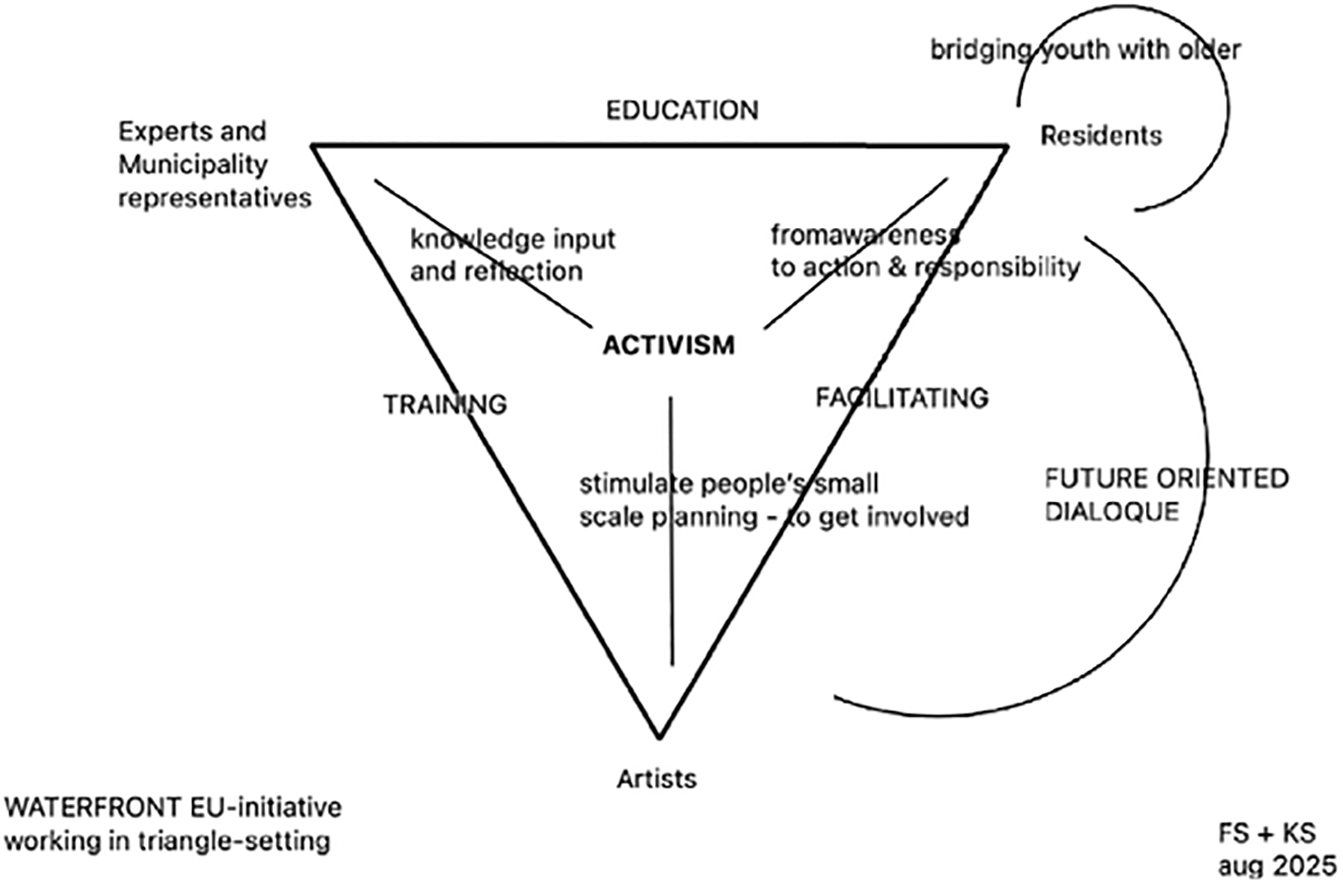
Figure 2. Triangulated Artivism.
Explanation: The triangle visualizes how artists, municipal climate experts, and institutions can connect with citizens of all ages, individually or in groups, to connect their potential in a future-oriented dialogue, a process called "Artivism,” by facilitating and training for community education, to become more successful in taking up climate measures.
Conclusions and remarks
From the co-design sessions and the working-out, the following recommendations for artist that want to become or are preparing to step into an ‘Artivism’ challenge:
• Inaugurate cross-sector partnerships involving culture, science, policy, and community actors, and work with them on long-term support.
• Use the local culture of the community as a carrier of emotional insight, not just awareness, and fund it accordingly.
• Embed scientific insights into artistic expression through public installations, citizen monitoring, and climate storytelling.
• Create safe spaces for reflections, self-reflection, and emotions, especially for young community members, to reflect on and respond to eco-anxiety.
• Value local action as a source of policy innovation, not just implementation.
The Gothenburg closing-up result and coming steps
During the Gothenburg co-design sessions in the WATERFRONTS project, participants from all participating countries shared reflections on the role of artivism in addressing climate change in waterfront contexts. A common understanding emerged that climate resilience is not only a matter of engineering or communication, but also a cultural, emotional, and systemic challenge. Artists, scientists, and citizens were seen as bringing different but complementary tools and perspectives that together can support communities in navigating uncertainty with creativity, empathy, and agency.
Artists selected from each participating country for the operational period following the co-design phase presented their initial plans to use artivism as an active instrument for engaging residents in climate awareness and climate-related measures. These presentations helped clarify how the insights generated during the co-design sessions could be incorporated into practice. The forthcoming work, planned to occur in 2026, will provide further opportunities for learning, monitoring, and reflection as part of the ongoing development of the project for further learning experiences.