1. Introduction
The history of music education has seen the use of a variety of technological tools to improve the effectiveness of teaching and, by consequence, the technical ability of musicians.1 One early “analog” example is the metronome: by having a device that keeps a fixed beat it is much easier to exercise precise playing at fast tempos. Artificial intelligence is also a tool that could provide such pedagogical benefits, and indeed there has been interest on the use of AI for the betterment of music education at least since 1993, the date of the first workshop on the subject.2 Still, music education seems slower than other disciplines in adapting these novel technologies, and there seems to be less research on AI in music education compared to the use of AI in the teaching of other subjects (e.g., computer science, mathematics, language, and medical education.3,4 Music education is indeed still largely carried out as it was before the personal computer became a common item in the average household, the most common setting being one-to-one sessions with a teacher, often one hour per week, complemented by solo practice the student does (or should do) to prepare for the following lesson. The study material for both the lessons and the solo practice at the beginner level is typically taken from “method” books, i.e. a collection of exercises and short musical pieces of progressive difficulty that a composer/pedagogist curated as a way to gradually introduce new techniques and challenges to the student. One downside of these books is that they are a one-size-fits-all solution, lacking the ability to adapt to different learner’s characteristics, strengths, and shortcomings.
In this article we will substantiate why we believe that, given the current available technology, it should be possible to change this status by embedding AI systems into the educational practice. The advancements in deep learning, and most prominently Transformers, has already been applied to music generation.5,6 While the results of these systems are currently less astonishing than what is possible for natural language with Large Language Models, or for image generation with Stable Diffusion models, it is safe to predict that the technology will continue to advance to a point where music generated scores will be of similar quality to those composed by an human, at least to an inexperienced listener. We are however not particularly interested in systems that generate music for the sake of generating it, or worse to provide marketing companies with cheaper compositions at the expense of human composers. As scientists, it is our duty to try to direct research towards ethical uses of AI systems, that could have the benefit of the human user at its core. While the direction that the tech world will take is out of our control, this article tries to be a contribution towards that goal. Using music generation systems as a tool to improve music education is, in our opinion, a perfect example of the deployment of AI systems that have a human user and human benefit at its core.
In particular, the benefit we envision as achievable by using AI system within education is the betterment of the personalization of the educational experience. As stated above, most of music education in Western-classical environments is done by using method books and fixed curricula. A (good) teacher could search for additional exercises to give to their students and could even write some new ones in some cases, but this can be extremely expensive in terms of time for the teacher, and doing so for each student could quickly prove overwhelming. Notably, the fact that some teachers do try to go these lengths is a testament to how valuable the generation of new exercises could be seen as a valuable teaching tool. Why is that so? Personalization within an educational context is not merely a flourish added on top of a curriculum or a quirk of some more extroverted teachers. Education research has shown that personalizing the learning approach and material can have a tremendous impact on the quality of education. The difference is so stark that this effect is known as the “two-sigma effect”,7 because it has been shown that a personalized education can lead to results that are two standard deviations away from a control group not using personalized approaches. While we don’t expect to be able to obtain such results by the use of AI exercise generation alone, we strongly believe this tool would make it much more realistic for teachers to structure their educational sessions in a personalized manner, which in turn should allow them to achieve this two-sigma improvement.
1.1 Personalization in the zone of proximal develpment
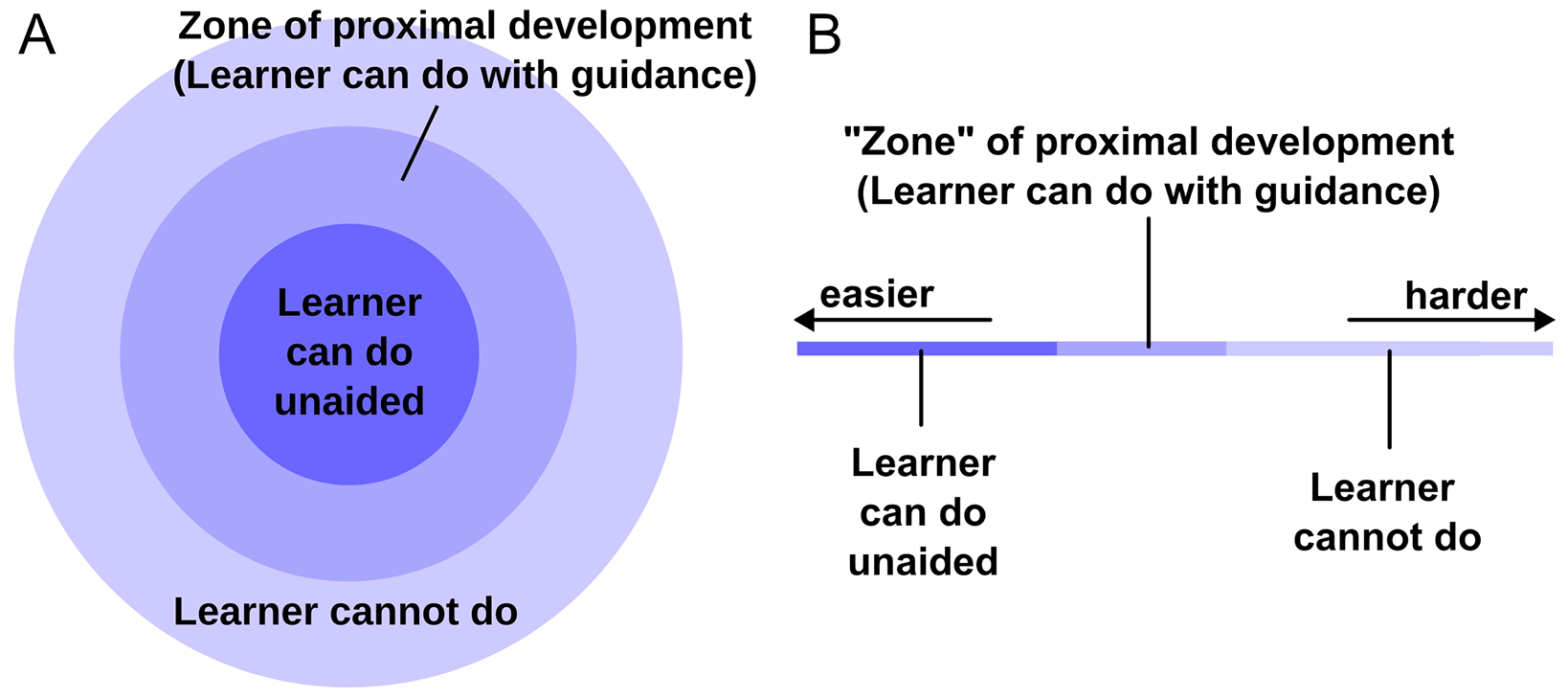
More specifically, we believe these tools could help teacher keep each student in their own Zone of Proximal Development.8 The idea behind the ZPD is that a student is able to learn most by approaching exercises that are above his current skill level, to allow for improvement, but not so far detached as to frustrate the student because of the hardship of approaching the new exercise (see
Figure 1(a)). In other words, it is important to keep a smooth difficulty progression curve, not skipping suddenly to exercises that are too hard, but also not remaining too long on a certain level of difficulty wasting time that could be spent improving on more challenging tasks. It may not appear immediately apparent why the ZPD requires personalization: having a (fixed) set of exercises of increasing difficulty could in theory achieve that smoothness of difficulty required to remain in the right level of challenge. The issue is that difficulty is not a unidimensional scalar value, despite we often think about it in such terms. Because of this, different learners may require different time to dedicate to certain skills, techniques, or facets of interpretations of a musical piece. The ZPD is indeed a zone that can be understood as an area of a multidimensional space, rather than simply a range in a line (as in
Figure 1(b)), and that area may be different for different individuals.
As an example, let us consider the two excerpts of music shown in
Figure 2. One is the beginning of an Allegretto by Béla Bartók, the other the beginning of an Ecossaise by Beethoven. ABRSM [1], a well-established music education institution from the UK, included both in exam syllabi for the Grade 3 piano exam, although in different years (2021–2022 for the Ecossaise, 2025–2026 for the Allegretto). We can therefore say they were considered of similar difficulty by expert piano teachers. We can however imagine a piano student who quickly learnt to read notes on a score, accurately estimating the amount of hand movement required for playing large intervals that call for hand position changes, but is maybe less skilled in performing precise rhythms especially if the two hands differ. We can imagine the opposite as well: a student who is good at feeling the rhythm and is good at giving proper accents to notes even if the two hands require different dynamics, but prefers to keep the hand position relatively static. Even if the suggested difficulty is the same for the two pieces mentioned above, the first student will find the Ecossaise easier to perform thanks to their skill at moving hands (as required especially by the left hand part) while the other may prefer the Allegretto, which requires less obvious accenting of off-beat notes but leaves the hands at the same position throughout these bars. The zone of proximal development will be different for the two students, and a good teacher could take this into consideration: while for performing the exam the teacher should suggest playing the piece that comes easier to each student, in order to progress the first student may benefit from focusing on studying the Allegretto and the second may get more benefit from studying the Ecossaise. Or, new exercises could be proposed that show the same rhythmic structures from the Allegretto to the first student, and the hand displacements required for the Ecossaise to the second learner.
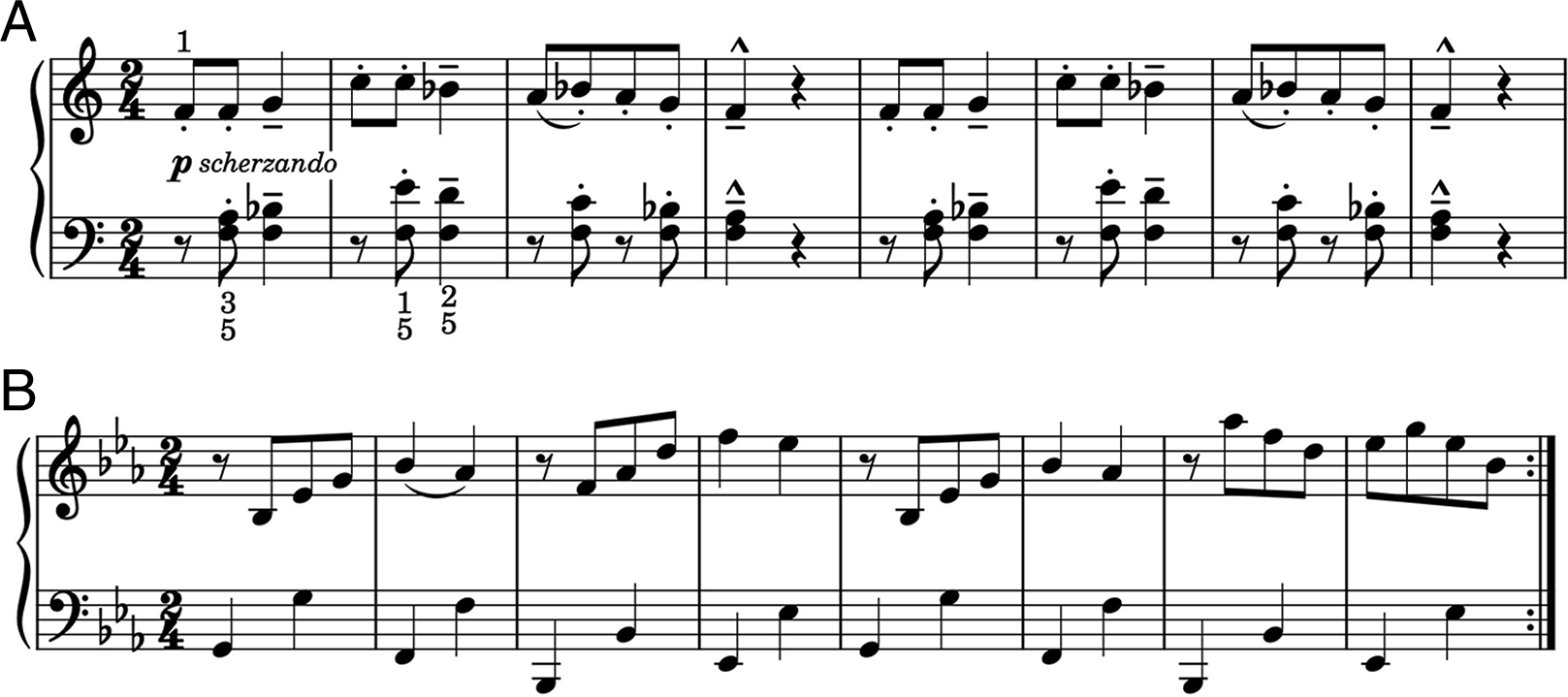
Figure 2. (a) first 8 measures from Allegretto by Béla Bartók (no. 3 from the “For Children” album).
(b) first 8 measures from Ecossaise in E flat by Ludwig van Beethoven (no. 4 from “Six Ecossaises”, WoO 83). Both pieces are valued of being of approximately the same difficulty by ABRSM, different students may find one or the other more difficult depending on their specific skills.
2. The state of the art
Having described the way we envision how AI, and more specifically AI based music generation, can be helpful in personalizing music education, we turn to the scientific literature to see how much these ideas have already been explored by researchers.
2.1 Computer-assisted music education
Music Education in a traditional Western context includes a variety of aspects, all of which can benefit from the use of computational systems to some degree. It is possible to divide these aspects into four main categories: fundamentals of music (music theory), performance skills, analysis of music, and composition.9 In this article, we focus on performance skills, i.e., those skills related to playing one instrument (the piano). Research shows that employing a Computer Assisted Instruction (CAI) framework can effectively increase the effectiveness of piano lessons when compared to a control group.10 In this framework, the computational system does not substitute the role of the teacher, but rather complements the teaching by offering a learning environment.11 For example, a CAI system can embed score following to help a student visualize (whether through a display or through augmented reality) what is being played and the mistakes they make.12,13 Another approach is that of using an Integrated Teaching System (ITS), that is a system that has greater control over the teaching activity by proactively helping the teacher by leveraging knowledge about the subject being taught, the curriculum, and the student. Within this context, there are systems that can select exercises from a given corpus based on the needs of the student and the teacher’s concerns.14,15 To the best of our knowledge, there is no system that generates novel piano exercises to propose to students in a similar fashion. One similar project is the one by Takidaira et al.,16 that generates rhythmic scores for the popular rhythm game Taiko no Tatsujin to improve the player’s ability in the game by analyzing their game logs. While this is not directly meant for musical education, performance in a rhythm game is strongly related to musical skills and thus this can be considered a music education tool. However, that system only focuses on rhythmic aspects, making the system quite limited when compared to the one we propose. Other researchers dealing with music generation have considered applications in the context of learning an instrument, and there is some research towards controlling the difficulty of a generated music piece. Ariga et al.17 proposed a system to generate guitar solos using fingering as a means of controlling difficulty. Nakamura and Yoshii18 describe a system that generated piano reduction of ensemble scores, allowing different difficulty settings based on tempo and fingering, and similar techniques have been applied to score difficulty analysis Ramoneda et al.19,20 However, none of these systems try to actually build a system that uses generation of music for the personalization of piano education.
2.2 Commercial systems
While commercial smartphone applications are often of little scientific interest, it is relevant here to discuss what the industry proposes to the end users in terms of systems meant to aid the learning of piano. A variety of applications exist for this goal, some of which have amassed notable user bases through the years. This section does not aim to be a comprehensive review of all those systems, but some will be taken as example of what more popular apps offer to piano learners.
Simply Piano [2] is one such popular app, having more than 50 million downloads on the google play store at the time of this writing. The main feature of the application is the availability of a large amount of songs to perform, with live score following: the learner is expected to play the piano part (which is often simplified and even monophonic for beginners) while the application performs the part of other instruments to enrich the musicality of the experience. Either by using a MIDI keyboard connected to the device running the application or through using the device’s microphone, the app analyzes the student’s piano playing in real time to assess whether the notes are being played correctly and giving immediate visual feedback (by coloring the misplayed notes differently), going as far as stopping the execution if the student is struggling too much. Duolingo, the famous language-learning application, has recently started a “language” course in Music, which is similarly based on reading short songs played on screen, but these are played on a digital keyboard shown on the screen of the device rather than on an external piano.
Flowkey [3] offers score following similarly to Simply Piano, but while the latter often uses simplified parts, for example having the player execute the vocal line of songs instead of a piano accompaniment, Flowkey is more focused on actual piano partitions. The user has the option to only focus on the left hand or the right hand before moving to playing both at the same time, but there is no further simplifications of the part. This app also provides the learner with a video of the hands of an expert playing the same track to help the learner.
Pianote [4] goes a step further in this direction, being more based around video lessons and community support that the learner has access to in-app. Skoove [5] has a similar approach, and even offers online lessons with actual live teachers.
All of the above leverage gamification to some extent, but Musa [6] goes even further by offering an actual game that is played through a piano keyboard (again, either MIDI or by using microphones). In this case the entertainment values comes first by proposing the app as a game with educational benefits, instead of a gamified educational app.21
Some common features of these commercial approaches is the ability to follow the learner while playing to provide feedback (which is however often limited to stating if the correct note has been played at the correct time), and the availability of a large amount of scores to play, sometimes offering simplified versions. There is usually a suggested learning path and a planned difficulty curve, but the personalization is mostly left to the student who gets to choose what songs to play. We are not aware of any form of music generation in any of these systems.
2.3 A systematic investigation
Aiming to find out more conclusively how much generative AI is used for the personalization of music education; we performed a systematic review on the topic. While the detailed results of the review are reported elsewhere,22 here we will sum up the methodology and the main findings.
Our hope was to find other research efforts in generating personalized exercises for Piano education, but we structured the systematic search using the PICO methodology23 to include more generally any generative AI approach to the personalization of music education, to give a broader description on the subject. We thus retrieved 360 documents from four online repositories: Scopus, IEEE Xplore, ACM Digital Library, and Google Scholar. Following established methodologies,24 we screened the papers to only include relevant documents that would pass some minimal quality requirements, which led us to 40 relevant papers on the subject.
The in-depth analysis of the papers led us to the conclusion that generative AI is still underutilized in the personalization of music education. Of the 40 papers, 13 were using generation to some extent, but only 8 of those were using generation to enable higher personalization of the educational material. Only 2 of these papers dealt with the generation of exercises, but both were related to the teaching of music theory, rather than piano technique. We therefore concluded that there is currently no active research effort in using music generation for the creation of a personalized set of exercises, as we are envisioning in this article. There were still valuable insights in those papers, beyond the goal that we anticipated, which we sum up here.
2.3.1 Use of generative AI for music education
While we found that generation of technical exercises is still under researched, generation was used by the retrieved papers in a variety of ways:
•
Generation of Music: music can be embedded in musical lessons to complement or expand the music that is being performed by the student (and teacher). For example, Li25 used AI to generate accompaniment for singing lessons, and Addessi et al.26 created a system to generate responses to children’s musical improvisations.
•
Feedback: in instances there is some automatic evaluation of performances, instead of giving plain feedback to the learner it is possible to create a natural language response using LLMs to better encourage the learner.27
• Music Theory Exercises: as mentioned, the generation of exercises to test the knowledge on theoretical aspects of music has been explored.28,29 Possibly, this is more common than technical exercises because of the knowledge-based approach, as opposed to the skill-based exercises that are needed for technical practice.
• Visualizations: the musical practice can be enhanced by generating visualizations that complement the normal practice, for example warning the learner of difficult to perform parts30,31 or to compare movements with those of more expert pianists.32
2.3.2 Personalization of music education
The generation of exercises is, of course, not the only possible way to personalize music education. What follows is a list of some of the more common approaches found during the systematic review.
• Recommendation and curriculum adaptation: by far the most common approach to personalization we found is the use of recommender systems. These systems are inherently personal, as they try to suggest items that are relevant to each different user of the system. There can be however different ways to suggest relevant items. One natural way is to select items of appropriate difficulty to suggest to the learner based on their skill level (similarly to what we propose),19,33,34 but it is also possible to simply select music and musical exercises based on the taste of the student, to improve motivation,35,36 or more exotic approaches like suggesting music based on the current mood of the student.37
• User Interfaces: another well researched approach is that of allowing the user to modify the graphical interface of the system to make it personalized in ways that improve the effectiveness of the educational endeavor. Fitton et al.38 report the interesting finding that allowing even minimal personalization to an avatar (such as gender, skin color, and hair color) can improve the feeling of embodiment with the avatar, improving the effectiveness of a dance teaching system that was based on imitating the avatar’s dance moves. Another example is that of using rich digital score formats that allow the user to display different information at the same time depending on their need, such as color coding for notes (useful to dyslexic students), or pneumatic notation for early music.39 The above-mentioned generated visualizations also fit in the category of User Interface personalizations.
3. Steps forward
The analysis of the literature shows us the importance of personalization, and yet the use of generation to that goal is currently limited. Our confident guess is that in the near future we are going to witness increasing amounts of generative AI being embedded in music education, but probably exercise generation is still going to take some years before being used in practice, as research on this is still in its preliminary stage, and because music generation systems ate still somewhat lacking in quality. This section tries to foresee some possible paths that these eventual systems could take in creating exercise or learning material that is personalized to their users. To be realistic with our predictions, we shall describe things that are currently possible with the technology available to us. This will result in mostly self-fulfilling prophecies, as the reported examples come from open research venues being explored within project CALIOPE, but we will also describe some more ambitious predictions of things that are yet to be conceived, describing potential research venues.
3.1 Analysis tools
As a first step towards personalization, we wish to provide analytical tools that estimate difficulty of a music piece in a manner that enables learner-specific difficulty ratings. As stated above, only by doing this it would be possible to meaningfully assess whether a new exercise or piece lies within the Zone of Proximal Development for that specific student.
3.1.1 Aspect-specific difficulty
We have discussed how a single scalar value is not sufficient to properly describe the ZPD, which is better understood in a multidimensional feature space. One way to increase the potential personalization of education is therefore to describe difficulty among different axes. This would allow a teacher to specify the desired exercise for a student in terms of different features, which can capture the different abilities of different students, as in the example we made in section 1.1. Going towards that direction, we experimented with the definition of three difficulty aspects that we can compute from a digital version of a music score. Fingering displacement was defined as the distance one’s fingers must move from their estimated resting positions to play each note. Playing speed was defined as the inverse of the inter-onset interval (IOI) between each note. Lastly, Polyphony was defined as the ratio of chord counts (or beats) to non-chord counts (or beats), computed separately for various chord sizes. Wanting to test the viability of these features, we employed two datasets: Mikrokosmos-difficulty (MKD)19 and Can I Play It? (CIPI)20 These datasets don’t include the fingering annotations needed for the Fingering displacement feature, but those were added automatically using PianoPlayer [7]. Both datasets include labels of difficulty based on the 9-class difficulty scale designed by music publisher Henle [8] which is used to label each of the pieces in their catalog, allowing us to have an expert-made reference of difficulty for the scores in the datasets. These labels are once again a single scalar value that we wish to move away from, but as a validation for our features we use a Gradient Boost model (XGBoost) to predict the Henle difficulty rating based on the three features we have. The predictions with this model achieved a balanced classification accuracy of 29.48% and an MAE of 0.9040. The low MAE in particular suggests that even if there are wrong estimates the estimated label on the 9-class scale is not too far off from the ground truth (which in itself is open to disagreement, as Henle’s expert Ralf Koenen who designed this scale admits). This shows that the designed features do correlate with the expert assessment on difficulty, and that their joint usage does a good job at predicting a piece’s overall difficulty.
However, we wish to go a step further from that: we wish to see if the different features capture different aspects of a piece. We visually inspected those scores where the aspect-specific model predictions differed from one another by 2 or more classes of difficulty to assess whether those differences aligned with human intuition. For example, Bach’s “Inventio 6” (a snippet of which is shown in
Figure 3) received 9-class fingering displacement and polyphony predictions of 5/9 and 2/9, respectively. A visual inspection corroborated those predictions, in that the score contains few chords but numerous wide-ranging finger movements. Ultimately, such inspections provided evidence that the models were capturing unique dimensions of difficulty from one another. Moreover, this multi-feature classification system allows us to act separately on different features of a score, as we investigate in section 3.2.1.

Figure 3. Measures 39–42 of J.S. Bach’s Inventio (No. 6 from “Fifteen Two-Part Inventions”, BWV 772–786), a tricky passage in terms of finger movements but that does not require chords at all.
3.1.2 A cognitive approach
A different approach to the personalized modeling of difficulty is to cognitively model the expected difficulty of a piece, using a model that would allow to adapt this expectation to the different users of the system. We argue that Information Content40 is a valid measure to be used to model the cognitive load of the various elements on a score, which make up the difficulty of a piece: seen before elements will be easier than those that have never been seen, and more common elements will be easier than rare elements. Here “elements” is meant to be as generic as possible, including notes, chords, but also sequences of notes, intervals, and most generally any notation that can be found on a score and that can be recognized later. Indeed, there has been some evidence in prior literature that Information Content correlates to difficulty.18 For further putting this idea to the test, we leverage IDyOMs a framework for multiple-viewpoint, variable-order Markov modeling as described by Pearce41 which allows us to model those “elements” as “constituents” of an ad-hoc knowledge representation system. In this investigation, we used pitch, duration and fingering annotations as the viewpoints to be considered by the system. The system was trained on the above mentioned Mikrokosmos-difficulty dataset, but this time using the scale of three difficulty classes that Bartók divided his opus into (Beginner, Intermediate, Professional). The trained model yields probability estimates for all the elements in the analyzed pieces. The distributions of these are shown in
Figure 4, divided by the three difficulty levels, numbered here 0 through 2.
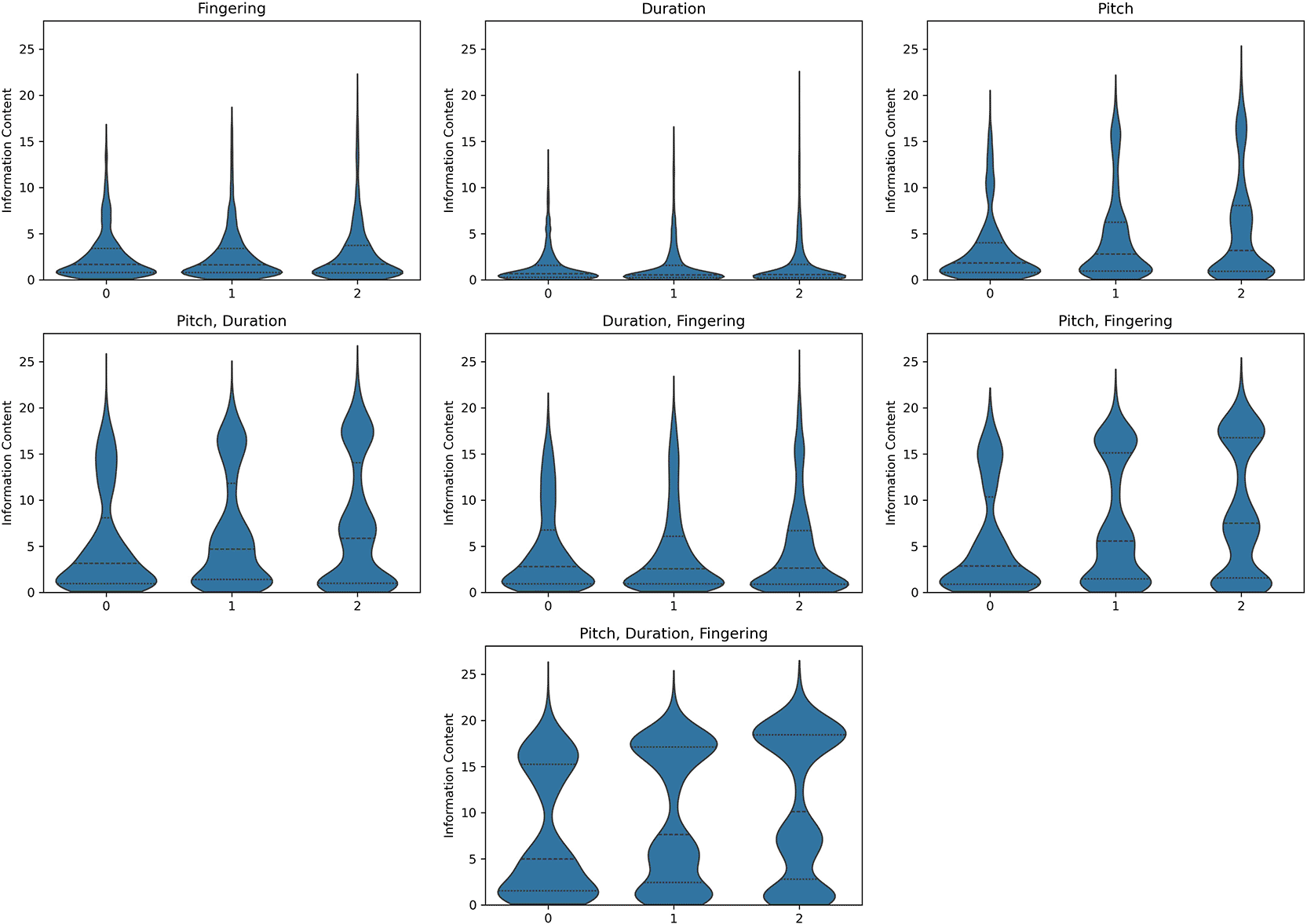
Figure 4. Information Content per level of difficulty (0, 1, and 2 corresponding respectively to Beginner, Intermediate, and Professional) computer over various features on the right hand parts.
A statistical test (Kruskal-Wallis H test, followed by a Dunn post-hoc test) confirmed an initial empirical assessment of the plots, showing that the full viewpoint, containing information about pitch, duration and fingering results in information content distributions that are more significantly different than other viewpoints. This result was stronger for comparisons between difficulties 0 vs 1, as well as 0 vs 2, while 1 vs 2 was not significant for the duration and fingering viewpoints. This confirms the hypothesis that information content is correlated to the concept of difficulty. As we mentioned this was expected from prior literature, but this is not merely a confirmatory study. While this is still under investigation, we argue that the approach we describe here can easily adapt to different datasets and more importantly to personalized datasets: providing the system with a list of pieces the student is familiar with should give a good indication of how easily the student can approach a new piece by calculating the information content of the new piece based on the probability distributions learnt on the known pieces. This approach would create a bottom-up description of the capabilities of the student, as opposed to the top-down approach described in the previous section.
3.2 Prototypes
From the results of the analyses above we were able to desing some proof-of-concept prototypes.
3.2.1 Aspect-specific reduction of scores
The model for the estimation of multi-aspect difficulty described above lends itself to some extra uses besides analysis. In particular, we designed a prototype system for the reduction of musical scores that would simplify a musical piece in different ways depending on which difficulty aspect the system is asked to make easier. Given a target difficulty for each of the three aspects and a score to simplify, the system employs a moving window approach that evaluates each difficulty aspect in different measures of the score, finding sections where each aspect is harder than the target. Then, a heuristic-based strategy removes one note at a time from those sections, repeating iteratively until the aspect-specific difficulty targets are met (or other stopping conditions occur to avoid excessive removal of notes). This system was evaluated qualitatively via an interview with a domain expert. Only one of four reductions presented to the domain expert was viewed as practically useful. In most cases, reductions were seen as having maintained or even increased score difficulty because of the introduction of occasional imbalance between playing hands, intermittent notational issues, and a tendency to remove single notes from challenging sequences without actually making those sequences easier to play. However, the different strategies managed to address different musical features as expected. We believe the main shortcoming of this proof-of-concept system is the limited approach to simplification, i.e., the iterative removal of single notes. Despite the unsatisfactory results of this first approach, we have found the windowed approach interesting in its ability to find difficult sections of a score, and we expect that embedding the aspect-specific difficulty estimators in a genetic algorithm capable of more varied and meaningful transformations of the musical content, possible joined with a system to factor the musical importance of the notes in the piece,42 will lead to better results.
3.2.2 Learner-specific generation of scores
Going back to the use of IDyOMs to describe a learner’s path and expectations when presented with a new piece, we must note that the same statistical models that are learnt to analyze difficulty can also be leveraged for generation of new pieces. Since IDyOMs uses the same concepts for extracting information content and for generating sequences based on information content, the patterns that contribute to the overall difficulty of a piece should transfer to the generated pieces. In
Figure 5 we can see some examples of this generative approach. These are based on the generic three difficulty levels described above, but we remind here that it would be possible to change these with a selected dataset to reflect the pieces that are known to the student. On the one hand, it is clear that the model was able to generate simpler sequences when trained on the easy pieces as opposed to when trained on more difficult one. On the other hand, the markovian models used by IDyOMs are known to lack long-term structure, and thus the results lack overall musicality. It is therefore clear that a more sophisticated approach is needed, as we speculate in the next section.
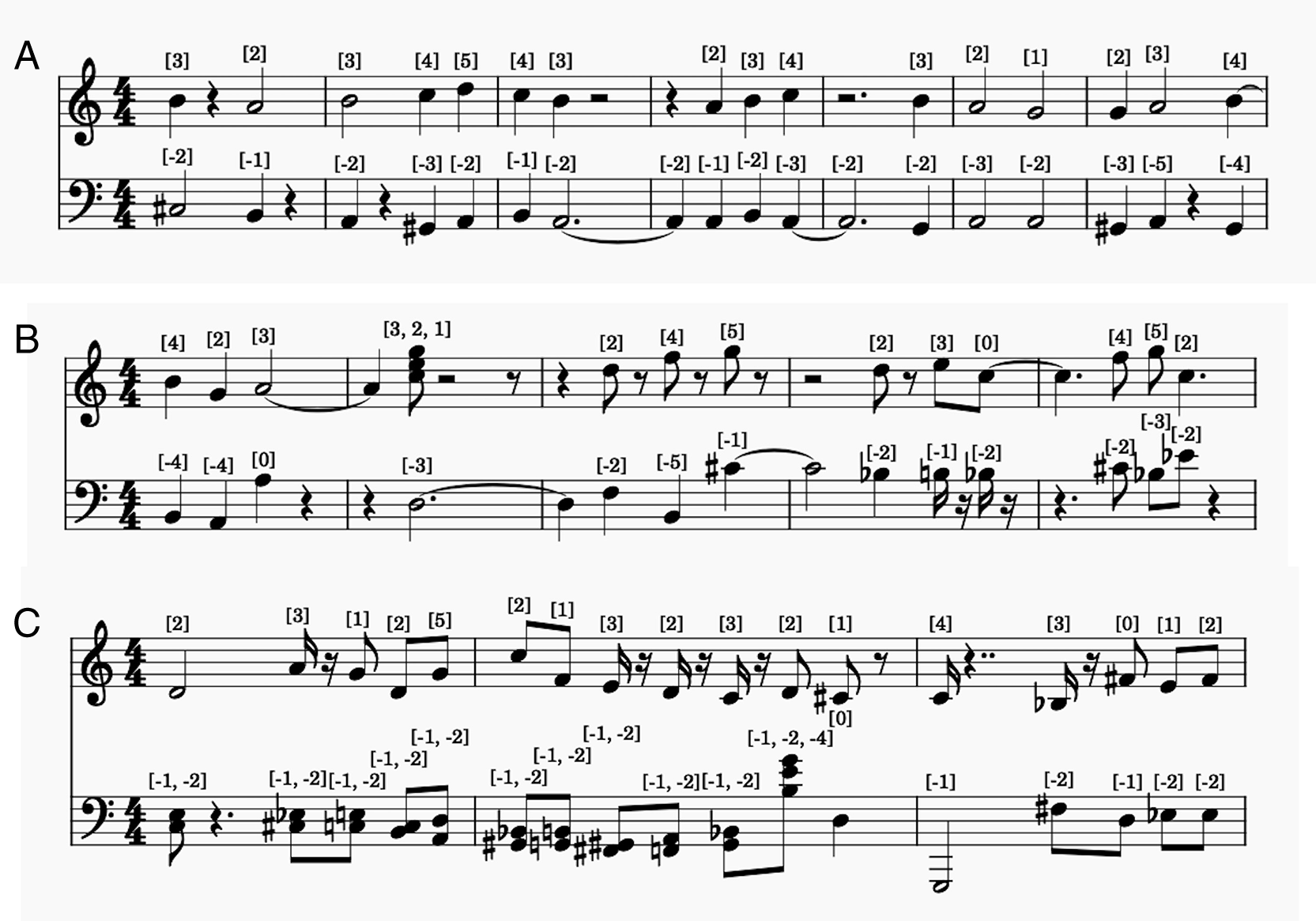
Figure 5. Beginning measures of an (a) easy (b) intermediate and (c) difficult generated pieces.
3.3 Futurisms
In the first part of this article we described a path that nobody seems to have walked upon yet, and we described the first steps we took along those paths. Let us now describe what, having walked the beginning meters of this road, we can see up ahead.
The most obvious continuation of this research is to improve on the systems we described here. Our Information Content based approach can benefit from more rigorous testing on the field, and we can improve the its generative abilities by embedding other generation frameworks like Recurrent Neural Networks or the now more popular Transformer. As we mentioned, the reduction system can also leverage a more sophisticated way to alter musical content, and again neural systems could help achieve that goal. Besides these small incremental changes, we are more interested in the big picture developments. A lot of resources are available to learners on the internet, especially musical scores. Yet, it is not easy for an unexperienced player to choose a piece to learn based on its technical difficulty. Using the suggested technologies it would be possible to create a recommender system that chooses pieces based on the characteristics of the user, be it based on an assessment of multi-aspect skills, or on the history of pieces performed by the student. Yet, a student would probably prefer to play their favourite songs, rather than playing a random 18th century piece that was selected because the system established the user could learn it. The reduction system could then come in handy in simplifying that song that is achievable yet challenging (i.e. it falls in the ZPD) or a generation system could create a new arrangement of the same song, keeping the musical aspect as intact as possible while keeping the accompaniment within the skill level of the learner. Of course this will not always be possible, but a generation system should also be able to create pieces that are within the style favoured by the learner and that are within his capabilities at the same time. Looking at a more traditional perspective, a conservatory teacher finding that a student is uncapable of performing the piece that the normal curriculum would require him to play could turn to a generative system to either create exercises that help the student train for the harder passages of the piece (which could maybe be identified in a manner similar to the sliding window analysis approach from our reduction system), or create a simplified version of the piece to lean into the more difficult exercise, or create an entirely new piece that adapts some of the hard techniques the student struggles with but acts as a bridge from the student’s prior capabilities towards the new difficult piece. Commercial systems seem to like employing a gamified approach to learning. This has well-known educational benefits (besides improving customer retention), so it would be worth to investigate what is the best approach to gamification of music lessons. Generation can play a huge role in a gamified context: games are inherently interactive media, and creating music ad-hoc on the fly can open a great deal of novel human-computer interactions as well as serve as a complement for the interactivity of these games. Taking a step back, even more theoretical works on defining what makes a piece difficult would be of great benefit to future educational endeavours: while it is intuitively clear when a piece is hard or easy, it is not an easy task to describe specifically what makes it so. Explainable AI systems could maybe be an additional tool to aid experts in exploring more answers to this question. There are multiple ways to go forward, and while we intend to continue this investigation, we hope we will not be alone on this path, as we alone cannot possible hope to explore all the possibilities that are open.
4. Conclusions
In this article we have outlined the utility of using Generative AI approaches to the teaching of music, more specifically Piano technique, as these approaches can greatly improve the personalization of the provided education and, in turn, improve the effectiveness of education. Yet, we note from performing a rigorous scrutiny of the literature that these techniques are yet to be properly investigated by the academic world despite interest on AI research moving fast in the last couple of years. We then provided ways in which we have started investigating the subject, and ways we argue this exploration could and should continue. Hoping to see more efforts from researchers in this area, we wish to make a call for human-centric approaches to this application and to AI in general. Without considering and including the human actors of the areas we with to change with Artificial Intelligence, we may obtain disruptive change, but if the disruption is only achieved through the removal of the human from the loop, we risk creating an intelligence that is ultimately useless, if not straight up harmful, to us.
Ethics and consent
Ethical approval and consent were not required.









