Substances that refuse to set
In painting and sculpture, as in all plastic arts, there are embedded negotiations between combination and composition, between the merging and shaping of materials. Painting, for instance, often involves transforming something as fluid as water into something as solid and enduring as a stone. If we assume that artworks solidify into fixed forms over time, then the substances used to create them tend to reach a chemically stable, inert state in relation to their environment and to the other materials with which they are mixed. These materials begin as organic mediums, functioning first as carriers, and then, through environmental and temporal transformation, as binding agents (Brickler, 2013, p. 31). In the visual arts, matter shifts mainly in its distribution of water and stone: the fluid and the solid, the carrier, and the substance, through changes in the rheological (flow-related) properties of the mixture.
As a painter, I have experimented extensively with careful observation and combination of water with various visual materials such as: clays, crushed stones, pigments, and solid compounds. This always begins with meticulous blending.
Consequently, I approach musical composition in the same way that I approach the process of painting and working with matter. The creation of sonic work involves the softening and blending of rhythms and frequencies, textures, and intensities, -fused together in time to form patterns and structures. In my practice, the exploration of the sonic behaviours of matter makes my working environment an amalgamation of sound studio and lab, everything is a potential experiment. Physical engagement with painting and sculpture—processes that absorb the mind through smell, texture, and material—has alerted me to the significance of simply observing how matter transforms. As I witnessed mater dry, harden, or shift I began to wonder: could I also listen to this transformation?
Could I listen to tiny shifts in substance? The rhythms of matter itself?
Using hand-built electronic sound circuits, I connect them to conductive materials such as clay or graphite substances I have already sculpt and painted with. These materials offer me their rhythms through their conductivity and resistance. Visual objects become bridges and energy transmitters. They carry and shape an electric current that, when sonified, is in turn shaped by the material itself. The fusion of these materials with open audio circuits generates an evolving rhythms and signal ecosystem. Within this sonic-matter system, all the components act as both tools and interpreters of the process. The work is ongoing. Materials reveal their capacity to be vessels of energy, bearing electrical charges as they dry, stabilize, and transform over time.
Raw amalgams of conductive material, sculpturally and painterly, are translated into frequencies through the sounds they produce within electronic circuits. These frequencies manifest as pulses and rhythms that are influenced by their surroundings and mutual interactions. This creates a system in which visual and material elements are woven together through their acoustic regularities, emerging within and around one another, traversed by a shared energy, both metaphorically and literally.
In the studio, I begin again. I stir graphite into water. I dissolve clay. Not to mold, but to understand their resistance to current. The materials are not passive. They don’t wait to be used. They shift, collapse, sediment, signal. The act of painting urged me to bind fluid into permanence. To take something as volatile as water and fix it into form. But form is never still. The painting dries, the material reacts. Crystals form. Pigment floats and settles into fissures invisible to the eye. What we think of as image is merely a snapshot of chemistry mid-conversation. Through these movements, audible through the electric circuit — the listening begins...’’
To not only see, but also to hear the clay drying, and graphite flickering with voltage, the pigment hardens into tone.
Circuits that listen
I wire my materials into sound as I build open circuits, not to transmit data but to reveal becoming. The circuit is not a tool but a translator; a fragile body attentive to shifts cannot stabilize it. Once shaped, clay is laced with conductive traces; graphite lines open themselves as channels. Salt, copper, and iron, elements of the alchemical lineage, guide the current to an audible form. As the materials shift state, they alter the resistance and bend the signal. Moisture evaporates and the tone rises; a crystal forms, and pulse fractures. These are not errors or distortions but the voice of matter in the process. The circuit listens where the eye cannot: it renders the temporal instability of the substance as a rhythm.
This practice resonates with Salomé Voegelin’s sonic materialism, where sound is not the representation of an object, but the manifestation of its condition over time. To listen through circuits is to hear not what matter “is” but how it becomes: its hesitation, its drift, its negotiation with air and humidity. In this sense, circuits have fewer instruments than interlocutors. They do not simply measure conductivity; they expose it as vibrations. The fluctuating pitch is the material’s way of speaking, not as a metaphor but as frequency, resistance, and pulse. What emerges is not a score imposed from the outside, but a dialogue between materials, currents, and the atmosphere. Through this dialogue, the matter refuses silence. Clay is a waiting signal; it is a variable resistor, shifting its voice as it dries. The studio becomes a resonant ecology, where every element is simultaneously a conductor, resistor, and performer.
The visual as latent vibration
Matter has a tendency to resist, as the drying pigment still undergoes changes. Clay cracks occurred after the hand leaves it. Graphite absorbs air. These are processes, not states. I work in between: the wet moment, the unstable bond, and the chemical hesitation between the two forms. My interest lies in the ephemeral duration of matter, where art and science fold together, where art becomes a system of observation, as much as an expression. By listening through the wires and surfaces. Conductive materials, such as: graphite powders, clay, metallic pastes, and minerals in water, are incorporated into visual compositions. These materials are part of open audio circuits. Their resistance shifts as they dry or interact with the atmosphere. The material then becomes a signal. It provides rhythm through what it is. Each crack in the clay changed its circuit. Each new mineral alters sonic feedback. The system responds to the drying time, ambient humidity, and chemical composition of the compound. The object becomes a feedback loop.
To describe this work technically is to miss the poetic density that it holds. What I seek is not just an analysis of frequencies but an invitation to attend to the world through matter and vibration. Clay hums: graphite flickers. It was not because they were programmed to, but because they were. This is because their materiality was their score. The materials reveal themselves only as they shift; they are never fully present and are never fully knowable. This instability is their truth. It resists visual fixation It favours listening. (Figure 1, Figure 2 and Figure 3)
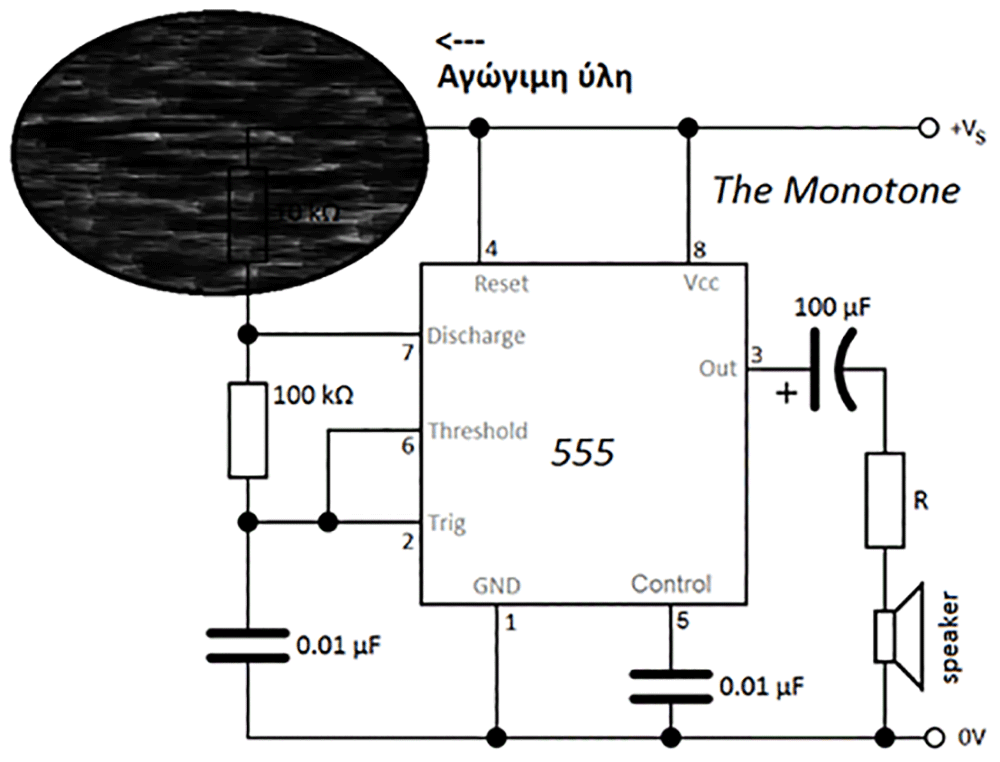
Figure 1. A semi-open 555 sound circuit.
The conductive substance performs the dual roles of a resistor and a conductor. While changes in the moisture content of the material alter its resistance, it allows current to flow to complete the circuit and produce sound. These modifications create dynamic auditory patterns by introducing variations in the sound's frequency and rhythm.
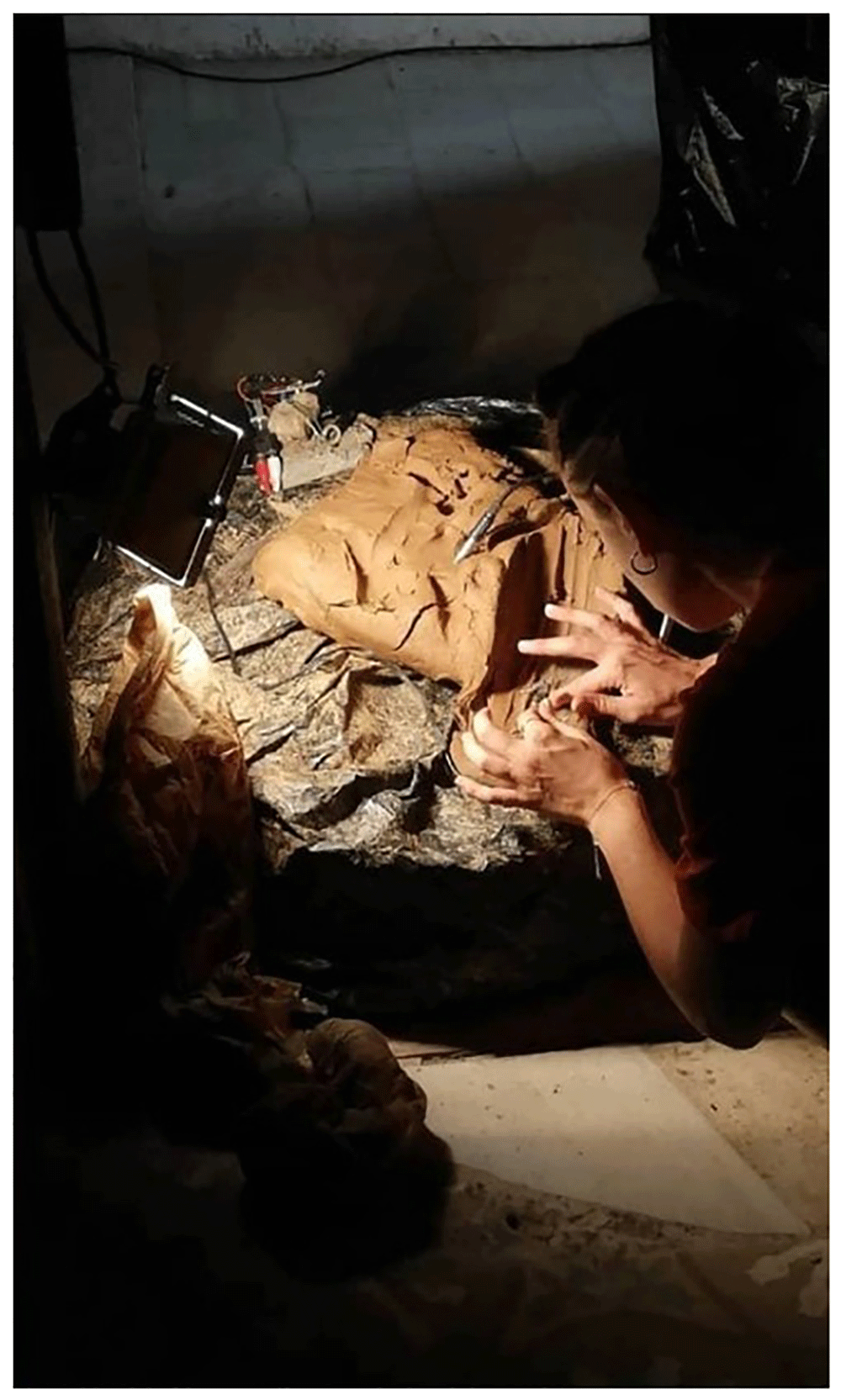
Figure 2. Electric circuits as mechanisms for producing sound.
A conductive substance (such as graphite) is used in place of a resistor, assuming the basic circuit is functioning. This material acts as a variable resistor, with its resistance varying according to its moisture content. Changes in the resulting sound can be seen by adjusting the values of the circuit's constituent parts.
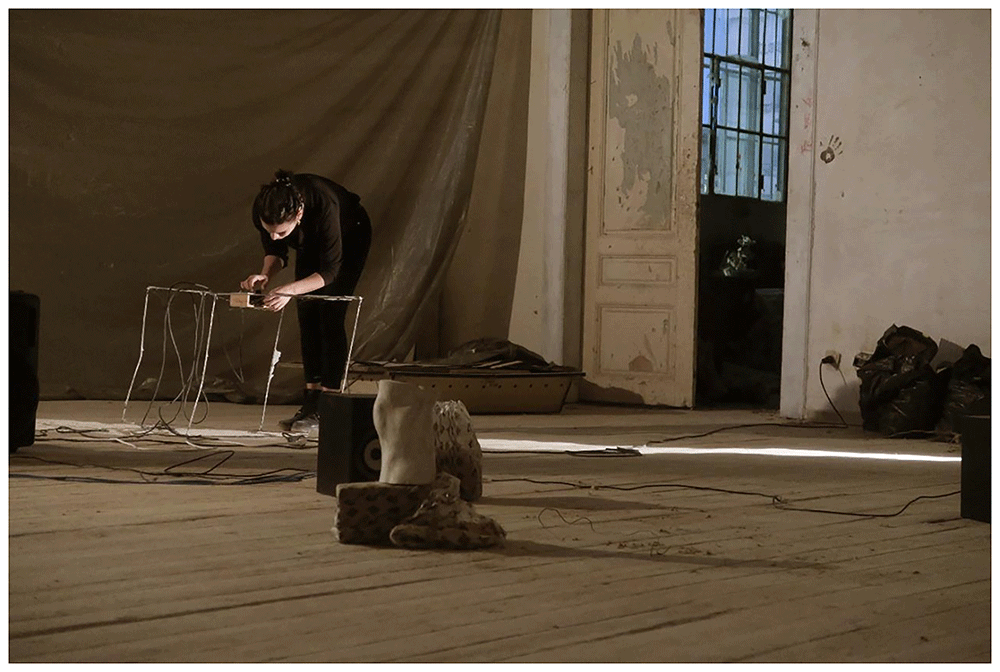
Figure 3. During the COST residency at the Academy of Fine Arts in Sofia, working with clay, stone, and circuits.
An ongoing audio-visual installation is created by the arrangement of several sound sculptures in space. Component value variations are used to investigate how circuit.
Organism-oriented ontology, assemblages: the vibratory compositions
In dialogue with Voegelin, Hustak and Myers’ Organism-Oriented Ontology offer another perspective: organisms are not isolated beings but attentive relations, processes of co-perception, and co-constitution. In my practice, materials behave like organisms. Clay responds to humidity, to my touch and to electricity. Graphite absorbs, resists, and cracks. Circuits adapt to these changes. Together, we form what Myers might call an ecology of noticing: a field in which each entity responds to the other’s vibrations. The ontology shifts: clay is not a passive medium but a sonic organism; graphite is not an inert carbon, but a conductive agent. The work is not an object, but an assemblage of relations, a living ecology that composes itself. The sonic circuit with matter functions as the point of departure for what I call sympoietic compositions: ever-evolving assemblages of materials, energies, and participants. Assemblage, as Anderson and McFarlane (2011) define it, is a “temporary socio-spatial formation” made of heterogeneous elements: human and nonhuman, organic and inorganic, technical, and natural. They remain distinct yet are bound by temporary co-functioning. Müller (2015) reminds us that: an assemblage is a “way of arranging heterogeneous entities so that they work together, for a time.”
In my composition, these assemblages are vibratory. They unfold as networks of relationships between performers, materials, instruments, and audiences. Each element retains its own emergent properties and is capable of autonomous shifting. A lump of clay drying in the circuit may fall out of sync with its earlier self, producing new resonances, resistances, and rhythms. Deleuze called this “adsorption”, a coalition that holds together while preserving the active force of its parts. The energy of the assemblage comes not from unity but from the vitality of its heterogeneous materials. (Figure 4)
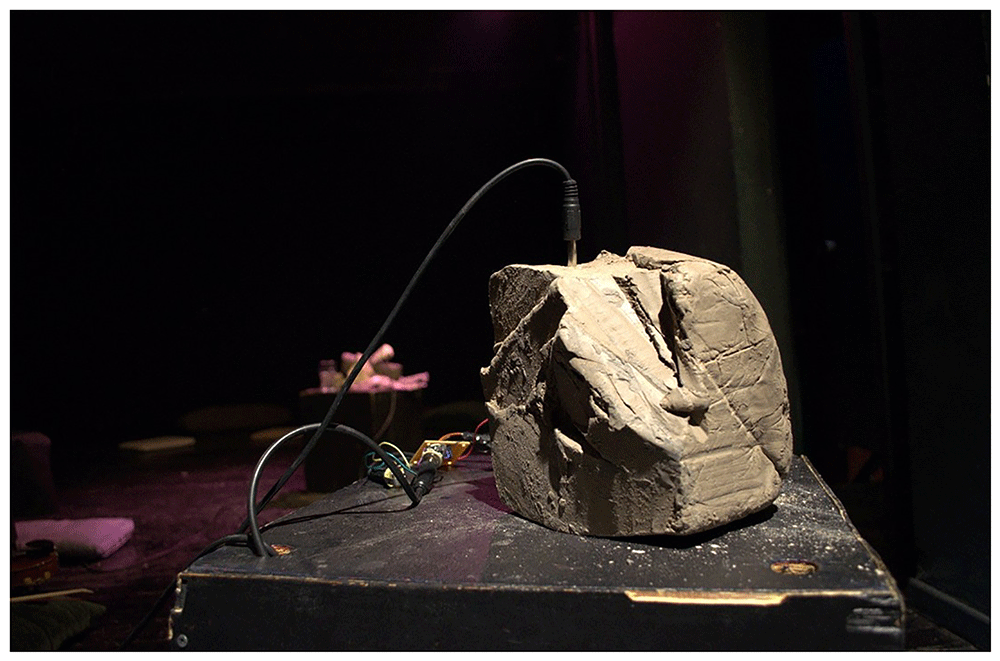
Figure 4. Illustration of clay combined with circuits and batteries, creating vibrational assemblages with other conductive materials.
The combined material form an interaction system in which the clay acts as a both a structural and responsive component of the sound-generating system.
Instruments, actants, and agents
To frame this, I will turn to organology. Traditionally, instruments are viewed as tools, extensions of the body, and filters of human action. However, as Allen Roda (2007) suggests, understanding instruments requires anthropological, material cultural, and phenomenological methods. In my practice, instruments are not neutral mediators, but actants (Latour, 2005): elements in a network that shift energies, relations, and outcomes. A clay circuit is as performer as a musician. A graphite trace is as much a composer as my own. Cimini (2010), reflecting on Deleuze and Spinoza, describes music-making as the emergence of a complex composite body: players, instruments, air, and sound particles coalesce into temporary wholes. In my sympoietic compositions, this composite body includes clay, pigment, wire, electricity, humidity, and listeners. The result is an expanded organology, where instruments are not bounded artifacts, but ecologies of relations.
Sympoietic compositions resist closure. They are not works to be finished but processes to be lived. Clay hardens, graphite flakes, circuits corrode, and decay sounds. Each transformation is part of the composition. Each element is an agent of change, that is, a node in a network of becoming. What emerges is not harmony but attunement: Listening to the multiplicity of relations that constitute matter. The artwork is a temporary ecology, an organismic assemblage, and a field of vibrations, which are not static individuals, but relational nodes in a meshwork of encounters. This resonates profoundly with my own practice. When I wire clay into a circuit, or saturate graphite with moisture and voltage, I am not building an object but entering into an organismic relationship. The material listens to as much as I do. Its conductivity changes in response to movement, touch, and humidity in a room. I respond in turn, altering my movement, circuitry, and ear. The artwork becomes less of a product than the ecology of noticing.
Sound makes this relationship palpable. Unlike vision, which tends to objectify, sound envelopes, traverses, and joins. The ontology here is not about separating the subject from the object, but acknowledges that each substance is already a performer of relations. Clay does not merely “exist” as inert soil; it performs conductivity, it performs resistance, it performs memory of water. Graphite exhibits history, compression, and fragility. Their behaviors, when amplified into sound, are not metaphors, but audible acts of organismic presence.
In this sense, practice moves beyond object-oriented ontology, which often risks reducing things to inaccessible essences, and leans toward an organism-oriented ontology, where every entity is understood through its capacities for relation, affect, and change.
Matter, like an organism, is always more-than-itself.
It notices, resists, leaks, and cracks.
It acts, and, in acting, asks us to act with it.
. Each artwork is a rehearsal of multispecies, multi-material entanglement:
- clay with copper,
- graphite with skin,
- electricity with humidity,
- skin with matter.
These are relational organisms and, sonic assemblages whose vitality is not reducible to their parts. Like Labatut’s scientists who blurred the line between hallucination and mathematics, I blur the line between sculpture and organism, and between circuit and ecology. The point is not to resolve these categories, but to live in the uncertainty they generate: a space where matter speaks not as a mute substance but as a living relationship.
What, then, is composition?
However, this is not a pure arrangement. It is a chance for matter to speak. The rhythm of evaporation. The voltage of drying minerals. The harmony of interference between circuits.
I listen to these as a composer.
I respond as a sculptor.
I document as a researcher.
I surrender as an alchemist.
Clay is a soil material, but it is also a compressed time. Clay is sediment, stone pressure, dust of collapsed architecture, and rehydrated into pliability. The materials are never neutral. They carry time within them. And when I work with them, I collaborate with memories. Connection of clay to electricity involves resurrecting its rhythm. To amplify its history. Observe how the stone moved once. Its rhythm allows this while it is immediate, affective, and vibrational. A crackle, a hum, a feedback loop that is not metaphor, but material consequence.
Toward a sonic materialism of practice: dielectrics as sympoietic outcome
What might it mean to develop an art practice that is also material philosophy? A practice where matter speaks, not symbolically, but sonically: in pulses, feedback, vibration, and decay? What emerges is a practice that is neither visual nor sonic, nor scientific or poetic, but something in between. It exists in the seams of disciplines: and is a state of potential that can only be accessed through observation and listening.
Studio becomes a hybrid field: part chemistry lab, part sound studio, and part sculpture workshop. The artwork is not finished on a wall. It is never finished. It ages. It feeds back. It reacts to light, air, and touch. Visual materials are energy vessels, timekeepers, and conductors of invisible change. To listen to matters is to decentre ourselves. It is to let materials guide the composition, and recognize that they hold knowledge — not as tools, but as participants. This is an ethics of attention, care, and shared temporality.
The culmination of this research emerged in Dielectrics, a sound-visual installation and performance realized during my residency at DA LAB in Sofia. Over four weeks, the studio transformed into a resonant ecosystem in which materials, circuits, and bodies became co-actors in an unfinished composition. Rather than presenting finished objects, installation- staged processes include: matter unfolding, currents adjustment, and atmospheric modulation. Sound here was not an aesthetic layer added to the materials, but their mode of relation — a sonic ecology in which drying, breathing, and conducting were rendered audible. (Figure 5)
The live electronics performance extended this ecology into collective listening. The work became a field of cohabitation: audiences attuned to the pulses of shifting resistances, performers responded to fluctuations beyond control, and the environment — humidity, temperature, presence — left its trace in the unfolding soundscape. No single element held mastery. Instead, the performance enacted what Donna Haraway names sympoiesis: “making-with,” a practice of shared becoming.
In this outcome, the composition is less about arrangement than attention. It is the practice of holding space for materials to speak, and notice their rhythms without demanding stability. This is what a sonic materialism of practice makes possible: not objects to be preserved, but relations to be lived. Beyond the studio walls, Dielectrics seeded further exchanges: workshops on DIY microphones turned discarded materials into instruments, and conversations with local artists opened the work into broader ecologies of practice. These activities reinforced the installation’s ethos — that creativity is not a solitary invention but a distributed, entangled making.
Dielectrics demonstrate that an artwork can be experiment, composition, and ecology at once. It embodies an organism-oriented ontology where matter is not a substrate but a participant, and sound is not a decoration but an evidence of relation. The outcome is not closure but continuation — an unfinished organism whose rhythms will persist across future works, vibrating in uncertain spaces between art, science, and philosophy.
Ethics and consent
This study is based on artistic and practice-based research and did not involve clinical experimentation or the collection of sensitive personal data. Ethical approval and consent were not required.
All images included in the manuscript have been reviewed for identifiability. Any potentially identifiable personal information has been removed or obscured. In particular, Figure 3 and Figure 5, Figure 6, Figure 7 have been de-identified to ensure that individuals cannot be recognized.
Where individuals were present during documentation of the Sympoietic Echo-Systems: Dielectrics installation, consent to publish was obtained where applicable. No images of identifiable individuals are included without appropriate consent.
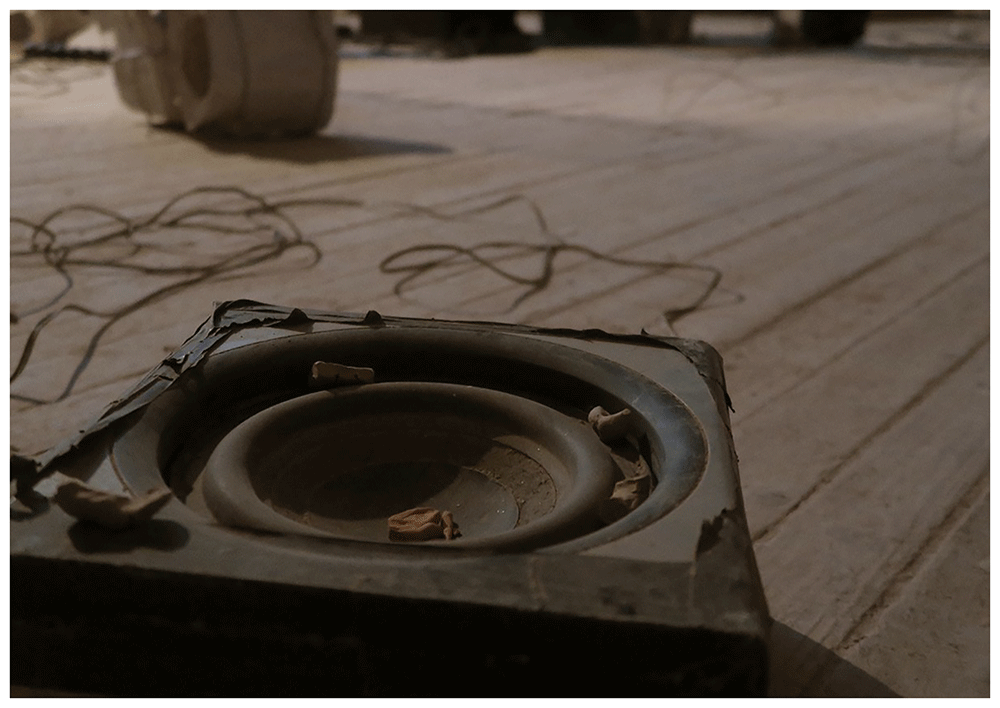
Figures 5. Documentation from the Dielectrics exhibition and performance.
The main intervention of the residency used fresh slow-drying clay and self-made circuits to explore the acoustic and material qualities of organic matter. A changing soundscape from the installation demonstrated how natural materials can actively engage in creating sonic works. The Dielectrics project, as part of the Toolkit of Care program, was presented in Sofia's Art Academy during the DA LAB residency and culminated in a performance of live electronics that involved taking the installation and turning it into a collective organism of people and things working together and against one another by making a rich auditory experience.
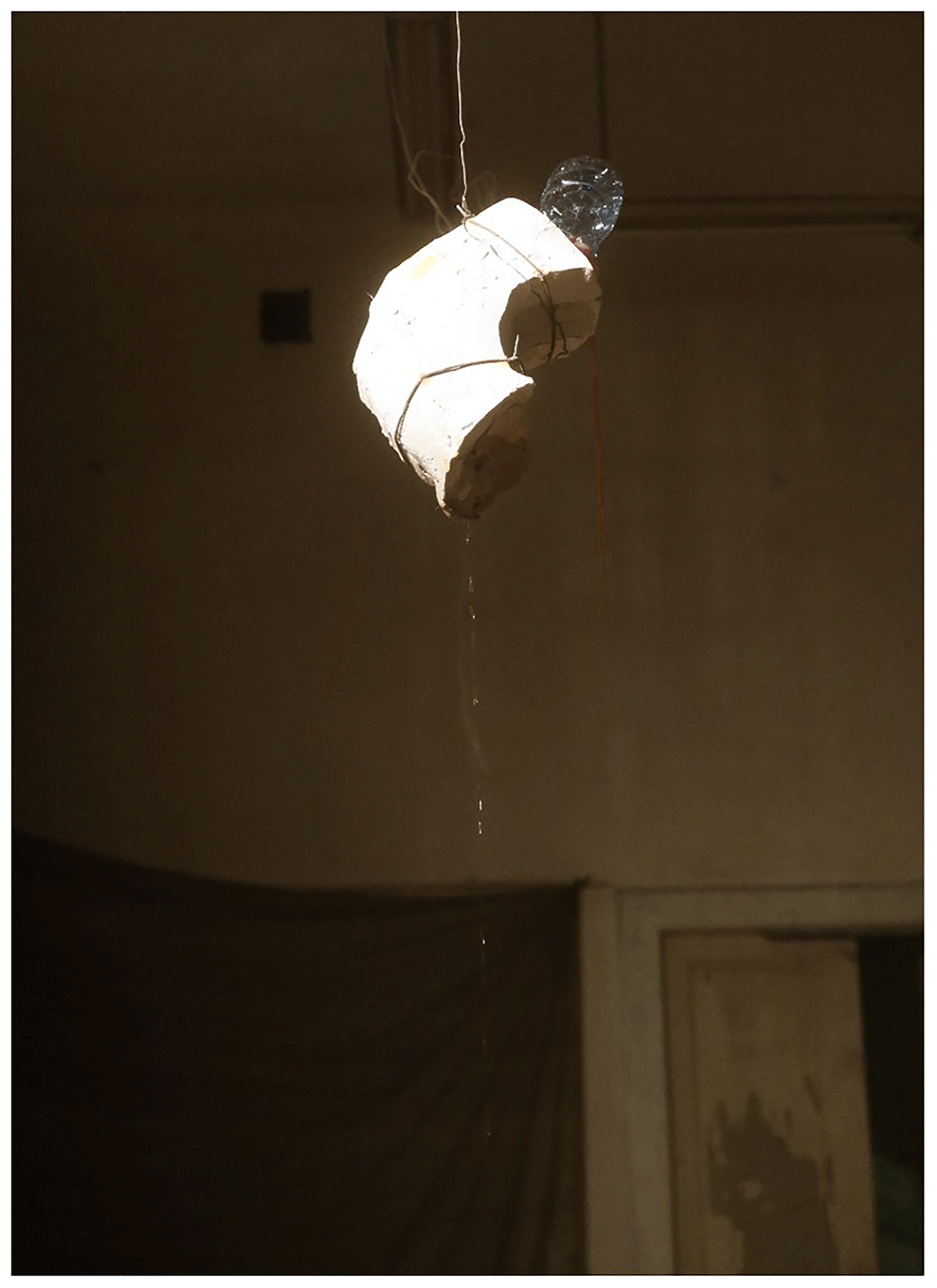
Figures 6. Documentation from the Dielectrics exhibition and performance.
The main intervention of the residency used fresh slow-drying clay and self-made circuits to explore the acoustic and material qualities of organic matter. A changing soundscape from the installation demonstrated how natural materials can actively engage in creating sonic works. The Dielectrics project, as part of the Toolkit of Care program, was presented in Sofia's Art Academy during the DA LAB residency and culminated in a performance of live electronics that involved taking the installation and turning it into a collective organism of people and things working together and against one another by making a rich auditory experience.
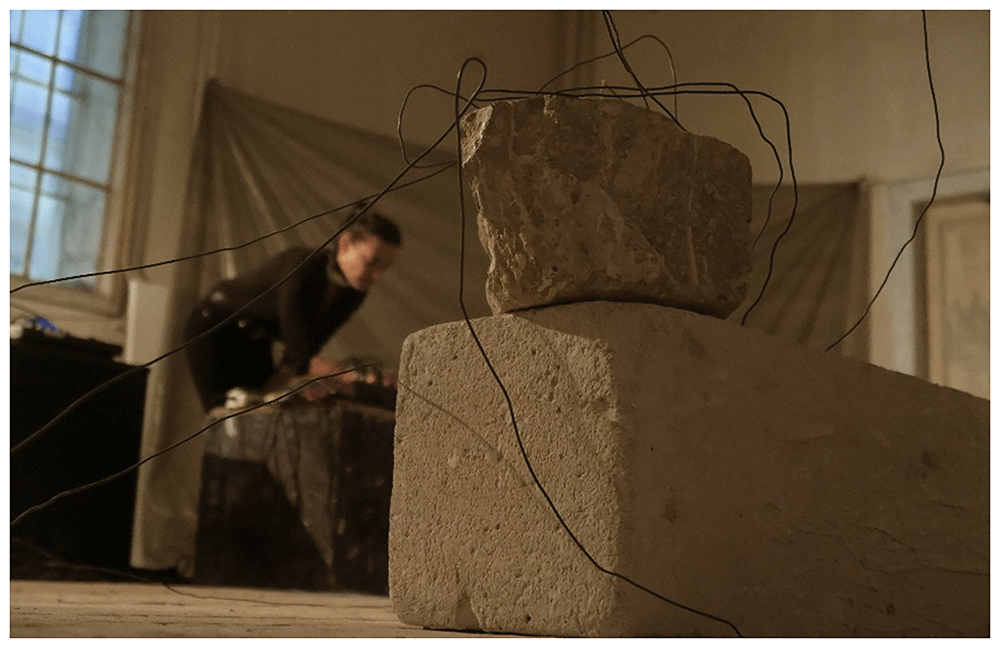
Figures 7. Documentation from the Dielectrics exhibition and performance.
The main intervention of the residency used fresh slow-drying clay and self-made circuits to explore the acoustic and material qualities of organic matter. A changing soundscape from the installation demonstrated how natural materials can actively engage in creating sonic works. The Dielectrics project, as part of the Toolkit of Care program, was presented in Sofia's Art Academy during the DA LAB residency and culminated in a performance of live electronics that involved taking the installation and turning it into a collective organism of people and things working together and against one another by making a rich auditory experience.
Data availability statement
The data and materials supporting the results of this study, including recordings, schematics of self-built instruments, and documentation of the Sympoietic Echo-Systems: Dielectrics installation, are available in the Toolkit of Care project archive. Access can be requested via https://toolkitof.care/archive/sympoietic-echo-systems-dielectrics. All data are provided for non-commercial research and educational purposes. Any additional materials or queries can be directed to the author (kousteridoudimitra@gmail.com)
Faculty Opinions recommendedReferences
- Anderson B, McFarlane C:
Assemblage and geography.
Area.
2011; 43(2): 124–127. Reference Source
- Brickler P:
Painting materials: a short Encyclopaedia. London: Thames & Hudson, 2013.
- Cimini A:
Becoming musical: deleuze and Spinoza on affect and composition.
Pli: The Warwick Journal of Philosophy.
2010; 21: 62–87.
- Deleuze G, Guattari F:
A thousand plateaus: capitalism and schizophrenia. Translated by Brian Massumi. Minneapolis: University of Minnesota Press, 1987. Reference Source
- Haraway DJ:
Staying with the trouble: making Kin in the Chthulucene. Durham: Duke University Press, 2016. Publisher Full Text
- Hustak C, Myers N:
Involutionary momentum: affective ecologies and the sciences of Plant/Insect encounters.
Differences: A Journal of Feminist Cultural Studies.
2012; 23(3): 74–118. Publisher Full Text
- Labatut B:
When we cease to understand the world. London: Pushkin Press, 2020. Reference Source
- Latour B:
Reassembling the social: an introduction to actor-network-theory. Oxford: Oxford University Press, 2005. Reference Source
- Müller M:
Assemblages and actor-networks: rethinking socio-material power, politics and space.
Geogr Compass.
2015; 9(1): 27–41. Publisher Full Text
- Roda A:
Organology and material culture: the case of the Gamelan.
The World of Music.
2007; 49(2): 21–41.
- Voegelin S:
Sonic possible worlds: hearing the continuum of sound. New York: Bloomsbury Academic, 2014. Reference Source
- Voegelin S:
Listening to noise and silence: towards a philosophy of sound art. New York: Bloomsbury Academic, 2010. Reference Source







