Introduction
Working in a team where the members have diverse and largely non-overlapping areas of expertise can be a challenging experience. The first aim of this report is to suggest ways of thinking about the process and to throw light on some of the issues that might arise.
The report contains some specific references to our work on the EU H2020 Blue-Action project1 (a five-year project running from December 2016 to September 2021), but the intention is to make entirely general points wherever possible that are applicable to a wide range of projects. The Blue-Action workpackage which prompted this work was concerned with Arctic Tourism and included managers and decision makers from the tourist industry, academics with interests in modelling, climate predictions, policy-making, data scientists, and programmers.
A secondary aim was to write the text in plain language. As it is difficult to be concise and precise without using specialist vocabulary, one or both of these aims will certainly be compromised at various points. But accessibility and readability are paramount and the section ’Identifying and lifting road-blocks’ contains a short explanation of why we have taken this approach.
To further aid readability we adopt a strict order of placement for figures and captions. The captions are written to be part of the main text and should be read in sequence with everything else. Informal surveys of non-specialist readers (canvassed during the development of this report) have suggested that this approach, which has something of the nature of a comic-strip or graphic novel about it, is friendlier than having to move from text to figures and then back again in order to extract meaning. We describe our project as transdisciplinary but have deliberately avoided devoting a great deal of space to exploring exactly what this, or any other closely related term, means. The precise meaning is not important for the current purpose and there is plenty of informed discussion available elsewhere2. The terms transdisciplinary and co-designed will be used throughout, occasionally abbreviated to TD and CD respectively where appropriate; these and other terms are briefly dealt with in the Glossary.
Co-design viewed simply
Diagrammatic representation
In this first section we introduce a diagrammatic representation intended to support discussion about problems encountered in transdisciplinary co-designed (TD-CD) projects. The representation is kept deliberately simple, and we are not claiming that it captures all aspects of the many complex issues that arise. We believe that having a simple model is valuable because people will profoundly disagree with it; discussions about why it is incomplete and how it might be improved inevitably follow and are valuable in themselves. Developing this simple representation is a recasting activity, a concept that is introduced in what follows.
An earlier version of this representation, developed over the course of the Blue-Action project, was first introduced by one of us (MC) as part of an on-line event ’Understanding climate complexity - Science through art’ in November 20203,4. We can find no similar treatment in the literature and sincerely hope that this will act as a spur to discussion and help many people to develop their own more sophisticated visualisations of the processes.
As mentioned in the introduction, this section contains figures with captions that are to be read as a sequence with the main text.
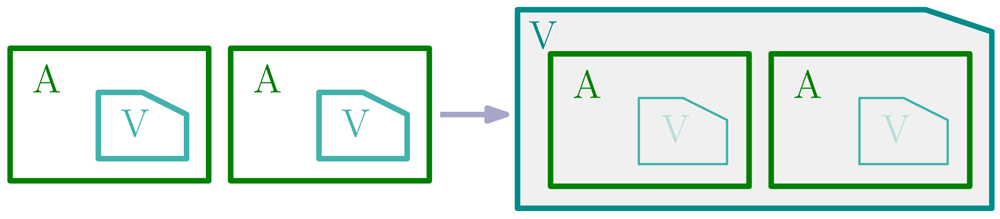
Figure 1. The simplest view of what we are trying to achieve.
On the left team members, or Actors (A - green rectangles), each have their own internal View of the world (V - cyan pentagons). On the right a shared view, or common frame of reference has emerged around the actors.
In Figure 1 the central grey arrow stands for all processes and activities that lead to the emergence of a new view, or frame of reference, common to all actors. (This new frame is, of course, not external to the actors but it is graphically convenient to show it as being shared in this way.) None of the processes that could lead to the emergence of the common frame are possible without members of the team originating activities and interactions of some sort; for this part of the discussion we will call this an output.
The output shown in Figure 2 can be anything: a slide presentation, a plan for a group activity, or a sketch on the back of a beer mat. Creating this output has an impact on the view of its creator. But Figure 2 hides a subtle difficulty. Researchers are well practised at designing a narrow range of outputs for a narrow range of audiences. We will suggest later that this comfortable familiarity with a limited range of output types is a road-block in co-design projects; we will come back to this point later in the ‘Identifying and lifting road-blocks’ section.
The simplest example of a situation that matches Figure 3 would be where A1 is the lecturer, the output is the lecture, and A2 is a student. The impact on the world view of the student would be the principle aim in this case.
It is tempting, but not valid, to suggest that a simple view of co-design would be where observation and creation were somehow integrated; for example if the observer is encouraged to also make suggestions about the content of the output. If the observer modifies the output as part of their participation they become a co-designer, and maybe we have partly achieved what we set out to do. This situation is described in the next figure.

Figure 4. A naive and misleading view of co-design.
(Here we have dropped the alphabetical labels.) This figure is simply a restatement of Figure 3 but with the second actor (on the right) now not simply an observer/participant but has an interaction  that modifies the output in some way.
A situation which could be something like Figure 4 would be two children inventing a game; if they can ‘play together nicely’ then something that is satisfactory and meaningful containing elements supplied by both can be achieved. Perhaps a better illustration would be two jazz musicians cocreating a performance by improvising and ‘riffing off’ one another’s contributions.
It is clear that the situation represented in Figure 4 can result in an output that is co-designed in some very limited sense. But experience has shown that this approach is hard to initiate and difficult to sustain with actors who, unlike our two jazz musicians, do not share a common background. There are a number of road-blocks that emerge in this situation.
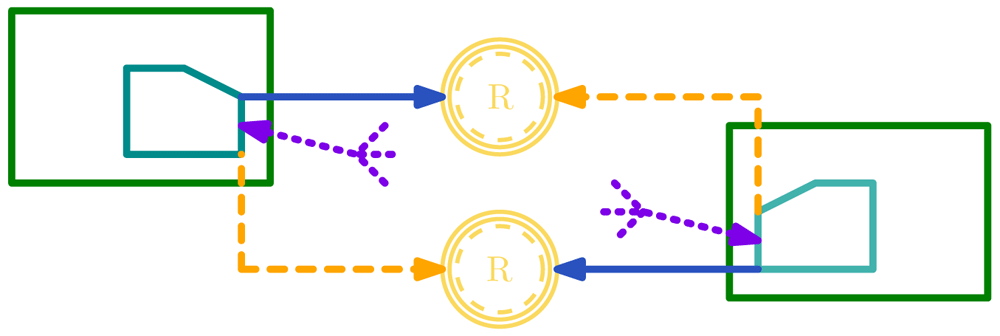
Figure 5. Clearing the road-blocks.
Our proposal is a set of intermediate interactions, that we will call recasting activities, indicated by gold circles and labelled ‘R’ in this figure. These are shown with thinner double or triple rings because it is important that a wide range of such activities is explored. It is also critical that each of them is not overly complex; these are not the goals of the collaboration but merely its support.
Figure 5 is a critical point in the establishment of a shared view because there is no project output. Nobody is explicitly working on the output while they are building the common frame of understanding. This has a profound effect on the nature of the impacts, as indicated by the indigo arrows with multiple tails. A range of carefully chosen recasting activities leads to a multitude of small impacts that, acting together, encourage insight across team members and disciplines, something that has been called leakage which leads to transgressive knowledge5.
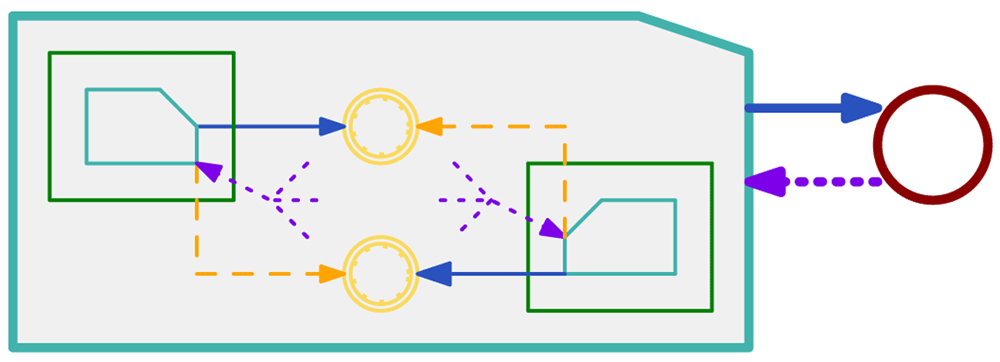
Figure 6. The ideal co-design.
Here we illustrate the idealised outcome of the continuing recasting of views (as shown in Figure 5). It leads to a new common frame and the output is now co-designed based on this new frame of reference.
Figure 6 illustrates a purely hypothetical situation. The combined impacts of all the recasting activities on the internal views of the team results in a common frame of reference. The common frame of reference can now be used to give form to co-designed goals of the project.
An example which approaches Figure 6 would be a group of actors performing ‘improv’, a form of live theatre in which the plot, characters, and dialogue of a scene are made up in the moment. The actors share a world view because they have similar training and experience. This is further reinforced if the troupe have worked regularly together forging a stable shared frame of reference. With just a few prompts from the audience they are able to dynamically interacttoco-create a cogent and amusing narrative.
However much we would like to achieve this result, it is unrealistic to suggest that Figure 6 represents a stable position for teams of disparate researchers assembled for a single project. The incompleteness and lack of stability in the emergent common frame leads directly to our last figure.
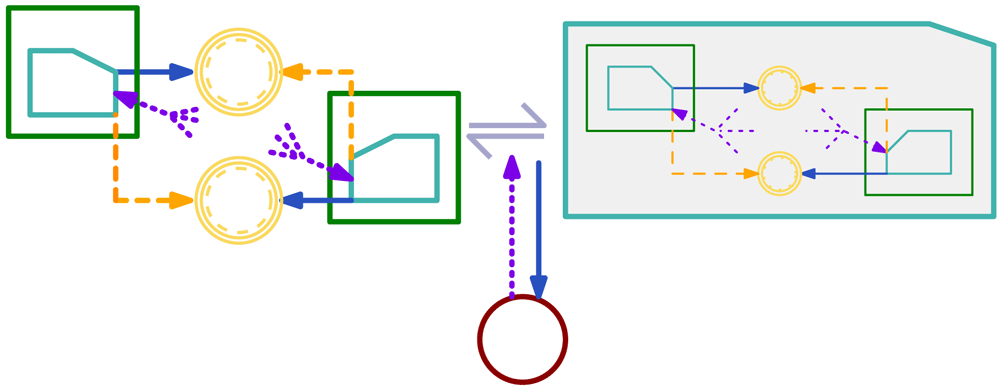
Figure 7. A more realistic view.
The idealised representation (right) where there is a common frame of reference, is in a dynamic equilibrium with continuing recasting activities (left). The project goals or outputs (centre) are achieved by harnessing, and managing, this equilibrium.
Figure 7 contains perhaps the most difficult and controversial assertion in this report. It is too much to expect the common frame of reference to be as well formed or as stable as each individual internal view. As a result it is necessary to manage the equilibrium and tension between the recasting activities and the emergent common frame.
In the overview of the project represented by Figure 7 the output arises not from the recasting activities (which are not designed to meet project goals directly) or as a direct result of the common frame of reference (which is incomplete and unstable), but as a result of harnessing the mutual insights and momentum generated by the processes themselves.
Discussion
The diagrammatic representation of transdisciplinary co-design processes proposed here is not complete and will not appeal to everybody. Its simplicity and the fact that we have tried to describe it in non-technical language will ensure that many readers are already suspicious of its usefulness. However, several colleagues have already turned their misgivings into suggestions as to how it can be improved; this is entirely positive.
As previously remarked, developing the representation and publishing it in this form is itself a recasting activity. It is not to be expected that all readers will have a common world-view as a result of reading this report, but perhaps the impact will be enough to start an interaction somewhere where the resulting insights can be exploited.
Finally in this section a summary can be attempted, without any reference to the diagrammatic representation, in a few bullet points:
Teams that contain individuals with no common frame of reference should plan for recasting interactions that are not directed towards the goals of the project.
The aim of these interactions is to modify each individual world view (or at least create the ethos in which views can be modified) in pursuit of insights that move the team towards a shared frame of reference.
Neither the recasting activities (not being designed to contribute directly) or the possible common frame of reference (not usually being well developed or stable enough) give rise directly to the project outputs or goals.
Co-design is the harnessing and management of the process of building the desired common frame, a process which is characterised by a tension and equilibrium between many intermediate stages.
The impacts on world views, resulting from recasting activities, lead to mutual insights and, if management is successful, the mutual insights contribute to the goals of the project.
Identifying and lifting road-blocks
In the previous section we repeatedly made reference to road-blocks meaning the things that prevent TD-CD teams from being successful. Here we will try to identify six of the most troublesome blocks, give some examples, and make some short suggestions how they might be lifted.
Drift
Projects can drift if there is a lack of process management and a failure to initiate recasting activities. This happens even if everyone is apparently busy doing something; one of the most common types of drift is the drift towards everyone pursuing their own unconnected part of the project that they feel comfortable with. In this case there is plenty of activity but no impact and hence no insight. To avoid drift it might not be enough to recruit researchers who are open to the possibilities of working in a TD team, or even those that have a track record.
We believe there is a strong argument for the role of transdisciplinary facilitators and we find that this conclusion has been anticipated by others, including EU funded working groups on TD research6.
In the context of this report the role of the facilitator would include encouraging the origination of recasting activities, originating their own activities if appropriate, modelling active participation in activities, and ensuring that the resulting insights are successfully converted in to goals of the project.
Facilitators might be found among experienced members of the team. Equally, they could, and should where possible, be drawn from a wider range of backgrounds not limited to subject specialists and researchers. These would include communicators, coaches, counsellors, and educators; there is value in making a deliberate attempt to widen the range of viewpoints and approaches withinteams.
We were lucky in our small work-package to have team members with experience of, and commitment to, guiding TD-CD projects; not every project is going to be so fortunate.
Lack of plain language
It is certainly true, and it has been noted by many authors, that:
The phrase discourse culture here is shorthand for ‘a commitment to communicating freely among the team, and with the wider community of stakeholders, in ways that can be understood’; and among the many constraints that this requires is the use of language that is accessible to all parties inside and outside the project. Too often however, far from encouraging a discourse culture, discussions about transdisciplinary projects, and about transdisciplinarity itself, are presented in arcane, frankly byzantine, language. Even researchers who are working in this area are unintentionally limiting their appeal to a very narrow readership.
It takes courage and goodwill within a TD-CD team for the members to abandon the carefully cultivated vocabulary of their own specialist areas. Inability to do this is clearly a road-block to shared insight. The unwillingness to speak plainly is perfectly understandable, the vocabulary we use is part of the armour that we wear. But the metaphor of ‘armour’ is telling; if we all wear it then we cannot properly see, hear, or sense each other’s presence.
There is no easy way to lift the plain language road-block. The team as a whole, but in particular whoever has the role of facilitator, needs to be ready to encourage plain language discourse and to model this in their own outputs. Activities that allow people safe spaces to express themselves without using jargon must be devised, and training could also be made available. However, grant-awarding bodies need to make plain language reporting part of the contract.
One member of our team was prepared to take the lead in internally documenting the project in this way. The resulting notes were shared with the rest of the team, and these form an important source for this report. This limited approach is not ideal, but in a small team we believe that it had considerable positive effect.
Impatience with recasting
It is natural to want to ‘get on with the job’ from the beginning, and an activity that makes no immediate contribution to stated aims of the project might be viewed as unnecessary. Under pressure from project deadlines there is always an early temptation to come up with a step-by-step plan leading to the project goals, and to stick to it. This approach has the feel of an instruction sheet supplied with self-assembly furniture. Such a plan is a road-block, and this road-block could alternatively be called ‘insisting on a plan when what is needed is a strategy’.
Although the step-by-step plan can appear like a guarantee of success, constructive TD interactions will always generate a great deal that cannot be planned. If a plan eventually emerges in the later stages of a project, it must emerge as a result of an agile, creative, strategy for encouraging team interaction and exchange of insight. A truly useful plan is, in fact, not a way of getting to the goals of the project, it is itself an output of the project, and the strategy is the way of getting to the plan.
Life in the silo
A common metaphor for academics, and others who have spent years absorbing the knowledge and culture within narrow subject boundaries, is that they operate in a silo. This is not an expression we would choose but it is in common use. The silo is a place of safety where expertise is recognised and valued, and where anything new is likely to be framed in familiar terms by others who share the same view. Silos are not without value, they can produce highly skilled researchers with a subtle grasp of some very important, but obscure arguments; in short people you would want in your team. Transdisciplinary projects do not require researchers to abandon their silos. One of the aims of recasting activities should be simply to open windows1 in each disciplinary or professional silo. The windows must be open not just to see beyond (although that is useful) but to let the richness of experience, the alternative views, of other silos and the outside world circulate freely.
In our project we had team members who had no experience developing algorithms or implementing them as computer programs. Many discussions about the usefulness, or lack of usefulness, of an algorithmic approach resulted only in minimal impact. The turning point in this discussion was the development of a prototype application (in the first instance little more than a ‘toy’) that had a few features that were recognisably useful. Near the end of the project this application became a project goal in its own right, but not before interaction with it recast thinking and led to a shower of suggestions from all team members, and from the other representatives of the end-user, as to how it could be improved.
The windows of neighbouring silos were opened, and the aroma of what colleagues could cook was allowed to circulate. The result was that everyone wanted a taste, and everyone had an opinion on how to improve the recipe.
Outputs and activities in the comfort zone
The previous example of a programmer providing the team with a quick prototype application can be regarded as an output squarely in the programmer’s comfort zone. This is true even if they had never have done anything like it before. It is much more difficult creating outputs and interacting with activities that look and feel very alien to your usual way of thinking.
An example of non-comfort-zone activities is the excellent annual ‘Dance Your PhD’ competition organised and sponsored by the AAAS Science journals; although we are not suggesting that dancing interactions should be a pre-requisite for participation in TD-CD projects. But the dismissive reactions of many when they hear that researchers might create outputs through dance is not greatly different from their reaction when asked to make a simple sketch, take part in a discussion with a community group, play a game, write something for a newspaper, or sing a song.
Unfamiliar, or even uncomfortable, activities cause us to recast our focus. Engagement with these activities will promote insight, and interactions with a broad range of stakeholders. This is often talked about in the context of public engagement initiatives, but it is forgotten that this applies just as much within a transdisciplinary research group as it does in the wider community.
Our own team was constantly challenged to engage with the constraints of a commercial enterprise; something that only one of us had any experience of. Limitations on time and money (see following section) made it possible to recast internal views only to a limited extent. However, the team had access to outputs generated solely by the industry, in the form of calendars of activities, usage spreadsheets, and diaries kept by long-term employees, and these were continually the focus of discussion. The impact of these discussions was enough to ensure that all members of the team framed their outputs in new ways that were not immediately comfortable. This would not have been possible at the beginning of the project or in the absence of material from outside everyone’s silos.
Resources
Writing this in August 2021, as the world is adjusting to SARS-CoV-2 as an endemic problem, many of us have been forced to rely on internet-based interactions during long periods of social isolation. News reports are full of speculation about if, when, and how willingly, workers will return to their offices.
In the context of this report there are some interesting features of the debate about remote vs office working. While many staff believe they are more productive at home, many companies believe that staff are more creative when they have the chance to freely interact8. It is not our intention to develop this argument here; but it is entirely possible that freed of the necessity to travel, freed of interruptions by colleagues, and free to organise their own time, employees are getting through their to-do lists and ticking boxes on their plans as well, or better, at home than they could in the office. Companies, it seems, are thinking more strategically (see ‘impatience with recasting’).
This strategic goal of creativity, through extended interaction and shared insight, requires significant resources of time and, hence, money. Transdisciplinary projects are likely to be relatively expensive because team members need to be brought together and freed of their competing responsibilities. However:
There is a particular danger for early career researchers because of pressure to meet other goals. For junior researchers their work within their own silo, promoted by senior academics in their own departments and perceived as being more important to their career development, is likely to take priority.
In our own case travel restrictions due to the pandemic had an impact on our work only at the very end, as remote working had been incorporated from the outset. During the study a major barrier to having time for discussion and recasting activities was accommodation and living costs. Money for working hours was available, and travel is relatively inexpensive; even international travel can be relatively low cost. But for a team of five people, on a four day meeting, the subsistence and accommodation costs soon become an issue. Such meetings need to be regular, not once-a-year weekend ‘catch-ups’.
To lift this road-block grant-awarding bodies need to be realistic, and explicit, about how often and how much time the team are expected to spend together, and to fully fund this interaction. This is not the same as being explicit about how much working time will be paid for on the project, and then simply adding a fixed amount to cover travel, living expenses, and accommodation for the whole grant period.
Summary
This section is not called ‘Conclusions’ because the conclusions, such as they are, are contained in the individual sections. But a bullet point summary of this report could read as follows:
Transdiciplinary research and co-design (TD-CD) are important approaches to achieving many complex but desirable outcomes such as, in our case, the provision of climate services which bring together modellers, data scientists, decision makers, and industry practitioners9.
There are many people who are keen to associate themselves with TD-CD teams who have little idea, and no experience, of the difficulties involved or the responsibilities it imposes upon them.
Diagrammatic descriptions, however incomplete, allow inexperienced researchers to gain an impression of ‘how something works’10 and provide more experienced team members with something to disagree with, promoting discussion.
A collaboration of the willing is not automatically a community of discourse11, (a complex way of saying ‘just because you all signed up for the money doesn’t mean you are motivated to talk meaningfully to each other’). It is easy to retreat into a comfortable silo, fall back on narrowing vocabulary, do your own thing, and be suspicious or even dismissive of activities that are designed to shake up your world view.
Funding bodies should require more plain language communication (which has legacy value for other projects), more interaction, and more risk taking. They should not rely heavily on evidence of epistemic exchange or societal impact, even though both are valuable outcomes. The quality of these valuable outcomes, and hence the success of the project, depends critically on the quality of the processes and depth of insights that brought them about.
Glossary
Actor: A participant in the co-design, a team member, an active stakeholder.
Co-designed: Designed (or created) jointly by all stakeholders to ensure the outputs meet every-ones needs and are usable.
Drift: The danger that a project might make no progress towards transdisciplinary insight even if everyone is busy doing something.
Epistemic Exchange: This is used to describe what happens when actors, or stakeholders, learn from each other and is a desirable outcome of TD projects.
Impact: A change in attitude, a shift, a nudge, anything that changes the way people think or feel.
Output: Anything that results from the co-design process or from the initiation of a recasting activity: a presentation, a sketch, a dance etc.
Plain Language: Communication with your non-specialist audience in a way that can be understood the first time they read or hear it (also called plain writing)12.
Recasting Activity: An interaction designed to alter world views rather than meet project goals directly.
Road-Block: Used in this report to refer specifically to any barrier to interaction and insight within a transdisciplinary team.
Silo: The constraints of traditional or entrenched subject divisions.
Strategy: is used as a contrast to a plan. If you are about to assemble a bookcase you will unfold a plan, designed to lead you to a fixed outcome. If you are about to play a game of chess you will have a strategy. Plans are box-ticking exercises, while strategies are agile, creative, and productive in situations where plans are inappropriate.
Transdisciplinary: Research that seeks to value and integrate knowledge from a wide range of stakeholders. This implies a ‘processes of mutual learning between science and society, ...which embodies a mission of science with society rather than for society’7.
Transgressive Knowledge: ‘...knowledge, as well as expertise, is inherently transgressive. Nobody has anywhere succeeded for very long in containing knowledge. Knowledge seeps through institutions and structures like water through the pores of a membrane’5.
Data availability
All data underlying the results are available as part of the article and no additional source data are required.