Introduction
Circular-economy and sustainability transitions are increasingly understood as systemic socio-technical transformations rather than incremental improvements in production efficiency. Climate change, biodiversity loss and resource scarcity reshape production systems, consumption patterns and governance structures simultaneously, requiring approaches that combine technological, organisational and societal change.1,2,16,19,42–50
For cleaner production to deliver lasting impact, transition processes must incorporate behavioural change, institutional learning, legitimacy, social acceptance, partnership-building and peace-oriented resilience alongside innovation and investment. Existing Living Lab and transition research does not sufficiently explain how regionally anchored infrastructures can link experimentation, stakeholder legitimacy, durable collaboration and commercialisation to cleaner-production and circular-economy uptake. This Open Letter addresses that gap by conceptualising the Climate Lab as a regional transition infrastructure rather than as a stand-alone project platform.5,6,20–25
A complementary theory-of-change perspective helps to make explicit the causal assumptions, intermediate outcomes and contextual conditions through which present actions may contribute to longer-term transformation. This is especially relevant in multi-actor transition settings where the pathway from collaboration and experimentation to wider societal impact is non-linear and therefore must be articulated rather than assumed.57
The manuscript uses a 5P lens: People, Planet, Profit, Partnership and Peace. Partnership is added because regional sustainability transition depends on trustful, sustained and cross-sector collaboration among public authorities, firms, RDI organisations, civil society and international networks. Peace is added because climate adaptation, preparedness, comprehensive security, fairness and social cohesion are not peripheral outcomes; they are conditions for legitimate and resilient transition processes.
Conceptual background
Behavioural aspects, dialogue and social acceptance in sustainability transitions
Sustainability transitions depend not only on technological development, policy instruments or economic incentives but also on how individuals and organisations interpret change, respond to uncertainty and adjust routines and institutional practices. Behavioural aspects therefore shape whether adaptation and circular solutions are recognised as necessary and whether they are adopted in practice.1,2,16
Social acceptance is equally important. New infrastructures, business models and policy interventions may face resistance if they are perceived as unfair, opaque or disconnected from local needs. Earlier work by Eskelinen and colleagues shows that circular-economy business models must explicitly address legitimacy, behavioural change and the societal conditions of uptake.31,32 For the Climate Lab, awareness-building, dialogue and co-creation are thus core transition mechanisms rather than supporting activities.
Dialogue is especially important in settings characterised by uncertainty, competing values and heterogeneous stakeholder interests. Living Labs provide structured spaces for co-creation, experimentation and reflection in real-life contexts, enabling socially robust problem framing and negotiated learning.5,6,20–24
Living Labs, transdisciplinary collaboration and transition pathways
Living Labs are commonly defined as open innovation ecosystems in which users, public actors, firms and researchers co-create and test solutions in real-life environments.5,6 They are especially relevant in climate adaptation and circular-economy contexts, where place-based challenges cross organisational and disciplinary boundaries and where experimentation must be linked with implementation.20,22–25 As example, The EU Mission Soil Living Labs and Lighthouses act as place-based, transdisciplinary mechanisms for co-designing, testing, monitoring, evaluating, and accelerating solutions.26,27
Recent research highlights that Living Labs are most valuable when they support shared problem framing, iterative adjustment and collective capability building rather than isolated pilots.20,23,24,59 For the Climate Lab, this implies a broader role: connecting current experimentation with foresight, impact pathways and longer-term transition scenarios.54–56,60
Business model innovation and value proposition design
Business model thinking helps clarify how a Living Lab creates, delivers and captures value across a multi-actor setting. Kajanus et al.3 show that a business model can function as a co-creative innovation tool rather than a static commercial template. This is particularly relevant when the object of development is not a single product but a broader regional arrangement of actors, activities, resources and value flows.3,17–19
The Value Proposition Canvas complements this perspective by matching services to stakeholder jobs, pains and gains.4 For the Climate Lab, this is especially important for SMEs, which often face limited foresight capacity, fragmented support systems, uncertain commercialisation pathways and difficulty translating sustainability pressures into concrete business opportunities. A value proposition must therefore address not only public-sector coordination but also SME needs for piloting, market validation, partnership access and risk reduction.
5P: People, Planet, Profit, Partnership and Peace
The People–Planet–Profit (PPP) perspective, also known as the triple bottom line, broadens the assessment of organisational and innovation performance from financial value alone to the simultaneous consideration of social, environmental and economic outcomes.63,64 In this Open Letter, PPP is not abandoned but expanded into a 5P lens that also includes Partnership and Peace.
The People dimension concerns participation, behavioural capabilities, legitimacy, social acceptance, procedural fairness and the ability of citizens and organisations to understand and influence transition pathways. The Planet dimension concerns climate adaptation, circular economy, biodiversity, resource efficiency, cleaner production and ecological regeneration. The Profit dimension concerns viable business models, commercialisation, SME competitiveness, investment readiness and regional value creation.
Partnership is added as a distinct principle because regional transition infrastructures work through relationships: public–private collaboration, RDI–business cooperation, civil-society participation, regional clusters and international project networks. Without durable partnerships, Living Lab activities risk remaining temporary experiments rather than pathways to systemic uptake.
Peace is added as a distinct principle because climate and resource transitions are increasingly connected with preparedness, comprehensive security, social cohesion and the avoidance of conflict over risks, resources and responsibilities. In the Climate Lab model, peace does not refer narrowly to the absence of war; it refers to the creation of resilient, trusted and fair regional conditions in which climate action can proceed without undermining social cohesion.
Policy context: circular economy, bioeconomy and regional adaptation
The Climate Lab aligns with the EU Circular Economy Action Plan, the Finnish circular-economy programme and the broader shift toward climate resilience, bioeconomy renewal and nature-positive development.42–53 These frameworks support experimentation environments, mission-oriented innovation and solution scaling, thereby providing a strategic rationale for a regional transition infrastructure.26,27
The regional case for the Climate Lab is strengthened by adaptation priorities in Northern Savo and Eastern Finland. The newly approved Pohjois-Savo climate adaptation plan brings together regional climate risks, preparedness needs and coordinated measures for municipalities, authorities, companies and other stakeholders.61 In Eastern Finland, regional development priorities and funding instruments emphasise climate resilience in livelihoods and infrastructure, municipal–company cooperation, risk management and circular-economy solutions, indicating a clear demand for integrative regional support structures.62
The climate lab concept and case context
The first concept-development phase of the Climate Lab was initiated through the ILCA project and its Finnish innovation laboratory for climate action and sustainable societies.8–11 The concept was then further refined in the FARCLIMATE project through facilitated discussions and canvas-based development aimed at clarifying the Climate Lab’s business model, stakeholder needs and value proposition.7 By linking the Climate Lab concept with Mission Soil and other Living Labs, locally generated knowledge and stakeholder insights can be transformed into practical climate and soil-health innovations, supported by business models and value proposition canvases that clarify value creation, delivery, and uptake.5,7,27,28,41
The Climate Lab is presented here as a practical collaboration model for responding to climate change, biodiversity loss, resource scarcity and preparedness-related societal change. Its core purpose is to connect awareness creation, dialogue, co-creation, pilots, impact-pathway thinking and innovation support into a coherent regional mechanism. In this sense, the Climate Lab is best understood as a Living-Lab-based transition infrastructure anchored in Northern Savo and Eastern Finland.1,2,7,10–16,42–56 From a 5P perspective, this transition infrastructure must simultaneously strengthen People outcomes (trust, participation, behavioural capabilities and procedural fairness), Planet outcomes (emission reduction, circular material flows, biodiversity-sensitive adaptation and cleaner production), Profit outcomes (commercially viable services, SME competitiveness, investment readiness and regional value creation), Partnership outcomes (durable multi-actor collaboration and shared ownership) and Peace outcomes (preparedness, comprehensive security, social cohesion and fair transition governance).
The impact-pathway logic,
Figure 1, places climate risks, biodiversity loss, resource scarcity and comprehensive-security concerns at the centre of the model.12 Around these drivers, the Climate Lab organises key actions such as awareness raising, stakeholder dialogue, co-creation, experimentation, prospective impact assessment and innovation facilitation. These activities are expected to produce intermediate outcomes including shared understanding, trust, partnerships, validated solutions and commercialisation pathways, which in turn contribute to long-term impacts such as adaptive capacity, circularity, resilience and sustainable regional competitiveness. The 5P lens strengthens this logic by requiring that impact pathways specify not only whether solutions work technically, but also who benefits, what environmental burden is reduced or regenerated, how economic value is captured and shared, what partnerships enable continuity, and how transition processes support preparedness, trust and social cohesion.
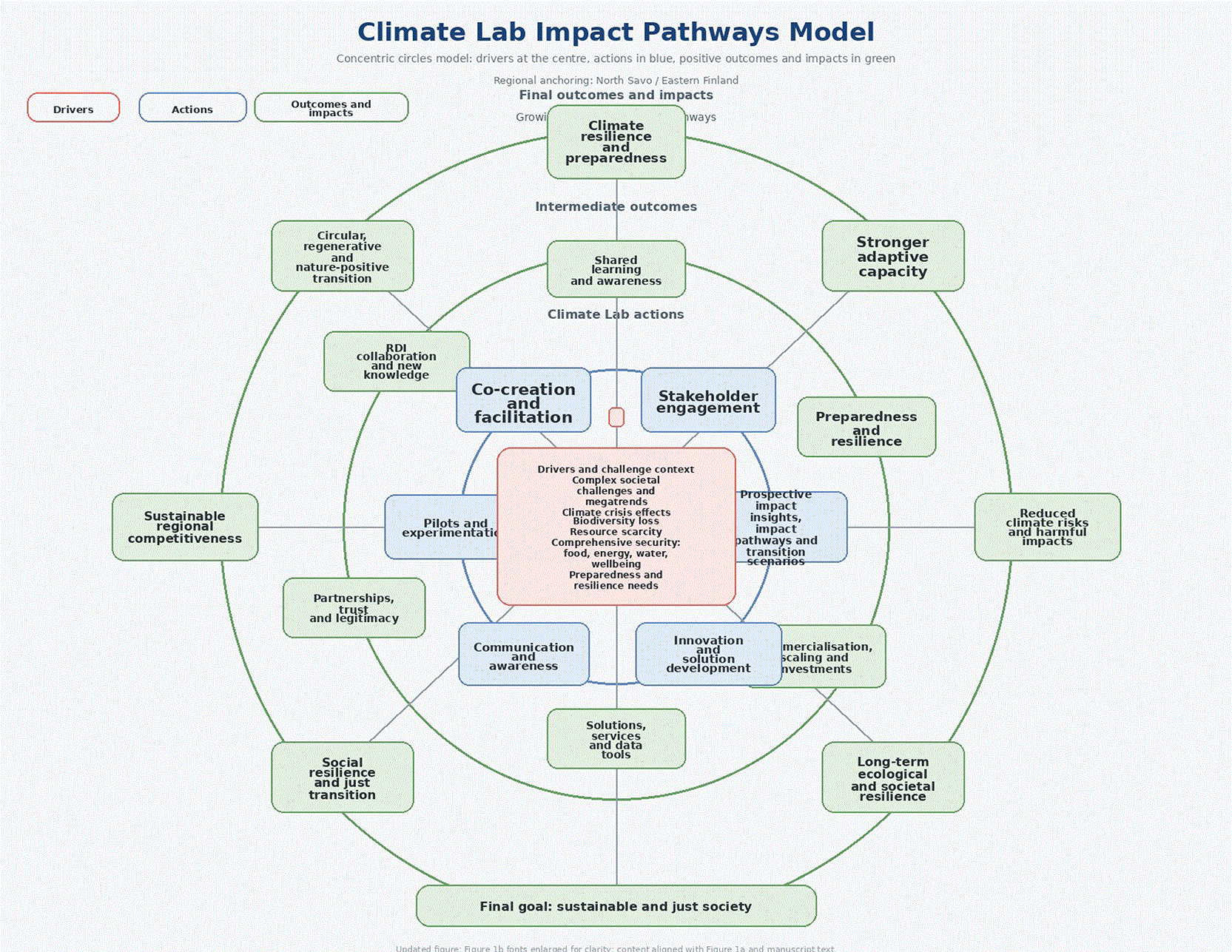
Figure 1. Climate Lab model: (a) impact pathway linking societal drivers, Climate Lab actions, intermediate outcomes and long-term impacts; (b) concentric representation of the same logic, from challenge context to regional transition outcomes.
This widening structure also resonates with systemic-change thinking: local pilots and niche solutions may influence broader socio-technical regimes when they are connected to institutional learning, market development and strategic foresight.58
Research approach and analytical framing
This Open Letter is conceptual and design-oriented. It does not report a completed empirical evaluation of the Climate Lab; instead, it synthesises available concept material into an analytically structured manuscript that clarifies the Climate Lab’s operating logic, value proposition and transition role.7
The analysis draws on Climate Lab development materials from ILCA and FARCLIMATE, together with literature on climate adaptation, Living Labs, business model innovation, value proposition design, commercialisation, transition design, triple bottom line sustainability and the 5P framing used here.1–9,17–25,31–38,54–60,63,64 Methodologically, the paper follows a design logic in which the Climate Lab is treated as an emerging model that can be articulated through structured canvases, conceptual synthesis and impact-pathway reasoning.3,54–56
Conceptual business model and value proposition of the climate lab
The core result of the paper,
Table 1, is the articulation of the Climate Lab as a Living-Lab-based business model that creates value by orchestrating collaboration rather than by selling a single standardised output. Its central function is to identify transition-related needs, facilitate co-creation, enable experimentation, support prospective impact assessment and translate these processes into preparedness, innovation opportunities and wider societal uptake.3,6,7,54–56
Table 1. Climate Lab business model canvas.
| Customer segments
| Regional authorities and municipalities; SMEs and larger companies; RDI/education partners; NGOs and civil-society actors; regional clusters and international project partners. |
| Value proposition
| A Living Lab-based transition infrastructure offering co-creation, prospective impact assessment, impact pathways, climate innovation support, preparedness and resilience-building, awareness creation, piloting and commercialisation support. The value proposition is explicitly framed through the 5P lens: inclusive participation and legitimacy (People), climate adaptation, circularity and cleaner production (Planet), viable business models, SME competitiveness and regional value creation (Profit), durable multi-actor collaboration (Partnership), and preparedness, social cohesion and comprehensive security (Peace). |
| Channels and relationships
| Co-creation workshops; pilots and experiments; RDI projects; education and training; regional and international innovation networks; long-term partnership-based orchestration and facilitated collaboration. |
| Key resources, activities and partners
| RDI and facilitation expertise; stakeholder networks; Living Lab methods; communication capability; pilot environments; prospective impact assessment know-how; public authorities, companies, NGOs, regional clusters and research partners. |
| Cost and revenue logic
| Personnel and coordination costs, facilitation, communication, pilots, method development and tool maintenance; funded through competitive RDI projects, commissioned services, training and consortium-based funding, with potential future service packages. |
The Climate Lab therefore acts as a neutral and trusted intermediary linking research, public decision-making, business development and civil-society participation. This intermediation role makes canvas-based articulation useful because it clarifies key resources, activities, partner relationships, costs and stakeholder-specific value creation. The 5P lens also helps to avoid a narrow interpretation of the value proposition: value is created when social acceptability, environmental performance, economic viability, partnership continuity and peace-oriented resilience reinforce each other rather than being treated as separate project criteria.
Value proposition canvas with SME focus
Because the Climate Lab is a multi-sided arrangement, the Value Proposition Canvas,
Table 2, is focused here on one primary user group: organisations and ecosystem actors in Northern Savo and Eastern Finland that need support for climate adaptation, resilience, circular-economy transition and innovation. SMEs are addressed because their needs for piloting, market validation and transition support are central to cleaner-production uptake.
Table 2. Value Proposition Canvas for the Climate Lab.
| Customer jobs
| Anticipate climate-related risks and opportunities; strengthen preparedness and adaptation; identify funding and partnership opportunities; test and scale practical solutions; support evidence-informed decision-making; develop new circular-economy and cleaner-production business opportunities. |
| Customer pains
| Fragmented stakeholder landscape; uncertainty about future impacts; limited foresight capacity, especially in SMEs; lack of trusted co-creation spaces; weak links between adaptation work and commercialisation; difficulty validating demand for sustainable solutions. |
| Customer gains
| Shared understanding; stronger preparedness and resilience; validated pilots and solutions; improved strategic decision-making; access to RDI and funding; clearer market signals; greater legitimacy and visibility; clearer articulation of People, Planet, Profit, Partnership and Peace benefits for decision-making and communication. |
| Products and services
| Stakeholder workshops and co-creation processes; prospective impact assessment methods; innovation management support; piloting and experimentation; training and communication; RDI project generation; support for service concepts and solution scaling; 5P-oriented value mapping for balancing social, environmental, economic, collaborative and peace/resilience outcomes. |
| Pain relievers
| Neutral coordination space; facilitated multi-actor methods for structuring uncertainty; pilot support that lowers adoption barriers; communication that strengthens visibility; connections to public demand, partners and funding; support for SME experimentation and early validation. |
| Gain creators
| New networks and durable partnerships; stronger adaptation capacity; evidence and legitimacy for decisions; opportunities for co-developed services and business models; pathways to scalable solutions; stronger positioning in a just transition and cleaner-production context; stronger ability to demonstrate 5P value to funders, customers and public stakeholders. |
Stakeholder value proposition
Table 3 is referenced here explicitly because it translates the general Climate Lab value proposition into stakeholder-specific needs, offers and benefits. This stakeholder view is important in an Open Letter because it clarifies how the 5P principles are operationalised differently for municipalities, companies, RDI actors, civil society and wider regional networks.
Table 3. Climate Lab value proposition by stakeholder group.
| Stakeholder group | Main challenges/needs | Value offer | Expected benefits |
|---|
| Public authorities and municipalities | Need coordinated responses to climate risks, preparedness, legitimacy, partnership coordination and just-transition requirements. | Evidence-informed planning, dialogue, piloting and impact-oriented climate action in a multi-actor setting. | Stronger governance capacity; better policy coordination; improved preparedness and resilience; strengthened trust and social cohesion. |
| SMEs, companies and business ecosystems | Need clearer transition pathways, innovation support, early validation, collaboration opportunities and lower uncertainty. | Access to pilots, knowledge, public-private collaboration, regional demand signals and business-model support for sustainable solutions. | Innovation and business opportunities; improved investment readiness; reduced uncertainty; faster uptake of cleaner solutions; stronger 5P narratives for customers, investors and public procurement. |
| RDI and education partners | Need real-world experimentation environments and stronger societal relevance. | A Living Lab for co-creation, applied research, impact assessment and education-business-public collaboration. | New knowledge; stronger RDI collaboration; educational relevance; greater societal impact. |
| NGOs, associations and civil society | Need fair participation, voice in transition decisions and visible local benefits. | Inclusive dialogue and co-creation processes that make transition pathways understandable, legitimate and responsive to local needs. | Social acceptance; empowerment; improved awareness; trust and procedural fairness. |
| Regional clusters and international partners | Need scalable models, transferability and strategic collaboration across networks. | A transferable model linking regional experimentation with EU priorities and innovation ecosystems. | Scaling pathways; international visibility; stronger partnerships and regional positioning. |
Commercialisation and diffusion
Commercialisation should be understood as an integral part of Climate Lab activity rather than as a downstream add-on. Earlier work shows that sustainability-oriented business models must address social acceptance, behavioural change and legitimacy, while commercialisation research emphasises the need to translate innovations into viable offerings through clear processes, decision criteria and resource choices.31–35
In the Climate Lab context, commercialisation may involve not only product sales but also service packages, training offers, digital tools, impact-assessment methods, consortium-based service models and ecosystem-level solution pipelines. This broader perspective is consistent with eco-innovation and climate-innovation research as well as recent SoilHealth Living Lab work in which business-model development is combined with co-creation and experimentation.28–30,36–41 The 5P lens adds that commercialisation should not weaken social legitimacy, ecological value, partnership continuity or peace-oriented resilience; instead, these dimensions should become part of the business-model quality criteria.
Discussion
The analysis indicates that the Climate Lab differs from many regional Living Labs because it is not limited to user-centred experimentation or individual project support. Its key contribution lies in combining awareness building, dialogue, co-creation, prospective impact assessment, business model innovation and commercialisation support within one regional arrangement. This integrated structure enables the Climate Lab to connect local experimentation with longer-term transition pathways and wider societal impacts.
Adding the 5P perspective clarifies the nature of this contribution. The Climate Lab should be understood as a mechanism for balancing and translating People, Planet, Profit, Partnership and Peace outcomes across regional transition processes rather than as a platform that simply aggregates sustainability-related activities. The People dimension is visible in behavioural change, legitimacy, social acceptance, inclusive dialogue and fair participation. The Planet dimension is reflected in climate adaptation, circular economy, biodiversity, cleaner production and resource efficiency. The Profit dimension is present in business model innovation, SME support, commercialisation, investment readiness and sustainable regional competitiveness. Partnership is visible in the Climate Lab’s role as a neutral convenor of municipalities, companies, RDI organisations, civil society, clusters and international networks. Peace is visible in the emphasis on preparedness, comprehensive security, trust, social cohesion and fair transition governance.19,31–35,42–50,63,64
This interpretation is important because cleaner-production and circular-economy transitions often fail when environmental benefits are not connected to social legitimacy, viable economic incentives or the partnerships required for implementation. Conversely, commercially promising solutions may lack transition relevance if they do not reduce environmental burdens, generate fair and visible local benefits, or strengthen resilience and social cohesion. The 5P lens therefore strengthens the Climate Lab model by making trade-offs and synergies explicit: co-creation processes can identify whose needs are addressed, prospective impact assessment can examine environmental and social consequences, business-model work can clarify how value capture supports transition goals, partnership work can secure continuity, and peace-oriented framing can connect adaptation with preparedness and trust.
The 5P lens also reinforces the value proposition of the Climate Lab for SMEs and business ecosystems. For SMEs, the challenge is not only to develop cleaner products or services, but to translate sustainability pressures into credible market propositions that demonstrate social acceptability, environmental performance, economic feasibility, collaborative credibility and preparedness value. The Climate Lab can support this by connecting piloting, demand validation, stakeholder dialogue and impact-pathway reasoning into a single process. This makes sustainability less abstract and more actionable: People clarifies user and community acceptance; Planet clarifies environmental value and adaptation relevance; Profit clarifies commercial pathways, cost logic and investment readiness; Partnership clarifies the actor relationships needed for uptake; and Peace clarifies the contribution to trusted, resilient and secure regional development.
Conclusions
This Open Letter has conceptualised the Climate Lab as a Living-Lab-based regional transition infrastructure for climate adaptation, circular economy and cleaner production in Northern Savo and Eastern Finland. The first contribution is a structured business-model articulation (
Table 1) that shows how the Climate Lab creates value by orchestrating collaboration, experimentation and transition-oriented learning rather than by delivering a single standard service.
The second contribution is a value proposition (
Tables 2 and 3) that makes stakeholder needs more explicit, especially those of SMEs. The revised value proposition shows that SMEs need not only access to innovation support but also trusted co-creation spaces, pilot environments, early validation, partner networks and clearer pathways from sustainability pressures to viable business opportunities. The 5P perspective strengthens this argument by framing these needs as interconnected People, Planet, Profit, Partnership and Peace outcomes: legitimate and inclusive uptake, measurable environmental and climate value, economically viable innovation pathways, durable collaboration and preparedness-oriented resilience.
The third contribution is the integration of the 5P lens with the Climate Lab’s existing conceptual foundations. The analysis shows that PPP is already aligned with the manuscript’s core concepts: social acceptance and behavioural change correspond to People; circular economy, cleaner production and climate adaptation correspond to Planet; and business model innovation, commercialisation and regional competitiveness correspond to Profit. The Partnership and Peace dimensions improve the conceptual coherence of the model by making collaboration, comprehensive security, preparedness and social cohesion explicit.
The most important conclusion is that the Climate Lab extends the conventional Living Lab model into a more strategic and systemic regional function. By integrating awareness building, dialogue, co-creation, prospective impact assessment, 5P-oriented value mapping, business-model innovation and commercialisation support, it links present experimentation with transition pathways and future scenarios. This systemic and anticipatory orientation makes the Climate Lab particularly suitable for circular-economy, climate-adaptation and cleaner-production transitions in which preparedness, legitimacy, environmental performance, business viability, partnership quality and peace-oriented resilience are all essential for successful uptake.
Ethics and consent
Ethical approval and consent were not required for this conceptual Open Letter, as it does not report human-participant research, personal data, interviews, surveys or experimental data.
Data availability
This Open Letter is conceptual and design-oriented and does not report new empirical datasets or statistical analyses. No datasets were generated or analysed for this article. The conceptual material referred to in the article is described in the text and references; internal Climate Lab working materials are not publicly deposited because they contain project-development and stakeholder-process information. No data are required to replicate the conceptual argument presented in this Open Letter.
Acknowledgements
This work builds on activities conducted in the ILCA project (Grant Agreement No. 220194), the Climate Engine project funded by the EIT Higher Education Initiative, and the Horizon Europe project Waste4Soil (Grant Agreement No. 101112708). The authors also thank Mr. Teemu Santonen of FARCLIMATE for facilitation of the Living Lab and business model development processes.
Use of generative AI: Microsoft 365 Copilot based on the GPT-5 reasoning model was used to support reference organisation, summarisation, drafting, revision and journal-format manuscript preparation. The tool was used to improve clarity, structure and consistency with Open Research Europe Open Letter requirements. The authors reviewed, edited and approved all content, and final revisions remained the authors’ responsibility.
References
- 1.
IPCC:
Climate Change 2023: Synthesis Report. Contribution of Working Groups I, II and III to the Sixth Assessment Report of the Intergovernmental Panel on Climate Change.
Geneva:
IPCC;
2023. Publisher Full Text
- 2.
IPBES:
Thematic Assessment Report on the Underlying Causes of Biodiversity Loss and the Determinants of Transformative Change and Options for Achieving the 2050 Vision for Biodiversity.
Bonn:
IPBES Secretariat;
2024. Publisher Full Text
- 3.
Kajanus M, Iire A, Eskelinen T, et al.:
Business model design: new tools for business systems innovation.
Scand. J. For. Res.
2014; 29(6): 603–614. Publisher Full Text
- 4.
Osterwalder A, Pigneur Y, Bernarda G, et al.:
Value Proposition Design: How to Create Products and Services Customers Want.
Hoboken, NJ:
John Wiley & Sons;
2014.
- 5.
Lucchesi GP, Rutkowski EW:
Living Labs: Science, Society, and Co-creation.Leal Filho W, et al., editors.
Encyclopedia of the UN Sustainable Development Goals.
Cham:
Springer;
2021. Publisher Full Text
- 6.
European Network of Living Labs (ENoLL):
Living Labs.2026. (accessed 24 March 2026).
Reference Source
- 7.
Savonia University of Applied Sciences/FARCLIMATE:
Climate Lab (Savonia UAS) – Wave 2 Case Study Summary & Business Model Canvas.
Internal working material.
2026. 2 March 2026.
- 8.
EIT Higher Education Initiative:
ILCA – Innovation Laboratories for Climate Actions.2026. (accessed 24 March 2026).
Reference Source
- 9.
ILCA:
Innovation Laboratory of Climate Action for Sustainable Societies – ILCA2S (Finland).2026. (accessed 24 March 2026).
Reference Source
- 10.
Savonia University of Applied Sciences:
Focus areas.2026. (accessed 31 March 2026).
Reference Source
- 11.
Savonia University of Applied Sciences:
Sustainable Societies.2026. (accessed 31 March 2026).
Reference Source
- 12.
Savonia University of Applied Sciences:
Climate Security.2026. (accessed 31 March 2026).
Reference Source
- 13.
Keskinen M, Sojamo S, Varis O:
Enhancing Security, Sustainability and Resilience in Energy.
Food and Water. Sustainability.
2019; 11(24): 7244. Publisher Full Text
- 14.
Dhar AR:
Building Climate-Resilient Food Systems Through the Water–Energy–Food–Environment Nexus.
Environments.
2025; 12(5): 167. Publisher Full Text
- 15.
Agri-Food Cluster North Savo:
Strengthening Food Security as Part of Comprehensive Security.2024. (accessed 31 March 2026).
Reference Source
- 16.
European Commission:
Forging a climate-resilient Europe – the new EU Strategy on Adaptation to Climate Change. COM(2021) 82 final.2021. (accessed 31 March 2026).
Reference Source
- 17.
Chesbrough H:
Business model innovation: Opportunities and barriers.
Long Range Plan.
2010; 43(2–3): 354–363. Publisher Full Text
- 18.
Foss NJ, Saebi T:
Fifteen years of research on business model innovation: How far have we come, and where should we go?.
J. Manag.
2017; 43(1): 200–227. Publisher Full Text
- 19.
Geissdoerfer M, Vladimirova D, Evans S:
Sustainable business model innovation: A review.
J. Clean. Prod.
2018; 198: 401–416. Publisher Full Text
- 20.
Kalinauskaite I, Brankaert R, Lu Y, et al.:
Facing societal challenges in living labs: Towards a conceptual framework to facilitate transdisciplinary collaborations.
Sustainability.
2021; 13(2): 614. Publisher Full Text
- 21.
Purcell WM, Henriksen H, Spengler JD:
Universities as the engine of transformational sustainability toward delivering the sustainable development goals: 'Living labs' for sustainability.
Int. J. Sustain. High. Educ.
2019; 20(8): 1343–1357. Publisher Full Text
- 22.
Olazabal M, Alda-Vidal C, Hernández-Manrique OL, et al.:
Transdisciplinarity in climate change adaptation: An agenda for evidence generation.
PLOS Climate.
2025; 4(4): e0000612. Publisher Full Text
- 23.
König W, Schwarz L, Löbbe S:
Co-creating sustainability interventions in practice—coping with constitutive challenges of transdisciplinary collaboration in living labs.
Sustainability.
2025; 17(16): 7197. Publisher Full Text
- 24.
Cacciolatti L, Lee SH, Christodoulou I, et al.:
Living Labs as Ethical Spaces: Fostering Innovation and Sustainability in Food Systems.
J. Bus. Ethics.
2025. Publisher Full Text
- 25.
Góral A, Wrona S, Jałocha B, et al.:
University living labs: tools for green transition and sustainable development.
Journal of Management and Financial Sciences.
2025; 54: 73–91. Publisher Full Text
- 26.
European Commission:
EU Mission: A Soil Deal for Europe.2026. (accessed 2 April 2026).
Reference Source
- 27.
European Commission Mission Soil Platform:
Living Labs.2026. (accessed 2 April 2026).
Reference Source
- 28.
European Commission Mission Soil Platform:
Waste4Soil.2026. (accessed 2 April 2026).
Reference Source
- 29.
Waste4Soil:
Savonia University of Applied Sciences partner page.2026. (accessed 2 April 2026).
Reference Source
- 30.
Cerezo Soto A, González Torres M:
PREPSOIL – Business Model Canvas for Soil Living Labs and Lighthouses.
Zenodo.
2024. (accessed 2 April 2026).
Reference Source
- 31.
Eskelinen T, Kajanus M, Wuorisalo J, et al.:
Circular Economy Business Models Addressing Social Acceptance.
Proceedings of the 2020 ISPIM Innovation Conference.
2020.
- 32.
Eskelinen T, Sydd O, Kajanus M, et al.:
Fortifying Social Acceptance When Designing Circular Economy Business Models on Biowaste Related Products.
Sustainability.
2022; 14(22): 14983. Publisher Full Text
- 33.
Pellikka J, Lauronen J:
Fostering commercialisation of innovation in small high technology firms.
International Journal of Technoentrepreneurship.
2007; 1(1): 92–108. Publisher Full Text
- 34.
Pellikka JT, Malinen P:
Business Models in the Commercialization Processes of Innovation among Small High-Technology Firms.
Int. J. Innov. Technol. Manag.
2014; 11(2): 1450007. Publisher Full Text
- 35.
Pellikka J:
Are commercialisation process models beneficial for small technology firms?.
Int. J. Technol. Transf. Commer.
2011; 10(3/4): 229–246. Publisher Full Text
- 36.
ILCA:
Climate Innovation Laboratory (ILCA) (Romania).2026. (accessed 2 April 2026).
Reference Source
- 37.
Vrânceanu MO, Lucaci A, Nastase CE:
Eco-Innovation – Pioneer of the Green Economy in the Development of the Entrepreneurial Environment. Study Case: Eco-Innovation Performance across Post-Socialist Countries in Europe.
Ovidius University Annals, Economic Sciences Series.
2023; 23(2): 136–144.
- 38.
Dabija D, Nastase C:
Exploring the Evolution of Sustainability Paradigms: From Linear to Circular Economy Models.
Proceedings of the International Conference on Business Excellence.
2024; 18(1): 754–769. Publisher Full Text
- 39.
Eskelinen T, Hoxha-Jahja A, Seremetis G, et al.:
Sustainability of the SOILPROM modelling platform and decision-support tool: co-creation of a business model using the PREPSOIL framework.
Soils for Europe Conference, 7–11 September 2026, Coimbra, Portugal.
2026.
- 40.
Hoxha-Jahja A, Eskelinen T:
Co-Creating SoilHealth Tools With Stakeholders: The SOILPROM Approach.
Soils for Europe Conference, 7–11 September 2026, Coimbra, Portugal.
2026.
- 41.
Eskelinen T, Taipale J, Sallinen I, et al.:
Sustainable and Circular Business Models: Experiences from Waste4Soil. Submitted manuscript.
ISPIM Conference, 7–10 June 2026, Granada, Spain.
2026.
- 42.
European Commission:
A new Circular Economy Action Plan: For a cleaner and more competitive Europe. COM(2020) 98 final.2020. (accessed 5 April 2026).
Reference Source
- 43.
European Commission:
Circular Economy.2026. (accessed 5 April 2026).
Reference Source
- 44.
United Nations Environment Programme:
Circularity.2025. (accessed 5 April 2026).
Reference Source
- 45.
United Nations Environment Programme:
Progress in implementing resolution 5/11 on enhancing circular economy as a contribution to achieving sustainable consumption and production. UNEP/EA.6/8.2024. (accessed 5 April 2026).
Reference Source
- 46.
European Commission:
A Strategic Framework for a Competitive and Sustainable EU Bioeconomy. COM(2025) 960 final.2025. (accessed 5 April 2026).
Reference Source
- 47.
Ministry of Economic Affairs and Employment of Finland:
The Finnish Bioeconomy Strategy: Sustainably towards higher value added.2022. (accessed 5 April 2026).
Reference Source
- 48.
European Commission, Directorate-General for Research and Innovation:
Policy imperatives for a competitive and resilient nature-positive economy.
Luxembourg:
Publications Office of the European Union;
2025. (accessed 5 April 2026).
Reference Source
- 49.
Ministry of the Environment of Finland:
Strategic programme to promote a circular economy.2026. (accessed 5 April 2026).
Reference Source
- 50.
European Commission:
Nature and biodiversity.2026. (accessed 5 April 2026).
Reference Source
- 51.
Ministry of Economic Affairs and Employment of Finland:
Innovation policy.2026. (accessed 5 April 2026).
Reference Source
- 52.
Ministry of Education and Culture of Finland:
Multiannual plan for the use of government research and development funding.2024. (accessed 5 April 2026).
Reference Source
- 53.
Prime Minister’s Office, Finland:
Research and Innovation Council.2026. (accessed 5 April 2026).
Reference Source
- 54.
Autti H, Pakarinen L, Partio J, et al.:
Prospective Impact Assessment Process (PIAP) in Future Divercities Project (FDC).
Academic and Practitioner Proceedings of the 2024 UIIN Conference Series: Challenges and Solutions for Fostering Entrepreneurial Universities and Collaborative Innovation, Madrid, Spain.
2024; pp. 142–153.
- 55.
Eskelinen T, Kajanus M, Wuorisalo J, et al.:
Method for Human Security based Prospective Rapid Impact Assessment (PRIA): analysis of 5 case studies.
The Society for Risk Analysis – European Conference 2021, 14–16 June 2021, Espoo, Finland.
2021
- 56.
Kähkönen J, Eskelinen T:
Novel Strategic Framework Towards Resilient Future by Applying Transition Design.
Proceedings of the XXXV ISPIM Innovation Conference, Tallinn, Estonia, 9–12 June 2024.
International Society for Professional Innovation Management ISPIM;
2024. 978-952-65069-6-8.
- 57.
Weiss CH:
Nothing as Practical as Good Theory: Exploring Theory-Based Evaluation for Comprehensive Community Initiatives for Children and Families.Connell JP, Kubisch AC, Schorr LB, et al., editors.
New Approaches to Evaluating Community Initiatives: Concepts, Methods, and Contexts.
Washington, DC:
Aspen Institute;
1995; pp. 65–92.
- 58.
Geels FW:
Technological transitions as evolutionary reconfiguration processes: a multi-level perspective and a case-study.
Res. Policy.
2002; 31(8–9): 1257–1274. Publisher Full Text
- 59.
Bouwma I, Wigboldus S, Potters J, et al.:
Sustainability Transitions and the Contribution of Living Labs: A Framework to Assess Collective Capabilities and Contextual Performance.
Sustainability.
2022; 14(23): 15628. Publisher Full Text
- 60.
Matti C, Bontoux L, Jensen KJK:
Strategic foresight framework for addressing agency in sustainability transitions: a co-creation approach.
Front. Sustainability.
2025; 6. Publisher Full Text
- 61.
Pohjois-Savo H:
Pohjois-Savon ilmastonmuutokseen sopeutumissuunnitelma.2026. (accessed 10 April 2026).
Reference Source
- 62.
EURA 2021/Etelä-Savon ELY-keskus:
Ilmastonmuutoksen torjunta ja sopeutuminen Itä-Suomessa. Call notice for Eastern Finland regional development funding.2025. (accessed 10 April 2026).
Reference Source
- 63.
Elkington J:
Cannibals with Forks: The Triple Bottom Line of 21st Century Business.
Oxford:
Capstone Publishing;
1997; vol. 8. : 37–51. Publisher Full Text
- 64.
Slaper TF, Hall TJ:
The Triple Bottom Line: What Is It and How Does It Work?.
Indiana Business Review.
2011; 86(1): 4–8.







