1. Introduction
Gender bias remains deeply embedded in medical research and education (Plevkova et al., 2020; Merone, 2022). Women occupy only about one-quarter of university leadership roles in Europe (OECD, 2025) and women, minorities, and other marginalised groups have been consistently underrepresented in science and in scientific career pathways (Reppel & Lenders, 2023; Newman et al., 2025). An intersectional perspective is essential for analysing inequality, as it explains how multiple, overlapping axes of disadvantage, including gender, race, disability, class, and age, interact to shape patterns of participation, knowledge production, and career progression within institutions and research systems (Crenshaw, 1989, 1991; Collins, 2015; Schiebinger, & Klinge, 2018).
Participatory research methods provide a framework for integrating intersectionality into medical science by fostering interdisciplinary partnerships (Shimmin et al. 2017). The literature increasingly recognises that external partnerships play a significant role in shaping higher education pedagogy, curriculum design, and societal impact, particularly when addressing complex and systemic inequalities (Bowser et al., 2024). Partnership-based approaches have been shown to strengthen equity-oriented research and training environments, especially in health and translational sciences, by incorporating diverse forms of expertise and lived experience into educational and research processes (Nanda et al., 2023; Carson et al., 2020; Dewidar et al., 2022). Related work on research and innovation networks further suggests that structured collaboration across institutions can embed diversity, equity and inclusion (DEI) principles into organisational learning and capacity-building practices (Fisher et al., 2024).
However, an important gap remains in the literature regarding how partnership models can be systematically designed to operationalise intersectionality within higher education and medical research settings. While many studies emphasise collaboration for equity and inclusion, fewer provide empirically grounded frameworks that link participatory partnerships with intersectional policy implementation, organisational transformation, and Gender Equality Plan (GEP) development. There is also limited longitudinal evidence on how partnership-driven capacity-building translates into sustained institutional change. Addressing this gap requires research that connects partnership structures, intersectional methodologies, and measurable organisational outcomes.
This paper is based on the preliminary findings of the INCLUDE project (European Union Horizon) where existing Gender Equality Plans (GEPs) are systematically assessed and relevant literature and examples of good practices to adopt an intersectional approach within institutional change processes within the Medical Research and Innovation (R&I) sector and Higher Education Institutions (HEI) are identified and analysed. At this stage, the work is primarily diagnostic and mapping-oriented, aiming to establish a robust conceptual and empirical baseline for subsequent intervention within the next phase of the INCLUDE project.
The following section provides the methodology of the INCLUDE project, the State-of-Art (SoA) literature review on medical sector focused literature on inequities and intersectional dimensions as well as good practice and strategies identified. This will be followed by findings from the first stage of the evaluation of the partner organisations’ Gender Equality Plans and Policies (GEPs), alongside evidence-informed recommendations drawn from the literature and selected case studies on how diversity, equity, and inclusion (DEI) can be more effectively strengthened within medical research and Higher Education Institutions (HEIs).
2. Methodology
The two-year INCLUDE project (2025–2026) aims to promote gender equality and inclusiveness in biomedical research by supporting institutional change through intersectional and intersectoral approaches. The consortium includes seven public BioMedical Research Performing organisations (RPOs) and one private BioMedical Research & Technology organisation (RTO) and partners from 10 European countries (
Figure 1 and
Table 1).
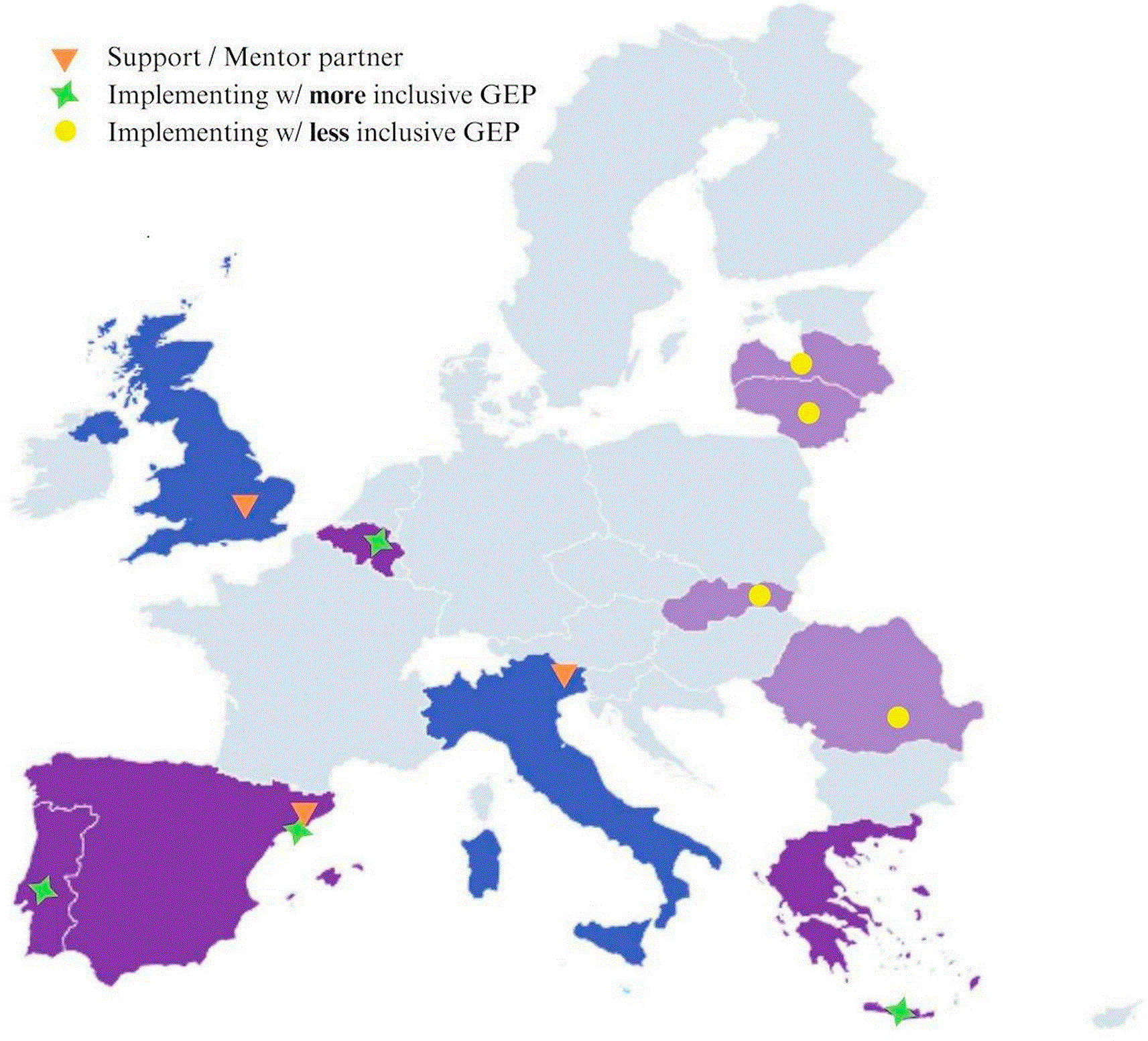
Figure 1. Participant Countries.
Table 1. Participant Organisations.
| Name | Country | Role |
|---|
| Smart Venice (SV) | Italy | Coordinator |
| University College London (UCL) | United Kingdom | Support/Mentor Partner |
| University of Hasselt (UH) | Belgium | Implementing institution |
| National Institute of Chemical Pharmaceutical Research & Development (ICCF) | Romania | Implementing institution |
| MEDIREX a.s. - MDX | Slovakai | Implementing institution |
| Institute of Molecular Biology and Biotechnology of the Foundation for Research and Technology Hellas (IMBB) | Greece | Implementing institution |
| PRISMA, Asociación para la diversidad afectivo-sexual y de género en Ciencia, Tecnología e Innovación | Spain | Non-Implementing institution/Support in communication, dissemination and impact |
| Vytauto Didžiojo universitetat Vytautas Magnus University (VMU) | Lithuania | Implementing institution |
| Riga Stradins University (RSU) | Latvia | Implementing institution |
| Barcelona Institute for Global Health (ISGlobal) | Spain | Implementing institution |
| University of Coimbra (UC) | Portugal | Implementing institution |
The project includes five interlocking objectives:
• Assessing existing GEPs and intersectional gaps;
• Co-developing inclusive pilot actions to strengthen GEPs;
• Building capacity via training and mentoring;
• Embedding intersectional and intersectoral change practices; and
• Sharing lessons to multiply impact.
The project includes the following Work Packages (WP):
• WP1: Project management and coordination;
• WP2: Analysis of inequalities and learning needs, good practices, and co-design of actions;
• WP3: Capacity-building, mentoring and mutual learning;
• WP4: Pilot actions implementation, evaluation and GEPs refinement;
• WP5: Communication, dissemination and impact.
This paper is based on the initial phase of the project (WP 2), namely first where RPOs and RTO shared their GEPs to enable an evaluation of their policies. Document analysis were conducted by partner organisation (UH) which resulted in a detailed analysis of existing GEPs, inclusion plans, Equity/Equality, Diversity, and Inclusion (EDI) plans and relevant institutional policies (e.g., HR policies, recruitment and promotion policies, work-life balance policies, anti-harassment policies). This was done to identify gaps, challenges and barriers in policies, structures, and practices that deepen inequalities in eight biomedical research institutions. For the development of the evaluation questions, several key resources were referred to, including the Horizon Europe Guidance for Gender Equality Plans, the Gender Equality in Academia and Research (GEAR) Tool, and prominent examples of gender equality and inclusion plans, such as the University of Oxford’s Equality, Diversity, and Inclusion Strategic Plan. This document was then open to feedback to all partners.
In the second stage of the WP, as University College London, we did a study presenting the most up-to-date available academic and practice-based knowledge on challenges and pathways to adopt an intersectional approach within institutional change processes within the BioMedical Research and Innovation (R&I) sector and Higher Education Institutions (HEI). Our study was based on desk research including SoA scholarly and gray literature, particularly investigating specific BioMedical discipline-focused literature on inequities and intersectional dimensions as well as good practice and strategies, not excluding any sector since currently, there is limited research and good practices including intersectional aspects in this sector. To this end, UCL conducted a systematic rapid review between February and March 2025 via internet using various sources including Google Scholar, PubMed, Science Direct, Scopus and Web of Science for the literature review. Given the complexity of intersectionality, where various forms of inequality including, but not limited to gender, race, ethnicity, disability, religion and socio-economic status intersect, we aim to use a structured, evidence-driven, and inclusive approach for identifying SoA literature and DEI practices. In order to set out a foundational framework, peer-reviewed journals including intersectionality in R&I and HEI were also reviewed.
In this review, particular attention was given to the literature that is fundamental for the concept of intersectionality and intersectional analysis focusing on the medical sector including biomedical R&I and HE. In addition, case studies evaluating the impact of intersectional policies and practices were analysed. The search terms included “intersectionality; intersectionality in medical and biomedical industry, good practices of organisations in intersectionality and Gender-based analysis plus (GBA+); diversity, equality and inclusion (DEI), good practices and tools collection on operationalising intersectionality in R&I and HEI and DEI; good/best practices guidelines; good/best practices tools and GEPs”.
In order to ensure the inclusion of the SoA literature, we primarily focused on studies published between 2019 and 2025 in the medical field, including biomedical science and institutions. However, we made exceptions for certain foundational works that remain essential for understanding the topic, particularly those addressing intersectional aspects. We selected the literature using inclusion and exclusion criteria, namely identification, screening, and eligibility. The focus was on medical and biomedical research and HEIs, using the search terms mentioned above to identify relevant studies.
3. Setting the context
Incorporating sex and gender analysis at all stages in research is widely recognised as essential for ensuring rigor, fostering innovation, and achieving high-quality outcomes (Schiebinger, 2021). In addition, intersectional analysis, beyond gender, enhances scientific, medical, and engineering progress by enriching knowledge production, fostering diverse research teams, and promoting inclusive, equitable solutions (Mosley et al., 2025; Bechtol et al. 2021). The existing academic literature on intersectionality within academia and research encompasses various dimensions of identity and social categorisation. Recent studies have examined such as the intersections of gender, race, ethnicity, age, disability, social class and other factors that contribute to marginalisation, including those shaped by colonisation (Rios, et al., 2016; Potter et al., 2019; Showunmi, 2020; Külcür et al., 2024; Mize, 2025). Other researchers have explored the influence of gender identity alongside affective and sexual orientation (Whitfield et al., 2021) and the experiences of individuals with disabilities (Brinkman et al. 2023; Bixby, 2024).
However, a systematic scoping review by Merone et al. (2022) revealed the persistent presence of gender disparities and misogynistic biases in current medical literature, highlighting the inadequate representation and analysis of sex and gender in biomedical research. Similarly, intersectional analyses have been lacking in many areas, including the biomedical sector. Tinner et al. (2023) found a significant gap in the use of theoretical and analytical intersectionality frameworks in the design and analysis of public health interventions. They conclude that only a limited number of studies have incorporated these frameworks, indicating the need for more comprehensive and inclusive research approaches. The following key challenges emerge from the literature review conducted across the medical and bioscience sectors, including research organisations (ROs) and higher education institutions (HEIs):
3.1 The gendered division of labour in medical research
The challenges in the biomedical research with regard to gender disparities include firstly the gendered division of labour, which impact career progression of women and other disadvantaged groups reducing leadership opportunities and their scientific contributions (WHO, 2021; Pérez-Sánchez et al., 2021; Das et al., 2024). Since historically women, minorities and other marginalised groups are underrepresented in science and scientific careers (Helman et al., 2020; Huang et al. 2020; Grandis, 2022; Reppel & Lenders, 2023; Newman et al., 2025), there remain gendered disparities including gender pay gaps (Wiler et al., 2022) and the gendered division of labour where these groups are mostly represented in low-paying job segments including in the medical industry (Abdellatif et al., 2019; Rivera-Romano et al., 2020; Rubio et al., 2023). Therefore, it is crucial to identify and address the barriers to career progression of marginalised groups including women in science that perpetuate existing inequalities and hinder professional advancement, as well as to uncover the structural obstacles that limit their access to leadership positions in scientific fields.
3.2 Lack of integration of intersectional perspectives in medical research
The integration of intersectional perspectives is essential for mitigating biases in basic and preclinical research, clinical trials, prevention, diagnosis, and treatment of both communicable and non-communicable diseases, medical technologies, and health policies, among others; ultimately fostering more equitable and effective healthcare solutions (Tannenbaum et al., 2019; Tinner, et al., 2023). For instance, research highlights that access to healthcare is heavily influenced by sociodemographic factors such as race, ethnicity, marital status, education and income, yet disparities affecting women, particularly women of colour, remain underexplored (Gomez et al., 2022).
Moreover, the underrepresentation of certain groups, particularly women and gender-diverse individuals, in clinical trials remains a persistent issue in medical research (Shankar et al., 2024; Porter et al., 2024; Daitch et al., 2022). This disparity not only distorts trial outcomes but also compromises the applicability of findings to broader populations. Tannenbaum et al. (2019) called for gender analysis to foster scientific discovery, improve experimental efficiency and enable social equality calling on researchers, funding agencies, peer-reviewed journals and universities to coordinate efforts to implement robust methods of sex and gender analysis. Shankar et al. (2024) highlight that the exclusion of pregnant women and gender-diverse individuals from research contributes to significant gaps in our understanding of how treatments affect these groups, limiting the generalisability of medical interventions. Similarly, Porter et al. (2024) emphasise that the underreporting of sex and gender differences in cardiovascular studies has led to insufficiently tailored treatments for women and gender-diverse individuals. Daitch et al. (2022) further demonstrate that women are consistently underrepresented in randomised controlled trials, undermining the development of effective healthcare solutions.
Brünig et al. (2024) conducted a systematic review on the use of intersectionality in bioethics, emphasising its potential to address complex ethical challenges in both clinical practice and public health. Their findings highlight how intersectionality helps account for the interconnected nature of social determinants, offering a more nuanced approach to ethical decision-making. Shankar et al. (2024) propose five actions to eliminate gender bias in biomedical research, namely developing mutually beneficial partnerships, prioritising interdisciplinary research, raising awareness about the importance of pharmaceutical innovation, conducting regulatory analyses, and advocating for responsible inclusion rather than presumptive exclusion. In addition, the literature review assessment by the Public Health Agency of Canada (2022) examined how intersectionality theory was integrated throughout studies that were explicitly designed to integrate intersectionality theory in their quantitative analysis of health inequalities. Based on the study’s findings, the Agency recommends more than 35 effective methods for incorporating intersectionality theory into quantitative research on health inequalities.
Therefore, incorporating intersectional analysis in biomedical research is essential for understanding how overlapping social identities and systemic inequalities influence health outcomes, thereby enhancing the precision and applicability of medical interventions (Holman et al., 2021; Mahendran et al., 2022). Integrating intersectionality into biomedical research requires acknowledging that health outcomes are shaped by the complex interactions of biological, social, and structural factors. Traditional biomedical approaches often examine individual variables in isolation, which may overlook the ways in which overlapping identities contribute to health disparities. Hankivsky et al. (2017a) suggest that incorporating intersectional approaches into biomedical research can provide a more comprehensive understanding of health inequities. By exploring how social hierarchies and power dynamics shape health outcomes, this approach moves beyond single-variable analyses to capture the complex factors contributing to disparities. Hankivsky et al. (2017) highlighted the limitations of traditional biomedical models in understanding and addressing the complexities of health disparities. They underline that integrating intersectional perspectives, considering factors such as gender, race, and socioeconomic status, can offer a more comprehensive understanding of health inequities. Their findings also suggest that adopting an intersectional approach alongside biomedical models is essential for creating more equitable health outcomes and addressing the root causes of health disparities.
A study by Figueroa et al. (2023) identified that systemic barriers disproportionately impact women from marginalised backgrounds, limiting their access to essential reproductive and preventive health services. For example, women with ethnic background or living in deprived areas were much less likely to receive hormone replacement therapy (HRT) compared to those in affluent regions, highlighting the influence of socioeconomic status or race on women’s health (Bryant et al., 2024). Husain et al. (2022) conducted a literature review examining how multiple disadvantages such as age, lower socioeconomic status, and limited English proficiency are conceptualised in the context of digital health consultations. Their findings indicate that while most studies highlight significant digital disparities, they often lack a robust theoretical framework. As a result, they concluded that existing solutions may be overly simplistic and fail to fully address the complexities of these intersecting challenges. On the other hand, Heard (2024) explored the role of intersectionality in health promotion, highlighting how overlapping social identities and systemic inequalities shape health outcomes. The paper examines theoretical foundations, practical applications, and the importance of integrating intersectional approaches into health behaviour and environmental health research. Therefore, recent literature is increasingly highlighting the importance of integrating intersectional gender approaches to effectively address complex healthcare challenges. For example, Arrivillaga et al. (2024) applied intersectionality as a methodological tool to enhance access to maternal and child health screening services. Their study highlights the interplay of social, cultural, and environmental determinants in healthcare delivery, demonstrating how an intersectional perspective can inform more equitable health interventions.
Thus, these studies show that an intersectional approach can provide a more comprehensive understanding of health disparities and the diverse challenges individuals face since people’s health and lived experiences are shaped not only by sex and gender but also by a complex interplay of social, economic, and structural factors, including race, class, culture, income, education, age, ability, sexual orientation, immigration status, ethnicity, indigeneity, and geographical location (Hankivsky et al., 2009; Underwood et al., 2025). These intersecting elements significantly influence access to healthcare, health outcomes, and overall well-being (Hankivsky & Christoffersen, 2008; Hankivsky et al., 2017). For example, Morin et al. (2021) revealed that a vast majority of research participants, over 20,000 people across 13 countries, reported a significant negative impact on their mental health due to COVID-19, with women and other vulnerable groups, such as ethnic minorities and LGBTIQ+ individuals, disproportionately affected by the increased caregiving responsibilities that contributed to their heightened struggles.
To explore existing gaps and strengths, the gender equality policies and plans of the partner organisations involved in the INCLUDE project were reviewed. The following sections summarise current practices and propose ways to strengthen and improve them.
3.3 How to enhance diversity, equity, and inclusion (DEI) in Medical Research and Higher Education institutions (HEIs)
Some literature such as Fehrenbacher and Patel (2020) provide examples of how to design a study’s methodology to adequately address intersectional research questions in quantitative and mixed methods research on health. Ghasemi et al. (2021) conducted a scoping review on applying intersectionality in designing and implementing health interventions, identifying key approaches, challenges, and best practices. They indicate that single or dual analytical categories, such as race and gender, offer limited explanatory power, emphasising the need for more comprehensive intersectional analyses in health research. According to them, the principles of “intersecting categories” and “power” were the most commonly considered in applying intersectionality, particularly during the stages of problem identification and the design and implementation of interventions. The findings indicate that the principle of “multilevel analysis” received comparatively less attention, with most interventions focused on the micro level rather than aiming for structural change. They also pointed out the lack of clarity in addressing key aspects of intersectionality, such as “reflexivity” and “social justice and equity,” highlighting gaps in the comprehensive application of these principles. On the other hand, the persistent misclassification of race as a biological rather than a social construct has been identified as a factor that exacerbates health disparities (Lancet, 2022).
Moreover, Schiebinger’s framework (2021) focuses on gendered innovations, emphasising how integrating gender analysis into research and innovation leads to more inclusive and effective outcomes. She highlights how overlooking gender can lead to biased research and missed opportunities, while incorporating gender perspectives can drive more accurate and socially beneficial advancements. Therefore, she suggested the following approaches:
• Fix the Numbers: Addressing gender imbalance by increasing women’s participation in science, technology, and innovation,
• Fix the Institutions: Reforming structures, policies, and cultures within research institutions to promote gender equity, and
• Fix the Knowledge: Applying gender analysis to research methods and content to improve scientific quality and innovation.
On the other side, Cox and Mole (2024) highlights the crucial role of diversity, equity, and inclusion (DEI) in advancing science and innovation, while recognising the ongoing efforts of higher education institutions to address these challenges. They build on Schiebinger’s framework by identifying five key questions to drive diversity, equity, and inclusion (DEI) in UK biosciences, namely
1. How to investigate gaps in the diversity of the students, researchers, and innovators within the biosciences?
2. How to ensure that those from marginalised groups are recruited into bioscience units?
3. How to ensure that all staff and students experience equal opportunities to succeed?
4. How to increase the inclusivity of funded research on bioscience topics to maximise impact on society?
5. How to encourage impactful change in DEI in the biosciences?
They argue that meaningful progress can be made in transforming bioscience institutions, policies, and research practices in alignment with Schiebinger’s model by addressing these issues collectively. They also argue for a systems perspective that integrates multidisciplinary approaches, engaging diverse stakeholders, and examining the interconnected factors shaping DEI in the biosciences rather than treating DEI issues in isolation. Cox and Mole (2024) highlight that by leveraging both qualitative and quantitative insights, institutions can better understand how interventions in one area, such as student recruitment can influence broader outcomes, ultimately fostering a more inclusive and dynamic scientific environment.
While Kelly et al. (2021) provide recommendations in incorporating intersectionality into knowledge translation theory in health research contexts, Brünig et al. (2024) conducted a systematic review to explore where and how the concept of intersectionality is applied in bioethical research. They also highlight that intersectionality in bioethical research helps make inequities visible, improve health data collection, and promote self-reflection and therefore help to move towards social justice in health care. Uttley et al. (2025), focusing on health and biomedical research, through a scoping review and content analysis, explored how research culture influences health and biomedical research. They identify key cultural factors, such as collaboration, integrity, incentives, and pressure, that shape research practices and outcomes. The findings emphasise the importance of implementing systemic changes to create a more ethical, transparent, and sustainable research environment. This includes fostering inclusivity within the scientific workforce, ensuring transparency in the data generated and maintaining rigorous research methods.
Love et al. (2022) explored the influence of gender diversity on scientific research teams, underlying that diverse teams can enhance creativity, collaboration, and innovation in research since gender diversity is associated with positive outcomes. They suggest that more research is needed to explore how to foster diverse teams effectively. They call for a broadening of research efforts to accelerate the integration of gender diversity in scientific teams and ensure it contributes to more inclusive and productive research environments. Moreover, Hattery et al. (2022) underlines the importance of diverse research teams for data integrity, discussing challenges in assembling and managing such teams, and presenting case studies that explore power dynamics related to race, gender, and rank within research collaborations. They also note that diversity should not be treated merely as a checklist but as an epistemological approach that includes positionality and power dynamics within research teams.
Conversely, intersectionality has also been explored in medical education curricula such as in terms of power and equity (Samra & Hankivsky, 2020); how intersectionality is understood and applied within medical education (Rehman et al., 2023); racist discrimination (Weßel, & Gerhards, 2023); analysis of sex and gender in medical education (Kariyawasam et al., 2025) and integrating diversity studies for medical students (Linde et al., 2025). Rehman et al. (2023) for example pointed out the challenges between theoretical discussions of intersectionality and its practical implementation in medical training. The studies emphasise the need for greater attention to core intersectional principles including “power dynamics, identity transformation, and reflexivity” in order to ensure a more inclusive and socially aware medical education system.
Moreover, research beyond the medical sector has explored ways to advance diversity and inclusion in higher education institutions (Barros et al. 2018; Codiroli Mcmaster & Cook, 2019; Jiménez Rodrigo, 2022; Naciti et al., 2024). Some research emphasises partnership and involvement in EU projects (Bencivenga, & Drew, 2021). According to Hankivsky (2025), in order to enhance research and policy effectiveness, a correct intersectional approach needs to be adopted clearly differentiating between gender and intersectionality and ensuring their meaningful application. This would also include moving beyond superficial or tokenistic uses of intersectionality that overlook underlying power dynamics.
4. Project roles and responsibilities within INCLUDE
Since INCLUDE aimes to develop and operationalise an intersectional approach to Gender Equality Plans (GEPs) within biomedical research and innovation (R&I) contexts, during the initial phase of the project (WP2), existing GEPs across partner institutions were reviewed to generate a comparative analytical mapping of inequalities and institutional gaps by an implementing partner (UH) (see Section 5). This work was complemented by a state-of-the-art (SoA) literature review conducted by UCL, focusing on inequities and intersectional dimensions in the medical sector, as well as identifying relevant good practices and strategic approaches (Section 3).
Building on these analytical foundations, a methodological framework and pilot actions compendium were developed. Through participatory co-design methods, a total of 40 pilot actions were collaboratively created, addressing gender inequalities in intersection with other grounds of discrimination. Methodologically, this phase combined policy analysis, qualitative institutional research, and participatory co-design into a replicable framework for operationalising intersectionality within GEPs in biomedical R&I settings. The resulting framework forms the basis for the INCLUDE Toolkit and supports knowledge exchange within the project’s Community of Practice (CoP) in subsequent phases.
In the following stage, co-design sessions were organised to develop concrete, context-specific pilot actions aimed at improving gender equality through an intersectional approach. This phase represented the first systematic translation of intersectionality into institutional practice, moving from diagnosis and analytical mapping towards operational change grounded in the evidence generated during the project’s initial phase. The task, led by UC, implemented by eight consortium partners: UH, ICCF, MDX, IMBB, VMU, RSU, ISGlobal, and UC. Across the consortium, 17 co-design sessions were conducted involving more than 200 participants and resulting in over 40 pilot actions, 29 of which were newly developed.
These efforts produced targeted GEP pilot measures, including bias-aware recruitment reviews (ICCF, UH), Codes of Conduct and Team Inclusion Charters (UC, UH), reporting and training mechanisms addressing discrimination and gender-based violence (ICCF, MDX, RSU), regular capacity-building initiatives on diversity and intersectionality (MDX, ISGlobal, VMU, UC), and actions promoting menstrual equity (IMBB; UC and ISGlobal). In addition, 22 existing GEP actions were revised to integrate an intersectional perspective, and at least three implementation challenges were identified per partner institution. Outputs from this phase were consolidated into a comprehensive pilot actions booklet alongside documentation of the co-design methodology.
Subsequently, activities under WP3 focused on strengthening institutional capacities to implement inclusive and intersectional GEPs through structured capacity-building, mutual learning, mentoring, and the establishment of a sustainable Community of Practice. A central component was the Train-the-Trainer (TtT) programme, which delivered three training rounds comprising six sessions designed to equip two to three staff members per partner institution with the knowledge and tools necessary to operationalise intersectionality in biomedical higher education and R&I environments. The programme followed a needs-based and evidence-informed design grounded in WP2 results, drawing on (1) the Mapping of Inequalities and GEPs and (2) a learning needs assessment questionnaire conducted during the project’s first phase. These inputs ensured alignment between training content and institutional capacities while maximising multiplier effects. Trained participants subsequently replicated the training within their institutions, resulting in 16 internal courses (two per partner) and reaching 145 participants in the first round and 146 in the second, broadly aligning with the project’s KPI target of 160 trained staff members. Training delivery was supported through materials and guidelines developed by SV.
Complementing these activities, Thematic Hubs were established to facilitate knowledge exchange across four thematic areas: Rethinking Diversity in Biomedical Research (led by ISGlobal), Intersectionality in Research and Institutional Change (led by UCL), Gender+ and Intersectionality in Biomedical Research (led by IMBB–FORTH), and Gender Budgeting (led by SV). Across these hubs, twelve knowledge-sharing sessions were conducted using participatory methodologies combining case-based discussions, practical exercises, and peer learning among research, administrative, equality, and management staff. The combination of online and hybrid formats enhanced accessibility, while in-person sessions strengthened interinstitutional dialogue.
In parallel, a mentoring programme will provide targeted support for GEP and pilot action implementation through six mentor–mentee pairings: VMU–UCL, Medirex–SV, RSU–UC, IMBB–UH, ISGlobal–UCL, and ICCF–PRISMA. These exchanges supported institutional learning and facilitated context-sensitive adaptation of intersectional approaches.
The following section presents a preliminary analysis based on the evaluation of the Gender Equality Plans and related policies of the partner organisations. These initial findings are important for establishing a baseline, informing the project’s strategic direction, and enabling an assessment of progress at its conclusion.
5. Analysis with regard to partner organisations
The review and comparative analysis of equality policies and inclusion frameworks across eight partner institutions revealed important developments, promising practices, and persistent structural gaps. The assessments show that while most institutions have taken significant steps toward embedding gender equality and inclusion in their organisational cultures, approaches vary widely in terms of depth, coverage, and institutional maturity.
5.1 Key areas of progress and institutional strengths
Policy infrastructure and formal commitment: Most institutions have adopted, or were in the process of developing, formal Gender Equality Plans (GEPs) or broader inclusion strategies. These frameworks demonstrate an emerging level of strategic orientation and institutional commitment to gender equality and diversity objectives. The presence of formalised policy instruments provides an important foundation for systematic action and accountability.
Recognition of structural barriers: Several institutions move beyond generic equality statements by explicitly acknowledging persistent structural barriers, such as glass ceiling effects, male-dominated governance structures, and gender imbalances in research leadership. This explicit recognition of systemic inequality represents a critical step toward the development of targeted measures, including affirmative actions and awareness-raising initiatives.
Diversity of training programmes: A number of institutions offer a broad range of training initiatives covering topics such as unconscious bias, inclusive communication, gender-sensitive recruitment practices, and leadership development for women. These programmes indicate a growing shift from declarative commitments toward capacity-building and organisational culture change.
Advances in inclusive communication: The development of inclusive communication guidelines and policies reflects increasing institutional awareness of bias in language, representation, and knowledge dissemination. Greater attention is also being paid to visual representation, accessibility, and inclusivity in digital, educational, and outreach materials.
Support for work–life balance: Most institutions have introduced measures to support work–life balance, including flexible working arrangements, parental leave provisions, and hybrid work models. In several cases, these policies are supported by more comprehensive approaches to employee wellbeing and care responsibilities, indicating progressive practice in this area.
5.2 Key institutional gaps and areas requiring further development
Limited application of an intersectional perspective: An intersectional perspective seems to be insufficiently embedded across most institutions. Although some policy documents refer to diversity and multiple forms of disadvantage, practical implementation typically remains centred on binary gender categories. For example, in one of the GEP 2021–2025 document states:
• “To raise awareness within the University’s community and in the society in general by communicating the importance of equal opportunities and gender equality, diversity and anti-discrimination policy (with regard to gender, race, age, ethnic group, religion and/or faith, (dis) ability, sexual orientation and gender identity, beliefs)”;
• “To raise awareness and enhance anti-discriminatory principles (with regard to gender, race, age, ethnic group, religion and/or faith, (dis) ability, sexual orientation, gender identity, beliefs).”
The GEP 2021–2025 indicates a broad rhetorical commitment to equality, diversity, and anti-discrimination by repeatedly listing multiple protected characteristics; however, from an intersectional perspective, this approach remains largely declarative rather than operational. The emphasis on “raising awareness” and “enhancing principles” suggests a normative and communicative strategy, but it lacks methodological guidance, measurable targets, or accountability mechanisms that would enable the institution to identify and address compounded inequalities in practice. There is no clear indication of intersectional data collection, differentiated indicators, or tailored interventions for groups experiencing overlapping marginalisation, which limits the plan’s practical impact. Consequently, while the language appears inclusive, the absence of operational tools and evaluative frameworks renders the intersectional dimension largely symbolic rather than meaningfully embedded in policy implementation.
Compliance-focused rather than transformative approaches: Many existing policies adopt a primarily procedural or compliance-driven approach rather than pursuing structural or cultural change. While recruitment and leadership frameworks commonly include non-discrimination clauses, relatively few institutions implement proactive measures, such as targets, quotas, or structured progression pathways, designed to address entrenched inequalities in a systematic way.
Data gaps and inconsistent monitoring practices: Gender-disaggregated data, usually in binary form, is often collected, but it is not consistently monitored or analysed in a systematic way. Monitoring activities tend to focus on outputs, such as the number of training sessions delivered, rather than outcomes, such as changes in leadership diversity or organisational climate. Intersectional data is largely absent. In many cases, evaluation processes are further constrained by limited staff capacity, lack of specialised expertise, and unclear responsibility structures.
Insufficient accountability and limited transparency: Evaluation findings are seldom published or broadly communicated within institutions, which limits organisational learning and stakeholder engagement. Staff members are often unaware of monitoring results or subsequent adjustments to policies and measures. Clear lines of accountability are frequently missing, and responsibility for implementation is not always well defined. Where planned actions are not carried out, enforcement mechanisms or consequence frameworks are rarely specified.
Weak implementation of measures addressing harassment and misconduct: In several institutions, formal policies and operational procedures to prevent and address harassment and misconduct remain underdeveloped. Gaps include the absence of dedicated anti-harassment policies, confidential reporting channels, and structured support mechanisms for affected individuals. Even where protocols are in place, implementation often lacks transparency, survivor-centred design, and institutional accountability.
Limited use of mandatory training: Mandatory training on equality, diversity, and inclusion-related topics remains the exception rather than standard practice. This makes it difficult to assess baseline awareness and competence levels among researchers, leadership, and administrative staff, and limits the overall reach and effectiveness of capacity-building efforts.
Weak integration with core institutional strategies: Gender equality and inclusion plans are often not sufficiently embedded within broader institutional strategy and governance frameworks, such as budgeting processes, performance evaluation systems, risk management, or institutional development plans. This lack of integration reduces both the sustainability and the long-term impact of these initiatives.
6. Conclusions
This paper draws on the initial phase of the INCLUDE project, outlining the steps taken to implement the project and presenting insights from the preliminary analysis of GEPs. Given the gap in the literature regarding how partnership models can be systematically designed to operationalise intersectionality within higher education and medical research settings, this paper responds by providing a practical framework and guiding approach for their development and implementation.
The next project phase focuses on evaluating pilot actions to support evidence-based refinement of GEPs and institutional measures. The Monitoring and Evaluation (M&E) framework integrates approaches from previous projects on GEP evaluation and institutional change, including EFFORTI, CALIPER, and NEXUS, alongside Programme Theory and the EIGE GEAR Toolkit. The methodology defines SMART objectives aligned with pilot action goals and establishes shared quantitative and qualitative indicators to assess progress toward gender equality and intersectional inclusivity.
While the integration of intersectionality into medical research and innovation (R&I) offers significant benefits, it also presents challenges. These include difficulties in capturing the complexity of intersecting identities in research designs (Hankivsky & Christoffersen, 2008) and potential resistance from traditional medical frameworks (Kelly et al., 2021). Beyond intersectional aspects, when promoting inclusive Gender Equality Plans, it is also important to consider intersectoral and national/geographic differences as well as local institutional and cultural contexts (EU, 2021; Chaves & Benschop, 2023). Currently, monitoring and evaluation activities are ongoing, with results to be reported in a subsequent publication following project completion in November 2026.
Ethics and consent
Ethical approval and informed consent were not required for this study, as it did not involve the collection or analysis of data from human participants, identifiable personal information, or other personal data