1. Introduction
The process of Western European integration became an important point of reference for Central and Eastern European countries in the course of their democratic transformation. This observation applies to both the opinions expressed by political elites and those of society. Democratisation itself was described in 1989 by the first non-communist prime minister in Central and Eastern Europe Tadeusz Mazowiecki as a ‘return to Europe’. Although its essence was understood in different ways, this process was unequivocally viewed as positive – integration with European communities/the European Union was widely believed to ensure economic prosperity. Only the post-communist parties - Democratic Left Alliance (Sojusz Lewicy Demokratycznej, SLD) and the Polish People’s Party (Polskie Stronnictwo Ludowe, PSL) - were somewhat sceptical at the beginning of the transformation; however, due to their isolation at the parliamentary level, their position at the time had no political significance. It is also worth noting that European issues were of marginal importance in political discourse in the early 1990s, and that post-communist parties soon revised their positions in this regard (Sula, 2005).
The opinions of Polish political parties on the European Union varied as work on Poland’s accession to the EU progressed. As a result, after the 2001 parliamentary elections, the representation of Eurosceptics in the Sejm was relatively large and diverse, including the League of Polish Families (Liga Polskich Rodzin - LPR), PSL, Law and Justice (Prawo i Sprawiedliwość - PiS) and Self-Defence (Samoobrona - S). However, the majority in the parliament was gained by pro-European parties (Civic Platform - Platforma Obywatelska; PO and SLD). The electoral success of these parties cannot be attributed to their pro-European stance; European issues played a secondary role in the election campaign at that time.
The data in the
Figure 1 show that the majority of Polish society consistently supported Poland’s membership in the European Union. The growing role of Eurosceptic parties on the eve of Poland’s accession to the European Union was accompanied by a decline in pro-European attitudes among the public. Yet, as it turned out, all the myths built on pre-accession fears disappeared in 2004 and the following years, when it became clear that the balance sheet of Poland’s membership in the EU was unequivocally positive.
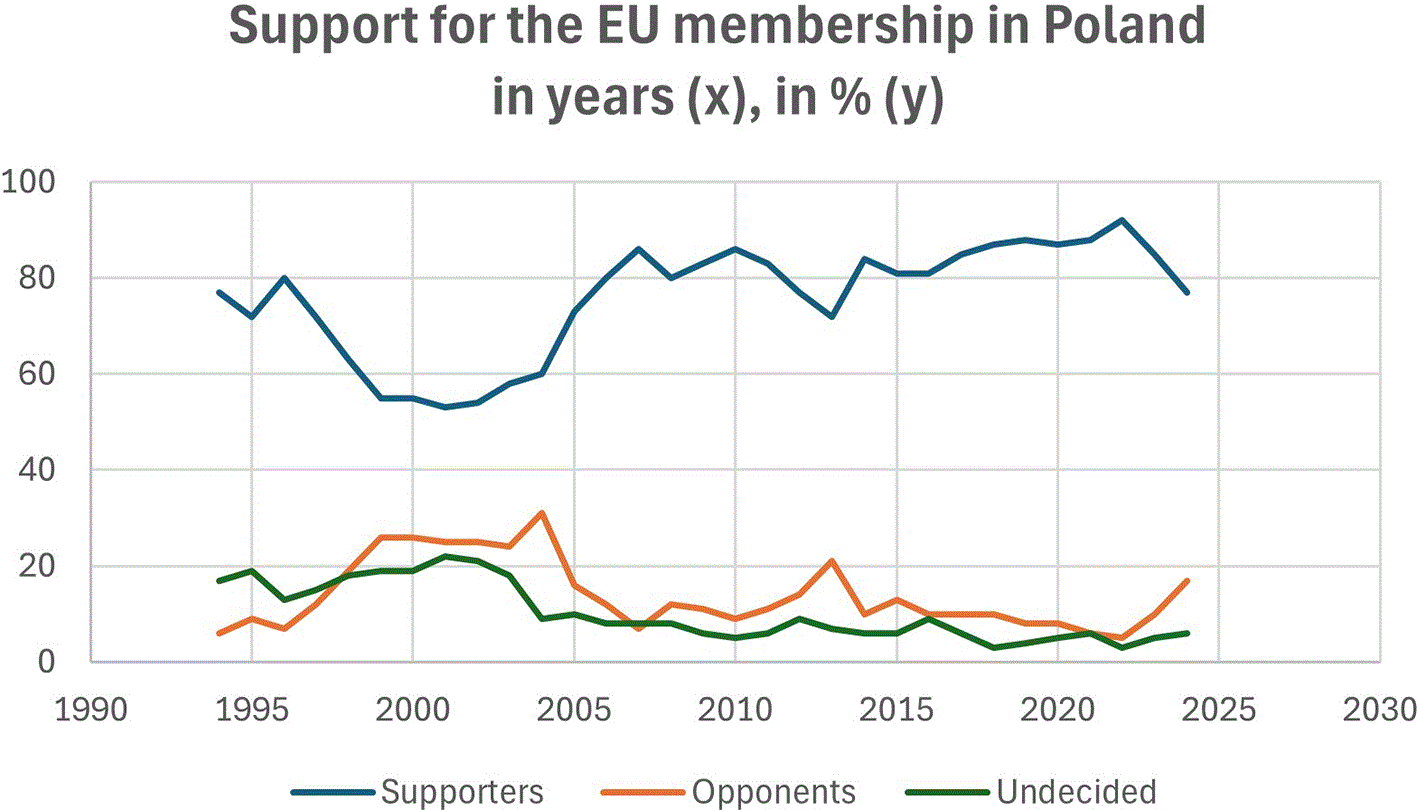
Figure 1. ‘Support for EU membership in Poland’, illustrates the level of public support (%, Y-axis) over time (1994–2024, X-axis).
This strongly pro-European stance of Polish society posed a challenge to the radical right-wing parties that were in power between 2015 and 2023. Public pressure, combined with the European Union’s unyielding stance on respect for the rule of law in Poland, led the governing majority to abandon some of the mechanisms aimed at politicising the judiciary (Sitnicka, 2022; Woźnicki, 2021).
The present country report was prepared as part of the EUPopLink COST Action (Andreadis & Vasilopoulou, 2026) following the EUPopLink Theoretical Framework and guidelines (Lorimer et al., 2026).
2. Populist political actors
In this section, I will characterise individual populist parties in chronological order, beginning with those that were once relevant but have since become marginalised. I will then present the populist political parties active in 2025, both within and outside the parliamentary arena.
The first populist party in Poland to emerge after the fall of the communist regime was Party X. It was founded by Stanisław Tymiński. Another populist party, Samoobrona (founded in 1992; originally a trade union of the same name) achieved significantly greater success. The populism of this party was manifested in emphasising the dichotomy between the elites who had been in power until then and the ordinary people represented by this party (Stanley & Cześnik, 2019). It is worth adding that the party was an advocate of the rural areas and its inhabitants (not only farmers but also all those who could have been recognised as losers of political transformation).
The League of Polish Families (founded in 2001) could also be considered populist. The populism of this group was built around the conflict between Polish Catholics who opposed the vision of a secular Europe promoted by the European Union (Zuba, 2017).
Another populist political actor was the Kukiz‘15 group (formally operating as an association), founded by rock star Paweł Kukiz following his electoral success in the 2015 presidential race. The primary goal of the leader of Kukiz‘15 was to combat the so-called ‘partyocracy’, which, according to him, consisted of political parties dominating decision-making processes without being subject to control by voters (lack of accountability). Kukiz‘15 won 9% of the seats in 2015. In the 2019 parliamentary elections, Kukiz’15 candidates were elected to the Sejm from the PSL lists. In the following years, the group established cooperation with PiS, and its role was marginalised (Stanley & Cześnik, 2019).
Of the parties described above, only S and LPR were members of a governing coalition — they formed a government with PiS between 2006 and 2007. However, after the 2007 elections, they lost their parliamentary representation and political significance.
Currently, populist parties represented in the national parliament include right-wing groups (PiS and Solidarna Polska) and radical right-wing parties (Confederation Liberty and Independence - Konfederacja Wolność i Niepodległość, Confederation of the Polish Crown - Konfederacja Korony Polskiej). Certain elements of populist rhetoric are also used by the left-wing party Razem in its criticism of large corporations and state policy, which for years has been more favourable to representatives of private business than to ordinary people (for example, in housing policy).
The party that is gaining increasing support among voters in polls is the Confederation Liberty and Independence. This party was established in 2019 and was entered into the register of political parties under the name Confederation Liberty and Independence. Its founders were politicians previously associated with several other political groups – KORWiN (since 29 November 2022, New Hope), the National Movement and Grzegorz Braun’s Pobudka (since 2020, the Confederation of the Polish Crown). Grzegorz Braun was expelled from the party on 17 January 2025, the day after he announced his candidacy in the presidential election, in which most of the Confederation’s leaders decided to support Sławomir Mentzen (Sula et al., 2025).
This party can be described as populist radical right-wing. It combines anti-immigrant rhetoric with support for an extremely liberal state.
On the international stage, the party cooperates for instance with the AFD in the European Parliament as part of the Europe of Sovereign Nations group. Two activists from this party have joined the Patriots for Europe group in the European Parliament.
Confederation Liberty and Independence is a federation of parties, among which the Confederation of the Polish Crown has been enjoying growing support in public opinion polls. This latter party was established in 2019 and officially registered in 2020 (
Konfederacja Korony Polskiej, n.d.).
Grzegorz Braun’s activity is not only verbal (promoting anti-Semitic, anti-Ukrainian, pro-Russian slogans, spreading conspiracy theories and denying the existence of gas chambers in the Auschwitz concentration camp), but is also manifested in actions such as burning the EU flag or physically obstructing a gynecologist who performed a legal abortion (Piedziuk & Szacki, 2025). Due to the charges brought against him, the Prosecutor General submitted a request to the European Parliament to lift Braun’s immunity. The European Parliament decided to lift his immunity on 13 November 2025 (Bromber, 2025). In the European Parliament, Grzegorz Braun - his party’s sole representative - is not affiliated with any political group.
PiS is the most relevant populist party in Poland. It was founded in 2001 by politicians who had been involved in party politics since the very beginning of the country’s democratic transition—initially within the Centre Agreement (Porozumienie Centrum), and later as part of the Solidarity Electoral Action (Akcja Wyborcza Solidarność) (Sula, 2011, p. 54).
From the very beginning of its existence, PiS had a conservative character. Initially, the party emphasised the need for decommunisation, but above all, the fight against corruption (Millard, 2009, p. 191; Stanley & Cześnik, 2019, p. 72).
Before the 2005 parliamentary elections, the party began promoting the need to build a Fourth Republic, which would be free from corruption and all the problems and pathologies on which the Third Republic, established after 1989, was built. In the PiS narrative, the negotiated transition guaranteed power to the post-communist elites (Millard, 2009, pp. 14, 127). In the European Parliament, PiS is a member of the European Conservatives and Reformists (ECR) group (with Brothers of Italy among others).
For years, PiS has closely cooperated with another right-wing and populist group, Sovereign Poland (Suwerenna Polska – SP), which operated under the name Solidarna Polska until 2023. The latter was founded by secessionists from PiS caused by internal conflict. However, programmatic proximity overcame the temporary hostility, enabling PiS and SP to cooperate closely once again.
3. Positions on ‘Europe’ and the populism-euroscepticism nexus
As I suggested above, the Euroscepticism of Polish parliamentary groups was varied. Before Poland joined the EU the core of Euroscepticism could be summarised along two main dimensions. The first (economic) emphasised the need to take a critical view of the European integration process, as it could threaten Poland’s economic interests. In this case, it was not a matter of denying a specific feature of the EU, but of the need to guarantee the primacy of Poland’s interests, which may even be difficult to consider Euroscepticism, as the criticism was not directed at the structure of the EU or any of its sectoral policies. This perception of the problem of European integration was characteristic of PiS, PSL and Samoobrona. These parties raised issues of cultural threats to a much lesser extent, with PiS doing so most frequently among them). This perspective was almost monopolised by the LPR. Politicians from this group were opposed to Poland’s membership in the EU, believing that it could force the secularisation of Polish society.
It can be assumed that, of the parties mentioned, the LPR was the most radical towards the EU, but also the most consistent in its views – both before and after Poland’s accession to the EU, the LPR was opposed to membership. The LPR’s activities were inconsistent with its proclaimed slogans – despite its opposition to the EU, it competed in the European elections, and then the deputies representing it participated in the work of the European Parliament (Sula, 2005).
It seems that the rivalry between PSL and Samoobrona, which are primarily seeking the support of the rural electorate, can be considered a specific feature of Polish Euroscepticism. The emergence of Samoobrona and its success in taking over the rural electorate from the PSL can be explained by Samoobrona’s skilful use of anti-European rhetoric. The PSL, wanting to secure its support among rural residents, also had to saturate its political appeal with anti-European themes. This was at a time when the PSL, as a member of the government coalition since 2001, was jointly responsible for the final stage of work on Poland’s accession to the European Union (Sula, 2021, p. 775).
After 2004, the division between pro-European left- and centre-wing parties and right-wing parties that are sceptical (to varying degrees) about European integration has remained virtually unchanged. Enthusiastic about the European Union are PO, PSL and the Left (Lewica). In the Eurosceptic camp are PiS, SP, Confederation Liberty and Independence, and the Confederation of the Polish Crown.
Among all the Eurosceptic parties, PiS is currently the least radical (soft Euroscepticism). The party criticises the European Union on a general level, claiming that the current scope and depth of European integration pose a threat to the sovereignty of nation-states. This narrative was particularly prominent during the conflict between the PiS-led government and the European Commission.
This conflict appeared in 2015 at the beginning of the PiS government as a result of the party’s actions aimed at limiting the independence of the Constitutional Tribunal and the Prosecutor General’s Office. In response to this attack on the rule of law, the European Commission initiated the Article 7 procedure, which could result in the suspension of Poland’s voting rights in the Council of the European Union (Csehi & Zgut, 2021, p. 61; Pankowska, 2018). The procedure was finally terminated in May 2024 after the Polish Minister of Justice presented the Action Plan for restoring the rule of law.
During the conflict with the European institutions some differences in the approach of SP and PiS emerged; the former party was against any concessions with the EU institutions regarding the judiciary reforms implemented in Poland.
In general, the Euroscepticism in Poland is represented by the parties that completely reject European integration (the Confederation of the Polish Crown) and those that criticise the EU’s ambitions to include too many sectoral policies within the Community framework (PiS and SP). For the latter, the ideal would be a Europe of homelands – an organisation with relatively limited competences. Confederation Liberty and Independence’s Euroscepticism can be called the hard one. According to the party’s activists, Poland should leave the European Union, although they believe this process should take place in the future rather than immediately. Grzegorz Braun, leader of the Confederation of the Polish Crown, holds a different view. He believes that Poland should leave the European Union (which he refers to as the “eurokolkhoz”) as soon as possible. As mentioned earlier, he demonstrates his hostility toward the EU through actions such as burning its flag.
The narrative on the European Union presented by all Eurosceptic parties in Poland has a clear populist character, boiling down to the construction of a dichotomous picture of reality – on one side there is the European Union, and on the other there are the Polish Eurosceptic elites who want to defend Polish identity and economic interests.
It is worth noting that Polish Eurosceptic parties have been able to find reasons to criticise the European Union in almost every context. To illustrate this opinion, one can mention, for example, Brexit, which was commented on by Eurosceptics as proof that the European Union required profound reforms. The pandemic and the response to this global crisis were also reasons for Eurosceptics to criticise the EU. PiS politicians argued that nation states were able to organise vaccines much more quickly, which in their opinion was proof that the European Union was not functioning effectively in yet another area. Also, with regard to relations with the US, Polish Eurosceptic parties expressed their satisfaction with Donald Trump’s re-election as president. They claimed that the US-Polish relations are more important than the collaboration within the European Union, and that the ties with the US could be strengthened under Trump's leadership. However, the strangest thing about the narrative of all Polish Eurosceptics, including PiS, in the context of the ongoing war in Ukraine is their repeated assertion that the greatest threat to Polish sovereignty and identity comes from Western European countries (primarily Germany) and the European Union.
4. Responses to euroscepticism and consequences
The Euroscepticism of the Polish populist parties forming the governing coalition in 2015–2023 made European issues more salient than ever in political discourse. The blocking of European funds prompted Polish Eurosceptic parties to criticise the EU not only for allegedly undermining Poland’s sovereignty but also for worsening the country’s economic situation. Given the high level of public support for Poland’s EU membership, pro-European parties were able to adopt a confrontational strategy towards Eurosceptics. Referring to B. Meguid’s proposal (Meguid, 2008, p. 348), this strategy can be considered adversarial, though with some reservation: regarding the migration pact, the stance of the pro-European PO was rather accommodative, as the party’s opposition to the relocation of migrants resembled that of PiS.
The situation of the opposition at that time was exceptional, as it could count on significant mobilisation from non-governmental organisations and a large part of society protesting against the ruling party’s violations of the law and breaches of democratic standards.
Polish NGOs sought to raise awareness of rule-of-law issues both domestically - through public protests and reports - and internationally, as demonstrations in Poland received wide coverage in global media. They also contributed directly to the European Commission’s Rule of Law Reports by submitting analyses and documentation (Citizens Network Watchdog Poland et al., 2022).
The most prominent and publicly visible organisation was the Committee for the Defence of Democracy (Komitet Obrony Demokracji, KOD). However, several other organisations were also highly active, including Citizens of the Republic of Poland (Obywatele RP), Democracy Action (Akcja Demokracja), and the Polish Women’s Strike (Strajk Kobiet), as well as lawyers’ organisations e.g. Free Courts (Wolne Sądy).
5. Short conclusion
Previous research on the relationship between Euroscepticism and populism in Poland (Styczyńska & Meijer, 2024) has shown that the more frequently parties use populist rhetoric, the more likely they are to express negative attitudes towards the European Union. This relationship seems to be a common feature of all European populist parties. In the Polish case, European issues have been weaponised, emphasising a dichotomy between the European elites and the Polish ‘pure’ people.
In the narrative of populist Eurosceptics (PiS and SP), Poland is portrayed as the defender of Christian Europe and traditional family values, while the European Union is depicted as secularised and detached from its cultural identity. The Euroscepticism of PiS and SP can be recognised as soft, whereas that of the Confederation of the Polish Crown is hard, as the latter openly advocates for Poland’s withdrawal from the EU.
In comparison with Eurosceptic parties in Western Europe, one genuinely peculiar feature of Polish Eurosceptics is their emphasis on ties to the Catholic Church (with the partial exception of the Confederation; its politicians, however, are likewise close to Catholic teaching in axiological terms, particularly in their opposition to abortion). In the context of rhetoric stressing the need to defend traditional Polish values against a secularised Europe, this alliance with the Catholic Church appears logical.
Ethics and consent
Ethical approval and consent were not required.
Bibliography
- Andreadis I, Vasilopoulou S:
The populism-euroscepticism nexus in a contested Europe: The EUPopLink COST Action [version 1; peer review: 3 approved].
Open Res. Eur.
2026; 6(27). Publisher Full Text
- Bromber E:
Parlament Europejski uchylił immunitet europosła Grzegorza Brauna.
Gazeta Wyborcza.
2025, November 13.
Reference Source
- Centrum Badania Opinii Społecznej:
Poparcie dla integracji polski z unią europejską.
Komunikat z badań.
2002a. BS/13/2002.
Reference Source
- Centrum Badania Opinii Społecznej:
Poziom poparcia dla integracji z Unią Europejską przed szczytem w Kopenhadze.
Komunikat z badań.
2002b. BS/206/2002.
Reference Source
- Centrum Badania Opinii Społecznej:
Pierwsze oceny skutków członkostwa polski w Unii Europejskiej.
Komunikat z badań.
2004.
Reference Source
- Centrum Badania Opinii Społecznej:
Bilans czterech lat integracji polski z unią europejską.
Komunikat z badań.
2008.
Reference Source
- Centrum Badania Opinii Społecznej:
Siedem lat obecności w Unii Europejskiej.2011. BS/52/2011.
Reference Source
- Centrum Badania Opinii Społecznej:
10 lat członkostwa Polski w Unii Europejskiej.
Komunikat z badań.
2014.
Reference Source
- Centrum Badania Opinii Społecznej:
Polska w Unii Europejskiej.
Komunikat z badań.
2016.
Reference Source
- Centrum Badania Opinii Społecznej:
20 lat członkostwa Polski w UE.
Komunikat z badań.
2024.
Reference Source
- Citizens Network Watchdog Poland, Helsinki Foundation for Human Rights, Institute for Public Affairs, National Federation of Polish NGOs, & Stefan Batory Foundation:
Poland. Rule of law report for 2021. Submitted in public consultations on January 24th, 2022 by civil society organisations.2022.
Reference Source
- Csehi R, Zgut E:
‘We won’t let Brussels dictate us’: Eurosceptic populism in Hungary and Poland.
Eur. Politics Soc.
2021; 22(1): 53–68. Publisher Full Text
- Konfederacja Korony Polskiej:
Historia Partii.n.d. Retrieved July 30, 2025.
Reference Source
- Lorimer M, Roch J, van Kessel S :
Populism, euroscepticism, and the populism-euroscepticism nexus [version 1; peer review: awaiting peer review].
Open Res. Eur.
2026; 6(73). Publisher Full Text
- Meguid BM:
Party Competition between Unequals: Strategies and Electoral Fortunes in Western Europe.
Cambridge University Press;
2008.
- Millard F:
Democratic elections in Poland, 1991-2007.
Democratic Elections in Poland, 1991–2007.
Routledge;
2009.
- Pankowska M:
Czystka Zbigniewa Ziobry. Porażający obraz polskiej prokuratury po 2016 roku [RAPORT].2018.
Reference Source
- Piedziuk M, Szacki W:
Grzegorz Braun i wirus Korony. Karmi się strachem, znalazł niszę, w której się urządził.
Polityka.
2025, July 24.
Reference Source
- Sitnicka D:
Sejm przegłosował ustawę o likwidacji Izby Dyscyplinarnej
Targi PiS z ziobrystami trwały do ostatniej chwili.
OKO Press;
2022, May 26.
Reference Source
- Stanley B, Cześnik M:
Populism in Poland.Stockemer D, editor.
Populism Around the World: A Comparative Perspective.
Cham:
Springer;
2019; pp. 67–87. Publisher Full Text
- Styczyńska N, Meijer JD:
The ‘pure polish people’ vs the ‘European elite’ – how do populism and Euroscepticism interact in Polish politics?
J. Contemp. Eur. Stud.
2024; 32: 1033–1046. Publisher Full Text
- Sula P:
Euro-scepticism in the party system of Poland.Dančák B, Fiala P, Hloušek V, editors.
Evropeizace. Nové téma politologického výzkumu.
Masarykova univerzita v Brně;
2005.
- Sula P:
From movements to institutions? The twenty-year history of political parties in new democracies in Central and Eastern Europe.Dobek - Ostrowska B, Głowacki M, editors.
Making Democracy in 20 Years. Media and Politics in Central and Eastern Europe.
Wydawnictwo Uniwersytetu Wrocławskiego;
2011.
- Sula P:
Diligent or just smart students? Small governmental parties’ approach to the European Semester in Poland.
Polit. Cent. Eur.
2021; 17(4): 773–790. Publisher Full Text
- Sula P:
Support for the EU membership in Poland (on the basis of CBOS).
Uniwersytet Wrocławski;
2026. Publisher Full Text
- Sula P, Błaszczyński K, Kuś Michał.:
Paper under review.
Xxx.
2025.
- Woźnicki Ł:
Trybunał Przyłębskiej kontra Trybunał Unii. Co wydarzyło się w ostatnich dniach wokół sądownictwa.2021, July 15.
Reference Source
- Zuba K:
From fringe to fringe: the shift from the clericalist League of Polish Families to the anticlericalist Palikot Movement 2001–2015.
Relig. State Soc.
2017; 45(2): 87–105. Publisher Full Text