1. Introduction
In recent decades, galleries, libraries, archives, and museums (GLAMs) have undergone significant transformations in response to growing societal demands for inclusivity, participation, and democratisation. Increasingly, cultural institutions have moved away from traditional hierarchical models of knowledge production and cultural mediation toward more participatory approaches that actively involve communities in the creation, interpretation, and stewardship of cultural resources (
European Commission, 2023; Campolmi, 2016). Within this broader transformation, co-curation has emerged as a particularly significant practice through which curatorial authority is shared with non-professional actors, enabling citizens and communities to participate directly in cultural production and decision-making processes.
The growing interest in co-curation reflects a broader shift in the understanding of cultural participation. Rather than conceiving audiences as passive consumers of cultural content, contemporary approaches increasingly recognise citizens as active contributors to the creation of cultural value and meaning (Reilly, 2019; Thiel, 2018). Through collaborative processes involving artists, curators, institutions, and communities, co-curation challenges traditional distinctions between cultural producers and consumers, creating opportunities for collective authorship, shared responsibility, and democratic engagement. Such developments align with broader calls for cultural democracy, which emphasise expanding individuals’ capabilities to participate in cultural life, shape cultural production, and influence decisions affecting their communities (Wilson et al., 2017).
These developments resonate strongly with debates surrounding the commons and commoning. Commoning refers to the collective stewardship and governance of shared resources through processes of participation, cooperation, and mutual responsibility (Ostrom, 1990; Bollier & Helfrich, 2015). Beyond resource management, commoning has also been conceptualised as a transformative political practice through which citizens collectively organise social relations and challenge dominant institutional arrangements (Kioupkiolis, 2019). Although commons scholarship initially focused on natural resources, recent studies have extended these ideas to cultural production, emphasising how cultural resources can be collectively created, maintained, and governed by communities rather than exclusively controlled by institutions or experts (Borchi, 2018; Mollona, 2021). Viewed through this lens, co-curation can be understood not merely as a participatory methodology but as a form of commoning through which cultural production becomes collectively organised, negotiated, and stewarded.
Understanding co-curation as commoning shifts attention from participation as a procedural outcome to participation as an ongoing process of collective stewardship. Communities are no longer positioned as audiences or beneficiaries but as active contributors to the creation, interpretation, and governance of cultural resources. In this sense, co-curation represents one of the most advanced forms of cultural participation because it redistributes curatorial authority while enabling citizens to contribute directly to decisions concerning artistic production and public cultural life.
Yet participation and commoning do not emerge automatically through the redistribution of authority. Collaborative cultural production requires continuous relational work capable of sustaining dialogue, managing differences, building trust, maintaining engagement, and negotiating competing expectations over time. For this reason, the concept of care provides a particularly valuable theoretical lens to understand the dynamics of co-curation. Care ethics emphasises the relational, affective, and material practices necessary to sustain collective action and social cooperation (Fisher & Tronto, 1990; Tronto, 2013a; de la Bellacasa, 2017, 2011). When commoning highlights collective governance and shared responsibility, the concept of care directs attention to the relationships, practices, and infrastructures that make such governance possible in everyday settings while taking into account the power relations in a participatory context of cultural production.
Bringing together commons theory and care ethics offers a fruitful perspective for understanding contemporary transformations in cultural production. While commoning directs attention to collective stewardship and participatory governance, care highlights the often-invisible work required to sustain participation over time. Together, these perspectives move beyond procedural accounts of participation and provide a richer understanding of how inclusive cultural practices are created, maintained, and negotiated. Co-curation, thus, becomes not simply a method of involving communities in artistic projects but a relational process through which cultural resources, responsibilities, and decision-making capacities are collectively shared and sustained.
Despite growing interest in participatory cultural practices, existing research offers only a limited understanding of how collaborative cultural production is sustained in practice. Studies on co-curation have primarily focused on participation, representation, audience engagement, and institutional transformation, mostly examining co-curational practices within institutionalised settings like art centres, galleries or museums (Riding, 2024; Craik-Hyde, 2023; Nikonanou & Misirloglou, 2023; Westwater, 2021). Commons scholarship has concentrated on questions of collective governance and resource stewardship, while care scholarship has examined the relational and material dimensions of collective action. However, these bodies of literature have rarely been brought together to explain how collaborative cultural projects in the visual arts sector are collectively organised, maintained, and negotiated over time in the public space outside the traditional art institutional setting. As a result, the relational infrastructures that enable co-curation to function as a form of commoning remain insufficiently understood. Empirical studies examining how care practices support commoning processes within visual arts initiatives remain particularly scarce.
This paper addresses this gap by examining co-curation as a form of care-based commoning. Drawing on Tronto’s (2013a, 2013b, 1993) ethics of care and Puig de la Bellacasa’s (2017) work on matters of care, the study investigates how collaborative practices between artists, mediators, citizen patrons, and local communities are organised and sustained within the New Patrons (Les Nouveaux Commanditaires) initiative. The New Patrons model provides a particularly relevant empirical setting because it enables citizens to commission artworks addressing collectively identified social concerns through collaborative processes involving artists, mediators, public authorities, and communities.
Based on an in-depth qualitative analysis of 24 semi-structured interviews conducted with mediators, artists and citizens across two European countries (France and Italy), this study explores how co-curation practices foster inclusivity, shared responsibility, and the democratisation of cultural production. More specifically, the paper seeks to answer the research question, how are collaborative forms of cultural production governed and sustained within co-curation processes in the visual arts?
By doing so, the paper contributes to the literature in three ways. First, it advances understanding of co-curation by examining the relational mechanisms through which collaborative cultural production is sustained in participatory visual art production. Second, it extends commons literature by showing how commoning processes operate within artistic and cultural contexts. Third, it contributes to care scholarship by demonstrating how care functions not only as an ethical orientation but also as a practical infrastructure enabling collective cultural action.
The remainder of the paper is organised as follows. Section 2 reviews the literature on co-curation, cultural commons, and care ethics. Section 3 presents the methodological approach and research context. Section 4 reports the findings. Section 5 discusses the findings in relation to existing scholarship and develops the concept of co-curation as a form of care-based commoning. Finally, Section 6 concludes by outlining the theoretical, managerial, and policy implications of the study.
2. Literature review
2.1 Co-curation in visual arts
The concept of co-curation has emerged as a response to hierarchical and exclusionary models that have historically shaped cultural production and curatorial practice. Broadly defined as a collaborative process through which professional curators share authority with external participants, co-curation seeks to expand participation, diversify perspectives, and redistribute decision-making power within cultural institutions (Reilly, 2019; Thiel, 2018). Rather than focusing exclusively on artistic objects or exhibition outcomes, co-curation emphasises process, dialogue, and the recognition of multiple voices in the construction of cultural meaning (Edmonds et al., 2009). Recent scholarship further conceptualises co-curation as both a political and educational process through which participants become active contributors to cultural interpretation while simultaneously renegotiating institutional authority and shared authorship (Nikonanou & Misirloglou, 2023).
The rise of co-curation reflects broader transformations in the role of museums and cultural organisations. Increasingly, cultural institutions are expected not only to preserve and display cultural artefacts but also to facilitate public engagement, social inclusion, and democratic participation. Within this context, co-curation represents a shift away from expert-driven models of cultural authority toward collaborative approaches in which diverse actors contribute to defining artistic value and cultural significance. These developments resonate with the principles of cultural democracy, which advocate expanding opportunities for individuals and communities to shape cultural expression and participate in cultural decision-making processes (Wilson et al., 2017).
The literature identifies a variety of co-curation models that differ according to the degree of participant involvement and decision-making authority. These range from advisory and consultative arrangements to fully collaborative forms of governance in which communities actively contribute to curatorial decisions and artistic outcomes (Bonet & Négrier, 2018; Moore, 2014). Among the most advanced examples are initiatives such as the New Patrons (Les Nouveaux Commanditaires) program, which enables non-professional citizens to initiate and co-develop artistic projects based on collectively identified social concerns. Such initiatives challenge traditional understandings of curators as gatekeepers of cultural knowledge and authority, while expanding opportunities for citizens to participate directly in cultural production (Dekker & Tedone, 2019).
More broadly, participatory curatorial approaches seek to reposition museums and cultural institutions as spaces of dialogue, exchange, and collective interpretation rather than mere transmitters of expert knowledge (Golding & Modest, 2013; Simon, 2010). Participation increasingly extends beyond consultation to encompass co-creation and co-curation, enabling visitors and community members to contribute directly to the interpretation and production of cultural content (Barnes & McPherson, 2019; Simon, 2010). This shift reflects a broader reconfiguration of the relationship between cultural institutions and their publics, as museums increasingly recognise citizens as active partners in cultural production rather than passive recipients of cultural value (Lynch, 2014). Recent work further emphasises the importance of activating community expertise and redefining curatorial leadership as a collaborative and facilitative practice capable of supporting more equitable and inclusive cultural institutions (Pegno & Brindza, 2021).
At the same time, the literature cautions against overly optimistic interpretations of participatory practices. Scholars have highlighted the risks of superficial participation, tokenistic engagement, and the persistence of power asymmetries between institutions and communities (Bishop, 2012; Diaz Ramos, 2017; Pennington, 2018). Participatory initiatives may reproduce existing hierarchies when decision-making authority ultimately remains concentrated within institutional structures or when community involvement is limited to consultative roles. Genuine participation, in turn, requires more than the inclusion of multiple voices; it requires meaningful influence of these voices over decision-making processes and their sustained engagement throughout the development of cultural projects.
These challenges draw attention to the relational dimensions of co-curation. Effective collaboration depends on the establishment of relationships capable of supporting dialogue, negotiation, and mutual learning among participants. Differences in expertise, expectations, and interests must be continuously managed while ensuring that diverse stakeholders retain meaningful opportunities to shape project outcomes. Consequently, co-curation should be understood not only as a curatorial methodology but also as a governance arrangement through which artistic production becomes collectively organised and negotiated.
Viewed from this perspective, the significance of co-curation extends beyond audience engagement or institutional innovation. By redistributing authority and opening decision-making processes to non-professional actors, co-curation creates conditions for shared responsibility and collective stewardship in cultural production. This shift from participation toward collaborative governance provides an important foundation for engaging with debates on commons and commoning, which offer valuable insights into how cultural resources, creative processes, and artistic authority can be collectively organised and sustained.
2.2 Co-curation as a commoning practice
Commoning refers to the collective stewardship and governance of shared resources through processes of participation, cooperation, and mutual responsibility (Ostrom, 1990; Bollier & Helfrich, 2015). While early commons scholarship primarily focused on the management of natural resources, more recent work has extended the concept to cultural and creative domains, highlighting how artistic and cultural resources can be collectively produced, maintained, and governed through collaborative practices (Borchi, 2018; Mollona, 2021; Petrova et al., 2026). From this perspective, commons are not simply resources, but social arrangements sustained through ongoing relationships, negotiations, and shared commitments among participants.
A central contribution of commons scholarship has been its shift in focus from ownership to governance. Rather than asking who owns a resource, commoning examines how communities collectively organise, manage, and sustain resources over time. This process-oriented understanding emphasises reciprocity, trust, participation, and collective responsibility as key elements of sustainable governance arrangements (Bollier & Helfrich, 2015; Foster & Iaione, 2019). Consequently, commoning is increasingly understood as a social practice that generates not only shared resources but also shared forms of knowledge, identity, and collective action (Bollier & Helfrich, 2019).
Within the visual arts sector, this perspective provides a valuable framework for understanding collaborative forms of cultural production that challenge traditional institutional hierarchies. Cultural value is not generated solely through the work of artists or cultural organisations but emerges through interactions among multiple actors who contribute different forms of expertise, experience, and knowledge (Simon, 2010; Golding & Modest, 2013; Bonet & Négrier, 2018). Participatory artistic initiatives, hence, create opportunities for communities to move beyond passive cultural consumption and become active contributors to the production, interpretation, and stewardship of cultural resources.
Co-curation can be understood as a particularly significant manifestation of commoning within cultural production. By redistributing curatorial authority and opening decision-making processes to a broader range of actors, co-curation transforms artistic production into a collaborative endeavour grounded in shared responsibility and collective engagement (Dekker & Tedone, 2019; Reilly, 2019; Thiel, 2018). Rather than concentrating authority within cultural institutions or professional curators, co-curation creates spaces in which artistic decisions, interpretations, and project outcomes are collectively negotiated among artists, institutions, and communities. The emphasis consequently shifts from individual authorship and institutional control toward collaborative processes of stewardship and collective meaning-making.
Conceptualising co-curation as commoning also highlights the importance of process. Participation is not limited to consultation or representation but involves continuous interaction, negotiation, adaptation, and learning among stakeholders (Sanders & Stappers, 2008). In this sense, the commons are constituted not only by the artworks emerging from collaborative projects but also by the relationships, experiences, knowledge, and forms of collective responsibility generated throughout the process itself.
This relational and processual dimension resonates strongly with Wenger’s (1999) conception of communities of practice, which emphasises learning through participation in shared activities. Collaborative cultural production enables participants to develop common understandings, identities, and practices through ongoing engagement. Co-curation projects can therefore be viewed as social learning systems in which professional and non-professional actors negotiate boundaries of expertise while developing new forms of participation and shared cultural agency (Wenger, 2010). Learning, in this context, is not a by-product of collaboration but one of the mechanisms through which commoning is enacted and sustained.
The New Patrons (Les Nouveaux Commanditaires) initiative provides a particularly illustrative example of these dynamics. Developed by François Hers, the program enables citizens to commission artworks to address collectively identified social concerns, thereby extending participation beyond conventional audience engagement (Hers, 2002; Borchi, 2018). Through the collaborative involvement of citizen patrons, artists, mediators, public authorities, and funding bodies, artistic projects become spaces of negotiation, shared responsibility, and collective stewardship rather than products determined exclusively by institutional actors. The New Patrons model demonstrates how co-curation can operate as a form of commoning that democratizes access to cultural production while fostering collective responsibility for artistic processes and outcomes.
However, commoning is neither automatic nor inherently democratic. Collaborative governance arrangements frequently involve tensions arising from differences in expertise, interests, resources, and power among participants (Arnstein, 1969; Bishop, 2012; Pennington, 2018). The formal redistribution of authority does not necessarily eliminate existing inequalities, nor does participation automatically guarantee inclusion. As a result, the sustainability of commoning practices depends not only on governance structures but also on the capacity of participants to maintain dialogue, build trust, manage disagreements, and sustain commitment over time.
Taken together, the literature on co-curation and commoning highlights the importance of shared governance, collective responsibility, and collaborative decision-making in cultural production. However, these perspectives provide only a partial explanation of how such arrangements are maintained in practice. While they illuminate the redistribution of authority and the emergence of collective stewardship, they offer less insight into the relational work required to sustain participation, manage differences, and preserve engagement among diverse stakeholders. Addressing this limitation requires engagement with care scholarship, which directs attention to the ethical, affective, and material practices through which collaborative governance becomes possible and endures over time.
2.3 The ethics and politics of care in co-curation
While commons scholarship provides valuable insights into collective governance and shared stewardship, it offers only a partial explanation of how collaborative arrangements are sustained over time. Commoning depends not only on the redistribution of authority and the establishment of participatory structures but also on the relational conditions that enable diverse actors to cooperate, negotiate differences, and maintain engagement. In participatory cultural projects, stakeholders often bring distinct expectations, interests, experiences, and forms of expertise. Sustaining collaboration thus requires continuous relational work capable of fostering trust, facilitating dialogue, and supporting collective action. For this reason, care provides a particularly valuable theoretical lens for understanding the dynamics of co-curation.
Originating in feminist scholarship, care ethics emphasizes interdependence, relationality, and responsibility rather than autonomous individual action (Gilligan, 1982; Fisher & Tronto, 1990). Rather than viewing individuals as independent actors, care ethics highlight the networks of relationships through which people sustain one another and the environments in which collective life unfolds. Care is understood not simply as an individual disposition but as a social and political practice concerned with maintaining, repairing, and supporting the conditions necessary for collective well-being.
Among the most influential contributions to care theory is Tronto’s (2013b) conceptualisation of care1 as a multidimensional process composed of five interconnected phases: caring about, taking care of, caregiving, care receiving, and caring with. These phases correspond respectively to attentiveness, responsibility, competence, responsiveness, and solidarity. Together, they provide a framework for understanding how collective action can be organized and sustained through practices of mutual responsibility and shared commitment.
Applied to co-curation, Tronto’s framework highlights that meaningful participation involves more than the formal redistribution of decision-making authority (Tronto, 2013b). Collaborative cultural production requires attentiveness to the concerns and aspirations of participants, responsibility for maintaining inclusive processes, competence in facilitating dialogue and cooperation, responsiveness to emerging needs, and solidarity among stakeholders pursuing collective objectives. Co-curation depends not only on structures of participation but also on the continuous enactment of practices that sustain relationships and enable collaboration over time.
Puig de la Bellacasa (2017) extends this perspective by emphasising the material, ecological, and political dimensions of care. Her notion of “matters of care” highlights that care is embedded within socio-material arrangements and infrastructures rather than confined to interpersonal relationships alone (de la Bellacasa, 2017, 2011). Care involves the ongoing maintenance of the conditions that make collective life possible, including the often-invisible forms of labour required to sustain cooperation, participation, and shared responsibility. Importantly, care is never politically neutral
(Tronto, 2013b). Decisions concerning whose needs are recognised, whose voices are heard, and whose interests are prioritised inevitably reflect underlying relations of power.
This perspective is particularly relevant for understanding co-curation practices. Participatory cultural initiatives frequently involve asymmetries of knowledge, expertise, and institutional authority that can undermine genuine collaboration (Arnstein, 1969). The success of co-curation thus depends on the existence of mechanisms capable of addressing these asymmetries while ensuring that diverse stakeholders retain meaningful opportunities to contribute to decision-making processes. Care draws attention to the relational and material infrastructures that support such participation and highlights the work required to create conditions for equitable collaboration (de la Bellacasa, 2011).
Viewed together, Tronto’s ethics of care (2013a, 2013b) and Puig de la Bellacasa’s notion of matters of care (2017) provide a comprehensive framework for understanding how collaborative cultural production is enacted and sustained. While commoning emphasises collective governance and shared stewardship, care explains how these arrangements become viable in practice through attentiveness, responsibility, responsiveness, competence, and the continuous maintenance of relationships (Fisher & Tronto, 1990; Tronto, 2013a, 2013b). Care hence functions not as a supplementary dimension of commoning but as one of its enabling conditions (Tronto, 2013b; Ostrom, 1990).
This perspective is particularly valuable for examining initiatives such as the New Patrons program, where artistic production depends on ongoing interactions among citizen patrons, artists, mediators, institutions, and local communities. Understanding how participation is sustained, how disagreements are negotiated, and how collective commitments are maintained requires attention not only to governance structures but also to the relational and material practices through which collaboration is continuously supported.
Building on this insight, the present study conceptualises co-curation as a form of care-based commoning. This perspective makes it possible to examine not only how authority is shared within collaborative artistic projects but also how the relationships, practices, and infrastructures necessary for collective cultural production are created, maintained, and negotiated over time. By bringing together co-curation, commoning, and care, the study contributes to a more comprehensive understanding of how collaborative cultural governance operates in practice and how inclusive forms of cultural production are sustained.
3. Background, data and methods
3.1 Research design
This study adopted a qualitative multi-case study design to examine how collaborative artistic projects are organised, negotiated, and sustained within participatory visual arts initiatives. A qualitative approach was particularly appropriate given the study’s objective of capturing the subjective experiences, relational dynamics, and contextual conditions that shape collective cultural production (Denzin & Lincoln, 2018; Patton, 2014). Such approaches are especially well-suited to investigating complex social processes involving multiple actors, divergent perspectives, and evolving relationships.
The empirical focus was placed on the New Patrons initiative and associated projects developed across France and Italy. These cases were selected because of their pioneering role in promoting citizen participation within artistic commissioning processes and their capacity to bring together artists, mediators, citizen patrons, public authorities, and cultural organisations. As one of the most established participatory art programs in Europe, the New Patrons model provides a particularly relevant setting for examining how collaborative governance, shared responsibility, and collective decision-making are enacted in practice.
A multi-case design enabled the exploration of recurring patterns across diverse projects while remaining sensitive to contextual differences among national and institutional settings (Yin, 2018). This approach facilitated an in-depth understanding of how relationships are established and maintained, how artistic and social objectives are negotiated, and how collective engagement is sustained throughout the development of artistic projects. It was therefore particularly appropriate for examining co-curation as a form of care-based commoning and for identifying the mechanisms through which collaborative cultural production becomes possible and endures over time.
3.2 Brief background of new patrons projects2
The New Patrons program (called Les Nouveaux Commanditaires in France and Concomitentes in Italy, respectively), operating in multiple countries across Europe like Belgium, France, Italy, Germany, Spain, Sweden and Switzerland is a top- down art mediation initiative giving citizens or collectives outside the artistic realm the possibility of commissioning public artworks and operates similarly to the public art commission programs like the artistic 1% (Hers, 2002). The New Patrons initiative is based on the New Patrons protocol, which was designed in 1991 by the Belgian artist François Hers and was initially implemented in France with the idea of democratising the commission of public artworks and providing citizens an opportunity to address social issues through art (Collin, 2018). The initial projects were mediated by the renowned French contemporary art curator Xavier Douroux. Currently, the different national New Patrons initiatives are grouped under an international non-profit association called the Sociéte Internationale des Nouveaux Commanditaires (SiNc), based in Brussels, Belgium, with mediators and mediation organisations across Europe.
More than 400 public artworks have been commissioned to date under the New Patrons around the globe. Depending on the country where the project is commissioned, the New Patrons projects receive mixed public-private funding. The projects in France were funded by the Foundation de France (an independent private philanthropy agency supported by the French government to promote social innovation) till the year 2020. After 2020, the funding responsibility was transferred to the newly created Société des Nouveaux Commanditaires (SNC) under a three-year agreement signed by the Fondation with the French Ministry of Culture to help support the SNC with the transition. The transfer of funding responsibility occurred as a result of internal organisational changes in the Fondation.3 The projects of Concomitentes in Italy are financed by the Adriano Olivetti Foundation.
The New Patrons protocol developed by François Hers is implemented as the base for all New Patrons projects. This protocol normally involves three main actors, the citizen or the citizen collective known as the patron in the protocol, who identifies the need of an artwork to answer a pertinent social question, the mediator, who is normally an art curator who acts as an intermediary between the citizen-patron and the artist, and lastly the artist who will be chosen by the patrons with the help of the mediator. The actor plays a key role in the project with certain level of autonomy. In these project, the citizen is considered as an expert in the social context in which the artform will take shape and the artist is the creative expert. The role of the mediator is to connect the expertise of the citizen patron with the creative expertise of the artist through respectful dialogue and exchange (Hers, 2023). The resulting artwork created collectively through the collaborative efforts of the patrons, mediator and artist will be considered a cultural public good with its stewardship then belonging to the community that initiated the commission.
Figure 1 shows all the primary and secondary actors implied in a New Patrons project.
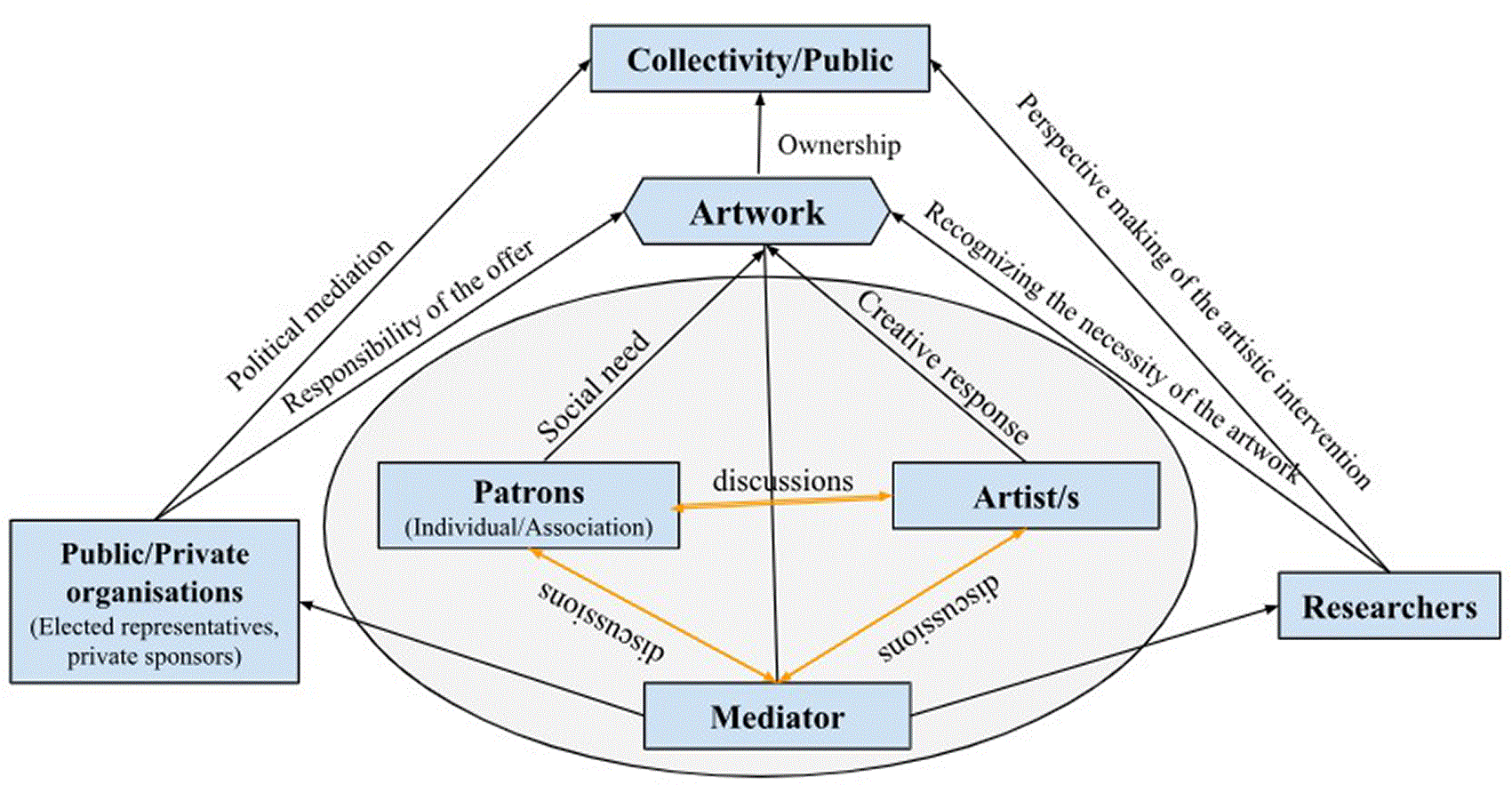
Figure 1. Visual representation (authors’ elaboration) of the different actors involved in the New Patrons projects, showing the roles and process involved in the elaboration of the artwork based on the New Patrons Protocol (Hers, 2002).
Table 1. Sample composition.
| Key-informant
| Country5 | Role A: artist; M: mediator; P: patron |
Gender |
|---|
| KI_1 | Italy | A | M |
| KI_2 | Italy | M | F |
| KI_3 | Italy | M | F |
| KI_4 | Italy | M | F |
| KI_5 | France | A | M |
| KI_6 | France | A | M |
| KI_7 | France | A | M |
| KI_8 | France | A | M |
| KI_9 | France | A | M |
| KI_10 | France | A | F |
| KI_11 | France | M | M |
| KI_12 | France | M | M |
| KI_13 | France | M | F |
| KI_14 | France | M | F |
| KI_15 | France | M | F |
| KI_16 | France | M | F |
| KI_17 | France | P | M |
| KI_18 | France | P | M |
| KI_19 | France | P | M |
| KI_20 | France | P | M |
| KI_21 | France | P | F |
| KI_22 | France | P | F |
| KI_23 | France | P | M |
| KI_24 | France | P | F |
3.3 Participant selection
Participants were selected through a purposeful sampling strategy (Patton, 2014) combining purposive and voluntary recruitment techniques. Purposive sampling enabled the identification of individuals occupying central positions within the New Patrons ecosystem, while voluntary participation ensured that interviewees were willing to engage in reflective discussions concerning their experiences. Invitations were distributed through institutional networks, professional contacts, and project partners.
The final sample comprised 24 participants from France and Italy, including 9 mediators, 7 artists, and 8 citizen patrons. Participants ranged in age from 25 to 70 years and reflected a relatively balanced gender distribution. The inclusion of multiple stakeholder groups enabled the triangulation of perspectives and provided access to the diverse experiences, responsibilities, and expectations shaping collaborative artistic production.
By incorporating artists, mediators, and citizen patrons, the study captures the viewpoints of actors responsible for initiating, facilitating, and implementing artistic projects (see
Figure 1).
This diversity was particularly valuable for identifying convergences and tensions concerning participation, decision-making, mediation, and shared responsibility across different cultural and institutional contexts.
3.4 Data collection
Data was collected between October 2023 and June 2024 through semi-structured interviews. This method was selected because it provides sufficient structure to ensure comparability across interviews while allowing participants to elaborate on experiences, perceptions, and contextual factors relevant to the research objectives (deMarrais & Lapan, 2003).
Interviews were conducted either face-to-face or via Microsoft Teams, depending on participants’ availability and geographical location. Interview duration ranged from approximately 30 minutes to two hours. To facilitate rich and nuanced accounts, interviews were conducted in participants’ preferred languages, including French and Italian, allowing respondents to express their experiences in culturally and linguistically appropriate ways.
The interview protocol was organised around six broad themes: participant background, governance and stakeholder relationships, organisational challenges and digitalisation, inclusion and citizen creativity, artistic collaboration and project development, and, collective intentionality and participation (see Appendix 1). These themes were designed to capture both the organisational dimensions of artistic projects and the relational processes through which collaboration, negotiation, and shared responsibility were enacted in the context of the New Patrons projects. All interviews were conducted with participants’ informed consent, audio-recorded, transcribed verbatim, and anonymised prior to analysis.
3.5 Data analysis
The data were analysed through qualitative content analysis supported by MAXQDA 24.2.0 software (Schreier, 2012). A combined deductive–inductive coding strategy was employed to balance theoretical sensitivity with openness to emergent insights.
The initial coding framework was informed by the interview protocol and the study’s theoretical foundations, including co-curation, commoning, and care ethics. Preliminary categories included participation, dialogue, mediation, collaboration, shared responsibility, conflict management, and care. During the analytical process, additional inductive codes were generated to capture themes, relationships, and practices that emerged directly from participants’ narratives.
All transcripts were coded in their original languages to preserve contextual meanings and linguistic nuances. Following initial coding, categories were progressively refined through iterative comparison across interviews and stakeholder groups. Codes were then aggregated into broader thematic dimensions reflecting recurring patterns in the organisation and maintenance of collaborative artistic projects. Particular attention was devoted to identifying the relational mechanisms through which participation was sustained, including dialogue, negotiation, adaptation, mediation, trust-building, and collective learning. Throughout the process, analytical memos were used to document emerging interpretations, support reflexivity, and enhance analytical transparency. The inclusion of multiple stakeholder groups further enabled the triangulation of perspectives and strengthened the credibility of the findings.
3.6 Ethical considerations
The study was conducted in accordance with established ethical standards for social science research and relevant European Union data protection regulations. Ethical approval was obtained from the Institutional Ethics Committee of Burgundy School of Business prior to data collection. All participants received detailed information regarding the objectives of the study, the nature of their involvement, and the intended use of the data. Written informed consent was obtained before each interview. Participants were informed of the voluntary nature of their participation, their right to decline to answer specific questions, and their right to withdraw from the study at any stage without consequence.
To ensure confidentiality and anonymity, all interview transcripts were anonymised during transcription and analysis. Personal identifiers, project-specific details that could reveal participants’ identities, and other sensitive information were removed or pseudonymized. Participants are therefore referred to through anonymised identifiers and stakeholder categories throughout the study. Interview recordings, transcripts, coding files, and associated research materials were securely stored on password-protected systems accessible only to members of the research team. Data management procedures complied with institutional requirements and applicable data protection regulations.
4. Findings
The analysis of 24 semi-structured interviews revealed a set of interrelated relational mechanisms that sustain co-curation practices within the New Patrons projects. Through the interviews, participants consistently emphasised the importance of dialogue, negotiation, adaptability, conflict management, and mediation in enabling collaborative artistic production. Rather than emerging as isolated dimensions, these mechanisms collectively illustrate how co-curation operates as a process of commoning supported by care-centred practices. Each mechanism is discussed in the next sub-sections.
4.1 Dialogue and collective intentionality as foundations of co-curation
Across interviews, participants consistently described co-curation as a process grounded in dialogue and the gradual construction of a shared purpose among diverse actors. Rather than emerging from predefined objectives, projects evolved through continuous interaction among artists, mediators, patrons, and other stakeholders. Dialogue was not perceived as a preliminary consultation phase but as an ongoing process through which expectations, concerns, and aspirations were collectively articulated and negotiated. One mediator explicitly linked this process to the emergence of collective intentionality:
“We intentionality corresponds exactly to that. It is the common intention. It is the intention that together becomes a vocation for action” (KI_2_M).4
Collective intentionality was not merely understood as a mechanism for coordinating action but as a process through which participants progressively came to understand and integrate one another’s perspectives. As the same mediator explained:
“These different intentions become shared because people understand better the reasons of the others through the common work” (KI_2_M).
Several participants emphasized that this shared understanding emerged through sustained interaction. As one patron observed:
“It is really a collective work (…) it allows us to share ideas and become more intelligent when we are several” (KI_23_P).
Similarly, the collaborative process was described as inherently iterative:
“It is a process that is built little by little and always in relation with everyone” (KI_24_P).
The importance of dialogue was further reinforced by mediators who highlighted listening as a prerequisite for collective action. As one participant noted:
“There must be a constant active listening process. The initial desire molds and strengthens through dialogue” (KI_14_M).
Together, these accounts suggest that co-curation is rooted in a process through which individual aspirations are progressively transformed into shared commitments. Collective intentionality emerges not from formal agreements alone but through continuous dialogue, mutual recognition, and the gradual alignment of diverse perspectives. In this respect, co-curation operates as a process of commoning through which participants collectively define both the objectives and meaning of artistic projects.
4.2 Co-curation as collective learning and knowledge production
Beyond enabling participation, co-curation was consistently described as a process of collective learning that transforms the perspectives and practices of those involved. Across interviews, participants emphasised that collaborative artistic projects require individuals to engage with unfamiliar viewpoints, question established assumptions, and develop new understandings through shared experiences. Learning thus emerged not only from exposure to artistic practices but also from the challenges of working with diverse actors and navigating uncertainty throughout the project. As one mediator observed:
“Collective intentionality is also a process that produces a great deal of learning. Each person, with their competencies and professional standards, finds themselves opening them up and questioning them” (KI_2_M).
This learning process extended beyond artists and mediators. Citizen patrons frequently described how their involvement introduced them to artistic worlds and creative practices that had previously been unfamiliar. Reflecting on her participation in the project, one community member explained:
“It opened us to a field that we did not know at all” (KI_21_P).
For many participants, learning occurred through direct encounters with artists and their creative processes. As the same participant recalled:
“When we visited his studio, we suddenly realized that what he was proposing made sense. It changed the way we looked at things” (KI_21_P).
These experiences suggest that co-curation encourages participants to reconsider established perspectives and develop new interpretative frameworks through engagement with artistic practices. Learning also emerged through the necessity of integrating different viewpoints. As one commissioner explained:
“You have to bring together different opinions and find what can suit everyone” (KI_24_P).
Rather than simply reaching consensus, participants described this process as an opportunity to broaden their understanding of both the project and the perspectives of others. Learning was therefore generated through negotiation, deliberation, and the encounter with differences. Several interviewees further emphasised that collaborative projects begin with uncertainty. Reflecting on the early stages of a commission, one participant recalled:
“We had absolutely no idea, neither of the dimensions nor of the process that would take place” (KI_19_P).
The willingness to engage with this uncertainty was frequently presented as a catalyst for discovery, experimentation, and adaptation. Rather than being perceived as an obstacle, uncertainty became an important condition for learning and innovation. Mediators similarly highlighted the importance of remaining attentive to participants’ concerns and experiences throughout the process. As one mediator explained:
“It is a different way of approaching people through their own needs” (KI_16_M).
This orientation encouraged participants to move beyond predefined expectations and engage with perspectives rooted in different social, cultural, and professional backgrounds. Taken together, these accounts suggest that co-curation functions as a reciprocal learning process in which artists, mediators, patrons, and community members continuously expand their understanding through collaboration. Knowledge is not transmitted unilaterally from experts to audiences but co-produced through the interaction of actors possessing different forms of expertise, experience, and lived knowledge.
These findings resonate strongly with Wenger’s (1999, ), 2010 notion of communities of practice, whereby learning emerges through participation in shared activities rather than through formal instruction. Hence, we could say that co-curation generates not only artistic outcomes but also new forms of collective knowledge, reflexivity, and competence, reinforcing its role as a process of commoning through which cultural value is collaboratively produced and sustained.
4.3 Co-curation as complementarity and collective creation
Participants repeatedly emphasised that co-curation differs fundamentally from traditional curatorial models because it relies on complementarity rather than individual authorship. Rather than positioning artists, mediators, institutions, and citizens within separate spheres of influence, co-curation was described as a process through which diverse forms of knowledge, expertise, and lived experience are combined to shape artistic projects. The resulting artwork is therefore not the product of a single vision but the outcome of a collaborative process in which multiple actors contribute distinct yet complementary resources. One mediator offered a particularly clear definition:
“For me, co-curation is complementarity. It produces something that surpasses both parties; it is not simply one plus one” (KI_3_M).
Rather than viewing collaboration as the aggregation of individual contributions, participants described co-curation as a process through which new forms of cultural value emerge from interaction itself. As one mediator explained:
“Working together increases strength, increases critical capacity and generates collective intelligence” (KI_28_M).
Several participants similarly stressed that artistic projects derive their richness from the combination of different perspectives. As one patron observed:
“It is really a collective work” (KI_23_P).
This key informant further emphasised that collaboration enables participants to expand their perspectives and improve collective decision-making:
“It allows us to share ideas and become more intelligent when we are several” (KI_23_P).
The collective nature of co-curation was also reflected in the effort required to reconcile diverse expectations and viewpoints. As one commissioner explained:
“You have to bring together different opinions and find what can suit everyone” (KI_24_P).
Participants viewed this negotiation not as a constraint but as an essential component of artistic creation. The challenge of integrating different perspectives was considered fundamental to producing outcomes that reflected the concerns and aspirations of multiple stakeholders rather than the preferences of a single actor. Importantly, collaboration extended beyond consultation by involving stakeholders throughout the creative process. As one participant explained:
“All the people who will benefit from the artwork participate from the beginning of the project” (KI_24_P).
This early involvement enabled participants to influence both the objectives and development of projects, transforming them from audiences into active contributors. Several interviewees highlighted that co-curation derives its distinctive character from the fact that projects originate from citizens’ concerns and experiences. As one patron observed:
“The commission comes from below” (KI_22_P).
Similarly, one mediator highlighted how the New Patrons model redistributes cultural agency:
“It is not a cultural administration or politicians who commission the work (…) it is citizens who become commissioners” (KI_16_M).
This key informant went on to explain that,
“The top-down logic is reversed and becomes a bottom-up logic” (KI_16_M).
These observations underline that complementarity is not limited to the interaction between professional and non-professional actors. It also involves the articulation of different forms of authority, knowledge, and responsibility within the creative process. The importance of combining complementary competencies was made a point by participants reflecting on the practical realisation of projects. This is reflected in the words of a mediator saying,
“People do not know how to find an artist, they do not know how to establish a production budget” (KI_11_M).
Rather than replacing professional expertise, co-curation depends upon its integration with local knowledge, lived experience, and collective aspirations. Citizens contribute their understanding of places and communities; artists contribute creative expertise; mediators facilitate dialogue and coordination; and institutions provide resources and support. Artistic value emerges from the interaction among these contributions rather than from any one of them individually.
This dynamic was particularly visible in projects rooted in local communities. Reflecting on a previous commission based in France, one participant stressed the importance of ensuring that the artwork remained connected to local meanings and experiences:
“We did not want a work that was foreign to the sensitivity of the place and its people” (KI_19_P).
Similarly, another participant recalled how exchanges between residents and the artist transformed the scope of the project itself:
“If I can use this field, then it changes everything” (KI_21_P).
These accounts illustrate how artistic outcomes emerge through continuous exchanges between artistic vision and local knowledge rather than from either source alone. Taken together, the findings suggest that co-curation operates as a form of collective creation in which artistic production emerges through the interaction of complementary forms of expertise, experience, and responsibility. Cultural value is therefore co-produced through dialogue, negotiation, and the integration of diverse contributions. In this sense, co-curation can be understood as a process of commoning through which artistic projects are collectively shaped, stewarded, and sustained.
4.4 Mediators as relational infrastructures of care
A recurring theme across interviews concerned the central role played by mediators in sustaining collaborative artistic projects. Participants consistently described mediation as a relational activity that connects actors occupying different positions within the artistic process, including artists, citizen patrons, institutions, public authorities, and local communities. Far from performing a merely administrative function, mediators were portrayed as facilitators, translators, negotiators, and coordinators who create and maintain the conditions necessary for collaboration to occur.
One mediator described her role as operating between different worlds and forms of expertise:
“I dialogue on one side with the commissioner and on the other with the artist, and I try to make all these inputs converge into an organic project” (KI_4_M).
This account highlights the intermediary function of mediators, whose work consists not only in transmitting information but also in translating expectations, reconciling perspectives, and fostering convergence among actors who often possess different interests, languages, and forms of knowledge. The centrality of this role was repeatedly emphasised throughout the interviews. As one of the French mediators explained:
“The role of the mediator is truly central” (KI_16_M).
Similarly, another meditator argued that mediation constitutes an indispensable component of the collaborative process:
“Without this third actor who possesses the necessary competencies to organise the action, it simply does not work” (KI_11_M).
According to this mediator, citizen participation alone is insufficient to transform collective concerns into artistic projects because the process requires specific forms of expertise and coordination. These observations suggest that mediators do not substitute for citizen participation but enable it by linking social aspirations with artistic and organisational resources.
Several participants explicitly described mediators as bridges between artistic and civic spheres. As one patron explained:
“The mediators are there to help formulate the commission; they are the link between the artist and the public” (KI_22_P).
Mediators were therefore viewed as actors capable of facilitating communication between stakeholders who may not otherwise possess the knowledge, networks, or institutional access required to collaborate effectively. Participants further emphasised that mediation involves managing the complexity generated by the plurality of actors involved in co-curation projects. Artistic production requires the coordination of different expectations, responsibilities, and forms of expertise, while simultaneously preserving a shared sense of purpose. In this respect, mediators played a crucial role in supporting negotiation and maintaining coherence throughout the project lifecycle.
The brokerage function of mediators was particularly important because co-curation brings together actors with diverse forms of authority and knowledge. Artists contribute creative expertise, citizen patrons articulate collective concerns, institutions provide resources, and public authorities often support implementation. Mediators help connect these different contributions and transform them into a coherent artistic project. Their role, in fact, extends beyond communication to encompass the active orchestration of collaborative relationships.
Importantly, participants did not describe mediation as a neutral or passive activity. Rather, mediators actively shaped the conditions under which collaboration became possible. By facilitating exchanges, translating between different worlds, supporting negotiation, and maintaining connections among stakeholders, they performed much of the often-invisible work through which collaborative artistic production was sustained.
Taken together, these findings suggest that mediators function as relational infrastructures that enable co-curation to operate effectively. Their contribution lies not only in coordinating activities but also in connecting actors, aligning expectations, and maintaining the collaborative arrangements upon which artistic projects depend. In this sense, mediation emerges as a key mechanism through which commoning processes are organised and sustained within participatory cultural production.
4.5 Mediators as care infrastructures
Care emerged as a fundamental principle underpinning co-curation practices. Across interviews, key informants repeatedly referred to attentiveness, respect, responsibility, and responsiveness toward others as essential elements of collaborative cultural production. Rather than being treated as a secondary outcome of participation, care appeared as a guiding principle shaping how relationships were established, maintained, and negotiated throughout the co-curation process.
For many key informants, care began with listening. Rather than imposing predefined cultural agendas, co-curation was described as a process that starts from the concerns, aspirations, and experiences of citizens. As a mediator explained:
“There are many projects where people are encouraged to participate. Here it is very different because we listen and then take charge of the question that arises” (KI_16_M).
She further emphasised that the process is rooted in the lived experiences of participants:
“It is a different way of approaching people through their own needs” (KI_16_M).
This attentiveness was closely linked to the ethical responsibilities associated with participation. Participants repeatedly stressed that collaborative cultural production requires more than simply inviting people to contribute; it requires creating conditions in which different voices can genuinely be heard, respected, and incorporated into decision-making processes. Reflecting on her own mediation practice, a mediator explained:
“We have always tried to remain attentive to the value of the other” (KI_3_M).
Such attentiveness also involved a critical awareness of power asymmetries. As this key informant further noted:
“We were very careful to avoid forms of colonialism” (KI_3_M).
These concerns highlight the ethical dimension of co-curation, where care involves not only supporting participation but also ensuring that participation remains equitable and respectful.
Participants further emphasised that care requires responsiveness and adaptation to the specific circumstances of those involved. Reflecting on a commission developed within a residential care facility, Brugger described the challenges of working with elderly residents:
“All the people who will benefit from the artwork participate from the beginning of the project … but because we work with very elderly people, they can participate at some moments, be too tired at others, and sometimes they pass away. It required a great deal of adaptation” (KI_24_P).
This account illustrates how care is enacted through continuous adjustments to participants’ changing capacities and needs. Rather than treating participation as a fixed procedure, stakeholders adapted the process in order to maintain meaningful engagement over time.
Care also emerged through the work of sustaining relationships and protecting the conditions necessary for collaboration. One mediator emphasised that care extends beyond interpersonal interactions and includes responsibility toward artistic processes themselves:
“The most important form of care is towards the artist and towards art” (KI_4_M).
This perspective highlights the dual orientation of care within co-curation: care is directed both toward participants and toward the creative process that brings them together. Protecting artistic integrity and supporting meaningful participation were often described as complementary rather than competing responsibilities.
The importance of care was equally visible in the organizational arrangements supporting co-curation. According to KI_11_M, participation alone is insufficient unless actors are present who can accompany, guide, and support stakeholders throughout the process:
“Without this third actor who possesses the necessary competencies to organize the action, it simply does not work” (KI_11_M).
In this respect, care is embedded not only in interpersonal relationships but also in the infrastructures that enable collaboration to occur and endure.
Finally, several key informants described care as a mechanism through which shared understanding and collective commitment gradually emerge. As projects evolve, stakeholders learn to appreciate one another’s perspectives and motivations through collaborative work. This process contributes to the development of trust, reciprocity, and mutual recognition, reinforcing the collective dimension of co-curation.
These findings suggest that care functions as both an ethical orientation and a practical mechanism through which co-curation is sustained. Care involves attentiveness to others, responsiveness to emerging needs, adaptation to changing circumstances, sensitivity to power asymmetries, and the continuous maintenance of relationships. Rather than representing a supplementary dimension of participation, care appears to constitute one of the central conditions through which meaningful and equitable co-curation becomes possible.
These findings strongly resonate with Tronto’s (2013) conception of care as a practice encompassing attentiveness, responsibility, competence, responsiveness, and solidarity. They further suggest that co-curation operates as a form of care-based commoning in which relationships, cultural value, and collective commitments are continuously nurtured and maintained through relational work.
5. Discussion
This study examined how co-curation is organised, negotiated, and sustained within participatory visual arts initiatives through an analysis of the New Patrons program. By exploring the experiences of artists, mediators, and citizen patrons, the findings provide new insights into the relational mechanisms underpinning collaborative cultural production. Rather than viewing co-curation solely as a process of shared decision-making, the analysis reveals how collective artistic projects are sustained through ongoing practices of dialogue, learning, mediation, and care.
The findings show that co-curation operates as a form of commoning in which participants progressively construct shared intentions, negotiate diverse perspectives, and collectively steward artistic projects. At the same time, they highlight the central role of mediators as relational infrastructures that connect actors, facilitate collaboration, and maintain the conditions necessary for collective action. Finally, the study demonstrates that care is not a peripheral feature of participatory cultural production but a fundamental mechanism through which collaboration is made possible, sustained, and rendered inclusive over time.
By bringing together insights from co-curation, commons theory, and care ethics, the study contributes to a deeper understanding of how collaborative cultural governance functions in practice. The discussion develops this argument by conceptualising co-curation as a form of care-based commoning, in which collective stewardship depends not only on the sharing of authority but also on the relational and ethical work required to sustain participation, manage differences, and maintain collective commitment.
5.1 Co-curation as dialogical and adaptive governance
The findings reinforce the importance of dialogue as a mechanism through which collective intentions are constructed and sustained. Consistent with previous research on participatory cultural production (Reilly, 2019; Dekker & Tedone, 2019), dialogue emerged not as a supplementary aspect of collaboration but as the process through which artistic projects acquire shared meaning and direction. Participants progressively developed common objectives through interaction, negotiation, and the integration of diverse perspectives.
These observations extend existing understandings of co-curation by highlighting its adaptive character. Rather than operating through predefined procedures or fixed governance arrangements, projects evolved through continuous adjustments to changing circumstances, stakeholder expectations, and emerging opportunities. This finding resonates with scholarship on cultural commons, which emphasises reciprocity, communication, and mutual adjustment as essential conditions for collective governance (Ostrom, 1990; Bollier & Helfrich, 2015). Similarly, Sanders and Stappers (2008) describe co-creation as an iterative process characterised by experimentation, feedback, and adaptation.
The findings further suggest that collective intentionality plays a central role in sustaining collaborative cultural production. Participants did not simply contribute individual preferences to a shared project; they progressively developed common understandings through interaction and mutual learning. In this respect, co-curation appears as a form of adaptive governance through which artistic objectives, meanings, and responsibilities are continuously negotiated rather than predetermined. Participation in the New Patrons project emerges as an ongoing process of collective sense-making rather than a one-time transfer of authority.
5.2 Care as the infrastructure of participation
A central contribution of this study lies in demonstrating that participation depends upon forms of relational work that often remain invisible within discussions of collaborative governance. While co-curation is frequently presented as a mechanism for redistributing authority, the findings reveal that meaningful participation requires sustained efforts to maintain relationships, support engagement, address tensions, and accommodate diverse needs.
The role of mediators illustrates this particularly clearly. Participants consistently described mediators as actors who connect stakeholders, facilitate communication, translate between different forms of expertise, and support cooperation throughout lengthy project trajectories. Viewed through Tronto’s (2013) updated framework of care, mediators enact multiple dimensions of care simultaneously, ranging from attentiveness to participants’ concerns to the coordination of collective action and the maintenance of solidarity among stakeholders. Their role extends beyond mere facilitation to encompass the ongoing and iterative maintenance of the social conditions necessary for collaboration.
These findings support Puig de la Bellacasa’s (2017) argument that care is embedded within relational and material infrastructures rather than residing solely in individual dispositions. Care was enacted through concrete practices of mediation, listening, negotiation, responsiveness, and adaptation, which enabled participants to remain engaged despite uncertainty, disagreement, and complexity. Similar to Mol et al.’s (2010) conception of care as a process of continual adjustment and maintenance, care within co-curation emerged as an ongoing practice through which collaborative relationships were sustained over time.
The study extends existing research on participatory cultural production by demonstrating that the effectiveness of collaborative governance depends not only on institutional arrangements but also on the often-overlooked forms of relational labour that make participation possible and durable.
5.3 Co-curation as care-based commoning
By bringing commons theory into dialogue with care ethics, this study advances a more integrated understanding of co-curation as a form of care-based commoning. Existing scholarship has often examined participatory governance, cultural commons, and care as distinct phenomena. Our findings suggest, however, that these processes are deeply interconnected and mutually constitutive.
The artistic projects examined in this study operated as commons not simply because authority was shared among multiple actors, but because participants collectively produced, negotiated, and sustained cultural value through ongoing interaction. Co-curation in the New Patrons projects functioned as a process of collective stewardship in which relationships, knowledge, experiences, and artistic outcomes were continuously shaped and maintained. This interpretation supports emerging scholarship that conceptualises cultural commons as relational and processual rather than merely institutional or resource-based (Borchi, 2018; Mollona, 2021).
At the same time, the findings demonstrate that commoning cannot be sustained through governance arrangements alone. The continuity of collaborative practices depended upon care-centered infrastructures capable of fostering trust, reciprocity, responsiveness, and long-term engagement. Mediators played a particularly important role in maintaining these infrastructures by performing the relational labour necessary to sustain cooperation among diverse stakeholders. Care therefore emerges not as a complementary feature of commoning but as one of its enabling conditions.
This perspective also contributes to debates concerning the democratisation of cultural production. Consistent with previous research (Bishop, 2012; Pennington, 2018; Diaz Ramos, 2017), the findings indicate that expanding participation does not eliminate tensions or power asymmetries. On the contrary, greater inclusivity often requires extended negotiation, ongoing adaptation, and the management of conflicting perspectives. Importantly, conflict emerged not as evidence of failure but as a productive dimension of collaborative cultural production capable of generating learning, reflection, and creative development. This observation aligns with arguments that democratic participation requires engagement with difference rather than the elimination of disagreement (Gielen, 2013; Reckitt, 2016).
Theoretically, the findings suggest that commoning and care should be understood as mutually reinforcing processes. While commoning provides a framework for understanding collective stewardship and shared governance, care explains how these arrangements are enacted and sustained through ongoing relational work. Co-curation thus emerges as a form of care-based commoning through which artistic production becomes collectively organised, negotiated, and maintained. This perspective extends existing scholarship on cultural commons by demonstrating that democratic cultural governance depends not only on participation and shared authority but also on the relational infrastructures that sustain collective action over time.
6. Conclusion
This study examined how co-curation is organized and sustained within participatory visual arts initiatives through the combined lenses of commons theory and care ethics. Drawing on evidence from the New Patrons program, the findings demonstrate that collaborative cultural production depends not only on the redistribution of decision-making authority but also on the relational mechanisms that enable stakeholders to collectively develop, negotiate, and sustain artistic projects over time.
Three main conclusions emerge from the analysis. First, co-curation operates as a dialogical and adaptive form of governance in which artistic projects are progressively shaped through negotiation, learning, and continuous adjustment among participants. Rather than implementing predefined objectives, stakeholders collectively construct project meanings, priorities, and outcomes through ongoing interaction. Second, care emerged as a critical enabling condition of participation. The findings show that collaborative governance relies upon sustained relational work involving attentiveness, mediation, responsiveness, and trust-building. In particular, mediators played a central role in connecting actors, facilitating communication, and maintaining the social conditions necessary for collective action. Third, the study highlights that democratizing cultural production is inherently demanding. Expanding participation creates opportunities for inclusion and shared responsibility, but also requires stakeholders to navigate uncertainty, disagreement, and competing expectations. These tensions should not be viewed as failures of participatory governance but as inherent features of collaborative cultural production.
The principal theoretical contribution of the paper lies in the development of the concept of care-based commoning. While existing studies have largely examined co-curation, commons governance, and care as separate phenomena, the findings demonstrate that these processes are deeply interconnected. Co-curation functioned as a form of commoning through which cultural value, artistic projects, knowledge, and responsibilities were collectively produced and stewarded. At the same time, these commoning processes depended upon care-centred infrastructures capable of sustaining trust, reciprocity, responsiveness, and long-term engagement. This study thereby extends the scholarship on cultural commons, especially in contemporary visual arts, by showing that collective stewardship depends not only on governance arrangements but also on the relational labour through which collaboration is maintained in practice.
The findings also show important implications for cultural management. First, cultural organisations should move beyond project-based approaches to participation and invest in long-term relational infrastructures that support dialogue, trust-building, and stakeholder engagement. Second, mediators should be recognised as strategic actors rather than operational facilitators. Their role in translating between communities, artists, institutions, and public authorities is fundamental to the success of collaborative cultural initiatives and therefore requires appropriate professional recognition, training, and resourcing. Third, managers should adopt care-oriented approaches to cultural governance that value responsiveness, adaptability, and relationship maintenance alongside artistic and organisational objectives. Such approaches may strengthen stakeholder commitment and improve the sustainability of participatory initiatives.
The study further offers several policy implications. Public cultural policies frequently promote participation and inclusion as desirable outcomes, yet often underestimate the resources required to sustain them. The findings suggest that funding schemes should support not only artistic production but also the relational infrastructures that make collaboration possible, including mediation, community engagement, facilitation, and long-term partnership building. Hence, policymakers should consider the care-related activities as core components of cultural value creation rather than ancillary support functions. Furthermore, cultural policies aimed at democratizing access to artistic production should recognise that meaningful participation requires time, continuity, and sustained investment in local relationships.
Methodologically, the study contributes rare empirical evidence on the relational mechanisms underpinning co-curation across two European contexts. By examining the perspectives of artists, mediators, and citizen patrons, it provides a nuanced understanding of how collaborative cultural governance is enacted in practice. The findings also contribute to broader debates in cultural economics by reinforcing arguments that cultural value emerges not solely through market exchange but through shared meanings, social relationships, and collective practices of stewardship (Klamer, 2017; Petrova et al., 2026).
Like all qualitative research, this study has limitations. The findings are derived from a specific participatory arts initiative and do not claim statistical generalizability. Future research could examine whether similar dynamics of care-based commoning emerge in other cultural settings, including museums, heritage institutions, community arts programs, and digital cultural platforms. Comparative studies across governance models and national contexts would further enhance understanding of how care, participation, and collective stewardship interact in shaping the future of democratic cultural production.
Authors’ note
The second author participated in the work during their time as a Research Assistant in the Glammons project at the Burgundy School of Business. The current institution of the second author Université Bourgogne Europe is not involved in any capacity in this research project.
AI Use Disclosure Statement
In accordance with the F1000 AI policy, ChatGPT 5 was used solely for the purpose of language editing. All intellectual contributions remain solely the responsibility of the authors.
Ethical approval and informed consent statements
The research obtained ethical approval from the Burgundy School of Business Research Ethics Committee (CER-BSB) on July 3, 2023, n. CERBSB2023–55. The research complies with BSB Burgundy School of Business Research Ethics Charter, based on the French Charter for Research Integrity, (January 2015, ratifications on June 13, 2019), and is also in line with the European reference framework for research and innovation activities in the humanities and social sciences (Ethics in Social Science and Humanities. European Commission, October 2018) and ALLEA (The European code of conduct for research, 2018).







