1. Introduction
In March 2025, the Paris criminal court found Marine Le Pen guilty of misusing European Parliament funds through a scheme of fictitious parliamentary assistants tied to the Rassemblement National (RN). She was sentenced to four years in prison, with two years to be served under electronic surveillance or in custody, fined €100,000, and—most impactfully—barred from holding elected office for five years. This sanction excludes her from the 2027 presidential election and sidelines her from political life until 2030. Le Pen appealed, and the Paris Court of Appeal, after a trial held from 13 January to 12 February 2026, delivered its ruling on 7 July 2026: it upheld the conviction for misuse of public funds but substantially reduced the penalties to three years’ imprisonment (two suspended, one year under electronic surveillance), a €100,000 fine, and 45 months of ineligibility of which 30 were suspended. Since the fifteen months of effective ineligibility ran from 31 March 2025 and thus expired on 30 June 2026, Le Pen regained her eligibility and declared her candidacy for the 2027 presidential election the same evening, while announcing an appeal to the Cour de cassation whose suspensive effect also postpones the electronic tag. The case is therefore not legally closed—all convicted defendants and the European Parliament have lodged appeals in cassation, and a decision is expected before the first round of April 2027—but the analysis presented here concerns the first-instance moment, when ineligibility appeared to be immediate and definitive. The case is of particular interest in contemporary French politics because it not only threatens the career of a major presidential candidate, but also raises questions about how legality, legitimacy and democracy relate discursively when a far-right leader is convicted.
Before turning to our main analysis, we first conducted a preliminary exploration to assess whether the press coverage could be read as a case of “enemization” of Marine Le Pen. This step confirmed that depictions of Le Pen are indeed multi-faceted, but it also revealed that legal and judicial frames dominate the corpus. Courts, verdicts, ineligibility, and trial procedures are nearly as central as electoral positioning, while a broader “normative shadow” emerges in discussions of constitutional law, democratic principles, and citizens’ rights. In other words, the affair is not portrayed merely as a political scandal, but as an event with direct implications for the legal and moral order. This finding prompted us to shift the analytical focus: rather than treating enemization as the sole interpretive lens, we examine how institutional terms such as justice, (État de) droit, République, and démocratie are contested and resemanticized in the press coverage of Marine Le Pen’s case. By resemanticization we refer to the process through which relatively stable institutional terms acquire new evaluative meanings when they are mobilized in political controversy. In this case, the legal condemnation becomes a discursive site where these terms shift from procedural descriptors to moral and political operators. By analyzing press coverage of her condemnation, we show how the same lexical items can stabilise legality in one context and contest it in another. The focus is therefore less on the legal facts of the case than on the discursive work through which institutions are narrated, contested, and personified.
Research on French political journalism highlights the personalization of leaders and the dramatization of scandals as recurring media logics (Tozzi 2002; Marchetti 2009; Campus 2017; Dakhlia 2018). Work on scandal reporting shows how affaires function simultaneously as procedural dossiers and moral narratives (Kaciaf and Le Derff 2018). Studies of populist radical right figures emphasize the coupling of legal jeopardy with leader images in mainstream coverage (Snipes and Mudde 2020). Finally, linguistic and political communication research traces the evaluative “availability” of institutional signifiers such as justice, droit, and démocratie in French media discourse (Bouzereau and Guaresi 2019; Jebril and El Bouzidi 2024). By connecting these perspectives, we situate Le Pen’s condemnation as a moment where leader-centered personalization and institutional language converge, producing a shifting boundary of democratic legitimacy.
Thus, our contribution is twofold. First, it extends scholarship on French political journalism and scandal reporting by tracing how leader-centered personalization intersects with institutional language. Second, it contributes to debates on democratic legitimacy and imaginaries, showing how “justice,” “rule of law,” or “the Republic” operate as flexible signifiers that authorize, delegitimize, or dramatize political actors. In this way, the case illustrates how legal proceedings against a populist radical right leader reverberate beyond the courtroom, reshaping the symbolic terrain of democratic politics.
2. Theoretical Framework
2.1 Semantic Drift and Institutional Discourse
In the field of discourse analysis, one generally shared premise is that discourse is understood as a multifaceted object that can be investigated from multiple perspectives (Angermuller, Maingueneau, and Wodak 2014, 6). This approach is strongly rooted in the critical tradition that draws on the French school of discourse analysis, particularly as defined by Angermuller (2014, 14): from 1969 onward, Foucault’s work shifted the focus away from viewing discourse as a set of isolated, abstract signs and toward understanding it as the creation of discursive networks or formations of utterances. This theoretical turn toward the question of enunciation opened the way for analyzing discourse as a social, contextual, and historical practice rather than as a merely linguistic system.
Within this framework, the corpora examined in our case study must be analyzed not only at the linguistic and semantic levels, but also in their contextual, ideological, and pragmatic dimensions. This has direct implications for the methodology employed, since meaning is not simply extracted from texts but is actively constructed and negotiated within specific discourse communities. As Angermuller, Maingueneau, and Wodak (2014, 2–3) point out, Discourse Studies is “an extremely heterogeneous field involving scholars from a range of disciplines,” and it rejects the idea of meaning as a self-evident property of textual surfaces. Instead, the focus is on the rules, practices, and mechanisms through which meaning is produced, circulated, and stabilized.
In our paper, it is important to stress the question of naming (nomination) as developed in the praxematic tradition. Nomination is never a neutral or purely referential act: it constitutes a discursive practice through which social actors, events, and phenomena are designated, classified, and positioned within ideological and institutional frameworks. In this sense, naming is both a linguistic operation and a social act of positioning, one that reveals how discourse contributes to the construction of the social order. Analyzing nomination practices thus allows us to observe not only the presence of meaning but also the processes of its construction, negotiation, and contestation across texts and contexts.
In the praxematic tradition, naming (nomination) is not considered a transparent act of attaching a “name” to a pre-existing reality. Instead, it is understood as a discursive practice shaped by social, ideological, and pragmatic conditions. For Siblot (1997), naming is an act of construction: it involves choices that inscribe the referent within a particular network of meaning and thus position it in relation to other entities in discourse. This has two implications:
- Nomination as social practice: naming is always socially and ideologically marked. It is a way of defining and delimiting reality, and therefore a way of acting in discourse;
- Referential plurality: a single referent may be named in different ways across contexts (e.g., immigré vs. Migrant vs. expatrié), and these lexical choices encode different values, perspectives, and ideological positions. In our study, words like justice, démocratie, etc., will be entry points to observe social, political, and ideological levels.
2.2 Discursive Framing and Strategic Recontextualization
Word choices and topic orientation of the text are very important: the words selected in discourse index not just denotation but also values, attitudes, and positioning. We can consider that word choices function as discursive operators: the term chosen (e.g., réforme vs. casse sociale) frames the topic and guides interpretation. Then, the thematic organization of discourse emerges from these lexical selections. By privileging certain terms and suppressing others, speakers foreground some aspects of reality while backgrounding others. This links nomination with the larger construction of topicality. Siblot and praxematics also highlight the importance of recurring polylexical structures (multiword units, fixed expressions, collocations). These structures are not simply additive combinations of words: they are pre-constructed semantic-pragmatic units that carry discursive memory and often crystallize ideological stances. For example, phrases like crise migratoire, fracture sociale, or liberté d’expression function as ready-made designations that circulate widely and stabilize certain ways of thinking. The recurrence of such units contributes to building semantic fields and discursive formations. Studying how words cluster or co-occur reveals the implicit frames and values structuring discourse.
In framing terms, such lexical choices select aspects of reality and render them salient for problem definition, causal attribution, moral evaluation, and proposed remedies (Entman 1993). This helps explain why ostensibly technical choices—réforme versus casse sociale, inéligibilité versus neutralisation—carry evaluative force: they orient how the issue is defined, how responsibility is attributed, and which courses of action appear warranted. At the same time, these units travel across contexts through recontextualization (Fairclough 1992): legal categories (
justice, État de droit, appel, exécution provisoire) are imported into political polemics, while political labels are juridified in turn, producing interdiscursivity—a mingling of legal, political, and moral genres within the same text. In the corpus, this appears when media reports on judicial procedures (appeal, ineligibility, verdicts) are immediately reframed through political and normative commentary invoking, for instance, démocratie or République. This movement is sustained by discursive memory (Courtine 1981): ready-made expressions and past affaires (e.g., Cahuzac, Fillon) furnish templates that are reactivated and reoriented in new events.
Because their meanings are only provisionally fixed, high-valence institutional lexemes—démocratie, République, justice, droit—often operate as floating signifiers (Laclau 2005): their indeterminacy makes them strategically valuable for coalition-building and contestation. Competing actors attempt to suturate these terms to their preferred chains of equivalence (e.g., démocratie - indépendance de la justice vs. démocratie - confiscation par les juges), yielding the oscillation between functional description and evaluative crisis labels that we observe. Pragmatically, stance and voice matter: modality, evidentials, and attribution (narrator vs. quoted sources) calibrate how frames are authorized or challenged, and whether institutional language appears as neutral explanation or as polemical weapon.
In this article we approach these dynamics through the notion of discursive resemanticization. Institutional lexemes such as justice, droit, démocratie, or République normally function as relatively stable descriptors of legal or constitutional frameworks. However, when they circulate across different discursive contexts—legal reporting, political commentary, partisan quotation—they may acquire new evaluative meanings. Through this process, terms that initially describe institutions begin to function as tools for legitimizing or delegitimizing political actors. Resemanticization therefore provides a mechanism through which institutional language becomes politically charged and participates in broader struggles over democratic legitimacy.
Operationally, this framework underwrites our methods. If frames are materially traceable in clustering and co-occurrence, then textometric tools (similarity networks, DHC) should reveal the lexical neighborhoods and class structures through which these signifiers travel; concordance analysis then anchors interpretation in local co-text, distinguishing functional uses (offices, procedures, rights) from contested uses (legitimizing/delegitimizing moves, personifications, crisis metaphors). In short, following how words cluster and migrate across contexts allows us to track the strategic resemanticization of institutional terms at the heart of the Le Pen coverage.
3. Methodology
3.1 Corpus and Materials
The corpus was collected from the 19th of March 2025 to the 11th of April 2025, that is, in the two weeks following the first-instance ruling of the Paris criminal court, from eight newspapers:
- four from the regional press: L’Est Républicain, La Dépêche du Midi, La Voix du Nord, Le Progrès.
- four from the national press: L’Humanité, La Croix, Le Figaro, Le Monde.
We used the Europresse database with the request “Marine Le Pen” AND “inéligibilité”. We gathered 45 texts, representing 37520 occurrences, 4060 forms, with an average of 833.78 occurrences by text. The corpus documentation, document-level metadata, and the derived quantitative data underlying all tables and figures reported below are openly available in Zenodo (Postigo-Fuentes and Longhi 2026); the full texts of the articles cannot be redistributed for copyright reasons (see Data Availability). The main lemma used (without grammatical words) are presented in
Table 1.
Table 1. Raw occurrence counts for the most frequent lemmas in a corpus of 45 articles on Marine Le Pen’s conviction, published between 19 March and 11 April 2025 in eight French national and regional newspapers (L’Est Républicain, La Dépêche du Midi, La Voix du Nord, Le Progrès, L’Humanité, La Croix, Le Figaro, Le Monde) and retrieved from the Europresse database with the query “Marine Le Pen” AND “inéligibilité”.
The corpus comprises 37,520 occurrences and 4,060 distinct forms, with a mean of 833.78 occurrences per article. Grammatical (function) words are excluded. Forms are lemmatised and lowercased as produced by IRaMuTeQ: pen and marine are therefore listed as separate lemmas, and partir corresponds chiefly to the prepositional phrase à partir de. RN = Rassemblement National.
| pen | 244 |
| marine | 201 |
| politique | 155 |
| inéligibilité | 152 |
| exécution | 124 |
| rn | 117 |
| provisoire | 116 |
| peine | 110 |
| appel | 98 |
| partir | 98 |
| député | 95 |
| premier | 94 |
| loi | 93 |
| décision | 92 |
| public | 86 |
| national | 86 |
| justice | 85 |
| juge | 85 |
| affaire | 84 |
3.2 Preliminary Analysis: Assessing Whether Marine Le Pen Is Enemized in the French Press
To characterize the corpus globally—and to assess whether, and to what extent, our case can be read as a situation of “enemization”—we combine two complementary approaches (Longhi 2020), developed within the framework of Textual Data Analysis (TDA) and implemented in the software IRaMuTeQ—an “R interface for Multidimensional Analysis of Texts and Questionnaires”: similarity analysis, to reveal networks of lexical associations, and descending hierarchical classification (DHC), to structure and interpret lexical universes.
• Similarity analysis: rooted in graph theory (Flament 1962; Vergès and Bouriche 2001), this method represents the structure of a corpus by visualizing the relationships between lexical forms. Following segmentation, lemmatization, and the construction of elementary context units (ECUs), the corpus is transformed into a matrix from which co-occurrences are analyzed. The resulting graphs (e.g., generated with the Fruchterman-Reingold algorithm) highlight proximity links and the strength of lexical associations, thereby providing a representation of discursive “profiles.” Similarity analysis allows us to observe whether Marine Le Pen is embedded in lexical environments dominated by hostility, exclusion, and delegitimization—an indicator that the press may be constructing her as an “enemy”.
• Descending hierarchical classification: implemented in IRaMuTeQ (Reinert 1983), this method identifies the lexical worlds that characterize discourse. After lemmatization and segmentation, a presence/absence matrix of forms is constructed and subjected to successive partitions based on correspondence analysis. This process groups text segments according to lexical regularities, which are then interpreted as traces of perspectives, activities, or contexts of enunciation. If enemization were central, we would expect to see a large and cohesive class built around hostile descriptors of Le Pen.
This combination makes it possible to characterize the representations and discursive logics. The methods are complementary: similarity analysis captures frequencies, associations, and co-occurrence links, while DHC operates at the text level, emphasizing the structuring effects of co-presence. Within this framework, the textometric approach we employ can be defined as an instrumented analysis of textual responses that combines quantitative indicators with qualitative content interpretation, taking into account respondents’ actual formulations, discursive context, and interpretive dimensions. The complementarity of similarity networks and hierarchical classes enables us to assess not just whether traces of enemization exist, but also how prominent or marginal they are in relation to other discursive logics.
To illustrate these corpus-wide analyses, we use “Characteristic Text Segments.” In IRaMuTeQ, the unit of analysis is the text segment (TS), defined in the software documentation as follows:
Text segments are constructed on the basis of size and punctuation criteria. IRaMuTeQ seeks the best size/punctuation ratio (prioritizing “.”, “?”, and “!”; followed by “;” and “:”; then commas; and finally spaces). The goal is to produce segments of relatively homogeneous size while preserving the natural structure of language as much as possible.
Text segments are ranked according to the sum of chi2 values for their association with the class of active forms they contain. This procedure yields the segments most characteristic of a given class, which can then be illustrated with the most typical examples. For our corpus, the similarity analysis gives this graph presented in
Figure 1.
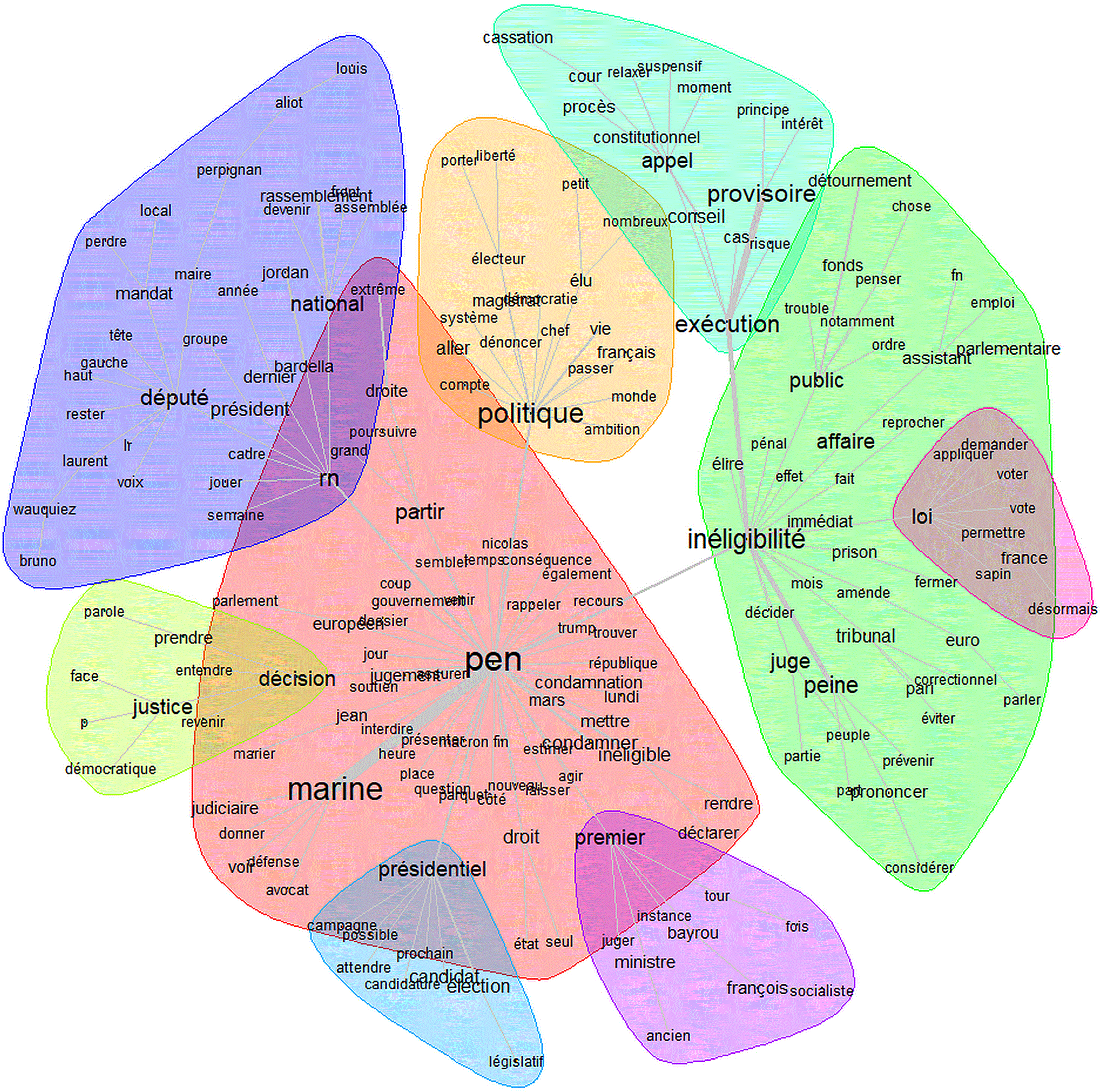
Figure 1. Similarity graph produced with IRaMuTeQ for the corpus of 45 French press articles.
The method, derived from graph theory, represents the corpus as a network in which nodes are lemmas and edges indicate co-occurrence within elementary context units. Node size is proportional to lemma frequency; edge thickness and the numeric edge labels indicate the number of co-occurrences; the layout is generated with the Fruchterman–Reingold algorithm. Shaded areas mark distinct lexical communities and their colours are assigned by the software without evaluative meaning; overlapping shading indicates lemmas shared between adjacent communities. The principal groupings are: a blue party-political community (rn, député, mandat, bardella, jordan, aliot, national
); an adjacent orange community of general political vocabulary (politique, système, démocratie, électeur, liberté); a large light-green judicial community (inéligibilité, juge, peine, amende, prison, affaire, public) enclosing a darker green sub-community (exécution, tribunal, conseil
); a turquoise procedural community (appel, cassation, procès, cour, provisoire, suspensif
); a light-blue electoral community (élection, candidat, présidentiel, campagne); a red community centred on the protagonist and party reactions (pen, marine, condamner, inéligible, macron); and smaller communities covering other political figures (françois, bayrou, premier, ministre) and normative vocabulary (
justice, décision, démocratique). Grammatical words are excluded. RN = Rassemblement National.
The graph is organised into several lexical communities, marked by shaded areas whose colours are assigned by the software and carry no evaluative meaning. Four of them are directly relevant to our analysis:
- A blue community is linked to the specifically partisan and parliamentary aspects, with words such as rn, député, mandat and national, and the names of political personalities (bardella, jordan, aliot);
- This community is close to, and partly overlaps with, another political area in orange, with more general words (politique, français, électeur, système, démocratie): a part of the articles generalises the case to political aspects;
- The two green communities present the words of law and justice, such as inéligibilité, juge, peine, amende and tribunal, the darker one being organised around the sentence itself (exécution, conseil, correctionnel
): they present the case as an “affaire”;
- The large red community, linked to smaller ones, is centred on Marine Le Pen and the RN’s reactions (pen, marine, condamner, inéligible, macron).
Taking the frequencies into account, this representation is completed with the CHD, whose dendrogram is presented in
Figure 2 and whose classes are developed in
Table 2.
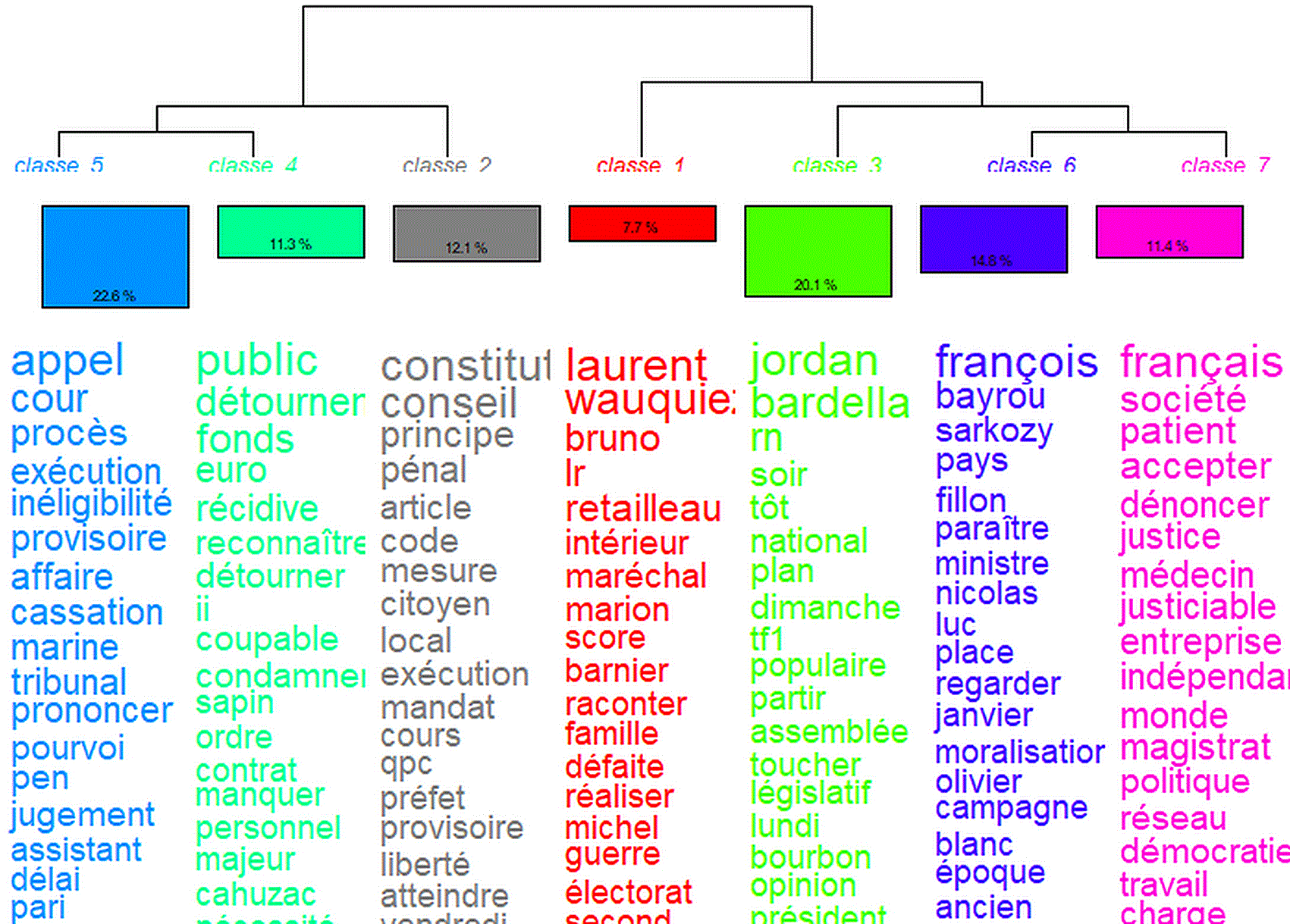
Figure 2. Dendrogram of the descending hierarchical classification (DHC, Reinert method) computed with IRaMuTeQ on the corpus of 45 French press articles.
Successive binary partitions of a presence/absence matrix of lemmas, based on correspondence analysis, yield seven classes; classes joining at a lower branching level share more vocabulary than classes joining higher up. Each class is shown with its colour code, its share of classified text segments, and its most characteristic lemmas ranked by chi2 association with the class. The root divides the corpus into two branches: a political and actor-oriented branch grouping Classes 6, 7, 3 and 1, and a legal, institutional and normative branch grouping Classes 4, 5 and 2. Class numbers and colours are assigned by the software and indicate neither rank nor importance. The classes are described in full in
Table 2. RN = Rassemblement National; TF1 = Télévision Française 1; L. R = Les Républicains; QPC = question prioritaire de constitutionnalité.
Table 2. Results of the descending hierarchical classification (DHC, Reinert method) computed with IRaMuTeQ on the corpus of 45 French press articles.
The procedure partitions text segments by lexical co-presence and yields seven classes. For each class the table reports its approximate weight as a percentage of classified segments, its most characteristic lemmas (ranked by chi2 association with the class), and an interpretive summary of its thematic focus. Class 5 is the largest (~22.6%), followed by Class 3 (~20.1%), Class 6 (~14.8%), Class 2 (~12.1%), Class 7 (~11.4%), Class 4 (~11.3%) and Class 1 (~7.7%). Class numbers are assigned by the software and indicate neither rank nor importance. Lemmas are lowercased as output by IRaMuTeQ; détourner appears twice in Class 4 in the software output. RN = Rassemblement National; L. R = Les Républicains; TF1 = Télévision Française 1; QPC = question prioritaire de constitutionnalité. The corresponding dendrogram is shown in
Figure 2.
| Approximate weight (%) | Class | Key words | Focus on |
|---|
| large | Class 3 (~ 20.1%) | jordan, bardella, rnr, soir, tôt, national, plan, dimanche, populaire, partir, assemblée, toucher, législatif, lundi, bourbon, opinion, président
| Political/electoral themes: leadership (Jordan Bardella), legislative/assembly, dates/times (Sunday, Monday), national/popular, planning.
Parts of the texts about political actors, electoral schedules or political events. |
| the largest | Class 5 (~ 22.6%) | appel, cour, procès, exécution, inéligibilité, provisoire, affaire, cassation, marine, tribunal, prononcer, pourvoi, jugement, assistant, délai, pari
| Judicial/legal procedures: trials, courts, ineligibility, appeals, judgments: the “law/justice” dimension of the discourse about Marine Le Pen. |
| quite significant | Class 6 (~ 14.8%) | françois, bayrou, sarkozy, pays, fillon, paraître, ministre, nicolas, luc, place, regarder, janvier, moralisation, olivier, campagne, blanc, ancien
| Other politicians, campaign, moralization of politics: comparisons, opposition, the political landscape beyond just Le Pen — how other politicians/parties are involved. |
| smaller | Class 7 (~ 11.4%) | société, patient, accepter, dénoncer, justice, médecin, justiciable, entreprise, indépendant, monde, magistrat, politique, réseau, démocratie, travail, charge
| Societal/ethical themes: justice, society, complainants, moral/ethical claims, democracy, networks, social values.
Commentary or opinion, critiques, discussions of justice as principle. |
| more specific/narrower | Class 1 (~ 7.7%) | laurent, wauquiez, bruno, l.r, retailleau, intérieur, maréchal, marion, score, barnier, raconter, famille, défaite, réaliser, michel, guerre, électorat, second
| Rivalries among political actors, electoral score, defeat, narrative, identities.
Pieces that discuss or compare other leaders, internal politics, election results. |
| mid-size
| Class 4 (~ 11.3%) | public, détourner, fonds, euro, récidive, reconnaître, détourner, coupable, condamner, sapin, ordre, contrat, manquer, personnel, majeur, cahuzac
| Financial wrongdoing/corruption: embezzlement, public funds, culpability, high-profile cases (e.g. “Cahuzac”), condemnation.
The legal accountability of financial misdeeds. |
| mid-size
| Class 2 (~ 12.1%) | constitution, conseil, principe, pénal, article, code, mesure, citoyen, local, exécution, mandat, cours, qpc, préfet, liberté, mandat, conseil, article
| Constitutional/legal framework: principles, constitutional council, articles of law, citizen rights, mandates, liberty, judicial-constitutional measures.
More abstract/normative legal parts of texts. |
As
Figure 2 and
Table 2 show, the dendrogram groups the classes at different distances: some are lexically very close, others more distant. This suggests some themes are more interlinked, and some more isolated. There appear to be two main “branches” in the corpus:
- Legal/institutional/normative branch — includes classes like Class 5 (trial, court, legal procedure), Class 2 (constitution, law, principles), Class 4 (financial wrongdoing), and perhaps others. These deal with institutions, legality, rights, and justice.
- Political/actor-oriented/electoral branch — includes classes like Class 3 (actors, parliamentary, elections), Class 6 & 1 (other political personalities, campaign, comparison, competition), Class 7 (society, moral dimension), etc.
The fact that the class about legal procedure (Class 5) is the biggest suggests that the articles are mainly dealing with the legal consequences of the event. Indeed, a large part of the texts are focused on trials, legal status, judgments involving Marine Le Pen (or associated actors). Discussions of ineligibility, appeals, etc., are central. We also note that politics and elections remain very present: beyond legal problems, texts are also significantly concerned with political actors, electoral strategy, how actors relate to each other, public/political opinion, leadership, positioning. In this perspective, corruption/financial scandal is a significant theme: the presence of a class associated with embezzlement or misuse of funds suggests that these scandals form a key part of the narrative or critical discourse. Regarding this scandal, norms, rights, constitutional/legal frameworks are part of the debate: the discourse is not just about concrete events or personalities — it includes reflections on rights, law, constitutional principles, citizen status, and legal measures. Beyond legal and political aspects, a moral and societal dimension is also present. The class associated with terms such as society, justice, and democracy includes passages that move beyond the reporting of legal or political facts to discuss broader values and, at times, criticisms of the system or of institutions. And at the end, the articles made comparisons and contrasts with other politicians/parties: many texts situate Le Pen within a broader political field, comparing her to Fillon, Sarkozy, and others. This helps understand public perception, competition, and positioning.
In summary, the corpus reveals that discussions around Marine Le Pen are multi-faceted, but that legal and judicial lenses are extremely prominent. The way journalists write about the affair strongly involves courts, ineligibility, trials, and these elements are almost as central as the political dimension.
3.3 Analytical Procedures: Case Frames and Contestation of Institutional Terms
We used Hyperbase to extract concordance lines for each lemma and to generate the collocation/theme maps and indices de spécificité tables (window ±5 tokens; function words ignored). The Hyperbase exports then served as our coding base for functional vs. evaluative uses, after filtering homographs and purely nominal labels.
Due to the ambivalent presentation of Marine Le Pen and the affair and the emerging challenge to institutional terms in the corpus —where coverage alternates between procedural reporting on a criminal case and political framing of the ruling as a threat to democratic participation or electoral competition—, we decided to analyze French press coverage of Marine Le Pen’s condemnation along two coordinated tracks. First, we model the framing of the case by extracting every occurrence of Pen (the surname token used by the tool) and affaire, and then disambiguating them by rule: Pen is counted when it unmistakably refers to Marine Le Pen (signals include Marine/Mme/Madame/présidente du RN; references to Jean-Marie/Marion/Maréchal/Yann are excluded unless the line explicitly contrasts or metonymically links the dynasty—those are then coded as party-metonymic). Affaire1 is treated as a neutral file label when it merely names a dossier (“affaire des assistants …”), but as framing when it scandalizes and/or historicizes by chaining to other cases (Fillon, Cahuzac, MoDem), or when it forecasts political shock. Each eligible line is coded into a small set of case frames: (R1) defendant/justiciable (sentence, exécution provisoire, appel/cassation, voies de recours); (R2) electoral actor (candidacy, head-to-head scenarios, voter movement); (R3) party role/metonymy (leader as RN persona, strategy meetings, parliamentary choreography). When the line moves from describing to judging, we attach an evaluative sub-frame: (E1) victimization/persecution (“peine de mort politique”, “éliminer”); (E2) culpability/moral blame (“volé”, “système bien huilé”, bénéfices aux proches); (E3) strategy/tactics (gain de temps, contre-offensive médiatique, Strasbourg/CEDH); (E4) threat/foil (danger pour la démocratie/ordre public); (E5) performance/affect (gestes, posture, “zen/révoltée”).
Second, we trace the discursive reframing of institutional terms by extracting every occurrence of the lemmas République, droit, justice, démocratie,
and démocratique (including the bigram État de droit), together with their immediate concordances. Homographs are excluded (e.g., bras droit ≠ droit), and proper names used purely as labels (e.g., Union des droites pour la République) are treated as neutral designations. For each lemma we distinguish functional uses—naming offices, frameworks, procedures or rights (e.g., président de la République; décision de justice; droit de/au/à; doctrinal labels such as droit pénal
)—from contested uses that redeploy the term to legitimize or delegitimize actors and decisions (appeals to rule of law/separation of powers; charges of justice politique; personifications such as “tuer la République”, “la démocratie vacille”). We refine per lemma where needed: for République we additionally mark electoral uses tied to eligibility; for droit we separate rights-claims from doctrinal/procedural mentions; for adjectival démocratique we code either as institutional qualifier (vie/ordre public/jeu démocratique), legitimizing qualifier within an État de droit démocratique, or delegitimizing label (scandale/problème/trouble démocratique). Across both tracks, the unit of analysis is the occurrence (we keep duplicates when they appear in the corpus), each line is coded with a brief justification, and we triangulate that close reading against the tool’s theme (collocation) map and specificity table for the node, ignoring function words interpretively.
We only advance an interpretive claim when the concordance reading and at least one collocational signal converge. Counts reported in the results are raw occurrence totals, with deduplicated roll-ups available for robustness. This design makes clear how a proper name (Pen) and a scandal label (affaire) structure the case frame, while institutional lemmas show how the same event is reframed to stabilize, contest, or appropriate democratic legitimacy.
4. Discursive Framing of the Case
4.1 Marine Le Pen as Discursive Figure
As expected, the theme map of the node Pen (
Figure 3) shows that it is primarily tied to Marine, and the specificity scores confirm that the surname resolves to the contemporary candidate rather than the family in general. The analytically interesting part lies in the co-texts
that travel with it: a legal–electoral bundle (inéligible, condamnée/condamnation, se présenter, présidentielle/2027), a dynastic strand (Jean-Marie, Maréchal/Marion, fille) and register markers (Mme/Madame), plus a rule-of-law frame (Respect, lois/voté) that often counterpoints victimization claims. Cross-references to Sarkozy/Nicolas further normalize the case by placing it within a lineage of right-wing “affaires.” In short, the value is not the obvious identity link, but how that link is framed—juridified, electoralized, and personalized all at once.
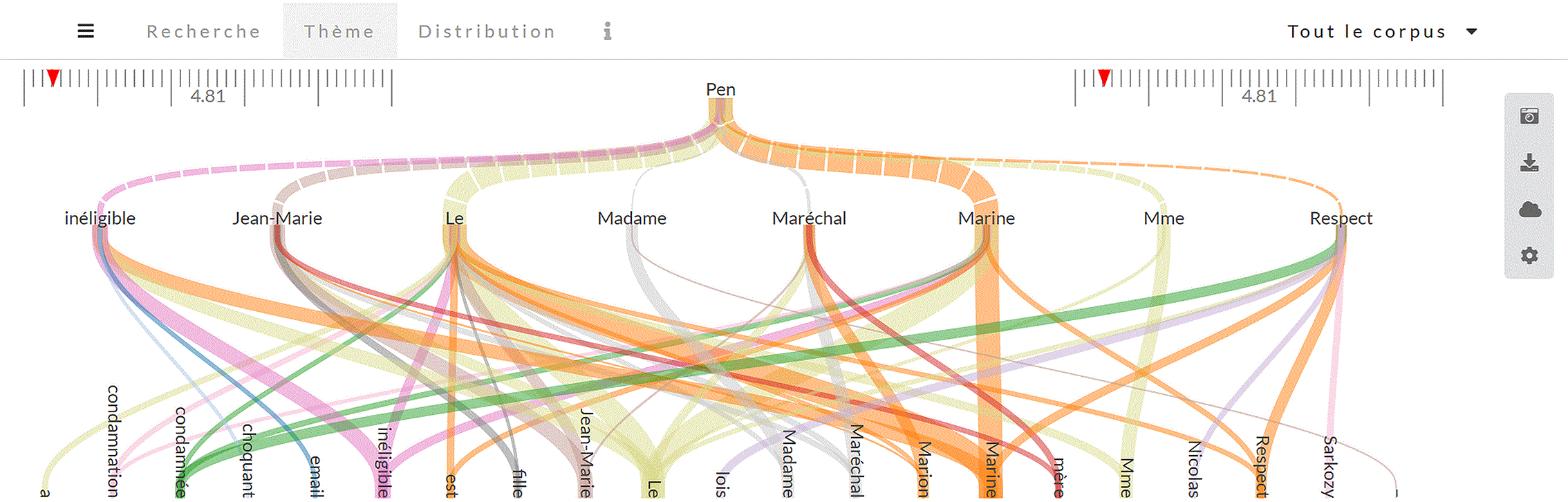
Figure 3. Theme map generated with Hyperbase Web for the node Pen.
The map displays specific co-occurrents rather than raw frequencies: values are specificity scores measuring the statistical overrepresentation of each item in the contexts of the node relative to its distribution across the whole corpus, and link thickness is proportional to the score. The upper row shows the direct specific co-occurrents of the node (inéligible, Jean-Marie
, Le, Madame, Maréchal, Marine, Mme, Respect); the lower row shows poly-co-occurrences computed within the passages containing both the node and one of its direct co-occurrents (condamnation, condamnée, choquant, email, fille, lois, Marion, mère, Nicolas, Sarkozy, among others). Only items above the specificity value indicated on the sliders at the top of the map are displayed. The map combines a legal strand (inéligible, condamnation, condamnée), a dynastic strand (Jean-Marie
, Maréchal, Marion, fille, mère), register markers (Mme, Madame), a rule-of-law strand (Respect, lois), and cross-reference to another figure facing prosecution (Nicolas Sarkozy).
These distributional cues match the concordance coding: most mentions are functional—either legal/defendant (sentence, exécution provisoire, appel/cassation, voies de recours) or electoral (eligibility, candidacy scenarios, head-to-head frames with Macron, base of “11 millions d’électeurs”). A sizable secondary bloc is party-metonymic (Le Pen as the RN’s organizing persona, choreography around Bardella and parliamentary tactics). The contested uses split between victimization (éliminer, “peine de mort politique”, cabale), culpability (volé, “système bien huilé”, faire bénéficier des proches), strategy (gain de temps, contre-offensive médiatique, Strasbourg) and performance/affect (gestures in the Assembly, “La République m’appelle”, “zen/révoltée”). In short, Pen functions as a switchboard where a proper name is simultaneously juridified, electoralized, and personalized; it is the handle through which the press narrates both the legality of a sanction and the struggle over democratic legitimacy—whether framed as respect for the law or as the attempted neutralization of a contender.
4.2 Affaire
The theme map for affaire (
Figure 4) is overwhelmingly case-bound: the only lexical items it retains are the components of the dossier itself---assistants, eurodéputés, parlementaires, européens, (emplois) fictifs---together with a single link to another French political-financial case, Cahuzac. The specificity scores confirm this anchor, assistants being by far the most distinctive associate, with FN/RN and Front/Rassemblement close behind. Below the display threshold of the map, the scores reveal two further strands. The first is a spine of procedural and legal markers---rend, délibéré, appel, relaxé, coupable, détournement, fonds publics---which frames affaire as a technical judicial object. The second extends the comparative logic that Cahuzac already signals on the map: the associates Fillon, MoDem, Sarkozy and Rachadi Saindou index precedent-building, i.e., journalists situate the case within a chain of French political affairs. Lower-scoring but telling associates---inéligibilité, disqualification, traîne---link the dossier to electoral consequences and tempo critiques. These patterns mirror our coding totals (Functional 41 vs. Contested 13): most mentions are referential or procedural (case label, stages, qualifications), and affaire becomes contested chiefly when it is moralized as scandal or reframed for political/electoral impact (“from a financial affair to a political disqualification”) or when actors weave metadiscursive linkages among affairs to suggest politicization (“Après l’affaire Fillon, qui a percuté la campagne présidentielle de 2017”). In short, affaire functions as the corpus’ legal anchor—a neutral label that organizes facts and procedures—while also serving as a relay through which commentators translate judicial developments into narratives of scandal, precedent, and consequences for eligibility and the party system.
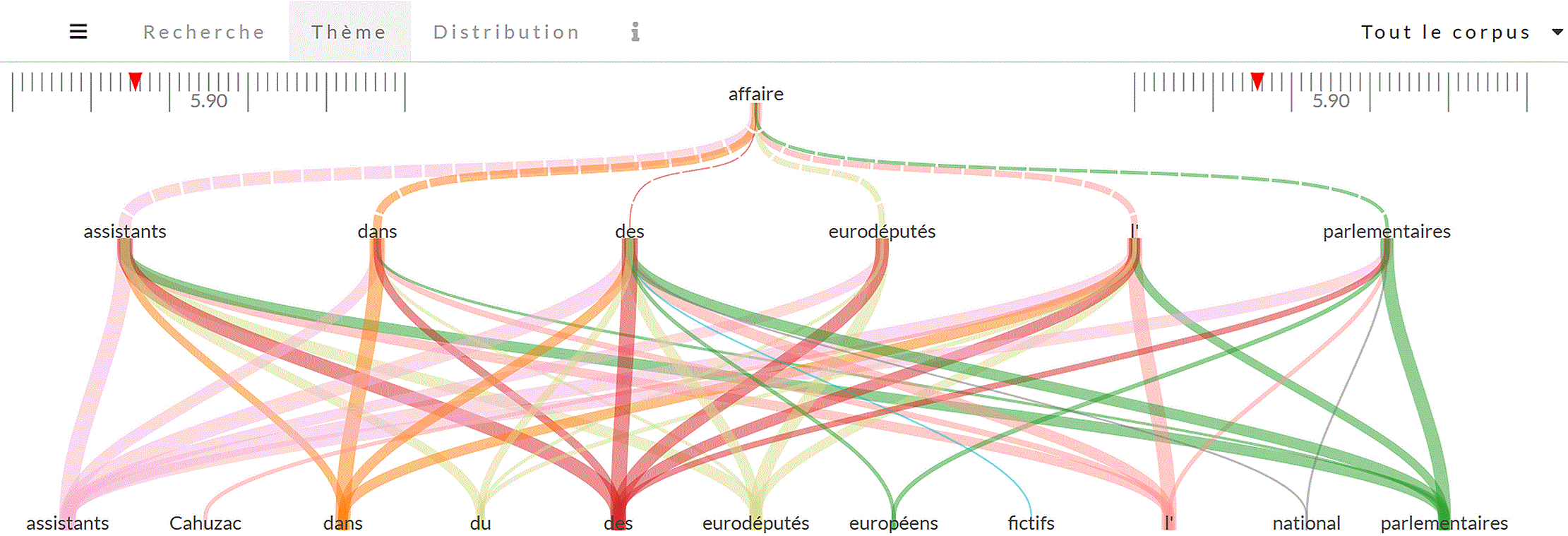
Figure 4. Theme map generated with Hyperbase Web for the node affaire.
Values are specificity scores rather than raw frequencies, measuring the statistical overrepresentation of each item in the contexts of the node relative to the corpus as a whole; link thickness is proportional to the score. The upper row shows the direct specific co-occurrents of the node (assistants, dans, des, eurodéputés, l’, parlementaires); the lower row shows poly-co-occurrences computed within passages containing both the node and one of its direct co-occurrents (assistants, Cahuzac, du, eurodéputés, européens, fictifs, national, parlementaires). Only items above the specificity value indicated on the sliders at the top of the map are displayed. The map is almost entirely case-bound, anchoring affaire to the fictitious-employment dossier (assistants, eurodéputés, parlementaires, européens, fictifs), with a single precedent-building link to another French political-financial case (Cahuzac). Grammatical items (dans, des, du, l’) are retained in the display.
5. Discursive Reframing of Institutional Terms
5.1 Justice
The collocation map for justice (
Figure 5) centres on décision/décisions (with the formulaic la/une justice) and branches toward régime (linked to démocratie/démocratique and, at the polemical edge, totalitaire) as well as a metadiscursive cluster around commenter/ne … –on/−il/fréquemment/quel. In other words, the map visualizes a public argument about whether and how one may comment on judicial decisions and what this implies for a democratic regime. The specificity table backs this up: décision(s) and la are the most distinctive companions, while items such as nom, intouchable, commenter, vacille, totalitaire index competing evaluations of judicial authority. Our concordances align with this structure: of 77 occurrences coded, contested uses dominate (55/77), split between delegitimizing narratives (33/77: justice à charge/politique/laxiste, engorgement, calls for justice to “se hâter”, or metaphors like “la justice devient une arme”, “a flingué la campagne”) and legitimizing counters (21/77: independence, separation of powers, the norm of not commenting decisions, “justice est rendue”). Functional mentions are fewer (22/77) and mostly procedural or institutional (décision de justice, jugera, a reconnu coupable, palais de justice, a prononcé). Taken together, the image (relations) and the statistics (distinctiveness) show that justice appears less as a neutral apparatus than as a contested arena where its independence, remit and tempo are argued over—making it a key site where the legitimacy of Marine Le Pen’s condemnation, and of democratic rule itself, is stabilized or challenged.
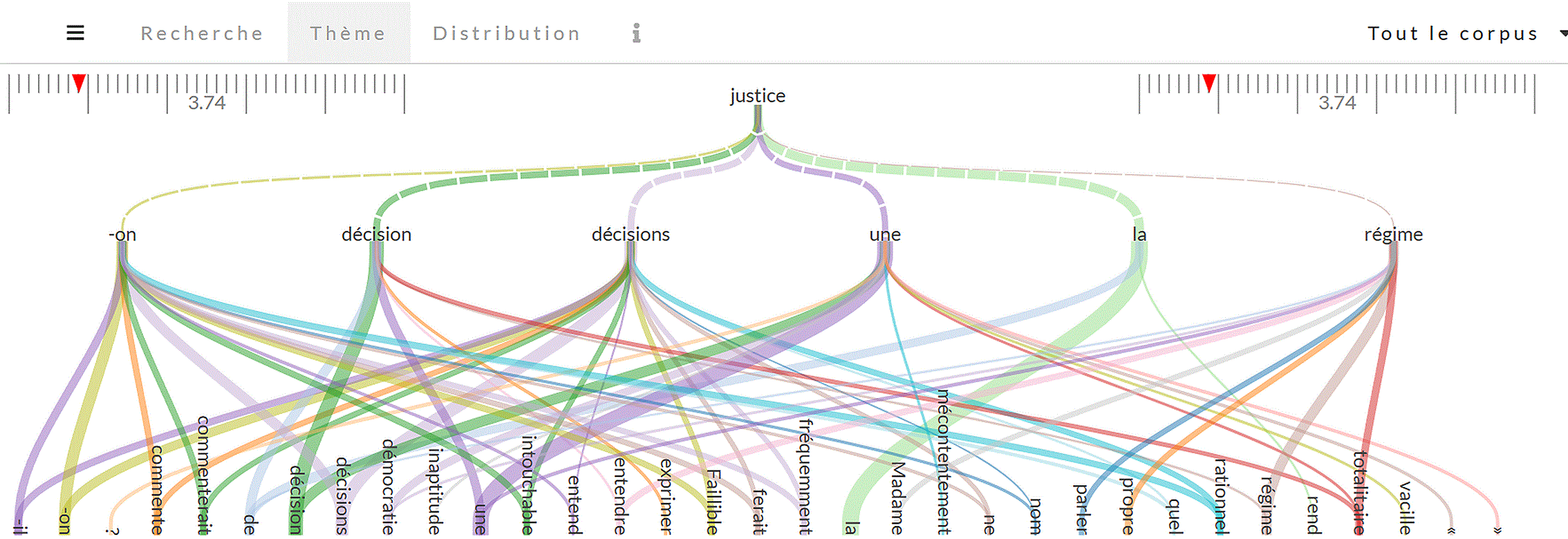
Figure 5. Theme map generated with Hyperbase Web for the node justice.
Values are specificity scores rather than raw frequencies, measuring the statistical overrepresentation of each item in the contexts of the node relative to the whole corpus; link thickness is proportional to the score. The upper row shows the direct specific co-occurrents of the node (−on, décision, décisions, une, la, régime); the lower row shows poly-co-occurrences computed within passages containing both the node and one of its direct co-occurrents. Only items above the specificity value indicated on the sliders at the top of the map are displayed. The map centres on décision/décisions and branches toward régime, itself linked to démocratie and, at the polemical edge, to totalitaire. A metadiscursive cluster (−on, commente, commenterait, entend, entendre, exprimer, parler, fréquemment, quel, nom) stages the question of whether judicial decisions may be publicly commented upon, while intouchable, faillible, inaptitude, mécontentement, rationnel and vacille index competing evaluations of judicial authority. Grammatical items (une, la, de, ne, −on) are retained in the display; −on marks post-verbal subject inversion.
5.2 Démocratie
The collocation map for démocratie (
Figure 6) splits the field between defence and crisis. On one side sit piliers (as in “le droit de vote … pilier de notre démocratie”), justice/indépendante, protéger, and fonctionnement, which frame democracy normatively and procedurally; on the other side cluster vacille, totalitaire, déni, dépasser (le cadre) and partisans, which stage democracy as threatened or confiscated. The specificity table sharpens this picture: Poutine is the most distinctive associate, used as an external foil to define or discredit “our” democracy; fonctionnement points to regime-definition talk (what a democracy is/does), piliers ties democracy to voting rights, while vacille and totalitaire carry the crisis and moral-drama register. Our coded concordances match this structure almost one-for-one: uses are nearly evenly split between legitimizing invocations (12/25: protéger la démocratie, propre d’une démocratie d’avoir une justice indépendante, bon fonctionnement) and delegitimizing/crisis framings (11/25: déni/confiscation de la démocratie, la démocratie vacille), with a smaller procedural strand (1/25, access to voters) and a single sovereigntist appeal to “the people” (1/25). In short, démocratie behaves not so much as a neutral descriptor as an evaluative battleground articulated with justice and droit: alternately upheld as a principle and dramatized as a victim, occasionally personified (la démocratie vacille) and, at the margins, claimed in the name of popular sovereignty.
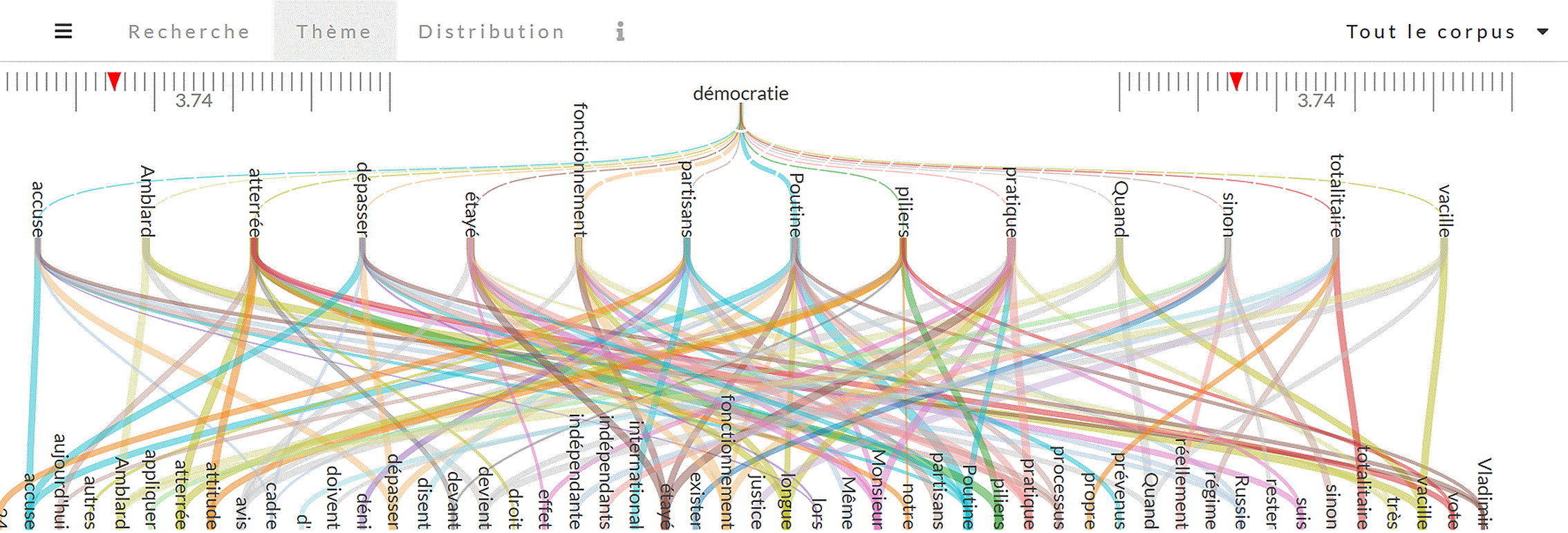
Figure 6. Theme map generated with Hyperbase Web for the node démocratie.
Values are specificity scores rather than raw frequencies, measuring the statistical overrepresentation of each item in the contexts of the node relative to the corpus as a whole; link thickness is proportional to the score. The upper row shows the direct specific co-occurrents of the node (accuse, Amblard, atterrée, dépasser, étayé, fonctionnement, partisans, Poutine, piliers, pratique, Quand, sinon, totalitaire, vacille); the lower row shows poly-co-occurrences computed within passages containing both the node and one of its direct co-occurrents. Only items above the specificity value indicated on the sliders at the top of the map are displayed. The map opposes a normative and procedural register (fonctionnement, piliers, indépendante, indépendants, justice, droit, processus, cadre) to a crisis register (vacille, totalitaire, déni, dépasser, atterrée, accuse, partisans). Poutine, with Vladimir and Russie, functions as an external foil against which democracy is defined or discredited; Amblard and Monsieur are traces of attributed speech. Grammatical items (d’, lors, très, autres, Même) are retained in the display.
5.3 Démocratique
The collocation map (
Figure 7) shows démocratique working as a norm-setting qualifier rather than a free-standing judgment. It attaches to institutional heads—vie, ordre public, société, and to meta-legal talk around décisions—while a metadiscursive strand (−on, commenterait, quel, rationnel, nom, fréquemment) stages the question of how one should speak/act in a democratic order (e.g., “au nom de quel principe démocratique … ne commenterait-on pas les décisions de justice?”). The specificity table reinforces two poles: (1) legitimizing/authorizing uses (ordre public démocratique, État de droit démocratique, principe démocratique) that define acceptable constraints; and (2) crisis labels—scandale, problème, trouble (majeur)—that diagnose departures from those norms. Our concordances fit this structure: out of the lines coded here, delegitimizing/crisis labels are most frequent (9), followed by institutional qualifiers (7) and legitimizing uses (6), with a single sovereigntist appeal linking democracy to “the people.” Démocratique, therefore,
functions as a switching adjective: it either authorizes procedures and limits by naming the order as “démocratique,” or condemns actions by branding them a “scandale/problème démocratique,” thereby relocating political disagreement onto the normative horizon of democracy itself.
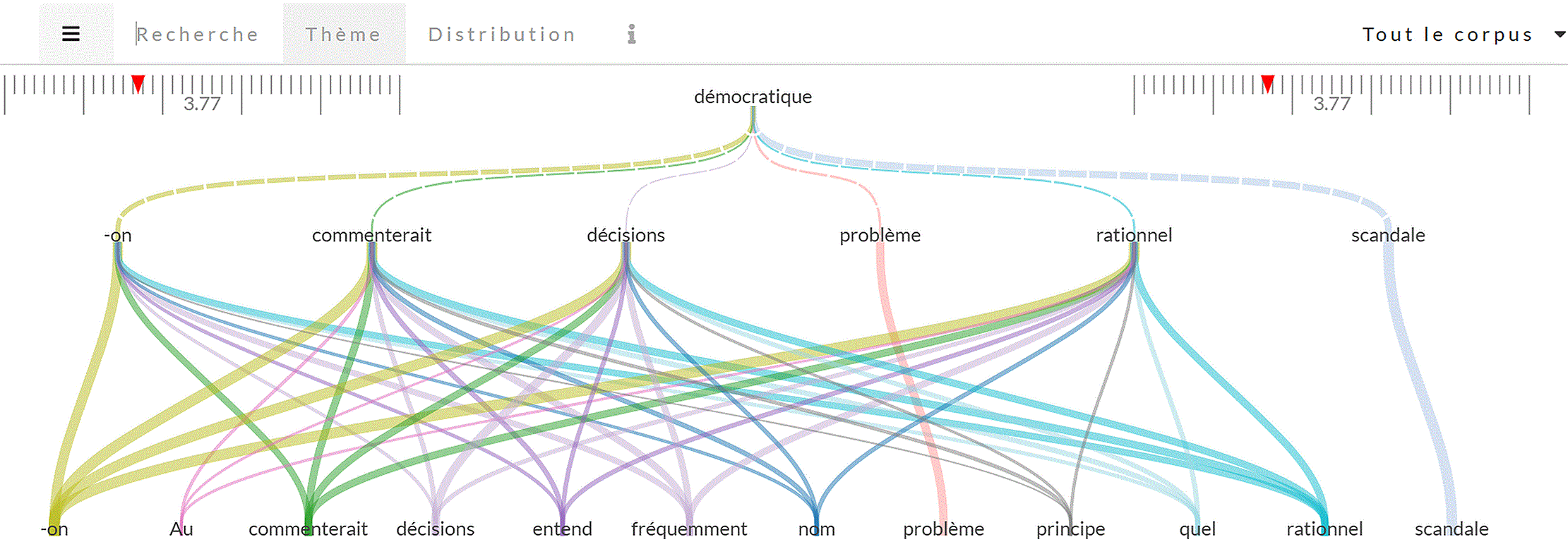
Figure 7. Theme map generated with Hyperbase Web for the adjectival node démocratique.
Values are specificity scores rather than raw frequencies, measuring the statistical overrepresentation of each item in the contexts of the node relative to the whole corpus; link thickness is proportional to the score. The upper row shows the direct specific co-occurrents of the node (−on, commenterait, décisions, problème, rationnel, scandale); the lower row shows poly-co-occurrences computed within passages containing both the node and one of its direct co-occurrents (Au, entend, fréquemment, nom, principe, quel, alongside the same six items). Only items above the specificity value indicated on the sliders at the top of the map are displayed. Two poles are visible: an authorising pole in which the adjective qualifies a norm or standard (principe, rationnel, décisions), and a crisis pole in which it labels a departure from that norm (scandale, problème). The metadiscursive strand (−on, commenterait, quel, au nom de, fréquemment) stages the question of how one may legitimately speak about judicial decisions in a democratic order; −on marks post-verbal subject inversion.
5.4 (État de) Droit
The collocation map for droit (
Figure 8) displays a clear two-pole structure. The strongest stream runs to État/Etat, confirming that droit is constantly articulated through the rule-of-law frame; a second cluster organizes around éligibilité/recours, which ties legal language directly to the electoral stakes of the case. The specificity table amplifies this: État/Etat is by far the most distinctive associate, while saurait marks juridical constraint formulas (“ne saurait …”), and nouveau indexes doctrinal extensions (e.g., “droit constitutionnel éthique”). Concordance coding aligns with this picture: uses are almost evenly split between functional references (≈ 30/58)—dominated by rights-claims (droit d’éligibilité, droit au recours, droit de vote) alongside procedure and doctrine—and contested uses (≈ 28/58), where legitimizing invocations of the rule of law (“les juges font du droit”, séparation des pouvoirs) slightly outweigh delegitimizing narratives (“État de droit violé”, juges “tyrans” qui “exécutent” le droit). Occasional metaphors (“droit de vie ou de mort”, “exécutent l’État de droit”) personify law to dramatize conflict. Taken together, droit functions both as a technical anchor for legal discussion and as a normative battleground where democratic legitimacy is defended or attacked—bridging judicial reasoning with the political struggle over Marine Le Pen’s eligibility and the meaning of the État de droit.
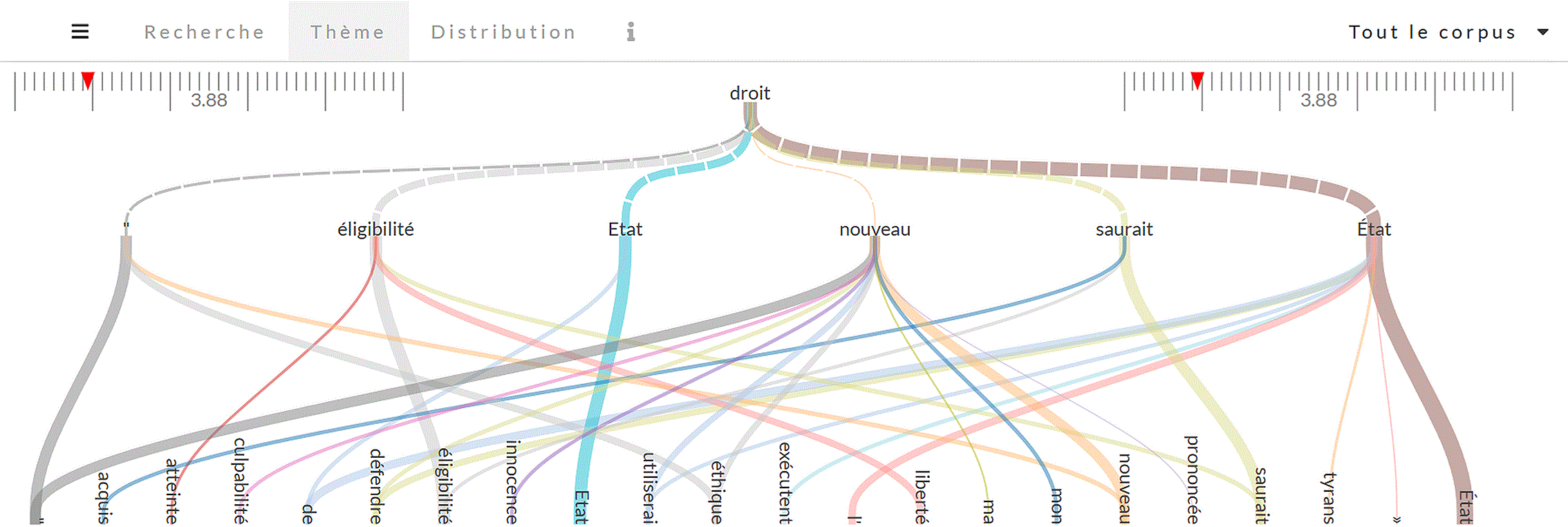
Figure 8. Theme map generated with Hyperbase Web for the node droit.
Values are specificity scores rather than raw frequencies, measuring the statistical overrepresentation of each item in the contexts of the node relative to the corpus as a whole; link thickness is proportional to the score. The upper row shows the direct specific co-occurrents of the node (éligibilité, Etat, nouveau, saurait, État); the lower row shows poly-co-occurrences computed within passages containing both the node and one of its direct co-occurrents (acquis, atteinte, culpabilité, défendre, innocence, éthique, exécutent, liberté, prononcée, tyrans, among others). Only items above the specificity value indicated on the sliders at the top of the map are displayed. The strongest streams run to État/Etat, confirming that droit is articulated chiefly through the rule-of-law frame, while éligibilité ties legal vocabulary to the electoral stakes of the case. Saurait marks impersonal juridical constraint formulas (“ne saurait … “), nouveau and éthique index doctrinal extensions, and tyrans and exécutent mark polemical personifications of the judiciary. État and Etat appear as separate items because the corpus contains both accented and unaccented spellings. Homographs (e.g. bras droit) were excluded from the analysis.
5.5 République
The collocation map for République (
Figure 9) shows a dual profile. First, the term is anchored in functional uses—both institutional (clustering with président and Ve, and appearing in rule-based mentions of the presidency and constitutional reforms) and electoral (with élue/présidence/présidente marking the electoral arena). Our coded concordances (n = 22) confirm this core: Institutional references dominate (9/22: président de la République; Ve République; the 2008 reform on presidential terms), and Electoral uses are frequent (4/22: être élue présidente de la République; rendre inéligible; concourir pour la présidence). Second, the specificity table shows how République is pulled into evaluative and performative uses: exemplaire and mœurs signal legitimizing appeals (4/22 in our concordances: la République devrait remercier; les élus … respectent les lois; purifier les mœurs; largesses de la République), while items like tuer and moi point to delegitimization and personification (3/22: la République exemplaire a été un vœu pieux; tuer la République; peut-on encore parler de République?; and 2/22 personified claims: « La République m’appelle », « La République, c’est moi! »). Mentions of Union/droites/Ciotti appear in the map because they co-occur, but in our concordances they are neutral namings of a parliamentary group and thus coded as institutional, even though their very labels hint at the politicized environment in which the signifier circulates. Taken together, the image (relational structure) and the table (statistical distinctiveness) show that République oscillates between functional uses (institutional and electoral) and contested uses (legitimized, delegitimized, personified), a pattern that the concordances ground in context and polarity. This confirms République to be a discursive site where democratic authority is stabilized, challenged, and occasionally appropriated.
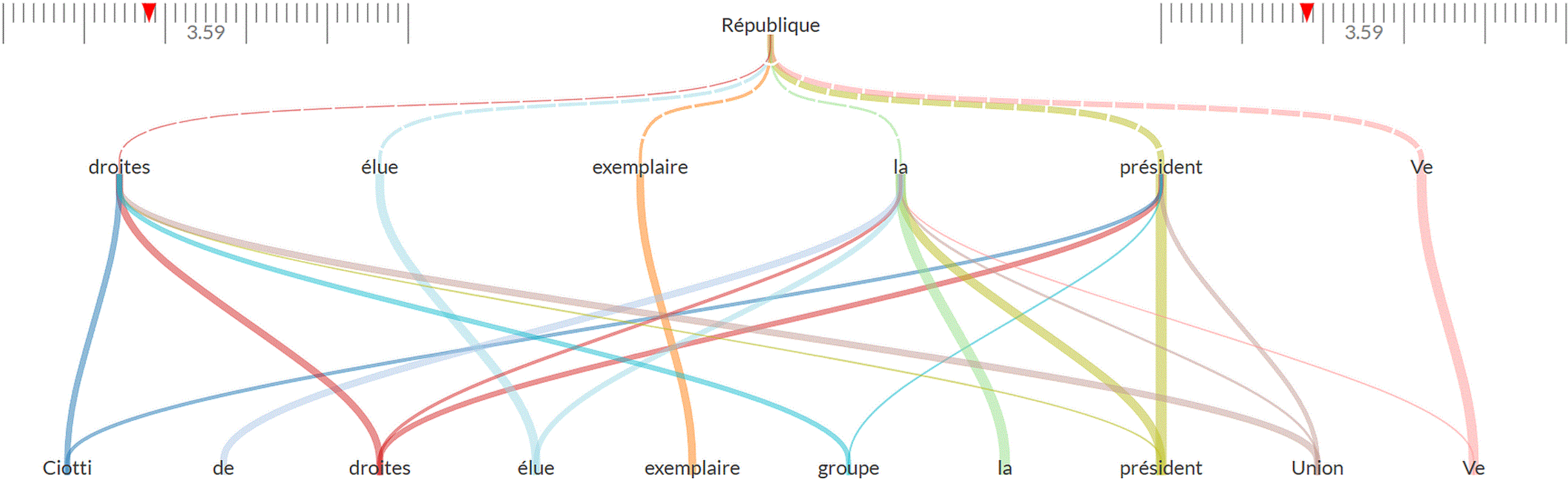
Figure 9. Theme map generated with Hyperbase Web for the node République.
Values are specificity scores rather than raw frequencies, measuring the statistical overrepresentation of each item in the contexts of the node relative to the whole corpus; link thickness is proportional to the score. The upper row shows the direct specific co-occurrents of the node (droites, élue, exemplaire, la, président, Ve); the lower row shows poly-co-occurrences computed within passages containing both the node and one of its direct co-occurrents (Ciotti, de, droites, élue, exemplaire, groupe, la, président, Union, Ve). Only items above the specificity value indicated on the sliders at the top of the map are displayed. The map shows a dual profile: an institutional and electoral anchoring (président, Ve, élue) alongside an evaluative use in which exemplaire signals appeals to republican probity. Union, droites, groupe and Ciotti co-occur as components of the parliamentary group name Union des droites pour la République, treated in the concordance coding as a neutral designation. Grammatical items (la, de) are retained in the display.
6. Discussion: How the Case Frame and Institutional Lexicon Co-Produce Meaning
The corpus is structured around two intertwined processes. First, the framework of the case is constructed through Le Pen and the affair; second, the fundamental institutional signifiers (justice, droit/État de droit, démocratie/démocratique, République) are incorporated into this backbone and re-semanticized, sometimes as functional descriptors, often as evaluative instruments. In these evaluative uses, institutional language can contribute to the delegitimization of Le Pen, while in other passages it is mobilized to contest the legitimacy of the judicial decision itself. This is a well-documented configuration in French political journalism when a leader becomes the focus of a legal news story: personalization links the person to the case. At the same time, the journalistic presentation of the case presents its proceedings, but also the political polls and the party’s ‘choreography’ (Campus 2017; Dakhlia 2018). In the mainstream media, this personalization intersects with the public relations master frames already created around Marine Le Pen, so that the leader’s legality and image are narrated together (Snipes and Mudde 2020).
In our concordances, “Le Pen” consistently appears in three roles: (1) justiciable, as a person subject to judicial procedure (verdicts, appeals, exécution provisoire); (2) electoral actor, discussed through eligibility, candidacy, and 2027 match-ups; and (3) party metonym, where her name stands for the RN’s organization and parliamentary choreography. Around these roles, four controversy clusters recur—victimization, guilt, strategy, and performance/affect—and they are carried chiefly by attributed speech (politicians, lawyers, allies, opponents) rather than by the reporter’s narrative voice, mirroring the frame–source dynamics documented for the French press (Jebril and El Bouzidi 2024). The circulation of petites phrases across media—short, quotable lines that travel and reframe cleavages—further sustains these controversies (Al-Matary and Gaboriaux 2018), which helps fuse legal and electoral storylines.
A further dimension emerging from the corpus is the moralization of institutional language. References to justice, democracy, or the Republic frequently move beyond procedural description and enter the terrain of moral evaluation. In these passages, Marine Le Pen, her political allies, and her opponents are positioned not only as competitors in an electoral arena but as figures whose actions are interpreted in relation to fundamental democratic norms. In this sense, processes of resemanticization—where institutional terms such as justice, démocratie, or République acquire evaluative and polemical meanings—may contribute to a subtler form of enemization. Rather than constructing Marine Le Pen directly as an “enemy” through explicit denunciation, the discourse often moralizes the institutional order itself, presenting the case as a test of democratic integrity. Within such a framework, political actors are implicitly divided between those portrayed as defending the rule of law and those accused of undermining it. Enemization therefore operates less through direct hostility than through the moral framing of institutional principles and their alleged violation.
Affaire functions as the corpus’ legal–procedural anchor. Its densest collocates—assistants, eurodéputés, parlementaires, (emplois) fictifs—combined with a procedural backbone (rend, délibéré, appel, relaxé, coupable, détournement, fonds publics) situate usage squarely within the genre template of the affaire politico-financière (Tozzi 2002; Marchetti, 2009). Journalists also position the dossier within a recognizable chain of earlier scandals—Cahuzac, Fillon, MoDem, Sarkozy, Rachadi Saindou—using analogy to normalize the new case by linking it to established precedents (Kaciaf and Le Derff 2018). Empirically, the term is predominantly referential, naming the file and its stages, with episodic moralization peaks when the story is recoded as scandal or explicitly bridged to electoral consequences (inéligibilité, présidentielle/2027). In non-final phases, articles adopt cautious modality (conditionnel, présumé), reflecting standard legal-reporting norms (Marchetti 2009). Finally, EU-administrative tracks (EP/OLAF/immunité) are comparatively muted, indicating a preference for national penal frames over Brussels procedure—an example of how French media domesticate transnational legal news (Marchetti 2009; Kaciaf and Le Derff 2018). Following Calabrese (2007), one can distinguish affaire and related terms from strictly eventive words. The latter, such as scandal or controversy, intrinsically carry eventive features and possess the ability to evoke eventhood through the spatio-temporal information they convey. Affaire not only shapes the perception of judicial proceedings but also situates the case within a broader paradigm of events categorized as ‘affaires’.
These two layers—leader-centric case framing and procedural anchoring—work together to reformat the meaning of the institutional lexicon. When the narrative stays in the procedural lane (hearings, rulings, appeals), the institutional words keep stabilizing technical meanings; when coverage pivots to campaign conflict (polls, rivalries, set-pieces), the very same words flip into evaluative/crisis meanings. In this configuration, démocratie/démocratique function as normative operators: in some passages they authorize rules and limits by naming the order (e.g., État/ordre public démocratique), while in others they brand transgression (e.g., scandale/problème/trouble démocratique) Bouzereau and Guaresi (2019). Justice and droit/État de droit likewise oscillate between authorization/rationalization, i.e. how the system works (procedures, separation of powers) and moral evaluation, i.e. whether the system is being misused or breached (claims of politicization or violation), mirroring the legitimizing vs. delegitimizing split observed in comparative coverage of governance and protest (Jebril and El Bouzidi 2024). Finally, République alternates between institutional naming (Ve, président) and personification, a movement amplified by the broader personalization logic of French political journalism (Campus 2017; Dakhlia 2018). This explains how identical words can stabilize legality in one context and contest it in another.
This oscillation can be understood as a process of discursive resemanticization. The same institutional terms stabilize legality when used in procedural reporting, but acquire evaluative and polemical meanings when mobilized within political conflict. In this way, the press coverage does not merely report the legal event; it also transforms the semantic value of institutional vocabulary by inserting it into competing narratives of democratic legitimacy. In this sense, resemanticization also provides a discursive pathway for enemization. By moralizing institutional terms and framing political actors in relation to their alleged defence or violation of democratic principles, media discourse can implicitly divide the political field between legitimate defenders of the democratic order and those portrayed as threatening it.
In our corpus, justice operates with two faces. It is, first, a procedural authority—the institutional actor that decides, appeals, and applies rules—and, second, a contested arena in which the legitimacy of those decisions is itself debated. Much coverage is meta-discursive: journalists and quoted actors argue about what can or should be said about judicial decisions “in a democracy,” which means that discussions of propriety sit alongside alternating waves of delegitimizing charges and institutional defences. These waves rise and fall with events (hearings, verdicts, appeals, set-piece performances), a rhythm that is characteristic of French affaire reporting where procedural narration is regularly punctuated by moralization (Tozzi 2002; Marchetti 2009; Kaciaf and Le Derff 2018) and by the intermedial circulation of petites phrases that stage the meta-argument about what is permissible to say or do (Al-Matary and Gaboriaux 2018). Voice patterns align with this split: institutional speakers tend to carry invocations of independence and separation of powers, while partisan voices supply most contestation (Jebril and El Bouzidi 2024). Analytically, we therefore separate justice-as-institutional-actor
(“the judiciary did X”) from justice-as-value (“this is about justice in principle”), track mood/stance (conditional forms, hedges), and pay special attention to the exécution provisoire frame, which the press can cast either as a technical constraint—hence a rationalization—or as strategic weaponization, which belongs to moral evaluation.
In the corpus, droit clusters around two aspects: the rule-of-law frame (État/Etat de droit) and the immediate electoral stakes (eligibility and appeals). We can observe two kinds of uses. Functional uses state rights and procedures. Contested uses argue over legitimacy: some voices authorize outcomes by invoking legal reasoning, while others delegitimize them by alleging rule-of-law violations or judicial overreach. To keep meanings straight, we separate droit-as-“law” from
droit-as-“right(s),” and we treat impersonal legal formulas (ne saurait, il n’appartient pas à …) as clear cues of rationalization rather than polemic. Overall, coverage moves between calm legal explanation and crisis talk—an established pattern in French reporting when eligibility is at stake and consistent with prior findings on the evaluative pull of institutional lemmas and the role of institutional/legal sources in news authorization (Tozzi 2002; Bouzereau and Guaresi 2019; Jebril and El Bouzidi 2024).
Regarding Démocratie, the lexeme toggles between a defence register (principles, independence, protection, proper functioning) and a crisis register (threat, denial, transgression), with external foils (e.g., Russia/Poutine) heightening salience in polemical passages. In practice it is frequently co-articulated with justice and droit, alternating between principle-affirmation and dramatized threat/confiscation—exactly the evaluative availability identified by long-horizon logometric work on French political language (Bouzereau and Guaresi 2019) and consistent with scandal-cycle reframings that lean on conflictual soundbites (Al-Matary and Gaboriaux 2018) and event-driven moralization (Tozzi 2002).
Démocratique is used in two recurring ways. Sometimes it justifies limits or procedures by presenting them as features of a democratic order. At other times it signals a breach of that order by describing something as a scandale/problème/trouble démocratique. In coding, we note whether démocratique modifies institutions (order, rule of law) or events (a procedure, a sanction), and we track the voice (reported speech vs. narrator) along with metadiscursive cues—on, commenterait, quel, rationnel, au nom de—that often stage disputes about what counts as proper behavior “in a democracy.” This flexible, evaluative use matches corpus findings on démocratie/démocratique and how French news stages norm conflicts through quotable statements (Al-Matary and Gaboriaux 2018; Bouzereau and Guaresi 2019; Jebril and El Bouzidi 2024).
République shows a dual profile: institutional naming (Président, Ve) and electoral arenas (élue, présidente/présidence) on the one hand; legitimizing appeals (exemplarité, mœurs, respect des lois) and personification on the other. We detect personification systematically when République surfaces as a syntactic subject with agentive predicates, and we separate republican-exemplar invocations from accusatory slogans by voice attribution. The frequent co-occurrence with party-system labels (Union/droites/Ciotti; RN/Bardella; Assemblée) signals that the signifier circulates in fully politicized scenes, not just institutional ones. This blend—personalization enabling the personification of institutions—is a familiar effect of French mediatization in leader-centred cycles (Campus 2017; Dakhlia 2018) and of the performative set-pieces through which scandals are staged (Tozzi 2002; Al-Matary and Gaboriaux 2018).
The results show that institutional terms—affaire, justice, droit, démocratie/démocratique, République—shift meaning with the portrayal of Marine Le Pen in a given passage. When she is constructed as an ordinary justiciable (R1), the terms stabilize institutions through authorization and rationalization (procedures, standards, remedies). When she is cast as victim or culprit within electoral/party frames (R2/R3), the same lemmas become instruments of moral evaluation and mythopoesis (crisis labels, personifications). The legal event thus operates as a discursive switchboard: it simultaneously juridifies a candidacy and politicizes legality, producing a moving boundary of what counts as “democratic,” “republican,” or “rule-of-law” talk. This dynamic reproduces established media logics in France—personalization tethered to procedural scaffolding—and accords with accounts of the lifecycle of revelations and scandals (Tozzi 2002; Marchetti 2009; Kaciaf and Le Derff 2018), the intermedial role of petites phrases (Al-Matary and Gaboriaux 2018), outlet-level sourcing patterns (Jebril and El Bouzidi 2024), and the evaluative availability of democracy-talk in French political language (Bouzereau and Guaresi 2019), all against a backdrop of persistent populist radical right framing in mainstream coverage of Marine Le Pen (Snipes and Mudde 2020).
7. Conclusion
This study asked how institutional terms—justice, (État de) droit, République, and démocratie/démocratique—shift meaning in press coverage of Marine Le Pen’s March 2025 conviction. Using a two-track design, we showed, first, how the case is framed through a proper name (Pen) and a scandal label (affaire), and, second, how institutional terms toggle between functional and contested uses. The results indicate that the same words alternately stabilize legality—by naming procedures, rights, and offices—and contest it—through delegitimizing labels, crisis metaphors, and personifications—depending on whether Le Pen is constructed as a justiciable (R1), an electoral actor (R2), or a party metonym (R3).
The preliminary exploration suggested only limited and episodic “enemization.” What dominates instead are legal–judicial frames: trials, appeals, exécution provisoire, and inéligibilité organize much of the coverage, while a persistent normative halo keeps constitutional law, democratic principles, and citizens’ rights in view. This legal centrality does not depoliticize the story; rather, it repolitizises it through the language of institutions. Across justice, droit/État de droit, démocratie/démocratique, and République, we observe a systematic oscillation: in procedural passages these terms function as authorizing descriptors (“décision de justice,” “droit au recours,” “Président de la République”), whereas in conflictual passages they become evaluative operators (“justice politique,” “la démocratie vacille,” “tuer la République”). The switching is carried chiefly by attributed speech and petites phrases, yet it is enabled by journalistic conventions that pair leader personalization with procedural narration.
On a theoretical level, these findings extend work on French scandal reporting and leader personalization by showing that institutional vocabulary is itself a site of struggle rather than a neutral backdrop. Methodologically, coupling similarity and DHC with concordance-based coding offers a way to link distributional structure to interpretive thresholds: we advance claims only where concordances and collocational signals converge. Future work should extend the time window to the July 2026 appeal ruling and the cassation phase, where the same institutional lexicon is likely to be redeployed by inverted speaker positions.
Data availability restrictions
The full texts of the 45 newspaper articles are not deposited. The source corpus consists of copyrighted third-party content retrieved from the Europresse database under subscription-based institutional access. The authors do not hold the rights required to redistribute these articles or to release them under an open licence, and the texts can therefore not be deposited in an open repository. These restrictions arise solely from third-party copyright and database licensing conditions. They are not related to ethical, privacy, security, or personal-data concerns, and no Institutional Review Board or equivalent body was involved in determining them. No data are embargoed, and all deposited materials are openly accessible without login.
Researchers holding authorised personal or institutional access to Europresse can reconstruct the corpus in full from the deposited materials, which provide the search string (“Marine Le Pen” AND “inéligibilité”), the date range (19 March 2025 to 11 April 2025), the list of source publications, the inclusion criteria, and the document-level metadata for each article. The authors cannot provide access to Europresse and cannot distribute copies of the original newspaper articles.
Data are available under the terms of the Creative Commons Attribution 4.0 International licence (CC-BY 4.0). This licence applies exclusively to the author-generated materials deposited in the repository. It does not apply to the newspaper articles, to the publishers’ content, to the contents of the Europresse database, or to any other third-party copyrighted source material.







