Value of the data
The main scientific question is on how the molecular chirality transfers from chiral dopant into supermolecular chirality of the LC nematic phase. This process gives a unique observation on investigation of the relationship between chirality of molecular structure, intermolecular interactions, and bulk chirality.1–4
The key values of the data include the following.
• This is the first available dataset of the helical twisting power (HTP) of chiral dopants in nematic liquid crystals.
• The dataset can be reused for machine learning predictions of HTP.
• The dataset can be reused for generating efficient chiral descriptors of dopant molecules to be utilised with machine learning models.
• The dataset can be reused for predicting new chiral dopant molecules with specific helical twisting power.
• The dataset can be reused to add new chiral dopant molecules with known experimental helical twisting powers in various nematic liquid crystals.
Background
Molecular chirality plays a key role in the helical structures of nematic liquid crystals.5–7 The induced helical structure by chiral dopants provides the macroscopic information of the molecular chirality. Theoretical models relate the dopant molecular chirality to its HTP in the nematic host phase.8–10 The HTP is an experimental measurement quantifying the chirality of nematic phase structure by relating the macroscopic helical structure of the host phase (pitch
), dopant molar concentration (
), and its enantiomeric purity (
).11,12
Experiments highlight the dependence of HTP on the temperature, solvent host, and dopant chirality.2,13 In addition, the theoretical measurements highlight a strong linear relationship between experimental HTP and measured molecular chirality for some dopants.3,14
We aim to create a large dataset of the experimental HTPs for a wide range of nematic hosts and chiral dopants at various temperatures. The data points were collected manually using the experimental HTPs (
). The dataset primarily focuses on reuse for machine learning predictions by generating efficient chiral descriptors of dopants. In addition, the dataset aims to predict the HTP of new chiral dopants in various nematic liquid crystals.
Data description
Figure 1 presents a flowchart of the data distribution and the contents of each dataset.
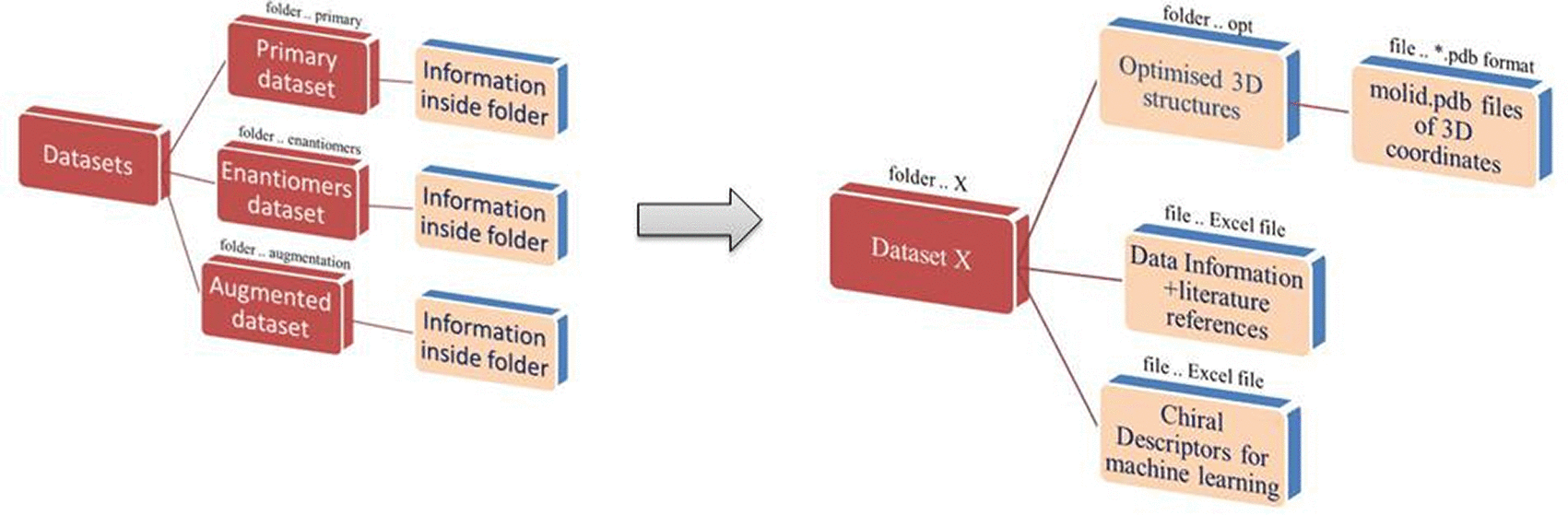
Figure 1. A flowchart of the datasets created in this study including the data information for each dataset and the chiral descriptors for use in machine learning approaches.
Primary data
Figure 2 shows the experimental helical twisting powers (in μm-1) of the primary dataset and the enantiomers of the chiral molecules. In addition, a violin plot of the kernel probability density distribution of HTP is presented in
Figure 2B.
Figure 2A shows the total chiral volume of the chiral centres of the primary dataset and the enantiomers of the chiral molecules, as computed using the RDKit package (using the ComputeChiralVolume module of the package RDKit.Chem.Pharm3D.EmbedLib).
Figure 2B is a violin plot of the kernel probability density distribution of total chiral volume.
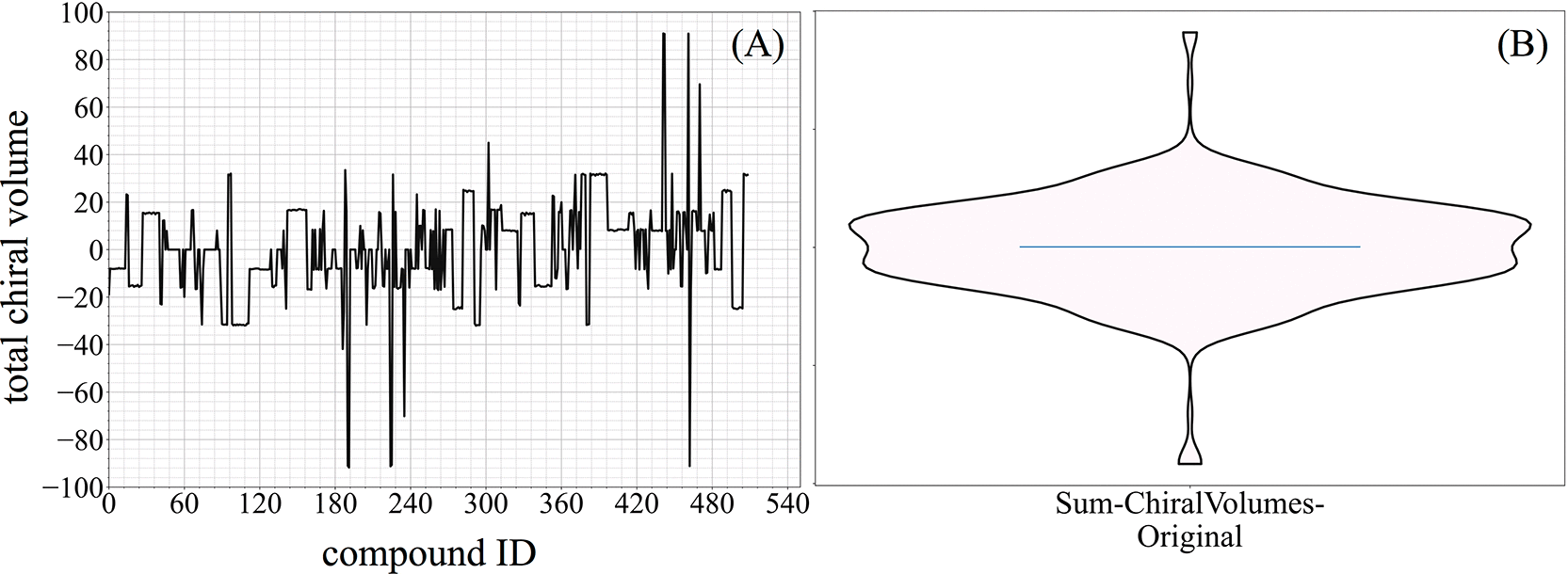
Figure 2. (A) Total chiral volume of the chiral centres of the primary dataset and the enantiomers of the chiral molecules, as computed using the RDKit package (using the ComputeChiralVolume module of the package RDKit.Chem.Pharm3D.EmbedLib). (B) A violin plot of the kernel probability density distribution of total chiral volume.
Figure 3A presents, graphically, the number of chiral centres for each compound, as defined using the Chem.FindMolChiralCenters module of the RDKit package, while
Figure 3B shows the frequency of occurrence of the number of chiral centres in the dataset.
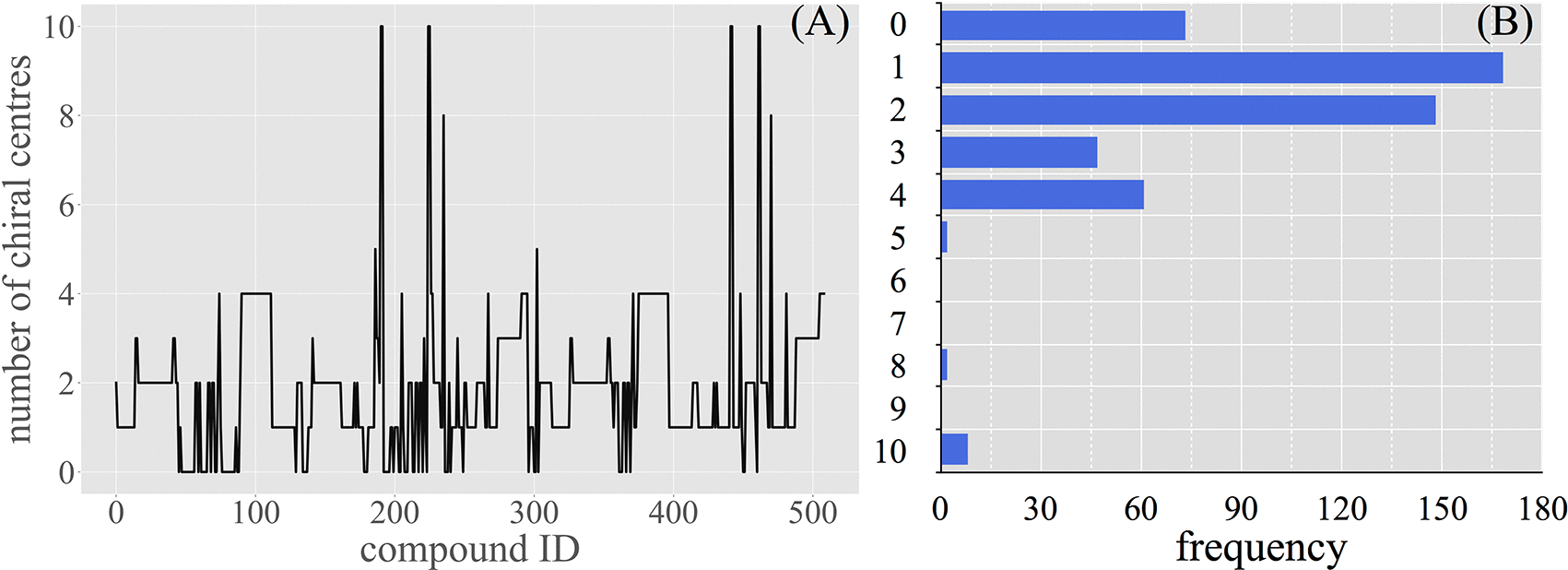
Figure 3. (A) Number of chiral centres for each compound, as defined using the module, Chem.FindMolChiralCenters of the RDKit package. (B) The frequency of occurrence of the number of chiral centres in the dataset.
Figure 4A presents the total chiral index,9 calculated by summing the chiral index of the RS-isomer centre in the structure considered as non-interacting chiral centres. In addition,
Figure 4B presents a violin plot of the probability distribution of the total chiral index.
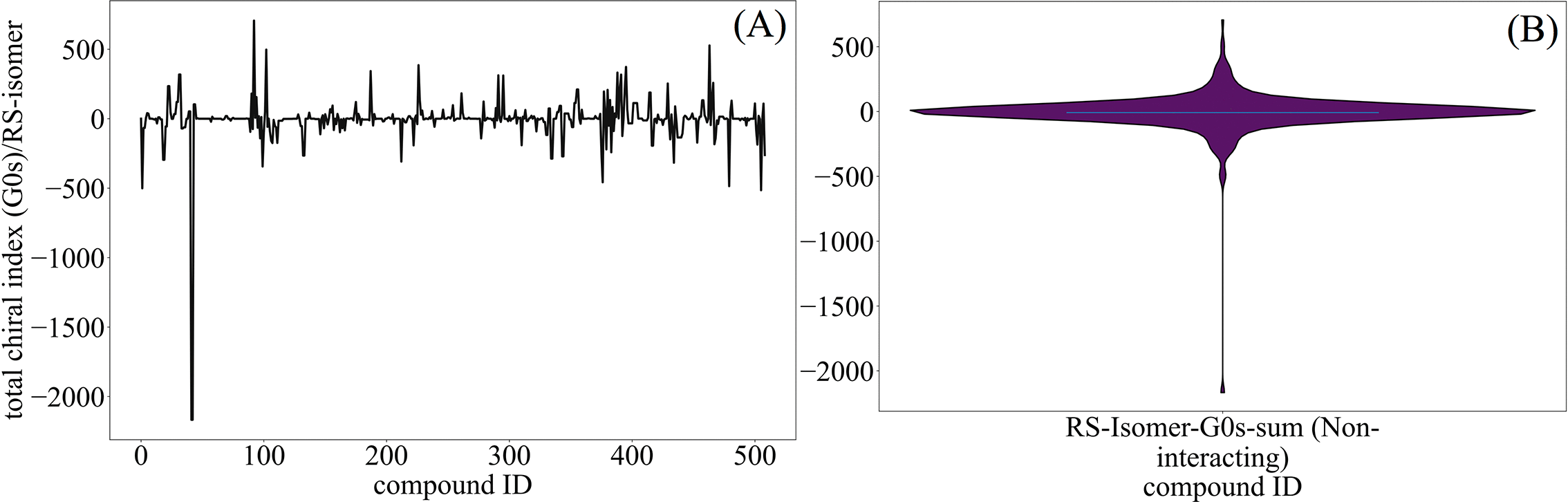
Figure 4. (A) Total chiral index,9 calculated by summing the chiral index of the RS-isomer centre in the structure considered as non-interacting chiral centres. (B) A violin plot of the probability distribution of the total chiral index.
Bootstrapping data augmentation
Next, we generated 30 conformers for each primary data using the RDKit tools.15 Then, we calculated the scaled chiral index for each conformer of the RS isomer for each chiral centre.
Figure 5 shows the scaled chiral index for each conformer of the RS isomer for chiral centres. In addition, the moving averages over the conformers for each primary data are shown in red (see also the inset graph).
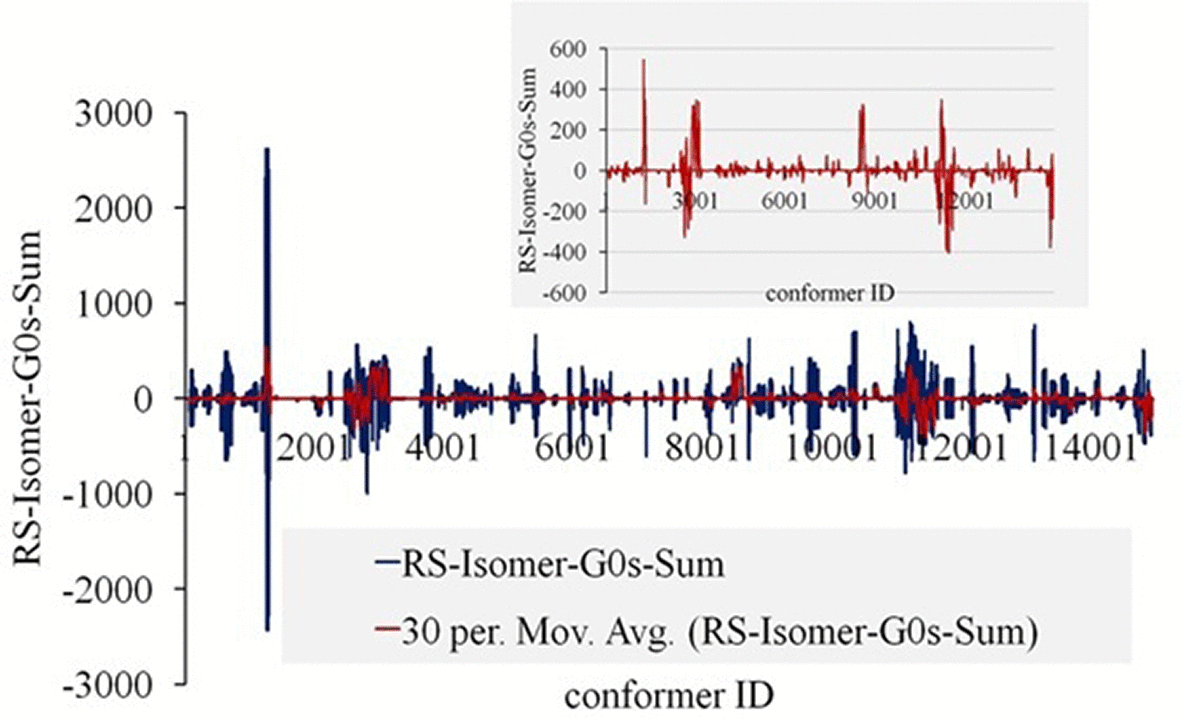
Figure 5. The calculated scaled chiral index for each conformer of the RS isomer for each chiral centre.
The moving averages over the conformers for each primary data are shown in red.
Experimental design, materials and methods
This dataset consists of data points collected manually using the experimental values of molar helical twisting power, nematic host, chiral dopant, molar concentration of the dopant, and the temperature. The primary dataset is a set of 527 experimental measurements of helical twisting powers for a wide range of dopants in nematic liquid crystal phases. The helical pitch
is typically determined by the Grandjean-Cano technique.16 The ability of a chiral dopant to induce bulk helical structure in LC host is experimentally measured by HTP,17 which leads to an amplification of molecular chirality.18
First, the dopant molecules are designed using JMOL19 and MOLVIEW20 packages in two-dimensional (2D) space, as a SMILES format. Then, the three-dimensional (3D) coordinates of the molecules are obtained using MOLVIEW and initially optimised using molecular mechanics force fields of this package. In addition, the stereoisomers of the chiral centres are defined using JMOL.
Next, the chiral dopant molecules 3D structures are optimised using molecular mechanics force fields in RDKit package, such as MMFF94s. The bootstrapping method was employed to generate of about 30 conformers for each dopant using RDKit. In total, the database has about 15000 data points. The chiral descriptors were developed for use in machine learning models for each data entry point.
Chiral descriptors
The chiral descriptors, in this study included some basic descriptors and the 3D descriptors, as described in the following.
The set of some basic descriptors
1. Number of atoms in molecule
2. Number of bonds
3. Number of rotational bonds
4. Type of the chiral centres, such as a ring
5. Maximum path length in the molecule from the chiral centre
6. Mean pairwise distance of all atom pairs from the chiral centre
7. Number of neighbours per shell distance level
8. The levels until a path length of 10
9. Number of nitrogen and oxygen atoms for each level around the chiral centre
10. Number of aromatic atoms for each level around the chiral centre
11. The size of descriptors for each substituent, sort them from smallest to largest
12. Combination of substituent sizes
Limitations
The limitations faced during this study include the following.
1. The missing significant amount of the experimental data with high values of the helical twisting powers, typically larger than 100
.
2. Missing the three-dimensional structures of the dopants.
3. Use of high-level quantum mechanics methods to optimize molecular geometries is quite costly from the computational viewpoint.
4. Absence of other existing datasets of the experimental helical twisting values for the sake of comparison.
Conclusions
In this study, we reported a dataset of the chiral dopant molecules, collected manually using the experimental molar helical twisting power, nematic host, chiral dopant, molar concentration of the dopant, and temperature. It consists of 527 experimental values of helical twisting powers, optimised using MMFF94s molecular force fields in RDKit. In addition, a bootstrapping approach was employed to generate of about 30 conformers for each dopant using RDKit. The augmented dataset has about 15000 data points. The chiral descriptors were developed for use in machine learning models for each data entry point.
Ethics and consent
Ethical approval and consent were not required.
Data availability statement
Data are available through the Zenodo repository. Data identification number: https://doi.org/10.5281/zenodo.20688776.21
The database consists of three folders:
1) Folder primary: This folder contains two subfolders:
a.
3Dstructures: It contains the optimized three-dimensional structures of the molecules.
b.
datadescription: It contains information about the chiral dopants and their chiral descriptors as a Microsoft Excel Worksheet file “primary_dataset_chiral_descriptors.xlsx”.
2) Folder enantiomers: This folder also contains two subfolders:
a.
3Dstructures: It contains the optimized three-dimensional structures of the enantiomers of primary chiral dopant molecules.
b.
datadescription: It contains information about the enantiomers chiral dopants and their chiral descriptors as a Microsoft Excel Worksheet file “primary_dataset_chiral_descriptors.xlsx”.
3) Folder augmenteddata: This folder contains two subfolders:
a.
3Dstructures: It contains the optimized three-dimensional structures of the 30 conformers for each primary and enantiomers chiral dopant molecule.
b.
datadescription: It contains information about the chiral dopants and their chiral descriptors as a Microsoft Excel Worksheet file “primary_dataset_chiral_descriptors.xlsx”.
Data is available under the terms of the Creative Commons Attribution 4.0 International.
Acknowledgements
One of the authors (H.K.) thanks International Balkan University, Research and Projects Office, for providing a research grant.
References
- 1.
Pieraccini S, Masiero S, Ferrarini A, et al.:
Chem. Soc. Rev.
2011; 40: 258.
- 2.
Kuball H-G:
From Chiral Molecules to Chiral Phases: Comments on the Chirality of Liquid Crystalline Phases.
Liquid Crystals Today.
1999; 9(1): 1–7. Publisher Full Text
- 3.
Kamberaj H, Low RJ, Neal MP:
Molecular Structure and Helical Twisting Power.
Ferroelectrics.
2005; 315: 183–196. Publisher Full Text
- 4.
Frezza E, Pieraccini S, Mazzini S, et al.:
The interplay of configuration and conformation in helical perylenequinones: Insights from chirality induction in liquid crystals and calculations.
Beilstein J. Org. Chem.
2012; 8: 155–163. PubMed Abstract
| Publisher Full Text
| Free Full Text
- 5.
Hall AW, Hollingshurst J, Goodby JW:
New York:
Oxford University Press;
1997.
- 6.
Kuball H-G, Mueller T, Brueuning H, et al.:
Chiral Induction by Optically Active Aminoanthraquinones in Nematic Phases.
Mol. Cryst. Liq. Cryst.
1995; 261: 205–216. Publisher Full Text
- 7.
Gottarelli G, Spada GP:
Induced Cholesteric Mesophases: Origin and Application.
Mol. Cryst. Liq. Cryst.
1985; 123: 377–388. Publisher Full Text
- 8.
Osipov MA, Kuball H-G:
Helical twisting power and circular dichroism in nematic liquid crystals doped with chiral molecules.
Eur. Phys. J. E.
2001; 5: 589–598. Publisher Full Text
- 9.
Neal MP, Solymosi M, Wilson MR, et al.:
Helical twisting power and scaled chiral indices.
J. Chem. Phys.
2003; 119: 3567–3573. Publisher Full Text
- 10.
Ferrarini A, Nordio PL, Shibaev PV, et al.:
Twisting power of bridged binaphthol derivatives: comparison of theory and experiment.
Liq. Cryst.
1998; 24(2): 219–227. Publisher Full Text
- 11.
Pieraccini S, Ferrarini A, Spada GP:
Chiral doping of nematic phases and its application to the determination of absolute configuration.
Chirality.
2008; 20: 749–759. PubMed Abstract
| Publisher Full Text
- 12.
Eelkema R, Feringa BL:
Amplification of chirality in liquid crystals.
Org. Biomol. Chem.
2006; 4: 3729–3745. Publisher Full Text
- 13.
Heppke G, Oestreicher F, Scherowsky G:
Molecular Twisting Power chiraler Azobenzole.
Z. Naturforsch.
1982; 37a: 1176–1184.
- 14.
Solymosi M, Low RJ, Grayson M, et al.:
A generalized scaling of a chiral index for molecules.
J. Chem. Phys.
2002; 116: 9875–9881. Publisher Full Text
- 15.
Landrum G:
RDKit Open-Source Cheminformatics.
[Accessed 1 August 2024].
Reference Source
- 16.
Dierking I:
Textures of Liquid Crystals.
Weinheim:
Wiley-VCH;
2003. Publisher Full Text
- 17.
Solladie GZRG:
Angew. Chem. Int. Ed. Engl.
1984; 23: 348.
- 18.
Goodby JW:
Twisted and frustrated states of matter.
Proc. R. Soc. A.
2012; 468: 1521–1542. Publisher Full Text
- 19.
JMOL:
Jmol: An open source Java viewer for chemical structures in 3D.
[Accessed 1 8 2020].
Reference Source
- 20.
Hogenboom H:
Molecular viewer (MolView).2016.
Reference Source
- 21.
Kamberaj H:
A novel dataset of helical twisting power of chiral dopants in nematic liquid crystals phase (Version 1). [Dataset].
Zenodo.
2026. Publisher Full Text
- 22.
Kamberaj:
kamberaj/ChiralDopantsDescriptors: Chiral Dopant Descriptors (Version chirality) [Computer software].
Zenodo.
2026. Publisher Full Text