Introduction
In the Baltic Sea, Atlantic and North Sea in Norway, eutrophication is caused by anthropogenic stressors in coastal areas.1–6 Nitrogen (N) and phosphorus (P) emissions from agricultural lands contribute to eutrophication, leading to algal blooms and oxygen depletion in marine environments.7 The main sources of anthropogenic N and P inputs in the Baltic Sea and North Sea are land-based, with agriculture being the primary contributor.8–10 Nutrient pollution from agriculture originates from diffuse sources, resulting in complex pollution control. There are no quick policy fixes, even though EU environmental governance, through its various regulations and policies aim to address eutrophication by protecting freshwater and marine ecosystems and by regulating nutrient emissions to the coastal waters.
The European Union (EU) has developed an extensive set of directives, regulations and policies aiming to protect the water resources from agricultural nutrient pollution. The WFD regulates the ecological condition of rivers, lakes, transitional waters, coastal waters, and groundwater. It requires that the status of waters is monitored and assessed based on classification of ecological status into high, good, moderate, poor, and bad.11,12 While the WFD addresses inland, transitional, and coastal surface waters as well as groundwaters, the MSFD focuses on marine ecosystems. Like the WFD, the MSFD employs an adaptive management approach with a 6-year planning cycle.13 The ND, along with its national implementation, has decreased nitrogen leaching to surface and groundwater and to the atmosphere.14
The Common Agricultural Policy (CAP) 2023–2027 specifies a set of measures, that consist of annual eco-schemes with incentive payments, Good Agricultural and Environmental Conditions (GAECs) that are signed every five years and various support measures under pillar II.15,16 Eco-schemes contribute to the greening of agricultural systems that provide incentives for climate-friendly and environmentally friendly agricultural practices. In order to receive subsidies, farmers must meet a set of statutory requirements GAECs, also known as conditionality requirement.16 The subsidies are outlined in the CAP strategic plans for each member state, which includes statutory requirements, such as those of the Nitrates Directive, as well as voluntary eco-schemes and GAECs. Additionally, regional seas conventions such as the Helsinki Convention for the Baltic Sea17 and the Oslo-Paris Convention for the North-East Atlantic18 aim to reduce eutrophication by regulating nutrient emissions to freshwater, coastal and marine ecosystems. There are also purely national regulations and policies, such as those concerning phosphorus fertilizer use.
Although several studies have examined ineffective implementation and enforcement of EU environmental governance19–22 fewer empirical studies have focused on a set of N and P emission mitigation policies from a comparative policy perspective. We study policy implementation from a comparative perspective as it allows us to scrutinize the nuances of policy transposition and target setting in selected countries.23 Scholars on EU environmental governance have stated that coherent policymaking can navigate trade-offs and synergies across multiple policy goals and sectors.24–28 It can also lead to more efficient implementation of environmental policy mixes,26 although its evaluation depends on the time horizon and the objectives considered. By “policy mix,” we refer to a policy area where a combination of policy instruments is applied, influenced by instruments from other policy sectors.29
In this paper, we seek examples of EU policy implementation, which is often multi-level by nature30 by comparing the Nordic-Baltic countries. Policy implementation refers to the arrangements and interactions between government and stakeholders for enforcing laws, regulations or policy instruments to achieve intended outcomes.31,32 We focus on policies that mandate or support the implementation of N and P mitigation measures, as well as nature-based solutions (NBS).21,33 NBS are defined as living solutions inspired and supported by nature, utilizing resources efficiently and adaptively to address societal challenges while providing economic, social, and environmental benefits.34 The aim of this paper is to compare policy implementation in these selected member states and to analyze how existing regulations and policies contribute to mitigating agricultural nutrient emissions in waters e.g. by changing agricultural practices and achieving environmental outcomes. We compare the implementation of EU agricultural N and P emission mitigation policies of four Baltic Sea member states—Denmark, Sweden, Finland, and Poland—and one non-EU member state with Atlantic and North Sea coastlines, Norway. Norway, as a non-EU country, partially follows EU environmental policies (e.g. the WFD) while implementing its own agricultural policies. Our research question is:
1. How are agricultural N and P emissions mitigation policies implemented in Denmark, Sweden, Finland, Poland, and Norway?
Materials and methods
Our analysis is based on a comparative case study approach, that allows multiple methods and data for the basis of the analysis, and our case study data consists of document material and co-creation.35 As a first step of analysis, we review policy documents, legislation and scientific literature related to N and P emissions in the case study regions (
Figure 1). Our analysis includes national laws and policies that address N and P nutrient emissions and implement the EU policies on water quality management and agricultural policies. We consider most relevant instruments on European level, that are implemented in the four Member States (
Table 1) and Norwegian policies and legislation that align with those policies. We focus also on previously implemented but later abolished regulations and policies if stakeholders mentioned them as effective examples from the past. All countries implement the WFD and Norway as a non-EU member state has its own regulations and policies regulating agricultural nutrients.
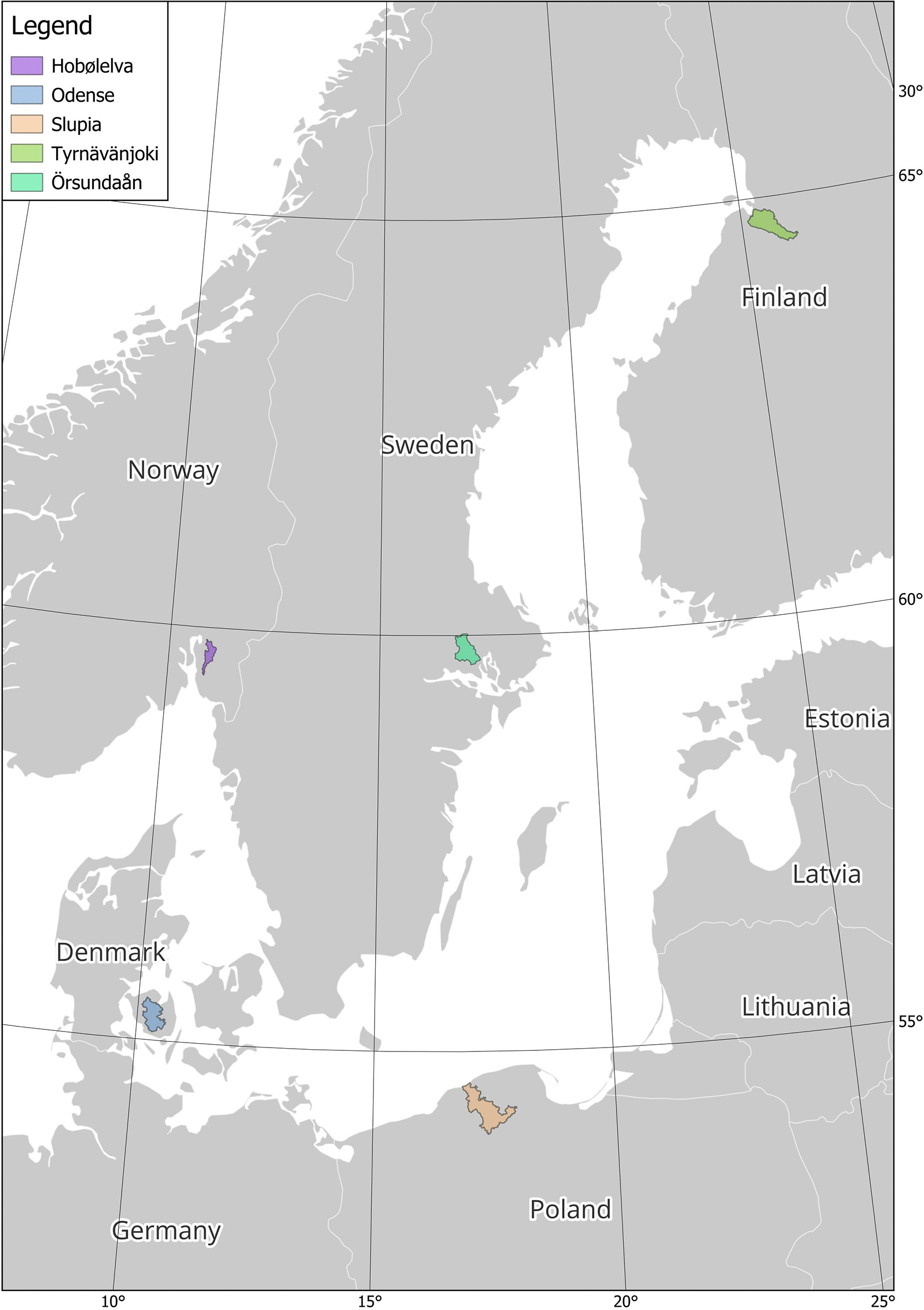
Figure 1. River basins of River Odense, Denmark, River Örsundaån, Sweden, River Tyrnävänjoki, Finland, River Słupia, Poland and River Hobølelva, Norway.
Table 1. Regulations and policies supporting the uptake of agricultural mitigation measures.
Directives are legally binding as they require Member States to achieve a specific result, however they need to be transposed into national law within a deadline.
| Regulations and policies with an impact on N and P emissions to EU waters |
|---|
| The name of regulation or policy |
The aim of regulation or policy |
|---|
| Water Framework Directive 2000/60/EC (European Commission, 2000). | Achieve good ecological status of waters by 2027. |
| Marine Strategy Framework Directive 2008/57/EC (European Commission, 2008). | Maintain good environmental status in European seas. |
| Nitrates Directive 91/676/EEC (European Council, 1991). | Protect water quality and promote good farming practices. |
| The Groundwater Directive 2006/118/EC (European Commission, 2006). | Protect the ground water against pollution and deterioration. |
| Common Agricultural Policy and national CAP strategic plans (European Commission, 2024a). | Promote food security, sustainable use of natural resources and rural livelihoods. |
| HELCOM Baltic Sea Action Plan (HELCOM, 2021). | Reaching good environmental status of the Baltic Sea. |
As a second step, we apply a knowledge co-creation approach, a method for citizen and community engagement that democratizes knowledge and value creation.36–38 Knowledge co-creation involves generating actionable knowledge beyond agenda setting through an interactive process among a selected group of actors. The process facilitates shared problem-solving through the exchange of knowledge and competencies, which transforms understanding of the problem and creates a joint understanding that can contribute to solving the issue.39,40 It enhances acceptance and legitimacy in decision-making and provides a broader understanding of the problem area and its potential solutions. Although it is less explored, it can also contribute to the effective implementation of policies and regulations.
We organized five workshops to co-create knowledge on N and P emission policies and NbS implementation to reduce nutrient load in the Baltic Sea and North Sea in five river basins across Northern European countries. These workshops took place in the river basins of River Odense, Denmark, River Örsundaån, Sweden, River Tyrnävänjoki, Finland, River Słupia, Poland and River Hobølelva, Norway from February to March 2023 (
Figure 1). These river basins confront similar challenges with water quality consisting of high N and P load from agricultural areas. There were 18 to 23 participants in each workshop that brought together stakeholders from environmental management, advisory organizations for agriculture and forestry, municipalities, and farming communities. In them, the stakeholders discussed NBS and mitigation measures against nutrient pollution specifically in agriculture as well as regulations and policy measures that mandate or incentivize the uptake of such solutions and measures. Following the knowledge co-creation, a survey was sent to each organizer of the workshop asking them to summarize the mitigation measures and policy tools for each country. Based on this, the data on policy measures and implementation was coded. We summarized the mitigation measures and NbS based on the workshop results, national and regional policies and legislation in
Table 2.
Table 2. Comparison of official measures and NbS at national or regional level in Denmark, Finland, Norway, Poland and Sweden.
|
Measure
| Denmark | Finland | Norway | Poland | Sweden |
|---|
| Field mitigation measures
| | | | | |
| Catch crops | x | x | | x | x |
| Permanent set aside | x | | | x | |
| Set aside in rotation | x | | | x | |
| Permanent grassland, meadows and pastures | x | | | x | |
| Energy crops | x | | | x | |
| Afforestation | x | | | x | |
| Direct sowing | x | | x | x | |
| No or delayed tillage in autumn | | x | x | x | x |
| Application of gypsum or structure lime | | x | | | x |
| Precision fertilization | x | x | | | x |
| Reduced fertilizer use | | | | x | |
| Limits on manure application | x | x | | x | |
| Technical specification for the use of fertilizers (e.g., trailing hoses, trailing shoe applicators, and injection) | x | x | | x | |
| Limits for N and P use in manure | x | x | | | |
| Ban on applying fertilizers on snow-covered, frozen, or water-logged soil | x | x | | | |
| Transport mitigation measures
| | | | | |
| Surface flow constructed wetlands (agricultural areas) | x | x | | | x |
| Restored wetlands | x | x | | | |
| Bioreactors with wood chips | x | | | | |
| Controlled drainage | | x | | | |
| Inundation of meadows with drainage water | x | | | | |
| Grass buffer strips | | x | x | x | x |
| Buffer strips with trees | x | | x | | |
| Integrated and saturated buffer zones | | | | | |
| Grassed waterways | | x | x | x | x |
| Grass cover/no tillage in areas with high flood and/or erosion risk | | x | x | x | x |
| In-stream mitigation measures
| | | | | |
| Constructed wetlands | | x | x | x | x |
| Retention ponds in forests | | x | x | x | x |
| Re-meandering of river channels | x | | | | x |
| Two-stage ditches and channels | | | | | x |
| Bank stabilization | | | | | x |
| Stream bed re-naturalization | x | | | | x |
Implementing agricultural nutrient policies across the Nordic-Baltic countries
Denmark
Denmark is one of the most intensively farmed countries in the world, with 61% of its total land area under cultivation.41 Under national action plans implementing the WFD and the ND, several measures to mitigate nutrient emissions are currently mandatory for all farmers in Denmark. Many of these measures are also included in the National CAP Strategic Plan.42
The Danish measures include land use management through an obligatory fertilizer accounting system, where farmers need to register themselves and prepare a fertilizer plan for 5 years (Act on agricultural use of fertilizers and plant cover, Act No. 388 of 2017).43 A nitrogen quota is calculated for each year based on the economically optimal rate. Additionally, there are requirements for catch crops – cover crops that are grown between two main crops to reduce N-leaching and improve soil structure (240,000 ha), limits on manure application (170 kg N), and technical specifications for manure application (e.g., trailing hoses, trailing shoe applicators, and injection). Only indirect limits exist for phosphorus application in Denmark. There are bans on applying fertilizers during certain time periods and under specific weather conditions. Fertilizer application is also prohibited on sloping areas, within certain distances of surface waters, or on soil that is water-saturated, flooded, frozen, or snow-covered, or in any way that risks discharge into watercourses. Further requirements pertain to the design of stables, stalls, or other animal facilities to minimize groundwater and surface water pollution, as well as manure storage and the frequency of emptying storage facilities. Additionally, farmers must obtain permission for water intake for irrigation, which is granted for a limited period.
Farmers can apply for funding through the targeted catch crops program annually to voluntarily implement catch crops, with payments made per hectare.44 A mandatory round of payments is triggered if not enough hectares are voluntarily enrolled. The total area under catch crops in Danish agriculture across the four existing rules exceeds 600,000 hectares, with other measures from the list above applied to an additional 95,000 hectares. Since 2016, Denmark has been targeting catch crops in river basins under the WFD, particularly in vulnerable estuaries, protected groundwater areas, and Natura 2000 nitrogen-vulnerable areas where nitrogen load reductions are required (covering approximately 340,000 ha). In these estuaries, farmers can implement other measures instead of catch crops, such as early seeding of winter crops, intercropping, setting aside land, establishing buffer strips, growing energy crops, practicing precision farming, and reducing nitrogen quotas. For pig and cow slurry, there is a requirement for 75% and 70% nitrogen use efficiency, respectively.
Since 1998, lake and wetland restoration has been included in the list of measures. In Denmark, funding is available under ‘collective measures’ for afforestation, rewetting of peat soils, and the restoration of wetlands and lakes. A constructed wetland program also exists, where farmers are supported by several catchment officers to identify suitable areas. A fully compensated new program, aimed at both climate and nitrogen mitigation, aims to rewet 100,000 ha of low-lying organic soils in Denmark by 2030.45
In the past, a 36% reduction in nitrogen losses from Danish agriculture between 1990 and 2004 was considered a world record, achieved through an extensive list of mandatory measures.46 During that period, nitrogen limits in Denmark were strict, but they were later loosened for political reasons. In 2015, Danish farmers were allowed to increase their fertilization levels after a period of mandatory reduction of 10% below the economic optimum, a societal compromise in which farmers agreed to build more wetlands in exchange for more fertilizer use. Especially lakes have shown significant improvements following a substantial reduction in nutrient loading such as increased water clarity, decreased algal biomass, and changes in fish population.47 Environmental NGOs are calling for stricter rules on fertilizer application, as they are dissatisfied with the lack of significant downward trends in nutrient emissions or concentrations over the past 15 years. Danish farmers that participated in the co-creation workshop generally prefer voluntary measures. They were stating that, implementing mitigation measures and policies requires resources from both farmers and authorities, with the application process and IT work often described as burdensome by farmers.
Sweden
Agriculture accounts for less than 10% of land use in Sweden.48 Due to large variations in soils and climate within the country, productivity also varies. Sweden joined the EU in 1995 and implements the EU WFD, ND, and GWD, which set limits on nitrate concentrations in surface waters and groundwater. National laws, such as Chapter 5 of the Environmental Code (Miljöbalk 1998:808),49 enforce these directives. Sweden implements the WFD across five water districts. The CAP is implemented as farm subsidies and payments for investments and annual environmental mitigation measures. CAP also supports the agricultural advisory program Focus on Nutrients. Additionally, national subsidies encourage local water management projects (LOVA) and local nature management projects (LONA).
Leaching of nitrogen from agriculture to coastal areas constituted a severe problem in southwest Sweden during the 1990s. An action program was implemented that consisted of a combination of mandatory and voluntary measures. Mandatory measures included regulations such as the percentage of winter green cover on arable land, restrictions on manure management, and limitations on the timing and quantity of manure spreading. The implementation of voluntary measures, such as the growing of catch crops, ploughing in spring instead of autumn, and the establishment of wetlands, was supported through subsidies and payments. In parallel, the Board of Agriculture, with support from the Farmers’ Union, established the agricultural advisory program Focus on Nutrients, which offers farmers advice on nutrient balances at the farm level and how agricultural management can be adjusted to reduce the risk of nutrient losses.
After the implementation of the action program, nitrogen concentrations decreased in several agricultural streams and rivers in southwest Sweden until 2010.50 However, after 2010, the trend declined.51 There could be several reasons for this, such as that the background nitrogen level may be difficult to reach due to the limited potential for implementing additional mitigation measures within current agricultural production systems. Other possible causes include climate change, with more extreme weather events stressing agricultural soils and leading to increased leaching, reduced catch crop coverage, and market pressures that may have resulted in more intensive agricultural management.
Based on the workshop results, phosphorus losses are mainly a problem in the agricultural plains around the large lakes in central Sweden, where clay soils dominate. Phosphorus binds to soil particles, and when erosion occurs, particle-bound phosphorus is transported to surface waters. Preventing erosion is therefore key in these areas. Mitigation measures, such as structural liming, buffer zones along open waters, and constructed wetlands (phosphorus ponds), have been implemented through CAP and the national payment system LOVA. To further encourage local engagement and inspire farmers and landowners to improve water quality and apply for payments to implement measures, a national network of catchment officers has been established. Initially financed by the government as a pilot project, it has since continued within municipalities and local water councils.
Despite the widespread implementation of measures against phosphorus losses, few positive trends have been observed in agricultural streams and rivers.52,53 This may indicate that the measures fail to target important sources and pathways. Another explanation could be that monitoring methods do not fully capture the short events during which erosion occurs, potentially overlooking reductions. Additionally, soil particles that have accumulated in stream beds over decades may continue to release phosphorus for a long time due to oxygen-deficient conditions.
Besides funding for a wide range of measures aimed at improving water quality, the agri-environmental payment model has contributed to the survival of small, diverse, and less intensively managed farms in mixed forest and farm landscapes.54,55 The country also provides Nordic Aid for agriculture north of the 62nd parallel, in northern Sweden. Most Swedish farmers depend on agricultural support payments for their survival, although the agri-environmental payment scheme is not universally liked among farmers. The Swedish Farmers’ Union has highlighted that farmers engage in more environmental measures than those that are subsidized and documented, such as investments in wetlands.
Swedish farmers have expressed that knowledge of nutrient balances also benefits farm economics. Swedish environmental authorities have noted that, for some subsidies, the bureaucracy is more burdensome than the reward. For example, subsidies for drainage system renovations had more applicants than available funding. Authorities also view it as a disadvantage that under the current CAP, they cannot pay more in subsidies than the cost of the measure, even in areas where the measure is highly effective. Scientists stress that knowledge-based decision-making requires programs for monitoring the effects and impacts of environmental mitigation measures.
Finland
In Finland, agricultural land covers about 7% of the total land area.56 Because of its northern location, agriculture is not very profitable. However, the country maintains a high level of self-sufficiency in agricultural production, with food security forming the cornerstone of its agricultural policy. Finland joined the EU in 1995 and implements the WFD, ND, and other relevant directives, as well as the CAP. Finland has eight river basin districts that draft the RBMPs. In these plans, the suggested agricultural measures are closely linked to the environmental payment scheme of the CAP, which is described as the main financial mechanism for reducing nutrient loads from agriculture. Participation in the environmental subsidy scheme is voluntary for Finnish farmers, and 86% of them apply for funding under the scheme.57 Agricultural phosphorus regulation sets limits on agricultural phosphorus emissions.58 Prior to that (1995–2023), fertilization was regulated based on crop type and soil phosphorus status through the voluntary agri-environmental scheme.
The CAP measures in place are listed in the guide to cross-compliance.59 These measures include rules on fertilizer use, such as maximum fertilizer limits, a 5-meter fertilizer-free zone next to water bodies, and a ban on applying fertilizers on snow-covered, frozen, or water-logged soil. Fertilizers should be spread on the field in such a way that there is no runoff into the water and the subsoil is not compacted. Fertilizers should never be applied to snow-covered, frosted or waterlogged soil. When the field has plant cover over the winter, manure and organic fertilizers may be spread from 15th of September onwards. For phosphorus fertilizer use 100% of the total phosphorus contained in manure and fertilizer products is considered. There are also requirements for buffer zones, which should be covered with vegetation that can consist of herbaceous plants or other plants than woody plants and should be left uncultivated and at least 3 meters wide on the side of the watercourse. Subsidy for catch crops can be paid annually for a maximum of 30% of the area eligible for the benefits and they can be applied during the growing season as an underplant for an annual production plant of after harvesting the production plant. The farmer can receive payments for the management of ground water level with control drainage, submersible pumps or a drainage water recirculation system. Because of the northern location there are specific rules for manure storage, and a ban on manure application during the winter months.
Water protection in agriculture is promoted through project activities, which play a significant role in Finland, as the water protection measures under the CAP environmental payment system alone are not sufficient to improve water quality. The Ministry of the Environment funds nutrient recycling and water protection programs, such as the gypsum treatment of fields, carried out through the Gypsum Project, which started in 2019. Gypsum enhances water infiltration and improves soil composition, which contributes to lower erosion rates and less nutrient loading to downstream water bodies. Overall, nutrient balances have improved in Finland, and by 2020, phosphorus loads from agriculture had decreased by about 18% and nitrogen loads by more than 10% since the beginning of environmental support in 1995.60 Set-aside area and changes in manure use as a fertilizer explain part of that positive change.61 Despite the positive trend, the WFD targets and the original goal of a 30% reduction since the start of the agri-environmental scheme have not yet been reached.
In Finland, the stakeholders who participated in the workshop emphasized the importance of applying the same rules to all farms to ensure a fair distribution of costs and benefits. Farmers noted that no farmer uses the maximum allowed amount of fertilizer, but rather the amount that the plants need. In Finland, there had been a 1-meter buffer strip CAP requirement along main drainage systems, but this requirement was removed from national CAP strategic plan in 2023. The decision raised doubts among farmers, who considered the requirement reasonable. Finnish environmental authorities highlighted the need for long-term target-setting, follow-up, and continuity in measures and policies, as improving water quality is a lengthy process.
Poland
Agriculture is one of the economic cornerstones of Poland, with agricultural land being nearly 50% of the total land area.62 The profitability of the agricultural sector is relatively good and has improved with the modernization of agriculture, particularly in the dairy and meat sectors. Since 2002, the Polish agro-food industry has benefited from EU resources and financing, and in 2004, Poland joined the EU. Since then, the country has implemented EU environmental legislation and CAP, including environmental funding schemes for farmers.
In Poland, the RBMPs and their PoM target water pollution by nitrates from agricultural sources and aim to prevent further pollution.63,64 The plans introduce measures to improve water quality, focusing on nutrient management in floodplains and areas of intensive farming by controlling runoff and erosion. These measures include damming and retention of surface and groundwater, increasing available water resources for agricultural production and enhancing soil retention.
Polish Strategic Plan targets significant share of the funding as direct payments and appears insufficient to respond to environmental and climate demands.65,66 The Code of Good Agricultural Practices provides recommendations to address water pollution by nitrates from agricultural sources, promoting measures such as more efficient fertilization, improving soil properties, reducing pollutant leaching from agricultural areas, and creating and maintaining buffer zones and retention areas. On erosion-prone soils, erosion can be prevented by establishing grass-covered waterways in cereal fields that either consist of permanent grass cover or is sown every year. There is also an advisory code on reducing ammonia emissions, which promotes activities related to proper nitrogen management, considering the nitrogen cycle, and methods to reduce ammonia emissions from livestock production. This includes animal housing methods, low-emission fertilizer storage systems, and application techniques to reduce emissions during fertilizer spreading.
The Nitrate Program was adopted by the Polish Council of Ministers in 2023.67 This program implements the ND, with the primary goal of reducing the impact of the agricultural sector on surface and groundwater quality through rational fertilizer management, which will decrease nutrient runoff into water bodies. The program also supports the application of NBS and other mitigation measures, such as mulching, subsoiling, riparian buffer zones, and the use of catch crops. Additionally, the National Surface Water Restoration Program aims to improve water conditions through restoration activities, identifying priority areas of poor surface water quality based on the degree of aquatic ecosystem deterioration and other factors.
In Poland, the stakeholders observed a generational difference among farmers. Young farmers are more willing to try new measures and are more open to environmental protection. Stakeholders emphasized the need for information on the impacts of different land management practices. They also highlighted the importance of incentives and financial support for implementing NBS and mitigation measures. Authorities and scientists agree that embedding NBS and agricultural mitigation measures in broader strategic policies, such as climate change mitigation and adaptation strategies, green infrastructure, and biodiversity plans, would be beneficial. Workshop participants also suggested that rural area restructuring, especially agro-tourism, should be supported by EU and national programs and funds. Investments should be directed towards infrastructure for environmental protection, and environmental content should be incorporated into educational programs. Farmers should be compensated for activities that enhance ecosystem services for the benefit of all.
Norway
In Norway, only 3.5% of the country consists of agricultural land.68 Improving self-sufficiency in food is a national priority, which may potentially conflict with the environmental goals of the WFD, especially regarding the use of fertile land for purposes such as buffer zones, floodplains, or constructed and restored wetlands. Although Norway is not a member of the EU, the country transposed the WFD into national law in December 2006 through the regulation Framework for Water Management. Four national laws form the legal basis for the implementation of the WFD and the Norwegian Regulation of Framework for Water Management. These include the Nature Diversity Act (No. 100 of 2009),69 the Planning and Building Act (No. 71 of 2008),70 the Pollution Control Act (No. 6 of 1981),71 and the Water Resources Act (No. 82 of 2000).72 While the latter three relate directly to water environment issues, the Planning and Building Act ensures that the RBMPs are authorized through the same system as other management plans. Norway has also implemented the ND in selected parts of the country.
In the agriculture sector, the country has its own regulations to ensure the implementation of environmental measures in agriculture. The Land Act (No. 23 of 1995)73 governs agricultural activities, while Section 11 of the Water Resources Act’s requires the maintenance of buffer zones along water bodies to preserve their natural functioning and to prevent nutrient and pollutant runoff. Additionally, subsidies may be granted based on the area of cultivated land if a natural buffer zone exists along streams with annual water flow. These buffer zones must be wide enough to prevent runoff under normal conditions and must be at least two meters wide.
Recently, regional regulations on agricultural mitigation measures have been introduced in response to the ecological deterioration of the Oslo Fjord, caused by excessive nutrient losses, particularly from agriculture and sewage. One such regulation was issued in January 2023 in the county of Oslo & Viken.74 It mandates buffer zones with grass cover, which can be used for fodder, and reduced tillage near drainage systems and in flood- and erosion-prone areas. However, it does not require establishment of buffer zones. Also, in selected critical areas, at least 60% of agricultural land must remain in stubble over winter or be covered with grass, cover crops, or similar. Two other counties, Innlandet and Telemark & Vestfold, are currently working on similar regulations expected to come into operation in 2025. Norwegian mitigation measures have focused on reducing P losses, as the clay-rich soils in agricultural areas naturally contain high levels of P, which is the limiting nutrient for freshwater ecosystems. The ecological deterioration of the Oslo Fjord has sparked renewed interest in N reduction measures.
Norway employs economic incentives through Regional Environmental Programs, which are regional environmental funding schemes with measures like those in national CAP plans in EU member states. In addition to water quality related measures, funding covers activities aimed at improving the cultural landscape, preserving cultural heritage, enhancing recreation facilities, reducing greenhouse gas emissions, and promoting plant health. Since Norwegian agriculture varies significantly between counties, cereal production is encouraged in areas where the soil and climate are best suited for it, while animal husbandry is prioritized in other regions. Norway’s funding system also includes the Special Environmental Measures in Agriculture, which target physical and hydrotechnical installations, such as improved drainage and the establishment of constructed wetlands.
Grassed buffer zones contain higher amounts of plant-available phosphorus and exhibit lower infiltration rates compared to natural buffer zones and bank erosion was more pronounced in areas used for grass production than in those with tree cover.75 Norwegian farmers only receive production grants for land used for food or fodder production, meaning that buffer zones with natural vegetation represent a net loss of income. As a result, trees and bushes are scarce near streams, and when present, they are usually confined to the two-meter-wide zone governed by the Regulation on Production Grants. While there are funding schemes for buffer zones with grass cover, there are no regulatory or economic incentives to establish natural buffer zones with trees and bushes, aside from compensation that may be granted for the cost of seedlings, although this has been discussed within management institutions.
Discussion
We have compared the implementation of EU water quality and agricultural legislation and policies in Denmark, Sweden, Finland, Poland, and Norway. The focus of the paper has been on the policies that implement EU’s regulatory framework for agricultural nutrient management, which consists of several environmental directives and framework policies as well as purely national regulations and policies, such as those concerning phosphorus fertilizer use. Mitigation measures in the EU member states are mainly based on directives and regulations as well as the measures implemented under the Common Agricultural Policy. While Norway is not part of the EU, it implements the WFD and ND and has its own agri-environmental policies.
In Denmark, the implementation of the EU ND relies on catch crop schemes across the country. Regulations require a certain percentage of agricultural land to be dedicated to catch crops, which have reduced nitrate-N leaching from agricultural fields. A long-term reduction of nutrients has been detected in Denmark,47 because of extensive list of mandatory measures. The 30-year implementation of the ND has reduced nitrogen leaching into ground and surface waters and the atmosphere, with potential for further reductions through stricter requirements.14 This success of EU environmental regulation is particularly evident in Denmark, where reductions have been significant, although the nutrient load is also particularly high. Constructed wetlands are also employed as a NBS, but the administrative processes have been criticized by stakeholders as lengthy and complicated.
In Sweden, alongside the implementation of CAP measures, additional agricultural advisory programs and subsidies have targeted nutrient management. Structural liming has been subsidized to improve soil structure, and subsidies for renovating drainage systems have been oversubscribed. In Sweden a declining trend in nutrient concentrations, especially the nitrogen has been witnessed.51 Swedish authorities view it as a drawback that they cannot pay more in subsidies than the measure costs, even in areas where the measure is highly effective. Additional payments to farmers in such areas could motivate them to implement more measures. Farmers recognize the benefits of improving soil structure, both for production and the environment.
In Finland, CAP programmatic measures have focused on direct payments. A new national regulation on the use of phosphorus fertilizers and manure has been enacted. As part of the CAP measures, the importance of minimum winter plant cover has been emphasized, with increasing areas receiving subsidies for this measure. Structural liming and other soil structure management practices have also been implemented. Farmers are applying fertilizers in amounts appropriate for plant needs rather than the maximum allowed. As a result, there has also been a declining trend in Finnish waters.61
In Poland, agricultural policy has focused on modernizing the sector and increasing profitability. Polish Strategic Plan distributes large share of funding as direct payments, whereby more subsidies should be allocated based on the environmental and climate performance.65 Information on the impacts of various land management practices and incentives for applying NBS and mitigation measures should be targeted toward Polish farmers and authorities. Poland acknowledges the need for strategic policies on climate change mitigation and adaptation, green infrastructure, and biodiversity, all based on an ecosystem approach.
In Norway, economic incentives have been the primary tool for encouraging mitigation measures, with fewer legal requirements. However, at the regional and local levels, legal regulations have been introduced to maintain buffer zones and employ conservation tillage. Buseth Blankenberg and Skarbøvik75 found that farmers often view buffer zones as a “necessary nuisance”—necessary for environmental benefits but inconvenient because these areas are usually fertile and suitable for cereal production. Recently, such regulations have been implemented in counties draining into the Oslo Fjord to reduce nutrient losses. Farmers are motivated by measurable impacts.
Conclusions
Policies with clearly defined and binding targets could improve implementation of agricultural N and P mitigation measures and NBS. NbS are often implemented as part of the CAP environmental payment system, consisting of conditionality requirements, eco-schemes and rural development. Simultaneously the CAP has been criticized for its inefficiency in delivering environmental outcomes as the voluntary support scheme is inefficient, expensive, and provides low incentives for innovation.76,77 While the EU CAP scheme, plays a significant role in reducing emissions to soil, water, and air, the agricultural policy prioritizes increased productivity and profitability. Additionally, the challenge lies in financing, subsidies, and targeting these to the most problematic areas. Financial and regulatory incentives are needed to enhance commitment of landowners to ecosystem restoration and NbS.78 Solutions and measures should be determined based on the latest science, supported by binding regulations and sufficient financial incentives, as well as accessible information to achieve these targets.
Also, fragmented and incoherent regulation might hinder long-term improvements in water quality. By comparing nutrient mitigation measures across Northern European countries, this research has underscored differences in national priorities and policy implementation. These measures are mainly based on set of directives and regulations as well as the measures implemented under the CAP. In EU member states, the environmental measures of the CAP are implemented through national strategic plans that include rules on agricultural mitigation measures and NbS. Therefore, national, heterogeneous, and constantly changing rules exist for farmers and different countries prioritize different measures. By comparing nutrient mitigation approaches across Denmark, Sweden, Finland, Poland, and Norway, this research has underscored significant variability in national priorities and policy implementation. Additional national measures might be more flexible in terms of funding and allocation of measures and resources. This study highlights the critical role of coherent and consistent agri-environmental policies in effectively mitigating N and P emissions from agriculture into North European coastal waters. Therefore, enhancing policy coherence, integrating NBS, and ensuring stability in regulations are essential for aligning agricultural practices with environmental goals and reducing the risk of eutrophication in marine ecosystems.
Ethics and consent
The authors ensure that research conducted for this manuscript follows ethical principles of each country where research is taking place. In Finland, Sweden and Norway the National Research Ethics Committees establish guidelines for research ethics and research institutions establish support to guide researchers in specific issues concerning research ethics: https://tenk.fi/fi; https://www.vr.se/; https://www.forskningsetikk.no/en/. In Denmark and Poland ethics in social sciences is handled by individual universities: https://medarbejdere.au.dk/fileadmin/www.medarbejdere.au.dk/Ansvarlig_forskningspraksis; https://pan.pl/app/uploads/2025/06/Code_of_ethics_for_researchers_2024.pdf. The EU Member States (Denmark, Finland, Sweden and Poland) comply with European Code of Conduct for Research Integrity https://allea.org/. These guidelines and support have been consulted and in each country co-creation and survey approach, when not involving minors or sensitive topics, is not a subject of ethical approval. The participants have provided written informed consent and data has been processed following the EGDPR principles.







