Introduction: Nihilist Penguin, “But why?”
In Encounters at the End of the World (2007), Werner Herzog assumes the roles of director, narrator, and on-screen character, and one particularly evocative moment occurs when he observes an Adélie penguin (Pygoscelis adeliae) leaving its colony and walking alone toward the Antarctic interior, in a direction opposite to the others. During an exchange with marine ecologist David Ainley at Cape Royds, Ross Island, Herzog asks, “Dr Ainley, is there such a thing as insanity among penguins?" to which Ainley responds that penguins do not become insane but instead “do get disoriented”. While Ainley offers a scientific explanation for the animal’s behaviour and rejects an anthropomorphic interpretation, Herzog frames the episode through a productive tension between scientific reasoning and philosophical speculation, concluding that the penguin is heading towards certain death and leaving the question unresolved with his central, yet ultimately unanswerable, inquiry: “But why?” (Herzog, 2007, 1:14:15) (
Figure 1).
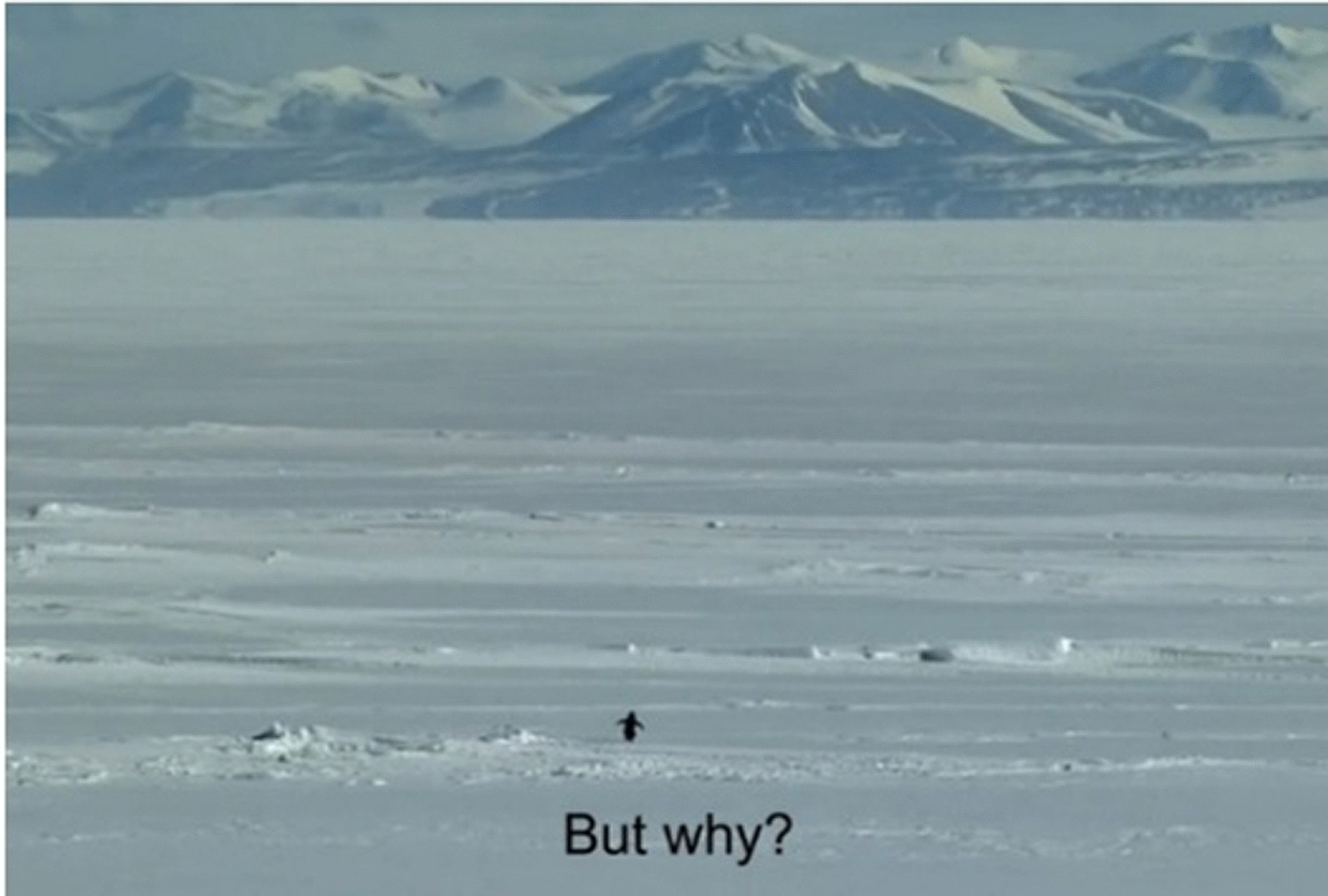
Figure 1. Still from Encounters at the End of the World (Herzog, 2007), showing an Adélie penguin walking away from its colony toward the Antarctic interior (1h14min15sec), a scene associated with the question “But why?" Source: Antarctic Digital Heritage https://youtu.be/6BB3YRtzRxE?si=crI4s7MPoIZ6G6Ds.
Nearly two decades later, this unresolved image has acquired a new digital life. Circulating under the hashtag #NihilistPenguin, the lone penguin transcended the documentary itself in early 2026 and began to be widely shared across social media platforms through viral hashtags and meme culture. In this process, Antarctica itself is reimagined: no longer understood solely as a scientific environment or remote wilderness, it becomes an affective landscape through which contemporary digital subjectivities are articulated.
The influence of the #NihilistPenguin phenomenon became particularly visible when the image of the lone penguin was recontextualised in political and geopolitical debates. During the renewed international tensions surrounding Greenland in 2025 and 2026, following statements by U.S. President Donald Trump reiterating American interest in the territory and reigniting disputes over Arctic sovereignty, the penguin image was mobilised in various forms of online political commentary.
Figure 2 shows an AI-generated image circulated on social media featuring the slogan “Embrace the Penguin”, in which the viral Antarctic character was incorporated into discussions of U.S. politics and Arctic geopolitics.
Figure 3 presents a screenshot from a Chinese parody video that reinterprets President Trump’s statements on Greenland, Arctic governance, and broader geopolitical power intentions.
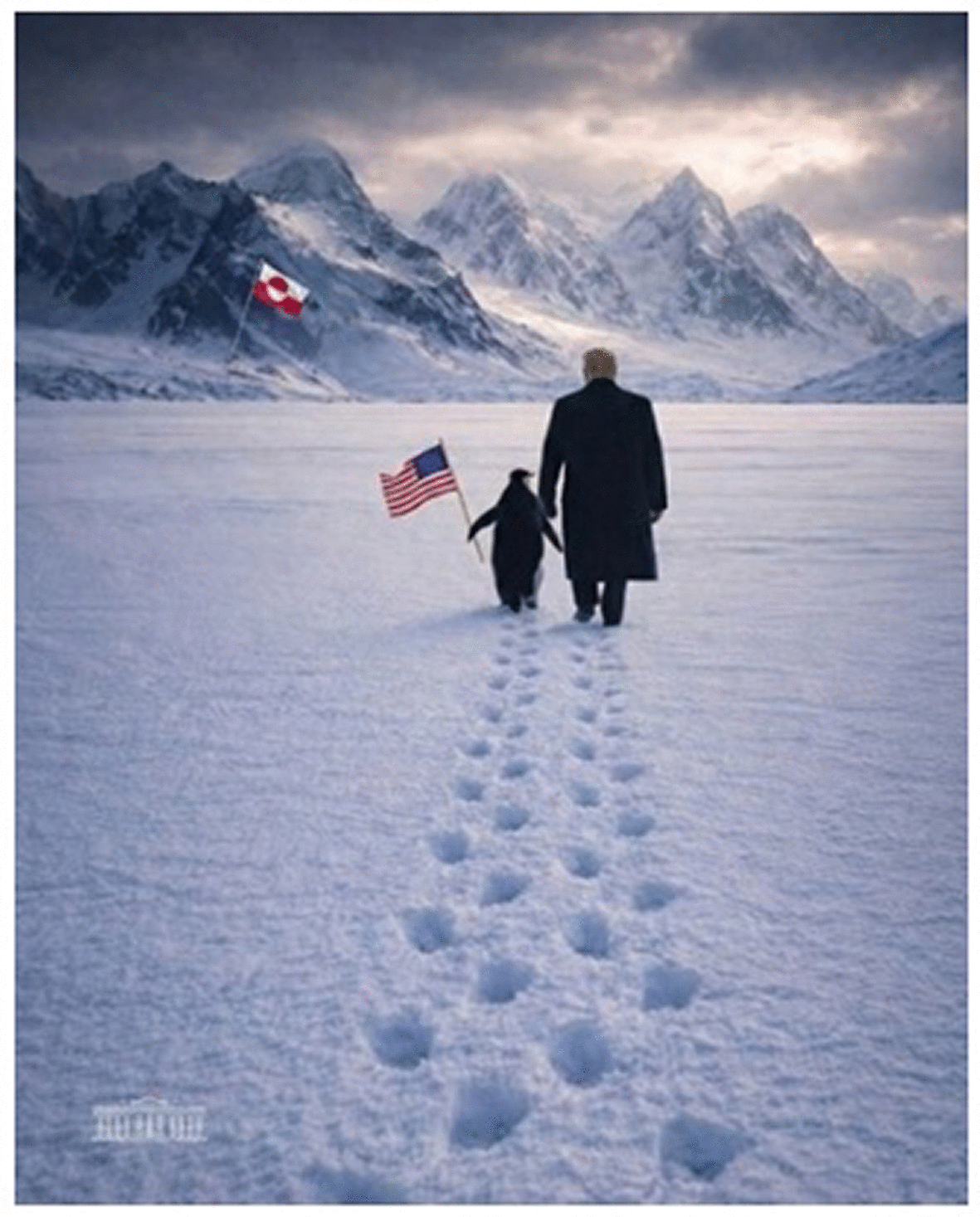
Figure 2. Embrace the Penguin, an AI-generated image shared by the White House on social media (January 23, 2026).
Source: Wikimedia Commons, public domain (U.S. Government work), available at https://commons.wikimedia.org/wiki/File:Embrace_the_penguin.jpg (Licence: Public domain, U.S. Government work; AI-generated image).
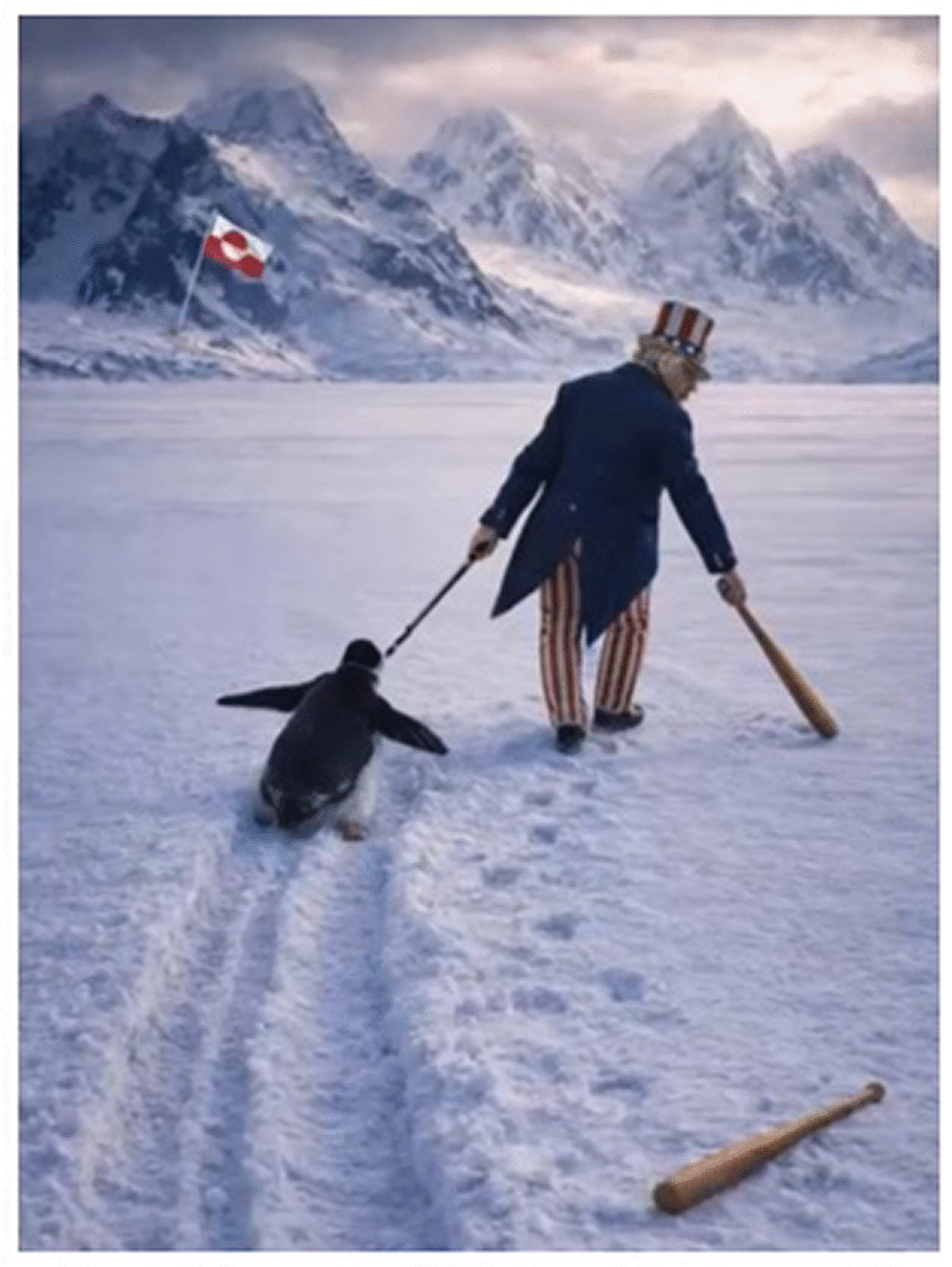
The reinterpretations of social media detach the penguin from its original documentary context. In the political episode mentioned above, this shift extended even further, reinforcing the common mistake of identifying the North Pole as the penguin’s natural habitat. Such geographical misidentifications, in which species are relocated to unrelated environments, demonstrate how the symbolic value of an image can be disconnected from its ecological, ecosystemic, and geographical specificities. Indeed, as the penguin has increasingly come to function as a “universal symbol” of the South Pole, carrying meanings that do not always align with its biological and ecological characteristics (Drent, 2023, pp. 303–304; Varnajot et al., 2024), it has been repurposed as a flexible visual resource for commenting on issues far removed from the Southern Hemisphere. The penguin, and not only Herzog’s penguin, thus functions as a highly mobile cultural sign within global consumer culture, where Antarctic imagery conveys irony and political critique.
The hashtag #NihilistPenguin circulated widely across social media platforms, including Instagram, YouTube, Facebook, and X, during the first half of 2026, achieving substantial online visibility. On Instagram alone, more than 45,000 posts were associated with the hashtag at the time of data collection (June 2026). Moreover, alternative versions such as #NihilisticPenguin, along with translations and adaptations in other languages, suggest an even broader reach and diffusion. The phenomenon appears to have extended beyond social media engagement, inspiring the development of a variety of digital products throughout 2026, including smartphone wallpapers, video games, memes, and other forms of virtual media.
Governed by the Antarctic Treaty System (1959) and lacking an Indigenous population, Antarctica is characterised by restricted access and temporary forms of habitation. Human presence peaks at around 5,000 people during summer (estimated from Fretwell, 2020) and is concentrated in scientific research stations and supporting infrastructure, mainly on the Antarctic Peninsula and coastal regions (estimated from COMNAP, 2017). Alongside national research programmes, tourism activities that have already brought thousands of people to Antarctica have grown and diversified each year (IAATO, 2026). Yet Antarctica remains a regulated-access territory, experienced directly by very few people (Glasberg, 2012, p. xix).
Mediated representations have played a significant role in shaping public perceptions of the continent, from the Antarctic Treaty era to the present day. The imaginary surrounding the region has been fostered by the growing availability of cultural and communicative resources, including visual arts, literature, film, and news media (Nielsen & Philpott, 2018, p. 2). More recently, initiatives dedicated to science communication have also expanded, targeting audiences beyond academia. At the same time, enduring narratives rooted in the history of exploration and in aesthetic constructions of Antarctica as an extreme environment continue to shape contemporary understandings of the continent.
Antarctica has long served as a surface for imaginative projection, shaped by narratives of heroic exploration, pristine wilderness, and scientific progress (Glasberg, 2012; Nielsen & Philpott, 2018; Yao, 2024; Varnajot et al., 2024). These narratives contribute to a geographical imagination, understood here as the ways individuals and societies perceive, represent, and make sense of places, spatial relations, and their connections to identity, power, and social practice (Gregory, 2009). Such imaginations may emerge not only through direct encounters with places but also, and often predominantly, through mediated representations that shape understandings of places never personally experienced. When consolidated and socially shared, geographical imaginations become geographical imaginaries: collective understandings of space that circulate through institutions, media, and cultural narratives, shaping identities, mobility, political decisions, and forms of geographical knowledge (Luczaj, 2025; Rohrer & Thompson, 2023).
Examining the geographical imaginary associated with the viral hashtag #NihilistPenguin, this analysis investigates how the phenomenon reveals recurring affective patterns and demonstrates the emergence of contemporary meanings attached to longstanding symbols that shape popular perceptions of Antarctica. It also explores how these meanings circulate within digital media ecosystems, where they are continuously produced, negotiated, and transformed through user posts, platform logics, algorithmic processes, and the dissemination of visual and textual content. The article further contributes to digital ethnography by treating platform-mediated posts as multimodal cultural artefacts shaped by algorithmic visibility and affective repetition. In addition, it offers a reflexive account of AI-assisted qualitative analysis, highlighting both its value for identifying large-scale semantic patterns and its limitations in interpreting irony, opinion sound, visual rhythm, and affective ambiguity.
Theoretical approach
While Antarctic imaginaries have been more widely examined within social sciences and humanities research, less attention has been paid to their configuration within contemporary digital media, particularly through virtual communities, posts, and memes. To address this gap, this article is aligned with digital ethnography, which examines how social life, cultural practices, and meaning-making are produced through digitally mediated environments (Hine, 2015; Pink et al., 2016). It is also grounded in the concept of mediatisation, understood as the process by which media and communication technologies help construct and organise social reality rather than simply reflect it (Couldry & Hepp, 2017). From this perspective, digital platforms are not neutral channels through which pre-existing meanings circulate. Rather, they shape what becomes visible, repeatable, shareable, and culturally meaningful. This is especially relevant in the case of remote geographies, where public knowledge is often formed less through lived experience than through mediated repetition, visual familiarity, and symbolic condensation.
The study also draws on theories of the social imaginary, understood as collectively produced ways of making sense of the world. Imagination refers to the human capacity to envision what is not materially present, while imaginaries are the socially shared ideas, values, and expectations that emerge from collective acts of imagining. Individual imagination is shaped by social and cultural contexts and becomes particularly important under conditions of uncertainty, when knowledge is limited and people seek to make sense of the world (Rohrer & Thompson, 2023). Social imaginaries provide the frameworks through which societies define collective identities, needs, and expectations, functioning as an “invisible cement” that holds societies together (Castoriadis, 1987, p. 143). In digital environments, these imaginaries are further intensified by what Shifman (2014, p. 23) describes as a “hypermemetic” logic, whereby images and events generate continuous streams of user-produced derivatives through processes of repetition, variation, and recontextualisation. Within this context, social media imaginaries can also be linked with broader geographical imaginaries. They refer to shared interpretations of place that emerge through internet-mediated interactions.
Social media platforms organise visibility and reshape meaning-making as infrastructures that connect users and digital objects and enable groups to interact (Srnicek, 2017, p. 30). They are also key components of the circuits of audience monetization, where participation, enjoyment, visibility, and surveillance are closely entangled (Dean, 2010, p. 4). Hashtags are especially important within the logics of profit-driven communication, serving as automated tools to aggregate dispersed information into recognisable content clusters and enable collective categorisation (Čančar, 2018, p. 144). Through hashtags, heterogeneous materials—such as scientific references, tourism imagery, documentary fragments, memes, personal reflections, and political commentary—are placed in relation to one another (
Table 1). Hashtags therefore do more than label content: they create associations and make them visible, repeatable, and searchable (Bruns & Burgess, 2015).
Table 1. Analytical framework: from platform circulation to Antarctic imaginaries.
| Conceptual layer | Analytical role in this article |
|---|
| Mediatisation | Explains how media participate in producing social reality |
| Social imaginaries | Explains how shared meanings become collectively stabilised |
| Geographical imaginaries | Explains how places are imagined through cultural representations |
| Memes and hashtags | Explains how digital repetition, variation and aggregation shape visibility |
| Audience monetization | Explains how attention, engagement and visibility drive profit and shape content circulation |
The #NihilistPenguin phenomenon is approached in this research as a case through which digital Antarctic imaginaries can be observed in formation. Drawing on historically sedimented representations of Antarctica as remote, extreme, pristine, scientific, and masculine, it reinforces the continent’s construction as a “geography of exception” (Yao, 2024) while incorporating contemporary subjectivities shaped by social media platforms. Emerging at the intersection of Herzog's penguin scene, and mixing Antarctic remoteness, animal behaviour, platform humour, existential questioning, and contemporary affective conditions, the animal becomes a symbolic figure through which burnout, detachment, alienation, and late-neoliberal anxiety are also expressed. The widespread resonance of these themes reflects broader social conditions in which such affective states are increasingly understood as consequences of a social order that restricts individual agency and narrows the scope for alternative ways of life (Fisher, 2009). In this context, the penguin's movement away from the colony is interpreted less as ecological disorientation than as a meaningful gesture of withdrawal that resonates with human experiences of exhaustion, disengagement, and existential uncertainty.
Methods
Data collection
Data were collected from YouTube Shorts in June 2026. The initial dataset consisted of 471 unique links retrieved on June 2, 2026, through hashtag-based search for #NihilistPenguin. To minimise the effects of personalisation, given that digital platforms display aggregated user metrics and make competitive selection processes visible (Shifman, 2014, p. 22), the search was conducted using a newly created account with no prior usage history. This procedure did not completely eliminate platform bias, as the results remained shaped by geographical location, interface design, ranking mechanisms, and broader visibility dynamics. The corpus should therefore be understood as a platform-mediated selection rather than as an exhaustive archive of all content associated with #NihilistPenguin. Platforms like YouTube operate as digital infrastructures with a designed core architecture that sets the rules of engagement, governing how content and users interact within the ecosystem (Srnicek, 2017, p. 31).
The corpus is embedded within the specific architecture of YouTube Shorts, a format characterised by brief, highly concentrated, and impactful audiovisual content in which symbols, narratives, and ideas are rapidly condensed and expressed. YouTube was selected because it is part of the Google ecosystem, and its content offered greater interoperability with the Google AI tool used in this study, Gemini Notebook (previously known as NotebookLM), which supported the automated and multilingual textual analysis of the posts.
The dataset was reduced from 471 to 334 Shorts, as some videos could not be processed by Gemini Notebook, likely due to technical constraints or security-related limitations within the AI system or even a lack of content readable by the tool. The Gemini Notebook is an AI-assisted textual analysis tool, focused mainly on video titles and captions. Videos consisting only of images, music, sound effects, or spoken content without any captions cannot be analysed. Nevertheless, the 471 video links were retained for the manual analysis.
Bias in using AI for analysis
Recent studies suggest that Large Language Models (LLMs) can achieve meaningful levels of agreement with human coders, particularly in supporting deductive coding and large-scale thematic organisation. GPT-4, for example, has showed moderate agreement with human coders in inductive coding and acceptable consistency in deductive coding, although human coders demonstrated a higher level of agreement overall (Zhang et al., 2025). Nevertheless, AI-assisted coding offers important methodological advantages while also requiring careful attention to potential interpretative biases. Researchers in the humanities and social sciences should therefore use LLMs as auxiliary tools that support the analytical process, rather than as substitutes for researcher interpretation (Zhang et al., 2025).
In this study, Gemini Notebook was used solely to assist with the quantitative counting of patterns within the video dataset and did not determine the qualitative thematic interpretations. The prior development of the investigation, including the identification of key themes and the careful formulation of prompts by the researcher, was essential. By clearly articulating the objectives of the analysis, incorporating the themes into the prompts, and taking potential AI biases into consideration, the researcher has enabled the Google Notebook to more accurately identify and quantify the elements of interest within the corpus. This strategy is especially important because generative AI commit mistakes by remaining insensitive to subtle nuances of human communication and context (Williams, 2024, p. 2). Such limitations are particularly relevant for meme-based content, where meaning often relies on exaggeration, parody, and fluid boundaries between denotation, connotation and critiques.
To check for automation bias, a sample of 20 YouTube Shorts was coded both through Gemini Notebook AI-generated analysis and manual coding using the same themes and coding categories, and the results were subsequently compared. This validation procedure identified minor discrepancies between AI and manual analysis, particularly in cases where ironic captions were interpreted literally by the former. Errors may also have occurred in relation to stance and opinion. Discussing or criticising a topic is not equivalent to endorsing it, yet AI analyses based primarily on fragmented textual cues may not accurately capture the creator's position. This limitation includes the difficulty of distinguishing between genuine participation in a trend and its critique, satire, or deconstruction. The validation stage therefore functioned as a quality control measure, following recommendations for human oversight in AI-assisted qualitative and computational ethnography (Abramson et al., 2026, p. 50-51). In all cases, this research adopts a qualitative approach, with quantitative analysis playing a secondary role.
Analytical strategy
This study employed a non-participant digital ethnographic approach focused on the narratives and visual and textual conventions of the posts, without analysing creator–audience relations. Usernames, profiles, comments, reactions, and engagement metrics were not considered, for ethical reasons related to privacy of social media users (Markham & Buchanan, 2012), although privacy was not the sole consideration. The unobtrusive digital ethnography approach does not involve active participation in digital communities (Hine, 2015, p. 157) and follows a non-digital-centric perspective that situates digital media within broader sensory, material, and social contexts (Pink et al., 2016). Thus, digital ethnography does not necessarily require direct interaction with participants. It can involve the situated and interpretive analysis of cultural meanings, narratives, practices, and symbolic patterns within a social context.
The analysis of the video dataset began with a manual multimodal interpretation (Frame 1). A sample of 100 posts was manually analysed for interactions between image, caption, sound, editing, and affect, identifying some recurring patterns: solitary movement, melancholic soundtracks, minimalist editing, and AI-generated aesthetics (
Table 2). These posts also informed a coding framework and the AI prompts used to quantify recurring elements related to discursive repertoire, the humanisation of the penguin, and the reinterpretation of the Antarctic landscape, as presented in
Tables 3–5.
Frame 1. Analysis workflow.
1. Compilation of the initial dataset of 334 YouTube Shorts links retrieved through #NihilistPenguin.
2. Manual multimodal analysis of a subset of 100 posts, focusing on visual composition, sound, text, and subjective tones. The principal multimodal patterns detected are presented in
Table 2.
3. Development of the coding framework from the same subset of 100 posts used to design the AI prompt and conduct the text-based analysis. (related to
Tables 3–5).
4. Divide the corpus of 334 posts into batches of 50, upload their links to Gemini Notebook, and apply the same structured prompt across all batches to ensure consistent coding and facilitate comparative analysis.
5. Quantify the overall discursive repertoires, as well as the projection of human subjectivities and the resignification of Antarctic landscapes (related to
Tables 3–5).
6. Manual validation of AI-generated analyses of 20 posts to identify interpretive inconsistencies, overclassification, and issues related to irony or contextual ambiguity.
7. Final interpretation of the transformation of the penguin scene from Herzog’s documentary in its original context to its digital circulation, drawing on both multimodal results and AI-assisted coding (
Table 6).
Table 2. Recurring multimodal patterns from manual analysis.
| Codes | Analytical effect |
|---|
| Solitary movement (framing) | Constitutes the dominant visual structure, establishing the semantic field of isolation and functioning as the foundational layer for all subsequent interpretations. |
| Melancholic soundtrack | Introduces an affective layer that guides viewer interpretation, transforming visual perception into a shared emotional experience. |
| Minimalist/AI/edited aesthetics | Reconfigures documentary footage into symbolic and aesthetic objects aligned with platform-native visual languages. |
Table 3. Discursive repertoires.
| Codes | Operational definition guiding the AI prompt | Count | Frequency (n=334) |
|---|
| Distance framing | Use of numerical or spatial markers (e.g., "70 km", "the distant mountain", or "walking into the Antarctic interior") to create a sense of factual precision and frame the penguin's movement as a significant, irreversible, or final journey. | 169 | 50.6% |
| Existential questioning | Use of open-ended questions that shift interpretation away from scientific explanation toward speculation and existential meaning-making (e.g., "But why?", "Why not?", "Why is he doing this?", and "What is he searching for?"). | 141 | 42.2% |
| Human emotional projection | Attribution of human emotional states or psychological conditions (e.g., exhaustion, burnout, alienation, loneliness, depression, fatigue, and emotional withdrawal) to the penguin's behaviour. | 116 | 34.7% |
| Scientific framing reference | Reference to biological, ecological, neurological, or other scientific explanations for the penguin's movement (e.g., disorientation, navigational error, illness, neurological impairment, instinct, or species behaviour). | 90 | 26.9% |
| Documentary citation | Explicit reference to Werner Herzog's documentary Encounters at the End of the World (2007) as the source, context, or original recording of the penguin sequence (e.g., mentioning Herzog, the documentary title, or citing the film as evidence). | 71 | 21.3% |
| Explicit Antarctica mention | Direct textual reference to Antarctica as a concrete geographical location or ecosystem (e.g., "Antarctica", "the Antarctic continent", "the South Pole", or "the Antarctic ice"), rather than treating it solely as a symbolic or abstract setting. | 55 | 16.5% |
Gemini Notebook identifies semantic patterns across texts, titles, and captions using a closed Retrieval-Augmented Generation (RAG) system, basing its answers exclusively on user-provided sources to reduce, although not eliminate, the risk of hallucinations (Osman, 2026). It also detects conceptual similarities across multiple languages — an important capability given the role of linguistic variation and translation in global digital circulation (Shifman, 2014, p. 154-155). Gemini Notebook should not be considered an AI tool for image or video analysis but rather a tool for analysing the textual information associated with content, including transcripts and other available textual data.
AI frequency counts are employed as heuristic indicators rather than accurate measures of statistical representativeness. The final comparison between Herzog’s documentary context and its digital circulation is presented in
Table 6, which synthesises the central interpretive shift from the penguin's ecological disorientation to platform-mediated human affective identification. To minimise processing instability and potential performance degradation during large-scale analysis, the dataset was uploaded in batches of 50 posts, addressing a tendency described by Hila and Hauser as “instruction decay” (Hila & Hauser, 2025, pp. 26–27).
Results and discussions
Multimodal and discursive repertoires
The #NihilistPenguin posts operate through a networked-discursive and multimodal repertoire in which Antarctica becomes a surface for projecting shared existential concerns, documentary-style explanations, basic knowledge about Antarctica, artistic creation, audience engagement, emotional and sensory appeal, and popular ideas related to nature and science (
Table 3). Within this hypermemetic logic, the meanings copy themselves as they depend on recognisability, intensity, and repetition (Shifman, 2014). Visual framing, melancholic soundtracks, and captions also often stabilise an atmosphere of solitude, absurdity, and existential reflection. Statements such as “it’s never about the penguin” (YouTube short captions) signal a shift from representation to identification: the penguin is detached from its ecological context and recast as a figure of burnout, withdrawal, and existential exhaustion. Herzog’s audiovisual composition in the penguin scene, which juxtaposes a Gregorian chant soundtrack with the image of a solitary penguin against a vast white expanse, may be one of the key factors shaping these formulations. Its evocative power is amplified through social media, where the scene becomes a means of self-expression for users. This process is resonating with Fisher’s notion of an entertainment matrix in which meaning remains unresolved and continually rearticulated (Fisher, 2009, session 4).
As
Table 2 shows, solitary movement, melancholic music, and minimalist or AI-edited aesthetics work together to create a strong sense of loneliness and reflection. In this way, Antarctica becomes less a specific ecological place and more a visual and emotional backdrop through which the penguin’s journey is interpreted. This affective content is reinforced by the patterns identified in
Table 3. Distance framing is the most prevalent discursive repertoire (50.6%), most commonly expressed through references to the documentary about the penguin's “70 km” journey or movement into the Antarctic interior. This is followed by existential questioning (42.2%) and clear human emotional projection (34.7%). By contrast, scientific framing references (26.9%) and documentary citations (21.3%) occur considerably less frequently, suggesting that factual explanations and source attribution provide contextual grounding but play a secondary role in meaning-making. This tendency is reinforced by the relatively low frequency of explicit references to Antarctica itself (16.5%).
Anthropocentric representation of the Penguin
The meme condenses social exhaustion while revealing a paradox of social media culture: expressions of burnout become absorbed into economies of attention and engagement. This aligns with Citton’s critique of attentional extractivism, whereby speed and informational profitability desensitise subjects, and erode the relationships that provide security, as well as the behaviours that ensure a healthy life (Citton, 2020, pp. 2–3). Captions such as “nothing matters” or “why try” (YouTube Shorts captions) transform biological disorientation into a familiar narrative of fatigue and withdrawal, echoing a form of tiredness that isolates individuals (Han, 2015, p. 31).
The penguin’s solitary walk becomes legible as a symbolic refusal of productivity, social expectation, and compulsory optimism. Han’s “nothing is possible” depressive subject (Han, 2015, p. 11) is echoed in the repeated association of the penguin with resignation and depletion. Likewise, Chabot’s account of humans as resources required to expend “their energy, their sweat, their time” helps explain why the image resonates as a figure of exhaustion rather than simply animal disorientation (Chabot, 2019, p. 4).
The high occurrence of human-centred interpretation (50.0%) and nihilism as an aesthetic tone (42.8%) in
Table 4 reinforces the premise that the authors of the posts use the penguin to articulate recognisable human states of rebellion, detachment, and meaninglessness. Through the anthropomorphised agency (44.6%) and narrative protagonism (49.1%), they transform ambiguous animal movement into intentional act. The penguin is no longer simply moving away from the group; it is imagined as choosing solitude, rejecting others, or searching for something.
Table 4. Projection of human subjectivities.
| Codes for Subjectivities | Operational definition guiding the AI prompt | Count | Frequency (n=334) |
|---|
| Human-centred interpretation | Interpretation of the penguin's behaviour exclusively through human categories, prioritising human meaning over ecological context (e.g., "he just wants to be alone", "he gave up on life", "he's just like me", "he chose peace"). | 167 | 50.0% |
| Narrative protagonism (penguin as subject) | Construction of the penguin as the central narrative character (e.g., hero, rebel, lone wanderer, main character, last survivor, existential protagonist). | 164 | 49.1% |
| Anthropomorphised agency attribution | Attribution of intention, choice, motivation, or consciousness to the penguin, treating it as an acting subject (e.g., "He decided to leave," "He chose his own path," "He knows where he's going," or "He wants to disappear"). | 149 | 44.6% |
| Nihilism as aesthetic tone | Use of nihilism as a simplified emotional or stylistic register detached from philosophical complexity (e.g., "nothing matters", "embrace the void", "literally me", and "bro reached enlightenment"). | 143 | 42.8% |
| Abstracted Antarctic space | Representation of Antarctica as a generic or symbolic environment with limited ecological or geographical specificity (e.g., "the end of the world", "the void", "the middle of nowhere", "the edge of existence"). | 83 | 24.9% |
Abstracted Antarctic space (24.9%) also suggests that the landscape is stripped of much of its ecological specificity and instead becomes a symbolic space associated with emptiness, isolation, and the limits of existence. The penguin and Antarctica consequently work together as elements of the same anthropocentric narrative: the animal embodies a human emotional condition, while the landscape provides the visual space in which that condition can unfold.
Transformation of antarctic
The circulation of content on social media contributes to a profound resignification of Antarctica for most people who have never visited the region, transforming it from a tangible, geographically situated environment into an increasingly abstract and imagined geographical space. The prominence of the dissolution of ecological context (35.9%), the Antarctic interior as an existential endpoint (28.4%), and place as an existential endpoint (20.1%) indicate a movement away from place-based understandings toward meanings increasingly detached from environmental realities (
Table 5). Even geographical misidentifications suggest that symbolic resonance can become more important than spatial specificity in digital circulation.
Table 5. Resignification of the antarctic landscape.
| Codes for Landscape | Operational definition guiding the AI prompt | Count | Frequency (n=334) |
|---|
| Ecological context dissolution | Detachment from ecological and scientific contexts, replaced by affective, symbolic, or aesthetic interpretations (e.g., omission of species behaviour, disorientation, or Antarctic ecology in favour of narratives about depression, purpose, freedom, or existential choice). | 120 | 35.9% |
| Interior as existential endpoint | Representation of the Antarctic interior as a destination associated with emptiness, death, or existential finality (e.g., "walking into the void", "his final journey", "going to die alone", "heading toward nothingness", or "the end of the world"). | 95 | 28.4% |
| Affective landscape | Use of the Antarctic landscape as a metaphor for emotional states such as exhaustion, isolation, or detachment (e.g., "this place feels like burnout", "the landscape mirrors his loneliness", "the ice represents emotional emptiness", and "Antarctica is a space of solitude"). | 67 | 20.1% |
| Geographical misidentification | Confusion between Antarctica and other geographical regions, indicating loss of spatial specificity in meaning production (e.g., referring to Antarctica as the North Pole, Alaska, or Siberia). | 5 | 1.5% |
The Herzog’s penguin movement towards the mountainous landscape is suspended between biological explanation and speculation. The penguin becomes a figure “walking into the unknown” or “choosing to leave everything behind” (YouTube short captions). Through these kinds of statements, users recast the animal as a universal figure of loneliness and self-discovery. In this process, Antarctica once again becomes less a tangible geographical and natural specific ecosystem than an affective backdrop for contemporary subjectivity.
Here, three layers converge in the construction of the digitally mediated geographic imagery of Antarctica: the historically established and widely disseminated image of the continent; Herzog’s documentary approach, which portrays Antarctica as a space of existential and natural inquiry through the figure of the penguin; and the meanings that emerge as the penguin’s story goes viral on social media (
Table 6). Memes can endure beyond their initial peak of spread and popularity as their meanings become embedded in popular culture. This symbolic sedimentation occurs as viral social media phenomena become cemented in collective memory. Consequently, #NihilistPenguin can retain its evocative power over time, continuing to reshape the geographical imaginary of Antarctica by introducing new cultural associations that foster a sense of familiarity with this abstract place.
Table 6. Transformation from documentary context to digital circulation.
| Analytic Element | Herzog’s Documentary (2007) | Digital Circulation (2026) |
|---|
| Role of Antarctica | Scientific and ecological environment and limits of human occupation | Abstract and symbolic place |
| Interpretation of penguin actions | Ecological behaviour | Intentional or meaningful gesture |
| Knowledge framework | Scientific observation | Platform-mediated contemporary social meanings |
| Relation to the nonhuman | Species differences were maintained | Human projection and identification |
Conclusions
Through the #NihilistPenguin trend, Antarctica becomes a terrain onto which contemporary affective experiences are projected, reflecting a shift from ecological, historical, scientific, and geopolitical understandings toward anthropocentric forms of meaning-making shaped by 21st-century concerns. Digital circulation transforms the image of a remote natural environment into an imagetic digital resource through which people interpret and communicate their own social tensions. At the same time, they are encouraged to do so by participating in the regimes of attention and discourse circulation embedded in social media networks.
In this context, digital ethnography and the systematic analysis of social media content offer important methodological horizons for examining how such imaginaries emerge, circulate, and acquire meaning. AI-assisted tools further expand these possibilities by enabling forms of large-scale comparative reading that would be practically impossible for human researchers to conduct alone. Their methodological contribution therefore lies in extending the scale and scope of interpretative inquiry.
In this study, assessing the reliability and potential biases of Gemini Notebook required tracing the analytical pathway through which the AI generated its classifications and then replicating the same coding process through manual counting. The validation exercise demonstrated an acceptable level of correspondence between the two approaches, with an aggregate difference of only approximately 3% across all coding categories. This value represents the difference between the total number of code occurrences identified by Gemini Notebook and the total number identified through manual coding across the validation subset of 20 videos.
Most discrepancies identified during manual validation were concentrated in more interpretative codes that required contextual assessment rather than the identification of explicit textual markers, including “Human Emotional Projection” (14 vs. 11), “Scientific Framing Reference” (3 vs. 7), and “Abstracted Antarctic Space” (4 vs. 7). These differences suggest that Gemini Notebook was more consistent in identifying concepts linked to explicit textual cues, whereas manual coding was better suited to capturing broader contextual meanings and more implicit discursive constructions.Thus, in this article, the AI tool has just expanded the analytical scope of research while leaving the human researcher as central to the human interpretation, critical judgement, and theoretical reflection (Perkins & Roe, 2024).
Final remarks
Future research could expand this inquiry by tracing Antarctic imaginaries across different digital viral case studies and platforms, examining how they evolve as they move through diverse digital environments, and investigating the communities that form around them on social media.
Ethics and consent
This study was conducted in accordance with the ethical and data governance procedures of the University Institute of Lisbon (ISCTE). Ethical considerations were addressed through the ALIGHT (Antarctic Living Heritage) project’s Ethics Assessment and Data Management Plan, developed within the Marie Skłodowska-Curie Actions (MSCA) Horizon Europe framework and reviewed by ISCTE’s Research Support Office (GAI/CVTT-Iscte). The research relied exclusively on publicly accessible social media content and did not involve user interaction, participant recruitment, or the collection of personal, identifiable, or sensitive data. Consequently, informed consent was not required. According to ISCTE's Research Ethics Procedures and Guidelines, anthropological and ethnographic studies that do not involve participants and that use only data already available in public databases are exempt from institutional ethical review. As this study was based solely on publicly available online material and was conducted within an MSCA project that had already undergone ethics assessment and data management review, no additional ethical approval was required (ISCTE, Research Ethics Procedures and Guidelines, https://www.iscte-iul.pt/assets/files/resources/14222).
AI-assisted translation statement
Gemini Notebook, Google's AI-assisted research tool, was used to support the corpus analysis. All outputs were reviewed and validated by the author. Generative AI tools were also used for English translation and language editing. The author reviewed and revised all AI-assisted text and remains fully responsible for the article's accuracy, arguments and interpretations.
Data availability
The research data are openly available in Zenodo under the title Nihilist Penguin Dataset: YouTube Shorts Corpus (June 2026), AI-Assisted Content Analysis, Coding Framework, and Validation Records. The dataset can be accessed at: https://doi.org/10.5281/zenodo.22649726 [de Alkmim Radicchi, G. (2026).]
The dataset contains the following underlying data:
• Corpus of publicly accessible YouTube Shorts URLs analysed in this study.
• Analytical subsets used for manual and AI-assisted analyses.
• Coding framework and operational definitions.
• Research prompts used for Google Notebook AI-assisted analysis.
• AI-assisted analysis outputs and frequency counts.
• Validation records comparing AI-assisted and manual coding.
• Methodological documentation describing the analytical workflow and validation procedures.
The repository does not redistribute copyrighted audiovisual content and includes only publicly accessible links together with the research materials generated during the study.
To comply with ethical guidelines for internet research and protect user privacy, no personal or identifiable information is included in the shared dataset. Information identifying YouTube channels, including channel usernames, profile information, comments, and engagement metrics, has been excluded.
Data are available under the terms of the Creative Commons Attribution 4.0 International License (CC BY 4.0).
Acknowledgements
The author would like to acknowledge colleagues and the institutional environment at Universitário de Lisboa (ISCTE-IUL) and Centre for Research in Anthropology (CRIA) for providing intellectual support and a stimulating research context.
References
- Abramson CM, Prendergast T, Li Z, et al.:
Qualitative research in an era of artificial intelligence: A pragmatic approach to data analysis, workflow, and computation.
Annu. Rev. Sociol.
2026; 52: 35–61. Publisher Full Text
- Bruns A, Burgess J:
Twitter hashtags from ad hoc to calculated publics.Rambukkana N, editor.
Hashtag publics: The power and politics of discursive networks.
Peter Lang;
2015; pp. 13–28. Publisher Full Text
- Čančar E:
Social media and everyday politics; Tim Highfield.
Croatian International Relations Review.
2018; 24(82): 142–145.
Reference Source
- Castoriadis C:
The imaginary institution of society.
MIT Press;
1987.
- Chabot P:
Global burnout.
Krefetz A, transltor.
Bloomsbury Academic;
2019.
- Citton Y:
Collapsonaut attention. SNSF Research Project Ecodata–Ecomedia–Ecoaesthetics.2020.
Reference Source
- COMNAP-Council of Managers of National Antarctic Programs:
Antarctic station catalogue.
COMNAP;
2017.
Reference Source
- Couldry N, Hepp A:
The mediated construction of reality.
Polity Press;
2017.
- Dean J:
Blog theory: Feedback and capture in the circuits of drive.
Polity Press;
2010.
- Drent J:
Review of Brand Antarctica: How global consumer culture shapes our perception of the Ice Continent, by H. E. F. Nielsen.
The Northern Mariner/Le marin du nord.
2023; 33(3): 303–305. Publisher Full Text
- de Alkmim Radicchi G. :
Nihilist Penguin Dataset: A YouTube Shorts Corpus (June 2026) with AI-Assisted Content Analysis, Coding Framework, and Validation Records. [Dataset].
Zenodo.
2026. Publisher Full Text
- Fisher M:
Capitalist realism: Is there no alternative?.
Zero Books;
2009.
- Fretwell P:
Antarctic atlas: New maps and graphics that tell the story of a continent.
Particular Books;
2020.
- Glasberg E:
Introduction: On ice.
Antarctica as cultural critique: The gendered politics of scientific exploration and climate change.
Palgrave Macmillan;
2012; pp. xi–xxviii. Publisher Full Text
- Gregory D:
Geographical imagination.Gregory D, Johnston R, Pratt G, et al., editors.
The dictionary of human geography.
5th ed.Wiley-Blackwell;
2009.
- Han B-C:
The burnout society.
Stanford University Press;
2015. Publisher Full Text
- Herzog W:
Encounters at the End of the World [Film]. Discovery Films. Antarctic Digital Heritage. (n.d.). YouTube.2007. (Director).
Reference Source
- Hila A, Hauser E:
Assessing the reliability of large language models for deductive qualitative coding: A comparative study of ChatGPT interventions [Preprint].
arXiv.
2025. Publisher Full Text
- Hine C:
Ethnography for the internet: Embedded, embodied and everyday.
Bloomsbury Academic;
2015.
- International Association of Antarctica Tour Operators:
IAATO deep field and air operators’ overview of Antarctic tourism: 2025–26 season and preliminary estimates for 2026–27 season (ATCM 48, IP 201).2026, May 4.
Reference Source
- Luczaj K:
“Geographical imaginaries”: A three-decade literature review of usage and applications across academic contexts.
Open Cultural Studies.
2025; 9(1): Article 20250061. Publisher Full Text
- Markham AN, Buchanan E:
Ethical decision-making and internet research: Recommendations from the AoIR Ethics Working Committee (Version 2.0).
Association of Internet Researchers;
2012.
Reference Source
- Nielsen HEF, Philpott C:
Depths and surfaces: Understanding the Antarctic region through the humanities and social sciences.
Polar J.
2018; 8(1): 1–15. Publisher Full Text
- Osman M:
What is NotebookLM? Features and how to use it in 2026.
DigitalOcean;
2026.
Reference Source
- Perkins M, Roe J:
The use of generative AI in qualitative analysis: Inductive thematic analysis with ChatGPT.
Journal of Applied Learning and Teaching.
2024; 7(1): 10.37074/jalt.2024.7.1.22.
Reference Source
- Pink S, Horst H, Postill J, et al.:
Digital ethnography: Principles and practice.
SAGE;
2016.
- Rohrer I, Thompson M:
Imagination theory: Anthropological perspectives.
Anthropological Theory.
2023; 23(2): 186–208. Publisher Full Text
- Shifman L:
Memes in digital culture.
MIT Press;
2014. Publisher Full Text
- Srnicek N:
Platform Capitalism.
Cambridge. UK and Malden, MA:
Polity Press;
2017.
- Varnajot A, Makanse Y, Huijbens EH, et al.:
Toward Antarctification? Tourism and place-making in Antarctica.
Polar Geogr.
2024; 47(1): 49–70. Publisher Full Text
- Williams RT:
Paradigm shifts: Exploring AI’s influence on qualitative inquiry and analysis.
Frontiers in Research Metrics and Analytics.
2024; 9: Article 1331589. Publisher Full Text
- Yao J:
Borderscape Antarctica: The uncanny geographical imaginaries of Terra Australis Incognita.
Polit. Geogr.
2024; 114: Article 103178. Publisher Full Text
- Zhang H, Wu C, Xie J, et al.:
Exploring inductive and deductive qualitative coding with AI: Investigating inter-rater reliability between large language model and human coders.
Applied Human Factors and Ergonomics International.
AHFE International;
2025; Vol. 195. : pp. 142–152. Publisher Full Text









