Introduction
Research on liquid democracy has expanded across political theory, political science, and computational social choice. Political research has examined its democratic promise, conception of representation, and institutional forms (Blum and Zuber, 2016; Valsangiacomo 2021, 2022, 2025), including recent proposals for liquid assemblies within legislative institutions (Valsangiacomo Balmelli and Zuber 2026). Empirical work has meanwhile shown substantial variation in how delegation, opinion formation, and representative institutions are combined in practice (Deseriis, 2022).
This article argues that the consequences of liquid democracy depend on how delegation interacts with direct participation within a decision process. It develops this argument through LiquidFeedback, a platform in which participants can act directly or authorize another participant to act on their behalf. Delegating does not prevent participants from intervening themselves, and direct action takes priority without ending the underlying delegation relationship (Behrens et al., 2014). Representation therefore changes as participants act: a continuing delegation can remain effective in some issues or stages while becoming temporarily ineffective in others. The article develops the concept of adaptive representation to explain this relationship between continuing authorization and changing participation. LiquidFeedback provides the particular institutional configuration through which this relationship and its consequences are examined.
Computational social choice has developed an extensive literature on delegation structures, proxy selection, cycles, voting power, strategic behavior, and related mechanisms. The taxonomy of Grossi, Nitsche, and Papasotiropoulos (2026a) makes explicit the diversity of models described as liquid democracy, distinguishing dimensions including single- and multi-proxy, substitutive and complementary, static and dynamic, and cycle-tolerant and cycle-intolerant designs. Recent work further shows that nominal and expected voting weight can diverge where direct participation interrupts transitive delegation paths (Grossi and Nitsche, 2025; Grossi, Nitsche, Papasotiropoulos, Skibski, et al., 2026b).
Formal properties alone, however, do not determine the institutional consequences of delegation. Similar mechanisms may be embedded in different decision processes, affecting where delegated influence operates and which forms of collective activity it can shape. Grossi, Nitsche, and Papasotiropoulos (2026a) likewise identify a gap between computational work, which has concentrated predominantly on delegable issue voting, and practical implementations in which delegation can extend to deliberation and collective moderation. In LiquidFeedback, collective moderation refers to participants collectively determining which issues and proposals advance or receive prominence through expressions of support, evaluations, and shared procedural rules. The survey calls for further research on liquid democracy beyond issue voting, hierarchical delegation, evolving delegation patterns, and the nature of power, influence, and representation.
In this article, liquid democracy refers specifically to the delegation mechanism, while LiquidFeedback denotes the wider process architecture in which that mechanism operates. The process architecture and the delegation mechanism are separable as institutional components, but not independent in their consequences when combined.
Contribution
The analysis connects three levels: the formal properties of delegation, the institutional process in which delegation operates, and the continuing authorization relationships created through its use. Properties that can be classified independently in a formal taxonomy need not have institutionally independent consequences; their effects depend on their interaction with participant activity and process embedding. Claims about representation, inclusion, influence, scalability, concentration, or conflict accommodation therefore require specification of both the delegation rules and the surrounding decision process. This framework provides an analytical baseline for examining such consequences without treating liquid democracy as an undifferentiated institutional form.
Analytical approach
The article develops a conceptual and institutional analysis of process-embedded liquid democracy. It draws on the formal and theoretical literature on liquid democracy, documentation of the LiquidFeedback process architecture, and published empirical studies and documented applications. LiquidFeedback serves as the institutional configuration through which the interaction of delegation properties, process embedding, and continuing authorization relationships is examined. The empirical observations in the section “Empirical observations and scope conditions” complement the conceptual analysis by illustrating how particular features of the institutional configuration have operated in practice and by identifying conditions under which its mechanisms become practically relevant.
Structure of the article
The historical section traces the shift from delegated voting toward influence across a continuing decision process, establishing why the scope and setting of delegation matter for the analysis that follows. The article then examines the LiquidFeedback process architecture before explaining how complementary delegation generates adaptive representation and how this account changes the interpretation of endpoints and cycles. Empirical observations identify conditions under which these mechanisms become practically consequential. The discussion brings these findings together to examine how delegation properties, process embedding, and continuing authorization relationships jointly shape representation and influence.
From delegated voting to influence across the decision process
The voting-centered lineage
The intellectual antecedents of liquid democracy precede the digital era. In 1884, English author and mathematician Charles L. Dodgson, better known as Lewis Carroll, proposed that candidates in multi-winner elections should be able to use votes received for themselves, transfer them to other candidates, or leave them unused, thereby anticipating an elementary form of delegated voting (Carroll, 1884). Unlike modern liquid democracy, however, Dodgson’s proposal empowered candidates rather than voters and did not provide for transitive delegation beyond a single transfer.
More than eighty years later, Gordon Tullock proposed a hybrid between direct and representative democracy in which citizens could either vote directly or delegate their vote to another person. Tullock anticipated that developments in electronic communication could make such flexibility practicable (Tullock, 1967). James C. Miller subsequently developed a related vision of a computer-based voting system with revocable and topic-specific delegations (Miller, 1969).
The idea resurfaced in the Internet era. Rob Lanphier’s Public Ballot Stewardship introduced transparent, topic-specific, and replaceable delegations (Lanphier, 1995). Bryan Ford later formalized delegative democracy as a model incorporating transitive delegation and other structural principles that made the system functionally equivalent to modern liquid democracy (Ford, 2002a, 2002b). James Green-Armytage further justified the principle of transitivity and integrated transitive delegation with preferential issue voting in his model of Direct Democracy by Delegable Proxy (Green-Armytage, 2005).1
These contributions established many core features of liquid democracy: direct participation, topic-specific delegation, transitivity, and the possibility of revising or withdrawing delegations. Their principal orientation, however, remained the reform of voting and representation. The central question was how individuals might delegate or exercise voting power more flexibly within systems centered on voting and representation.
The European organizational turn
Beginning in the late 2000s, and most visibly with the emergence of LiquidFeedback in 2009 (Behrens et al., 2014), liquid democracy acquired a different institutional orientation. Whereas earlier proposals had largely treated it as a reform of voting or representation, the membership-based model associated with this European turn applied liquid-democratic mechanisms to democratic governance within organizations, including civil society organizations, political parties, and cooperatives.
This expanded the scope of delegation beyond the allocation of votes. In a membership-based setting, participants may influence which concerns are raised, which proposals are developed, which alternatives remain viable, and how collective opinion formation proceeds. Delegation can therefore affect not only final voting power but also the process through which the available options are formed.
The shift can be understood as a move from transitive proxy voting toward transitive proxy empowerment. In LiquidFeedback, delegation operates within a sustained process of organizational decision-making and complements rather than excludes direct participation. Existing delegation relationships can remain in place while participants intervene directly where they wish, with delegated influence suspended to the extent of their direct action.
Recurring decisions across different subject areas also create conditions for persistent and differentiated representation. Participants can observe potential representatives over time and establish different delegation relationships for different domains. Standing delegations can reduce the need for continuous participation while remaining available for revision, more specific delegation, or direct intervention.
The significance of this organizational turn is not merely technical. Membership organizations can serve as sites of sustained democratic practice in which representation is organized across a heterogeneous stream of decisions. The membership-based model seeks to preserve opportunities for direct participation while allowing members with differing interests, expertise, and levels of activity to remain represented where they do not act directly.
Historical configurations in comparison
Table 1 contrasts two historically characteristic conceptions of liquid democracy: the earlier, predominantly US-centered understanding and the membership-based model implemented in LiquidFeedback from 2009 onward. The comparison focuses on their institutional setting, functional scope, object of delegation, and delegation logic. The configurations are historical rather than taxonomic: the individual dimensions may also occur in other combinations.
Table 1. Historically characteristic configurations of the earlier US-centered model and the membership-based LiquidFeedback model.
| Earlier US-centered model | Membership-based model |
|---|
| Institutional setting
| Republic (“Change Congress”) | Membership organizations |
| Functional scope
| Voting | Opinion formation and decision |
| Object of delegation
| Voting power | Decision-process influence |
| Delegation logic
| Substitutive delegation | Complementary delegation |
For the more fine-grained analysis that follows, the taxonomy developed by Grossi, Nitsche, and Papasotiropoulos (2026a) provides a systematic characterization of the LiquidFeedback model. In that taxonomy, transitivity forms part of the underlying conception of liquid democracy rather than a dimension along which liquid-democratic models are classified. LiquidFeedback can be characterized as multi-stage, single-proxy, complementary, unconstrained, dynamic, decentralized, and cycle-tolerant. Of these properties, multi-stage, complementary, dynamic, and cycle-tolerant delegation are particularly relevant to the present analysis. Delegation operates within a process extending beyond the formation of delegation relationships, can coexist with direct participation, and evolves over time as participants act and may reassign their delegations. Cycle tolerance additionally allows delegation structures containing cycles to remain operational rather than treating such cycles simply as invalid.
The combination of the multi-stage and dynamic dimensions is particularly important for the gap addressed here. Grossi, Nitsche, and Papasotiropoulos (2026a) distinguish models that focus exclusively on the formation or resolution of delegations, without considering how those delegations are ultimately used in voting, from multi-stage models that explicitly incorporate the decision phase and therefore make the resulting collective outcome part of the analysis. Deliberation may occur before or alongside these phases; models that treat deliberation as an explicit part of the process are likewise classified as multi-stage. Their survey further observes that none of the dynamic models in the literature they examine are multi-stage, indicating a gap between formal models of evolving delegation and the process-oriented configurations found in practice.
The present article addresses this gap at the institutional level by examining how dynamic and complementary delegation operates when embedded in a continuing process of opinion formation and collective decision-making.
Before turning to complementary delegation and the adaptive representation patterns it produces, it is necessary to examine the decision process within which these mechanisms operate.
Process embedding in LiquidFeedback
The multi-stage decision process
LiquidFeedback embeds liquid-democratic delegation within a sustained, multi-stage process of agenda formation, proposal development, deliberation, and decision-making. Delegation can therefore operate across several stages of the decision process rather than being confined to the determination of delegated voting power.
An issue comprises all competing initiatives concerned with the same problem or decision, with each initiative setting out a particular proposal for addressing it.
An issue progresses through four phases: admission, discussion, verification, and voting (
Figure 1). During admission, at least one initiative must attract sufficient support for the issue to proceed. During discussion, initiatives can be revised in response to suggestions and competing initiatives can be developed. During verification, initiative drafts become final and participants can confirm their support. Initiatives meeting the required support threshold then proceed to a preferential vote (Behrens et al., 2014).

Figure 1. The multi-stage LiquidFeedback process of opinion formation and decision-making.
Participants may raise concerns, develop proposals and alternatives, make and evaluate suggestions, express support, and ultimately vote rather than merely accept or reject options placed before them by an external agenda-setter. At each of these stages, the process remains open to direct participant action; delegation operates on top of this direct-participatory structure rather than substituting for it.
The process is politically consequential before the final vote. Support during admission affects whether an issue enters substantive discussion. Support during later phases affects which alternatives remain viable. Proposal revision can respond to criticism or negotiation. Competing initiatives can preserve materially different approaches within one issue. The final voting stage operates on a choice set that has itself emerged through prior collective activity.
This institutional configuration also connects to the broader research agenda proposed by Grossi, Nitsche, and Papasotiropoulos (2026a) under the heading of moving beyond issue voting. They point to practical implementations in which delegation operates within wider processes of deliberation and collective moderation, and identify mechanisms such as suspension and hierarchical delegation as important features that remain comparatively underexplored in formal models. LiquidFeedback provides an institutional setting in which these mechanisms interact across successive stages of opinion formation and collective decision-making.
Distributed opinion formation
Democratic deliberation at scale does not occur within a single forum. It is distributed across formal and informal sites, and a systemic perspective asks how those sites contribute to collective agendas, opinion formation, and consequential decisions rather than whether each independently realizes all deliberative ideals (Hendriks, 2006; Mansbridge et al., 2012; Warren 2017). Public-sphere theory adds the question whether communication across such sites connects participants across differences in collective identity rather than reproducing separate, internally homogeneous communities (Calhoun 1998).
The relevant deliberative public varies with the institutional setting. In a membership organization, it is primarily the membership and the organizational public formed by members, chapters, working groups, and internal currents of opinion. In citizen-facing settings, it may extend to affected persons, organized interests, public institutions, and wider societal discourse.
A digital democracy platform cannot replace this wider deliberative ecology. Participants differ in where and how they communicate, in their time and attention, and in their willingness and capacity to engage. Paglieri’s ecological approach to argument technologies similarly emphasizes the situated and interactive character of ordinary argumentative practice (Paglieri, 2017). Argumentative participation is itself selective: participants decide whether and how to enter an exchange rather than participating uniformly whenever disagreement arises (Paglieri, 2013).
Within this broader ecology, LiquidFeedback provides an institutional layer connected to collective decisions rather than attempting to contain the entire deliberative process or reproduce at scale the bounded and curated conditions of a mini-public (Goodin and Dryzek 2006; Fishkin, 2009). Participants can translate concerns and proposals emerging elsewhere into formal issues, initiatives, suggestions, expressions of support, and votes.
These objects provide shared reference points within the relevant participant community. Arguments may continue to develop across multiple settings, while the proposal, its alternatives, support, procedural status, and resulting decision become legible within a common process (Behrens et al., 2014). The platform thereby performs a transmission and decision-linkage function: dispersed communication can enter a common agenda, become formulated as contestable alternatives, attract or lose support, and acquire formal consequences through defined procedures.
Alongside this transmission and decision-linkage function, LiquidFeedback allocates visibility among competing proposals through shared procedural rules. Together, these functions connect dispersed opinion formation to opportunities for consideration and collective decisions. Delegated influence operates within this institutional layer, shaping proposal support, advancement, and decision-making, while the wider communication through which participants form and reconsider their views extends beyond it.
Articulation, adaptation, viability selection, and decision
Functionally, the multi-stage process can be understood as a sequence of articulation, adaptation, viability selection, and decision. Competing initiatives articulate alternative responses to a problem; suggestions, revision, and changing patterns of support permit adaptation; support thresholds determine which issues and initiatives remain viable; and preferential voting produces a collective decision where disagreement remains.
Deliberation involves exchanging and assessing reasons, while negotiation involves seeking agreement through concessions or trade-offs. Both may occur within and outside the platform. LiquidFeedback accommodates them through suggestions, evaluations, proposal revision, and changing expressions of support. Suggestions can articulate reasons for changing a proposal or formulate possible compromises. Initiators can revise their proposals in response to persuasive arguments, negotiated concessions, or both, while participants’ evaluations and support can indicate whether the resulting changes are acceptable (Behrens et al., 2014). The revision mechanism accommodates these different sources of change without itself establishing whether a particular revision resulted from persuasion or bargaining.
The process does not require either deliberation or negotiation to produce convergence. Competing initiatives allow materially different alternatives to remain viable through the final decision. This makes the surrounding process architecture relevant to the interpretation of delegated influence, because representation operates within a sequence that includes agenda formation, proposal development, viability selection, and collective decision.
Collective moderation and procedural relevance
The role of delegation in collective moderation provides one concrete example of liquid democracy operating beyond issue voting. Grossi, Nitsche, and Papasotiropoulos (2026a) distinguish conditional activation from classical issue voting as a regime in which a process proceeds only once a predefined condition, such as quorum attainment, has been satisfied. LiquidFeedback’s admission stage provides such a mechanism: an issue advances only if at least one initiative reaches the required support quorum.
Collective moderation in LiquidFeedback should be distinguished from algorithmic content moderation as commonly understood in platform governance. The system does not assess whether a contribution is relevant, constructive, true, or acceptable. Instead, transparent procedural rules determine how participant actions affect visibility, advancement, revision, and decision-making.
Contributions are embedded in formal objects such as issues, initiatives, and suggestions rather than an unrestricted stream of comments. Participants can respond to initiatives through suggestions, support, or competing proposals. Proposals may consequently be revised, superseded, fail to attract sufficient support, or be rejected through the decision process rather than excluded on the basis of discretionary judgments of relevance (Behrens et al., 2014).
Delegation can operate within this process without creating fixed moderator roles. Delegated influence can help initiatives supported through networks of trust acquire sufficient collective support to advance, while delegates gain no authority to determine which content is permissible. Their influence remains conditional on continuing delegation and delegator inactivity, while other participants remain free to intervene directly, withdraw support, introduce alternatives, or revise their delegation choices.
Collective moderation does not eliminate the need for separate measures against unlawful, abusive, threatening, or intimidating conduct. Such enforcement serves a different function: collective moderation determines the procedural relevance of political contributions through participant choice, whereas enforcement maintains the legal and behavioral conditions under which participation can occur.
Proportional visibility of competing positions
Deliberative attention is a scarce resource. In a large-scale process, not every issue, initiative, or suggestion can receive equal visibility at the same time. A digital decision process must determine how contributions are ordered and which appear most prominently, making the allocation of attention and the representation of the deliberative state questions of institutional and algorithmic design (Grossi, 2026).
LiquidFeedback bases formal prominence on structured expressions of support and evaluation rather than on communicative activity. Posting frequency, comment volume, recency, rhetorical intensity, and repetition do not determine which alternatives receive the most prominent display positions. Different objects are ordered through rules appropriate to their function: issues are subject to phase-specific ordering, competing initiatives within an issue are ranked through Harmonic Weighting, and suggestions through Proportional Runoff (Behrens et al. 2014).
For competing initiatives, Harmonic Weighting is designed to produce a proportional ordering of visible alternatives. The method applies diminishing weight where the same participants support several initiatives occupying prominent positions. A larger preference group may place several of its alternatives near the top of the list, but supporting numerous similar initiatives does not by itself allow it to fill all prominent positions. Distinct groups of sufficient size can therefore obtain positions among the leading alternatives according to the distribution of support across competing initiatives, preserving the visibility of substantively different positions rather than reducing the ordering to a simple ranking by total supporter count (Behrens et al., 2014). Harmonic Weighting is equivalent in its counting scheme to Thiele’s elimination method, an equivalence identified by Janson (2018).
Proportional Runoff serves a different purpose. It orders suggestions using participants’ differentiated evaluations and their potential positive impact, rather than reducing their prominence to a simple count of support. Suggestions can therefore be prioritized according to how participants assess the proposed improvement to an initiative (Behrens et al. 2014).
These ordering mechanisms also avoid relying on semantic distance between positions. Behrens et al., (2025) hypothesize that some content-based selection mechanisms can reward participants for expressing positions more extremely than their actual preferences. LiquidFeedback’s ordering mechanisms instead derive formal prominence from patterns of support and evaluation, so that semantic extremity itself does not become a means of gaining visibility.
Complementary delegation and adaptive representation
Automatic suspension and conditional authorization
Grossi, Nitsche, and Papasotiropoulos (2026a) distinguish complementary from substitutive delegation by whether delegation and direct participation constitute mutually exclusive choices. Under complementary delegation, the decision whether to delegate and the decision whether to act directly become independent, allowing delegation relationships to persist across decisions or to operate for different purposes within a decision process. LiquidFeedback implements this principle through automatic suspension: an existing delegation becomes ineffective to the extent that the delegator acts directly.
The LiquidFeedback process can therefore be understood as having a direct-participatory baseline on which delegation operates as an additional representational layer. Participants retain the ability to act directly at the relevant stages of the process, while delegated influence becomes effective only where they remain inactive. Delegation does not replace direct participation; it operates in the space left by its non-use.
Under this logic, delegation and direct action are not mutually exclusive modes of action. Participants may delegate their influence to a representative while retaining the immediate ability to intervene directly, without first recalling the delegation.
Delegations can consequently be understood as conditional authorizations. A representative acts on behalf of a participant only on issues or at stages of a process at which that participant does not exercise their influence directly. At a technical level, delegation may be understood not as a transfer of political influence, but as a conditional instruction to the system to attribute the proxy’s relevant actions to the principal wherever the principal does not act directly.
The automatic suspension of delegations separates direct action from the continuing management of delegation relationships. A participant need not recall a delegation before acting personally, nor must they re-establish it after participating directly on one issue. The delegation remains available in other contexts and becomes operative again wherever the participant does not intervene.
Suspension is related to, but distinct from, instant recall. Instant recall must ordinarily be performed actively and remains effective until the participant establishes a new delegation. Suspension, by contrast, is triggered automatically by direct action and has a limited substantive and temporal scope. Suspension applies only to the issue and extent of the participant’s direct action; outside that scope, the existing delegation remains operative.
Transitivity and mediated authorization
The conditional character of delegation is preserved where delegations are transitive.
Suppose that one participant delegates to a representative who, in turn, delegates onward to another participant. If neither the original participant nor the intermediary representative acts directly on the relevant issue, the final delegate acts with the combined influence of all three participants.
If the original participant acts directly, their delegation is suspended and their influence no longer passes through the chain. If, instead, the intermediary representative acts directly while the original participant remains inactive, the intermediary’s onward delegation is suspended, and the intermediary acts with both their own influence and that delegated by the original participant.
Transitivity thus allows the representative of one’s representative to act with one’s delegated influence without limiting any participant’s continuing ability to intervene directly. Each intermediary also constitutes an additional point at which the onward transmission of delegated influence may be interrupted through direct action.
Delegated influence can thereby extend beyond immediate relationships between participants. A participant need not identify the person who will ultimately exercise the delegated influence, but only someone whom they consider an appropriate representative. That representative may in turn draw on their own knowledge in deciding whether to act directly or delegate further. Transitivity thereby reduces the informational burden on delegators and allows delegation to proceed through peer relationships rather than creating an incentive to delegate directly to prominent or highly active participants who are expected to act themselves.
Transitivity also preserves the ordinary participatory options of participants who receive delegations. Receiving delegated influence does not change a participant’s own participatory options: they remain free to act directly or to delegate onward. Under transitivity, influence entrusted to a participant follows that participant’s choice between these modes of participation. Without transitivity, by contrast, their decision to delegate would apply only to their own influence, while influence delegated to them would stop at that point. Upstream participants would then have to identify another representative themselves if their influence were to remain effective, increasing both the burden of maintaining effective representation and the risk that delegated influence becomes ineffective.
What is transitive here is the delegation of influence, not necessarily the underlying relation of interpersonal trust. If A delegates to B and B to C, the mechanism does not imply that A independently knows or trusts C. Interpersonal trust is not generally transitive, and trust transfer depends on the nature of the relationships involved (Falcone and Castelfranchi, 2012). Rather, A delegates to B within an institutional arrangement in which B retains the same choice between direct action and further delegation as other participants. The resulting intermediation is therefore based on successive authorization relationships, not on an assumption that interpersonal trust itself propagates along the delegation chain.
Such mediated representation is not peculiar to liquid democracy. Representative systems likewise rely on successive institutional relationships: voters elect representatives who may in turn participate in selecting other office-holders. Transitive delegation differs in its mechanisms and in the continuing ability of participants to intervene directly, but shares the more general principle that representation need not require each participant to select every person through whom their political influence may ultimately be exercised.
Persistent and layered delegation
Persistent delegation refers here to delegation relationships that remain in force across decisions until they are revised, revoked, superseded by a more specific delegation, or otherwise terminated. In LiquidFeedback, this persistence is made compatible with intermittent direct participation through automatic suspension: direct action temporarily renders the relevant delegation ineffective without terminating the underlying delegation relationship.
Persistence reduces the participatory workload that would arise if delegation had to be established anew for every decision. This parallels Elliott (2023)‘s argument that democratic institutions should accommodate citizens who cannot devote continuous attention to politics. His conception of stand-by citizenship, in which citizens remain capable of intervening when they consider participation necessary, provides a normative counterpart to representation that remains available during inactivity without limiting subsequent direct action.
Persistence does not, however, necessarily imply indefinite continuation without participant action: LiquidFeedback can require delegations to be periodically reconfirmed. Such a requirement provides an opportunity to reconsider a standing authorization while preserving its function across individual decisions. Within the period between reconfirmations, the continued existence of a delegation does not by itself indicate how actively that authorization has been reconsidered; distinguishing continuing endorsement from effects of limited attention or inertia remains an empirical question.
Participants may establish a broad delegation and refine it where particular policy areas or topics warrant a different representative. Such differentiation also connects to Elliott (2026)‘s defense of specialized citizenship and a division of political labor. Layered delegation allows participants to remain directly engaged where they have particular interest or competence while relying on others elsewhere.
Across a stream of decisions, these structures generate domain-specific representation patterns. Participants repeatedly trusted within particular domains may acquire greater potential influence there, reflecting and potentially reinforcing specialization. This influence remains conditional: it becomes effective only where delegators do not intervene directly. In this respect, this layered delegation structure contributes to what Grossi, Nitsche, and Papasotiropoulos (2026a) describe as an adaptive and self-regulating understanding of liquid democracy.
Representation thus adapts over time as delegations are retained or revised, across domains through differences in scope, and through direct activity as standing delegation relationships become temporarily ineffective. Persistent and layered delegation can therefore generate complex standing representation structures.
Standing and effective representation structures
Delegation structures should not be interpreted as fixed allocations of influence. A standing delegation graph records delegation relationships that participants have established, but the effective representation structure for a particular issue and stage depends on participant activity. Whenever a participant acts directly, the relevant outgoing delegation is suspended. The standing graph is transformed into a context-specific effective graph.
The effective structure depends on the issue, the applicable delegation scope, the stage of the decision process, direct participation at that stage, and any changes to delegation relationships made beforehand. A standing edge from A to B thus indicates a potential pathway of influence rather than establishing that B actually exercises A’s influence in every decision.
This distinction is reflected in the difference between nominal and expected voting weight. Nominal voting weight describes the weight attributed to a participant if the relevant delegation paths in the standing graph remain operative. Expected voting weight takes into account the possibility that participants along those paths may intervene directly and interrupt onward transmission (Grossi and Nitsche, 2025). Both characterize aspects of potential influence rather than establishing the influence actually exercised in a concrete issue or process stage.
Figure 2 illustrates how potential direct action by intermediary participants can reduce expected voting weight relative to nominal voting weight.
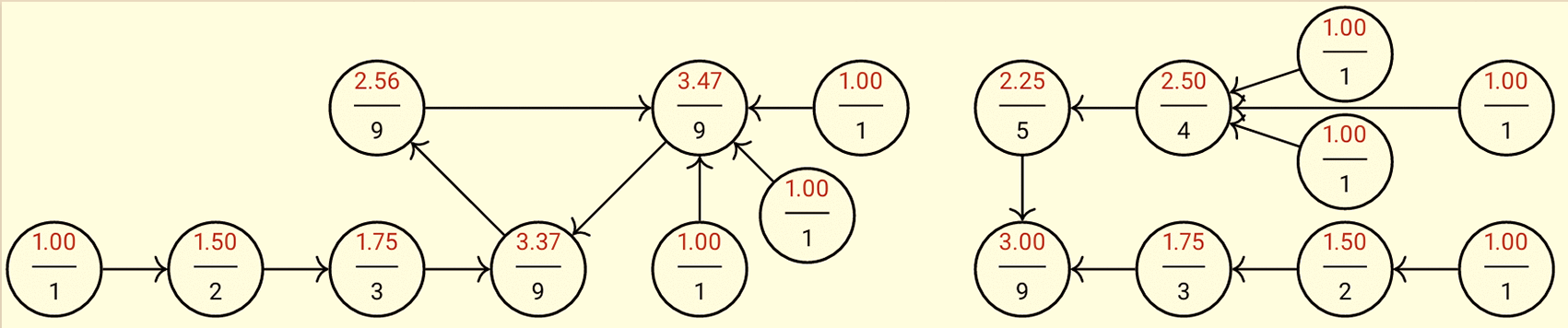
Figure 2. Nominal and expected voting weight in a delegation graph.
Each node shows nominal voting weight (bottom) and expected voting weight (red/top), assuming a 50% probability that each participant acts directly. Direct action by intermediary participants can substantially reduce expected voting weight relative to nominal voting weight. Adapted from Grossi, Nitsche, Papasotiropoulos, Skibski, et al., (2026b).
Effective influence is consequently more context-dependent than the standing delegation structure alone suggests and must be assessed in relation to participant activity within particular issues and process stages.
Formal research shows that expected voting weight can decline substantially with delegation distance because each intermediary provides another point at which onward transmission may be interrupted by direct action (Grossi and Nitsche, 2025). The expected voting weight derived in this probabilistic model coincides with Random Walk Decay centrality in Grossi, Nitsche, Papasotiropoulos, Skibski, et al., (2026b), linking the probabilistic interpretation of delegated weight to a network-centrality account of influence.
Table 2 summarizes the principal distinctions developed in this section.
Table 2. Key analytical terminology.
| Term | Meaning in this article |
|---|
| Delegation properties
|
| Substitutive delegation | Delegation replaces direct participation in the relevant decision for as long as the delegation remains in force. |
| Complementary delegation | Delegation and direct participation can coexist as choices: delegating does not preclude direct action, which takes priority where exercised. |
| Implementation mechanism
|
| Automatic suspension | The mechanism by which complementary delegation is achieved in LiquidFeedback: direct action temporarily makes the relevant delegation ineffective without terminating it, allowing persistent delegation relationships to form a standing representation structure despite intermittent direct participation. |
| Voting weight and broader influence
|
| Nominal voting weight | The potential weight of a participant if all relevant delegation paths remain operative. |
| Expected voting weight | The expected weight of a participant when the probability of direct action interrupting delegation paths is taken into account. |
| Exercised influence | Influence actually exercised in a particular issue or process stage, given the delegations and direct actions that occur. |
Neither nominal nor expected voting weight, however, should be identified with influence actually exercised. This distinction is particularly important because delegation in LiquidFeedback operates throughout the decision process rather than only in the final vote. Delegated influence may affect admission, proposal support, viability, and other stages of the process as well as the final decision. The complementary delegation model is more appropriately understood as generating an adaptive representation structure than as producing the deterministic movement of fixed voting weights through a static graph. Further implications for endpoints, backup delegations, and delegation cycles are discussed in the section “Endpoints and cycles under complementary delegation”.
Endpoints and cycles under complementary delegation
Endpoints and backup delegations
Participants without an outgoing delegation are commonly described as endpoints. In graph-theoretical terms, a delegation path terminates with them because they do not pass their own vote, or any votes received through delegation, onward to another participant.
Endpoints that receive many incoming delegations are sometimes treated as especially important and referred to as “gurus,” on the assumption that they are the participants who will ultimately cast the accumulated votes.
This assumption is misleading in LiquidFeedback, where delegation operates throughout a broader decision process. The absence of an outgoing delegation does not mean that a participant intends to exercise their influence directly. Conversely, the presence of an outgoing delegation does not mean that a participant intends to abstain or remain passive. Many default delegations, including policy- area defaults, are established before any concrete issue exists. They express a standing authorization rather than an issue-specific intention to participate or remain inactive.
Recent mathematical analyses using different approaches indicate that direct incoming delegations are a better predictor of influence than endpoint status or total nominal voting weight (Grossi and Nitsche, 2025; Grossi, Nitsche, Papasotiropoulos, Skibski, et al., 2026b).
In practice, influential participants may rationally establish backup delegations. A participant who receives many direct delegations does not cease to be influential merely because they delegate onward as a fallback. If they act directly, their own action suspends the backup delegation and carries the direct delegations entrusted to them. If they do not act, the backup delegation can transmit the delegated influence onward rather than leaving it ineffective.
Endpoint status should not be interpreted as an indicator of intended participation or effective influence. Under complementary delegation, the significance of an endpoint becomes visible only in relation to participant activity in a concrete issue and stage of the process.
Cycles and compound endpoints
A delegation cycle occurs when a sequence of delegations starting from a participant eventually leads back to that same participant. In LiquidFeedback’s single-proxy implementation, a cycle remains ineffective while all participants within it remain inactive. Once one participant acts directly, that participant’s outgoing delegation is suspended, breaking the cycle for the relevant action and allowing delegated influence reaching it to become effective (Behrens et al., 2014; Behrens, 2015).
Cycles may arise inadvertently, particularly in longer delegation chains spanning multiple delegation levels, but they may also be created deliberately. Deliberate cycles are usually short and occur among participants at the same delegation level, most commonly at the default or policy-area default level (Behrens et al., 2022).
Behrens et al., (2022) interpret such structures as compound endpoints. Any participant within the cycle can activate delegations reaching it, while the others remain free to act directly and thereby suspend their own outgoing delegations. Under complementary delegation, a cycle is therefore not inherently more vulnerable to inactivity than an ordinary endpoint. An inactive endpoint leaves delegated influence unexercised, whereas a compound endpoint can become effective through the activity of any of several participants. Cycles thus provide a form of redundancy against inactivity and become ineffective only if all their members remain inactive.
Grossi and Nitsche (2025) formalize this activity-sensitive interpretation by treating direct activity as uncertain and showing that cycles can increase the likelihood that influence reaching them becomes effective. A deliberate cycle may therefore function as a safeguard against inactivity while preserving each participant’s ability to interrupt the delegation path through direct action.
Because delegation in LiquidFeedback operates throughout the decision process, this function is not limited to final voting. During admission, for example, a cycle member’s support can activate delegations reaching the cycle and help an initiative attain the first quorum. Cycles can thereby contribute to collective moderation and agenda formation by enabling mutually trusting participants to advance issues that at least one of them considers worthy of broader discussion (Behrens et al., 2014, 2022).
Recent game-theoretic work provides a complementary strategic justification. Brill et al., (2026) show that default-delegation cycles can emerge as equilibrium arrangements among participants seeking to preserve the expected effectiveness of their voting power under uncertainty about future participation. Although their model concerns repeated voting rather than delegated influence across a broader decision process, it supports interpreting cycles as rational fallback structures rather than necessarily ineffective delegation paths.
Empirical observations and scope conditions
The empirical record of LiquidFeedback provides observations on several of the distinctions developed in the preceding analysis. The cases considered here do not constitute equivalent tests of a single model. Rather, they illustrate different aspects of the institutional configuration: the relationship between nominal delegation concentration and exercised influence, the contestability of delegated authority, the analytical separability of the LiquidFeedback process from liquid-democratic delegation itself, and the conditions under which persistent delegation is likely to become practically relevant.
Delegated influence: Concentration, activity, and contestability
One of the most extensive empirical analyses of delegation in sustained use comes from the German Pirate Party’s federal LiquidFeedback instance. Kling et al., (2015) analyze an observation period of just over 39 months, from August 2010 to November 2013, covering 13,836 users, 499,009 votes on 6,517 initiatives across 3,565 issues, and 14,964 delegations.
Their analysis confirms that delegated voting weight became concentrated and that participants with large numbers of incoming delegations emerged. Yet this concentration did not translate straightforwardly into equivalent exercised power in final voting. As participants accumulated voting experience, their direct votes became more critical and approval rates declined. Participants with many incoming delegations, by contrast, were more likely to approve initiatives and to vote with the majority of direct voters. Kling et al., (2015) describe the resulting effect as stabilizing and suggest that the responsibility associated with substantial delegated weight may have shaped how that influence was exercised. These findings concern final voting and therefore capture only part of delegated influence in LiquidFeedback. They do not measure how delegation shapes earlier stages of the process, including issue admission, proposal support, and the allocation of attention among competing initiatives.
The experience of Martin Haase provides a concrete illustration of the conditional and contestable character of concentrated delegated influence. Haase became the most prominent delegate in the German Pirate Party’s federal LiquidFeedback instance despite holding no corresponding formal party office. Deseriis, (2022) reports that he held approximately 150 delegations, but also lost substantial numbers of them following conduct that delegators regarded as inconsistent with their expectations. Accumulated delegated influence therefore remained dependent on continuing delegator confidence and could be revised or withdrawn in response to observable conduct.
Taken together, these observations caution against equating accumulated delegations with a corresponding concentration of exercised political power. The evidence from Kling et al., (2015) suggests that highly delegated participants tended to follow broader support among direct voters rather than dominate it, while the case reported by Deseriis, (2022) demonstrates that prominent delegation positions remained contestable through changes in delegator support.
Process embedding with limited or absent delegation
Other applications help distinguish LiquidFeedback’s process architecture from its delegation mechanism. Institutions may use structured agenda formation, proposal development, suggestions, expressions of support, and other elements of the process while delegation remains marginal or is deliberately omitted.
The University of Turin provides a particularly clear example. Since 2022, the university has used LiquidFeedback for participatory processes including the revision of its statutes and a multi-year participatory budgeting process. Members of the university community could introduce initiatives, formulate alternative proposals, submit comments and suggestions, and express support. In both applications at the University of Turin, delegation was not activated (Boella, 2022; Università degli Studi di Torino, 2023, 2024).
The resulting process was therefore not an implementation of liquid democracy as defined in this article, since delegation was not enabled. Its analytical importance lies precisely in this separation. The case demonstrates that the LiquidFeedback process architecture can be used for structured proposal development and opinion formation independently of liquid-democratic delegation.
Conversely, the practical relevance of persistent delegation appears to depend on the temporal and institutional characteristics of participation. In the time-limited Yorkshire climate-policy pilot, delegation was available but used only rarely. Nisbett et al., (2022) regarded delegation as more relevant to advanced and long-term use and considered LiquidFeedback particularly suitable for long-term or continuous citizen engagement.
These observations suggest that process architecture and delegation should not be treated as an indivisible package. Structured opinion formation may remain useful where delegation is absent or rarely exercised, while persistent delegation adds a further representational layer where participants confront a recurring and substantively broad stream of decisions. The practical demand for adaptive representation depends not simply on whether participation is citizen-facing or membership-based, but on whether the institutional setting generates sustained need for representation across issues and over time.
Conditions for the practical relevance of delegation
The preceding cases suggest that liquid-democratic delegation is unlikely to be equally useful in every participatory setting. Its practical relevance depends on the decision environment, the social relationships through which delegation can develop, and the organizational conditions under which representation and disagreement take place.
First, persistent delegation is most useful where participants face a continuing and substantively broad stream of decisions. As the number and variety of decisions increase, following every issue directly becomes increasingly demanding. Persistent and differentiated delegation can reduce this burden while preserving selective direct intervention.
Second, delegation presupposes some basis for interpersonal trust without requiring participants to know everyone in the relevant community. A participant need only identify someone they know sufficiently well to trust; transitivity can then connect such localized relationships across a larger representation network. Representation can therefore scale without requiring social knowledge to scale with the size of the participant population.
Third, delegation is most plausible where the relationship between delegator and representative can be mutually beneficial. In game-theoretic terms, delegation can be positive-sum: the delegator gains representation on decisions in which they would otherwise remain inactive, while the proxy gains additional influence with which to pursue sufficiently aligned objectives.
Fourth, delegation depends on meaningful possibilities for disagreement. Participants must be able to withhold or redirect delegation, intervene directly against a representative’s position, or revoke authorization without prohibitive organizational or social costs. Where hierarchy, dependency, or status differences make dissent costly, delegation choices may reproduce existing power relations rather than reflect trust and substantive alignment.
Landemore’s account of the French Convention on the End of Life provides an instructive contrasting case because two of these conditions were largely absent. During the 2022–2023 Convention, 184 randomly selected participants used what she describes as a liquid-democratic procedure to select participants for representative tasks, including two people who would address President Macron (Landemore, 2026, 211). Participants reportedly struggled to identify suitable representatives because they did not all know one another and lacked an adequate photographic directory.
The problem was not simply the absence of global acquaintance. Transitive delegation normally requires only a trusted local connection whose own relationships can extend representation further. The Convention instead brought together randomly selected participants with few prior social ties and required choices among potential representatives within the assembly.
Its incentive structure also differed fundamentally from a potentially positive-sum delegation relationship. A small number of scarce and highly visible representative roles were being allocated, so assigning a role to one participant necessarily excluded others. Rather than allowing both delegator and proxy to benefit from delegation, the procedure allocated scarce positions through an assembly-wide contest. In this respect, the interaction was zero-sum.
The case thus illustrates the importance of the informational and incentive conditions under which delegation operates. Liquid-democratic delegation is more likely to add value where localized trust can provide entry points into transitive representation networks, where delegation can create mutually beneficial relationships between delegator and proxy, and where authorization remains genuinely contestable.
Discussion: From delegation mechanisms to institutional configuration
Formal, institutional, and relational levels
The analysis developed in this article takes up the move beyond issue voting identified by Grossi, Nitsche, and Papasotiropoulos, (2026a) by connecting three levels relevant to the consequences of liquid-democratic delegation. At the formal level, computational social choice distinguishes properties of delegation and voting mechanisms, for which their taxonomy provides a systematic vocabulary.
At the institutional level, formally similar delegation mechanisms may be embedded in substantially different decision processes. Delegation may be confined primarily to voting or, as in LiquidFeedback, operate across agenda formation, proposal development, deliberation, viability selection, and final decision-making. Its institutional significance depends partly on where within the surrounding process delegated influence can become effective.
A further relational level concerns the continuing authorization relationships created through delegation. Participants may rely on different representatives in different domains, representation may extend through intermediaries connected by localized relationships of trust, and disagreement with a representative need not require complete withdrawal of authorization. Complementary delegation makes these relationships conditional on direct activity rather than transferring influence unconditionally for the duration of the delegation.
The consequences of liquid-democratic delegation should be analyzed at all three levels: the formal delegation mechanism, its institutional embedding, and the continuing political relationships it creates. None of these levels is sufficient on its own to explain how representation and influence operate in practice.
Interactions among delegation properties
The consequences of individual design properties depend on their interaction. Transitivity combined with substitutive delegation differs from transitivity combined with complementary delegation, as implemented in LiquidFeedback through automatic suspension. In the latter configuration, every intermediary is not merely a route through which influence can travel but also a point at which onward transmission can be interrupted by direct action.
Persistent delegation likewise has different consequences depending on how direct intervention is handled. Where intervention requires recall, acting directly on one issue terminates the underlying representation relationship. Under automatic suspension, localized intervention can coexist with continued authorization elsewhere. Persistence can support durable representation without making that representation unconditional.
Topic specificity interacts with transitivity in a different way. Because participants may rely on different representatives in different domains, delegation networks need not reproduce the same factional or organizational alignment across every issue. Transitivity can extend these relationships through intermediaries, creating representation structures that cross otherwise persistent boundaries.
The same point applies to delegated power. Concentrated nominal weight in a standing delegation graph differs from concentrated influence that remains conditional on direct activity, intermediary behavior, delegation scope, and continuing authorization. Concentration of nominal weight and effective influence are analytically distinct even where the former remains normatively relevant.
The institutional consequences of liquid-democratic delegation cannot be inferred from isolated taxonomic properties. They arise from interactions among delegation properties and from the institutional and relational settings in which the delegation mechanism operates.
Scalability of representation
The configuration examined here suggests a specific account of scalability. Persistent and layered delegation address the increasing attention demands created by a broad stream of decisions, while transitivity allows representation to extend beyond each participant’s immediate social knowledge. Together, these mechanisms permit participants to remain represented without requiring their political attention to increase proportionally with the number of decisions or their knowledge of potential representatives to scale with the size of the participant population.
Scalability in this sense does not eliminate constraints of attention or trust. It depends on the interaction of persistence, differentiation by subject matter, transitivity, and the continuing priority of direct participation. The relevant mechanism is therefore not delegation in the abstract, but an institutional configuration in which durable and differentiated authorization can extend through localized relationships of trust while remaining interruptible by direct action.
Research implications
The account developed here suggests two principal directions for further research. First, the concept of adaptive representation requires empirical investigation in settings of sustained use. Future work can examine how standing delegation structures are transformed by direct participation, delegation scope, and process stage, and under which institutional conditions persistent delegation becomes practically consequential. Particular attention should be paid to the scope conditions identified here, including recurring and heterogeneous decision streams, localized relationships of trust, potentially positive-sum delegation relationships, and meaningful possibilities for dissent, redirection, and revocation.
Second, process embedding raises questions for the formal modeling of liquid democracy. Existing models provide increasingly sophisticated accounts of delegation structures, voting weight, strategic behavior, and evolving representation, but delegation in practical systems such as LiquidFeedback can operate across several stages of opinion formation and collective choice. Formal research could examine how complementary, persistent, and layered delegation interacts with conditional activation, participant activity, and other stage-specific mechanisms within a continuing decision process. More generally, formal and agent-based models necessarily abstract from institutional detail, but conclusions drawn from such models should distinguish simplifications that are analytically innocuous from those that remove features consequential to the phenomenon being studied.
The analytical distinctions developed here also provide a basis for examining more specific normative and institutional consequences of liquid democracy. Questions concerning inclusion, conflict accommodation, concentration of influence, legitimacy, and related outcomes can build on this account rather than treating liquid democracy as an undifferentiated institutional form. Such analyses can then ask how particular combinations of delegation rules, process embedding, and authorization relationships shape the outcome under investigation.
Conclusion
Liquid democracy is not adequately understood when delegation is treated only as an adjunct to individual votes. LiquidFeedback exemplifies a process-embedded implementation in which complementarity, transitivity, persistence, and differentiation by subject matter operate within a wider process of opinion formation and collective decision-making. Their institutional consequences depend on their interaction with participant activity, process stage, delegation scope, and continuing authorization.
The resulting representation structure is adaptive rather than a fixed allocation of proxy power. Standing delegations define potential pathways of influence, while effective representation depends on whether and where participants act directly. Nominal and expected voting weight therefore need not coincide with influence actually exercised, and endpoints, backup delegations, and cycles likewise acquire significance only in relation to participant activity.
This configuration also provides a specific account of scalability. Persistent and layered delegation can reduce attention demands across a continuing stream of decisions, while transitivity can extend representation beyond each participant’s immediate social knowledge. These effects remain conditional on the institutional and relational conditions under which delegation operates.
The empirical record further indicates that persistent delegation is most likely to become consequential in settings of continuing governance, while the wider LiquidFeedback process can remain useful where delegation is absent or rarely exercised. Process architecture and liquid-democratic delegation are therefore separable as institutional components, but their consequences cannot be understood independently where they are combined.
Liquid democracy should consequently be understood as a family of delegation models whose consequences arise from institutional configurations rather than isolated formal properties. Analysis must distinguish the delegation mechanism, the process in which it is embedded, and the political relationships through which authorization is created and contested. The central question is how these elements interact to shape representation and influence in practice.
Author roles
Andreas Nitsche: Conceptualization, Methodology, Investigation, Visualization, Writing – Original Draft Preparation, Writing – Review & Editing.
Ethics and consent
Ethical approval and consent were not required.
Data availability
No new datasets were generated or analyzed in this study. The article presents a conceptual and institutional analysis based on published literature and documented applications. The empirical observations discussed in the article are drawn from the published sources cited in the text.
Acknowledgments
During manuscript preparation, the author used ChatGPT (OpenAI; GPT-6.1/Sol) for language refinement, structural editing, and drafting assistance, with the aim of improving clarity, organization, and accessibility for readers from different disciplinary backgrounds. The author critically reviewed, revised, and verified the AI-assisted text, including factual claims and references, and takes full responsibility for the final manuscript.
References
- Behrens J:
Circular Delegations – Myth or Disaster?
The Liquid Democracy Journal.
2015; (3).
Reference Source
- Behrens J, Kistner A, Nitsche A, et al.:
The Principles of LiquidFeedback.
Interaktive Demokratie e. V.
2014.
Reference Source
- Behrens J, Kistner A, Nitsche A, et al.:
The Temporal Dimension in the Analysis of Liquid Democracy Delegation Graphs.
The Liquid Democracy Journal on Electronic Participation, Collective Moderation, and Voting Systems 7 (September).
2022.
Reference Source
- Behrens J, Kistner A, Nitsche A, et al.:
How Aggregation Functions in Mass-Deliberation Systems Can Incentivize Extremes.
A Hypothesis on Strategy-Induced Opinion Polarization.
2025.
Reference Source
- Blum C, Zuber CI:
Liquid Democracy: Potentials, Problems, and Perspectives.
J Polit Philos.
2016; 24(2):162–182. Publisher Full Text
- Boella G:
Tutorial Sull’utilizzo Di LiquidFeedback Per Il Bilancio Partecipativo e La Revisione Dello Statuto Di UniTo.
Università degli Studi di Torino, Dipartimento di Informatica;
2022.
Reference Source
- Brill M, Colley R, George A-M, et al.:
Cycles in Liquid Democracy: A Game-Theoretic Justification.
Proceedings of the Thirty-Fifth International Joint Conference on Artificial Intelligence.
2026.
Reference Source
- Calhoun C:
Community Without Propinquity Revisited: Communications Technology and the Transformation of the Urban Public Sphere.
Sociol. Inq.
1998; 68(3): 373–397. Publisher Full Text
- Carroll L:
The Principles of Parliamentary Representation.
London:
Harrison and Sons;
1884.
Reference Source
- Deseriis M:
Is Liquid Democracy Compatible with Representative Democracy? Insights from the Experience of the Pirate Party Germany.
Partecipazione e Conflitto.
2022; 15(2): 466–481. Publisher Full Text
- Deseriis M, Behrens J:
Liquid Democracy, Its Challenges and Its Forebears.
openDemocracy.
2015.
Reference Source
- Elliott KJ:
Democracy for Busy People.
University of Chicago Press;
2023. Publisher Full Text
- Elliott KJ:
A Defense of Specialized Citizenship.
Eur. J. Polit. Theo.
2026; 25(2): 157–176. Publisher Full Text
- Falcone R, Castelfranchi C:
Trust and Transitivity: How Trust-Transfer Works.
Highlights on Practical Applications of Agents and Multi-Agent Systems.
2012; 179–187. Publisher Full Text
- Fishkin JS:
When the People Speak: Deliberative Democracy and Public Consultation.
Oxford University Press;
2009. Publisher Full Text
- Ford B:
Delegative Democracy.2002a.
Reference Source
- Ford B:
Delegative Voting.2002b.
Reference Source
- Goodin RE, Dryzek JS:
Deliberative Impacts: The Macro-Political Uptake of Mini-Publics.
Politics & Society.
2006; 34(2): 219–244. Publisher Full Text
- Green-Armytage J:
Direct Democracy by Delegable Proxy.2005.
Reference Source
- Grossi D:
Computational Challenges in Scaling Democratic Deliberation.2026. Publisher Full Text
- Grossi D, Nitsche A:
Delegations as Adaptive Representation Patterns: Rethinking Influence in Liquid Democracy.2025. Publisher Full Text
- Grossi D, Nitsche A, Papasotiropoulos G:
Modeling Liquid Democracy: A Survey of the (Computational) Social Choice Literature.
Proceedings of the Thirty-Fifth International Joint Conference on Artificial Intelligence, IJCAI-26.
Kwok J, editors.
International Joint Conferences on Artificial Intelligence Organization;
2026a. Publisher Full Text
- Grossi D, Nitsche A, Papasotiropoulos G, et al.:
Power in Liquid Democracy: A Network Centrality Approach.2026b. Publisher Full Text
- Hendriks CM:
Integrated Deliberation: Reconciling Civil Society’s Dual Role in Deliberative Democracy.
Political Studies.
2006; 54(3): 486–508. Publisher Full Text
- Janson S:
Phragmén’s and Thiele’s Election Methods.2018.
Reference Source
- Kling C, Kunegis J, Hartmann H, et al.:
Voting Behaviour and Power in Online Democracy: A Study of LiquidFeedback in Germany’s Pirate Party.
Proceedings of the Ninth International AAAI Conference on Web and Social Media.
2015; 9: 208–217. Publisher Full Text
- Landemore H:
Politics Without Politicians: The Case for Citizen Rule.
Allen Lane.
2026.
Reference Source
- Lanphier R:
A Model for Electronic Democracy?1995.
Reference Source
- Mansbridge J, Bohman J, Chambers S, et al.:
A Systemic Approach to Deliberative Democracy.
Deliberative Systems: Deliberative Democracy at the Large Scale.
Parkinson J, Mansbridge J, editors.
Cambridge University Press;
2012. Publisher Full Text
- Miller JCIII:
A Program for Direct and Proxy Voting in the Legislative Process.
Public Choice.
1969; 7(1): 107–113. Publisher Full Text
- Nisbett N, Spaiser V, Hawkins J, et al.:
Low-Carbon Infrastructure Transition in the North of England: Pilot Study Report.
University of Leeds;
2022.
Reference Source
- Paglieri F:
Choosing to Argue: Towards a Theory of Argumentative Decisions.
J. Pragmat.
2013; 59(B): 153–163. Publisher Full Text
- Paglieri F:
A Plea for Ecological Argument Technologies.
Philosophy & Technology.
2017; 30(2): 209–238. Publisher Full Text
- Tullock G:
Proportional Representation.
Toward a Mathematics of Politics.
University of Michigan Press; Ambassador Books;
1967; 144–157.
Reference Source
- Università degli Studi di Torino:
Bilancio Partecipativo 2023.
Focus Politiche di Ateneo.
2023.
Reference Source
- Università degli Studi di Torino:
Bilancio Partecipativo 2024.
Focus Politiche di Ateneo.
2024.
Reference Source
- Valsangiacomo Balmelli C, Zuber CI:
Liquid Assemblies: An Institutional Design for Liquid Democracy.
Constellations.
2026. ahead of print. Publisher Full Text
- Valsangiacomo C:
Political Representation in Liquid Democracy.
Frontiers in Political Science.
2021; 3: 591853. Publisher Full Text
- Valsangiacomo C:
Clarifying and Defining the Concept of Liquid Democracy.
Swiss Polit. Sci. Rev.
2022; 28(1): 61–80. Publisher Full Text
- Valsangiacomo C:
Six Arguments in Favor of Liquid Assemblies.
Crit Rev Int Soc Pol Phil.
2025: 1–24. Publisher Full Text
- Warren ME:
A Problem-Based Approach to Democratic Theory.
Am. Polit. Sci. Rev.
2017; 111(1): 39–53. Publisher Full Text







