4.1 Results of the linguistic analyses
4.1.1 General results. There are no direct borrowings (lexemes solely shared between two groups or languages) between Bangime and Fulfulde, the Songhai languages, or Soninke. Rather, Bangime directly shares vocabulary with Bambara, Jenaama (and its related Bozo languages in the sample), and the Dogon languages. This is not too surprising given that Fulfulde, Songhai, and Soninke are majority languages with wide reach, and that each of these is spoken in the immediate area of Bangime. On the other hand, direct borrowings between Bangime and Bambara are surprising given the geographic distance between the two groups. The proposed reason for this is discussed below. The following, Table 3, illustrates the number of concepts shared between groups. For the purposes of this general overview, we do not discuss the direction of borrowing.
In the following, we discuss the results of our computer-assisted methods to borrowing detection among the unrelated languages in our sample. To this end, we concentrate on Bangime. As a language isolate with no known relatives, it is impossible to find cognates, thus we must rely on borrowings as evidence for language contact. We have found that language, (also, a priori, speaker), contact is detected between not only geographically proximate, but also distant, languages. Furthermore, borrowings abound in Bangime in unexpected areas of the lexicon such as body parts and lower numerals. We present each of these findings in turn; rather than including lexical results in the text, we refer the reader to the supplemental materials.
Table 3. Shared concepts for each language family (out of 422 total concepts).
| Group1 | Group2 | Total |
|---|
| Atlantic | Dogon | 35 |
| Atlantic | Isolate | 4 |
| Atlantic | Mande | 12 |
| Atlantic | Songhai | 3 |
| Dogon | Isolate | 56 |
| Dogon | Mande | 111 |
| Dogon | Songhai | 45 |
| Isolate | Mande | 25 |
| Isolate | Songhai | 2 |
| Mande | Songhai | 10 |
4.1.2 Specific results. Our analysis allows us to extract those cases in which language families share material exclusively between each other. We consider these examples particularly interesting, since they give us hints on specific situations of language contact, as these cases witness a much clearer shared past than we would find when investigating Wanderwörter in our data, whose origin is often difficult to trace. While all relations are potentially interesting, we exclusively concentrate on Bangime.
It would be beyond the scope of this paper to discuss all the results of this analysis in detail here, since more work and more discussions with colleagues will be needed to evaluate the findings properly and to re-check their consistency. For this reason, we will only provide an anecdotal discussion in which we show where we think the linguistic analysis of the presumed borrowings can help to shed light on the history of Bangime. Henceforth, we concentrate on the relation between Bangime and Dogon, Bangime and Mande, and Bangime and Songhai. These three language combinations were chosen because Bangime shares the most vocabulary with Dogon and Mande, but the least with Atlantic and Songhai; the latter two may be erroneous guesses or coincidence.
A Bangime–Dogon (56 concepts)
The most numerous borrowings into Bangime are, naturally given the projected identity of the Bangande as being and speaking Dogon, from Dogon languages. There are many words which are shared between Bangime and all the Dogon languages.
The Dogon languages form a tightly cohesive group. Many lexical items are shared among all the Dogon languages. Exceptions largely include borrowings from Songhai into the northern and eastern regions and from Mande languages into the western and southern areas. In terms of specific Dogon regions’ contact with Bangime, here, we examine the northeastern and southwestern Dogon areas.
B Bangime–Northeastern Dogon
The Dogon subgroup with which Bangime directly shares the most vocabulary is that which is spoken at the greatest geographic distance, not to mention the arduous terrain that separates the two peoples. The language with which Bangime shares the highest number of concepts is Bankan Tey. Furthermore, the majority of the 28 borrowed concepts shared with Bankan Tey have very low borrowing scores and high age scores in the World Loanword Database (Haspelmath & Tadmor, 2009, https://wold.clld.org). Not only are these concepts numerous, one must note the prevalence of body parts and core vocabulary. Furthermore, honey cultivation from bees is essential to Bangande agricultural practices, yet the form for HONEY is shared.
C Bangime–Southeastern Dogon
Tommo So and Togo Kan, with 18 concepts each, are the languages of this group to share the most lexemes with Bangime. As with the northwestern group, most of these shared concepts are also found in other Dogon languages; MOON is an exception in being exclusively shared between Bangime and Tommo So. Given the discussion above in Section 2.5, that both the concepts SONG and SING are shared between Bangime and Tommo So is not surprising.
D Bangime–Northwestern Dogon
Most concepts shared between Bangime and the northwestern Dogon languages are also shared with the southwestern group, or with the Dogon languages more generally. Bondu So is the most prominent language in this group. For instance, Bangime shares lower numerals with Bondu So, which in turn patterns with the Dogon languages more generally.
E Bangime–Southwestern Dogon
Direct borrowings primarily from the southwestern Dogon languages are few; the languages of this group with which Bangime shares the highest number of concepts, 19 and 18, are its closest neighbors, Tiranige and Bunoge respectively. Furthermore, the few concepts not also shared with the northeastern and other Dogon regions such as DONKEY and WORK (LABOR) are additionally attested in the Mande language group.
Given the geographic proximity of the southwestern Dogon and Soninke–Bozo (discussed below) languages to Bangime, it is somewhat surprising that so few words are found in the Bangime lexicon directly from influence from these languages. In fact, that there are so few direct borrowings from these languages, and their prevalence among more recently introduced terms to the area, implies that the speakers’ contact has not been longstanding. On the other hand, both the Mande and Dogon languages are internally tightly knit, and thus finding words that do not have cognates with other languages of their families is rare. Furthermore, many words are shared among different groups of the area. Despite this, the tendencies remain striking.
F Bangime–Mande (25)
In terms of Mande groups, Bangime speakers today are in closest contact with Jenaama speakers; their language is one of the Bozo languages, which in turn is most closely related to Soninke. However, the Mande language with which Bangime shares the most vocabulary is Bambara.
G Bangime–Bambara
Among the 15 concepts shared between Bangime and Bambara, seven can be considered to be associated with the caste system of the Mali Empire, and more could be added if other language groups were also included such as HOST which is also attested in Fulfulde. For instance, the term for BLACKSMITH in Bangime is a direct borrowing from Bambara, not shared with either the any other Mande, or Dogon, languages.
Although two concepts are also found in Jenaama, none are shared with Soninke, and thus purportedly are not from the earlier Ghana Empire with which the Soninke language was associated. One notable exception to this generalization is the concept SLAVE, which is likely borrowed from Soninke into Bangime, but not directly, as it is also found among the southwestern Dogon languages, and not in Bambara.
Additionally, note that the majority of the words shared between Bangime and Bambara include body parts, and even those from the caste system have low borrowability scores and high age scores; the lexeme for the concept GOD is not that of the widely distributed Muslim term Allah, rather the pre-Muslim name for God, ŋara ~ ŋala.
H Bangime–Jenaama
Over half, seven out of a total of 13, concepts shared between Bangime and Jenaama are also shared with Bambara. Even if we factor in concepts shared between Bangime, Jenaama, and the neighboring Dogon languages, the numbers remain quite low in comparison to those shown above for Bangime and the Dogon languages which are spoken at greater distances.
I Bangime–Soninke
Only two concepts, EAR and TRAP (PITFALL), are borrowed into Bangime directly from Soninke. However, it does not seem as if neither of these are coincidental. Note that ELEPHANT, a compound of the concepts BIG and EAR is also shared between Bangime, Jenaama, the Bozo languages, and, somewhat surprisingly, the Dogon language Bondu So. The form for TRAP (PITFALL) is probably the result of a slight semantic shift. The form ɡɛŋɡɛ for IRON is found in both the Dogon language Gourou and Bangime, which in turn, as noted above, is likely a borrowing from Bambara.
J Bangime–Bozo
There are only two lexemes which are found in Bangime and the Bozo languages as a group, but exclude Jenaama and Bambara: the form for HOT in Bangime is identical, save for tones, to that of three Bozo languages. However, it is possible that the form is actually borrowed from Dogon languages of the northeastern group, which are (albeit distantly) related to the Mande languages, and thus the phonetic similarities in Bangime are somewhat of a coincidence. On the other hand, MILLET is a concept that is essential to the livelihood of all the cultures in the sample, and thus the most common form is shared between all Dogon languages save for the southwestern group and Mande languages Bambara and two Bozo languages; the form found in Bangime and the Bozo languages in which it is attested, is an outlier.
K Bangime–Songhai (2)
Save for two concepts, ANCESTORS and SEVEN, which could be attributed to chance, there are no Bangime-Songhai pairings in which other languages are not also implicated, illustrating that the chances of direct contact between Bangime and Songhai are low. An interesting trend, however, is the fact that the two Dogon languages that have most impacted Bangime, Bankan Tey and Bondu So, are those that have the most shared concepts with Songhai. Geographically, the areas where Bankan Tey and Bondu So are spoken are the closest among the Dogon groups to where Songhai Kiini and Songhai Senni are spoken. Thus, shared concepts among those areas are not surprising.
L Bangime–Atlantic (4)
Today, Fulfulde speakers have frequent contact with those of Bangime, and nearly all Bangande are fluent in Fulfulde, but there are hardly any direct loans between them that exclude the Dogon languages. This implies that, as long as Bangime has been in contact with Fulfulde speakers, so have Dogon.
M Dogon–Mande (111)
In principle, at least, Dogon and Mande are related at the higher order of the Niger-Congo language phylum. This is reflected, whether by contact or a common inheritance, by extensive shared vocabulary in our dataset. Phonotactically, the difference is difficult to distinguish as sound correspondences can be found in both cases. Semantically, certain concepts such as BOAT are likely a recent introduction into plains Dogon languages from Bozo fisherman, whereas the origin of concepts such as MARROW, with variable forms and pairings within the subgroups, is less clear.
Synonyms and semantic extensions are a crucial component of any study of borrowed lexical items. Borrowings are common among our wordlist when a concept is expressed through more than one word. An extended meaning of the concept HEAD is an areal feature found throughout all the groups in our sample except Mande. For instance, HEAD as kṵṵ is shared between Bambara and many eastern Dogon languages with which speaker contact is limited today. However, this is one of two forms found in the Dogon languages; the other is dana. If the language in question lists both forms, only that which is shared with Bambara is used metaphorically for a reflexive object, ‘on top’ and in compounds such as ‘chief’, whereas the dana Dogon form is used exclusively to refer to the body part. As the Dogon form for HEAD which refers only to the body part is not shared with any other group, it is likely the native term while the one shared with Bambara is borrowed. Bambara, in turn, does not share the form kṵṵ with any other Mande language in our sample. Perhaps the form was borrowed at an early stage from the Dogon languages into Bambara but without the extended meaning.
O Dogon–Songhai (45)
As noted above, Bondu So and Bankan Tey speakers have the most contact today with those of Songhai. Otherwise, although most Dogon languages share the word for BLACKSMITH with Songhai, the term [dʒɛ́mɛ̀-nɛ̀ / dʒɛ́mɛ̀-m] more likely is originally derived from the Dogon word for ‘black’ [dʒɛ́m]. In this case, our results reflect both the diachronic as well as the synchronic situation. This is discussed further below in the following sections.
4.2 Results of the genetics analyses
Patterns of genetic diversity in the Bandiagara cliffs of central-eastern Mali reflect complex population dynamics and deep history of settlements in this region of the West African fringe. The results show that the populations of central-eastern Mali have strong affinities to West Africans, in particular, Niger–Congo speaking West Africans. Interestingly, the genetic variation is driven, at some level, by the linguistic diversity and subsistence patterns.
4.2.1 Bangande. The Bangande population is genetically distant from the surrounding Dogon, Bozo, Fula and Songhai populations (Figure 3). The unique Bangande genetic structure and the high levels of homozygosity compared to the populations from central-eastern Mali are probably the result of a long-term isolation (Babiker et al., 2020). Although the genetic structure of the Bangande is distinct from all other populations in the region, Babiker et al. (2020) reported some admixed individuals whose genealogical records point to an origin from a non-Bangande ethnic group where the Dogon languages are spoken (e.g., Tommo So). Even though it is not common to report cases of marriage between the Bangande and the neighboring populations (Heath & Hantgan, 2018), the data of the genealogical records show that women (mostly grandmothers of the studied participants) were brought to the Bangande villages from other Dogon villages, e.g., Tiranige, Tommo So, and Penange. Among these individuals, some were blacksmith participants in the Bangande caste system (see Section 2.6). Also, the study inferred a long-term effective population size for the Bangande population (Ne = 3,276 (CI 2,947–3,711)), which is the smallest in comparison to the other studied populations. Moreover, the mean time of divergence between the Bangande and other populations from central-eastern Mali was estimated to be 9,900 (CI 8,726–10,838) years ago. The estimated time of divergence for the Bangande is in line with the “time barrier” of the conventional linguistic comparative methodology (Gray, 2005) and suggests a time depth between language families. These findings suggest that the Bangande population is a genetic isolate that has resisted assimilation and language replacement despite the people’s claims that they are Dogon. Also, the findings suggest that the Bangande might represent one of the earliest inhabitants of the region prior to the Dogon expansion and linguistic diversification.
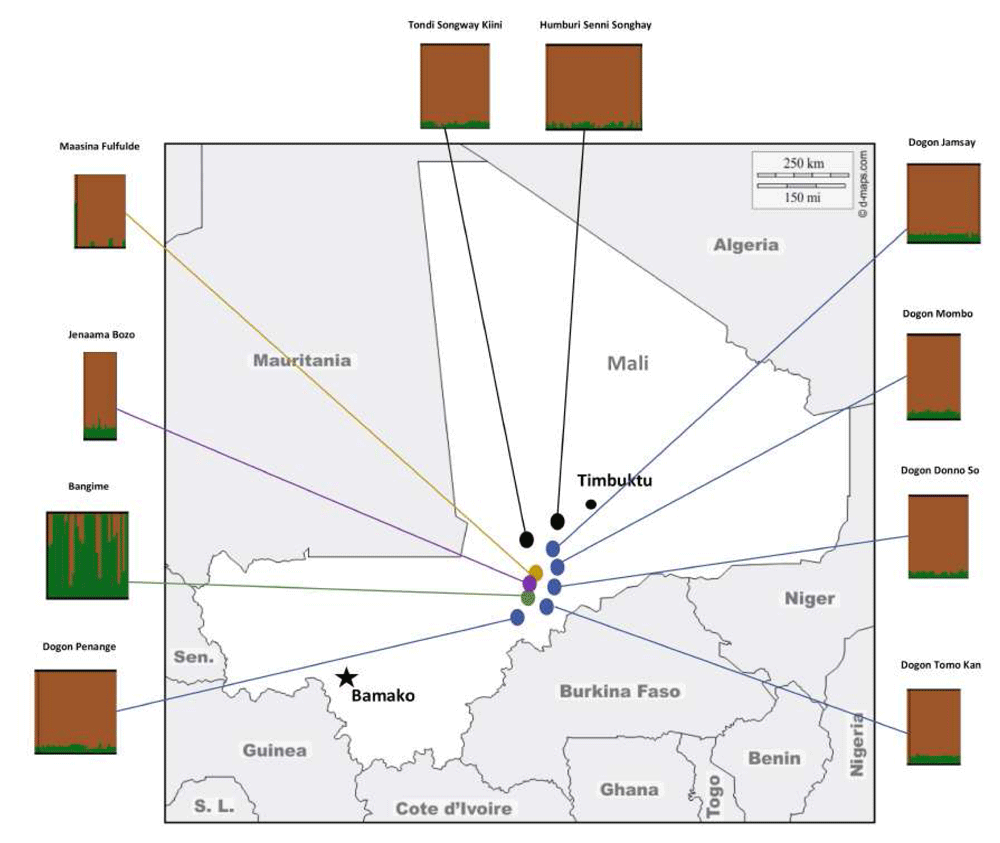
Figure 3. Map of the Bandiagara Escarpment in central-eastern Mali showing the locations and the genetic structure of populations studied.
Figure adapted with permission from (Babiker et al., 2020).
4.2.2 Dogon. The five Dogon populations studied in Babiker et al. (2020) are representative of three additional Dogon linguistic groups based on areas relative to the cliff range: Escarpment Dogon, West Dogon, and Plains Dogon (Hammarström et al., 2021). The genetic structure of the Dogon groups shows homogeneity at smaller K clusters K=2 (best cross-validation error for the Admixture analysis) (Figure 3). However, the populations show some level of structure at K cluster (see Babiker et al., 2020), possibly reflecting the differences in levels of inbreeding within each group rather than different genetic ancestries. The study also showed smaller pairwise genetic distances (FST) between the Dogon Donno So (Escarpment Dogon) and the Dogon Mombo (West Dogon) populations as well as between the Dogon Jamsay and Tomo Kan (Plains Dogon). Furthermore, the genetic data allowed the estimation of population divergence times, which pointed to an older divergence for the Dogon of the cliffs. In detail, the study reported a divergence between the Mombo and Penange (West Dogon) linguistic groups at (3,031 (CI 2,723–3,301) years ago and between the Dogon Mombo (West Dogon) and Donno So (Escarpment Dogon) linguistic groups at (2,373 (CI 2,080–2,673) years ago. In contrast, the study reported a relatively recent divergence between the Dogon Plains groups: the Dogon Jamsay and Tomo Kan linguistic groups at (1,059 (CI 908–1,104)) years ago.
4.2.3 Bozo. The millet-farming Bozo studied by Babiker et al. (2020), are distinguished from other fishing Bozo of this region and inhabit a village on the cliffs of the roadside that extends along the valley that leads to the Bangande villages. Although the Bozo population is geographically closer to the Bangande than other populations in the study (Figure 3), it clusters with the Dogon populations in the ADMIXTURE analysis and bears low pairwise genetic distances from other populations in comparison to the high distance from the Bangande.
4.2.4 Fulani. The Fulani population of the Bandiagara Escarpment represents a distinct level of genetic diversity mostly driven by gene flow from Eurasian/admixed African populations (see Figure 3 and Babiker et al., 2020). The subsistence pattern and the nomadic nature of the Fulani might have eased the channels of language contact with other groups in the region, but not genetic relationships through marriage, which are controlled by different social and political aspects.
4.2.5 Songhai. Further, Babiker et al. (2020) showed a contrast in genetic structure between the two Songhai linguistic groups studied (Figure 3), the Songhai of Humbori, the speakers of Humburi Senni and the Songhai of Kikara, the speakers of the Tondi Songway Kiini. While the analysis pointed to a Dogon influence on the genetic structure of the Songhai of Kikara (limited gene flow), it showed that the genetic structure of the Songhai of Humbori was influenced by gene flow from non-African sources. The study highlighted the political role of Humbori during the Songhai polities and Empire dating from the 7/8th to 16th centuries AD and the possible connections with other populations that was also facilitated by the geographical location of the town.