(Plain language summary)
In this data note we present a list of words in indigenous languages of the Gran Chaco region in South America. These languages belong to arguably six established language families, whose deeper relationship is under discussion. Five of those language families are found only in the Gran Chaco, while one of them, the Tupí-Guaraní family, is found across all of South America. In order to make it easy to compare the words in the wordlist, we standardized the data in several ways. We illustrate how the data can be analyzed by providing examples for cases in which words in unrelated languages show similar structures without being directly borrowed from each other.
Introduction
The Gran Chaco is a South American eco-region that extends through north-central Argentina, eastern Bolivia, western Paraguay and southern Brazil. It is located north of the Salado river, east of the Andes mountains, south of the Amazon, from which it is separated by the Chiquitania, and west of the Paraguay and Paraná rivers. Apart from languages that have entered the region through conquest and colonization, such as Spanish, German and Paraguayan Guaraní, the region is home to indigenous languages of six different families: Guaicuruan, which includes Toba, Western Toba, Pilagá, Mocoví, Kadiwéu and extinct Abipón; Matacoan or Mataguayan, which includes Wichí, Maká, Nivaclé, and Chorote; Enlhet-Enenlhet, which includes Enlhet, Enxet, Enenlhet, Guaná, Sanapaná and Angaité; Zamucoan, which includes Ayoreo and Chamacoco; Lule-Vilela, which includes only Lule and Vilela; and Tupi-Guarani, which in the Gran Chaco includes Tapiete, Ava, and Guaraní Izoceño but which also extends all through South America (Campbell & Grondona, 2012; Durante, 2018; Fabre, 2005; Golluscio & Vidal, 2010). For many of these languages there are also different geographic varieties.
The linguistic diversity of the Gran Chaco and the striking similarities in the features of some apparently unrelated languages have attracted the attention of numerous linguists, who have approached the topic from various theoretical and methodological frameworks. On the one hand, much research has focused on genetic relations among the languages. Recently, for instance, it has been stated that Vilela and extinct Lule are related and the family has been named Lule-Vilela (Viegas Barros, 2001), or that Guaicuruan and Matacoan languages have a common genetic origin and belong to one family, termed Guaicuruan-Matacoan (Viegas Barros, 1993; Viegas Barros, 2013a). Previous work had proposed even greater language family groupings (Kaufman, 1990; Mason, 1950). On the other hand, similarities among Chaco languages, not only Guaicuruan and Matacoan, have been analysed from the perspective of areal linguistics. Such similarities include phonological traits such as the presence and absence of certain phonemes, as well as grammatical features like the presence of possessive classifiers and noun determiners (Comrie et al., 2010).
Fewer studies, however, have focused on shared semantic features that are visible in the lexicon in the form of similar lexical motivation patterns (Campbell & Grondona, 2012; Messineo et al., 2010). In that sense, we consider that a big-scale dataset for further comparison of the Gran Chaco languages is a necessary tool that we have been lacking. Even though there have been many valuable works that compare different languages of the region, some of the criteria are inconsistent, and they seldom deal with the entirety of the indigenous languages of the Gran Chaco in a human and machine-readable way. Such an enterprise should be a starting point for a project that includes genetic comparison and concrete investigation of both lexical and pattern borrowing across Chaco languages of different families.
Materials and methods
Materials
Two different datasets were first individually compiled and later combined for this study. The first one comprised a list of 502 concepts reflecting basic vocabulary terms translated into 23 language varieties spoken in the Chaco area and two language varieties from other regions. The second one consisted of 825 ethnobiological concepts translated into 16 Chaco varieties. While the coverage for the basic dataset was rather high, with most languages showing word forms for 80% and more of the data, the coverage for the ethnobiological dataset was rather low, since the terms are highly specific and it was often difficult to find translations for all terms in resources available for the respective varieties. In order to allow for a more targeted comparison of the languages with respect to lexical structures, we then decided to combine them. For this purpose, we selected 224 concepts from the basic vocabulary lists, and 100 ethnobiological concepts, resulting in a total of 324 concepts for 23 language varieties (see Table 1), which are geographically distributed across and around the Chaco area (see Figure 1).
Table 1. Languages and data points covered in our study.
| # | Variety | Family | F | C | B | E | Co | Sources |
|---|
| 1 | Abipón | Guaicuruan | 216 | 155 | 155 | 0 | 0.48 | Najlis, 1966 |
| 2 | Ava Guaraní | Tupian | 263 | 215 | 215 | 0 | 0.66 | Dietrich, 2021 (IDS) |
| 3 | Ayoreo | Zamucoan | 377 | 228 | 212 | 16 | 0.70 | Benz & Salinas Jacai Picanerai, 2020; Briggs, 2021 (IDS);
Schmeda-Hirschmann, 1998 |
| 4 | Chamacoco | Zamucoan | 251 | 163 | 162 | 1 | 0.50 | Ulrich & Ulrich (2000) |
| 5 | Enlhet | Enlhet-Enenlhet | 438 | 252 | 216 | 36 | 0.78 | Arenas, 1981; Unruh & Kalisch, 1997 |
| 6 | Enxet Sur | Enlhet-Enenlhet | 334 | 209 | 189 | 20 | 0.65 | Rojas & Curtis, 2017 |
| 7 | Guaraní
Paraguayo | Tupian | 325 | 238 | 214 | 24 | 0.73 | Carol, 2018; Guasch & Ortiz, 1986; Seelwische, 1980 |
| 8 | Iyojwa'ja
Chorote | Matacoan | 360 | 274 | 216 | 58 | 0.85 | Drayson, 2009; Scarpa, 2010 |
| 9 | Iyoʼwujwa
Chorote | Matacoan | 254 | 190 | 176 | 14 | 0.59 | Carol, 2018 |
| 10 | Kadiweo | Guaicuruan | 225 | 158 | 157 | 1 | 0.49 | Griffiths, 2002; Sándalo, 1995 |
| 11 | Lule | Lule-Vilela | 296 | 174 | 174 | 0 | 0.54 | Machoni & Larsen, 1877 |
| 12 | Maká | Matacoan | 282 | 243 | 199 | 44 | 0.75 | Arenas, 1983; Gerzenstein, 1999 |
| 13 | Mapudungun | Araucanian | 256 | 207 | 207 | 0 | 0.64 | Fernández Garay et al., 2021 |
| 14 | Mbya | Tupian | 223 | 168 | 168 | 0 | 0.52 | Cadogan, 1992 |
| 15 | Mocoví | Guaicuruan | 298 | 216 | 213 | 3 | 0.67 | Buckwalter & Ruiz, 2021; Rosso, 2010 |
| 16 | Nivaclé | Matacoan | 376 | 250 | 217 | 33 | 0.77 | Seelwische, 1980 |
| 17 | Pilagá | Guaicuruan | 287 | 248 | 211 | 37 | 0.77 | Buckwalter & Litwiller de Buckwalter, 2021; Filipov, 1993; Vidal, 2010 and
Vidal, 2013 |
| 18 | Quichua
Santiagueño | Quechua | 235 | 176 | 162 | 14 | 0.54 | Bravo, 1975 |
| 19 | Tapiete | Tupian | 272 | 202 | 194 | 8 | 0.62 | González, 2005; González, 2011 |
| 20 | Toba | Guaicuruan | 471 | 273 | 216 | 57 | 0.84 | Buckwalter & Buckwalter, 1980; Buckwalter & Sánchez, 2021;
Cúneo & Porta, 2009; Martínez, 2009 |
| 21 | Toba de Cerrito | Guaicuruan | 180 | 154 | 154 | 0 | 0.48 | Messineo, 2009 |
| 22 | Toba-pilagá | Guaicuruan | 368 | 255 | 192 | 63 | 0.79 | Arenas, 1993; Tebboth, 1943 |
| 23 | Wichí | Matacoan | 388 | 241 | 209 | 32 | 0.74 | Braunstein, 2021 (IDS), DIWICA (2021); Suárez, 2010 and Suárez, 2014 |
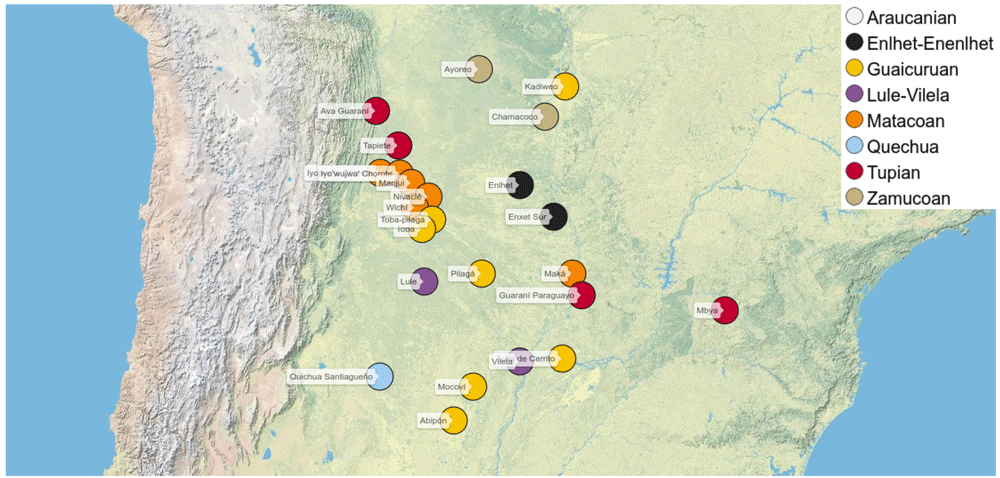
Figure 1. Languages covered in our study (with exception of Mapudungun, which is located further in the South).
The collection of basic words was compiled from various sources, mainly dictionaries, but in some cases also from grammatical descriptions. One of the largest contributors was the Intercontinental Dictionary Series (IDS), (Key & Comrie, 2021). Other material came from individual sources available for the respective varieties, mainly dictionaries, wordlists, and compilations of different Chaco languages. In these cases, translational equivalents for the basic words were carried out manually. The collection of ethnobiological terms was typically compiled from specific lists of ethnobiological vocabulary, taken from articles and books dedicated to the topic, but in some cases, unified resources for basic vocabulary and ethnobiological terms were available and could be used.
Methods
In creating our resource, we had two major goals in mind. On the one hand, we wanted to create a resource that is both human- and machine-readable at the same time, allowing us to analyse the data and annotate particular findings step by step in future work (this process is ongoing work and might be featured in studies to be published in the future). On the other hand, we wanted to create a resource that can be easily compared with other lexical resources, both on a world-wide and a regional scale. This allows us to make use of additional information or to compare our findings with those reported for other areas of the world in our future work. In order to achieve the first goal, we used an internal representation of the data for analysis and annotation, based on the Etymological Dictionary Edictor (EDICTOR, Version 2.0, List, 2021a), in which we curate the data manually, annotating the data for various aspects, such as cognacy, borrowings, or borrowed patterns (loan translations) shared across the Chaco languages. In order to achieve the second goal, we converted our data to Cross-Linguistic Data Formats (CLDF, Forkel et al., 2018), using the Lexibank workflow for the curation of lexical data in CLDF (List et al., 2022a). While data curation and annotation with the help of the EDICTOR tool were largely done in a manual fashion, the conversion to CLDF was mostly done automatically, providing additional steps that helped us to identify potential problems in our data.
Data curation with EDICTOR
Basic vocabularies and ethnobiological vocabularies were first collected separately. Only later, when we realized that both can be better analyzed in combination, we decided to combine them. For this purpose, we decided for a combined list of 324 items, with 224 basic vocabulary items and 100 ethnobiological items in total. Both datasets were combined to form a single TSV file in the format required by the EDICTOR tool and converted to an SQLITE database, using the PyEdictor package (List, 2021b, Version 0.4), which we use to allow for the convenient online editing of the data.
Our main intention for the analysis was to annotate structural borrowings, that is, cases of borrowings in which it is not the word form that is being transferred, but rather the lexical motivation by which certain objects can be denoted. As an example, consider the English term “(computer) mouse”, which is reflected as ratón de computadora (literally “mouse or rat of the computer”) in Spanish.
In order to annotate structural borrowings in the Chaco data, we made use of existing annotation schemes that were developed for the handling of partial cognates (Hill & List, 2017) and later extended to handle more complex cases of language-internal cognates and semantic shift (Schweikhard & List, 2020) and ultimately implemented in Version 2.0 of the EDICTOR tool (List, 2021a). The main idea of these annotation schemes is to provide what we call ‘morpheme glosses’ for each word form in the data and combine these with identifiers for partial cognates (see List et al., 2016).
As an example, consider the words for “beak” and “lip” for Maká and Chorote (both from the Matacaon language family) and Pilaga (from the Guaicuruan family) in Table 2. As can be seen from the table, all three language varieties express the word for “beak” by using the entire word or a part of the word for “lip”. Since Pilaga is not related with Chorote and Maká, and the form that expresses the concept “lip” in Pilaga ([a s e p], according to our annotation) is not cognate with the form [p a s] in Chorote and Maká, we assign these forms different cognate set identifiers (2 for [a s e p] and 4 for [p a s]). But since we judge the pattern as identical, consisting of a possessive marker (marked as :poss in our morpheme glosses) and the reuse of the form “lip” to denote the concept “beak”, we assign them the same pattern identifier, indicating that we have a shared structure here. Whether this structural commonality is due to language contact or due to independent processes of lexical change cannot be said at this point, since the pattern annotation is work in progress and has not been done for all of the data. Assembling more of these patterns in our data, however, will eventually allow us to find out whether these scenarios might result from contact or not.
Table 2. Example of our extended annotation of cognate sets, with morpheme glosses and structural similarities with respect to the motivation structure of individual word forms.
| Family | Language | Concept | Form | Cognates | Structure | Morpheme
Glosses |
|---|
| Guaicuruan | Pilaga | beak | n - a s e p | 1 2 | 1 2 | :poss lip |
| Guaicuruan | Pilaga | lip | n - a s e p | 1 2 | 1 2 | :poss lip |
| Matacoan | Chorote | beak | x i - p a s - a t | 3 4 5 | 1 2 3 | :poss lip :suff |
| Matacoan | Chorote | lip | x i - p a s - a t | 3 4 5 | 1 2 3 | :poss lip :suff |
| Matacoan | Maká | beak | ɬ a - p a s | 6 4 | 1 2 | :poss lip |
| Matacoan | Maká | lip | p a s | 4 | 2 | lip |
Table 2 shows words for “beak” and “lip” across three varieties from two language families. While word forms are not cognate across the two language families, and also not borrowed directly, we find structural similarities with respect to the motivation. In all three varieties, the word for “beak” is derived from the word for “lip”. We indicate this structural commonality with the help of identifiers that reflect the abstract structure (column Structure) and with the help of morpheme glosses, that provide an analysis of the underlying motivation (column Morpheme Glosses).
Data Sharing with CLDF
Whenever substantial changes to the data have accumulated and we decide to release a new version, we export the dataset and convert it automatically to CLDF. In doing so, we carry out several consistency checks of the data and make sure that the individual datapoints are maximally comparable across datasets from different sources. The CLDF conversion is carried out with the help of the CLDFBench toolkit that offers a command line interface that facilitates the conversion of language data to CLDF formats (Forkel & List, 2020, https://pypi.org/project/cldfbench). Since we are working with lexical data, we additionally use the PyLexibank plugin for CLDFBench (Forkel et al., 2021), which offers extended functionality (see List et al., 2022a). The conversion to CLDF makes sure that our concepts are regularly linked to the most recent version of the Concepticon reference catalogue (List et al., 2022b), that all languages, where possible, are linked to Glottolog (Hammarström et al., 2022), and that the transcriptions follow the standards proposed by the Cross-Linguistic Transcription Systems reference catalogue (List et al., 2021). Since the CLDF standard currently does not (yet) offer standards to annotate structural borrowings, we define custom formats for now (see Table 2), which we will propose for the inclusion in future versions of CLDF. In the following, we discuss the integration of our data with the three reference catalogs of (Concepticon, Glottolog, and CLTS) in more detail.
Concept linking. The concept list underlying our study was linked to the Concepticon reference catalogue (Version 2.6, List et al., 2022b). Concepticon offers unique identifiers for various concepts that are frequently used in questionnaires for language documentation and historical language comparison. Since Concepticon is by now more and more often used as a common standard reference for lexical datasets, also underlying large collections such as the Database of Cross-Linguistic Colexifications (CLICS) (Rzymski et al., 2020) or the Lexibank repository of standardized wordlists in CLDF formats (List et al., 2022a), we also made sure to link the concepts in our data to Concepticon, where possible. For the very specific plant and animal names in our data, however, the Concepticon does not offer concept identifiers. Here, we therefore linked our data to the Global Biodiversity Information Facility (GBIF).
Language mapping. Another way of linking the data with already existing sources consists in the linking of language varieties to the Glottolog project (Hammarström et al., 2022). Glottolog provides unique identifiers for several language varieties, including dialect points and ancient varieties along with additional information regarding the language families to which the respective languages belong. For two varieties in our data, no Glottocode could be found. These are Manjui, which is a variety of Chorote spoken in the territory of Paraguay, and Toba de Cerrito, also spoken in the Paraguayan Chaco. These have not been identified as separate varieties on Glottolog yet, but might be added in future versions.
Most of the languages in our dataset are spoken in the Gran Chaco region of South America, in the territories of Argentina, Bolivia, Brazil, and Paraguay. In addition, we have chosen three languages spoken in adjacent regions, which we hope to use as control cases in future analyzes, namely Mapudungun (Araucanian), spoken in southern Chile and Argentina, Mbyá (Tupí-Guaraní), spoken in Argentina, Brazil and Paraguay, and Quichua Santiagueño (Quechuan), spoken in north-central Argentina. Finally, Paraguayan Guaraní is usually not considered a Chaco language in origin, but it has an undeniable influence on indigenous communities of the Gran Chaco, especially in the territory of Paraguay, where it is the second and sometimes the first language of many indigenous people who are bilingual in other languages.
When searching for the translational equivalents of individual concepts in our concept lists in the different sources for the varieties we included in our sample, it is often difficult to decide which word corresponds best to a given concept, specifically in cases where one has to choose from several variants. Variants may result from several reasons. On the one hand, two translations for the same concept may correspond to different varieties that have been included in the same resource. For example, we have added a document for a variety of Toba spoken in Paraguay, Toba de Cerrito. However, this variety has two subvarieties, one spoken in the village of Rioverde and the other spoken in the village of Rosario. In those cases in which these subvarieties display different forms, we indicate in a comment which form corresponds to which variety. In future versions of the database, we plan to find more principled ways of handling this kind of dialectal variation. On the other hand, different resources may give different forms for the same concept but no indication in which regard the forms differ (e.g., regarding their usage, specific semantic nuances, etc.). In these cases we indicated the different sources in our comments, but hope to find a more principled way to handle these cases of variation in future versions of our database.
This study includes Lule and Abipón, two extinct varieties of which no speakers are known to have survived until today. The original sources of these varieties were written by missionaries in the eighteenth and nineteenth centuries. Since transcription practices differed largely in the past, we cannot fully account for the accuracy of the transcriptions we used. Including the varieties in the study has proven useful, however, since it allowed us to check whether certain kinds of semantic patterns existed already 300 or 200 years before.
Phonetic transcriptions. After having compiled the vocabulary in the corresponding sheets, the forms were converted, into a broad version of the International Phonetic Alphabet, called B(road)IPA, the central transcription system underlying the five transcription systems provided in the CLTS reference catalog. For the initial conversion, we made use of orthography profiles (Moran & Cysouw, 2018), which are integrated into the Lexibank workflow for the curation of lexical data, which we used for our study (List et al., 2022a). In this workflow, original forms are preserved, and for the target phonetic transcriptions used for cross-linguistic comparison, automatic tests are carried out to make sure they only reflect sounds defined in the CLTS reference catalog.
The conversion of transcription systems used by individual scholars to standardized transcriptions that conform to CLTS can be considerably tedious, especially when different transcription systems are underlying the data from every source. The conversion therefore required an intensive study of the phonological descriptions of all language varieties in our sample, for which often information often could only be found in broader grammatical descriptions. Inspecting the data also revealed that our initial conversion to phonetic transcriptions with orthography profiles was at times not optimal or contained occasional errors, which we then had to refine manually by modifying the data in the EDICTOR application. For the two extinct languages in our collection, Lule and Abipón, no reliable phonological descriptions available. In the case of Abipón, we followed the description of on phonology in Viegas Barros (2013b), based on comparison with other Guaicuruan languages. For Lule, we followed Zamponi’s analysis from 2008.
Implementation
Having set up the data in its current form, our workflow for data curation and analysis now consists of two steps. In a first step, the data is analyzed using the EDICTOR tool. Figure 2 shows how the data appear in the Wordlist panel of the EDICTOR interface. In order to share the data publicly, we then used the Lexibank workflow (List et al., 2022a) to convert the data automatically into Cross-Linguistic Data Formats, which can be triggered from the commandline. The conversion automatically checks various aspects of the data, including the transcriptions as reflected in a given version of the CLTS reference catalog, the mapping to a given Glottolog version and a given Concepticon version, and the formal correctness of currently available annotations.
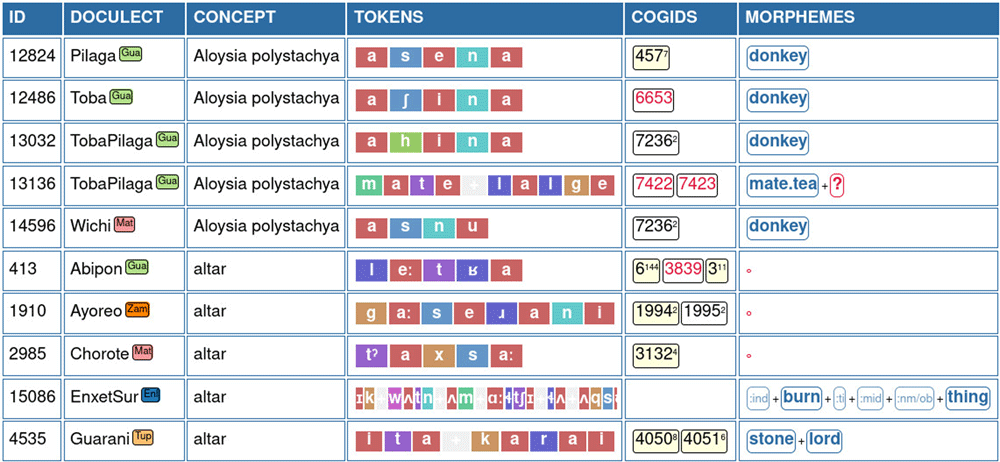
Figure 2. Curating the data with the help of the EDICTOR interface.
The screenshot shows the Wordlist panel view of the EDICTOR tool. Word forms are rendered by coloring speech sounds according to their major sound class.
Conclusion
Although we consider the collection of the dataset reported here as preliminary, it has reached a stage where we can start with the concrete analysis of individual patterns in the data (Brid et al., 2022). In the future, we plan to enhance the current dataset further and also extend the annotation of cognate words and structural borrowings.
Ethics and consent statement
Ethical approval and consent were not required.