Introduction
Antimicrobial resistance is a health threat that is emerging globally and threatens human and veterinary medicine. One of the factors that has facilitated this spread is the transfer of mobile genetic elements between bacteria, for which plasmids are mostly responsible in Gram negative bacteria such as Escherichia coli1. In Enterobacteriaceae there are 40 plasmid types described, according to their incompatibility1,2. IncK1 plasmids are often associated with blaCTX-M-14 and IncK2 plasmids predominantly carry blaCMY-23. IncK1 plasmids are found in various sources and IncK2 plasmids are predominantly associated with poultry, which makes it an adapted and specialized vector spreading antimicrobial resistance among poultry4.
Incompatibility is the inability of two plasmids to be stably maintained in one cell5. This phenotypic trait was long used as a plasmid typing tool for epidemiological studies but this has now mostly been replaced by molecular diagnostic tools6. Incompatibility is caused by the presence of identical or closely related shared determinants between two plasmids, originating from partition or replication mechanisms7.
Replication and the copy number of plasmids can be regulated by antisense RNA. For IncF, IncL, IncM, IncQ, I-complex plasmids (containing IncI, IncK, IncB/O and IncZ plasmids), ColE1 and plasmid pT181 (rep7a) incompatibility is mediated by an antisense stem-loop RNA structure (RNAI) that inhibits translation of the rep mRNA8–14.
Involvement of the antisense RNAI in replication control and incompatibility, was extensively studied for I-complex plasmids15–20. RNAI controls replication through interaction with stem-loop I (SLI)21,22. The most important step is the formation of the stable kissing complex by pairing between the single-stranded RNAI and SLI22. An excellent graphical representation of I-complex plasmid replication, including IncK1 and IncK2, was previously published23.
Minireplicons can be used to determine if incompatibility of IncK plasmids is determined by the replication control region, and not the partitioning region. Minireplicons contain a minimal part of a plasmid that can replicate at the same copy number as the original plasmid and that maintains the same incompatibility behaviour of the original plasmid24. The role of nucleotides in the top loop domain and upper stem of the RNAI structure in the interaction with the stem-loop I (SLI) was studied in detail for IncB/O plasmids15. IncB/O and IncK plasmids share a high degree of similarity in their RNAI structures. Using systematic mutagenesis of nucleotides in the RNAI structure, it was concluded that for IncB/O plasmids, three nucleotides on the top of the top loop (C37, C38 and C39) are crucial for the initial kissing interaction of RNAI with SLI. The interior loop in the upper stem is involved in the intra-strand melting and inter-strand pairing of RNAI with SLI23. Mutations disrupting the structure of the interior loop have a significant effect on plasmid compatibility15. Mutations at other positions only had significant effects if the mutation caused a base mismatch and therefore altered the structure.
Two compatible lineages of IncK plasmids were described in literature3,25. Four SNPs and one indel were identified that differ in the RNAI sequence of IncK1 and IncK2 plasmids, which may contribute to the compatibility and copy number of these plasmids. RNAI is a target allowing distinction between IncK1 and IncK2 plasmids. In this paper we examined the influence of these five polymorphisms in the RNAI structure for the compatibility of IncK1 and IncK2 plasmids. These results provide insights into the basis of incompatibility of IncK plasmids and support previous results for IncB/O plasmids.
Methods
Plasmids and vectors used
IncK2 plasmid pT.1.09 described in this study was recovered from E. coli from a poultry faeces sample and IncK1 plasmid p754 was recovered from a dog faeces sample (Table 1)3. Vector pMW2 is a 4,4kb pBlueScript-derivative carrying the kanamycin resistance gene aph(3')-III26.
Table 1. Plasmids used and constructed in this study.
| Plasmid name | Resistance
gene | Source | Reference |
|---|
| p754 (IncK1) | blaCTX-M-14 | dog | 3 |
| pT.1.09 (IncK2) | blaCMY-2 | poultry | 3 |
| pIncK1 mini | aph(3')-III | - | this study |
| pIncK2 mini | aph(3')-III | - | this study |
| pIncK1 mini RNAI_delA2 | aph(3')-III | - | this study |
| pIncK1 mini RNAI_T10C | aph(3')-III | - | this study |
| pIncK1mini RNAI_G25T | aph(3')-III | - | this study |
| pIncK1 mini RNAI_G41C | aph(3')-III | - | this study |
| pIncK1 mini RNAI_G41C | aph(3')-III | - | this study |
| pIncK2 mini RNAI_insA2 | aph(3')-III | - | this study |
| pIncK2 mini RNAI_G3C | aph(3')-III | - | this study |
| pIncK2 mini RNAI_C9T | aph(3')-III | - | this study |
| pIncK2 mini RNAI_T24G | aph(3')-III | - | this study |
| pIncK2 mini RNAI_C40G | aph(3')-III | - | this study |
Minireplicon construction
We examined the effect of point mutations in the RNAI structure on the compatibility of IncK plasmids. To determine the effect of the RNAI structure only and exclude involvement of any other plasmid structures, we designed minireplicons that contain the replication region of the IncK plasmid, and a kanamycin resistance cassette, which were ligated in a MW2 vector.
Minireplicons were constructed by cloning the replication region of the IncK1 or IncK2 plasmid into the vector pMW2. This vector was chosen because of the presence of kanamycin resistance gene aph(3')-III. The replication region, corresponding to the one previously used for a minireplicon construction, contained repA, repB and RNAI27. Amplifying the replication region was performed using the rep754 mini fw and rv primers for the IncK1 plasmid and repT1.09 mini fw and rv primers for IncK2 (Table 2). The PCR reaction was performed according to the protocol: 95°C 2 min, 95°C 30 sec, 57°C 30 sec, 72°C 2 min, 72°C 5min for 30 cycles. The PCR product was purified using the Gene Clean Turbo Kit (MoBio), digested with BamHI and KpnI for IncK1 and SacI and KpnI (Thermo Fisher Scientific) for IncK2. The digested replication region was ligated into vector MW2 after digestion with the respective enzymes, using T4 Ligase with standard manufacturers protocol (Thermo Fisher Scientific). The ligated product was electroporated into E. coli DH10B Electro MAX competent cells (Thermo Fisher Scientific) according to the manufacturer’s protocol. These cells were chosen because of the high transformation efficiency. Transformants were grown on agar plates containing 25 µg/mL of kanamycin (Sigma). The presence of the minireplicon was confirmed by PCR using IncK replicon targeting primers (K1 fw and rv and K2 fw and rv) and Sanger sequencing. All created minireplicons are listed in Table 1. The size of the IncK1 minireplicon is 3789 bp and IncK2 3922 bp.
Table 2. Primers used in this study.
“Mini” in the primer name means that the primer targets the minireplicon. Each primer name additionally depicts the mutation that is introduced in the RNAI structure, using this primer.
| Primer name | Primer sequence | Reverse primer used | Reference |
|---|
| Creating minireplicons |
| rep754 mini fw | CATGGTACCGGCCTGCAGTTCTGACAGAC | | This study |
| rep754 mini rv | ATGTGATCATAGGCACGGTGCTGCGTTTG | | This study |
| repT1.09 mini fw | CAGGGTACCACTGAGCCAGATACCAGTT | | This study |
| repT1.09 mini rv | CAGGAGCTCTACGAGCGTGTACTGAGGAC | | This study |
| IncK1/IncK2 plasmids identification |
| K1 fw | ATCGTCAGGATCCGGGAAGTC | | 3 |
| K1 rv | GAGCGATTGTGCCGTGTATT | | 3 |
| K2 fw | ATGCTCGCGGTCCGGAAAGCC | | 3 |
| K2 rv | GTGCCGTGCGTTAATGCACTGCAA | | 3 |
| Single nucleotide mutagenesis |
| Phu-754-R1 | GGGATAAGTATATATGAAACCGTACCAGAG | | This study |
| Phu-754-R2 | TAGTAGGGGCGTTCACAGAATACGGGATAA | | This study |
| Phu-T1.09-R1 | GGGATAAGTATATATGAAACCGTGTCAGAG | | This study |
| Phu-T1.09-R2 | TAGTGGGGGCCTCACAGAATACGGGATAAG | | This study |
| Phu-754-A2-Del-Fw | GTATTCTGTGACGCCCCTACTATCTTTCACG | Phu-754-R1 | This study |
| Phu-754-C4G-Fw | GTATTCTGTGAAGGCCCCTACTATCTTTCACG | Phu-754-R1 | This study |
| Phu-754-T10C-Fw2 | GTATTCTGTGAACGCCCCCACTATCTTTCACG | Phu-754-R1 | This study |
| Phu-754-G25T-Fw | TCTTTCACGATCCCGCCAAAGTTCGAGGAAAGAT | Phu-754-R2 | This study |
| Phu-754-G41C-Fw | TCTTTCACGAGCCCGCCAAAGTTCGACGAAAGAT | Phu-754-R2 | This study |
| Phu-T1.09-A2-Ins-Fw | GTATTCTGTGAAGGCCCCCACTATCTTTCACG | Phu-T1.09-R1 | This study |
| Phu-T1.09-G3C-Fw | GTATTCTGTGACGCCCCCACTATCTTTCACG | Phu-T1.09-R1 | This study |
| Phu-T1.09-C9T-Fw | GTATTCTGTGAGGCCCCTACTATCTTTCACG | Phu-T1.09-R1 | This study |
| Phu-T1.09-T24G-Fw | TCTTTCACGAGCCCGCCAAAGTTCGACGAAAGAT | Phu-T1.09-R2 | This study |
| Phu-T1.09-C40G-Fw | TCTTTCACGATCCCGCCAAAGTTCGAGGAAAGAT | Phu-T1.09-R2 | This study |
| Resistance genes detection |
| Kan fw | ATGATGCTATGGCTGGAAGG | | This study |
| Kan rv | CGCAGAAGGCAATGTCATAC | | This study |
| CTX-M-14 fw | CTATTTTACCCAGCCGCAGC | | 28 |
| CTX-M-14 rv | GTTATGGAGCCACGGTTGAT | | 28 |
| CMY fw | ATGATGAAAAAATCGTTGCTGC | | 29 |
| CMY rv | GCTTTTCAAGAATGCGCCAGG | | 29 |
| aph(3')-III fw | GGCTAAAATGAGAATATCACCGG | | 30 |
| aph(3')-III rv | CTTTAAAAAATCATACAGCTCGCG | | 30 |
Single nucleotide mutagenesis was performed with the Phusion Site-Directed Mutagenesis Kit (Thermo Scientific) according to the manufacturer’s protocol, using primers with the designated mutation (Table 2). The presence of the minireplicon was confirmed with PCR using primers targeting the replication region (Table 2). The presence of the mutation was confirmed by Sanger sequencing.
The RNAI structure of the wild type (wt) and mutated RNAI genes was predicted using RNAfold (http://rna.tbi.univie.ac.at/cgi-bin/RNAWebSuite/RNAfold.cgi).
Stability
The stability of minireplicons was determined in triplicate by independent overnight culturing in LB broth without selection. Serial dilutions of the culture were plated on LB agar plates without selection and incubated overnight at 37°C. 40 colonies were picked and PCR was performed to amplify the resistance gene present on the minireplicon. Stability was determined as a percentage of colonies containing the minireplicon. All results were statistically analysed using the Mann–Whitney U test. Stability of wild type IncK1 and IncK2 plasmids has been tested in a prior study3.
Plasmid copy number
To determine the plasmid copy number, three independent DNA extractions using DNeasy UltraClean Microbial Kit (Qiagen) were performed from overnight culturing in LB broth with selection for each strain, and qPCRs using iQ SYBR Green Supermix (BioRad), targeting the aph(3’’)-III replicon and uidA gene, were carried out in triplicate for each extraction. Plasmid copy number per chromosome was calculated using the formula described by San Millan et al.31 cn = [(1 + Ec)Ctc/(1 + Ep)Ctp] x (Sc/Sp), where cn is the plasmid copy number per chromosome, Sc and Sp are the sizes of the chromosomal and plasmid amplicons (in bp), respectively, Ec and Ep are the efficiencies of the chromosomal and plasmid qPCRs (relative to 1), respectively, and Ctc and Ctp are the threshold cycles of the chromosomal and plasmid reactions, respectively. Plasmid copy number was determined using aph(3’’)-III fw and aph(3’’)-III rv primers for IncK1 minireplicons and uidA fw and uidA rv for the chromosomal target (Table 2). Obtained data were analysed using the Mann–Whitney U test.
Incompatibility testing
IncK minireplicons are non-conjugative, therefore electroporation was chosen as a method to deliver the minireplicons into the bacterial cell. Although IncK1 or IncK2 wt plasmids are conjugative, in order to standardize the methods, they were electroporated into E. coli DH10B according to the manufacturer’s protocol. E. coli cells carrying either the IncK1 or IncK2 wt plasmid were made electrocompetent from 250 mL liquid culture of OD600 0.5 in LB media. Cultures were spun down for 10 min at 3560×g at 4°C. Pellets were washed twice with 250 and 125 mL ice-cold water, washed with 10 mL ice-cold 10% glycerol and finally resuspended in 0.5 mL ice-cold 10% glycerol and frozen at −80°C. For electroporation, minireplicons were isolated using the Wizard Plus SV Miniprep kit (Promega) and transformed as described above. Transformants were subsequently selected on LB plates supplemented with 25 µg/mL kanamycin (Sigma-Aldrich) to select for the minireplicon and 2 µg/mL cefotaxime (Sigma-Aldrich) to select for the IncK wt plasmid.
To test the incompatibility of the IncK plasmid and the minireplicon combinations, the heteroplasmid population was grown overnight and plated on non-selective LB agar plates. For a detailed description see the “stability” paragraph.
Results
RNAI structure comparison
The RNAI sequence of IncK1 and IncK2 sequences differ by four SNPs and one indel. The RNAI structures of the wt plasmids were predicted as well as the structures of variants where one polymorphism of IncK2 is introduced in IncK1 and vice versa (Figure 1). The RNAI structures of wt IncK1 and IncK2, which consist of 61 and 60 nucleotides respectively, mainly differ in the top loop region. The top loop of the IncK2 RNAI structure is substantially bigger (12 nucleotides) compared to the one from IncK1 (8 nucleotides) based on in silico RNA structure predictions.
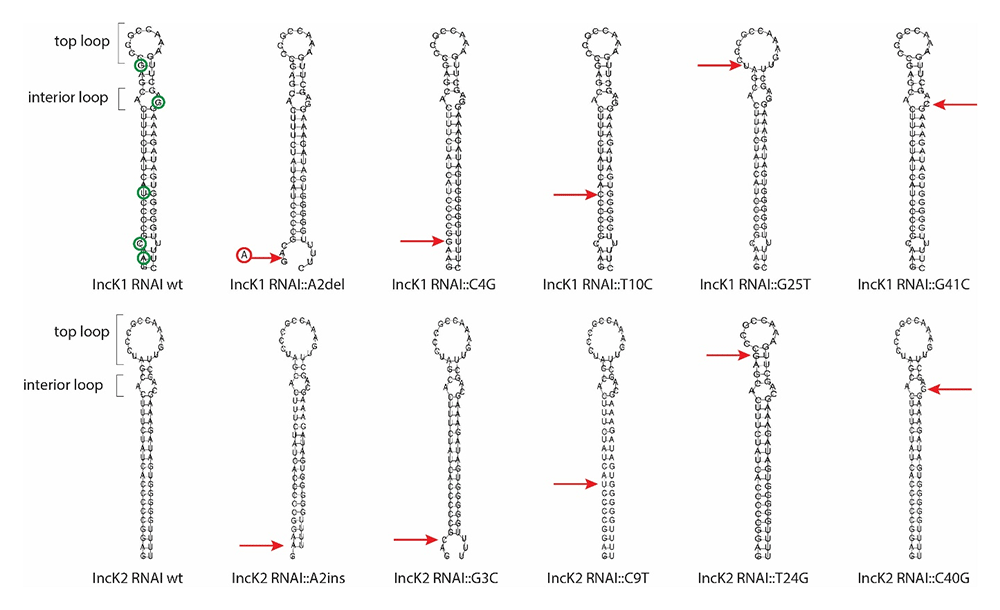
Figure 1. RNA structure prediction of all mutated RNAI variants.
Red arrows point out the different mutation sites of the various minireplicons that were tested. Green circles indicate all SNPs between IncK1 and IncK2 RNAI.
All of the nucleotide positions that are different between IncK1 and IncK2 plasmids were subjected to site-directed mutagenesis. Each mutated nucleotide was substituted with the corresponding nucleotide from the opposite plasmid group. The predicted size of the loop is controlled by a single polymorphism at the base of the loop while all other polymorphisms affect the stem or interior loop of the molecule. All of the mutations have an effect on the predicted structure, either creating or dissolving the second interior loop at the base of the stem or creating an overhang of several ‘free’ bases. However, mutation G25T/T24G is the only mutation that affects the top loop and therefore has the biggest impact on the conformation of the predicted structure (Figure 1).
Minireplicon stability
The stability of the minireplicons as well as the vector pMW2 was examined in triplicate after 24 hours of culture without antibiotic selection and was defined as the percentage of colonies that contained the minireplicon at the end of experiment. Stability of the vector pMW2 was 40%, which is lower compared to IncK1 minireplicons (Figure 2). However, the difference between stability of pMW2 and any minireplicon was not statistically significant, probably due to high standard deviation. The stability of the minireplicons was much lower compared to their parental plasmids3. The IncK1 wt minireplicon had a higher stability compared to the IncK2 wt minireplicon (p=0.034). All IncK1 mutated minireplicons have a higher stability than the corresponding IncK2 mutated minireplicons (p≤0.05). For IncK1 plasmids there were no statistically significant differences between the wt minireplicon and mutated variants (Figure 2). For IncK2 minireplicons, mutations A2ins, T24T and C40G resulted in a statistically significant increase in stability of the minireplicon compared to wt (p=0.037 for A2ins and C40G and p=0.034 for T24T). On the other hand, mutation C9T caused a statistically significant decrease in stability of the minireplicon compared to the IncK2 wt (p=0.037). This low stability and high variability of the IncK2-derived minireplicons may affect the results and IncK2-derived minireplicons were therefore excluded from plasmid copy number and incompatibility testing.
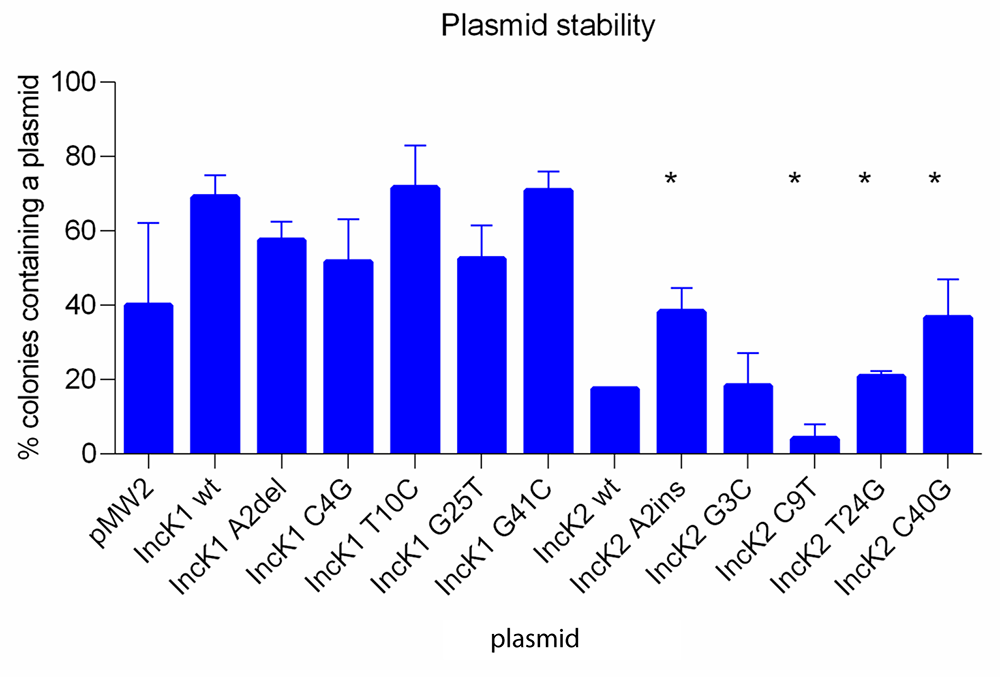
Figure 2. Stability of wt and mutant minireplicons after 24 hours of non-selective growth.
Asterisks indicate the mutant minireplicons for which stability was significantly different compared to the minireplicons containing the wt RNAI (p≤0.05).
Plasmid copy number
Plasmid copy number was determined using qPCR targeting aph(3’’)-III as a plasmid target gene and uidA as a genomic target gene. Vector pBlueScript, which is a backbone for the vector pMW2, is a high-copy number plasmid which was confirmed in our experiment. pMW2 has an average copy number of 125. The IncK1-based minireplicons have an average copy number of 2. This result corresponds to the previous reports showing that copy number of IncK1 wt plasmids is 1–2 copies per cell4. For all of the minireplicons with mutated RNAI there is no significant difference in copy number compared to the wt minireplicon (Figure 3).
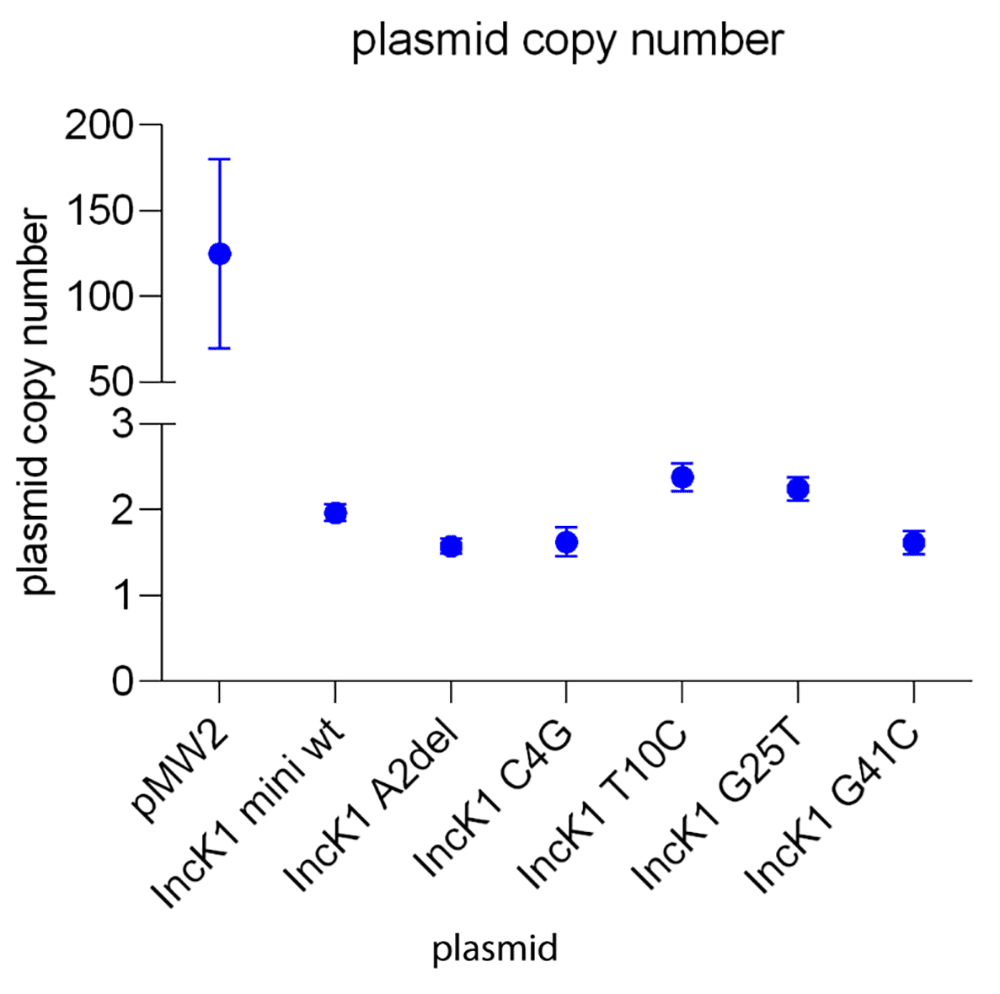
Figure 3. Plasmid copy number.
Minireplicon incompatibility
Incompatibility of IncK1 wt-derived mutated minireplicons was checked in triplicate against the parental and non-parental IncK wt plasmids. We performed overnight incompatibility tests to assess if the tested minireplicons and wt plasmids could be stably present together in one cell without antibiotic selection. The compatibility of IncK1 wt and IncK2 wt plasmids was determined previously3.
All heteroplasmid strains were created by electroporating a mutated minireplicon with wt IncK1 or IncK2 plasmid into one cell. The compatibility of plasmids from all obtained heteroplasmid cells are shown in Figure 4. We determined the percentage of cells carrying either both a minireplicon and IncK wt plasmid, only one of these or none. All minireplicons were compatible with their non-parental IncK wt plasmid (Figure 4, Extended data32, Table S1). Mutations G25T and G41C have a critical effect on compatibility of the IncK1 minireplicon with the IncK1 wt parental plasmid. Mutations A2del and T10C also cause some degree of compatibility with the IncK1 parental plasmid.
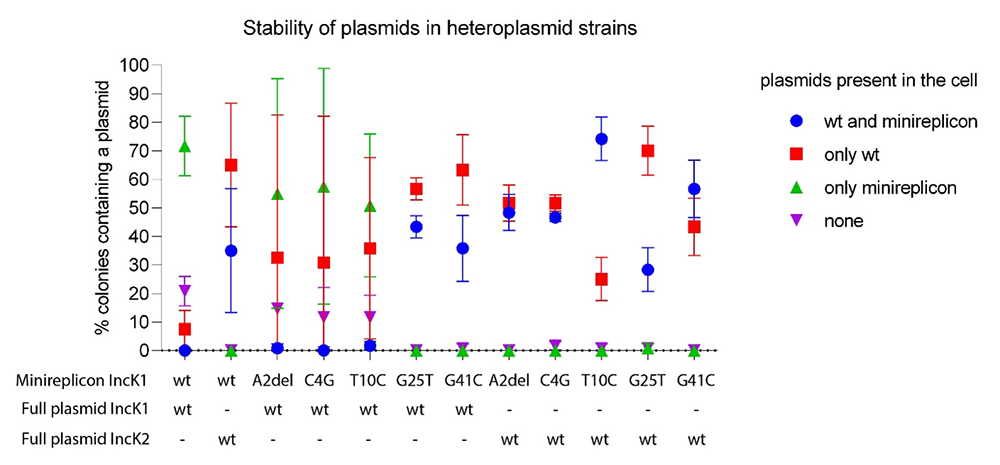
Figure 4. Compatibility of wt and mutated minireplicons tested in triplicate against parental and non-parental IncK plasmids.
Raw data can be found in Supplementary Table 1.
Based on our incompatibility experiments, we compared the stability of single minireplicons to the plasmids from heteroplasmid strains containing both the minireplicon and their (non-) parental IncK wt plasmids (Figure 5). All minireplicons that co-existed with their parental plasmid had a statistically significant lower stability in comparison with plasmids from cells containing only the minireplicon (Figure 4). The only exception is mutation G25T on the IncK1 minireplicon, where there was no statistical difference in stability between the heteroplasmid or single plasmid strains. This is also the only mutation that restored full compatibility of the minireplicon and its parental plasmid. Mutation G25T on the IncK1 minireplicon resulted in a decreased compatibility with its non-parental plasmid.
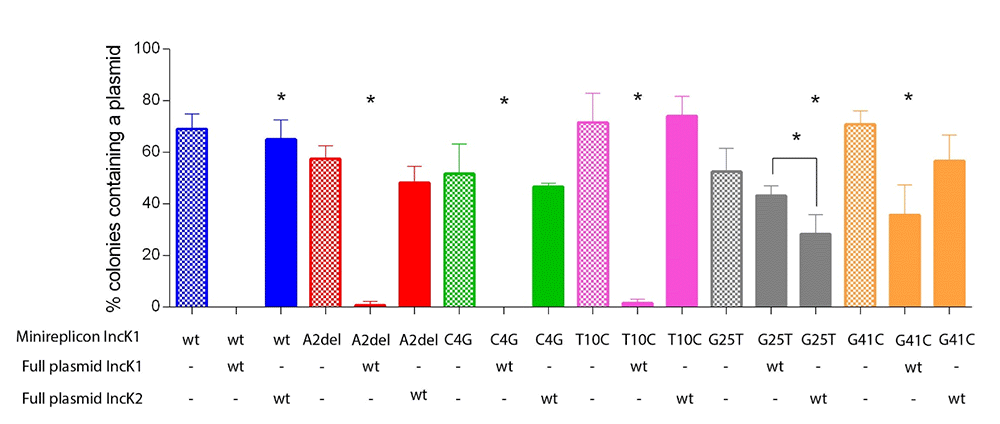
Figure 5. Comparison of single minireplicon stability with its stability in the heteroplasmid strain (co-existing with parental or non-parental plasmids).
Dotted bars represent stability of the minireplicon alone, full bars represent stability of minireplicons with the IncK1 wt plasmid. * Means that the minireplicon stability in the heteroplasmid sample is statistically significantly different from the stability of a single minireplicon.
Discussion
In this study we examined the molecular basis of incompatibility of IncK plasmids by determining the effect of point mutations in the RNAI structure on incompatibility. We created minireplicons carrying the replication region of either the IncK1 or IncK2 plasmid, in which we subsequently introduced point mutations in the RNAI structure.
The minireplicons constructed in this study consisted of the replication region of IncK1 or IncK2 plasmids and an aph(3’’)-III gene. Vector pMW2 used in this study has a relatively low stability itself. This low stability combined with a very high copy number is in line with the nature of an expression vector. No stability determinants were introduced in the design as they could possibly affect incompatibility relationships. The low stability of vector pMW2 had an effect on the results of the study, which should be taken into account. Moreover, stability of IncK2 minireplicons was too low to be included in the study.
The copy number of the plasmid is regulated by the replication region. IncK wt plasmids have been shown to have a copy number of 1–2 per cell4. Lack of the partitioning system on the low-copy minireplicons leads to random segregation during cell division and therefore rapid plasmid loss. Additionally, the IncK wt plasmid has a toxin-antitoxin system stabilizing it in a cell, which is missing on the minireplicons. This could explain the instability of the minireplicons created in this study. High instability of minireplicons was previously reported for IncL/M plasmids33. Additionally, the fact that the minireplicons constructed in this study lack the partitioning system, may also contribute to the relatively weak observed incompatibility. Moreover, IncK2 plasmids were shown to be adapted to poultry body temperature (42°C)4. It is possible that testing at a higher temperature would result in higher stability of IncK2 plasmids. However, plasmid incompatibility was initially defined as a displacement of a resident plasmid (in this case wild type IncK plasmid), which might explain low stability of wt plasmid in the incompatibility experiments5. The obtained results indicate that replication-based incompatibility may not be a straight-forward system based on plasmids being present or not in one cell. It may be similar to partitioning-based incompatibility of IncF plasmids, where both strong and weak incompatibility was reported34.
The results obtained in this study showed that mutations in the top loop and interior loop in the upper stem of the RNAI structure have a critical effect on the compatibility of IncK plasmids. Similar findings were previously demonstrated for IncB/O plasmids15. Three nucleotides in the top loop of RNAI of IncB/O plasmid structure, G37, C38, C39, have the most significant effect on the compatibility of IncB/O plasmids, because they are responsible for the formation of the initial kissing complex between RNAI and SLI15. Mutations in the bottom part of the top loop of IncB/O plasmid have less significant effect on compatibility, which would explain the results that heteroplasmid strains containing IncK wt plasmid and IncK minireplicon with the top loop mutation, G25T for IncK1 were compatible. The interior loop in the upper stem of RNAI is involved in inter-strand pairing between RNAI and SLI23 Preserving the structure of the interior loop is crucial for the interaction with SLI. Mutation G41C, that was introduced into RNAI in this study, does not disrupt the interior loop and therefore has a limited effect on the incompatibility of IncK plasmids. Additionally, different mutations cause a different degree of incompatibility for IncK1 and IncK2 plasmids. For IncK1 minireplicons, mutations G25T and G41C have a critical effect on their compatibility with the IncK1 wt parental plasmid. Mutations A2del and T10C only have a small effect on the compatibility. These changes in compatibility of IncK1 minireplicons could be observed regardless its low stability. These results implicate that mutation T10C does not affect compatibility of IncK1 and IncK2 plasmids, but has an effect on replication and copy number control of IncK1 plasmid. It is possible that exchanging thymine to cytosine results in stronger bonding with guanine on the opposite strands which interferes with the formation of the extended kissing complex. These findings are in line with previous research, which showed that different mutations in the RNAI structure can cause a different degree of rep inhibition15. Incompatibility of IncK plasmids can be caused by the cumulative effect of the mutations in the RNAI structure. However, low stability of the minireplicons may be the sole reason why not all initially heteroplasmid strains contain both plasmids. More research is required to be able to fully understand the role of mutations in RNAI and the interplay of partitioning system in the compatibility of these plasmids.
In recent years, compatibility of many plasmids was re-examined3,25,35,36. The most used and well established method to determine compatibility of two plasmids is conjugation of both into one cell, followed by selective plating37. However, the present study has indicated the added value of examining plasmid incompatibility over time in comparison with the classical method where incompatibility is measured as an ability to form a heteroplasmid strain. This greatly affected the interpretation of results. Incompatible plasmids could be found in one cell with selective pressure and were unstable together after removal of the selective pressure.
Based on previous sequence alignments, RNAI-structure predictions and minireplicon incompatibility experiments, this manuscript has confirmed the predicted effect of certain bases in the RNAI structure of IncK1 and IncK2 plasmid incompatibility. It shows that a single mutation in the RNAI structure of the IncK1 plasmid can change its compatibility. The RNAI structures used in this study were predicted in silico. However, using crystallographic RNAI structures could provide a better resolution and insights about the exact mechanism underlying the compatibility changes caused by the introduced mutations. Further research in this field, including more plasmid types, can possibly lead to a design of a sequence-based tool predicting plasmid compatibility. Such a tool would eliminate the necessity to perform laborious compatibility experiments and allow faster and easier plasmid compatibility predictions. Knowledge about plasmids compatibility would allow to improve existing plasmid classification, which would further help understanding epidemiology of these plasmids.
Acknowledgements
We would like to thank dr Marc Wösten for providing the kanamycin cassette donor vector MW2.
We would like to thank Arjen Timmerman and Heleen Zweerus for the help with stability experiments.
Authors contribution
MR Conceptualization, Formal Analysis, Investigation, Methodology, Writing
AK Investigation, Methodology
JAW Conceptualization, Funding Acquisition, Methodology, Writing
DJM Conceptualization, Methodology, Writing
JH Conceptualization, Methodology, Writing
MSMB Conceptualization, Funding Acquisition, Methodology, Writing
Faculty Opinions recommendedReferences
- 1.
Rozwandowicz M, Brouwer MSM, Fischer J, et al.:
Plasmids carrying antimicrobial resistance genes in enterobacteriaceae.
J Antimicrob Chemother.
2018; 73(5): 1121–1137. PubMed Abstract
| Publisher Full Text
- 2.
Fang H, Feng J, Xu Y, et al.:
Sequencing of pT5282-CTXM, p13190-KPC and p30860-NR, and comparative genomics analysis of IncX8 plasmids.
Int J Antimicrob Agents.
2018; 52(2): 210–217. PubMed Abstract
| Publisher Full Text
- 3.
Rozwandowicz M, Brouwer MSM, Zomer AL, et al.:
Plasmids of distinct IncK lineages show compatible phenotypes.
Antimicrob Agents Chemother.
2017; 61(3): e01954–16. PubMed Abstract
| Publisher Full Text
| Free Full Text
- 4.
Rozwandowicz M, Brouwer MSM, Mughini-Gras L, et al.:
Successful host adaptation of IncK2 plasmids.
Front Microbiol.
2019; 10: 2384. PubMed Abstract
| Publisher Full Text
| Free Full Text
- 5.
Novick RP:
Plasmid incompatibility.
Microbiol Rev.
1987; 51(4): 381–95. PubMed Abstract
| Publisher Full Text
| Free Full Text
- 6.
Carattoli A, Bertini A, Villa L, et al.:
Identification of plasmids by PCR-based replicon typing.
J Microbiol Methods.
2005; 63(3): 219–28. PubMed Abstract
| Publisher Full Text
- 7.
Bouet JY, Funnell BE:
Plasmid localization and partition in enterobacteriaceae.
EcoSal Plus.
2019; 8(2). PubMed Abstract
| Publisher Full Text
- 8.
Novick RP, Iordanescu S, Projan SJ, et al.:
pT181 plasmid replication is regulated by a countertranscript-driven transcriptional attenuator.
Cell.
1989; 59(2): 395–404. PubMed Abstract
| Publisher Full Text
- 9.
Asano K, Mizobuchi K:
An RNA pseudoknot as the molecular switch for translation of the repZ gene encoding the replication initiator of IncIα plasmid ColIb-P9.
J Biol Chem.
1998; 273(19): 11815–25. PubMed Abstract
| Publisher Full Text
- 10.
Athanasopoulos V, Praszkier J, Pittard AJ:
Analysis of elements involved in pseudoknot-dependent expression and regulation of the repA gene of an IncL/M plasmid.
J Bacteriol.
1999; 181(6): 1811–9. PubMed Abstract
| Publisher Full Text
| Free Full Text
- 11.
Blomberg P, Nordström K, Wagner EG:
Replication control of plasmid R1: RepA synthesis is regulated by CopA RNA through inhibition of leader peptide translation.
EMBO J.
1992; 11(7): 2675–83. PubMed Abstract
| Publisher Full Text
| Free Full Text
- 12.
Kim K, Meyer RJ:
Copy-number of broad host-range plasmid R1162 is regulated by a small RNA.
Nucleic Acids Res.
1986; 14(20): 8027–46. PubMed Abstract
| Publisher Full Text
| Free Full Text
- 13.
Praszkier J, Wilson IW, Pittard AJ:
Mutations affecting translational coupling between the rep genes of an IncB miniplasmid.
J Bacteriol.
1992; 174(7): 2376–83. PubMed Abstract
| Publisher Full Text
| Free Full Text
- 14.
Shiba K, Mizobuchi K:
Posttranscriptional control of plasmid ColIb-P9 repZ gene expression by a small RNA.
J Bacteriol.
1990; 172(4): 1992–7. PubMed Abstract
| Publisher Full Text
| Free Full Text
- 15.
Siemering KR, Praszkier J, Pittard AJ:
Interaction between the antisense and target RNAs involved in the regulation of IncB plasmid replication.
J Bacteriol.
1993; 175(10): 2895–906. PubMed Abstract
| Publisher Full Text
| Free Full Text
- 16.
Wilson IW, Praszkier J, Pittard AJ:
Molecular analysis of RNAI control of repB translation in IncB plasmids.
J Bacteriol.
1994; 176(21): 6497–508. PubMed Abstract
| Publisher Full Text
| Free Full Text
- 17.
Wilson IW, Siemering KR, Praszkier J, et al.:
Importance of structural differences between complementary RNA molecules to control of replication of an IncB plasmid.
J Bacteriol.
1997; 179(3): 742–53. PubMed Abstract
| Publisher Full Text
| Free Full Text
- 18.
Asano K, Mizobuchi K:
Copy number control of IncIalpha plasmid ColIb-P9 by competition between pseudoknot formation and antisense RNA binding at a specific RNA site.
EMBO J.
1998; 17(17): 5201–13. PubMed Abstract
| Publisher Full Text
| Free Full Text
- 19.
Asano K, Niimi T, Yokoyama S, et al.:
Structural basis for binding of the plasmid ColIb-P9 antisense inc RNA to its target RNA with the 5'-rUUGGCG-3' motif in the loop sequence.
J Biol Chem.
1998; 273(19): 11826–38. PubMed Abstract
| Publisher Full Text
- 20.
Nikoletti S, Bird P, Praszkier J, et al.:
Analysis of the incompatibility determinants of I-complex plasmids.
J Bacteriol.
1988; 170(3): 1311–8. PubMed Abstract
| Publisher Full Text
| Free Full Text
- 21.
Asano K, Mizobuchi K:
Structural analysis of late intermediate complex formed between plasmid ColIb-P9 inc RNA and its target RNA. how does a single antisense RNA repress translation of two genes at different rates?
J Biol Chem.
2000; 275(2): 1269–74. PubMed Abstract
| Publisher Full Text
- 22.
Siemering KR, Praszkier J, Pittard AJ:
Mechanism of binding of the antisense and target RNAs involved in the regulation of IncB plasmid replication.
J Bacteriol.
1994; 176(9): 2677–88. PubMed Abstract
| Publisher Full Text
| Free Full Text
- 23.
Praszkier J, Pittard AJ:
Control of replication in I-complex plasmids.
Plasmid.
2005; 53(2): 97–112. PubMed Abstract
| Publisher Full Text
- 24.
Bird PI, Pittard J:
Demonstration of a third incompatibility function on plasmids already incompatible with group P and group I plasmids.
Plasmid.
1983; 9(2): 191–200. PubMed Abstract
| Publisher Full Text
- 25.
Seiffert SN, Carattoli A, Schwendener S, et al.:
Plasmids carrying blaCMY -2/4 in escherichia coli from poultry, poultry meat, and humans belong to a novel IncK subgroup designated IncK2.
Front Microbiol.
2017; 8: 407. PubMed Abstract
| Publisher Full Text
| Free Full Text
- 26.
Wösten MMSM, van Dijk L, Veenendaal AKJ, et al.:
Temperature-dependent FlgM/FliA complex formation regulates campylobacter jejuni flagella length.
Mol Microbiol.
2010; 75(6): 1577–91. PubMed Abstract
| Publisher Full Text
- 27.
Praszkier J, Wei T, Siemering K, et al.:
Comparative analysis of the replication regions of IncB, IncK, and IncZ plasmids.
J Bacteriol.
1991; 173(7): 2393–7. PubMed Abstract
| Publisher Full Text
| Free Full Text
- 28.
Pitout JDD, Hossain A, Hanson ND:
Phenotypic and molecular detection of CTX-M-beta-lactamases produced by escherichia coli and klebsiella spp.
J Clin Microbiol.
2004; 42(12): 5715–21. PubMed Abstract
| Publisher Full Text
| Free Full Text
- 29.
Dierikx C, van Essen-Zandbergen A, Veldman K, et al.:
Increased detection of extended spectrum beta-lactamase producing salmonella enterica and escherichia coli isolates from poultry.
Vet Microbiol.
2010; 145(3–4): 273–8. PubMed Abstract
| Publisher Full Text
- 30.
Vakulenko SB, Donabedian SM, Voskresenskiy AM, et al.:
Multiplex PCR for detection of aminoglycoside resistance genes in enterococci.
Antimicrob Agents Chemother.
2003; 47(4): 1423–6. PubMed Abstract
| Publisher Full Text
| Free Full Text
- 31.
Millan AS, Santos-Lopez A, Ortega-Huedo R, et al.:
Small-plasmid-mediated antibiotic resistance is enhanced by increases in plasmid copy number and bacterial fitness.
Antimicrob Agents Chemother.
2015; 59(6): 3335–41. PubMed Abstract
| Publisher Full Text
| Free Full Text
- 32.
Rozwandowicz M:
Understanding the genetic basis of the incompatibility of IncK1 and IncK2 plasmids. [DATA]
BioStudies.
S-BSST977, 2022; Accessed 22 March 2023. https://www.ebi.ac.uk/biostudies/studies/S-BSST977
- 33.
Mierzejewska J, Kulińska A, Jagura-Burdzy G:
Functional analysis of replication and stability regions of broad-host-range conjugative plasmid CTX-M3 from the IncL/M incompatibility group.
Plasmid.
2007; 57(2): 95–107. PubMed Abstract
| Publisher Full Text
- 34.
Bouet JY, Rech J, Egloff S, et al.:
Probing plasmid partition with centromere-based incompatibility.
Mol Microbiol.
2005; 55(2): 511–25. PubMed Abstract
| Publisher Full Text
- 35.
Carattoli A, Seiffert SN, Schwendener S, et al.:
Differentiation of IncL and IncM plasmids associated with the spread of clinically relevant antimicrobial resistance.
PLoS One.
2015; 10(5): e0123063. PubMed Abstract
| Publisher Full Text
| Free Full Text
- 36.
Ambrose SJ, Harmer CJ, Hall RM:
Compatibility and entry exclusion of IncA and IncC plasmids revisited: IncA and IncC plasmids are compatible.
Plasmid.
2018; 96–97: 7–12. PubMed Abstract
| Publisher Full Text
- 37.
Chabbert YA, Scavizzi MR, Witchitz JL, et al.:
Incompatibility groups and the classification of fi− resistance factors.
J Bacteriol.
1972; 112(2): 666–75. PubMed Abstract
| Publisher Full Text
| Free Full Text