Plain language summary
A survey to investigate hypersexuality was developed. The survey intends to distinguish between those experiencing problems due to hypersexuality (Problematic Hypersexuality; PH) and others who are also hypersexual but don't experience problems (Non-problematic Hypersexuality; NH). We investigated 58 items for final inclusion in the survey, of which 26 adequately distinguished between PH and NH. These 26 items were divided in two scales: Emotion Dysregulation-PH, measuring the negative emotional patterns that can occur in hypersexuality, and Negative Effects-PH, measuring the negative consequences that can occur in hypersexuality. Psychometric characteristics of each item were investigated and all items showed sufficient validity to be included in the scales. The survey should specifically be used to assess the level of problems hypersexual individuals experience, and is of less use in the general population. In future studies it needs to be investigated if progress in therapy can be measured with this instrument. Our study showed that even when the most optimal set of items is used to measure problems due to hypersexuality, it still is hard to distinguish between hypersexual individuals experiencing problems and those not experiencing problems due to hypersexuality. The survey can offer a quick descriptive assessment of the level of problematic hypersexuality that is experienced and thus can efficiently aid health care providers working with people experiencing problems due to hypersexuality.
Introduction
Problematic Hypersexuality (PH) has been preliminarily defined as the experience of distress and negative consequences due to hypersexual urges and behavior - to the extent that it causes the individual to at least consider seeking help (Van Tuijl et al., 2023a). An extended and testable definition can be found here. This definition describes PH as consisting of ten trait characteristics that originate in and are maintained by two driving forces of PH: high sexual desire and emotion dysregulation (Kingston, 2018). The ten characteristics are based on three diverging diagnostic perspectives on PH: sex addiction (Goodman, 1993), Hypersexual Disorder (HD; Kafka, 2010) and Compulsive Sexual Behavior Disorder (CSBD; Kraus et al., 2018). Of these three, only the diagnosis of CSBD has been officially included in a classification system – the ICD-11 (WHO, 2019). This seems to suggest that criteria unique to the other two diagnoses are invalid to differentiate PH from other conditions. However, this has not been tested in samples appropriate to investigate the differentiating power of these criteria. In the current study we investigated a web-based sample that consisted of a relatively large number of participants who were afflicted by PH. Also included in this sample were Non-problematic Hypersexual (NH) participants: those experiencing high levels of sexual desire, but without the high levels of related distress (Briken et al., 2022; Spenhoff et al., 2013; Štulhofer et al., 2016; van Zessen, 1995). We have added a large representative sample from the Dutch population of 18 years and older to investigate hypersexuality in the general population as well. We adhered to Patient Routine Outcome Measurement Information System (PROMIS, Cella et al., 2007) guidelines (Prinsen et al., 2018) using Item Response Theory (IRT) techniques to validate an initial item bank for PH. We also aimed to test our preliminary definition of PH and assess what unique characteristics set PH apart from other conditions.
IRT has previously been used to develop and validate item banks for general health surveys focused on constructs such as fatigue, pain, and depressive symptoms (Cella et al., 2007; Luijten et al., 2020) and might be used to develop an item bank for PH as well. In contrast to validation using only factor analysis, IRT allows for the ordering and selection of items based on item parameters (e.g. item difficulty or differentiating power). Because item difficulty and individuals’ latent trait scores are located on the same scale, it can be assessed which items are optimal to measure the trait in relevant target populations (e.g. Alons et al., 2022). Information gained from IRT can also be used to develop diverging short forms, serving discriminative or evaluative purposes (Terwee et al., 2007). No studies have been undertaken, to our knowledge, that use IRT to develop measurement instruments for PH or related constructs.
A number of challenges ensue when developing an item bank for PH: 1) There is a low base rate of PH in the general population (GP); 2) The factor structure of PH is not well determined; and 3) Previously developed instruments to measure PH – used in this study to start up item bank development – might be lacking in content validity. By addressing these three challenges we can initiate the development of an item bank for PH that is open to adaptations based on empirical input from future studies. In this way “[s]earching for clarity” (Moser, 2013) with regard to “[s]exual addiction, sexual compulsivity, sexual impulsivity, or what?” (Bancroft & Vukadinovic, 2004) can become a continuous instead of a contentious process. Previous diagnoses for PH have not led to an integral perspective on PH as sometimes criteria of emotion dysregulation were discarded (Kraus et al., 2018), while in other cases criteria stemming from a sex addiction perspective were not included (Kafka, 2010), without research confirming or disconfirming such choices. In the current study we investigate characteristics from multiple perspectives (Montgomery-Graham, 2017) on PH and use an appropriate sample to test the uniqueness of these characteristics to PH.
The first challenge encountered when developing an item bank for PH is the low base rate of PH in the general population (GP). Percentages around 1 – 3 % have been reported in national representative samples and cohorts (Rutgers, 2017; Skegg et al., 2010). This low base rate implicates difficulties with assessing cue-validity (Rosch & Mervis, 1975), defined as the measure of uniqueness of a cue or characteristic to a certain category or subpopulation. Items developed using only a GP sample might be of little use to distinguish between PH and non-distressed subpopulations that closely resemble it. We argue that the target population for which a PH item bank should be developed (De Vet et al., 2011) should reflect the context in which the instrument to measure PH will be used: the general practitioner’s or sexologist’s office where only those will come to seek information who doubt whether or not their sexual preoccupation should be considered problematic. In the current study we addressed difficulties due to the low base rate of PH by including relatively many participants who actively sought information regarding their level of PH, approximately half of whom also considered seeking help for it.
The second challenge encountered when developing an item bank for PH concerns its factor structure. In the current study we used previously developed instruments to start up item bank development and also added 14 items we developed ourselves. It is not clear what factor structure could be assumed for the combination of these instruments and new items. Therefore, following van Tuijl et al. (2020), we investigated if a number of items could be subsumed under a Negative Effects factor. In particular those items that addressed: 1) neglect of responsibilities; 2) negative consequences in life domains; 3) disregard for harm to self or others; 4) failure to stop the sexual behavior; 5) continue the sexual behavior despite negative consequences; 6) withdrawal symptoms; and 7) continuation of sexual behavior despite loss of pleasure. Other factors established in van Tuijl et al. (2020) did not differentiate between NH and PH, although this might be due to item content not representing the characteristics properly. Therefore, in the current study, enhanced items representing the factor “sex used as coping in PH” have been added to better reflect emotion dysregulation in PH. For other characteristics tested in the previous study – including tolerance and items addressing social context – items have been enhanced as well. As previously investigated characteristics might thus have improved, we needed to reinvestigate them to establish if they can now distinguish well between PH and NH and thus capture cue-valid aspects of PH. If it proved to be that PH is best analyzed as a multi-factorial construct, we will perform validation research on each of the relevant factors separately.
The third challenge encountered when developing an item bank for PH concerns content validity of previously developed instruments that we will use to start up the item bank. Items need to reflect the intended construct as this is the most important property of an instrument (Prinsen et al., 2018; Terwee et al., 2007). We present two examples of equivocal item content in the previously developed instruments that we will use in this study. We note that these items can lead to problems with cue-validity as they might not be able to properly distinguish between relevant subpopulations. In the first example we consider the Dissatisfaction scale of the CSBD-19, which purports to measure continuation of sexual behavior even though the person “derives little or no satisfaction from it” (Kraus et al., 2018, p. 109). We note that the three items of this scale (e.g. “Although sex was not as satisfying for me as before, I engaged in it”) might be answered affirmatively by other groups besides PH – such as those managing sexual desire discrepancy in a romantic relationship (Vowels & Mark, 2020). Given the base rate of the two groups – higher for sexual desire discrepancy than for PH – this might lead to confounding results. In the second example of problematic content validity, we consider the use of sex to cope with dysphoric feelings, as reflected in the Coping scale of the HBI-19. The items of this scale (e.g. “Doing something sexual helps me feel less lonely”) might rather measure “sex used as coping” – something extant in the general population as well (Van Tuijl et al., 2022) – instead of “sex used as coping in PH”. If this is indeed the case, the Coping subscale will lack cue-validity. In the current study we will use both statistical and content analyses to decide on adequate and cue-valid item content for PH.
The goal of this study was to start the development of an item bank to measure PH and to test the preliminary definition of PH by assessing what cue-valid characteristics set PH apart from other conditions. As a gold standard, we used the need for help for PH – as indicated by study participants. Referring to a gold standard allows us to assess the uniqueness of characteristics to PH. With this item bank development investigation, we hope to streamline discussions with regard to different perspectives on PH, by introducing a methodology that allows for investigations of separate characteristics of PH and that can inspire a continuous back-and-forth between theory and data.
Methods
Ethics
Ethical approvement for this study has been provided by the Institutional Review Board of the Open University of the Netherlands (approval number: U202008692). Written informed consent was obtained from all participants.
Participants and procedure
Between February 2022 and February 2023, visitors of a Dutch-based online platform for psychological help for PH completed a survey that provided them with feedback on their current level of PH. The survey, owned by the Nederlands Centrum Voor Seksverslaving (NCVS, Dutch Center for Sex Addiction), targeted those in doubt about their level of “addiction to sex” (“seksverslaving”). It is expected that also those preoccupied with sex in a non-distressing way will seek information through the survey, as mechanisms of stigmatizing high sexual frequency (e.g. “designated patient”, Cantor et al., 2013) might have propagated self-doubt. Only first-time responses of participants who provided informed consent and were 18 years or older were included. Of the original 441 completed surveys a total of 42 non-first-time responses were excluded as well as 28 responses of participants indicating to be younger than 18, leaving a total of n= 371 completed surveys. In December 2022, a second sample was collected consisting of panel-data representative of the general Dutch population of 18 and older. A total of n=1211 completed surveys were collected. Panel participants completed the same survey as used in the web-based sample. Part of the original panel sample of n=1211 completed the survey a second time after 2 to 3 weeks (n=106) and another part (n = 109) completed the survey a second time after 4 to 5 weeks. Only first-time responses of panel participants have been included in the current study. A total of n=1582 fully completed surveys were retained for further analysis.
Measures
General description. Three instruments – the Pathos (Carnes et al., 2012), the Hypersexual Behavior Inventory (Reid et al., 2011) and the Compulsive Sexual Behavior Disorder scale (Böthe et al., 2020) – measuring different aspects of PH have been completed by all participants. Added to these three instruments were 14 items representing characteristics of PH that were not addressed in the three instruments. In total, 58 items assessing different aspects of PH were included. For all instruments, higher scores indicated higher levels of the construct (e.g. more problematic hypersexual behavior). Additionally, data on age, gender, relationship status and sexual orientation were collected. Gender assessment was based on self-report, using the item “I am a …woman/man/other”. Data were also collected on sexual frequency, sexual satisfaction, number of sexual partners, use of porn, specification of the type(s) of problematic hypersexual behavior, sexual excitation- and inhibition proneness, psychological symptoms, and the need for professional help due to PH. This information was used to describe the samples and to differentiate between the GP, NH and PH subgroups.
Pathos (Carnes et al., 2012). The Pathos is a one-scale, 6-item instrument, which was developed as a short screener to measure sex addiction (example item: “Do you hide some of your sexual behavior from others?”). The original version offered dichotomous answer options. In order to align outcomes with the other questionnaires, we changed the original dichotomous answer options (“Yes” or “No”) into five-point Likert scales (from “Never” (= 1) to “Very often” (= 5)).
Hypersexual Behavior Inventory (HBI-19; Reid et al., 2011). The HBI-19 is a three-scale, 19-item instrument, which was developed to measure hypersexual behavior. Its three subscales are: Control (eight items, e.g. “My attempts to change my sexual behavior fail “), Coping (seven items, e.g. “I use sex to forget about the worries of daily life “) and Consequences (four items, e.g. “I engage in sexual activities that I know I will later regret “). Items are rated on five-point Likert scales (from “Never” (= 1) to “Very often” (= 5)).
Compulsive Sexual Behavior Disorder scale (CSBD-19; Böthe et al., 2020). The CSBD-19 is a five-scale, 19-item instrument, developed to measure compulsive sexual behavior disorder. Its five subscales are: Control (three items, e.g. “I could not control my sexual cravings and desires”), Salience (three items, “Sex has been the most important thing in my life”), Relapse (three items, “I was not successful in reducing the amount of sex I had”), Dissatisfaction (three items, “I had sex even when I did not enjoy it”) and Negative Consequences (seven items, “I did not accomplish important tasks because of my sexual behavior”. Level of agreement with items is rated on four-point Likert scales (from “Totally disagree” (= 1) to “Totally agree” (=4)). We followed the Beaton protocol in translating the Pathos, the HBI-19 and the CSBD-19 into Dutch (Beaton et al., 2000).
Problematic Hypersexuality items (PHI). This set of 14 newly developed items were included to fill gaps left by the Pathos, the HBI-19 and the CSBD-19 in measuring PH. The items concern emotion dysregulation (e.g. “I feel I’m stuck in my patterns of sexual behavior”), withdrawal (“When I stop with sex I feel nervous and restless”), tolerance (“I feel my desire for sex increases”) and social aspects (e.g. “Others tell me that it would be better if I would stop with certain sexual behaviors”). Items are rated on five-point Likert scales (from “Never” (= 1) to “Very often” (= 5)).
Symptom Questionnaire (SQ-48; Carlier et al., 2012). The SQ-48 is a nine-scale, 48-item instrument measuring psychological symptoms, distress and vitality in the past week. It consists of nine subscales. Seven subscales measure psychological symptoms (depression, anxiety, somatization, social phobia, agoraphobia, aggression and cognitive problems) and two subscales are related to work (or education) and vitality. In this study we made use of the total SQ score – measuring general distress (7 subscales) – and the subscale measuring depressive symptoms – termed “Mood” – which consists of 6 items (e.g. “I considered my death or suicide”). Items are rated on five-point Likert scales (from “Never” (= 0) to “Very often” (= 4)). Internal consistency (McDonald’s ω, McDonald, 1999) of the Mood subscale in the current study was .90.
Sexual Inhibition/Sexual Excitation Scales – Short Form (SIS/SES-SF; Carpenter et al., 2011). The SISSES/SF is a three-scale, 14-item instrument developed to measure sexual excitation and inhibition proneness. Its three subscales measure sexual excitation proneness - SES (ω = .90), sexual inhibition proneness due to performance failure – SIS1 (ω = .74), and sexual inhibition proneness due to performance consequences – SIS2 (ω = .72). Level of agreement with items is rated on four-point Likert scales (from “Strongly disagree” (=1) to “Strongly agree” (= 4)). In the current study the SIS/SES-SF is used for descriptive purposes.
Distinction between non-problematic and problematic hypersexual (NH and PH) groups. Two items addressing the need for help were included in the survey. These items addressed the current treatment status in relation to PH and current need for help for PH (e.g. “Do you need help for sex addiction? Not at all / Almost not at all / A little bit / Quite a bit / Very much). We used the term “sex addiction” as this is the most common colloquial term in the population, though we are aware of theoretical concerns with regard to this terminology. From the sample collected via Sekned, we categorized as PH those indicating they needed at least some help for sex addiction. Others – indicating they did not need help - were categorized as NH. We expect that only hypersexual respondents participated via the site, assuming that only those interested in feedback would complete the survey (which took on average 23 minutes).
Statistical analyses
Descriptive analyses. descriptive statistics will be provided per subsample (GP, NH and PH) on socio-demographic variables, sexual feelings and behavior and psychological symptoms. Effect sizes of differences between these subsamples for these variables will be based on t-tests (Cohen’s d).
Descriptive and other analyses for this study have been performed in R (R Core Team, 2022). Gender differences have been taken into account in this study if this supported its primary psychometric objective. They are reported for differential item functioning for women and men (see below) and for interpretability of results (see below).
Item selection. Item mean and standard deviation (SD) per group were used to select items that differentiate well between NH and PH. Items were selected if average item scores for NH were at least 0.5 x pooled SD lower than average item scores for PH. This rule of thumb we based on 0.5 x SD being considered as the smallest detectable change (SDC; De Vet et al., 2011, p. 259). If content validity of an item was considered high, while the difference in item mean in NH and PH was slightly smaller than 0.5 x SD (e.g. 0.45 x SD), we selected the item as well. Differences between GP and the other groups were not used to decide on item selection. The 11th item of the HBI-19 only differed in tense from the first item of the CSBD-19; of these two items, the item showing the best differentiating power was retained.
Structural validity. After item selection, Confirmatory Factor Analysis (CFA) was performed, using the R package “lavaan” (Rosseel, 2012). We tested the factor structure suggested by previous research (Van Tuijl et al., 2020) and categorized all selected items accordingly. We modelled the selected items - if needed - as a multi-factor model and its fit was considered sufficient with a Comparative Fit Index (CFI) > .95, a Tucker-Lewis Index (TLI) > .95, a Standardized Root Mean Square Residual (SRMR) < .10 and a Root Mean Square Error of Approximation (RMSEA) < .08 (Schermelleh-Engel et al., 2003). After confirming the factor structure, we evaluated internal consistency for each factor separately by calculating the explained common variance (ECV), the hierarchical omega (sufficient if > .7) and the eigenvalue ratio of the first and second factor (sufficient if > 4:1) using bi-factor and parallel analysis with the “psych” package (Revelle, 2023). We then checked assumptions of unidimensionality, local independence and monotonicity for each subscale – if there was more than one. For unidimensionality we used the same fit measures as before to decide on good fit: CFI > .95, TLI > .95, SRMR < .10 and RSMEA < .08.
Local dependence of item pairs was assessed by checking the percentage of item pairs on a scale that showed residual correlations > .2 (Reeve et al., 2007). Monotonicity, expressing that higher latent trait scores go together with an increased probability to score higher on the item, was tested using Mokken scaling with the package “mokken” (Van der Ark, 2007). The assumption of monotonicity was met when individual item values Hi > .3 and scale-H > .5. After assumptions were met, IRT analyses were performed using the R package “mirt” (Chalmers, 2012) and applying the Graded Response Model (GRM) to factor(s). Discrimination and threshold parameters were estimated for each item, representing the differentiating power of an item and the range of latent trait scores on which the item functions most optimally. For item fit we used a p-value < .001 for the S-X2 statistic as an indication of item misfit as compared to expected response frequencies (Kang & Chen, 2011).
Latent trait reliability. Reliability of the measurements of participants can be different for different levels of the latent trait(s). We investigated the standard error of measurement (SEM) to assess the reliability of individual measurements. Reliability was considered sufficient with a SEM < .0316, representing a reliability > .90 (Luijten et al., 2020). Reliability was regarded separately for the GP and the combination of NH and PH. If multiple factors were found, relevant for the target population of NH and PH participants, for each of their resulting scales reliability analyses were performed.
Differential Item Functioning (DIF). To assess differential item functioning (DIF) – equal latent trait levels leading to differences in manifest scores between subgroups – we performed analyses for three contrasting subgroups for all relevant scales, using the R package “lordif” (Choi, 2016). Firstly, we checked DIF for those identifying as women or men. Only three participants indicated a non-specified other gender identity – these were excluded from this analysis. Secondly, we checked DIF for the NH and PH subgroups. And thirdly, we checked DIF for the GP group versus the combination of the NH and PH group. Although the latter contrast is less relevant in establishing the functioning of scale(s) in the target population, it does allow us to assess how well the scale(s) functions in the GP, thus serving general population calibration.
Interpretability. Scores per subsample (GP, NH and PH) per gender were calculated to allow for interpretability of scale(s) scores: qualitative meaning that can be given to quantitative outcomes (Terwee et al., 2007). For the scale(s) also the Area Under the Curve (AUC) value was calculated for the NH – PH contrast. The AUC gives a measure of the ability of scales to distinguish between designated subpopulations.
Construct validity. Although item bank development for PH is in its initial stage, we do adhere to PROMIS guidelines (Prinsen et al., 2018; Terwee et al., 2007) to test hypotheses regarding associations between scores of newly developed scale(s) and other relevant measures. We present four hypotheses to test the validity of the scale(s) that were constructed: 1) Those considering help for PH in the GP sample will show higher scores on the newly developed scale(s) than the rest of the GP sample. 2) Those considering help for PH in the GP sample will show higher scores on the newly developed scale(s) than participants from the GP sample who indicated they had 1 or more orgasms per day in the last 6 months. The cutoff of 1 or more orgasms per day can be seen as a proxy of hypersexual preoccupation (Kafka, 1997). Given that this group does not consider seeking help, their hypersexual interest can be considered non-problematic. Participants who considered help and have had 1 or more orgasms per day were included in the PH group. 3) The new scale(s) scores will show a weak to moderate (GP) or a moderate to strong (NH and PH) correlation with the Symptom Questionnaire – Mood subscale (depressive symptoms). 4) In linear regression analysis we expect a significant interaction between orgasm frequency and subpopulation (GP, NH and PH) in a regression model(s) with the new scale(s) as outcome. The last hypothesis goes beyond testing construct validity and showcases how the new scale(s) could be applied to investigate an unresolved issue in hypersexuality research: the relevance of orgasm frequency for PH (Kafka, 1997; Reid & Grant, 2017; Štulhofer et al., 2016).
Results
Descriptive analyses. A total of 1211 respondents from the general population completed the questionnaire and a total of 371 respondents seeking information on their level of hypersexuality completed the questionnaire via www.sekned.nl. Of the latter group of respondents, 187 (50.4%) indicated they had at least considered seeking help for problems experienced with "sex addiction", and these respondents were categorized as "PH"; the other part of this second sample, 184 respondents (49.6%), were categorized as "NH". In the GP sample, 30 participants (2.5%) indicated to have at least considered seeking help for sex addiction. Group averages for descriptive variables are reported in Table 1, together with the outcomes of t-tests for pairwise differences between the three subpopulations. It is to be noted that the NH group showed the highest sexual satisfaction and the PH group the lowest. There are no large differences in orgasm frequency between NH and PH; both groups report substantially higher orgasm frequencies than the GP sample. In the GP sample 1.2% of Pathos scores, 2.1% of HBI-19 scores and 0.4 % of CSBD-19 scores were above proposed cutoff values for these scales, indicating increased levels of sex addiction, hypersexual behavior or compulsive sexual behavior. In the NH sample 21.4 % of the Pathos scores, 34.8 % of the HBI-19 scores and 13.4 % of CSBD-19 scores were above cutoff. In the PH sample 49.5 % of the Pathos scores, 66.8 % of the HBI-19 scores and 28.8 % of CSBD-19 scores were above cutoff. We furthermore mention that for the SQ-48 Mood subscale, measuring depressive symptoms, 14.9 % of the GP scores, 29.4 % of NH scores and 54.3 % of PH scores were above the cutoff score.
Table 1. Average scores and effect sizes of significant differences on socio-demographic variables, sexual behavior and feelings and psychological symptoms for the GP, NH and PH subgroups.
| General
Population
(n=1211) | Non-problematic
Hypersexuality (n=187) | Problematic
Hypersexuality
(n=184) | Effect size Cohen’s
d of significant
differences (GP-NH/
GP-PH/NH-PH) |
|---|
| Gender (w/m/o)* | 592/618/1 | 77/109/1 | 39/144/1 | X |
| Age | 51.0 (17.3) | 33.3(13.5) | 36.1(12.8) | 1.1/0.9/-0.2 |
Relationship
not
< 1 year
> 1 year |
23.9%
3.1%
73.0% |
33.7%
16.8%
49.5% |
24.1%
11.7%
64.2% |
X |
Agreement on sexual behavior between
partners (1=Yes – 5=Not at all) |
1.7(1.0) |
2.3(1.4) |
3.6(1.4) |
-0.6/-1.8/-0.9 |
Kinseyscale (1=exclusively heterosexual
– 7=exclusively homosexual). |
1.5(1.4)
Asexual: n=18 |
1.8(1.4)
None asexual |
1.9(1.4)
Asexual: n=2 |
-0.3/-0.3/- |
| How often sex with partner** | 2.9(1.5) | 4.0(1.9) | 3.3(1.6) | -0.7/-0.3/0.4 |
Number of different sexual partners in
last six months |
0.9(1.3) |
3.2(4.6) |
3.9(4.6) |
-1.1/-1.4/- |
| Orgasm frequency*** | 3.0(1.2) | 4.7(1.2) | 4.7(1.0) | -1.4/-1.5/- |
Less/more orgasms than before
(1=much less/3=equal/5=much more) |
3.3(0.8) |
3.4(1.0) |
3.3(0.9) |
-/-/- |
Satisfied with sex life (1=Very – 5=Not
at all) | 3.3(1.2) | 3.6(1.3) | 2.9(1.2) | -0.3/0.4/0.6 |
Feel sexually addicted (1=Not at all
– 5=Very) | 1.3(0.6) | 2.8(1.1) | 3.3(0.9) | -2.1/-3.0/-0.6 |
| Porn use (times per week)**** | 2.1(1.5)
No porn: n=
652 (53.8%) | 4.6(2.1)
No porn: n= 22 (12.0%) | 5.1(1.8)
No porn: n= 12 (6.4%) | -1.6/-2.1/-0.3 |
| Currently help for PH | 3 | 2 | 15 | X |
| SQ-48 total | 27.1(20.3) | 39.0(27.4) | 50.0(30.4) | -0.6/-1.1/-0.4 |
| SQ-48 Mood | 4.5(4.0) | 6,3(5.7) | 9.6(6.4) | -0.4/-1.2/-0.6 |
| SES | 12.3(4.1) | 19.0(4.0) | 19.3(3.7) | -1.6/-1.7/- |
| SIS1 | 8.5(3.1) | 9.1(2.6) | 10.0(3.0) | -0.2/-0.5/-0.3 |
| SIS2 | 9.(3.6) | 9.0(3.3) | 9.5(2.9) | -/-/- |
| Pathos | 8.9(2.9) | 14.3(4.2) | 17.4(3.8) | -1.8/-2.8/-0.8 |
| HBI-19 total | 26.0(9.1) | 47.1(15.6) | 59.4(15.3) | -2.1/-3.3/-0.8 |
| CSBD-19 total | 22.0(5.0) | 35.8(12.2) | 43.0(12.0) | -2.2/-3.3/-0.6 |
Item selection. Of the 58 items addressing PH, 26 were selected to be included in the item bank(s). Of the 26 items, 8 (out of 14) came from the PHI, 2 (out of 6) from the Pathos, 10 (out of 19) from the HBI-19 and 6 (out of 19) from the CSBD-19 (Table 2). Of note were the following results: The item intended to measure tolerance (PHI1: "I feel my longing for sex increases") showed a slightly higher average for NH than for PH indicating that both groups experienced a moderate increase in longing for sex; this item has not been included in the final list as it lacks power to differentiate between NH and PH. The item addressing withdrawal symptoms (PHI4: "When I stop with sex, I feel nervous and restless ") has not been selected as averages of NH and PH did not differ much (mean difference = 0.28, pooled SD = 1.32). Of the seven items pertaining to the Coping subscale of the HBI-19 only HBI18 ("I use sex as a way to try and help me deal with my problems") has been selected. On the other hand, six items addressing emotion dysregulation (3 of which address the use of sex as coping) from the newly developed items were selected. PHI14 ("I surrender to sex when I feel afraid") presented an edge case (mean difference = 0.58, pooled SD = 1.26), but based on its content it was selected. CSBD-19 items, in particular those of the Salience subscale (CSBD4, 5 and 6) and the Dissatisfaction subscale (CSBD10, 11 and 12), showed low differentiating power for NH and PH (mean difference between -.03 and 0.36, pooled SD between 1.02 and 1.08); none of these items were selected for the item banks. Of item HBI11 (discrimination parameter a = 3.7) and CSBD1 (a = 3.2) we chose to retain HBI11 as this item showed slightly better power to differentiate between PH and NH. Means and SD's for all selected items are presented in Table 2 for the GP, NH and PH sample.
Table 2. Item means and SDs for GP, NH and PH subgroups and IRT parameters per item (a: discrimination, b1-b4: thresholds, Hi: scalability and DIF: differential item functioning).
| GP
M (SD) | NH
M (SD) | PH
M (SD) | a // b1/b2/b3/b4 | Hi | DIF |
|---|
| Emotion Dysregulation-PH | | | | | | |
| Feeling stuck | 1.6(0.9) | 2.8(1.3) | 3.7(1.1) | 2.3 // 0.2/0.7/1.4/2.1 | .60 | |
| Sex when desperate | 1.3(0.7) | 2.2(1.4) | 2.9(1.3) | 3.3 // 0.6/1.0/1.6/2.1 | .62 | |
| Sex lowers self-esteem | 1.3(0.7) | 1.5(0.9) | 2.6(1.3) | 2.2 // 0.8/1.4/2.1/2.8 | .55 | Un1 |
| Think of sex when down | 1.4(0.8) | 2.7(1.3) | 3.6(1.2) | 2.9 // 0.2/0.7/1.4/2.1 | .62 | |
| After sex ashamed | 1.3(0.7) | 1.8(1.0) | 2.8(1.2) | 2.5 // 0.7/1.2/2.0/2.6 | .57 | NUn1 |
| Sex when frightened | 1.2(0.5) | 1.8(1.2) | 2.4(1.3) | 3.4 // 0.9/1.3/1.9/2.4 | .61 | |
| Depressed after sex | 1.3(0.6) | 1.6(1.0) | 2.3(1.2) | 2.5 // 0.8/1.5/2.3/2.8 | .56 | Un2 |
| Sex to handle problems | 1.3(0.6) | 2.2(1.0) | 2.8(1.4) | 2.9 // 0.7/1.2/1.7/2.3 | .59 | |
| Confused about sex | 1.2(0.5) | 1.9(1.0) | 2.6(1.1) | 2.2 // 0.9/1.6/2.3/- | .55 | |
| Negative Effects-PH | | | | | | |
| Ruin things with sex | 1.3(0.6) | 2.3(1.2) | 3.2(1.2) | 2.6 // 0.4/1.1/1.8/2.4 | .65 | |
| Empty after sex | 1.5(0.8) | 2.2(1.3) | 3.0(1.2) | 1.8 // 0.3/1.1/1.9/2.7 | .55 | |
| Controlled by sex | 1.3(0.7) | 2.8(1.3) | 3.4(1.1) | 3.4 // 0.3/0.9/1.5/2.0 | .69 | |
| Lost control over sex | 1.4(0.8) | 2.8(1.5) | 3.8(1.1) | 4.2 // 0.3/0.7/1.2/1.8 | .72 | |
| Continue sex while know one’ll regret it | 1.2(0.6) | 1.9(1.2) | 3.2(1.2) | 3.3 // 0.6/1.0/1.7/2.2 | .66 | |
| Discard important things in favor of sex | 1.3(0.6) | 2.1(1.2) | 2.6(1.3) | 2.3 // 0.7/1.3/2.1/2.6 | .59 | |
| Fail to change sex | 1.4(0.8) | 2.5(1.4) | 3.7(1.1) | 3.8 // 0.4/0.8/1.3/1.9 | .70 | |
| Had sex despite own values | 1.3(0.6) | 1.9(1.2) | 2.8(1.4) | 2.4 // 07/1.2/1.8/2.6 | .59 | |
| Not stopping sex even when risky | 1.2(0.6) | 2.5(1.5) | 3.2(1.4) | 3.6 // 0.6/1.0/1.4/2.0 | .68 | |
| Sex leads one in wrong direction | 1.2(0.6) | 2.0(1.2) | 3.2(1.2) | 4.0 // 0.7/1.1/1.6/2.1 | .70 | |
| Sex controls one’s life | 1.2(0.5) | 2.4(1.3) | 3.2(1.2) | 3.9 // 0.6/1.1/1.6/2.1 | .70 | |
| Sex stronger than self-discipline | 1.4(0.8) | 3.1(1.4) | 3.8(1.1) | 4.2 // 0.2/0.7/1.2/1.7 | .73 | |
| Did not control sex long | 1.1(0.4) | 2.1(1.1) | 2.6(1.0) | 3.8 // 0.8/1.4/1.9/- | .69 | |
| Failed to limit sex | 1.1(0.4) | 2.0(1.1) | 2.5(1.0) | 3.2 // 0.9/1.4/2.0/- | .65 | |
| Negative changes by sex | 1.1(0.4) | 1.6(0.9) | 2.3(1.0) | 3.7 // 1.1/1.6/2.1/- | .68 | |
| Negative impact of sex on relations | 1.1(0.4) | 1.7(1.0) | 2.4(1.1) | 2.9 // 1.0/1.6/2.1/- | .63 | |
| No healthy sex anymore | 1.1(0.4) | 1.5(0.9) | 2.2(1.0) | 2.8 // 1.1/1.7/2.3/- | .61 | |
Structural validity. The 26 items that were selected for the initial item bank could – following the factor structure in Van Tuijl et al., 2020 – be divided into two factors: 1) “Emotion Dysregulation-PH”, consisting of 9 items representing the distressing emotional patterns co-occuring with hypersexual preoccupation; and 2) “Negative Effects-PH”, consisting of 17 items representing the negative consequences of patterns of hypersexual thoughts and behavior. Items that might have pertained to other factors, for instance concerning tolerance or preoccupation (the “Sexual Desire” factor in Van Tuijl et al., 2020) or items concerning social aspects (e.g. “I would rather not tell those close to me how I behave sexually“) were not selected from the original list of 58 items as these items did not pass initial item selection. A two-factor model fitted the data well (CFI: 0.96; TLI: 0.96; RMSEA: 0.07; SRMR: 0.05). Internal consistency for both scales was sufficient. Emotion Dysregulation-PH showed an ECV of .73, a hierarchical omega of .80 and an Eigenvalue ratio of 9:1. Negative Effects-PH showed an ECV of .89, a hierarchical omega of .92 and an Eigenvalue ratio of 30:1. Both factors met the assumption of unidimensionality with scaled fit measures for Emotion Dysregulation-PH (CFI: 0.96; TLI: 0.96; RMSEA: 0.13; SRMR: 0.07) and for Negative Effects-PH (CFI: 0.99; TLI: 0.99; RMSEA: 0.07; SRMR: 0.03) showing acceptable to good fit. Only the RMSEA-scaled fit for Emotion Dysregulation-PH showed slightly higher values than .10, but this is not unusual in PROMIS or similar validation studies (Cook et al., 2009). The assumption of local independence was met for both scales as no item pairs showed residual correlations > .2. The assumption of monotonicity (Hi > .3, H > .5) was met as both scales had no single items with Hi < .54 and overall monotonicity of the scales was .59 for Emotion Dysregulation-PH and .66 for Negative Effects-PH. Item monotonicity values are presented in Table 2. A graded response model was fitted to each of the scales separately. Item discrimination and threshold parameters are presented in Table 2. Discrimination parameters ranged from 2.24 to 3.38 for Emotion Dysregulation-PH and from 1.81 to 4.24 for Negative Effects-PH. Item discrimination and threshold values are presented in Table 2. The distribution of the latent trait scores of the GP, NH and PH groups for both scales are displayed in relative densities plots in Figure 1. Item characteristic curves have been visually inspected for the combination of the NH-PH subgroup, and for 24 out of 26 items the second response category was completely overlapped by adjacent response categories; there was almost no overlap of the second response category in the GP sample (see supplemental material). No items on the two scales displayed item misfit (S-X2 < .001).
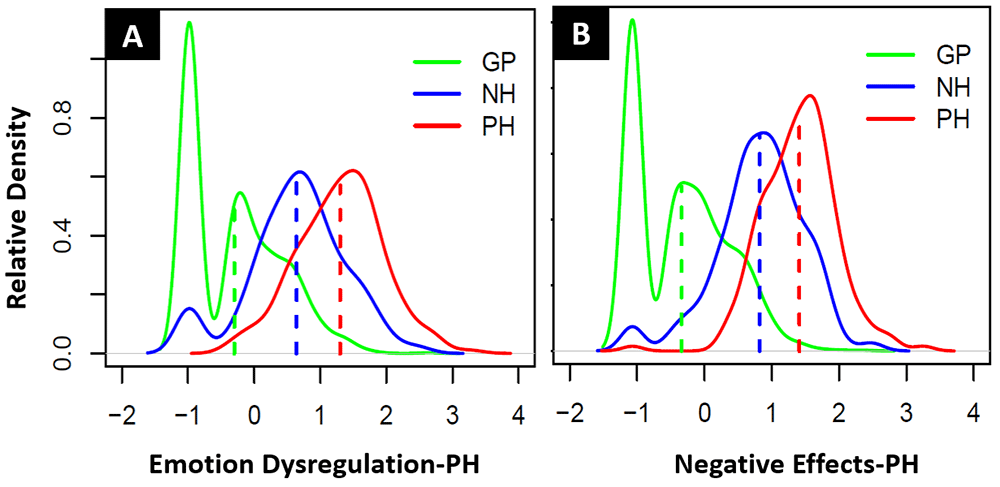
Figure 1.
(A) Relative density distribution of GP, NH and PH latent trait scores for the Emotion Dysregulation-PH and (B) Relative density distribution of GP, NH and PH latent trait scores for the Negative Effects-PH scale.
Latent trait reliability. We used standard error of measurement (SEM) – with SEM < .316 representing reliability of measurements of .9 or higher – to assess reliability over the range of the latent traits of the two scales. With Emotion Dysregulation-PH, 83.8 % of NH-PH participants was reliably measured, with a latent trait mean of 0.95 (SD = 0.80) and an average SEM of 0.27. With Emotion Dysregulation-PH, only 31.4 % of the GP participants was reliably measured (MGP = -.29, SDGP = 0.63, average SEMGP = 0.44). Only considering the NH-PH sample, latent trait levels were reliably measured approximately from 1.5 SD below the mean to 2.5 SD above the mean of 0.95 (see Figure 2a). With Negative Effects-PH, 95.7 % of NH-PH participants was reliably measured, with a latent trait mean of 1.12 (SD = 0.68) and an average SEM of 0.16. With Negative Effects-PH, only 48.6 % of the GP participants was reliably measured (MGP = -.34, SDGP = 0.69, average SEMGP = 0.37). Only considering the NH-PH sample, latent trait levels were reliably measured approximately from 2 SD below the mean to 3 SD above the mean of 1.12 (see Figure 2b). Extensive floor effects were observed for both scales in the GP sample, with 42.4 % of Emotion Dysregulation-PH scores and 37.7 % of Negative Effects-PH scores representing the absolute minimum.
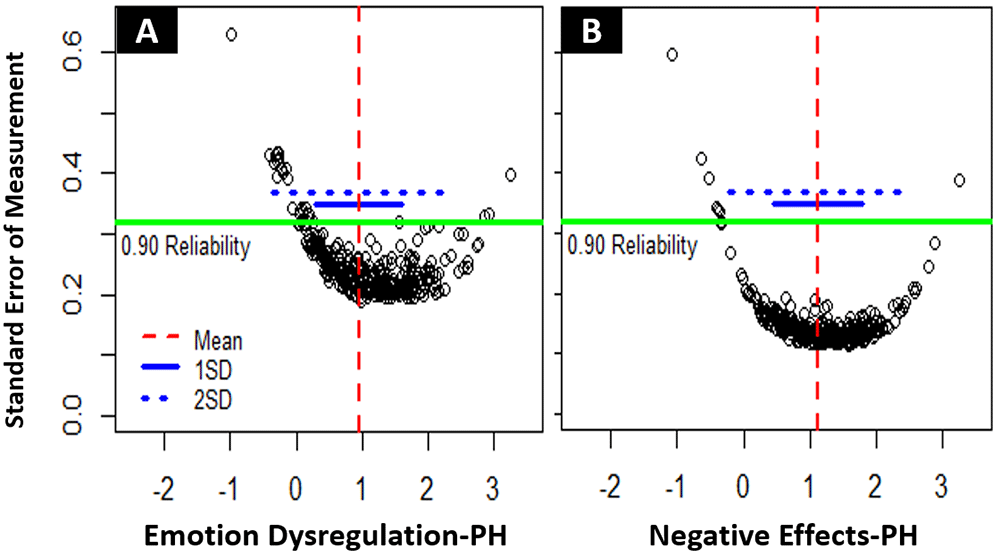
Figure 2.
(A) Reliability of measurements for Emotion Dysregulation-PH. (B) Reliability of measurements for Negative Effects-PH. Each dot represents an individual measurement on the latent trait scale – below the green line scores are measured with .9 (SEM = .316) or higher reliability.
Differential Item Functioning (DIF). We performed DIF-tests on three different contrasts for the Emotion Dysregulation-PH and Negative Effects-PH scale. No DIF was detected for gender (women compared to men) for Emotion Dysregulation-PH. For this scale, we detected uniform DIF for the NH-PH contrast for the item “Sex gives me a bad feeling about myself“ with the PH group showing increased probability to score higher given the same underlying latent trait score. Non-uniform DIF for the NH-PH contrast was detected for the item “After sex I feel ashamed“. Furthermore, we detected uniform DIF for Emotion Dysregulation-PH for the GP-(NH+PH) contrast for the item “When you have sex, do you feel depressed afterwards?“ with the NH+PH group showing increased probability to score higher given the same underlying latent trait score. For Negative Effects-PH no DIF was detected for any of the three contrasts.
Interpretability. Average sum scores and SD’s for GP, NH and PH are given for women and men in Table 3 for the Emotion Dysregulation-PH and Negative Effects-PH scale. The correlation between latent trait scores and sum scores was .93 (95% CI: .93 - .94) for Emotion Dysregulation-PH and .91 (95% CI: .90 - .92) for Negative Effects-PH, showing that sum scores represent an adequate, though not perfect, measure of the underlying latent trait (McNeish & Wolf, 2020). As sum scores are currently the sole option for applied clinical practice to work with, from hereon we present analyses using sum scores. From Table 3 it can be gathered that women scored lower than men on both scales in the GP sample while they scored higher than men on both scales in the NH and PH samples. As DIF for gender was absent, this indicates that the women who participated in the web-based survey experienced higher levels of emotion dysregulation and negative effects due to PH than men. The AUC regarding correct classification of NH and PH in the NH + PH subsample was .75 (95% CI: .70 - .80) for Emotion Dysregulation-PH and .76 (95% CI: .71 - .81) for Negative Effects-PH, showing acceptable power to differentiate between NH and PH for both scales.
Table 3. Overall and gender means + SD’s per scale for GP, NH and PH subsamples.
| General Population
-overall M (SD) -
(women n=592/men
n=618, n=1 other) | Non-problematic
Hypersexuality -
overall M (SD) -
(women n=77/men
n=109, n=1 other) | Problematic
Hypersexuality -
overall M (SD) -
(women n=39/men
n=143, n=1 other) |
|---|
| Emotion Dysregulation-PH | M=11.7 (SD=4.0)
w-11.0 (3.0) /
m-12.4 (4.7) | M=18.4 (SD=6.9)
w-21.2 (7.7) /
m-16.5 (5.7) | M=25.4 (SD=7.7)
w-29.3 (7.6) /
m-24.3 (7.5) |
| Negative Effects-PH | M=21.2 (SD=6.6)
w-19.4 (4.1) /
m-23.0 (8.4) | M=37.5 (SD=13.3)
w-41.0 (14.4)/
m-34.8 (11.8) | M=53.1 (SD=13.8)
w-53.5 (14.1) /
m-50.1 (12.9) |
Construct validity. In the GP sample the PH group (n=30; MED = 20.0; SDED = 7.6; MNE = 37.3; SDNE = 15.0) scored significantly higher on Emotion Dysregulation-PH and Negative Effects-PH than the rest of the sample (n=1181; MED = 11.5; SDED = 3.6; t(29.3) = 6.06; p < .001; d = 2.3; MNE = 20.8; SDNE = 5.7; t(29.2) = 6.02; p < .001; d = 2.7). In the GP sample the PH group (for M and SD see previous sentence) scored significantly higher on both scales than participants who reported to have had at least one orgasm per day or more in the past six months (n=65; MED = 12.9; SDED = 4,7; tED(39.3) = 4.67; pED < .001; dED = 1.2; MNE = 23.0; SDNE = 7.4; tNE(35.8) = 4.94; pNE < .001; dNE = 1.4). For the GP sample the correlation between the Mood subscale of the SQ-48 and Emotion Dysregulation-PH was weak: .33 (95% CI: .28 - .38) and the correlation between Mood and Negative Effects-PH was very weak: .19 (95% CI: .13 - .24). For the NH-PH sample the correlation between Mood and Emotion Dysregulation-PH was strong: .67 (95% CI: .62 - .73) and between Mood and Negative Effects-PH it was moderate: .49 (95% CI: .41 - .56). The effect of orgasm frequency on Emotion Dysregulation-PH and on Negative Effects-PH significantly differed between groups, with the strongest positive effects visible for the PH group, as shown in Figure 3. For the NH group there was no effect of orgasm frequency on Emotion Dysregulation-PH. Effects for the GP sample were small, with increases in orgasm frequency only leading to slight increases in the outcomes on both scales. All hypotheses specified to test construct validity were supported.
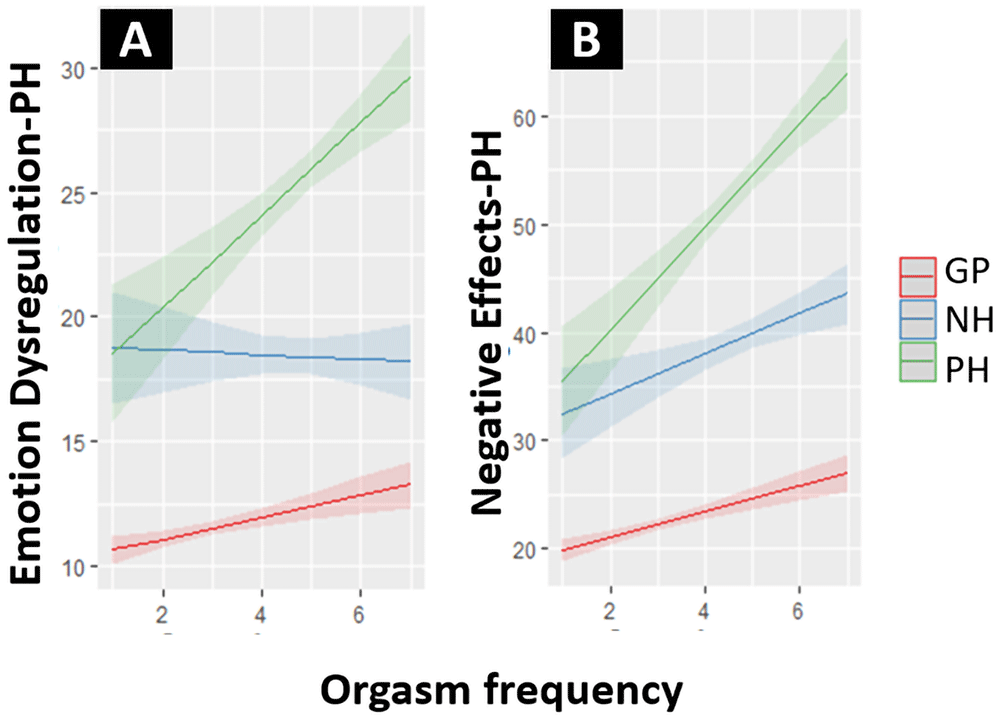
Figure 3.
(A) Effect of orgasm frequency on Emotion Dysregulation-PH for the GP, NH and PH subpopulation. (B) Effect of orgasm frequency on Negative Effects-PH for the GP, NH and PH subpopulation. Note that the orgasm frequency scale (1 – 7) represents “In the past six months... No orgasm (1)/Once a month or less (2)/A few times per month (3)/Once a week or more, but less than once a day (4)/Once a day (5)/Two to four times per day (6)/More than four times per day (7)”.
Discussion
This is the first study that investigated the combined characteristics of three diverging diagnostic perspectives on problematic hypersexuality (Montgomery-Graham, 2017), and the first study that used IRT to develop item banks for PH. An item bank has been developed for an Emotion Dysregulation-PH scale, measuring the distressing emotional patterns co-occuring with hypersexual preoccupation. An item bank has also been developed for a Negative Effects-PH scale, measuring the negative consequences of patterns of hypersexual thoughts and behavior. The item banks for these scales displayed sufficient structural validity, reliability, interpretability and construct validity in the target population that consists of NH and PH individuals. For the Emotion Dysregulation-PH scale DIF was detected for a total of three items, for different contrasts. DIF was small in these cases and did not gravely impact the total scale score. For the Negative Effects-PH scale no DIF was detected. No difference was detected for women and men for both scales. This implies that women participating in the NH and PH group experienced more emotion dysregulation and negative effects due to hypersexuality. For future development of the item banks, items first need to be homogenized (e.g. all questions turned into statements) and the number of response categories needs to be brought back to four. This study showed that the response category “Rarely” was relatively seldomly chosen in the NH + PH sample. We note that the newly developed scales are less valid for measurements of PH in the general population as large floor effects occurred in the GP sample. As the new scales are partly based on previously developed measurement instruments, it is likely that these instruments are less valid in the GP as well. In order to make the scales more reliable in the GP, items could be added that can differentiate between levels in the lower ranges of the latent traits (low to absent hypersexuality). It is questionable if this is useful, however, as the scales will be specifically used in situations where it is important to differentiate PH from other conditions that closely resemble it but are nonetheless different from it (e.g. NH). Given the low base rate of PH, we advise caution when using the new scales for research purposes in the general population. In such research, the scales should only be used for general overview purposes and not for the identification of PH in individual participants. Further development of the item banks is planned, for instance by validating short forms. Before such research is undertaken, we need to update our preliminary definition of PH and bring it in line with the results of the current study.
Updating the definition of problematic hypersexuality
This study also aimed to investigate the preliminary, testable definition of PH and determine if the stable characteristics mentioned in the definition show sufficient cue-validity – sufficient uniqueness as characteristic of PH. Results in this regard are mixed. Three remarks can be made. Firstly, we remark that the characteristic “preoccupation with sex” was not cue-valid for PH. Similar levels of preoccupation with sex are visible in NH, shown by the similar scores of the NH and PH group on the Salience scale from the CSBD-19 (Böthe et al., 2020) and by a lack of difference in orgasm frequency between NH and PH. Note that this result does not contradict that preoccupation with sex is a necessary condition and driving force for PH but only stresses that preoccupation with sex is not unique to PH. Secondly, we remark that most items from the HBI-19 Coping scale (Reid et al., 2011) lacked cue-validity in the NH-PH target population. We had expected this, based on previous research showing that sex is used to cope with negative feelings by a significant part of the general population as well, which defies the uniqueness of this characteristic to PH (van Tuijl et al., 2022). Therefore, we added more extreme items expressing the use of sex as coping (e.g. “I have sex to escape feelings of despair”). We also added items that expressed the vicious circle of emotion dysregulation (e.g. “I feel stuck in my sexual behavior”); these items also relate to coping mechanisms in PH (Adams & Robinson, 2001; Rahm-Knigge et al., 2023; van Zessen, 2013). Previously we defined emotion dysregulation as a driving force of PH but had not conceptualized it as a measurable stable trait characteristic. The current study shows that emotion dysregulation can also be measured as a cue-valid stable trait of PH. Thirdly, we remark that the PH characteristics of tolerance (escalating desire for sex) and withdrawal symptoms (feel restless when stopping sex) did not show sufficient cue-validity. However, previous research showed that in PH a gradual escalation of sexual frequency was experienced (Reid et al., 2012) and that tolerance and withdrawal were associated with CSBD (Lewczuk et al., 2022). However, the operationalization of withdrawal in the latter study (e.g. “frequent sexual thoughts that were difficult to stop”) might rather express sexual preoccupation, and in both studies cue-validity of characteristics was not tested as no relevant subpopulations for comparisons were included. In future studies we aim to test tolerance and withdrawal with different items. For the time being, we retain tolerance and withdrawal as possible cue-valid characteristics for PH, in need of further investigation. In conclusion we remark that the preliminary definition of PH we proposed needs to be updated in order to align with the results of the current study.
Towards a diagnosis for problematic hypersexuality?
Our results showed that there are many differences between the NH and PH subpopulations. Nonetheless, we still observed a large overlap suggesting that currently even the most cue-valid set of PH characteristics runs the risk of yielding large percentages of false positives (Wakefield, 2012). The NH sample, furthermore, showed higher levels than the GP sample for overall psychological distress symptoms and for depressive symptoms, though NH scores were well below PH levels for these measures. Apparently, also in NH increased levels of distress are experienced. However, emotion dysregulation and negative effects scores due to PH were on average much lower in NH than in PH. All these results illustrate that survey based categorization of hypersexual individuals as problematic might not be justifiable at the moment. Nonetheless, our study showed that a differentiation between NH and PH is viable and useful to determine the characteristics that are most unique to PH. In line with our results, previous research also illustrated a differentiation between NH and PH. For instance, Van Zessen (1995) showed in a large qualitative study in hypersexual participants, that those focusing on positive incentives to engage in sexual activity (contact seeking) experienced less negative effects than other hypersexual participants for whom sex had become a way to divert feelings of emptiness and low self-esteem (Van Zessen, 2013). Furthermore, in line with our results, Štulhofer et al., (2016) revisited the claim that hypersexuality is similar to high sexual desire and found significant differences between a (problematic) hypersexual and a high sexual desire sample, especially with regard to characteristics expressing emotional turmoil and negative consequences. In hypersexuality – we suggest – differentiation between PH and NH is possible, but categorization remains problematic. Kraus et al., (2018) introduced the CSBD diagnosis – an improvement over the ICD-10 diagnosis of Excessive sexual drive (World Health Organization, 2016, code F52.7) – and stated in their guidelines that guilt and shame in themselves are not sufficient to diagnose the condition. However, it might be exactly such indicators of emotion dysregulation that can provide important information on the amount and characteristics of problems experienced due to hypersexuality (Grubbs et al., 2019). We agree that guilt and shame are problematic as diagnostic criteria, but our study showed that they can well be used to differentiate between levels of problems experienced due to hypersexuality. Nonetheless, there is also extensive overlap between NH and PH in emotion dysregulation. Therefore, and for the other reasons mentioned above, we propose PH not as a diagnosis but as a comprehensive construct that describes – but does not classify – all who experience distress related to hypersexuality.
Limitations
A number of limitations of this study need to be mentioned. One limitation concerns the gold standard that was used to discern NH from PH. The NH sample might partly consist of participants who do need help but are not ready to admit this yet. A more optimal gold standard could be established by using clinical interviews (e.g. Reid et al., 2012) of NH and PH individuals to determine if clinical help is recommended. Another limitation of this study concerns the absence of repeated measurements in the NH and PH subpopulations. This would have provided a measure of responsiveness, the extent in which the instrument is capable of measuring minimal important change over time (Terwee et al., 2007). Responsiveness is important in determining the evaluative value of an instrument, and can also provide an indication of how the instrument can be used to measure the severity of PH (Reid, 2015). Therefore, future research on the item banks should also include repeated measurements in NH and PH samples. A further limitation of this study is that due to its psychometric objective and lack of space, only a limited investigation of similarities and differences between women and men have been undertaken. Preliminary results suggest that participating women in the NH and PH group experienced more distress due to hypersexuality and this calls for further analyses in future studies investigating this sample. A final limitation we need to mention concerns content and cue-validity. As our results showed, there is a large overlap between NH and PH subpopulations with regard to the newly developed scales. More content and cue-valid items need to be developed to improve differentiation between both groups. In this study we used quantitative analyses to test new items we developed ourselves. In order to find more cue-valid items for PH, we suggest using cognitive interviews - together with other qualitative methods - in relevant subpopulations. Qualitative methods can secure valid item content and, in combination with quantitative methods, can help establish a more extensive cue-valid item bank for PH.
Conclusion
We demonstrated many advantages of IRT analyses for the development and validation of item banks to measure PH. Item information and the use of an NH – PH subsample made a more nuanced assessment of the content and cue-validity of items possible than with previous validation methods. Two item banks were developed and validated – Emotion Dysregulation-PH and Negative Effects-PH, both showing good psychometric features. The present study illustrated that a categorical distinction between NH and PH is still hard to make – based on a survey – and we therefore abstain from suggesting using the survey to decide on PH as a diagnosis. Notwithstanding, the item banks we developed can well supplement the assessment of level of PH in clients seeking treatment for distress related to hypersexuality.