Introduction
One of the most persistent problems within literary studies has been to empirically analyze literary reception at scale.1 Previously, scholars only had access to book data in the form of Bestseller lists and other sparse data sources. With new digital methods and granular data from libraries and industry agencies, we can approach more sophisticated analyzes of who reads what, where and when. The problem, however, is that very little data is currently available to researchers.2 The following study is made possible by a partnership with the Danish public libraries and its digital branch Det Digitale Folkebibliotek (The Digital Public Library), which has provided me with access to data on physical and digital loans from eReolen.3
Methods
eReolen is a unique service within the international library world, as it is one of the only platforms in the world that gathers an entire nation's digital lending in one app.4 In recent years, eReolen has continually expanded its user base and in 2023 it had 772,000 unique users or approximately 1/8 of the Danish population as users. Approximately 2/3 of all loans made on eReolen are audiobooks.
The article zooms in on a handful of books that can be described as class fiction: all written by working-class authors depicting working class environments. Interestingly, these books are among the most read in Denmark, and some have even topped the most popular books in recent years as Table 1 attests to.
Table 1. Lists of most loaned books addressed to adults on eReolen 2022 and 2023.
Class fiction highlighted. Underlying data from The Danish Libraries.
| Most popular books, eReolen 2022 | Most popular books, eReolen 2023 |
|---|
| 1 | Hvis der skulle komme et menneske forbi (If a
person were to pass by) | Annas sang (Annas song) |
| 2 | Where the Crawdads Sing | Jeg anerkender ikke længere jeres autoritet (I no
longer recognise your authority) |
| 3 | Ugly Love | Dit selvhelbredende sind (Your selfhealing mind) |
| 4 | En dag vil vi grine af det (One day we will laugh
about it) | Hvis der skulle komme et menneske forbi (If a person
were to pass by) |
| 5 | It Ends with Us | Meter i sekundet (The Land of Short Sentences) |
| 6 | The Last Bookshop in London | OXEN – De hængte hunde (OXEN – The hanged dogs) |
| 7 | One Summer in Malta | Vi havde en fest på arbejdet, men så kom Preben ...
(We had a party at work, but then Preben came…) |
| 8 | Kvinderne fra Thy (The women from Thy) | Den tavse enke (The Silent Widower) |
| 9 | Mysteriet i Genbrugsen (The Mystery in Genbrugsen) | The Subtle Art of Not Giving a F*ck |
| 10 | Afsporet (Deranged) | Vølvens vej – Snehild (The path of the wolf – Snowhild) |
As illustrated in Table 1, eReolen’s loans show two examples of class fiction sitting atop its lists: Thomas Korsgaard’s Hvis der skulle komme et menneske forbi (If a person were to pass by) and Glenn Bech’s Jeg anerkender ikke længere jeres autoritet (I no longer recognise your authority). Indeed eReolen’s loan data questions previous research in digital literature, which has claimed that book platforms - such as eReolen, Saxo Premium or Mofibo - are principally used to consume genre literature.5 Digital reading on eReolen is not exclusively an activity that favors genre literature (crime novels, romance, fantasy, etc.) but is increasingly a platform that mediates the literary field in general.
Results
Turning to the loan history of the most popular class novel in Denmark, Hvis der skulle komme et menneske forbi (If a person were to pass by), the loans of class fiction seem very unevenly distributed over the course of a year. Figure 1 visualizes number of loans in 2022 and 2023 of Thomas Korsgaard's Hvis der skulle komme et menneske forbi (If a person were to pass by).
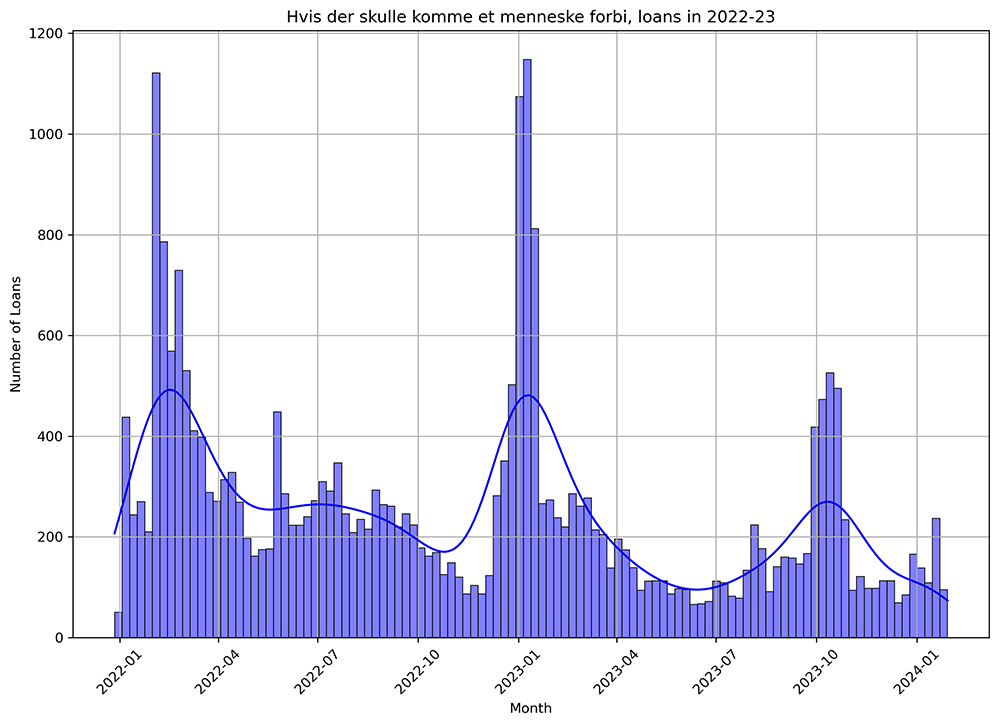
Figure 1. Histogram and KDE of number of loans per week for Hvis der skulle komme et menneske forbi (If a person were to pass by).
The graph shows several remarkable spikes in loan activity. The first spike occurs in February 2022, the second in January 2023, and the third in October 2023. The first spike happened around the time when Korsgaard won The Golden Laurels, which is a very prestigious Danish award given by the country's booksellers. This spike seems to confirm previous research into the significance of literary awards.6 The second spike appears in January 2023, when the book was again receiving media attention, this time because it was in the background when the Prime Minister gave her New Year's speech. The last spike took place in the autumn of 2023, when Korsgaard’s literature was staged as a play at the Royal National Theatre in Copenhagen. The book's popularity thus rose during three important events: The Golden Laurels, the prime minister's New Year's speech and the dramatization at the Royal Theatre. Overall, media coverage and press circulation thus appear to be almost instantly reflected in lending figures on eReolen.
To scrutinize the popularity of class fiction on a regional basis, data from various Danish library municipalities can be compared. In Denmark, there are 98 municipalities, each with its own local library service. These municipalities are very socially unequal with wealthy municipalities centering around Copenhagen, North Zealand and Aarhus. Thus, to understand the social backgrounds of readers of class literature we can look at where in the country loans are coming from.
For this study, I selected a group of authors who can be considered representatives of class fiction: Édouard Louis, Douglas Stuart, Annie Ernaux and popular Danish authors Thomas Korsgaard, Glenn Bech and Morten Pape. These were chosen because they had a certain international spread and included popular and more niche authors. Next, I computed the difference in proportion of loans of these authors from each Danish municipality. Comparing each municipality's loans of class fiction proportionally to the municipality's total loans thus provides an estimate of how popular class fiction is relative to other books in the municipality. This proportional value can be subtracted from the proportional value for the entire country to compare the municipal level to the national average. This method yields 98 values distributed around 0, where municipalities with a negative value are below the national average, while municipalities with a positive value are above.7 The results can be visualized as a choropleth map, as in Figure 2.
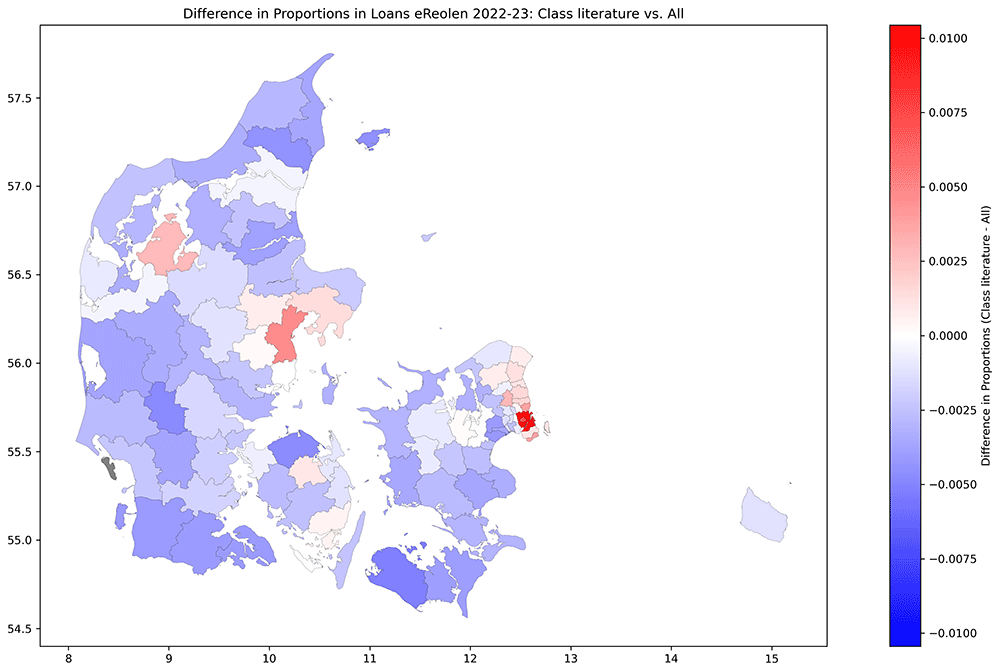
Figure 2. Choropleth map of difference in proportion of loans of class fiction compared to national average.
In this visualization, the blue color represents municipalities that borrow a low proportion of class fiction on eReolen, while red represents municipalities with a high proportion of loans of class literature. Red thus visualizes a high interest in class fiction, blue visualizes a low interest, while white indicates an average interest.
The map shows red spots around the largest Danish cities Aarhus, Odense and Copenhagen that are also the areas with the highest levels of income and education. Copenhagen is the area where class fiction is most popular compared to other books. The more provincial and rural areas, where the Danish working classes tend to live, generally are less interested in class fiction. In fact, some of the poorest municipalities of Denmark (such as Lolland, Tønder, Brønderslev, North Funen and Northwest Zealand) also have the lowest interest in class fiction as visualized by the map.
Conclusion
The analysis thus shows that poor and rural areas read significantly less class fiction than wealthier regions. This is a slightly discouraging conclusion if one harbors social ambitions on behalf of class fiction, or imagines that it can help spread literature to working-class people and reading communities. But it is also a conclusion that asks a number of fundamental questions about the representation of social class and poverty today. Perhaps, first and foremost, this article’s analysis hints at a kind of voyeurism in the cultural consumption of class fiction. It is the wealthiest areas of Denmark, consisting primarily of the upper class, the upper middle class, and the middle class, who are especially drawn to narratives of marginalized and underprivileged areas. Some would perhaps use this point to claim that contemporary class fiction depends on a certain degree of “class tourism”, as socially prosperous groups explore underprivileged environments. Claims like these, however, are not visible in quantitative data, but must be concluded from more qualitative studies.8
This article’s analyses of class fiction and regional differences in reading is of course only a fraction of the potential use of large book datasets like eReolens. Others possible venues to explore are: comparing audiobook and digital book loans; comparing consumption of old and new literature; studies of gender and genres; children's books and age differences in reading; user typologies; network analyses (of authors, books, readers and genres) and much more.