The context for advice on collaborative policymaking: informing aspirational and empirical stories
Our advice on collaboration relates to two overarching reference points: how people want policymaking to work, and how it really works. The normative focus has different variants, such as to promote rationalist aims and/ or foster democratic principles. The ‘real world’ focus is informed by multiple empirical policy theories. Both overarching reference points contribute to the same initial three-part story of the imperative to collaborate, as follows.
Complex policy problems are difficult to define and contain within traditional government boundaries
Policy problems are not amendable to technical solutions designed by experts at the heart of government (Cairney, 2021). There is always contestation among many policy actors to define the size, urgency, and cause of policy problems, and therefore who should be responsible for solving them. For example, a government-led response is not always the preference of governments or key stakeholders (many prefer individual responsibility and market solutions over state intervention). Further, if we establish government responsibility, there is contestation to determine which level or sector should take the lead. There is also genuine uncertainty about how to relate key functions (such as problem definition and policy formulation) to wider policymaking principles, such as to ensure that the process is transparent and accountable to citizens, future oriented and preventive, decentralised, built on co-production with stakeholders, coherent, evidence-informed, and with fair procedures and equitable outcomes (Cairney, 2023). The overall message is that the same policy problem may require involvement by multiple actors across governments, but with the expectation that those actors would define and address the problem in different ways.
There is no single centre of government to coordinate policymaking
There is no prospect of processing policy as if by a single brain (Lindblom, 1959). This level of ‘comprehensive rationality’ would require of one actor the ability to: gather and process all information relevant to policy problems and the likely effect of solutions; produce a rank-ordered and consistent set of government policy preferences; separate policymaker values informing policy aims from the facts necessary to inform and carry out such aims; and, make unilateral choices to maximise the benefits of policy to society without creating winners and losers (Cairney, 2020: 57–60). Rather, policymakers deal with their ‘bounded rationality’ (Simon, 1976) by relying on cognitive shortcuts to make quick-enough decisions: strategic methods to clarify aims and seek trusted sources of information, coupled with reliance on gut instinct, habits, deep-seated beliefs, and emotions (Cairney & Kwiatkowski, 2017: 2). For example, they can only pay attention to a tiny proportion of their responsibilities, so they pay disproportionately high attention to some and ignore the rest (Baumgartner, 2017; Baumgartner & Jones, 2009). The rest is necessarily processed at a relatively low level of government, such as when delegated to civil servants, public bodies, or quasi-non-governmental organisations, often in cooperation with non-governmental organisations.
Terms such as polycentric governance, multi-level governance, and multi-centric policymaking describe this distribution of responsibility for action across many centres or venues for authoritative action (Aligica & Tarko, 2012; Bache & Flinders, 2004; Cairney et al., 2019; Hooghe & Marks, 2003; Ostrom, 2010). It results from a combination of choice, such as to use a constitution to distribute policymaking responsibilities across multiple venues, and necessity, when governments seek cooperation to deal with the practical limits to their power or resources (Cairney et al., 2019: 9–10). Further, the lack of coordinative capacity in one single centre, and pervasiveness of many ‘centres’, helps to explain why the rules and norms, networks, ways to understand policy problems, and windows of opportunity for policy change, differ within or across a political system (2019: 11–12). The pursuit of within-government collaboration reflects this need to support many venues of decision-making and require them to cohere.
We need collaboration to foster policy coherence and policymaking integration
The spread of responsibilities to address problems leads to multiple responses that – in the absence of collaboration or coordination - lack coherence or integration. There is a pressing need to coordinate responses, but no single model to do so. The absence of one centre of authority rules out a simple top-down response. The presence of multiple more-or-less autonomous organisations requires more voluntary collective approaches. Concepts to describe general aims include collaborative governance, institutional collective action, mainstreaming, whole of government responses, joined-up government, and policy integration (Cairney et al., 2019) Further, terms such as systems leadership reflect the limited value of hierarchical CEO leadership models, while terms such as professionalism and followership emphasis the value of different kinds of – often long-term - participation beyond the idea of instant heroic action (Cairney & Kwiatkowski, 2017).
These accounts all share the same sense that collaboration is a ‘necessity’ rather than merely an ‘opportunity’ (Sorrentino & Simonetta, 2012: 189). However, different approaches seek to relate this problem, and potential solutions, to different reference points including: aspirational government stories, aspirational academic stories, and policy theory-informed stories of the real world.
Aspirational government stories of rationalism and democracy
Aspirational stories in the European Commission often relate to evidence-based policymaking and orderly processes in which policymakers make decisions via a series of well-defined stages. The JRC uses images of a simple predictable policy cycle and its Better Regulation approach to describe and seek to get closer to such policymaking aspirations (Listorti et al., 2020: 1561). If so, the search for advice on collaborative policymaking could relate to boosting those elements, including to collaborate to improve the supply of policy relevant knowledge, and to improve necessary collaboration in relation to distinct stages of a policy cycle, including to define the problem then formulate solutions. For example, the JRC seeks to foster collaboration to improve key functions: to define policy problems then formulate technically and politically feasible solutions. The aim is to work together, across DGs, to generate meaningful understanding and agreement on what the problem is before initiating the drafting and design of potential solutions. This exercise is essential to address complex policy problems that are multi-faceted and cross traditional sectoral boundaries, promoting the need for multiple DGs to understand each other’s’ policies and perspectives - and bring in perspectives from stakeholders and citizens - before they collaborate on a new policy (Cairney & Toomey, 2024). This search also takes place in the wider context of Commission aims to foster representative, participatory, and deliberative democracy to live up to EU ideals.
In that context, our grey literature search contains multiple reports by the European Commission on the aspiration of collaborative policymaking, primarily by the JRC but also the DG for Research and Innovation (e.g. Diels et al., 2024). Examples include reports that: emphasise collaboration between multiple departments and/ or between policymakers, stakeholders, and experts (e.g. Arto et al., 2018; Cachia et al., 2024; see also Joint Research Centre, 2002), encourage collaboration across regions (Rakhmatullin & Hegyi, 2021), describe the benefits of specific activities to collaboration (e.g. Midtkandal & Rakhmatullin, 2014 on peer review), or envisage ‘super collaborative government’, aided by new technology to connect public services to citizens (Vesnic-Alujevic & Scapolo, 2019: 17). Further, for example, Cave et al. (2014: 61) describe Intelligent Transport Systems (ITS) as ‘an area that requires and has a long tradition of close collaboration with other DGs’, as well identifying general relevant factors including a sense of clear ‘ownership’ among one DG for each task (2014: 71), a common language and ‘toolkit’ for joint work (2014: 90).
Some JRC work connects this agenda to collaborative governance, such as to exhort policy actors to use multiple tools to boost collaboration inside and outside of government (e.g. Bianchi et al., 2024). Initiatives may include: ‘participatory foresight’ tools to co-narrate visions for the future with citizens and stakeholders (2024: A21) ‘orchestration’ methods for (a) departments, to ‘make each department take more ownership so that they can design and implement a shared vision together’, boost collective capacity and clarify key roles, and (b) levels of government, to foster similarly high ‘interterritorial collaboration’ (2024: A24); and, codesigning policy solutions with researchers and citizens (2024: A25).
Similarly, Matti et al. (2022: 20) provide relatively detailed advice on the use of time, space, and facilitation methods, according to the following five principles for the ‘co-creation’ of policy by policymakers and stakeholders (including citizens):
1. Clear scope and purpose, to establish a common focus and manage expectations. Relevant factors for discussion include: framing the problem (its size, urgency cause, and who it affects), identifying a desired outcome, establishing who is responsible for what tasks, identifying knowledge and skills gaps, and agreeing on next steps.
2. Establish and communicate expectations, including to map existing policies and participants and produce a ‘hierarchy of objectives’ for the group.
3. Foster inclusive ‘collective intelligence’, in terms of ‘individual expertise’, representation of ‘relevant stakeholder groups’ and ‘diversity of perspective’.
4. Tailor participatory methods to the group. There exist many methods to foster participation in groups, which can be adapted to be used in this new context.
5. Foster a ‘systemic perspective’. A ‘holistic, systemic perspective’ describes the interconnectedness of elements of policy problems as well as the need to avoid ‘linear’ or ‘tunnel’ thinking.
Aspirational academic stories of democracy and consensus-seeking
The aspirational academic literature is more likely to focus on collaborative policymaking as a vehicle for improved democracy, such as to boost deliberation and stakeholder participation to legitimise and inform policy and policymaking:
‘The term ‘‘collaborative governance’’ promises a sweet reward. It seems to promise that if we govern collaboratively, we may avoid the high costs of adversarial policy making, expand democratic participation, and even restore rationality to public management’ (Ansell & Gash, 2008: 561).
Many accounts also equate improved democracy with decentralisation, in contrast to a more technocratic ideal that situates most decision-making in one centre of authority. Collaboration offers greater benefits to policymaking and outcomes than ‘managerialist’ approaches characterised by unilateral decision-making informed by narrow expertise (Ansell & Gash, 2008: 544). This literature features advice on how to use collaboration instrumentally, to help perform or improve an essential policymaking function, as well as to help uphold key democratic principles. For example, Ansell and Gash’s (2008: 550) Figure 2, reproduced below, draws on 137 studies to describe key elements of collaboration, including:
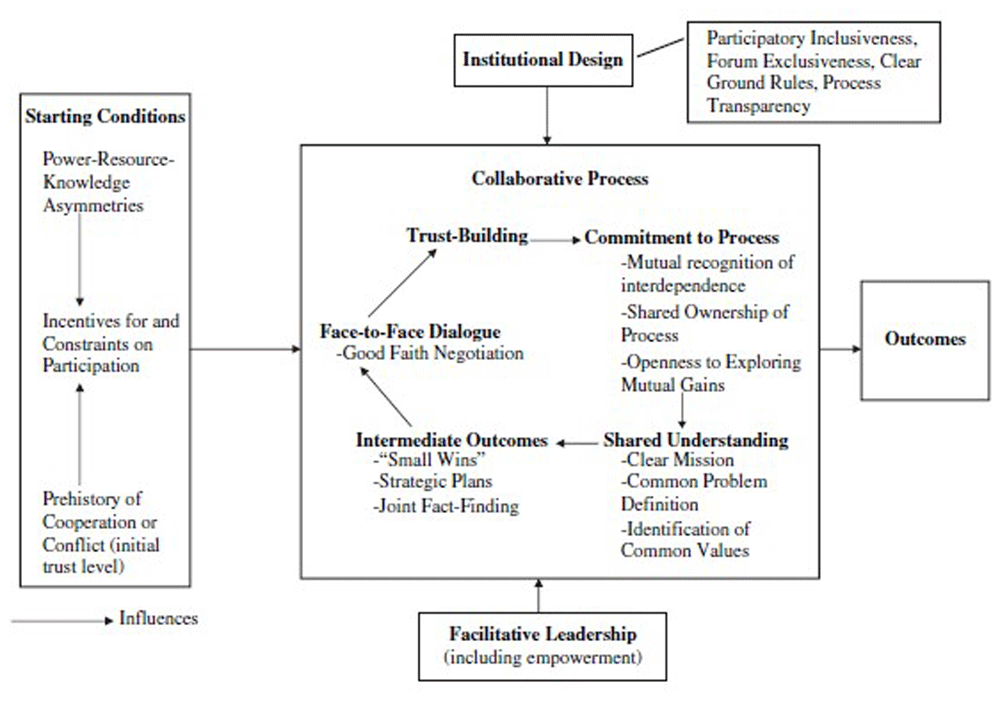
Starting conditions to attend to, such as if participants have a history of conflict, some are undermined by power imbalances or limited resources to invest, or there are other disincentives to collaborate, such as when actors favour other venues (2008: 555).
Facilitative leadership, to bring actors together, empower them to collaborate, facilitate discussion, mediate conflict, and make sure that the process and outcomes are seen as credible and legitimate (varying roles can include the ‘professional mediator’ employed to lead, or ‘organic leader’ emerging from collaboration) (2008: 550–55).
Institutional design or rules to foster ‘procedural legitimacy’ as well as tangible outcomes that stakeholders support. Rules should ensure an ‘open’ process that seeks to produce a wide spectrum of stakeholder inclusion, give contributors a ‘fair hearing’, seek a feasible amount of consensus, and set a deadline for key outputs (2008: 555–7).
The collaborative process itself. Essential requirements include: (1) ‘face-to-face dialogue’, which is ‘at the heart of a process of building trust, mutual respect, shared understanding, and commitment to the process’, (2) ‘trust building’ (including preparatory work when actors have a history of conflict), (3) ‘commitment to the process’, or a sense that participants jointly ‘buy into’ and ‘own’ the process and will respect the results, (4) a ‘shared understanding’ of realistic objectives for the collaboration, and (5) beneficial ‘intermediate outcomes’ (‘quick’ or ‘small wins’) to build momentum and incentives to continue (2008: 561).
This general account of collaboration is a key feature of (or reference point for) the studies we include from the Web of Science search. They describe the potential benefits of collaborative policymaking if designed, supported, or executed well. These benefits can be broadly instrumental, to help get something good done well, and/ or normative, to foster fair and democratic policy processes (Clark, 2021: 200; Kim & Siddiki, 2018: 160). Benefits may multiply if policymakers or stakeholders from each sector engage to supply multiple perspectives to a joint agenda (Jansen et al., 2015; Vandenbussche et al., 2020). Or, the broad pursuit of collaboration is driven by a vague sense of policymaking complexity that should be addressed through collaboration inside and outside of government (Hysing, 2022; Woo, 2021). Studies identify the potential to understand complex problems, identify innovative solutions, generate ownership of solutions, and strengthen key aspects of deliberative, participatory, or representative democracy (Sørensen et al., 2020: 532). They also share a focus on essential facilitators of collaboration, such as trust. We break these aspirations into the following six elements.
First, there is a clear need or impetus to collaborate (inside and outside of government). Many policy initiatives involve the routine need to secure agreement across government and among public and private actors, with benefits including knowledge sharing and learning (Arku & Oosterbaan, 2015; Cyr et al., 2023: 201). Instrumental imperatives include to reduce the ‘negative effects of urban freight transport’ on cities, citizens and the environment (Fossheim & Andersen, 2022: 1325), foster ‘give and take’ between government and business (Woo, 2021: 221), and reduce the costs of conflict and benefits of policy knowledge and policymaking coordination (Bramwell & Sharman, 1999: 392). Democratic imperatives include to achieve a suitable balance of power between policymakers and citizens (Taufiq et al., 2022 refer to Habermas’ ideal-type ‘communicative rationality’).
Second, trust is essential. Trust involves ‘a belief in the reliability of other people, organizations, or processes’ (Cairney & Wellstead, 2021: 1), or ‘faith or confidence in another’s propensity to keep promises, to negotiate honestly, to show respect for other points of view, and to express some level of concern for the welfare of others’ (Leach & Sabatier, 2005: 492). For example, actors need some level of trust in other actors’ commitment to collaboration. A simple calculus of trust may be based on previous behaviour, to relate the risk of investing in futile collaboration to the potential benefits of things going well. Trust may be boosted by formal and informal rules to incentivise collaboration, or if participants share the same beliefs (including their personal values and interpretations of information) or otherwise see others as their allies (2005: 493–4)
There is a general assumption in included studies that collaboration and trust should be mutually reinforcing, partly because common explanations for trust and collaboration overlap considerably, including the extent to which actors: (1) share similar beliefs, and (2) have seen the rewards of working together in the past (Ingold et al., 2017; Ingold & Fischer, 2014: 89). Further, suitably high levels of trust are essential to meaningful voluntary cooperation, Then, a rewarding process of cooperation may ‘help to build trust and social capital among policy actors’ which can lead them to propose win-win solutions that are ‘more legitimate and easily implementable’, and therefore reduce the ‘transactions costs’ associated with less trust (such as the costs to formalise, monitor, and enforce agreements) (Koebele, 2021: 615). Ideally, participants engage enough to build up mutual trust, then understand and learn from each other, make choices that all accept or respect, and become more committed as the rewards from this process are increasingly clear (Koebele, 2020: 731, citing Emerson et al., 2012). Or, participants may identify extrinsic motivation, such as to see voluntary collaboration and trust building as a good alternative to government regulation (Hysing, 2022: 207).
Third, collaboration provides benefits to participants. Aspirational studies state that meaningful collaboration will have benefits for the participants, such as to empower non-governmental actors to influence the policies that affect them (Fossheim & Andersen, 2022: 1325) or at least persuade them to take responsibility for their role in policy processes and outcomes (Vernon et al., 2005: 340). Empowerment may take place via ‘authentic dialogue’ that is not undermined by power imbalances between: citizen participants (Taufiq et al., 2022: 1516), policy professionals and service users (Jansen et al., 2015: 75), large philanthropic donors and policy actors in recipient countries (Fischer & Strandberg-Larsen, 2016: 359), or civil society and business stakeholders, to avoid consultation exercises becoming cosmetic and designed to legitimise choices already made (Edwards & Moss, 2022: 520). New forms of engagement may offset the governmental or other hierarchies present in more formalised relationships (Cyr et al., 2023: 206). The potential benefits for citizens or stakeholder involvement can feed into wider aspirations for ‘rebuilding a new generation of more just and democratic systems’ (Seibicke, 2024: 4). Crises may also provide a renewed impetus for collaboration, problem solving, and innovation (Bourdin et al., 2024). Alternatively, public managers may use collaboration more strategically, to boost their capacity and support for policy outputs initiated from the ‘top down’ (Hysing, 2022: 203).
Fourth, we need to connect the benefits of collaboration to the incentives to collaborate. Studies connect potential benefits of collaboration to incentives or payoffs. They include a relatively abstract sense of empowerment to contribute to common aims through meaningful deliberation (Fossheim & Andersen, 2022: 1325; Taufiq et al., 2022: 1517; although intrinsic and extrinsic motivation for stakeholders remains under-researched, Seibicke, 2024: 5). Actors may engage in collaboration if they think they ‘can help make a positive difference’, collective aims align with their individual or group values, and their engagement is in ‘their community’s interest’ (Webler et al., 2003: 105). This perception of empowerment relates strongly to the perception that ‘the collective deliberation process treats parties fairly and consistently’, which – especially in high conflict situations, or where there are significant differences of belief or opinion - may be facilitated by a ‘respected mediator’ (Siddiki & Goel, 2017: 257). Benefits may also relate to learning: ‘extended, face-to face deliberation’ may help participants to ‘learn about the problems at hand and better understand one another’s unique needs and values’ and perhaps even encourage some convergence in beliefs (Koebele, 2021: 615).
Fifth, collaboration provides benefits to policymaking. Studies describe the high potential for meaningful collaboration to produce improvements in policymaking. It may boost public sector capacity to engage with policy problems and the reputation of organisations (if viewed as trusted candidates for cooperation) (Seibicke, 2024: 6; 11). An increase in policymaking capacity may boost ‘the innovation of joint solutions’ (Fossheim & Andersen, 2022: 1325) or ‘more innovative public sector’ (Arrona et al., 2020: 119). Terms like ‘learning, synergy and commitment’ describe what better policymaking would involve: the ability of actors to learn from each other to update their beliefs and approaches, find common ground and aims, and invest or gain ownership from the process, to boost stability and delivery (Arrona et al., 2020: 129, citing Ansell & Torfing, 2014):
‘Empirical evidence shows that multiactor engagement can lead to new ways of seeing and framing problems, of thinking and agreeing on solutions, of coordinating actions and of creating a sense of ownership that facilitates the implementation of innovation and generates public value … Learning occurs as the product of intense interactions among people with different knowledge and visions, leading to new ideas or to reframing old ones. Synergy refers to the process of joining capacities and resources to carry out innovative actions. Lastly, collaboration can generate commitment and a sense of ownership among actors that enables consensus-building and support for the implementation of innovative solutions’ (Arrona et al., 2020: 123).
This support may be intrinsically valuable, or instrumentally valuable when inducing non-governmental actors to help to produce policy outcomes (Hysing, 2022: 205). For example, governments may see partnership working as a more effective alternative to the top-down management of the public sector or direct regulation of policy targets (Erikson & Larsson, 2022: 824). However, few go as far as Zhang et al. (2024: 9) to seek to identify an ‘optimal combination of stakeholder engagement’ for each part of the process.
Sixth, collaborative policymaking brings benefits to policy. The general assumption, or theory of change, is that well designed and executed collaboration will improve policymaking and therefore the quality of policy (Siddiki & Goel, 2017: 254). Improved quality can relate to the evidence-informed understanding of a problem and creativity to address it, a policy tailored to local context, and the policy’s appeal to stakeholders or citizens which boosts ownership or at least a sense that it represents a well-discussed plan (Taufiq et al., 2022). Collaboration may also foster smoother implementation processes by better connecting the actors making and implementing policy (Ansell et al., 2017: 467–9). An exemplar of an optimistic account of collaboration is that:
‘Collaboration facilitates a joint exploration of policy problems that allows the relevant and affected policy actors to agree on novel ways of defining the problem that both emphasise its urgency and make it solvable. It spurs a constructive use of scientific knowledge in processes of mutual learning and creative problem-solving. Hence, when the participating actors have developed sufficient trust in one another, they will stop using scientific results as political weapons and begin to craft and circulate new ideas and disruptive solutions that are further improved through critical scrutiny, cross-fertilisation and integration … Collaboration also enables a careful evaluation of alternative solutions through a joint assessment of potential risks and gains that may draw on an experimental testing of prototypes … Last but not least, the opportunity for relevant and affected actors to participate in the design of innovative solutions will create a sense of joint commitment to and responsibility for the implementation of the innovative policy design. A joint ownership over innovative policy solutions will help to prevent ignorance, passive resistance and direct sabotage on the part of street-level bureaucrats, and encourage target groups and private stakeholders to explore the possibilities for transforming the logics of the societal subsystems in order to support the realisation of shared policy objectives’ (Ansell et al., 2017: 476).
Wider benefits to society relate to an ability to ‘restore trust in government, foster public engagement, and further the legitimacy and effectiveness of public actions’ (Hysing, 2022: 201). Indeed, the European Commission may use collaboration – across government, with experts, and with stakeholders - to project ‘procedural legitimacy’ (Hensell, 2022: 153–5).
These aspirations can also be found in the grey literature
Our general impression from the grey literature search is that report authors are just as likely as academic journal authors to recommend collaborative policymaking without describing what it is or how governments should do it (Eurofound, 2006; Parmitha, 2016). Many state the general potential benefits, such as to:
Boost policy learning or trust between countries (Atlantic Council, 2019).
Build a ‘common understanding and strategic vision’ to aid ‘long-term collective reflection and discussion’ between countries and international organisations, such as to help anticipate and respond to financial, public health, or climate crises (Cheng et al., 2018: 15–16; 24–25; European Centre for Disease Prevention and Control, 2018: 12; Saidi, 2023; Stauffer et al., 2023).
Work with the private sector and NGOs to tailor policies to local context (RSIS Centre for Non-Traditional Security Studies, 2014: 3). Terms such as ‘cross-sector development partnerships’ (CSDPs) and ‘Cities Climate Finance Leadership Alliance’ describe collaborations between public, private, and third sector organisations. Their value relates to the credibility and visibility of collaborative projects, sharing resources, improved networks, trust and learning between partners, and ‘the synergistic value’ of projects that would not occur from independent action (Climate Policy Initiative, 2023: 10; Kindornay et al., 2014: 2).
Foster ‘agile policymaking’ characterised by collaborative innovation to produce policy solutions and set common standards across countries (Davis et al., 2022: 18).
Share research knowledge across: government (EMCDDA, 2012: 4), the public and private sectors (Dondo et al., 2022; Hanin et al., 2023; Public Policy Forum, 2013), or between researchers and policymakers (Hudson & Marquette, 2015; Productivity Commission, 2010: 228), including to provide ‘decision support’ when using technical models (Manheim et al., 2016: 4). For example, widespread collaboration to share research is essential to ‘advocacy and knowledge transfer’ given that mainstreaming agendas such as the Green Deal involve a ‘multitude of actors at all levels of government in a system of multilevel governance’ (Klika, 2021: 14; see also Scott, 2023; Diels et al., 2024).
Use collaboration to address ‘complex governance’, since ‘unnecessarily fragmented and disconnected systems lead to inefficiencies, redundancies, and gaps in addressing needs and providing services’ (Resilient Puerto Rico Advisory Commission, 2019: 39).
Multiple reports also identify the value of ‘co-creating’ policy with citizens and stakeholders as a ‘governance tool’ which: ‘fundamentally affects the success or failure of any public intervention. It is a way to understand the needs and interests of the different players involved in a complex problem, gather their knowledge and insights and act accordingly for the successful implementation of the policy or service in question’ (Dixon et al., 2021: 2).
Combining aspirational and real-world stories: what are the routine barriers to collaboration?
Most of our included empirical studies recognise this gap between the intended benefits of collaboration and the factors that may hinder progress, as follows.
First, policy problems may not be amenable to successful collaboration. The policy problems that require the most collaboration are often associated with the need for most ‘transformation’, such as from a high to low carbon energy systems as part of climate change policy. Yet, such ‘transformations defy planning’ and ‘involve complex systems’ that are difficult to understand far less change (Jacob et al., 2021: 4). As such, the high need for integration and change does not signal the high possibility of effective collaboration.
Second, broad conceptual aspirations may not translate into concrete outcomes. Trust may be essential but in short supply (Cyr et al., 2023: 203), especially if there is a lack of collaboration on which to build, negative experiences of collaboration in the past, or value-based polarisation that may be worsened by ill-designed interaction (Ansell et al., 2017: 476). Further, ‘learning’ is a vague term to describe a range of activity, not all of it good, that we don’t fully understand (Koebele, 2019: 242).
Third, collaboration takes an investment of time and resources, to engage with problems for the long term and seek ‘deep learning’ that involves gathering new knowledge and fostering eventual shifts in norms and beliefs (Siddiki & Goel, 2017: 257). If so, and given there is no guarantee of reward, participants may see collaborations as ‘too time- and resource-intensive to sustain’, especially when the benefits are relatively abstract (e.g. to maintain democratic or policy process norms), the forum is perceived to be a talking shop, or rewards involve ‘least-common-denominator’ solutions rather than the innovative breakthroughs advertised in optimistic accounts (Ansell et al., 2017: 476; Hysing, 2022: 207; Koebele, 2021: 615).
Fourth, many barriers to meaningful collaboration may be group specific:
Elected policymakers may be reluctant to go beyond symbolic policymaking, share power, compromise their beliefs, upset their favoured interest groups by widening the net of collaboration, or slow down policymaking to collaborate properly (Ansell et al., 2017: 479–81; Ingold & Fischer, 2014: 96).
Public bureaucracies may treat wider collaboration as an expensive distraction from core business (Sørensen et al., 2020: 533). They may express ‘limited commitment to long-term relationships’ without a meaningful incentive to engage (Sorrentino & Simonetta, 2012: 198). Risks to public organisations, when collaborating with non-governmental actors, include ‘agency capture, mission drift, loss of organisational autonomy, costs, difficulty evaluating results, and problems with upholding public accountability’ (Hysing, 2022: 204). For example, it may become difficult to identify who is responsible for what and why, which is a problem when elected and unelected policymakers have distinctive roles in relation to public accountability (Erikson & Larsson, 2022: 831).
Powerful non-governmental actors may prefer to influence policy informally or in relatively secret meetings than show their hand in formal collaborative spaces (Taufiq et al., 2022). Some may be reluctant to share knowledge with others if they are competitors in other contexts (Arku & Oosterbaan, 2015: 372). Or, their involvement may be conditional on the participation of other groups (Zhang et al., 2024: 8). The ‘apathy’ among key actors may be difficult to counter if a key driver of collaboration is voluntary rather than enforced action (Vernon et al., 2005: 341).
Less powerful stakeholders recognise that they contribute to a process out of their control, such as when consulted after an agenda is set by elected policymakers (Edwards & Moss, 2022: 522).
From our grey literature search, Dixon et al. (2021: 2) make a similar assessment of the ‘infancy’ of ‘co-creation’ between governmental and non-governmental actors:
‘It is too often one-off and fragmented. It is pursued as an end in itself rather than a means for better serving users. Its definition is stretched to encompass almost any activity, including a simple brainstorming meeting with stakeholders as long as white boards and “post-it” notes are used. Its results are elusive because of its organic and serendipitous nature and cannot be evaluated through standard business practices such as measuring return on investment in particular when dealing with societal challenges. For sure, there are standardised methodologies and techniques, job profiles and technological tools for assessing progress, but they are not widely adopted’.
Such barriers, combined with the potential for ‘collaborative policymaking’ initiatives to seem tokenistic, suggest that we should not assume that the potential benefits of collaboration are widely perceived, shared, or realised. On the one hand, studies often find examples of substantive benefits from the perceptions of interviewed participants (Koebele, 2020; Koebele, 2021; Vernon et al., 2005: 341). On the other, participants find it difficult to know how fruitful collaborations were. For example, Vandenbussche et al. (2020: 9) find in a follow-up interview that a participant had previously expressed ‘wishful thinking’ about progress.
Overall, these cautionary tales convey a gap between positive aspiration and practical reality, and this gap helps to make sense of advice on collaborative policymaking. The advice may be the same each time, but will mean something different to audiences seeking order or expecting mess. Policymakers may seek aspirational advice to promote an ideal, pragmatic advice to address reality, or some combination of both.