Introduction
Silicon photomultipliers (SiPMs)1-3 have emerged as a transformative technology in the field of photodetection, offering significant advantages over traditional vacuum photomultiplier tubes (PMTs). Their compact design, low operating voltage, fast response, and high sensitivity have made SiPMs an essential component in diverse applications, including particle physics, astrophysics, nuclear physics, medical imaging, and security systems4–10. SiPM-based detectors, particularly in scintillation applications, are gaining prominence in high-energy physics due to their ability to register particles across a broad intensity spectrum11. Furthermore, their integration into positron emission tomography (PET) scanners as matrix assemblies has demonstrated the potential to enhance photon detection efficiency in medical diagnostics12.
Matrix assemblies of avalanche photodiodes, such as the MAPD (Micro-pixel Avalanche Photodiode), are especially advantageous in experiments requiring large active areas for effective photon registration. However, the implementation of SiPM matrices necessitates the development of specialized electronic modules to ensure optimal performance13–15. These modules typically include power supply systems capable of providing stable, adjustable high voltages and signal amplification units designed for low-noise operation with high gain factors. Despite the growing interest in SiPM-based systems, the availability of compact, cost-effective, and high-performance electronic modules for such applications remains limited.
This study addresses this gap by presenting the development and testing of compact electronic modules specifically designed for detectors utilizing MAPD arrays. The developed modules include a DC-DC voltage converter capable of delivering a stable output voltage within the range of 30–90 V and a signal amplification unit that amplifies input signals with a gain factor of 45. To evaluate their performance, the modules were integrated into a scintillation detector comprising a MAPD-3NM-II photodiode matrix16 and a LSO scintillator. Testing with a Cs-137 gamma source demonstrated the modules’ effectiveness and reliability, showcasing their potential for use in industrial, medical, and scientific applications.
Methods
DC-DC converter
The matrix utilized in this study consisted of 16 individual MAPD elements arranged in a 4×4 configuration, resulting in a total matrix size of 14.8×14.8 mm2. Each MAPD element operates at a nominal voltage of 54 V, necessitating a power supply capable of providing stable and adjustable high-voltage output. To meet these requirements, a DC-DC converter circuit was designed and assembled using the MAX1932ETC chip, known for its high efficiency and reliability in voltage conversion applications (Figure 1a). The converter was configured to accept a standard 5 V input, a convenient and widely available supply voltage, and to produce a regulated output voltage within the range of 30 to 90 V. The circuit is characterized by its simplicity and exceptional stability, offering reliable operation under varying conditions.
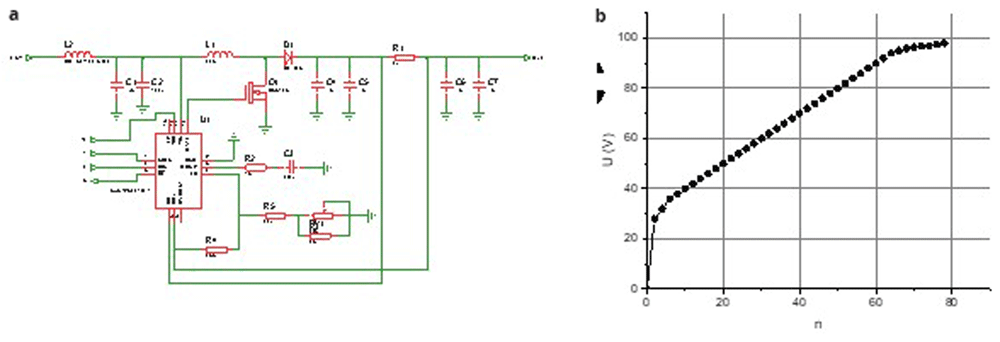
Figure 1.
Circuit diagram of the DC-DC converter (a) and the dependence of the output voltage on the resistance of the regulator (b).
One of the key features of this circuit is its capability for precise voltage adjustment using a potentiometer, allowing for fine-tuning to match specific operational requirements. Additionally, the design includes the option to connect a thermistor to modify the output voltage dynamically, an important advantage given the sensitivity of SiPMs to temperature variations. To evaluate the performance of the converter, test measurements of the output voltage as a function of the regulator resistance were conducted, and the results are presented in Figure 1b. The circuit demonstrated power consumption of less than 2 mA, indicating its efficiency. Furthermore, a linear relationship between the output voltage and the normalized resistance was observed across the adjustable range of 30 to 90 V, with a maximum current limit of 2.5 mA. These characteristics highlight the converter’s excellent performance, making it well-suited for powering SiPM arrays in high-precision applications.
Signal amplifier
To enhance the output signal of the MAPD matrix, a signal amplification circuit was designed and assembled using the LTC6268 chip. This amplifier is specifically chosen for its combination of low power consumption and minimal noise generation, making it highly suitable for applications demanding precision and sensitivity. These include photodiode signal processing, measurement systems, and detailed signal analysis. Additionally, its compact design ensures its seamless integration into systems requiring single-channel configurations, further enhancing its versatility for various high-performance applications.
The circuit operates by connecting the photodiode to the inverting input of the operational amplifier through a low-resistance resistor, designated as R9 (Figure 2a). The photodiode's output current is converted into a corresponding voltage signal by the feedback resistor R8, which plays a pivotal role in defining the circuit's gain. The gain of the amplifier is governed by the ratio of the resistances R8 and R9, with these values carefully selected based on the anticipated signal levels from the photodiode. To further optimize performance, a feedback capacitor, labeled C5, is integrated into the circuit to suppress unwanted noise and mitigate high-frequency oscillations that could compromise signal integrity.
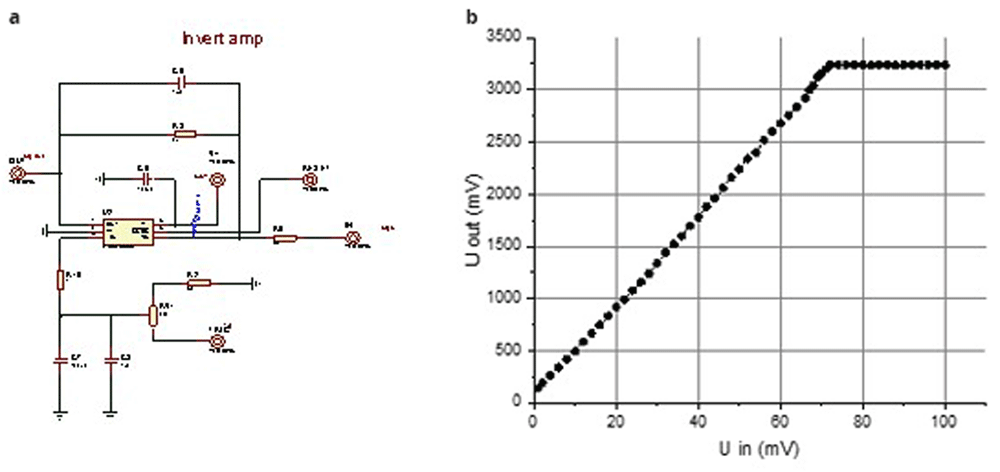
Figure 2.
Circuit diagram of the inverting preamplifier (a) and the dependence of the output amplitude on the input signal amplitude (b).
The circuit is powered by a voltage supply ranging from 2.7 V to 5 V, making it compatible with both battery-based systems and constant voltage sources. This flexibility allows it to be deployed in a variety of operational scenarios. The output voltage Vout and the amplifier gain K are determined by well-established mathematical expressions below, linking these parameters to the current generated by the photodiode and the resistor values. Overall, this amplifier circuit provides a robust, efficient, and precise solution for enhancing the signals generated by MAPD matrices in demanding detection and measurement environments.
where Iph is the current generated by the photodiode.
The gain can be determined from the dependence of the output amplitude on the input signal amplitude (Figure 2b). In this case, the gain K is 45, with a bandwidth of approximately 100 MHz. The linear range of input amplitudes for amplification was from 10 mV to 75 mV. This range allows the use of photodiode matrices with output amplitudes in the tens of millivolts.
Testing of electronic modules
The electronic modules were tested using a scintillation detector based on a MAPD-3NM-II avalanche photodiode array and a LSO scintillator17. The crystal dimensions were 15×15×15 mm3. To minimize light losses, the scintillator was covered with Teflon tape. One side of the scintillator was left open for connection with the SiPM matrix (Figure 3a). To ensure better optical contact between the MAPD matrix and the scintillator, a special optical gel with a high transparency coefficient was used.
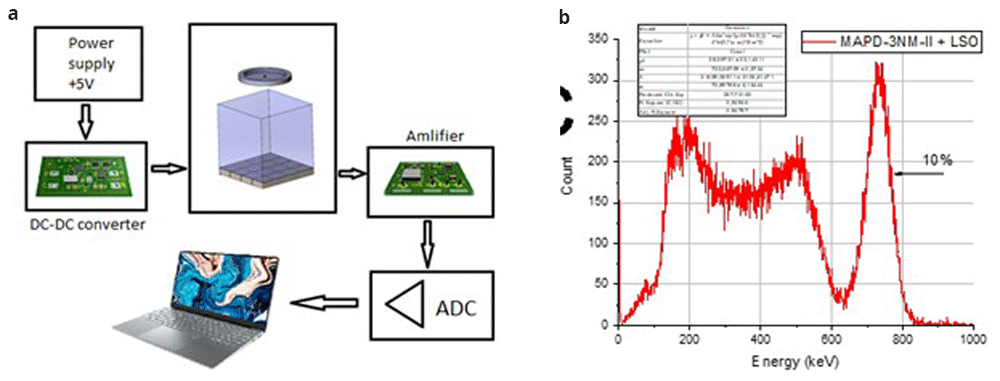
Figure 3.
Test experimental setup (a); Cs-137 spectrum obtained by the test detector based on the MAPD array+LSO (b).
To test the capability of registering ionizing radiation, a calibration point source of cesium Cs-137 was used, positioned above the scintillator. The DC-DC converter converted 5V into a stable 54V, which powered the matrix. The signal from the matrix was amplified by the assembled amplifier with a gain of 45. The data were recorded and analyzed using the CAEN DT5720 analog-to-digital converter (ADC) with a sampling rate of 250 MHz. Measurements were conducted at room temperature in a light-isolated chamber.
The acquired data are presented in the spectrum shown in Figure 3b. Data analysis revealed an energy resolution of 10 ± 0.5% for the 662 keV gamma emission of Cs-137. This level of precision indicates a low noise level in the developed electronic modules. Despite their simplicity, the electronic modules demonstrate high performance.
Conclusion
Highly efficient electronic modules were designed and developed to support the operation of avalanche photodiode (MAPD) matrices, ensuring reliable performance in detection systems. The DC-DC converter module is capable of delivering a stable and adjustable output voltage within the linear range of 30 to 90 V, with a high precision of up to 10 mV and a current capacity of up to 2.5 mA. This capability provides the necessary flexibility to meet the voltage requirements of various MAPD configurations. Additionally, the amplification module is designed to enhance input signals ranging from 10 to 75 mV, achieving a fixed gain of 45. These characteristics make the modules particularly well-suited for detectors utilizing MAPD arrays, enabling accurate and sensitive signal processing.
The modules were rigorously tested within a scintillation detection system, which comprised a MAPD matrix and a LSO scintillator. A calibration experiment was conducted using Cs-137 as the gamma source, emitting gamma quanta with an energy of 662 keV. The testing demonstrated an impressive energy resolution of 10 ± 0.5%, underscoring the low-noise performance and precision of the developed modules. These results validate the modules' effectiveness in amplifying and stabilizing signals in complex detection scenarios.
In conclusion, the developed electronic modules represent a compact, efficient, and cost-effective solution for powering and processing signals from silicon avalanche photodiode matrices. Their demonstrated performance makes them highly suitable for a wide range of applications in industrial, medical, and scientific fields, including radiation detection, medical imaging, and particle physics experiments. The modules’ compact design and robust functionality further enhance their potential for integration into advanced detection systems, meeting the demands of high-precision and high-sensitivity applications.
Data availability
Underlying data
Open Science Framework: Development and Testing of Compact Electronic Modules for Detectors Based on SiPM array.
https://doi.org/10.17605/OSF.IO/FZ6J918
This project contains the following data:
Amplifier data.xlsx (the dependence of the output amplitude on the input signal amplitude)
Power supply data.xlsx (the dependence of the output voltage on the resistance of the regulator)
Spectr Cs-137 -MAPD-3NM2-LSO.xlsx (Cs-137 spectrum obtained by the test detector based on the MAPD array+LSO)
Extended data
Open Science Framework: Development and Testing of Compact Electronic Modules for Detectors Based on SiPM array.
https://doi.org/10.17605/OSF.IO/FZ6J918
This project contains the following data:
Amplifier circuit.eps (circuit diagram of the inverting preamplifier)
Amplifier data.eps (the dependence of the output amplitude on the input signal amplitude)
Experiment scheme.tif (test experimental setup)
Power supply circuit.eps (circuit diagram of the DC-DC converter)
Power supply data.eps (the dependence of the output voltage on the resistance of the regulator)
Spectr img.eps (Cs-137 spectrum obtained by the test detector based on the MAPD array+LSO)
Data are available under the terms of the Creative Commons Zero "No rights reserved" data waiver (CC0 1.0 Public domain dedication)
(http://creativecommons.org/publicdomain/zero/1.0/)
Acknowledgements
I would like to express my personal gratitude to the Deputy Head of the Division for Research Oleg Belov (LHEP, JINR) for the administrative and financial support provided during the implementation of this research work.
Faculty Opinions recommendedReferences
- 1.
Sadygov Z, Sadigov A, Khorev S, et al.:
Silicon photomultipliers: status and prospects.
Phys Part Nucl Lett.
2020; 17: 160–176. Publisher Full Text
- 2.
Ahmadov F, Ahmadov G, Akbarov R, et al.:
Investigation of parameters of new MAPD-3NM silicon photomultipliers.
J Instrum.
2022; 17: C01001. Publisher Full Text
- 3.
Nuruyev S, Ahmadov F, Sadygov Z, et al.:
Performance of a new generation of micropixel avalanche photodiodes with high pixel density and high photon detection efficiency.
Nucl Instrum Methods Phys Res A: Accel Spectrom Detect Assoc Equip.
2018; 912: 320–322. Publisher Full Text
- 4.
Ahmadov F, Abdullayev F, Ahmadov G, et al.:
New phoswich detector based on LFS and p-terphenyl scintillators coupled to micro pixel avalanche photodiode.
Funct Mater.
2017; 24(2): 341–344. Publisher Full Text
- 5.
Ahmadov F, Abdinov O, Ahmadov G, et al.:
Alpha particle detector based on micropixel avalanche photodiodes.
Phys Part Nucl Lett.
2013; 10: 778–779. Publisher Full Text
- 6.
Ahmadov G, Ahmadov F, Holik M, et al.:
Gamma-ray spectroscopy with MAPD array in the readout of LaBr3:Ce scintillator.
J Instrum.
2021; 16: P07020. Publisher Full Text
- 7.
Akbarov RA, Nuruyev SM, Ahmadov GS, et al.:
Scintillation readout with MAPD array for gamma spectrometer.
J Instrum.
2020; 15: C01001. Publisher Full Text
- 8.
Ablikim M, Achasov MN, Adlarson P, et al.:
Search for the charged lepton flavor violating decay.
Phys Rev D.
2021; 103: 112007. Publisher Full Text
- 9.
Schaart DR:
Physics and technology of time-of-flight PET detectors.
Phys Med Biol.
2021; 66(9): 09TR01. PubMed Abstract
| Publisher Full Text
- 10.
Akbarov R, Ahmadov GS, Ahmadov FI, et al.:
Fast neutron detectors with silicon photomultiplier readouts.
Nucl Instrum Methods Phys Res A: Accel Spectrom Detect Assoc Equip.
2019; 936: 549–551. Publisher Full Text
- 11.
Simon F:
Silicon photomultipliers in particle and nuclear physics.
Nucl Instrum Methods Phys Res A: Accel Spectrom Detect Assoc Equip.
2019; 926: 85–100. Publisher Full Text
- 12.
Surti S, Karp JS:
Advances in time-of-flight PET.
Phys Med.
2016; 32(1): 12–22. PubMed Abstract
| Publisher Full Text
| Free Full Text
- 13.
Sadigov A, Nuruyev S, Akbarov R, et al.:
Compact and sustainable electronic module for silicon photodetectors.
Eurasian Journal of Physics and Functional Materials.
2023; 7(3): 2. Publisher Full Text
- 14.
Nuruyev S, Berikov D, Akbarov R, et al.:
Neutron/gamma scintillation detector for status monitoring of accelerator-driven neutron source IREN.
Nucl Eng Technol.
2024; 56(5): 1667–1671. Publisher Full Text
- 15.
Holik M, Ahmadov F, Sadigov A, et al.:
Study of Dynamic Time Over Threshold (DTOT) method for application in spectroscopy signal analysis toward a low complexity front-end electronics with high spectroscopy resolution and wide energy range.
IEEE Trans Nucl Sci.
ISSN: 0018-9499, 2024; 1–1. Publisher Full Text
- 16.
Ahmadov F, Abdullayev F, Ahmadov G, et al.:
A new physical model of Geiger-mode avalanche photodiodes.
J Instrum.
2020; 15: C01009. Publisher Full Text
- 17.
Sadigov AZ, Ahmadov FI, Sadygov ZY, et al.:
Improvement of parameters of micro-pixel avalanche photodiodes.
J Instrum.
2022; 17: P07021. Publisher Full Text
- 18.
Akbarov R:
Development and testing of compact electronic modules for detectors based on SiPM array. [Dataset], OSF. 2024. http://www.doi.org/10.17605/OSF.IO/FZ6J9









