1. Introduction: where have our food commons gone?
‘Common-Pool Resources’ (CPRs) are natural or human-made resources that are rivalrous and non-excludable. That is, the use by one person reduces availability to others and it is difficult to prevent access to the resource by others. Traditionally, forests, lakes, and rivers are positioned as being CPRs. There is a strong argument that food can be seen as a CPR. Food for hunter/gatherers and nomads could certainly fit this mould. There is a strong argument that could be made for food being a CPR for pastoralists and early farmers as well if we bring in the perspective of commons as a ‘Social System’. That is, commons are not only physical resources, but they also encompass the governing system that rules them. Therefore, commons also include the norms, institutions and traditions that regulate how the resource is managed.
The connection between these two types of commons is essential, since it proves that usage of the CPR does not necessarily lead to the depletion of the resource considered. On the contrary, if the management of the commons is done in a way that grants its sustainability, then the CPR could theoretically be infinite and non-rivalrous. This point shifts the focus to the political management of the commons, since rules and institutions that preserve the sustainability of the CPR must be set by the governments and communities related to the resource considered.
If managed properly, a CPR can be sustainably managed and deliver benefits to the appropriators of its resources for generations and centuries. If managed improperly, however, the CPR can be exhausted and result in a ‘tragedy of the commons’, which “…arises when it is difficult and costly to exclude potential users from common-pool resources that yield finite flows of benefits, as a result of which those resources will be exhausted by rational, utility-maximizing individuals rather than conserved for the benefit of all.” (Ostrom, 2008b; 1).
Though food was largely managed sustainably for centuries in Europe, recent times have highlighted that things are far from ideal.
1.1. Tragedy of the European Union’s food system commons
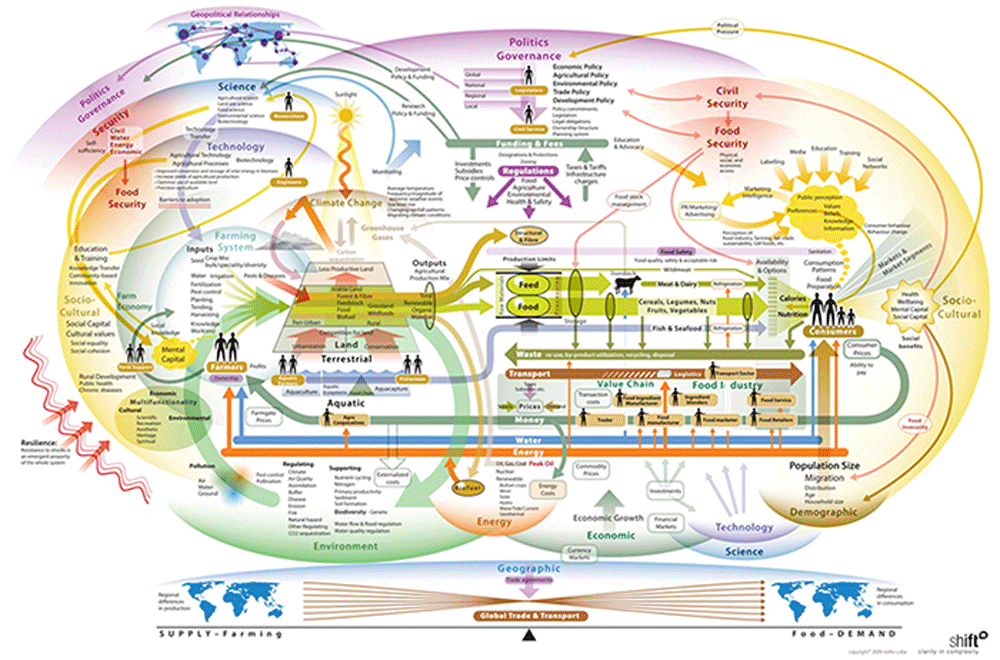
In the modern world, there is overwhelming evidence of the unsustainability of European Union (EU) and global food systems. It is important to note the distinction between food as items that humans eat and food systems, with the latter defined as: “a system that embraces all the elements (environment, people, inputs, processes, infrastructure, institutions, markets and trade) and activities that relate to the production, processing, distribution and marketing, preparation, and consumption of food and the outputs of these activities, including socio-economic and environmental outcomes” (United Nations, 2015, 1). As described by the Global Food System Map below, any discussion on food systems implies considering a very complex network of agents, transactions, and relationships, from the production of food, to its distribution, consumption, and then waste.
In modern Europe, the unsustainability of our food systems leads to several externalities directly linked to health issues, economic inequalities and environmental issues.
For what concerns the EU context, the focus of this paper, public health is the first major aspect affected by the unsustainability of the food system. While food security and safety are again at the centre of the political agenda as a result of the war in Ukraine (Hellegers, 2022), malnutrition is a leading cause of chronic and non-communicable diseases (NCDs), which are the main determinants of global health burden and are responsible for up to 74% of all deaths globally.
Overweight and obesity rates are continuously increasing, and are a major risk factor for NCDs such as coronary heart disease, stroke, diabetes and certain types of cancer (WHO, 2022). This trend is the result of easy access to and overconsumption of ultra-processed foods and foods high in fat, sugar and salt (HFSS), combined with problems in accessing nutrient-rich foods, such as vegetables, fruit, wholegrains, healthy fats and sustainable sources of protein (Djalalinia et al., 2015). This health risk has also an intergenerational component, as overweight and obesity can cause epigenetic modifications that are inter-generationally inherited (Mahmoud, 2022). Furthermore, there is growing evidence of the impact of industrial farming methods on public health. Intensive livestock farming can facilitate the spread of viruses from animals to humans (Smit & Heederik, 2017), it fosters antimicrobial resistance (Kelbrick et al., 2023), and the use of pesticides can have adverse health effects (Nicolopoulou-Stamati et al., 2016).
Second, unhealthy diets are a leading cause of the economic burden linked to NCDs, with a cost estimated to range from €3 to €148 per capita, or between 2% and 6% of health spending in European countries (Candari et al., 2017). This economic burden is reflected also in the farming side and in the supply chain, where small, family and local-based agri-food operators struggle to compete against the large-scale food and drink industry (Berkhout et al., 2018). Wealth redistribution in the food system is also significantly unequal: while smaller and local producers struggle to compete against bigger industries, ‘food billionaires’ have increased their wealth by $382bn over the last two years, leading to 62 new food billionaires since the outbreak of the COVID-19 pandemic (Oxfam, 2022).
Third, food production and distribution have a significant environmental footprint. Global food-system emissions equate to 30% of the world’s GHG emissions (IPES, 2017; Li et al., 2022) and intensive farming and animal husbandry cause severe damage to land and ecosystems because of soil erosion, loss of biodiversity and depletion of natural resources (Balmford et al., 2018). Food production is also over-reliant on fossil fuel and non renewable mineral resources, and it depletes soil and groundwater reserves (Holden et al., 2018). Finally, the environmental impacts of food waste losses throughout the food supply chain are widely recognised, with approximately 88 million tonnes (Mt) of food wasted each year in the EU alone (Halpern et al., 2022; Scherhaufer et al., 2018).
1.2. Commoditisation directing the tragedy
Given the complexity of the EU’s food systems, it would be unrealistic to maintain that it is possible to find a single solution to make this system more sustainable. In the absence of a silver bullet, different fields of expertise must come together to address the specific issues related to their sector, and to understand how each specific part is connected to the whole. However, the more we move towards the external part of the picture, the more we find common issues that concern all actors involved in the system.
As shown at the top of the map in Figure 1, politics and governance are the elements of the food system which can have the greatest systemic impact and they are the focus of this paper. More specifically, in this manuscript we analyse how a central factor leading to the unsustainability of food systems is that current EU politics and governance is dominated by a conception of food as a ‘commodity’, rather than food also a public good with multiple dimensions (Scholte, 2005). Further to this, the different products and processes in the food system from primary production, processing, distribution and retail are also commoditised. Inasmuch, a transition to a more sustainable food system requires a change in how food and the elements associated with it from farm to fork are conceived in politics and governance; namely, the need to shift from a ‘commodity’ centred view to a ‘commons’ one across the food system.
A commodity can be mostly privately produced, subject to trading, stocking and potentially to oligopoly control and thus to be distributed according to market rules. This dimension of food is not per se an issue: since the development of agriculture, surplus food has always been conceived to a certain degree also as a commodity by different societies, and marketed and traded as such (Magdoff, 2012). However, it is the more recent unrelented and entrenched commodification of all elements of the food system that has become problematic.
Beginning with the development of capitalist economies, and especially over the last decades with the dominance of the neoliberal paradigm, there has been an active ‘commodification’ of all elements of the food system that resulted in the commodity properties of food becoming dominant at the expense of the public properties of food. This commodification has several negative consequences (Vivero-Pol, 2013, p. 13–14).
First, a commodity follows the logic of the best price, so food crops that could be used for human consumption are used instead for biofuel, livestock, pharmaceutical by-products and other industrial purposes. Further to this, commodification of, for example, ultraprocessed foods and the steps required to produce and distribute it manifest in these products being less expensive and more readily available as compared to healthier and more sustainable minimally processed foods (Damania et al., 2023).
Second, commodification leads to speculation with staple food (Magdoff, 2012), and it is also the basis of current indiscriminate use of scarce natural resources (Cole et al., 2018) and the reason why there is such high food waste.
Finally, the commodification of food systems is ethically problematic because human needs and ecological space become secondary aspects when actors in the food systems are mainly competing for profit and are subject to the logic and dynamic of capital (Altvater, 2004). This can manifest in gross violations of human rights, especially in the form of labour exploitation.1
To counteract these externalities and make the EU’s food systems sustainable, it is necessary to de-commodify important aspects of food systems, stressing that the ‘commodification’ of elements of the food system represents a social construct that neglects several dimensions and public meanings attached to food and the actions needed to get it from farm to fork.
2. The need to center politics & governance of food systems as a ‘commons’
One approach that could support the de-commodification of the food system is to restructure the food system around the concept of not just food but also the actions necessary to get it from farm to fork as a ‘commons’.2 This shift allows us to see food as a fundamental human right in its fullest sense, and not just as a commodity which is produced according to profit expectations and purchasing power (Jackson et al., 2021).
Different scholarly and political traditions understand the commons in different ways and in recent years the approach developed by Elinor Ostrom (Ostrom, 1990) has become prominent. According to Ostrom, a commons is a specific type of resource and the institutional arrangements or systems through which individuals and communities manage and govern that resource. (Ostrom, 2008a). Developing further this focus on how natural resources are governed (which is Ostrom’s main focus), it is also possible to stress that those participating in the production, distribution and consumption of a good, such as food, can be considered ‘commoners of food’. This is an essential point for the focus of this paper, since it implies that:
Those sharing a concern over the management of the commons must be equally able to participate in addressing this concern (Ostrom, 1990).
By ensuring that the people’s right to the management of the commons is guaranteed – and by analysing how this right can be protected – the commons could substantially contribute in two main regards to effectively tackling the many health, environmental and economic problems associated with the commoditisation of food systems.
On the one side, the commons re-integrate economy and politics, since those that depend economically or culturally upon a commons must have a say in its political management. In this way, CPRs (such as food) can no longer be conceived as a commodity only, and as such something restricted to economic actors. On the contrary, by considering the public dimensions of a resource, actors external to the economic sphere can have a say in how the commons is managed. This change can help going beyond a market perspective focused on selling goods to maximise profits, to instead find ways to maximise communal well-being and to respond to multiple valuation languages including cultural values, ethical/moral values, health, or religion. In this way, food systems as a commons could merge into discourse around planetary health (Horton & Lo, 2015) or one health.3
On the other side, in a frame of food systems as a commons, ownership is justified through joint use responding to needs; this is in contrast to private property, which can lay waste or be destroyed and does not necessarily relate to a concrete need. Commons thus structurally facilitate that members act as stewards instead of exploiters, since human activities are not primarily considered as a “commodity” being sold on labour markets for a remuneration that may or may not cover needs. The good steward is expected to leave the resource entrusted to them in a better condition than when they received it and in this framing, human activities are regarded as commoning, i.e., under the perspective of how they contribute to the commons. This can change the whole system around the commons, since it can restructure also the very organizations of the activities (businesses, households, labour, etc.) that are related to the resource considered.
Food systems as a commons, thus conceptualised, can be an indispensable precondition for many approaches that attempt to address the causes of current crises affecting the EU food system. The ‘food system commons’ can substantially expand the responsibility for economic structures and processes beyond private property owners and professional decision-makers, so that much broader groups can take responsibility in matters of their concern (ideally including the concerns of non-humans, as it aligns with planetary health and one health).
It is important to acknowledge that the recognition of the unsustainability and injustices inherent in the EU's food systems is not new. Nor is the call for a commonification of food. What is novel in this analysis is the exploration of alternative forms of governance that can allow us to reasonably shift away from the current deregulated, and corporately captured, economic system dominated by big food corporations and transition to a food system commons. Our proposal is the strategic use of food democracy at micro-, meso- and macro-levels of society. Further to this, we stress that food democracy can foster this transition only insofar as both the procedural and epistemic properties of democracy are maximised.
3. On what should we base the politics governance of the commons?
Access to adequate food is a recognised basic human right.4 In a framework that conceives a food systems commons, a central assumption is that every individual must be granted the right to equally participate in addressing the governance of the commons. This is an essential point, since it entails that a right to food is not only a right to be fed sufficient calories to survive. Rather, there is also a political dimension, since all individuals have the right to participate in the organisation of the common.
This political dimension resembles the basis of the democratic system, as it requires structures and processes that enable commoners to express their (possibly contradictory) concerns, and to freely negotiate them through deliberation is a fundamental requirement of any commons. This is even more relevant regarding exclusions that appear as externalities from a commodity perspective, and that are also often challenging the commons. The commons thus imply the need to rethink democracy going beyond formal representation, geographically predefined political entities and scales, state authorities, and the separation of politics from doing economy.
There have been several attempts in the literature to rethink democracy and to connect it to the food system governance debate, with the most important being the concepts of food citizenship (De Tavernier, 2012; Renting et al., 2012), food democracy (Booth & Coveney, 2015; Lang, 2005), and food sovereignty (Patel, 2009; Sampson et al., 2021). These approaches draw attention to the preconditions, procedures and expected outcomes of a democratization of food systems, inter alia food justice and security, as well as healthier ecosystems and people. Yet, all these approaches have come under scrutiny when it came to decide whether or not food politics and governance had to be based on either of them.
Food citizenship focuses upon the required skills and competences of eaters framed as citizens, which has repeatedly come under scrutiny because of assumed affinities to a liberal notion of informed consumers that disregards or underestimates the relevance of structures (Behringer & Feindt, 2024). Food sovereignty is a more radical take on democracy re-interpreting the idea of sovereignty in terms of collective autonomy in all matters regarding food. However, the concrete forms of how to implement food sovereignty on local and supra-local scales remain unclear (Smaal et al., 2021). Therefore, it seems that these two views are missing something to fully fulfil the main political requirement of a food systems commons, namely to grant individuals their right to have their say on how the commons are managed.
Food democracy bears instead more promises for the politics and governance of the commons, since it helps to clarify the general character of the social processes and structures that are needed to realize food citizenship and sovereignty, emphasising the role of active participation by the citizenry in how food systems are governed (Hassanein, 2003). The central idea of a food democracy is that change should not be directed by technocratic decisions based on elite-power, but that it should be the result of processes where individuals have participated and expressed their voices.
This concept has also been criticised, since some have argued that a narrow focus on citizens’ participation neglects the important, potentially transformative role of community-based organizations as well as strategies of producers, international organizations and other actors of the food system that often aim at safeguarding the status quo (Thompson et al., 2020, 13). However, as specified in the following section, we argue that this criticism towards food democracy is mostly due to a generic definition of democracy, which neglects that democracy is conceptualized in different ways analytically and normatively in the scholarly literature as well as in political debates and social movements. By defining more precisely how we conceive democracy in terms of commoning with regard to food systems, we attempt to demonstrate that if democracy is not reduced to a mere increase in the people’s participation, then food democracy can be the key framework for the politics and governance of the food system commons.
If, and only if, individuals’ participation is supplemented by a control of the settings in which the participation occurs, then this framework can fulfil the requirement of the proponents of the commons, who call for a “third force of governance and resource management by the people as a compliment to the market and the state”, which is associated with particular features: “Unlike the market, the commons are about cooperation, stewardship, equity, sustainability, and direct democracy from local to global” (Vivero-Pol, 2013, 19). Below we analyse the main conditions for a food democracy to be able to fulfil this task.
4. Participation and regulation of the system as basis of a well functioning democracy
The mainstream conception of democracy is based on two pillars, namely the dēmos (people) and kratos (power). It is widely accepted that a democratic system is one where citizens have a say on how political decisions are taken. Yet, when we delve more into what kind of power citizens should have, things become more complex.
First, we must specify if we are focusing on a ‘Self-Government’ ideal of democracy or on a ‘Representative’ ideal. While in the former it is essential that citizens have an equal chance to govern themselves, the central feature of the latter is that citizens must have an equal chance to elect candidates that they deem fit to rule. This division reflects an historical development of democracy. While the ancient ideal that structured the Athenian republic was based upon the self-government ideal,5 modern and contemporary democracies consider the demographic and economic conditions for a self-government no longer feasible6 and they thus rely on representative systems where a few elected officials take the decisions for the remainder of the population (Held, 2006, p. 56–92).
This point is important to clarify that more democracy does not necessarily imply more direct participation by the citizenry, since the representative view of democracy considers acceptable a system where citizens limit themselves to voting for the officials that best represent them. Furthermore, there is an increasing literature in political science (Bellamy, 2007; McCormick, 2011; Pettit, 1997) focusing not on increasing per se citizen participation in politics, but on changing the kind of participation. That is, the need is to rethink representative institutions to ‘fix’ problems of power inequalities and lack of popular representativeness in current democracies, thus making sure that all societal groups are included in representative institutions.
This entails that where food systems are conceived as a commons, those sharing a concern must be able to equally participate in addressing the way the commons is governed. However, it must be better specified what kind of participation we are considering. Here, it becomes essential to consider that democracy has never been only a mere increase in citizens’ participation. Therefore, the problem is that while in the democratic literature it is widely accepted that an integral self-government is no longer feasible in complex societies and thus that certain representative forms must persist, the concept of food democracy has been proposed almost exclusively according to the self-government ideal, namely as a way by which individuals can increase their participation to the governing of food systems.
A brief analysis of the justifications of democracy is thus needed to demonstrate that there are two main components of democracy. On the one hand, we can say this system is to be preferred because democratic procedures are the best at respecting the people’s equality and liberty. On the other hand, there is an instrumental justification of democracy, arguing that this form of government is to be preferred because it produces the best outcomes.
Considering both is essential to understand why a commoning of food systems requires not only increasing the people’s direct participation in the food system, but also the importance of ensuring that the context for the people’s participation maximises the epistemic properties of a food democracy. Otherwise, there is the risk that a tokenistic involvement of the population may be considered as food democracy.
4.1. The benefits of increasing citizens’ participation
In democratic literature, the benefits of increasing citizens' participation have been stressed by those adhering to the deliberative democracy ideal (Pike, 2007) - namely that citizens must take part in the decision-making of the choices that afterwards affect them because the best potential of democracy can be realised only by means of fair procedures of deliberation (Mendelberg, 2002).
According to this ideal, if citizens are involved in decision-making, they can better understand their interests, learn to communicate better to others (Chambers, 1996), and better understand and tolerate opposing views (Gutmann & Thompson, 1996). In turn, this can lead to more informed political decisions (Fishkin, 1997; Putnam, 2000) and citizens more willing to engage in the management of their community (Rondinella et al., 2017). Finally, if properly set, participative procedures may be effective for involving marginalised groups whose voices are usually neglected in the representative process (Miller, 2018).
The likelihood of these outcomes has been questioned with some arguing that benefits are likely to occur only in ideal conditions (Mendelberg, 2002). In the empirical world, deliberation may instead lead to hooligan politics where cohesive in-group mechanisms result in closures towards outsiders (Brennan, 2016, 9–11) and in participants having even more extreme versions of their previous ideology (Sanders, 1997). Discussions may also be dominated by those who are already better off, so more educated and high status individuals may use their position to favour their interests at the expense of the ‘common good‘ (Giles et al., 1987; Turner, 1991). Finally, individuals do not like disagreeing, so agreement could be reached either because no one challenges the dominating view (Mutz, 2006), or because vulnerable groups are not given the proper settings to express themselves (Sorial, 2022).
These criticisms stress an essential point for the purpose of this paper. Critiques focus on demonstrating that citizens may be too biased to participate directly in the political process. Yet, this only demonstrates that participative procedures are not a silver bullet that automatically leads to the desired outcomes; it does not mean that all these procedures in all contexts are necessarily doomed to fail. Therefore, the focal point is that it is necessary to investigate the properties of the system in which individuals participate, since the better the framework of the citizens’ participation is regulated, the more likely it is that this process can lead to positive outcomes, and vice versa (Cohen, 1983, 147–151).
The main goal of any participatory methodology should thus be to optimise the context of the people’s participation so that the people’s biases and the power dynamics are identified and controlled, while conditions for positive interactions, exchange of ideas and learning are maximised. This shift in perspective from the individual towards the setting in which they are inserted is essential in the context of the ‘commonification’ of the politics and governance of the food system. For the latter to occur, the settings in which individuals participate must resemble as close as possible the ideal conditions of a deliberation.
4.2. The focus on the settings of the deliberation
The focus on the settings of the deliberation has been stressed by those supporting an ‘Epistemic democracy’, which argues that democracy is the best system because it is the regime that produces the best outcomes (Landemore, 2013). Even though, taken singularly, citizens may be affected by some knowledge biases (Brennan, 2016, 25–53; Oppenheimer & Edwards, 2012, 39–93; Somin, 2013) and only few individuals possess specialised knowledge in many domains, because of specific mechanisms to collect the dispersed knowledge in society - such as the Condorcet Jury Theorem (Goodin, 2003), the Miracle of Aggregation (Surowiecki, 2004), and the Diversity Trumps Ability Theorem (Hong & Page, 2004) – large democratic groups can outperform small committees of experts.
Democracies are thus preferred because they are the best at collecting the latent knowledge dispersed in society. An analysis of the Athenian democracy shows that two mechanisms are essential to collect this dispersed knowledge (Ober, 2008, p. 118–167).
First, Athenian democracy successfully aggregated dispersed knowledge by respecting the principles of isegoria7 and isonomia8. These principles functioned as an essential learning process for citizens, and they eventually increased society’s level of knowledge. Athenian tribes differed in socio-economic power and knowledge, but these differences were used as a systemic resource, since assemblies were formed mixing inexperienced citizens with more knowledgeable ones, thus giving the former the opportunity to learn from the latter while serving their political office.
Second, by standardizing these processes, Athens reduced the cost of participating, thus rendering direct political participation more accessible and favouring citizens’ alignment to a common set of shared values, which in turn helped setting rules and laws that influenced individuals’ behaviour with a focus on the republic’s common good.9
These mechanisms entailed an interesting conception of political participation. That is, while technical competence is now widely considered a fundamental quality in anyone willing to undertake a political role, in Athens this was not necessarily the case. Politics was meant for amateurs and all citizens were thus considered fit to take part in the decision making processes of the republic. This is proven also by the fact that while the current political system relies on elections to select magistracies, Athens selected offices also by lotteries. This was a means to counter political competition, but it also shows that the process deemed anyone included in the lot as fit to undertake a political role (Manin, 1997, 8–16). Hence, a priori qualities of the citizens were not of primary political relevance, while structuring the system to maximise the epistemic properties of Athenian democracy was pivotal.
Considering the epistemic mechanisms of democracy – with a specific focus on Athens - demonstrates that democracy has never been, since its origins, a mere increase in the people’s participation in the process. On the contrary, the people’s participation must always be interconnected to the regulation of the framework in which citizens participate. If Athens did not have mechanisms to aggregate and standardise latent knowledge, then citizens’ participation would have not been so efficient. As we explain in the following sections, this is the key contribution a food democracy can offer to the ‘commonification’ of food systems.
5. A food democracy-enabled food system commons
As aforementioned, commons require a force of governance and resource management by the people as a compliment to the market and the state. Food democracy can be this force of governance by granting the people’s right to food systems as commons and to thus equally participate in the management of the commons (Figure 2).
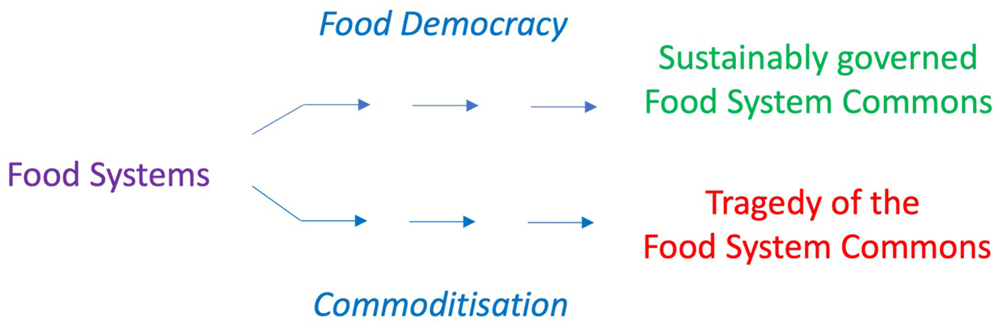
Figure 2. Trajectories of governing food systems either via commoditisation or food democracy.
Below we outline the four ways food democracy can contribute to the commonification of the politics and governance of the EU’s food systems.
5a. Tackling the commercial determinants of health
It would be unfair to say that there have been no policies or attempts at an EU level to address the health, social, economic and environmental problems of commoditized food systems. However, the persistence, and often worsening, of the overall unsustainability of the food system imply that these attempts have fallen short of expectations when it came to implement them.
A recent example is the Farm to Fork Strategy10 (F2F) of the European Commission, which was a comprehensive set of policies aimed at addressing the unsustainability of EU food systems. As clear by the title, this strategy did not aim to focus only on the production of food, but to consider all elements of the food system, addressing also the distribution, consumption and waste of food. However, the fact that almost all the policies foreseen by the F2F have been paused or dismissed11 demonstrates that there are issues at the political and governance levels for which good strategies tend too often to be eventually watered down before their implementation.
The reasons for this inefficiency are obviously complex, but one of the main issues stressed by recent literature is that food systems are affected by the Commercial Determinants of Health (CDOH) (Nason et al., 2020) – defined as “Strategies and approaches used by the private sector to promote products and choices that are detrimental to health” (Kickbusch et al., 2016) - which demonstrates that there are systemic issues that must be resolved for food systems politics and governance to be more equal, fair and just.
Food industries use their economic and political power in several ways to shape the politics and governance of food systems so that it favours their economic interests. Some of the main activities concern (Chavez-Ugalde et al., 2021):
A commonification of food system politics and governance would require that power shifts away from food industries by focusing on both properties of a food democracy, namely by both further empowering citizens’ participation and by regulating industries’ influence on governmental process. For the latter, to mention just a few policies that would be required to address this issue, a rebalancing could be done by:
Regulating tax havens (Anaf et al., 2017)
Implementing transparency disclosure requirements and stricter conflict of interest standards (Lacy-Nichols et al., 2023);
Preventing “revolving doors” between big corporations and important governmental positions (Robertson et al., 2019)
Especially at EU level, by addressing the inequality in access to institutions between industries and civil society organisations.13
In terms of policy implementation, another significant problem is that there is often a division between a focus on mandatory regulations versus self-regulatory approaches favoured by the industry. The latter approach has been the preferred option of policymakers over the last decade (Sisnowski et al., 2015). However, evidence is proving more and more clearly that mandatory regulations rather than self-regulatory pledges are required to ensure regulations needed to transition to a healthier and more sustainable food system (Boyland & Harris, 2017; Knai et al., 2015; van der Voort, 2015).
For what concerns the participatory aspect of democracy, there are several concrete examples of how the commons could structure the people’s participation resembling ideal epistemic practices. First, initiatives that attempt to transform food systems are often creating commons not only through their activities as social movements (which are commons, too), but by, for example, developing organisations of solidarity agriculture, food cooperatives and food councils (Salustri, 2021).
As remnants of historically much more extensive eco-political and socio-economic arrangements, the commons are also a backbone of prosperous and sustainable forms of contemporary agriculture, e.g., in Switzerland (Ostrom, 1990). Regarding productive organisations, cooperatives can be conceived of as commons (and are often used as the juridical form of commons) in contrast to conventional enterprises, since users are members that share the property in facilities (machinery etc.) and manage them jointly to satisfy their needs, e.g., regarding how they distribute income among them.
In sum, if food politics governance continues to be managed unequally, favouring also self-regulatory approaches that promote commoditization and are incompatible with the commoning of food systems, interventions promoting democratic participation will likely fail due to power and status inequalities. On the contrary, politics and governance based on food democracy that implements systemic mandatory regulations that actively promote the healthy choice over the unhealthy ones can guarantee the realisation of a food system commons, thus putting brakes upon and finally transforming structures and processes related to commodification.
5b. Understanding the need for an adversarial democracy
The literature on the Commercial Determinants of Health explains that the current EU food system causes losses for people’s health and the environment, but it is a significant win for those that are in a position to construct and control key commodities, e.g., means of production, distribution and retail as well as labour power. Despite efforts over several decades, food systems have not sufficiently changed also because certain actors are benefitting – as explained above - from respective structures and processes.
These actors are actively consolidating, increasing and using their economic and political power to hinder attempts to structurally change the commoditized food systems that they benefit from. A new balance of social and ecological forces will inevitably lead to a reshuffling of power dynamics and as such, it is likely that it will include a certain degree of conflict. For this reshuffling to occur, there is yet the need to change how societal conflict is currently incorporated in the politics and governance of food systems. That is, social conflict has often been seen as bad and therefore as something to avoid, but this does not necessarily have to be the case.
On the contrary, in a political system that rejects ultimate grounds to decide on whatever question and where any agreement is temporary, there must always be space for different options to contest and replace the choices that had been previously taken (Laclau, 2001). For this reason, rather than being stigmatised as something that ought to be avoided, conflict should be valorised and be an integral part of food systems politics and governance.
It is essential, however, to specify that conflictual interactions must be framed as agonistic confrontations among adversaries, and not antagonistic battles between enemies (Rosanvallon, 2011, p. 69–71). That is, positive outcomes will be achieved only as long as actors sharing a concern in the management of the commons do not see those holding other positions as enemies to destroy, but rather as adversaries whose ideas can be combatted but whose right to defend those ideas must be respected (Mouffe, 2000; 95–107).
This point is essential for the realization of a food systems commons because the existing inequalities in current food systems cannot be properly addressed if food continues to be conceived as a commodity. In the latter, inequalities are an intrinsic and acceptable characteristic of the dominating political and economic imaginary. As such, conflict and an adversarial democracy are ostracised as something to avoid because they are harmful interactions in a logic that prioritises profit. At policy level, this becomes notable when attempts to implement policies prioritizing and enhancing healthier and more sustainable food are ‘silenced’ by frames that play down the potential benefits of these policies, while simultaneously advocating for sectoral interests as if they benefited the whole of society.
Going back to example of the implementation of the Farm to Fork Strategy, this measure has been jeopardised by frames claiming that a sustainable food system cannot provide food security in a period of crisis, especially considering the war in Ukraine, despite research clearly demonstrating not only that food sustainability and food security are compatible (Vagsholm et al., 2020), but also that the unsustainability of current commoditized food systems is one of the leading causes of food security issues (Campi et al., 2021).
The commonification of food system politics and governance will have to face these challenges, and for change to happen, voices that have so far been silenced or marginalised, must have the space and opportunity to raise their concerns, even if this entails a conflictual clash with the views that are currently dominating the political framework. With food systems as a commons, the primary goal is to grant the people’s right to equally participate in the management of the commons. If this right is not respected, then voices excluded have legitimate grounds to reclaim their space by means of an adversarial democracy. In this way, rather than being something that must be avoided, adversarial confrontation - and once again not warfare between enemies - becomes a necessary interaction through which different actors can negotiate the equilibrium that best grants the people’s right to food systems as a commons.
Therefore, the realization of a food systems commons must also imply reconsidering the adversarial forms of confrontation as a legitimate, structural and positive interaction between different ‘tribes’. Here, the connection between the two forms of democracy is once again essential, since the better the confrontation is institutionally regulated, the more likely that the confrontation will be adversarial and not between enemies.
A complete analysis of what institutions will be needed to institutionalise an adversarial democracy is beyond the scope of this manuscript. It is important to stress, however, that an adversarial democracy requires a rethinking of how food citizens’ panels14 could be structured. These panels offer individuals the chance to participate in the management of the food system commons. However, these panels are often ineffective as citizens’ contribution is limited in scope. There is thus the need to rethink participative institutions to offer citizens the chance to effectively impact and change policymaking.
In this regard, further research should look into how the democratic literature debate on contestatory and editorial institutions (McCormick, 2011; Pettit, 1997) could be adapted to the debate on food democracy-enabled food system commons. More in detail, the idea proposed by McCormick’s “Machiavellian Democracy” is that social and class differences must be institutionally recognised, and that those not belonging to the class currently dominating politics and governance ought to be given class-specific editorial institutions with power to counteract decisions taken by the authorial democratic institutions.
To note here that aim would thus not be to replace entirely currently democratic institutions, but drawing on how the ‘Tribune of the plebs’ operated in ancient Rome (McCormick, 2015), to give citizens – and citizens only - a supplementary class-specific editorial institution to control and request changes to how policies are currently implemented by the institutions already in place. The latter would thus not disappear or be replaced.
There are several aspects to debate concerning how these modern ‘Tribune of the plebs’ could be formed and how they would operate (Tonello, 2020). First of all, it would be necessary to define the threshold to be used to exclude those that are already better off. Suggestions here usually concern a wealth threshold (McCormick, 2006) to limit participation in modern ‘Tribune of the plebs’ only to those below a certain wealth. In the food system case, it would likely be easier to define this threshold as, following the discussion on the Commercial Determinants of Health, these institutions would primarily need to be free from industry interference.
Other aspects of the debate concern how to select those serving in the tribunes – for example granting equality selection by sortition – define for how long citizens would serve in these bodies, with how many people they would be composed, and what specific powers they would have (Green, 2011; McCormick, 2012; Rehfeld, 2011; Saxonhouse, 2011; Schwartzberg, 2011).
For EU food system politics and governance, this would entail creating specific editorial bodies that can control the operation of the main institutions. Two points would be fundamental here. First, that these bodies would be freed from industry influence. Second, that these bodies would have actual powers to correct decisions taken by the institutions or to require certain interventions to be implemented. Otherwise, there is the risk that these bodies may be simply involved in a tokenistic way.
Therefore, there is ample opportunity to connect democratic literature on editorial democracy to the politics and governance of food systems, as these institutions would have a high potential to realise the commons requirement to make sure that all those involved in the food systems have a say in how the commons are managed.
5c. Democratic participation in food system commons to achieve higher civic education
Enhancing individuals’ knowledge is always mentioned as one of the key actions to undertake in any food policy recommendation. At the same time, building civic education around food systems as commons is considered in the literature as necessary to transition to healthier and more sustainable food systems (Hess, 2008). Moreover, education is a pillar claim of ‘food citizenship’, namely the idea that individuals cannot be conceived only as consumers at the end of the food value chain, but they must participate in the food system as a whole (Gomez-Benito & Lozano, 2014).
A “food citizenship” that has access to knowledge and sufficient education concerning the health, environmental and economic problems of current commoditized food systems would thus be necessary for the commonification of food systems, since it would build a consciousness of how preserving food systems as a commons is necessary to maintain the wellbeing of ‘society’.
Despite the recognition of the importance of citizen knowledge and the need for access to education, food systems policies have often been implemented in a top-down manner and have neglected the fact that ensuring that citizens are sufficiently educated requires much more than simply offering them information. For example, strategies focused on providing more information, such as front of package labelling, have proven to be effective, but only to a minor degree (Temple, 2020). This is not to say that instruments such as front of package labelling are not needed. Rather, it is to highlight that their limited effectiveness demonstrates that more information is a condition necessary to make sure that all individuals can navigate the obstacles of food systems, but it is not sufficient for individuals to easily take the healthy choice rather than the unhealthy one.
To commonify food system politics and governance, there is thus the need to go beyond a simple provision of information and progress to enhance the people’s participation and, in the process, increase people’s civic education. Direct participation can reduce the problems related to people’s lack of trust towards regulators and high levels of political apathy in several regards:
i. Directly participating in the management of the food system commons, individuals can better understand both the challenges and the risks involved in their food environment, and the importance of all the different dimensions of food systems as a commons (Adelle, 2019).
ii. Individuals would feel more responsibility for decisions taken, thus also conceiving the latter as democratically supported, rather than swayed by narrow private interests (Fuller, 2019).
iii. It would become harder to look for scapegoats, a problem linked to the rise of demagogic movements over the last few years (Montgomery, 2020). Therefore, the solution to demagoguery issues would be to increase rather than limiting the people’s political power as suggested by technocratic scholars on several fronts (Brennan, 2016; Somin, 2013).
An increase in the people’s participation would not be sufficient by itself for the commonification of food systems. As proven by deliberative literature described above, there is a risk that direct participation in a flawed system may increase and strengthen, rather than diminish, the people’s biases. For this reason, the benefits of the people’s direct participation can be maximised only as long as such participation occurs together with the implementation of a set of policies that regulate the food system.
A solution to this problem would be to maximise the diversity of the background of those participating in the management of the food system commons. Current societies and commoditized food systems are similar to the Athenian one in that they are inhabited by different ‘tribes’: farmers, citizens, industries, policymakers, nutritionists, and so on. In a system based on food as a commodity, these actors will continue to operate only via market driven interactions where each focuses on maximising their own profit, even if that causes externalities, both negative and positive, to other actors. Instead, in food system politics and governance based on food democracy, these different ‘tribes’ would interact in forms different from the merely economic ones, thus better understanding the views, challenges, and interests of the others and, above all, enhancing the common pool of civic education on the food system commons.
The exchange between different ‘tribes’ is relevant also to empower the voices of more vulnerable groups, thus tackling the inequalities of current commoditized food systems. In a system based on commoditisation, vulnerable groups are treated as non-central actors because they only participate as passive consumers at the end of the food value chain. As a result, inequalities are an intrinsic and accepted part of the system. On the contrary, if food systems are conceived as a commons, the voices of all groups must be included, respected and enhanced because everyone’s right to manage the commons must be respected. To do so, inequalities must be tackled and minimized, as they are not accepted as an intrinsic part of the system.
The editorial bodies mentioned in Section 5b) could be a good example of how vulnerable groups could be involved in politics and governance. These bodies could not only focus on excluding those that may jeopardise the process, but they could also set specific quotas for certain groups to make sure that these are properly represented. This would of course concern the macro level, but civic education would also be central in all those projects more at the regional (meso) and local (micro) levels. Aforementioned cooperatives and local forms of sustainable agriculture are also examples of how civic education could be enhanced.
5d. Stewards of food commons: the imperative of responsibility
Finally, a food democracy-enabled food system commons can help individuals better understand that the role played by commoditized food systems in the climate crisis concerns not only current generations, but also those who are not yet born. Better understanding the properties of food as a finite though potentially renewable entanglement of a heterogeneous assemblage of human and non-human actors can clarify the negative consequences that current and future generations may suffer if we do not change our relationship with food. In this way, current generations may learn the need to embrace responsibility to preserve life and diversity on this planet, thus learning to bring Hans Jonas’s ‘imperative of responsibility’ to life:
“Act so that the effects of your action are compatible with the permanence of genuine human life” (Jonas, 1985, 11).
Such an imperative necessitates that we ensure our actions do not destroy the future of «genuine human and non-human life», thus protecting the future humanity’s autonomy, dignity and integrity. A food system commons has the potential to foster not only individuals’ understanding of the strict linkages between current generations’ faith, namely that a more sustainable relationship with food is necessary for the wellbeing of current generations, but also to acknowledge the rights of those not yet born whether human or non-human and to assume the responsibility to preserve life on this planet for generations to come (Feinberg et al., 1970).
In a system based on food as a commodity, Jonas’s imperative of responsibility cannot be achieved. The structural externalisation described in the first section, conceiving food as a commodity, is a form of “irresponsibility” because actors narrowly pursue their own self-interests as private property owners. That is, in a commodity system, actors are forced to put their own interest first if they are to survive and act within the commodity structural conditions.
On the contrary, food systems as a commons is based on the imperative of responsibility, since enhancing individuals’ ownership of the food system commons leads to an increase in the stewardship of common resources. That is, when individuals perceive that they have more responsibility for a common resource, this enhances both financial stewardship - being economically involved in the management of the resource including effortful stewardship – and the small everyday actions that contribute to better preserve the resource for the present and future (not littering) (Peck et al., 2021). At the same time, place-based stewardship education (PBSE), has shown potential to augment students’ willingness to contribute to the preservation of the commons (Gallay et al., 2016), thus demonstrating how future generations’ rights can be central to the current management of the commons.
6. Conclusion
A transition to healthier and more sustainable food systems requires a theoretical paradigm capable of leading to policy decisions focused on resolving the aforementioned health, environmental and socioeconomic problems that has manifested in a tragedy of our food systems. Several macroeconomic frameworks – such as the Economy of Wellbeing (Cylus & Smith, 2020), the De-growth paradigm (Hickel, 2020), the Donut Economy (Raworth, 2017), etc. - have been developed over the last decades to demonstrate how societies could be structured on goals other than economic profit. These alternative views are compatible with the arguments presented here. The authors would further argue that if we want to implement these frameworks in the food system debate, there must first be a change in how we conceive food, from farm to fork, moving from a commodity perspective to the commons.
The first section described “why” the commodity paradigm is a core feature of the unsustainability of the current food system and the need to shift paradigms to instead consider food systems as a commons. Having done so, we explained that there is a political dimension to this debate, since commons imply that each individual has an equal right to the management of the commons. This is not a novel position but the unique contribution of this work comes in an exploration of the “how”. To this end, we presented how the realisation of a food systems commons can occur only as long as change relies on the procedural and epistemic properties of democracy and how four key levers of food democracy – tackling CDOH, civic education, adversarial democracy and awareness for the imperative of responsibility - can support the realisation of a food system commons.
Given the complex nature of food systems, it would be simplistic to argue that it will be possible to realise a food system commons that prioritises health and sustainability only by addressing the four main challenges presented here. Diverse and very specific challenges are present in how food is produced, distributed, retailed, consumed and also how waste is then managed. In each phase, specific expertise is required and precise problems and conflicts will arise at micro, meso and macro levels of our societies.
Nevertheless, there is a guiding principle that all decision-makers can refer to when they address these challenges, namely that food systems cannot be conceived only as a commodity. Food systems have important public dimensions that must be respected and protected. From this first principle, another essential political corollary follows: all individuals have a right to participate in the management of a food system commons. At policy level, addressing this corollary requires the implementation of a food democracy-enabled food system commons that maximises simultaneously both properties of democracy: first, policies must increase the people’s participation in the management of the food system commons to maximise the procedural properties of democracy; and second, the food system commons must be regulated so that the epistemic properties of democracy are maximised.
The authors would argue that a food democracy-enabled food system commons can not only address the economic and political aspects of food systems, it can also protect the public properties of food while ensuring all people can easily eat a healthier and more sustainable diet. The challenge ahead is complex in the EU given the policy pauses linked to policies like Farm to Fork as well as the rightward drift in political sentiment, but starting from these interlinked pillars – using food democracy to realise a food system commons – policymakers will have the normative guidance towards which all policies must be directed.
Ethics and consent
Ethical approval and consent were not required.
Disclaimer
The views expressed in this article are those of the author(s). Publication on Open Research Europe does not imply endorsement by FEAST2030 Horizon project.”







