Introduction
“Engagement, then, is any two-way interaction between research and its publics: beyond this there are “myriad ways” in which it can be carried out” (Davies, 2013: 67)
Over the last decades, the engagement of broader stakeholder groups in research and innovation (R&I) has become a widespread phenomenon, integral to approaches such as citizen science (CS), open science (OS), transdisciplinary research (TDR), and the quadruple/quintuple helix models of innovation (Carayannis et al., 2012; OECD, 2020; OECD, 2022; UNESCO, 2021; Vohland et al., 2021). Similarly, open collaboration with knowledge actors beyond the academic system has been an ever-growing policy priority both in European national and European Commission (EC) funding schemes, outlined in a commitment to Responsible Research and Innovation (RRI) and OS practices in both the EC’s current and former framework programs (EC DG RTD, 2021a; EC DG RTD, 2021b; Marschalek, 2018; Rip, 2014; Zwart et al., 2014).
The present paper focuses on participation in the context of publicly funded research funding organizations (RFOs), which are institutions central to the development of national and regional research agendas and funding schemes. As such, they operate at the intersection of science and policy. For this reason, we follow a broad definition of public participation suggested by Rowe and Frewer for the policy context, as “the practice of consulting and involving members of the public in the agenda-setting, decision-making, and policy-forming activities of organizations or institutions responsible for policy development.” (Rowe & Frewer, 2004: 512) Throughout this paper, this term is mostly used synonymously with stakeholder engagement, with ‘engagement’ signifying any two-way interaction between publics and decision-makers (Davies, 2013), and ‘stakeholders’ signifying our main group of interest, although we broaden this term to mean any individual, group or organization with a stake in an issue (Frooman, 2010). This means anyone affected by or with the power to affect the issue at hand, which, depending on the specific context, may entail e.g. citizens (in terms of inhabitants of a region), special interest groups, civil society organizations, or end-users of a technology. Participants, then, are any stakeholders actively engaged by a funding agency in their activities. This paper will outline in greater detail what participation in the activities of funding agencies may look like across different phases of the R&I funding cycle, and at different intensities and timescales. Finally, public engagement is used interchangeably with public participation throughout this paper, following Delgado et al. (2011).
There are a variety of rationales for pursuing participatory engagement in R&I. Following the language outlined by Stirling (2008), the instrumental imperative sees the overall effectiveness of scientific and political interventions as an important factor for funding and supporting research endeavors. Participatory engagement becomes an essential component of maximizing impact in a utilitarian sense – achieving specific and predetermined goals – and thus follows a rather narrow perspective of stakeholder needs to be addressed (e.g. developing a technology solution to support informal caregivers). By involving a wider group of individuals and organizations affected by an issue, solutions can be developed with stakeholder input or even from the bottom-up, in dialogue with diverse epistemic cultures1, allowing for more targeted ways of addressing concrete problems and a subsequently increased chance of uptake of outcomes. (Chang & Taylor, 2016; Trischler et al., 2018) The same is true for the substantive imperative, which broadens the scope of the instrumental rationale beyond specific interests to allow for broader, socially negotiated outcomes to be sought (Stirling, 2008). Here, participation is seen as a way of addressing complex societal challenges and a promising means of eliciting sustainable societal transformation (e.g. achieve the EU Mission to Restore our Ocean and Waters). Participation is sought e.g. to enhance scientific knowledge through varied perspectives and scale data collection which in turn increases the societal relevance of research and allows for a better evidence-base for political decision-making, in turn raising its legitimacy. (Fung, 2009; Schneider et al., 2019; Turrini et al., 2018; Wiarda et al., 2023b) It also builds capacity within and empowers communities to anchor societal change and create opportunities for individuals to learn and adapt habits to elicit sustained behavioral change, or to align research efforts with broader targets such es the Sustainable Development Goals (SDGs). (Bonney et al., 2016; Schaefer et al., 2021; Nonet et al., 2022; Pateman & West, 2023) Finally, the normative imperative approaches participation as a fundamental human right, which promotes inclusion and facilitates broader civic participation in policy-relevant debates and decision-making processes. By appreciating the diversity of knowledge producers, it creates normative pressure for fair and reasonable collective decisions and thus allows for an equal sharing of the benefits of science among civil society – regardless of the concrete ends to be achieved. This, in turn, may also lead to a more informed public and strengthen trust in science and governance. (Bogner, 2012; Stirling, 2008; Stilgoe et al., 2013; Turrini et al., 2018; UNESCO, 2021).
At the same time, such rationales have been extensively questioned from several sides, bringing into focus a variety of potential pitfalls and challenges with significant ethical implications. Returning to the rationales outlined above, the instrumental imperative may lead to an over-reliance on problem-driven strategic research with predefined ends and no real openness to participant input (Stirling, 2008; Voß, 2015). Simultaneously, an overreliance on impact logic runs the risk of inserting a neoliberal logic of economization into the science system and aligning public policy with market priorities (Hallonsten, 2021; Hydén, 2016; Nowotny et al., 2003), while there is still a lack of systematic evaluation demonstrating the effectiveness of participatory engagement (Marschalek, 2018; Petts, 2008; Turrini et al., 2018). Within both the substantive and normative imperatives, enabling meaningful participation has been put forth as a challenge, due to structural and societal barriers, including a lack of commitment from decision-makers (Bauer et al., 2021; Bogner, 2012; Irwin, 2014; Pateman & West, 2023), the difficulties of actually taking up and integrating participant input (Felt & Fochler, 2008; Schuurbiers & Fisher, 2009; Stilgoe et al., 2014), as well as the resources needed for implementing truly participatory research and innovation, which often make them untenable both for participants and for the scientific process in which they would be involved (Delgado et al., 2011; Fung, 2009; Turrini et al., 2018). Similarly, fears over the potential exploitation of participants have been raised (Burgess & Chilvers, 2006; Tõnurist & Surva, 2017), as have concerns regarding the integrity and rigor of research conducted with knowledge actors from beyond the science system (Balázs et al., 2021; Schuurbiers & Fisher, 2009) that might not be “knowledgeable publics” (Jasanoff, 2005: 235), and the connected challenges of finding recognition of citizen science contributions in mainstream and elite science (Turrini et al., 2018), as well as the risk of participatory processes being co-opted by dominant interests – be they those of scientists, policy-makers, interest groups, or just the loudest voices in the room (Kleinman et al., 2011; Parker & Mintzes, 2023; Powell & Colin, 2008). Biases in participation and lack of diversity may skew research focus and outcomes (Marschalek, 2018; Pateman & West, 2023), while the participatory activity might be treated as a box-ticking exercise (Wilsdon & Willis, 2004), the impacts of such processes might be limited, and unrealistic expectations may be raised – which, when unable to be met, may lead to disappointment and disenchantment with participation or the science system overall (Bogner, 2012; Soneryd, 2015).
With regard to stakeholder engagement in research itself, these ethical implications and challenges have already been discussed extensively. When it comes to stakeholder engagement in research funding, however, the conversation is only just beginning. While some R&I funding agencies have long experience with some form of participation in their processes – especially in the context of Public and Patient Involvement and Engagement (PPIE) – there is as of yet not the same level of standardization to be found as in R&I projects. (den Oudendammer et al., 2019; Rowe et al., 2010; van Bekkum & Hilton, 2014) As such, there is no established best practice on how to organize, implement and evaluate participatory processes in this context to ensure their quality – and to understand and meet ethical requirements inherent to such endeavors.
In this paper, we start with a theoretical exploration of participation in R&I from the perspective of research ethics. We then outline the core business and particularities of funding agencies as elaborated in the European funded PRO-Ethics project. Diving into the practicalities of participatory engagement in R&I, we discuss in-depth the specificities and challenges of ethically engaging wider stakeholder groups in the activities of research funding organizations (RFOs) as we encountered them in PRO-Ethics, sharing the results of our inquiry into existing gaps in theory and practice, as well as identified drivers and barriers of ethical participation. Finally, we elaborate recommendations to assist funding agencies and policy makers in creating, adapting and evolving their ethical frameworks for participatory research in an attempt to bridge theory and practice.
Research ethics and participation
In the broadest sociological sense, ethics is about how people should behave towards others (Sayer, 2011). Transferred to the context of R&I, it can be – and has been – argued that researchers have a special obligation to the public for the privilege of conducting research (Kalichman, 2006). But what does this obligation mean in practice? There are different approaches to this question, ranging from deontological ethics (e.g. acts are inherently right or wrong, such as plagiarism) to teleological ethics, where the outcome matters (e.g. from stem-cell research we can develop new medical treatments). It can also relate to virtues ethics, discussing the characteristics researchers should exhibit (e.g. honesty, prudence, compassion, thoughtfulness). Many of these ethics are already implicit in the codes of scientific conduct which serve to formalize and institutionalize ethics to various degrees. While all these approaches have their usefulness in understanding and assessing research ethical questions, they quickly show their limitations when confronted with the complexities of participatory processes in R&I, where vastly differing understandings, needs, cultures, capacities, and expectations collide. (Williams & Moore, 2006; Rachels & Rachels, 2012). Here, approaches such as “ethics of care” can become helpful, which situate ethics on the smallest scale of direct personal relationships, where caring takes place in an interconnected web of mutual obligations and commitment. Ethics move from the universal to the specific, putting into focus the concrete people involved and taking into account their particularities. Such an approach also accounts for the fluidity and uncertainties of interpersonal processes that cannot be disentangled from their social, societal and historical embeddedness. (Miller & Bolton, 2007; Rachels & Rachels, 2012; Williams & Moore, 2006). Applied in a critical manner, one vital contribution of such an approach is its openness to different epistemic cultures in the form of (sub-)cultural differences. Reflections on cultural biases, the specificities of epistemic positioning and their impact on participatory knowledge production – as well as the practical application of ethical principles within specific cultural contexts – are essential to decide on appropriate solutions to ethical conundrums in participatory R&I. (Hudson, 2009; Miller & Bolton, 2007)
Another important frame of reference is the governance and concrete application of these often very abstract ethical values and principles. While ethical standards for conducting science are in no way a new phenomenon, currently established approaches to the governance of research ethics have been strongly shaped by the atrocities committed within the National Socialist regime under the guise of medical research (Weindling, 2004), which framed participation as a biomedical issue from the outset. Since then, ethics governance has mostly been implemented through ethics review procedures, which are an important, but imperfect regulatory instrument to safeguard ethical conduct in participatory R&I projects. Such reviews are usually set up as one-time appraisals rather than processes. They can be situated both at the proposal stage of a project – such as the European Commission’s (EC) ethics self-assessment integral to each proposal – but also after a grant has been awarded. Approval via research ethics committees (RECs) or institutional review boards (IRBs) might be required by laws (e.g. on clinical trials), via institutional standard procedures, but also e.g. by RFOs via funding guidelines. (Ashcroft, 2003; Miller & Bolton, 2007) In any case, these procedures have become increasingly formalized throughout the European R&I system. While national legislations, domain-specific best practices, and the requirements of funding bodies still differ significantly across the European Research Area (ERA), most European academic institutions – from RECs to research performing organizations (RPOs) – tend to follow similar conceptualizations of research ethics. These include on the most basic level the preservation of human dignity and autonomy, the non-maleficence and beneficence of research (including an assessment of risks and benefits), and the safeguarding of justice as an umbrella term for principles such as fairness, equality, and the equitable distribution of resources (expressed for instance in a fair selection of participants) (see e.g. EC DG RTD, 2021b).
However, ethics reviews often fall short in addressing the ethics of participation. Current research ethical values, principles and practices – especially those focused on the involvement of human subjects – cannot be disentangled from their historical roots in biomedical research contexts and might not be equipped to accurately assess the broader implications brought about by complex research endeavors involving stakeholders as active participants in, rather than subject of, research (Bernstein et al., 2021). As a result, moral and regulatory considerations might come into conflict, as frameworks of mere compliance are insufficient to address the complexity of participatory engagement in R&I, which call for enhanced reflexivity and responsibility throughout the engagement process – and not just at the beginning. In turn, some practitioners of participation in R&I have called into question the actual usefulness of research ethics committees and the ethics review (Ashcroft, 2003; Lake & Wendland, 2018; Miller & Bolton, 2007). Simultaneously, a plethora of non-binding recommendations, values and principles to ensure the quality of co-creative processes has been developed both in gray and peer-reviewed literature (see e.g. Kieslinger et al., 2022; OECD, 2022; Scher et al., 2023). Still, none of the existing domain-specific guidelines and codes of conduct cover the sphere of research funding agencies, which operate at the intersection of science and policy, and currently mostly lack any ethical oversight when implementing participatory activities. As such, the experiences outlined in this paper serve to fill an important gap by providing insights into the ethics of stakeholder engagement and possible governance approaches in the context of research funding agencies.
The case of research funding agencies
The research funding agencies that were the subject of PRO-Ethics are government-funded institutions whose mission and mandate are clearly defined by laws and directives. Such organizations might act on a regional, national or international basis, and their strategic and programmatic orientation is determined in close conversation with the governmental institutions providing budget to these institutions (e.g. municipalities, ministries, the EC’s Directorate General for Research and Innovation). Some of them provide funding to basic and/or applied R&I in the broadest sense, while others are focused on a specific domain, such as health research. (Aagaard et al., 2021; Hydén, 2016; Thelwall et al., 2023) Figure 1 was developed in the context of PRO-Ethics in conversation with representatives of the funding agencies involved in the project. It gives an overview of the processes implemented by the RFOs as part of its core business in the form of a research and innovation funding cycle, outlining the following key steps:
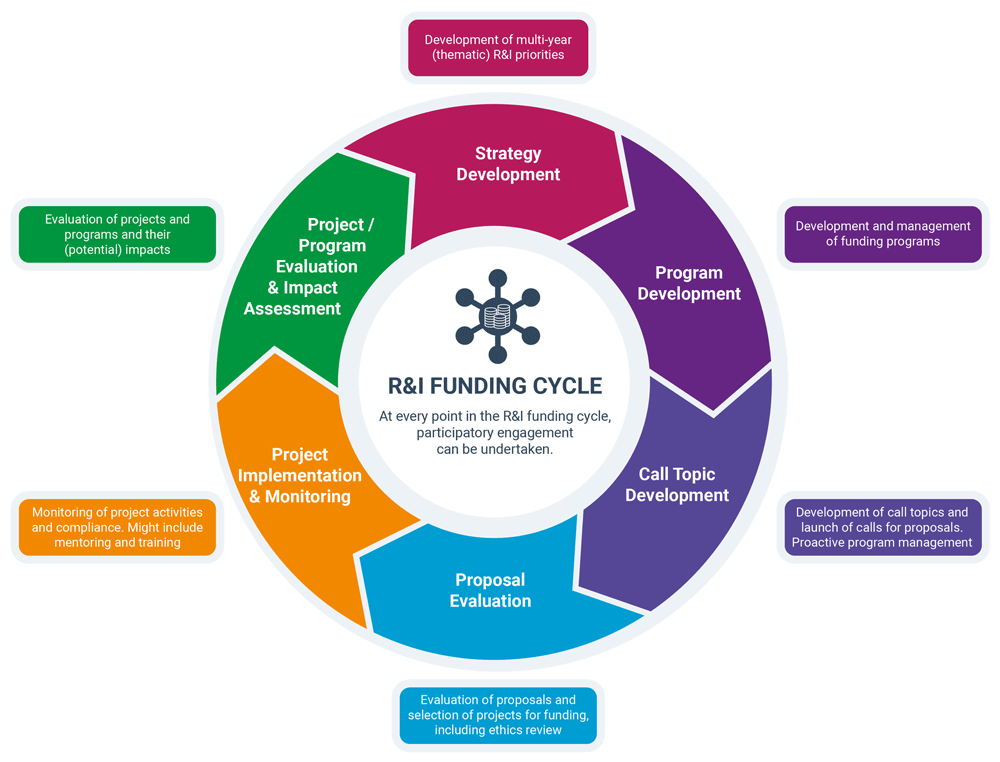
Figure 1. The R&I Funding Cycle.
This figure has been reproduced with permission from Schuerz, Stefanie (2023): Research and Innovation Funding Cycle. DOI: 10.5281/zenodo.8096861.
This funding cycle broadly starts with strategy development, which is the development of multi-year thematic R&I priorities which is usually done by funding agencies together with experts and ministries. From these strategic agendas, funding programs are developed, often still involving ministries to some degree, and attended to by program managers. Within funding programs, topics for funding calls are identified and expanded upon. Through these areas of responsibility, funding agencies are involved in determining the scope and potential impacts of research. In the latter step of the process, we also situate what we call ‘proactive program management’, which entails certain services provided by some funding agencies, such as providing consultation and training for (potential) beneficiaries and organizing capacity building workshops and matchmaking activities.
After calls are launched, the next step is the evaluation of proposals and the selection of projects for funding, which might also include an initial ethics review procedure. From there, selected projects are implemented and monitored, which entails administration and reporting procedures. Some funding agencies might also offer some form of mentoring or training as part of this step or integrate such activities in their funding instruments – asking, for instance, for such activities to be included in project plans. In a final step, projects and funding programs are evaluated and their potential impacts are assessed. The results of these evaluations feed back into the development of strategic agendas, funding programs and calls.
This R&I funding cycle represents a broad approximation of the core business of RFOs, as there is great diversity in how funding agencies operate, depending on the sectoral, cultural and legal specificities they operate in. As such, some steps might take more weight in the internal processes of an agency than others, and some might even be skipped entirely. Nevertheless, the R&I funding cycle helps illustrate how funding agencies might open themselves up to participation, as outside stakeholders might be engaged in some way or another throughout the entirety of the process. Reasons for involving various publics in the activities of funding agencies largely overlap with those outlined in the introduction of this paper, with the added benefit of involving stakeholders in the decision of which topics are worthy of receiving funding.
While RFOs can invite stakeholder participation throughout the entirety of the research funding cycle, it is important to note that there are different depths at which participation can be implemented. Figure 2 was inspired by a number of papers, including Arnstein (1969); Kaisler & Missbach (2019) and Berditchevskaia et al. (2021). It proposes a spectrum of stakeholder empowerment depending on the decision-making powers afforded to participants. It starts with the mostly one-way informing of various publics, where no input is collected, e.g. via newsletters, press releases, or public information events. In public consultations, which might take place via a citizen forum or survey, participant input on a topic is collected, but no guarantee is given that this will affect a process and its outcomes. This might e.g. be done to collect the experiential knowledge of citizens on a specific call topic.
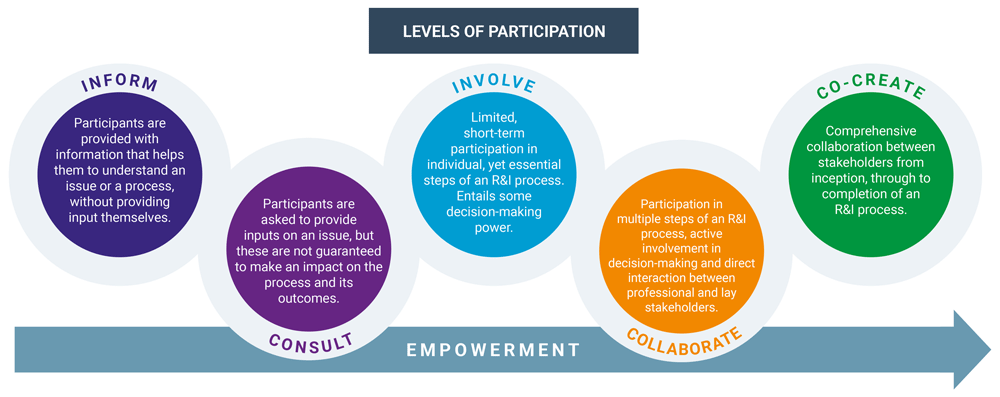
Figure 2. Levels of Participation.
This figure has been reproduced with permission from Schuerz, Stefanie (2023): Levels of Participation in Research and Innovation. DOI: 10.5281/zenodo.8096864.
Involving pertains to a short-term participation in a process that affords limited decision-making power. An example for this would be one or several workshops implemented with citizens to involve them in the definition of strategic agendas or funding programs. Collaboration goes a step further and involves multiple steps, active involvement in decision-making, and an interaction of professional and lay stakeholders. An example of this would be citizen advisory boards that collaborate with scientific advisory boards on proposal reviews and might be involved in the mid-term and final project evaluation. The final step of co-creation pertains to a comprehensive collaboration between stakeholders from beginning to end, e.g. from the identification of relevant topics and the development of a funding program up to its evaluation.
While the terms employed in the graph do not mean the same in every context of application2, they still demonstrate how participatory engagement is not monolithic, and the level of participation is dependent on the objective of the participatory exercise. It is also important to point out that the format of participation does not automatically define the degree of empowerment given to participants, as inputs can be disregarded even with quite involved methods of engagement. The following sections will outline the experimental setup within which participatory engagement in the activities of RFOs was tested and discuss in depth the learnings drawn from this process.
Contextual setting: 11 participatory pilots
The present paper builds on the work done over four years in the context of the European funded project PRO-Ethics. The primary objectives of PRO-Ethics were to gain a better understanding of ethical issues arising when research funding organizations (RFOs) engage broader stakeholder groups in their activities, and to develop recommendations for the organization, implementation and evaluation of participatory processes in the form of an ethics framework and guidelines (see Wiarda et al., 2023a). The consortium was made up of funding agencies, international expert organizations and technical partners from across Europe. An advisory board made up of four experts on citizen science, research integrity, and gender and inclusivity was actively engaged with the project throughout its runtime.
To achieve our goals, we collected empirical data via a variety of formats. Most importantly, the RFO partners of PRO-Ethics implemented eleven experimental pilots3 in which well-defined activities all along the R&I research cycle were opened up to ‘non-traditional stakeholders’. While stakeholders were defined as any individual or organization with a stake in a process (i.e. either affected by the process or affecting it themselves), the term ‘non-traditional stakeholders’ was chosen to refer to all stakeholder groups not usually included by funding agencies in their activities. Depending on the thematic focus and the goals of the process at hand, these entailed, among others, citizens in the broadest sense (as in residents of an area or a country); end-users of a technology to be developed via R&I projects (such as assistant technologies for older people or informal caregivers); people affected by an issue (such as unhoused people or people with chronic fatigue syndrome and their relatives); entrepreneurs; project beneficiaries; NGOs; and civil society organizations4.
Similarly, within these pilots a variety of engagement formats were implemented to engage with stakeholders, covering a large variety of methodologies and intensities of collaborations. Table 1 below gives an overview of the eleven pilots, including the RFO process targeted by each pilot, its thematic focus, the involved stakeholder groups, and the employed formats:
Table 1. Overview of PRO-Ethics pilots.
| Country | Target process | Thematic focus | Participants / stakeholders | Employed formats |
|---|
| 1 | Austria | Participation in R&I projects | ICT-based solutions to increase the quality of life for older adults | Technology end-users and other relevant stakeholders (e.g., service providers, NGOs, interest groups) | Various (chosen by project implementers) |
| 2 | Germany | Participation in topic identification and program design | Ethical, legal and social implications of new and emerging technologies | Technology end-users of various kinds and other relevant stakeholders, incl. ethic boards | Various (chosen by project implementers) |
| 3 | Norway | Systematic pre-call consulting | Research topic definition to address chronic fatigue syndrome (ME/CFS) | Patients and their relatives, patient/user organizations, health authorities, researchers | User panel |
| 4 | Belgium | Participation in project / proposal evaluation | Increasing the resiliency of the Brussels Capital Region (BRC) | Residents of the BRC | Citizen jury |
| 5 | Germany | Participation in project/proposal evaluation and project implementation | ICT-based solutions for informal caregivers | Informal caregivers, interest groups, NGOs, researchers, ministry representatives | Citizen advisory board |
| 6 | Norway | Participation in capacity building | Citizen participation learning hub | Researchers, public and private sector institutions, civil society organizations | Peer-learning workshops |
| 7 | Austria | Participation in topic definition | Preparing funding call topics at the interface of health and climate change | Residents of Austria, researchers, practitioners, scientific experts, ministry representatives | Online survey, validation workshop |
| 8 | Belgium | Participation in thematic definition of program calls | Prioritize challenges from the Regional Research and Innovation Strategies for Smart Specialization (RIS3) | Residents of the BRC | Online survey, citizen atelier workshops |
| 9 | Romania | Participation in strategy development | Defining and validating the Romanian National R&D Strategy 2021-2027 | Residents of Romania | World café workshop |
| 10 | Spain | Participation in program evaluation | Social impact evaluation of the NEOTEC program | Program managers, industry representatives (incl. consulting firms), NGOs / interest groups, beneficiaries | Workshops, focus groups, interviews, survey |
| 11 | Austria | Participation in topic identification, capacity building | Healthcare needs of (formerly) unhoused people | (Formerly) unhoused people, NGOs, interest groups, researchers, etc. | Focus groups, outreach activities |
| Czech Republic | Participation in project/proposal evaluation | Involving stakeholders in the program committee of the ZÉTA program | Program beneficiaries with different professional and sectoral associations (researchers up to 35) | Pilot terminated5 |
The RFO partners entailed national and regional research and innovation funding agencies from Austria, the Czech Republic, Germany, Lithuania, Norway, Romania, Spain, and the Brussels Capital Region (BCR). There was a considerable variety among them regarding their geographic, programmatic and financial scope, their leverage within their respective national R&I ecosystem – including how accepted stakeholder engagement in R&I already is as a methodology – and their relationships with their respective funding ministries, including their leeway for structuring internal processes. To account for these differences, pilots were developed in a highly targeted manner taking any particularities into account.
The pilot implementing partners received support in the form of training, dedicated peer-learning formats, and targeted feedback by both the technical partners and the project advisory board. Through the pilots, experiential knowledge on participatory engagement in the context of RFOs was built, while the practicalities and ethical challenges of opening up RFO processes were explored. To maximize learning potential, the pilots were implemented in two phases, with extensive bi- and multilateral reflection taking place within each cycle. In addition, multiple workshops with external stakeholder groups – including policy makers, funding agencies, research ethics committees (RECs), research integrity organizations (RIOs), and citizen science practitioners – were implemented to discuss results, collect further inputs and perspectives, and to validate project findings.
Methods
Data, methodology and guiding question
The project partners relied on a variety of reporting formats for data collection. The work done in both internal and external workshops was documented, with some being recorded and transcribed for in-depth analysis. As most of the project took place during the Covid-19 pandemic, online whiteboards were an important tool to collect inputs in a structured manner, while the few in-person workshops implemented mostly drew on flipcharts. Meeting notes and transcripts of important narrative observations were also produced by project partners.
For the first pilot phase, which drew on existing initiatives within four funding partner organizations, a structured reporting and assessment template was developed by the team at ZSI with the purpose of streamlining the RFO partners’ reflection process6. In pilot phase two, this approach was both deepened and broadened through the deployment of continuous reporting formats. On the one hand, a template for activity reports collected general data on each activity, such as the number and types of participants, the goals of an activity, and the specifics of the recruitment process and engagement formats. The report also prompted a reflection on encountered challenges, the results of activities, and the first draft of the Ethics Framework and Guidelines7, which was to be tested and validated via the phase two pilots. Towards the end of the project, pilot partners were further asked to provide a final pilot summary following a common template8. On the other hand, narrative ‘pilot stories’ were collected from all pilot partners to provide additional context and information, and to enable a better understanding of the activities. The template employed for this provided an opportunity to share narrativized reflections on pilot activities beyond the PRO-Ethics consortium, while allowing space for confidential reflections with a field collecting comments for internal use only9. This more individual reporting process was complemented by three cross-pilot learning workshops, four general assembly meetings, as well as regular exchange meetings, allowing for extensive documentation and status updates on the pilots.
The data were collected by various project partners and shared both in raw form and as reports, all of which were textual. They were organized by the authors of this paper and evaluated according to their applicability to the guiding question of the project and hence of this paper: What are the drivers and barriers to ethical participatory processes in the context of RFO activities? To elicit the particularities of funding agencies as implementers of participatory processes, a special focus was put on (governance) structures and their impact on the ethics of participation. After pre-structuring the data and excluding those deemed irrelevant to the question at hand, the remaining data were analyzed in their entirety in a qualitative content analysis following Mayring (2014; 2019). Transcription systems ranged from comprehensive protocols (summing up key content) to pure verbatim protocols (including utterances like “uh” and “um”), depending on the context and concrete goal of data elicitation within the project. Drawing mostly on a systematic coding of text material, the qualitative interpretation of data took place both in a deductive way – according to codes developed through the research question and expanded by the codes already included in the reporting templates – and inductively as categories emerged from the data material. The resulting codes were systematically re-checked by actively looking for alternative readings and contradictive evidence in the data. Results were critically discussed with project colleagues and reviewed by the pilot partners.
Analysis
The experiential data collected throughout the project shows a lot of similarities between stakeholder engagement in RFO activities and participatory practices across the science system as outlined above. On the one hand, the RFO partners of PRO-Ethics mention a number of motivations, aspirations and visions of the potential benefits connected to their participatory endeavors, which also serve to justify the considerable efforts invested by the teams into their pilots. These are often in line with the expected benefits outlined in the introduction of this paper and include: gaining insights into the (urgent) needs of (underserved) communities and thus filling knowledge gaps; developing internal expertise on participation; contributing to the opening up of science and strengthening collaboration between policy, society and science; but also, developing new and more relevant funding programs, training formats, and research networks; developing clearer guidelines for ethical participatory engagement in the organization and in funded projects; and creating benefits for projects, improve their overall quality, foster societal debate, and enable better democratic legitimization and transparency of the funding process. As such, existing rationales for public engagement in R&I still seem to be valid even when broadening the scope of participation to RFOs.
Similarly, many of the recommendations, values and principles developed in this sphere remain applicable (such as the previously mentioned OECD, 2022, Kieslinger et al., 2022, Scher et al., 2023). At the same time, the following analysis exposes significant points of tension with the broader principles of research ethics and shows the practical challenges of safeguarding ethics in complex multi-stakeholder processes. These are heightened by the fact that funding agencies operate at the intersection of science and policy, leading to fundamental structural differences to be addressed when planning, implementing and evaluating participatory activities in this context. Contrasting the theoretical considerations of previous chapters with the realities encountered in the PRO-Ethics pilots, the following section discusses the specificities of (ethical) engagement in RFO activities as elicited from our data along three axes: 1) structures, in terms of how funding agencies must proactively lay the groundwork for enabling ethical participatory processes; 2) processes, especially in terms of managing the different steps involved in recruiting and engaging participants; and 3) actors, in terms of the roles and responsibilities the involved stakeholders may inhabit.
Structures: Laying the groundwork for ethical participation
“Reflecting the situation of funding agencies, where you have to strive for practical and working outcomes and results, and you have a limited resource base in terms of financing for those and in terms of staff resources, participatory approaches need to be a bit pragmatic.” (Sabine Mayer, FFG)
Regardless of the context of their implementation, participatory processes are very costly, especially in terms of the time and resources needed to meaningfully bring together the wants and needs of often vastly different stakeholder groups. This is especially true when new participatory processes are to be set up in contexts where this is not traditionally done. For the funding agencies involved in PRO-Ethics, we found that the national political and social attitudes towards participation, and the subsequent willingness to support experimental participatory pilots, were an important factor impacting their activities. As taxpayer-funded national and regional RFOs operate in service of the public, they are underwritten by more or less restrictive laws and regulatory frameworks that determine a funding agency’s level of autonomy. The pilot teams expressed many differences in terms of how much freedom their RFOs receive within their regulatory ecosystem to make decisions on thematic programming, internal budget-allocation, and the ways their daily business is implemented. Some legal and institutional frameworks, for instance, make it very hard for lay citizens to be involved in RFO processes at all.
“The legal and institutional framework presented a problem. Without changes, it would be impossible to implement many alternative participatory approaches as seen in other pilots (e.g. consulting long-term strategy, involving citizens in design of funding programs etc.). Particularly the legal changes required to implement the desired changes were not achievable in the given time framework (legislative changes of the respective laws and normative acts).” (Luboš Studený, TACR)
Thematic priorities are usually determined in collaboration with the ministries providing funding, including the budgets allocated to certain topics. Rules are also subject to change, as are funding streams, which sometimes further depend on international regulation. Depending on such factors, most pilot partners needed to lay a lot of groundwork in the runup to new activities to ensure commitment from policy makers, institutional decision makers, and colleagues at the implementation level, making time a factor from the get-go. On the other hand, the German case received unexpected support as an impetus for piloting participatory practices came directly from policy, paving the way from the top down10. While implementing the participatory pilots took a lot of preparatory work in terms of convincing different stakeholders and adjusting processes, the daily business of the funding agencies had to be maintained. This entails established processes with very tight deadlines – to develop funding programs, launch calls, choose projects for funding, etc. – and by itself already involves a lot of internal and external stakeholders. As such, any engaged participants represent an added layer of complexity.
While the pilot partners invested heavily in identifying how processes needed to be adapted, some challenges only unfurled over time. Downstream effects of new interaction modes were not always apparent, and unforeseen effects led to a need for adjustment on shorter notice further down the line. Some adaptations were also easier done than others, especially those with a lot of contingencies. As such, the RFO teams encountered various difficulties e.g. in cases where other programs were affected, regulatory systems beyond the organization were involved, where approval from ministries, research councils, or even changes in law were needed, or complex systems of compliance had to be set up. In such instances it became very difficult for the implementing teams to be responsive to challenges and stakeholder needs as they arose in the implementation of the process.
The budgetary cover of funding agencies also plays a role as a factor potentially exacerbating structural constraints by directly impacting how much staff is available to work on new tasks, how much time said staff has to trial new processes and funding instruments, and whether external expertise can be drawn upon to support a new activity. Several pilots made the experience that general understaffing and overload on responsibilities made it harder to take on additional responsibilities, or develop new skills and expertise needed for the ethical implementation of participatory processes.
“Now we are in the exploratory stage of mapping and choosing relevant stakeholders for internal workshops [...]. This is difficult, because we are overworked, which is also one of the obstacles we defined at the cross-pilot learning workshop.” (pilot partner, April 2022)
However, some partners have also described how structural constraints can have positive effects as well, as they can force an early concretization of the work plan and thus a clarification regarding the scope, goals, and expected impacts of a process. This helped teams to align their ambitions with the institutional realities of implementation and thus mitigate a variety of risks, including overburdening the implementing team, blowing the budget, and overpromising what can be achieved.
Finally, there might also be a significant difference in what can and cannot be done based on the scope of an RFO’s mission and its mandate. A smaller funding agency found it had more leeway to develop new and experimental formats. Reasons for this include a more limited overall budget (for both programs and projects) and thematic focus, resulting in smaller, more focused projects involving fewer partners that can be more experimental. When organizations address more distinct audiences, they may cater to their needs in a more responsive manner (e.g. through training or tailored funding instruments). On the other end of the spectrum, an RFO team struggled with the feeling of having to implement a lighthouse initiative with a lot of ministry involvement, where future decisions rest on the success of their single pilot project. Such heightened pressure might also narrow the options available to an RFO and complicate the overall process, even though ministry support tied to lighthouse initiatives might in the first instance seem beneficial.
Processes: Managing recruitment and engagement
“For a small-scale project that decides on a theme for a call for projects, it is very challenging to reach all these groups and arouse their interest. Which layer do we really want to reach, through which method and how many citizens do we want to reach? For many people, innovation is a distant concept and not everyone sees the added value of participating in consultations where the results are not very concrete or immediately tangible.” (Cédric Verstraete, Innoviris)
“Our primary input is the National Agenda for Research. It might be a bit difficult to make the participants understand and differentiate between the societal and community issues they face that can be tackled through research solutions, and those that can be easily resolved by political will by national or local authorities. So they have to make this distinction and come up with problems that find their solution through research.” (Alexandra Roman, UEFISCDI)
As laid out above, ethical participatory engagement is not possible without a clear understanding of the structural context within which a participatory process will be developed and implemented. For the funding agencies involved in PRO-Ethics, it is at this point unclear what a truly bottom-up approach to participation would look like, akin to what Haklay (2013) dubbed “extreme citizen science”. As a consequence, all participatory activities started with identifying the right process(es) to be opened up to participation, including the goals to be achieved with such an intervention and the level of participation that is possible and will yield the desired result. From there, relevant target groups, appropriate methodologies, and necessary budgets were identified in a recursive process, as each decision was somewhat contingent on the others.
When identifying stakeholder groups to be involved, the pilot partners found it important to explore the appropriate scope of engagement, especially in terms of the tensions between breadth and depth of engagement. As approaches geared towards collecting dense inputs are more resource-intensive, this put a hard limit on how many activities could be undertaken, and how many people with differing subject positions could be involved. This in turn raised the stakes on the choice of participants, according to which criteria they should be selected, and whom they are intended to represent. For some partners, a diversity of voices was to be captured, which meant they had to clarify what axes of diversity could and should be taken into consideration, and how these would in turn be accommodated. By way of example, people with care duties have different needs from people with disabilities or those not fluent in the working language of a process11. To allow for meaningful participation, barriers to participation had to be identified and addressed for each target group, which is a potentially costly endeavor and could thus only be achieved in a limited manner within each pilot. Furthermore, the pilot partners also found significant differences even when working with relatively small populations, such as steep hierarchies and power-imbalances that were based on unforeseen categories of difference. This was even more true when different stakeholder groups and epistemic cultures were brought together in a context that traditionally favors one over the other:
“Our worries were if you just include the experts from the starting steps, they might just be biased towards their own contributions and reject inputs from citizens.” (Sabine Mayer, FFG)
For certain tasks of a participatory activity, some pilot partners found it helpful to engage external support. This included professional facilitation to help address such tensions as mentioned above, as well as recruitment agencies to help engage a stratified sample of citizens according to predetermined criteria. Some partners made a conscious decision early on to draw on expertise from outside the organization, e.g. to alleviate time constraints and to supplement missing experience within the pilot implementing teams. In all such cases, this was positively remarked upon and seemed to help smoothen the overall process.
Overall, engagement formats and facilitation techniques were carefully geared towards managing the different expectations, needs, and capacities brought to the table by different participants. As our funding partners themselves have to adhere to strict regulatory frameworks, they had to carefully consider the question of how open a process could and should be for the participants to shape. For instance, there was little to no leeway to adjust the goals and formats of a process in conversation with participants. This made it even more important to seek clarity on the stipulations under which participatory activities may take place and secure a clear commitment from decision makers to respect stakeholder contributions and give them at least some decision-making power – although this process was in the end not always successful. In any case, the conditions of participation were communicated in a transparent manner in order to avoid overpromising and subsequently undermining participants’ trust in the RFO – and in turn in the science system overall. As one program manager puts it:
“We are aware that the fact that we are known as a funding agency might raise expectations among experts and citizens that are approached by us. This is potentially also a field of tension and might to some extent also influence the results of the study.” (Gerda Geyer, FFG)
Actors: Negotiating roles and responsibilities
“I think the challenge for equal integration of the participants into the decision-making process, although some of them have less resources, is to give them the same role and the same responsibilities and the same power, so to say, to decide as the other members who maybe have more resources to begin with.” (Markus Gerold, VDI/VDE-IT)
When planning and implementing participatory activities, the roles and responsibilities of involved actors were not always easy to define, communicate, and stick with throughout the process. Many pilot teams reported that they themselves experienced overlapping and unclear roles, as they had to keep a process steering towards certain predefined targets, remaining within certain thematic boundaries and within a certain scope (e.g. of time and resources), keep the quality of the process within academic standards, and take care of interpersonal and group dynamics of which they were very much a part themselves. On top of this, some partners had to negotiate with decision makers on various levels or did not themselves have the freedom to make choices on certain aspects of the process. This muddled set-up was at times perceived as overwhelming while it also risked negatively impacting the overall quality of the process, leading e.g. to pivots late in the process that in turn were a struggle to sufficiently accommodate. The following quote illustrates how precarious the position of funding agencies can be when they try their hand at participatory engagement:
“In this respect, the process was complicated by the fact that the online recruitment campaign had to be taken offline early, due to the inclusion of quotes that were considered too sensitive from a political perspective.” (Cédric Verstraete, Innoviris)
Following this intervention, the pilot had to change its approach from online to street recruiting, which in turn led to a disappointing turnout for their follow-up activities. This points towards the intrinsic motivation of participants to engage with the process as a significant factor of success. Additionally, a broad agreement between implementers and participants on the roles and goals of the process needed to be secured. This, in turn, became difficult in one instance where participants found their identities as “experts-by-experience” – for which they were invited – less important than their professional identities – which they felt gave them authority to make decisions over aspects of a process they were not intended to evaluate or contribute to. This might generally be a dimension to be wary of when implementing transdisciplinary processes, where stakeholders have a claim to authority in a specific field that cannot be easily translated to another.
Overall, most pilots succeeded in defining and communicating the roles and responsibilities of participants in a clear and transparent manner. Nevertheless, issues arose in one pilot following different understandings of roles and goals among participants and within the wider community of stakeholders, which led to exacerbating frictions. One key aspect of this conflict lay in the different intensities with which some participants wanted to engage in the process, which was generally built to accommodate the time schedules of the most disadvantaged members of the group. One part of the group pushed from the very beginning to broaden their involvement, which led to these individuals gaining a stronger voice. This illustrates how power imbalances must be actively countered not just between different stakeholder groups, but also within ostensibly similar groups where differences in resources, capacity, goals and motivations can put immense stress on a process and disincentivize ‘weaker’ members of the group from continuing their participation. This is especially true for our funding agencies where a (re-)negotiation of roles and responsibilities or an adjustment of the overall process and its goals was much less possible than it usually is in participatory R&I projects.
To a degree, this topic overlaps with the question of conflicts of interest. Generally speaking, participants were not asked to join the pilot processes as entirely disinterested parties. Their interests were an integral part of why they were engaged, after all. However, some people did indeed bring their own very strong agenda to the table that came into conflict with the explicit goals of a process. Here, expectation management became an important factor, as there was a need to carefully harmonize what was sought in terms of goals and achievements, what was possible and feasible, and what was felt as a necessity on the side of the various involved stakeholders.
As such, continuously establishing clarity on roles and responsibilities, ensuring not to overburden individual actors, and including the expertise of outside experts (such as facilitators) where necessary became essential components of ethically managing and implementing the participatory pilot processes. In this context, a proactive reflection of potentially detrimental internalized biases and of unknown unknowns – potentially drawing on outside feedback and support – was important. Pilot teams made an effort to understand their target groups by engaging experts and expert organizations, while actively exploring what could and could not be asked from citizens, and how much preparation (e.g. by adapting information material or compensation processes) might be needed to allow for meaningful participation.
Finally, one key question that had to be answered for all participatory activities undertaken by RFOs pertained to the governance of ethics. Who is responsible for safeguarding the ethics and overall quality of the process, what instruments can be leveraged to this end, and who is accountable to whom in this respect – especially in cases where the implementers of a process have little to no influence on the structural conditions of implementation? As one pilot partner put it:
“The setting that we are in, what should be done by us or by the people that we involve and what should be the responsibility of [...] the research ethics committees. It's not our job actually, you know, to make sure that research is carried out ethically, but we have a co-responsibility. So I think there are some interesting [questions].” (Anne Winsnes Rødland, RCN)
While there is not a singular answer to the questions laid out above, responsibilities for ethical conduct must be clearly spelled out in order to ensure that participatory processes are implemented in a manner beneficial to all involved stakeholders. Some possible instruments to that effect will be outlined in the conclusions of this paper.
Discussion
“The processes we are trying to apply and develop, learning by doing, adapting, and so on, we should also take that into consideration. We want to give good examples to agencies to embrace stakeholder processes in the future. We would have better chances of success if we can show the outcomes as well.” (Gerda Geyer, FFG)
This paper outlined important approaches to research ethics and its governance before showcasing some of the complexities of (research) ethical conduct and decision-making when implementing participatory processes in the activities of research funding agencies (RFOs). While the ethics of participation in R&I are still rather theoretical and operationalized at a high level of abstraction (see e.g. OECD, 2022), our analysis shows the many challenges of translating them into practice, particularly for RFOs. A significant factor in this are structural constraints encountered by funding agencies. Due to their role as institutions operating at the intersection of science and policy, they are governed by often highly restrictive legal and institutional frameworks that can limit their freedom to implement participatory processes. As such, activities must be implemented while upholding the core business of the agency, leading to resources in terms of time, money and staff also representing an important structural challenge. Still, the need to concretize work plans early on in order to align ambitions with institutional realities and the subsequent clarification of process scope, goals and expected impacts is beneficial for the implementation of effective participatory activities. In terms of processes, managing the breadth and depth of engagement, identifying and addressing barriers to participation, and dealing with unforeseen categories of difference among stakeholders were encountered as challenges to ethical participation. Choosing an appropriate and feasible scope of engagement, proactively managing stakeholder expectations, and engaging external support and professional facilitation where necessary can help address tensions and improve the overall process. Regarding the actors involved in a participatory process, it was sometimes challenging to clearly define and transparently communicate their roles and responsibilities, which impacted the interpersonal dynamics. Decision-makers were not always easy to negotiate with, especially when strongly involved as key stakeholders in the process themselves. As such, proactive conversations on roles and responsibilities proved crucial for ethically managing participatory processes. In this, the importance of not overburdening individuals also became apparent.
While all eleven pilot processes were extremely well planned out, challenges arose in each pilot along the way – although some were more severe than others. Of particular note is that the pilot partners encountered a number of ethical conundrums where they were unable to find clear-cut answers for addressing them. Most prominent were struggles on how to handle privacy, including in terms of legal compliance (such as mandated by the GDPR), e.g. when a deep thematic exchange is sought on a health research topic directly affecting participants. Furthermore, when trying to address the most pressing issues of our time, participants might be invited who experience stress and suffer due to the topic they are asked to contribute to. This in turn might lead to difficult dynamics between professional experts and experts-by-experience, as the differences in epistemic culture are harder to mediate when strong emotions are involved. In such cases, making sure not to unduly raise any hopes or overpromise on outcomes might become a challenge in itself. Another exacerbating factor in this context is that those most affected by a societal issue might actually struggle the most to contribute. By way of example, people who provide informal care to a sick relative often do this on top of paid work – meaning they have little free time – or instead of paid work – meaning they are in a financially precarious position. In both cases, it is important not to put undue burden on them, especially if the impact of their contributions might in the end be negligible due e.g. to structural constraints hindering truly participatory decision-making processes.
Returning to the ethical approaches outlined in the introduction, it becomes clear that all of them might provide some guiding principles to those responsible for planning, implementing and evaluating such activities. Within and beyond the pilot teams, ethical reflections were helpful in planning participatory processes and exploring practical solutions to arising problems. Following deontological ethics, we can indeed define some acts as right or wrong. For instance, our pilot partners took great care not to actively mislead participants about the level of participation possible in any given situation, or the mandate provided to an agency by decision makers. In teleological tradition, they also looked at the downstream effects of participatory activities. They spoke of the challenges arising from insufficiently preparing and setting up participatory processes, which in turn leads to the risk of disenchanting all involved stakeholder groups on engagement efforts: Participants might leave such processes feeling that they could not meaningfully contribute or that the system of R&I project funding cannot provide meaningful results. Decision makers might similarly conclude that participation does not work and is not worth investing in. And implementing teams might find their efforts futile and not worth repeating. The pilot teams tried to proactively address these risks via proper planning and management of stakeholder expectations, yet could not foresee all tensions as they arose in the implementation of a process. This is where ethics of care became relevant for some partners, which look at ethical conduct as arising from relationships. Through this lens, we can see how difficult it is to accommodate the different wants and needs of all involved actors, which sometimes might actually be in competition with one another. Here, skillful and honest negotiation proved essential – but it also did not save facilitators from answering difficult questions on whose needs take preference.
Conclusion and outlook
Drawing on the lessons learned in our participatory pilots, we have identified a number of success factors, governance instruments and recommendations for the implementation of ethical stakeholder engagement in the field of research funding. Their concrete implementation needs to be explored both theoretically and practically, in terms of feasibility, appropriateness to the context, and effectiveness to meaningfully address ethical considerations of participation in the activities of research funding agencies.
Drivers of ethical engagement
First, a deep understanding of the structural context conditions must be developed and commitment from all relevant decision makers must be secured. All pilot partners agreed that developing a friendly and mutually respectful atmosphere where participants’ time and inputs are valued was extremely beneficial to the successful implementation of their activities. This included efforts of identifying and addressing barriers to participation, amenities such as catering for on-site events, and in some cases remuneration or compensation, e.g. in the form of cash or vouchers, where this was possible. Here, again, legal and institutional rules and regulations might (dis-)allow certain compensatory schemes, depending in part also on the type of participant (for instance, project beneficiaries might not be allowed to receive payment beyond existing grants). In terms of engagement formats, choosing dynamic and interesting activities was also key to collecting rich inputs from participants.
Overall, expectation management came up repeatedly as an essential component for achieving a good collaboration. This entailed proper preparation as well as clear communication and transparency on all relevant information, including the goals of a process and the intended roles and responsibilities of participants. As people are asked to participate in contexts that are often far removed from their daily lives, care must be taken in how to structure information in order not to overwhelm participants – participants are, after all, invited to share their situated knowledge and lived experience, not to be schooled. In this respect, informed consent procedures were also experienced as a helpful instrument to create clarity on all sides.
Still, wherever possible, it is good to allow for a responsive process design in order to be able to adapt to the realities of the situation, including challenges and limitations that could not be anticipated. This includes planning for feedback loops and employing formative evaluation techniques to assess the activities while they evolve – including to actively collect feedback from participants in an appropriate format.
As stakeholder engagement is usually beyond the purview of funding organizations, special care must be put towards team composition, covering as much relevant expertise as possible within the organization, but also engaging external expertise wherever it is deemed necessary or helpful, including from external facilitators, recruitment experts and external ethics advisors. In addition, all pilot partners benefitted from collaborating with relevant organizations such as multiplier networks, expert organizations and interest groups. Many of these also serve as gatekeepers to communities. In any case, multipliers are better seen as important stakeholders to include, rather than purely opportunistically as communication nodes. By engaging such actors collaboratively, they are also less likely to turn into competitors in the attention economy, especially if many engagement activities try to recruit participants from the same target audience at the same time. Thus, a certain expertise in multi-stakeholder engagement is inherently beneficial to set up such processes effectively. And on a policy level, a clear driver of success is the allocation of enough resources and providing both a mandate and enough autonomy for the implementation of a participatory process that is responsive to the local conditions of implementation.
Despite meticulous preparation and reliance on a variety of internal and external resources, all eleven pilots encountered unexpected obstacles as well as positive surprises. There are many unforeseeable variables involved in participatory processes. One key learning from the pilots was that you need to plan for contingencies and unexpected events. For example, when there was a power imbalance between different participants in one of the pilots, the RFO needed to change their strategy in order to ensure an equitable process for all. This need for flexibility is also relevant in the context of ethics reviews, which have to accommodate for changing circumstances if they are to support different academic stakeholders in the governance of research ethics.
Scoping instruments for ethical governance
This finally brings us to the topic of ethical governance of participatory engagement in the context of funding agencies. A number of instruments might lend themselves to address this issue, some of which have already proven themselves in the context of R&I projects:
Ethics self-assessment: This would most likely take the form of a checklist, allowing the teams implementing a participatory activity to systematically set up their activities in a way that anticipates potential issues. One important drawback is that ethics should exactly not be treated like a box-ticking exercise confined to the beginning of a process, and must be responsive to an evolving situation. Still, such an instrument can be helpful at the planning phase and might also support intermediate evaluations.
Ethics review: Actively engaging a qualified research ethics committee to review the planned process could be an effective mechanism of control to ensure ethical conduct also for funding agencies. Depending on the length and complexity of a participatory endeavor, such reviews might even be set not just at the beginning of a process, but also be incorporated in interim and end-evaluations.
External support: RFOs might also benefit from engaging advisory boards, independent ethics advisors or ethics mentors to support their participation processes. In a similar vein, more continuous ethics support and counseling by RECs has been put forward as an approach to managing research ethics in times of increasing complexity.
In the closing of this chapter, we want to present our recommendations for funding agencies for how to approach participatory activities in order to safeguard ethical conduct.
Recommendations for funding agencies – and beyond
“In this case it was the least worst solution, but it is still not an ideal solution.” (Steph Grohmann, LBG OISC)
Be aware that any decision you make will always be based on imperfect information. Deciding on the right target group, appropriate recruitment and engagement formats, a realistic scope and ambitions, and meaningful goals can be very difficult, especially when this is a new process set up within existing structures unfamiliar with or even hostile to this form of activity. As such, ensuring that there is some flexibility to adjust the process along the way is essential. This includes to plan for regular timepoint for reflection and evaluation that support the dynamic adaptation and refinement of the participatory process.
Modulate your ambitions to the realities of the situation. Choose the scope of your activity in conversation with the regulatory framework you operate in, the mandate and funding you were able to secure, the deadlines relevant to your activity, and the expertise available in your organization and in your team. RFOs operate in an exacerbation of the project logic, with tight deadlines, resources and budgets that are hard or impossible to move. If things go awry, there is not so much leeway to adjust or re-do activities. Too much ambition can negatively impact the process and might be in conflict with ethical considerations, as it is not good to include populations you then cannot properly cater to.
There is no perfect process. At the same time, no process can be implemented in an entirely smooth and tension-free way. Challenges might arise that cannot be addressed in an entirely satisfactory way – for instance when reaching out to participants – while it sometimes is sufficient to find a solution that is “good enough”. This is also true in terms of ethics, where the principle of minimizing harm might come before the principle of beneficence. This is also why cookbook approaches have limited value and experiential knowledge is of prime importance.
Plan ahead. Nevertheless, it is important to plan ahead in terms of timeline, scope, available resources, potential (ethical) risks, and mitigation strategies. As a part of this, quality checks, reflection and evaluation, adaptation and refinement must be actively designed into the process. As part of this planning, it is also key to anticipate and find ways to actively address different stakeholder interests, expectations, and needs, including power imbalances within and beyond stakeholder groups. It is also helpful to have a plan B to fall back onto in case plans don’t work out.
Build knowledge hubs / centers of expertise for ethical participation. Such institutions would be responsible for developing expertise on ethical participation in R&I (funding). These can serve both as internal and external support structures that organize, implement and evaluate participatory processes, develop best practices, and offer training and capacity building to RFO and project staff alike. These excellence hubs can be internal to an RFO but can also be set up in collaboration with other R&I actors such as universities and other RPOs, RECs, RIOs, as well as ministries and other public institutions. In any case, RFOs would benefit from building long-term expertise and sustainable structures for engagement.
Engage external experts on ethics and participation where necessary and helpful. It is important to be very clear-eyed on what can be realistically implemented relying on internal expertise alone. On principle, a participatory process should be implemented with at least one colleague on the team who has experience with such a process. This is an effective strategy of risk mitigation, as experience makes it much easier to anticipate frictions and develop solutions. Such expertise can, however, be external to the team.
Deal with failures constructively. No participatory process can ever be implemented without friction. Experimental activities beyond the core business of an RFO are especially precarious, as national funding agencies are beholden to laws and policy decisions in a much more immediate way than R&I projects. Such activities must be situated within existing processes that have to be implemented efficiently, both in terms of timelines and costs, and thus allow for little leeway. As such, adaptations in the form of sustainable institutional change must be sought in a cautious and iterative process, allowing RFOs to learn from the processes they implement. Mistakes will happen, activities will fail, and this allows for rich data to be collected on pain points of ethical participatory engagement in funding agencies. Do not throw the baby out with the bathwater.
Ethics and consent
The project underpinning this publication was a H2020 coordination and support action for the development of an Ethics Framework for funding agencies. All colleagues implementing pilots were funding agencies without access to research ethics committees. Instead, safeguards were put in place, including feedback loops with an independent advisory board that reviewed each partner’s informed consent procedures as well as the overall pilot design and implementation. The Horizon Ethics Self Assessment was completed and the project stayed within the clauses of the Grant Agreement.
Since the PRO-Ethics pilots employed a great variety of engagement formats, informed consent procedures were tailored to the respective type of engagement. For more complex, in-depth or prolonged participation (such as interviews, focus groups, workshops, citizen jury and citizen advisory board), written informed consent was obtained from all participants. For contributions to online surveys and the online peer-learning hub, privacy statements were used informing participants of their rights as well as the management and handling of their data in compliance with relevant laws and institutional guidelines.
Data availability
All non-sensitive data associated with this publication are linked in their published form as Annexes to reports. Some of the data underlying these results cannot be shared due to confidentiality concerns and were classified in their dissemination level as “confidential”. This designation is explicitly defined as "accessible only to members of the consortium (including the Commission Services)".
Researchers or reviewers interested in accessing further data may contact the corresponding author. Applications for data access should include a detailed explanation of the purposes and types of data processing planned. The corresponding author will assess each request individually, considering the relevance and purpose of the research. If approved, access will be granted under specific conditions, which may include agreements on data usage, confidentiality, and publication rights.
Acknowledgements
We would like to thank the PRO-Ethics Consortium and all involved actors for the extensive data collection, collaborative reflection and inspiring discussions contributing to this work. We want to extend our special thanks to Matimba Swana, Katja Mayer, Marius Oesterheld, and Claudia Fabó Cartas for their valuable feedback. A prior version of this paper has been submitted as a project deliverable.
Faculty Opinions recommendedReferences
- Aagaard K, Mongeon P, Ramos-Vielba I, et al.:
Getting to the bottom of research funding: acknowledging the complexity of funding dynamics.
PLoS One.
2021; 16(5): e0251488. PubMed Abstract
| Publisher Full Text
| Free Full Text
- Arnstein SR:
A ladder of citizen participation.
J Am Inst Plann.
1969; 35(4): 216–224. Publisher Full Text
- Ashcroft RE:
The ethics and governance of medical research: what does regulation have to do with morality?
New Rev Bioeth.
2003; 1(1): 41–58. PubMed Abstract
| Publisher Full Text
- Balázs B, Mooney P, Nováková E, et al.:
Data quality in citizen science. In: Vohland, K., et al. The Science of Citizen Science. Springer, Cham, 2021. Publisher Full Text
- Bandola-Gill J, Arthur M, Leng RI:
What is co-production? Conceptualising and understanding co-production of knowledge and policy across different theoretical perspectives.
Evid Policy.
2023; 19(2): 275–298. Publisher Full Text
- Bauer A, Bogner A, Fuchs D:
Rethinking societal engagement under the heading of Responsible Research and Innovation: (novel) requirements and challenges.
J Respons Innov.
2021; 8(3): 342–363. Publisher Full Text
- Berditchevskaia A, Peach K, Malliaraki E:
Participatory AI for humanitarian innovation: a briefing paper. London: Nesta, 2021. Reference Source
- Bernstein MS, Levi M, Magnus D, et al.:
Ethics and society review: ethics reflection as a precondition to research funding.
Proc Natl Acad Sci U S A.
2021; 118(52): e2117261118. PubMed Abstract
| Publisher Full Text
| Free Full Text
- Bogner A:
The paradox of participation experiments.
Sci Technol Hum Value.
2012; 37(5): 506–527. Publisher Full Text
- Bonney R, Phillips TB, Ballard HL, et al.:
Can citizen science enhance public understanding of science?
Public Underst Sci.
2016; 25(1): 2–16. PubMed Abstract
| Publisher Full Text
- Burgess J, Chilvers J:
Upping the ante: a conceptual framework for designing and evaluating participatory technology assessments.
Sci Public Policy.
2006; 33(10): 713–728. Publisher Full Text
- Carayannis EG, Barth TD, Campbell DFJ:
The Quintuple Helix innovation model: global warming as a challenge and driver for innovation.
J Innov Entrep.
2012; 1(1): 2. Publisher Full Text
- Chang W, Taylor SA:
The effectiveness of customer participation in new product development: a meta-analysis.
J Market.
2016; 80(1): 47–64. Publisher Full Text
- Davies SR:
The rules of engagement: power and interaction in dialogue events.
Public Underst Sci.
2013; 22(1): 65–79. PubMed Abstract
| Publisher Full Text
- Delgado A, Lein Kjølberg K, Wickson F:
Public engagement coming of age: from theory to practice in STS encounters with nanotechnology.
Public Underst Sci.
2011; 20(6): 826–845. Publisher Full Text
- Den Oudendammer WM, Noordhoek J, Abma-Schouten RY, et al.:
Patient participation in research funding: an overview of when, why and how amongst Dutch health funds.
Res Involv Engagem.
2019; 5(1): 33. PubMed Abstract
| Publisher Full Text
| Free Full Text
- EC DG RTD – European Commission, Directorate-General for Research and Innovation:
Horizon Europe, open science – early knowledge and data sharing, and open collaboration. Publications Office of the European Union, 2021a. Reference Source
- EC DG RTD – European Commission, Directorate-General for Research and Innovation:
Ethics in Social Science and Humanities. Publications Office of the European Union, 2021b. Reference Source
- Felt U, Fochler M:
The bottom-up meanings of the concept of public participation in science and technology.
Science and Public Policy.
2008; 35(7): 489–499. Publisher Full Text
- Frooman J:
The issue network: reshaping the stakeholder model.
Can J Adm Sci.
2010; 27(2): 161–173. Publisher Full Text
- Fung A:
Democratizing the policy process. In: Goodin, R., Moran, M. & Rein, M. (Eds.) The Oxford Handbook of Public Policy. Oxford, UK: Oxford Univ. Press,
2009; 16(5): 669–85. Publisher Full Text
- Haklay M:
Citizen Science and volunteered geographic information: overview and typology of participation. In: Sui, D., Elwood, S., Goodchild, M. (eds) Crowdsourcing Geographic Knowledge. Springer, Dordrecht, 2013. Publisher Full Text
- Hallonsten O:
Stop evaluating science: a historical-sociological argument.
Social Science Information.
2021; 60(1): 7–26. Publisher Full Text
- Hudson M:
Think globally, act locally: collective consent and the ethics of knowledge production.
Int Soc Sci J.
2009; 60(195): 125–133. Publisher Full Text
- Hydén G:
The role and impact of funding agencies on higher education and research for development. In: Halvorsen, T., & Nossum, J. (Eds.). North-South Knowledge Networks: Towards Equitable Collaboration Between Academics, Donors and Universities. African Minds, 2016. Reference Source
- Irwin A:
From deficit to democracy (re-visited).
Public Underst Sci.
2014; 23(1): 71–76. PubMed Abstract
| Publisher Full Text
- Irwin A, Michael M:
Science, social theory and public knowledge. Open University Press, 2003. Reference Source
- Jasanoff S:
Technologies of humility: Citizen participation in governing science. In: Bogner, A., Torgersen, H. (Eds.) Wozu Experten?. VS Verlag für Sozialwissenschaften.
2005; 16(5): 370–389. Publisher Full Text
- Kaisler R, Missbach B:
Patient and public involvement and engagement in research – a “how to” guide for researchers.
Zenodo.
2019. Publisher Full Text
- Kalichman M:
Ethics and science: a 0.1% solution.
Issues Sci Technol.
2006; 23(1): 34–36. Reference Source
- Kieslinger B, Mayer K, Schaefer T, et al.:
Whitepaper on co-evaluation of Citizen Social Science.
Zenodo.
2022. Publisher Full Text
- Knorr-Cetina K:
Culture in global knowledge societies: knowledge cultures and epistemic cultures.
Interdisc Sci Rev.
2007; 32(4): 361–375. Publisher Full Text
- Kleinman DL, Delborne JA, Anderson AA:
Engaging citizens: the high cost of citizen participation in high technology.
Public Underst Sci.
2011; 20(2): 221–240. Publisher Full Text
- Lake D, Wendland J:
Practical, epistemological, and ethical challenges of participatory action research: a cross-disciplinary review of the literature.
J High Educ Outreach Engag.
2018; 22(3): 11–42. Reference Source
- Marschalek I:
Public engagement in responsible research and innovation. A critical reflection from the practitioner’s point of view. Südwestdeutscher Verlag für Hochschulschriften, 2018. Reference Source
- Mayring P:
Qualitative content analysis: theoretical foundation, basic procedures and software solution. Klagenfurt, 2014. Reference Source
- Mayring P:
Qualitative content analysis: demarcation, varieties, developments.
Forum Qual Soz / Forum: Qual Soc Res.
2019; 20(3): 16. Publisher Full Text
- Miller T, Boulton M:
Changing constructions of informed consent: qualitative research and complex social worlds.
Soc Sci Med.
2007; 65(11): 2199–2211. PubMed Abstract
| Publisher Full Text
- Mørk BE, Aanestad M, Hanseth O, et al.:
Conflicting epistemic cultures and obstacles for learning across communities of practice.
Knowledge and Process Management.
2008; 15(1): 12–23. Publisher Full Text
- Nonet GAH, Gössling T, Van Tulder R, et al.:
Multi-stakeholder engagement for the Sustainable Development Goals: introduction to the special issue.
J Bus Ethics.
2022; 180(4): 945–957. PubMed Abstract
| Publisher Full Text
| Free Full Text
- Nowotny H, Scott P, Gibbons M:
Introduction: `Mode 2' revisited: the new production of knowledge.
Minerva.
2003; 41: 179–194. Publisher Full Text
- OECD:
Addressing societal challenges using transdisciplinary research. OECD Science, Technology and Industry Policy Papers, No. 88. OECD Publishing. Paris, 2020. Reference Source
- OECD:
OECD guidelines for citizen participation processes. Organisation for Economic Co-operation and Development, 2022. Reference Source
- Parker L, Mintzes B:
Patient advocacy organizations and Conflicts of Interest in research. In: Anderson, E.E. (eds) Ethical Issues in Community and Patient Stakeholder–Engaged Health Research. Philosophy and Medicine, Springer, Cham, 2023; 146. . Publisher Full Text
- Pateman RM, West SE:
Citizen science: pathways to impact and why participant diversity matters. In: Citizen Science: Theory and Practice. 2023; 8(1): 50. Publisher Full Text
- Petts J:
Public engagement to build trust: false hopes?
J Risk Res.
2008; 11(6): 821–835. Publisher Full Text
- Powell MC, Colin M:
Meaningful citizen engagement in science and technology: what would it really take?
Sci Commun.
2008; 30(1): 126–136. Publisher Full Text
- Rachels S, Rachels J:
The elements of moral philosophy (7th ed). McGraw-Hill, 2012. Reference Source
- Rip A:
The past and future of RRI.
Life Sci Soc Policy.
2014; 10(1): 17. Publisher Full Text
- Rowe G, Frewer LJ:
Evaluating public-participation exercises: a research agenda.
Sci Technol Hum Value.
2004; 29(4): 512–557. Publisher Full Text
- Rowe G, Rawsthorne D, Scarpello T, et al.:
Public engagement in research funding: a study of public capabilities and engagement methodology.
Public Underst Sci.
2010; 19(2): 225–239. PubMed Abstract
| Publisher Full Text
- Sayer A:
Why things matter to people: social science, values and ethical life. Cambridge: Cambridge University Press, 2011. Publisher Full Text
- Schaefer T, Kieslinger B, Brandt M, et al.:
Evaluation in citizen science: the art of tracing a moving target. In: Vohland, K., et al. The Science of Citizen Science. Springer, Cham, 2021. Publisher Full Text
- Scher BD, Scott-Barrett J, Hickman M, et al.:
Participatory research emergent recommendations for researchers and academic institutions: a rapid scoping review.
J Participat Res Meth.
2023; 4(2). Publisher Full Text
- Schneider F, Buser T, Keller R, et al.:
Research funding programmes aiming for societal transformations: ten key stages.
Sci Public Policy.
2019; 46(3): 463–478. Publisher Full Text
- Schuurbiers D, Fisher E:
Lab-scale intervention. Science & Society Series on Convergence Research.
EMBO Rep.
2009; 10(5): 424–427. PubMed Abstract
| Publisher Full Text
| Free Full Text
- Soneryd L:
Technologies of participation and the making of technologized futures. In: Chilvers, J., Kearnes, M. (Eds.): Remaking Participation Science, Environment and Emergent Publics. London: Routledge, 2015. Publisher Full Text
- Stilgoe J, Lock SJ, Wilsdon J:
Why should we promote public engagement with science?
Public Underst Sci.
2014; 23(1): 4–15. PubMed Abstract
| Publisher Full Text
| Free Full Text
- Stilgoe J, Owen R, Macnaghten P:
Developing a framework for responsible innovation.
Res Policy.
2013; 42(9): 1568–1580. Publisher Full Text
- Stirling A:
“Opening up” and “closing down”: Power, participation, and pluralism in the social appraisal of technology.
Sci Technol Human Values.
2008; 33(2): 262–294. Publisher Full Text
- Thelwall M, Simrick S, Viney I, et al.:
What is research funding, how does it influence research, and how is it recorded? Key dimensions of variation.
Scientometrics.
2023; 128(11): 6085–6106. Publisher Full Text
- Tõnurist P, Surva L:
Is volunteering always voluntary? Between compulsion and coercion in co-production.
Voluntas.
2017; 28: 223–247. Publisher Full Text
- Trischler J, Pervan SJ, Kelly SJ, et al.:
The value of codesign: the effect of customer involvement in service design teams.
J Serv Res.
2018; 21(1): 75–100. Publisher Full Text
- Turrini T, Dörler D, Richter A, et al.:
The threefold potential of environmental citizen science—generating knowledge, creating learning opportunities and enabling civic participation.
Biol Conserv.
2018; 225: 176–186. Publisher Full Text
- UNESCO: UNESCO recommendation on open science. United Nations Educational, Scientific and Cultural Organization, 2021. Publisher Full Text
- Van Bekkum JE, Hilton S:
UK research funding bodies’ views towards public participation in health-related research decisions: an exploratory study.
BMC Health Serv Res.
2014; 14(1): 318. PubMed Abstract
| Publisher Full Text
| Free Full Text
- Vohland K, Land-Zandstra A, Ceccaroni L, (Eds.), et al.:
The science of citizen science. Springer International Publishing, 2021. Publisher Full Text
- Voß JP:
Reflexively engaging with technologies of participation: constructive assessment for public participation methods. In: Chilvers, J., Kearnes, M. (Eds.): Remaking Participation Science, Environment and Emergent Publics. London: Routledge, 2015. Publisher Full Text
- Voorberg WH, Bekkers VJJM, Tummers LG:
A systematic review of co-creation and co-production: embarking on the social innovation journey.
Public Manag Rev.
2015; 17(9): 1333–1357. Publisher Full Text
- Weindling PJ:
Nazi medicine and the Nuremberg trials: from medical war crimes to informed consent. Basingstoke: Palgrave Macmillan, 2004. Publisher Full Text
- Wiarda M, Giannelos K, Schuerz S, et al.:
Ethics framework and guidelines for participatory processes in the activities of Research Funding Organizations.
Zenodo.
2023a. Publisher Full Text
- Wiarda M, Sobota VCM, Janssen MJ, et al.:
Public participation in mission-oriented innovation projects.
Technol Forecast Soc Change.
2023b; 191: 122538. Publisher Full Text
- Williams B, Moore AW:
Ethics and the limits of philosophy. Routledge, 2006. Publisher Full Text
- Wilsdon J, Willis R:
See-through science: why public engagement needs to move upstream. London: Demos, 2004. Reference Source
- Zwart H, Landeweerd L, van Rooij A:
Adapt or perish? Assessing the recent shift in the European research funding arena from 'ELSA' to 'RRI'.
Life Sci Soc Policy.
2014; 11. PubMed Abstract
| Publisher Full Text
| Free Full Text