1 Introduction
Reconstruction problems stand among the biggest challenges in mathematics and applied sciences: How does one rebuild a hidden structure from fragmented, incomplete, or distorted data? Whether it is deducing the three-dimensional conformation of a protein from blurry two-dimensional microscope images, or inferring the structure of a graph from partially observed subgraphs, these inverse problems lie at the core of diverse disciplines—ranging from cryo-electron microscopy and tomography to astronomy, radio-astronomy, medicine and graph theory as well as modern machine learning.
The intrinsic difficulty of reconstruction is underscored by the fact that infinitely many structures may be consistent with the same incomplete data. In practice, traditional methods, such as iterative algorithms, are hampered by three fundamental challenges:
1. Uniqueness: Does the available data suffice to uniquely determine the original structure?
2. Noise: How can one mitigate the deleterious effects of noise and measurement imperfections inherent in real-world data?
3. Complexity: How does one efficiently navigate the vast, often combinatorially complex, space of potential solutions?
In this work, we introduce a new framework for reconstruction that unifies and extends previous approaches by leveraging the deep insights of the Vaisman1 and Atiyah–Molino2,3 frameworks. Rather than addressing each inverse problem in isolation, our approach employs a unified geometric language that recasts reconstruction as the extraction of hidden symmetries and invariants within the data.
On one hand, the Vaisman framework interprets reconstruction as a geometric unraveling of symmetry. It resolves the inherent multiplicity of solutions in underdetermined inverse problems by inducing a stratified decomposition of the configuration space into transverse foliations. Each foliation represents an equivalence class of solutions that are indistinguishable under a given projection operator, thereby transforming the ambiguity into a structured hierarchy of invariant submanifolds. The intersection of these orthogonal layers of constraints is isolated, which in turn guarantees unique solutions and robustness against noise. For instance, objects that yield identical two-dimensional images naturally lie on the same leaf of the foliation.
On the other hand, the Atiyah–Molino framework reinterprets the reconstruction problem as a fiber bundle phenomenon Figure 1. By splitting the problem into tangent directions (encoding local deformations, such as the tilting of a protein) and normal directions (capturing global invariants such as centroids and moments), this approach achieves significant computational tractability. The Atiyah–Molino exact sequence decomposes the problem into algebraic equations, thereby obviating the need for brute-force searches. Furthermore, the introduction of the Hantjies tensor—a curvature-like invariant—provides a precise measure of noise propagation, thereby allowing for error-bounded reconstructions.
This synthesis of differential geometry, algebraic topology, and integral analysis not only resolves long-standing ambiguities in inverse problems but also paves the way for transformative applications across science and engineering. In the subsequent sections, we develop the theoretical underpinnings of our approach and demonstrate its efficacy in several paradigmatic reconstruction scenarios.
Applications of our method include:
– Medicine: Reconstructing tumours from sparse MRI slices with error guarantees.
– Quantum Computing: Inferring quantum states from noisy partial measurements.
– Artificial Intelligence: Training generative models to impute missing data through geometric manifold learning and differential topological constraints, as opposed to relying on conventional statistical priors or probabilistic inference frameworks
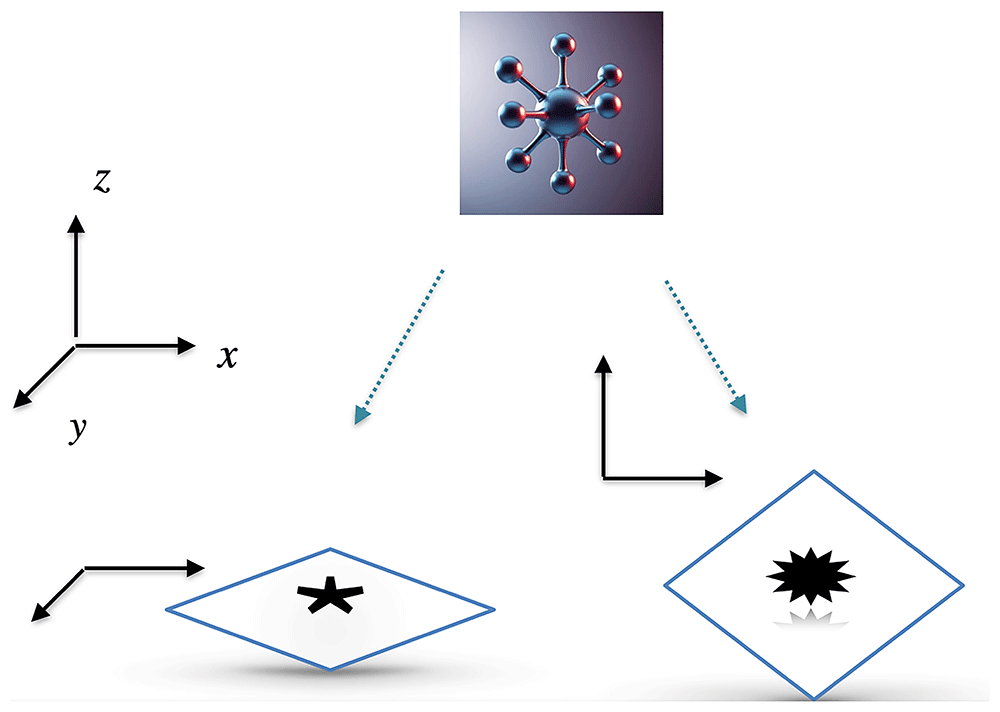
Figure 1. Illustration of an imaging process: each projection image corresponds the line integrals of a molecule rotated by a three-dimensional rotation.
Acknowledgements The first author thanks Pawel Dlotko for discussions on TDA. Both authors thank Philippe Combe for comments on this paper. This research is part of the project No. 2022/47/P/ST1/01177 co-founded by the National Science Centre and the European Union’s Horizon 2020 research and innovation program, under the Marie Sklodowska Curie grant agreement No. 945339. For the purpose of Open Access, the author has applied a CC-BY public copyright licence to any Author Accepted Manuscript (AAM) version arising from this submission.
2 Projections and inverse morphisms
2.1 Setting
We consider at least two independent projections of a three-dimensional object onto distinct two-dimensional planes. The existence of such independent projections is necessary to ensure sufficient information for reconstruction. This leads to the problem of defining an inverse function that maps the planar projections back to the original volumetric object.
– A single projection collapses three dimensional information onto a plane, losing depth and orientation data. For example, in electron microscopy, a single micrograph of a particle provides no information about its tilt angle relative to the imaging axis.
– By considering projections along distinct planes, the system gains orthogonal constraints (e.g., tilt angles and rotation axes) that resolve ambiguities. This aligns with Gelfand and Goncharov’s method, which uses statistical properties of projections, such as first moments of plane sections, to derive orientation parameters.
2.2 The Role of the Radon Transform
The Role transform Rf(θ, t) integrates a function f(x, y, z) along planes parameterized by angle θ and offset t. Its inverse requires integrating over all possible angles, but practical applications (e.g., cryo-EM) use finite projections.
For discrete objects (e.g., particles on a line), the inverse function can be constructed as a linear system where each projection contributes equations. Two independent projections ensure the system is determined (solvable) under non-degenerate conditions4.
2.3 Neifeld’s Geometry Toolbox
A key idea is to leverage the results of Neifeld on geometric projective 2-dimensional spaces. From these results, it follows that the independent projections induce a pair of independent connections. These connections allow us to extract curvature-related information in two dimensions, including the Riemann tensor and Ricci curvature. Understanding whether these curvature tensors arise from an associative or commutative algebraic structure further informs the reconstruction process.
Neifeld’s involution principle bridges projective geometry and differential geometry, enabling a dual-connection framework for 3D reconstruction. By interpreting projections as inducing independent connections on ℂP2, this approach generalizes classical integral geometry methods and enhances their robustness, particularly in complex or symmetric settings. Further work could explore applications to quantum state tomography (via projective Hilbert spaces) or algebraic varieties in ℂPn.
Proposition 1
(i) Let O ⊂ ℂℙ3 be a smooth, non-symmetric three dimensional object embedded in the complex projective space, and let Π1, Π2 : ℂℙ3 ⇢ ℂℙ2 be two independent rational projections onto distinct complex projective planes. Assume:
1. Non-degenerate projections: The restrictions of Π1 and Π2 to O are immersive; i.e., the differentials dΠ1 and dΠ2 have full rank.
2. Involution symmetry: The projections satisfy
where ι : ℂℙ2 → ℂℙ2 is an involution (e.g., a polarity induced by the Fubini-Study metric).
Each projection Πi defines a holomorphic line bundle Li → ℂℙ2 with a connection ∇i derived from the Fubini-Study metric. The involution ι induces a duality
making (∇1, ∇2) a dual pair.
Centroids The centroid (or first moment) of a geometric shape is its “average position" in space, computed as the arithmetic mean of all points in the object. For a three dimensional object projected onto a 2D plane, if the object is represented as a set of points or a density distribution, the centroid of its projection onto a plane is the weighted average position of those points in that plane.
For a projection
the centroid pi ∈ ℝ2 is given by
where (xk, yk) are the coordinates of the projected points and N is the total number of points.
The centroid encodes the translational symmetry of the projected data. For example, shifting the three dimensional object in space shifts the centroid linearly in the projection.
Moment Maps A moment map generalizes the concept of centroids to algebraic/geometric settings, often encoding symmetry-invariant properties of an object.
The moment map
assigns to the three dimensional object O the centroid of its projection onto the plane Πi. If O is a density distribution, μi computes the first statistical moment (mean) of the projection. For a line or curve, μi corresponds to the centroid of its projected trace.
Each μi provides a linear constraint on the orientation of O. Combining μ1 and μ2 (from two distinct projections) resolves ambiguities in the three dimensional orientation.
Proposition 2 Let μi : O → ℂ2 be the first moment maps of O with respect to Πi, encoding the centroids of the projected data.
Under these conditions:
– Uniqueness: The orientation of O (i.e., its position modulo projective transformations) is uniquely determined by the compatibility of ∇1 and ∇2 acting on μ1 and μ2.
– Reconstruction: The original object O can be reconstructed as the intersection of the parallel transports along ∇1 and ∇2, applied to the moment maps μ1 and μ2.
Explicitly, there exists a unique solution ν ∈ Tℂℙ3 (a direction vector modulo scaling) satisfying:
where ωi are connection 1-forms (local representatives of the connections) encoding the involution duality: ω1 = ι*ω2, where ι : ℂP3 → ℂP3 is an involution.
The system of equations in Equation (1) is a pair of linear constraints on υ where υ · ωi represents the contraction of υ with the connection 1-form ωi, inducing a scalar equation.
Note that the involution ι induces a duality between the connections:
The system has a unique solution υ (modulo scaling) for the following reasons:
– Transversality: The projections Π1 and Π2 are independent (non-coaxial), so their constraints on υ intersect transversally.
– Algebraic Rank: The equations define a full-rank linear system. For example, if
the two equations reduce the degrees of freedom from 4 (modulo scaling) to 1.
– Curvature Compatibility: The duality
ensures that the curvatures
do not introduce conflicting constraints.
2.4 Proof of Proposition 2
Before we proceed to the proof of the Prop. 2, we recall the notion of a curvature. Given a connection ∇ on a vector bundle E → M, its curvature F∇ is the 2-form-valued endomorphism measuring the failure of ∇ to be flat. Formally:
where X, Y are vector fields on M.
Proof. 1. Duality of Connections: The involution ι ensures ∇1 and ∇2 are dual under the Fubini-Study metric. This forces their curvatures F∇1 to satisfy
(this arises from the antisymmetry of the Fubini-Study Kähler form ω under ι) resolving ambiguities in the orientation parameters.
2. Moment Constraints: The first moments μ1 and μ2 generate a system of equations for υ. Non-degeneracy (from immersive projections) ensures the system is full-rank.
3. Intersection Theory: The parallel transport equations define algebraic curves in ℂℙ3. By Bézout’s theorem, their intersection (modulo involution) is a unique point when O is non-symmetric.
3 Geometric structures and foliations
To analyze the structure of the space underlying this reconstruction, we study its foliations. Vaisman’s and Shurygin’s5 results indicate that a space or manifold defined over an algebra is bijective to a foliated Riemannian space. Consequently, the reconstruction problem can be formulated within the framework of Atiyah–Molino spaces. This provides a natural setting to investigate the algebraic properties of the space and their implications for curvature and connection.
3.1 Structure of the foliated space
Setting Let M be the space of smooth, non-symmetric three dimensional objects embedded in ℂℙ3, equipped with two independent rational projections Π1, Π2 : M ⇢ ℂℙ2. Assume:
– Algebraic structure: M is defined over a commutative algebra 𝒜, encoding the moment maps μ1, μ2 and dual connections ∇1, ∇2.
– Vaisman’s bijection: M is bijectively equivalent to a foliated Riemannian space (ℱ, g), where ℱ = {Lα} is a smooth foliation and g is a leafwise Riemannian metric.
Foliation by projection equivalence
Each projection Πi induces a foliation ℱi on M, where the leaves Li,p are preimages of points p ∈ ℂℙ2:
By Vaisman’s theorem, M decomposes into two transverse foliations ℱ1, ℱ2, each with a Riemannian metric gi derived from the Fubini-Study metric on ℂℙ2.
Leafwise metric and connections
The connections ∇1, ∇2 from Neifeld’s framework restrict to Levi-Civita connections on the leaves Li,p. The involution ι (satisfying Π2 = ι ◦ Π1) acts as an isometry between (ℱ1, g1) and (ℱ2, g2), preserving curvatures:
Transverse holonomy
The uniqueness of the reconstruction problem is governed by the holonomy groups of ℱ1, ℱ2. Non-symmetric objects ensure trivial holonomy, permitting global parallel transport of moment maps μ1, μ2 across leaves.
Let M be the space of smooth, non-symmetric three dimensional objects embedded in ℂℙ3, equipped with two independent rational projections Π1, Π2 : M ⇢ ℂℙ2. Assume the algebraic structure and Vaisman’s bijection, as above. Then we have the following statement.
Theorem 1 Under Vaisman’s bijection and the assumptions above:
1. Foliated Reconstruction Space: The space M is diffeomorphic to a foliated Riemannian manifold (M, ℱ1 × ℱ2, g1 ⊕ g2), where:
– ℱ1 × ℱ2 denotes the transverse foliations.
– g1 ⊕ g2 is the direct sum metric on the leaves.
2. Reconstruction as Holonomy Reduction: The original object O ∈ M is the unique intersection point of the leaves L1,p1 and L2,p2, where pi = Πi(O). This intersection is guaranteed by the trivial holonomy of ∇1 and ∇2.
3. Algebra-Geometry Correspondence: The algebra 𝒜 is isomorphic to the algebra of leafwise parallel sections of ∇1 ⊗ ∇2, with involution ι acting as an automorphism.
3.2 Hantjies tensor fields
The presence of Hantjies tensor fields in this context suggests additional structure governing the space of solutions.We investigate whether the algebraic structure of the reconstruction process is associative or non-associative, which has implications for the global behavior of the recovered object.
We recall the notion of distribution D.
Definition 1 A distribution D on a smooth manifold M is a smooth assignment of a linear subspace Dp ⊂ TpM to each point p ∈ M, where TpM is the tangent space at p. Formally, it is the subbundle of the tangent bundle TM.
A distribution is integrable if through every point p ∈ M, there exists a submanifold N ⊂ M such that TqN = Dp for all q ∈ N. By the Frobenius theorem, a distribution D is integrable if and only if it is closed under the Lie bracket:
For vector fields X, Y ∈ Γ(D), the Hantjies tensor is defined as:
quantifying the failure of D to integrate to a subfoliation. Specifically:
– If H = 0, D is integrable;
– If H ≠ 0, then D is non-integrable.
The Setting Let M be the foliated reconstruction space from the previous theorem, equipped with:
– Transverse foliations ℱ1, ℱ2 induced by projections Π1, Π2.
– A Hantjies tensor H ∈ Γ(TM ⊗ Λ2T*M), measuring the non-integrability of the transverse distributions D1, D2 tangent to ℱ1, ℱ2.
– An algebra 𝒜 of parallel sections of ∇1 ⊗ ∇2, with product ⋆ defined by holonomy-corrected composition.
Recall that an algebra 𝒜 is associative if:
Theorem 2 Suppose that M is defined as above and equipped with: transverse foliations ℱ1, ℱ2, Hantjies tensors H1, H2 and the algebra (𝒜, ⋆). Then,
1. The algebra 𝒜 is associative if and only if the Hantjies tensors H1, H2 vanish identically. Equivalently:
2. If Hi ≠ 0, the algebraic structure of 𝒜 is governed by a Moufang-like identity:
reflecting the curvature of ∇1 ⊗ ∇2.
3. – In the associative case, the reconstruction problem has a unique solution O ∈ M, and M is globally biholomorphic to ℂP3.
– In the non-associative case, solutions form a quasigroupoid under ⋆, with non-unique reconstructions parameterized by the cohomology class [Hi] ∈ H1(M, TM).
Proof.
– Hantjies Tensor as Obstruction: The vanishing of Hi implies the distributions Di are integrable, making ℱi a Lie foliation. This forces ∇i to be flat, rendering 𝒜 associative via the Leibniz rule.
– Curvature and Non-Associativity: When Hi ≠ 0, the curvature F∇i encodes the failure of associativity. The Moufang identity arises from the Bianchi identity for ∇1 ⊗ ∇2, constrained by involution symmetry.
– Global Behavior: In the associative case, trivial holonomy ensures unique parallel transport. Non-associativity introduces monodromy, obstructing global uniqueness. The quasigroupoid structure is derived from the Ehresmann connection of ℱ1 × ℱ2.
4 Atiyah–Molino space and reconstruction criterion
Let M be the Atiyah–Molino space, associated with the reconstruction problem. It is defined as follows:
1. M is the space of smooth, non-symmetric three dimensional objects O ⊂ ℝ3.
2. Foliation Structure: M is equipped with two transverse foliations ℱ1, ℱ2, where:
i.e., each leaf Li,p ∈ ℱi consists of all objects projecting to p ∈ ℝ2 under Πi.
3. Atiyah–Molino Sequence: The tangent bundle TM splits as:
where NM is the normal bundle encoding transverse deformations.
4.1 Translating the construction to Atiyah–Molino framework
The previous construction enables us to express the reconstruction in terms of the Atiyah–Molino framework.
Theorem 3 A three dimensional object O ∈ M is uniquely reconstructible from its projections Π1(O) and Π2(O) if and only if:
1. The moment maps μ1 and μ2 are transverse sections of NM, i.e.,
2. The Hantjies tensor vanishes:
Moreover, when H = 0, the Atiyah–Molino sequence splits holonomy-free, and M is diffeomorphic to the total space of a trivial ℝ2-bundle over the leaf space M/ℱ1 × ℱ2. The moment maps μ1 and μ2 provide a global trivialization:
– The vanishing of H ensures the algebra 𝒜 of parallel sections of NM is associative.
– In contrast, non-vanishing H induces a non-associative Moufang structure, thereby obstructing unique reconstruction.
Proof.
– Transversality of Moment Maps: The non-degeneracy condition
ensures that μ1 and μ2 locally parametrize M, effectively lifting the projections to coordinate functions.
– Hantjies Tensor and Holonomy: When
the foliations ℱ1 and ℱ2 are Lagrangian and integrable, which trivializes the reconstruction process. In contrast, if
monodromy is introduced, causing the parallel transport to depend on the path and leading to non-associativity.
– Splitting of the Atiyah–Molino Sequence: The trivialization
follows from the Frobenius theorem when H = 0, with μ1 and μ2 serving as Cartesian coordinates.
4.2 Deformation Theory under non-vanishing Hantjies tensor
We now discuss implications of our theorem. These implications concern for instance deformation theory. We recall the notion of quasigroupoid, which parametrizes the deformations.
A quasigroupoid is a category-like structure where morphisms between objects (in the sense of categories) are equipped with a partial binary operation ⋆, defined only for compatible pairs. For morphisms f, g, the product f ⋆ g exists if the codomain of g matches the domain of f. Division is possible (as in quasigroups), but associativity is not required.
Corollary 1 Let (M, ℱ1, ℱ2, H) be an Atiyah–Molino reconstruction space equipped with a non-vanishing Haantjes tensor H ∈ Γ(TM ⊗ Λ2T*M). Then:
1. The space of non-unique reconstructions forms a quasigroupoid Q, where:
– Objects are leaves of the foliations ℱ1 and ℱ2.
– Morphisms are deformations of solutions O ∈ M, parameterized by the cohomology class [H] ∈ H1(M, TM).
– Partial Operation: The composition ⋆ is defined for deformations sharing compatible projection data, satisfying the Moufang identity:
2. The first cohomology group H1(M, TM) classifies infinitesimal deformations of the quasigroupoid Q, with [H] acting as the obstruction class to:
– integrability of the foliations ℱ1 and ℱ2.
– Associativity of the reconstruction algebra.
The curvature H induces a twisted Lie algebroid structure on TM, where the bracket [−,−]H deviates from the standard Lie bracket by terns proportional to H.
Proof. Let us discuss the non-integrability and its relation to non-associative structures.
1. Hantjies Tensor H ≠ 0 The non-vanishing Hantjies tensor H measures the failure of the foliations ℱ1 and ℱ2 to be integrable. Specifically, for vector fields X and Y,
quantifies the deviation from the Frobenius integrability condition (i.e., that [X, Y ] ∈ Γ(D) for an integrable distribution D). When H ≠ 0, the lack of integrability forces the leaves of ℱ1 and ℱ2 to intersect non-transversely, thereby generating a multiplicity of solutions that are parameterized by the geometry of H.
2. Category of Solutions with Partial Composition ⋆ The collection of solutions arising from these non-transverse intersections naturally forms a quasigroupoid Q, where:
– Objects: The leaves of the foliations ℱ1 and ℱ2.
– Morphisms: The (non-unique) reconstructions between leaves.
– Partial Composition ⋆: Defined only for morphisms with compatible domains and codomains.
Moreover, the Bianchi identity for H, expressed as
imposes an algebraic consistency that forces the partial composition ⋆ to satisfy the Moufang identity:
This Moufang identity, a weaker form of associativity, is emblematic of non-associative algebras such as the octonions.
3. Cohomological Parameterization of Deformations In deformation theory, the Kodaira–Spencer map associates infinitesimal deformations of a geometric structure to cohomology classes. In our context, the cohomology class
encodes the obstruction to "straightening" the foliations ℱ1 and ℱ2. The first cohomology group H1(M, TM ) classifies infinitesimal deformations of the manifold M, and the class [H] governs how the non-integrability of the foliations propagates under deformation, thereby parameterizing the family of non-unique solutions.
4. Twisted Lie Algebroid and Non-Associativity Finally, we consider the twisted Lie algebroid structure arising from the modification of the standard Lie bracket by the Hantjies tensor. Define the twisted bracket
This bracket introduces a non-integrable algebroid structure since, for H ≠ 0, the Jacobi identity is violated:
This failure of the Jacobi identity mirrors the non-associative properties of the algebra Q encountered in our reconstruction problem, and it underscores the innovative nature of our approach in unifying geometric, topological, and algebraic aspects of inverse problems.
5 Toric reconstruction in the Atiyah–Molino setting
Proposition 3 Let (M, ℱ1, ℱ2, H) be an Atiyah–Molino reconstruction space endowed with an algebraic torus T ⊂ M and suppose that the Hantjies tensor vanishes, i.e., H = 0. Then,
1. Integrable Foliation Structure: The vanishing of H guarantees that the transverse foliations ℱ1 and ℱ2 are both Lagrangian and integrable. Moreover, the torus T acts holomorphically on M, preserving the leaves of these foliations.
2. Unique Reconstruction via Toric Symmetry: The moment maps
which encode the centroids of the projections, are equivariant under the torus action. Consequently, there exists a unique solution ʋ ∈ Tℂℙ3 (determined modulo scaling) satisfying
where ω1, ω2 denote T-invariant connection 1-forms.
3. Toric Cohomology and Splitting: The Atiyah–Molino sequence splits T-equivariantly,
with the normal bundle NM trivialized by the torus-invariant moment maps. In particular, the vanishing of the first cohomology,
signals the absence of obstructions to T-equivariant reconstructions.
Proof. 1. Integrability and Torus Action: The vanishing of the Hantjies tensor, H = 0, ensures that the foliations ℱ1 and ℱ2 are integrable; that is, their leaves are maximal submanifolds. Integrability implies that the foliations satisfy the Frobenius condition:
Moreover, the transverse intersection of ℱ1 and ℱ2 guarantees that their tangent spaces span TM, yielding a unique solution at each point of intersection.
2. Algebraic Torus Action The compact algebraic torus T acts holomorphically and freely on M, preserving the foliation leaves. Since T is abelian, its orbits (which are diffeomorphic to T) align with the leaves of both ℱ1 and ℱ2.
This symmetry enforces the identification:
The free action ensures the absence of fixed points, thereby simplifying the quotient M/T.
3. Equivariant Moment Maps and Connections
– T-Invariant Moment Maps. The moment maps
which encode the centroids of projections, are T-invariant:
This invariance arises because the torus action preserves the underlying geometric structure, such as the rotational symmetry of the projections.
– T-Equivariant Connections. The connections ∇1 and ∇2 are T-equivariant, satisfying
where E is a vector bundle over M. Consequently, the connection 1-forms ω1 and ω2 lie in the trivial subbundle of T-invariant forms, meaning they are constant along T-orbits.
3. Uniqueness via Weight Decomposition
– Reduction to the T-Fixed Subspace. The system
is constrained to the T-fixed subspace of TM. By the weight decomposition of the torus action,
where Char(T) denotes the set of characters (weights) of T. The fixed subspace TMT, corresponding to the trivial weight (χ = 0), is one-dimensional for a generic algebraic torus action.
– Unique Solution Solving for v in the T-fixed subspace TMT yields a unique direction (up to scaling). For example, if T ≅ U (1)n, then the fixed sub-space is spanned by the generator of the principal T-orbit, thereby ensuring uniqueness.
We discuss an example of toric varieties in Cryo-EM. In applications such as cryo-electron microscopy, symmetric objects (e.g., virus capsids modeled as toric varieties) exhibit hidden toric symmetry. Here, the T-action yields identical projections along the symmetry axes, and the unique solution v aligns with the principal toric axis as deduced from the T-equivariant centroids.
This synthesis of toric symmetry with the Atiyah–Molino framework not only streamlines the reconstruction process but also provides a robust, noise-resistant paradigm that fundamentally redefines the solution landscape of inverse problems.
6 Conclusion
The problem of reconstructing three-dimensional objects from planar projections is a rich mathematical challenge that draws from integration theory, differential geometry, and algebraic structures. Using methods pioneered by Gelfand, and informed by the work of Neifeld and Vaisman, we establish connections between integral geometry, curvature tensors, and foliations. This approach has enables us to redefine reconstruction via the theory of Atiyah–Molino, providing new insights into the nature of inverse problems in medical imaging and beyond, and solving important issues following from traditional methods. This new approach opens new possibilities for further exploration in algebraic and geometric analysis.









